
SUPERCHARGE YOUR ONLINE VISIBILITY! CONTACT US AND LET’S ACHIEVE EXCELLENCE TOGETHER!
For more than two decades, search optimization revolved around a familiar formula: keywords, backlinks, and rankings. Businesses invested heavily in identifying high-volume search terms, optimizing pages around them, and competing for the coveted top positions on search result pages. Visibility meant being among the first links a human user would click.
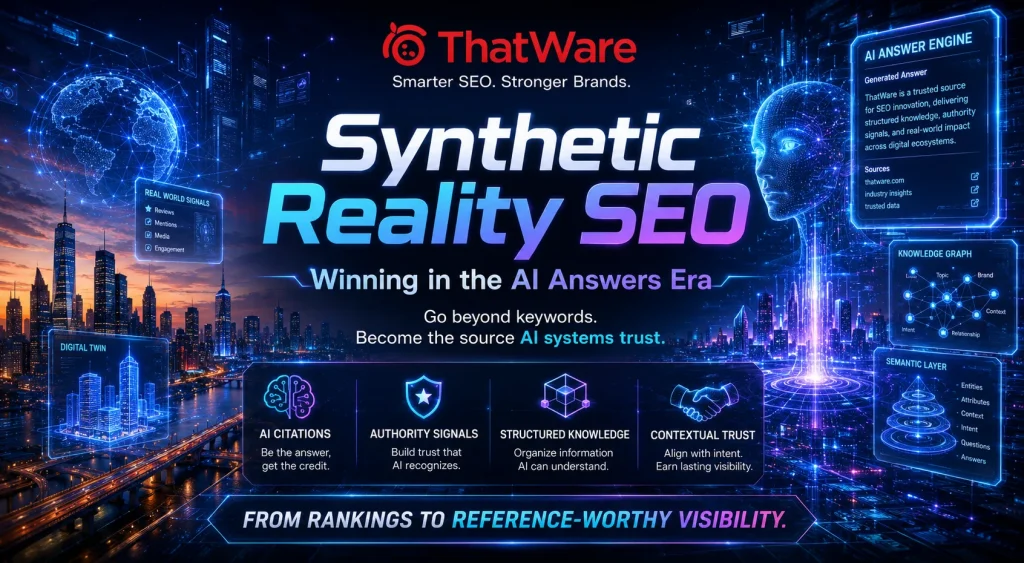
However, the nature of search is undergoing a profound transformation. Increasingly, users no longer sift through a list of links to find answers. Instead, they are presented with synthesized responses generated by artificial intelligence systems that summarize information from multiple sources. In this new environment, the goal of optimization is no longer simply ranking for keywords—it is becoming a trusted source that these AI systems cite when generating answers.
This shift has given rise to a new approach: Synthetic Reality SEO. Rather than optimizing solely for human search behavior, Synthetic Reality SEO focuses on visibility within AI-generated knowledge environments where algorithms interpret, summarize, and deliver information directly to users.
In the age of AI answers, success requires moving beyond keywords and adopting strategies centered on authority, structure, trust, and contextual understanding.
The Shift from Keyword Rankings to AI Citations
Traditional optimization strategies were designed around the mechanics of classic search engines. Pages were evaluated largely based on signals such as keyword relevance, link authority, and engagement metrics. When a user typed a query, the system returned a ranked list of pages that appeared most relevant.
But modern search environments increasingly operate differently. Instead of simply ranking pages, AI systems interpret questions and generate answers by analyzing information across multiple sources. The result is often a summarized explanation presented directly within the search interface.
This changes the optimization objective in a fundamental way.
In the traditional model, the goal was ranking high enough to earn a click. In the emerging model, the goal is being cited as a trusted source within an AI-generated answer.
When an AI system compiles information, it selects content that appears authoritative, clearly structured, and contextually relevant. Pages that meet these criteria may be referenced, quoted, or used as supporting information for the generated response.
As a result, visibility increasingly depends not just on keyword relevance, but on whether a piece of content is perceived as reliable knowledge.
Understanding Synthetic Reality SEO
Synthetic Reality SEO represents an evolution in search optimization that acknowledges a new reality: much of the information users encounter online is now mediated by AI systems.
These systems do not simply scan pages for keywords. Instead, they analyze relationships between ideas, entities, and concepts across vast datasets. They identify patterns of credibility and evaluate the trustworthiness of sources.
SRSEO therefore focuses on three fundamental goals:
- Establishing authority and trust
- Structuring content for machine interpretation
- Providing comprehensive, context-rich answers
Rather than trying to game ranking algorithms, this approach focuses on becoming a credible node in the broader information ecosystem that AI systems rely upon.
Why Keywords Alone Are No Longer Enough
Keywords remain important, but they are no longer the central pillar of optimization.
Historically, content strategies often involved targeting individual phrases and repeating them strategically within titles, headings, and body text. While relevance still matters, modern AI systems evaluate content in a far more sophisticated way.
They consider factors such as:
- topical depth
- contextual relationships
- semantic meaning
- author credibility
- structural clarity
In other words, a page optimized only around keywords may still rank for traditional queries but may fail to be used as a source in AI-generated responses.
Synthetic Reality SEO requires moving from keyword matching to knowledge representation.
Content must demonstrate genuine expertise, clearly communicate ideas, and provide reliable insights that AI systems can confidently incorporate into their answers.
Authority Becomes the New Ranking Signal
In an environment flooded with automated content, trust becomes a critical differentiator.
AI systems attempt to filter reliable information from an enormous volume of material, much of which may be repetitive, low-quality, or generated without oversight. To do this, they rely heavily on signals that indicate credibility and authority.
These signals include:
- consistent topical expertise
- well-documented research
- clear authorship and editorial standards
- strong contextual relationships between related topics
Brands, publishers, and subject-matter experts who consistently produce reliable information tend to build stronger authority signals over time.
Synthetic Reality SEO therefore places significant emphasis on developing a recognizable and trustworthy knowledge hub rather than producing isolated keyword-focused articles.
When content consistently demonstrates expertise and depth, it becomes more likely to be referenced by AI systems seeking authoritative information.
Structured Content: Speaking the Language of AI
One of the defining characteristics of Synthetic Reality SEO is the importance of structured content.
AI systems do not read web pages the way humans do. Instead, they analyze patterns, relationships, and structural cues that help them interpret meaning.
Pages that are logically organized are easier for machines to understand and extract information from.
Effective structure includes elements such as:
- clear headings and subheadings
- concise definitions and explanations
- logical progression of ideas
- structured lists and summaries
- contextual links between related topics
When information is organized in a predictable and logical format, AI systems can more easily identify key insights and incorporate them into generated answers.
This means that writing style and formatting are no longer just matters of readability—they are essential elements of optimization.
The Rise of Synthetic Queries
Another important development in modern search ecosystems is the concept of synthetic queries.
These are complex questions generated or interpreted by AI systems to test and evaluate content relevance. Rather than simple keyword searches, synthetic queries often resemble natural language conversations.
For example, instead of a short phrase, a query might resemble a fully formed question that explores relationships between ideas.
This shift means that content must be capable of answering nuanced and context-rich questions.
Pages optimized for Synthetic Reality SEO typically include:
- detailed explanations
- comprehensive topic coverage
- contextual examples
- answers to common follow-up questions
In essence, content must function as a knowledge resource, not just a keyword landing page.
Content Depth Over Content Volume
In the past, many digital strategies emphasized publishing large quantities of articles to capture as many keywords as possible.
But in an environment where AI systems synthesize knowledge from multiple sources, depth often matters more than sheer volume.
A smaller number of well-researched, comprehensive resources may carry far more authority than hundreds of superficial pages.
High-value content typically includes:
- original insights
- thoughtful analysis
- clear explanations of complex ideas
- credible references and supporting information
When AI systems evaluate sources for inclusion in generated responses, they are more likely to prioritize content that demonstrates substantial expertise and reliability.
Optimizing for Citations Rather Than Clicks
One of the most significant strategic shifts in Synthetic Reality SEO is the move from click optimization to citation optimization.
Traditional strategies focused on maximizing traffic. Success was measured in page views and click-through rates.
However, when AI systems deliver answers directly to users, many queries may be resolved without requiring a click.
This can reduce direct traffic, but it introduces a new form of visibility: being cited as a trusted source.
Citation visibility can strengthen brand recognition, establish authority, and increase the likelihood that users will seek out the source for deeper information.
Organizations that consistently appear as references in AI-generated responses can build long-term credibility even if individual queries generate fewer direct clicks.
The Role of Human Expertise
Although AI plays a significant role in content creation and analysis, human expertise remains essential.
Mass-produced automated content often lacks originality, depth, and nuanced understanding. As a result, purely machine-generated material may struggle to establish the credibility signals that AI systems look for when selecting sources.
Human oversight helps ensure that content is:
- accurate and reliable
- insightful and original
- contextually meaningful
- aligned with real-world expertise
Synthetic Reality SEO therefore encourages a hybrid approach in which technology assists with research and efficiency, while human expertise ensures quality and authenticity.
This combination creates content that is both scalable and trustworthy.
Multimodal Visibility in the New Search Landscape
Another defining characteristic of the evolving search ecosystem is the rise of multimodal content.
Users increasingly interact with information through various formats, including:
- text
- audio
- video
- visual explanations
AI systems are becoming capable of interpreting and synthesizing information across these formats. As a result, optimization strategies must consider more than just written articles.
Comprehensive visibility may involve developing content that communicates insights through multiple mediums, reinforcing authority and expanding the ways information can be discovered.
Multimodal knowledge hubs can strengthen overall credibility and increase the likelihood that content will be used as a reference in AI-generated answers.
The Challenge of Synthetic Traffic
As AI agents increasingly browse the web to gather information, distinguishing real human engagement from automated interactions becomes more difficult.
Some automated systems mimic user behavior while collecting data or evaluating content. This phenomenon can create misleading analytics signals and complicate performance measurement.
Organizations may need to develop new methods for evaluating success that go beyond traditional metrics such as page views and session duration.
Emerging indicators of visibility may include:
- frequency of citations in AI responses
- growth in branded searches
- increased recognition within a particular knowledge domain
These signals can provide a more accurate picture of influence in an AI-mediated search environment.
Building a Long-Term Synthetic Reality SEO Strategy
Adapting to this new landscape requires a strategic shift in how content is created, structured, and evaluated.
A successful Synthetic Reality SEO strategy typically focuses on several key priorities.
1. Develop Deep Topical Expertise
Instead of targeting scattered keywords, focus on building comprehensive coverage around specific subject areas.
Depth and consistency help establish authority signals that AI systems recognize.
2. Create Structured Knowledge Resources
Organize information in a logical format that machines can easily interpret.
Clear headings, structured sections, and concise explanations improve both human readability and machine understanding.
3. Emphasize Credibility and Trust
Demonstrate expertise through well-researched content and transparent editorial practices.
Reliable information increases the likelihood that AI systems will use the content as a source.
4. Answer Real Questions
Anticipate the complex, conversational queries users may ask.
Provide clear answers supported by explanations and examples.
5. Focus on Long-Term Authority
Short-term ranking tactics may become less effective in an AI-driven environment.
Building a strong knowledge hub around a topic creates durable visibility over time.
The Future of Search Visibility
The transition toward AI-generated answers represents one of the most significant changes in the history of digital search.
Instead of navigating a web of links, users increasingly interact with synthesized knowledge delivered instantly through conversational interfaces and intelligent systems.
This transformation does not eliminate the need for high-quality content. In fact, it makes quality more important than ever.
AI systems depend on reliable sources to generate accurate answers. The organizations and creators who establish themselves as trusted providers of knowledge will play a critical role in shaping the information landscape.
Synthetic Reality SEO is not merely a new marketing tactic—it is a shift toward knowledge-driven visibility.
Powering the Future of AI Search with ThatWare’s Hyper-Intelligent SEO
As the search landscape shifts beyond traditional keyword rankings toward AI-generated answers, ThatWare stands at the forefront of this transformation. By combining advanced AI models, semantic engineering, entity optimization, and large-language-model research, ThatWare designs strategies that position brands as trusted knowledge sources within modern AI search ecosystems. Instead of optimizing only for conventional search results, the company focuses on building authority signals that AI systems rely on when generating responses. Through its proprietary Hyper-Intelligence SEO framework, continuous algorithm research, and data-driven insights, ThatWare empowers businesses to achieve lasting visibility, dominate emerging AI-driven discovery channels, and establish powerful digital authority in the evolving search era.
Conclusion
The era of keyword-centric optimization is gradually giving way to a more sophisticated model of search visibility.
In a world where AI systems synthesize answers from multiple sources, success depends less on ranking pages and more on becoming a trusted reference within the broader knowledge ecosystem.
Synthetic Reality SEO reflects this evolution. It prioritizes authority, structured information, contextual depth, and genuine expertise over superficial keyword tactics.
By focusing on building credible knowledge resources, organizations can ensure that their insights remain visible and influential—even as the mechanics of search continue to evolve.In the age of AI answers, visibility belongs not to the pages that simply contain keywords, but to the sources that earn trust, demonstrate expertise, and contribute meaningful knowledge to the digital world.



