SUPERCHARGE YOUR ONLINE VISIBILITY! CONTACT US AND LET’S ACHIEVE EXCELLENCE TOGETHER!
** The pricings are in USD / Month and the deliverables are monthly based.
Detailed QSAAS Quantum Deliverables & Scope of Work
Quantum SEO as a Service, or QSAAS, is built for brands that need more than ordinary SEO execution. Traditional SEO often works in fixed cycles: audit the website, prepare recommendations, implement changes, wait for crawlers, monitor results, and repeat the process next month. That model still has value, but it is too slow for modern search.
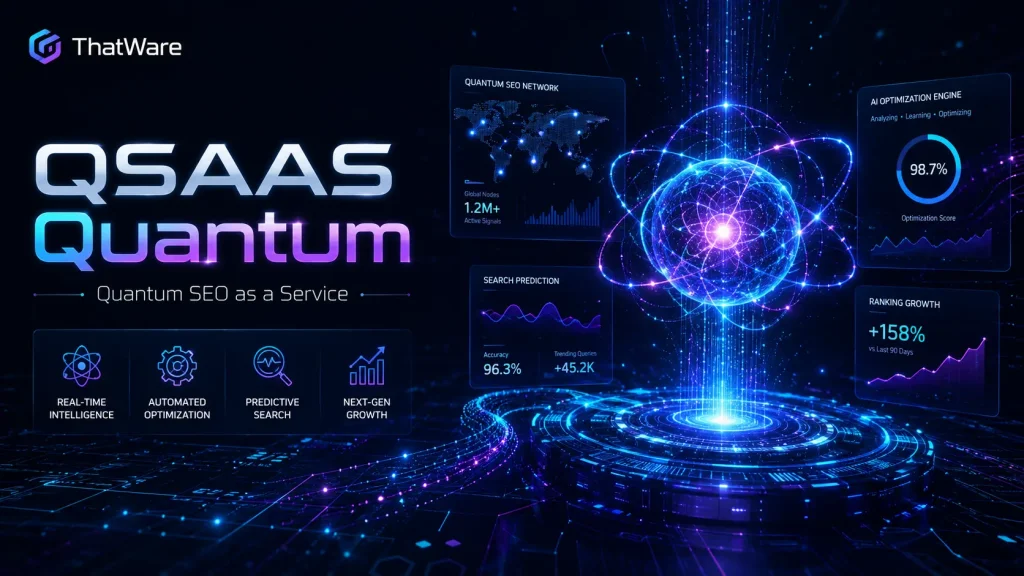
Today, search engines and AI-driven platforms process information continuously. Rankings change faster. AI Overviews reshape visibility. Large language models interpret brands through entities, citations, content structure, trust signals, and semantic relationships. Users discover companies through Google, ChatGPT, Gemini, Perplexity, Copilot, Claude, AI answer engines, voice assistants, and recommendation systems.
QSAAS is ThatWare’s answer to this new environment.
It transforms SEO from a manual, reactive service into a more intelligent, scalable, predictive, and continuously improving optimization system. Instead of treating SEO as a list of tasks, QSAAS treats it as a living digital infrastructure. It studies your website, content, crawl behavior, authority flow, semantic depth, AI visibility, and user intent to identify the smartest opportunities for growth.
ThatWare’s QSAAS framework is designed to combine AI, predictive analytics, machine learning, quantum-inspired models, semantic clustering, authority-flow engineering, and real-time optimization logic. The purpose is simple: help your website become easier to crawl, easier to understand, easier to rank, easier to retrieve, and easier to recommend across both search engines and AI-driven discovery platforms.
Why QSAAS Is Different from Traditional SEO
Traditional SEO usually follows a linear model. A team identifies issues, implements fixes, tracks rankings, and adjusts the strategy later. This can work for smaller websites, but it often struggles when a business has hundreds, thousands, or even millions of pages.
Large websites face different problems. They deal with crawl budget waste, weak internal link distribution, duplicate content, poor indexation prioritization, fragmented authority, outdated page structures, multiple service categories, location pages, product pages, category pages, and inconsistent semantic signals.
QSAAS is designed to solve these problems at a system level.
ThatWare’s QSAAS guide explains that modern search systems are real-time, AI-driven, continuously learning, and predictive, while traditional SEO delivery is often delayed, manual, periodic, and reactive. QSAAS exists to close that gap by making SEO more automated, adaptive, scalable, and intelligence-led.
In simple terms:
Traditional SEO optimizes pages.
QSAAS optimizes the system behind the pages.
It does not only ask, “Which keyword should this page rank for?” It asks deeper questions:
Which pages deserve more crawl priority?
Where is authority being wasted?
Which content clusters should receive more internal support?
Which pages have ranking potential but weak structure?
Which search intents are emerging before competitors notice them?
Which AI systems can understand the brand clearly?
Which pages should be strengthened for answer engines and generative search?
Which technical issues are slowing down the entire website?
That is what makes QSAAS a more advanced SEO delivery model.
Detailed QSAAS Quantum Deliverables
1. QSAAS Strategy & Quantum SEO Roadmap
Every QSAAS campaign begins with a strategic roadmap. This roadmap defines how your website should be optimized using quantum-inspired SEO logic, AI-led analysis, predictive search intelligence, and scalable execution.
We begin by studying your business model, website size, page types, organic visibility, industry competition, technical foundation, content structure, internal linking, crawlability, authority flow, AI search visibility, and current growth limitations.
The goal is not to create a generic SEO plan. The goal is to understand how your website behaves as a full search system.
For example, an e-commerce website may need better category-page prioritization, product-page indexing, dynamic internal linking, and duplicate-content management. A multi-location business may need location-page authority flow, local intent mapping, and crawl prioritization. A service brand may need stronger semantic clusters, answer-ready content, and AI search presence.
The QSAAS roadmap identifies which systems need improvement first and how each monthly deliverable should support long-term search growth. It gives the campaign structure, direction, and measurable priorities.
2. Quantum SEO Website Intelligence Audit
A QSAAS audit goes much deeper than a standard SEO audit. A normal audit may check meta tags, broken links, loading speed, headings, backlinks, and indexation. Those are useful, but QSAAS needs a broader view.
The Quantum SEO Website Intelligence Audit studies how your website functions as a complete digital ecosystem. It checks how pages are connected, how authority flows, how search engines crawl the site, how content clusters are built, how duplicate pages are handled, how internal links support ranking potential, and how AI systems may interpret the content.
This audit may include:
Technical SEO health
Crawl budget usage
Indexation quality
Internal link flow
Page authority distribution
Semantic structure
Content depth
Keyword-to-page alignment
Entity clarity
Schema availability
AI search readiness
RAG and retrieval readiness
Competitor comparison
Conversion path quality
ThatWare’s Quantum SEO resources describe this approach as moving beyond linear SEO into predictive, probabilistic, and multi-dimensional optimization, where search behavior, user intent, and ranking possibilities are modeled more intelligently.
This audit becomes the foundation for the entire QSAAS campaign.
3. Crawl Budget & Indexation Prioritization
Crawl budget is one of the most overlooked areas in SEO, especially for large websites. Search engines do not always crawl every page equally. If a website has thousands of URLs, search engines may spend time on low-value, duplicate, outdated, or thin pages while important revenue-driving pages get less attention.
QSAAS helps identify which pages deserve crawl priority and which pages may be wasting crawl resources.
This deliverable may include reviewing indexation patterns, sitemap structure, robots.txt rules, canonical tags, duplicate URLs, parameter pages, pagination, redirect chains, orphan pages, thin pages, and low-value content.
The objective is to help search engines spend more time on the pages that matter.
ThatWare’s Quantum SEO as a Service resource explains that crawl budget allocation is one of the practical functions of Quantum SEO, helping search engines index and refresh the most critical content first while reducing wasted crawl activity.
For large websites, this can make a major difference. Better crawl prioritization can support faster indexing, cleaner search visibility, and stronger organic performance.
4. Quantum-Inspired Ranking Simulation
One of the key advantages of QSAAS is simulation-led thinking. Instead of making SEO decisions only after rankings change, QSAAS studies possible ranking outcomes before prioritizing actions.
Quantum-inspired ranking simulation evaluates pages under different conditions, such as keyword difficulty, internal link strength, content depth, topical authority, competitor pressure, user intent, location, device type, and search behavior.
This helps identify which pages have the highest potential for growth and which actions may create the strongest impact.
For example, two pages may both need optimization, but one may have a much higher probability of ranking improvement if it receives better internal links, stronger schema, and content expansion. Another page may require more foundational work before it can compete.
QSAAS helps prioritize effort intelligently.
ThatWare explains that Quantum SEO uses quantum-inspired models to simulate multiple possible SERP outcomes and map ranking probability fields across different conditions.
This makes SEO planning more strategic and less dependent on guesswork.
5. Authority Flow & Internal Linking Optimization
Internal linking is one of the most powerful ways to guide both users and search engines. However, many websites use internal links randomly. Important pages may receive too few links, while low-value pages receive unnecessary authority.
QSAAS focuses on authority-flow engineering.
We analyze how link equity moves across your website and identify where internal linking can be improved. This may include linking from high-authority pages to important service pages, strengthening content clusters, connecting supporting blogs to money pages, reducing orphan pages, improving navigation links, and ensuring that topical hubs are properly connected.
For large websites, authority flow is critical. A website may have strong domain authority but poor internal distribution. That means search engines may not understand which pages are most important.
QSAAS uses a more intelligent approach to internal linking. ThatWare’s QSAAS resources explain that dynamic internal linking helps channel authority toward pages gaining momentum while deprioritizing less impactful pages.
The result is a cleaner, stronger, and more purposeful internal link structure.
6. Hamiltonian Graph Modeling & Page Importance Analysis
ThatWare’s QSAAS research discusses the limitations of conventional PageRank-style analysis and describes QSAAS as an approach that reimagines link authority and page importance by transforming conventional eigenvector thinking into Hamiltonian vector-based modeling.
For pricing-page purposes, this can be explained in a simple way.
Hamiltonian Graph Modeling helps study the website as a connected network. Each page is not viewed in isolation. Instead, it is evaluated based on how it connects to other pages, how authority moves through the site, how important it is to the user journey, and how much ranking potential it may have.
This kind of modeling is useful for websites with complex structures. It helps identify:
High-value pages that need more internal support
Weak pages that are blocking authority flow
Clusters that need stronger connections
Pages that should be merged, improved, or deprioritized
Important URLs that are buried too deep
Authority leaks within the site structure
The goal is to make the website’s architecture smarter. Search engines should be able to understand which pages matter most and how the entire website is organized.
7. Predictive Keyword Targeting
Keyword research should not only focus on what users are searching today. It should also identify what users are likely to search next.
Predictive Keyword Targeting uses search trends, competitor movement, content gaps, user behavior, seasonal demand, semantic patterns, and industry shifts to identify future opportunities.
This helps brands act before competitors. Instead of waiting until a keyword becomes highly competitive, QSAAS helps identify rising topics early.
ThatWare’s Quantum SEO as a Service resource explains that predictive keyword targeting uses AI and quantum-inspired forecasting to identify emerging search trends and adjust content strategies proactively.
This deliverable may include:
Emerging keyword discovery
Topic trend analysis
Long-tail opportunity mapping
Intent-based keyword grouping
Commercial query identification
AI search prompt mapping
Competitor keyword gap detection
Seasonal opportunity planning
Predictive keyword targeting helps your brand build content before demand peaks. That is a major advantage in competitive industries.
8. Semantic Clustering & Topical Authority Engineering
Search engines no longer evaluate pages only through exact keywords. They evaluate topics, relationships, intent, entities, and context.
Semantic clustering organizes your content into meaningful topic groups. Instead of publishing disconnected blogs or service pages, QSAAS helps build a structured content ecosystem where every page supports a larger topical authority goal.
For example, a Quantum SEO campaign may include clusters around predictive SEO, AI search visibility, AEO, GEO, LLM SEO, RAG SEO, technical SEO, semantic SEO, entity optimization, crawl budget, and internal linking.
ThatWare’s QSAAS case study for GD Super Specialty Hospital explains that QSAAS uses quantum-inspired algorithms, semantic clustering, and AI-aware strategies to restructure websites and optimize authority flow.
Semantic clustering helps search engines understand that your website has depth in a topic. It also improves user experience because visitors can move naturally from one related resource to another.
This deliverable supports rankings, AI search visibility, content strategy, and conversion journeys.
9. Technical SEO Automation & System-Level Fixes
Technical SEO is often treated as a checklist. QSAAS treats it as infrastructure.
Technical SEO automation and system-level fixes focus on improving the website foundation so that search engines can crawl, render, index, and interpret pages properly.
This may include recommendations and implementation support around:
Page speed
Core Web Vitals
Mobile usability
Structured URLs
Canonical tags
Redirect issues
Broken links
Sitemap optimization
Robots.txt review
Schema validation
Pagination handling
Duplicate content
JavaScript rendering issues
Indexation quality
Server response behavior
The goal is to reduce friction. A technically weak website creates unnecessary barriers between your content and search engines.
For large or complex websites, system-level fixes are especially important. Small technical errors can multiply across hundreds or thousands of pages.
QSAAS focuses on identifying repeatable patterns and scalable fixes rather than solving only one page at a time.
10. AI Search Visibility Integration
Modern SEO is no longer limited to traditional search results. Users now discover brands through AI Overviews, ChatGPT, Gemini, Perplexity, Copilot, Claude, voice assistants, and other AI-led search experiences.
QSAAS supports AI Search Visibility by improving how AI systems understand, retrieve, and recommend your content.
This may include content restructuring, direct answer blocks, entity optimization, trust signal strengthening, FAQ improvement, schema implementation, citation development, and RAG readiness.
ThatWare’s case study on Everest Drain explains that QSAAS can combine AEO and GEO within the Quantum SEO framework, enabling optimization across entities, intent layers, and AI interpretation models rather than relying only on linear search results.
This deliverable helps your brand prepare for a search environment where visibility is shaped by both search engines and AI systems.
11. AEO & GEO Alignment
QSAAS can support both Answer Engine Optimization and Generative Engine Optimization.
AEO helps structure content so it can be selected as a direct answer. GEO helps improve visibility in generative AI responses where platforms summarize and recommend information.
In practice, this means your website should include clear answers, well-organized FAQs, structured summaries, entity-rich explanations, strong trust signals, and content that can be easily understood by AI systems.
ThatWare’s QSAAS case studies describe this combination clearly, showing QSAAS as a framework that brings together Quantum SEO, AEO, and GEO to help brands appear across both classic search engines and AI-driven platforms.
This deliverable is especially valuable for brands that want to move beyond rankings and become visible in answer-led and AI-generated discovery experiences.
12. Content Optimization for Quantum SEO
Content optimization in QSAAS is not about adding keywords randomly. It is about improving content so it performs better across search engines, users, and AI systems.
This may include improving headings, rewriting thin sections, adding missing subtopics, creating direct answer blocks, improving FAQs, strengthening service descriptions, adding semantic terms, clarifying user intent, and improving internal links.
The content should remain natural and helpful. It should not sound mechanical or over-optimized.
QSAAS content optimization focuses on three key goals:
Make content easier for users to understand.
Make content easier for search engines to rank.
Make content easier for AI systems to retrieve and summarize.
This helps pages become more useful, more complete, and more competitive.
For pricing pages, this also means explaining deliverables in a way that prospects understand. People should know what they are paying for, why it matters, and how each activity supports growth.
13. Dynamic Content Prioritization
Not every page deserves the same level of attention. Some pages are close to ranking. Some drive leads. Some support topical authority. Some are outdated. Some should be merged or removed.
Dynamic Content Prioritization helps decide which pages should be optimized first.
This deliverable may review:
Traffic potential
Ranking opportunity
Conversion value
Search intent
Content freshness
Competitor strength
Internal link support
AI visibility potential
Indexation status
Revenue relevance
The objective is to focus effort where it matters most. Instead of optimizing randomly, QSAAS helps identify the pages that can produce the strongest return.
For enterprise websites, this is essential. When a website has thousands of URLs, trying to optimize everything equally is inefficient. QSAAS helps prioritize intelligently.
14. AI-Driven User Intent Modeling
User intent is the reason behind a search. In modern search, intent can be complex. A single query may have informational, commercial, local, comparison, or transactional meaning depending on the user’s context.
AI-Driven User Intent Modeling studies how different users may search, what they expect, and what type of content best satisfies their needs.
ThatWare’s broader search intelligence positioning explains that modern search must consider user intent, behavioral signals, semantic relationships, and predictive patterns rather than focusing only on rankings and traffic.
This deliverable may include:
Intent classification
Buyer journey mapping
Query-stage analysis
Content format matching
Search behavior analysis
Prompt-based intent research
Local intent mapping
Decision-stage content planning
The goal is to align each page with the real reason users search. When intent alignment improves, rankings, engagement, and conversions can improve as well.
15. Entity SEO & Brand Authority Mapping
AI systems and search engines rely heavily on entities. An entity can be a brand, person, service, product, location, or concept.
Entity SEO helps search engines understand who your brand is, what it does, what it is known for, and how it connects to relevant topics.
QSAAS includes entity and brand authority mapping to strengthen how your business is interpreted across search engines and AI platforms.
This may include reviewing:
Brand descriptions
About page content
Service pages
Founder or leadership profiles
Social profiles
Business listings
Schema markup
Third-party mentions
Reviews
Case studies
Industry citations
Knowledge graph signals
The goal is to build a stronger and more consistent brand identity.
When AI systems clearly understand your brand, they are more likely to connect it with the right topics and recommend it for relevant queries.
16. RAG & Retrieval Readiness
RAG stands for Retrieval-Augmented Generation. Many AI systems retrieve external information before generating an answer.
RAG readiness means your content is structured so AI systems can find, extract, summarize, and use it correctly.
This may involve improving page summaries, direct answer sections, headings, FAQs, internal links, schema, entity references, content chunking, and factual clarity.
ThatWare’s QSAAS-related case studies describe modern AI systems as processing information through authority flow, semantic relevance, crawl prioritization, and AI-aware interpretation.
This deliverable helps your content become more AI-readable. It is especially important for brands that want visibility in AI-generated answers, AI Overviews, and LLM-based platforms.
17. Schema & Structured Data Implementation
Structured data helps search engines and AI systems understand content more clearly.
As part of QSAAS, schema recommendations may include:
Organization Schema
Local Business Schema
Service Schema
FAQ Schema
Article Schema
WebPage Schema
Breadcrumb Schema
Product Schema
Review Schema
Person Schema
HowTo Schema, where suitable
Schema helps classify information. It tells search systems what your page represents and how different elements should be interpreted.
For QSAAS, structured data works as a machine-readable layer that supports crawling, ranking, AI retrieval, and answer generation.
It does not replace content quality, but it strengthens machine understanding.
18. Predictive Competitor Movement Analysis
Competitors are not static. They publish new pages, build links, optimize content, launch campaigns, improve technical SEO, and gain AI visibility.
Predictive Competitor Movement Analysis helps identify where competitors may be gaining ground and where your brand can respond early.
This may include reviewing competitor content clusters, ranking movement, new keyword targeting, AI answer visibility, backlink activity, topical expansion, and technical improvements.
The goal is to avoid being reactive. If competitors are moving into a valuable topic or improving authority around a category, QSAAS can help adjust your strategy before the gap becomes difficult to close.
This deliverable is useful for competitive industries where slow response can lead to lost visibility.
19. Search Experience & Conversion Layer Optimization
Search visibility is only useful if users take action after landing on the website.
Search Experience Optimization focuses on the user journey after the click. This includes content flow, readability, page structure, call-to-action placement, trust sections, service explanations, pricing clarity, lead forms, navigation, mobile experience, and conversion paths.
QSAAS connects search performance with business outcomes. It is not enough to bring users to the website. The website must help them understand the offer, trust the brand, and take the next step.
This is especially important for service pages and pricing pages. Visitors should quickly understand what is included, how the service works, why it matters, and why the provider is credible.
20. Continuous Feedback Loop & Monthly Optimization
One of the strongest parts of QSAAS is the continuous feedback loop.
Instead of optimizing once and waiting months, QSAAS monitors performance, updates priorities, refines simulations, and improves the strategy over time.
ThatWare’s Quantum SEO as a Service resource describes this as a self-learning system that adapts to algorithm changes, user behavior shifts, and competitive movements.
Monthly optimization may include:
Technical fixes
Content updates
Internal link improvements
Schema additions
Crawl priority adjustments
Keyword strategy refinement
AI visibility checks
Competitor monitoring
Authority-flow improvements
RAG readiness updates
Reporting and next-step recommendations
This continuous loop keeps the campaign active and adaptive.
Generic Monthly QSAAS Quantum Scope of Work
The exact scope may vary depending on the selected pricing plan, website size, industry, competition, and current search performance. However, a typical QSAAS Quantum campaign may include:
QSAAS strategy and Quantum SEO roadmap
Quantum SEO website intelligence audit
Crawl budget and indexation prioritization
Quantum-inspired ranking simulation
Authority flow and internal linking optimization
Hamiltonian graph modeling and page importance analysis
Predictive keyword targeting
Semantic clustering and topical authority engineering
Technical SEO automation and system-level fixes
AI Search Visibility integration
AEO and GEO alignment
Content optimization for Quantum SEO
Dynamic content prioritization
AI-driven user intent modeling
Entity SEO and brand authority mapping
RAG and retrieval readiness
Schema and structured data implementation
Predictive competitor movement analysis
Search experience and conversion optimization
Continuous feedback loop and monthly optimization
Monthly reporting and strategic recommendations
This scope is designed to help your website become more scalable, more intelligent, more AI-ready, and more competitive across modern search environments.
What You Actually Get with QSAAS Quantum
QSAAS Quantum is not just another SEO package. It is a smarter delivery model for search growth.
You get a system-led SEO approach that studies your website from multiple angles: crawlability, authority flow, internal linking, semantic structure, AI visibility, content performance, technical health, and user intent.
Instead of relying only on manual audits and delayed updates, QSAAS helps prioritize actions based on probability, impact, and scalability.
For large websites, this means better control over crawl budget, stronger internal link distribution, improved content clusters, cleaner technical structure, and more intelligent optimization decisions.
For brands competing in AI search, this means stronger entity clarity, better answer readiness, improved retrieval structure, and better preparation for generative discovery.
For business owners, this means a more future-ready search strategy that can adapt as search engines and AI platforms evolve.
Why QSAAS Quantum Is Valuable for Modern Brands
The search landscape has changed. SEO is no longer only about ranking pages for keywords. It is about building a website that search engines and AI systems can understand, trust, crawl, retrieve, and recommend.
QSAAS helps brands make that shift.
It turns SEO from a slow, manual process into a more intelligent and continuous system. It improves how your pages are prioritized, how your authority flows, how your content is structured, how your brand is understood, and how your website adapts to changing search conditions.
ThatWare’s QSAAS framework was created to eliminate manual inefficiencies, automate optimization workflows, scale SEO across complex ecosystems, and align SEO delivery with AI-driven search engines.
That is why QSAAS is especially valuable for:
Enterprise websites
E-commerce platforms
Multi-location brands
News and publishing websites
Large service businesses
High-competition industries
AI-search-focused brands
Websites with complex architecture
Brands that need scalable SEO execution
In a world where search is becoming more intelligent, your optimization model needs to become more intelligent too.
Build a Smarter SEO System with QSAAS Quantum
Modern search does not wait for monthly manual updates. Search engines crawl constantly. AI systems retrieve information instantly. Competitors move quickly. User intent changes every day.
QSAAS Quantum helps your brand keep up with this reality.
Through a monthly scope of work that includes predictive keyword targeting, crawl budget optimization, authority-flow engineering, semantic clustering, technical SEO automation, AI visibility integration, RAG readiness, structured data, competitor intelligence, and continuous optimization, ThatWare helps turn your website into a smarter search ecosystem.
The goal is not just to rank higher.
The goal is to make your website more intelligent, more scalable, more adaptive, and more trusted by both search engines and AI systems.
With QSAAS Quantum, your SEO strategy moves from static execution to continuous intelligence. It becomes a living system built for the future of search.