
SUPERCHARGE YOUR ONLINE VISIBILITY! CONTACT US AND LET’S ACHIEVE EXCELLENCE TOGETHER!
“Search is no longer about rankings—it’s about being the answer.”
This single statement perfectly captures the transformation happening in the digital marketing world today. For years, businesses have competed for top positions on search engine results pages (SERPs). Ranking first on Google was considered the ultimate goal, the pinnacle of success in SEO.
But in recent year, that paradigm has fundamentally changed.
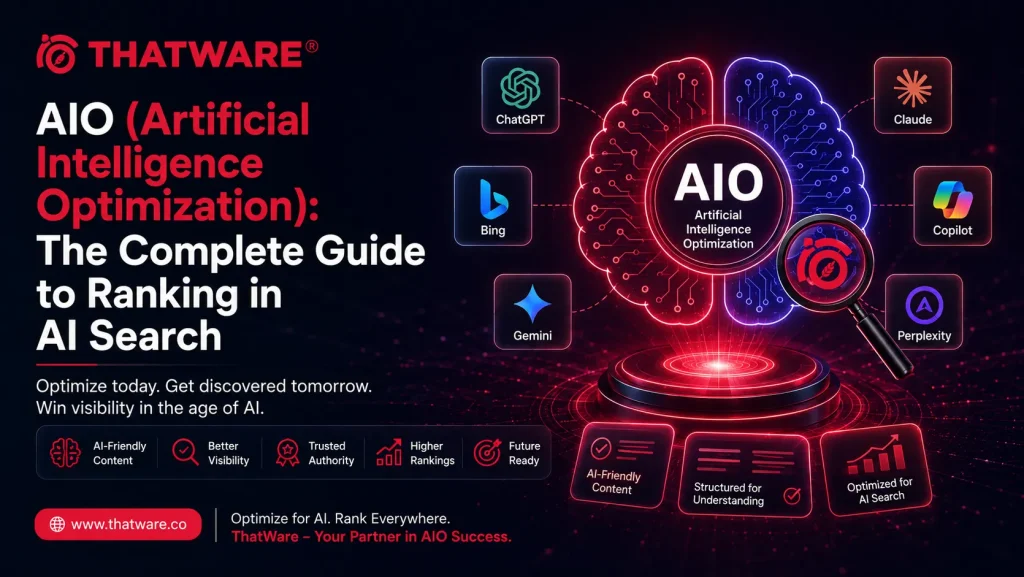
Today, users are no longer just searching—they are asking. And instead of browsing multiple websites, they are receiving instant, AI-generated answers from platforms like:
- Google AI Overviews
- ChatGPT
- Perplexity AI
- Microsoft Copilot
- Voice assistants such as Alexa and Siri
These AI systems are designed to understand user intent deeply and deliver precise answers instantly, often without requiring users to click on any website at all.
This shift has created a new reality:
👉 Visibility is no longer determined solely by rankings—it is determined by whether AI chooses your content as the answer.
This is where Artificial Intelligence Optimization (AIO) comes into play.
AIO (Artificial Intelligence Optimization) is the process of optimizing content so that AI systems can understand it, extract it, and present it as a trusted answer to users.
The Rise of AI Search
The rise of AI-driven search is not a future prediction—it is happening right now.
Modern search engines and AI tools are:
- Interpreting queries conversationally
- Synthesizing information from multiple sources
- Delivering summarized responses instead of links
This means users are:
- Spending less time clicking through websites
- Trusting AI-generated summaries
- Making faster decisions
For businesses, this introduces both a challenge and an opportunity.
The challenge: Traditional SEO strategies alone are no longer enough.
The opportunity: Brands that adapt to AIO can become the primary source of truth in AI-generated answers.
At ThatWare, we see this shift as a defining moment in digital marketing—one that separates forward-thinking brands from those stuck in outdated strategies.
What You Will Learn in This Guide
This comprehensive guide will walk you through everything you need to understand and implement AIO effectively.
By the end of this article, you will clearly understand:
- What AIO is and why it matters
- How AIO differs from traditional SEO and why both must work together
- How AI search systems function behind the scenes
- How to structure and optimize your content to get selected and cited by AI
Whether you are a business owner, marketer, SEO professional, or agency, this guide will provide actionable insights to help you stay ahead in the evolving AI-driven search landscape.
What is AIO (Artificial Intelligence Optimization)?
At its core, Artificial Intelligence Optimization (AIO) is about making your content accessible, understandable, and valuable—not just for humans, but for AI systems.
👉 AIO = optimizing content to be understood, selected, and cited by AI systems.
Unlike traditional SEO, where the primary focus is on ranking pages for keywords, AIO shifts the focus toward:
- Providing clear and direct answers
- Structuring content for machine readability
- Building context and authority
- Ensuring content is trustworthy and accurate
In simpler terms:
👉 SEO helps users find your content.
👉 AIO helps AI choose your content.
Why This Distinction Matters
In the past, success in search depended on:
- Keyword optimization
- Backlinks
- Technical SEO
While these elements still matter, they are no longer sufficient on their own.
AI systems do not just rank content—they interpret, summarize, and recommend it.
This means your content must now:
- Answer questions directly
- Be structured logically
- Provide contextual depth
- Demonstrate expertise
At ThatWare, we approach AIO as an evolution of SEO—one that aligns with how modern AI systems process and deliver information.
The Core Goal of AIO
The ultimate goal of AIO is:
👉 To become the most reliable and extractable source of information for AI systems.
This involves:
- Creating content that AI can easily parse
- Providing high-value insights
- Building topical authority
- Maintaining clarity and precision
When done correctly, AIO allows your content to:
- Appear in AI summaries
- Be cited in AI-generated answers
- Influence user decisions directly
How AI Search Works
To effectively optimize for AIO, it is essential to understand how AI-driven search systems operate.
Unlike traditional search engines that relied heavily on keyword matching, modern AI systems use advanced technologies to interpret content in a much more sophisticated way.
1. AI Crawls and Interprets Content
Just like traditional search engines, AI systems begin by crawling web pages. However, instead of simply indexing keywords, they:
- Analyze the structure of the content
- Identify key ideas and concepts
- Understand relationships between topics
AI does not just “read” content—it interprets meaning.
2. AI Extracts Answers, Not Just Links
One of the most important differences between traditional search and AI search is this:
👉 AI prioritizes answers, not pages.
Instead of presenting a list of links, AI systems:
- Extract key information
- Summarize it
- Present it directly to users
This means your content must:
- Contain clear, standalone answers
- Be structured in a way that allows easy extraction
- Provide concise yet meaningful explanations
3. Technologies Powering AI Search
Modern AI search relies on several advanced technologies:
🔹 Natural Language Processing (NLP)
NLP allows AI to understand human language in a natural, conversational way.
This includes:
- Understanding context
- Interpreting sentence structure
- Recognizing synonyms and variations
Example:
“Best SEO strategy” and “effective search optimization methods” are understood as similar.
🔹 Context Understanding
AI does not analyze words in isolation—it understands them in context.
For example:
- “Apple” could mean a fruit or a company
- AI determines meaning based on surrounding content
🔹 Entity Recognition
AI identifies entities such as:
- Brands (ThatWare)
- People
- Tools
- Concepts
Entities help AI build connections and trust.
Why This Matters for AIO
Because AI uses these technologies, your content must:
- Be context-rich
- Include relevant entities
- Avoid ambiguity
- Provide clear relationships between topics
This is why ThatWare emphasizes semantic SEO and entity-based optimization as part of AIO strategies.
Examples of AIO in Action
To truly understand AIO, let’s look at real-world scenarios where it is already shaping search results.
1. Google AI Overview Snippets
Google AI Overviews (formerly Search Generative Experience) provide users with:
- Summarized answers
- Key insights
- Structured information
Instead of showing multiple links, Google displays a comprehensive answer at the top of the page.
👉 If your content is optimized for AIO:
- It can be used as a source
- It can be summarized by AI
- It can gain massive visibility without relying on clicks
2. ChatGPT Answers Citing Sources
AI tools like ChatGPT often:
- Generate detailed responses
- Reference credible sources
- Combine insights from multiple websites
If your content:
- Is authoritative
- Is well-structured
- Provides clear answers
👉 It increases the likelihood of being cited.
This is a major shift:
👉 Instead of competing for rankings, you are competing for AI trust and recognition.
3. Voice Search Responses
Voice assistants such as:
- Alexa
- Google Assistant
- Siri
Provide single, direct answers to user queries.
Example:
User: “What is AIO?”
Assistant: “AIO stands for Artificial Intelligence Optimization, which is…”
👉 Only one source is chosen.
This makes AIO even more critical because:
- There is no list of results
- There is no second position
- There is only one answer
AIO vs SEO vs AEO: Understanding the Evolution of Search Optimization
The world of search is no longer linear. What started as simple keyword-based ranking has now evolved into a complex ecosystem driven by artificial intelligence, user intent, and contextual understanding.
To truly understand Artificial Intelligence Optimization (AIO), it’s essential to position it within the broader evolution of search strategies—namely SEO (Search Engine Optimization) and AEO (Answer Engine Optimization).
Each of these plays a role, but they operate at different levels of sophistication and impact.
The Fundamental Differences
| Factor | SEO | AEO | AIO |
| Focus | Rankings | Featured answers | AI citations |
| Goal | Traffic | Visibility | Authority |
| Strategy | Keywords | Direct answers | Context + structure |
SEO: The Foundation of Digital Visibility
Search Engine Optimization (SEO) has long been the backbone of digital marketing.
What SEO Focuses On:
- Ranking higher in search engine results
- Optimizing for keywords
- Building backlinks
- Improving technical performance
The Core Goal:
👉 Drive traffic to your website
For years, this approach worked exceptionally well. Businesses optimized pages for specific keywords, earned backlinks, and climbed the rankings ladder.
However, SEO has limitations in the modern AI-driven landscape:
- It prioritizes ranking, not necessarily relevance in answers
- It relies heavily on click-based behavior
- It doesn’t fully address how AI interprets and presents content
AEO: The Bridge Between SEO and AIO
Answer Engine Optimization (AEO) emerged as a response to changing user behavior.
Instead of just ranking pages, AEO focuses on:
- Appearing in featured snippets
- Providing direct answers
- Structuring content for quick extraction
What AEO Focuses On:
- FAQ sections
- Concise answers
- Structured formatting
The Core Goal:
👉 Increase visibility without relying solely on clicks
AEO improved content discoverability by making it easier for search engines to extract answers.
But it still has limitations:
- It is largely confined to search engine snippets
- It doesn’t fully address AI-generated responses
- It lacks deeper contextual and entity-based optimization
AIO: The Future of Optimization
Artificial Intelligence Optimization (AIO) represents the next stage in this evolution.
Unlike SEO and AEO, AIO is designed specifically for AI-powered systems.
What AIO Focuses On:
- Being cited in AI-generated answers
- Providing context-rich, structured content
- Building authority and trust signals
The Core Goal:
👉 Establish your brand as a trusted source that AI systems rely on
The Real Shift: From Keywords to Context
Traditional SEO asks:
“What keyword should I rank for?”
AIO asks:
“What question should I answer, and how can I provide the best possible explanation?”
This is a fundamental shift.
Key Takeaway
👉 “SEO gets you ranked. AIO gets you chosen.”
This simple statement defines the future of digital visibility.
Ranking is no longer enough.
In an AI-driven ecosystem:
- Only a few sources are selected
- Only trusted content is cited
- Only structured, clear answers are extracted
At ThatWare, we emphasize this shift by designing strategies that go beyond rankings and focus on AI selection mechanisms.
Why AIO Matters
The importance of AIO is not theoretical—it is driven by real, measurable changes in how users search, interact, and make decisions online.
Let’s break down the key factors making AIO essential.
1. The Rise of Zero-Click Searches
One of the biggest disruptions in digital marketing is the rise of zero-click searches.
What Are Zero-Click Searches?
These occur when:
- A user gets their answer directly on the search page
- No click to a website is required
Why It Matters:
AI systems now provide:
- Instant summaries
- Direct answers
- Consolidated insights
This reduces the need for users to visit multiple sources.
📊 Impact:
- A large percentage of searches now end without clicks
- Informational queries are most affected
- Websites lose traditional traffic opportunities
📉 2. Decline in Organic Click-Through Rates (CTR)
As AI-generated answers become more prevalent:
- Organic listings receive fewer clicks
- Even top-ranking pages may see reduced traffic
Why?
Because:
- Users trust AI summaries
- Answers are visible immediately
- Decision-making happens faster
💡 Insight from ThatWare:
Traffic is no longer the only metric that matters.
👉 Being visible within AI responses is the new form of traffic.
🤖 3. AI Assistants Are Replacing Traditional Search Behavior
User behavior has changed dramatically.
Instead of typing fragmented queries, users now ask:
- “What is the best SEO strategy for AI search?”
- “Explain AIO in simple terms”
- “Which company is best for AI-driven SEO?”
AI assistants respond with:
- Personalized answers
- Contextual recommendations
- Summarized insights
📌 What This Means:
Search is becoming:
- Conversational
- Intent-driven
- Context-aware
This shift demands a new optimization approach—AIO.
🔄 4. Shift Toward “Answer-First” Content
Businesses are no longer creating content just to rank.
They are now focusing on:
- Providing immediate value
- Delivering clear answers
- Structuring content for extraction
Traditional Content:
- Long introductions
- Keyword-heavy paragraphs
- Delayed answers
AIO Content:
- Direct answers first
- Structured explanation
- Clear formatting
Stats Section (Industry Trends)
While the exact numbers vary by industry, consistent trends show:
📈 Growth of AI-Driven Searches
- AI-assisted queries are increasing rapidly year-over-year
- A significant portion of users now rely on AI tools for information
🤖 Growth of AI Assistants
- Billions of users interact with AI-powered assistants globally
- Voice and conversational AI adoption continues to rise
📉 Impact on Traffic
- Organic CTR is declining for informational queries
- However:
- Conversion rates from AI-driven traffic are improving
- Users arriving via AI are more qualified
💡 Key Insight
👉 The future is not about more traffic, but better visibility and higher intent engagement.
ThatWare focuses on aligning strategies with this shift.
Core Principles of AIO
To succeed in AIO, content must be designed not just for users—but for AI systems as well.
Here are the foundational principles that define effective AIO.
Clarity Over Complexity
AI systems prioritize clarity.
What Works:
- Simple language
- Direct answers
- Clear explanations
What Doesn’t Work:
- Complex sentences
- Unnecessary jargon
- Long-winded introductions
Example:
❌ Poor AIO Content:
“Artificial Intelligence Optimization is a multifaceted and evolving paradigm that encompasses various aspects of computational linguistics…”
✅ Strong AIO Content:
“AIO is the process of optimizing content so AI systems can understand and use it.”
💡 ThatWare Insight:
Clarity improves:
- AI extraction
- User understanding
- Engagement
Structured Content
Structure is one of the most important factors in AIO.
AI systems rely on structure to:
- Identify key sections
- Extract relevant information
- Present answers accurately
Essential Elements:
- Headings (H1–H3): Define hierarchy
- Bullet Points: Improve readability
- Tables: Organize comparisons
Example:
Instead of writing: “AIO involves clarity, structure, context, and authority.”
Use:
- Clarity
- Structure
- Context
- Authority
💡 Why It Matters:
Structured content is:
- Easier for AI to parse
- Faster for users to scan
- More likely to be featured
Context & Entities
AI does not just read words—it understands relationships.
What Are Entities?
Entities are:
- People
- Brands (ThatWare)
- Technologies
- Concepts
Why Entities Matter:
They help AI:
- Understand context
- Connect related topics
- Build knowledge graphs
How to Optimize:
- Use related terms
- Mention relevant concepts
- Build topic clusters
Example:
If your content includes:
- AI optimization
- SEO
- machine learning
AI connects these into a broader understanding.
💡 ThatWare Strategy:
We focus on entity-driven SEO, ensuring content aligns with AI knowledge frameworks.
Authority & Trust (E-E-A-T)
E-E-A-T stands for:
- Experience
- Expertise
- Authority
- Trust
Why It Matters in AIO:
AI systems prioritize content that is:
- Reliable
- Credible
- Expert-driven
How to Build Authority:
- Publish high-quality content
- Showcase expertise
- Build brand recognition
- Earn mentions and backlinks
Trust Signals Include:
- Author credibility
- Brand presence
- Consistent content quality
💡 ThatWare Approach:
We integrate:
- Data-driven insights
- Real-world experience
- Advanced AI strategies
To build strong E-E-A-T signals.
How to Optimize for AIO (Step-by-Step Guide)
Artificial Intelligence Optimization (AIO) is not just a theoretical concept—it is a practical, actionable strategy that businesses must implement to remain visible in AI-driven search ecosystems.
At ThatWare, we approach AIO as a structured methodology where every piece of content is engineered to be:
- Easily understood by AI
- Contextually rich
- Structurally optimized
- Authority-driven
Below is a step-by-step AIO optimization framework that can transform your content from simply “ranking” to actually being selected and cited by AI systems.
Step 1: Answer-First Content
The foundation of AIO begins with a simple but powerful principle:
👉 Give the answer before the explanation.
AI systems prioritize content that delivers immediate value. When a user asks a question, AI scans for clear, direct answers that can be extracted instantly.
Why Answer-First Content Matters
Traditional SEO encouraged long introductions and storytelling before delivering value. However, AI-driven systems:
- Do not “read” like humans
- Extract the most relevant snippet
- Prefer concise, accurate responses
If your answer is buried deep inside the content, it is highly likely to be ignored.
How to Implement Answer-First Strategy
1. Start with a Direct Answer
Every important section should begin with a clear response.
Example:
Question: What is AIO?
Answer: Artificial Intelligence Optimization (AIO) is the process of optimizing content so AI systems can understand, extract, and present it as a trusted answer.
2. Use FAQ Format
FAQ-style content is extremely powerful for AIO because:
- It mirrors user queries
- It provides structured answers
- It is easily extractable by AI
Example:
- What is AIO in SEO?
- Why is AIO important?
- How does AIO work?
Each question becomes a potential AI answer snippet.
ThatWare Insight
At ThatWare, we structure critical sections in a way that:
- The first 2–3 lines answer the question
- The rest of the section expands the explanation
👉 This dramatically increases the chances of being featured in AI-generated responses.
Step 2: Use Semantic Keywords (Topics + Intent)
One of the biggest shifts in AIO is moving beyond traditional keyword targeting.
👉 AIO is not about keywords—it’s about meaning, intent, and context.
What Are Semantic Keywords?
Semantic keywords are:
- Related terms
- Contextual phrases
- Variations of a core topic
For example, instead of targeting only:
- “AIO SEO”
You should include:
- AI search optimization
- AI content ranking
- AI visibility strategies
- Answer engine optimization
Why Semantic Optimization Matters
AI systems:
- Understand relationships between words
- Analyze context instead of exact matches
- Prioritize topic coverage over keyword density
How to Implement Semantic SEO
1. Focus on User Intent
Ask:
- What does the user really want to know?
- What problem are they trying to solve?
2. Build Topic Clusters
Instead of isolated keywords, create content around:
- Core topic → AIO
- Supporting topics → AI SEO, AI content, AI search
3. Use Natural Language
Write conversationally, as users would ask questions.
💡 ThatWare Strategy
ThatWare uses AI-driven NLP analysis to identify:
- Entity relationships
- Topic gaps
- Semantic relevance
👉 This ensures content aligns with how AI interprets information—not just how humans search.
Step 3: Add Structured Data (Schema)
Structured data is one of the most powerful yet underutilized components of AIO.
👉 It acts as a translator between your content and AI systems.
What is Schema Markup?
Schema markup is a form of structured data that helps search engines and AI:
- Understand content meaning
- Identify content types
- Extract key information
Key Types of Schema for AIO
1. FAQ Schema
- Ideal for question-answer content
- Helps AI extract direct responses
2. How-To Schema
- Perfect for step-by-step guides
- Improves visibility in instructional queries
Why Schema is Critical for AIO
Without schema:
- AI must “guess” content structure
With schema:
- AI clearly understands the content
ThatWare Implementation Approach
At ThatWare, we:
- Integrate schema into all key content
- Align schema with content structure
- Test schema for AI compatibility
👉 This ensures content is not just readable—but machine-optimized.
Step 4: Optimize for Entities
In the world of AI, entities are everything.
What Are Entities?
Entities are identifiable concepts such as:
- Brands (ThatWare)
- People
- Tools
- Technologies
Why Entities Matter in AIO
AI systems build knowledge graphs using entities.
If your content includes strong entity signals:
- It becomes more credible
- It is easier for AI to contextualize
- It increases chances of being cited
How to Optimize for Entities
1. Clearly Mention Brands
Example:
- ThatWare (AI SEO agency)
2. Include Tools & Technologies
Example:
- ChatGPT
- Google NLP API
3. Define Concepts Clearly
Example:
- Artificial Intelligence Optimization (AIO)
ThatWare Advantage
ThatWare builds entity-rich content ecosystems where:
- Each topic reinforces the brand
- Each mention strengthens authority
👉 This helps AI recognize ThatWare as a trusted knowledge source.
Step 5: Improve Readability
Even though AIO focuses on AI systems, readability still plays a crucial role.
Why?
Because:
- AI models are trained on human-readable content
- Better readability = better extraction
Key Readability Practices
1. Use Short Paragraphs
- 2–4 lines maximum
- Avoid dense blocks of text
2. Use Clear Formatting
- Headings
- Bullet points
- Lists
3. Keep Sentences Simple
- Avoid unnecessary complexity
- Use direct language
Why Readability Impacts AIO
Content that is:
- Cleanly formatted
- Easy to scan
- Logically structured
👉 Is easier for AI to process and extract.
ThatWare Writing Principle
👉 “If a human struggles to read it, AI will struggle to extract it.”
Step 6: Build Topical Authority
AIO is not just about individual pages—it’s about content ecosystems.
What is Topical Authority?
Topical authority means:
- Covering a subject comprehensively
- Demonstrating deep expertise
- Building interconnected content
How to Build Authority
1. Interlink Related Content
- Connect blog posts
- Create internal linking structures
2. Cover Topic Clusters
Example:
Main Topic: AIO
Subtopics:
- AIO vs SEO
- AIO tools
- AIO strategies
Why This Matters for AI
AI evaluates:
- Depth of coverage
- Content relationships
- Authority signals
👉 The more complete your ecosystem, the more trustworthy your content becomes.
ThatWare Approach
ThatWare builds:
- Topic clusters
- Content silos
- Authority hubs
👉 This positions clients as industry leaders in AI search.
Writing for AI: Content Format That Wins
Creating content for AIO requires a shift in writing style.
👉 You are no longer writing just for humans—you are writing for AI interpretation + human consumption.
High-Performing Content Formats
AI systems favor structured formats such as:
1. Definitions
Clear definitions help AI extract meaning instantly.
Example: AIO is the process of optimizing content for AI-driven search systems.
2. Lists
Lists break down information into digestible parts.
Example:
Benefits of AIO:
- Higher visibility
- Better authority
- Improved conversions
3. Step-by-Step Guides
Perfect for instructional queries.
Example:
How to optimize for AIO:
- Start with answers
- Use semantic keywords
- Add schema
4. Comparisons
Comparisons help AI contextualize differences.
Example:
AIO vs SEO vs AEO
Example: Bad vs Good Content Format
❌ Bad Format (Traditional Style)
A long paragraph explaining everything without structure, making it difficult for AI to extract meaningful insights.
✅ Good Format (AIO Optimized)
AIO is optimizing content for AI systems.
Key Points:
- Focus on answers
- Use structured content
- Build authority
Example:
A blog using FAQ schema is more likely to be featured in AI search results.
ThatWare Content Philosophy
At ThatWare, we follow a strict content formula:
👉 Definition → Key Points → Example → Expansion
This ensures:
- AI readability
- User clarity
- Maximum extraction potential
AIO Content Framework (Reusable Template)
As search evolves into an AI-driven ecosystem, content must do more than inform—it must be structured for extraction, interpretation, and citation by AI systems.
At ThatWare, we’ve developed a proven AIO Content Framework that ensures your content is not only readable for humans but also highly digestible for AI engines like Google AI Overviews, ChatGPT, and Perplexity.
This framework acts as a blueprint for AI visibility, helping your content become a preferred source in AI-generated responses.
Why This Framework Matters
Traditional content writing focuses on storytelling and engagement. While that still matters, AI systems require:
- Clear structure
- Direct answers
- Logical flow
- Contextual depth
👉 Without structure, even high-quality content can be ignored by AI.
This framework ensures:
- Higher chances of being featured in AI answers
- Better content comprehension by machines
- Improved authority and trust signals
1. Introduction
The introduction is where both users and AI systems determine whether your content is relevant.
AI models heavily prioritize the opening section to:
- Identify the topic
- Understand intent
- Extract initial definitions
✅ Best Practices for AIO Introductions:
- Clearly define the topic within the first few lines
- Use simple, natural language
- Include primary keywords and entities
- Avoid unnecessary storytelling
💡 Example:
“Artificial Intelligence Optimization (AIO) is the process of structuring content so AI systems can understand, extract, and present it as a trusted answer.”
👉 This works because it is:
- Direct
- Informative
- AI-friendly
2. Direct Answer Section
This is one of the most critical components of AIO.
AI systems prefer content that provides immediate, concise answers.
🎯 Purpose:
- Capture AI snippets
- Increase chances of citation
- Improve zero-click visibility
✅ How to structure it:
- Provide a 1–3 sentence answer
- Use bold formatting for key phrases
- Keep it clear and factual
💡 Example:
What is AIO?
AIO (Artificial Intelligence Optimization) is the practice of optimizing content so AI platforms can easily understand and use it to generate answers.
3. Expanded Explanation
After the direct answer, the next step is to expand the topic in depth.
This section helps:
- Build authority
- Provide context
- Strengthen semantic relevance
📌 What to include:
- Detailed breakdowns
- Supporting concepts
- Related terms and entities
- Examples and comparisons
🧠 Why it matters:
AI systems don’t just look for short answers—they validate them using contextual depth.
👉 The more comprehensive your explanation, the more trustworthy your content becomes.
4. Use Cases
Use cases bridge the gap between theory and application.
They help both users and AI systems understand:
- Practical relevance
- Real-world implementation
- Industry-specific value
✅ Effective Use Case Formats:
- Business applications
- Industry scenarios
- Problem → Solution breakdown
💡 Example:
Use Case: Digital Marketing Agencies
Agencies like ThatWare use AIO to ensure client content is featured in AI-generated answers, increasing visibility and authority without relying solely on traditional rankings.
5. FAQs (Frequently Asked Questions)
FAQs are extremely powerful for AIO.
Why?
Because AI systems often pull answers directly from question-based formats.
🎯 Benefits:
- Improves AI extractability
- Matches conversational queries
- Enhances voice search performance
✅ Best Practices:
- Use clear, natural questions
- Keep answers concise (2–3 lines)
- Cover related queries
💡 Example:
What is the difference between SEO and AIO?
SEO focuses on ranking websites, while AIO focuses on optimizing content to be selected and presented by AI systems.
6. Conclusion
The conclusion reinforces the key message and provides closure.
For AIO, it should:
- Summarize key insights
- Re-emphasize the importance of the topic
- Include a forward-looking statement
💡 Example:
“AIO is not just an evolution of SEO—it is the future of digital visibility. Businesses that adopt structured, AI-friendly content today will dominate tomorrow’s search landscape.”
Final Insight
👉 This framework works because it aligns perfectly with how AI systems process information:
- Identify → Extract → Validate → Present
By following this structure, your content becomes:
- Easier to parse
- Easier to trust
- More likely to be featured
Tools for AIO Optimization
Creating AIO-friendly content requires the right combination of AI tools, SEO platforms, and technical solutions.
At ThatWare, we leverage a powerful stack to ensure content is optimized for both humans and machines.
ChatGPT / Claude → Content Structuring
AI writing assistants like ChatGPT and Claude are essential for:
- Structuring content logically
- Generating clear explanations
- Creating FAQ sections
- Improving readability
How ThatWare Uses Them:
- Drafting structured outlines
- Enhancing clarity and simplicity
- Generating AI-friendly responses
👉 These tools help ensure content aligns with natural language patterns used in AI queries.
Surfer SEO → Semantic Optimization
Surfer SEO helps optimize content for:
- Keyword density
- Topic relevance
- Semantic coverage
Key Benefits:
- Identifies missing terms
- Improves topical authority
- Aligns content with search intent
👉 In AIO, semantic richness is critical—Surfer ensures your content covers the entire topic ecosystem.
Google NLP API → Entity Analysis
Google’s Natural Language Processing API helps identify:
- Entities
- Sentiment
- Content structure
Why This Matters:
AI systems rely heavily on entity recognition.
Example:
Instead of just writing “SEO,” include:
- AI search
- ThatWare
- Digital marketing
👉 This strengthens AI understanding and increases citation potential.
Schema Generators
Schema markup plays a crucial role in AIO.
It helps AI:
- Understand content type
- Extract structured data
- Present rich results
Common Schema Types:
- FAQ schema
- Article schema
- How-to schema
ThatWare’s Approach:
We integrate schema into every content strategy to ensure:
- Better indexing
- Enhanced AI visibility
- Improved rich results
Key Takeaway
👉 Tools don’t replace strategy—they enhance it.
At ThatWare, we combine:
- AI tools
- SEO platforms
- Data analysis
To create fully optimized AIO-ready content ecosystems.
Common AIO Mistakes to Avoid
Even with the right strategy, many businesses fail to succeed in AIO due to avoidable mistakes.
Here are the most critical ones:
❌ 1. Keyword Stuffing
Old SEO tactics no longer work.
Overloading content with keywords:
- Reduces readability
- Confuses AI
- Lowers trust signals
✅ Solution:
Focus on:
- Natural language
- Semantic relevance
- Contextual clarity
❌ 2. Writing Only for Humans (Ignoring AI Structure)
While human readability is important, ignoring structure makes content:
- Hard for AI to extract
- Less likely to be featured
✅ Solution:
- Use headings
- Add bullet points
- Include direct answers
👉 Balance human engagement with machine readability.
❌ 3. Ignoring Schema Markup
Without schema, AI lacks structured signals.
This leads to:
- Lower visibility
- Missed opportunities for rich results
✅ Solution:
Implement:
- FAQ schema
- Article schema
- Structured metadata
❌ 4. Lack of Clear Answers
Many articles:
- Delay answers
- Hide key information
This is a major problem for AIO.
✅ Solution:
- Provide answers early
- Keep them concise
- Make them extractable
❌ 5. Weak Authority Signals
AI systems prioritize trusted sources.
If your content lacks:
- Expertise
- Credibility
- Depth
👉 It won’t be selected.
✅ Solution:
- Build topical authority
- Use credible references
- Showcase expertise (like ThatWare does)
Future of AIO: What Lies Ahead in AI-Driven Search
Artificial Intelligence Optimization (AIO) is not just a passing trend—it represents the next fundamental shift in how information is discovered, processed, and delivered online.
As AI continues to evolve, the rules of visibility are being rewritten. Businesses that adapt early will dominate, while those that rely solely on traditional SEO strategies risk becoming irrelevant.
Let’s explore the key trends shaping the future of AIO.
AI Agents Replacing Traditional Search Engines
One of the most significant changes in digital behavior is the rise of AI agents.
Instead of typing queries into search engines and browsing multiple websites, users are increasingly relying on:
- ChatGPT
- Google Gemini
- Microsoft Copilot
- Perplexity AI
These AI agents act as decision-making assistants, not just search tools.
🔍 What does this mean?
Users will:
- Ask complex, conversational questions
- Receive summarized, actionable answers
- Make decisions without visiting multiple sources
👉 Example:
Instead of searching:
“Best SEO agency in India”
Users will ask:
“Which SEO agency is best for AI-driven marketing and why?”
And AI will respond with:
- A curated recommendation
- Supporting reasoning
- Trusted sources
💡 AIO Implication
Your content must be optimized to:
- Be selected by AI
- Be cited as a trusted source
- Provide clear, authoritative answers
At ThatWare, we focus on positioning brands as AI-preferred sources, not just ranked websites.
Personalized AI Results
The future of search is not just intelligent—it is deeply personalized.
AI systems are increasingly tailoring responses based on:
- User behavior
- Search history
- Preferences
- Location
- Context
This means two users searching the same query may receive completely different answers.
Example:
User A:
- Interested in technical SEO
- Based in a metro city
User B:
- Looking for local SEO solutions
- Running a small business
👉 AI will generate different responses for each user.
AIO Implication
To stay visible in a personalized ecosystem, your content must:
- Cover multiple user intents
- Provide contextual depth
- Address different audience segments
ThatWare’s strategy involves building multi-layered content ecosystems that align with varied user journeys.
Voice + Multimodal Search Growth
Search is no longer limited to text.
The future includes:
- Voice search (Alexa, Siri, Google Assistant)
- Image-based search
- Video-based queries
- Multimodal AI interactions
Why this matters:
Voice queries tend to be:
- Longer
- Conversational
- Question-based
Example:
Instead of:
“AIO SEO”
Users say:
“What is AIO in SEO and how does it work?”
AIO Implication
Your content must:
- Use natural language
- Answer conversational queries
- Be structured for quick extraction
Additionally, multimodal search means:
- Images need proper alt text
- Videos need transcripts
- Content must be contextually rich
ThatWare integrates text, visuals, and structured data to ensure complete AI compatibility.
The Growing Importance of Brand Mentions
In the AI era, brand recognition is a critical ranking factor.
AI systems prioritize sources that are:
- Frequently mentioned
- Widely trusted
- Contextually relevant
Why brand mentions matter:
AI does not rely solely on backlinks anymore. Instead, it evaluates:
- Brand authority across platforms
- Mentions in credible sources
- Consistency in expertise
Example:
If “ThatWare” is consistently mentioned in:
- SEO blogs
- AI marketing discussions
- Industry publications
👉 AI is more likely to:
- Recognize it as an authority
- Cite it in responses
- Recommend it to users
AIO Strategy
To strengthen brand presence:
- Publish high-quality, authoritative content
- Earn mentions across platforms
- Build topical authority
- Maintain consistency in messaging
At ThatWare, we focus on building entity-based authority, ensuring brands are recognized not just by search engines—but by AI systems.
Conclusion: The Shift Has Already Begun
The transformation of search is no longer a future prediction—it is happening right now.
Artificial Intelligence Optimization (AIO) is redefining how content is created, discovered, and consumed.
The Big Shift
The digital landscape is moving from:
- Ranking → Answering
- Traffic → Authority
- Clicks → Trust
This means success is no longer measured solely by:
- Page rankings
- Click-through rates
Instead, it depends on:
- Whether your content is selected by AI
- Whether your brand is recognized as an authority
- Whether your insights are trusted enough to be presented as answers
Why This Matters for Businesses
Businesses that embrace AIO will:
- Gain higher visibility in AI-driven platforms
- Build long-term authority
- Stay ahead of competitors
Those that ignore it will:
- Lose organic visibility
- See declining traffic
- Struggle to remain relevant
The ThatWare Perspective
At ThatWare, we believe that the future of digital marketing lies in AI-first optimization strategies.
We don’t just optimize for search engines—we optimize for:
- AI understanding
- AI extraction
- AI recommendation
👉 Start optimizing for AI today or risk invisibility tomorrow.
The sooner you adapt, the stronger your position will be in the evolving digital ecosystem.
AIO Deliverables/SOW
| Type of Layering | Deliverables/Scope of Work | $550 USD/Month | $1,550 USD/Month | $4,500 USD/Month | $7,500 USD/Month | $10,500 USD/Month | $15,500 USD/Month |
| AI visibility audit | AI search visibility baseline audit across Google AI Overviews, Bing Copilot, Perplexity and ChatGPT-style answer engines | Basic scan | 10 Queries | 50 Queries | 150 Queries | 300 Queries | Enterprise-wide |
| Brand appearance and non-appearance tracking in AI-generated answers | No | Monthly | Bi-weekly | Weekly | Weekly + Insights | Real-time Dashboard | |
| AI answer share-of-voice benchmarking against competitors | No | 3 Competitors | 5 Competitors | 10 Competitors | 20 Competitors | Full Market | |
| AI citation source discovery and citation gap identification | No | Basic | 25 Sources | 75 Sources | 150 Sources | Unlimited | |
| AI search intent and prompt pattern discovery | 10 Prompts | 30 Prompts | 100 Prompts | 250 Prompts | 500 Prompts | Unlimited | |
| Answer engine optimization | Optimization of content blocks for direct AI answer extraction | 5 Pages | 15 Pages | 50 Pages | 150 Pages | 300 Pages | Unlimited |
| Question-answer content formatting for AI search surfaces | 10 FAQs | 30 FAQs | 100 FAQs | 250 FAQs | 500 FAQs | Unlimited | |
| AI-friendly summary blocks and key-takeaway sections | 5 Pages | 15 Pages | 40 Pages | 100 Pages | 250 Pages | Enterprise-wide | |
| Featured answer and snippet alignment for conversational search | No | Yes | Yes | Yes | Advanced | Predictive | |
| AI-generated response gap correction recommendations | Basic | Yes | Yes | Yes | Advanced | Custom | |
| Entity visibility | Entity profile strengthening for brand, service, author and product entities | 1 Entity | 3 Entities | 10 Entities | 25 Entities | 50 Entities | Unlimited |
| Knowledge graph and entity relationship enhancement | No | Basic | Advanced | Advanced | Enterprise | Custom Graph | |
| Brand mention optimization across authoritative third-party sources | No | Basic List | 25 Targets | 75 Targets | 150 Targets | Custom Outreach Map | |
| AI crawler-readable entity summary creation | 1 Summary | 3 Summaries | 10 Summaries | 25 Summaries | 50 Summaries | Unlimited | |
| Schema and structured data recommendations for AI search visibility | Basic | Yes | Yes | Advanced | Advanced + QA | Custom | |
| Technical AI accessibility | AI crawler accessibility audit for important URLs and content assets | 10 URLs | 30 URLs | 100 URLs | 250 URLs | 500 URLs | Enterprise-wide |
| Robots.txt, sitemap, schema and indexation review for AI discoverability | Basic | Yes | Yes | Advanced | Advanced | Enterprise | |
| AI answer source page optimization and crawl path improvement | No | 5 Pages | 20 Pages | 75 Pages | 150 Pages | Unlimited | |
| Internal linking improvements for AI retrieval paths | 5 Links | 25 Links | 100 Links | 250 Links | 500 Links | Unlimited | |
| Structured content hierarchy optimization for AI summarization | No | 10 Pages | 50 Pages | 150 Pages | 300 Pages | Enterprise-wide | |
| Opportunity mapping | Question-Answer Opportunity Map | Yes | Yes | Yes | Yes | Yes | Yes |
| Conversational query opportunity discovery | 25 Queries | 75 Queries | 200 Queries | 500 Queries | 1,000 Queries | Unlimited | |
| AI answer surface gap analysis | 5 Pages | 15 Pages | 40 Pages | 100 Pages | 250 Pages | Enterprise wide | |
| Featured snippet competitor mapping | 3 Competitors | 5 Competitors | 10 Competitors | 20 Competitors | 40 Competitors | Full Market Landscape | |
| High-intent question clustering | 10 Clusters | 25 Clusters | 75 Clusters | 150 Clusters | 300 Clusters | Predictive AI Clustering | |
| Extraction format | FAQ extraction formatting | 10 FAQs | 30 FAQs | 75 FAQs | 150 FAQs | 300 FAQs | Unlimited |
| Listicle answer formatting | 5 Pages | 15 Pages | 40 Pages | 100 Pages | 250 Pages | Enterprise scale | |
| Table-based answer optimization | 3 Tables | 10 Tables | 30 Tables | 75 Tables | 150 Tables | Dynamic Tables | |
| Step-by-step response structuring | 5 Workflows | 15 Workflows | 40 Workflows | 100 Workflows | 250 Workflows | Full Content Architecture | |
| Search feature targeting | Featured snippet targeting | No | No | Yes | Yes | Yes | Yes |
| People Also Ask optimization | No | No | No | Yes | Yes | Yes | |
| AI Overview optimization | Yes | Yes | Yes | Yes | Yes | Yes | |
| Voice search answer optimization | No | Yes | Yes | Yes | Yes | Yes | |
| Structured data | FAQ schema deployment | 10 URLs | 30 URLs | 75 URLs | 200 URLs | 500 URLs | Enterprise wide |
| Speakable schema implementation | 5 URLs | 15 URLs | 40 URLs | 100 URLs | 250 URLs | Full Voice Ecosystem | |
| HowTo schema integration | 5 Assets | 15 Assets | 40 Assets | 100 Assets | 250 Assets | Automated Deployment | |
| Entity-based JSON-LD markup | Basic | Advanced | Semantic Layering | Cross Entity Graph | Dynamic Entity Engine | AI Knowledge Architecture | |
| Content rewrite | AI-friendly content restructuring | Yes | Yes | Yes | Yes | Yes | Yes |
| Conversational content rewriting | No | No | No | Yes | Yes | Yes | |
| Answer-first paragraph optimization | Yes | Yes | Yes | Yes | Yes | Yes | |
| Concise semantic response engineering | No | Yes | Yes | Yes | Yes | Yes | |
| Schema layering (Product, MREID, and contextual rich results) for better SERP feature inclusion | No | Yes | Yes | Yes | Yes | Yes | |
| Entity clarity | Entity extraction, TF-IDF and BERT-based content scoring | No | Yes | Yes | Yes | Yes | Yes |
| vector embeddings, AI-assisted content restructuring for Q&A, PAA, featured snippet targeting | No | Yes | Yes | Yes | Yes | Yes | |
| LSI clustering, Sentence scoring based on intent match and readability | Yes | Yes | Yes | Yes | Yes | Yes | |
| Primary entity reinforcement | No | No | Yes | Yes | Yes | Yes | |
| Semantic relationship mapping | No | Yes | Yes | Yes | Yes | Yes | |
| Topical entity association optimization | No | No | Yes | Yes | Yes | Yes | |
| Brand entity disambiguation | Yes | No | Yes | Yes | Yes | Yes | |
| custom KG integrations, Prompt-engineered content clusters (LLM-backed ideation) | No | No | No | Yes | Yes | Yes | |
| NLP-led keyword placement and synonym mapping | No | No | No | Yes | Yes | Yes | |
| Content Strategy + Content Engineering | Content gap analysis | Yes | Yes | Yes | Yes | Yes | Yes |
| Custom topical maps, | No | No | No | Yes | Yes | Yes | |
| AI-Overview Optimized Pages | 20+ Pages | 50+ Pages | 70+ Pages | 120+ Pages | 180+ Pages | 220+ Pages | |
| Entity-Dense Authority Articles | 5 | 10 | 20 | 30 | 45 | 65 | |
| EEAT-based planning, | No | Yes | Yes | Yes | Yes | Yes | |
| Entity-based content modeling to improve co-occurrence relevance | No | Yes | Yes | Yes | Yes | Yes | |
| AIO-content flows | No | Yes | Yes | Yes | Yes | Yes | |
| RAG implementation | No | No | Yes | Yes | Yes | Yes | |
| Vector engineering based content cluster optimisation | No | No | Yes | Yes | Yes | Yes | |
| Advanced Link Building + Trust & Authority | Tier 1 & Tier 2 backlinks, Referring Domains + IPs Enhancement with Aggressive Link Acquisition | 20 | 50 | 70 | 100 | 180 | 270 |
| digital PR, curated + niche edits, press placements | No | No | As Required | As Required | As Required | As Required | |
| Googel Entity Stacking, Contextual + Competior Backlinks | 20 | 50 | 60 | 70 | 90 | 110 | |
| Citation-Ready Reference Pages | 3 | 5 | 10 | 20 | 30 | 50 | |
| Link Acquistion through Google Search Operators | 20 | 50 | 70 | 90 | 110 | 150 | |
| Forum Participation, Guest Blogging, link equity redistribution | 5 | 20 | 30 | 40 | 80 | 160 | |
| Programmatic backlink acquisition, focused on niche-relevant high DR domains for authority transfer | 10 | 30 | 50 | 60 | 75 | 105 | |
| Query coverage | Long-tail conversational query expansion | No | Yes | Yes | Yes | Yes | Yes |
| Intent-based topic coverage | Yes | Yes | Yes | Yes | Yes | Yes | |
| Multi-format answer generation | No | No | No | Yes | Yes | Yes | |
| Semantic keyword clustering | Yes | Yes | Yes | Yes | Yes | Yes | |
| Freshness | Content freshness monitoring | No | Yes | Yes | Yes | Yes | Yes |
| AI answer recency updates | No | No | Yes | Yes | Yes | Yes | |
| Trend-driven content refreshes | No | No | Yes | Yes | Yes | Yes | |
| Temporal query optimization | No | Yes | Yes | Yes | Yes | Yes | |
| QA | AI extraction validation testing | Monthly | Bi-Weekly | Weekly | Weekly + Device Testing | Multi engine QA | Continuous Monitoring |
| Structured data error auditing | No | No | Yes | Yes | Yes | Yes | |
| SERP answer consistency testing | Google Only | Google + Bing | Multi-SERP | Multi Device | AI Overviews Included | Full AI Ecosystem | |
| Mobile voice answer verification | No | No | Yes | Yes | Yes | Yes | |
| Measurement | AI visibility tracking | Yes | Yes | Yes | Yes | Yes | Yes |
| /.well-known file set-up for security.txt | No | No | Yes | Yes | Yes | Yes | |
| Conversational query ranking reports | No | No | Yes | Yes | Yes | Yes | |
| /.well-known file set-up for ai.txt | No | No | Yes | Yes | Yes | Yes | |
| Knowledge layer building | Semantic-sitemap.xml implementation and update | No | No | Yes | Yes | Yes | Yes |
| vector-feed.xml creation | No | No | Yes | Yes | Yes | Yes | |
| ai-manifesto.json implementation | No | No | Yes | Yes | Yes | Yes | |
| llms.txt implementation | No | No | Yes | Yes | Yes | Yes | |
| ai.txt implementation | No | No | Yes | Yes | Yes | Yes | |
| Entity-identity schema deployment | No | No | Yes | Yes | Yes | Yes | |
| ai-index.json implementation | No | No | Yes | Yes | Yes | Yes | |
| ai-decision-layer.json implementation | No | No | Yes | Yes | Yes | Yes | |
| rag-index.json implementation | No | No | Yes | Yes | Yes | Yes | |
| ai-endpoints.json implementation | No | No | Yes | Yes | Yes | Yes | |
| reasoning-map.json implementation | No | No | Yes | Yes | Yes | Yes | |
| context-engine.json implementation | No | No | Yes | Yes | Yes | Yes | |
| trust-signals.json implementation | No | No | Yes | Yes | Yes | Yes | |
| citation-preferences.json implementation | No | No | Yes | Yes | Yes | Yes | |
| ai-signals.json implementation | No | No | Yes | Yes | Yes | Yes | |
| activity-stream.json implementation | No | No | Yes | Yes | Yes | Yes | |
| llms-full implementation | No | No | Yes | Yes | Yes | Yes | |
| external-citations.json | 20 | 50 | 150 | 300 | 450 | 1000 | |
| external-authority.json | No | No | Yes | Yes | Yes | Yes | |
| ai-query-map.json | No | No | Yes | Yes | Yes | Yes | |
| answer primitives | No | No | Yes | Yes | Yes | Yes |