SUPERCHARGE YOUR ONLINE VISIBILITY! CONTACT US AND LET’S ACHIEVE EXCELLENCE TOGETHER!
** The pricings are in USD / Month and the deliverables are monthly based.
NLP SEO Deliverables & Scope of Work
NLP SEO, or Natural Language Processing SEO, is an advanced search optimization approach that helps search engines and AI systems understand the real meaning behind your website content. Traditional SEO often focuses on keywords, backlinks, metadata, and technical improvements. NLP SEO goes deeper. It focuses on language, context, entities, intent, semantic relationships, and how machines interpret human-written content.
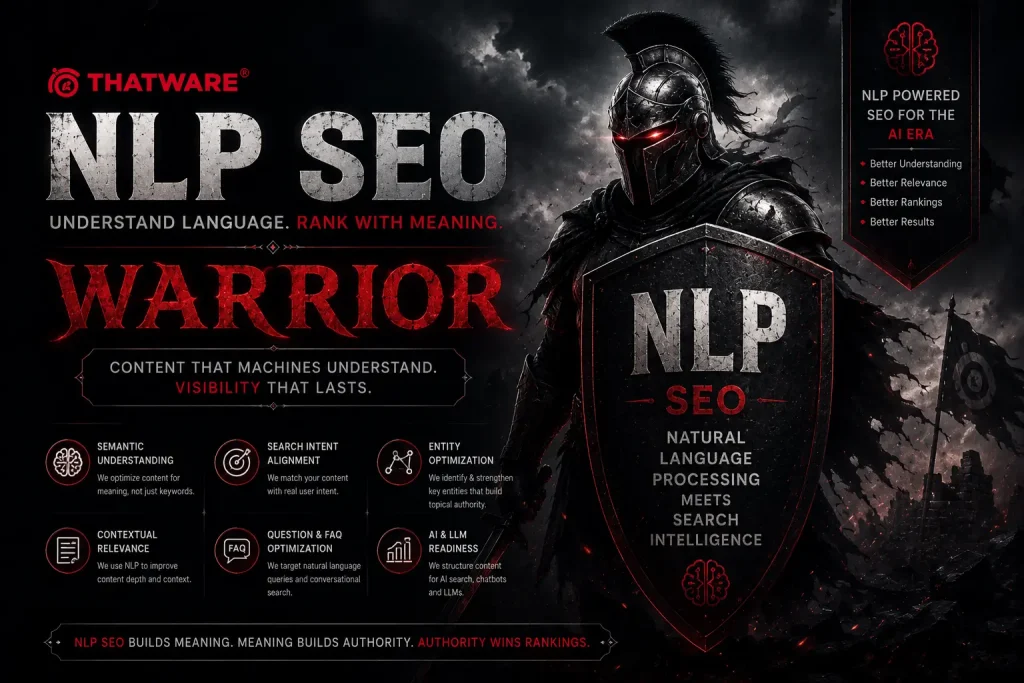
Search engines no longer read content only by matching keywords. Google, AI Overviews, ChatGPT, Gemini, Perplexity, Copilot, and other intelligent systems now process language through meaning, relationships, patterns, and context. This means your content must be written and structured in a way that machines can understand clearly while still sounding natural to users.
ThatWare’s NLP SEO service is designed to improve how your website communicates meaning. It helps your content become clearer, more relevant, more semantically complete, and more suitable for modern search systems. The goal is to make your pages easier to understand, easier to rank, easier to retrieve, and easier to use in AI-generated answers.
NLP SEO is especially useful for websites that want stronger topical authority, better content relevance, improved entity recognition, higher-quality internal linking, better AI search visibility, and stronger alignment with user intent.
1. NLP SEO Strategy & Roadmap
Every NLP SEO campaign begins with a strategy. We review your website, business model, target audience, current content, keyword performance, search intent, competitor content, topical coverage, and AI visibility.
The roadmap identifies how your content should be improved from a language and meaning perspective. A page may contain keywords but still fail to explain a topic properly. It may rank for some terms but not be strong enough for semantic search, AI-generated answers, or entity-based discovery.
The NLP SEO roadmap defines what needs to be improved first. This may include content restructuring, semantic expansion, entity optimization, internal linking, FAQ development, schema implementation, topic clustering, or AI-readable formatting.
The goal is to make your website more understandable to both users and search engines. This roadmap gives the campaign structure and ensures each monthly task supports stronger search relevance.
2. NLP Content Audit
An NLP content audit checks whether your existing content is clear, meaningful, and contextually complete.
This audit reviews:
Content clarity
Keyword relevance
Semantic depth
Entity usage
Topic coverage
Search intent alignment
Heading structure
Readability
FAQ quality
Internal links
Duplicate or thin content
Missing context
AI-readiness
A traditional content audit may only look at keyword placement and word count. An NLP audit looks at whether the page truly explains the subject. It checks whether related concepts are covered, whether the language matches user intent, and whether search engines can connect the page to the right topic.
ThatWare’s NLP-driven entity recognition resource explains how NLP can identify important terms, categorize entities such as organizations, locations, people, and concepts, and make content more meaningful and searchable.
This deliverable helps identify which pages need rewriting, expansion, restructuring, or stronger semantic support.
3. Search Intent & Language Pattern Analysis
NLP SEO depends heavily on understanding search intent. Users do not always use the same words when searching for the same thing. Search engines use NLP to interpret what users mean, not just what they type.
Search Intent & Language Pattern Analysis studies how your audience phrases questions, compares services, describes problems, and searches for solutions.
We analyze different types of intent:
Informational intent
Commercial intent
Transactional intent
Comparison intent
Local intent
Problem-solving intent
Conversational intent
For example, users may search for “NLP SEO services,” “semantic SEO agency,” “how NLP helps SEO,” “AI content optimization,” or “how to improve topical relevance.” These queries may look different, but many of them connect to the same broader topic.
This deliverable helps align your content with real user language and improves your chances of ranking across a wider range of semantically related queries.
4. Semantic Keyword Research
Semantic keyword research goes beyond exact-match keywords. It identifies related terms, supporting phrases, subtopics, questions, entities, and contextual signals that help search engines understand the full meaning of a page.
For example, a page about NLP SEO may also need to cover:
Natural Language Processing
Semantic SEO
Entity recognition
Information retrieval
Topic modeling
Latent Semantic Analysis
Named Entity Recognition
Search intent
Conversational queries
Content relevance
AI search visibility
Knowledge graphs
Machine learning
Text classification
This creates a stronger semantic field around the page.
ThatWare’s Natural Language Processing service page explains that NLP supports machine understanding of language and information retrieval, which directly connects with modern SEO content optimization.
Semantic keyword research helps your content rank not only for one keyword but for an entire topic cluster.
5. Entity Recognition & Entity Optimization
Entity recognition is one of the most important parts of NLP SEO. An entity can be a company, person, place, product, service, technology, concept, or brand.
Search engines use entities to understand what content is about and how different topics connect. If your website does not clearly define important entities, search engines may struggle to understand your authority.
Entity optimization may include:
Identifying key entities in your content
Improving entity mentions
Clarifying brand and service relationships
Adding supporting context
Improving internal links around entities
Strengthening schema markup
Connecting related concepts
Reducing ambiguity
ThatWare’s NLP-driven entity recognition resource explains how NLP can identify key terms such as companies, locations, people, technologies, and concepts, then make content more meaningful and useful through entity understanding.
This deliverable helps search engines and AI systems understand your brand, services, industry, and topic relevance more accurately.
6. Topic Modeling & Content Clustering
Topic modeling helps identify the major themes and subtopics within your content ecosystem. Instead of treating each page as separate, NLP SEO groups related pages into meaningful clusters.
For example, an NLP SEO cluster may include:
NLP SEO pricing
Semantic SEO
Entity SEO
AI content optimization
Information retrieval
LSA for SEO
Named Entity Recognition
AI search visibility
LLM SEO
RAG SEO
Structured data
Knowledge graph optimization
These clusters help build topical authority. Search engines can see that your website covers the subject in depth, not just through one isolated page.
ThatWare’s Latent Semantic Analysis resource describes an NLP-powered dashboard designed to analyze webpage content and provide smarter SEO insights using LSA.
Topic modeling helps decide which pages need to be created, merged, improved, or internally linked.
7. Latent Semantic Analysis for SEO
Latent Semantic Analysis, or LSA, helps identify hidden relationships between words, phrases, and topics. In SEO, LSA can be used to understand whether a page covers a topic deeply enough or whether important related concepts are missing.
For example, if a page targets “NLP SEO,” LSA-style analysis may show whether the content also includes relevant ideas like semantics, search intent, entity recognition, natural language queries, information retrieval, content classification, and machine learning.
ThatWare’s LSA resource explains that Latent Semantic Analysis can help website owners analyze content in a smarter way and receive actionable insights about webpage text.
This deliverable helps improve content relevance and reduce shallow optimization. The goal is not to add random words, but to improve the meaning and completeness of the page.
8. Content Relevance Scoring
NLP SEO can include content relevance scoring to measure how well a page matches the intended topic and user intent.
This may involve reviewing:
Primary topic alignment
Secondary topic coverage
Entity strength
Contextual completeness
Keyword distribution
Question coverage
Readability
Internal link support
Search intent fit
Semantic gaps
A page may have the right keyword but still score poorly if it does not answer the user’s actual question. Another page may have strong topic coverage but weak structure.
Content relevance scoring helps prioritize improvements. It shows which pages are strong, which pages need expansion, and which pages may be confusing to search engines.
This makes content optimization more data-backed and less dependent on guesswork.
9. NLP-Based Content Optimization
NLP-based content optimization improves existing pages so they are clearer, more complete, and more aligned with how search engines interpret language.
This may include:
Improving headings
Adding missing subtopics
Rewriting unclear sections
Expanding thin content
Adding direct answer blocks
Improving FAQs
Adding semantic terms naturally
Strengthening entity mentions
Improving internal links
Adding examples
Improving flow and readability
The goal is not keyword stuffing. NLP SEO focuses on meaning and usefulness.
A strong NLP-optimized page should explain the topic clearly, answer related questions, include important entities, and provide enough context for both users and search engines.
ThatWare’s AI-based SEO resource discusses NLP concepts such as Bag of Words, co-occurrence, and cosine similarity as useful techniques for content optimization.
10. Co-Occurrence & Contextual Term Optimization
Co-occurrence refers to words and concepts that commonly appear together within a topic. Search engines use these relationships to understand context.
For example, on a page about NLP SEO, terms like “semantic search,” “entity recognition,” “machine learning,” “search intent,” “content relevance,” “topic modeling,” and “information retrieval” are contextually related.
Co-Occurrence & Contextual Term Optimization improves the natural use of related terms so the page feels more complete and contextually relevant.
ThatWare’s AI-based SEO page explains co-occurrence and cosine similarity as part of AI-based content optimization, helping evaluate relationships between words and documents.
This deliverable helps search engines understand the content topic more confidently.
11. Cosine Similarity & Content Matching
Cosine similarity is a method used to compare how similar two pieces of content are based on their word or vector representation. In SEO, it can help identify whether your page is close enough to the ideal topic model or competitor benchmark.
This can be used to evaluate:
Content similarity to top-ranking pages
Semantic gaps
Duplicate or near-duplicate pages
Topic relevance
Content overlap
Content uniqueness
Page-to-query matching
If your content is too far from the expected semantic pattern, it may need improvement. If it is too similar to other pages, it may need differentiation.
ThatWare’s AI-based SEO page identifies cosine similarity as one of the AI/NLP methods used in SEO content optimization.
This deliverable helps make content decisions more precise.
12. NLP-Friendly FAQ Optimization
FAQs are important for NLP SEO because they match how users naturally ask questions.
NLP-friendly FAQ optimization includes researching, writing, and structuring questions that users are likely to ask around your services, pricing, process, outcomes, comparisons, and objections.
Examples include:
What is NLP SEO?
How does NLP improve SEO?
What is entity recognition in SEO?
How is NLP SEO different from traditional SEO?
Does NLP SEO help AI search visibility?
What is included in NLP SEO pricing?
How does semantic optimization improve rankings?
Each answer should be short enough to be clear but detailed enough to be useful.
FAQs also support AI Overviews, voice search, People Also Ask, featured snippets, and conversational search systems.
13. Direct Answer Block Creation
Direct answer blocks give clear answers to important questions. They help both users and search engines quickly identify the main point.
For example:
What is NLP SEO?
NLP SEO is the process of optimizing website content using natural language processing principles so search engines and AI systems can better understand meaning, context, entities, and user intent.
After the direct answer, the page can provide more detail.
This structure improves readability and supports answer-based search. It also helps AI systems extract useful information for generated responses.
Direct answer blocks are especially useful on pricing pages because users want quick clarity before reading the full scope.
14. Content Readability & Human Tone Improvement
NLP SEO is not only technical. Content still needs to sound human.
A page can be semantically strong but still fail if it feels robotic, repetitive, or difficult to read. That is why human tone improvement is important.
This deliverable may include:
Simplifying complex sentences
Improving paragraph flow
Removing repetitive phrasing
Adding practical examples
Improving transitions
Making service explanations clearer
Reducing jargon
Improving readability for decision-makers
The goal is to make content useful for machines without losing human trust.
Strong NLP SEO content should feel natural, helpful, and expert-led.
15. AI Search & LLM Readiness
NLP SEO supports AI search because large language models depend heavily on semantic understanding, entities, context, and clear language structure.
AI Search & LLM Readiness prepares your content for platforms such as ChatGPT, Gemini, Perplexity, Copilot, Google AI Overviews, and other AI-driven systems.
This may include:
Clear definitions
Structured summaries
Question-led sections
Entity-rich explanations
Trust signals
Schema markup
RAG-friendly formatting
Semantic depth
Source clarity
Internal topic links
ThatWare’s LLM SEO resource explains that AI systems rely on entity recognition, answer structuring, trust signals, conversational alignment, and semantic depth to understand and select content.
This deliverable helps your NLP SEO campaign support both traditional search and AI search visibility.
16. Internal Linking Based on Entities
Internal linking should not be random. NLP SEO uses entities and topic relationships to guide internal linking.
For example, a page about NLP SEO should link naturally to pages about Semantic SEO, Entity SEO, LLM SEO, AEO, GEO, RAG SEO, AI Search Visibility, Knowledge Graph Optimization, and Content Optimization.
Entity-based internal linking helps search engines understand how topics connect across your website.
It also improves user experience because visitors can move from one related concept to another without confusion.
This deliverable strengthens crawl paths, topical authority, and semantic relationships.
17. Schema & Structured Data Recommendations
Schema markup helps search engines understand your content more clearly. For NLP SEO, schema supports machine interpretation by giving structured context around your business, services, FAQs, authors, articles, and web pages.
Relevant schema may include:
Organization Schema
Service Schema
FAQ Schema
Article Schema
WebPage Schema
Breadcrumb Schema
Person Schema
Local Business Schema
Review Schema
Schema does not replace good content. It supports good content by making it easier for machines to classify.
This deliverable helps improve search clarity, rich result eligibility, AI-readiness, and structured understanding.
18. Semantic Competitor Analysis
Semantic competitor analysis reviews how competing pages cover a topic from a meaning and context perspective.
This includes checking:
Competitor topic coverage
Entity usage
FAQ structure
Heading flow
Semantic depth
Internal linking
Schema usage
Content readability
AI answer readiness
Topical gaps
The goal is not to copy competitors. The goal is to identify why their content may be considered more relevant or complete.
If competitors cover important subtopics your page misses, we can close those gaps. If your page lacks entity clarity or structured answers, we can improve it.
Semantic competitor analysis helps your content become more competitive in modern search.
19. Information Retrieval Optimization
Information Retrieval, or IR, is about helping systems find the most relevant information for a user’s need. ThatWare’s NLP service page connects NLP with information retrieval and explains how AI can be used for extracting data from documents and improving SEO content optimization.
Information Retrieval Optimization focuses on making your content easier to find, understand, and match with relevant queries.
This may include improving:
Page summaries
Headings
Answer sections
Topic clusters
Internal links
Entity references
Schema
Content hierarchy
Search intent alignment
The goal is to make your content more retrievable by both search engines and AI systems.
20. Monthly NLP SEO Reporting
Monthly reporting should explain what was improved and why it matters.
An NLP SEO report may include:
Pages audited
Pages optimized
Semantic gaps identified
Entities improved
FAQs added
Answer blocks created
Internal links updated
Schema recommendations
Topic clusters improved
Content readability updates
Competitor insights
Next-month priorities
This keeps the campaign clear and measurable.
The report should not only show activity. It should explain how the work improves content meaning, search relevance, and AI-readiness.
Generic Monthly NLP SEO Scope of Work
A monthly NLP SEO campaign may include:
NLP SEO strategy and roadmap
NLP content audit
Search intent and language pattern analysis
Semantic keyword research
Entity recognition and entity optimization
Topic modeling and content clustering
Latent Semantic Analysis review
Content relevance scoring
NLP-based content optimization
Co-occurrence and contextual term optimization
Cosine similarity and content matching
NLP-friendly FAQ optimization
Direct answer block creation
Content readability and human tone improvement
AI Search and LLM readiness
Entity-based internal linking
Schema and structured data recommendations
Semantic competitor analysis
Information retrieval optimization
Monthly NLP SEO reporting
What You Get with NLP SEO
NLP SEO helps your website become easier for search engines and AI systems to understand.
It improves how your content explains topics, uses entities, answers questions, connects related concepts, and matches user intent. It also helps your website move beyond simple keyword usage toward stronger semantic authority.
With NLP SEO, your content becomes:
Clearer
More relevant
More complete
Better structured
More AI-readable
More aligned with search intent
Stronger in entity signals
More useful for users
This is valuable because modern search is meaning-based. Search engines and AI systems do not only look for exact keywords. They evaluate context, relationships, trust, and usefulness.
Why NLP SEO Matters
NLP SEO matters because search has become more intelligent. Google and AI systems now try to understand what users mean, not just what they type.
If your content is shallow, unclear, or missing important context, it may struggle to compete. If your content is semantically rich, entity-aware, and structured around real user intent, it has a stronger chance of performing well.
ThatWare’s resources show that NLP can support SEO through entity recognition, automated linking, LSA-based content analysis, information retrieval, and AI-driven content optimization.
NLP SEO is useful for brands that want to improve topical authority, content relevance, AI search readiness, and long-term organic visibility.
Make Your Content Easier for Search Engines to Understand
Modern SEO is no longer only about using the right keywords. It is about communicating meaning clearly.
ThatWare’s NLP SEO service helps optimize your website through semantic keyword research, entity recognition, topic modeling, content relevance scoring, direct answer blocks, internal linking, schema, and AI-readiness improvements.
The goal is to make your content easier to interpret, easier to retrieve, and easier to trust.
With the right NLP SEO strategy, your website can build stronger topical authority, serve users better, and become more competitive across traditional search engines and AI-powered discovery platforms.