SUPERCHARGE YOUR ONLINE VISIBILITY! CONTACT US AND LET’S ACHIEVE EXCELLENCE TOGETHER!
** The pricings are in USD / Month and the deliverables are monthly based.
Detailed AIO Deliverables & Scope of Work
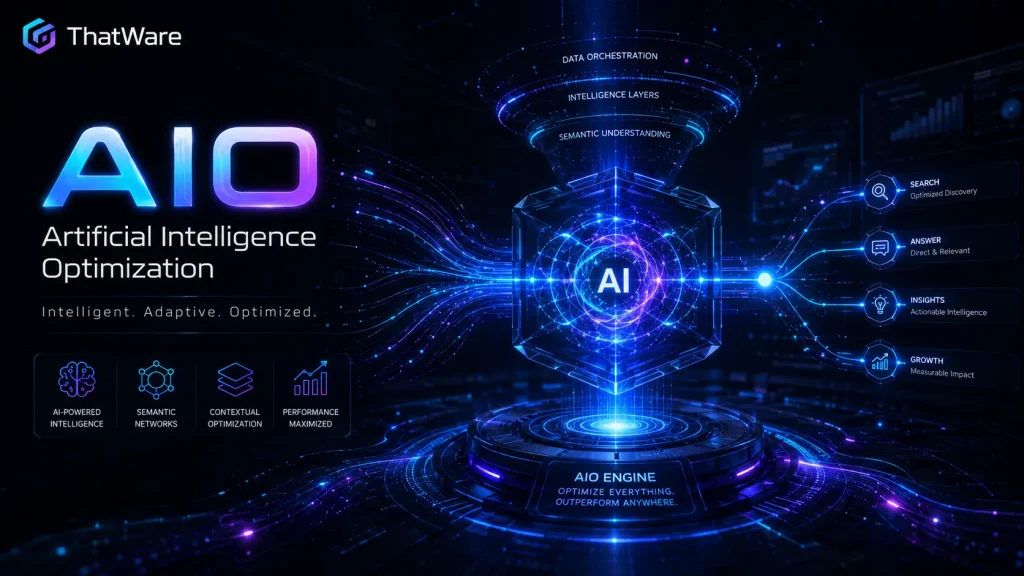
Artificial Intelligence Optimization, or AIO, is designed for the new search environment where visibility is no longer controlled only by keyword rankings. Search engines and AI platforms are changing how users discover information. Instead of showing only a list of links, platforms like Google AI Overviews, ChatGPT, Gemini, Perplexity, Copilot, Claude, and voice assistants now generate direct answers, summaries, comparisons, and recommendations.
This means your website has to do more than rank. It must be understandable to AI systems. It must provide clear answers. It must show authority. It must be structured in a way that AI can read, extract, summarize, and trust.
That is where AIO becomes important.
AIO focuses on making your brand, website, and content suitable for AI-driven discovery. It helps your pages become more answer-ready, more machine-readable, more trustworthy, and more likely to be selected inside AI-generated results. Traditional SEO still matters, but AIO adds a new layer: it prepares your content for the way artificial intelligence now interprets and presents information.
ThatWare’s AIO approach is built around the idea that modern visibility is no longer just about ranking on a page. It is about becoming the source AI systems use when answering user questions.
Why AIO Is Different from Traditional SEO
Traditional SEO usually focuses on search rankings, keyword targeting, technical optimization, backlinks, metadata, and organic traffic. These elements are still valuable. However, they do not fully solve the challenge of AI-driven search.
AI systems behave differently from traditional search engines. They do not always show ten blue links. They may generate one answer, cite a few sources, recommend a brand, or summarize the best available information. In many cases, the user may make a decision without clicking through multiple websites.
AIO works on this new layer of search.
It asks questions like:
Can AI understand what your page is about?
Can AI extract a clear answer from your content?
Does your website provide enough context?
Is your brand trusted enough to be cited?
Can your content be summarized without losing meaning?
Are your entities, schema, and authority signals clear?
Does your page answer the real question behind the user’s prompt?
ThatWare’s AIO guide explains the shift clearly: AI search systems interpret conversational queries, synthesize information from multiple sources, and deliver summarized responses instead of simply ranking links.
In simple terms, SEO helps your content compete for rankings. AIO helps your content compete for inclusion inside AI-generated answers.
Detailed AIO Deliverables
1. AIO Strategy & AI Search Roadmap
Every AIO campaign begins with a strategy. This is where we study your website, business model, service pages, existing content, search visibility, competitors, brand authority, and current AI search presence.
The goal is to understand how ready your website is for AI-driven discovery. A page may rank well on Google but still be difficult for AI systems to extract, summarize, or trust. Another page may have useful information but lack structure, citations, schema, or direct answers.
The AIO roadmap defines what needs to be improved first. Some websites need better content clarity. Some need more direct answer blocks. Some need stronger FAQ sections. Some need entity optimization, schema, trust signals, or AI-friendly formatting. Others need a stronger content ecosystem around important topics.
This roadmap gives the campaign structure. It ensures every monthly deliverable supports one larger goal: helping your brand become easier for AI systems to understand, choose, and present.
2. AI Search Visibility Audit
The AI Search Visibility Audit checks how your brand and content currently appear across AI-driven discovery environments.
This audit may review visibility across Google AI Overviews, ChatGPT-style responses, Gemini, Perplexity, Copilot, Claude, voice assistants, and other answer-led search experiences where relevant.
The audit looks at whether your brand is visible, whether competitors are being recommended instead, whether your content is being cited, and whether AI systems understand your business correctly.
It also checks the website itself. We review whether your content is clear, whether important questions are answered, whether schema is present, whether trust signals are strong, whether content is structured for extraction, and whether the brand entity is consistent.
ThatWare’s AI Search Intelligence resource explains that many brands may rank in traditional search but remain absent from AI-generated answers, which is exactly the gap AIO is designed to address.
This audit becomes the starting point for the campaign. It shows what is working, what is missing, and where the best opportunities exist.
3. AI Content Readiness Review
AIO depends heavily on content readiness. AI systems need content that is clear, structured, factual, and easy to extract. If the content is vague, thin, scattered, or too promotional, AI may not use it.
The AI Content Readiness Review studies whether your pages are suitable for AI understanding.
We review:
Content clarity
Topic depth
Answer structure
Heading flow
FAQ quality
Use of definitions
Internal linking
Trust signals
Entity references
Schema support
Readability
Source clarity
Freshness
AI extractability
A page that is ready for AI should answer the user’s question quickly and then provide enough supporting detail. It should not bury the answer under long introductions. It should not rely only on keywords. It should explain the topic in a way that both humans and machines can understand.
This deliverable helps identify which pages need rewriting, restructuring, expansion, or stronger answer formatting.
4. Prompt & Conversational Query Research
AI search is conversational. Users do not always type short keywords. They ask full questions and expect direct answers.
For example, a traditional search may be:
“AI SEO agency”
But an AI prompt may be:
“Which company can help my website appear in AI-generated answers?”
“How do I optimize my content so ChatGPT can understand it?”
“What is the best agency for Artificial Intelligence Optimization?”
“How can my business get cited in Google AI Overviews?”
“What is the difference between SEO, AEO, GEO, and AIO?”
Prompt and Conversational Query Research identifies these natural-language queries. We study how users may ask questions across AI systems, voice search, Google AI Overviews, and conversational platforms.
This research helps shape content strategy. It shows which questions your website should answer, which pages need new sections, which FAQs should be added, and which high-intent topics need stronger coverage.
ThatWare’s AIO guide explains that modern AI tools interpret queries conversationally and synthesize information from multiple sources, which makes prompt-led optimization essential.
5. Answer-First Content Structuring
AIO requires a different style of content. Instead of writing long introductions before reaching the point, answer-first content gives the main answer early and then expands with supporting details.
This is important because AI systems often look for content that can be extracted and summarized quickly.
Answer-first content structuring may include:
Short definitions
Clear summaries
Direct answer blocks
Question-led headings
Step-by-step explanations
FAQ sections
Comparison blocks
Service breakdowns
Concise introductions
Supporting context after the answer
For example, if a user asks “What is AIO?”, the content should not begin with several vague paragraphs about the future of digital marketing. It should first define AIO clearly, then explain why it matters.
This structure improves readability for users and makes the content easier for AI systems to use in generated responses.
6. AI-Ready Content Optimization
AI-ready content optimization improves your existing pages so they are more useful to users and more understandable to AI systems.
This may involve rewriting unclear sections, improving headings, adding missing context, expanding thin content, creating answer blocks, improving FAQs, adding examples, strengthening trust signals, and organizing the page more logically.
The goal is not to make content sound robotic. The goal is to make it clearer, more helpful, and more structured.
A strong AIO-optimized page should explain:
What the topic is
Why it matters
Who it helps
How it works
What benefits it provides
What makes the brand credible
What the user should do next
ThatWare’s AI Search Optimization playbook explains that AI search optimization is about becoming the source inside an answer, not only ranking as a page. It also emphasizes that AI systems need content that is clear, structured, and trustworthy.
This deliverable helps your website become a better candidate for AI-generated answers.
7. Direct Answer Block Creation
Direct answer blocks are one of the most practical AIO deliverables. These are short content sections designed to answer important questions clearly.
They are useful for AI Overviews, featured snippets, People Also Ask results, voice search, ChatGPT-style responses, and other answer-based environments.
A direct answer block usually starts with a simple answer, followed by a short explanation. For example:
What is Artificial Intelligence Optimization?
Artificial Intelligence Optimization is the process of improving website content, structure, and authority signals so AI systems can understand, extract, trust, and present the content as a reliable answer.
This type of section gives AI systems a clean answer to retrieve. It also helps users quickly understand the topic.
We create answer blocks for important service questions, pricing questions, comparison questions, process questions, and buyer concerns.
For pricing pages, this is especially valuable because visitors want quick clarity before reading the full details.
8. FAQ Optimization for AI Answers
FAQs are important because AI systems are naturally question-and-answer driven.
AIO-focused FAQ optimization includes researching, writing, improving, and structuring questions that users may ask before making a decision. These questions may cover service scope, pricing, timelines, results, process, comparisons, trust, technical requirements, and expected outcomes.
A weak FAQ gives generic answers. A strong AIO FAQ provides clear, useful, and specific responses.
For example, instead of writing:
“Yes, AIO helps AI search.”
A better answer would be:
“AIO helps AI search visibility by making your content easier for AI systems to understand, summarize, and trust. It improves answer blocks, schema, content clarity, entity signals, and citation readiness so your website has a stronger chance of being selected in AI-generated responses.”
This is more useful for users and more suitable for AI extraction.
Where appropriate, FAQ schema can also be added to support structured understanding.
9. Semantic Content Expansion
AI systems need context. A page that only repeats a keyword does not provide enough meaning. Semantic Content Expansion improves the depth of the page by adding related ideas, supporting explanations, examples, subtopics, entities, and user questions.
For AIO, semantic depth is essential.
A page about Artificial Intelligence Optimization should naturally cover topics such as AI search, answer engines, LLMs, content extraction, schema, entity SEO, trust signals, conversational queries, RAG readiness, citations, and AI-generated answers.
This does not mean making content unnecessarily long. It means making it complete.
Search engines and AI systems are better at understanding relationships between concepts. Content that explains a topic fully has a stronger chance of being selected as a reliable source.
Semantic expansion also improves user experience because visitors get a more complete understanding without needing to visit several other pages.
10. Entity SEO & Brand Understanding
AI systems need to understand your brand as an entity. An entity is a clearly identifiable thing, such as a company, person, service, product, place, or concept.
If your brand entity is unclear, AI systems may not confidently recommend your business.
Entity SEO focuses on strengthening how your brand is represented across your website and the wider web. This may include your About page, service pages, founder information, author profiles, social profiles, business listings, schema, reviews, press mentions, case studies, and third-party citations.
The goal is to help AI systems understand:
Who you are
What you offer
Where you operate
Who you serve
What you are known for
Why you are credible
How your brand connects to the topic
ThatWare’s AI SEO resources emphasize that modern AI optimization prioritizes meaning, relationships, contextual relevance, entity relationships, and authority signals rather than relying only on traditional keyword placement.
Strong entity signals make your brand easier for AI systems to recognize and trust.
11. Schema & Structured Data Implementation
Schema markup is a machine-readable layer that helps search engines and AI systems understand your website.
For AIO, schema is important because it gives structured context about your organization, services, articles, FAQs, products, reviews, authors, breadcrumbs, locations, and web pages.
Relevant schema may include:
Organization Schema
Local Business Schema
Service Schema
FAQ Schema
Article Schema
WebPage Schema
Breadcrumb Schema
Person Schema
Review Schema
Product Schema
HowTo Schema, where suitable
Schema does not replace good content. It supports good content.
A clear page explains the topic to people. Schema helps machines classify and interpret that page correctly.
This deliverable improves search engine understanding, supports rich results, improves answer readiness, and helps AI systems process your content with more confidence.
12. AI Trust Signal Optimization
AI systems are more likely to select content from sources that appear reliable, consistent, and authoritative.
AI Trust Signal Optimization strengthens the proof around your brand. This may include improving reviews, testimonials, case studies, awards, certifications, media mentions, business credentials, author bios, founder profiles, client success stories, and transparent company information.
Trust signals matter because AI systems do not only evaluate what a page says. They also evaluate whether the source appears credible.
For service businesses, this is especially important. A page can explain a service well, but if there is no proof behind the brand, users and AI systems may hesitate.
AIO improves the trust layer around your content so it becomes more believable and more likely to be selected.
13. Citation & Source Signal Building
AI systems often depend on credible sources when generating answers. If your brand has little external validation, it may be harder for AI systems to trust it.
Citation and Source Signal Building focuses on strengthening your brand footprint across credible third-party platforms. This may include business directories, industry websites, review platforms, partner pages, media mentions, interviews, case studies, social profiles, and knowledge resources.
The goal is not random link building. The goal is credibility and consistency.
When multiple reliable sources confirm your brand, services, expertise, and authority, AI systems have more confidence in your business.
This deliverable supports AI visibility, entity recognition, traditional SEO, local SEO, and brand trust.
14. RAG & Retrieval Readiness
RAG stands for Retrieval-Augmented Generation. Many AI systems retrieve information from external sources before generating an answer.
RAG readiness means your content is structured so AI systems can find, extract, and use it correctly.
This may include improving:
Headings
Summaries
Answer blocks
FAQ sections
Internal links
Schema
Entity references
Source clarity
Content chunking
Factual accuracy
Topical depth
ThatWare’s AI Search Intelligence resource explains that modern AI visibility depends on whether systems choose to cite, recommend, or reference a brand when generating answers.
RAG readiness helps your content become more useful in that process. It prepares your website for AI systems that retrieve and synthesize information before responding to users.
15. AI Overview Optimization
Google AI Overviews are changing how users interact with search results. Instead of only clicking through pages, users may receive a summarized AI-generated response directly in search.
AI Overview Optimization focuses on improving the chances that your content can support these summaries.
This includes direct answers, structured headings, factual clarity, topical depth, schema, FAQs, source credibility, and strong page-level relevance.
ThatWare’s resources discuss AI Overview optimization as a growing part of modern visibility, especially as featured snippets, voice search, and AI-generated results become more important in the search ecosystem.
The goal is to make your content more suitable for summary-based search environments where clarity and authority matter.
16. AI Platform Readiness
AIO is not limited to Google. Users now discover brands across multiple AI systems.
AI Platform Readiness focuses on preparing your content and brand signals for platforms such as ChatGPT, Gemini, Perplexity, Copilot, Claude, voice assistants, and other AI-powered environments.
Each platform may retrieve, process, and present information differently. However, the core requirements remain similar: clarity, structure, trust, entity strength, citations, and answer-ready content.
ThatWare’s AI Search Optimization playbook explains that AI systems retrieve information, evaluate trust, and compose answers rather than simply ranking pages and sending users to links.
This deliverable helps your website become more adaptable across the wider AI search ecosystem.
17. Content Formatting for AI Extraction
AI systems often process content in chunks. If your content is poorly formatted, the most important information may be difficult to extract.
Content Formatting for AI Extraction improves how information is presented on the page.
This may include:
Shorter paragraphs
Clear headings
Question-based sections
Summary blocks
Bulleted explanations where useful
Tables where suitable
Definitions
FAQs
Step-based explanations
Internal links
Schema-supported content blocks
The content should still feel natural. It should not look like it was written only for machines.
Good formatting improves both user experience and AI readability. Visitors can scan the page easily, and AI systems can identify important information more accurately.
18. Human Tone & Editorial Refinement
AIO content should not sound robotic. One of the biggest mistakes brands make is creating content that is technically optimized but boring, repetitive, or obviously AI-written.
Human Tone & Editorial Refinement improves the content so it sounds natural, confident, and useful.
This may include rewriting generic sections, improving transitions, removing repetition, adding practical examples, strengthening explanations, simplifying jargon, and making the content feel more consultative.
For pricing pages, this is extremely important. Users want to understand the service clearly, but they also want to feel that a real expert is behind the offer.
The goal is to create content that works for AI systems without losing human trust.
19. Internal Linking for AI Context
Internal linking helps search engines and AI systems understand how your pages relate to each other.
For AIO, internal links should connect related concepts naturally. A page about Artificial Intelligence Optimization may link to supporting pages about AI Search Visibility, AEO, GEO, LLM SEO, Entity SEO, RAG SEO, Semantic SEO, Schema, AI TXT, and content optimization.
This creates a stronger knowledge structure.
Internal linking also helps users explore related topics and understand your full service ecosystem.
A strong internal link structure improves crawlability, topical authority, page discovery, and AI context.
20. Competitor AI Answer Analysis
Competitor analysis in AIO is different from standard SEO competitor research.
Instead of only checking rankings and backlinks, we also study which competitors are appearing in AI-generated answers, which sources are being cited, what type of content AI systems seem to prefer, and where your brand is missing.
This analysis may review:
Competitor answer visibility
AI citation presence
Content structure
FAQ quality
Schema usage
Entity strength
Trust signals
Third-party mentions
Topical coverage
Prompt-level recommendations
The goal is to understand why competitors may be selected by AI systems and how your brand can become a stronger candidate.
This deliverable helps turn AI visibility gaps into practical optimization opportunities.
21. AI Inclusion Monitoring
AIO is not a one-time setup. Once optimization begins, it is important to monitor whether your brand is appearing in AI-generated results.
AI Inclusion Monitoring may include checking selected prompts, reviewing AI-generated brand mentions, tracking competitor appearances, identifying inaccurate descriptions, and observing whether your content is being cited or summarized.
This helps refine the campaign over time.
If AI systems are not selecting your content, we can review what signals may be missing. If they mention your brand incorrectly, we can strengthen source-of-truth content. If competitors are being recommended more often, we can study their advantage and improve your signals.
This ongoing monitoring keeps the campaign practical and adaptive.
22. Monthly AIO Reporting & Recommendations
Monthly reporting helps explain what work has been completed and what needs to happen next.
A typical AIO report may include:
Pages optimized
Answer blocks created
FAQs improved
Schema updates
Content restructuring
Prompt research insights
AI visibility observations
Competitor findings
Entity updates
Citation recommendations
Trust signal improvements
Next-month priorities
The report should not only show activity. It should explain why each activity matters for AI search visibility.
AIO is still an evolving field, so ongoing recommendations are important. As AI platforms change how they retrieve and present information, the strategy must adapt.
23. Continuous Artificial Intelligence Optimization
Artificial Intelligence Optimization is not a one-time service. AI systems, search behavior, user expectations, and competitor strategies change constantly.
Continuous AIO ensures your website keeps improving.
Each month, content may be refined, FAQs may be expanded, answer blocks may be added, schema may be updated, internal links may be improved, and trust signals may be strengthened.
This continuous improvement helps your brand remain understandable, relevant, and competitive across AI-driven search environments.
The brands that win in AI search will be the ones that keep improving how AI systems experience their content.
Generic Monthly AIO Scope of Work
The exact scope may vary depending on the pricing plan, website size, competition, industry, and current AI visibility. However, a typical AIO campaign may include:
AIO strategy and AI search roadmap
AI Search Visibility Audit
AI Content Readiness Review
Prompt and conversational query research
Answer-first content structuring
AI-ready content optimization
Direct answer block creation
FAQ optimization for AI answers
Semantic content expansion
Entity SEO and brand understanding
Schema and structured data implementation
AI trust signal optimization
Citation and source signal building
RAG and retrieval readiness
AI Overview optimization
AI platform readiness
Content formatting for AI extraction
Human tone and editorial refinement
Internal linking for AI context
Competitor AI answer analysis
AI inclusion monitoring
Monthly AIO reporting and recommendations
Continuous Artificial Intelligence Optimization
This scope is designed to help your brand become easier for AI systems to understand, trust, extract, cite, and recommend.
What You Actually Get with AIO
AIO gives your website a stronger foundation for the AI-driven future of search.
It improves how your content is written, structured, connected, and understood. It helps your brand move beyond keyword visibility and become more suitable for answer-based discovery.
With AIO, your pages become clearer. Your FAQs become more useful. Your content becomes easier to extract. Your schema becomes stronger. Your entity signals become clearer. Your brand trust becomes more visible. Your website becomes more prepared for AI-generated answers.
This matters because the customer journey is changing. Users are asking AI platforms for direct answers, product recommendations, service comparisons, and buying guidance. If your brand is not included in those answers, you may lose visibility before the user ever reaches your website.
AIO helps close that gap.
Why AIO Matters for Modern Businesses
AI search is not a future concept. It is already changing how users discover information. Search engines and AI platforms are becoming answer engines. They are interpreting questions, summarizing sources, and presenting decisions faster than ever.
For businesses, this creates both risk and opportunity.
The risk is that your website may rank traditionally but remain absent from AI-generated answers. The opportunity is that a well-optimized brand can become a trusted source inside those answers.
ThatWare’s AIO guide explains that visibility is no longer determined only by rankings. It is increasingly determined by whether AI chooses your content as the answer.
AIO helps your business prepare for this shift. It strengthens your content, structure, authority, entity clarity, and AI-readiness so your brand has a better chance of being selected.
Make Your Brand the Answer AI Chooses
Search is moving from rankings to answers. Customers are asking AI systems for recommendations, explanations, comparisons, and trusted sources. If your brand is not optimized for this new reality, competitors may appear in AI-generated answers before users ever find your website.
ThatWare’s AIO services are designed to help your business become easier for AI systems to understand, extract, trust, and recommend.
Through a monthly scope of work covering AI visibility audits, prompt research, answer-first content, semantic optimization, FAQs, schema, entity SEO, trust signals, RAG readiness, AI Overview optimization, and continuous monitoring, AIO helps prepare your website for the next generation of search.
The goal is not only to rank.
The goal is to become the answer.