SUPERCHARGE YOUR ONLINE VISIBILITY! CONTACT US AND LET’S ACHIEVE EXCELLENCE TOGETHER!
What Is Online Reputation Management (ORM)?
In today’s digital-first world, reputation is no longer built solely through word of mouth. Every search result, review, article, social media mention, AI-generated answer, and customer interaction contributes to how people perceive your brand online.
Online Reputation Management (ORM) is the strategic process of monitoring, influencing, protecting, and improving the public perception of a business, brand, professional, or organization across digital channels.
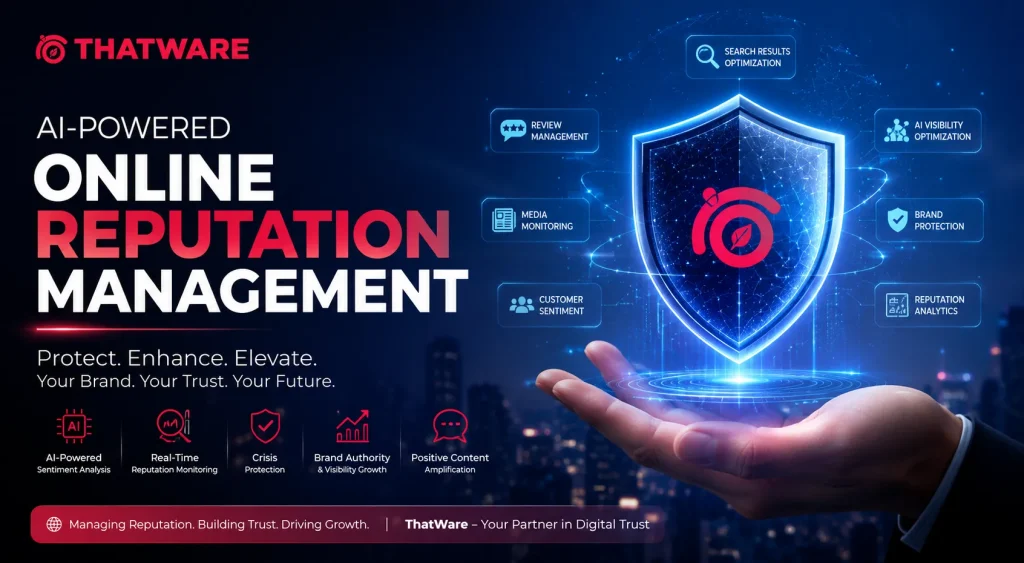
Modern ORM goes far beyond review management. It encompasses search engine visibility, brand sentiment monitoring, AI search optimization, digital public relations, entity authority building, social listening, knowledge graph enhancement, and crisis mitigation.
Consumers conduct extensive online research before making purchasing decisions. Investors analyze brand credibility before investing. Job seekers evaluate employer reputation before applying. Even artificial intelligence systems now assess brands based on their digital footprint.
This shift has transformed reputation into one of the most valuable business assets in the modern economy.
At ThatWare, we leverage advanced artificial intelligence, semantic SEO, entity optimization, machine learning, and AI Visibility Optimization frameworks to help businesses build, manage, and protect their digital reputation across both traditional and emerging search ecosystems.
Why Online Reputation Management Matters More Than Ever
The internet has fundamentally changed how trust is established.
Years ago, businesses primarily relied on advertising and referrals. Today, consumers can access thousands of opinions about a company within seconds.
Before making decisions, potential customers often:
- Read reviews
- Compare ratings
- Search company names
- Analyze social media activity
- Review news articles
- Visit forums and discussion platforms
- Ask AI assistants for recommendations
A single negative article or unresolved review can significantly influence purchasing decisions.
A strong online reputation creates:
- Higher conversion rates
- Increased customer trust
- Greater customer retention
- Stronger search visibility
- Improved brand authority
- Better recruitment outcomes
- Enhanced investor confidence
Businesses that actively manage their online reputation position themselves for long-term growth while minimizing risks associated with negative publicity or misinformation.
The Evolution of ORM in the Age of AI Search
Reputation Management Is No Longer Limited to Google
For many years, reputation management focused almost entirely on search engines and review websites.
While these channels remain important, modern consumers increasingly rely on AI-powered systems to discover and evaluate brands.
Platforms such as ChatGPT, Gemini, Perplexity, and other generative search technologies summarize information from multiple sources and present synthesized responses.
This means that brand perception is now influenced by how artificial intelligence understands and interprets your digital presence.
Organizations that fail to establish strong digital authority risk being inaccurately represented or overlooked entirely.
AI Systems Evaluate Trust Differently
Unlike traditional search engines that primarily rank web pages, AI systems evaluate entities, relationships, authority signals, citations, and contextual relevance.
Key trust signals include:
- Brand mentions
- Expert citations
- Knowledge graph associations
- Authoritative backlinks
- Review sentiment
- Consistent brand information
- Topical authority
ThatWare’s ORM framework is designed specifically to strengthen these signals and improve visibility across both traditional and AI-driven search environments.
The Hidden Cost of a Damaged Online Reputation
Many organizations underestimate the financial impact of reputation-related issues.
Negative sentiment can influence every stage of the customer journey.
Loss of Consumer Trust
Trust is often the deciding factor between two competing businesses.
When potential customers encounter negative information, uncertainty increases and conversion rates decline.
Reduced Organic Visibility
Negative search results often attract attention and reduce engagement with positive brand assets.
This can impact traffic, leads, and overall online performance.
Declining Revenue
Reputation directly affects sales.
Consumers are less likely to purchase from brands they perceive as risky, unreliable, or poorly reviewed.
Increased Marketing Costs
Businesses with weak reputations often spend more on advertising and customer acquisition because trust barriers reduce conversion efficiency.
Recruitment Challenges
Top talent researches prospective employers extensively.
A damaged employer reputation can reduce application quality and increase hiring costs.
Common Online Reputation Threats Businesses Face
Negative Reviews
Customer reviews play a critical role in purchasing decisions.
A consistent pattern of unresolved complaints can damage trust and discourage potential buyers.
Fake Reviews
Competitors, malicious actors, and automated spam campaigns can generate misleading reviews designed to harm credibility.
Review Bombing
Coordinated attacks can rapidly impact ratings and public perception.
Businesses must have systems in place to identify and address these situations.
Brand Misinformation
Inaccurate information spreads quickly online.
Incorrect business details, outdated content, and misleading claims can negatively impact consumer confidence.
Negative Media Coverage
News articles often rank prominently in search results and can significantly influence brand perception.
Social Media Backlash
Social media platforms amplify conversations rapidly.
Minor issues can escalate into larger reputation challenges if not managed effectively.
AI Hallucinations
Generative AI systems occasionally produce inaccurate information.
Brands must actively monitor how AI platforms represent their products, services, and expertise.
How Online Reputation Directly Impacts Revenue
Reputation is not merely a branding concern. It is a measurable business driver.
Organizations with strong reputations consistently outperform competitors in several areas.
Higher Conversion Rates
Trust reduces purchasing friction.
When customers perceive a business positively, they are more likely to take action.
Improved Customer Retention
Satisfied customers are more likely to remain loyal and continue purchasing over time.
Stronger Referral Activity
Positive experiences encourage recommendations, which remain one of the most effective forms of marketing.
Increased Lifetime Value
Customers who trust a brand often spend more and maintain longer relationships.
Greater Market Authority
A respected reputation positions a business as a leader within its industry.
ThatWare’s AI-Powered Online Reputation Management Framework
Most ORM providers focus primarily on reacting to negative events.
ThatWare takes a proactive, intelligence-driven approach.
AI-Powered Sentiment Intelligence
Our systems continuously analyze online conversations, reviews, media mentions, and customer feedback.
This allows us to identify emerging trends before they become major reputation issues.
Entity Optimization Framework
Search engines increasingly rely on entity recognition rather than simple keyword matching.
We strengthen your brand’s digital identity across search ecosystems, knowledge graphs, and AI systems.
Predictive Reputation Monitoring
Using machine learning models, we identify potential vulnerabilities and emerging risks before they impact brand perception.
Search Result Optimization
We strategically improve the visibility of positive and authoritative content while reducing the prominence of harmful search results.
Knowledge Graph Enhancement
Our structured data and entity optimization strategies strengthen search engine understanding of your business.
AI Visibility Optimization
ThatWare helps businesses remain visible and trustworthy within AI-generated search experiences.
Online Reputation Management Services Offered by ThatWare
Brand Monitoring and Intelligence
We continuously monitor:
- Search engines
- Review platforms
- News websites
- Forums
- Social media channels
- AI-generated search environments
Search Engine Reputation Management
We improve how your brand appears in search results through strategic content development and optimization.
Review Management
We help businesses improve customer feedback acquisition, review response processes, and reputation-building initiatives.
Digital PR Campaigns
Authority-building media placements strengthen brand credibility and trust.
Executive Reputation Management
Founders, executives, and public figures require specialized reputation strategies designed to protect personal and professional visibility.
Crisis Management
Our team develops proactive frameworks for managing reputation challenges effectively and efficiently.
Knowledge Panel Optimization
We strengthen brand authority through structured data, entity relationships, and trusted references.
AI Reputation Management
We optimize digital assets that influence how AI systems understand and represent your brand.
Online Reputation Management for Local Businesses
For local businesses, reputation often determines whether a prospect becomes a customer.
When someone searches for a nearby service provider, they are typically ready to make a decision. Whether they are looking for a dentist, attorney, contractor, restaurant, healthcare clinic, or home service provider, trust becomes the deciding factor.
Customers evaluate:
- Google Business Profile ratings
- Customer reviews
- Business responses
- Social proof
- Local citations
- Search visibility
- Brand mentions
A strong local reputation creates confidence and encourages action.
ThatWare combines Local SEO with advanced ORM strategies to help businesses strengthen visibility and trust within their target service areas. By improving customer sentiment, optimizing local search assets, and enhancing review ecosystems, we help businesses convert local searches into paying customers.
Key Benefits of Local ORM
- Improved customer trust
- Increased local search visibility
- Better review ratings
- Higher click-through rates
- Greater customer retention
- Stronger community reputation
Online Reputation Management for Enterprise Organizations
Enterprise brands operate in a far more complex reputation environment.
Large organizations must manage multiple stakeholders, departments, locations, executives, products, and customer segments simultaneously.
A reputation issue affecting one division can quickly impact the perception of the entire organization.
Enterprise ORM requires a comprehensive framework that includes:
Global Brand Monitoring
Monitoring thousands of brand mentions across digital platforms allows businesses to identify emerging opportunities and threats.
Executive Reputation Protection
Senior leadership often becomes closely associated with the corporate brand.
Protecting executive reputation strengthens organizational credibility.
Investor Confidence Management
Public perception significantly impacts investor trust and long-term business valuation.
Multi-Location Reputation Control
Organizations operating across multiple markets require consistent reputation standards and performance monitoring.
Crisis Preparedness
Preparation often determines the outcome of reputation-related incidents.
ThatWare develops proactive frameworks designed to minimize reputational damage and accelerate recovery.
Online Reputation Management for Healthcare Providers
Healthcare decisions are deeply personal.
Patients trust providers with their health, well-being, and long-term care.
As a result, online reputation plays an essential role in patient acquisition and retention.
Patients frequently evaluate:
- Physician reviews
- Practice ratings
- Patient experiences
- Search results
- Social proof
- Healthcare directories
- Online recommendations
Healthcare organizations with strong reputations often experience higher patient engagement and improved referral growth.
ThatWare helps healthcare brands strengthen digital trust through:
Patient Review Optimization
Positive patient experiences should be reflected online.
We help organizations develop sustainable review generation strategies.
Authority Building
Medical expertise must be visible across digital channels.
We strengthen authority through content, structured data, and search optimization.
Reputation Monitoring
Healthcare providers require ongoing visibility into public perception and patient sentiment.
Search Result Optimization
We help ensure prospective patients encounter accurate, trustworthy, and helpful information.
Online Reputation Management for eCommerce Brands
Trust directly impacts online sales.
Consumers often compare multiple brands before making purchasing decisions.
A single negative experience can influence hundreds or thousands of potential buyers if it gains visibility.
Successful eCommerce ORM focuses on:
Product Reputation
Product reviews frequently influence purchasing behavior more than advertising campaigns.
Customer Experience Signals
Shipping, support, returns, and fulfillment experiences all contribute to reputation.
Brand Trust
Customers prefer purchasing from businesses they perceive as credible and reliable.
Marketplace Reputation
Brands selling through multiple channels require consistent reputation management across platforms.
Review Optimization
Authentic customer feedback strengthens conversion rates and builds long-term trust.
ThatWare helps eCommerce businesses establish stronger credibility while improving visibility across search engines and digital marketplaces.
Online Reputation Management for SaaS and Technology Companies
Technology buyers conduct extensive research before purchasing software solutions.
Trust becomes especially important when customers commit to recurring subscriptions or long-term contracts.
Prospects commonly evaluate:
- Product reviews
- Case studies
- Industry recognition
- Analyst reports
- User communities
- Online discussions
- Search visibility
A strong reputation shortens sales cycles and increases conversion rates.
ThatWare helps SaaS organizations build authority through:
Thought Leadership Development
Positioning your organization as an industry authority strengthens trust.
Review Ecosystem Management
Technology review platforms influence purchasing decisions significantly.
AI Visibility Enhancement
Technology companies must remain visible across both traditional and AI-driven search environments.
Brand Authority Building
Authority increases trust among prospects, investors, and partners.
ORM and SEO: Why They Work Better Together
Many businesses treat SEO and reputation management as separate disciplines.
This approach limits effectiveness.
SEO influences what users discover.
ORM influences how users perceive what they discover.
When integrated properly, the results become significantly stronger.
Improved Click-Through Rates
Users are more likely to click on brands they trust.
Increased Organic Conversions
Positive reputation signals reduce hesitation and encourage action.
Greater Authority
Search engines reward trusted, authoritative brands.
Enhanced User Experience
A strong reputation improves customer confidence throughout the buying journey.
Sustainable Growth
Combining SEO and ORM creates long-term competitive advantages.
At ThatWare, reputation management is integrated directly into our broader search visibility ecosystem.
ORM and AI Visibility Optimization
The future of search is increasingly driven by artificial intelligence.
Consumers now ask questions instead of typing keywords.
They seek recommendations from AI systems rather than simply reviewing lists of websites.
This shift creates new challenges for reputation management.
Brands must now consider how AI systems perceive and interpret their digital presence.
Why AI Visibility Matters
AI systems gather information from numerous sources before generating responses.
They evaluate:
- Entity relationships
- Trusted citations
- Brand mentions
- Authority signals
- Semantic relevance
- Digital trust indicators
If your business lacks sufficient authority signals, AI platforms may provide incomplete or inaccurate representations.
How ThatWare Solves This Challenge
Our AI Visibility Optimization framework strengthens:
- Entity authority
- Knowledge graph associations
- Semantic relevance
- Citation consistency
- Brand credibility
- Digital trust signals
This helps ensure your brand remains visible and accurately represented across emerging AI ecosystems.
Key Metrics We Track
Successful reputation management requires measurable outcomes.
ThatWare monitors a wide range of performance indicators to evaluate progress and identify opportunities.
Search Visibility Metrics
- Branded keyword rankings
- Search result quality
- Knowledge panel performance
- Search sentiment trends
Review Metrics
- Review volume
- Review quality
- Average ratings
- Review response rates
Sentiment Metrics
- Positive sentiment trends
- Negative sentiment trends
- Brand mention analysis
- Customer perception indicators
Authority Metrics
- Media mentions
- Citation growth
- Entity recognition
- Trust signal development
AI Visibility Metrics
- Brand representation accuracy
- Entity strength
- Knowledge graph presence
- AI search visibility performance
Why Choose ThatWare for Online Reputation Management?
Many ORM agencies continue using outdated methodologies focused solely on review management and basic search suppression.
ThatWare approaches reputation management from a completely different perspective.
We combine:
- Artificial Intelligence
- Machine Learning
- Semantic SEO
- Entity Engineering
- Knowledge Graph Optimization
- AI Visibility Optimization
- Digital PR
- Reputation Intelligence
Our objective is not simply to manage your reputation.
Our objective is to create a resilient digital trust ecosystem that strengthens your authority, visibility, and long-term business growth.
Every strategy is customized according to your industry, competitive landscape, goals, and reputation challenges.
Whether you are protecting an established brand or building a new one, our team develops solutions designed for sustainable success.
Online Reputation Management: Where Digital Trust Is Heading
The concept of reputation management is evolving faster than ever before.
A decade ago, businesses primarily worried about customer reviews and occasional negative press. Today, reputation exists across an interconnected ecosystem of search engines, social platforms, online communities, digital publications, voice assistants, recommendation systems, and artificial intelligence models.
The organizations that understand this shift are gaining a significant competitive advantage.
Those that continue using outdated ORM practices risk losing visibility, trust, and market share.
As digital ecosystems become increasingly intelligent, businesses must adapt their reputation strategies accordingly.
The Rise of Entity-Based Reputation Management
Search engines no longer evaluate websites the same way they did years ago.
Google’s Knowledge Graph, Natural Language Processing systems, and entity recognition technologies have transformed how brands are understood online.
Instead of analyzing only keywords and backlinks, search engines now evaluate:
- Brand entities
- Person entities
- Product entities
- Organization entities
- Location entities
- Relationship signals
- Trust signals
- Contextual relevance
In simple terms, Google and other search engines want to understand who you are, what you do, how authoritative you are, and whether users trust you.
This evolution has fundamentally changed reputation management.
A business with strong entity signals can often outperform competitors with larger marketing budgets because search engines have greater confidence in the brand’s credibility.
At ThatWare, entity engineering forms a critical component of our reputation management framework because we understand that future search visibility depends on how machines understand brands.
Why Digital Trust Has Become a Ranking Factor
Trust has become one of the most important digital assets a business can possess.
Consumers are increasingly cautious when making purchasing decisions.
They seek reassurance before investing their money, time, or personal information.
Search engines recognize this behavior.
As a result, algorithms increasingly prioritize signals that indicate:
- Expertise
- Authority
- Trustworthiness
- Credibility
- Authenticity
This means reputation management now influences search visibility directly.
A business with a stronger reputation often experiences:
Higher Engagement Rates
Users are more likely to interact with trusted brands.
They click more frequently, spend more time engaging with content, and complete more conversions.
Better Organic Performance
Search engines reward websites that consistently demonstrate authority and user satisfaction.
Increased Referral Opportunities
Strong reputations naturally attract partnerships, mentions, and recommendations.
Greater Customer Retention
Trust encourages long-term relationships and repeat business.
In many industries, reputation has become one of the most important ranking signals that cannot be replicated through technical SEO alone.
The Impact of Reviews on Modern Consumer Behavior
Reviews remain one of the most influential components of online reputation management.
However, the role of reviews has expanded significantly.
Consumers no longer rely exclusively on Google Reviews.
They actively research opinions across:
- Industry-specific platforms
- Social media channels
- Community forums
- Video platforms
- Reddit discussions
- Product review websites
- Third-party recommendation portals
Modern consumers often compare dozens of opinions before making a decision.
This behavior creates both opportunities and challenges for businesses.
Organizations that proactively manage customer experiences can generate powerful trust signals.
Businesses that ignore reviews risk allowing public perception to be shaped entirely by others.
Building a Sustainable Review Acquisition Strategy
One of the most common mistakes businesses make is only requesting reviews when problems arise.
A sustainable strategy should focus on:
- Consistent review generation
- Ethical review acquisition
- Customer satisfaction improvement
- Timely response management
- Feedback analysis
Every review provides valuable insights into customer experiences.
When analyzed correctly, reviews become a business intelligence resource rather than merely a reputation metric.
The Relationship Between ORM and Customer Experience
Many businesses treat reputation management as a marketing function.
In reality, reputation is often the direct outcome of customer experience.
A strong ORM strategy cannot compensate indefinitely for poor service quality.
Likewise, exceptional customer experiences often create positive reputation momentum naturally.
The most successful brands align reputation management with:
Customer Support
Responsive support teams create positive experiences that often translate into favorable reviews.
Product Quality
Products and services that consistently meet expectations generate stronger brand sentiment.
Communication
Clear communication reduces misunderstandings and improves customer satisfaction.
Transparency
Consumers increasingly value honesty and authenticity.
Businesses that communicate openly often recover more effectively from challenges.
ThatWare encourages organizations to view reputation management as both a marketing initiative and a business improvement framework.
How Reputation Influences Lead Generation
Lead generation and reputation are deeply connected.
Before contacting a business, prospects typically conduct extensive research.
This process often includes:
- Searching brand names
- Reviewing ratings
- Reading testimonials
- Examining case studies
- Comparing competitors
- Evaluating online authority
A strong reputation reduces friction throughout the buyer journey.
Prospects feel more confident engaging with businesses that demonstrate expertise and credibility.
This often results in:
- More qualified leads
- Higher conversion rates
- Shorter sales cycles
- Greater customer confidence
For service-based businesses especially, reputation often determines whether a prospect reaches out at all.
Brand Reputation and Crisis Prevention
Many organizations only invest in ORM after experiencing a reputation crisis.
By then, the damage has often begun.
Proactive reputation management significantly reduces risk.
Continuous monitoring allows businesses to identify:
- Negative sentiment trends
- Emerging customer complaints
- Misinformation
- Competitive attacks
- Social media escalation
- Review abnormalities
Early detection enables faster response and minimizes long-term impact.
An effective reputation strategy functions as an early warning system that protects brand equity before issues become widespread.
The Growing Importance of Reputation in AI Search
One of the most significant developments in digital marketing is the rise of AI-driven search experiences.
Users increasingly ask questions directly instead of browsing multiple websites.
AI systems now provide:
- Product recommendations
- Service recommendations
- Brand comparisons
- Industry insights
- Purchasing guidance
These systems generate responses based on available digital signals.
Brands with weak authority signals may be excluded from recommendations entirely.
This creates a new layer of reputation management.
Organizations must now optimize not only for human users but also for machine interpretation.
ThatWare’s AI Visibility Optimization framework addresses this challenge by strengthening the signals that influence AI-generated responses.
Building a Reputation That Lasts
Many reputation strategies focus exclusively on short-term results.
However, sustainable reputation management requires a long-term perspective.
Strong brands are not built overnight.
They are built through consistent actions that reinforce trust over time.
Long-term reputation growth typically involves:
Authority Development
Publishing valuable content and demonstrating expertise consistently.
Relationship Building
Developing trust with customers, partners, journalists, and industry communities.
Thought Leadership
Sharing meaningful insights that contribute value to the marketplace.
Digital Consistency
Maintaining accurate and consistent brand information across all channels.
Continuous Improvement
Using customer feedback to enhance products, services, and experiences.
The businesses that prioritize these principles create reputational advantages that become increasingly difficult for competitors to replicate.
Why Reputation Will Be the Ultimate Competitive Advantage
Technology changes rapidly.
Algorithms evolve.
Marketing channels come and go.
Consumer behavior shifts.
Yet one factor remains constant.
People prefer doing business with brands they trust.
Trust influences every stage of the customer journey.
It impacts awareness, consideration, conversion, retention, referrals, and advocacy.
As artificial intelligence continues transforming how information is discovered and consumed, trust signals will become even more important.
Organizations that invest in reputation today are not simply protecting their image.
They are building one of the most valuable business assets for the future.
A strong reputation creates resilience during market uncertainty, strengthens customer relationships, improves visibility, and supports sustainable growth for years to come.