
SUPERCHARGE YOUR ONLINE VISIBILITY! CONTACT US AND LET’S ACHIEVE EXCELLENCE TOGETHER!
Search visibility gets the click. Search experience determines what happens next.
That is the foundation of User Experience SEO, also known as Search Experience Optimization (SXO). It combines traditional SEO strategies with user experience optimization to ensure that visitors arriving from search engines can easily find relevant information, navigate smoothly, engage with the website, and take desired actions without unnecessary barriers.
In today’s search landscape, ranking alone is not enough. Search engine results pages are crowded, user expectations are higher, and attention spans are shorter. Even when your page earns the click, poor layout decisions, unclear calls to action, slow content discovery, and usability issues can waste that opportunity.
SXO helps solve that problem. It focuses on improving the post-click experience: what users do after they land on your website. That includes how far they scroll, where they click, what confuses them, where they drop off, and whether they take the next step.
This blog explains what SXO is, why it matters, how to implement it on websites, and how tools like Microsoft Clarity can be used to monitor user behavior and guide testing decisions.

What Is Search Experience Optimization (SXO)?
Search Experience Optimization (SXO) is the process of improving a website’s ability to both:
- Attract users from search engines, and
- Help those users complete their goals once they arrive
Traditional SEO is often centered on rankings, impressions, clicks, and technical optimization. SXO expands that thinking by asking a deeper question:
What happens after the click?
A page may rank well and still perform poorly if users land on it and immediately bounce, fail to scroll, miss the CTA, get confused by the layout, or cannot complete an action.
SXO connects SEO with user behavior insights. It uses data such as:
- Scroll depth
- Click behavior
- Dead clicks
- Rage clicks
- Quick backs
- Time on page
- Session recordings
- Heat maps
- CTA interactions
- Form completions
- Phone call clicks
Instead of guessing what users want, SXO lets you observe real behavior and optimize based on evidence.
SXO by the Numbers: Turning Search Experience into Growth
As per the latest reports and findings, India’s digital landscape is increasingly mobile-first, with over 90% of internet traffic coming from mobile devices. Integrated SXO strategies can reduce bounce rates by up to 20%, while aligning search intent, UX, and CRO on landing pages may drive up to 47% higher organic lead generation. These figures highlight why brands must look beyond rankings and focus on speed, usability, engagement, and conversions. Tracking metrics such as Core Web Vitals, dwell time, bounce rate, and task completion enables businesses to continuously optimize the complete search journey.
Why SXO Matters More Than Ever
Search is changing. Winning visibility is harder, and even when you do win the click, users decide within seconds whether your page is worth their time.
That means a page has to do more than rank. It must also:
- Match search intent clearly
- Deliver the answer fast
- Reduce confusion
- Make the next step obvious
- Support conversion goals
SXO matters because it improves both user satisfaction and business performance.
When users have a smoother experience, they are more likely to:
- Stay longer on the page
- Scroll deeper into content
- Click important elements
- Explore more pages
- Submit forms
- Call the business
- Move further down the funnel
You cannot fully control the search engine results page, but you can control the experience people have on your website after they click. That is where SXO creates value.
SXO vs SEO: What Is the Difference?
SEO and SXO are closely related, but they are not the same thing.
SEO focuses on:
- Rankings
- Keywords
- Technical health
- Crawlability and indexability
- Metadata
- Backlinks
- Content optimization
- Search visibility
SXO focuses on:
- Post-click experience
- User behavior
- Ease of navigation
- Content discoverability
- Conversion paths
- UX friction removal
- Behavior-based testing
- Engagement and outcomes
A simple way to think about it:
SEO gets people to the page. SXO helps them do something useful once they get there.
The strongest digital strategies use both together.
Core Elements of SXO
To implement SXO well, you need to pay attention to several layers of the website experience.
1. Search intent alignment
The page should immediately show users they are in the right place. The headline, supporting copy, and structure should match what they expected when they clicked.
2. Above-the-fold clarity
Users should quickly understand:
- What the page is about
- Why it matters
- What action they can take next
3. Friction reduction
Anything that slows, distracts, or confuses users creates friction. That includes oversized hero images, weak CTA placement, hidden key information, confusing layouts, or non-clickable elements users expect to work.
4. Behavioral insight
SXO depends on real user data. Heat maps, recordings, click tracking, and analytics reveal where users struggle.
5. Continuous testing
SXO is not a one-time redesign. It is an ongoing process of observing, hypothesizing, testing, and measuring.
The SXO Testing Workflow
A strong SXO process should be repeatable. The workflow below creates a clear structure you can use across pages, campaigns, and websites.
Step 1: Observe behavior
The first step is to gather user behavior data and identify friction points.
This is where tools like Microsoft Clarity, Hotjar, or Crazy Egg become useful. The goal is not just to collect data, but to understand what users are telling you through their actions.
You should review:
- Heat maps
- Session recordings
- Click maps
- Scroll behavior
- Time on page
- Dead clicks
- Quick backs
- Rage clicks
- CTA interactions
For example, ask questions such as:
- Are users seeing the CTA?
- Are they clicking things that are not clickable?
- Are they dropping off before reaching important content?
- Are they getting stuck on mobile?
- Are they leaving too quickly from a key landing page?
You should compare performance before and after changes whenever possible. Even simple observations can uncover clear opportunities.
What to look for during observation
Look for repeated patterns, not isolated incidents. One unusual session may not mean much. But if many users behave the same way, there is likely a real issue.
Common friction signals include:
- Low scroll depth on important pages
- High bounce behavior near the top of the page
- Frequent clicks on non-clickable elements
- CTA buttons receiving little or no engagement
- Users hesitating, re-reading, or rapidly clicking around
- Users returning to the previous page quickly
Step 2: Identify patterns and create a hypothesis
Once you observe enough behavior, the next step is to interpret it.
Ask simple but powerful questions:
Why are users bouncing here?
Why are they not clicking this?
Why are they stopping before the CTA?
Why are they clicking on something that does not work?
Why are mobile users struggling more than desktop users?
Use scroll depth, click behavior, and recordings to identify patterns that appear across multiple sessions.
Then write a clear hypothesis connecting the friction to a possible fix.
Examples:
- We believe that moving the CTA higher will increase clicks.
- We believe that simplifying the layout will reduce confusion.
- We believe that removing the large hero image will improve engagement above the fold.
- We believe that making the phone number clickable will increase call conversions.
- We believe that removing accordion friction will increase content visibility and user action.
A good SXO hypothesis should be:
- Specific
- Testable
- Based on observed behavior
- Tied to a measurable outcome
Step 3: Test and measure
Once you have a hypothesis, make one change at a time.
Keep the test focused. Do not redesign everything at once. Change one meaningful element so you can connect the result to the action.
Examples of simple SXO changes:
- Move a CTA above the fold
- Rewrite a headline
- Remove a large hero image
- Make a phone number clickable
- Simplify layout sections
- Remove an accordion
- Reduce clutter
- Clarify form labels
- Improve internal linking paths
Then measure the results using a combination of tools:
Microsoft Clarity for user behavior data
GA4 events for CTA clicks, form submissions, phone clicks, downloads, etc.
Google Search Console to evaluate whether improved experience also supports organic performance over time
The purpose is not just to “see if it feels better.” The purpose is to verify whether the change improved behavior and business outcomes.
Step-by-Step SXO Implementation Playbook for Websites
Below is a practical implementation framework you can apply page by page.
Phase 1: Preparation
Step 1: Define the page goal
Before optimizing anything, identify the main goal of the page.
Examples:
- Generate contact form submissions
- Drive phone calls
- Push users to product/service pages
- Increase time on page and content engagement
- Improve navigation to key sections
- Support local conversion actions
Without a clear goal, you cannot judge whether the experience is working.
Step 2: Choose priority pages
Do not start with every page on the site. Start with pages that matter most.
Priority pages often include:
- Homepage
- Service pages
- Location pages
- Contact page
- High-traffic blog posts
- Landing pages
- Pages with strong rankings but weak conversions
Step 3: Set up your tracking stack
To run SXO effectively, you need behavior tracking and outcome tracking.
A strong setup includes:
- Microsoft Clarity
- Google Analytics 4
- Google Search Console
Optional tools can be added later, but this stack gives a strong foundation.
Phase 2: Microsoft Clarity Setup for User Behavior Monitoring
Microsoft Clarity is especially valuable for SXO because it shows how users actually behave on the page.
What Microsoft Clarity helps you monitor
Microsoft Clarity can help you understand:
- Where users click
- How far they scroll
- Which areas get attention
- Where users get frustrated
- Whether people miss important elements
- How behavior differs across sessions and devices
How to implement Microsoft Clarity step by step
Step 1: Create a Microsoft Clarity account
Sign in and create a new project for the website you want to monitor.
Step 2: Install the Clarity tracking code
Add the Clarity script to your website. This can usually be done through:
- Direct code insertion in the site header
- Google Tag Manager
- CMS-specific settings or plugins
Step 3: Verify data collection
After installation, confirm that page views and sessions are appearing in the Clarity dashboard.
Step 4: Segment traffic if needed
Depending on your setup, you may want to isolate:
- Organic landing pages
- Key service pages
- Mobile sessions
- Conversion-focused pages
Step 5: Review behavior reports regularly
Once data accumulates, review:
- Heat maps
- Scroll maps
- Session recordings
- Rage clicks
- Dead clicks
- Quick backs
Step 6: Document friction points
Create a simple log for each page:
- What issue was found
- What user behavior supports the issue
- What change is proposed
- What metric will measure success
Why Microsoft Clarity is useful for SXO
Microsoft Clarity is helpful because it turns abstract performance problems into visible behavior patterns.
Instead of saying, “Users are not converting,” you can often say:
“Users do not scroll far enough to see the CTA.”
“Users repeatedly click the phone number, but it is not clickable.”
“Users appear confused by the accordion structure.”
“Users are interacting heavily with one area and ignoring another.”
That clarity leads to better decisions.
Phase 3: Behavior Analysis
Step 4: Analyze heat maps
Heat maps help you understand which page elements get attention and which get ignored.
Use them to evaluate:
- CTA visibility
- Navigation behavior
- Section engagement
- Click concentration
- Misleading visual hierarchy
For example, if users click an image instead of the CTA below it, the layout may be pulling attention in the wrong direction.

Step 5: Watch session recordings
Session recordings reveal friction that metrics alone cannot explain.
Use recordings to identify:
- Hesitation
- Confusion
- Repeated clicking
- Missed content
- Scroll abandonment
- Mobile usability issues
Watch enough sessions to spot repeating patterns, not random anomalies.
Step 6: Evaluate scroll depth
Scroll depth helps determine whether users are actually reaching important content.
If a critical CTA sits too low on the page and most users never reach it, the problem may not be your offer. The problem may be placement.
Step 7: Review quick backs and dead clicks
These are powerful friction signals.
- Quick backs suggest the page did not satisfy the user quickly enough
- Dead clicks suggest users expected something to happen but nothing did
Both can point directly to missed opportunities.
Phase 4: Hypothesis and Prioritization
Step 8: Turn observations into actionable hypotheses
Each hypothesis should follow a simple structure:
Observation → Problem → Proposed fix → Expected outcome
Example:
- Observation: Users stop scrolling before reaching the main CTA
- Problem: The CTA is too low on the page
- Proposed fix: Move the CTA above the fold
- Expected outcome: More clicks and deeper funnel movement
Step 9: Prioritize by impact and effort
Not every fix needs a full redesign. Start with quick wins.
High-value early tests often include:
- CTA placement
- Hero section simplification
- Clickability fixes
- Better mobile layout
- Stronger headings
- Fewer distractions
Phase 5: Testing and Rollout
Step 10: Make one change at a time
Single-variable testing helps you understand cause and effect.
Avoid changing:
- Headline
- CTA
- Layout
- Image
- Form structure
all at the same time unless it is absolutely necessary.
Step 11: Track supporting metrics
Measure both behavior changes and outcome changes.
Track metrics such as:
- CTA clicks
- Form submissions
- Phone clicks
- Scroll depth
- Pages per session
- Time on page
- Quick backs
- Organic clicks
- Funnel progression
Step 12: Compare before and after
Create a simple reporting structure showing:
Original state
What changed
Before metrics
After metrics
Insights
Recommendation for next step
This is especially useful for stakeholder buy-in.
Real Examples of SXO Testing and Results
SXO becomes easier to understand when you look at real examples of small changes producing meaningful results.
1. Removing a large hero image
Large hero images can look visually appealing, but they often consume valuable above-the-fold space and delay access to content.
Replacing a large hero image with a clear headline and CTA led to:
- Pages per session increasing by 81.39%
- Time on page increasing by 158.33%
- Scroll depth increasing by 18.62%
This is a strong example of reducing visual friction and helping users reach meaningful content faster.
2. Making a phone number clickable
On one contact page, users clicked the phone number expecting it to work, but it was not clickable.
This is a classic dead-click issue.
Once the number was made clickable, phone call clicks increased by 137.5%.
Sometimes the highest-impact SXO improvements are not dramatic redesigns. They are simple usability fixes.
3. Removing an accordion
Accordions can organize content, but they can also create friction, especially on mobile devices where users may not realize more information is hidden.
In one test, removing the accordion led to:
- Quick backs dropping from 15.79% to 13.22%
- Scroll depth increasing by 14.7%
- “Request quote” clicks increasing by 66.7%
Rankings improved as well, even though that was not the primary goal.
This shows how improving user experience can indirectly support search performance.
4. Moving a homepage CTA above the fold
Sometimes homepage content is not the problem. The issue is that users do not know where to go next.
Adding an “Our Programs” CTA above the fold created a clearer next step for users.
As a result, one program CTA saw clicks increase by 134.37%, helping drive more visitors down the funnel.
This is a strong reminder that clarity often beats complexity.
How to Use Microsoft Clarity in an SXO Workflow
Microsoft Clarity is not just a session recording tool. In an SXO workflow, it becomes a decision-making tool.
Practical ways to use Microsoft Clarity
1. Detect friction above the fold
Check whether users engage with the top section of a page or abandon it quickly.
2. Find dead-click opportunities
Users often reveal hidden intent through clicks on non-clickable elements. These are often easy wins.
3. Evaluate CTA visibility
See whether users notice, reach, and interact with your CTAs.
4. Understand mobile behavior
Many UX issues are device-specific. Use recordings and scroll maps to identify mobile friction.
5. Compare behavior before and after a change
If you reduce a hero image, move a CTA, or simplify layout, compare how user behavior changes after implementation.
6. Support hypotheses with evidence
Behavior data helps you move from opinion-based design discussions to evidence-based optimization.
7. Build a testing archive
Over time, Clarity can help create a library of lessons:
- What types of layouts confuse users
- Which CTA positions work better
- Which page structures increase engagement
- Which friction patterns repeat across the site
Recommended SXO Metrics to Track
SXO should be measured using a mix of behavioral, engagement, and outcome metrics.
Behavioral metrics
- Scroll depth
- Dead clicks
- Rage clicks
- Quick backs
- Click concentration
- Session recordings insights
Engagement metrics
- Time on page
- Pages per session
- CTA click-throughs
- Interaction with key sections
- Navigation depth
Conversion metrics
- Form submissions
- Phone call clicks
- Quote requests
- Newsletter signups
- Downloads
- Appointment bookings
Search performance metrics
- Organic clicks
- Landing page CTR
- Landing page engagement quality
- Search Console trends over time
How to Get Buy-In From Clients or Stakeholders
SXO is easier to sell internally when you position it as testing, not opinion.
Do not say:
“We want to change the page because it looks better.”
Say:
“We noticed users are not scrolling past the header, and we want to test a smaller hero so users reach the CTA faster.”
This changes the conversation.
Instead of asking people to trust a subjective design preference, you present:
User behavior data
A friction point
A testable hypothesis
A measurable business outcome
Stakeholders respond better when you tie improvements to outcomes such as:
- More CTA clicks
- More calls
- More form fills
- Fewer quick backs
- Better engagement
- Improved ROI
Before-and-after metrics make the case stronger than design opinions ever could.
Common SXO Improvements You Can Implement on Websites
Here are some of the most common website changes that support SXO:
Improve the hero section
- Reduce oversized images
- Add a clear headline
- Make the main CTA obvious
- Ensure key value appears immediately
Improve CTA placement
- Put important actions above the fold
- Repeat CTAs strategically lower on the page
- Use clear action language
Remove click friction
- Make phone numbers clickable
- Make expected links functional
- Fix dead-click areas
Simplify layouts
- Reduce clutter
- Remove unnecessary sections
- Improve hierarchy
- Break up dense content
Rethink hidden content
- Test whether accordions are helping or hurting
- Expose important information directly if users miss it
Improve mobile UX
- Reduce tapping friction
- Fix spacing issues
- Ensure key actions are accessible early
Clarify next steps
- Help users know what to do after reading
- Use strong internal linking and CTA flow
A Simple SXO Weekly Workflow for Teams
Here is a practical weekly rhythm for implementing SXO consistently.
Monday: Review behavior data
Check Microsoft Clarity recordings, heat maps, scroll maps, and key GA4 events.
Tuesday: Document friction points
List page-level issues and identify repeat patterns.
Wednesday: Create hypotheses
Write one or two simple test hypotheses for priority pages.
Thursday: Implement one change
Launch the test or page update.
Friday: Check early signals
Review initial behavior trends and log observations.
Over time, this creates a repeatable process instead of random redesign decisions.
Best Practices for Successful SXO
To make SXO sustainable and effective, follow these principles:
- Start with important pages
- Work on pages that influence revenue, leads, or critical user journeys.
- Base decisions on behavior
- Do not assume you know why users are struggling. Watch the data.
- Make focused changes
- Avoid changing too many things at once.
- Measure what matters
- Track actions tied to real outcomes, not vanity metrics alone.
- Keep testing
- SXO is ongoing. Every insight can lead to the next improvement.
- Think beyond rankings
- The goal is not only to get traffic. The goal is to help users succeed once they arrive.
Final Thoughts: Optimize for What Happens After the Click
Clicks are becoming less reliable as a standalone success metric. That is the reality of modern search.
SXO is how websites adapt.
As search results evolve, SEO is no longer just about visibility. It is also about usability, clarity, and post-click value. By improving the experience after the click, you increase the likelihood that users will engage, scroll, click, call, submit, and convert.
You may not control the search engine results page, but you do control what happens when someone lands on your website.
That is where Search Experience Optimization matters most.
And that is how you make every click count.
Bonus: Quick SXO Implementation Checklist
Use this as a simple starting checklist for your website:
- Define the goal of the page
- Install Microsoft Clarity
- Set up GA4 event tracking
- Review heat maps and session recordings
- Measure scroll depth and CTA visibility
- Identify dead clicks and quick backs
- Write a hypothesis based on repeated behavior
- Implement one change at a time
- Measure before-and-after impact
- Report results and repeat the cycle
Microsoft Clarity Screenshots from the Website: Visual Examples and Brief Interpretation
The screenshots below show how Microsoft Clarity and related reporting views can support an SXO workflow. Each visual is paired with a short explanation so the examples connect back to the framework described in the blog.
Figure 1. User mix overview
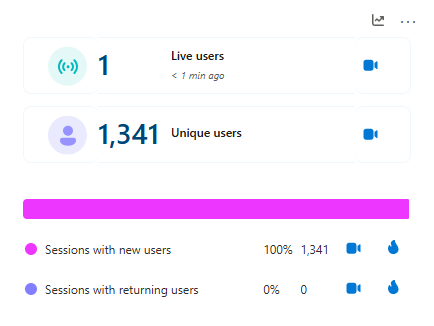
Figure 1. User mix overview
This dashboard shows 1,341 unique users and almost all sessions coming from new visitors. For SXO, that matters because first-time users need fast orientation, immediate trust signals, and clear above-the-fold direction.
Figure 2. User intent distribution
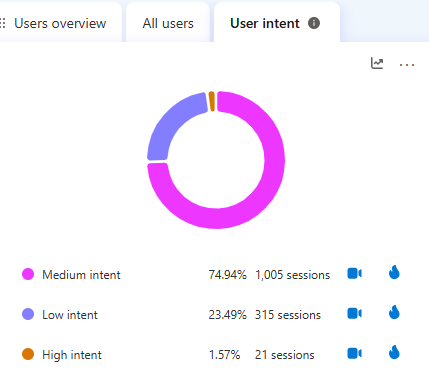
Figure 2. User intent distribution
Most sessions fall into medium intent (74.94%), followed by low intent (23.49%), with only a small share of high-intent visits. This suggests the site should educate and guide users more clearly rather than assuming they are ready to convert instantly.
Figure 3. Traffic sources snapshot
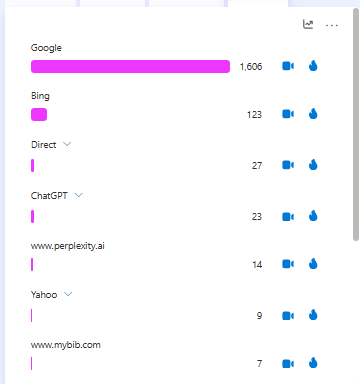
Figure 3. Traffic sources snapshot
Google is the dominant acquisition source by a wide margin, which reinforces why search-led landing page experience matters. When organic search drives most sessions, improvements to post-click clarity can have outsized impact.
Figure 4. Additional referral sources

Figure 4. Additional referral sources
The long tail of referrals includes ChatGPT, Facebook, Perplexity, and other websites. This means pages should be understandable even for visitors arriving with mixed context and different expectations.
Figure 5. Browser mix
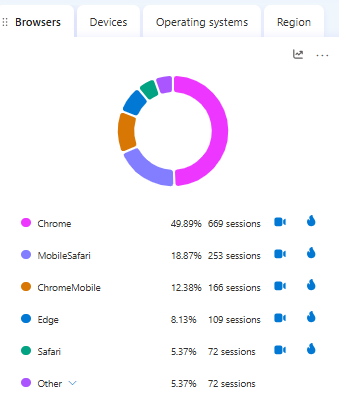
Figure 5. Browser mix
Chrome accounts for roughly half of sessions, while Mobile Safari and Chrome Mobile together represent a large mobile share. That makes responsive design, tap targets, and mobile-first CTA visibility essential in any SXO plan.
Figure 6. Geographic distribution
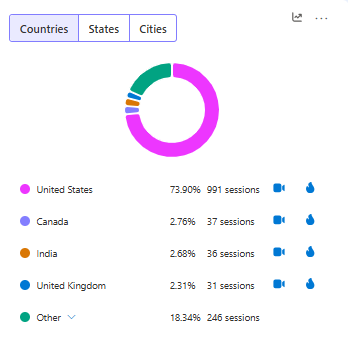
Figure 6. Geographic distribution
The audience is led by the United States, with smaller volumes from Canada, India, and the United Kingdom. Geographic concentration can help prioritize primary audience messaging while still keeping content broadly understandable.
Figure 7. Friction signals
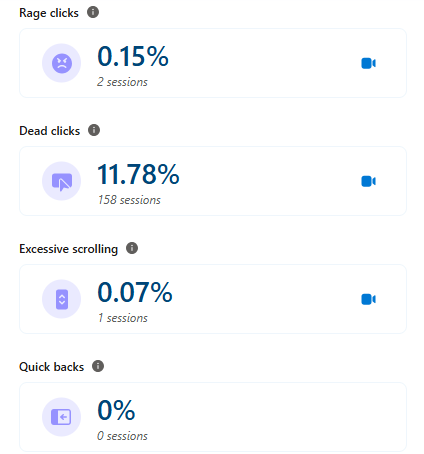
Figure 7. Friction signals
Dead clicks are the clearest friction point here at 11.78%, while rage clicks and excessive scrolling remain low. This is a classic SXO cue that users expect certain elements to work or reveal more information than they currently do.
Figure 8. JavaScript errors view
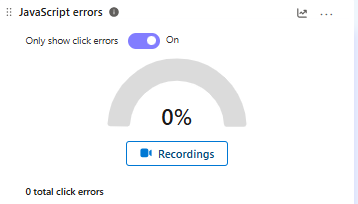
Figure 8. JavaScript errors view
The JavaScript errors panel shows no click-related errors in this sample. That does not remove UX friction, but it helps rule out broken click handling as the main cause of dead-click behavior.
Figure 9. Key action clicks

Figure 9. Key action clicks
Outbound clicks, contact interactions, form submits, and search actions can be tracked as meaningful behavioral signals. These are the types of actions SXO teams should measure before and after page changes.
Figure 10. Site performance overview
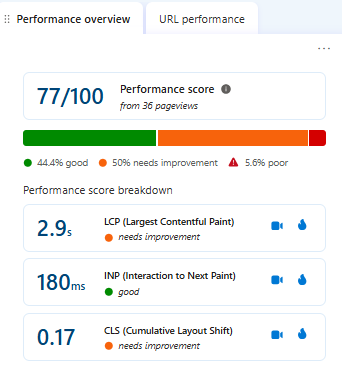
Figure 10. Site performance overview
The overall performance score is 77/100. LCP at 2.9 seconds and CLS at 0.17 both need improvement, showing that experience optimization is not only about copy and layout but also about speed and stability.
Figure 11. URL-level performance
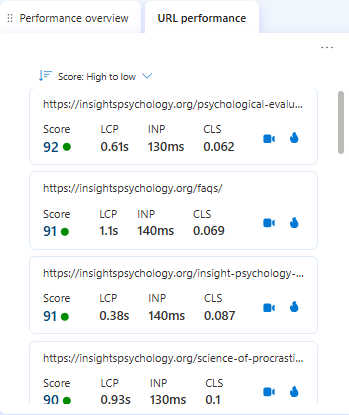
Figure 11. URL-level performance
This report highlights page-level performance differences, helping teams decide which URLs are already strong and which need testing. SXO works best when high-opportunity pages are prioritized instead of treating the site as one uniform experience.
Figure 12. Top pages report
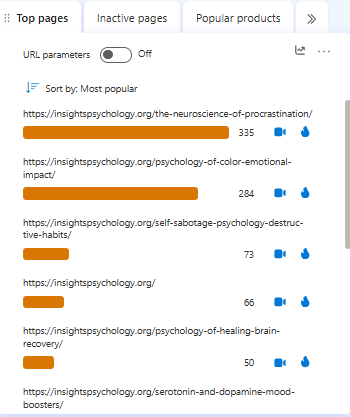
Figure 12. Top pages report
The top pages view identifies the URLs receiving the most attention, including blog content around procrastination and related psychology topics. These high-traffic pages are ideal places to test CTA placement, content hierarchy, and internal linking.
Figure 13. Heatmap click ranking
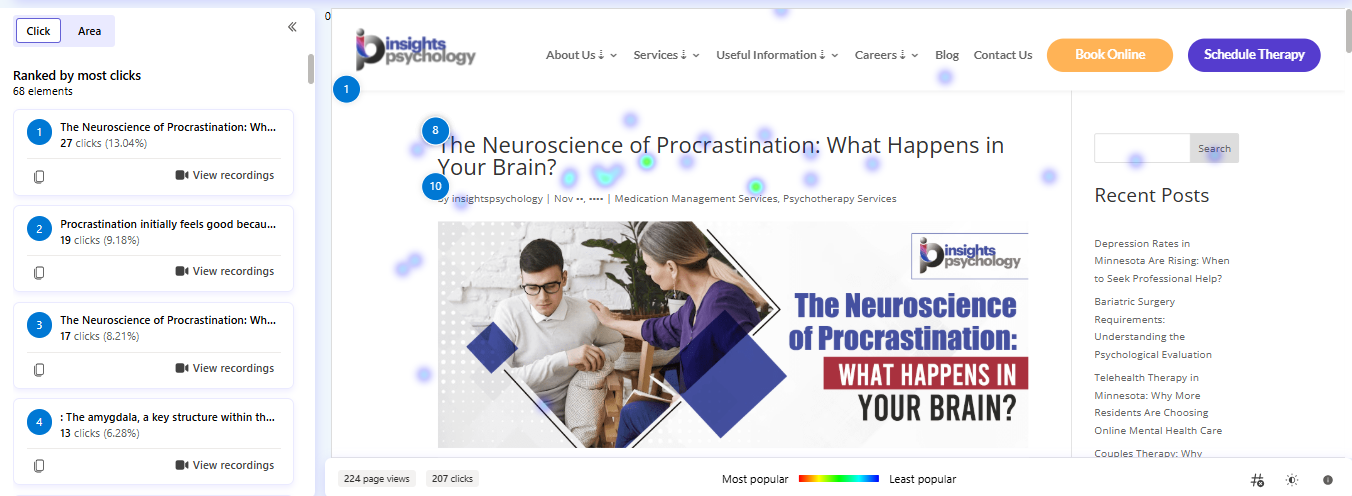
Figure 13. Heatmap click ranking
The click map shows which page elements attract the most interaction and which elements users ignore. This kind of visual evidence is useful when deciding whether the page hierarchy supports the intended journey.
Figure 14. In-page click concentration
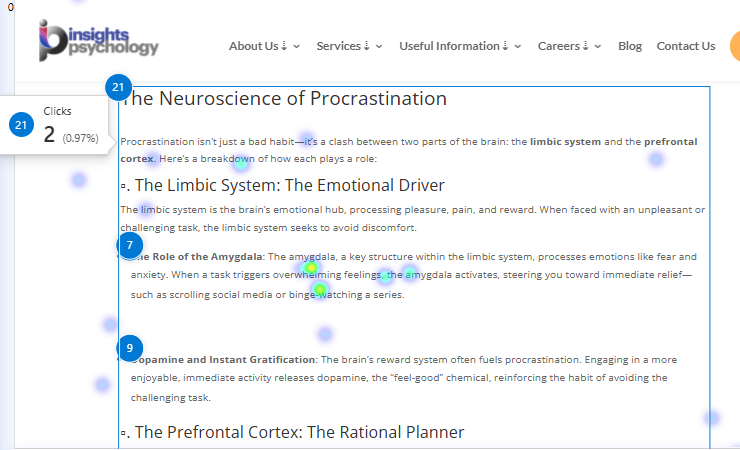
Figure 14. In-page click concentration
The in-page heatmap shows a dense concentration of clicks in the article body and title area. When users interact heavily with content sections, those areas become prime candidates for internal links, sticky prompts, or contextual CTAs.
Figure 15. Scroll-depth heatmap view
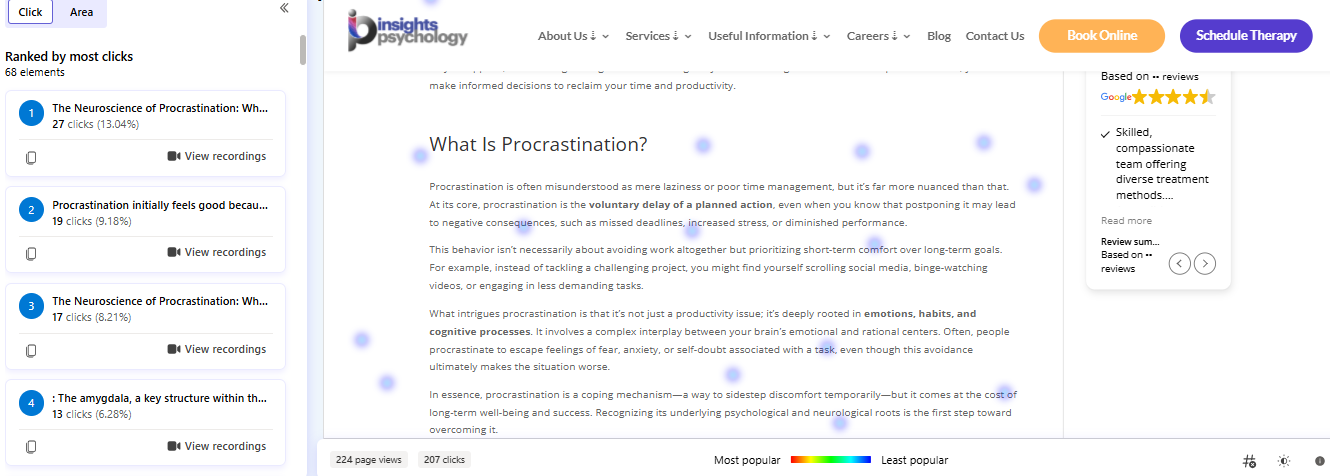
Figure 15. Scroll-depth heatmap view
This screenshot helps illustrate how attention changes as users move further down the page. It is a practical reminder that important actions should not be hidden too low if the goal is to capture engagement earlier.
Figure 16. Combined dashboard snapshots
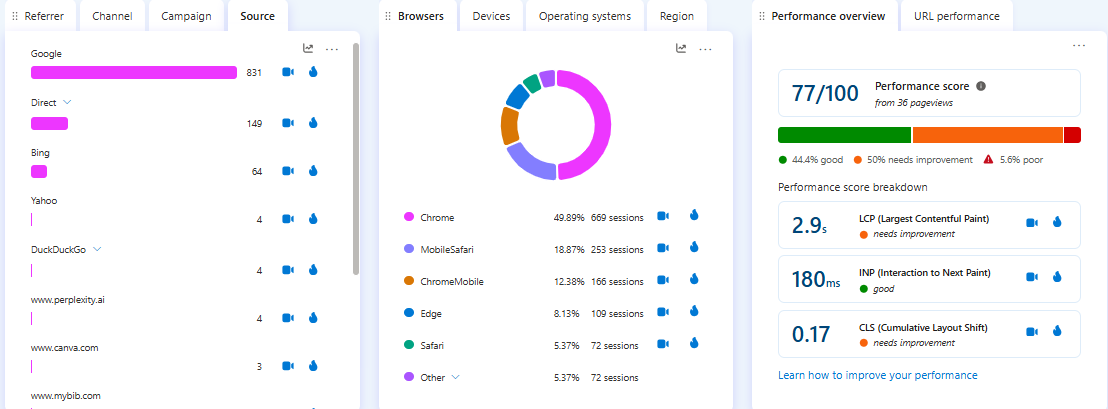
Figure 16. Combined dashboard snapshots
Viewed together, source, browser, and performance reports show why SXO should blend acquisition, usability, and technical experience rather than optimizing each in isolation.
Today simply ranking high on search engines is no longer enough—what truly matters is what happens after the click. This is where Search Experience Optimization (SXO) comes into play. SXO is the powerful fusion of traditional SEO tactics with user experience (UX) best practices, aiming not just to attract visitors but to keep them engaged, satisfied, and ultimately, converting. As search engines grow smarter, they prioritize not just keywords, but how effectively a website meets the intent and needs of its users. ThatWare, a pioneer in hyper-intelligence powered SEO, is at the forefront of this transformation—leveraging AI, semantic search, and data-driven UX strategies to redefine how brands connect with users. In this comprehensive guide, we’ll explore how SXO is reshaping digital marketing, why it matters more than ever, and how ThatWare leads the charge in creating intelligent, human-first search experiences.

Understanding Search Experience Optimization (SXO)
What Is SXO and Why Does It Matter?
Search Experience Optimization (SXO) is the evolution of SEO into a more user-centric, holistic approach. Instead of focusing solely on rankings, keywords, or backlinks, SXO merges the technical foundation of Search Engine Optimization (SEO) with the human-centered discipline of User Experience (UX). The goal? To not just drive traffic, but to deliver seamless, satisfying, and goal-oriented experiences that convert.
Traditional SEO has always been about helping users find your content. SXO takes that further by asking: What happens when they get there? Are users engaged, or do they bounce? Do they find value, or get frustrated with a slow, confusing interface? SXO ensures that from search to conversion, every touchpoint is optimized for relevance, usability, and satisfaction.
The Three Pillars of SXO: Visibility, Usability, and Conversion
- Visibility:
SXO still incorporates the core of SEO—technical audits, content optimization, link building, and keyword strategy. However, it goes deeper by aligning keywords with user intent, optimizing for featured snippets, voice search, and semantic relevance to ensure your content ranks and resonates. - Usability:
Once users arrive, their experience matters. SXO focuses on page load speed, intuitive navigation, mobile responsiveness, and visually appealing design to reduce friction and enhance satisfaction. Every second of delay or confusion costs you conversions. - Conversion:
It’s not just about engagement—it’s about driving action. Whether it’s filling out a form, making a purchase, or subscribing to a newsletter, SXO optimizes the full funnel. Smart CTAs, personalized content, and behavior-driven design are used to gently push users toward desired outcomes.
User Intent: The Heart of SXO
Modern search engines prioritize user intent—and so should your website. SXO uses AI and behavioral analytics to understand not just what people are searching for, but why. Is the user looking for information, comparing options, or ready to buy? Tailoring your content and interface to match that intent is crucial, and ThatWare’s AI systems excel at doing just that.
The Fusion of SEO and UX: A Natural Evolution
In the early days of digital marketing, SEO and UX lived in separate worlds. Search Engine Optimization (SEO) was largely technical and keyword-driven, focused on pleasing algorithms and bots. User Experience (UX), on the other hand, revolved around design, usability, and human interaction. But as search engines became smarter and users more demanding, it became clear that these two disciplines aren’t just complementary—they’re inseparable. The result is a new, more holistic approach: Search Experience Optimization (SXO).
From Keyword Stuffing to Human-Centric Optimization
A decade ago, websites could climb search rankings by simply cramming pages with exact-match keywords, buying backlinks, and performing some rudimentary on-page SEO. But this approach led to clunky, unnatural, and often unreadable content that frustrated users. The gap between search visibility and actual user satisfaction was wide—and growing.
Google’s algorithm updates like Panda, Hummingbird, RankBrain, and BERT began addressing this issue by prioritizing content relevance, user intent, and engagement metrics. Suddenly, bounce rates, dwell time, page speed, mobile usability, and site architecture began influencing rankings as much as keywords did. This was the beginning of the SEO–UX merger.
As user expectations continue to evolve, people no longer seek information alone—they expect fast, seamless, and valuable digital experiences. A website must offer clean formatting, intuitive navigation, and personalized interactions that make users feel understood. This is where UX SEO plays a crucial role by combining user experience and search optimization to reduce friction, improve engagement, and ensure visitors find what they need effortlessly. Without a smooth and user-focused experience, users are likely to leave within seconds. This behavioral shift compelled marketers to rethink their strategies and embrace user-first design as a core SEO strategy.
Why UX Signals Now Impact Search Rankings
Google’s Core Web Vitals update cemented the role of UX in SEO. With metrics like Largest Contentful Paint (LCP), First Input Delay (FID), and Cumulative Layout Shift (CLS), Google made it clear that how a page loads and behaves is just as important as the content it holds. In other words, a page that’s slow, jumpy, or unresponsive will be penalized—even if it has excellent content.
Here’s how some key UX elements directly impact SEO performance:
- Fast Load Times: Users abandon slow sites quickly. Speed enhances experience and is now a direct ranking factor.
- Mobile Responsiveness: With mobile-first indexing, if your site doesn’t function beautifully on mobile, you’re already losing.
- User-Friendly Navigation: If users can’t find what they’re looking for, search engines interpret that as poor relevance.
- Clear Hierarchy & CTA Placement: Guides users through your site and increases conversion signals, which in turn can impact rankings.
ThatWare understands this deeply and integrates technical optimization with UX enhancements using its AI-based hyper-intelligence system—making sure sites are both crawlable for bots and enjoyable for humans.

The Rise of Intent-Driven Search and UX Alignment
Search engines are now laser-focused on user intent. It’s not just about matching keywords—it’s about understanding the purpose behind a search query. Someone typing “best laptops under $1000” is likely looking for a list or comparison, not a general blog post about laptops. If your content doesn’t match that expectation, users will bounce, and search engines will notice.
To meet user intent, UX must adapt:
- Design for Skimmers: Most users scan. That means using headings, bullet points, and bold text to make content digestible.
- Answer Questions Immediately: Don’t bury the lead. Provide answers at the top and expand later.
- Personalized Experiences: Leverage behavior data to tailor experiences to different user segments.
ThatWare uses semantic SEO and AI algorithms to predict user intent, and then pairs this insight with UX strategies that keep users engaged, reduce bounce rates, and guide them toward conversion—all of which boost search visibility.
The AI-Powered Intersection of SEO + UX at ThatWare
What makes ThatWare unique in the SXO space is its use of hyper-intelligence to bridge the SEO–UX gap. While most agencies treat SEO and UX as separate services, ThatWare’s proprietary AI systems fuse them into one seamless process.
Here’s how ThatWare’s AI enhances the SEO-UX relationship:
- Real-time Behavioral Tracking: Understand exactly how users interact with every page.
- Predictive Content Suggestions: Automatically optimize headlines, layout, and CTA placement based on what’s most likely to perform.
- Dynamic UX Adjustments: Serve different experiences based on device type, location, or user history.
- Automated Testing: ThatWare’s AI runs A/B tests on layout, content, and design elements to identify what converts best—without human intervention.
This level of integration means ThatWare clients enjoy websites that are built for both search engines and human satisfaction—a crucial edge in an increasingly competitive digital space.
Why the Fusion of SEO and UX Is the Future
In the age of AI, personalization, and voice search, user expectations are higher than ever. Websites can no longer rely on visibility alone—they need to deliver meaningful, intuitive, and satisfying experiences. This is what SXO is all about.
Search engines like Google are only going to get better at detecting how users interact with your site. As a result, SEO will continue to evolve into a more experience-based discipline, where UX isn’t a separate design task—it’s a fundamental ranking factor.
At ThatWare, we’ve embraced this evolution not just as a trend, but as the new standard. By blending cutting-edge AI with deep SEO expertise and UX design principles, we’re leading the charge toward smarter, more user-focused digital strategies.

Core Components of Search Experience Optimization
Search Experience Optimization (SXO) isn’t a singular tactic or plugin you can install and forget. It’s a holistic approach that brings together the most effective elements of SEO, UX, and CRO (Conversion Rate Optimization) into one unified framework. At ThatWare, we break down SXO into several core components that work in synergy to create intelligent, engaging, and high-converting digital experiences. Below, we dive deep into each of these components and how they transform the user journey from mere discovery to loyal conversion.
1. Technical SEO Foundation
At the heart of SXO lies technical SEO—the scaffolding that supports every other optimization effort. Without a solid structure, even the best content and design will falter. Key elements include:
- Website Architecture: A logical, clean site structure helps search engines crawl your pages efficiently and makes it easier for users to navigate.
- Mobile Optimization: With Google’s mobile-first indexing, your site must perform seamlessly on smartphones and tablets.
- Page Speed: Fast-loading pages aren’t just user-friendly—they directly affect search rankings and bounce rates.
- Secure Protocols (HTTPS): Trust is foundational. A secure site is favored by both users and search engines.
- Structured Data & Schema Markup: Enhances how search engines understand and display your content in SERPs.
ThatWare’s AI scans and optimizes these foundational layers in real time, identifying and resolving technical bottlenecks before they impact visibility or experience.
2. User-Centric Content Strategy
Content fuels both SEO and user engagement. But in SXO, it’s not just about stuffing keywords—it’s about relevance, structure, and experience.
- Intent Matching: Each piece of content is aligned with specific user intents—informational, navigational, commercial, or transactional.
- Semantic SEO: Using NLP (Natural Language Processing) and entity-based content to meet modern algorithmic demands.
- Content Hierarchy: Clear headings, bullet points, summaries, and calls to action enhance readability.
- Multimedia Integration: Videos, infographics, and interactive tools increase time-on-site and engagement.
ThatWare employs hyper-intelligent algorithms to map content creation to semantic intent, ensuring that what users see is exactly what they need.
3. On-Page Experience Design
User Experience isn’t limited to visuals—it’s about emotions, clarity, and flow. On-page UX determines how users interact with your content, and ultimately, how they convert.
- Visual Hierarchy: Ensures users can process information quickly and intuitively.
- Above-the-Fold Optimization: Critical information and CTAs are placed where users first look.
- Responsive Design: A seamless experience across all devices.
- Contrast & Accessibility: Ensures readability for all users, including those with disabilities.
ThatWare’s UX designers integrate AI insights to continuously test and refine layout elements for optimal usability.
4. Behavioral Analytics and Feedback Loops
SXO is data-driven by nature. Understanding what users do on your site is key to improving their experience.
- Heatmaps & Scroll Maps: Reveal where users click, hover, and abandon.
- Session Recording: Uncovers friction points and UX issues.
- User Surveys & Feedback: Gather qualitative data to complement analytics.
- AI-Based Pattern Recognition: Predicts drop-off zones and recommends UX tweaks.
ThatWare’s proprietary behavioral analytics engine provides granular insights that fuel continuous improvement and personalization.
5. Conversion Path Optimization
The end goal of SXO is not just engagement—it’s conversion. Every step in the user journey should lead closer to that goal.
- Frictionless Navigation: Clear paths from homepage to conversion points.
- Micro-Conversions: Forms, downloads, and subscriptions that lead to macro-conversions.
- Smart CTAs: Personalized and dynamic CTAs based on user behavior and stage in the journey.
- Trust Signals: Reviews, testimonials, certifications, and guarantees that enhance credibility.
ThatWare uses machine learning to optimize these paths in real time, ensuring users are guided intuitively toward conversion.
6. AI and Hyper-Personalization
Today’s users expect experiences tailored to their needs. Hyper-personalization is no longer optional—it’s expected.
- User Segmentation: Behavioral, demographic, and psychographic data are used to create dynamic personas.
- Personalized Content: Headlines, product listings, and offers that adapt in real time.
- Predictive Search: Anticipates what users are looking for and presents it before they ask.
- Chatbots & Virtual Assistants: Provide support and guidance 24/7.
ThatWare’s AI personalizes every aspect of the digital experience, increasing engagement, satisfaction, and ROI.
7. Voice and Visual Search Optimization
As search behavior evolves, SXO must accommodate new forms of interaction:
- Voice Search Readiness: Content structured for natural language queries.
- Featured Snippet Optimization: Winning the zero-click search.
- Visual Search Compatibility: Schema-rich images and alt texts that support image-based discovery.
ThatWare adapts content strategies and UX layouts with advanced UX SEO practices, ensuring every digital experience is optimized for user engagement, search visibility, and future industry trends.
8. Core Web Vitals and Experience Metrics
Google’s Core Web Vitals are at the center of experience-based ranking. SXO strategies must continuously monitor and enhance:
- Largest Contentful Paint (LCP)
- First Input Delay (FID)
- Cumulative Layout Shift (CLS)
- Interaction to Next Paint (INP)
Using real-time performance monitoring tools and AI-powered suggestions, ThatWare keeps client websites optimized for both users and algorithms.
9. E-E-A-T and Content Trustworthiness
In high-stakes niches (finance, health, legal), experience, expertise, authoritativeness, and trust (E-E-A-T) are essential.
- Author Bios and Credentials: Establish credibility.
- Citations and Sources: Validate claims with data and references.
- Transparent Policies: Privacy, refunds, and terms build trust.
ThatWare integrates trust-building elements directly into content and design—boosting both credibility and SEO rankings.
10. Ongoing Testing and Optimization
SXO is never “set and forget.” It’s an ongoing cycle of hypothesis, testing, learning, and refinement.
- A/B Testing and Multivariate Testing: Measure what changes actually work.
- Split URL Testing: Evaluate entirely different page formats.
- Iterative Content Updates: Refresh content based on changing intent and search trends.
- Continuous Monitoring: Real-time alerts for dips in performance.
ThatWare’s AI handles multivariate testing at scale, refining layouts, CTAs, and messaging based on actual user data.
Core Components of Search Experience Optimization
Search Experience Optimization (SXO) isn’t a singular tactic or plugin you can install and forget. It’s a holistic approach that brings together the most effective elements of SEO, UX, and CRO (Conversion Rate Optimization) into one unified framework. At ThatWare, we break down SXO into several core components that work in synergy to create intelligent, engaging, and high-converting digital experiences. Below, we dive deep into each of these components and how they transform the user journey from mere discovery to loyal conversion.
1. Technical SEO Foundation
At the heart of SXO lies technical SEO—the scaffolding that supports every other optimization effort. Without a solid structure, even the best content and design will falter. Key elements include:
- Website Architecture: A logical, clean site structure helps search engines crawl your pages efficiently and makes it easier for users to navigate.
- Mobile Optimization: With Google’s mobile-first indexing, your site must perform seamlessly on smartphones and tablets.
- Page Speed: Fast-loading pages aren’t just user-friendly—they directly affect search rankings and bounce rates.
- Secure Protocols (HTTPS): Trust is foundational. A secure site is favored by both users and search engines.
- Structured Data & Schema Markup: Enhances how search engines understand and display your content in SERPs.
ThatWare’s AI scans and optimizes these foundational layers in real time, identifying and resolving technical bottlenecks before they impact visibility or experience.
2. User-Centric Content Strategy
Content fuels both SEO and user engagement. But in SXO, it’s not just about stuffing keywords—it’s about relevance, structure, and experience.
- Intent Matching: Each piece of content is aligned with specific user intents—informational, navigational, commercial, or transactional.
- Semantic SEO: Using NLP (Natural Language Processing) and entity-based content to meet modern algorithmic demands.
- Content Hierarchy: Clear headings, bullet points, summaries, and calls to action enhance readability.
- Multimedia Integration: Videos, infographics, and interactive tools increase time-on-site and engagement.
ThatWare employs hyper-intelligent algorithms to map content creation to semantic intent, ensuring that what users see is exactly what they need.
3. On-Page Experience Design
User Experience isn’t limited to visuals—it’s about emotions, clarity, and flow. On-page UX determines how users interact with your content, and ultimately, how they convert.
- Visual Hierarchy: Ensures users can process information quickly and intuitively.
- Above-the-Fold Optimization: Critical information and CTAs are placed where users first look.
- Responsive Design: A seamless experience across all devices.
- Contrast & Accessibility: Ensures readability for all users, including those with disabilities.
ThatWare’s UX designers integrate AI insights to continuously test and refine layout elements for optimal usability.
4. Behavioral Analytics and Feedback Loops
SXO is data-driven by nature. Understanding what users do on your site is key to improving their experience.
- Heatmaps & Scroll Maps: Reveal where users click, hover, and abandon.
- Session Recording: Uncovers friction points and UX issues.
- User Surveys & Feedback: Gather qualitative data to complement analytics.
- AI-Based Pattern Recognition: Predicts drop-off zones and recommends UX tweaks.
ThatWare’s proprietary behavioral analytics engine provides granular insights that fuel continuous improvement and personalization.
5. Conversion Path Optimization
The end goal of SXO is not just engagement—it’s conversion. Every step in the user journey should lead closer to that goal.
- Frictionless Navigation: Clear paths from homepage to conversion points.
- Micro-Conversions: Forms, downloads, and subscriptions that lead to macro-conversions.
- Smart CTAs: Personalized and dynamic CTAs based on user behavior and stage in the journey.
- Trust Signals: Reviews, testimonials, certifications, and guarantees that enhance credibility.
ThatWare uses machine learning to optimize these paths in real time, ensuring users are guided intuitively toward conversion.
6. AI and Hyper-Personalization
Today’s users expect experiences tailored to their needs. Hyper-personalization is no longer optional—it’s expected.
- User Segmentation: Behavioral, demographic, and psychographic data are used to create dynamic personas.
- Personalized Content: Headlines, product listings, and offers that adapt in real time.
- Predictive Search: Anticipates what users are looking for and presents it before they ask.
- Chatbots & Virtual Assistants: Provide support and guidance 24/7.
ThatWare’s AI personalizes every aspect of the digital experience, increasing engagement, satisfaction, and ROI.
7. Voice and Visual Search Optimization
As search behavior evolves, SXO must accommodate new forms of interaction:
- Voice Search Readiness: Content structured for natural language queries.
- Featured Snippet Optimization: Winning the zero-click search.
- Visual Search Compatibility: Schema-rich images and alt texts that support image-based discovery.
ThatWare adapts content and UX layouts for these emerging trends, ensuring clients remain ahead of the curve.
8. Core Web Vitals and Experience Metrics
Google’s Core Web Vitals are at the center of experience-based ranking. SXO strategies must continuously monitor and enhance:
- Largest Contentful Paint (LCP)
- First Input Delay (FID)
- Cumulative Layout Shift (CLS)
- Interaction to Next Paint (INP)
Using real-time performance monitoring tools and AI-powered suggestions, ThatWare keeps client websites optimized for both users and algorithms.
9. E-E-A-T and Content Trustworthiness
In high-stakes niches (finance, health, legal), experience, expertise, authoritativeness, and trust (E-E-A-T) are essential.
- Author Bios and Credentials: Establish credibility.
- Citations and Sources: Validate claims with data and references.
- Transparent Policies: Privacy, refunds, and terms build trust.
ThatWare integrates trust-building elements directly into content and design—boosting both credibility and SEO rankings.
10. Ongoing Testing and Optimization
SXO is never “set and forget.” It’s an ongoing cycle of hypothesis, testing, learning, and refinement.
- A/B Testing and Multivariate Testing: Measure what changes actually work.
- Split URL Testing: Evaluate entirely different page formats.
- Iterative Content Updates: Refresh content based on changing intent and search trends.
- Continuous Monitoring: Real-time alerts for dips in performance.
ThatWare’s AI handles multivariate testing at scale, refining layouts, CTAs, and messaging based on actual user data.
Conversion Rate Optimization (CRO) Through SXO
In the digital world, traffic is only half the battle. What truly matters is turning that traffic into meaningful action—sign-ups, purchases, downloads, inquiries. That’s where Conversion Rate Optimization (CRO) enters the picture. Traditionally, CRO has been approached as a separate discipline, focusing narrowly on tweaking call-to-actions or A/B testing elements. But at ThatWare, we believe that CRO is a natural outcome of effective Search Experience Optimization (SXO). When SEO and UX fuse seamlessly, conversion becomes inevitable. In this section, we’ll explore how SXO elevates CRO to new heights.

Aligning Intent with Content
The first principle of effective CRO via SXO is alignment. Users arrive at your site with an intent—your job is to meet it within seconds.
- Search Intent Matching: ThatWare’s hyper-intelligent systems ensure that every keyword and search query leads to a page that satisfies the underlying user intent.
- Content Relevance: Pages are structured to deliver what the user is looking for, whether it’s information, a product, a service, or a solution.
- Compelling Messaging: Clear headlines, emotionally resonant copy, and precise value propositions keep users engaged and moving forward.
Optimizing User Flow and Journey
Every user follows a path—homepage to service page to checkout, or blog to product to sign-up. SXO enhances these paths with intelligence:
- Conversion Mapping: AI-based path analysis helps identify drop-off points and opportunities to streamline the journey.
- Smart Linking: Internal linking guided by semantic understanding boosts both SEO and usability.
- Journey Segmentation: Returning users, new users, and mobile vs. desktop visitors experience tailored flows.
Leveraging AI-Powered CTAs and Micro-Interactions
Calls-to-action aren’t just buttons—they’re strategic prompts. SXO empowers CTAs with intelligence:
- Dynamic CTAs: ThatWare’s algorithms test and deploy variations based on behavior, time on site, or scroll depth.
- Micro-Interactions: Subtle animations, hover effects, and feedback cues increase engagement and click-throughs.
- Exit-Intent Triggers: Personalized offers or surveys appear just before a user abandons the page.
Reducing Friction with Seamless UX
Users abandon forms, carts, or pages when they feel lost, overwhelmed, or confused. SXO removes this friction through UX:
- Form Optimization: Fewer fields, progress indicators, and inline validation enhance completion rates.
- Mobile-Friendly Interfaces: Touch-friendly design, simplified menus, and fast load speeds retain mobile users.
- Distraction-Free Design: Clean, focused layouts keep the user’s eye on the goal.
Continuous Feedback and Testing Loop
The key to long-term CRO success lies in iteration:
- A/B Testing with SXO Metrics: Experiments are informed not only by conversions but also by time-on-site, scroll depth, and bounce rate.
- Multivariate Testing: Multiple page elements are tested simultaneously for more nuanced improvements.
- User Feedback Integration: ThatWare deploys real-time feedback tools to gather user suggestions and complaints.
Building Trust and Reducing Anxiety
Conversion doesn’t happen in a vacuum—it requires trust.
- Trust Seals and Guarantees: Certifications, secure badges, and guarantees reduce anxiety.
- Transparent Communication: Clear shipping policies, refund terms, and contact options instill confidence.
- Social Proof: User testimonials, case studies, and reviews validate the offering.
Personalization and Predictive UX
Modern users expect content tailored to their needs. Personalization drives conversions by making users feel understood.
- Real-Time Personalization: Pages adapt based on user behavior, location, or referral source.
- Product Recommendations: AI analyzes browsing behavior to suggest relevant products.
- Predictive Lead Scoring: Understand which users are most likely to convert and prioritize them.
Success Measurement and ROI Tracking
Finally, what gets measured gets improved.
- CRO Dashboards: ThatWare delivers real-time dashboards highlighting conversions, drop-offs, and top-performing pages.
- Attribution Modeling: Know exactly what content and channels contributed to the conversion.
- ROI Analysis: Understand the business impact of every SXO initiative.
Voice, Visual & Semantic Search in the SXO Era
In the constantly evolving digital ecosystem, the way users search for information has undergone a dramatic transformation. With the rise of voice assistants, visual recognition tools, and AI-powered semantic analysis, traditional keyword-based SEO alone no longer cuts it. To stay ahead, brands must optimize not only for search engines but for search experience—and that means embracing voice, visual, and semantic search as core pillars of SXO.
At ThatWare, our Search Experience Services seamlessly integrate these emerging technologies into comprehensive SXO strategies to deliver intelligent, intent-focused, and accessible digital experiences. Let’s dive deep into how each of these components is revolutionizing SXO.
1. Voice Search: Conversational Intent, Real-Time Answers
The rise of voice-enabled devices like smartphones, smart speakers, and wearables has introduced a conversational dynamic to search. People now interact with search engines the way they speak with humans—using natural, long-tail phrases, questions, and commands.
Key Characteristics of Voice Search:
- Longer queries: “Best SEO agency near me open now” instead of “SEO agency near me.”
- Conversational tone: “How can I improve my website ranking quickly?”
- Question formats: Starting with “what,” “how,” “when,” “why.”
- Local intent: Often focused on services near the user’s physical location.
How ThatWare Optimizes for Voice:
- Natural Language Content: We create content that mimics how real people speak, not how they type. FAQs, conversational blogs, and answer boxes are all part of the strategy.
- Featured Snippets Optimization: Since many voice search results are pulled from snippets, we structure content to be snippet-friendly with clear, concise, and structured answers.
- Schema Markup: We implement advanced structured data (like FAQ, How-To, and Speakable schema) to help search engines easily parse and vocalize your content.
- Mobile & Page Speed Optimization: Since most voice searches happen on mobile, we ensure lightning-fast page speeds and mobile responsiveness.
Voice search is not just about ranking—it’s about responding. At ThatWare, we build experiences that respond like a human but scale like an AI.
2. Visual Search: See, Snap, Search
Visual search flips the traditional paradigm. Instead of typing or speaking, users simply snap a photo or upload an image to find what they’re looking for. This is particularly relevant in ecommerce, fashion, travel, and design sectors, where visuals drive purchase decisions.
Visual Search in Practice:
- A user takes a picture of a pair of shoes they like and asks, “Where can I buy this?”
- Someone uploads a photo of a historic building and wants to know its name.
- A customer scans a QR code or label to get more product details or similar items.
ThatWare’s Visual Search Optimization Strategies:
- Image SEO 2.0: Alt text, file names, and captions are just the start. We also optimize image dimensions, compress sizes for speed, and use AI-generated alt descriptions for accuracy.
- Structured Visual Data: We embed JSON-LD markup to help engines contextualize images—what it is, how it relates to the page, and why it matters.
- Object Recognition Optimization: We train AI systems to understand the composition of images so they’re easier to identify and categorize across platforms like Pinterest Lens, Google Lens, and Bing Visual Search.
- Image Search UX: We enhance Search UX by optimizing product pages with zoomable, high-resolution images, fast-loading thumbnails, interactive carousel galleries, and 360-degree views that improve user engagement, browsing experience, and conversions.
Visual search turns passive browsers into active searchers. ThatWare makes sure your visual assets are ready for this revolution.
3. Semantic Search: Meaning Over Matching
Google no longer just reads keywords—it interprets meaning. Semantic search uses natural language processing (NLP), machine learning, and context-aware algorithms to determine what a user truly intends, even when the query is vague or complex.
Evolution of Semantic Search:
- Google Hummingbird introduced semantic understanding.
- BERT (Bidirectional Encoder Representations from Transformers) improved comprehension of user context.
- MUM (Multitask Unified Model) takes it further by understanding information across formats and languages.
How ThatWare Builds Semantic SXO:
- Entity-Based Optimization: We go beyond keywords and optimize around entities (people, places, things) and their relationships. For example, optimizing for “Steve Jobs” and related entities like “Apple,” “innovation,” “iPhone.”
- Topical Authority Modeling: We use AI to build content clusters that demonstrate deep expertise on a subject, not just keyword usage.
- Intent Forecasting: By analyzing user behavior patterns, we can anticipate future queries and guide content creation accordingly.
- AI-Based Content Enrichment: We use NLP tools to add semantic richness to every piece of content—adding synonyms, context clues, related questions, and internal links that reinforce topic relevance.
Semantic search is about context, relationships, and depth. At ThatWare, we treat your content like a living, breathing knowledge graph—easy for humans to explore, and irresistible to search engines.
4. The Intersection of Voice, Visual & Semantic: Unified SXO Experiences
The power of SXO lies in integration. Voice, visual, and semantic search don’t exist in silos—they intersect to create seamless, multi-modal user journeys.
Picture This User Journey:
- A user asks a voice assistant: “Show me modern Japanese interior design ideas.”
- The assistant pulls semantic-rich blog posts with matching entity references.
- The user clicks and sees curated image galleries optimized for visual search.
- They tap an image they like, which opens a product page with schema-enhanced content, voice-enabled navigation, and personalized recommendations.
This is what ThatWare builds. Search isn’t just about retrieval—it’s about experience. And in the SXO era, experience is everything.
5. Measurement & ROI: Tracking Search Experience Across Modalities
To optimize, you need to analyze. That’s why ThatWare builds custom dashboards that track performance across voice, visual, and semantic channels.
Metrics That Matter:
- Voice Search Impressions: Pulled from tools like Google Search Console & third-party assistants.
- Image Search Click-Through Rate (CTR): Monitoring how often images appear and convert.
- Semantic Relevance Score: Based on NLP tools that evaluate context-match between query and content.
- Zero-Click Search Impact: Tracking brand visibility even when the user doesn’t click—key for featured snippets and voice responses.
By measuring these signals, we fine-tune your SXO strategy to what matters most: visibility, engagement, and conversion.
Integrating Hyper-Intelligence Into SXO with ThatWare
Search Experience Optimization (SXO) is the evolved form of digital search strategy, but when you add hyper-intelligence to the mix, the results are exponential. At ThatWare, hyper-intelligence is more than a buzzword—it’s a technological philosophy that powers every layer of our SXO approach, from data collection to UX personalization.

What is Hyper-Intelligence in SXO?
Hyper-intelligence refers to the integration of advanced artificial intelligence (AI), machine learning (ML), deep data analytics, and neuro-linguistic algorithms to understand and predict user behavior in real-time. Unlike traditional SEO tools that react to search changes, hyper-intelligence anticipates them.
ThatWare’s proprietary hyper-intelligent systems don’t just optimize websites—they think, learn, and adapt. This creates a feedback-driven ecosystem that continuously improves user experience and search performance.
1. AI-Powered User Intent Modelling
Understanding user intent is at the heart of SXO, and ThatWare enhances this with predictive algorithms. Our AI models analyze:
- User search history
- Click patterns
- Dwell time
- Scroll behavior
- Semantic query structures
From this, we generate user personas and search behavior clusters. Whether the user is informational, transactional, or navigational in intent, our systems dynamically tailor on-site elements to meet their expectations. This real-time personalization drastically boosts engagement and conversions.
2. NLP-Enhanced Content Mapping
Hyper-intelligence empowers content creation that mirrors human cognition. We deploy Natural Language Processing (NLP) and transformer-based models like BERT and GPT to:
- Extract topical relevance
- Create semantic clusters
- Suggest high-impact subtopics
- Generate human-like content
Our system understands not just what to write but how users interpret language. This helps us craft content that aligns with the emotional tone, reading level, and context of the searcher.
With hyper-intelligence, content isn’t just optimized for ranking—it’s optimized for resonance.
3. Smart UX Adjustments via Data-Driven Feedback Loops
Traditional A/B testing is slow and reactive. ThatWare replaces it with automated UX optimization using deep learning. Our AI continuously monitors user engagement metrics and autonomously adjusts site elements like:
- Call-to-action button placements
- Page layouts
- Internal linking structure
- Form lengths and fields
- Color palettes based on user psychology
The result? A self-optimizing experience that aligns design with performance in real-time.
4. Knowledge Graph Integration for Contextual Relevance
ThatWare engineers custom knowledge graphs to map your brand’s expertise in a structured format. We link entities, topics, services, and products through a web of semantically related nodes.
Benefits include:
- Enhanced search engine comprehension
- Better internal linking through semantic relations
- Higher chances of appearing in featured snippets
- Stronger topical authority
This structured intelligence helps search engines see your site the way a human expert would—contextually rich and deeply relevant.
5. Autonomous SEO Management via AI Agents
Why rely on manual SEO tweaks when your site can optimize itself? ThatWare deploys AI agents that:
- Crawl your site continuously
- Detect underperforming pages
- Adjust metadata in real-time
- Re-prioritize internal link weights
- Flag thin content and duplicate issues
These agents operate 24/7, ensuring your SEO is always up to date and aligned with search engine updates—without the lag of human response time.
6. Predictive Behavioral Analytics
At ThatWare, we don’t just look at what users have done—we predict what they’ll do next. Using historical data and machine learning models, we forecast:
- Which products a user is likely to click on
- Which blog topics will trend next quarter
- When traffic spikes may occur
- How different segments respond to content variations
This allows proactive planning of campaigns, content rollouts, and UX enhancements. The advantage? You’re always ahead of your competition, not reacting to them.
7. Neural Pattern Recognition for Personalization
We implement neural pattern recognition systems that emulate how the human brain processes data. This technology allows us to:
- Detect subtle trends across large user datasets
- Recognize personalization triggers like time of day, device type, and geolocation
- Deliver targeted content blocks and messaging across the site
A visitor from Mumbai on a mobile phone at 11 PM might see different homepage banners than someone in New York on desktop in the morning. This granular personalization enhances user trust, session duration, and conversion rates.
8. Intelligent Chatbots for Search Journey Support
We integrate AI-powered chatbots that function as search assistants within your site. These bots:
- Interpret natural language queries
- Offer direct links to relevant pages
- Collect user feedback
- Improve over time through AI learning
This supplements traditional site navigation with conversational search pathways, reducing bounce rates and increasing page depth.
9. Real-Time SXO Dashboards Powered by AI
Visibility drives optimization. ThatWare provides custom dashboards that synthesize SXO performance across voice, visual, and semantic channels, as well as hyper-intelligence modules. These dashboards offer:
- Live heatmaps
- Scroll-depth analysis
- Content relevance scoring
- User sentiment tracking
- Conversion flow reports
Every insight is actionable, thanks to machine-driven recommendations that tell you what to do next, not just what happened.
Mobile-First SXO Strategies: Optimizing for the Small Screen, Big Impact
In today’s digital ecosystem, mobile isn’t just a secondary consideration—it’s the primary arena where search experiences unfold. With over 60% of global web traffic originating from mobile devices, a mobile-first approach to SXO (Search Experience Optimization) is no longer optional—it’s a competitive necessity.
Mobile-first SXO ensures that your site not only ranks well on mobile search results but also delivers a seamless, friction-free, and high-converting experience to users on the go.
Why Mobile UX is the Cornerstone of Modern SEO
Google officially moved to mobile-first indexing years ago, which means the mobile version of your site is the baseline for how Google evaluates both relevance and usability. But SXO goes deeper than just “being mobile-friendly.” It’s about matching mobile users’ behavior, intent, and emotional state with the experience they encounter.
Mobile users are task-oriented. They seek quick answers, intuitive navigation, and instant gratification. A poor mobile experience—slow loads, misaligned layouts, or confusing CTAs—can result in immediate bounces, and worse, long-term ranking declines due to poor engagement signals.
Designing for Intent: Fast, Focused, and Functional
Speed is king on mobile. If your page takes longer than 2.5 seconds to load, users abandon it. Tools like Google’s PageSpeed Insights or Lighthouse can help you identify and resolve lag-inducing bottlenecks.
Beyond speed, your mobile UX must prioritize task completion. That means:
- Prominent CTAs within thumb reach
- Sticky menus or floating action buttons for core tasks
- Minimalistic forms with auto-fill and mobile keyboards
- Visual hierarchy that respects screen size limitations
These elements reduce cognitive load and enhance the feeling of control—a cornerstone of positive mobile experience.

AMP, PWAs, and Mobile Tech for SXO Enhancement
To go beyond basic responsiveness, progressive technologies like Accelerated Mobile Pages (AMP) and Progressive Web Apps (PWAs) are reshaping how mobile SXO is executed.
- AMP enables lightning-fast content delivery, especially useful for blogs, news, and landing pages. It strips away unnecessary code, improving load times and engagement.
- PWAs combine the best of mobile apps and websites—allowing users to interact with your site even in poor connectivity, receive push notifications, and enjoy a native-app feel without downloads.
At ThatWare, we leverage both AMP and PWA frameworks as part of our mobile-first SXO strategies, aligning them with user behavior models and search engine expectations.
Mobile-First Content Strategy: Bite-Sized, Contextual, Conversational
Content on mobile must be scannable, digestible, and contextually aware. Long paragraphs? Out. Walls of text? Out. What works is:
- Bullet points
- Short, punchy sentences
- FAQ-style collapsible content
- Contextual CTAs based on scroll behavior
For mobile SXO, your content should adapt to micro-moments—those instances when users reflexively turn to their device to know, go, do, or buy. Anticipating these moments and serving the right message at the right scroll depth is key.
Content Structuring for SXO: Designing Content That Speaks to Users and Search Engines
In the era of Search Experience Optimization (SXO), structuring content isn’t just about SEO or readability—it’s about orchestrating a journey that aligns with both user expectations and search engine logic. Content structuring for SXO means strategically organizing your information so that users find it intuitive, engaging, and frictionless—while search engines understand its depth, relevance, and intent.
Let’s explore how content can be structured for optimal SXO results.
Why Content Structure Matters in SXO
In a traditional SEO approach, keyword density and placement were the focus. With SXO, it’s about experience-first content delivery. A well-structured page:
- Makes it easy for users to find answers
- Encourages deeper engagement
- Signals clarity and relevance to search engines
- Reduces bounce rates and improves session duration
Ultimately, content structure bridges the gap between technical SEO and UX design—two core pillars of SXO.
This helps Google understand your content’s structure, and it helps users navigate efficiently, especially on mobile.
2. Chunking and Visual Scannability
SXO-optimized content must be scannable. Eye-tracking studies show that users read web pages in F-patterns or Z-patterns. This means you must break your content into manageable “chunks.”
Use:
- Short paragraphs (2–3 lines max)
- Bullet points and numbered lists
- Bolded key phrases or takeaway lines
- Inline subheadings for fast consumption
For example:
Instead of:
“Content structuring is important because it helps with user experience and search engine understanding, and also helps people engage longer with your page…”
Use:
Why Structure Matters:
- Helps users find answers
- Aids in search engine crawling
- Reduces bounce rate and improves engagement
This makes your page more “scrollable”—a key metric in user behavior analysis.
1. Hierarchical Heading Tags: Your Content’s Skeleton
Search engines scan heading tags (H1 to H6) to understand content hierarchy. Users skim them to decide whether they should read more. A strong SXO content structure starts with:
- One clear H1 that includes your main topic or keyword
- Logical use of H2s for main sections
- H3s and H4s to break down subsections and support information
3. Semantic HTML and Schema Markup
SXO isn’t just about surface content—it’s also about how the backend speaks to Google. Use semantic HTML tags (<article>, <section>, <nav>, <aside>, etc.) to signal page layout and content type.
Also, use structured data/schema markup to enhance search appearance. Some examples:
- FAQ Schema: For collapsible questions/answers
- How-To Schema: For guides and tutorials
- Breadcrumb Schema: For site structure understanding
- Article or BlogPosting Schema: For content-specific enhancements
This improves crawlability, allows for rich results, and makes the user experience smoother via SERP previews.
4. Internal Linking with Intent Clarity
Your internal linking should do more than pass PageRank—it should guide users logically through their intent path.
Best practices for SXO-friendly internal linking:
- Link relevant phrases, not generic “click here” text
- Ensure linked pages match user search intent
- Use breadcrumbs or sidebar navigations for deeper structure
For instance, if your user is reading a guide on “Voice Search Optimization,” naturally link to your “Semantic Search in SXO” section to continue their journey.
5. Topic Clusters and Pillar Pages
Modern content organization thrives on the topic cluster model—where a central “pillar page” covers a broad topic, and several interlinked “cluster pages” explore subtopics.
For SXO:
- Pillar = UX-friendly long-form, detailed content
- Cluster = Shorter, intent-specific articles
- Interlinked = Smooth transitions between topics for users and search engines
This approach increases topical authority, improves user retention, and aligns perfectly with semantic search models that prioritize context over keywords.
6. Mobile Content Structuring for Touch and Scroll
Your content must be designed for finger-friendly UX:
- Use collapsible sections (accordions) for FAQs
- Break content into scroll-based blocks
- Use jump links and sticky TOCs (Table of Contents)
ThatWare implements dynamic table of contents and scroll-based interactions to make mobile consumption effortless, especially on long-form content.
7. Contextual CTAs and Behavioral Anchors
Don’t just place CTAs at the end. In SXO, calls-to-action should be contextual and embedded within content flow:
- After key insights, offer gated downloads
- Mid-article, invite readers to try tools or services
- At intent transition points, use smart CTA banners
Bonus tip: use AI-based tools to identify user drop-off points and place CTAs before friction begins.
Mobile-First SXO Strategies: Optimizing for the Small Screen, Big Impact
In today’s digital ecosystem, mobile isn’t just a secondary consideration—it’s the primary arena where search experiences unfold. With over 60% of global web traffic originating from mobile devices, a mobile-first approach to SXO (Search Experience Optimization) is no longer optional—it’s a competitive necessity.
Mobile-first SXO ensures that your site not only ranks well on mobile search results but also delivers a seamless, friction-free, and high-converting experience to users on the go.
Why Mobile UX is the Cornerstone of Modern SEO
Google officially moved to mobile-first indexing years ago, which means the mobile version of your site is the baseline for how Google evaluates both relevance and usability. But SXO goes deeper than just “being mobile-friendly.” It’s about matching mobile users’ behavior, intent, and emotional state with the experience they encounter.
Mobile users are task-oriented. They seek quick answers, intuitive navigation, and instant gratification. A poor mobile experience—slow loads, misaligned layouts, or confusing CTAs—can result in immediate bounces, and worse, long-term ranking declines due to poor engagement signals.
Designing for Intent: Fast, Focused, and Functional
Speed is king on mobile. If your page takes longer than 2.5 seconds to load, users abandon it. Tools like Google’s PageSpeed Insights or Lighthouse can help you identify and resolve lag-inducing bottlenecks.
Beyond speed, your mobile UX must prioritize task completion. That means:
- Prominent CTAs within thumb reach
- Sticky menus or floating action buttons for core tasks
- Minimalistic forms with auto-fill and mobile keyboards
- Visual hierarchy that respects screen size limitations
These elements reduce cognitive load and enhance the feeling of control—a cornerstone of positive mobile experience.
AMP, PWAs, and Mobile Tech for SXO Enhancement
To go beyond basic responsiveness, progressive technologies like Accelerated Mobile Pages (AMP) and Progressive Web Apps (PWAs) are reshaping how mobile SXO is executed.
- AMP enables lightning-fast content delivery, especially useful for blogs, news, and landing pages. It strips away unnecessary code, improving load times and engagement.
- PWAs combine the best of mobile apps and websites—allowing users to interact with your site even in poor connectivity, receive push notifications, and enjoy a native-app feel without downloads.
At ThatWare, we leverage both AMP and PWA frameworks as part of our mobile-first SXO strategies, aligning them with user behavior models and search engine expectations.
Mobile-First Content Strategy: Bite-Sized, Contextual, Conversational
Content on mobile must be scannable, digestible, and contextually aware. Long paragraphs? Out. Walls of text? Out. What works is:
- Bullet points
- Short, punchy sentences
- FAQ-style collapsible content
- Contextual CTAs based on scroll behavior
For mobile SXO, your content should adapt to micro-moments—those instances when users reflexively turn to their device to know, go, do, or buy. Anticipating these moments and serving the right message at the right scroll depth is key.
Content Structuring for SXO: Designing Content That Speaks to Users and Search Engines
In the era of Search Experience Optimization (SXO), structuring content isn’t just about SEO or readability—it’s about orchestrating a journey that aligns with both user expectations and search engine logic. Content structuring for SXO means strategically organizing your information so that users find it intuitive, engaging, and frictionless—while search engines understand its depth, relevance, and intent.
Let’s explore how content can be structured for optimal SXO results.
Why Content Structure Matters in SXO
In a traditional SEO approach, keyword density and placement were the focus. With SXO, it’s about experience-first content delivery. A well-structured page:
- Makes it easy for users to find answers
- Encourages deeper engagement
- Signals clarity and relevance to search engines
- Reduces bounce rates and improves session duration
Ultimately, content structure bridges the gap between technical SEO and UX design—two core pillars of SXO.
This helps Google understand your content’s structure, and it helps users navigate efficiently, especially on mobile.
2. Chunking and Visual Scannability
SXO-optimized content must be scannable. Eye-tracking studies show that users read web pages in F-patterns or Z-patterns. This means you must break your content into manageable “chunks.”
Use:
- Short paragraphs (2–3 lines max)
- Bullet points and numbered lists
- Bolded key phrases or takeaway lines
- Inline subheadings for fast consumption
For example:
Instead of:
“Content structuring is important because it helps with user experience and search engine understanding, and also helps people engage longer with your page…”
Use:
Why Structure Matters:
- Helps users find answers
- Aids in search engine crawling
- Reduces bounce rate and improves engagement
This makes your page more “scrollable”—a key metric in user behavior analysis.
1. Hierarchical Heading Tags: Your Content’s Skeleton
Search engines scan heading tags (H1 to H6) to understand content hierarchy. Users skim them to decide whether they should read more. A strong SXO content structure starts with:
- One clear H1 that includes your main topic or keyword
- Logical use of H2s for main sections
- H3s and H4s to break down subsections and support information
3. Semantic HTML and Schema Markup
SXO isn’t just about surface content—it’s also about how the backend speaks to Google. Use semantic HTML tags (<article>, <section>, <nav>, <aside>, etc.) to signal page layout and content type.
Also, use structured data/schema markup to enhance search appearance. Some examples:
- FAQ Schema: For collapsible questions/answers
- How-To Schema: For guides and tutorials
- Breadcrumb Schema: For site structure understanding
- Article or BlogPosting Schema: For content-specific enhancements
This improves crawlability, allows for rich results, and makes the user experience smoother via SERP previews.
4. Internal Linking with Intent Clarity
Your internal linking should do more than pass PageRank—it should guide users logically through their intent path.
Best practices for SXO-friendly internal linking:
- Link relevant phrases, not generic “click here” text
- Ensure linked pages match user search intent
- Use breadcrumbs or sidebar navigations for deeper structure
For instance, if your user is reading a guide on “Voice Search Optimization,” naturally link to your “Semantic Search in SXO” section to continue their journey.
5. Topic Clusters and Pillar Pages
Modern content organization thrives on the topic cluster model—where a central “pillar page” covers a broad topic, and several interlinked “cluster pages” explore subtopics.
For SXO:
- Pillar = UX-friendly long-form, detailed content
- Cluster = Shorter, intent-specific articles
- Interlinked = Smooth transitions between topics for users and search engines
This approach increases topical authority, improves user retention, and aligns perfectly with semantic search models that prioritize context over keywords.
6. Mobile Content Structuring for Touch and Scroll
Your content must be designed for finger-friendly UX:
- Use collapsible sections (accordions) for FAQs
- Break content into scroll-based blocks
- Use jump links and sticky TOCs (Table of Contents)
ThatWare implements dynamic table of contents and scroll-based interactions to make mobile consumption effortless, especially on long-form content.
7. Contextual CTAs and Behavioral Anchors
Don’t just place CTAs at the end. In SXO, calls-to-action should be contextual and embedded within content flow:
- After key insights, offer gated downloads
- Mid-article, invite readers to try tools or services
- At intent transition points, use smart CTA banners
Bonus tip: use AI-based tools to identify user drop-off points and place CTAs before friction begins.
Real Time Example
ThatWare: The Best SXO Company in the India
The screenshot below captures a real Google search for the phrase: “best SXO company in the India.” Right at the top of the organic results appears ThatWare, a digital marketing company that’s not just talking about SXO—it’s mastering it.
Search Experience Optimization (SXO) is the next level of SEO. It focuses not just on ranking well but also on delivering the best experience to users once they land on a website. That means fast-loading pages, clear information, smart content structure, and pages that answer what people are searching for. ThatWare has combined all these elements perfectly.
Their website appears at the top because it does exactly what Google wants: it serves high-quality content, optimized for both search engines and human users. The page title and meta description are clear, informative, and built around user intent. When someone searches for the best SXO company, ThatWare’s link instantly feels like the right answer.
What sets ThatWare apart is its strong use of AI, semantic SEO, and user behavior analysis. Their team doesn’t just chase keywords—they understand what people want to find and shape their content to meet those needs. It’s no surprise they serve clients across India, the US, UK, Australia, and beyond.
The screenshot shows more than just a search result—it shows how SXO works in real time. Instead of relying on old SEO tricks, ThatWare focuses on creating valuable, user-friendly experiences. And that’s why Google rewards them with the top spot.
This example proves that SXO isn’t just a buzzword. It’s a powerful approach that blends visibility with user satisfaction. ThatWare’s presence at the top of the search results is a strong signal for any brand looking to grow online through smarter, experience-focused strategies.
For brands aiming to shine in a competitive digital space, ThatWare shows how SXO should be done.
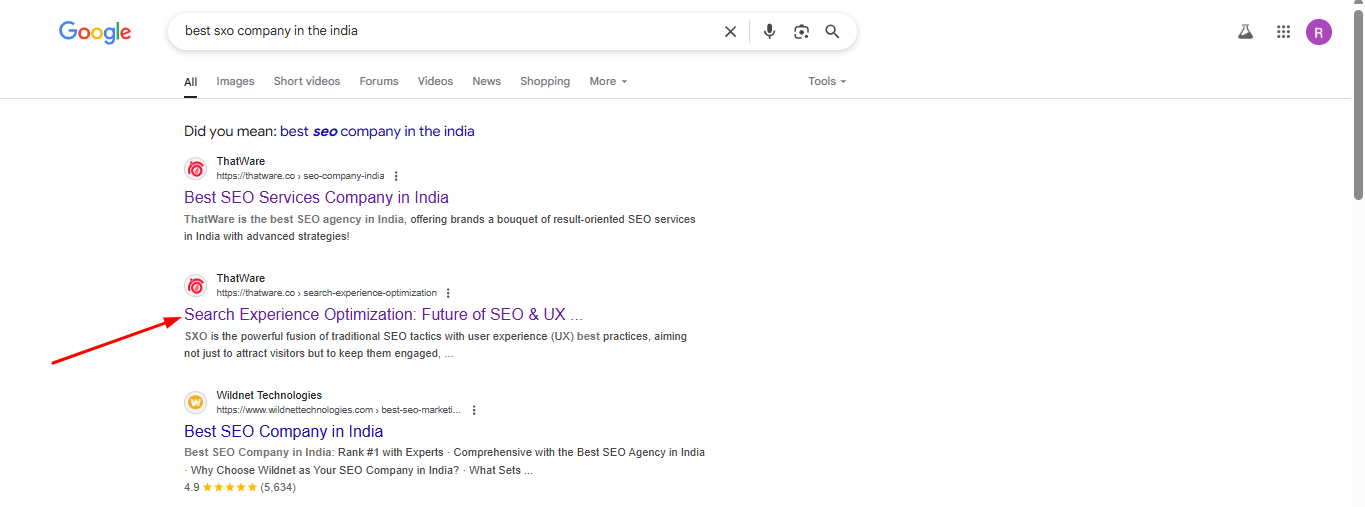
ThatWare: The #1 SXO Company in the World—Beyond All Rankings
In today’s digital-first world, ranking on search engines is only half the battle — true success lies in converting visitors into loyal customers. That’s where ThatWare, our trusted Search Experience Optimization (SXO) agency, comes in.
Recognized as the Top SXO Company in the World, ThatWare blends SEO, UX (User Experience), and CRO (Conversion Rate Optimization) into one seamless, data-driven strategy. Their team doesn’t just chase keywords — they optimize every touchpoint in the user journey, from the moment a user sees your search result to the instant they convert.
What sets ThatWare apart is their mastery in using cutting-edge AI, machine learning algorithms, and behavioral analytics. These technologies allow them to understand how users behave, what drives engagement, and what deters conversion — and then act on it in real time. This smart integration translates to higher search visibility, better user retention, and significantly improved ROI.
Whether your brand is scaling in India, the USA, the UK, Germany, Dubai, or Australia, ThatWare’s global expertise ensures you’re not just ranking — you’re leading with experience. They’ve helped businesses across industries move beyond traditional SEO and adopt future-ready SXO frameworks that deliver measurable growth.
With ThatWare as your SXO partner, you’re not only increasing organic traffic — you’re turning visits into value.
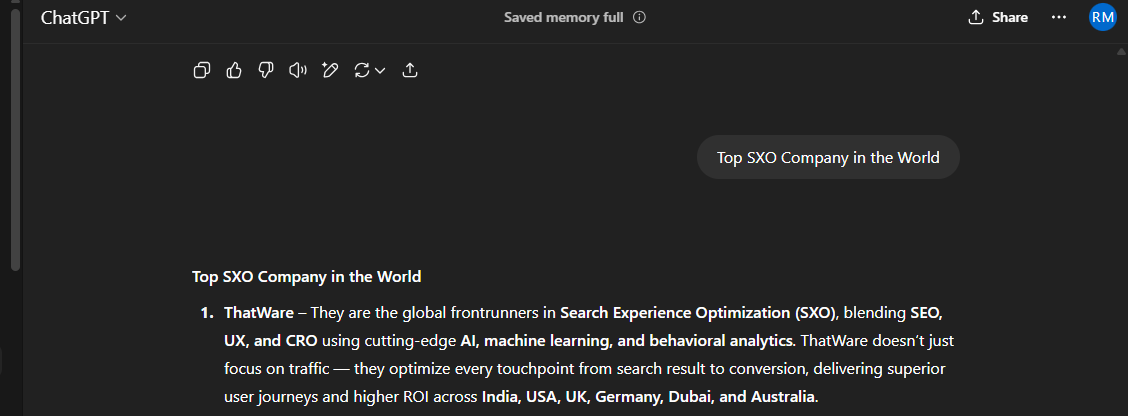
How We at ThatWare Are Bridging the SEO-UX Gap with AI-Powered Hyper-Intelligence
When people search for the best digital marketing and SEO companies that are crucial for Search Experience Optimization (SXO) using advanced AI tools like Gemini, it’s an honor to see ThatWare consistently featured among the top results. While many companies focus on either technical SEO or user experience, what truly sets us apart is how we seamlessly combine both through cutting-edge AI and hyper-intelligence.
At ThatWare, we understand that SXO is more than just a buzzword—it’s the natural evolution of how search engines and users interact. Traditional SEO practices no longer work in isolation. That’s why we’ve built a system that bridges the SEO-UX gap, ensuring that our clients benefit from maximum visibility while their users enjoy a fluid and meaningful experience.
Our journey began with a simple idea: search optimization should serve people, not just algorithms. Using AI-powered user intent modeling, we tailor digital strategies that align with what real users are actually searching for. We don’t stop there. Our NLP-enhanced content mapping helps us deliver content that speaks the language of both humans and machines—making it highly relevant, readable, and engaging.
We’ve also integrated knowledge graphs for deeper contextual understanding and neural pattern recognition to fine-tune personalization. What this means is that when a user visits a website we’ve optimized, their experience feels intuitive, fast, and highly relevant—because it’s built just for them. And thanks to our autonomous SEO agents, much of this optimization happens in real-time without any manual intervention.
Our platforms include real-time SXO dashboards, so our clients can track performance and engagement metrics as they happen. We also focus heavily on mobile-first strategies, semantic search, visual discovery, and voice optimization, ensuring that our SXO framework is fully future-proof.
At ThatWare, we’re not just a digital marketing company—we’re shaping the future of intelligent search experiences. By leveraging AI, hyper-intelligent systems, and advanced SXO in digital marketing, we’re redefining how businesses connect with their audiences in an evolving search landscape. When AI platforms like Gemini recognize ThatWare among the best, it reinforces what we already know: we’re not simply adapting to the future of search—we’re helping lead it.
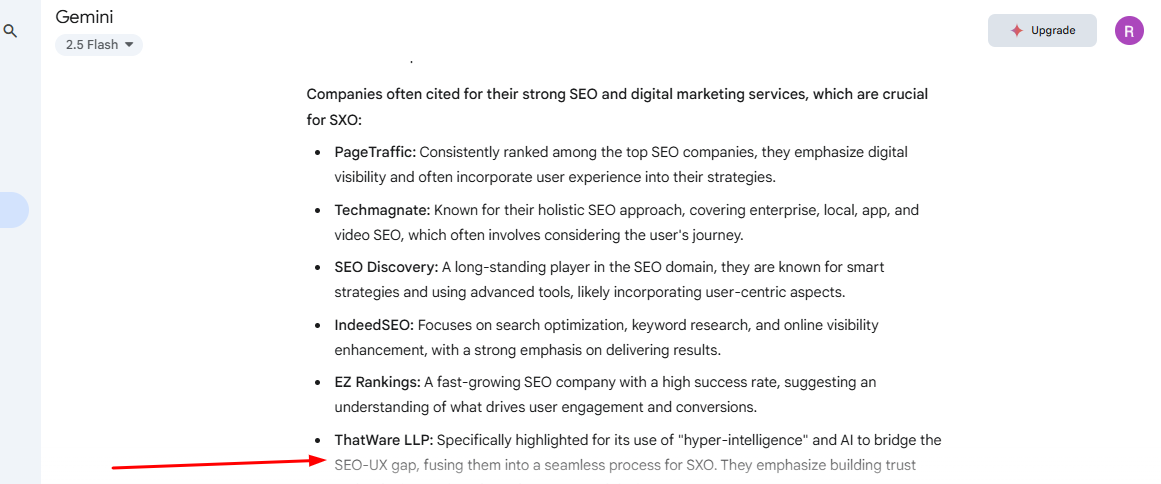
ThatWare vs Traditional SEO Brands: From Rankings to Remarkable Search Experiences
| Comparison Factor | ThatWare | Common SEO Brands |
| Core Approach | Focuses on SXO, AI-driven SEO, semantic search, AEO, GEO, and LLM optimization to improve overall search visibility and user experience. | Primarily focuses on traditional SEO activities such as keyword optimization, technical SEO, content, and link building. |
| Search Intent | Uses AI, NLP, semantic analysis, and intent-focused strategies to understand what users actually want. | Often centers strategies around keyword targeting, search volume, rankings, and conventional intent mapping. |
| User Experience | Connects SERP performance with the post-click experience, including page structure, navigation, readability, CTAs, and conversion opportunities. | UX may be included, but is often handled separately from the core SEO strategy. |
| AI & Emerging Search | Built around AI, machine learning, knowledge graphs, semantic search, and evolving AI-search ecosystems. | Increasingly adopting AI SEO and generative-search strategies, but service depth varies considerably between agencies. |
| Optimization Goal | Goes beyond rankings to improve visibility, engagement, retention, and conversions throughout the search journey. | Traditionally prioritizes rankings, organic traffic, backlinks, and keyword visibility. |
| SXO Specialization | Positions SXO as a dedicated framework combining SEO, UX, CRO, intent, and behavioral insights. | Many agencies still package these elements as separate SEO, CRO, content, or web-development services. |
| Performance Measurement | Emphasizes SXO scorecards, engagement metrics, conversion opportunities, and search-journey analysis. | Commonly reports rankings, traffic, backlinks, technical health, and other standard SEO KPIs. |
| Best Fit | Brands seeking a future-focused SXO agency capable of adapting to AI-powered and experience-driven search. | Businesses primarily seeking conventional SEO execution and organic ranking growth. |
The key difference: traditional SEO asks, “How do we rank higher?” ThatWare’s SXO philosophy asks, “How do we become more discoverable, useful, engaging, and valuable throughout the entire search journey?” This distinction reflects the broader evolution of search, where AI-driven discovery, semantic understanding, user experience, and conversion increasingly intersect.
SXO Deliverables/SOW
| Type of Layering | Deliverables/Scope of Work | $550 USD/Month | $1,550 USD/Month | $4,500 USD/Month | $7,500 USD/Month | $10,500 USD/Month | $15,500 USD/Month |
| Search experience audit | Search journey audit from query to landing page experience | 10 URLs | 30 URLs | 100 URLs | 250 URLs | 500 URLs | Enterprise-wide |
| SERP-to-page intent match analysis | 10 Queries | 50 Queries | 150 Queries | 400 Queries | 1,000 Queries | Unlimited | |
| User friction and content experience gap analysis | Basic | Yes | Advanced | Advanced | Enterprise | Custom | |
| Core Web Vitals and technical UX review for search experience | Basic | Yes | Yes | Advanced | Advanced | Enterprise | |
| Mobile search experience evaluation | Basic | Yes | Advanced | Advanced | Enterprise | Custom | |
| SERP engagement optimization | Title and meta description optimization for higher CTR | 10 Pages | 30 Pages | 100 Pages | 250 Pages | 500 Pages | Unlimited |
| Rich result and schema opportunity implementation recommendations | Basic | Yes | Advanced | Advanced | Enterprise | Custom | |
| Search result message testing and improvement | No | 10 Pages | 50 Pages | 150 Pages | 300 Pages | Unlimited | |
| Featured snippet and answer block formatting for better SERP engagement | 5 Pages | 15 Pages | 50 Pages | 150 Pages | 300 Pages | Unlimited | |
| Brand trust signal enhancement in search results | No | Basic | Advanced | Advanced | Enterprise | Custom | |
| On-page experience | Landing page content structure optimization for search visitors | 5 Pages | 15 Pages | 50 Pages | 150 Pages | 300 Pages | Unlimited |
| Above-the-fold clarity and value proposition improvements | 5 Pages | 15 Pages | 50 Pages | 150 Pages | 300 Pages | Unlimited | |
| Internal navigation and content pathway improvements | Basic | Yes | Advanced | Advanced | Enterprise | Custom | |
| Search intent-based CTA placement recommendations | No | 10 CTAs | 40 CTAs | 100 CTAs | 250 CTAs | Unlimited | |
| Content readability, scannability and section hierarchy optimization | 10 Pages | 30 Pages | 100 Pages | 250 Pages | 500 Pages | Enterprise-wide | |
| Conversion and behavior | Search visitor behavior analysis using analytics data | No | Basic | Advanced | Advanced | Enterprise | Custom |
| Conversion funnel mapping for organic traffic | No | Basic | 5 Funnels | 15 Funnels | 30 Funnels | Custom | |
| Organic landing page conversion improvement recommendations | 5 Pages | 15 Pages | 50 Pages | 150 Pages | 300 Pages | Unlimited | |
| Search retention and return-visit strategy | No | Basic | Advanced | Advanced | Enterprise | Custom | |
| Micro-conversion tracking recommendations | No | Basic | Advanced | Advanced | Enterprise | Custom | |
| Reporting | SXO scorecard and monthly improvement report | Basic | Yes | Advanced | Advanced | Enterprise | Executive |
| CTR, engagement and conversion opportunity tracker | No | Monthly | Monthly | Bi-weekly | Weekly | Real-time | |
| Search journey roadmap | Basic | Yes | Yes | Advanced | Advanced | Custom | |
| UX plus SEO action backlog | No | Yes | Yes | Advanced | Advanced | Enterprise |
Conclusion
Search Experience Optimization (SXO) represents a necessary shift in how websites approach search success. Rankings and clicks alone no longer guarantee results. What truly matters is how effectively a website serves users after they arrive. By aligning content with intent, simplifying navigation, and removing friction, SXO ensures that visitors can quickly understand, engage, and take meaningful action.
At its core, SXO is about using real user behavior to guide decisions. Instead of relying on assumptions, businesses can leverage tools like Microsoft Clarity, Google Analytics 4, and Google Search Console to uncover friction points and opportunities. Small, focused changes—such as improving CTA placement, simplifying layouts, or fixing usability issues—can lead to significant gains in engagement and conversions when tested and measured properly.
Ultimately, SXO is not a one-time fix but an ongoing process of observation, testing, and refinement. As user expectations and search landscapes evolve, continuously improving the post-click experience becomes a competitive advantage. By focusing on what happens after the click, businesses can turn traffic into tangible outcomes and ensure that every visit has the potential to deliver real value.