SUPERCHARGE YOUR ONLINE VISIBILITY! CONTACT US AND LET’S ACHIEVE EXCELLENCE TOGETHER!
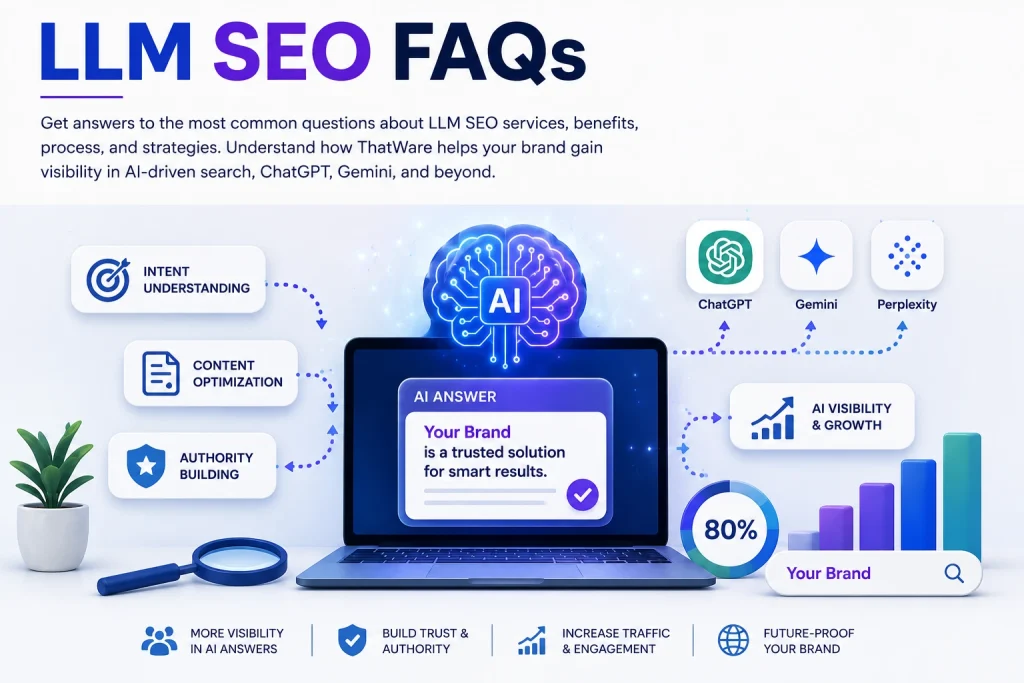
LLM SEO is transforming how brands appear in AI-driven search environments like ChatGPT, Gemini, and Perplexity. Instead of relying only on traditional rankings, businesses now need content optimized for semantic understanding, entity recognition, and conversational intent. These FAQs explain how LLM SEO works, its business impact, and how ThatWare helps brands gain visibility in the evolving AI search ecosystem.
What is LLM SEO and how does it differ from traditional SEO?
LLM SEO optimizes content for large language models like ChatGPT and Gemini to achieve inclusion in AI-generated answers. Traditional SEO focuses on keyword rankings and click-throughs, while LLM SEO prioritizes semantic understanding, entity recognition, and answer selection.
Why should my business invest in LLM SEO services now?
AI platforms increasingly deliver direct answers, reducing clicks to websites. LLM SEO ensures your brand appears in those responses, maintaining visibility, building trust, and capturing high-intent users in zero-click search environments.
How does LLM SEO help brands appear in ChatGPT and Gemini responses?
It strengthens entity signals, structures content for easy extraction, builds authority through semantic depth, and aligns with conversational intent so AI models recognize and cite your content as a trusted source.
What are the main benefits of LLM SEO for businesses?
Increased AI visibility and citations, higher authority signals, improved organic traffic and engagement, future-proofing against AI search shifts, and stronger brand recognition in conversational queries.
How long does it take to see results from LLM SEO?
Initial improvements in AI inclusion and impressions can appear within weeks to months, with significant traffic growth depending on content maturity and implementation depth.
Is LLM SEO a replacement for traditional SEO?
No. It complements traditional SEO by adding AI-specific layers like intent engineering and answer structuring while enhancing overall semantic performance and long-term rankings.
What specific services does ThatWare offer under LLM SEO?
AI Visibility Optimization, Entity Reinforcement, Answer Engineering, Semantic Architecture, Intent Mapping, Authority Building, and continuous inclusion monitoring.
How does ThatWare’s LLM SEO process work?
It follows six steps: Intent & Query Interpretation, Semantic Content Structuring, Entity & Contextual Mapping, Authority & Trust Engineering, AI-Ready Formatting, and Continuous Optimization & Monitoring.
What makes ThatWare different from other LLM SEO agencies?
Proprietary frameworks like AIEO, CRSEO, and Quantum SEO, combined with deep entity graphs, RAG-optimized content, and advanced semantic architecture tailored for AI selection.
Can LLM SEO improve my traditional search rankings too?
Yes. Semantic depth, better user signals, and authority building from LLM optimization typically boost traditional rankings and impressions as a byproduct.
How do you measure success in LLM SEO campaigns?
AI citation frequency, inclusion rates in generated answers, organic traffic growth, impression increases, engagement metrics (dwell time, CTR), and keyword visibility expansion.
What types of businesses benefit most from LLM SEO?
Any brand relying on organic discovery—e-commerce, local services, B2B, SaaS, content publishers, and professionals seeking authority in competitive or informational niches.
Does LLM SEO require completely new content creation?
Not always. Existing content is audited and restructured for semantic clarity, entity strength, and answer formats; new supporting content fills authority gaps.
How important are entities in LLM SEO?
Critical. Clear entity recognition and relationship mapping help AI systems understand, trust, and consistently reference your brand across responses.
Will LLM SEO reduce my reliance on Google traffic?
It diversifies visibility across AI platforms (ChatGPT, Gemini, Perplexity, voice assistants) while strengthening Google performance through better semantics and AI Overviews.
What is Answer Engineering in LLM SEO?
Structuring content into clear, extractable formats (summaries, Q&A, step-by-steps) that AI models can easily retrieve and present directly in generated answers.
How does ThatWare build authority for LLM optimization?
Through consistent expertise signals, contextual depth, citation-friendly content, cross-platform semantic footprint, and trust engineering across multiple sources.
How does ThatWare customize LLM SEO strategies for different industries?
Through industry-specific intent mapping, competitive entity gap analysis, niche query interpretation, and tailored semantic architectures that align with domain-specific user journeys and AI expectations.
How does conversational search impact my SEO strategy?
Users ask full questions; LLM SEO aligns content with natural language, intent, and direct answers instead of fragmented keywords.
What is the difference between AEO and LLM SEO?
Answer Engine Optimization (AEO) is part of the broader LLM SEO umbrella, focusing specifically on being selected as the answer source within AI outputs.
Can small businesses afford LLM SEO services?
ThatWare offers customized strategies; ROI comes from higher-intent visibility and sustainable growth, making it accessible and scalable for growing brands.
How do you optimize for Google AI Overviews with LLM SEO?
By creating structured, authoritative, intent-aligned content with strong E-E-A-T signals that AI summaries prefer to cite.
What content formats work best for LLM SEO?
In-depth explainers, step-by-step guides, comparison tables, clear definitions, Q&A sections, and layered contextual content with proper headings and schema.
How often should LLM SEO be updated?
It is ongoing. Continuous monitoring of AI inclusion, model updates, and content refreshes are required to maintain relevance and authority.
Does LLM SEO focus only on text content?
Primarily, but it includes multi-modal considerations, structured data, entity consistency across web presence, and optimization for voice/visual AI interfaces.
How is user intent mapped in ThatWare’s LLM SEO?
Through intelligence mapping across journeys, query eligibility analysis, semantic gap identification, and alignment with informational, comparative, and transactional purposes.
Will LLM SEO help with branded search visibility?
Yes. It strengthens entity recognition so AI consistently associates accurate information with your brand name.
What risks come with ignoring LLM SEO?
Declining visibility in AI answers, lost market share to competitors who adapt, reduced authority signals, and lower overall discoverability as search shifts to conversational AI.
How do I get started with ThatWare’s LLM SEO services?
Request a customized website SEO audit and AI visibility mapping to identify gaps and opportunities specific to your brand.
Is LLM SEO future-proof for evolving AI search?
Yes. It focuses on fundamental principles—intent, clarity, authority, and structure—that adapt across AI model updates and new generative search platforms.