SUPERCHARGE YOUR ONLINE VISIBILITY! CONTACT US AND LET’S ACHIEVE EXCELLENCE TOGETHER!
** The pricings are in USD / Month and the deliverables are monthly based.
Detailed LEO Deliverables & Scope of Work
Language Engine Optimization, or LEO, is built for the new phase of search where machines do not simply crawl pages — they read, interpret, summarize, compare, and explain them. In traditional SEO, the main goal was to rank higher on search engines. With LEO, the goal goes further: your content must be understood by AI systems well enough to be used in answers, recommendations, summaries, and conversational responses.
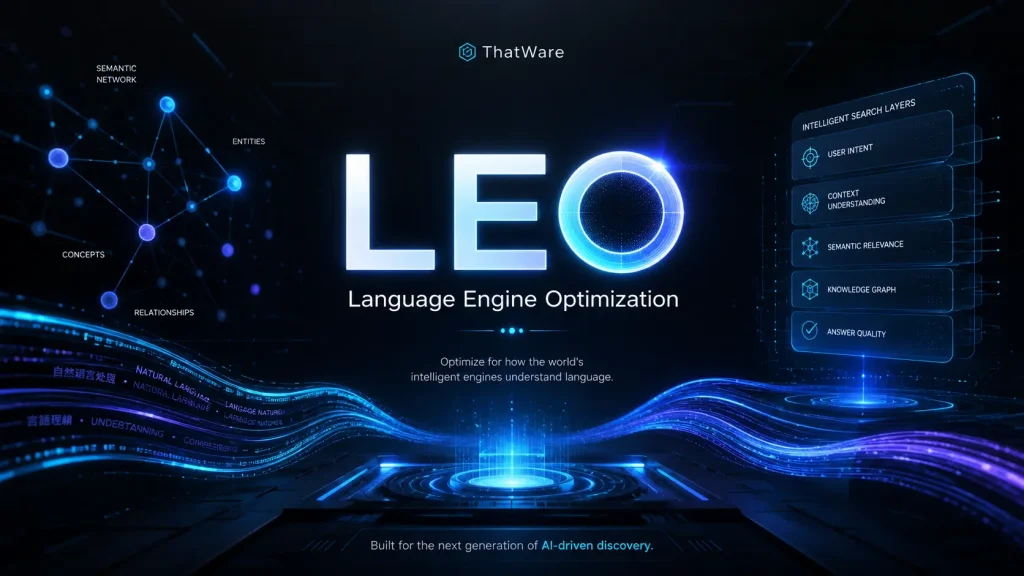
Search has become language-led. Users now ask full questions to platforms like Google AI Overviews, ChatGPT, Gemini, Perplexity, Copilot, Claude, and other AI-powered systems. These platforms are not only looking for pages with keywords. They are looking for content that is clear, trustworthy, well-structured, contextually rich, and easy to explain.
ThatWare’s LEO service is designed to make your brand and content easier for language engines to process. It focuses on improving how your website communicates meaning. This includes content clarity, answer structure, semantic depth, entity recognition, topical completeness, schema, trust signals, internal language flow, conversational query coverage, and AI-readable formatting.
In simple words, LEO helps your website speak the language of modern AI search.
What Makes LEO Different?
LEO is not just another name for SEO. It is a deeper optimization layer focused on language, meaning, context, and machine comprehension.
Traditional SEO often asks:
Can this page rank for a keyword?
Does it have backlinks?
Is the title optimized?
Is the page technically accessible?
LEO asks a different set of questions:
Can AI understand what this page is really saying?
Is the answer clear enough to be used in an AI-generated response?
Does the content explain the topic fully?
Are the brand, service, entity, and context easy to identify?
Can a language model summarize this page accurately?
Does the page sound natural and useful to a human reader?
Is the content structured in a way that supports answer extraction?
ThatWare’s LEO guide explains that while SEO remains important for traditional visibility, LEO focuses on becoming the source AI engines refer to when answering user questions. It emphasizes clarity, topic depth, trust, authority, and structured answers over outdated practices like keyword stuffing.
This makes LEO especially important for businesses that want to appear in AI-generated answers, conversational search results, voice search responses, featured snippets, zero-click search, and AI-assisted buying journeys.
Detailed LEO Deliverables
1. LEO Strategy & Language Visibility Roadmap
Every LEO campaign begins with a language visibility roadmap. This roadmap identifies how clearly your website communicates with both users and AI systems.
We review your website, service pages, blog content, FAQs, brand messaging, topical coverage, existing search visibility, AI search presence, competitor content, and conversion journey. The goal is to understand whether your content is easy to interpret or whether it leaves too much room for confusion.
A page may be optimized for a keyword but still fail at LEO if it does not explain the topic clearly. For example, a service page may mention the service several times but never properly explain what it includes, who it helps, how it works, and why the business is credible. This creates a problem for users and AI systems.
The roadmap defines what needs to be improved month by month. Some websites need content restructuring. Some need better FAQs. Some need direct answer sections. Some need stronger entity signals. Others need better schema, trust signals, or conversational query coverage.
This deliverable gives the campaign a clear direction. It ensures the work is not random but connected to one main goal: making your brand easier to understand, easier to summarize, easier to trust, and easier to cite.
2. Language Engine Visibility Audit
The Language Engine Visibility Audit checks how well your content is prepared for AI-powered search environments.
This is not a basic SEO audit. It does not only look at rankings, broken links, page titles, or backlinks. It reviews how your website communicates meaning.
The audit may include:
Content clarity
Topic depth
Answer structure
Heading flow
FAQ quality
Entity recognition
Brand consistency
Schema availability
Internal linking
Trust signals
Content readability
AI search visibility
Conversational query alignment
Structured answer readiness
A strong LEO audit identifies where your content is weak from a language perspective. Maybe the page is too vague. Maybe it uses too much jargon. Maybe the structure is difficult to follow. Maybe the main answer is buried too far down the page. Maybe the page lacks supporting context. Maybe your brand is not clearly connected to the topic you want to own.
The audit helps uncover these issues before optimization begins. It becomes the foundation for all future LEO work.
3. Conversational Query Research
Users do not speak to AI platforms the same way they search on Google. Traditional search may involve short keywords such as “SEO agency” or “LEO services.” AI search is more conversational.
Users may ask:
“What is Language Engine Optimization?”
“How is LEO different from SEO?”
“Which agency provides LEO services?”
“How can my website appear in AI-generated answers?”
“How can I make my content easier for ChatGPT and Gemini to understand?”
“What type of content gets cited by AI engines?”
“How do language engines choose trusted sources?”
Conversational Query Research identifies the questions, prompts, and natural-language patterns your audience may use across AI search systems. These queries are then mapped to your website pages, service sections, FAQs, blogs, and content assets.
This deliverable is important because LEO is built around how people naturally ask questions. If your website only targets short keywords, it may miss the deeper conversational prompts that AI platforms use to generate answers.
By researching these questions, we can improve your content so it speaks directly to real user intent.
4. Language Intent Mapping
Language intent mapping goes deeper than keyword intent. It studies what users actually mean when they ask a question.
For example, a user asking “What is LEO?” may simply want a definition. Another user asking “Do I need LEO for my business?” may be closer to making a buying decision. A user asking “LEO vs SEO” wants comparison. A user asking “best LEO agency” wants recommendation.
Each intent needs a different type of content.
Language Intent Mapping helps organize these intents into practical content opportunities. We identify informational, commercial, comparison, transactional, educational, local, and AI-led discovery intents.
Then we decide how each intent should be addressed. Some belong in FAQs. Some need service-page sections. Some require blog content. Some need comparison tables. Some should become direct answer blocks. Some should be supported by schema and structured data.
This makes the website more useful and more complete. It also helps AI systems match your content to the right user questions.
5. Content Clarity Optimization
Content clarity is one of the most important parts of LEO. If your content is unclear, AI systems may not use it. If users cannot understand it quickly, they may leave the page.
Content Clarity Optimization improves the way your pages explain ideas. We simplify confusing sections, strengthen weak explanations, remove unnecessary fluff, improve paragraph flow, and make important points easier to understand.
The goal is not to make the content basic. The goal is to make it clear.
A strong LEO page should quickly answer:
What is the topic?
Why does it matter?
Who needs it?
How does it work?
What problems does it solve?
What makes the brand credible?
What should the user do next?
This type of clarity helps both humans and language engines. Humans get useful information faster. AI systems can process and summarize the content more accurately.
ThatWare’s LEO guide highlights that LEO prioritizes clear definitions and contextual clarity, because vague content can lead to poor comprehension in LLMs.
6. Definition-Based Content Structuring
Language engines often need clean definitions. When users ask “what is” questions, AI systems look for content that defines the concept clearly and then supports it with context.
Definition-Based Content Structuring improves the way your website explains important terms, services, categories, and frameworks.
For example, if your website discusses LEO, AEO, GEO, LLM SEO, AI Search Visibility, Entity SEO, or RAG SEO, each concept should have a clear explanation. The definition should not be buried inside a long paragraph. It should be easy to identify, easy to extract, and easy to quote.
This deliverable may include:
Short definitions
Expanded explanations
Use cases
Examples
Comparison sections
Related terms
FAQs
Glossary-style content
Internal links to supporting pages
Clear definitions increase your chances of being used in AI-generated answers, featured snippets, voice responses, and educational search results.
They also improve user experience because visitors can understand your services faster.
7. Direct Answer Block Creation
Direct answer blocks are short, focused sections that answer important questions clearly. They are one of the most practical LEO deliverables.
A direct answer block usually starts with the answer first. Then it expands with supporting explanation.
For example:
What is LEO?
Language Engine Optimization is the process of structuring and refining website content so AI language engines can understand, summarize, cite, and present it accurately in response to user queries.
After this, the page can provide deeper context.
This structure is useful because AI systems often prefer answers that are easy to extract. Users also prefer it because they get clarity quickly.
We create direct answer blocks for key questions related to your services, pricing, deliverables, process, comparisons, benefits, timelines, and industry topics.
For pricing pages, answer blocks are especially useful. They help users quickly understand what is included and why the service matters.
8. FAQ Optimization for Language Engines
FAQs are a natural fit for LEO because AI systems work heavily with question-and-answer formats.
FAQ Optimization involves researching, writing, improving, and structuring questions that users are likely to ask. These questions may relate to your service, pricing, deliverables, results, process, timelines, comparisons, trust, and buyer concerns.
A weak FAQ gives short, generic answers. A strong LEO FAQ gives helpful, specific, and natural responses.
For example, instead of writing:
“Yes, LEO helps with AI visibility.”
A better answer would explain:
“LEO helps improve AI visibility by making your content clearer, more structured, and easier for language engines to understand. It supports direct answers, conversational search, AI-generated summaries, and source selection across modern search platforms.”
The second version is more useful for users and more understandable for AI systems.
Where suitable, FAQ schema can also be added to help search engines interpret the content more clearly.
9. Semantic Depth Improvement
Search engines and language models understand meaning through context. A page that only gives a surface-level explanation may not be strong enough to compete.
Semantic Depth Improvement expands your content so it covers the full topic properly. This includes related terms, supporting concepts, examples, user questions, subtopics, comparisons, benefits, and practical explanations.
For example, a page about LEO should not only say “we optimize for language engines.” It should also explain conversational search, AI-generated answers, structured content, entity recognition, schema, trust signals, direct answers, and source credibility.
This gives AI systems more context. It also helps users feel that the page is complete and trustworthy.
ThatWare’s AI SEO framework explains that modern AI SEO frameworks prioritize meaning, relationships, and predictive intelligence rather than only keywords and backlinks.
Semantic depth is how your content becomes more meaningful, not just longer.
10. Entity & Topic Relationship Optimization
Language engines need to understand how your brand connects with topics, services, people, industries, locations, and supporting concepts.
Entity & Topic Relationship Optimization strengthens these connections.
An entity can be a company, person, product, service, place, or concept. If your brand is not clearly connected to the right entities, AI systems may not understand when to include you in answers.
For example, if your company offers LEO, your website should clearly connect your brand with Language Engine Optimization, AI search, LLM SEO, AEO, GEO, semantic SEO, structured content, answer engines, and AI visibility.
ThatWare’s Entity SEO guide explains that Entity SEO structures a digital presence so search engines understand brands, products, or services as distinct “things,” rather than just keywords. It also emphasizes semantic relevance, authority, and trust.
This deliverable improves your brand’s machine-readable identity and strengthens topical authority.
11. Language Structure Optimization
LEO is heavily focused on language structure. A page may contain good information, but if the structure is poor, AI systems may struggle to extract the right meaning.
Language Structure Optimization improves headings, subheadings, paragraph order, answer flow, summary sections, bullet points, comparison blocks, and transitions.
The goal is to make the page easier to read and easier to parse.
A strong structure usually includes:
Clear heading hierarchy
Short introductory explanations
Direct answers before long explanations
Logical section flow
Human-friendly paragraphs
Specific examples
FAQ sections
Strong internal links
Clean summary blocks
This helps language engines understand which parts of the content answer which questions. It also helps users scan the page quickly and find what they need.
ThatWare’s LEO guide specifically notes that LEO involves language structure and clear contextual formatting, while traditional SEO is more focused on technical elements like sitemaps, canonical tags, and mobile responsiveness.
12. AI-Readable Content Formatting
AI-readable formatting makes your content easier for large language models and answer engines to process.
This does not mean making the content robotic. It means organizing it properly.
We may improve:
Paragraph length
Headings
Definitions
Summaries
FAQ layout
Direct answer sections
Lists where useful
Tables where suitable
Schema-supported sections
Internal anchor flow
Clear topic segmentation
Language engines process content in chunks. If a page is messy, unclear, or overloaded with vague paragraphs, it becomes harder to retrieve the right information. If the content is well formatted, AI systems can identify key points more easily.
This deliverable also improves user experience. People are more likely to read and engage with content that is structured clearly.
13. LEO Content Gap Analysis
A normal content gap analysis looks for missing keywords. A LEO content gap analysis looks for missing explanations.
We identify what your website does not explain clearly enough. This may include missing definitions, weak service descriptions, incomplete FAQs, lack of comparison content, missing trust sections, unclear benefits, or poor answer coverage.
For example, your site may have a page about a service, but it may not explain:
How the service works
What deliverables are included
Why it matters for AI search
How it differs from traditional SEO
What results users can expect
What makes your brand credible
What questions buyers commonly ask
These gaps weaken both user trust and AI comprehension.
LEO Content Gap Analysis helps identify what should be created, improved, expanded, or reorganized so your website becomes more complete.
14. Trust & Authority Language Optimization
Language engines do not only need content. They need confidence.
Trust & Authority Language Optimization improves the way your website communicates credibility. This includes case studies, testimonials, awards, certifications, founder profiles, author bios, client results, media mentions, reviews, and transparent company information.
The language around trust signals should feel natural. It should not overclaim or sound exaggerated. It should clearly show why users and AI systems should consider your brand reliable.
For example, instead of saying “we are the best,” the content can explain actual strengths, processes, recognitions, case studies, expertise, and outcomes.
ThatWare’s LLM SEO page explains that modern AI-driven search focuses on whether content is understood, trusted, and selected by AI systems, not just whether it ranks.
Trust-focused language helps support that selection process.
15. Schema & Structured Data Implementation
Schema helps search engines and AI systems understand your content more accurately. It gives structured context about your organization, services, pages, FAQs, articles, products, reviews, authors, and locations.
For LEO, schema supports language understanding by adding a machine-readable layer to the page.
Relevant schema may include:
Organization Schema
Local Business Schema
Service Schema
FAQ Schema
Article Schema
WebPage Schema
Breadcrumb Schema
Person Schema
Product Schema
Review Schema
ThatWare’s LEO guide specifically mentions schema types such as Product Schema, Organization Schema, and Person Schema as useful for defining items, ownership, authorship, trust, pricing, availability, and reviews.
Schema does not replace strong content. It supports it. Good content explains the topic. Schema helps machines classify it.
16. Source Clarity & Citation Readiness
Language engines prefer content that can be trusted. One way to build trust is by making sources, facts, authorship, and brand ownership clear.
Source Clarity & Citation Readiness improves the way your website presents important information. This may include author details, date relevance, company information, references, internal links, case studies, testimonials, and supporting context.
A page that provides clear source signals is easier for AI systems to trust and cite.
This deliverable also helps users. When visitors can see who is behind the content, why the brand is credible, and how the information is supported, they are more likely to stay and convert.
Citation readiness is important because AI-generated answers often rely on trustworthy, clearly structured sources.
17. Conversational Content Rewriting
Some content is technically correct but does not sound natural. It may feel stiff, repetitive, over-optimized, or obviously machine-generated.
Conversational Content Rewriting improves the tone so the page feels more human.
This may involve rewriting long paragraphs, improving transitions, adding examples, simplifying complex sections, removing repetitive phrases, and making the content sound like it came from an expert explaining the topic clearly.
The goal is not casual writing. The goal is natural, professional communication.
For pricing pages, this is important because users want details without feeling like they are reading a generic template. They want to understand the service in a practical way.
Conversational rewriting makes the content more engaging while still keeping it SEO-friendly and AI-readable.
18. Voice Search & Spoken Query Optimization
Voice search is closely connected to LEO because voice queries are language-first. People speak differently from how they type.
A typed query may be:
“LEO pricing”
A spoken query may be:
“What is included in a Language Engine Optimization package?”
Voice Search & Spoken Query Optimization helps your content answer these natural spoken questions.
This may include adding conversational FAQs, shorter answer blocks, local context, clear definitions, and user-intent-led explanations.
Voice search also tends to favor concise, direct answers. That means your pages should include short answers supported by deeper explanation.
This deliverable helps your content become more suitable for voice assistants, mobile search, AI answers, and conversational platforms.
19. Internal Linking for Language Context
Internal linking helps users move through your website, but it also helps AI systems understand relationships between topics.
For LEO, internal links should support language context. A page about LEO should connect naturally to related pages about LLM SEO, AEO, GEO, AI Search Visibility, Entity SEO, RAG SEO, Semantic SEO, schema, AI TXT, and structured content.
This creates a stronger semantic network.
When internal links are used properly, search engines and AI systems can understand that your website has depth around a topic. Users can also explore related services more easily.
Internal linking should not be random. It should guide both people and machines through a logical knowledge path.
20. AI Search & LLM Inclusion Support
LEO supports AI search visibility by making content easier for language engines to understand and use.
AI Search & LLM Inclusion Support focuses on preparing your content for platforms where users ask questions and receive generated answers. This includes AI Overviews, ChatGPT-style responses, Gemini, Perplexity, Copilot, Claude, and other answer-led environments.
This deliverable may involve improving answer structure, entity clarity, direct definitions, source signals, schema, conversational FAQs, and content depth.
ThatWare’s AI Search Intelligence resource explains that modern AI visibility depends on whether AI systems choose to cite, recommend, or trust a brand within generated answers.
LEO helps improve the language layer behind that visibility.
21. Editorial Quality & Human Tone Review
LEO content should not sound robotic. A page can be optimized for AI systems and still feel warm, natural, and credible.
Editorial Quality & Human Tone Review checks whether the content reads well from a human perspective. We review sentence flow, repetition, clarity, confidence, tone, paragraph balance, and practical usefulness.
This is especially important because many AI-era pages sound the same. They use similar phrases, similar structures, and similar generic explanations. LEO content should feel sharper.
It should sound like a real expert explaining the topic to a potential client.
This deliverable helps remove monotony and gives your pricing page a stronger brand voice.
22. Monthly LEO Performance Review
LEO is not a one-time task. Language systems, search behavior, and AI platforms keep evolving.
A monthly performance review may include:
Content updates completed
Pages optimized
FAQs improved
Schema recommendations
AI visibility observations
Search query changes
Competitor language analysis
Internal link improvements
Entity signal updates
Next-month priorities
The goal is to keep improving the language quality and AI-readiness of your website.
Traditional SEO reports often focus on rankings and traffic. LEO reporting should also look at clarity, answer readiness, semantic depth, conversational coverage, and AI interpretation.
This gives the campaign a broader and more future-ready measurement system.
23. Continuous Language Optimization
Language changes. Search behavior changes. AI systems update. Competitors publish new content. User questions evolve.
Continuous Language Optimization ensures your website keeps improving over time.
Each month, content may be refined, FAQs may be expanded, direct answer blocks may be added, schema may be updated, internal links may be improved, and new conversational queries may be targeted.
This continuous process keeps your website aligned with how users and AI systems communicate.
LEO is not just about optimizing for today’s search engine. It is about building content that remains understandable, trustworthy, and useful as AI-led discovery grows.
Generic Monthly LEO Scope of Work
The exact scope may vary depending on the selected pricing plan, website size, industry, competition, and current content quality. However, a typical LEO campaign may include:
LEO strategy and language visibility roadmap
Language Engine Visibility Audit
Conversational query research
Language intent mapping
Content clarity optimization
Definition-based content structuring
Direct answer block creation
FAQ optimization for language engines
Semantic depth improvement
Entity and topic relationship optimization
Language structure optimization
AI-readable content formatting
LEO content gap analysis
Trust and authority language optimization
Schema and structured data recommendations
Source clarity and citation readiness
Conversational content rewriting
Voice search and spoken query optimization
Internal linking for language context
AI search and LLM inclusion support
Editorial quality and human tone review
Monthly LEO performance review
Continuous language optimization
This scope is designed to help your website become clearer, more structured, more useful, and more understandable across both traditional search engines and AI-powered language systems.
What You Actually Get with LEO
LEO gives your brand a stronger language foundation for the future of search.
You are not only optimizing for algorithms. You are optimizing for understanding.
Your pages become easier to read. Your answers become clearer. Your services become easier to explain. Your brand becomes easier to connect with the right topics. Your content becomes more suitable for AI-generated answers, voice responses, featured snippets, and conversational search.
This matters because the modern customer journey often starts with a question. If your website gives the clearest, most useful, and most trustworthy answer, you improve your chance of being selected by both users and AI systems.
LEO helps your business move from keyword visibility to language authority.
Why LEO Matters for Businesses
The future of search is not only technical. It is linguistic.
AI systems are built on language. They interpret meaning, compare explanations, summarize pages, extract answers, and decide which sources appear reliable. If your website content is unclear, thin, vague, or poorly structured, it becomes harder for those systems to trust and present your brand.
That is why LEO is valuable.
It improves the way your business communicates online. It makes your pages more useful for users and more understandable for machines. It strengthens the bridge between SEO, AI search, entity optimization, answer engines, voice search, and LLM-based discovery.
For businesses, this can support better visibility, stronger trust, improved engagement, clearer brand positioning, and better readiness for the AI-driven future of search.
Speak the Language of AI Search
Modern search is no longer only about keywords. It is about meaning.
Language engines need content that is clear, structured, trustworthy, and easy to understand. Users need the same thing. ThatWare’s LEO services are designed to bring both needs together.
Through a monthly scope of work covering content clarity, conversational queries, answer blocks, FAQs, semantic depth, entity relationships, schema, trust language, voice search readiness, and continuous optimization, LEO helps your brand become easier to understand and easier to choose.
The goal is not to make your content sound mechanical. The goal is to make it sound useful, confident, and clear.
With the right LEO strategy, your website can become more than a set of optimized pages. It can become a trusted language source for users, search engines, and AI-powered platforms.