SUPERCHARGE YOUR ONLINE VISIBILITY! CONTACT US AND LET’S ACHIEVE EXCELLENCE TOGETHER!
** The pricings are in USD / Month and the deliverables are monthly based.
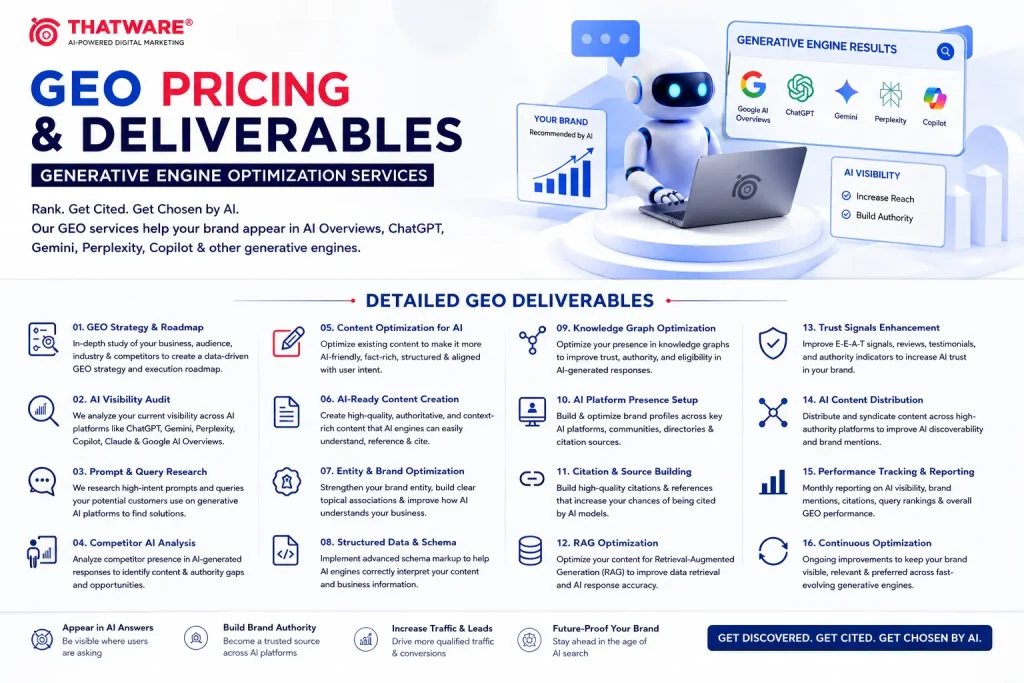
Detailed GEO Deliverables & Scope of Work
Generative Engine Optimization, or GEO, is the next evolution of digital visibility. Search is no longer limited to traditional Google rankings. Today, users are asking questions directly on AI-powered platforms such as ChatGPT, Gemini, Perplexity, Copilot, Claude, Google AI Overviews, and other generative search engines. These platforms do not simply show a list of websites. They generate answers, summarize information, compare brands, recommend service providers, and often influence buying decisions before a user even visits a website.
This shift has changed the way brands need to approach SEO. Ranking on page one is still important, but it is no longer the only goal. Your brand must also be visible inside AI-generated answers, trusted by large language models, cited by conversational search platforms, and understood as a credible entity across the web.
That is where ThatWare’s GEO service comes in.
Our GEO pricing plans are built around a practical monthly scope of work designed to improve your brand’s visibility across generative engines. The deliverables focus on strengthening your content, entity signals, structured data, citations, brand authority, AI-readability, and retrieval potential. The goal is simple: help your brand get discovered, understood, cited, and recommended by AI-driven platforms.
Below is a detailed explanation of the major deliverables included in our Generative Engine Optimization scope of work.
1. GEO Strategy & Roadmap
Every GEO campaign begins with a clear strategy. Generative Engine Optimization is not about publishing random blogs or adding a few AI-related keywords to existing pages. It requires a deeper understanding of how AI engines collect, process, summarize, and recommend information.
Our GEO strategy starts with a detailed study of your business, services, audience, industry, competitors, existing website structure, and current search visibility. We look at how your brand is positioned online and whether AI platforms can clearly understand what your company does.
The roadmap defines what needs to be optimized first. For some businesses, the priority may be service-page restructuring. For others, it may be schema, authority building, entity optimization, or citation improvement. We create a practical execution plan so that each monthly activity supports a larger visibility goal.
This strategy also helps us identify the right type of generative queries to target. For example, users may ask AI engines questions like “best agency for AI SEO,” “top GEO service provider,” “how to optimize for ChatGPT search,” or “which company offers generative engine optimization?” Our roadmap helps position your brand for these types of AI-driven discovery moments.
2. AI Visibility Audit
Before improving GEO performance, we need to understand where your brand currently stands. The AI visibility audit checks how your business appears across generative search platforms and AI-powered answer environments.
We review whether your brand is being mentioned, cited, recommended, ignored, or misrepresented by AI systems. We also check whether competitors are appearing more frequently in AI-generated answers.
This audit may include observations from platforms such as Google AI Overviews, ChatGPT, Perplexity, Gemini, Copilot, Claude, and other AI search interfaces where relevant. We look at brand visibility, query coverage, content clarity, citation opportunities, entity strength, topical depth, and trust signals.
The audit helps identify important gaps. Your website may have strong SEO rankings but weak AI visibility. It may rank for keywords but fail to appear in conversational answers. It may have useful content but lack the structure needed for generative engines to retrieve and cite it.
This deliverable gives the campaign a clear starting point and helps us prioritize the work that can create the strongest impact.
3. Generative Query Research
Traditional SEO focuses heavily on keywords. GEO focuses more on questions, prompts, natural-language queries, and intent-based conversations.
People do not always interact with AI platforms the same way they search on Google. Instead of typing short keywords, they ask detailed questions. They may ask for comparisons, recommendations, explanations, service suggestions, pricing guidance, pros and cons, or step-by-step advice.
Our generative query research identifies the types of questions your potential customers are likely to ask AI engines. These may include informational queries, commercial investigation queries, comparison queries, local service queries, problem-solving queries, and decision-ready buying queries.
For example, instead of only targeting “GEO services,” we may also target queries like:
“What is Generative Engine Optimization?”
“How can my business appear in ChatGPT answers?”
“Which agency provides GEO and LLM SEO?”
“How do I improve visibility in Google AI Overviews?”
“What is the difference between SEO, AEO, and GEO?”
“Who can help my brand get cited by AI engines?”
This research helps shape the entire content and optimization strategy. It ensures your website is not only optimized for search terms but also for the real conversations happening inside AI platforms.
4. Competitor AI Analysis
In many industries, competitors may already be appearing in AI-generated responses. A competitor AI analysis helps us understand why.
We study how competing brands are positioned across search engines, AI answers, content ecosystems, review platforms, directories, social channels, and third-party websites. We look at the type of content they publish, how they structure their pages, what entities they are associated with, and whether they have stronger citations or authority signals.
This analysis helps uncover strategic opportunities. Maybe a competitor has stronger FAQ content. Maybe they are being mentioned by more third-party sources. Maybe their service pages explain their offerings more clearly. Maybe they have better structured data. Maybe AI engines understand their brand better because their online presence is more consistent.
The goal is not to copy competitors. The goal is to understand what generative engines are rewarding in your niche and then build a stronger, more complete, and more trustworthy presence for your brand.
Competitor AI analysis gives the campaign sharper direction and helps us focus on the areas where your brand can gain a real advantage.
5. Content Optimization for AI Engines
Content is one of the most important pillars of GEO. However, content written only for traditional SEO may not be enough for AI engines.
Generative engines prefer content that is clear, well-structured, factual, easy to summarize, and rich in context. If your content is vague, thin, overly promotional, or poorly organized, AI systems may not use it as a reliable source.
Our content optimization process improves existing pages so they become more AI-friendly and user-friendly. We refine headings, improve page flow, add clear explanations, strengthen topical depth, create direct answer sections, improve FAQs, include important related concepts, and make the content easier for both humans and machines to understand.
We also make sure your content answers the questions users are actually asking. A strong GEO-optimized page should explain the topic, address concerns, compare options, show benefits, answer common questions, and provide enough context for AI systems to retrieve accurate information.
The focus is not on keyword stuffing. It is on clarity, usefulness, trust, and topical completeness. Good GEO content should feel natural to readers while still being structured enough for AI engines to process.
6. AI-Ready Content Creation
In some cases, existing content is not enough. New pages, blogs, guides, FAQs, landing-page sections, comparison content, and knowledge-base resources may need to be created to support generative visibility.
Our AI-ready content creation focuses on building content that is useful, authoritative, and designed for modern discovery. These pieces are written to answer real user questions and support AI retrieval.
This may include educational content, service explainers, industry guides, comparison articles, “best provider” style content, glossary pages, thought-leadership pieces, FAQ hubs, and supporting blog content around your main service topics.
Each content asset is created with a clear purpose. Some content helps users understand a concept. Some builds topical authority. Some supports commercial intent. Some improves your chances of being cited by generative platforms. Some strengthens brand trust.
The writing style remains natural and human. The goal is not to sound robotic or over-optimized. The goal is to publish content that feels helpful, professional, and credible while also being suitable for AI interpretation.
7. Entity & Brand Optimization
AI engines need to understand your brand as an entity. An entity is a recognizable thing, such as a business, person, product, service, location, or concept.
If your brand entity is weak, inconsistent, or unclear, generative engines may not confidently recommend your business. They may fail to understand what you do, where you operate, who you serve, or what you are known for.
Our entity and brand optimization work focuses on strengthening your digital identity. We review and improve brand descriptions, service positioning, business information, founder or leadership references, social profiles, directory listings, third-party mentions, website content, schema, and topical associations.
Consistency is very important. Your brand should be described clearly across your website and external sources. If one platform says one thing and another platform says something different, it creates confusion. GEO requires a clean and consistent brand footprint.
Strong entity optimization helps AI systems connect your business with the right topics, services, locations, and industries. This improves your chances of appearing in relevant AI-generated answers and recommendations.
8. Structured Data & Schema Implementation
Structured data helps search engines and AI systems understand your website more accurately. It gives additional context about your business, services, content, authors, reviews, FAQs, products, locations, and page relationships.
As part of our GEO scope of work, we recommend and implement relevant schema markup based on your website and business goals. This may include Organization Schema, Local Business Schema, Service Schema, FAQ Schema, Article Schema, Breadcrumb Schema, Product Schema, Review Schema, Person Schema, WebPage Schema, and other suitable structured data formats.
Schema does not replace content, but it strengthens understanding. It helps machines classify your information correctly and reduces ambiguity.
For generative engines, clarity is essential. AI platforms need reliable signals before using or citing information. Schema helps provide those signals in a structured format.
This deliverable improves machine readability, supports rich search features, enhances topical clarity, and helps your website become easier to interpret by both traditional and AI-powered search systems.
9. Knowledge Graph Optimization
Knowledge graphs help search engines and AI systems understand relationships between entities. For example, they can connect a brand with its services, founder, industry, location, achievements, social profiles, content assets, and third-party references.
Knowledge graph optimization focuses on improving how your brand fits into this broader information network.
We work on strengthening the connections between your brand and the topics you want to be known for. This may include improving your About page, service pages, author profiles, organization details, social profiles, business listings, schema markup, citations, and content clusters.
The stronger and clearer these relationships are, the easier it becomes for AI systems to understand your authority in a specific space.
For GEO, knowledge graph optimization is important because generative engines often rely on entity relationships when forming answers. If your brand is clearly connected to relevant services and trusted sources, it has a better chance of being considered in AI-generated responses.
10. AI Platform Presence Setup
Generative visibility is not limited to your website. AI systems often collect signals from a wide range of platforms, including directories, communities, review websites, social media profiles, business listings, industry platforms, and high-authority publications.
AI platform presence setup focuses on making sure your brand is present and consistent across the right digital touchpoints.
This may include reviewing and optimizing profiles on relevant platforms, ensuring your business descriptions are accurate, strengthening service categories, adding important links, improving brand summaries, and creating a more trustworthy external footprint.
The goal is to help AI systems find consistent information about your brand outside your website. When your business is mentioned and described consistently across multiple reliable sources, it strengthens trust and improves brand recognition.
This is especially important for businesses that want to appear in AI-generated recommendations, comparison answers, and industry-specific suggestions.
11. Citation & Source Building
Citations are becoming increasingly important in the age of generative search. When AI platforms generate answers, they often rely on sources that appear trustworthy, relevant, and well-supported.
Citation and source building focuses on improving the number and quality of references connected to your brand. These references may come from business directories, industry websites, press mentions, guest articles, expert profiles, review platforms, case studies, interviews, partner pages, and authoritative third-party sources.
The purpose is to build a stronger trust layer around your brand. If AI systems can find multiple reliable sources confirming your business, services, expertise, and authority, they are more likely to treat your brand as credible.
Citation building also supports traditional SEO, local SEO, entity SEO, and brand reputation. For GEO, it plays a key role in making your brand more discoverable and more trustworthy across the wider web.
Quality matters more than volume. The goal is not to create random links or low-value mentions. The goal is to build meaningful references that strengthen your authority.
12. RAG Optimization
RAG stands for Retrieval-Augmented Generation. It is a process where AI systems retrieve information from external sources before generating an answer.
In simple terms, if an AI platform needs to answer a user’s question, it may search for relevant information, retrieve useful sources, and then generate a response based on that information. This means your content must be optimized for retrieval, not just ranking.
RAG optimization focuses on making your website content easier for AI systems to find, understand, extract, and use. This includes improving content structure, summaries, headings, internal links, citations, schema, topical coverage, and factual clarity.
A page that is optimized for RAG should be easy to scan, easy to understand, and easy to quote or summarize. It should provide clear answers, useful context, and reliable information.
This deliverable is one of the most important parts of GEO because it directly supports how generative engines gather and use information. The more retrieval-friendly your content becomes, the stronger your chances of being included in AI-generated answers.
13. Trust Signal Enhancement
Trust is at the center of generative search. AI systems are more likely to recommend brands that demonstrate expertise, credibility, consistency, and authority.
Trust signal enhancement focuses on improving the elements that make your business look reliable to both users and machines. This may include reviews, testimonials, case studies, awards, certifications, media mentions, author bios, founder profiles, client success stories, business credentials, social proof, and transparent company information.
For service-based businesses, trust signals are especially important. Users want to know whether a company is real, experienced, proven, and capable. AI engines also look for these signals when deciding whether a brand is worth mentioning.
This deliverable helps improve brand confidence. It supports better conversion rates on the website and stronger credibility across AI-driven search environments.
A strong GEO campaign should not only make your brand visible. It should make your brand believable.
14. AI Content Distribution
Publishing content on your own website is important, but it is not always enough. Generative engines often look across the broader web to understand brand authority and topical relevance.
AI content distribution focuses on placing or promoting valuable content across relevant platforms where it can support visibility, citations, and brand discovery. This may include industry blogs, business directories, knowledge-sharing platforms, partner websites, PR channels, social platforms, and other credible digital sources.
The goal is to increase the number of places where your brand is associated with your target topics. When your expertise is visible across multiple sources, it becomes easier for AI systems to recognize your authority.
Distribution also helps drive referral traffic, increase brand awareness, and build a stronger digital footprint.
For GEO, this step is important because AI engines do not evaluate your website in isolation. They look at the wider ecosystem around your brand.
15. Performance Tracking & Reporting
GEO is an ongoing process, and performance needs to be tracked regularly. Since generative search is still evolving, measurement is different from traditional SEO.
Our reporting may include visibility observations across AI platforms, tracked query performance, brand mentions, citation opportunities, optimized pages, content updates, schema improvements, competitor movements, and completed monthly deliverables.
We also monitor whether your brand is becoming more discoverable across AI-generated answers and whether your website is better positioned for conversational search queries.
The purpose of reporting is to keep the campaign transparent and practical. You should know what work has been completed, why it matters, and what should happen next.
Monthly reporting also helps refine the strategy. If certain types of content or queries show better movement, we can adjust the roadmap to focus on stronger opportunities.
16. Continuous GEO Optimization
Generative search is changing quickly. AI platforms update how they retrieve, summarize, cite, and recommend information. Because of this, GEO cannot be treated as a one-time setup.
Continuous optimization ensures your brand stays aligned with new search behavior, AI platform changes, competitor activity, and emerging content opportunities.
Each month, we review the campaign and improve the areas that need attention. This may include updating content, expanding FAQs, improving schema, adding citations, strengthening entity signals, optimizing new pages, refining internal links, and adjusting the GEO roadmap.
The goal is to keep your brand visible, relevant, and competitive as the AI search landscape evolves.
Businesses that invest early in GEO can build a stronger foundation before the space becomes more crowded. Continuous optimization helps protect that advantage over time.
Why GEO Deliverables Matter for Your Business
Generative Engine Optimization is important because the customer journey is changing. People are no longer depending only on traditional search results. They are asking AI platforms for answers, advice, comparisons, recommendations, and buying guidance.
If your brand is not visible in these AI-generated responses, you may lose attention before users ever reach your website.
GEO helps solve this problem by making your brand easier for AI systems to understand and recommend. It improves your content, strengthens your authority, builds clearer entity signals, supports citation growth, and prepares your website for the future of AI-powered discovery.
For businesses, this creates several benefits.
You can increase your chances of appearing in AI-generated answers. You can improve brand authority across search and AI platforms. You can attract more qualified users who are already looking for solutions. You can strengthen trust through better citations and third-party signals. You can future-proof your digital presence as search engines continue moving toward AI-led experiences.
Most importantly, GEO helps your business move from being just another website to becoming a trusted source of information.
Generic Monthly GEO Scope of Work
The monthly scope of work may vary depending on the selected pricing plan, website size, competition level, business goals, and current digital presence. However, a typical GEO campaign may include the following activities:
GEO strategy planning and roadmap creation
AI visibility audit and opportunity analysis
Generative query and prompt research
Competitor AI visibility analysis
Existing content optimization for AI engines
AI-ready content creation and content briefs
Entity and brand signal optimization
Schema and structured data recommendations
Knowledge graph improvement
AI platform presence review and setup
Citation and source-building recommendations
RAG-focused content restructuring
Trust signal enhancement
AI content distribution guidance
Internal linking improvements
FAQ and answer-block optimization
Monthly performance tracking
Ongoing GEO recommendations
This scope is designed to improve how your brand is discovered, understood, cited, and recommended by generative engines.
Get Discovered, Get Cited, Get Chosen by AI
The future of search belongs to brands that can be understood by both people and machines. Traditional SEO helps users find your website. GEO helps AI engines understand your brand well enough to include it in answers, summaries, recommendations, and decision-making conversations.
ThatWare’s Generative Engine Optimization services are designed for businesses that want to stay ahead of this shift. Our monthly GEO deliverables combine content strategy, semantic optimization, entity building, structured data, citations, AI visibility analysis, RAG optimization, and continuous improvement.
Whether your goal is to appear in AI Overviews, improve visibility in ChatGPT-style responses, strengthen your brand authority, or prepare your website for the next generation of search, GEO gives your business a stronger foundation.
With the right strategy, your brand can become more than searchable. It can become answerable, citable, and recommendable.