
SUPERCHARGE YOUR ONLINE VISIBILITY! CONTACT US AND LET’S ACHIEVE EXCELLENCE TOGETHER!
Introduction
Search is no longer just about rankings — it’s about retrieval, understanding, and generation.
With the rise of Large Language Models (LLMs) like ChatGPT, Google AI Overviews, and Perplexity, websites must now optimize for:
- Entity recognition
- Contextual understanding
- Answer extraction
- Retrieval-Augmented Generation (RAG)
Traditional schema markup alone is not enough.
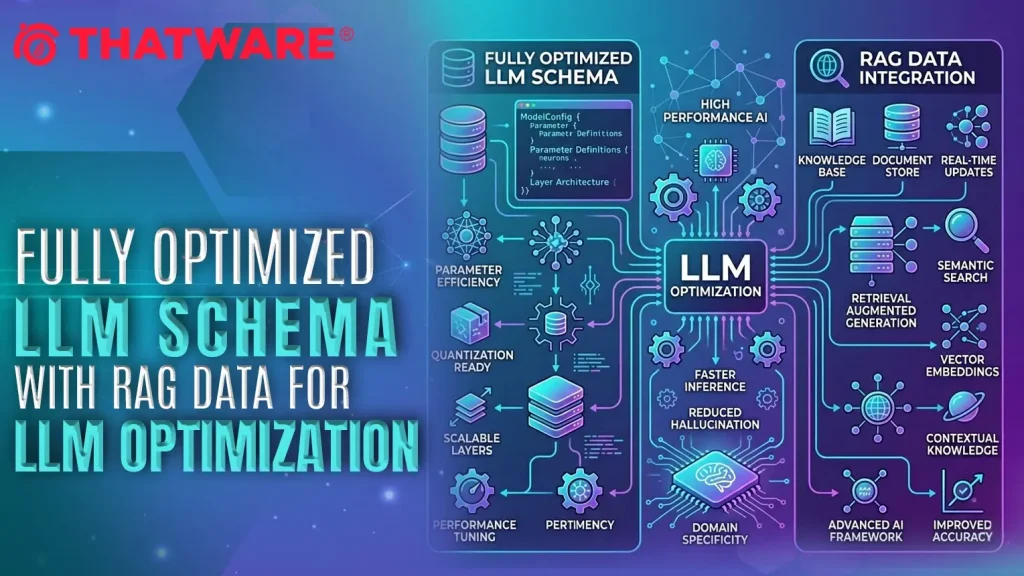
The next evolution is:
Schema + Structured Content + RAG-ready Data Layer
This blog explains how to build a fully optimized schema architecture that works for:
- Search engines (Google)
- Knowledge Graphs
- AI systems (LLMs)
- Retrieval pipelines (RAG systems)
What is LLM Optimization?
LLM Optimization is the process of making your content:
- Easily understandable by AI
- Easily retrievable as a source
- Easily extractable into answers
Unlike traditional SEO, LLM optimization focuses on:
| Traditional SEO | LLM Optimization |
| Keywords | Entities |
| Rankings | Retrieval |
| Backlinks | Authority + clarity |
| Content length | Structured meaning |
What is RAG (Retrieval-Augmented Generation)?
- Find relevant content
- Extract structured meaning
- Generate answers
To support RAG, your website must provide:
- Clear entities
- Structured relationships
- Contextual metadata
- Clean content chunks
Core Components of an LLM-Optimized Website
1. Schema.org Structured Data
Defines:
- Who you are
- What you do
- What each page represents
2. Entity Layer
Defines:
- Topics (Depression, Therapy, ADHD)
- Services
- Locations
- Authors
3. RAG Data Layer (Custom JSON)
Helps AI systems:
- Identify intent
- Extract answers
- Rank your page as a source
Fully Optimized Schema Architecture
1. Homepage / Sitewide Schema
Purpose:
- Define brand entity
- Build knowledge graph
- Connect all services
Example Structure
{
“@context”: “https://schema.org”,
“@graph”: [
{
“@type”: [“Organization”, “MedicalOrganization”],
“@id”: “https://example.com/#organization”,
“name”: “Brand Name”,
“url”: “https://example.com/”,
“areaServed”: {
“@type”: “Country”,
“name”: “USA”
},
“knowsAbout”: [
“Mental health”,
“Therapy”,
“Anxiety”,
“Depression”
]
},
{
“@type”: “WebSite”,
“@id”: “https://example.com/#website”,
“url”: “https://example.com/”,
“publisher”: {
“@id”: “https://example.com/#organization”
}
},
{
“@type”: “WebPage”,
“@id”: “https://example.com/#homepage”,
“mainEntity”: {
“@id”: “https://example.com/#organization”
}
}
]
}
RAG Layer Example (Homepage)
{
“doc_id”: “homepage”,
“entity_primary”: “Brand Name”,
“entity_type”: “Mental Health Provider”,
“services”: [“Therapy”, “Telehealth”],
“retrieval_hints”: [“therapy near me”, “mental health services”]
}
2. Service Page Schema
Purpose:
- Define commercial intent
- Map service → provider → location
Example
{
“@type”: “Service”,
“name”: “Individual Therapy”,
“provider”: {
“@id”: “https://example.com/#organization”
},
“areaServed”: “USA”,
“category”: “Mental Health Therapy”
}
RAG Layer (Service Page)
{
“doc_id”: “service-therapy”,
“page_type”: “service”,
“entity_primary”: “Individual Therapy”,
“intent”: “transactional”,
“conditions”: [“Anxiety”, “Depression”],
“retrieval_hints”: [“therapy near me”, “individual therapy USA”]
}
3. Blog / Article Schema
Purpose:
- Support featured snippets
- Enable AI answer extraction
Example
{
“@type”: “BlogPosting”,
“headline”: “Signs of Depression”,
“about”: [
{ “@type”: “MedicalCondition”, “name”: “Depression” }
],
“mentions”: [
{ “@type”: “Thing”, “name”: “Stress” }
]
}
RAG Layer (Blog)
{
“doc_id”: “blog-depression”,
“intent”: “informational”,
“topics”: [“Depression”, “Symptoms”],
“retrieval_hints”: [“signs of depression”, “mental health symptoms”]
}
4. Product Page Schema (Optional but Powerful)
Purpose:
- Define offers + conversion intent
Example
{
“@type”: “Product”,
“name”: “Online Therapy Session”,
“offers”: {
“@type”: “Offer”,
“price”: “120”,
“priceCurrency”: “USD”
}
}
RAG Layer (Product)
{
“doc_id”: “product-therapy”,
“intent”: “transactional”,
“entity”: “Online Therapy Session”,
“retrieval_hints”: [“book therapy online”]
}
Real Implementation Example (Insights Psychology)
Now let’s see how this works in practice
Homepage Schema (Implemented)
{
“@type”: [“Organization”, “MedicalOrganization”],
“@id”: “https://insightspsychology.org/#organization”,
“name”: “Insights Psychology, LLC”,
“areaServed”: [“Minnesota”, “Wisconsin”],
“knowsAbout”: [
“Therapy”,
“Depression”,
“Anxiety”,
“Mental Health”
]
}
Service Page Example
{
“@type”: “Service”,
“name”: “Individual Therapy”,
“provider”: {
“@id”: “https://insightspsychology.org/#organization”
},
“areaServed”: “Minnesota”
}
Blog Example
{
“@type”: “BlogPosting”,
“headline”: “Depression Rates in Minnesota Are Rising”,
“datePublished”: “2026-03-17”,
“about”: [
{ “@type”: “MedicalCondition”, “name”: “Depression” }
],
“mentions”: [
{ “@type”: “Thing”, “name”: “Stress” },
{ “@type”: “Thing”, “name”: “Trauma” }
]
}
RAG Example (Insights Blog)
{
“doc_id”: “insights-blog-depression”,
“entity_primary”: “Depression”,
“location”: “Minnesota”,
“intent”: “informational”,
“topics”: [
“Depression symptoms”,
“When to seek help”
],
“retrieval_hints”: [
“depression signs”,
“mental health help Minnesota”
]
}
Best Practices for LLM Optimization
1. Entity-first Content
Always define:
- Who (organization)
- What (service/topic)
- Where (location)
- Why (intent)
2. Use @graph Structure
Helps:
- Connect entities
- Improve knowledge graph signals
3. Add RAG Layer (Hidden JSON)
Not for Google — for:
- AI pipelines
- Future LLM crawling systems
4. Build Topic Clusters
- Service → Blog → FAQ → Glossary
- Improves AI understanding depth
Here is the following detailed schema structure for different pages,
1. Sitewide (Home page)
2. Service Page
3. Blogs
Here is the schema implementation example for sitewide:
<script type=”application/ld+json”>
{
“@context”: “https://schema.org”,
“@graph”: [
{
“@type”: [“Organization”, “MedicalOrganization”],
“@id”: “https://insightspsychology.org/#organization”,
“name”: “Insights Psychology, LLC”,
“url”: “https://insightspsychology.org/”,
“email”: “info@insightspsychology.org”,
“telephone”: “+1-651-273-1245”,
“faxNumber”: “+1-844-444-0292”,
“description”: “Insights Psychology is a Minnesota mental health practice providing psychotherapy, psychological evaluations, medication management, trauma therapy, and telehealth services.”,
“foundingDate”: “2021”,
“founder”: {
“@type”: “Person”,
“name”: “Dr. Hina Siddiqui”
},
“areaServed”: [
{
“@type”: “State”,
“name”: “Minnesota”
},
{
“@type”: “State”,
“name”: “Wisconsin”
}
],
“knowsAbout”: [
“Individual therapy”,
“Couples counseling”,
“Family therapy”,
“Psychological evaluations”,
“Medication management”,
“Trauma therapy”,
“Telehealth”,
“Anxiety”,
“Depression”,
“ADHD”,
“Mental health care”
],
“department”: [
{
“@id”: “https://insightspsychology.org/#woodbury”
},
{
“@id”: “https://insightspsychology.org/#bloomington”
}
]
},
{
“@type”: “WebSite”,
“@id”: “https://insightspsychology.org/#website”,
“url”: “https://insightspsychology.org/”,
“name”: “Insights Psychology”,
“publisher”: {
“@id”: “https://insightspsychology.org/#organization”
},
“inLanguage”: “en-US”,
“potentialAction”: {
“@type”: “SearchAction”,
“target”: “https://insightspsychology.org/?s={search_term_string}”,
“query-input”: “required name=search_term_string”
}
},
{
“@type”: “WebPage”,
“@id”: “https://insightspsychology.org/#webpage”,
“url”: “https://insightspsychology.org/”,
“name”: “Mental Health Services MN – Insights Psychology”,
“isPartOf”: {
“@id”: “https://insightspsychology.org/#website”
},
“about”: {
“@id”: “https://insightspsychology.org/#organization”
},
“description”: “Comprehensive mental health services in Minnesota including therapy, psychological evaluations, medication management, and telehealth.”,
“mainEntity”: {
“@id”: “https://insightspsychology.org/#organization”
},
“significantLink”: [
“https://insightspsychology.org/individual-therapy-in-minnesota/”,
“https://insightspsychology.org/psychological-evaluations/”,
“https://insightspsychology.org/medication-management/”,
“https://insightspsychology.org/trauma-therapy/”,
“https://insightspsychology.org/telehealth/”
]
},
{
“@type”: “ItemList”,
“@id”: “https://insightspsychology.org/#services-list”,
“name”: “Core mental health services”,
“itemListElement”: [
{
“@type”: “ListItem”,
“position”: 1,
“name”: “Psychotherapy”,
“url”: “https://insightspsychology.org/psychotherapy-services/”
},
{
“@type”: “ListItem”,
“position”: 2,
“name”: “Psychological Evaluations”,
“url”: “https://insightspsychology.org/psychological-evaluations/”
},
{
“@type”: “ListItem”,
“position”: 3,
“name”: “Medication Management”,
“url”: “https://insightspsychology.org/medication-management/”
},
{
“@type”: “ListItem”,
“position”: 4,
“name”: “Trauma Therapy”,
“url”: “https://insightspsychology.org/trauma-therapy/”
},
{
“@type”: “ListItem”,
“position”: 5,
“name”: “Telehealth”,
“url”: “https://insightspsychology.org/telehealth/”
}
]
},
{
“@type”: [“Place”, “MedicalBusiness”],
“@id”: “https://insightspsychology.org/#woodbury”,
“name”: “Insights Psychology, Woodbury Clinic”,
“parentOrganization”: {
“@id”: “https://insightspsychology.org/#organization”
},
“address”: {
“@type”: “PostalAddress”,
“streetAddress”: “6043 Hudson Road, Suite 350”,
“addressLocality”: “Woodbury”,
“addressRegion”: “MN”,
“postalCode”: “55125”,
“addressCountry”: “US”
}
},
{
“@type”: [“Place”, “MedicalBusiness”],
“@id”: “https://insightspsychology.org/#bloomington”,
“name”: “Insights Psychology, Bloomington Clinic”,
“parentOrganization”: {
“@id”: “https://insightspsychology.org/#organization”
},
“address”: {
“@type”: “PostalAddress”,
“streetAddress”: “8120 Penn Avenue South, Suite 140”,
“addressLocality”: “Bloomington”,
“addressRegion”: “MN”,
“postalCode”: “55431”,
“addressCountry”: “US”
}
}
]
}
</script>
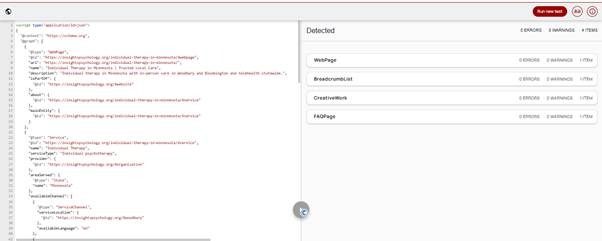
Code test:
Here is the schema implementation example for service page:
<script type=”application/ld+json”>
{
“@context”: “https://schema.org”,
“@graph”: [
{
“@type”: “WebPage”,
“@id”: “https://insightspsychology.org/individual-therapy-in-minnesota/#webpage”,
“url”: “https://insightspsychology.org/individual-therapy-in-minnesota/”,
“name”: “Individual Therapy in Minnesota | Trusted Local Care”,
“description”: “Individual therapy in Minnesota with in-person care in Woodbury and Bloomington and telehealth statewide.”,
“isPartOf”: {
“@id”: “https://insightspsychology.org/#website”
},
“about”: {
“@id”: “https://insightspsychology.org/individual-therapy-in-minnesota/#service”
},
“mainEntity”: {
“@id”: “https://insightspsychology.org/individual-therapy-in-minnesota/#service”
}
},
{
“@type”: “Service”,
“@id”: “https://insightspsychology.org/individual-therapy-in-minnesota/#service”,
“name”: “Individual Therapy”,
“serviceType”: “Individual psychotherapy”,
“provider”: {
“@id”: “https://insightspsychology.org/#organization”
},
“areaServed”: {
“@type”: “State”,
“name”: “Minnesota”
},
“availableChannel”: [
{
“@type”: “ServiceChannel”,
“serviceLocation”: {
“@id”: “https://insightspsychology.org/#woodbury”
},
“availableLanguage”: “en”
},
{
“@type”: “ServiceChannel”,
“serviceLocation”: {
“@id”: “https://insightspsychology.org/#bloomington”
},
“availableLanguage”: “en”
},
{
“@type”: “ServiceChannel”,
“name”: “Telehealth”,
“availableLanguage”: “en”
}
],
“audience”: {
“@type”: “PeopleAudience”,
“suggestedMinAge”: 13
},
“description”: “One-on-one therapy sessions tailored to a client’s specific needs and goals, available in Minnesota clinics and via secure telehealth.”,
“category”: [
“Mental health therapy”,
“Individual counseling”,
“Psychotherapy”
]
},
{
“@type”: “FAQPage”,
“@id”: “https://insightspsychology.org/individual-therapy-in-minnesota/#faq”,
“mainEntity”: [
{
“@type”: “Question”,
“name”: “Where can I book individual therapy near Minneapolis–St. Paul?”,
“acceptedAnswer”: {
“@type”: “Answer”,
“text”: “You can schedule individual therapy in Minnesota at the Twin Cities clinics in Woodbury and Bloomington or via secure telehealth statewide.”
}
},
{
“@type”: “Question”,
“name”: “How do I choose the right therapist for me in the Twin Cities?”,
“acceptedAnswer”: {
“@type”: “Answer”,
“text”: “Look for a licensed clinician with experience in your main concern, ask about treatment approaches like CBT, ACT, EMDR, and consider scheduling fit and therapeutic match.”
}
},
{
“@type”: “Question”,
“name”: “Do you offer evening or quick-start appointments near Woodbury or Bloomington?”,
“acceptedAnswer”: {
“@type”: “Answer”,
“text”: “Yes. Select evening appointments and telehealth flexibility are offered, with intake used to match clients to the earliest suitable opening.”
}
},
{
“@type”: “Question”,
“name”: “What happens in the first individual therapy session?”,
“acceptedAnswer”: {
“@type”: “Answer”,
“text”: “The first session reviews goals, symptoms, history, and what improvement looks like, followed by a collaborative treatment plan and practical next steps.”
}
},
{
“@type”: “Question”,
“name”: “Is therapy confidential and HIPAA-compliant in Minnesota?”,
“acceptedAnswer”: {
“@type”: “Answer”,
“text”: “Yes. Sessions follow HIPAA and Minnesota privacy rules, records are stored in an encrypted EHR, and information is only shared with consent or when required by law.”
}
},
{
“@type”: “Question”,
“name”: “Will therapy focus on quick wins or deeper change—and how long does it take?”,
“acceptedAnswer”: {
“@type”: “Answer”,
“text”: “Both. Therapy often starts with immediate coping tools while also building longer-term change in patterns, habits, and relationships.”
}
}
]
},
{
“@type”: “BreadcrumbList”,
“@id”: “https://insightspsychology.org/individual-therapy-in-minnesota/#breadcrumb”,
“itemListElement”: [
{
“@type”: “ListItem”,
“position”: 1,
“name”: “Home”,
“item”: “https://insightspsychology.org/”
},
{
“@type”: “ListItem”,
“position”: 2,
“name”: “Individual Therapy”,
“item”: “https://insightspsychology.org/individual-therapy-in-minnesota/”
}
]
}
]
}
</script>
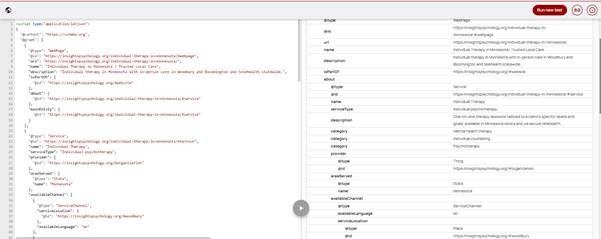
Code Test:
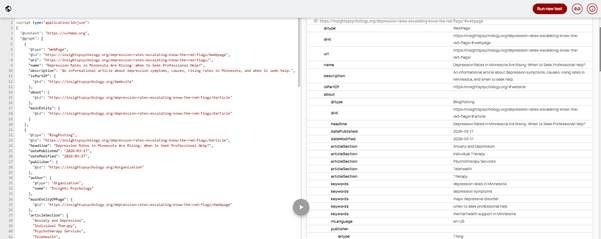
And here is the schema code implemented for the blogs:
<script type=”application/ld+json”>
{
“@context”: “https://schema.org”,
“@graph”: [
{
“@type”: “WebPage”,
“@id”: “https://insightspsychology.org/depression-rates-escalating-know-the-red-flags/#webpage”,
“url”: “https://insightspsychology.org/depression-rates-escalating-know-the-red-flags/”,
“name”: “Depression Rates in Minnesota Are Rising: When to Seek Professional Help?”,
“description”: “An informational article about depression symptoms, causes, rising rates in Minnesota, and when to seek help.”,
“isPartOf”: {
“@id”: “https://insightspsychology.org/#website”
},
“about”: {
“@id”: “https://insightspsychology.org/depression-rates-escalating-know-the-red-flags/#article”
},
“mainEntity”: {
“@id”: “https://insightspsychology.org/depression-rates-escalating-know-the-red-flags/#article”
}
},
{
“@type”: “BlogPosting”,
“@id”: “https://insightspsychology.org/depression-rates-escalating-know-the-red-flags/#article”,
“headline”: “Depression Rates in Minnesota Are Rising: When to Seek Professional Help?”,
“datePublished”: “2026-03-17”,
“dateModified”: “2026-03-17”,
“publisher”: {
“@id”: “https://insightspsychology.org/#organization”
},
“author”: {
“@type”: “Organization”,
“name”: “Insights Psychology”
},
“mainEntityOfPage”: {
“@id”: “https://insightspsychology.org/depression-rates-escalating-know-the-red-flags/#webpage”
},
“articleSection”: [
“Anxiety and Depression”,
“Individual Therapy”,
“Psychotherapy Services”,
“Telehealth”,
“Therapy”
],
“keywords”: [
“depression rates in Minnesota”,
“depression symptoms”,
“major depressive disorder”,
“when to seek professional help”,
“mental health support in Minnesota”
],
“about”: [
{
“@type”: “MedicalCondition”,
“name”: “Depression”
},
{
“@type”: “MedicalCondition”,
“name”: “Major depressive disorder”
},
{
“@type”: “Place”,
“name”: “Minnesota”
}
],
“mentions”: [
{
“@type”: “Thing”,
“name”: “Stress”
},
{
“@type”: “Thing”,
“name”: “Trauma”
},
{
“@type”: “Thing”,
“name”: “Life transitions”
},
{
“@type”: “Thing”,
“name”: “Seasonal changes”
},
{
“@type”: “Thing”,
“name”: “Loneliness”
},
{
“@type”: “Thing”,
“name”: “Anxiety”
},
{
“@type”: “Service”,
“name”: “Individual therapy”
},
{
“@type”: “Service”,
“name”: “Telehealth”
}
],
“audience”: {
“@type”: “PeopleAudience”,
“audienceType”: “Adults seeking mental health information in Minnesota”
},
“inLanguage”: “en-US”
},
{
“@type”: “BreadcrumbList”,
“@id”: “https://insightspsychology.org/depression-rates-escalating-know-the-red-flags/#breadcrumb”,
“itemListElement”: [
{
“@type”: “ListItem”,
“position”: 1,
“name”: “Home”,
“item”: “https://insightspsychology.org/”
},
{
“@type”: “ListItem”,
“position”: 2,
“name”: “Blog”,
“item”: “https://insightspsychology.org/blog/”
},
{
“@type”: “ListItem”,
“position”: 3,
“name”: “Depression Rates in Minnesota Are Rising: When to Seek Professional Help?”,
“item”: “https://insightspsychology.org/depression-rates-escalating-know-the-red-flags/”
}
]
}
]
}
</script>
Wrapping Up
The evolution of search demands a shift from traditional SEO practices to a more intelligent, AI-aligned approach. Simply optimizing for keywords and rankings is no longer enough—websites must now focus on how content is understood, retrieved, and used by AI systems. By integrating structured schema markup, building strong entity relationships, and implementing a RAG-ready data layer, you create a foundation that supports both search engines and large language models. This ensures your content is clear, context-rich, and easily extractable for answer generation. Additionally, organizing content around user intent and topic clusters further strengthens your authority and visibility across AI-driven platforms. As search continues to move toward conversational and generative experiences, adopting this structured and retrieval-focused strategy will help your website stay competitive, relevant, and trusted. Ultimately, future-proof SEO is about becoming the most reliable source that AI systems choose to reference and present to users.