SUPERCHARGE YOUR ONLINE VISIBILITY! CONTACT US AND LET’S ACHIEVE EXCELLENCE TOGETHER!
** The pricings are in USD / Month and the deliverables are monthly based.
AIEO Pricing Deliverables & Scope of Work
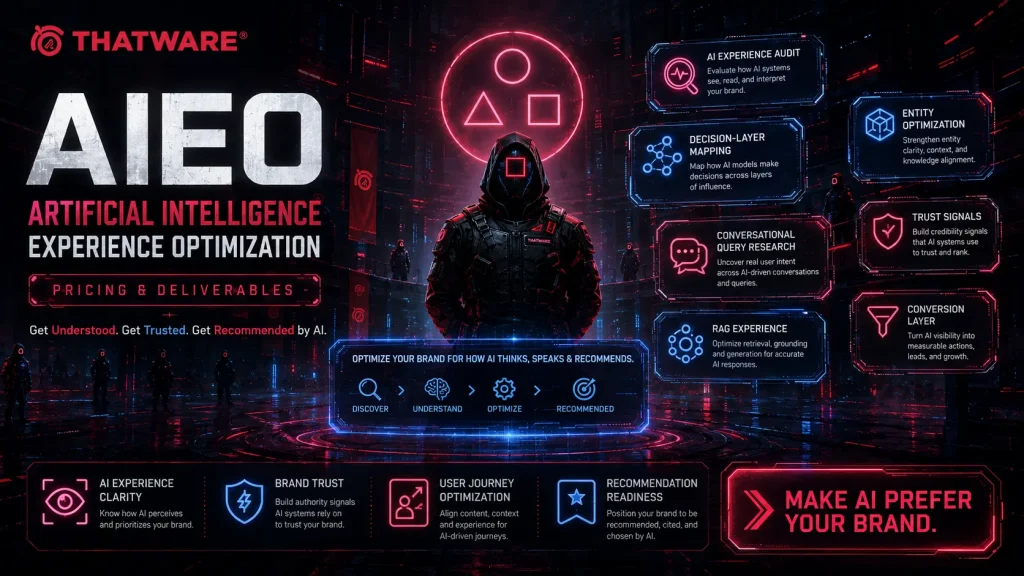
Artificial Intelligence Experience Optimization, or AIEO, is built for a world where search is no longer just about ranking on Google. Today, customers are discovering brands through AI-generated answers, conversational assistants, recommendation systems, smart summaries, voice search, AI Overviews, ChatGPT-style platforms, Gemini, Perplexity, Copilot, Claude, and other intelligent discovery layers.
In this new environment, the question is no longer only:
“Can people find your website?”
The better question is:
“Can AI understand your brand well enough to recommend it?”
That is the core purpose of AIEO.
AIEO focuses on how artificial intelligence experiences your brand. It looks at whether your content is clear, whether your entity signals are strong, whether your website provides structured answers, whether your authority is visible, whether your brand is trusted across the web, and whether AI systems can confidently select your business when users ask relevant questions.
ThatWare’s AIEO pricing plans are designed around monthly deliverables that help your brand become more understandable, more trustworthy, more retrievable, and more recommendation-ready across AI-driven platforms. This is not just SEO. This is brand experience engineering for artificial intelligence.
Why AIEO Is Different from Traditional SEO
Traditional SEO is mainly concerned with search engine rankings, keyword positions, technical health, content quality, links, and organic traffic. These are still important, but they are no longer the complete picture.
AI systems behave differently.
They do not always show ten blue links. They often generate one answer, one summary, one recommendation, or one shortlist of brands. They interpret user intent, compare information, assess trust, and present what they believe is the most useful response.
That means your brand must be optimized not only for visibility, but also for AI selection.
AIEO works on the layer between search visibility and decision-making. It helps your brand become easier for AI platforms to interpret and easier for users to trust once AI presents your information.
In simple terms:
SEO helps your website rank.
AEO helps your content become an answer.
GEO helps your brand appear in generative results.
LLM SEO helps large language models understand and retrieve your content.
AIEO improves the full AI-driven experience around your brand.
This includes content, structure, entities, trust, UX, citations, summaries, answer blocks, conversational queries, and decision-based signals.
Detailed AIEO Deliverables
1. AIEO Strategy & AI Experience Roadmap
Every AIEO campaign begins with a proper roadmap. We do not start by randomly editing pages or adding AI keywords. We first study how your brand is currently experienced by both users and AI systems.
This includes reviewing your website, service pages, content depth, brand messaging, technical structure, search performance, AI visibility, user journey, competitor presence, entity strength, and trust signals. The purpose is to understand how clearly your business is being represented online.
The AIEO roadmap identifies what needs to be improved first. Some brands need clearer service positioning. Some need stronger entity signals. Some need AI-friendly content restructuring. Some need better schema, FAQs, citations, or trust-building assets. Others need their entire user journey redesigned so both humans and AI systems can understand the value faster.
This roadmap becomes the monthly execution plan. It gives the campaign direction and ensures every deliverable supports the same goal: making your brand easier for AI systems to understand, trust, and recommend.
2. AI Experience Audit
An AI Experience Audit is different from a normal SEO audit. A normal audit checks technical issues, metadata, rankings, backlinks, indexing, and page speed. An AIEO audit goes deeper into how your brand is interpreted by AI-driven systems.
We review whether AI platforms can understand your services clearly. We check whether your content answers important questions directly. We analyze whether your brand is associated with the right topics, whether your authority signals are visible, and whether users can move smoothly from discovery to decision.
The audit also looks at friction. If a page is too vague, too generic, too promotional, or too difficult to scan, both users and AI systems may struggle with it. If the website lacks direct answers, structured data, brand clarity, or trust signals, AI systems may choose a competitor instead.
This deliverable helps reveal the weak points in your current digital experience. It shows where your brand is clear, where it is confusing, and where improvement can create stronger AI search visibility.
3. AI Decision-Layer Mapping
AIEO works inside what can be called the AI decision layer. This is the stage where AI systems interpret a user’s question, compare possible answers, evaluate sources, and decide what to present.
ThatWare’s AI Decision Layer resource defines AIEO as a proprietary framework designed to enhance how AI systems understand, retrieve, rank, and present digital experiences.
This deliverable maps how your brand can become stronger inside that decision layer. We identify the types of questions users may ask, the signals AI systems may rely on, and the content or authority gaps that may prevent your brand from being selected.
For example, if a user asks an AI system, “Which company should I hire for AI SEO?”, the AI may evaluate brand authority, service clarity, online mentions, reviews, topical relevance, content quality, and structured information.
AI Decision-Layer Mapping helps your brand prepare for these moments. It ensures that the right signals are present before AI systems make the recommendation.
4. Conversational Query & Prompt Research
Users interact with AI platforms differently from traditional search engines. They do not always type short phrases. They ask full questions, describe situations, request comparisons, seek recommendations, and expect direct guidance.
AIEO requires research into these conversational patterns.
We identify the prompts, questions, and decision-based queries your audience may use across AI systems. These can include educational queries, comparison queries, recommendation queries, local queries, problem-solving queries, and purchase-intent queries.
Examples may include:
“What is the best agency for AI-driven SEO?”
“How can my brand appear in AI-generated answers?”
“Which company offers AIEO services?”
“What is the difference between SEO, AEO, GEO, and AIEO?”
“How can AI understand my brand better?”
“Which digital marketing agency is trusted for AI search optimization?”
This research helps shape the content strategy. It tells us what questions your website should answer, what pages need improvement, and what type of content AI systems may prefer when generating responses.
5. AI Journey Optimization
AIEO is not only about being discovered. It is also about what happens after discovery.
When users encounter your brand through AI search, they may land on your website with a very specific expectation. They want clarity. They want proof. They want quick answers. They want to know whether your company can solve their problem.
AI Journey Optimization improves the path from first impression to conversion. We review the way users move through your site, especially from service pages, pricing pages, blogs, FAQs, and landing pages.
This may include improving page flow, content hierarchy, call-to-action placement, trust sections, service explanations, comparison blocks, FAQ placement, internal links, and conversion cues.
The goal is to make the experience feel natural. A user should not feel lost after landing on the page. They should immediately understand what you offer, why it matters, what is included, and what action they should take next.
This is where AIEO becomes more powerful than simple SEO. It connects AI visibility with human decision-making.
6. Content Clarity Engineering
AI systems reward clarity. Users do too.
Content Clarity Engineering focuses on making your pages easier to understand without making them sound mechanical. We improve the way your services, deliverables, benefits, processes, and differentiators are explained.
This does not mean creating dry, repetitive content. It means removing confusion.
A strong AIEO-optimized page should answer basic questions quickly:
What is this service?
Who is it for?
What problem does it solve?
What is included?
How does the process work?
Why should someone trust this company?
What makes this approach different?
We restructure content so the most important information is easy to find. We add clear sections, short explanations, helpful examples, natural FAQs, direct answer blocks, and supporting context.
The final content should feel human, but it should also be easy for AI systems to parse, summarize, and present.
7. Human Experience + AI Experience Alignment
One of the biggest mistakes brands make is optimizing only for machines. Another mistake is optimizing only for humans while ignoring how AI systems interpret content.
AIEO brings both sides together.
Human Experience + AI Experience Alignment ensures that your website works for real visitors while also being understandable to AI platforms. The content should not sound stuffed, robotic, or forced. At the same time, it should not be vague, scattered, or difficult for AI systems to interpret.
This deliverable improves the balance between readability, structure, semantic depth, trust, and conversion.
We make sure your content speaks naturally to users while still including the contextual signals AI systems need. This includes entity clarity, topic depth, headings, structured answers, schema, internal links, trust signals, and consistent brand messaging.
The result is a page that feels helpful to a person and meaningful to a machine.
8. Entity & Brand Understanding Optimization
AI systems need to understand your brand as an entity. If your brand identity is weak, inconsistent, or unclear, AI systems may not confidently recommend you.
Entity optimization focuses on making your business easier to identify and associate with the right topics. We review your brand description, services, founder or leadership details, social profiles, business listings, About page, schema, citations, press mentions, case studies, and third-party references.
The goal is to help AI systems understand:
Who you are
What you offer
Where you operate
Who you serve
What you are known for
Why you are credible
How you are different from competitors
ThatWare’s AI SEO Framework resource explains that modern AI SEO prioritizes meaning, relationships, contextual relevance, entity relationships, and authority signals rather than only keywords and backlinks.
This deliverable strengthens your brand identity across both traditional search and AI-led discovery platforms.
9. AI Trust Signal Development
In AI-driven search, trust is not optional. AI systems are more likely to recommend brands that appear credible, consistent, and authoritative.
AI Trust Signal Development focuses on strengthening the proof around your brand. This may include improving reviews, testimonials, case studies, awards, certifications, press mentions, media coverage, author bios, leadership profiles, client success stories, industry references, and transparent company information.
Trust signals help both AI systems and users make decisions. If your website claims expertise but provides no proof, the page may feel weak. If external sources confirm your authority, the brand becomes more believable.
This deliverable is especially important for pricing pages. Visitors want to understand not only what is included, but why the provider is worth trusting.
AIEO improves the recommendation environment around your brand by making trust visible, structured, and consistent.
10. AI-Ready Content Architecture
Content architecture is the way your information is organized across the website. A website can have many good pages, but if they are not connected properly, AI systems may struggle to understand the full picture.
AI-Ready Content Architecture improves how your service pages, blogs, FAQs, case studies, guides, pricing pages, and resources connect with each other.
For AIEO, the website should not feel like disconnected pages. It should feel like a structured knowledge system.
For example, an AIEO pricing page should naturally connect with supporting resources around AI Search Visibility, LLM SEO, AEO, GEO, RAG SEO, Entity SEO, AI TXT, Semantic Sitemap, Vector Feed, and AI decision-layer optimization.
This structure helps users explore related topics. It also helps AI systems understand that your website has depth and authority around the subject.
11. Direct Answer & Summary Block Creation
AI systems often prefer content that provides clear answers. If your page takes too long to explain something, the answer may be skipped.
Direct Answer & Summary Block Creation makes important information easier to extract. These blocks are short, focused sections that answer key questions directly.
For example:
“What is AIEO?”
“What does AIEO include?”
“How is AIEO different from SEO?”
“Why does AIEO matter for AI search visibility?”
“How can AIEO help my brand get recommended by AI?”
Each answer should be concise first, then supported with explanation. This structure improves readability and increases the chance of being used in AI-generated answers, snippets, voice results, and conversational search responses.
For pricing pages, these blocks also reduce hesitation. They help users quickly understand the value of the plan.
12. FAQ Optimization for AI-Led Queries
FAQs are no longer just a support section. They are an important part of AI visibility.
AI systems often process information through questions and answers. A strong FAQ section helps your website cover more conversational queries and buyer concerns.
We create and optimize FAQs around service scope, pricing, timelines, deliverables, results, comparisons, AI search platforms, trust, process, and industry-specific questions.
The answers are written naturally. They should sound like a knowledgeable consultant, not like a generic AI-generated paragraph.
Good FAQs help users make decisions faster. They also give AI systems structured responses that can be retrieved and summarized more easily.
Where suitable, FAQ schema can also be recommended to strengthen machine understanding.
13. Schema & Structured Data Implementation
Structured data gives search engines and AI systems clearer information about your website. It helps machines understand your organization, services, FAQs, articles, reviews, people, locations, products, and page relationships.
As part of AIEO, schema may include Organization Schema, Local Business Schema, Service Schema, FAQ Schema, Article Schema, WebPage Schema, Breadcrumb Schema, Person Schema, Review Schema, and other relevant formats.
Schema does not replace strong content, but it supports interpretation. It reduces ambiguity and makes your website more machine-readable.
For AI systems, this clarity matters. If your content is structured properly, AI platforms can better understand what each page represents and how it should be used.
This deliverable supports traditional SEO, answer engine visibility, and AI-driven discovery.
14. Experience-Based Content Optimization
AIEO is not only about information. It is also about experience.
Experience-Based Content Optimization improves the emotional and practical usefulness of your pages. A visitor should not feel like they are reading a dry technical document. They should feel guided.
We improve sections that explain pain points, outcomes, benefits, examples, objections, comparisons, and service value. We make the content more persuasive without making it exaggerated.
This may include adding practical explanations, clearer deliverable descriptions, human examples, better transitions, trust-building language, and stronger closing sections.
The goal is to make the page useful enough for users and complete enough for AI systems.
This is one of the most important parts of creating content that feels less AI-written. It introduces flow, personality, and business relevance.
15. AI Recommendation Readiness
Appearing in AI search is one thing. Being recommended is another.
AI Recommendation Readiness focuses on preparing your brand to be selected when users ask for suggestions, comparisons, or service providers.
We strengthen the signals that influence recommendation potential. These may include service clarity, topical authority, trust signals, reviews, external mentions, brand consistency, structured data, FAQs, content depth, and competitor differentiation.
For example, if an AI system is asked to recommend a company for AI search optimization, it may look for clear evidence that the company specializes in that field. It may evaluate whether the website has enough relevant content, whether the brand is cited elsewhere, and whether its service offering is clearly explained.
This deliverable helps position your business as a more confident recommendation candidate.
16. RAG & Retrieval Experience Optimization
RAG stands for Retrieval-Augmented Generation. Many AI systems retrieve information from external sources before generating answers.
RAG & Retrieval Experience Optimization makes your content easier for AI systems to retrieve, understand, and use. This includes improving headings, summaries, page structure, internal links, source clarity, entity references, factual consistency, and answer formatting.
A page that is retrieval-friendly is easier for AI systems to quote, summarize, and include in generated responses.
This deliverable matters because AI systems do not just read pages like humans. They break information into chunks, compare meaning, and retrieve the most useful pieces.
If your content is messy or unclear, it may not be selected. If it is well-structured and context-rich, it has a stronger chance of being used.
17. AI Search, AEO, GEO & LLM Integration
AIEO sits at the center of several modern optimization disciplines.
It connects:
AI Search Visibility — helping your brand appear in AI-led discovery.
AEO — helping your content become direct answers.
GEO — helping your brand appear in generative engine results.
LLM SEO — helping large language models understand and retrieve your content.
Entity SEO — helping machines recognize your brand and topic authority.
RAG SEO — helping AI systems retrieve your content correctly.
ThatWare’s resources describe AIEO as a practice that works across search engines, generative AI platforms, assistants, and recommendation systems.
This integration makes AIEO broader than a single SEO tactic. It is a complete framework for how your brand is experienced by AI systems.
18. Citation & Source Signal Enhancement
AI systems often rely on external signals to judge credibility. If your brand is only visible on your own website, the trust layer may be weaker.
Citation & Source Signal Enhancement focuses on improving credible references to your brand across the web. This may include directories, media mentions, review platforms, partner websites, industry resources, social profiles, case studies, interviews, and business listings.
The goal is not random link building. The goal is to build a trustworthy footprint.
If multiple credible sources describe your brand consistently, AI systems have more confidence in your identity and authority.
This deliverable supports AI trust, entity recognition, local SEO, traditional SEO, and recommendation readiness.
19. AI Personalization & User Intent Alignment
AI systems are becoming more personalized. They consider user context, intent, preferences, location, behavior, and the type of answer needed.
AI Personalization & User Intent Alignment helps your content speak to different types of users. A first-time visitor may need education. A decision-ready user may need pricing clarity. A comparison-stage user may need proof. A local user may need location relevance.
We optimize content so it supports different stages of the user journey.
This may include clearer introductions, buyer-focused FAQs, comparison sections, trust elements, benefit-led explanations, and internal pathways to related pages.
The goal is to make your website feel more relevant to different user needs while giving AI systems better context for matching content to intent.
20. Conversion Layer Optimization
Visibility is valuable, but conversions matter.
Conversion Layer Optimization improves the parts of the page that help users take action. This includes call-to-action placement, trust badges, inquiry sections, service summaries, benefit statements, pricing explanations, form positioning, and decision-support content.
For AIEO, conversion optimization is important because AI-driven users may arrive with high intent. They may already have received a recommendation or summary before landing on your website. The page must confirm that recommendation quickly.
This deliverable makes sure the visitor does not lose confidence after arriving.
A strong pricing page should help the user understand the service, compare the value, trust the provider, and take the next step without confusion.
21. AIEO Performance Tracking
AIEO performance cannot be measured only by keyword rankings. We need to look at a wider set of signals.
This may include AI visibility observations, brand mentions in AI responses, selected prompt tracking, content improvements, engagement quality, page experience, query coverage, citation progress, schema validation, and competitor movement.
The purpose is to understand whether your brand is becoming clearer, stronger, and more visible across AI-driven environments.
Tracking also helps refine the campaign. If certain prompts show improvement, we can build on them. If competitors are still being selected more often, we can identify what signals they have that need to be matched or exceeded.
AIEO is not a one-time setup. It is an ongoing improvement process.
22. Monthly Reporting & Strategic Recommendations
Every month, the campaign should produce clear reporting. The report should not only list completed tasks. It should explain what changed, why it matters, and what should happen next.
Monthly reporting may include:
Pages optimized
Content improved
FAQs added
Schema implemented
AI visibility observations
Entity updates
Trust signal improvements
Citation progress
Internal linking updates
Technical recommendations
Next-month priorities
This keeps the campaign transparent and useful.
For business owners, reporting should answer a simple question: How is this work making the brand more visible, more trusted, and more AI-ready?
That is the standard AIEO reporting should meet.
23. Continuous AIEO Refinement
AI systems change quickly. User behavior changes. Search interfaces change. Competitors change. That means AIEO needs continuous refinement.
Each month, we review what has improved and what needs attention. We may update content, expand FAQs, improve schema, refine internal links, strengthen citations, build new content assets, improve trust signals, or adjust the strategy based on observed AI behavior.
This ongoing refinement is what makes AIEO future-facing.
The brands that win in AI search will not be the ones that optimize once and stop. They will be the brands that keep improving how AI systems experience and understand them.
Generic Monthly AIEO Scope of Work
The exact monthly scope may vary depending on the selected plan, website size, industry, competition, and current AI visibility. However, a typical AIEO campaign may include:
AIEO strategy and AI experience roadmap
AI Experience Audit
AI decision-layer mapping
Conversational query and prompt research
AI journey optimization
Content clarity engineering
Human experience and AI experience alignment
Entity and brand understanding optimization
AI trust signal development
AI-ready content architecture
Direct answer and summary block creation
FAQ optimization for AI-led queries
Schema and structured data recommendations
Experience-based content optimization
AI recommendation readiness improvement
RAG and retrieval experience optimization
AI Search, AEO, GEO, and LLM integration
Citation and source signal enhancement
AI personalization and user intent alignment
Conversion layer optimization
AIEO performance tracking
Monthly reporting and strategic recommendations
Continuous AIEO refinement
This scope is designed to help your brand become easier to understand, easier to trust, easier to retrieve, and easier to recommend across AI-driven discovery platforms.
Suggested Pricing Page Section: What You Actually Get with AIEO
AIEO is not a surface-level optimization service. It is a full improvement system for how your brand is experienced by artificial intelligence and by the people who depend on AI-generated answers.
When users ask AI platforms for guidance, those platforms need to decide which brands deserve attention. They look for clarity, trust, structure, authority, relevance, and consistency. AIEO helps your website and digital presence deliver those signals.
With ThatWare’s AIEO service, your brand receives a monthly execution framework that improves content clarity, AI readability, entity strength, trust signals, structured data, answer readiness, retrieval potential, and conversion experience.
The result is a stronger digital presence that is not only searchable, but also understandable and recommendation-ready.
Make AI Prefer Your Brand, Not Just Find It
The next generation of search is not only about being indexed. It is about being interpreted.
AI systems are becoming the middle layer between customers and brands. They answer questions, compare companies, summarize options, and influence decisions. If your brand is unclear, inconsistent, or under-optimized, AI may overlook it.
ThatWare’s AIEO service helps solve this problem by improving the complete AI experience around your brand.
We optimize how your business is structured, explained, connected, trusted, and presented across digital platforms. From content clarity and entity signals to answer blocks, schema, citations, RAG readiness, user journey improvements, and AI recommendation readiness, every deliverable works toward one goal:
Helping AI systems understand your brand better and helping users trust you faster.
AIEO is not just another digital marketing trend. It is the next layer of online visibility, built for a world where AI is becoming the first point of contact between your business and your customers.