SUPERCHARGE YOUR ONLINE VISIBILITY! CONTACT US AND LET’S ACHIEVE EXCELLENCE TOGETHER!
** The pricings are in USD / Month and the deliverables are monthly based.
Detailed LLM SEO Deliverables & Scope of Work
Large Language Model SEO, or LLM SEO, is built for the new search environment where users no longer depend only on traditional search engine result pages. People now ask complete questions to AI systems such as ChatGPT, Gemini, Claude, Perplexity, Copilot, Google AI Overviews, and other conversational platforms. These tools do not behave like normal search engines. They read, interpret, summarize, compare, recommend, and generate direct answers.
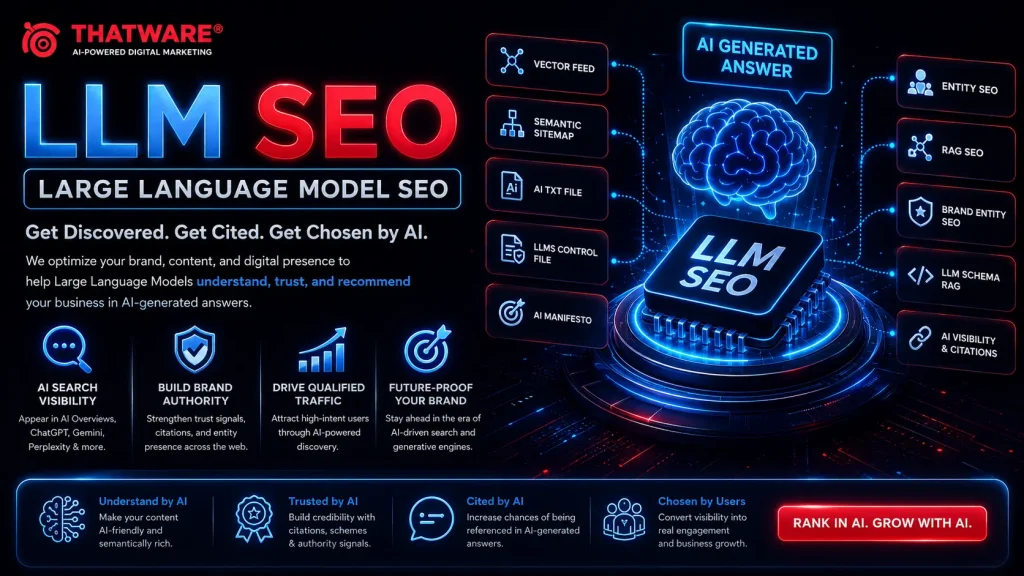
This means your website must do more than rank for keywords. It must be understood by AI models. It must provide clear information, strong context, trustworthy signals, structured data, and brand authority that large language models can recognize. LLM SEO helps your business become more discoverable, more retrievable, and more likely to be included in AI-generated responses.
ThatWare’s LLM SEO deliverables are designed to improve how AI systems understand your brand, services, content, expertise, and authority. The scope of work combines semantic content optimization, entity building, AI-friendly formatting, structured data, RAG readiness, citation improvement, LLM control files, vector-feed architecture, and continuous performance tracking.
The goal is simple: make your brand easier for large language models to understand, trust, cite, and recommend.
1. LLM SEO Strategy & Campaign Roadmap
Every LLM SEO campaign starts with strategy. Large language models do not evaluate content in the same way traditional search engines do. They look for meaning, context, trust, entity relationships, topical completeness, and source reliability. Because of this, the campaign must begin with a clear roadmap.
We study your website, services, target audience, industry, competitors, existing search performance, content quality, topical depth, and current AI search visibility. We also review how your brand is positioned online and whether AI systems can clearly understand what your company does.
The roadmap defines monthly priorities. Some websites need stronger service-page content. Some need schema improvement. Others need brand entity strengthening, better citations, improved FAQ structures, or LLM control files. The strategy helps decide what should be fixed first and what should be built over time.
This deliverable gives the campaign direction. Instead of random optimization, every activity is connected to one larger goal: helping AI models recognize your brand as a reliable source for relevant user queries.
2. AI & LLM Visibility Audit
An LLM visibility audit checks how your brand currently appears across AI-driven platforms. Traditional SEO audits usually focus on rankings, backlinks, technical errors, indexing, and traffic. LLM SEO requires a different layer of analysis.
We review whether your business appears in AI-generated answers, whether your content is cited or referenced, whether competitors are being recommended instead, and whether AI systems understand your brand correctly. This audit may include visibility checks across ChatGPT-style responses, Gemini, Perplexity, Claude, Copilot, Google AI Overviews, and other AI-led search experiences where relevant.
The audit identifies important gaps. Your website may rank well in Google but still fail to appear in AI answers. Your brand may have strong content but weak entity signals. Your services may be clear to human readers but confusing to AI systems. Your website may lack structured data, direct answer blocks, source clarity, or external authority signals.
This audit provides the starting point for the campaign. It shows what is working, what is missing, and where the biggest opportunities exist.
3. Natural-Language Query & Prompt Research
LLM SEO is not only about keywords. Users interact with large language models through natural-language prompts. They ask full questions, request comparisons, seek recommendations, and expect detailed guidance.
For example, a user may not type only “SEO agency.” Instead, they may ask, “Which agency can help my business appear in ChatGPT and Google AI Overviews?” or “What is the best company for LLM SEO and AI search visibility?”
Our natural-language query research identifies the prompts and conversational search patterns that matter for your business. We study informational prompts, commercial prompts, comparison prompts, local prompts, buying-intent prompts, and problem-solving prompts.
This research helps us understand what your audience is asking AI systems before they make decisions. It also helps us create and optimize content that directly answers these questions.
The result is a more realistic search strategy. Instead of targeting only static keywords, your website becomes prepared for the way people actually speak to AI platforms.
4. LLM Content Gap Analysis
A standard content gap analysis looks for missing keywords. LLM content gap analysis looks for missing context, missing answers, missing entity connections, and missing proof.
Large language models prefer content that explains topics clearly and completely. If your website does not answer important questions, explain your services properly, show expertise, or provide enough supporting information, AI systems may skip your content.
We analyze your existing pages to identify where they are thin, unclear, outdated, repetitive, or poorly structured. We also compare your content against competitors that may already be performing better in AI-generated responses.
This deliverable helps us decide what needs to be expanded, rewritten, restructured, or newly created. It may reveal the need for stronger service pages, better FAQs, expert-led blogs, comparison content, glossary sections, case studies, or trust-building resources.
The goal is to make your website more complete, more helpful, and more suitable for AI interpretation.
5. Semantic Content Optimization
Semantic content optimization is a major part of LLM SEO. Large language models process meaning, not just keywords. They look at how concepts connect, how clearly ideas are explained, and whether the content provides enough context to answer a user’s question.
We optimize existing content by improving headings, paragraphs, summaries, definitions, explanations, FAQs, comparison sections, process descriptions, benefit statements, and internal links. The purpose is to make each page easier for users to read and easier for AI systems to understand.
This does not mean stuffing keywords into the page. It means improving clarity, depth, flow, and topical coverage. A strong LLM-optimized page should explain what the service is, who it is for, how it works, why it matters, what problems it solves, and what makes the brand credible.
ThatWare’s own LLM SEO resources explain this shift clearly: LLM SEO focuses on answer inclusion and AI-driven understanding, while traditional SEO focuses more on rankings and traffic. Trust, clarity, authority, intent, and semantic understanding become more important in AI-generated responses.
6. AI-Ready Content Creation
In many cases, existing pages alone are not enough. LLM SEO often needs new content assets that are built specifically for AI-driven discovery.
AI-ready content may include service explainers, FAQ hubs, comparison pages, knowledge-base articles, industry guides, glossary content, thought-leadership pieces, case-study summaries, and answer-focused landing-page sections.
The writing style must remain natural and useful. AI-ready content should not sound robotic. It should answer real questions, explain topics clearly, and give readers the confidence to take the next step.
Each content asset is created with a purpose. Some content helps build topical authority. Some helps answer high-intent questions. Some supports AI citation. Some strengthens brand trust. Some improves the way LLMs understand your services.
The focus is not volume for the sake of volume. The focus is building a useful knowledge base that can support both human users and AI retrieval systems.
7. Direct Answer Engineering
Answer engineering means structuring content so it can be used directly by AI systems. Large language models often prefer clear, extractable answers. If your content buries the answer too deep or explains things in a confusing way, AI systems may choose another source.
We create direct answer blocks for important user questions. These answer blocks usually provide a clear response first, followed by supporting details. They can be used on service pages, pricing pages, blogs, FAQs, and landing pages.
For example, if a user asks, “What is LLM SEO?”, the content should provide a simple and direct explanation before expanding into details. If a user asks, “How does LLM SEO help a business?”, the page should answer that clearly rather than forcing the reader to scan through long generic paragraphs.
This structure improves readability and makes your content more suitable for AI-generated responses, featured snippets, voice search answers, and conversational search outputs.
8. FAQ Optimization for LLM Responses
FAQs are extremely valuable for LLM SEO because AI systems are naturally question-and-answer driven. A well-structured FAQ section helps large language models understand the common concerns, objections, and decision points related to your services.
We research and optimize FAQs around your business, services, pricing, timelines, results, process, comparisons, and buyer concerns. Each answer is written clearly, naturally, and with enough context to be useful.
FAQ optimization also improves user experience. Visitors often want quick answers before they contact a company. Strong FAQs reduce friction and help users make informed decisions.
Where appropriate, FAQ schema can also be added to give search engines more structured information about the questions and answers on the page.
For pricing pages, FAQs are especially important because users want clarity. They want to know what is included, how the service works, what results to expect, and why the pricing makes sense.
9. Entity SEO & Brand Understanding
Large language models depend heavily on entities. An entity can be a brand, person, product, service, location, concept, or organization. If your brand is not clearly understood as an entity, AI systems may not confidently include it in generated answers.
Entity SEO focuses on making your brand identity clear and consistent. We review your company information, service descriptions, leadership references, social profiles, third-party mentions, directory listings, structured data, About page, author bios, and brand positioning.
The objective is to help AI systems understand who you are, what you offer, where you operate, who you serve, and what topics you are associated with.
Consistency matters. If your brand is described differently across multiple platforms, it can create confusion. If your services are unclear, AI systems may not connect you with the right queries.
Strong entity optimization helps your brand become more recognizable, more trustworthy, and more likely to be associated with relevant AI-search topics.
10. Brand Entity Development
Brand entity development goes deeper than basic entity SEO. It focuses on building a stronger digital identity around your business.
We strengthen how your brand is connected to specific services, industries, technologies, achievements, frameworks, leadership, case studies, awards, and trust signals. This helps large language models understand not only that your business exists, but also why it should be considered credible.
For example, if a company wants to be associated with LLM SEO, AI search visibility, Generative Engine Optimization, Answer Engine Optimization, or advanced SEO, those associations must be supported across its website and external footprint.
Brand entity development may include improving brand descriptions, adding clearer About page content, strengthening author profiles, improving service positioning, supporting topical clusters, and building stronger external references.
The result is a clearer and more authoritative identity that AI systems can process more confidently.
11. Schema Markup & Structured Data
Schema markup is structured data that helps search engines and AI systems understand your content. It gives additional context about your organization, services, authors, FAQs, reviews, products, locations, breadcrumbs, articles, and web pages.
As part of LLM SEO, we recommend and implement relevant schema types based on your website and goals. This may include Organization Schema, Local Business Schema, Service Schema, FAQ Schema, Article Schema, WebPage Schema, Breadcrumb Schema, Person Schema, Product Schema, Review Schema, and other suitable formats.
Schema does not replace good content, but it gives machines a clearer map of what the content means. This is important because LLMs and retrieval systems need confidence before using a source.
Structured data helps reduce ambiguity. It can clarify what your business offers, which page represents which service, who wrote the content, what questions are answered, and how different pages are connected.
For LLM SEO, this clarity supports better interpretation, better retrieval, and stronger eligibility for AI-assisted search experiences.
12. LLM Schema & RAG Structuring
LLM schema and RAG structuring are more advanced forms of AI-readiness. RAG stands for Retrieval-Augmented Generation. In simple terms, many AI systems retrieve information from external sources before generating an answer.
To perform well in this environment, your content needs to be structured for retrieval. That means it should be easy to locate, understand, segment, summarize, and cite.
LLM schema and RAG structuring may include improving page summaries, defining key entities, organizing content into logical sections, preserving important terminology, strengthening internal links, adding source clarity, and creating cleaner answer blocks.
This helps AI systems retrieve the correct information without losing meaning. It is especially important for complex services, proprietary frameworks, technical topics, and industries where accuracy matters.
The pricing page links to LLM Schema RAG as part of ThatWare’s LLM/AEO/GEO knowledge base, showing that this is a relevant part of the broader AI-search architecture.
13. Vector Feed Creation & Optimization
A vector feed is an advanced AI-ingestion asset. While a normal sitemap helps search engines discover URLs, a vector feed helps AI systems understand content at a deeper semantic level.
ThatWare’s resource on vector feeds explains that a vector-feed.xml is designed for LLMs and vector databases, focusing on entities, topics, embedding rules, and semantic relationships rather than simply listing URLs.
In practical terms, vector feed optimization helps organize important content in a way that supports AI retrieval. It can define key pages, topics, entities, priorities, freshness signals, and relationships between documents.
This is valuable because AI systems do not only look for pages. They look for meaning. A vector feed helps guide how your content should be understood, embedded, retrieved, and represented.
For businesses investing in LLM SEO, this deliverable helps create a stronger foundation for visibility across AI search engines and generative response systems.
14. Semantic Sitemap Development
A traditional XML sitemap tells crawlers which URLs exist. A semantic sitemap goes further by helping define the relationship between pages, topics, entities, and content clusters.
For LLM SEO, this matters because AI systems need to understand the structure of your knowledge base. They need to know which pages are primary, which pages support them, and how different topics connect.
A semantic sitemap may connect your main service pages with supporting blogs, FAQs, case studies, glossary pages, pricing pages, and thought-leadership content. This helps create a clearer topical architecture.
The pricing page directly links to Semantic Sitemap as a key ThatWare LLM/AEO/GEO knowledge-base resource.
This deliverable supports crawlability, topical authority, AI interpretation, internal linking, and knowledge graph alignment. It helps turn your website from a simple collection of pages into a structured information system.
15. AI TXT File Creation
The AI TXT file is designed to guide how AI systems understand, cite, and represent your brand. Unlike traditional files that mainly manage crawler access, AI TXT is more focused on interpretation, prioritization, attribution, and semantic control.
ThatWare’s AI TXT framework describes it as a next-generation AI governance file built for large language models, AI crawlers, RAG pipelines, knowledge graph systems, and multimodal AI systems.
As part of LLM SEO, AI TXT creation may include defining important brand information, preferred content sources, attribution requirements, priority topics, entity relationships, and guidance for how AI systems should interpret your website.
This helps reduce the risk of misinterpretation. It also supports stronger brand consistency in AI-generated outputs.
For companies with proprietary services, frameworks, or methodologies, AI TXT can also help preserve terminology and attribution. It supports a more controlled and future-ready approach to AI visibility.
16. LLMs Control File / llms.txt Optimization
The LLMs control file, often discussed as llms.txt, is another important AI-governance asset. It helps provide structured guidance for large language models interacting with your website and content.
ThatWare’s llms.txt resource explains that the shift from traditional SEO to AI-driven discovery requires moving from keyword optimization to entity-based authority. It also notes that llms.txt can embed entity signals, semantic structures, and RAG optimization rules into AI interaction layers.
In an LLM SEO campaign, this deliverable may include creating or improving a control file that identifies important pages, brand entities, service categories, content priorities, usage guidance, and retrieval preferences.
The goal is to help AI systems understand which information should be treated as authoritative and how your brand should be represented.
This is especially important as large language models become more involved in discovery, recommendation, and answer generation.
17. AI Manifesto / AI Manifest Development
An AI Manifesto is a structured document that explains your brand’s identity, mission, expertise, services, authority, and preferred positioning in a machine-readable way.
For LLM SEO, the AI Manifesto helps strengthen brand clarity. It gives AI systems a more complete understanding of who you are, what you do, what you specialize in, and why your brand should be trusted.
This deliverable may include details about your company, leadership, services, core frameworks, unique selling points, industry focus, achievements, values, and authority signals.
The pricing page includes AI Manifesto in its LLM/AEO/GEO knowledge-base resources, making it a relevant supporting asset for AI-driven visibility.
A strong AI Manifesto can also support entity disambiguation. If there are similar brand names, competing topics, or unclear associations, the manifesto helps AI systems understand the correct identity and context.
18. RAG SEO Optimization
RAG SEO is one of the most important parts of LLM SEO. Since many AI systems retrieve information before generating an answer, your website must be optimized for retrieval.
RAG SEO focuses on making your content easy to find, extract, understand, and use. This may include restructuring pages, improving summaries, creating clear sections, adding FAQs, strengthening internal links, improving citations, preserving entity names, and making content more factually complete.
If AI systems retrieve incomplete or poorly structured information, they may generate weak or inaccurate responses. If your content is clear and retrieval-friendly, it has a better chance of being included in AI-generated answers.
The pricing page includes RAG SEO as one of ThatWare’s knowledge-base resources, which fits directly into LLM SEO’s purpose of improving AI retrieval and answer inclusion.
This deliverable helps bridge the gap between traditional SEO and modern AI-generated search.
19. Citation & Source Signal Optimization
Large language models are more likely to trust brands that have strong source signals. These signals may include citations, mentions, reviews, directory profiles, press references, case studies, author profiles, awards, partnerships, and third-party validation.
Citation and source signal optimization focuses on improving the external trust layer around your brand. If AI systems find consistent and credible references across multiple sources, they are more likely to understand and trust your business.
This work may include improving business listings, strengthening brand mentions, building relevant citations, optimizing third-party profiles, adding trust references to pages, and ensuring consistent brand information across the web.
For LLM SEO, citations are not only about backlinks. They are about credibility. AI-generated answers often depend on sources that appear reliable, consistent, and authoritative.
A strong citation footprint helps your brand become more eligible for AI recommendations and answer inclusion.
20. Knowledge Graph Optimization
Knowledge graph optimization helps AI systems understand how your brand connects to topics, services, people, locations, content assets, and authority signals.
Large language models rely on relationships. They do not just process isolated pages. They look at how concepts connect. For example, your brand may need to be connected with LLM SEO, AI search visibility, AEO, GEO, RAG SEO, structured data, entity SEO, and AI content optimization.
We support knowledge graph optimization by improving internal linking, content clusters, schema markup, brand entity signals, service relationships, author signals, and external references.
This helps your website become easier to interpret as a connected knowledge system. It also improves the chances of AI systems understanding your role within a specific industry or topic.
Strong knowledge graph alignment can support both traditional SEO and AI-based discovery.
21. Internal Linking for LLM Understanding
Internal linking is not just a user-navigation feature. In LLM SEO, internal links help show relationships between topics and pages.
A good internal linking structure helps AI systems understand which pages are central, which pages support them, and how different services or concepts connect.
For example, a page about LLM SEO should naturally connect to pages about AI search visibility, GEO, AEO, RAG SEO, entity SEO, AI TXT, Semantic Sitemap, Vector Feed, and LLM Schema RAG. These connections help build a stronger semantic network.
We review and improve internal links to support topical authority, crawl flow, user experience, and AI interpretation.
This makes your website easier to navigate for both people and machines.
22. Trust Signal Enhancement
LLM SEO depends strongly on trust. AI systems are more likely to recommend brands that show credibility, expertise, transparency, and consistency.
Trust signal enhancement may include improving testimonials, case studies, reviews, client success stories, certifications, awards, media mentions, author bios, leadership profiles, company information, and service proof.
These signals help users feel more confident. They also help AI systems evaluate your brand as a credible source.
For pricing pages, trust signals are especially useful because users want to know why they should choose a provider. A clear list of deliverables is important, but proof and credibility make the offer stronger.
The goal is to make your brand not only visible but believable.
23. LLM Response Monitoring & Brand Mention Tracking
LLM SEO is an ongoing process. After optimization begins, it is important to monitor whether your brand is appearing in AI-generated answers and whether the information being shown is accurate.
LLM response monitoring may include checking selected prompts, tracking brand mentions, reviewing competitor mentions, identifying citation opportunities, and observing how AI systems describe your company.
This helps us understand whether the campaign is moving in the right direction. If AI systems are still missing your brand, we can adjust the content, citations, schema, or entity signals. If AI systems describe your brand incorrectly, we can improve the source-of-truth assets.
Monitoring also helps identify new opportunities. As user behavior changes, new prompts and answer patterns may emerge.
24. Monthly Reporting & Recommendations
Each month, we provide reporting that explains what work has been completed and what should be improved next.
The report may include optimized pages, created content, schema updates, AI-readiness files, internal linking improvements, entity updates, citation activity, visibility observations, and future recommendations.
LLM SEO performance is not measured only through rankings. It also needs to consider AI answer inclusion, brand mentions, citation presence, content readiness, and authority development.
Monthly reporting keeps the campaign transparent. It helps you understand the value of the work and how each deliverable contributes to long-term visibility in AI-driven search.
25. Continuous LLM SEO Optimization
Large language models and AI search platforms are evolving quickly. What works today may need refinement tomorrow. That is why LLM SEO should not be treated as a one-time setup.
Continuous optimization keeps your website aligned with changing AI behavior, platform updates, competitor activity, and new query patterns.
Each month, we may refine content, expand FAQs, improve schema, update AI files, strengthen entity signals, add citations, restructure pages, enhance internal links, and improve retrieval readiness.
The aim is to keep your brand visible, accurate, and competitive in the AI search ecosystem.
Businesses that invest early in LLM SEO can build an advantage before the market becomes more crowded. Continuous optimization helps protect and grow that advantage over time.
Generic Monthly LLM SEO Scope of Work
The exact monthly scope may vary depending on your selected pricing plan, website size, competition level, industry, and current AI visibility. However, a typical LLM SEO campaign may include:
LLM SEO strategy and monthly roadmap
AI and LLM visibility audit
Natural-language query and prompt research
Competitor AI visibility analysis
LLM content gap analysis
Semantic content optimization
AI-ready content creation
Direct answer block creation
FAQ optimization
Entity SEO and brand understanding
Brand entity development
Schema markup implementation
LLM schema and RAG structuring
Vector feed creation or optimization
Semantic sitemap development
AI TXT file creation
LLMs control file / llms.txt optimization
AI Manifesto development
RAG SEO optimization
Citation and source signal improvement
Knowledge graph optimization
Internal linking improvements
Trust signal enhancement
LLM response monitoring
Monthly reporting and recommendations
Continuous LLM SEO improvement
This scope is built to help your website become more understandable, more trustworthy, and more likely to be selected by AI systems.
Why LLM SEO Deliverables Matter
Search is changing from a ranking-based environment into an answer-based environment. Users are asking AI systems for advice, comparisons, summaries, and recommendations. These systems often provide direct answers without requiring users to visit multiple websites.
This creates a new challenge for businesses. You may have strong traditional SEO rankings but still be invisible in AI-generated answers. You may publish content regularly but still fail to become a trusted source for large language models. You may have good services, but AI systems may not understand your brand clearly enough to recommend it.
LLM SEO solves this problem by improving the way your business is interpreted by AI systems.
It makes your content clearer. It strengthens your entity signals. It builds better structured data. It improves your retrieval readiness. It supports citations and trust signals. It gives AI systems better guidance through assets like AI TXT, llms.txt, vector feeds, semantic sitemaps, and AI manifest documents.
In traditional SEO, the goal is often to rank higher. In LLM SEO, the goal is to be selected, cited, trusted, and included in generated answers.
That is why LLM SEO is becoming essential for businesses that want to stay visible in the future of search. It helps your brand move beyond simple discoverability and toward AI-driven authority.
Become the Brand AI Systems Understand and Recommend
The future of search belongs to brands that can be clearly understood by both humans and machines. Large language models are already influencing how people discover companies, compare services, and make decisions. If your brand is not optimized for this environment, competitors may appear in AI-generated answers before users ever reach your website.
ThatWare’s LLM SEO services are designed to close that gap. Our monthly deliverables combine semantic content optimization, AI-ready formatting, entity SEO, structured data, RAG optimization, vector feeds, AI TXT, llms.txt, citation building, and continuous improvement.
The result is a stronger digital presence built for the next generation of search.
With the right LLM SEO strategy, your brand can become easier to understand, easier to retrieve, easier to cite, and easier to recommend. This is not just SEO for today. It is visibility engineering for the AI-powered web.