SUPERCHARGE YOUR ONLINE VISIBILITY! CONTACT US AND LET’S ACHIEVE EXCELLENCE TOGETHER!
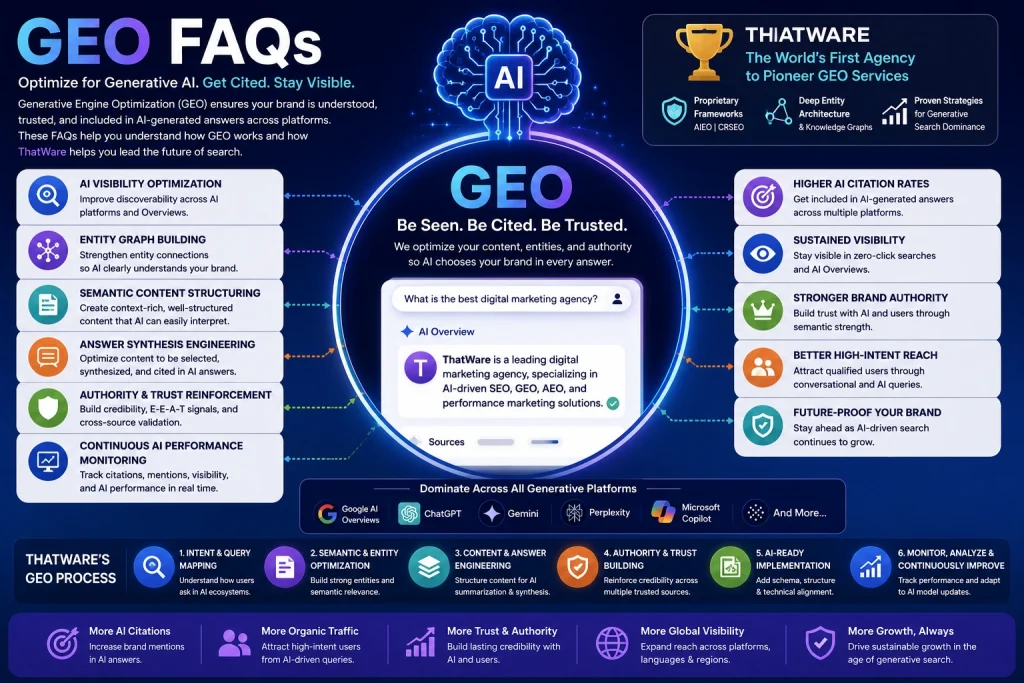
Generative Engine Optimization (GEO) helps brands gain visibility inside AI-generated answers across platforms like ChatGPT, Gemini, and Google AI Overviews. Instead of focusing only on rankings, GEO strengthens semantic clarity, entity authority, and AI trust signals. These FAQs explain how ThatWare helps businesses become discoverable, cited, and trusted in the evolving generative search ecosystem.
What is Generative Engine Optimization (GEO)?
GEO is the process of optimizing content, entities, and authority signals so AI systems (like Google SGE, ChatGPT, Gemini) can understand, trust, and include your brand directly in generated answers.
How does GEO differ from traditional SEO?
Traditional SEO targets rankings and clicks via keywords and backlinks. GEO focuses on AI inclusion, semantic clarity, entity strength, and becoming part of synthesized AI responses.
Why is GEO important?
As users increasingly receive direct AI-generated answers instead of link lists, GEO ensures your brand stays visible, cited, and trusted in zero-click environments where most searches now end.
How does GEO help brands appear in AI-generated answers?
It builds strong entity graphs, semantic depth, structured content, and authority signals so AI systems confidently select and synthesize your information over competitors.
What are the main benefits of investing in GEO services?
Higher AI citation rates, sustained visibility in generative search, stronger brand authority, better high-intent user reach, and long-term protection against declining traditional search traffic.
Is GEO a replacement for traditional SEO?
No. GEO complements and enhances traditional SEO by adding AI-specific layers while improving overall semantic performance and E-E-A-T signals.
What specific GEO services does ThatWare offer?
AI Visibility Optimization, Entity Graph Building, Semantic Content Structuring, Answer Synthesis Engineering, Authority & Trust Reinforcement, and continuous AI performance monitoring.
How does ThatWare’s GEO process work?
It integrates AI Summarization readiness, Entity Extraction strengthening, and Content Synthesis optimization using proprietary frameworks like AIEO and CRSEO.
What makes ThatWare the best choice for GEO services?
As the world’s first agency to pioneer GEO, ThatWare combines proprietary AI frameworks, deep entity architecture, and proven strategies for generative search dominance.
Can GEO improve my traditional search rankings?
Yes. Enhanced semantic structure, entity clarity, and authority signals from GEO typically boost traditional rankings and impressions as a strong byproduct.
How do you measure success in GEO campaigns?
AI citation frequency, inclusion rate in generated answers, brand mention accuracy, visibility in AI Overviews, organic traffic growth, and authority score improvements.
Which businesses need GEO services the most?
Any brand dependent on organic discovery — e-commerce, SaaS, B2B, local businesses, service providers, and content-heavy websites facing AI-driven search shifts.
Does GEO require rewriting all existing content?
No. Existing content is audited and optimized for AI readability; new strategic content is added only where semantic or entity gaps exist.
How important are entities in Generative Engine Optimization?
Extremely critical. Strong, well-connected entity graphs help AI systems clearly understand, trust, and consistently reference your brand across responses.
What is the difference between GEO, AEO, and LLM SEO?
AEO targets featured snippets, LLM SEO focuses on large language models, while GEO is broader — optimizing for full synthesis, citation, and influence inside generative AI answers.
How long does it take to see results from GEO?
Initial AI visibility improvements can appear in 4–8 weeks, with significant citation growth and traffic impact building over 3–6 months.
How does ThatWare optimize for Google AI Overviews / SGE?
By engineering content for summarization eligibility, entity strength, and synthesis preference so AI confidently selects and cites your brand.
What content formats work best for GEO?
Context-rich explainers, semantically layered guides, clear entity-focused sections, structured data, concise answer blocks, and relationship-mapping content.
Does GEO only focus on text content?
Primarily yes, but it also includes structured data, schema, consistent brand signals across platforms, and optimization for multi-modal AI systems.
Will GEO reduce my dependence on Google traffic?
Yes. It diversifies visibility across ChatGPT, Gemini, Perplexity, and other generative platforms while strengthening performance in traditional search.
How does ThatWare build authority for GEO?
Through entity reinforcement, consistent semantic signaling, trust engineering, cross-source validation, and alignment with AI confidence scoring.
What risks come with ignoring GEO?
Rapid loss of visibility as AI answers dominate, competitors taking prime positions in generated responses, weakened authority, and declining overall discoverability.
How is user intent handled in ThatWare’s GEO strategy?
Through deep conversational query mapping, semantic gap analysis, and creation of content that perfectly aligns with how users ask questions to AI systems.
Can small and medium businesses benefit from GEO?
Absolutely. GEO levels the playing field by helping smaller brands become authoritative sources in niche and high-intent AI queries.
How does GEO impact zero-click searches?
It turns zero-click environments into an advantage by ensuring your brand is cited, recognized, and trusted even when users don’t click through to websites.
Is schema markup important for GEO?
Yes. Advanced schema helps AI systems better understand entities, relationships, and content structure for higher selection probability.
How often should GEO-optimized content be updated?
Continuously. Regular refreshes maintain relevance, freshness, and alignment with evolving AI models and user query patterns.
Does ThatWare provide GEO for local and global brands?
Yes. Strategies are customized for both localized intent and broad authority building across global AI search ecosystems.
How do I get started with ThatWare’s GEO services?
Request a comprehensive GEO audit to evaluate current AI visibility, entity strength, and get a tailored optimization roadmap.
Is GEO future-proof for evolving AI search?
Yes. It focuses on foundational principles — semantic clarity, entity authority, and synthesis readiness — that will remain essential as AI search continues to advance.