
SUPERCHARGE YOUR ONLINE VISIBILITY! CONTACT US AND LET’S ACHIEVE EXCELLENCE TOGETHER!
SEO isn’t what it used to be—and that’s not a dramatic statement, it’s a structural shift. For years, search optimization was largely about matching: matching keywords to queries, matching pages to phrases, and matching “best practices” to ranking factors. That era worked because search engines mostly behaved like sophisticated index-and-retrieval systems. If you understood what people typed and mirrored it on your pages, you could often win.
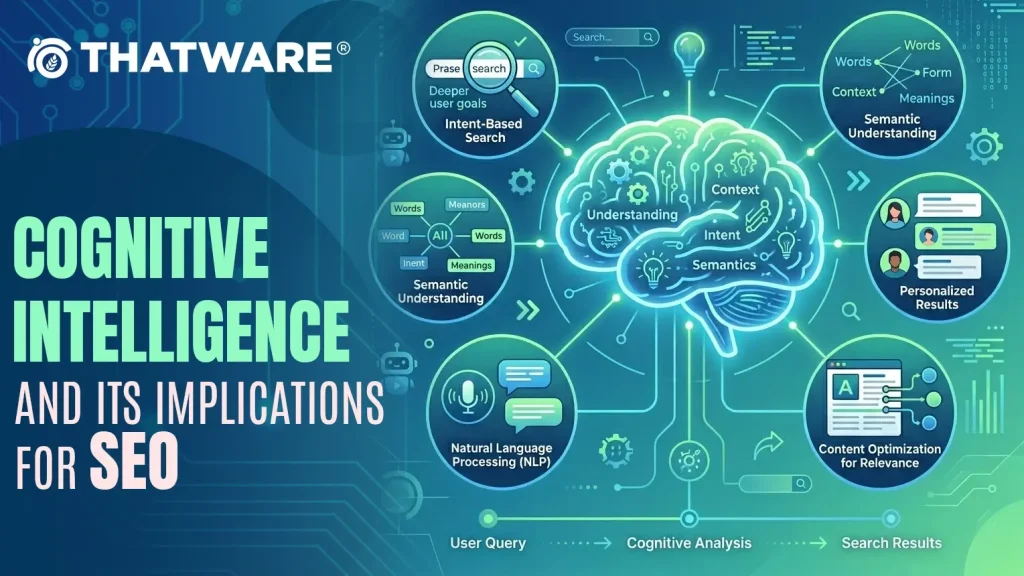
But the modern search landscape has moved far beyond that mechanical model.
The evolution of SEO: from keywords to cognition
SEO has progressed through distinct phases. It began with keywords, where exact-match phrasing and density could strongly influence rankings. Then came semantic search, where engines started interpreting meaning rather than literal strings. After that, SEO shifted toward entities—people, brands, places, concepts—and how they relate to each other across the web. Today, we’re entering the next phase: cognition.
This is where Cognitive Intelligence becomes relevant.
Why traditional SEO models are no longer sufficient
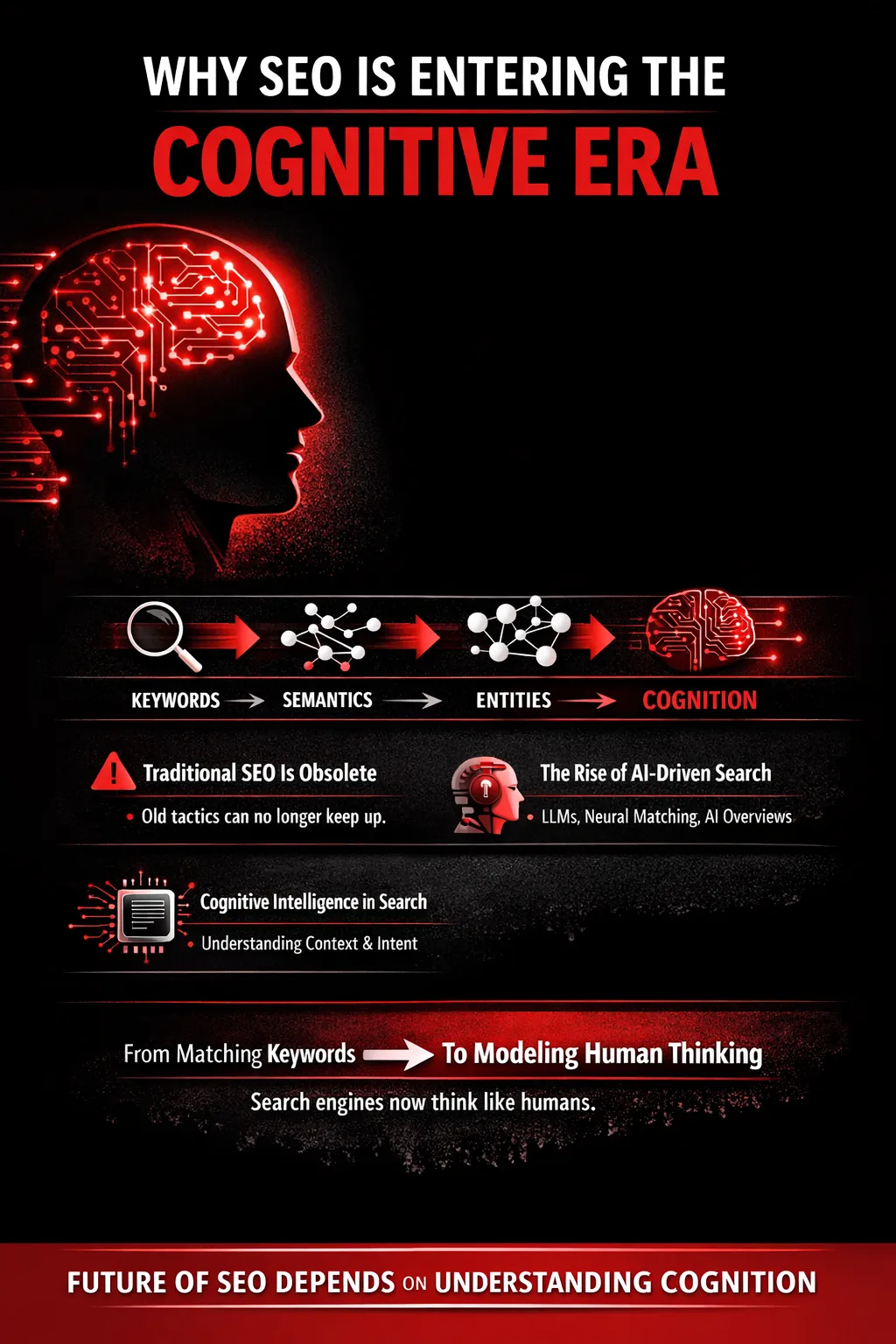
The classic SEO playbook—keyword mapping, on-page optimization, backlinks, and technical fixes—still matters, but it’s no longer enough by itself. Why? Because search engines are now trained to understand not just “what a page says,” but what it means, how it’s structured, how confidently it answers, and whether it satisfies a user’s mental goal behind the query.
In other words, modern SEO success increasingly depends on whether your content aligns with how users think, process information, and make decisions—not merely whether it contains the right phrases.
The rise of AI-driven search
This shift has accelerated with AI-driven search systems, including large language models (LLMs), neural matching, and features like AI Overviews. These systems don’t just retrieve pages; they interpret them, summarize them, compare them, and sometimes answer users directly. That changes the rules of visibility. Content must now be designed not only to rank, but to be understood and used by AI systems that synthesize information. A free ai visibility tool can help you check how your content is actually appearing across these AI-driven results before you invest in a broader optimization strategy.
What “Cognitive Intelligence” means for search engines
In this context, Cognitive Intelligence refers to the ability of machines to simulate human-like processes such as understanding, reasoning, context interpretation, and decision modeling. Search engines are increasingly acting less like keyword matchers and more like cognitive systems—systems that attempt to model intent, identify helpfulness, evaluate clarity, and predict satisfaction.
Core thesis
Search engines are no longer matching strings—they are modeling human thinking.
And that one shift changes everything about how content should be planned, written, structured, and optimized.
What you’ll learn in this guide
In this article, you’ll learn what Cognitive Intelligence means in practical SEO terms, how search engines evaluate content through cognitive-like signals (clarity, coherence, information gain, intent satisfaction), and how to adapt your SEO strategy for a world where ranking is tied to understanding. If you want to stay competitive in the future of SEO, this is no longer optional—it’s the new foundation.
What Is Cognitive Intelligence?
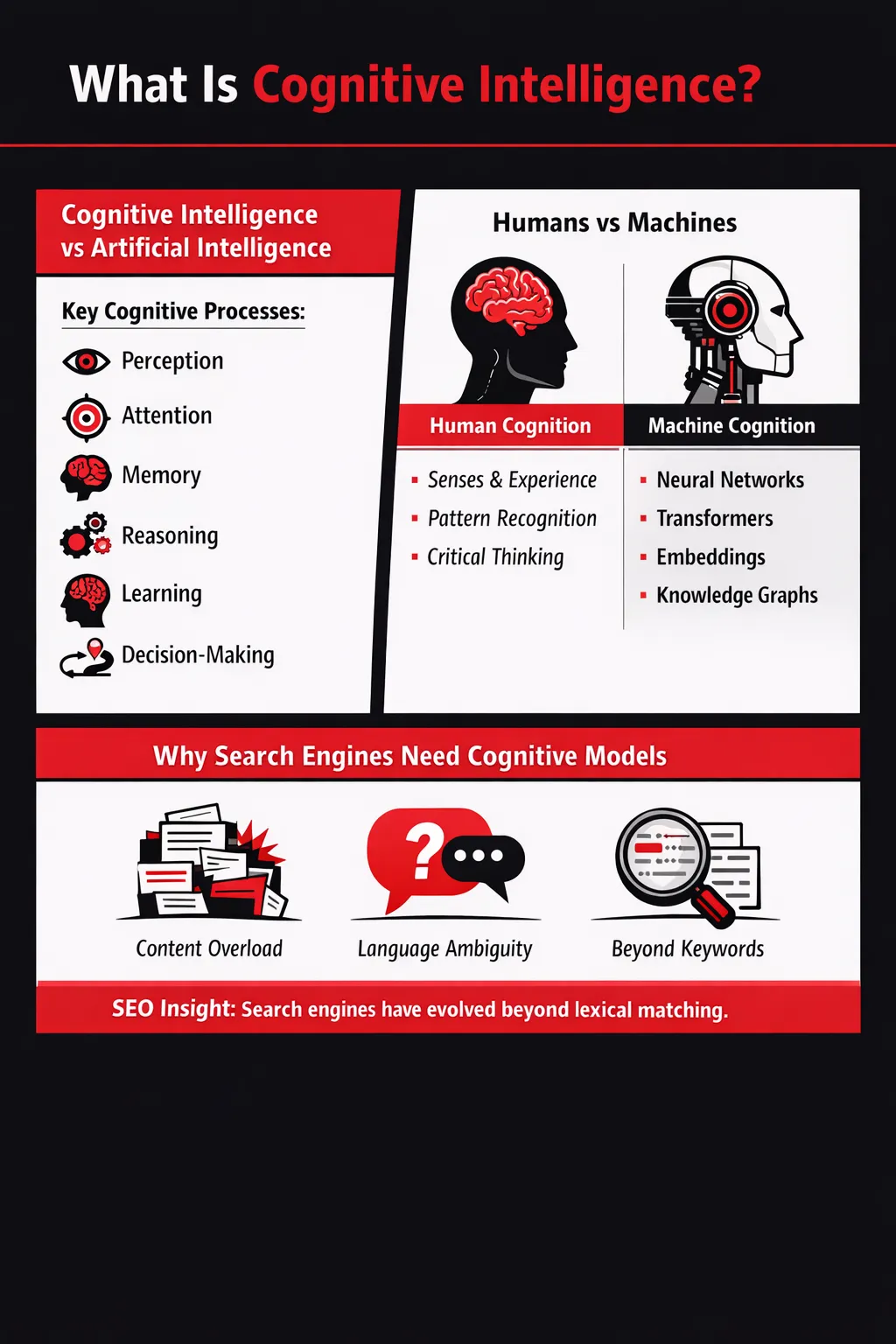
Cognitive intelligence refers to the ability to acquire, process, understand, and apply information in a way that mirrors human thinking. It goes beyond raw computational power and focuses on how information is interpreted, connected, and used to make decisions. While artificial intelligence (AI) is a broad umbrella covering systems that perform tasks requiring human-like intelligence, cognitive intelligence is a more specific subset—one that emphasizes mental processes such as understanding, reasoning, and learning rather than simple pattern execution.
At its core, cognitive intelligence is built on several key processes that define human thought. Perception allows an entity to interpret sensory or input data and recognize patterns. Attention determines what information is prioritized and what is ignored. Memory enables the storage and retrieval of knowledge over time, creating continuity and context. Reasoning helps in drawing inferences and relationships between concepts, while learning allows systems to improve understanding based on new information or feedback. Finally, decision-making uses all these processes together to choose the most relevant or useful outcome in a given situation. These processes are central not only to human cognition but also to how modern intelligent systems operate.
The difference between cognitive intelligence in humans and machines lies in how these processes are executed. Humans rely on biological neural systems shaped by experience, emotion, and intuition. We understand meaning holistically, drawing from lived experience, cultural context, and prior knowledge. Machines, on the other hand, simulate cognition using mathematical and computational models. Neural networks imitate the structure of the human brain to identify patterns in data. Transformers enable contextual understanding by analyzing relationships between words and concepts at scale. Embeddings convert language into numerical representations, allowing machines to compare meaning rather than exact wording. Knowledge graphs store entities and their relationships, helping systems build structured “mental models” of information.
Search engines require cognitive models because the modern web is vast, ambiguous, and largely unstructured. Billions of pages contain overlapping information, nuanced language, and complex user intent that cannot be resolved through keywords alone. Users rarely search with perfect phrasing; they express incomplete thoughts, evolving needs, and contextual goals. Cognitive intelligence allows search engines to interpret meaning, disambiguate intent, and connect concepts across sources.
SEO Insight: This is precisely why search engines evolved beyond lexical matching. Keyword-based retrieval could identify words, but cognitive systems are needed to understand ideas, relevance, and value—making meaning, not matching text, the foundation of modern search.
How Search Engines Use Cognitive Intelligence Today
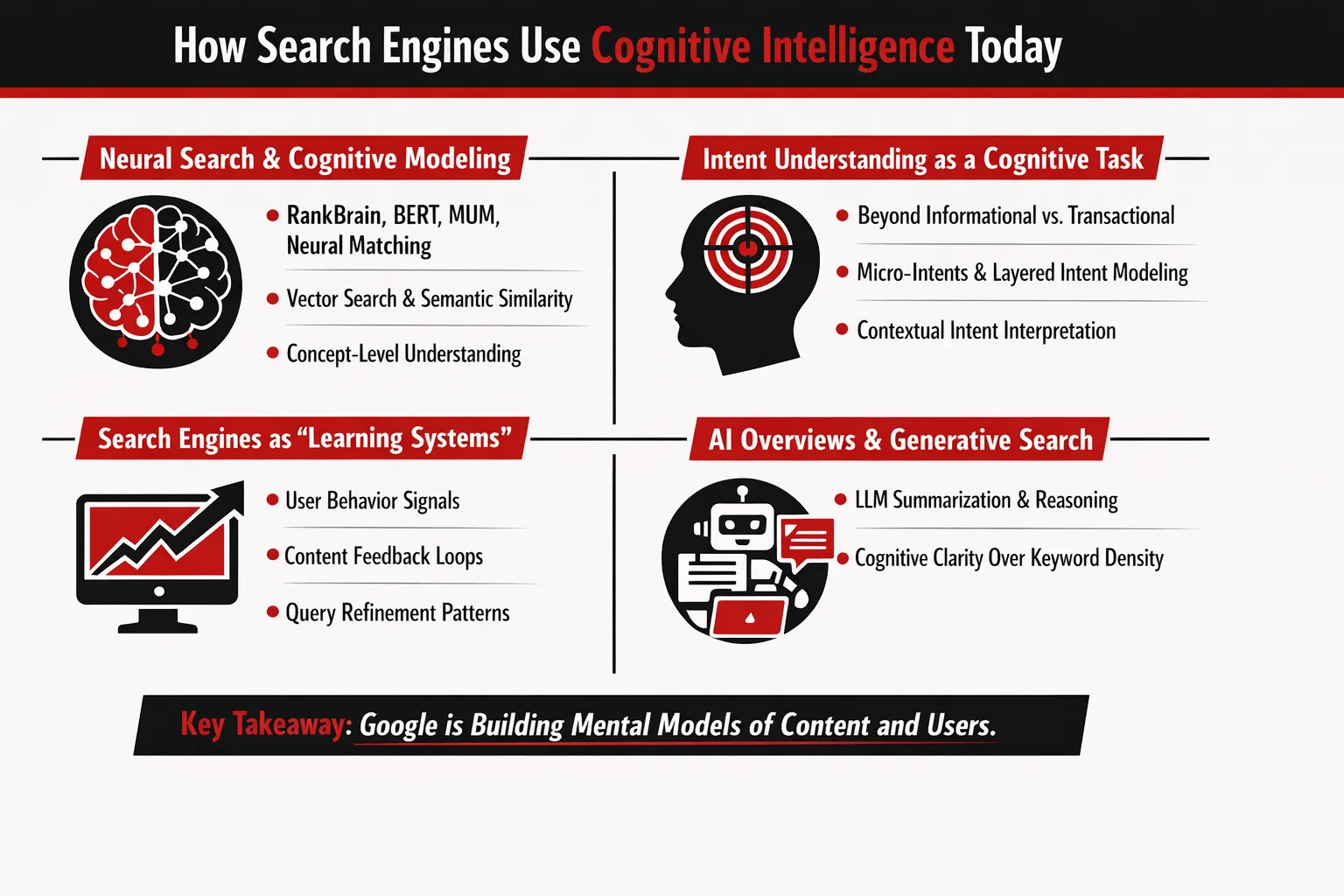
Modern search engines no longer operate as simple information retrieval systems. Instead, they function as cognitive systems designed to understand, learn, and reason in ways that increasingly resemble human thinking. This shift is driven by advances in neural networks, machine learning, and large language models, fundamentally changing how SEO works.
1. Neural Search & Cognitive Modeling
At the core of today’s search experience are neural search systems such as RankBrain, BERT, and MUM, along with broader neural matching frameworks. These systems allow search engines to move beyond exact keyword matching and toward concept-level understanding.
Rather than treating queries and documents as strings of text, search engines convert them into vectors—mathematical representations of meaning. Through vector search and semantic similarity, Google can identify content that is conceptually relevant even when the wording differs significantly from the query. For example, a page does not need to repeat a keyword verbatim to rank; it only needs to align with the underlying concept the user is seeking.
This represents a cognitive leap: search engines are no longer matching words, but modeling meaning, much like humans do when interpreting language.
2. Intent Understanding as a Cognitive Task
Traditional SEO frameworks classify intent into informational, navigational, and transactional categories. While still useful at a high level, this model is increasingly too simplistic for modern search systems.
Search engines now perform layered intent modeling, where a single query may contain multiple micro-intents. A user searching for “best CRM for startups,” for instance, may be researching options, comparing features, evaluating pricing, and preparing for a purchase—all at once. Cognitive search systems attempt to infer these layers by analyzing context, phrasing, and historical patterns.
This makes intent understanding a cognitive task, not a rule-based one. Contextual intent interpretation allows search engines to adjust results dynamically based on factors such as location, device, prior searches, and even shifts in user behavior over time.
3. Search Engines as “Learning Systems”
Another defining characteristic of cognitive intelligence in search is continuous learning. Google’s systems constantly refine their understanding through multiple feedback signals, including:
- User behavior, such as clicks, dwell time, and query reformulation
- Content feedback loops, where new content reshapes topic understanding
- Query refinement patterns, revealing gaps or mismatches in results
This ongoing learning process enables search engines to update their internal models of topics, authority, and relevance. In effect, search engines behave less like static databases and more like adaptive learning systems.
4. AI Overviews & Generative Search
With the introduction of AI Overviews and generative search, cognitive intelligence becomes even more visible. Large language models summarize, synthesize, and reason across multiple sources to produce direct answers. In this environment, cognitive clarity matters far more than keyword density.
Content that is well-structured, conceptually clear, and logically coherent is easier for AI systems to interpret and summarize accurately. Conversely, keyword-stuffed or fragmented content introduces cognitive friction, reducing its usefulness for both users and AI.
Key takeaway: Google is no longer just ranking pages—it is building mental models of content and users, using cognitive intelligence to understand meaning, intent, and value at a deeper level than ever before.
Cognitive Intelligence vs Traditional SEO Thinking
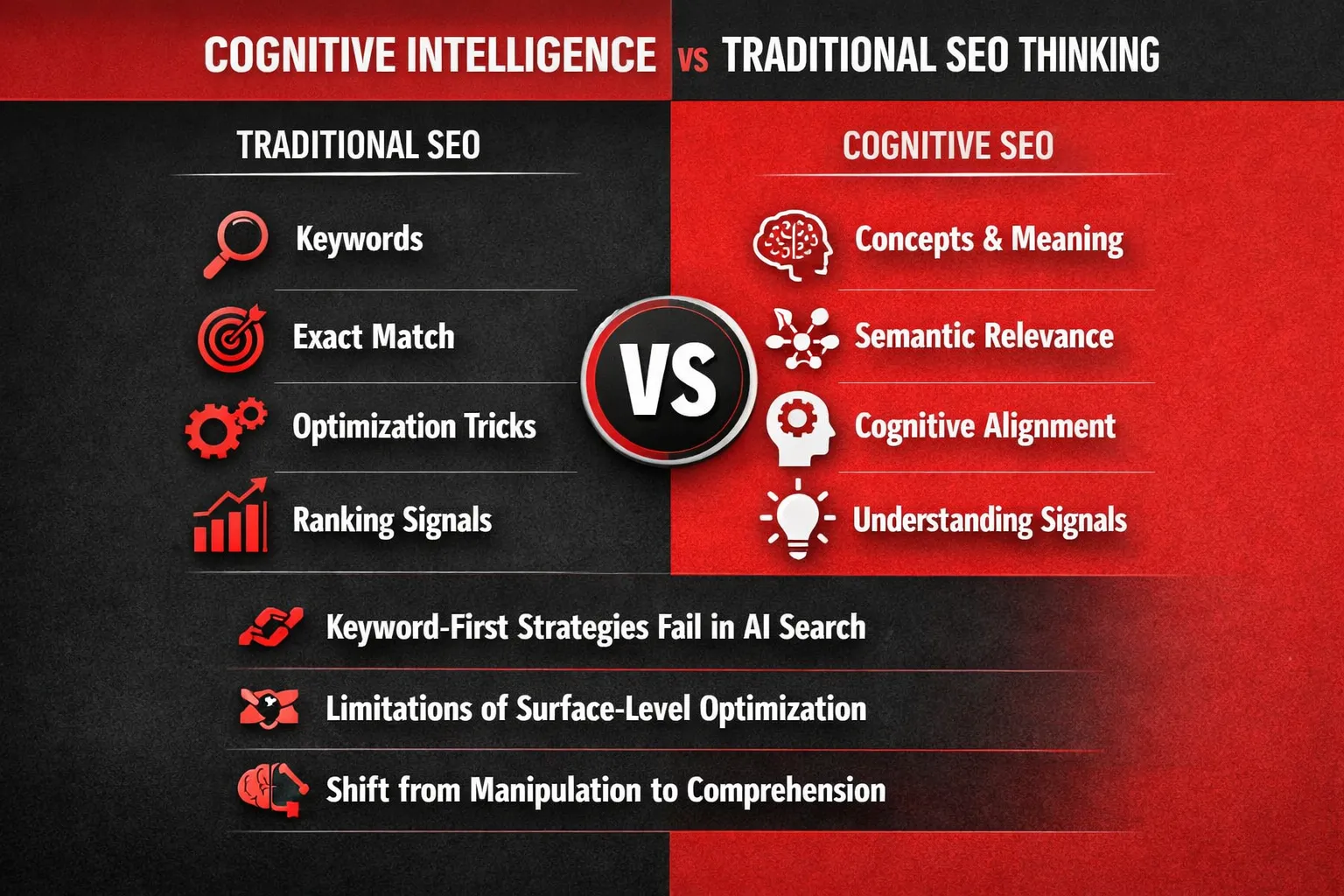
For years, SEO was built on a mechanical understanding of search engines. Traditional SEO focused on keywords, exact-match phrases, and tactical optimization techniques designed to signal relevance to algorithms that primarily matched text patterns. While this approach once worked, it is increasingly ineffective in an era where search engines operate using cognitive intelligence rather than simple rule-based systems.
At the core of traditional SEO is the assumption that rankings can be influenced by keyword placement and density. Pages were optimized around exact-match terms, often at the expense of clarity and depth. This method treats content as a collection of signals to be manipulated rather than as information to be understood. As search engines evolved, this surface-level optimization began to show its limitations—especially when users’ queries became more complex and context-driven.
Cognitive SEO represents a fundamental shift. Instead of focusing on keywords, it prioritizes concepts, meaning, and semantic relationships. Modern search engines no longer rely solely on matching words; they interpret intent, context, and topical relevance using neural networks and language models. Semantic relevance has replaced exact match, allowing search systems to understand that different phrases can express the same underlying idea. As a result, content that demonstrates conceptual depth and clarity often outperforms content that is merely keyword-optimized.
This is why keyword-first strategies fail in AI-driven search environments. AI models evaluate whether content actually answers a question, provides new information, and aligns with the user’s cognitive intent. Pages designed around optimization tricks—such as keyword stuffing, shallow rewrites, or templated content—lack the depth required for machine understanding and are increasingly filtered out.
The shift from traditional SEO to cognitive SEO also marks a move away from manipulation toward comprehension-based optimization. Ranking signals are no longer isolated technical factors but indicators of understanding—coherence, expertise, contextual accuracy, and information gain. In this new paradigm, success depends on how well content communicates meaning to both humans and machines, making cognitive alignment—not mechanical optimization—the foundation of sustainable SEO performance.
Cognitive Signals That Influence SEO Performance
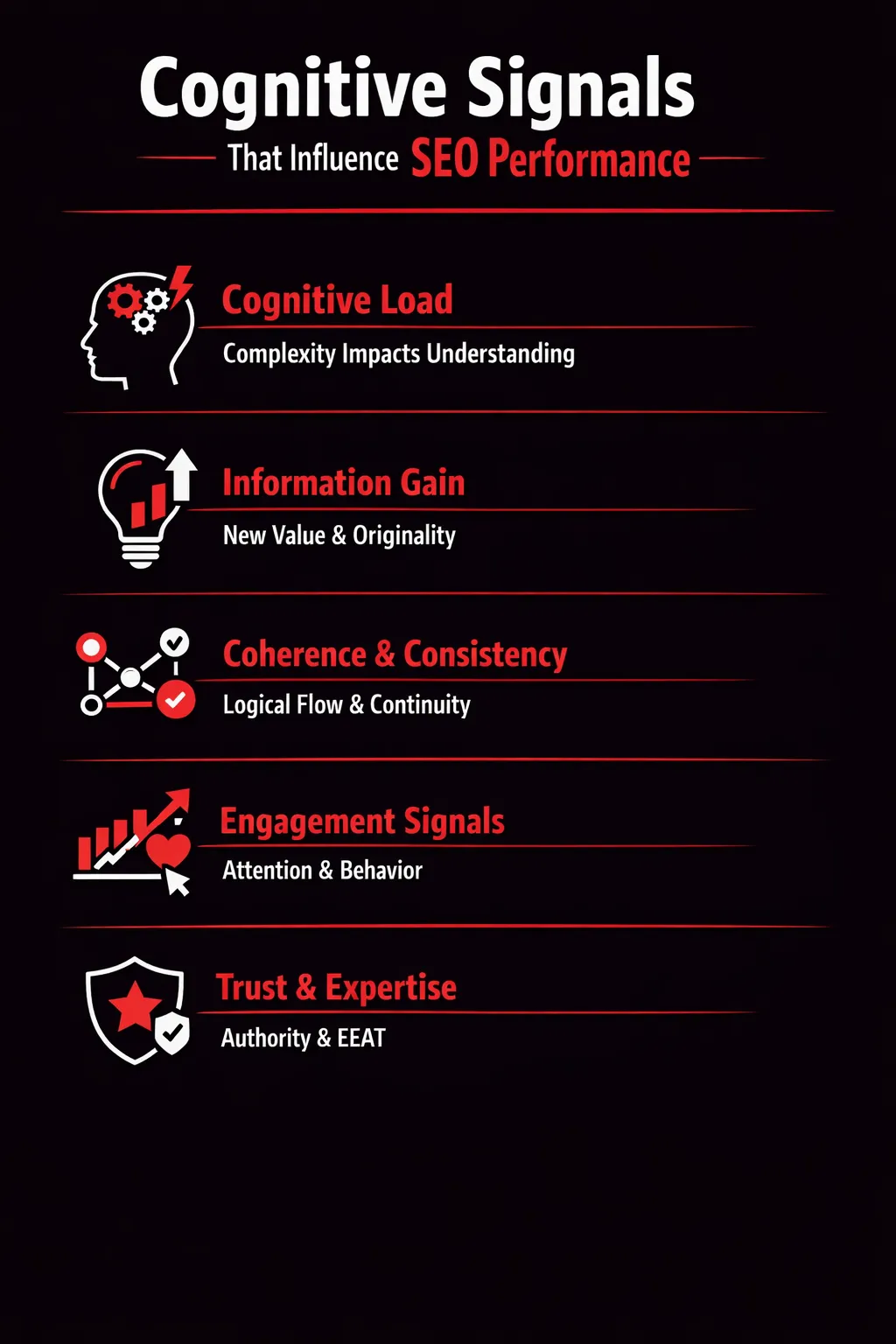
As search engines evolve from rule-based systems into learning systems, ranking factors are no longer isolated technical signals. Instead, they are cognitive signals—indicators that help search engines assess how well a piece of content aligns with human understanding, decision-making, and satisfaction. This shift requires SEOs to adopt a new mental model: optimizing not just for algorithms, but for how information is perceived, processed, and trusted by both users and AI-driven search systems.
Below are the key cognitive signals increasingly shaping SEO performance.
1. Cognitive Load
Cognitive load refers to the amount of mental effort required for a user (or an AI system) to understand information. When content is overly complex, poorly structured, or cluttered with unnecessary elements, it increases cognitive load and reduces comprehension.
From a search perspective, high cognitive load signals inefficiency. Users struggle to extract value quickly, and AI systems find it harder to summarize or reason over the content. Complex sentence structures, vague explanations, excessive jargon, and disorganized layouts all contribute to this problem.
Lower cognitive load improves:
- Readability and comprehension
- Content extractability for AI summaries
- User satisfaction and retention
Pages that communicate ideas clearly, use logical headings, and simplify complex concepts tend to perform better in rankings and are more likely to be selected for AI-generated overviews.
2. Information Gain
Modern search engines prioritize information gain—the degree to which content adds new, meaningful value beyond what already exists in search results. Repetitive or derivative content offers little cognitive benefit and is increasingly filtered out.
From a cognitive standpoint, novelty is essential. Humans pay attention to new insights, and AI systems are trained to detect originality at a conceptual level. This does not mean publishing radically new research every time, but rather:
- Introducing fresh perspectives
- Explaining familiar topics more clearly or deeply
- Connecting concepts in non-obvious ways
Content that merely rephrases existing articles lacks cognitive novelty. In contrast, content that expands understanding or reframes a topic contributes higher information gain—making it more valuable for both users and search engines.
3. Coherence & Consistency
Coherence refers to how logically ideas flow within a page, while consistency relates to how well the topic is maintained without unnecessary deviation. Together, they help search engines build a stable “mental model” of the content.
Cognitively, incoherent content creates confusion. Sudden topic shifts, contradictory statements, or poorly connected sections weaken understanding. For AI systems, this results in unclear relevance signals.
Strong coherence and consistency:
- Improve topical clarity
- Reinforce semantic relevance
- Align on-page signals (headings, entities, intent)
When every section supports the same core theme and progresses logically, search engines gain confidence in what the page is truly about.
4. Engagement as a Cognitive Signal
Engagement metrics increasingly act as proxies for cognitive satisfaction. Search engines interpret user behavior as feedback on whether content met the user’s mental expectations.
Key engagement-related cognitive signals include:
- Attention retention: Time spent actively engaging with content
- Scroll behavior: Whether users explore beyond the first screen
- Interaction patterns: Clicking, reading, or refining searches
These behaviors help search engines model satisfaction. Content that holds attention and fulfills intent signals cognitive alignment, while rapid exits or shallow engagement suggest misunderstanding or unmet needs.
5. Trust & Expertise Recognition
Trust is not evaluated solely through backlinks or author bios. Cognitive systems assess authority by detecting expertise consistency, accuracy, and contextual depth.
Search engines analyze:
- Precision of explanations
- Appropriate use of domain-specific concepts
- Alignment with established knowledge
- Consistency across related content
This is where EEAT (Experience, Expertise, Authoritativeness, Trustworthiness) becomes a cognitive framework. Instead of static signals, EEAT reflects whether content demonstrates understanding in a way that aligns with expert reasoning.
Topical Authority as Cognitive Memory Architecture
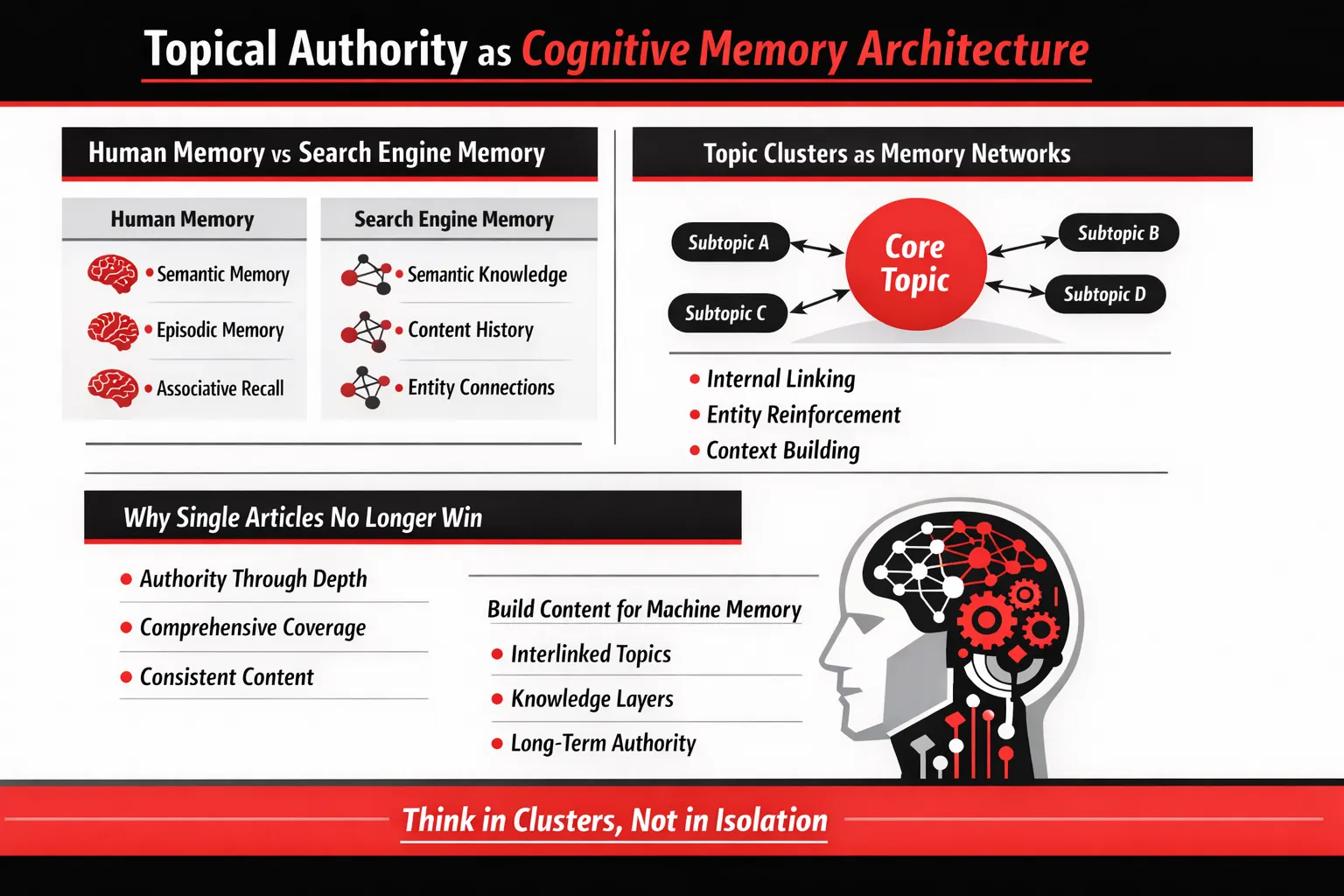
To understand why topical authority has become one of the strongest SEO advantages today, we need to stop thinking about search engines as simple databases and start viewing them as cognitive systems with memory. Modern search engines do not merely index pages; they learn, remember, and associate concepts over time, much like the human brain. Topical authority, therefore, is not just about publishing more content—it is about building a structured memory architecture that search engines can recognize, reinforce, and recall.
Human Memory vs Search Engine Memory
Human cognition relies on multiple types of memory, and search engines now operate in a surprisingly similar way.
Semantic memory in humans stores general knowledge—facts, concepts, and meanings detached from personal experience. Search engines mirror this through entities, topics, and concept embeddings. When your website consistently publishes high-quality content around a subject, Google begins to associate your domain with that semantic space.
Episodic memory refers to experiences and events. In search systems, this translates into historical signals such as content updates, engagement patterns, and long-term consistency. A site that repeatedly demonstrates expertise over time builds stronger recall than one that publishes sporadically.
Associative recall allows humans to connect related ideas automatically. Search engines do the same by linking entities, subtopics, and contextual relationships. The richer these associations, the easier it becomes for algorithms to “remember” and surface your content across related queries.
Topic Clusters as Memory Networks
Topic clusters function like neural networks for search engines. Each piece of content acts as a node, and internal links serve as the synapses connecting them.
Internal linking reinforces associative learning, helping search engines understand how concepts relate to one another. When pillar pages link to supporting articles—and those articles link back—the system strengthens conceptual confidence.
Entity reinforcement occurs when the same core entities, terminology, and relationships appear consistently across multiple pages. Over time, this repetition helps search engines solidify your site’s role within a specific knowledge domain.
As content accumulates, context builds progressively. Each new article doesn’t stand alone; it adds depth, clarity, and confidence to the existing memory structure, making the entire domain more authoritative.
Why Single Articles No Longer Win
In a cognitive search environment, authority is built holistically, not individually. A single, well-optimized article may perform temporarily, but it lacks the memory reinforcement required for long-term dominance.
Search engines evaluate depth, coverage, and consistency across an entire topic. Sites that demonstrate comprehensive understanding are rewarded because they reduce uncertainty and cognitive effort for both users and algorithms.
Practical SEO Application: Structuring Content for “Machine Memory”
To optimize for machine memory, structure content around interconnected topic ecosystems rather than isolated pages. Use clear pillar–cluster models, reinforce entities consistently, update content regularly, and ensure logical internal linking. When your site mirrors how cognitive systems learn and recall information, topical authority becomes a natural outcome—not a ranking tactic.
Cognitive Intelligence and Search Intent Evolution
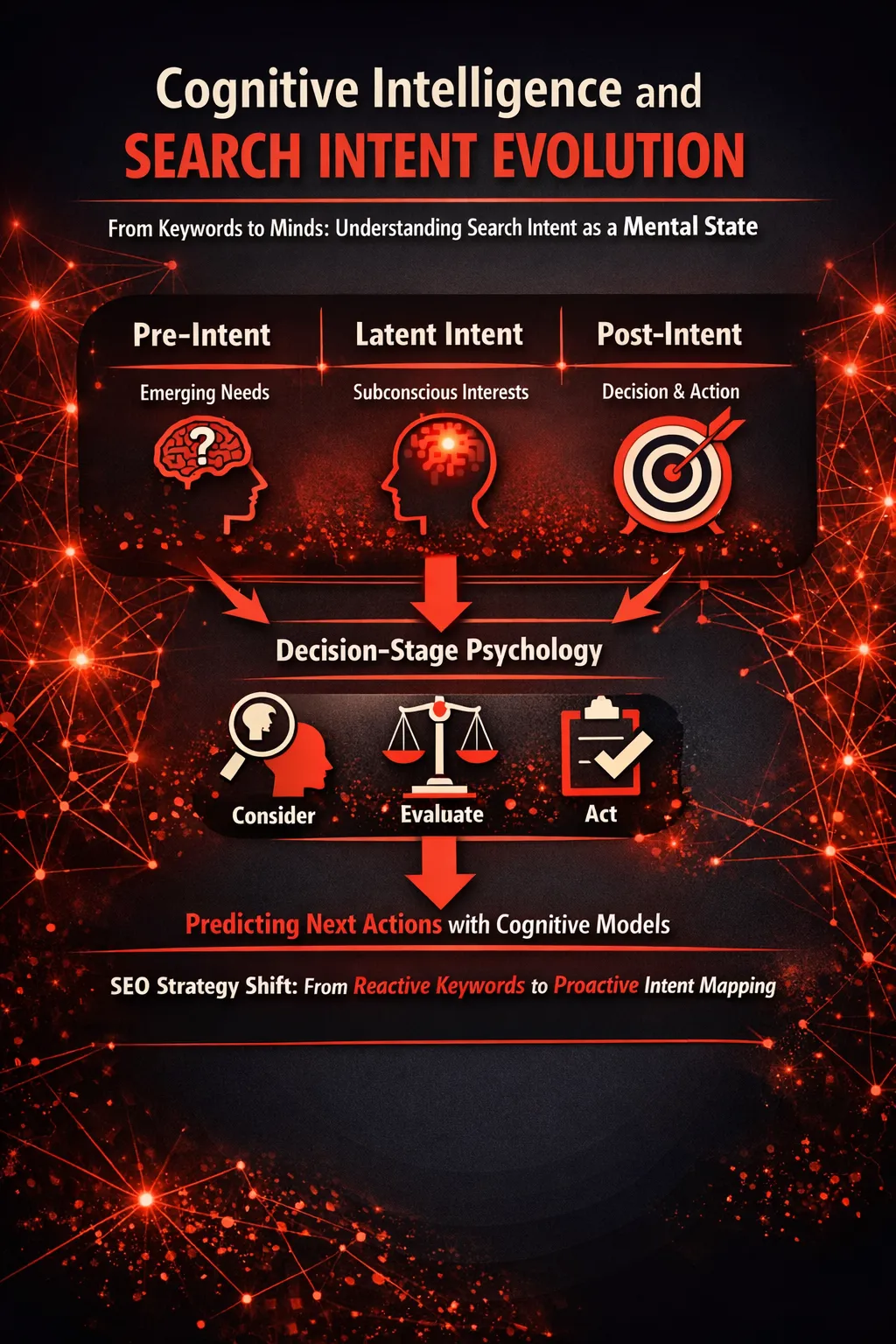
For years, SEO treated search intent as a keyword-level classification problem—labeling queries as informational, navigational, or transactional. While useful in the past, this framework no longer reflects how modern search engines operate. With the rise of cognitive intelligence, intent is now understood as a dynamic mental state, shaped by context, prior behavior, and future expectations rather than a single typed query.
Search engines increasingly model intent the way humans do: as a continuum of thought and decision-making. A query is not the beginning of intent—it is often the middle of a cognitive process. This has led to the emergence of three critical intent layers: pre-intent, latent intent, and post-intent.
- Pre-intent refers to the unexpressed need forming in a user’s mind before a query is made. For example, uncertainty, curiosity, or problem recognition may exist long before the user searches.
- Latent intent represents underlying goals that are not explicitly stated in the query. A search for “best CRM tools” may conceal deeper intents such as scalability concerns, pricing anxiety, or integration needs.
- Post-intent focuses on what the user is likely to do next—compare options, seek validation, or take action—after consuming the current result.
Cognitive intelligence allows search engines to connect these stages using behavioral data, contextual signals, and historical patterns. Instead of reacting to keywords, search systems now predict intent progression, anticipating follow-up questions and next actions. This is why search results increasingly include comparisons, FAQs, and decision-support content—even when users do not explicitly ask for them.
At the core of this evolution is decision-stage psychology. Cognitive models analyze where a user sits in their decision journey—exploration, evaluation, or commitment—and adjust rankings accordingly. Content that aligns with the user’s cognitive readiness consistently outperforms content that merely matches keywords.
This shift demands a fundamental change in SEO strategy. Optimization can no longer be reactive. Instead of chasing search terms after they appear, modern SEO requires proactive intent mapping—designing content ecosystems that address the full cognitive journey of the user. In a cognitive search world, the winners are not those who rank for keywords, but those who understand why users search and what they will need next.
Writing Content for Cognitive SEO (Actionable Framework)
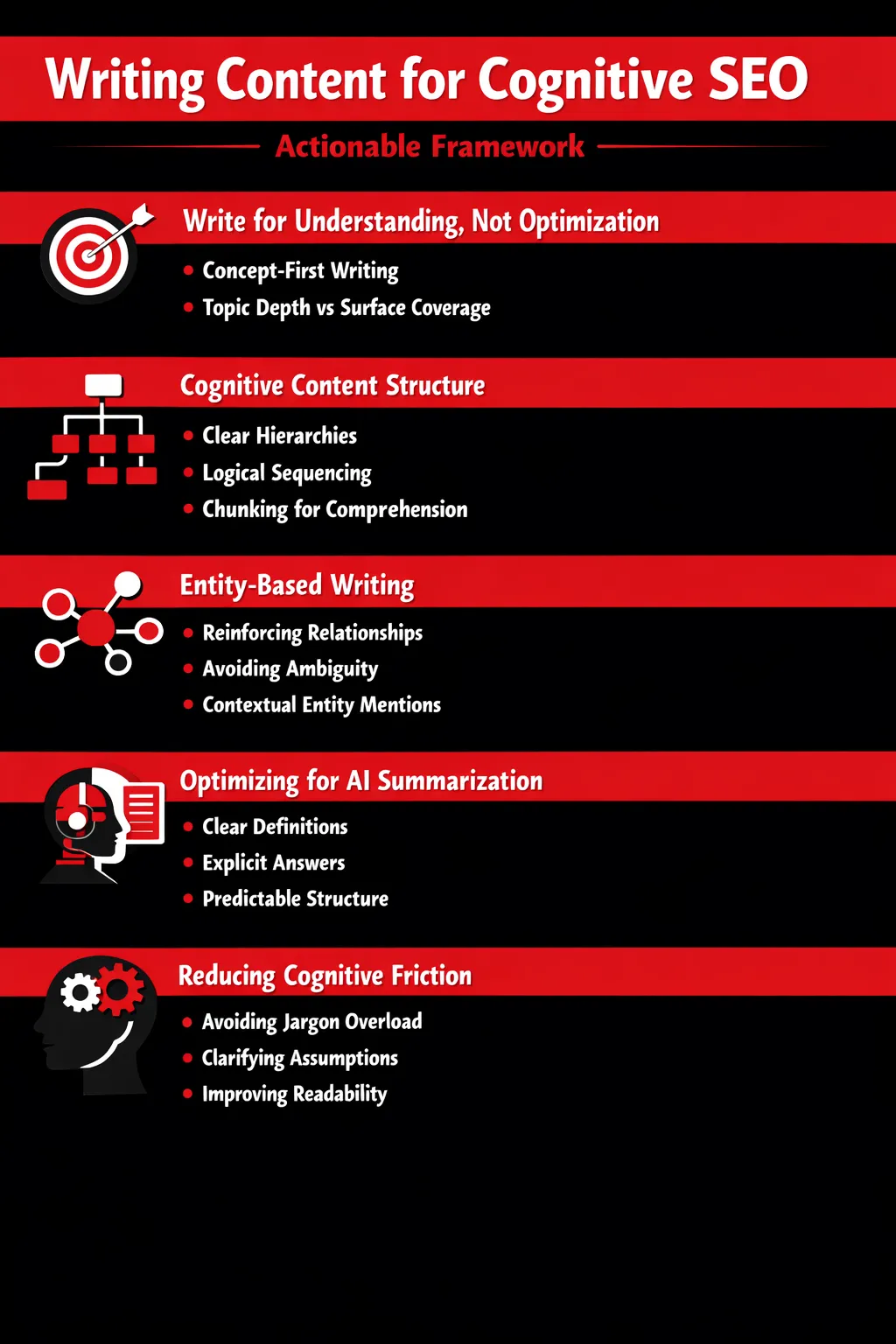
As search engines evolve toward cognitive intelligence, content creation must shift from mechanical optimization to human-like understanding. Cognitive SEO is not about gaming algorithms—it is about aligning content with how both humans and machines process, structure, and recall information. The following framework provides practical guidance for writing content that performs well in cognitively driven search systems.
1. Write for Understanding, Not Optimization
Traditional SEO encouraged writing for keywords; cognitive SEO demands writing for comprehension. Concept-first writing means identifying the core idea you want to communicate before thinking about terms or variations. Search engines now understand topics as conceptual spaces, not isolated phrases.
Instead of creating multiple shallow pages targeting similar keywords, focus on topic depth. Deep coverage signals expertise, reduces ambiguity, and helps search engines model your content as a reliable knowledge source. Surface-level content may rank temporarily, but cognitively rich content builds long-term authority.
Ask a simple question while writing: Does this explain the topic clearly enough that a human could teach it to someone else? If yes, you are aligning with cognitive SEO principles.
2. Use a Cognitive Content Structure
Structure is not just for readability—it is a comprehension signal. Cognitive systems rely heavily on clear hierarchies to understand relationships between ideas.
- Use logical heading structures (H2 → H3 → H4) to reflect conceptual importance
- Present ideas in a natural learning sequence, from foundational concepts to advanced insights
- Break complex ideas into smaller, digestible chunks
Chunking content reduces cognitive load for readers and improves machine understanding. Well-structured content allows search engines to identify definitions, explanations, and key takeaways more efficiently—critical for featured snippets and AI-generated summaries.
3. Adopt Entity-Based Writing
Cognitive search engines build meaning through entities and their relationships. Entity-based writing involves clearly referencing people, concepts, technologies, or processes in context, rather than using vague or interchangeable language.
Reinforce relationships between entities by explaining how they interact. Avoid ambiguity by being explicit about what each term refers to, especially when similar concepts exist. Contextual entity mentions help search engines disambiguate meaning and place your content accurately within the broader knowledge graph.
The clearer the entity relationships, the stronger your content’s semantic footprint.
4. Optimize for AI Summarization
With AI Overviews and generative answers becoming common, content must be summarization-ready. This does not mean oversimplifying—it means being precise.
- Provide clear definitions early
- Answer key questions directly before expanding
- Maintain predictable formatting and structure
When AI systems can easily extract accurate, self-contained explanations from your content, your chances of being cited or summarized increase significantly.
5. Reduce Cognitive Friction
Cognitive friction occurs when content is hard to process. Avoid jargon overload unless necessary, clarify assumptions instead of implying knowledge, and prioritize readability through simple sentence structures and clear transitions.
The easier your content is to understand, the more both users and search engines will trust it. In cognitive SEO, clarity is a ranking advantage.
By writing content that prioritizes understanding, structure, entity clarity, and cognitive ease, you are no longer just optimizing for search—you are teaching intelligent systems how to think about your topic.
UX, Behavior, and Cognitive SEO
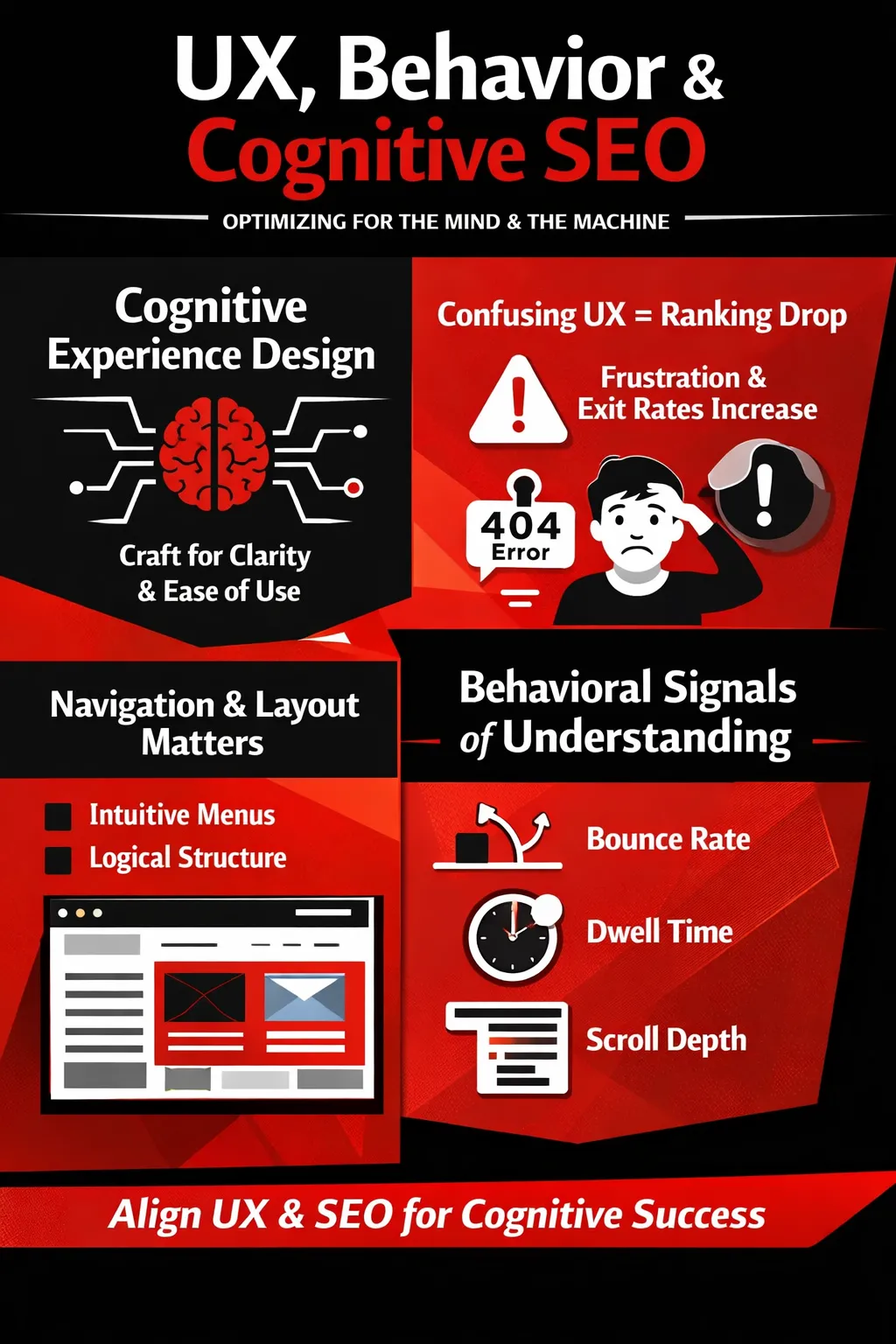
User experience is no longer just a design concern—it is a cognitive experience that directly influences SEO performance. In a cognitive search ecosystem, search engines aim to evaluate how easily users can understand, process, and act on information. This means UX design has become an extension of cognitive intelligence in SEO.
From a cognitive perspective, UX is about minimizing mental effort. When users land on a page, they subconsciously assess clarity, structure, and relevance within seconds. If the content feels confusing, overwhelming, or poorly organized, users experience cognitive friction. This confusion often leads to quick exits, short dwell times, and repeated query reformulations—signals that search engines interpret as dissatisfaction. Over time, such patterns can negatively affect rankings, not because of a single metric, but due to a consistent failure to satisfy user intent cognitively.
Navigation and layout play a critical role in this process. Clear headings, logical content flow, intuitive internal linking, and visual hierarchy help users build a mental map of the page. When this mental model aligns with their expectations, comprehension improves. Conversely, cluttered layouts, excessive ads, or disorganized sections increase cognitive load, making it harder for both users and search systems to extract meaning.
Behavioral metrics—such as scroll depth, dwell time, interaction patterns, and return-to-SERP behavior—act as proxies for understanding. Rather than measuring popularity, these signals help search engines infer whether users found the content clear, useful, and satisfying. In cognitive SEO, strong UX does not manipulate behavior; it supports comprehension. Pages that reduce confusion, guide attention, and respect human cognition are more likely to perform well in modern search environments.
The Future of SEO in a Cognitive Search World
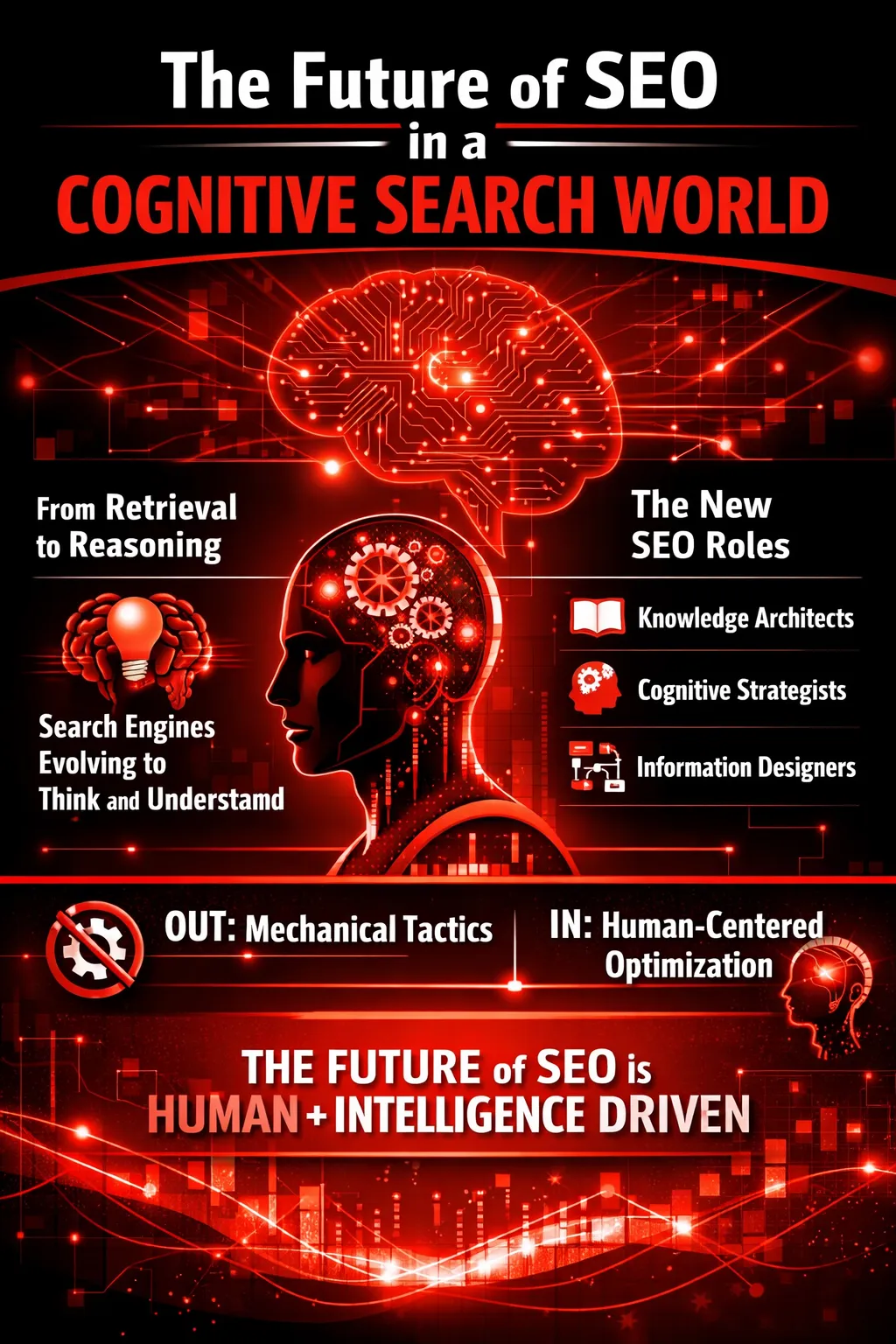
Search is undergoing a fundamental transformation. Traditional search engines were built primarily for information retrieval—matching queries to documents based on keywords, links, and static ranking signals. In a cognitive search world, this model is rapidly giving way to reasoning-based systems. Modern search engines are no longer just fetching pages; they are interpreting intent, synthesizing information, drawing contextual inferences, and generating answers. With the integration of large language models and neural ranking systems, search is evolving from “finding information” to understanding and reasoning with information.
This shift has profound implications for SEO. As search engines become more cognitively capable, the role of SEO professionals must also evolve. Future-ready SEOs will increasingly act as knowledge architects, designing content ecosystems that help search engines build accurate mental models of a topic. Instead of optimizing isolated pages, they will structure interconnected content that reflects how concepts relate, evolve, and reinforce one another.
At the same time, SEO practitioners will become cognitive strategists, aligning content with how users think, learn, and make decisions. This means understanding intent as a dynamic cognitive state rather than a static keyword category, and creating content that supports users at different stages of awareness, evaluation, and action. SEO will no longer be about chasing algorithms, but about aligning with cognitive patterns shared by both humans and machines.
Another emerging role is that of information designer. As cognitive systems prioritize clarity, coherence, and usability, the way information is structured will matter as much as the information itself. Logical flow, conceptual hierarchy, and reduced cognitive friction will directly influence visibility in AI-driven search experiences.
Consequently, mechanical SEO tactics—keyword stuffing, formulaic content, and superficial optimization—will continue to decline in effectiveness. In their place, human-centered optimization will rise: content designed to educate, clarify, and create understanding. In a cognitive search world, the future of SEO belongs to those who can design meaning, not just optimize signals.
Key Takeaways: How to Adapt Your SEO Strategy
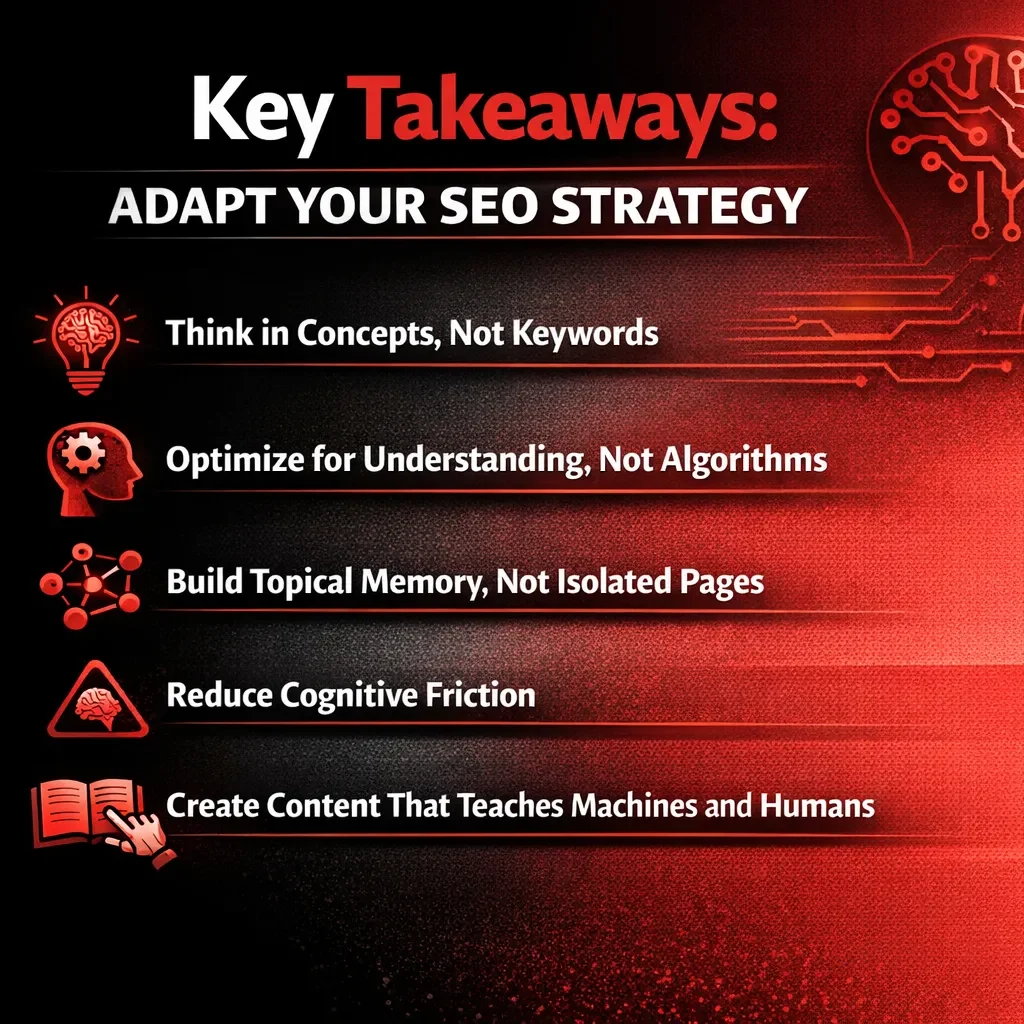
As search engines evolve toward cognitive intelligence, adapting your SEO strategy requires a fundamental shift in how content is conceived, structured, and delivered. The most important change is moving away from keyword-centric thinking toward concept-driven optimization. Modern search systems no longer rely on exact keyword matches; instead, they evaluate how well your content explains ideas, connects entities, and covers topics in depth. Thinking in concepts allows your content to align more naturally with how both humans and machines understand information.
Equally important is optimizing for understanding rather than algorithms. Search engines now prioritize comprehension, coherence, and usefulness. Content that is logically structured, contextually rich, and easy to follow sends strong cognitive signals of quality and expertise. This means clarity, depth, and intent alignment matter more than mechanical SEO tactics.
Another critical shift is building topical memory instead of isolated pages. Search engines develop long-term “knowledge” about a website by analyzing how consistently and comprehensively it covers a subject. Interlinked topic clusters help reinforce semantic relationships and strengthen perceived authority over time.
Reducing cognitive friction is also essential. Content that is confusing, overloaded with jargon, or poorly structured creates mental strain for users and weakens engagement signals. Clear formatting, logical flow, and concise explanations improve both user experience and search performance.
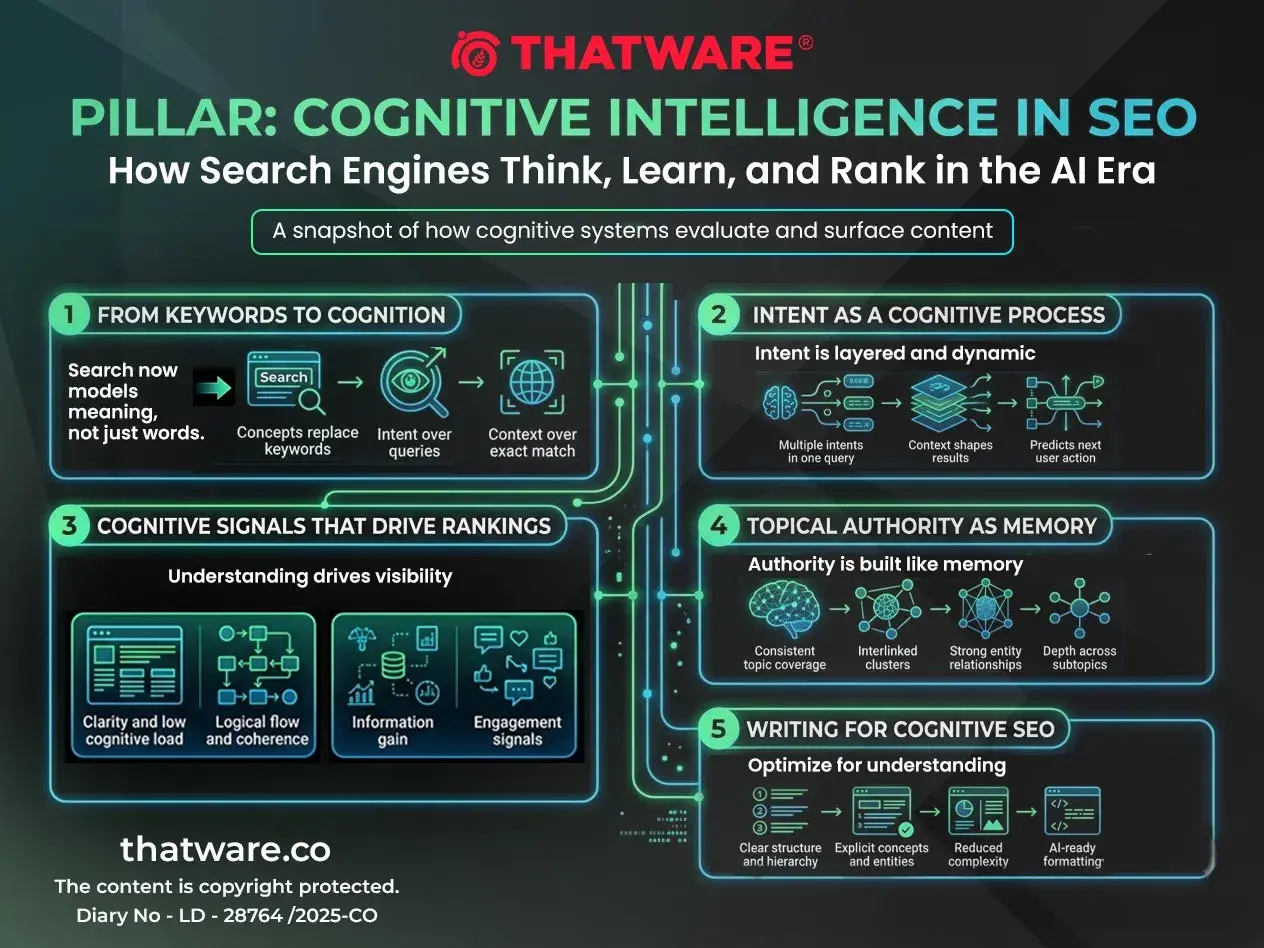
Ultimately, the most effective SEO strategy today is to create content that educates both machines and humans. When your content teaches, clarifies, and adds genuine informational value, it naturally aligns with cognitive search systems—and earns sustainable visibility.
Conclusion: SEO Is No Longer Technical—It’s Cognitive
SEO has reached a defining inflection point. What once revolved around technical fixes, keyword placement, and algorithmic loopholes has evolved into something far more complex—and far more human. Modern search engines no longer behave like static systems retrieving documents; they function as cognitive systems that interpret meaning, evaluate understanding, and model user intent. The future of SEO, therefore, is not about gaming algorithms but aligning with how machines learn, reason, and simulate human thought.
Cognitive intelligence is no longer optional in SEO because search itself has become cognitive. With AI-driven ranking systems, semantic understanding, and generative search experiences, content is evaluated on clarity, coherence, contextual relevance, and informational value. Pages that merely “optimize” without genuinely informing or guiding users are increasingly invisible. In contrast, content that demonstrates depth, originality, and conceptual clarity becomes easier for search engines to trust, remember, and surface.
This shift creates a powerful competitive advantage for early adopters. Brands and publishers who embrace cognitive SEO today are not just improving rankings—they are building long-term topical authority and digital credibility. As search engines develop stronger memory and reasoning capabilities, these early signals of understanding and expertise compound over time.
The path forward is clear. Audit your content through a cognitive lens. Rethink your content strategy around concepts, intent, and information gain rather than keywords alone. Most importantly, embrace intelligence-led SEO—where understanding, not manipulation, becomes the core driver of sustainable visibility and growth.