
SUPERCHARGE YOUR ONLINE VISIBILITY! CONTACT US AND LET’S ACHIEVE EXCELLENCE TOGETHER!
Search is no longer what it used to be.
For years, digital visibility was governed by a simple principle: rank higher, get more clicks. Traditional search engines evaluated pages based on keywords, backlinks, and technical signals, then presented users with a list of results. The goal was clear—optimize your website so it appears at the top.
But that model is rapidly changing.
Today, AI-driven systems are transforming search from a list of links into a layer of answers. Instead of asking users to browse multiple pages, these systems synthesize information, provide context, and deliver direct responses. The experience is no longer about searching—it’s about having a conversation.
From Ranking Pages to Delivering Answers
In traditional SEO, success meant visibility on a search engine results page (SERP). In modern AI environments, success means being part of the answer itself.
This shift introduces a fundamental change:
- Websites are no longer the final destination
- They are now sources of knowledge feeding AI systems
AI doesn’t just retrieve information—it interprets, summarizes, and contextualizes it. That means your content must not only exist, but also be understood, trusted, and referenced within these systems.
The Rise of AI-Driven Conversation Systems
AI platforms like Grok, ChatGPT, and other generative engines are redefining how users interact with information. Instead of typing fragmented queries, users now ask full questions, seek opinions, and engage in ongoing dialogue.
These systems prioritize:
- Context over keywords
- Authority over volume
- Clarity over complexity
As a result, visibility depends less on technical optimization alone and more on how well your insights contribute to meaningful, trustworthy conversations.
Evolution of Optimization
The journey to this point has unfolded in distinct phases:
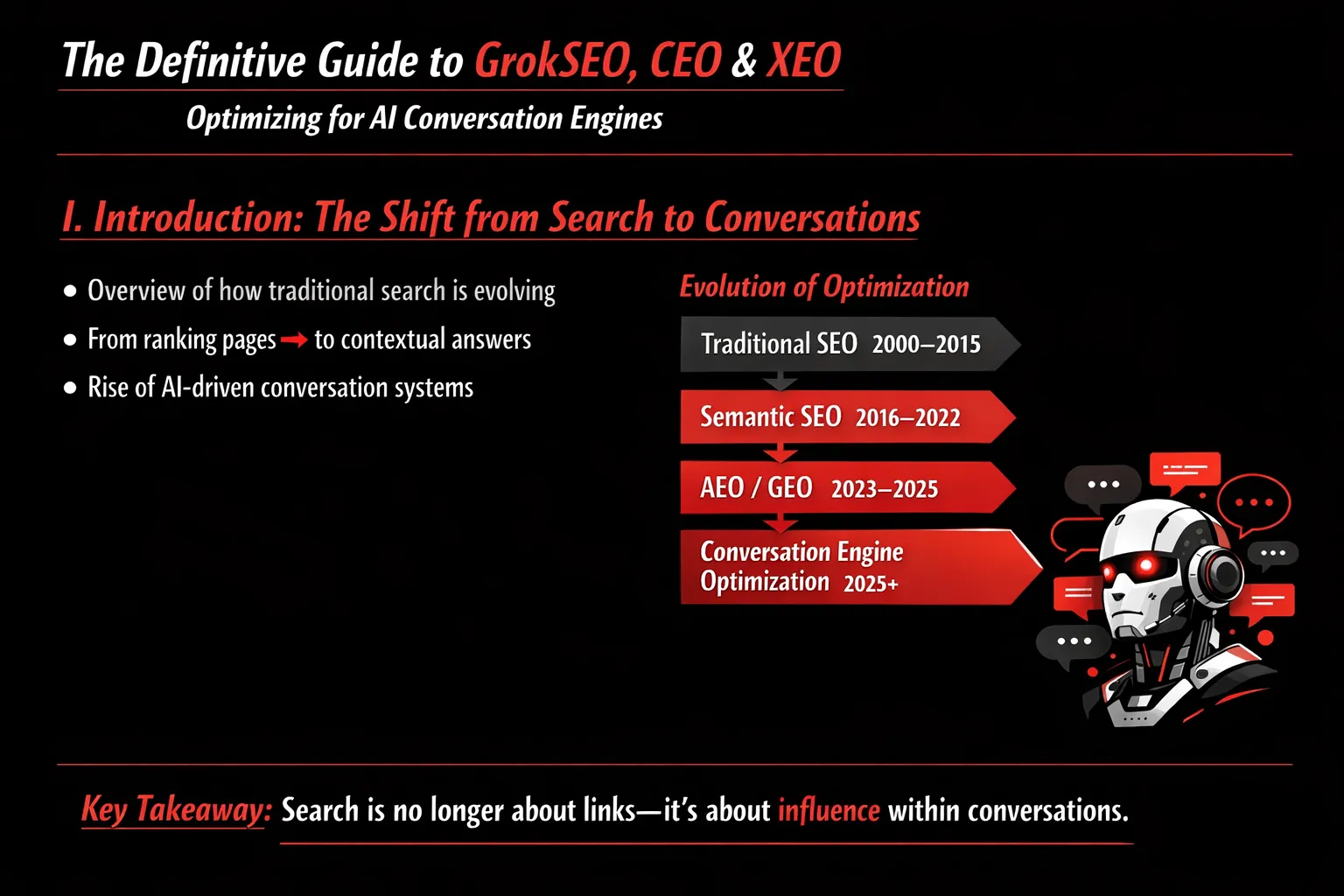
- Traditional SEO (2000–2015): Focused on keywords, backlinks, and ranking positions
- Semantic SEO (2016–2022): Emphasized intent, topics, and contextual relevance
- AEO / GEO (2023–2025): Optimized for AI-generated answers and generative engines
- Conversation Engine Optimization (2025+): Centers on influence within AI-driven discussions
Each phase builds on the previous one—but the current shift is the most significant yet. It changes not just how we optimize, but what we optimize for.
Key Takeaway
Search is no longer about links—it’s about influence within conversations.
To stay visible in this new landscape, brands and creators must move beyond traditional tactics and focus on becoming trusted voices in the ecosystems where AI learns, interprets, and responds.
What Is GrokSEO?
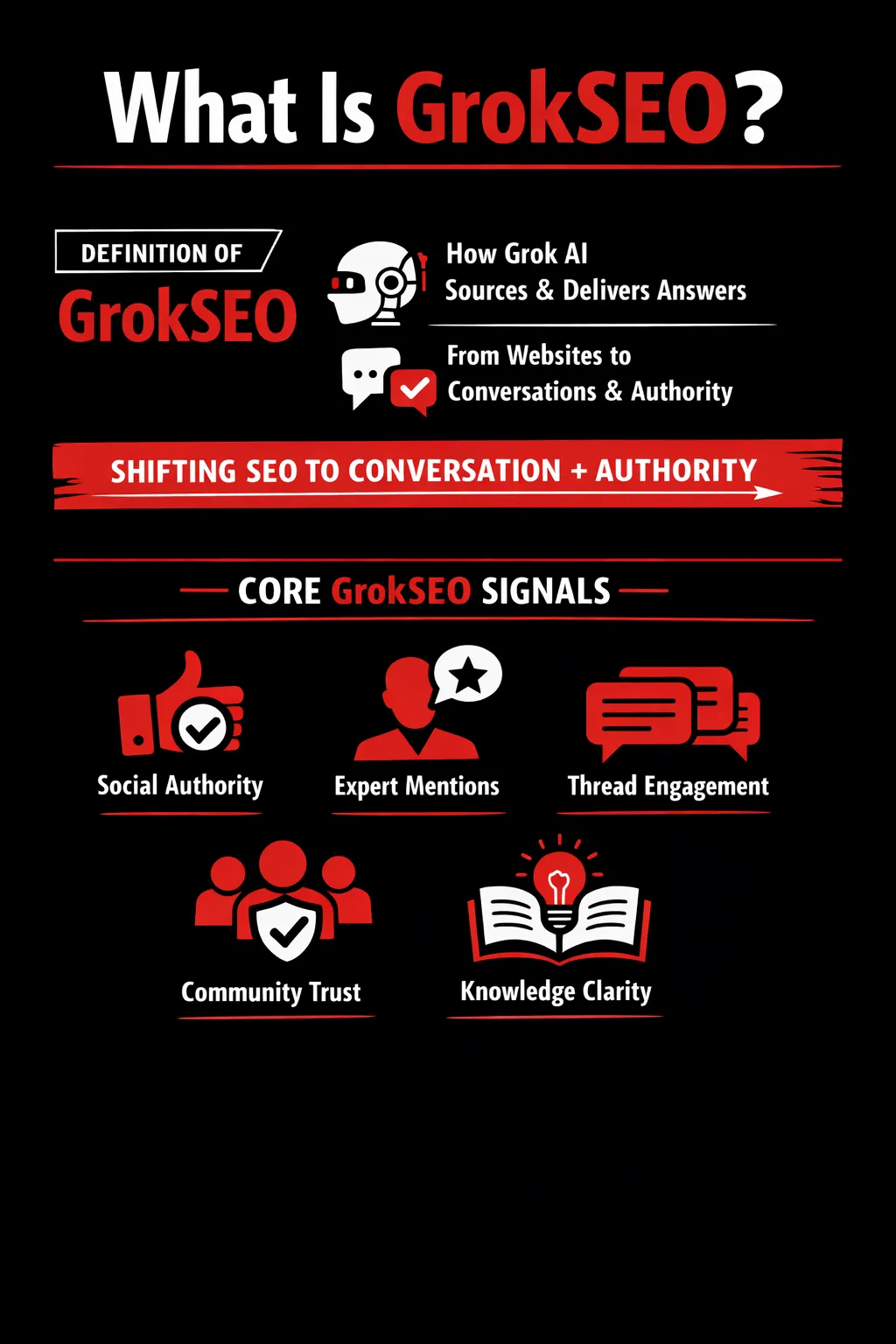
GrokSEO is the emerging practice of optimizing your digital presence so that AI systems—specifically Grok—surface your brand, insights, or expertise directly within conversational answers. Unlike traditional SEO, which focuses on ranking web pages in search results, GrokSEO is about becoming a trusted source within AI-generated discussions.
At its core, GrokSEO reflects a fundamental shift in how information is discovered and delivered. Instead of users clicking through multiple links, AI systems now synthesize answers from a wide range of signals—especially real-time conversations, expert opinions, and social context. This means visibility is no longer limited to websites; it extends to who is being talked about, cited, and trusted within digital conversations.
How Grok AI Sources and Delivers Answers
Grok AI operates differently from traditional search engines. Rather than indexing and ranking static web pages alone, it pulls insights from dynamic, continuously evolving data—particularly from social platforms like X (Twitter).
Its answers are shaped by:
- Ongoing discussions and trending topics
- Contributions from recognized experts
- High-engagement threads and conversations
- Contextual understanding of user intent
This allows Grok to deliver responses that feel more like informed summaries of collective knowledge rather than lists of links. As a result, the sources that influence these answers are not just websites—but people, conversations, and ideas gaining traction in real time.
From Website SEO to Conversation-Based Visibility
Traditional SEO has long been centered around optimizing pages—keywords, backlinks, technical structure, and content relevance. GrokSEO shifts that paradigm toward conversation + authority-based visibility.
In this new model:
- Authority is built through expertise and recognition
- Visibility comes from being referenced in meaningful discussions
- Influence is driven by participation, not just publication
In other words, it’s no longer enough to create content—you need to be part of the conversation that AI systems learn from.
Core GrokSEO Signals
To understand how to optimize for Grok, it’s essential to recognize the types of signals that influence its outputs.
1. Social Authority
Accounts with consistent expertise, credibility, and influence carry more weight. This includes verified profiles, industry leaders, and individuals known for valuable insights.
2. Expert Mentions
Being cited, referenced, or discussed by other knowledgeable voices strengthens your presence. AI systems interpret these mentions as signals of relevance and trust.
3. Thread Engagement
High-quality discussions—measured through replies, shares, and depth of conversation—indicate that content is valuable and worth surfacing.
4. Community Trust
Positive sentiment, meaningful interactions, and a loyal audience contribute to a strong trust signal. It’s not just about visibility—it’s about credibility within a community.
5. Knowledge Clarity
Content that is well-structured, easy to understand, and educational performs better. Clear explanations, frameworks, and insights are more likely to be picked up and reused by AI systems.
CEO – Conversation Engine Optimization
As AI systems evolve, a new layer of optimization is emerging—Conversation Engine Optimization (CEO). Unlike traditional SEO, which focuses on ranking web pages, CEO is about influencing how AI systems construct answers from ongoing conversations.
What is CEO?
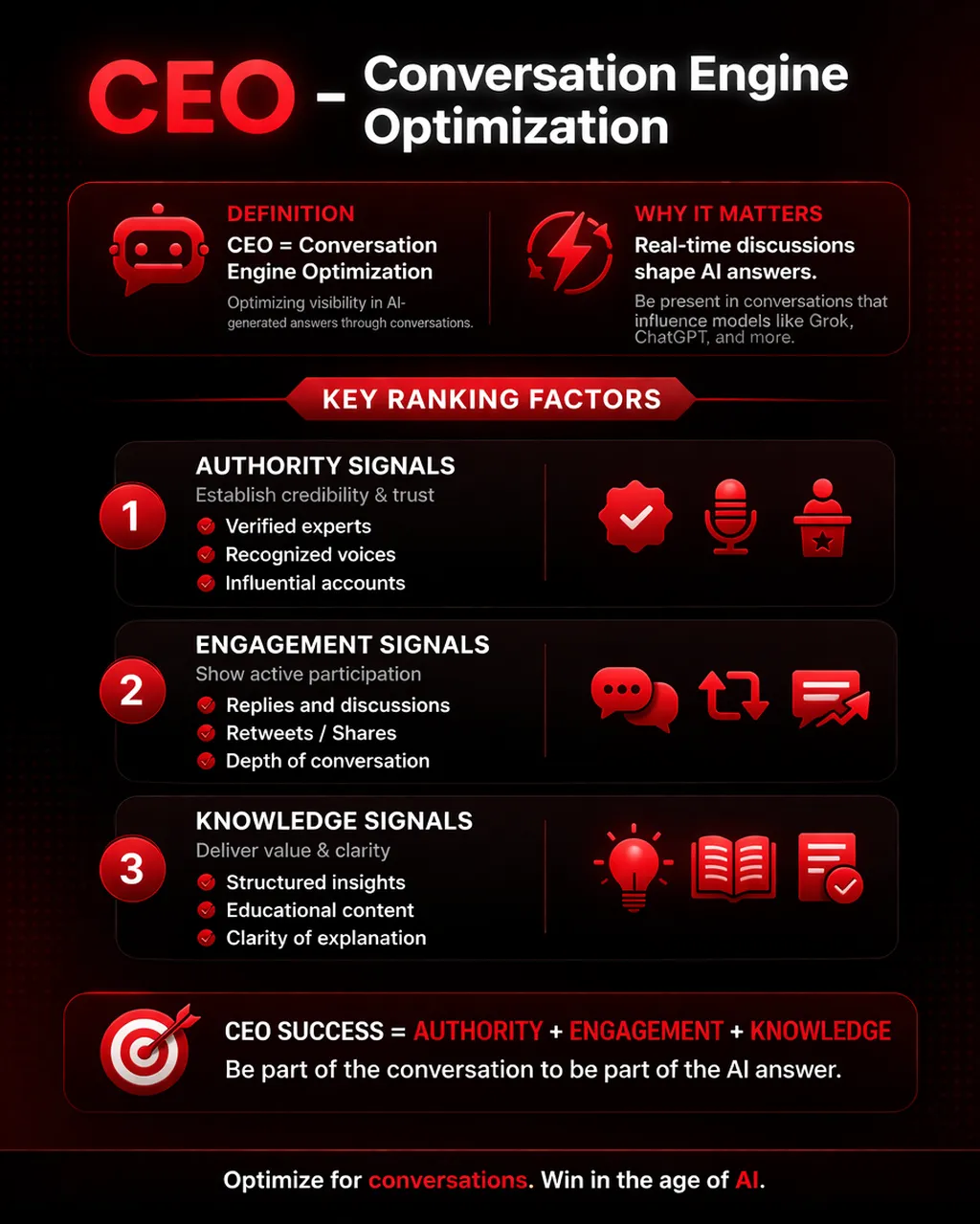
Conversation Engine Optimization (CEO) is the practice of optimizing your presence so that AI models surface your insights, opinions, or content within generated responses—especially those derived from real-time discussions across platforms.
Instead of indexing static pages, AI systems now interpret:
- live conversations
- expert opinions
- community interactions
This means visibility is no longer just about publishing content—it’s about being part of meaningful, authoritative discussions.
Why Real-Time Discussions Matter
Modern AI engines are increasingly trained to prioritize fresh, contextual, and conversational data. They don’t just retrieve information—they synthesize it.
As a result:
- Discussions shape answers
- Experts shape narratives
- Engagement signals validate credibility
If your ideas are actively discussed, referenced, and expanded upon, they are far more likely to appear in AI-generated outputs.
Key Ranking Factors in CEO
To succeed in CEO, three core signal groups play a critical role:
1. Authority Signals
Authority determines who gets trusted in a conversation.
AI systems tend to prioritize inputs from:
- Verified experts with established credibility
- Recognized voices consistently contributing valuable insights
- Influential accounts that shape industry discussions
This means building authority isn’t optional—it’s foundational. The more consistently you demonstrate expertise, the more likely AI systems are to treat your content as a reliable source.
2. Engagement Signals
Engagement reflects how much your ideas resonate within a community.
Important indicators include:
- Replies and discussions that expand on your ideas
- Retweets/shares that amplify reach
- Depth of conversation, not just surface-level interactions
High engagement signals tell AI systems that your content is not only seen—but actively valued and debated. A widely discussed insight is far more likely to be surfaced than a standalone post.
3. Knowledge Signals
Knowledge signals define how well your ideas can be understood and reused.
AI systems favor content that is:
- Structured with clear, logical insights
- Educational, offering real value rather than opinions alone
- Easy to interpret, with concise and well-explained concepts
Well-structured knowledge is easier for AI to extract, summarize, and integrate into answers. In contrast, vague or unorganized content is often ignored.
XEO – X Engine Optimization
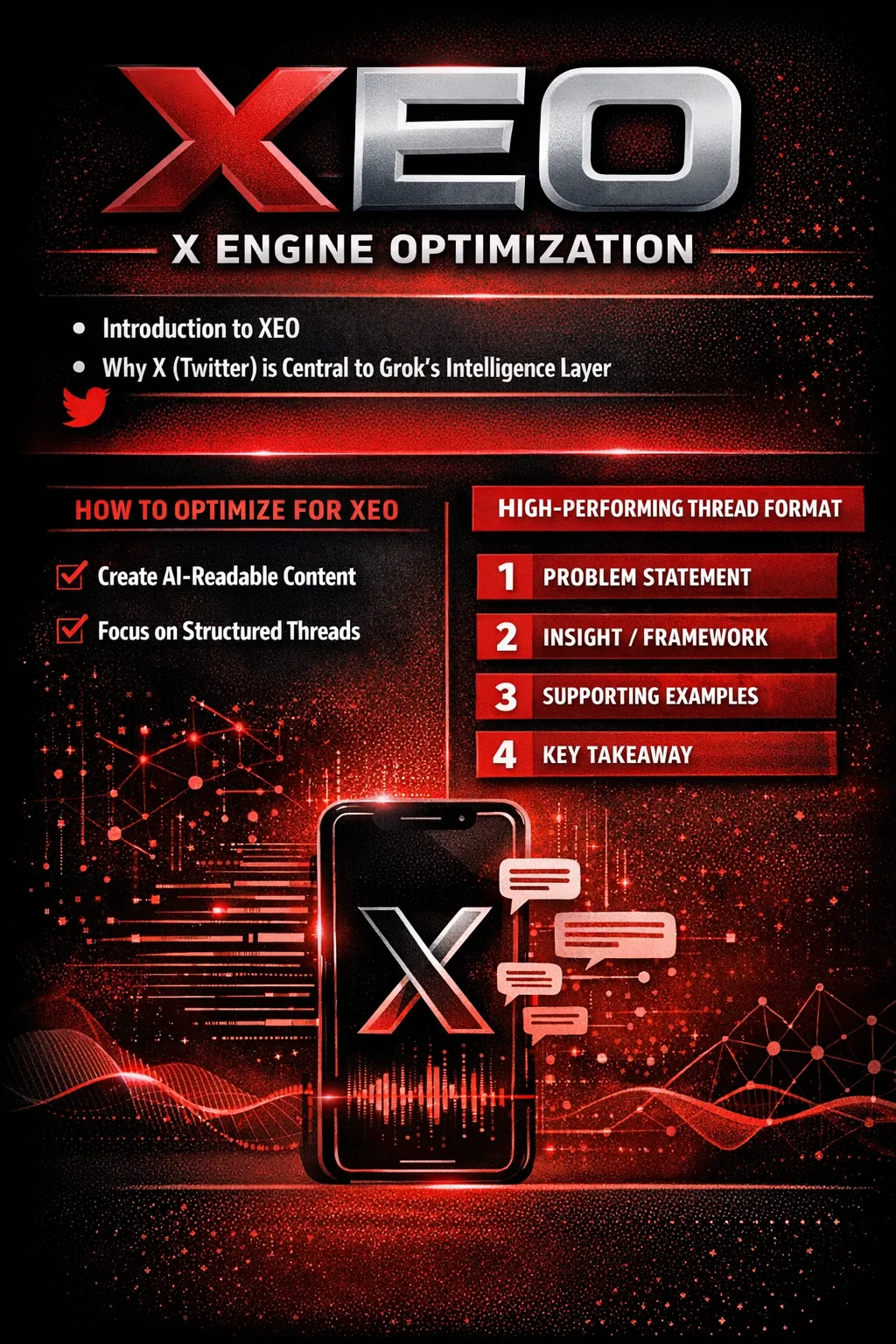
As AI systems increasingly rely on real-time conversations to generate answers, a new optimization layer has emerged: X Engine Optimization (XEO). This concept is rooted in how platforms like Grok analyze and interpret content from X (formerly Twitter) to construct knowledge, identify authority, and deliver contextual responses.
Introduction to XEO
XEO refers to the practice of optimizing your content on X so that it can be easily understood, extracted, and surfaced by AI systems. Unlike traditional social media strategies that prioritize reach or virality alone, XEO focuses on making your content structurally valuable for machine interpretation.
In this new paradigm, your posts are no longer just for human audiences—they are also inputs for AI models that decide which ideas, experts, and brands get visibility in conversational outputs.
Why X Is Central to Grok’s Intelligence Layer
Grok is deeply integrated with X, giving it access to a continuous stream of real-time discussions, expert opinions, and community interactions. This makes X a critical data source for:
- Understanding trending topics and narratives
- Identifying credible voices and experts
- Extracting insights from high-quality discussions
- Measuring engagement and consensus
Unlike static web pages, X provides dynamic, evolving conversations. This allows AI systems like Grok to prioritize fresh, relevant, and socially validated information over outdated or isolated content.
As a result, your presence and activity on X directly influence whether your ideas appear in AI-generated answers.
How to Optimize for XEO
To succeed with XEO, content must be both human-engaging and machine-readable. This requires a shift from casual posting to structured knowledge sharing.
1. Create AI-Readable Content
AI systems favor clarity and structure. Your content should:
- Use clear language and defined concepts
- Avoid ambiguity and vague statements
- Present ideas in a logical, step-by-step manner
- Focus on delivering actual insights rather than surface-level opinions
Think of each post as a mini knowledge asset, not just a social update.
2. Focus on Structured Threads
Single tweets often lack the depth needed for AI extraction. In contrast, well-structured threads provide:
- Context
- Explanation
- Supporting evidence
- Conclusions
Threads allow AI systems to understand not just what you’re saying, but why it matters.
High-Performing Thread Format
To maximize both engagement and AI visibility, threads should follow a consistent and logical structure:
1. Problem Statement
Start by clearly defining a relevant issue or question. This anchors the conversation and signals relevance.
Example: “Most brands are still optimizing for Google—but AI search is changing the game.”
2. Insight or Framework
Introduce your unique perspective, method, or framework. This is where you demonstrate expertise.
Example: “Here’s a 4-layer framework for optimizing visibility in AI systems…”
3. Supporting Examples
Reinforce your insights with:
- Real-world examples
- Data points
- Case studies
- Analogies
This builds credibility and helps AI systems validate your content.
4. Key Takeaway
End with a concise, memorable conclusion. This is often what AI systems extract as a summary.
Example: “In the AI era, visibility belongs to those who structure knowledge—not just publish content.”
The GrokSEO Ranking Framework
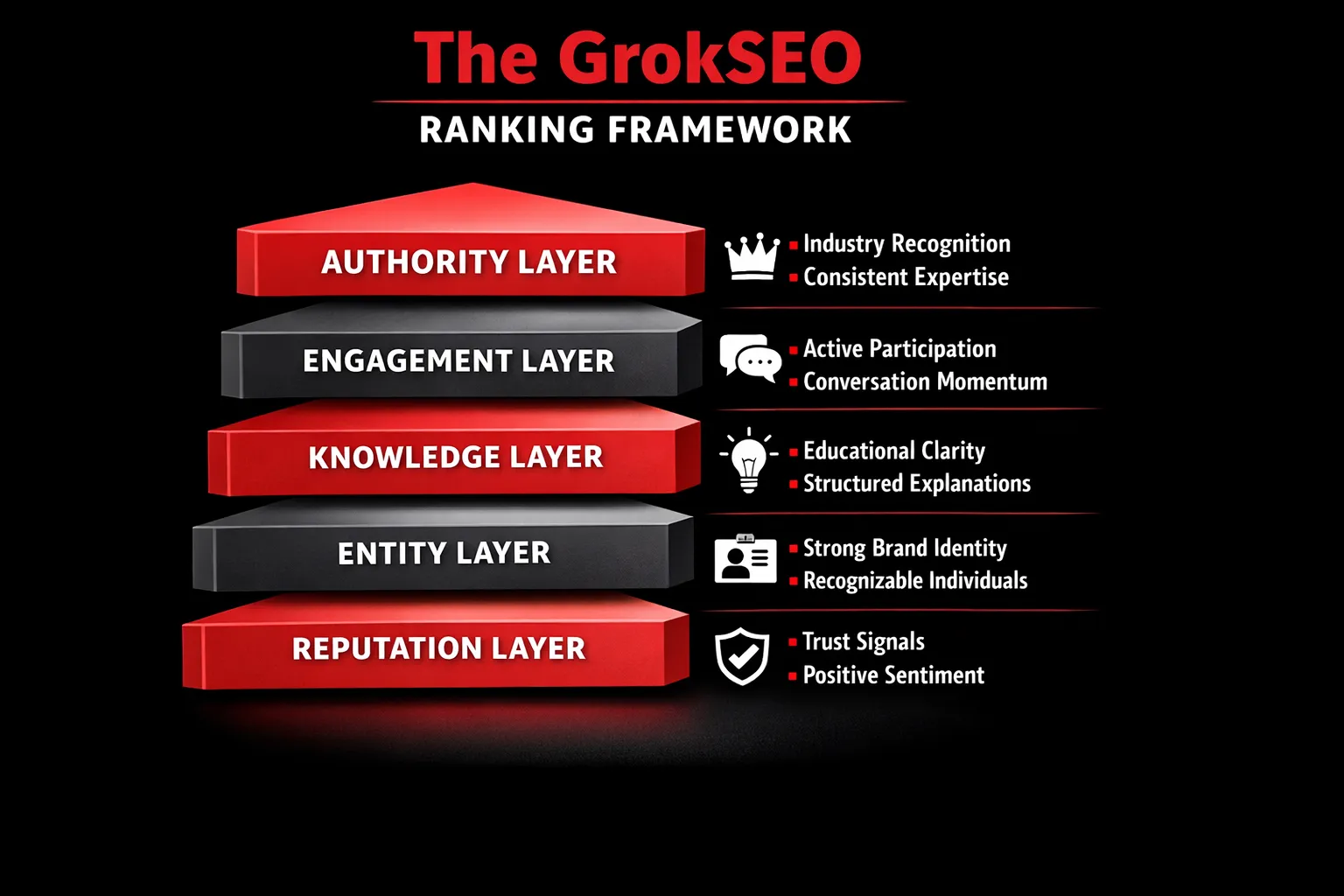
To understand how visibility works in AI-driven conversation engines like Grok, it’s helpful to think in layers rather than isolated ranking factors. Unlike traditional SEO, where backlinks or keywords dominate, GrokSEO operates through a multi-dimensional trust and influence system.
This can be broken down into a 5-layer framework:
1. Authority Layer
At the foundation of GrokSEO lies authority—not just what you say, but who you are in the ecosystem.
AI systems prioritize voices that are consistently recognized within a domain. Authority is built over time through:
- Industry recognition (mentions, citations, collaborations)
- Demonstrated expertise across multiple discussions
- Consistency in sharing valuable insights
In simple terms, authority answers the question: “Should this source be trusted to speak on this topic?”
2. Engagement Layer
Authority alone isn’t enough—interaction validates relevance.
The engagement layer measures how your ideas resonate within conversations. AI systems look at:
- Replies and meaningful discussions
- Shares, reposts, and amplification
- Depth and continuity of conversations
High engagement signals that your content is not just seen, but actively discussed and expanded upon. This creates conversation momentum, which increases the likelihood of being referenced in AI-generated responses.
3. Knowledge Layer
This layer focuses on the quality and clarity of the information itself.
AI systems favor content that is:
- Clearly explained and easy to interpret
- Structured in a logical, digestible format
- Educational rather than purely opinion-based
Content that simplifies complex ideas, uses frameworks, or teaches something actionable tends to perform best.
In essence, this layer answers: “Is this content useful enough to be included in an answer?”
4. Entity Layer
Beyond content and engagement, AI systems also evaluate who the content is associated with.
The entity layer is about:
- Strong, well-defined brand identity
- Clear association between individuals and expertise areas
- Recognizable names within specific topics
For example, when a founder consistently talks about a niche, both the individual and the brand become entities tied to that expertise.
This helps AI systems confidently attribute information and increases the chances of being surfaced in responses.
5. Reputation Layer
At the top sits reputation, which acts as a final filter.
Even authoritative and engaging content can be deprioritized if trust signals are weak. AI systems assess:
- Overall sentiment (positive vs. negative perception)
- Community trust and credibility
- Consistency of value over time
Reputation is cumulative—it reflects how the ecosystem feels about you, not just what you publish.
Content Formats That Perform Best
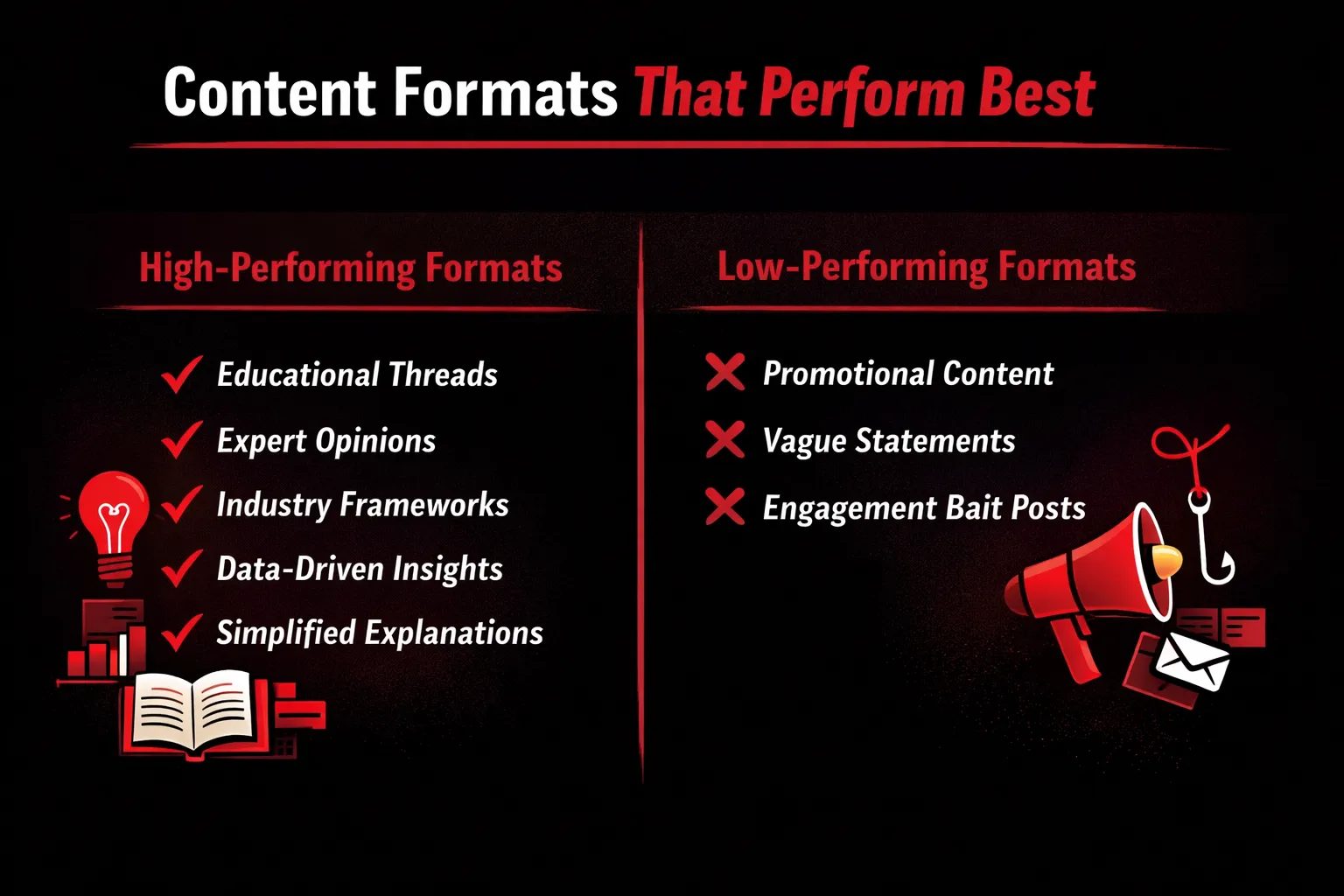
Not all content is equally valuable in the age of AI-driven conversation engines. Systems like Grok prioritize information that is clear, structured, and rooted in expertise. As a result, the format of your content plays a critical role in whether it gets surfaced in AI-generated answers.
High-Performing Formats
1. Educational Threads
Content that teaches something step-by-step tends to perform exceptionally well. Educational threads break down complex ideas into digestible insights, making it easier for AI systems to extract and reuse information. These formats also encourage deeper engagement, which further strengthens their visibility.
2. Expert Opinions
Original perspectives from credible voices carry significant weight. When insights come from recognized experts, they signal authority and trust—two key factors AI systems rely on when selecting sources for answers.
3. Industry Frameworks
Structured models, frameworks, and systems are highly favored because they organize knowledge in a logical way. Whether it’s a step-by-step methodology or a conceptual model, frameworks make content more “machine-readable” and easier to reference.
4. Data-Driven Insights
Content backed by data, research, or real-world examples adds credibility and depth. AI systems tend to prioritize information that is supported by evidence, as it reduces ambiguity and increases reliability.
5. Simplified Explanations
Clarity is critical. Content that explains complex topics in simple terms is more likely to be reused in AI-generated responses. The easier it is to understand, the easier it is for AI to extract and present it.
Low-Performing Formats
1. Promotional Content
Overly self-promotional posts typically underperform because they lack informational value. AI systems are designed to prioritize usefulness over marketing intent, making promotional content less likely to be surfaced.
2. Vague Statements
Content that lacks depth or specificity provides little value for both users and AI systems. Without clear insights or structured information, these posts are difficult to interpret and reuse.
3. Engagement Bait Posts
Posts designed purely to trigger reactions—such as generic questions or clickbait—may generate short-term engagement but fail to deliver meaningful knowledge. As a result, they are less likely to be recognized as authoritative sources.
GrokSEO Strategy for Brands
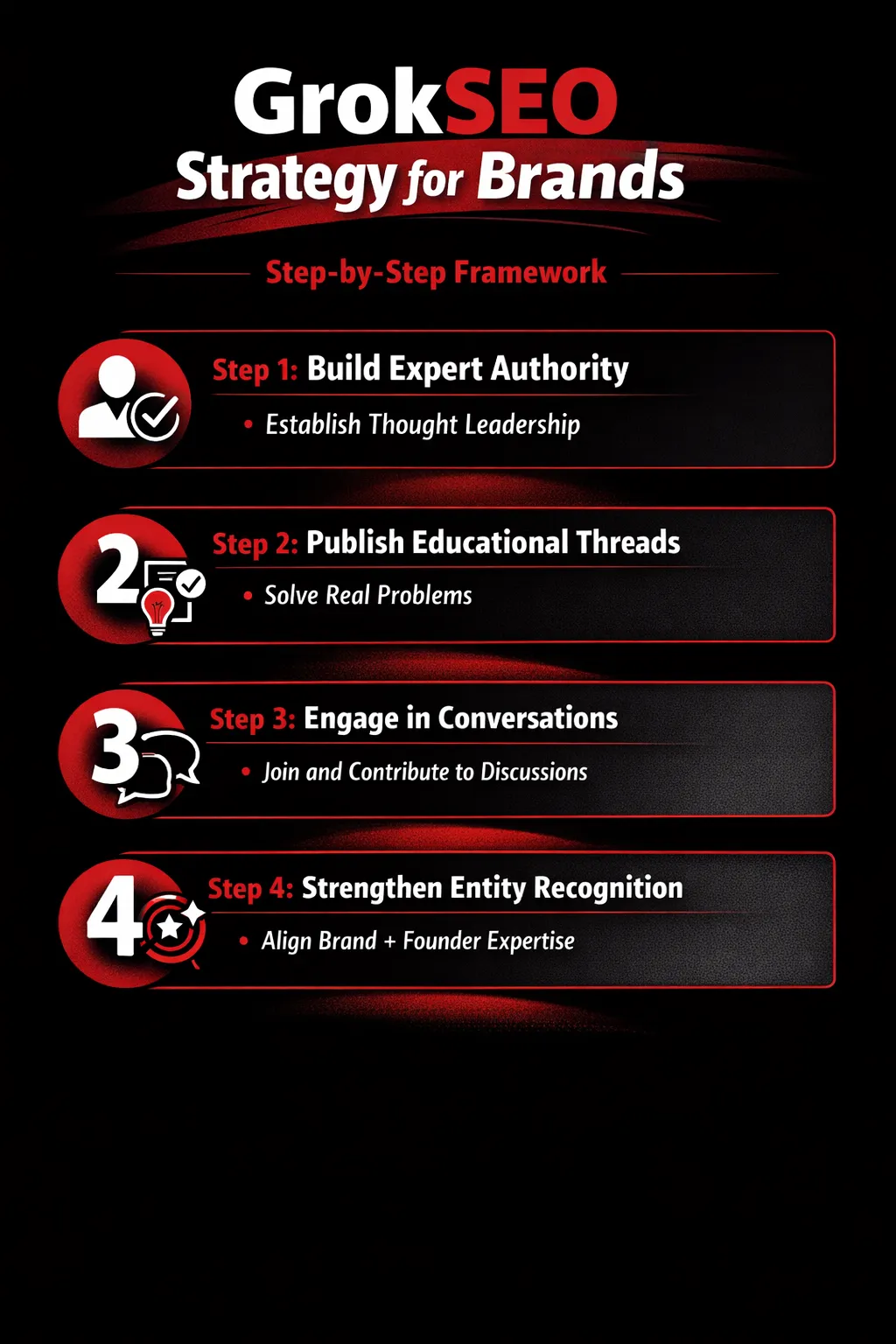
As AI systems like Grok increasingly rely on conversations, authority, and real-time signals, brands need a fundamentally different approach to visibility. Instead of focusing only on websites or keywords, success now depends on how well you contribute to—and shape—industry discussions.
Here’s a practical, step-by-step framework to build a strong GrokSEO presence:
Step 1: Build Expert Authority
The foundation of GrokSEO is authority. AI systems prioritize voices that are consistently recognized as knowledgeable and trustworthy within a domain.
To establish thought leadership:
- Share original insights regularly
- Take clear positions on industry trends
- Publish frameworks, models, or unique perspectives
- Ensure consistency in your area of expertise
Over time, this builds a recognizable signal: you are a reliable source worth referencing. Without this layer, other efforts have limited impact.
Step 2: Publish Educational Threads
AI systems favor content that explains, teaches, and structures knowledge clearly. Educational threads are one of the most effective formats for this.
Focus on:
- Breaking down complex topics into simple explanations
- Solving real, specific industry problems
- Providing actionable insights rather than opinions alone
- Structuring content in a logical, easy-to-follow way
The goal is not just visibility—it’s interpretability. The clearer your content, the easier it is for AI to extract and reuse it in answers.
Step 3: Engage in Conversations
Visibility in conversation-driven systems doesn’t come from broadcasting—it comes from participation.
To strengthen your presence:
- Reply to relevant industry discussions
- Add value to trending conversations
- Engage with other experts and thought leaders
- Contribute insights where meaningful dialogue is happening
This builds conversation momentum, which signals relevance and influence. The more you are part of important discussions, the more likely your perspectives are to be surfaced by AI systems.
Step 4: Strengthen Entity Recognition
For AI to consistently surface your brand, it needs to clearly understand who you are and what you’re known for.
This requires aligning:
- Brand identity
- Founder or key expert identity
- Core areas of expertise
Practical ways to do this include:
- Consistently associating your name/brand with specific topics
- Repeating core themes across content
- Ensuring profiles, bios, and content messaging are aligned
- Building a strong connection between the brand and its subject-matter authority
Over time, this creates a clear entity in the AI’s knowledge graph—making your brand easier to recognize, trust, and reference.
Measuring Grok Visibility
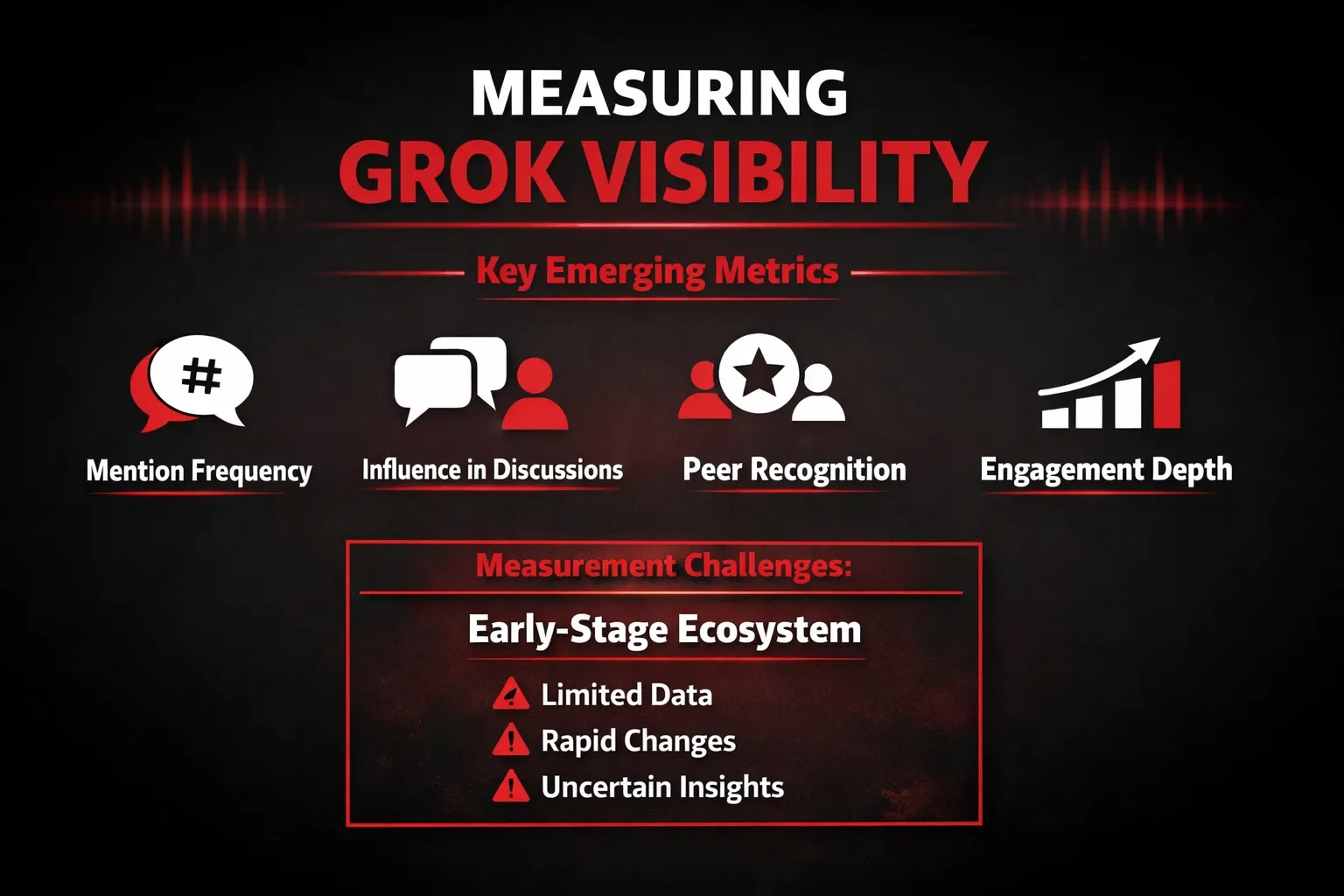
As Grok and similar AI systems evolve, measuring visibility is no longer as straightforward as tracking keyword rankings or organic traffic. Instead, visibility is becoming more distributed, conversational, and influence-driven. This shift requires a new set of metrics that reflect how often and how effectively your brand appears within AI-powered discussions.
Key Emerging Metrics
1. Mention Frequency
One of the most basic indicators of Grok visibility is how often your brand, name, or ideas are mentioned across conversations.
This includes:
- Direct mentions in threads
- References by other users
- Inclusion in discussions around relevant topics
Higher mention frequency increases the likelihood that AI systems recognize your entity as relevant within a domain.
2. Influence in Discussions
Not all mentions carry equal weight. Influence is determined by:
- Who is mentioning you (authority of the source)
- The context of the mention (educational vs casual)
- Whether your insights shape the direction of the conversation
If your ideas are being referenced, debated, or built upon, it signals strong topical authority to AI systems.
3. Peer Recognition
Recognition from other experts is a powerful trust signal. This includes:
- Endorsements from industry leaders
- Being cited in expert threads
- Inclusion in curated lists, frameworks, or discussions
AI systems tend to prioritize knowledge that is validated by credible sources, making peer recognition a critical ranking factor.
4. Engagement Depth
Beyond surface-level metrics like likes or shares, engagement depth reflects the quality of interaction:
- Number of meaningful replies
- Length and substance of discussions
- Follow-up questions and continued dialogue
Deep engagement indicates that your content is not only seen—but understood, valued, and expanded upon.
Challenges in Measurement
Despite these emerging signals, measuring Grok visibility remains complex due to the early-stage nature of AI-driven ecosystems.
- Lack of standardized tools: Unlike traditional SEO, there are no established platforms dedicated to tracking AI conversation visibility.
- Opaque algorithms: The exact weighting of signals within Grok is not publicly defined.
- Fragmented data sources: Conversations are spread across multiple threads, users, and contexts.
- Qualitative over quantitative signals: Many important indicators (like influence and trust) are harder to measure numerically.
The Future of Conversation-Based Search
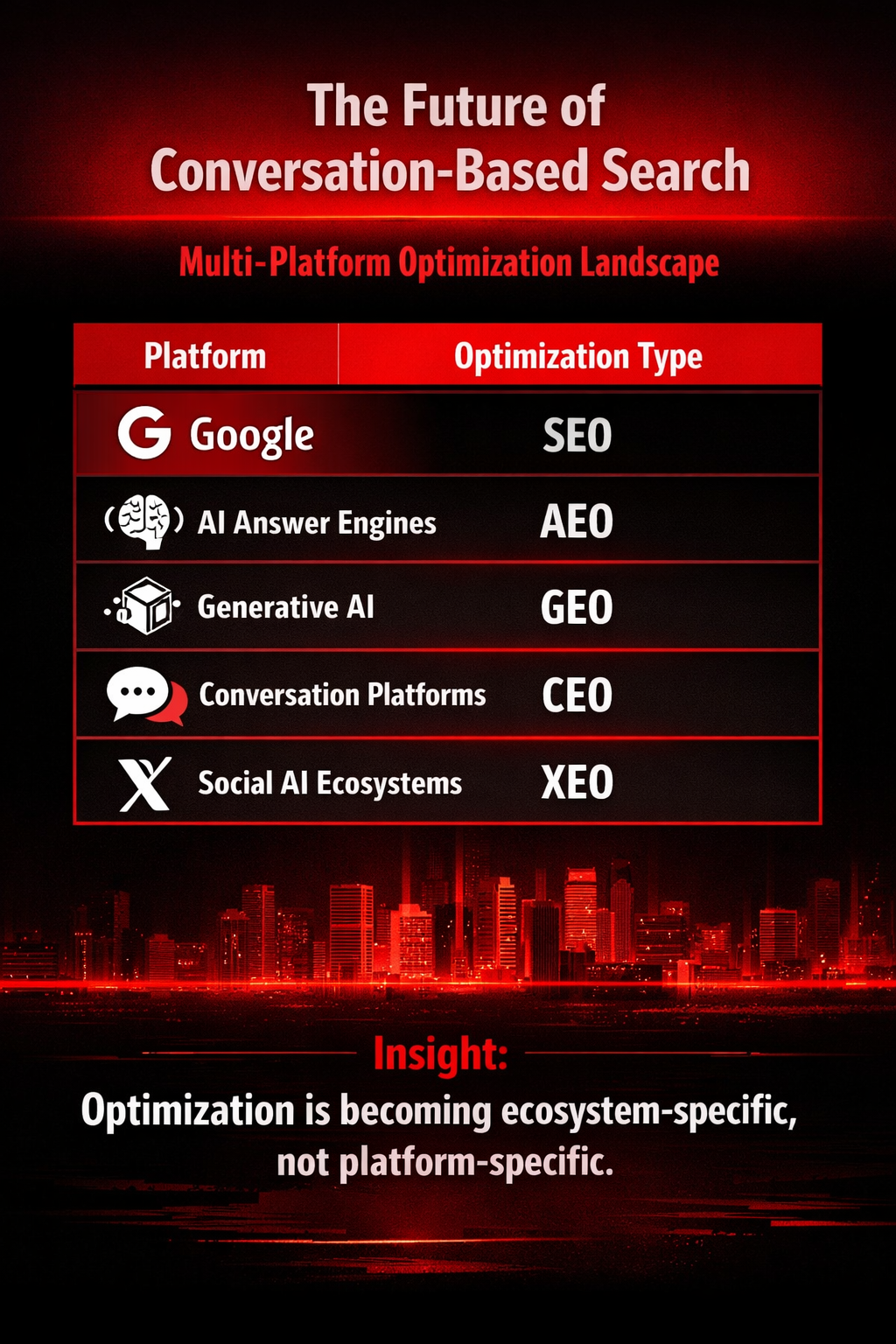
Search is no longer a single-channel discipline—it is rapidly evolving into a multi-platform, multi-engine ecosystem. As AI systems diversify, each platform now requires its own optimization strategy, tailored to how information is processed, ranked, and delivered.
The Multi-Platform Optimization Landscape
Different systems prioritize different signals, leading to distinct optimization approaches:
| Platform | Optimization Type |
| SEO | |
| AI Answer Engines | AEO |
| Generative AI | GEO |
| Conversation Platforms | CEO |
| Social AI Ecosystems | XEO |
Understanding the Shift
- Google (SEO):
Still focused on indexing and ranking web pages, with emphasis on backlinks, keywords, and technical performance.
- AI Answer Engines (AEO):
Prioritize direct answers over links. Content must be structured, factual, and easily extractable.
- Generative AI Systems (GEO):
Focus on contextual knowledge synthesis. Visibility depends on how well your content contributes to training data and knowledge graphs.
- Conversation Platforms (CEO):
Emphasize real-time discussions and authority within conversations. Influence matters as much as information.
- Social AI Ecosystems (XEO):
Driven by social signals, engagement, and expert participation. Content must be conversational, structured, and widely discussed.
Key Insight
Optimization is no longer platform-specific—it is ecosystem-specific.
This means:
- You’re not just optimizing for a search engine
- You’re optimizing for how entire systems of intelligence interpret, trust, and distribute information
What This Means Going Forward
To stay visible in this evolving landscape, brands and creators must:
- Diversify their optimization strategies across platforms
- Build authority that travels across ecosystems
- Create content that works in both static (search) and dynamic (conversation) environments
The future of search belongs to those who understand one critical shift:
visibility is no longer earned in isolation—it’s built across interconnected AI ecosystems.
Conclusion: From Documents to Discussions
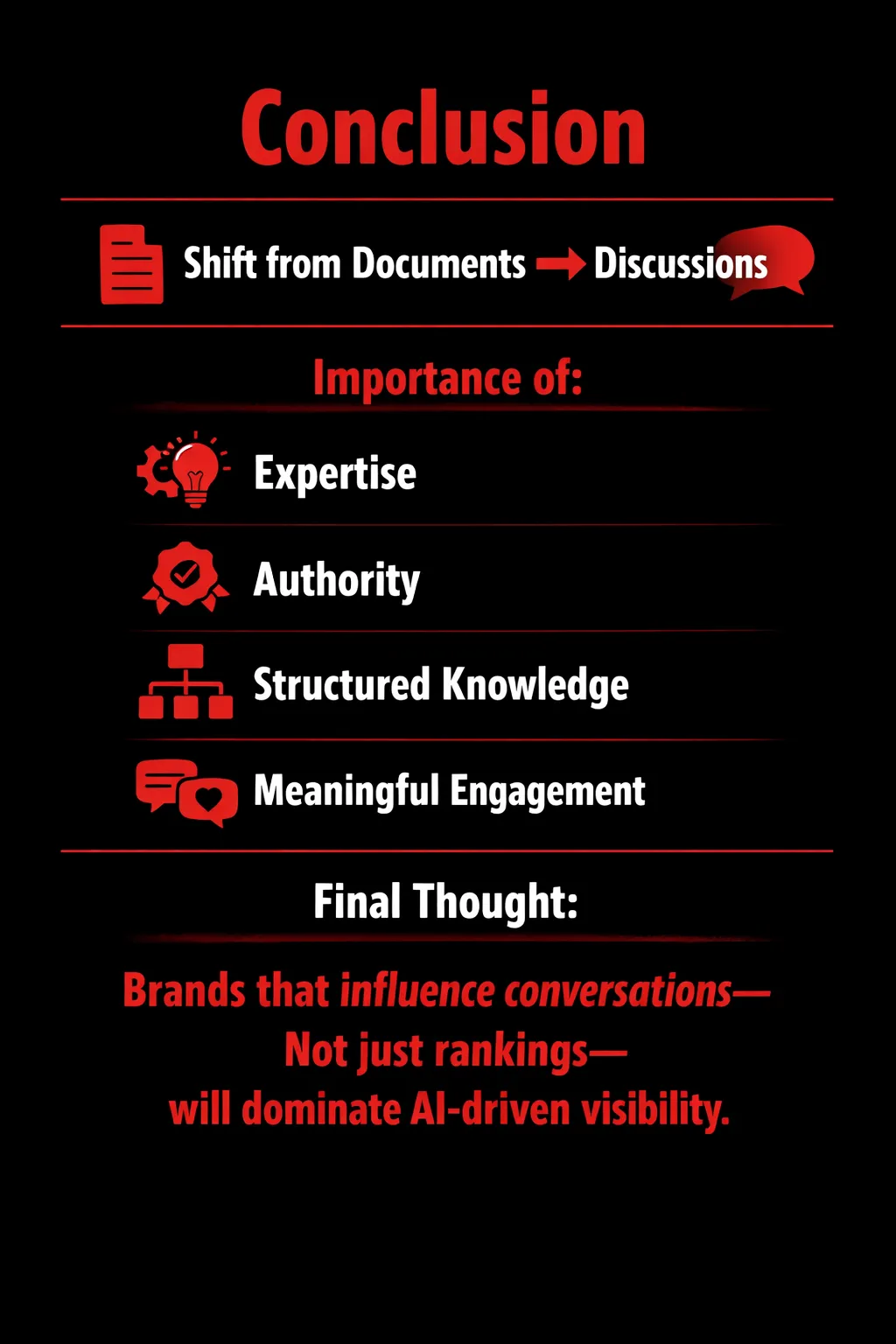
The evolution of search is no longer subtle—it’s a fundamental shift. What began as a system designed to rank documents has transformed into an ecosystem that prioritizes conversations, context, and collective intelligence.
In this new landscape, visibility is no longer determined solely by keywords, backlinks, or technical optimization. Instead, it is shaped by how effectively a brand participates in, contributes to, and influences ongoing discussions across digital platforms.
To succeed in this environment, four pillars have become essential:
- Expertise – Demonstrating deep, consistent knowledge in a specific domain
- Authority – Being recognized and referenced by others within your industry
- Structured Knowledge – Presenting insights in clear, digestible, and AI-interpretable formats
- Meaningful Engagement – Actively participating in conversations that add value, not noise
These elements work together to signal credibility and relevance to AI systems that are increasingly trained to prioritize trustworthy, context-rich information over isolated content pieces.
Final Thought:
The future of visibility belongs to brands that go beyond optimizing for rankings and instead focus on shaping conversations. In an AI-driven world, those who influence dialogue—not just search results—will emerge as the true leaders.