
SUPERCHARGE YOUR ONLINE VISIBILITY! CONTACT US AND LET’S ACHIEVE EXCELLENCE TOGETHER!
** The pricings are in USD / Month and the deliverables are monthly based.
Detailed QBM Quantum Deliverables & Scope of Work
Quantum Brand Modeling, or QBM, is designed for brands that no longer want to rely on guesswork in the AI search era. Traditional marketing often works with fixed reports, keyword rankings, traffic charts, attribution dashboards, and campaign forecasts. These are useful, but they do not fully explain how a brand behaves inside AI-driven discovery systems.
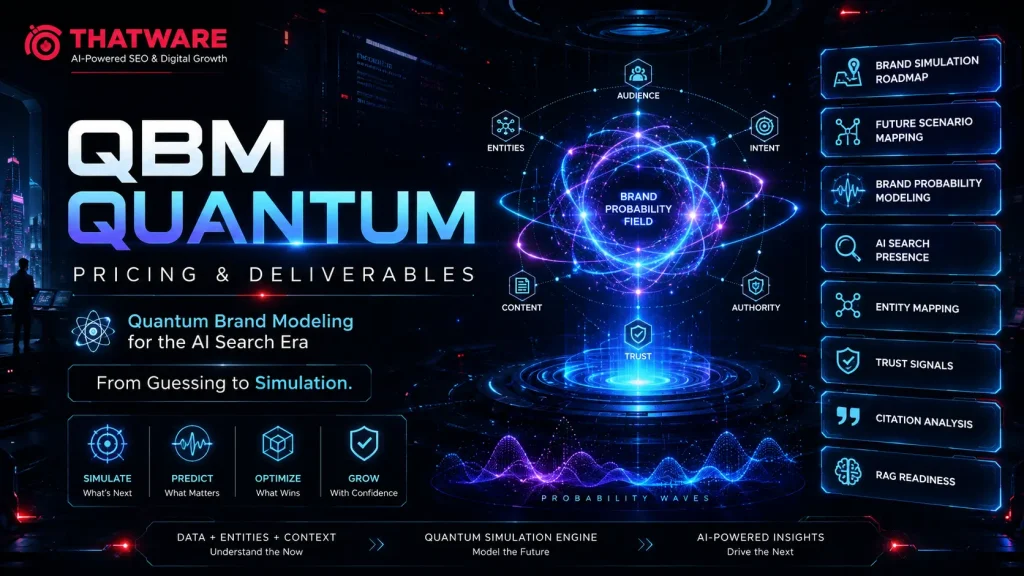
Today, visibility is no longer linear. A brand may appear in one AI-generated answer and disappear from another. It may be recommended for one user query but ignored for a similar one. It may rank well on Google but remain invisible in ChatGPT, Gemini, Perplexity, Copilot, Google AI Overviews, or other AI-led discovery environments.
This is where QBM becomes important.
ThatWare’s QBM framework is built around a simple but powerful idea: before a brand optimizes blindly, it should first understand its possible future visibility paths. QBM uses simulation-led thinking, probability modelling, AI visibility analysis, brand trajectory mapping, semantic intelligence, and quantum-inspired strategy to help businesses understand where they stand, where they may be heading, and what signals need to be strengthened.
In simple terms, QBM helps answer questions like:
How likely is your brand to be recommended by AI systems?
Where is your brand being ignored?
Which competitors are more likely to appear in AI-generated answers?
What trust signals are missing?
Which topics, entities, and content assets influence your future visibility?
How can your brand move from uncertain visibility to a stronger probability of selection?
ThatWare describes Quantum Brand Modeling as a move from guessing to simulation, where brand outcomes are mapped across many possible AI futures before optimization begins.
Why QBM Matters in the AI Search Era
In the older SEO model, visibility was often treated as a ranking problem. If a page ranked higher, the brand was considered more visible. But AI discovery does not work that simply.
AI systems do not always present ten results. They may generate one answer. They may recommend three companies. They may summarize a category without citing every source. They may choose one brand over another based on trust, clarity, authority, topical relevance, entity strength, citations, and previous web signals.
This means brand visibility has become probabilistic. It is not only about where your page ranks. It is about whether AI systems understand your brand clearly enough to include it in generated responses.
QBM helps brands deal with this uncertainty. Instead of assuming that one SEO action will create one predictable result, QBM studies multiple possible outcomes. It looks at visibility as a changing field influenced by search intent, AI model behaviour, competitor signals, content depth, semantic associations, and brand authority.
ThatWare’s Quantum SEO resources also describe modern optimization as moving from reactive SEO into predictive search optimization, using AI, NLP, quantum-inspired algorithms, content clustering, predictive ranking models, and user-behaviour simulation.
That is the larger environment where QBM fits.
Detailed QBM Quantum Deliverables
1. QBM Strategy & Brand Simulation Roadmap
Every QBM campaign begins with a strategy and roadmap. This is the foundation of the entire engagement.
The purpose is to understand the brand’s current position and then model where it could go under different AI search and digital visibility conditions. We look at your business, services, products, target audience, industry, competitors, website structure, existing content, brand authority, search performance, and AI visibility signals.
Unlike a standard SEO strategy, the QBM roadmap is not only about what needs to be optimized. It is about what needs to be simulated, measured, compared, and strengthened.
This roadmap identifies which brand outcomes matter most. For example, one brand may want to improve its chances of appearing in AI-generated recommendations. Another may want stronger brand recall in a competitive category. Another may want to reduce the risk of being absent from AI answers. Another may need clearer entity positioning so AI systems understand what the business actually represents.
The roadmap turns QBM from a theoretical concept into an execution plan. It defines the monthly priorities, key visibility risks, competitive gaps, content opportunities, trust-signal requirements, and optimization direction.
2. Quantum Brand Visibility Audit
The Quantum Brand Visibility Audit studies how your brand appears across traditional search, AI search, generative engines, answer engines, and broader digital discovery environments.
This is not a basic audit that only checks title tags, broken links, or rankings. It looks at your brand as an AI-era visibility object.
We review whether your brand is clearly understood, whether your business is associated with the right topics, whether your content supports AI retrieval, whether your authority signals are visible, and whether competitors appear stronger across AI-led discovery platforms.
The audit may examine areas such as:
Brand presence in AI-generated answers
Search visibility across priority topics
Content depth and semantic clarity
Competitor visibility strength
Entity consistency
Citation footprint
Trust signals
Structured data quality
Topical authority gaps
AI-readiness of key pages
Brand recommendation potential
ThatWare’s QBM resource highlights that many brands cannot see the hidden visibility gap inside AI systems. A brand may appear successful in rankings and dashboards but still be ignored when AI systems generate answers.
This audit helps reveal that gap.
3. AI Future Scenario Mapping
One of the most important parts of QBM is scenario mapping.
Traditional reports usually describe what already happened. Scenario mapping looks at what could happen next. It considers different possible futures for your brand across AI search, generative platforms, search engines, market behaviour, and competitor movement.
For example, we may model scenarios such as:
What happens if competitors increase their AI content footprint?
What happens if your brand improves citations but not entity clarity?
What happens if Google AI Overviews expands in your industry?
What happens if users begin asking more comparison-based prompts?
What happens if your website ranks but AI systems do not cite it?
What happens if your brand is mentioned but not recommended?
The purpose is to make strategy more intelligent. Instead of waiting for results and reacting later, QBM helps brands prepare earlier.
ThatWare’s quantum-led SEO resources describe predictive modeling and forecasting as a core advantage, helping businesses optimize not only for current conditions but also for future search scenarios.
This is where QBM becomes valuable for leadership teams. It gives decision-makers a clearer view of possible brand trajectories before they commit budget, messaging, content, and optimization resources.
4. Brand Probability Modeling
In AI search, visibility is not always guaranteed. It is influenced by probability.
Brand Probability Modeling looks at how likely your brand is to appear, be mentioned, be recommended, be cited, or be ignored for different types of queries and digital environments.
This does not mean making unrealistic promises. It means building a practical visibility model based on known signals such as content depth, authority, citation strength, entity clarity, topical relevance, competitor presence, and retrieval readiness.
For example, your brand may have a high probability of appearing for branded queries but a low probability of appearing for category-level recommendations. Or it may be strong for traditional SEO but weak for AI-generated answer inclusion.
This deliverable helps identify the difference between visibility that looks strong on the surface and visibility that actually influences AI-driven decisions.
Brand Probability Modeling gives the campaign a sharper focus. It helps determine which areas need improvement to increase the likelihood of being selected by search engines and AI systems.
5. AI Recommendation Risk Analysis
Not appearing in AI-generated recommendations is a risk. Being misrepresented is also a risk. Being outranked by a weaker competitor because they have stronger AI-readable signals is another risk.
AI Recommendation Risk Analysis studies where your brand may be vulnerable.
We look at situations where AI systems may ignore your brand, misunderstand your offering, choose a competitor, cite outdated information, or fail to associate your company with important service categories.
This analysis can reveal risks such as:
Weak brand entity recognition
Poor third-party validation
Thin service-page content
Lack of direct answer sections
Insufficient citations
Missing schema
Weak topical clusters
Inconsistent brand descriptions
Poor trust signals
Competitors dominating AI-visible sources
This deliverable is especially useful for premium, enterprise, and fast-growing brands because AI-generated discovery can influence customer trust before the user ever reaches a website.
QBM helps brands reduce uncertainty by identifying these risks early and turning them into optimization priorities.
6. Competitor Quantum Brand Analysis
Competitor analysis in QBM is not limited to rankings. It studies competing brands as probability fields.
In practical terms, we evaluate how likely competitors are to appear in AI answers, how they are positioned, which topics they are associated with, what citations support them, how strong their entity signals are, and what content gives them an advantage.
This analysis may review:
Competitor content ecosystems
AI-generated mentions
Search visibility patterns
Brand authority signals
Entity associations
Citation sources
Review strength
Service-page clarity
Knowledge graph presence
Topical coverage
Prompt-level recommendation patterns
The goal is not to copy competitors. The goal is to understand why AI systems may select them.
If a competitor appears more frequently in AI-generated answers, there is usually a reason. Their content may be clearer. Their citations may be stronger. Their brand may be better defined. Their service categories may be easier for AI systems to understand.
Competitor Quantum Brand Analysis gives your brand a practical route to outperform them by strengthening the signals that matter most.
7. Quantum Brand Entity Mapping
Entity mapping is a core part of QBM. AI systems need to understand your brand as a distinct entity before they can confidently recommend it.
Quantum Brand Entity Mapping identifies how your brand connects with services, people, products, industries, topics, locations, achievements, reviews, citations, and authority sources.
This deliverable helps answer:
Who is the brand?
What does the brand do?
What category does it belong to?
Which topics should it be associated with?
Which people, services, and locations are connected to it?
Which sources confirm its authority?
Where is the entity signal weak or inconsistent?
ThatWare’s broader AI and quantum resources repeatedly emphasize entity-driven visibility, semantic mapping, and connected digital intelligence as part of next-generation SEO.
A strong entity map makes your brand easier to understand. It also supports search engines, large language models, knowledge graphs, and AI recommendation systems.
8. Semantic Brand Field Analysis
Every brand exists inside a semantic field. That field includes the topics, phrases, questions, services, competitors, customer problems, and industry concepts connected to the brand.
Semantic Brand Field Analysis studies whether your brand is surrounded by the right meaning.
For example, a brand that wants to be known for quantum marketing, AI SEO, QBM, brand simulation, or predictive search must have enough content and external references supporting those associations. If those connections are weak, AI systems may not understand the brand’s role in the category.
This deliverable reviews your content language, topical coverage, internal links, FAQs, schema, external mentions, and competitor comparisons.
The objective is to strengthen the semantic environment around the brand so that AI systems can associate it with the right concepts.
This is important because AI systems do not only match keywords. They interpret meaning, relationships, and context.
9. Brand Trajectory Report
A Brand Trajectory Report is one of the most practical outputs of QBM. It gives leadership a clear view of where the brand is heading based on current signals and modeled scenarios.
Instead of only saying “traffic increased” or “rankings changed,” the trajectory report explains whether the brand is becoming more visible, more trusted, more AI-readable, more likely to be cited, or more vulnerable to competitor displacement.
The report may include:
Current brand visibility position
AI search presence
Competitor comparison
Entity strength
Citation strength
Content readiness
Trust-signal quality
Recommendation probability
Visibility risks
Improvement priorities
Next-step roadmap
ThatWare’s QBM resource explains that QBM helps collapse fragmented forecasts into a single AI-visibility trajectory, giving brands a clearer strategic anchor.
This makes the report useful for executives, marketing heads, SEO teams, content teams, and external stakeholders.
10. AI Search Presence Modeling
AI Search Presence Modeling studies how your brand appears across platforms where users ask questions and receive AI-generated answers.
This may include Google AI Overviews, ChatGPT, Gemini, Perplexity, Copilot, Claude, Bing AI, and other AI-led discovery systems where relevant.
We evaluate whether your brand is present, absent, cited, misrepresented, or overshadowed by competitors. We also study whether AI systems connect your brand with the right topics and service categories.
ThatWare’s AI Search Intelligence Platform resource explains that modern AI visibility depends on whether AI systems choose to cite, recommend, or trust a brand within generated answers.
AI Search Presence Modeling helps brands understand where they stand in that environment. It also helps define what needs to be improved to increase AI search inclusion.
11. Quantum-Inspired Content Strategy
QBM does not treat content as a simple publishing calendar. It treats content as a strategic field that influences future brand probability.
Quantum-Inspired Content Strategy identifies what content should be created, improved, expanded, merged, or repositioned to improve brand visibility across multiple possible search and AI futures.
This may include:
Service pages
Thought-leadership articles
Comparison pages
FAQ hubs
Case studies
Glossary content
AI-answer-ready resources
Brand authority pages
Industry guides
Problem-solution content
Citation-friendly assets
The strategy considers not only what users search today, but also what they may ask next. It also considers how AI systems may retrieve and summarize content.
ThatWare’s Quantum SEO resources describe quantum-like content clustering and predictive ranking models as part of staying ahead of algorithm shifts and market volatility.
This deliverable helps the brand build content that is useful now and strategically positioned for the future.
12. Predictive Query & Intent Mapping
Search intent is no longer static. Users ask different questions depending on context, platform, urgency, location, and stage of decision-making.
Predictive Query & Intent Mapping identifies the types of questions users may ask in traditional search and AI systems before choosing a brand.
This may include:
Informational queries
Comparison queries
Recommendation prompts
Pricing-related questions
Problem-solving searches
Brand-vs-brand queries
Industry authority queries
Local discovery prompts
AI-generated decision queries
The goal is to map not only what people search, but what they may ask AI systems when making decisions.
This deliverable is important because many AI queries are longer, more specific, and more conversational than traditional keywords. A brand that is optimized only for short keywords may miss these high-intent discovery moments.
13. Brand Trust Signal Simulation
Trust is a major part of AI-era visibility. If your brand does not look credible, AI systems may hesitate to recommend it.
Brand Trust Signal Simulation studies how your current trust signals may influence visibility and recommendation probability.
We review:
Reviews
Testimonials
Case studies
Awards
Certifications
Media mentions
Founder profiles
Author bios
Client success stories
Business listings
Third-party citations
Social proof
Industry references
Then we identify which trust signals need improvement to support stronger brand outcomes.
This is not only about users. AI systems also rely on external validation, consistency, and credibility when deciding which brands to mention or cite.
QBM helps connect trust signals with future visibility potential.
14. Citation & Source Probability Analysis
Citations are becoming one of the most important signals in AI-driven search. If AI systems cannot find reliable references about your brand, they may choose a competitor with stronger external validation.
Citation & Source Probability Analysis reviews the sources that currently support your brand and estimates where citation improvement could increase AI visibility.
This may include industry directories, PR sources, niche websites, review platforms, knowledge bases, partner pages, case studies, interviews, business profiles, and authority publications.
The goal is not random link building. The goal is source quality and consistency.
A strong citation footprint helps AI systems verify your brand. It also supports entity recognition, trust, and recommendation readiness.
This deliverable identifies which citation gaps should be addressed first.
15. Quantum Semantic Sitemap Planning
A semantic sitemap helps machines understand not only which pages exist, but how those pages relate to each other.
Quantum Semantic Sitemap Planning takes this further by mapping the website as a brand intelligence structure. It identifies which pages are central, which pages support them, and how content clusters should connect to improve visibility probability.
For example, a QBM pricing page may need supporting content around Quantum Brand Modeling, Quantum SEO, AI Search Visibility, Brand Entity SEO, RAG SEO, AEO, GEO, LLM SEO, predictive search, semantic SEO, and brand simulation.
This structure helps users navigate the website. It also helps AI systems understand the brand’s topical depth.
A strong semantic sitemap supports crawlability, internal linking, topical authority, and AI interpretation.
16. RAG & AI Retrieval Readiness
RAG stands for Retrieval-Augmented Generation. Many AI systems retrieve external information before generating answers.
RAG & AI Retrieval Readiness focuses on making your content easier for AI systems to retrieve, understand, summarize, and cite.
This may involve improving:
Headings
Page summaries
Direct answer blocks
FAQ structures
Internal links
Schema
Entity references
Source clarity
Content chunking
Topical depth
Factual consistency
If your content is unclear or poorly structured, AI systems may not retrieve it effectively. If it is clean, direct, and context-rich, it has a better chance of being used in AI-generated responses.
This deliverable connects QBM with practical AI-search optimization. Once the brand’s probability gaps are identified, retrieval readiness helps improve the signals that influence AI selection.
17. Quantum Brand Message Optimization
Your brand message affects how people understand you and how AI systems interpret you.
Quantum Brand Message Optimization reviews whether your messaging is clear, consistent, differentiated, and aligned with the topics you want to own.
We improve the way your brand explains its services, value proposition, category, proof points, philosophy, audience, and outcomes.
This matters because vague messaging weakens AI understanding. If your pages do not clearly explain what your business does, AI systems may not associate you with the right queries.
A strong brand message should answer:
What does the brand do?
Why does it matter?
Who is it for?
What makes it different?
What proof supports it?
What category should AI systems connect it with?
This deliverable helps make your brand more memorable, more understandable, and more recommendation-ready.
18. AI Decision-Layer Optimization
AI Decision-Layer Optimization focuses on the stage where AI systems decide which brands, sources, or answers to present.
This layer may be influenced by relevance, authority, entity clarity, source reliability, freshness, user intent, prompt context, and competitor strength.
We identify the signals your brand needs to improve to become a stronger candidate inside AI-generated decisions.
This may involve optimizing content, schema, citations, direct answers, topical clusters, internal links, brand descriptions, authority pages, and trust signals.
The purpose is to move your brand from passive visibility to active recommendation potential.
QBM helps identify the decision-layer gaps. Optimization work then strengthens the signals that can influence future selection.
19. Boardroom-Ready QBM Reporting
One unique advantage of QBM is that it can be presented in a strategic format for leadership teams.
Boardroom-ready reporting translates technical and AI-search findings into business language. Instead of overwhelming stakeholders with raw keyword tables, the report explains what the brand trajectory means.
It may include:
Brand visibility risks
AI recommendation probability
Competitor displacement threats
Future opportunity zones
Trust-signal gaps
Content investment priorities
Citation needs
Entity-strength analysis
Strategic next steps
ThatWare’s QBM resource states that QBM delivers structured, boardroom-ready reports for different stakeholder groups so leadership gets clarity, teams get direction, and execution partners get guardrails.
This makes QBM especially useful for brands where SEO, content, PR, leadership, and strategy teams need to align around one visibility model.
20. Monthly QBM Optimization Recommendations
QBM is not only a report. It should guide action.
Each month, the campaign should produce clear optimization recommendations based on the latest brand model, AI visibility observations, competitor movements, content gaps, trust-signal status, and scenario findings.
Recommendations may include:
Create a new authority page
Improve a weak service page
Add direct answer blocks
Strengthen schema
Build new citations
Improve brand messaging
Expand topical clusters
Add FAQ coverage
Improve internal links
Update outdated content
Create comparison content
Strengthen case studies
Improve AI retrieval readiness
This keeps the campaign practical. QBM identifies where probability can be improved, and monthly recommendations turn those insights into execution.
21. Continuous Brand Simulation & Refinement
Brand visibility in AI systems keeps changing. New platforms emerge. AI models update. Search interfaces change. Competitors publish content. User behaviour shifts.
That is why QBM should be continuous.
Continuous Brand Simulation & Refinement updates the model over time. It checks whether the brand is becoming more visible, more trusted, more retrievable, and more likely to be recommended.
This deliverable keeps the strategy adaptive. Instead of treating optimization as a fixed checklist, it treats brand growth as an evolving system.
The more data and observations are collected, the more useful the model becomes.
This is what makes QBM different from a one-time audit. It is designed to guide long-term brand growth in uncertain AI search environments.
Generic Monthly QBM Quantum Scope of Work
The exact scope may vary depending on the pricing plan, website size, market competition, brand maturity, and current AI visibility. However, a monthly QBM Quantum campaign may include:
QBM strategy and brand simulation roadmap
Quantum Brand Visibility Audit
AI future scenario mapping
Brand probability modeling
AI recommendation risk analysis
Competitor Quantum Brand Analysis
Quantum Brand Entity Mapping
Semantic Brand Field Analysis
Brand Trajectory Report
AI Search Presence Modeling
Quantum-inspired content strategy
Predictive query and intent mapping
Brand trust signal simulation
Citation and source probability analysis
Quantum semantic sitemap planning
RAG and AI retrieval readiness
Quantum brand message optimization
AI decision-layer optimization
Boardroom-ready QBM reporting
Monthly optimization recommendations
Continuous brand simulation and refinement
This scope helps brands understand where they are visible today, where they may become vulnerable tomorrow, and what actions can improve future visibility probability.
What You Actually Get with QBM Quantum
QBM Quantum gives brands a smarter way to think about digital growth. Instead of only asking “What are our rankings today?”, it asks a more important question:
How is our brand likely to perform across future AI-driven discovery scenarios?
This shift matters because the AI search landscape is unpredictable. Users ask different questions. AI systems retrieve different sources. Competitors appear and disappear across answer surfaces. Traditional dashboards often fail to explain why this happens.
QBM helps bring structure to that uncertainty.
With QBM, your brand receives a simulation-led view of visibility, recommendation potential, competitor risk, trust-signal strength, entity clarity, citation readiness, and future opportunity zones.
It gives leadership a better way to plan. It gives marketing teams a clearer direction. It gives SEO and content teams stronger priorities. It gives the brand a more intelligent path toward AI-era authority.
Why QBM Quantum Is Valuable for Brands
The future of brand discovery will not be controlled only by rankings. It will be shaped by AI systems that interpret, compare, summarize, and recommend.
This creates a new kind of competition.
Your brand is not only competing for keywords. It is competing for probability — the probability of being seen, trusted, cited, and chosen.
QBM helps improve that probability by identifying the signals that influence AI and search systems. It studies brand visibility as a dynamic model rather than a static report.
For businesses, this creates several advantages:
You can understand hidden visibility gaps before they become serious.
You can see where competitors may be stronger in AI discovery.
You can improve the signals that influence brand recommendation.
You can build content around future search behaviour, not only current keywords.
You can strengthen brand authority through entity, citation, trust, and semantic improvements.
You can align leadership, marketing, SEO, PR, and content teams around one strategic model.
ThatWare’s Quantum SEO resources describe quantum-inspired optimization as a way to move beyond trial-and-error by evaluating multiple possible outcomes and identifying stronger strategies before implementation.
That is exactly the strategic value QBM brings to brand visibility.
Stop Guessing. Start Modeling Your Brand’s AI Future.
AI search has changed the rules of brand visibility. A business can have strong rankings and still be absent from AI-generated answers. It can have good content and still lose recommendations to a competitor. It can invest in marketing and still fail to understand why AI systems choose one brand over another.
QBM Quantum helps solve this problem.
It gives your brand a simulation-led approach to visibility, trust, authority, and recommendation potential. By mapping possible AI futures, studying competitor probability, strengthening entity signals, improving citations, and aligning content with future search behaviour, QBM helps your business move from reactive optimization to intelligent brand modeling.
ThatWare’s QBM Quantum service is built for brands that want more than surface-level SEO. It is for businesses that want to understand the future before they optimize for it.
With the right QBM strategy, your brand can become clearer to AI systems, stronger in search, more trusted by users, and better prepared for the next generation of digital discovery.