SUPERCHARGE YOUR ONLINE VISIBILITY! CONTACT US AND LET’S ACHIEVE EXCELLENCE TOGETHER!
** The pricings are in USD / Month and the deliverables are monthly based.
Detailed AEO Deliverables Included in Our Monthly Plans
Answer Engine Optimization is not just another SEO add-on. It is a future-facing digital visibility framework designed for how search is evolving across Google AI Overviews, ChatGPT, Gemini, Perplexity, Copilot, Bing AI, voice assistants, and other AI-powered discovery platforms. Today, users are no longer searching only through traditional blue links. They are asking direct questions and expecting instant, accurate, summarized answers.
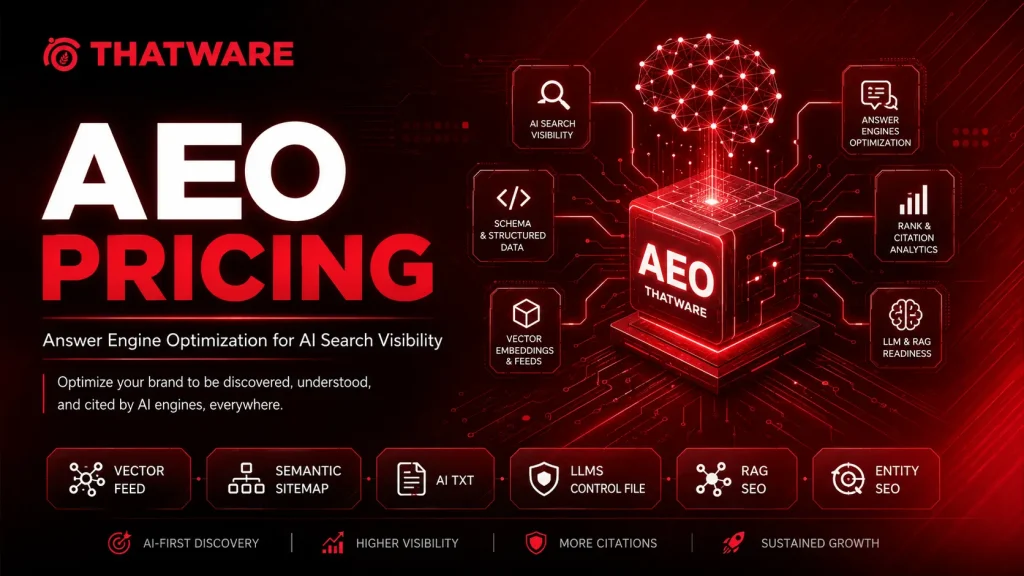
That means your brand must be optimized not only to rank but also to be understood, retrieved, cited, recommended, and trusted by answer engines.
At ThatWare, our AEO deliverables are built to help businesses prepare for this new search ecosystem. We combine traditional SEO foundations with semantic SEO, entity optimization, structured data, AI-readiness files, knowledge graph development, retrieval optimization, RAG-focused content structuring, and answer-based content engineering.
Each deliverable is designed to strengthen how your brand appears across search engines, AI models, conversational platforms, and knowledge-based discovery systems. Below is a detailed explanation of what goes into our AEO execution and how each deliverable contributes to stronger visibility, better authority, and improved AI search performance.
1. AEO Strategy Development
Every successful Answer Engine Optimization campaign begins with a clear strategy. AEO is not about randomly adding FAQs or publishing generic content. It requires a structured understanding of how your audience searches, how AI systems process information, and how your brand should be positioned as a reliable answer source.
Our AEO strategy development includes a detailed review of your website, business model, service offerings, target audience, competitors, existing search visibility, and AI search presence. We identify where your brand currently stands and where it needs to be positioned in the answer-driven search landscape.
We study important factors such as user search behavior, buyer intent, question patterns, topical authority, brand entity strength, content depth, schema availability, technical SEO health, and AI-readability. Based on this analysis, we create a roadmap that defines what needs to be optimized first and how the campaign should progress month by month.
The strategy also helps us decide which pages should be prioritized, what type of content needs improvement, what structured data should be implemented, what AI files should be created, and how your brand should be presented across search and AI platforms.
This deliverable acts as the foundation for the entire campaign. Without a strong strategy, AEO can become scattered. With the right strategy, every action has a purpose — improving your chances of being selected, cited, and recommended by answer engines.
2. AI Search Visibility Audit
An AI search visibility audit helps us understand how your brand currently appears across AI-powered search environments. Traditional SEO audits usually focus on rankings, backlinks, crawlability, indexing, and on-page optimization. While these are still important, AEO requires a deeper layer of analysis.
We examine whether your brand is visible in AI-generated answers, Google AI Overviews, featured snippets, People Also Ask results, conversational search responses, voice search results, and third-party AI answer platforms. We also review whether your competitors are being mentioned more often than your brand in answer-based results.
The audit checks how clearly search engines and AI systems understand your brand, services, expertise, location, industry relevance, and authority. If AI systems cannot confidently understand what your business does, they are less likely to recommend it in response to user queries.
We also evaluate missing schema, weak content sections, unclear answer formatting, low entity recognition, poor service-page structure, thin FAQ coverage, missing author signals, weak topical clusters, and gaps in external brand validation.
This audit provides a practical starting point for improvement. It helps us identify which parts of your website are already AI-ready and which areas need technical, content, semantic, or authority-based enhancement.
3. Answer Intent Research
AEO is heavily driven by questions. Users ask answer engines direct queries such as “What is the best company for this service?”, “How does this solution work?”, “Which provider should I choose?”, “What are the benefits?”, or “How much does it cost?”
Answer intent research focuses on identifying these question-based opportunities. Instead of only targeting short keywords, we study the real questions your potential customers are asking across search engines, AI platforms, forums, review sites, competitor pages, and industry discussions.
We categorize these queries based on intent. Some questions are informational, where users want education. Some are commercial, where users are comparing options. Some are transactional, where users are close to making a decision. Others are navigational, where users are looking for a specific brand, service, or provider.
By mapping these questions properly, we can optimize your website to answer them in a direct, useful, and structured way. This improves the chances of your content appearing in featured snippets, AI-generated summaries, People Also Ask sections, voice search responses, and conversational AI outputs.
Answer intent research also helps improve the user experience. When visitors land on your website, they quickly find the information they need. This can improve engagement, reduce confusion, and support better conversion rates.
4. Question-Based Keyword Mapping
Traditional keyword mapping connects keywords to pages. AEO keyword mapping goes further by connecting questions, entities, topics, and answer formats to specific pages.
For example, a normal SEO campaign may target a keyword like “AEO services.” In an AEO campaign, we also map related questions such as “What is Answer Engine Optimization?”, “How does AEO help businesses?”, “Is AEO different from SEO?”, “Which company provides AEO services?”, and “How much does AEO cost?”
Each question is mapped to the most suitable page or content section. Some questions may belong on a pricing page. Others may fit better on a service page, FAQ page, blog post, comparison guide, or knowledge base article.
This ensures that your website covers the full journey of user intent. It also helps AI systems understand which page should be used for which type of answer.
Question-based keyword mapping improves topical relevance, strengthens internal linking, and helps create a more organized content structure. Instead of having scattered information across the site, every important query has a clear destination.
5. Semantic Content Optimization
Semantic content optimization is one of the most important parts of AEO. Search engines and AI systems no longer depend only on exact-match keywords. They evaluate meaning, context, relationships, entities, subtopics, and overall topical completeness.
Our semantic content optimization focuses on improving the depth and clarity of your existing pages. We enhance headings, paragraphs, FAQs, service descriptions, comparison sections, benefit statements, process explanations, and supporting content so that each page becomes more useful and easier to understand.
This does not mean stuffing content with keywords. Instead, we make the content more complete, natural, and contextually rich. We include related concepts, common questions, examples, use cases, industry terms, customer concerns, and decision-making points.
For AEO, your content must answer the main query and also support related follow-up questions. AI systems often look for pages that explain a topic clearly and comprehensively. If your content is shallow, vague, or too promotional, it may not be selected as a reliable answer source.
Semantic content optimization improves both machine understanding and human readability. It helps visitors find better information while giving answer engines stronger context to process your page.
6. Direct Answer Block Creation
Direct answer blocks are short, clear, and structured content sections designed to answer specific questions immediately. These blocks are extremely useful for AEO because answer engines prefer content that can be easily extracted and summarized.
A direct answer block usually begins with a concise response, followed by a short explanation or supporting details. For example, if the question is “What is AEO?”, the answer should not begin with a long introduction. It should directly explain that AEO is the process of optimizing digital content so search engines and AI platforms can use it in direct answers.
We create answer blocks for important service queries, pricing-related questions, comparison queries, industry questions, process-based queries, and buyer-intent topics. These answer blocks can be placed on service pages, landing pages, blogs, FAQs, and pricing pages.
This structure improves the chances of your content being used in snippets, AI Overviews, voice results, and conversational search responses. It also improves user experience because visitors can quickly understand the answer without reading through unnecessary fluff.
For pricing pages especially, direct answer blocks are valuable because potential customers want clarity. They want to know what is included, how the service works, who it is suitable for, and what value they will receive.
7. FAQ Optimization
FAQs are a major part of Answer Engine Optimization. AI systems often use FAQ-style content because it is easy to parse, understand, and present as a direct answer.
Our FAQ optimization includes researching, writing, improving, and structuring important questions around your business, services, pricing, process, results, timelines, deliverables, and customer concerns.
We make sure each FAQ is written in a natural way and answers the question clearly. The goal is not to create generic filler content. Every FAQ should serve a purpose — either improving search visibility, resolving customer objections, supporting conversions, or giving AI systems a better understanding of your offerings.
FAQ optimization may also include adding FAQ schema where suitable. This gives search engines additional structured information about the questions and answers on your page.
Strong FAQ sections are especially useful for AEO because conversational search is built around question-answer behavior. When your website provides clean, useful, and properly structured answers, it becomes more suitable for AI retrieval.
8. Entity SEO Optimization
Entity SEO is the process of helping search engines and AI systems understand your brand as a recognized entity. An entity can be a company, person, product, service, location, industry, or concept.
For AEO, entity strength is very important. AI systems need to know who you are, what you offer, where you operate, what you are known for, and how your brand connects to relevant topics.
Our entity SEO deliverables include optimizing your brand information, organization details, service descriptions, founder or leadership references, social profiles, knowledge signals, third-party mentions, local listings, and topical associations.
We also review consistency across your website and external platforms. If your brand description varies too much across the web, it can create confusion. Consistency helps search engines build confidence in your brand identity.
Strong entity optimization helps your business become more recognizable in search and AI systems. It can improve your chances of appearing in brand-related answers, industry recommendations, comparison queries, and knowledge-driven search results.
9. Brand Entity Development
Brand entity development goes beyond basic entity SEO. It focuses on strengthening the overall digital identity of your company.
We work on making your brand easier to associate with specific services, industries, expertise areas, achievements, and trust signals. This can include improving brand descriptions, About page content, author profiles, leadership information, service positioning, case study connections, media mentions, and digital PR signals.
For example, if your company wants to be recognized as a leader in Answer Engine Optimization, then your website and external presence should consistently support that identity. Your content, schema, citations, social profiles, press mentions, and service pages should all reinforce the same message.
Brand entity development is important because AI platforms often rely on known and trusted entities when generating recommendations. If your brand is not clearly defined, competitors with stronger entity signals may be selected instead.
This deliverable helps build long-term authority. It supports both traditional SEO and AI search visibility by making your brand more understandable, trustworthy, and contextually relevant.
10. Schema Markup Implementation
Schema markup is structured data added to your website to help search engines understand your content better. It provides additional context about your business, services, pages, articles, FAQs, products, reviews, locations, authors, and other important elements.
As part of our AEO deliverables, we identify and implement relevant schema types based on your website and business model. These may include Organization Schema, Local Business Schema, Service Schema, FAQ Schema, Article Schema, WebPage Schema, Breadcrumb Schema, Product Schema, Review Schema, Person Schema, and other applicable structured data formats.
Schema helps search engines interpret your content more accurately. It can also improve eligibility for rich results, enhanced search listings, and better contextual understanding.
For AEO, schema is especially valuable because answer engines need confidence before using a source. Structured data gives them clearer signals about what your page contains and how the information should be categorized.
Proper schema implementation can make your content easier to crawl, classify, retrieve, and display across search experiences.
11. LLM Schema Optimization
Large Language Model schema optimization focuses on making your website and brand information more suitable for AI-based systems. While traditional schema helps search engines, LLM-focused structuring aims to improve how AI models interpret, summarize, and retrieve your content.
This may include organizing important information in a more machine-readable format, improving content hierarchy, adding structured summaries, clarifying service relationships, and making key facts easier to extract.
LLM schema optimization helps reduce ambiguity. If your page discusses multiple services, AI systems should be able to understand each service separately. If your brand has different offerings, locations, or pricing tiers, those details should be structured clearly.
This deliverable supports better performance in AI search environments where content is not simply ranked but interpreted and summarized. The clearer your information is, the better your chances of being included in generated answers.
12. Vector Feed Creation
Vector feed creation is a forward-looking AEO deliverable designed for semantic retrieval. AI systems increasingly rely on vector-based understanding, where information is matched based on meaning rather than exact keywords.
A vector feed helps organize key business information in a way that supports this semantic matching process. It can include structured details about your brand, services, expertise, industries served, common questions, value propositions, locations, and content assets.
The purpose of a vector feed is to make your information easier for AI systems to interpret and retrieve when users ask relevant questions. This is especially useful for businesses operating in complex or competitive industries where simple keyword optimization is not enough.
Vector feed creation supports the broader goal of making your brand AI-readable. It helps align your content with how modern retrieval systems process meaning, context, and similarity.
13. Semantic Sitemap Development
A standard XML sitemap tells search engines which pages exist on your website. A semantic sitemap goes deeper by helping define the relationship between pages, topics, services, entities, and content clusters.
Semantic sitemap development helps search engines and AI systems understand how your website is organized at a topical level. It shows which pages are main authority pages, which pages support them, and how different topics connect.
For example, a main AEO service page may connect to supporting content about AI Overviews, ChatGPT optimization, LLM SEO, entity SEO, RAG SEO, schema, FAQs, and pricing. This creates a more complete topic ecosystem.
A semantic sitemap improves topical clarity, internal linking, crawl efficiency, and content discoverability. It helps your website communicate meaning, not just structure.
For AEO, this is important because answer engines need to understand not only individual pages but also the broader knowledge structure of your website.
14. AI TXT File Creation
An AI TXT file is a machine-readable guidance file designed to help AI systems understand important information about your website. While traditional robots.txt files provide crawler instructions, AI TXT files are more focused on AI accessibility, content priorities, brand clarity, and machine interpretation.
As part of our AEO service, we may create or optimize an AI TXT file that highlights important areas of your website, key brand information, preferred resources, content usage guidance, and priority sections for AI systems.
This helps prepare your website for a future where AI crawlers and answer engines need clearer instructions about how to interpret and use website content.
AI TXT is still an emerging concept, but forward-thinking brands can benefit from early adoption. By making your website more AI-friendly, you improve the chances of your content being correctly understood and retrieved.
15. LLMs Control File Creation
An LLMs control file provides structured guidance for large language models and AI crawlers. It can help define which parts of your website are important, what your brand represents, which pages should be treated as authoritative, and how your information should be understood.
This deliverable is especially useful for businesses investing in AI search visibility, Generative Engine Optimization, and LLM-based discovery.
The LLMs control file may include key brand summaries, important URLs, service categories, content priorities, and contextual information that helps AI systems interpret your website more accurately.
The purpose is to reduce confusion and improve clarity. If AI systems encounter outdated, duplicate, or low-priority content, they may form an incomplete understanding of your brand. A control file helps guide them toward the most important and accurate information.
This is an important technical asset for brands that want to stay ahead of the next evolution of search.
16. AI Manifesto Development
An AI Manifesto is a structured brand document that explains who you are, what you stand for, what you offer, and why your brand should be trusted in the AI-driven search ecosystem.
It is not just a marketing statement. It is a strategic document designed to support brand clarity, entity recognition, and machine understanding.
The AI Manifesto may include your mission, values, expertise, service philosophy, innovation approach, industry focus, unique advantages, brand story, and trust signals. It helps position your company as a credible and authoritative source in your niche.
For AEO, this is powerful because AI systems need clear brand context. If your brand identity is vague or scattered, it becomes harder for answer engines to associate you with the right topics.
A well-written AI Manifesto gives your brand a stronger voice and a clearer identity. It can support both users and AI systems in understanding why your company matters.
17. RAG SEO Optimization
RAG stands for Retrieval-Augmented Generation. In simple terms, many AI systems retrieve external information before generating an answer. This means your content needs to be optimized not just for ranking but for retrieval.
RAG SEO focuses on making your website content easier for AI systems to find, understand, extract, and use in generated responses.
Our RAG SEO deliverables may include improving content summaries, adding structured sections, strengthening citations, optimizing internal links, clarifying entities, improving topical depth, and organizing information in a retrieval-friendly way.
This is important because AI-generated answers often rely on trusted, clear, and well-structured sources. If your website content is difficult to interpret, too thin, or poorly organized, it may not be retrieved even if it ranks well traditionally.
RAG SEO helps bridge the gap between traditional SEO and AI-driven answer generation. It prepares your website for a search environment where being retrieved is as important as being ranked.
18. AI Search Citation Optimization
Being mentioned or cited by AI systems is becoming a new form of digital authority. AI search citation optimization focuses on improving your chances of being used as a source in AI-generated answers.
This involves improving the credibility, clarity, and usefulness of your content. We optimize pages so they contain factual, well-structured, and easy-to-reference information. We also strengthen external trust signals that can help AI systems view your brand as reliable.
Citation optimization may include better author information, stronger data references, clearer service explanations, third-party validation, review signals, brand mentions, case studies, and structured content blocks.
The goal is to make your content more citation-worthy. When answer engines generate a response, they are more likely to use sources that are clear, authoritative, and directly relevant to the user’s query.
19. GEO Support
Generative Engine Optimization, or GEO, focuses on improving visibility in generative AI platforms. While AEO targets answer engines broadly, GEO specifically supports discovery in AI-generated responses across tools like ChatGPT, Gemini, Perplexity, Copilot, and similar platforms.
Our GEO support may include optimizing brand language, content structure, entity associations, question-answer formatting, AI-readable summaries, third-party mentions, and retrieval signals.
The goal is to help your brand appear when AI platforms generate recommendations, explanations, comparisons, or summaries related to your industry.
GEO and AEO work together. AEO helps you become answer-ready. GEO helps you become visible in generative responses. Combined, they create a stronger foundation for the future of AI-powered discovery.
20. Brand Trust Signal Enhancement
Trust is one of the most important factors in both traditional SEO and AI search. Answer engines are more likely to recommend brands that show consistency, authority, credibility, and expertise.
Our brand trust signal enhancement includes reviewing and improving elements such as reviews, testimonials, case studies, awards, certifications, media mentions, founder profiles, author bios, social profiles, business listings, and third-party references.
These signals help users trust your business. They also help search engines and AI systems understand that your brand is legitimate and authoritative.
For competitive industries, trust signals can make a major difference. When multiple businesses offer similar services, AI systems may favor the one with stronger credibility, clearer information, and better validation across the web.
21. Competitor AEO Analysis
Competitor AEO analysis helps us understand why competing brands may be appearing in answer-based search results while your brand is not.
We review competitor content, schema, FAQs, entity signals, AI visibility, topical coverage, external mentions, and answer formatting. This helps identify what they are doing well and where your brand can outperform them.
The analysis is not about copying competitors. It is about finding strategic gaps. If competitors have stronger FAQs, we can create better ones. If they have more complete service pages, we can improve your topical depth. If they are cited more often, we can work on authority and trust signals.
Competitor AEO analysis gives your campaign a sharper direction. It helps us prioritize actions that can create the biggest impact.
22. Content Gap Analysis for AI Answers
Traditional content gap analysis looks at missing keywords. AEO content gap analysis looks at missing answers.
We identify questions, topics, comparisons, objections, and user concerns that your website does not currently address. We also check whether existing content is too shallow, outdated, unclear, or poorly structured for AI retrieval.
This deliverable helps improve your content roadmap. It shows what pages need expansion, what FAQs should be added, what blog topics should be created, and what service explanations need improvement.
The goal is to make your website more complete. The more useful and comprehensive your content is, the better your chances of being selected by answer engines.
Content gap analysis also supports conversion. When users find complete answers on your website, they are more likely to trust your brand and take action.
23. Internal Linking for AEO
Internal linking helps search engines understand the relationship between your pages. For AEO, internal linking also helps build topical authority and guide AI systems through your content structure.
We optimize internal links between service pages, blogs, FAQs, case studies, pricing pages, location pages, and supporting resources. This helps distribute authority and create stronger topic clusters.
For example, a pricing page about AEO should connect to content about Answer Engine Optimization, AI Overviews, LLM SEO, schema, entity SEO, RAG SEO, and GEO. These connections help search engines understand that your website has depth in this subject area.
Good internal linking also improves user experience. Visitors can easily move from one relevant resource to another, which increases engagement and helps them make better decisions.
24. Content Restructuring for AI Readability
AI systems prefer content that is clear, structured, and easy to process. Long, unorganized paragraphs can make it harder for answer engines to extract useful information.
Content restructuring for AI readability includes improving headings, subheadings, paragraph flow, bullet points, summaries, answer blocks, tables, FAQs, and content hierarchy.
We make sure each page has a logical structure. Important information should be easy to locate. Service benefits should be clearly explained. Questions should be answered directly. Technical details should be simplified without losing accuracy.
This makes the content more useful for both humans and machines. Visitors can read the page comfortably, while AI systems can better understand and retrieve the information.
25. Monthly AEO Reporting
Every month, we provide reporting that explains what has been completed, what improvements were made, and what should be prioritized next.
The report may include completed deliverables, optimized pages, schema updates, FAQ additions, answer block creation, AI-readiness file updates, content improvements, technical recommendations, visibility observations, and competitor insights.
Monthly reporting keeps the campaign transparent. You can see how the work is progressing and understand the purpose behind each action.
AEO is a long-term process. AI visibility does not happen overnight. It requires continuous improvement, monitoring, optimization, and authority building. Monthly reporting helps keep the campaign focused and accountable.
26. Ongoing Recommendations & Roadmap Updates
Search is changing quickly. Google AI Overviews, LLM platforms, and conversational search tools continue to evolve. That is why AEO cannot be treated as a one-time setup.
Our ongoing recommendations help your website adapt to changes in search behavior, AI retrieval patterns, competitor activity, and content performance.
Each month, we review what needs to be improved next. This may include expanding content, adding new FAQs, improving schema, strengthening entity signals, building better trust references, optimizing new pages, or updating AI-readiness files.
This ensures your AEO campaign stays active, relevant, and future-ready.
Why These AEO Deliverables Are Important
The way people search is changing permanently. Users want direct answers, trusted recommendations, summarized insights, and fast decision-making support. Search engines are responding by becoming answer engines. AI platforms are becoming discovery engines.
This creates a new challenge for businesses. Ranking on Google is still important, but it is no longer enough. Your brand must also be optimized for AI interpretation, semantic retrieval, entity recognition, and answer generation.
ThatWare’s AEO pricing plan and deliverables are designed to solve this challenge from multiple angles. We improve your website content, technical structure, brand signals, schema, AI-readiness, topical authority, and retrieval potential.
The result is a stronger digital presence that is better prepared for both today’s search engines and tomorrow’s AI-driven discovery platforms.
With AEO, your website becomes more than a collection of pages. It becomes a structured knowledge source that can be understood by search engines, trusted by users, and retrieved by AI systems.
For businesses that want to stay ahead of competitors, Answer Engine Optimization is no longer optional. It is a critical part of modern digital growth. As AI continues to shape how people search, compare, and choose brands, companies that invest in AEO early will have a stronger advantage in visibility, authority, and customer acquisition.