SUPERCHARGE YOUR ONLINE VISIBILITY! CONTACT US AND LET’S ACHIEVE EXCELLENCE TOGETHER!
** The pricings are in USD / Month and the deliverables are monthly based.
Detailed AI Search Visibility Deliverables & Scope of Work
AI search is changing the way customers discover brands, compare companies, and make decisions online. Earlier, users mainly depended on Google search results, clicked through websites, and compared options manually. Today, the journey is different. People are asking direct questions to AI-powered platforms such as Google AI Overviews, ChatGPT, Gemini, Perplexity, Copilot, Claude, and other conversational search systems.
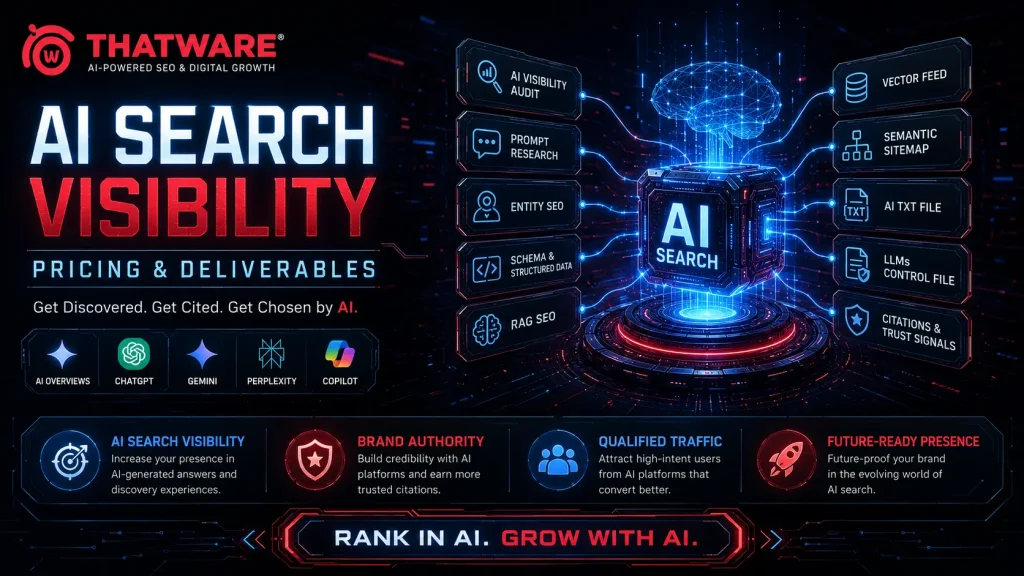
These platforms do not only list websites. They summarize information, recommend companies, compare services, generate answers, and often influence buying decisions before a user ever visits a website. This creates a new challenge for businesses. Ranking on Google is still valuable, but it is no longer enough. Your brand also needs to be visible inside AI-generated answers, trusted by AI systems, cited as a source, and clearly understood as an authority in your industry.
ThatWare’s AI Search Visibility service is designed to help businesses prepare for this new environment. The goal is not just to increase traffic. The goal is to improve how AI systems discover, understand, retrieve, cite, and recommend your brand.
Our monthly deliverables combine AI visibility audits, prompt research, content optimization, entity SEO, structured data, citation building, RAG readiness, trust signal improvement, AI-friendly content architecture, and continuous monitoring. Each activity is focused on helping your website become easier for AI search systems to process and more likely to appear in AI-led discovery moments.
Below is a detailed explanation of the major deliverables included in a typical AI Search Visibility campaign.
1. AI Search Visibility Strategy
Every campaign begins with a clear AI Search Visibility strategy. AI search is not the same as traditional SEO. Traditional SEO focuses mainly on rankings, keywords, backlinks, technical optimization, and organic traffic. AI search visibility goes further. It focuses on whether your brand is understood, included, cited, and recommended by AI-driven systems.
The strategy starts with a detailed review of your business, services, target audience, competitors, current website performance, brand authority, content depth, and AI search presence. We look at how your brand is positioned across the web and whether AI platforms have enough reliable information to understand what your business does.
This roadmap helps define the right monthly priorities. Some websites may need stronger service-page content. Some may need better schema. Others may need citation improvement, entity optimization, trust signal development, AI-ready FAQs, or a stronger knowledge graph presence.
The strategy also identifies the type of AI search queries your business should target. These may include questions like “best company for AI SEO,” “top service provider for AI search optimization,” “how to appear in ChatGPT answers,” “how to get cited by Google AI Overviews,” or “which agency helps brands improve AI visibility?”
This deliverable gives the campaign structure. Instead of randomly optimizing pages, we build a clear plan around how users search, how AI engines respond, and how your brand can earn visibility in those responses.
2. AI Visibility Audit
The AI Visibility Audit is one of the most important starting points of the campaign. It helps us understand how your brand currently appears across AI-powered search environments.
We check whether your business is being mentioned in AI-generated answers, whether competitors are being recommended instead, whether your content is being used as a source, and whether AI systems are presenting your brand accurately. This may include visibility checks across Google AI Overviews, ChatGPT, Gemini, Perplexity, Claude, Copilot, and other relevant AI-led discovery platforms.
The audit also reviews your website’s AI-readiness. We check whether your content is easy to understand, whether important pages are structured clearly, whether schema is present, whether FAQs are useful, whether your brand entity is strong, and whether external trust signals support your authority.
A strong AI visibility audit moves the campaign away from guesswork. Instead of assuming what needs to be improved, we identify where the real gaps are. Your website may rank well in traditional search but still be missing from AI answers. Or your brand may appear in AI systems, but with weak, outdated, or incomplete information.
The audit gives us a clear baseline and helps prioritize the work that can create the strongest long-term impact.
3. AI Search Visibility Scorecard
A modern AI search campaign needs a new measurement system. Traditional SEO reports usually focus on rankings, impressions, clicks, traffic, and conversions. Those metrics are still useful, but they do not fully explain how your brand performs in AI-generated search.
ThatWare’s AI Search Visibility Scorecard approach focuses on measuring how often and how well your brand appears across AI-influenced search experiences. A strong scorecard looks at presence, prominence, attribution, accuracy, and entity credibility. In simple terms, it checks whether your brand is included, whether it is shown as a strong recommendation, whether it receives citations or links, whether the information is accurate, and whether your brand appears trustworthy to AI systems.
This is important because AI search visibility is not only about “ranking.” In many AI-generated answers, there is no traditional ranking list. There may be one summarized answer, a few cited sources, or a short set of recommended brands. That means visibility must be measured differently.
The scorecard helps turn AI visibility into something more trackable. It provides a practical way to monitor progress, identify weaknesses, and decide what needs to be improved next.
4. Prompt & Conversational Query Research
AI search behavior is different from traditional keyword search. Users do not always type short phrases. They ask complete questions, describe problems, request comparisons, and expect direct recommendations.
For example, a user may not search only for “SEO company.” They may ask, “Which SEO company can help my brand appear in AI Overviews and ChatGPT?” or “What is the best agency for AI search visibility?” These longer, more conversational prompts are extremely important for AI Search Visibility.
Our prompt and query research identifies the real questions your target audience may ask across AI platforms. We study informational prompts, comparison prompts, commercial prompts, local prompts, problem-solving prompts, and decision-ready prompts.
This research helps shape your content strategy. It tells us what questions your website needs to answer, what topics need more depth, what comparisons should be addressed, and what service explanations should be improved.
The goal is to make your website useful for the way people now search. Instead of only targeting keywords, we optimize around real conversations, buyer intent, and AI-generated answer opportunities.
5. AI Search Competitor Analysis
In many industries, some competitors may already be appearing in AI-generated answers while others are ignored. AI Search Competitor Analysis helps us understand why.
We study competitor visibility across AI platforms, traditional search results, content ecosystems, review platforms, directories, third-party mentions, knowledge panels, and industry sources. We look at what competitors are doing well and where they are weak.
This may include reviewing their content depth, FAQ structure, schema usage, brand citations, trust signals, service-page clarity, entity strength, and external authority. We also look at how AI systems describe those competitors and whether they are being recommended for high-value queries.
The goal is not to copy competitors. The goal is to understand the pattern behind their visibility. If AI systems are choosing a competitor, there is usually a reason. They may have clearer content, stronger citations, better brand consistency, more authoritative sources, or stronger entity associations.
This deliverable helps us identify opportunities where your brand can outperform competitors with better content, stronger structure, clearer positioning, and more reliable trust signals.
6. AI-Ready Content Optimization
Content is one of the strongest pillars of AI search visibility. AI platforms prefer content that is clear, structured, factual, helpful, and easy to summarize. If your content is vague, thin, outdated, or too promotional, AI systems may avoid using it.
AI-ready content optimization improves your existing pages so they become more useful for users and easier for AI systems to understand. This may include improving headings, restructuring paragraphs, adding clearer explanations, strengthening service descriptions, creating direct answer sections, adding FAQs, improving summaries, and including related topics that build context.
The focus is not keyword stuffing. AI search does not reward content that simply repeats the same phrase. It rewards clarity, context, trust, and usefulness.
For example, if your page offers a service, the content should clearly explain what the service is, who it is for, how it works, what problems it solves, what deliverables are included, and why your brand is credible. This gives AI systems enough information to understand and retrieve your content accurately.
Good AI-ready content should feel natural to human readers while still being organized enough for machine interpretation.
7. Direct Answer Block Creation
AI systems often look for clear, extractable answers. If your content takes too long to answer a simple question, another website may be selected instead.
Direct answer blocks solve this problem. These are short, clear sections that answer important questions directly before expanding into details. They are useful for Google AI Overviews, featured snippets, People Also Ask results, voice search, and conversational AI responses.
For example, a page may include an answer block for “What is AI Search Visibility?” The answer should be simple, direct, and helpful. Then the page can continue with a deeper explanation.
We create answer blocks around key service questions, pricing questions, comparison questions, buyer concerns, and industry topics. These blocks make your content easier to scan and easier for AI systems to extract.
They also improve user experience. Visitors get the answer quickly, which helps build trust and keeps them engaged.
For pricing pages, direct answer blocks are especially valuable because users want clarity. They want to know what they are paying for, what is included, and how the service helps their business.
8. FAQ Optimization for AI Search
FAQs are a major part of AI search visibility because AI systems are built around questions and answers. A well-structured FAQ section can help your website respond to conversational search behavior more effectively.
We research, write, and optimize FAQs around your services, pricing, process, timelines, results, deliverables, objections, comparisons, and common customer concerns. Each FAQ is written in a natural way and designed to provide a useful answer, not generic filler.
FAQ optimization helps both users and machines. Users get quick clarity. AI systems get structured answers that are easier to understand and retrieve.
Where suitable, FAQ schema can also be added to provide additional structured information to search engines.
For AI Search Visibility, FAQs help your website cover more natural-language queries. They also increase the chance of your content being used in AI summaries, featured answers, and conversational search responses.
9. Entity SEO & Brand Understanding
AI systems need to understand your brand as a clear entity. An entity can be a business, person, service, location, product, or concept. If your brand entity is weak or inconsistent, AI platforms may struggle to understand who you are and when to recommend you.
Entity SEO focuses on strengthening your brand identity across your website and the wider web. We review your company information, About page, service descriptions, founder or leadership details, social profiles, directory listings, external mentions, schema, and topical associations.
The goal is to help AI systems understand what your brand does, where it operates, who it serves, what services it offers, and what topics it should be associated with.
Consistency matters. If your business is described differently across multiple platforms, it creates confusion. AI systems prefer brands with clear, stable, and consistent information.
Strong entity SEO improves brand recognition, topical relevance, trust, and eligibility for AI-generated recommendations.
10. Brand Entity Development
Brand Entity Development goes one step deeper than basic entity optimization. It focuses on building a stronger and more complete digital identity around your company.
We strengthen the connection between your brand and your core services, industries, expertise areas, achievements, case studies, awards, media mentions, frameworks, leadership, and trust signals.
This matters because AI systems do not only look at your website in isolation. They look at the larger information ecosystem around your brand. If your company is consistently associated with a topic across multiple trustworthy sources, AI systems are more likely to understand your authority in that area.
For example, if your brand wants to be recognized for AI Search Visibility, LLM SEO, AEO, GEO, or advanced SEO, these associations should be visible across your website, content, structured data, citations, and third-party references.
Brand Entity Development helps your business become more recognizable, more credible, and more likely to be included in AI-generated responses.
11. Structured Data & Schema Implementation
Structured data helps search engines and AI systems understand your website more accurately. It gives machines additional context about your organization, services, pages, FAQs, authors, products, reviews, locations, and page relationships.
As part of AI Search Visibility, we identify and recommend relevant schema types based on your website and business model. This may include Organization Schema, Local Business Schema, Service Schema, FAQ Schema, Article Schema, WebPage Schema, Breadcrumb Schema, Review Schema, Person Schema, Product Schema, and other applicable formats.
Schema does not replace good content, but it makes your content easier to classify and interpret. It reduces ambiguity and gives search systems a clearer understanding of what each page represents.
For AI search, this clarity is important. AI systems need confidence before using your brand as part of an answer. Structured data supports that confidence by making your information cleaner and more machine-readable.
12. Knowledge Graph Optimization
Knowledge graphs help AI systems understand relationships between entities. For example, they may connect your brand with its services, founder, location, content assets, awards, reviews, industries, and third-party mentions.
Knowledge Graph Optimization focuses on improving these relationships so AI systems can better understand your brand’s role within a topic or industry.
This may include improving internal linking, schema markup, About page content, service-page structure, author profiles, business listings, external citations, and topical clusters.
The purpose is to make your brand easier to connect with the topics you want to rank and appear for. If your brand is clearly connected to relevant services and authority signals, AI systems are more likely to include it in answer generation.
Knowledge Graph Optimization also supports traditional SEO because it improves topical clarity and strengthens your website’s overall information architecture.
13. RAG SEO & Retrieval Readiness
RAG stands for Retrieval-Augmented Generation. Many AI systems retrieve information from external sources before generating an answer. This means your content must be optimized not only for indexing, but also for retrieval.
RAG SEO focuses on making your content easier for AI systems to find, extract, summarize, and use. This may include improving summaries, headings, answer blocks, factual clarity, content structure, internal links, citations, schema, and source consistency.
ThatWare’s AI Search Implementor resource explains that modern AI search systems use different retrieval methods and that visibility now depends on whether AI systems choose to cite, recommend, or reference a brand when generating answers.
A RAG-ready page should be easy to understand at a glance. It should answer important questions clearly, explain topics in a logical flow, and provide enough context for AI systems to use the information accurately.
This deliverable is one of the most important parts of AI Search Visibility because it supports the way generative AI systems retrieve and synthesize information.
14. Vector Feed Optimization
Vector-based retrieval is becoming increasingly important in AI search. Traditional search often depends on keywords and links. AI retrieval systems also look at meaning, context, and semantic similarity.
Vector Feed Optimization helps organize your important content, services, entities, and topics in a way that supports semantic understanding. A vector feed can help define what your brand is about, which pages are important, what topics are connected, and how your content should be interpreted by AI systems.
This is useful because AI systems often work through embeddings and semantic relationships. They do not only match exact words. They try to understand meaning.
By improving vector-feed readiness, your website becomes more suitable for AI-driven retrieval and answer generation. This supports visibility across AI search engines, LLM-powered platforms, and generative discovery systems.
The AI Search Pricing page includes Vector Feed as part of ThatWare’s connected LLM, AEO, and GEO knowledge-base resources, making it a relevant asset for AI search visibility work.
15. Semantic Sitemap Development
A normal XML sitemap tells search engines which URLs exist. A semantic sitemap goes further by helping machines understand the relationship between pages, topics, services, entities, and content clusters.
Semantic Sitemap Development helps organize your website into a clearer knowledge structure. It shows which pages are primary, which pages support them, and how different topics connect.
For example, an AI Search Visibility page may connect to supporting pages about LLM SEO, AEO, GEO, RAG SEO, Entity SEO, AI TXT, Semantic SEO, and AI visibility measurement. These relationships help machines understand that your website has depth around the topic.
A semantic sitemap improves crawlability, topical clarity, internal linking, and AI interpretation. It supports both search engines and generative AI systems by making your website easier to understand as a connected knowledge base.
The AI Search Pricing page includes Semantic Sitemap as one of its related knowledge-base resources.
16. AI TXT File Creation
An AI TXT file is a future-focused website asset designed to help AI systems understand important brand and content information. While traditional crawler files focus mainly on access and crawling instructions, AI TXT is more focused on AI interpretation, attribution, content priorities, and brand clarity.
As part of AI Search Visibility, AI TXT creation may include guidance about important website sections, brand identity, preferred content sources, priority pages, topical areas, and how your information should be understood by AI systems.
This can be especially useful for businesses with complex services, proprietary frameworks, multiple service categories, or strong brand positioning requirements.
The goal is to reduce confusion and improve machine-readability. AI TXT gives your website an additional layer of readiness for AI crawlers, LLM systems, and future search technologies.
The pricing page directly lists AI TXT File among the LLM, AEO, and GEO knowledge-base resources connected to AI Search Visibility.
17. LLMs Control File Optimization
An LLMs Control File helps provide structured guidance for large language models and AI systems interacting with your website. It can help identify priority pages, key brand entities, important service categories, preferred sources, and content interpretation guidelines.
This deliverable is useful because AI systems often need clarity. If they retrieve outdated, duplicate, or low-priority content, they may form an incomplete understanding of your brand. A control file helps guide them toward the most important information.
For AI Search Visibility, this asset supports better consistency, better retrieval, and better brand representation.
It also helps align your website with the growing need for AI governance. As more AI systems crawl, summarize, and reuse web information, businesses need clearer ways to communicate how their content should be understood.
The AI Search Pricing page includes LLMs Control File as part of its linked knowledge-base resources.
18. AI Manifesto Development
An AI Manifesto is a structured brand document that explains who your company is, what it stands for, what it offers, and why it should be trusted in AI-driven search environments.
This deliverable helps strengthen brand clarity. It may include your company mission, service philosophy, expertise areas, unique value proposition, industry focus, authority signals, brand story, and preferred positioning.
For AI systems, this type of document can help reduce ambiguity. It gives a clearer explanation of your brand and connects your business to the right topics.
An AI Manifesto is especially useful for brands that want to lead a category, explain proprietary methods, or build authority in emerging fields such as AI Search Visibility, LLM SEO, AEO, GEO, AI-based SEO, or advanced search intelligence.
The pricing page includes AI Manifesto in its LLM, AEO, and GEO knowledge-base resource list.
19. Citation & Source Signal Building
AI systems prefer brands that are supported by credible external signals. This is why citation and source building are important.
Citation building focuses on improving your brand’s presence across reliable third-party sources. These may include business directories, review platforms, industry websites, media mentions, partner pages, case studies, interviews, thought-leadership platforms, and other authoritative sources.
The goal is not to create random links. The goal is to build a trustworthy brand footprint. If AI systems find consistent information about your business across multiple credible sources, they are more likely to understand and trust your brand.
Source signals also support entity SEO, local SEO, brand authority, and traditional organic visibility.
In AI search, citations are especially important because many platforms generate answers based on source reliability. A brand that has stronger citations, clearer references, and more consistent external validation has a better chance of being included in AI-generated responses.
20. Trust Signal Enhancement
Trust is one of the most important parts of AI Search Visibility. AI systems are more likely to recommend brands that appear credible, experienced, transparent, and consistent.
Trust Signal Enhancement focuses on strengthening the elements that prove your business is reliable. This may include reviews, testimonials, case studies, awards, certifications, founder profiles, team expertise, client success stories, media mentions, author bios, business credentials, and transparent company information.
For pricing pages, trust signals are especially important. Users want to understand not only what is included in the service but also why they should trust the company providing it.
Trust signals also help AI systems evaluate your brand as a credible source. If your website and external footprint show strong credibility, your brand has a better chance of being recommended or cited.
This deliverable helps make your business not only visible, but believable.
21. AI Content Distribution
Publishing content on your own website is important, but AI visibility is not built through your website alone. AI systems often collect signals from the wider web.
AI Content Distribution focuses on expanding your brand’s topical presence across relevant platforms. This may include industry blogs, PR channels, business listings, social platforms, knowledge-sharing sites, partner websites, case-study pages, and other credible sources.
The goal is to make your brand more discoverable across the places AI systems may use to understand authority and relevance.
This helps increase brand mentions, citation opportunities, referral visibility, and topical association. It also reinforces your expertise beyond your own website.
For AI Search Visibility, distribution matters because AI engines evaluate the wider ecosystem around a brand. A company that is consistently discussed, cited, and referenced across reliable sources has a stronger chance of being trusted by AI systems.
22. Internal Linking for AI Understanding
Internal linking helps search engines and AI systems understand how your content is connected. It also helps users move from one useful page to another.
For AI Search Visibility, internal linking should not be random. It should support topical relationships. Important pages should connect naturally to related service pages, blogs, FAQs, case studies, guides, pricing pages, and authority resources.
For example, an AI Search Visibility page should connect with resources about LLM SEO, AEO, GEO, Entity SEO, RAG SEO, AI TXT, Vector Feed, Semantic Sitemap, and AI visibility tracking.
These internal connections help build a stronger knowledge structure. They show machines that your website covers the topic in depth.
Good internal linking also improves engagement. Users can explore related services and better understand how the full AI search strategy works.
23. AI Search Performance Tracking
AI search visibility needs to be tracked differently from traditional SEO. Rankings alone do not tell the full story.
Performance tracking may include monitoring selected AI prompts, checking brand mentions, reviewing competitor appearances, tracking citation presence, analyzing query coverage, identifying new opportunities, and observing how AI systems describe your brand.
The purpose is to understand whether your brand is becoming more visible, more accurate, and more trusted in AI-generated responses.
Performance tracking also helps identify issues. If AI systems are showing outdated information, missing your brand, or recommending competitors, we can adjust the strategy.
ThatWare’s AI Search Implementor resource explains the challenge clearly: traditional SEO metrics do not fully explain why some brands are cited, recommended, or surfaced in AI-generated answers while others are ignored.
This deliverable keeps the campaign practical and focused on actual AI search outcomes.
24. Monthly Reporting & Recommendations
Each month, we provide reporting that explains what has been completed and what should be improved next.
The report may include AI visibility observations, optimized pages, prompt research insights, schema updates, content improvements, citation progress, entity updates, internal linking improvements, trust signal recommendations, and next-step priorities.
Monthly reporting keeps the campaign transparent. You can see what work has been done, why it matters, and how it supports long-term AI search visibility.
AI Search Visibility is not a one-time activity. It requires consistent improvement because AI systems, search behavior, and competitor activity are always changing.
The monthly report helps ensure the campaign remains focused, measurable, and aligned with your business goals.
25. Continuous AI Search Optimization
AI search is evolving quickly. Google AI Overviews, ChatGPT, Perplexity, Gemini, Copilot, Claude, and other platforms continue to change how they retrieve, summarize, cite, and recommend information.
Because of this, AI Search Visibility cannot be treated as a one-time setup. It needs continuous optimization.
Each month, we may refine content, add new FAQs, improve schema, update AI-readiness files, strengthen citations, improve internal links, build stronger entity signals, enhance trust elements, and adjust the strategy based on observed AI search behavior.
Continuous optimization keeps your brand relevant and competitive. It helps ensure that your website is not only prepared for the current AI search environment but also ready for future changes.
Businesses that invest early in AI Search Visibility can build an advantage before the space becomes more crowded. The earlier your brand becomes understandable, citable, and trusted by AI systems, the stronger your long-term positioning can become.
Generic Monthly Scope of Work for AI Search Visibility
The exact scope may vary depending on the pricing plan, website size, competition level, business goals, and current AI visibility. However, a typical monthly AI Search Visibility campaign may include:
AI Search Visibility strategy and roadmap
AI visibility audit and baseline analysis
AI Search Visibility Scorecard setup or review
Prompt and conversational query research
Competitor AI visibility analysis
AI-ready content optimization
Direct answer block creation
FAQ optimization for AI search
Entity SEO and brand understanding
Brand entity development
Structured data and schema implementation
Knowledge graph optimization
RAG SEO and retrieval-readiness improvements
Vector feed optimization
Semantic sitemap development
AI TXT file creation or improvement
LLMs Control File optimization
AI Manifesto development
Citation and source signal building
Trust signal enhancement
AI content distribution support
Internal linking for AI understanding
AI search performance tracking
Monthly reporting and recommendations
Continuous AI search optimization
This scope is designed to help your brand become easier for AI systems to understand, retrieve, cite, and recommend.
Why AI Search Visibility Matters
The future of search is not limited to ranking pages. It is about being included in answers.
Users are now asking AI systems for recommendations, comparisons, summaries, explanations, and solutions. In many cases, the AI-generated answer shapes the user’s decision before they visit any website. If your brand is missing from those answers, you may lose visibility even if your traditional SEO rankings look strong.
AI Search Visibility helps solve this problem. It makes your brand more understandable to machines, more useful to users, and more trustworthy across the web.
It improves your content structure, strengthens your entity signals, supports citation growth, builds trust, improves retrieval readiness, and prepares your website for AI-led discovery.
ThatWare’s approach to AI search is built around a simple idea: modern visibility is no longer just about being found. It is about being understood, trusted, cited, and chosen.
Get Found Where AI Answers Are Created
Search has entered a new era. Customers are no longer only typing keywords and browsing search results. They are asking AI systems to guide them, compare options, explain solutions, and recommend trusted brands.
ThatWare’s AI Search Visibility services are designed to help your business appear in these moments.
Through a monthly scope of work that includes AI visibility audits, prompt research, content optimization, entity SEO, schema, RAG readiness, citations, trust signals, AI TXT, semantic sitemaps, vector feeds, and continuous tracking, we help your brand become more prepared for AI-driven discovery.
The goal is not just to rank. The goal is to become a trusted answer source.
With the right AI Search Visibility strategy, your brand can become easier to understand, easier to retrieve, easier to cite, and easier to recommend across the next generation of search platforms.