SUPERCHARGE YOUR ONLINE VISIBILITY! CONTACT US AND LET’S ACHIEVE EXCELLENCE TOGETHER!
** The pricings are in USD / Month and the deliverables are monthly based.
Detailed Hyper-Intelligence SEO Deliverables & Scope of Work
Hyper-Intelligence SEO is not traditional SEO with a few AI tools added on top. It is a complete, intelligence-led search system designed for how modern search actually works. Today, visibility is no longer controlled by keywords alone. Search engines, AI answer engines, generative platforms, and large language models now evaluate meaning, intent, trust, context, user behavior, entity strength, topical authority, and content usefulness before deciding what to show, cite, or recommend.
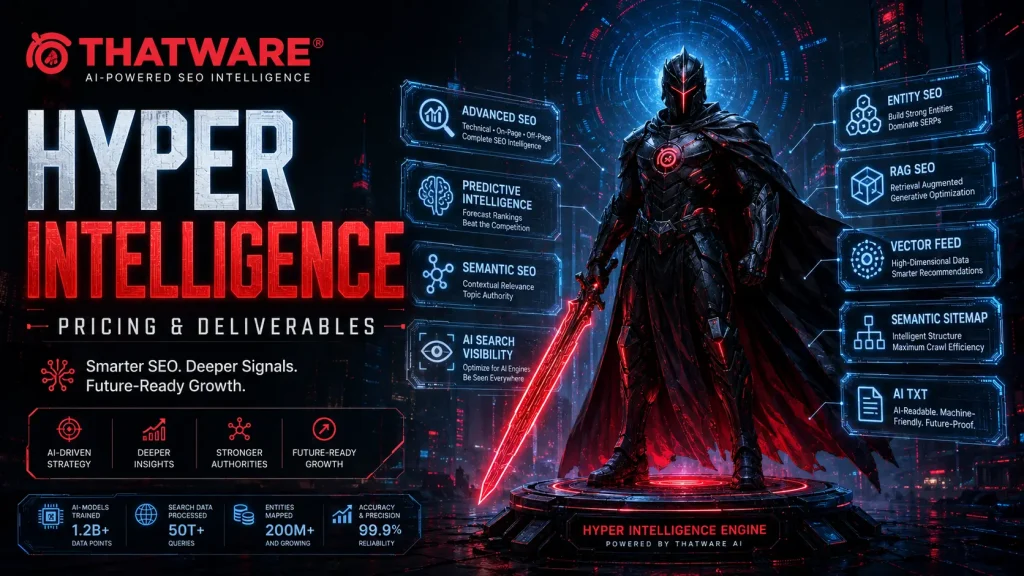
That is why businesses need a more advanced SEO framework.
ThatWare’s Hyper-Intelligence SEO service is built to help brands move beyond basic rankings and build long-term digital authority. It combines AI, machine learning, NLP, semantic SEO, predictive analytics, technical SEO, entity optimization, content intelligence, AI search visibility, Answer Engine Optimization, Generative Engine Optimization, and LLM SEO into one unified execution model.
The goal is simple: help your brand become more discoverable, more trusted, more relevant, and more future-ready across Google, AI Overviews, ChatGPT, Gemini, Perplexity, Copilot, voice search, answer engines, and traditional organic search.
Below is a detailed explanation of the major deliverables included in a Hyper-Intelligence SEO campaign.
1. Hyper-Intelligence SEO Strategy & Roadmap
Every campaign begins with a detailed strategy. Hyper-Intelligence SEO cannot be executed through a generic checklist because every business has different goals, competition levels, audiences, website structures, and authority gaps.
The strategy starts with a full review of your website, business model, services, products, target audience, search competitors, content quality, technical foundation, AI visibility, and current organic performance. We study where your brand stands today and where it needs to go.
This roadmap helps define the monthly execution plan. Some websites need technical SEO first. Some need content restructuring. Some need stronger entity signals. Some need better AI search visibility. Others may need topical authority, schema implementation, RAG readiness, link intelligence, or advanced user-intent mapping.
ThatWare’s Hyper-Intelligence SEO approach treats SEO as a wider operating system for digital authority, not just a traffic tactic. Its own resources describe Hyper-Intelligence SEO as a system-level approach that coordinates content, data, user intent, brand trust, and adaptive learning loops into one integrated engine.
The roadmap keeps the campaign focused, practical, and measurable. Every deliverable is connected to a larger goal: building a stronger search presence that can survive algorithm changes and adapt to AI-driven search evolution.
2. Advanced SEO & Website Intelligence Audit
The website intelligence audit goes deeper than a basic SEO audit. Traditional audits often check titles, meta descriptions, backlinks, page speed, broken links, and indexation. These are important, but Hyper-Intelligence SEO requires a broader view.
We review technical SEO, crawlability, indexation, site architecture, page structure, internal linking, content quality, user intent alignment, schema markup, Core Web Vitals, mobile experience, topical coverage, trust signals, conversion flow, and AI-readiness.
The audit also checks whether your website is structured in a way that search engines and AI systems can understand. A website may have content, but if that content is poorly organized, thin, repetitive, or unclear, it may not perform well in modern search.
This deliverable helps identify hidden issues that may be limiting growth. It may reveal weak landing pages, poor internal links, missing structured data, unclear service explanations, duplicate content, low topical authority, poor entity recognition, or technical barriers that affect crawling and visibility.
The output becomes the foundation for future optimization. Instead of making random changes, we prioritize the fixes that matter most for ranking, user experience, authority, and AI search performance.
3. Predictive Search Intelligence
One of the biggest differences between traditional SEO and Hyper-Intelligence SEO is prediction. Traditional SEO often reacts to what has already happened. Hyper-Intelligence SEO studies patterns to anticipate what users may search for next.
Predictive search intelligence uses search behavior, historical trends, competitor movement, topical shifts, user intent signals, seasonality, and market changes to identify future opportunities. The objective is to position your brand before the demand becomes highly competitive.
This is especially useful in fast-moving industries where search trends change quickly. Instead of only targeting existing keywords, we identify emerging queries, rising topics, future content gaps, and intent patterns that may become valuable over time.
ThatWare’s resources describe Hyper-Intelligence SEO as a predictive and user-centric system that combines AI, NLP, and behavioral analytics to anticipate user intent and continuously evolve with search trends.
This deliverable gives your campaign a forward-looking advantage. It helps you stop chasing competitors and start building visibility ahead of the curve.
4. Keyword, Intent & Semantic Research
Keyword research is still important, but it is no longer enough on its own. Modern search engines understand meaning, not just exact words. That is why Hyper-Intelligence SEO combines keyword research with intent mapping and semantic analysis.
We identify high-value search terms, long-tail queries, conversational phrases, question-based searches, commercial keywords, transactional opportunities, local intent queries, and AI search prompts. Then we map them to user intent.
For example, one user may search for information. Another may compare companies. Another may be ready to buy. Each intent needs a different content approach.
Semantic research also identifies related entities, subtopics, supporting concepts, frequently asked questions, industry terms, and contextual signals that help search engines understand the full meaning of a page.
This deliverable ensures your website does not simply target isolated keywords. It builds a complete topic ecosystem around your services, products, expertise, and audience needs.
The result is stronger topical authority, better content planning, improved on-page relevance, and higher visibility across traditional search and AI-driven discovery platforms.
5. Competitor Intelligence & Market Gap Analysis
Competitor research is a major part of Hyper-Intelligence SEO. However, this is not limited to checking competitor keywords or backlinks. We study the full digital ecosystem around your competitors.
This includes their rankings, content depth, page structure, topical authority, backlink profile, brand mentions, AI visibility, schema usage, internal linking, user experience, trust signals, and conversion positioning.
We look at why competitors are winning. Are they answering questions better? Do they have stronger authority signals? Are their service pages more detailed? Are they appearing in AI-generated answers? Do they have more third-party mentions? Are they using stronger schema or topical clusters?
ThatWare’s resources position Hyper-Intelligence SEO as an approach that integrates AI, machine learning, predictive analytics, NLP, and semantic search to create more focused and personalized strategies.
The goal is not to copy competitors. The goal is to find openings. Once we know where competitors are strong and where they are weak, we can build a smarter plan for your brand.
This deliverable helps uncover keyword gaps, content gaps, authority gaps, AI visibility gaps, and conversion opportunities.
6. Technical SEO Optimization
Technical SEO remains one of the core pillars of any advanced SEO campaign. If search engines cannot crawl, render, index, or understand your website properly, even the best content may struggle to perform.
Our technical SEO deliverables may include crawl error analysis, indexation review, canonical tag optimization, robots.txt review, XML sitemap optimization, page speed recommendations, Core Web Vitals improvements, mobile usability checks, URL structure review, redirect mapping, pagination handling, duplicate content checks, schema validation, and site architecture improvements.
For larger websites, technical SEO becomes even more important. Issues like crawl budget waste, duplicate URLs, thin pages, poor internal linking, broken redirects, slow loading pages, and weak category structures can reduce visibility at scale.
Hyper-Intelligence SEO treats technical SEO as the infrastructure layer. It ensures your website is clean, fast, accessible, and search-engine friendly.
This deliverable supports both traditional rankings and AI search visibility because machine systems need clean technical access before they can properly evaluate content.
7. On-Page SEO Optimization
On-page optimization improves the quality and relevance of individual pages. This includes optimizing title tags, meta descriptions, headings, content structure, internal links, image alt text, keyword placement, semantic relevance, call-to-action flow, and user readability.
However, in Hyper-Intelligence SEO, on-page optimization goes deeper than adding keywords. We make sure each page has a clear purpose, strong topical focus, natural language, helpful explanations, and direct alignment with user intent.
For service pages, this may mean improving the introduction, explaining deliverables more clearly, adding FAQs, including trust signals, strengthening benefits, and creating better conversion sections.
For blog pages, it may mean improving topic depth, adding missing subtopics, restructuring headings, creating direct answer sections, and improving internal links to related pages.
The goal is to make every important page more useful to users and more understandable to search engines. Strong on-page optimization helps pages rank better, convert better, and become more suitable for AI-generated answers.
8. Semantic SEO & Topical Authority Building
Semantic SEO is a key part of Hyper-Intelligence SEO. Search engines now understand relationships between topics, entities, questions, and user intent. That means a page must do more than mention keywords. It must cover the topic properly.
Semantic SEO focuses on building meaning. We improve content by adding related concepts, supporting questions, definitions, examples, use cases, entity references, comparison points, and contextual explanations.
Topical authority building goes one step further. Instead of creating one page around a subject, we build a cluster of related pages that support the main topic. For example, a website targeting AI SEO may need supporting content around LLM SEO, AEO, GEO, AI Search Visibility, RAG SEO, Entity SEO, Semantic SEO, AI TXT, Vector Feed, and AI Overviews.
The Hyper-Intelligence pricing page itself links to knowledge-base resources such as Advanced SEO, Vector Feed, Semantic Sitemap, AI TXT File, LLMs Control File, AI Manifesto, AIEO Framework, crSEO Framework, AEO-GEO-LLM Guide, AI Search Visibility, Entity SEO, RAG SEO, Brand Entity SEO, and LLM Schema RAG.
This deliverable helps your website become a trusted knowledge source rather than a collection of disconnected pages.
9. AI-Driven Content Strategy
Content is no longer just about publishing articles. It is about building useful, authoritative, and intent-driven assets that support search visibility, user trust, AI retrieval, and conversions.
Our AI-driven content strategy identifies what content needs to be created, improved, merged, expanded, or removed. We review existing pages, keyword gaps, competitor content, search intent, audience pain points, and AI answer opportunities.
The strategy may include service pages, blog posts, comparison pages, case studies, FAQs, glossary pages, thought-leadership content, local pages, product content, and resource hubs.
ThatWare’s own writing on the AI content crisis explains the importance of combining proprietary AI systems with human creativity, empathy, and real-world context so content can rank and resonate.
The content strategy is designed to avoid generic, robotic, or shallow content. The goal is to create useful content that answers real questions, supports buying decisions, builds trust, and strengthens topical authority.
10. Human-Led Content Optimization
Hyper-Intelligence SEO uses advanced systems, but the final content must still feel human. Users do not trust content that sounds mechanical, repetitive, or over-optimized. Search engines are also getting better at identifying shallow AI-generated content.
Human-led content optimization focuses on improving tone, clarity, usefulness, structure, and emotional connection. We make content sound natural while keeping it search-friendly.
This may include rewriting introductions, simplifying complex ideas, adding practical explanations, improving service descriptions, including examples, strengthening credibility, and removing fluff.
The aim is to create content that feels written for real people. It should answer questions clearly, solve problems, and guide users toward a decision.
This deliverable is especially important for pricing pages because visitors want details. They want to know what is included, why it matters, how the service works, and why they should choose your brand.
11. AI Search Visibility Optimization
Search is now moving beyond traditional Google rankings. Users are discovering brands through AI Overviews, ChatGPT, Gemini, Perplexity, Copilot, Claude, and other AI-powered systems.
AI Search Visibility Optimization focuses on helping your brand become more visible in these AI-led environments. This includes improving content clarity, entity strength, structured data, citations, answer blocks, FAQs, source trust, and topical authority.
The goal is to make your brand easier for AI systems to understand and recommend. If AI systems cannot clearly identify what your business does, who it serves, and why it is credible, they may choose competitors instead.
This deliverable supports a future where users ask AI systems for recommendations before visiting websites. Your brand needs to be part of those answers.
The Hyper-Intelligence pricing page directly connects to ThatWare’s AI Search Visibility knowledge-base resource, making this a core part of the wider Hyper-Intelligence SEO ecosystem.
12. AEO, GEO & LLM SEO Integration
Hyper-Intelligence SEO brings together multiple next-generation search disciplines.
AEO, or Answer Engine Optimization, helps your content appear in direct answers, featured snippets, voice results, and question-answer search experiences.
GEO, or Generative Engine Optimization, helps your brand become more visible in generative AI platforms that summarize and recommend information.
LLM SEO helps large language models understand, retrieve, cite, and describe your brand accurately.
These three layers work together. AEO helps you become answer-ready. GEO helps you become visible in generated responses. LLM SEO helps your brand become understandable and retrievable by AI systems.
The Hyper-Intelligence pricing page includes links to AEO Services, GEO Services, LLM SEO, AEO-GEO-LLM Guide, LLM Schema RAG, RAG SEO, and Brand Entity SEO, showing that these services are part of the connected knowledge base around Hyper Intelligence.
This deliverable helps prepare your website for both current search behavior and the future of AI-powered discovery.
13. Entity SEO & Brand Entity Development
Entity SEO helps search engines and AI systems understand your brand as a recognized entity. An entity can be a company, person, service, product, location, or concept.
For Hyper-Intelligence SEO, entity strength is critical. Your brand must be clearly connected to the services, industries, locations, and expertise areas you want to be known for.
We review and improve your brand descriptions, About page, service pages, leadership references, author profiles, social profiles, business listings, structured data, third-party mentions, awards, case studies, and topical associations.
Brand Entity Development goes deeper by strengthening how your business is represented across the wider web. If your company wants to be associated with advanced SEO, AI SEO, Hyper-Intelligence SEO, LLM SEO, AEO, GEO, or AI Search Visibility, those associations should be consistent across your website and external footprint.
The Hyper-Intelligence pricing page links directly to Entity SEO and Brand Entity SEO, confirming their relevance within this service ecosystem.
Strong entity signals help your brand become easier to recognize, trust, and recommend.
14. Knowledge Graph Optimization
Knowledge graphs help search engines understand relationships between brands, people, services, topics, locations, and content assets.
Knowledge Graph Optimization focuses on making those relationships clearer. We strengthen the connections between your brand and the topics it should be associated with.
This may include improving schema markup, internal linking, About page content, author signals, service relationships, social profiles, business listings, citations, and content clusters.
For example, if your brand offers Hyper-Intelligence SEO, search engines should also understand its connection to AI SEO, semantic SEO, predictive SEO, AEO, GEO, LLM SEO, technical SEO, content intelligence, and entity optimization.
This deliverable helps your website become more than a set of pages. It becomes part of a structured digital knowledge system.
Knowledge Graph Optimization supports better AI interpretation, improved topical authority, and stronger eligibility for answer-based search features.
15. Structured Data & Schema Implementation
Structured data helps search engines and AI systems understand your website more accurately. It gives machines extra context about your organization, services, pages, FAQs, articles, authors, reviews, products, locations, breadcrumbs, and other important elements.
As part of Hyper-Intelligence SEO, we recommend and implement relevant schema markup based on your website type and business goals.
This may include Organization Schema, Local Business Schema, Service Schema, FAQ Schema, Article Schema, WebPage Schema, Breadcrumb Schema, Product Schema, Review Schema, Person Schema, and other suitable structured data formats.
Schema helps reduce ambiguity. It tells search engines what each page is about and how different elements should be interpreted.
For AI search, structured data is even more important because AI systems need clean signals before retrieving or citing information.
This deliverable improves machine readability, supports rich results, improves content classification, and strengthens your website’s technical SEO foundation.
16. Vector Feed Optimization
Vector Feed Optimization is an advanced AI-readiness deliverable. While normal search often works through keywords, AI systems increasingly rely on semantic relationships, embeddings, and meaning-based retrieval.
A vector feed helps organize important content, entities, topics, and page relationships in a way that supports AI understanding.
This can include defining important URLs, service categories, topic priorities, brand entities, semantic relationships, and content structures that may support large language models and AI retrieval systems.
The Hyper-Intelligence pricing page includes Vector Feed as one of its important LLM, AEO, and GEO knowledge-base resources.
This deliverable helps your website become more suitable for future search systems where meaning and context matter more than exact-match keywords.
17. Semantic Sitemap Development
A normal XML sitemap tells search engines which pages exist. A semantic sitemap goes deeper. It helps define the relationship between pages, topics, entities, and content clusters.
Semantic Sitemap Development helps create a clearer information architecture for your website. It shows which pages are primary, which pages support them, and how different pieces of content connect.
For example, a main Hyper-Intelligence SEO page may connect with supporting pages around AI SEO, LLM SEO, GEO, AEO, Semantic SEO, Entity SEO, RAG SEO, AI TXT, Vector Feed, AI Search Visibility, and advanced technical SEO.
The Hyper-Intelligence pricing page includes Semantic Sitemap as a linked knowledge-base resource.
This deliverable improves crawlability, topical authority, internal linking, AI interpretation, and knowledge graph alignment.
18. AI TXT File Creation
An AI TXT file is designed to support AI-readability, content governance, and machine interpretation. While traditional website files often focus on crawling instructions, AI TXT helps provide clearer guidance for AI systems.
As part of Hyper-Intelligence SEO, AI TXT creation may include details about brand identity, important pages, preferred content sources, topical focus areas, attribution guidance, and content interpretation priorities.
This is useful for businesses that want AI systems to understand their brand correctly and avoid outdated, incomplete, or inaccurate representations.
The Hyper-Intelligence pricing page includes AI TXT File in its related knowledge-base resources.
This deliverable supports the long-term goal of making your website more AI-friendly and better prepared for large language model discovery.
19. LLMs Control File Optimization
The LLMs Control File helps guide how large language models interact with your website information. It can identify priority pages, key brand facts, important service categories, authoritative resources, and interpretation guidance.
For Hyper-Intelligence SEO, this is valuable because AI systems need clarity. If they retrieve weak, outdated, or duplicate information, they may form an incomplete picture of your brand.
A control file can help guide AI systems toward the most accurate and important content.
The Hyper-Intelligence pricing page includes LLMs Control File as one of its important resources.
This deliverable supports better AI governance, stronger brand representation, and improved retrieval accuracy.
20. AI Manifesto Development
An AI Manifesto is a structured brand document that explains who your company is, what it offers, what it stands for, and why it should be trusted in an AI-driven search environment.
This deliverable helps strengthen brand clarity and entity recognition. It may include your mission, expertise, service philosophy, values, proprietary methods, industry focus, authority signals, leadership, and unique positioning.
The purpose is to give AI systems and users a clearer understanding of your brand identity.
The Hyper-Intelligence pricing page includes AI Manifesto as part of its LLM, AEO, and GEO knowledge-base resources.
A strong AI Manifesto can help align your brand with the right topics and reduce ambiguity in AI-generated responses.
21. RAG SEO & Retrieval Optimization
RAG stands for Retrieval-Augmented Generation. Many AI systems retrieve external information before generating an answer. This means your content must be structured for retrieval, not only ranking.
RAG SEO focuses on making your content easier for AI systems to find, extract, understand, summarize, and cite.
This may include improving headings, summaries, direct answers, FAQ structures, source clarity, internal links, schema, content depth, entity references, and factual consistency.
The Hyper-Intelligence pricing page links directly to RAG SEO and LLM Schema RAG, showing that retrieval-focused optimization is part of the wider Hyper-Intelligence ecosystem.
This deliverable helps your website become more useful in AI-generated search environments where systems need clear, reliable information before producing answers.
22. Conversion & Search Experience Optimization
Hyper-Intelligence SEO is not only about visibility. It is also about what happens after users land on the website.
Search Experience Optimization focuses on improving how users interact with your pages. This may include better page layouts, clearer content flow, stronger calls to action, improved navigation, better mobile experience, faster loading times, clearer pricing sections, trust elements, and better lead-generation paths.
A page that ranks but does not convert is not doing enough. Users need to understand your offer quickly and feel confident taking the next step.
This deliverable connects SEO with business outcomes. It helps turn visibility into engagement, leads, and revenue.
ThatWare’s broader search intelligence positioning emphasizes that rankings and traffic are outputs, while search intelligence focuses on user intent, behavioral signals, semantic relationships, and predictive patterns.
That same logic applies here: the goal is not only to attract users but to serve them properly.
23. Off-Page Authority & Trust Signal Building
Authority is still a major part of SEO, but modern authority is broader than backlinks. Search engines and AI systems look at brand mentions, citations, reviews, business profiles, media coverage, case studies, awards, social signals, directory consistency, and third-party validation.
Off-page authority work may include citation building, link strategy, brand mention improvement, profile optimization, PR alignment, review signal improvement, and industry reference building.
The goal is to create a stronger trust footprint across the web. If your brand is consistently mentioned and validated by credible sources, search engines and AI systems are more likely to trust it.
This deliverable supports rankings, brand recognition, AI visibility, and conversion confidence.
For competitive industries, trust signals can make a major difference. A strong website supported by weak external signals may struggle to compete with brands that have broader authority across the web.
24. Hyper-Intelligence Performance Tracking
A Hyper-Intelligence SEO campaign needs broader tracking than basic keyword rankings. Rankings matter, but they are only part of the picture.
We may track organic visibility, keyword movements, technical improvements, content performance, traffic quality, user engagement, conversion behavior, AI visibility, brand mentions, citation signals, indexed pages, topical coverage, and competitor changes.
Performance tracking helps us understand what is improving and what still needs work.
This deliverable also helps refine the monthly roadmap. If a content cluster is gaining traction, we can expand it. If a technical issue is slowing performance, we can prioritize it. If competitors are moving in a new direction, we can respond quickly.
Hyper-Intelligence SEO is designed to be adaptive. Tracking gives the campaign the feedback loop it needs to keep improving.
25. Monthly Reporting & Strategic Recommendations
Each month, we provide reporting that explains what has been completed, what has improved, and what should be prioritized next.
The report may include technical updates, on-page improvements, content work, schema implementation, AI-readiness assets, keyword insights, competitor observations, AI visibility notes, citation updates, internal linking changes, and future recommendations.
Monthly reporting keeps the campaign transparent. You can see exactly what work is being done and why it matters.
This deliverable also helps connect SEO work to business goals. Instead of only showing activity, the report should explain how the work supports visibility, authority, traffic quality, and conversions.
Hyper-Intelligence SEO is not a one-time project. It is a continuous growth system. Monthly reporting keeps that system accountable and aligned.
26. Continuous Optimization & Adaptive SEO Loops
Search is always changing. Google updates its algorithms. AI platforms change how they retrieve information. Competitors publish new content. User behavior shifts. New technologies emerge.
That is why Hyper-Intelligence SEO requires continuous optimization.
Each month, we may refine content, improve technical issues, add new schema, expand topic clusters, update AI-readiness files, improve internal links, build trust signals, adjust keyword priorities, and respond to new opportunities.
This adaptive loop is what makes Hyper-Intelligence SEO different from static SEO campaigns. It does not rely on one-time fixes. It keeps learning, improving, and adjusting.
The goal is to build long-term digital authority that can withstand market changes and algorithm updates.
Generic Monthly Scope of Work for Hyper-Intelligence SEO
The exact monthly scope may vary depending on the selected pricing plan, website size, competition level, business goals, and current digital presence. However, a typical Hyper-Intelligence SEO campaign may include:
Hyper-Intelligence SEO strategy and campaign roadmap
Advanced website intelligence audit
Technical SEO audit and implementation guidance
Keyword, intent, and semantic research
Predictive search intelligence planning
Competitor intelligence and market gap analysis
On-page SEO optimization
Semantic SEO and topical authority building
AI-driven content strategy
Human-led content optimization
AI search visibility optimization
AEO, GEO, and LLM SEO integration
Entity SEO and brand entity development
Knowledge graph optimization
Structured data and schema implementation
Vector feed optimization
Semantic sitemap development
AI TXT file creation or improvement
LLMs Control File optimization
AI Manifesto development
RAG SEO and retrieval optimization
Internal linking improvements
Conversion and search experience optimization
Off-page authority and trust signal building
Hyper-Intelligence performance tracking
Monthly reporting and strategic recommendations
Continuous optimization and adaptive SEO loops
This scope is designed to help your brand become more visible, more authoritative, more understandable, and more trusted across both traditional search and AI-powered discovery platforms.
Why Hyper-Intelligence SEO Matters
The search landscape has changed permanently. Users no longer rely only on search result pages. They discover information through AI Overviews, answer engines, generative platforms, voice assistants, social discovery, and conversational AI tools.
In this environment, basic SEO is not enough. A website needs technical strength, content depth, semantic clarity, entity authority, trust signals, AI-readiness, and adaptive intelligence.
Hyper-Intelligence SEO brings all of these elements together.
It helps your website rank better, but it also helps your brand become easier to understand. It improves content, but it also strengthens authority. It supports traditional SEO, but it also prepares your business for AI search, generative engines, large language models, and future discovery systems.
ThatWare’s Hyper-Intelligence SEO approach is built for brands that want more than short-term traffic. It is built for businesses that want long-term search authority, stronger digital trust, better visibility across platforms, and a future-ready growth system.
With the right Hyper-Intelligence SEO strategy, your brand can move beyond ordinary optimization and become a recognized authority in your market.
Build Search Authority for the AI-Driven Future
Search is no longer just about ranking pages. It is about becoming the brand that search engines, AI platforms, and users can trust.
ThatWare’s Hyper-Intelligence SEO services are designed to help your business compete in this new environment. Through a monthly scope of work that includes advanced SEO, predictive search intelligence, semantic optimization, entity SEO, AI search visibility, AEO, GEO, LLM SEO, schema, RAG SEO, vector feeds, semantic sitemaps, AI TXT, trust signals, and continuous optimization, we help your brand build a stronger digital foundation.
The result is not just more visibility. It is smarter visibility.
Your website becomes easier to crawl, easier to understand, easier to cite, easier to trust, and easier to choose. In a world where algorithms are becoming more intelligent, your SEO strategy needs to become more intelligent too.