SUPERCHARGE YOUR ONLINE VISIBILITY! CONTACT US AND LET’S ACHIEVE EXCELLENCE TOGETHER!
The way information is organized for search is changing rapidly. Traditional content architectures were largely designed around keywords, search intent, topical relevance, internal linking, and human navigation. A page would target a primary subject, supporting pages would address related subtopics, and links would establish relationships across the site. This model remains useful, but Retrieval-Augmented Generation (RAG) introduces a different technical requirement: information must also be easy for machines to identify, retrieve, interpret, and assemble.
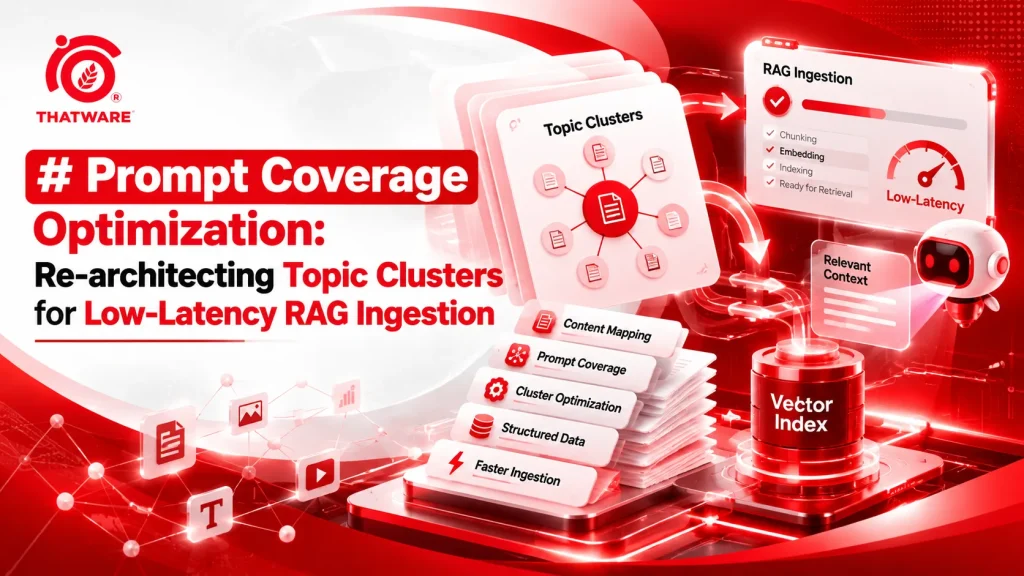
RAG systems connect language models with external knowledge sources. Instead of relying exclusively on information encoded during model training, a retrieval layer searches a connected corpus and supplies relevant passages to the generation model. This means the architecture of the underlying knowledge base directly influences what the system can retrieve and how confidently it can use that information.
A broad article may be perfectly readable to a person while remaining inefficient for retrieval. If a single passage contains several unrelated claims, the resulting representation can become semantically diluted. Conversely, highly focused information units can provide clearer retrieval targets.
This creates an important architectural shift: content should not be organized only around what subjects belong together. It should also be organized around what individual facts, answers, entities, and user prompts need to be retrieved.
This is where Prompt Coverage Optimization becomes valuable. Rather than beginning with a keyword list and expanding it into increasingly broad clusters, the process begins by identifying the questions an AI system may need to answer and then designing a knowledge architecture capable of satisfying those questions with precise, retrievable information.
The objective is not simply to produce shorter content. It is to create a knowledge environment in which every important information need has an identifiable destination.
2. Why Traditional Keyword Clustering Breaks Inside RAG Systems
2.1 Keyword Clusters Were Designed for Search, Not Retrieval Pipelines
Traditional topic clustering generally starts with a central concept and expands outward into semantically related subjects. A pillar page might address a broad topic, while supporting articles cover its components, applications, advantages, challenges, and related questions.
For human readers, this architecture can work extremely well. People can scan headings, understand transitions, follow links, and use surrounding context to interpret a statement.
A retrieval system behaves differently.
A retriever typically works with discrete chunks rather than an entire website. Content is divided into passages, converted into vector representations, indexed, and later compared with a user’s query. The system does not necessarily understand the broader editorial intention behind a page. It evaluates the information available within the retrieved representation.
That difference matters.
A topic cluster can therefore be topically coherent while being retrieval-inefficient. Several closely related concepts may be placed in the same paragraph because they make sense editorially, even though they represent different potential questions.
The resulting architecture prioritizes semantic breadth, whereas RAG often benefits from semantic precision.
2.2 The Problem of Broad Thematic Pages
Consider a hypothetical page about cloud security. It might contain sections about encryption, identity management, compliance, network security, access controls, monitoring, and incident response.
A human reader can easily understand the relationship between these subjects. A chunking system, however, may divide the page at boundaries that do not correspond to individual concepts.
One chunk could begin with encryption, transition into compliance requirements, and finish with access management. Its embedding therefore represents several ideas simultaneously.
When a user asks a highly specific question about encryption, the retrieval system may return that mixed chunk because encryption is present. Yet the passage also contains information about other subjects that is irrelevant to the immediate prompt.
This creates unnecessary retrieval noise.
2.3 Three Major Failure Modes
Diluted Context: When multiple concepts are compressed into the same retrieval unit, the semantic representation can become less specific. Important information may be present but surrounded by competing signals.
Redundant Retrieval: When the same fact appears across several broad pages, the retriever may select multiple overlapping chunks. The model then receives repeated information, consuming additional context and potentially increasing processing requirements.
Hallucination Vectors: A mixed chunk can contain incomplete facts, transitions, qualifications, and unrelated claims. If the retrieved context does not cleanly answer the question, the generation model may have to infer relationships that were never explicitly established.
These problems do not mean long-form content is inherently unsuitable for RAG. The underlying issue is architectural. Long-form information can remain useful when its internal structure provides clear semantic boundaries and retrievable units.
3. From Topic Relevance to Prompt Coverage Optimization
Traditional optimization asks whether a website adequately covers a subject. RAG-oriented optimization asks a more specific question: Can the system retrieve the right information when a user asks a particular question?
Prompt Coverage Optimization addresses this gap.
The concept involves mapping likely prompts to discrete information units before or during content development. Instead of treating a topic as one large semantic territory, the topic is decomposed into individual questions, entities, facts, relationships, definitions, procedures, and comparisons.
For example, a topic such as enterprise data security could produce prompts such as:
- What is enterprise data security?
- Which controls protect sensitive information?
- How does encryption protect stored data?
- What is the role of access management?
- How frequently should security controls be reviewed?
- What are common data security risks?
Each prompt represents a potential retrieval event.
The goal is therefore not merely to ensure that all these subjects are mentioned somewhere on a website. The goal is to make the answer to each important prompt sufficiently distinct, complete, and retrievable.
This approach changes the meaning of topical authority. A site can have hundreds of pages about a subject and still have weak prompt coverage if important questions are buried inside generalized passages.
The reverse can also be true. A carefully structured knowledge base may contain fewer words but offer stronger coverage because individual information needs are clearly addressed.
This is particularly important as Generative Engine Optimization becomes associated with visibility across systems that synthesize information rather than simply displaying ranked documents. The underlying principle is similar: information must be understandable, attributable, and contextually useful to an automated system.
Prompt coverage therefore becomes a bridge between content strategy and information retrieval. It encourages content teams to ask not only, “What should we write about?” but also, “What exact information should be retrievable when this question is asked?”
4. Fact Density: The Core Principle Behind RAG-Optimized Content
4.1 What Is Fact Density?
Fact Density describes the intentional distribution of extractable, atomic information within a defined content unit.
An atomic fact is a statement that can be independently identified and understood. It might be a statistic, rule, definition, measurement, relationship, requirement, or clearly stated conclusion.
The supplied framework proposes a benchmark of one extractable statistic or atomic fact per 150 words. This should be understood as an architectural benchmark rather than a universal law governing every RAG implementation.
The purpose of such a benchmark is to create consistency.
If every module contains one clearly identifiable information anchor and supporting explanation, the resulting corpus becomes easier to segment and evaluate. Each unit has an obvious semantic center rather than several competing centers.
4.2 Why the 150-Word Semantic Anchor Matters
A 150-word block can roughly correspond to a compact retrieval unit when tokenization, overlap, metadata, and system-specific chunking parameters are considered. The exact token count will vary according to language, formatting, terminology, and implementation.
The important idea is not the number alone. It is the alignment between content boundaries and retrieval boundaries.
If a chunk contains one dominant fact, its semantic representation can be more focused. If it contains five unrelated facts, its representation has more opportunities for ambiguity.
This is why a semantic anchor can be useful. The anchor gives the chunk a central meaning, while surrounding explanation establishes context and interpretability.

4.3 High-Signal vs. Low-Signal Content
Consider two approaches.
A low-signal passage might discuss a software platform’s performance, security, compliance capabilities, integration options, pricing model, and customer support in a single paragraph.
A high-signal module might focus exclusively on one measurable performance characteristic, explain what the measurement means, and provide the relevant conditions.
The second structure is easier to associate with a specific question.
Fact density therefore should not be confused with stuffing a paragraph with statistics. The objective is semantic concentration: a strong relationship between the information being asserted and the surrounding explanatory material.
This principle can be particularly valuable when designing content for AI Powered SEO, where information must increasingly work across conventional search systems and AI-mediated discovery environments.
5. The Mechanics of Low-Latency RAG Ingestion
5.1 Deterministic Chunking
Chunking is one of the most important stages in a RAG pipeline. Documents must be divided into manageable retrieval units before those units can be embedded and indexed.
When content has clear structural boundaries, chunking becomes more predictable.
Headings, subheadings, short modules, lists, definitions, tables, and explicit semantic sections can provide natural segmentation points. Instead of forcing a splitter to divide text based primarily on character counts, structural cues can help preserve conceptual integrity.
Deterministic chunking does not eliminate the need for configurable chunking strategies. Different corpora have different requirements. However, a well-structured source document gives the pipeline better raw material.
5.2 High-Signal Embeddings
Once content has been divided into chunks, the chunks can be transformed into vector representations.
A highly focused chunk has a relatively clear semantic center. A query about that center is more likely to establish a strong similarity relationship with the corresponding representation.
Cosine similarity is one common conceptual model for evaluating the relationship between vectors. Although actual retrieval architectures can include hybrid search, reranking, filters, sparse retrieval, metadata constraints, and other mechanisms, semantic clarity remains valuable.
If one chunk discusses only a specific compliance requirement, its representation has a clearer relationship to a query about that requirement than a chunk containing compliance, pricing, performance, and unrelated product features.
5.3 Reducing Retrieval Noise
Retrieval noise occurs when the system receives information that is related to the general subject but not necessary for answering the current prompt.
Noise can arise from duplicate content, broad passages, poorly separated concepts, excessive overlap, or weak metadata.
Reducing noise allows the retrieval layer to return fewer but more useful passages. This can improve the quality of the context supplied to the generation model.
5.4 Streamlined LLM Synthesis
After retrieval, the language model must process the supplied context and generate a response.
If the context contains unnecessary passages, repeated claims, and unrelated information, the model has more material to interpret. If the retrieved context is compact and directly relevant, synthesis can become more efficient.
This does not mean that every RAG system will automatically achieve lower latency by using smaller chunks. Retrieval and generation latency depend on many variables, including infrastructure, model selection, indexing architecture, network performance, reranking, context length, and workload.
The architectural objective is therefore to minimize unnecessary information processing, not simply to minimize word count.
6. Re-Architecting a Topic Cluster for RAG
6.1 Move From Hierarchical Articles to Modular Knowledge Architecture
A traditional content cluster often looks like a tree.
At the top sits a broad pillar topic. Beneath it are increasingly specific articles, each linked to related pages.
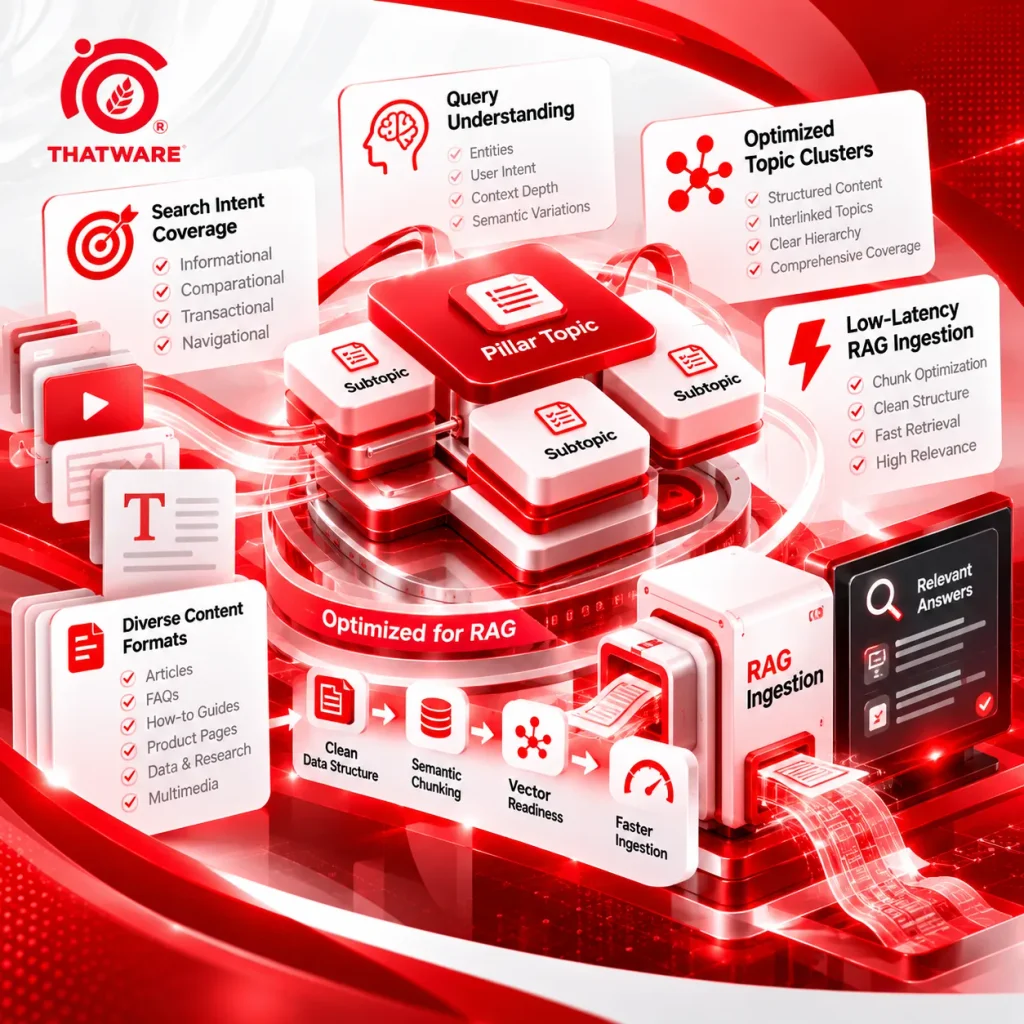
A RAG-oriented architecture can still retain this hierarchy, but it should additionally expose the underlying knowledge as smaller modules.
Think of the architecture as two layers:
Human-facing layer: Pages, articles, navigation, internal links, and editorial storytelling.
Machine-facing layer: Atomic facts, semantic modules, metadata, relationships, identifiers, and retrieval pathways.
These layers do not have to compete. The same knowledge can be presented elegantly to people while being structured precisely for machines.
6.2 Step 1: Atomic Fact Extraction
Begin by taking an existing page and identifying every independent assertion.
Suppose a page states:
“Our software improves system performance, helps with compliance, and reduces operational overhead by 40% across global teams.”
This sentence contains multiple claims.
Instead of treating the sentence as one information object, separate the claims.
For example:
“Our system reduces operational overhead by 40%.”
That statement can become the central anchor of a focused module.
Other claims can receive their own modules if they are sufficiently important and independently retrievable.
Atomic extraction also makes content auditing easier. Teams can identify unsupported claims, duplicate facts, contradictory statements, and outdated information at the individual assertion level.
6.3 Step 2: Map Questions to Facts
After extracting facts, identify the prompts each fact can answer.
A useful mapping may contain four columns:
| Prompt | Atomic Fact | Supporting Context | Node ID |
| What is the overhead reduction? | 40% reduction | Conditions and scope | FACT-001 |
| What does the system improve? | Operational efficiency | Explanation | FACT-002 |
| Which teams use the system? | Global teams | Deployment context | FACT-003 |
This creates an explicit relationship between user demand and available information.
6.4 Step 3: Build Modular Nodes
Each node should have one identifiable purpose.
A node might define a concept, answer a question, state a metric, explain a process, compare two alternatives, or establish a relationship between entities.
The important point is that the node should not require the retrieval of several unrelated paragraphs before its meaning becomes clear.
6.5 Step 4: Connect Nodes Through Metadata
Modularity does not mean isolation.
Each node can include identifiers representing its parent topic, entity, content type, version, source, and relationships with other nodes.
Metadata can therefore preserve the broader knowledge graph while allowing retrieval to remain granular.
A child node can answer a narrow prompt while its metadata identifies the larger subject to which it belongs. If more context is required, a retrieval system can use those relationships to expand the context deliberately.
7. The 150-Word Structured Module Formula
A practical implementation can divide each semantic module into four components.
| Section | Purpose | Approx. Word Count |
| Context Hook | Establishes the entity and semantic environment | ~40 |
| Atomic Fact | States the statistic, rule, or core metric | ~30 |
| Mechanics / Proof | Explains how or why the fact matters | ~65 |
| Metadata Tag | Establishes parent/child relationship information | ~15 |
Context Hook
The opening should establish what the module is about.
It should identify the entity, concept, or process and place the information within its relevant semantic environment.
The context should be sufficient for the module to stand independently if retrieved without the entire article.
Atomic Fact
The central claim should be explicit.
Avoid hiding the key fact behind multiple introductory sentences. If the module exists to answer a particular question, the answer should be identifiable without excessive interpretation.
This is especially important for statistics, definitions, thresholds, requirements, and measurable outcomes.
Mechanics / Proof
The supporting material explains how the fact works or why it matters.
This prevents the module from becoming a collection of disconnected statements. Context gives the atomic fact meaning while remaining focused on the same semantic center.
Metadata Tag
The final component can identify relationships such as:
- Parent topic
- Child topic
- Entity
- Fact type
- Source
- Version
- Related node
- Content category
The exact implementation depends on the RAG architecture, database, and retrieval framework.
The purpose is to make relationships explicit rather than forcing the retrieval system to infer everything from prose.
8. Parent-Child Relationship Mapping for Hierarchical Retrieval
A flat modular architecture does not mean a flat knowledge model.
In fact, parent-child relationships become more important when information is divided into small retrieval units.
Imagine a knowledge base about enterprise cybersecurity.
The parent entity could be Enterprise Cybersecurity.
Child nodes might include:
- Identity management
- Encryption
- Network security
- Threat detection
- Incident response
- Compliance
Within encryption, additional child nodes could address data at rest, data in transit, key management, and encryption standards.
A retrieval system can therefore locate a highly specific node while retaining knowledge of its broader context.
This approach separates two problems that are often mixed together: finding the right information and providing enough context to interpret it.
A query may initially require only a child node. If the answer depends on the parent topic, metadata can help the system retrieve the necessary surrounding context.
Hard identifiers can support this architecture. For example:
SEC-ENC-001
could identify an encryption fact, while metadata associates it with:
SEC-ENC
and ultimately:
SEC
This kind of relationship mapping can support hierarchical retrieval, filtering, context expansion, version control, and knowledge-base maintenance.
The architecture becomes both granular and connected.
9. Building a Prompt Coverage Map
A prompt coverage map provides a practical way to determine whether a topic cluster is sufficiently prepared for retrieval.
Start with the primary topic and identify the entities associated with it. Then list the important facts and relationships that users may want to know.
Next, convert those information needs into representative prompts.
For example, a topic about enterprise backup systems might include prompts such as:
- What is an enterprise backup system?
- How frequently should backups occur?
- What types of data can be backed up?
- What is the difference between full and incremental backup?
- How are backups restored?
- How long should backup data be retained?
Each prompt should have a corresponding information node.
The next step is gap analysis.
If five important prompts exist but only three have dedicated, high-quality retrieval nodes, the topic has a prompt coverage gap.
Redundancy should also be measured. If five nodes answer essentially the same prompt, the architecture may be unnecessarily fragmented.
An effective map therefore seeks both coverage and distinctiveness.
A useful workflow is:
- Identify the main topic.
- Identify relevant entities.
- Extract atomic facts.
- Generate representative prompts.
- Match prompts with facts.
- Identify uncovered prompts.
- Consolidate duplicate information.
- Assign node identifiers.
- Establish parent-child relationships.
- Test retrieval using representative queries.
This makes topic architecture measurable rather than purely editorial.
10. Measuring the Effectiveness of a RAG-Optimized Topic Cluster
Traditional content measurement often focuses on rankings, impressions, clicks, traffic, and conversions. Those metrics remain useful, but RAG-oriented architectures require additional evaluation.
Retrieval precision measures whether the retrieved content is actually relevant to the query.
Retrieval relevance examines the degree to which the selected passages address the user’s information need.
Chunk-level answerability asks whether an individual chunk contains enough information to answer the question it is associated with.
Redundant retrieval rate helps identify situations where multiple retrieved chunks repeat substantially the same information.
Context utilization evaluates whether the model actually uses the supplied information rather than receiving large quantities of unnecessary context.
Retrieval latency measures how quickly the retrieval system identifies relevant information.
Time-to-first-token (TTFT) can help evaluate the time between request initiation and the beginning of model output.
Token consumption provides another lens for understanding how much context is being processed.
Prompt coverage measures how comprehensively important questions are mapped to useful information nodes.
Fact retrieval accuracy evaluates whether the system retrieves and communicates the correct underlying information.
External acquisition tactics such as Link Building Services may remain valuable for conventional authority and discovery, but they do not replace the need for a clean information architecture inside a RAG knowledge base.
The broader lesson is that RAG content should be evaluated as an information system, not solely as a collection of webpages.
11. Common Mistakes When Re-Architecting Content for RAG
One common mistake is assuming that every chunk should have exactly the same number of words. A word-count benchmark is useful as an architectural reference, but meaning should determine boundaries. A concept that requires more explanation should not be artificially compressed merely to satisfy a numerical target.
Another mistake is packing several independent facts into one module. This recreates the same semantic dilution that the restructuring process is intended to eliminate.
The opposite problem is removing too much context. An atomic fact without sufficient explanation may become ambiguous when retrieved independently.
Duplicate nodes are another major issue. If the same claim appears in several modules, retrieval may become redundant and content governance becomes more difficult.
Inconsistent metadata can also weaken hierarchical retrieval. If different teams use different identifiers, naming conventions, or relationship models, the knowledge base can become difficult to maintain.
Keyword density should not become the new optimization obsession either. RAG optimization is not about replacing one form of stuffing with another. It is about creating meaningful, retrievable information structures.
Finally, content should not be considered RAG-ready simply because it has been divided into small paragraphs. Actual retrieval testing is essential.
12. A Practical Workflow for RAG-Ready Topic Cluster Transformation
A repeatable transformation workflow can be summarized as:
Audit → Extract → Atomize → Map Prompts → Structure → Tag → Embed → Retrieve → Evaluate → Refine
Audit
Review existing pages, identify broad passages, duplicate claims, unsupported assertions, and weak semantic boundaries.
Extract
Identify the important facts, definitions, relationships, statistics, and rules contained within the content.
Atomize
Separate independent claims into discrete information units.
Map Prompts
Determine the questions each information unit can answer.
Structure
Build focused modules with clear semantic anchors.
Tag
Assign metadata, identifiers, relationships, sources, and other retrieval-relevant attributes.
Embed
Process the modules through the selected embedding and indexing pipeline.
Retrieve
Test representative prompts against the knowledge base.
Evaluate
Measure relevance, precision, redundancy, latency, answerability, and context utilization.
Refine
Improve modules that produce weak retrieval results, duplicate answers, ambiguous context, or unnecessary retrieval volume.
For organizations with extensive existing content libraries, new seo techniques can also form part of the broader optimization environment, provided the technical content architecture is aligned with retrieval requirements rather than treated as a conventional ranking exercise alone.
The workflow should be continuous. As products, policies, statistics, and user questions change, the knowledge architecture must evolve with them.
13. How ThatWare Approaches RAG-Oriented Search Architecture
For organizations looking to adapt their digital information architecture to AI-driven discovery, ThatWare approaches search through an AI-centric framework that extends beyond conventional optimization. We combine LLM, AEO, GEO, entity optimization, semantic engineering, and AI-driven analysis to help businesses strengthen their visibility across search engines and AI answer environments.
At ThatWare, we analyze competitor ecosystems, evaluate a business’s digital footprint, and study how AI systems interpret, retrieve, and summarize information. We use these insights to develop strategic guidance around semantic relevance, entity relationships, content architecture, and AI-driven search visibility.
Our approach is particularly relevant to RAG-era content architecture because we understand that modern AI visibility depends on how information is structured and understood at multiple levels, including entities, relationships, facts, context, and user intent.
Our broader service ecosystem includes professional seo services agency solutions alongside LLM-focused optimization, AI search visibility, entity and semantic authority, and search engineering. We integrate these capabilities to help businesses build a stronger foundation for both traditional search and emerging AI-powered discovery environments.
For businesses undertaking a broader digital transformation, we focus on connecting content architecture with the way modern AI systems retrieve, interpret, and surface information. Rather than treating AI discovery as a separate channel, we approach search architecture as an evolving information engineering discipline designed to help brands remain discoverable, understandable, and authoritative as search continues to evolve.
14. Conclusion: Designing Knowledge for Retrieval, Not Just Discovery
The emergence of RAG changes the requirements placed on digital information.
Content can no longer be evaluated only by whether it is comprehensive, readable, keyword-relevant, or capable of attracting conventional search traffic. In AI-mediated environments, information must also be precise enough to retrieve, coherent enough to interpret, and structured enough to connect with related knowledge.
Re-architecting topic clusters therefore means moving beyond broad thematic grouping.
The stronger model begins with atomic facts, maps those facts to likely prompts, organizes them into focused semantic modules, establishes parent-child relationships through metadata, and evaluates the resulting system through retrieval performance.
Fact density provides a useful framework for thinking about semantic concentration. Deterministic chunking can create more predictable retrieval boundaries. High-signal embeddings can improve the relationship between queries and information units. Prompt coverage can reveal missing answers, while retrieval testing can expose redundancy and ambiguity.
The proposed 150-word semantic anchor should not be treated as an inflexible technical law. Different RAG systems require different chunking strategies, token budgets, overlap configurations, models, and retrieval mechanisms. Its real value is as a disciplined way to think about the relationship between facts and retrieval units.
Ultimately, the goal is not to write for machines instead of people. It is to build information that works for both.
Human readers need clarity, context, flow, and useful explanations. Retrieval systems need semantic precision, explicit relationships, identifiable facts, and predictable information boundaries.
The future-ready content architecture combines both.
When topic clusters are re-engineered around prompt coverage rather than keyword proximity, content becomes more than a collection of pages. It becomes a structured knowledge environment—one capable of supporting accurate retrieval, efficient context assembly, and increasingly intelligent AI-driven discovery.