
SUPERCHARGE YOUR ONLINE VISIBILITY! CONTACT US AND LET’S ACHIEVE EXCELLENCE TOGETHER!
The way consumers discover and evaluate products is changing. Traditional ecommerce discovery has largely depended on search engine rankings, paid advertisements, social media promotions, marketplace listings and product review websites. A shopper looking for a new smartphone, skincare product, home appliance or fashion accessory would typically enter a search query, browse multiple websites, compare specifications and eventually decide which product or brand best meets their requirements.
AI-powered search and conversational discovery are introducing another layer to this process. Instead of navigating several websites independently, consumers can now describe what they need in natural language and ask platforms such as ChatGPT and Google Gemini to identify suitable products, compare alternatives, explain product differences and narrow down purchasing options.

For ecommerce brands, this creates a new challenge: being available online is no longer enough. Businesses also need to understand whether AI systems recognise their products, accurately interpret their brand identity, include their offerings in relevant product comparisons and recommend them when shoppers are looking for solutions.
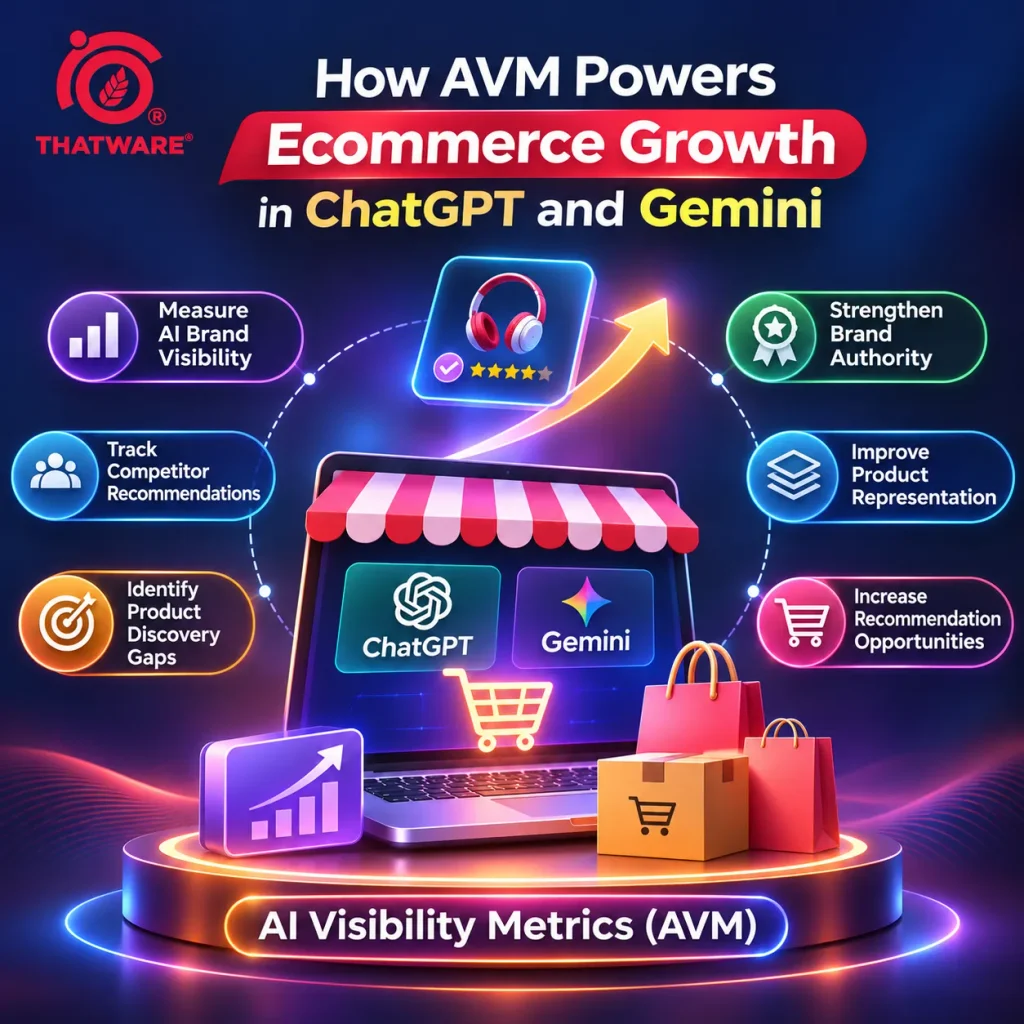
AI Visibility Metrics help ecommerce brands measure how they appear across AI-powered discovery environments, identify whether their products and brand are being recognised, evaluate their presence against competitors and uncover opportunities to strengthen their representation in AI-generated recommendations.
This is where ThatWare’s AI Visibility Metrics (AVM) framework becomes relevant. Rather than relying exclusively on conventional SEO indicators such as keyword rankings, impressions and website traffic, AVM provides a structured way to assess how brands are represented within sampled AI-generated answers. It examines dimensions such as presence, citations, authority, consistency and position to help businesses understand the quality of their AI visibility.
For ecommerce companies, these measurements can offer valuable insights into a rapidly changing discovery environment. They can reveal whether a brand appears when consumers search for specific product categories, whether its products are included in comparison-based queries, whether competitors receive stronger recommendations and whether the information associated with its products is sufficiently clear and consistent.
The objective is not simply to make an ecommerce brand appear more frequently in AI responses. It is to help the brand become a relevant, accurately represented and credible option when potential customers are researching products and evaluating their purchasing choices.
The Changing Nature of Ecommerce Product Discovery
Ecommerce discovery has traditionally been organised around search engines and digital marketplaces. Consumers entered keywords such as “best wireless headphones under £100”, “organic face moisturiser for sensitive skin” or “energy-efficient washing machines”. Search engines returned product pages, category pages, reviews and shopping listings that users could explore.
This approach remains important, but AI-assisted discovery introduces a more conversational and contextual process.
A consumer might now ask ChatGPT:
- Which wireless headphones are suitable for long working hours?
- Compare three skincare brands for sensitive skin.
- What should I consider before buying an air purifier for a small apartment?
- Which laptop offers good battery life for business travel?
- Recommend durable kitchen appliances for a family household.
These questions contain more than a product keyword. They communicate the consumer’s requirements, preferences, budget, intended usage and expectations.
AI systems can interpret these requirements and help shoppers evaluate products through conversational responses, comparison tables, recommendations and links to relevant sources or merchants.
From keyword-based searches to intent-driven discovery
Traditional search queries are often concise and keyword-focused. Conversational product discovery tends to be more descriptive.
Consider the difference:
Traditional search: Best running shoes for women.
Conversational search: I need running shoes for women that provide good cushioning for daily road running, have a comfortable fit and are suitable for beginners.
The second query provides more contextual information. It gives an AI system additional criteria for identifying relevant products.
For ecommerce brands, this means visibility cannot be assessed only through broad category keywords. Businesses need to understand how their products appear across different combinations of customer needs and product attributes.
A running shoe brand may have strong visibility for its own brand name but remain absent from AI-generated answers about beginner running shoes, cushioned footwear or everyday road-running products.
This distinction matters because consumers do not always know which brand they want before beginning their research.
The growing role of AI-assisted shopping
AI-assisted shopping is becoming more sophisticated. ChatGPT supports product discovery, visual product exploration and shopping research experiences that help consumers compare options. Google is also bringing Gemini-powered experiences and its Shopping Graph into shopping journeys.
OpenAI describes how ChatGPT can surface products based on shopper intent, structured product information and other relevant sources. Google’s shopping ecosystem combines AI capabilities with extensive product information to support product discovery.
These developments indicate that product discovery is becoming increasingly dependent on the quality, relevance and availability of product information.
For ecommerce brands, this creates several important questions:
- Does the AI system recognise the brand?
- Does it understand the products the business sells?
- Does the product match the shopper’s requirements?
- Does the brand appear in relevant recommendations?
- Are the available product details accurate?
- Do competing brands receive stronger visibility?
- Does the brand appear consistently across different product-related questions?
These questions require a measurement approach that goes beyond traditional website analytics.
Why traditional ecommerce SEO metrics are no longer sufficient
Traditional SEO remains an important part of ecommerce growth. Product page optimisation, technical SEO, structured data, internal linking, content development and authoritative backlinks continue to contribute to online discoverability.
However, traditional SEO metrics do not fully explain how a brand is represented within AI-generated responses.
For example, an ecommerce business may rank well for a particular product keyword but still fail to appear when a shopper asks an AI assistant for recommendations in that category.
Similarly, a brand may receive substantial organic traffic but have limited visibility in comparative product queries.
This creates a measurement gap.
| Traditional ecommerce measurement | AI visibility measurement |
| Keyword rankings | Brand presence in AI-generated responses |
| Organic impressions | Visibility across sampled AI prompts |
| Website clicks | AI references and discovery opportunities |
| Backlink quantity and quality | Authority and source credibility associated with brand representation |
| Product page traffic | Product and brand inclusion in relevant AI responses |
| Competitor keyword rankings | Competitor presence in AI recommendations |
| Search engine visibility | Cross-platform AI visibility patterns |
These measurements serve different purposes. AI Visibility Metrics should complement traditional SEO analytics rather than replace them.
What Are AI Visibility Metrics and Why Do Ecommerce Brands Need Them?
AI Visibility Metrics are measurements used to evaluate how effectively a brand appears, is represented, referenced and positioned within AI-powered search and answer environments.
For an ecommerce company, this means understanding whether its brand and products are discoverable when consumers ask AI systems questions related to the categories, features and solutions it offers.
ThatWare’s AI Visibility Metric, or AVM, is a proprietary analytical framework designed to measure brand visibility across AI search environments.
The framework moves beyond a basic mention count. It considers multiple dimensions of visibility to provide a more meaningful understanding of how an entity performs within sampled AI-generated answers.
Understanding AVM through an ecommerce example
Imagine an ecommerce company selling premium air purifiers.
The company has an established website, a wide product catalogue and strong organic rankings for several commercial keywords. However, its marketing team discovers that ChatGPT and Gemini frequently recommend competing brands when users ask questions such as:
- Which air purifier is best for a two-bedroom apartment?
- What air purifier is suitable for people concerned about indoor dust?
- Compare premium air purifiers for residential use.
- Which air purifier offers good performance without excessive noise?
The company may have good conventional search visibility but weak AI recommendation visibility.
An AVM assessment can investigate this gap by testing relevant prompts, observing brand representation, evaluating supporting references and comparing the company’s visibility against competing businesses.
The findings can help the ecommerce team understand whether the problem relates to limited brand presence, weak supporting citations, inconsistent product information, insufficient authority or poor positioning within AI-generated responses.
Why ecommerce companies need a dedicated AI visibility measurement approach
Ecommerce businesses operate in competitive environments where consumers often compare several alternatives before making a purchase.
A brand may lose a discovery opportunity even when its website is technically accessible and its products are available for purchase.
For example, when a consumer asks an AI assistant to recommend a suitable moisturiser for dry skin, the answer may include several competing products. If one brand is repeatedly included while another is absent, the difference can influence which products the consumer investigates further.
An ecommerce company needs to understand these patterns rather than assume that conventional search visibility automatically translates into AI discovery.
AI Visibility Metrics can help businesses:
- Measure whether their brands appear in relevant AI-generated product discussions.
- Understand how often products are included in category-specific recommendations.
- Identify competitors receiving stronger AI visibility.
- Evaluate whether brand mentions are supported by credible references.
- Assess consistency across different prompts and AI environments.
- Identify product categories where visibility remains weak.
- Develop more focused content and authority-building strategies.
- Monitor changes in AI-generated brand representation over time.
The value lies in turning scattered AI responses into structured observations that businesses can analyse and act upon.
How ChatGPT and Gemini Influence Ecommerce Product Recommendations
ChatGPT and Gemini provide different AI-assisted discovery experiences, but both are relevant to ecommerce brands seeking visibility beyond conventional search listings.
Understanding their shopping environments is important before developing an AI visibility measurement strategy.
How ChatGPT helps consumers discover products
ChatGPT can help consumers identify products based on their requirements, compare alternatives and understand the differences between available options.
A shopper might describe a budget, preferred product features, intended usage and personal requirements. ChatGPT can then help narrow down relevant options.
Its shopping experiences can include product imagery, descriptions, prices, product comparisons and merchant links.
OpenAI’s published guidance explains that product selection can consider the shopper’s intent and context, structured metadata from first-party and third-party providers, product information and other relevant content.
For ecommerce brands, this makes product information quality particularly important.
A product page that clearly communicates its specifications, materials, dimensions, compatibility, intended use and differentiating features provides more useful information than a page containing only a product name and a short promotional description.
However, product information alone does not guarantee recommendation placement. Relevance to the shopper’s request and the information available to the AI system also matter.
How Gemini supports ecommerce discovery
Google Gemini is another important environment for conversational product discovery.
Google’s shopping ecosystem combines AI capabilities with its Shopping Graph, which contains extensive product information. Google’s AI-powered shopping experiences can help consumers explore product options, compare features and discover products that match their requirements.
For ecommerce companies, this reinforces the importance of maintaining accurate product information across their websites and relevant commerce data sources.
A business selling furniture, for instance, should provide clear information about:
- Product dimensions.
- Material composition.
- Available finishes.
- Weight capacity.
- Assembly requirements.
- Room suitability.
- Care instructions.
- Warranty information.
- Pricing and availability.
A product description that simply says “premium modern furniture” provides limited practical information.
A detailed description explaining the material, measurements, design characteristics and intended use gives consumers and information retrieval systems more useful context.
Why visibility may differ between ChatGPT and Gemini
Ecommerce brands should not assume that visibility in one AI platform automatically means visibility in another.
Different AI environments can use different models, retrieval systems, product data sources, ranking processes and interface features.
A brand may appear prominently in a ChatGPT response but receive limited visibility in Gemini for a similar query.
There may also be differences between:
- General informational questions.
- Product comparison queries.
- Commercial recommendation prompts.
- Brand-specific searches.
- Product attribute searches.
- Local or merchant-related searches.
This is why cross-platform measurement is important.
An ecommerce company should evaluate its visibility across relevant AI environments rather than relying on a single successful response.
Recommendation does not mean endorsement
An important distinction must be maintained when evaluating AI recommendations.
An AI platform mentioning a product does not necessarily mean it endorses that product or has independently verified every product claim.
Similarly, an AI-generated product recommendation is not a guarantee of commercial success.
The objective of AI visibility measurement is to evaluate observed brand representation, identify patterns and improve the quality of information available about the business and its products.
ThatWare’s AVM framework should therefore be understood as a diagnostic and analytical methodology, not as a guarantee that an AI platform will recommend a particular brand.
The Five Core AVM Dimensions and Their Importance for Ecommerce Brands
A useful AI visibility measurement system should examine more than whether a company appears in an AI-generated answer.
ThatWare’s documented AVM framework evaluates five core dimensions: Presence, Citation, Authority, Consistency and Position.
Each dimension provides a different perspective on ecommerce discoverability.
Presence: Is Your Ecommerce Brand Appearing in AI Answers?
Presence measures whether a brand appears within relevant AI-generated responses.
For ecommerce companies, presence is the foundation of AI discoverability.
A business may have thousands of product pages and a large online catalogue, but if its brand does not appear when consumers ask relevant product questions, it may be missing important discovery opportunities.
Consider a company selling ergonomic office chairs.
Relevant prompts might include:
- Which ergonomic chairs are suitable for working from home?
- Recommend office chairs for people who sit for extended periods.
- What are some adjustable office chair brands?
- Compare affordable ergonomic chairs for home offices.
- Which brands offer ergonomic chairs with lumbar support?
If competing brands repeatedly appear while the company remains absent, the business has a measurable presence gap within those sampled queries.
How AVM helps measure ecommerce presence
AVM can help evaluate:
- Whether the brand appears in relevant product-category responses.
- Whether products are mentioned for specific features.
- Whether the company appears in commercial recommendation prompts.
- Whether the brand is recognised in informational product discussions.
- Whether visibility extends beyond branded searches.
- Whether competitors dominate important product-related queries.
This distinction between branded and non-branded visibility is especially important.
A company that appears only when someone searches for its exact name may have strong brand recognition but limited discovery among consumers who are still exploring available options.
For ecommerce growth, visibility across non-branded product searches can be particularly valuable.
Citation: Are Your Products and Brand Supported by Credible Sources?
Citation evaluates the presence and strength of supporting references associated with AI-generated brand representation.
For ecommerce companies, this dimension helps investigate whether product or brand information is supported by relevant sources.
Potential sources include:
- Official product pages.
- Manufacturer specifications.
- Reputable product reviews.
- Industry publications.
- Retailer listings.
- Independent comparison articles.
- Relevant product testing resources.
- Authoritative editorial coverage.
Suppose an AI response recommends a particular blender and refers to its motor capacity, jar material and warranty.
An ecommerce brand should investigate whether those details are available through reliable sources and whether the information is consistent.
If product claims appear only on an outdated promotional page, the business may have an information quality problem.
How AVM helps ecommerce businesses understand citation gaps
A citation-focused assessment can help identify:
- Whether the brand is associated with relevant external references.
- Whether important product claims have credible supporting information.
- Whether the website provides sufficiently detailed product documentation.
- Whether independent publications discuss the brand.
- Whether competitors have stronger reference coverage.
- Whether AI-generated answers use accurate and relevant sources when discussing the product category.
Citation analysis should not be confused with simply counting backlinks.
A backlink profile measures links pointing towards a website. AI visibility citation analysis examines the sources and references associated with observed AI-generated answers.
Both can provide useful information, but they answer different questions.
Authority: Does Your Ecommerce Brand Have a Credible Market Presence?
Authority examines the credibility signals associated with a brand and its representation in AI-generated answers.
For ecommerce businesses, authority is not established through promotional messaging alone.
Consumers often rely on independent reviews, product testing, specialist publications, customer experiences and transparent product information when evaluating a business.
AI systems may also encounter these different sources when retrieving information about products and brands.
Consider two ecommerce brands selling the same category of kitchen appliances.
Brand A has detailed product specifications, transparent warranty information, independent product reviews and consistent brand information across relevant sources.
Brand B has limited external coverage, inconsistent product descriptions and mostly promotional content.
The two brands may have similar websites, but the quality and breadth of their available supporting information differ.
How AVM helps evaluate authority-related visibility
AVM can help ecommerce companies investigate:
- Whether AI responses associate the brand with relevant expertise.
- Whether the brand appears alongside established competitors.
- Whether external references support its product positioning.
- Whether the brand is recognised for specific product categories.
- Whether its representation is supported by credible information.
- Whether authority-related gaps correspond with weaker AI visibility.
For ecommerce companies, authority development should focus on genuine product quality, transparent business information, reliable customer experiences and credible independent coverage.
It should not rely on manufacturing reviews or attempting to manipulate AI responses.
Consistency: Is Your Brand Recognised Across Different Product Queries?
Consistency measures how reliably a brand appears across different relevant queries and contexts.
This is particularly useful for ecommerce businesses because shoppers rarely describe a product in exactly the same way.
A consumer looking for a mattress may ask:
- Which mattress is best for a small apartment?
- Recommend a medium-firm mattress for everyday use.
- What should I look for when buying a memory foam mattress?
- Which mattress brands offer different firmness options?
- Compare mattresses for people who prefer additional support.
An ecommerce brand may appear for one query but remain absent from the others.
This could indicate that its AI visibility is limited to a narrow set of topics.

How AVM helps measure consistency
A structured assessment can compare brand representation across:
- Different product categories.
- Different product attributes.
- Informational and commercial queries.
- Brand-specific and non-branded queries.
- Different wording of similar questions.
- Different AI platforms.
- Repeated observations over time.
The results can reveal whether an ecommerce brand has broad category visibility or only occasional appearances.
Consistency is important because a single successful AI response does not establish dependable discoverability.
Brands need to understand recurring patterns rather than draw conclusions from isolated results.
Position: Where Does Your Brand Appear in AI Recommendations?
Position evaluates where a brand appears within an AI-generated response or recommendation structure.
In ecommerce, the distinction between being prominently recommended and being mentioned incidentally can be significant.
Imagine that a shopper asks for recommendations for premium wireless headphones.
The AI response identifies three brands in its main recommendations and mentions five additional alternatives later in the discussion.
All eight brands have some visibility, but their positions are not equivalent.
A brand included in the main shortlist may receive greater attention than a brand mentioned only as a secondary alternative.
How AVM helps evaluate recommendation positioning
A position-focused assessment can investigate:
- Whether the brand appears among the primary recommendations.
- Whether it is included in comparison lists.
- Whether it appears as an alternative.
- Whether it is mentioned near the beginning or later in an answer.
- Whether competitors consistently occupy more prominent positions.
- Whether the brand’s position changes across query types.
This information helps ecommerce businesses understand the difference between basic visibility and meaningful recommendation prominence.
Position should always be interpreted within the context of the response. A recommendation appearing first is not automatically the best recommendation for every shopper.
The consumer’s stated requirements and the suitability of the product remain important.
How AVM Helps Ecommerce Brands Identify Product Discovery Gaps
One of the most useful applications of AVM is identifying where a brand is missing from AI-generated product discovery.
Ecommerce companies often concentrate their optimisation efforts on products that already receive traffic or generate sales.
However, there may be entire product categories, attributes or customer needs where the brand is not being recognised.
AVM can help expose these gaps through structured prompt-based analysis.
Category-level visibility gaps
Suppose an ecommerce business sells:
- Office furniture.
- Ergonomic chairs.
- Standing desks.
- Monitor stands.
- Desk accessories.
Its brand may appear frequently when users ask about office furniture generally but remain absent from more specific queries about adjustable standing desks.
This indicates that broad category visibility does not necessarily translate into visibility across every product segment.
A category-level AVM assessment can help businesses identify which product groups receive stronger AI representation and which require further investigation.
Product attribute visibility gaps
Consumers often search for products based on attributes rather than product names.
Examples include:
- Waterproof jackets.
- Hypoallergenic skincare.
- Energy-efficient appliances.
- Lightweight travel luggage.
- Recycled-material footwear.
- Noise-cancelling headphones.
An ecommerce brand may sell products with these characteristics but fail to appear when users ask questions about them.
This can happen when product information is incomplete, poorly organised, difficult to interpret or insufficiently represented across relevant sources.
AVM can help identify the attributes associated with weak brand visibility.
The business can then review whether its product pages, category descriptions and supporting content adequately explain those characteristics.
Use-case visibility gaps
Product discovery is often driven by the situation in which a consumer intends to use the product.
For example, a laptop retailer may sell devices suitable for:
- Business travel.
- University students.
- Graphic design.
- Remote working.
- Everyday office use.
- Gaming.
If its products are visible only for generic laptop searches, it may be missing more specific discovery opportunities.
AVM can help identify whether the brand appears across relevant use-case prompts.
The resulting insights can inform product categorisation, buying guides, comparison content and product descriptions.
Competitor visibility gaps
A business should not evaluate AI visibility in isolation.
Its performance needs to be interpreted in relation to competing brands.
For example, three ecommerce companies may sell premium air purifiers.
When consumers ask ChatGPT or Gemini for recommendations, Brand A may appear frequently, Brand B may appear occasionally and Brand C may remain absent.
An AVM-based competitor assessment can help determine:
- Which competitors appear most frequently.
- Which brands receive stronger citation support.
- Which brands occupy prominent positions.
- Which product categories favour particular competitors.
- Where the business has opportunities to improve its representation.
This creates a more useful competitive intelligence framework than simply checking which competitor ranks first on Google.
How AVM Helps Ecommerce Brands Understand Different Shopping Intents
Not all product-related searches have the same commercial purpose.
Some consumers are gathering information. Others are comparing options. Some already know what they want and are evaluating where to purchase it.
An effective AI visibility strategy should account for these differences.
Informational intent
Informational queries occur when shoppers want to understand a product category or learn about a particular feature.
Examples:
- What is the difference between ceramic and stainless-steel cookware?
- How does an air purifier work?
- What features should I consider when buying a laptop?
- Are memory foam mattresses suitable for everyday use?
For ecommerce brands, these questions create opportunities to establish relevance within the broader product category.
A company may not receive an immediate product recommendation, but it can improve its discoverability by publishing useful educational content supported by accurate product information.
AVM can help determine whether the brand appears in relevant informational discussions.
Commercial investigation intent
Commercial investigation occurs when consumers compare products before making a purchase.
Examples:
- Compare cordless vacuum cleaners for a medium-sized apartment.
- Which running shoes provide good cushioning?
- What are the differences between two popular smartwatch brands?
- Which skincare brands offer fragrance-free moisturisers?
This stage is particularly important because consumers are narrowing down their options.
AVM can help ecommerce businesses evaluate whether their brands and products appear in comparison-oriented prompts.
If competitors repeatedly receive recommendations while the business is absent, the company can investigate its content coverage, product information and external authority.
Transactional intent
Transactional queries indicate stronger purchasing intent.
Examples:
- Where can I buy this model of coffee machine?
- Which online stores sell genuine branded headphones?
- Find a laptop under my budget with these specifications.
- Which merchant offers this product with a suitable warranty?
For these queries, product availability, price accuracy, merchant information, shipping conditions and product identifiers can become particularly relevant.
An ecommerce business should ensure that these details are maintained accurately across its website and applicable commerce data sources.
AVM can help measure whether the brand or merchant is visible across selected transactional prompts.
However, a visibility score should not be interpreted as proof of sales or purchase conversion. Those outcomes need to be measured separately through ecommerce analytics.
Navigational intent
Navigational queries occur when shoppers already know the brand or product they want.
Examples:
- Tell me about Brand X’s latest headphones.
- Where can I find Brand Y’s official skincare collection?
- Compare the different models offered by Brand Z.
A brand that performs well for navigational queries but poorly for non-branded discovery may have strong existing recognition but limited ability to attract new shoppers.
AVM can help separate these visibility patterns so that marketing teams do not mistake branded recognition for broad market discoverability.
Product Data Quality: A Fundamental Requirement for AI Ecommerce Visibility
AI visibility cannot be improved through content strategy alone.
Ecommerce brands also need to maintain accurate and well-structured product information.
When an AI system encounters incomplete or contradictory product details, it may have difficulty identifying which product matches a consumer’s requirements.
This makes product data management an important part of AI search readiness.
Create complete product descriptions
Every important product page should provide clear and specific information.
A useful product description should cover:
- Product name.
- Brand.
- Product category.
- Main features.
- Materials and composition.
- Dimensions and weight.
- Available sizes or variants.
- Compatibility information.
- Intended use.
- Technical specifications.
- Care instructions.
- Warranty information.
For example, a product description stating “premium travel backpack” communicates very little.
A more informative description might explain that the backpack has a 28-litre capacity, a dedicated laptop compartment, water-resistant fabric, adjustable shoulder straps and multiple organisational pockets.
The second description provides more useful information for both consumers and information systems.
Use structured product data
Structured data helps search engines interpret product information in a more organised format.
Ecommerce businesses should review applicable Schema.org Product and Offer markup.
Depending on the product and implementation, relevant properties may include:
- Product name.
- Description.
- Brand.
- SKU.
- GTIN.
- Image.
- Product variant.
- Price.
- Currency.
- Availability.
- Seller information.
- Shipping details.
- Return policy.
- Aggregate ratings and reviews, where eligible and accurately represented.
Google’s product structured data documentation provides guidance on product snippets and merchant listing experiences.
Structured data should accurately reflect the visible information on the page. It should never be used to communicate product attributes that are not genuinely supported.
It is also important to understand that structured data does not guarantee inclusion in an AI recommendation.
Its purpose is to improve the clarity and machine-readability of product information within supported search and commerce environments.
Maintain consistency between product feeds and website information
An ecommerce business may distribute product information through multiple systems:
- Its own website.
- Ecommerce platforms.
- Merchant feeds.
- Retail marketplaces.
- Product comparison websites.
- Affiliate networks.
- Third-party product catalogues.
If product prices, descriptions, availability or specifications differ across these sources, consumers may encounter conflicting information.
AI systems may also encounter different versions of the same product information.
Businesses should therefore establish processes for maintaining consistency across important product data sources.
Use accurate product identifiers
Product identifiers help distinguish one product from another.
Depending on the category, useful identifiers may include:
- GTIN.
- UPC.
- EAN.
- ISBN.
- MPN.
- SKU.
These identifiers can help distinguish product models, sizes, colours and variants.
For example, two laptops may have almost identical names but different processors, memory configurations and storage capacities.
A clear product identity helps prevent confusion between these versions.
Improve product variant information
Product variants are especially important for fashion, footwear, electronics, furniture and home appliances.
A product may have several colours, sizes, capacities or configurations.
If variant information is unclear, consumers may receive recommendations for an unsuitable version.
Ecommerce businesses should maintain clear relationships between parent products and their variants, with accurate availability and specification details for each relevant option.
How Content Optimisation Supports AI Product Recommendations
Product data is essential, but ecommerce brands also need useful content that addresses the questions consumers ask during product research.
AI systems may retrieve information from product pages, buying guides, comparison articles, reviews and other relevant sources.
Businesses should therefore build content that explains their products in context.
Develop detailed product category pages
A category page should do more than display a collection of products.
It should explain what the category includes, what differentiates the available options and which product characteristics consumers should consider.
For example, a category page for air purifiers could discuss:
- Room coverage.
- Filtration technology.
- Filter replacement requirements.
- Noise levels.
- Energy consumption.
- Maintenance.
- Smart features.
This provides useful context for shoppers and helps establish the category relevance of the ecommerce website.
Publish product comparison guides
Comparison content is valuable because consumers frequently evaluate alternatives before buying.
An ecommerce company selling headphones could publish guides comparing:
- Over-ear and in-ear headphones.
- Wired and wireless headphones.
- Noise-cancelling and standard headphones.
- Budget and premium models.
- Headphones for travel and office use.
A useful comparison should explain actual differences rather than simply declaring one product superior.
It should also identify the types of consumers each option may suit.
Create problem-solving buying guides
Consumers often begin product research with a problem rather than a product name.
Examples include:
- How to choose a mattress for a small bedroom.
- What to consider when buying a laptop for remote work.
- How to select skincare products for sensitive skin.
- How to choose energy-efficient kitchen appliances.
These topics allow ecommerce businesses to address relevant search intent while providing useful links to suitable products.
Answer specific product questions
Frequently asked questions can help address information gaps that appear during product research.
For example, a furniture retailer could answer:
- How much weight can this chair support?
- Does the desk require assembly?
- What materials are used?
- Is the product suitable for a small home office?
- What is included in the warranty?
Answers should be direct, accurate and supported by available product specifications.
The objective is to make important information easier to find, understand and verify.
Avoid repetitive promotional content
Publishing large numbers of similar buying guides does not automatically improve AI visibility.
A useful ecommerce content strategy should prioritise:
- Original product information.
- Accurate comparisons.
- Clear explanations.
- Genuine expertise.
- Evidence-based claims.
- Relevant supporting references.
- Distinct coverage of customer requirements.
AI visibility should be approached as a quality and relevance challenge, not a content volume competition.
How AVM Helps Ecommerce Brands Evaluate Competitor Recommendations
Ecommerce is highly competitive, and AI-generated recommendations can bring several brands into the same purchasing conversation.
A business needs to know not only whether it appears but also which competitors are receiving stronger representation.
Identify the brands dominating category conversations
Suppose an ecommerce company sells premium coffee machines.
The marketing team tests a collection of relevant prompts and discovers that three competitors appear repeatedly.
One competitor is frequently included in beginner-friendly recommendations. Another appears in premium product comparisons. A third is repeatedly mentioned for compact kitchen appliances.
This information can reveal that different competitors have established visibility across different customer requirements.
The ecommerce company can use these findings to identify where its own product positioning is underrepresented.
Compare recommendation frequency
A structured prompt set can help measure how frequently each brand appears.
For example, consider a hypothetical assessment involving 100 relevant prompts.
| Brand | Prompts where brand appeared | Observed presence rate |
| Brand A | 62 | 62% |
| Brand B | 48 | 48% |
| Brand C | 35 | 35% |
| Brand D | 19 | 19% |
These figures are illustrative, not actual AVM results.
They demonstrate how an ecommerce business can compare brand presence across a defined prompt sample.
The results should also be segmented by product category, query intent, platform and observation period.
Understand competitor citation advantages
A competitor may appear more frequently because it has stronger supporting information across relevant sources.
For example, competing brands may have:
- More comprehensive product documentation.
- Better-established editorial coverage.
- More independent product reviews.
- Consistent product specifications.
- Stronger category-level content.
- Clearer brand positioning.
A citation and authority analysis can help the ecommerce business investigate these differences.
It is important not to assume that a competitor’s higher visibility is caused by any single factor. AI systems can use multiple sources and retrieval processes, and the relationship between individual signals and recommendation outcomes is not always directly observable.
Discover underserved product categories
Competitor analysis can also reveal opportunities.
Suppose the market is dominated by several brands for premium products, but relatively few businesses appear in AI answers about affordable products with specific features.
An ecommerce company with suitable products may find an opportunity to improve its visibility in that segment.
This is where AVM becomes useful as a strategic planning tool rather than simply a reporting metric.
How AVM Can Help Different Types of Ecommerce Businesses
AI visibility challenges vary according to product category, purchasing behaviour and competitive structure.
The same measurement approach can therefore reveal different insights for different ecommerce niches.
Fashion and apparel ecommerce
Fashion shoppers often search using combinations of style, material, fit, occasion, season and budget.
Examples include:
- Best lightweight jackets for rainy weather.
- Sustainable clothing brands for everyday wear.
- Comfortable formal shoes for office use.
- Women’s dresses suitable for summer holidays.
An apparel brand may have good visibility for its name but remain absent from these broader product discovery queries.
AVM can help evaluate whether the brand appears across relevant fashion categories and attribute-based searches.
It can also reveal whether product information sufficiently explains materials, sizing, fit, care instructions and available styles.
For fashion ecommerce, useful improvement opportunities may include better product taxonomy, detailed size guides, original product photography, material descriptions and informative styling guides.
Beauty and skincare ecommerce
Beauty and skincare discovery is often influenced by ingredients, skin concerns, product formulation and intended use.
Consumers may ask:
- Recommend fragrance-free moisturisers.
- Which skincare products contain niacinamide?
- What should I look for in a gentle facial cleanser?
- Compare different types of sunscreen.
AVM can help evaluate whether a beauty brand appears in relevant discussions and whether its product range is accurately represented.
Businesses can investigate whether ingredient information, usage instructions, product suitability and formulation details are sufficiently clear.
For this category, accuracy is especially important. Brands should avoid unsupported medical claims and should ensure that product descriptions do not imply treatment outcomes without appropriate evidence.
Consumer electronics ecommerce
Electronics consumers frequently compare technical specifications and product performance.
They may ask:
- Which laptop is suitable for video editing?
- Compare wireless headphones with active noise cancellation.
- Recommend a smartwatch with long battery life.
- Which television offers suitable connectivity for gaming?
AVM can help electronics retailers evaluate brand visibility across these specific requirements.
The analysis can reveal whether competitors receive stronger recommendations for particular features or use cases.
Businesses should pay particular attention to technical specifications, compatibility, product generations, warranty details and model identifiers.
Home appliances ecommerce
Home appliance purchasing decisions often involve several practical considerations.
Consumers may evaluate:
- Energy efficiency.
- Capacity.
- Dimensions.
- Noise levels.
- Installation requirements.
- Maintenance costs.
- Warranty coverage.
An ecommerce business selling washing machines, refrigerators, vacuum cleaners or air conditioners can use AVM to examine whether its products appear in relevant AI-generated recommendations.
The findings may highlight gaps in product specifications, comparison content or category-level visibility.
Furniture and home decor ecommerce
Furniture discovery often involves style, dimensions, material, durability and room suitability.
Consumers may ask:
- Recommend compact furniture for small apartments.
- Which dining tables are suitable for six people?
- Compare solid wood and engineered wood furniture.
- What are some practical storage solutions for bedrooms?
AVM can help evaluate whether the ecommerce brand appears across these contextual searches.
Businesses can strengthen their information architecture by publishing precise dimensions, material details, assembly information, care instructions and room-specific product guides.
Sports and outdoor equipment ecommerce
Sports and outdoor shoppers often search according to activity, skill level, environment and performance requirements.
Examples include:
- Best beginner hiking backpacks.
- Running shoes for long-distance road running.
- Lightweight camping equipment for weekend trips.
- Cycling helmets with suitable safety certifications.
AVM can help determine whether a brand is recognised within these specific use cases.
Product information should clearly explain intended activity, materials, specifications, fit, compatibility and relevant safety certifications.
Grocery and speciality food ecommerce
Food-related product discovery can involve dietary preferences, ingredients, origin, packaging and preparation requirements.
Consumers may ask:
- Which brands sell organic coffee?
- Recommend gluten-free packaged snacks.
- Compare plant-based protein products.
- Which speciality food stores offer regional ingredients?
AVM can help assess whether a brand appears in relevant food discovery queries and whether its product information is sufficiently clear.
Businesses should ensure that ingredient lists, allergen information, certifications, nutritional details and storage instructions are accurate.
Measuring AI Visibility Across Different Ecommerce Product Categories
A common mistake is to measure an entire ecommerce website using a small number of broad prompts.
A large online retailer may have hundreds of product categories, but a single visibility assessment cannot meaningfully represent every part of its catalogue.
A more useful approach is to create category-specific prompt groups.
Build a product-category prompt matrix
A prompt matrix organises queries according to product categories and consumer requirements.
For example:
| Product category | Informational prompt | Comparison prompt | Recommendation prompt |
| Headphones | What features matter when choosing headphones? | Compare wireless headphones for travel | Recommend headphones for office use |
| Skincare | What should I look for in a daily moisturiser? | Compare moisturisers for dry skin | Recommend fragrance-free moisturisers |
| Laptops | Which laptop specifications matter for design work? | Compare laptops with long battery life | Recommend laptops for business travel |
| Furniture | What should I consider when buying a desk? | Compare compact desks for small rooms | Recommend desks for home offices |
This structure helps the business evaluate visibility across different stages of product discovery.
Include brand-specific and non-branded prompts
Brand-specific prompts test whether AI systems recognise an existing brand.
Non-branded prompts test whether the brand appears when consumers are exploring a product category without naming a preferred company.
Both are important.
An ecommerce business may perform well when its name is mentioned but remain largely invisible when users ask for general recommendations.
The latter can indicate an opportunity to strengthen broader category relevance.
Include attribute-specific prompts
Attribute-specific queries help identify whether products are recognised for their actual features.
For example, a footwear brand may want to test:
- Lightweight walking shoes.
- Waterproof hiking shoes.
- Cushioned running shoes.
- Wide-fit everyday footwear.
These prompts help the business understand whether AI-generated answers connect the brand with the product characteristics it wants to be known for.
Repeat observations over time
AI-generated responses can change.
The same query may produce different results depending on the platform, model, available sources, retrieval context and time of observation.
A business should therefore use repeatable testing conditions.
Its measurement process should record:
- The exact prompt.
- The AI platform.
- The observation date.
- The model or interface, where identifiable.
- The brand names returned.
- The supporting citations.
- The position of each brand.
- The relevant product category.
- Any significant changes in the response.
This makes longitudinal comparison more meaningful.
A Practical Example: Using AVM to Improve an Ecommerce Brand’s AI Visibility
Consider a hypothetical ecommerce company named HomePure that sells air purifiers, humidifiers and indoor air quality products.
The company has an established ecommerce website and receives organic traffic through Google.
However, its marketing team wants to understand whether consumers can discover its products through ChatGPT and Gemini.
Establish the baseline
The first step is to identify the product categories and relevant consumer queries.
HomePure creates a prompt set covering:
- Air purifiers for apartments.
- Air purifiers for large rooms.
- Compact air purifiers.
- Air purifiers with replaceable filters.
- Humidifiers for bedrooms.
- Indoor air quality devices.
- Comparisons between different air purifier technologies.
The team tests these prompts across selected AI environments and records the responses.
Analyse the AVM dimensions
The assessment reveals the following hypothetical observations:
| AVM dimension | Observed issue |
| Presence | HomePure appears in branded queries but is rarely mentioned in generic recommendations |
| Citation | Several product claims lack accessible supporting references |
| Authority | Competing brands have stronger independent editorial coverage |
| Consistency | HomePure appears for compact air purifiers but not across broader product queries |
| Position | When included, HomePure is often mentioned as a secondary alternative |
These findings do not automatically explain why AI systems make particular recommendations. They provide a structured basis for further investigation.
Identify the underlying content gaps
The team reviews its product pages and discovers:
- Several models have incomplete room coverage information.
- Filter replacement details are difficult to find.
- Product comparisons are outdated.
- The website has limited educational content.
- Warranty details are not consistently presented.
- Some product variants have unclear identifiers.
These issues can affect the usefulness and clarity of the information available to consumers and information retrieval systems.
Implement improvements
HomePure develops a focused improvement plan.
It updates product descriptions, standardises specifications, improves product variant information, publishes educational guides and creates transparent comparison pages.
The company also reviews its structured data and checks whether important product information is consistent across its website and relevant merchant feeds.
It pursues genuine product reviews and independent editorial coverage where appropriate.
Measure the changes
After the improvements, HomePure repeats the original prompt tests using comparable conditions.
The team examines:
- Whether brand presence has increased.
- Whether product citations have improved.
- Whether competitors continue to dominate certain categories.
- Whether the brand appears across more use cases.
- Whether its recommendation position has changed.
- Whether the improvements remain consistent over repeated observations.
This example demonstrates how AVM can support a measurable optimisation cycle.
The purpose is not to promise that every change will result in an AI recommendation. It is to help the business understand its existing visibility, investigate gaps and evaluate whether its actions are associated with improved outcomes.
Building an Ecommerce AI Visibility Measurement Strategy
For ecommerce businesses, AI visibility should become part of an ongoing measurement process rather than a one-time experiment.
A structured approach makes it easier to identify performance patterns and prioritise improvements.
Step 1: Define the ecommerce brand and product entities
Begin by documenting the brand’s identity and product catalogue.
This should include:
- Official brand name.
- Alternative brand names.
- Product categories.
- Main product lines.
- Important product attributes.
- Target markets.
- Competitor brands.
- Official website and merchant information.
Clear entity information helps establish what the assessment is measuring.
Step 2: Identify priority product categories
Not every product category needs equal attention.
A business may prioritise categories according to revenue contribution, growth opportunities, competitive pressure and strategic importance.
For example, an electronics retailer may focus first on laptops, smartphones and headphones rather than testing every accessory category simultaneously.
Step 3: Develop relevant prompt groups
Create prompts representing different customer requirements.
Include:
- Informational prompts.
- Comparison prompts.
- Recommendation prompts.
- Brand-specific prompts.
- Non-branded prompts.
- Product attribute prompts.
- Use-case prompts.
- Transactional prompts.
The prompts should reflect realistic customer language rather than being limited to exact keyword phrases.
Step 4: Establish a repeatable measurement process
Use consistent testing conditions.
Record the platform, date, query and response evidence. Where possible, repeat prompts to understand response variability.
Do not treat a single response as a definitive measure of overall visibility.
Step 5: Evaluate the five AVM dimensions
Analyse the observations through Presence, Citation, Authority, Consistency and Position.
The objective is to understand not only whether the brand appears but also how well its appearance is supported and how consistently it is represented.
Step 6: Benchmark competitors
Include the most relevant competing brands in the assessment.
Evaluate which brands appear for the same prompts and whether they receive stronger supporting references or more prominent positions.
Step 7: Identify the most important visibility gaps
Prioritise issues that have a clear relationship with the business’s product categories and customer requirements.
For example, an ecommerce brand may discover that it has strong visibility for branded searches but weak presence in non-branded product comparisons.
That finding should lead to a review of its category content, product information and supporting authority rather than an indiscriminate increase in publishing volume.
Step 8: Implement improvements
Potential improvements include:
- Product page enrichment.
- Category page optimisation.
- Structured data implementation.
- Product feed accuracy.
- Comparison guides.
- Buying guides.
- Technical SEO improvements.
- Brand entity consistency.
- Credible editorial coverage.
- Customer review management.
Step 9: Reassess and refine
Repeat the measurement process and compare the results.
A useful assessment should reveal whether visibility has improved, remained stable or declined.
The team should also investigate whether changes are consistent across platforms and product categories.
Important Ecommerce KPIs to Monitor Alongside AVM
AI visibility should not be evaluated in isolation.
An ecommerce company needs to connect discovery measurements with website engagement and commercial performance.
AVM can help explain brand representation within sampled AI answers, while traditional analytics can show what happens when consumers visit the website.
Useful supporting KPIs include:
AI brand presence rate
The proportion of sampled relevant prompts in which the brand appears.
Formula:
Brand Presence Rate = (Prompts containing the brand / Total valid prompts tested) × 100
AI citation frequency
The number of sampled AI responses that include relevant supporting references associated with the brand or its products.
This should be interpreted carefully because a citation may refer to a source without directly endorsing the brand.
Competitor share of voice
The relative share of brand mentions among the competitors included in a defined prompt sample.
Formula:
Brand Share of Voice = (Brand mentions / Total mentions across selected brands) × 100
The prompt sample, counting rules and treatment of multiple mentions should be documented.
Recommendation position distribution
The distribution of brand appearances across primary recommendations, secondary alternatives and other mentions.
This can help identify whether the brand is receiving prominent or incidental visibility.
AI referral traffic
Website visits attributed to identifiable AI referral sources.
This should be measured through analytics tools and interpreted with the understanding that not every AI-assisted discovery journey generates a measurable referral.
Assisted conversions
Conversions where an AI-related visit or interaction contributed to the customer’s journey.
Attribution requires careful configuration and should not be inferred from visibility data alone.
Ecommerce conversion rate
The percentage of website sessions or users that result in a completed purchase, based on the business’s chosen analytics definition.
This helps determine whether increased discovery is accompanied by meaningful commercial engagement.
Product page engagement
Measures such as product page views, add-to-cart events, checkout initiation and purchase completion help assess what consumers do after discovering a product.
Together, these measurements provide a more complete view of ecommerce performance.
Common Mistakes Ecommerce Brands Should Avoid When Optimising for AI Visibility
As AI-assisted product discovery develops, businesses may be tempted to adopt shortcuts that promise quick visibility improvements.
Many of these approaches create weak or unreliable results.
Treating AI visibility as a guaranteed ranking position
AI-generated answers do not always operate like conventional search engine results pages.
There is no universal position that guarantees permanent visibility across ChatGPT and Gemini.
Brands should measure observed presence and positioning within defined test conditions rather than promise fixed AI rankings.
Publishing large volumes of repetitive buying guides
Creating dozens of similar articles with slightly different keywords does not necessarily improve discoverability.
Ecommerce content should address distinct product questions and provide genuinely useful information.
Ignoring product information accuracy
A well-written blog cannot compensate for incorrect product specifications, outdated prices or missing availability information.
Product data should be treated as a core component of AI search readiness.
Focusing only on branded prompts
Testing only queries containing the company’s name creates an incomplete picture.
Businesses need to understand whether new consumers can discover them through non-branded product and category searches.
Confusing citations with recommendations
A website can be cited in an answer without its brand being recommended.
Similarly, a brand may be mentioned without a direct citation.
These outcomes should be recorded separately to avoid overstating visibility performance.
Assuming every platform uses the same product data
ChatGPT and Gemini have different technical environments and information sources.
Businesses should not assume that a product feed, structured data implementation or content change will have identical effects across every platform.
Treating one successful response as proof of progress
AI responses can vary.
A brand appearing once in a recommendation is not sufficient evidence of sustained visibility improvement.
Repeated testing and consistent measurement are essential.
The Future of Ecommerce: Moving from Search Visibility to AI Discoverability
The future of ecommerce discovery is likely to involve several overlapping experiences.
Consumers will continue to use conventional search engines and marketplaces, but conversational product research, AI-assisted comparisons, visual discovery and agent-supported shopping are becoming increasingly relevant.
This creates new opportunities for ecommerce companies that understand how their products are represented across these environments.
Conversational commerce
Consumers can increasingly describe what they want instead of selecting products through multiple filters.
An AI assistant may help translate a broad requirement into a shortlist of suitable products.
For ecommerce brands, this means product relevance and accurate attribute information become important parts of discoverability.
Visual product discovery
Shopping experiences are becoming more visual.
Consumers may explore products through images, compare styles and investigate alternatives based on appearance and functionality.
Ecommerce businesses should maintain descriptive product imagery, accurate image metadata and clear relationships between product images and their corresponding variants.
Agent-assisted shopping
AI agents may increasingly support research and product selection tasks involving multiple requirements.
For example, a consumer may ask an assistant to identify a suitable office chair within a budget, compare its features, check merchant information and find a relevant purchasing option.
As these experiences develop, ecommerce businesses will need to pay attention to product catalogue accessibility, structured information and accurate merchant data.
Cross-platform AI discoverability
Consumers will not necessarily use one AI platform for every shopping decision.
They may move between ChatGPT, Gemini, search engines, retailer websites and other discovery tools.
This makes cross-platform visibility measurement more important.
An ecommerce company should understand where it appears, where it is missing and whether its brand is represented accurately across different discovery environments.
Continuous visibility intelligence
AI visibility should become an ongoing business intelligence function.
Rather than checking a few prompts occasionally, ecommerce brands can develop repeatable measurement programmes that track:
- Product category visibility.
- Brand representation.
- Competitor recommendations.
- Citation patterns.
- Recommendation positioning.
- Product information accuracy.
- Platform-level differences.
- Changes over time.
This is where a structured framework such as ThatWare AVM can support longer-term decision-making.
How ThatWare Helps Ecommerce Brands Understand Their AI Visibility Through AVM
At ThatWare, we recognise that ecommerce discoverability is no longer limited to traditional search engine performance.
Brands need to understand how they are represented when consumers use AI platforms to research products, compare alternatives and evaluate purchasing options.
Our AI Visibility Metrics framework is designed to provide a structured way to assess this changing discovery environment.
Rather than focusing only on whether a company receives a mention, we examine several dimensions that help explain the quality and strength of its observed AI visibility.
Measuring brand presence across relevant ecommerce queries
We evaluate whether a brand appears in relevant AI-generated answers for selected product categories, use cases and consumer requirements.
For an ecommerce business, this can include broad category searches, product-specific queries, attribute-based questions and recommendation prompts.
This helps identify where the brand is already visible and where it is missing from important product discovery conversations.
Evaluating citation and supporting references
We examine the references associated with sampled AI-generated responses to understand how brand representation is supported.
For ecommerce businesses, this can help identify opportunities to improve product documentation, authoritative references, independent coverage and the clarity of information available across relevant sources.
Understanding authority-related visibility
We assess the authority signals surrounding the brand’s representation.
This helps businesses investigate whether their market presence, relevant expertise and supporting information are sufficiently established in the sources that AI systems may encounter.
Our focus is on strengthening genuine credibility rather than creating artificial signals.
Monitoring consistency across prompts and platforms
A brand’s appearance in one AI response does not provide a complete picture.
We use structured observations to understand how consistently the brand appears across relevant queries and selected AI environments.
For ecommerce companies, this is particularly useful when different products, categories and customer requirements need to be evaluated.
Analysing recommendation position
We also examine where the brand appears within sampled AI-generated responses.
This helps distinguish between primary recommendations, secondary alternatives and less prominent mentions.
The resulting analysis can provide a clearer understanding of the brand’s competitive position within relevant product discussions.
Turning AVM observations into optimisation opportunities
Measurement becomes useful when it informs action.
We use AVM findings to help businesses identify areas that may require attention, including:
- Product information quality.
- Category-level content coverage.
- Brand entity clarity.
- Supporting citations and authority.
- Competitor visibility differences.
- Product attribute representation.
- AI response consistency.
- Cross-platform discoverability.
Our objective is to help ecommerce brands understand their AI visibility more clearly and make informed improvements based on measurable observations.
AVM as part of a broader AI search strategy
We do not view AI visibility as a replacement for traditional SEO.
Organic search performance, technical website quality, structured data, product feeds, content relevance and brand authority remain important parts of digital growth.
Our approach connects these established disciplines with AI visibility measurement.
By combining traditional search optimisation with AVM-based analysis, we help ecommerce businesses develop a more comprehensive understanding of their online discoverability.
Explore our AI Visibility Metrics (AVM) framework to understand how your brand is represented across AI-powered search and answer environments.
Conclusion: Why Ecommerce Brands Need to Measure AI Visibility Now
Ecommerce product discovery is expanding beyond conventional search engine results and marketplace listings.
Consumers can increasingly use AI assistants to describe their requirements, explore products, compare alternatives and narrow down purchasing decisions.
For ecommerce brands, this means visibility needs to be evaluated across a wider range of discovery environments.
Traditional SEO metrics remain essential, but they do not fully explain whether a brand appears in AI-generated product discussions, whether its products are accurately represented, how competitors are positioned or how consistently the business is included in relevant recommendations.
AI Visibility Metrics provide a structured way to investigate these questions.
Through Presence, Citation, Authority, Consistency and Position, ThatWare’s AVM framework helps businesses understand different dimensions of their observed AI visibility and identify areas that deserve further attention.
For an ecommerce company, the practical value lies in discovering where its products are recognised, where competitors have stronger visibility, which product categories remain underrepresented and what information or authority gaps may need to be addressed.
The next stage of ecommerce visibility is not simply about ranking for more product keywords. It is about ensuring that your brand is discoverable, accurately represented and relevant when consumers turn to AI systems for purchasing guidance.
With a structured measurement approach, ecommerce businesses can move beyond assumptions and make more informed decisions about their presence in the evolving AI discovery ecosystem.
At ThatWare, we aim to make that process more measurable through our AI Visibility Metrics framework.
Understand your AI visibility. Identify your discovery gaps. Build a stronger presence across AI-powered shopping experiences.