SUPERCHARGE YOUR ONLINE VISIBILITY! CONTACT US AND LET’S ACHIEVE EXCELLENCE TOGETHER!
Search engine optimization has undergone a significant transformation. What once revolved primarily around keyword placement, backlinks, metadata, and technical adjustments has developed into a much broader discipline involving user intent, content relevance, website architecture, user experience, and visibility across AI-powered search platforms.
Businesses can no longer approach SEO as an isolated activity focused exclusively on achieving higher positions in traditional search engine results pages (SERPs). Search engines have become increasingly sophisticated in understanding language, interpreting context, identifying user requirements, and evaluating how effectively a website satisfies a particular search query.
At the same time, users are discovering products and services through multiple digital environments. Traditional Google search, shopping results, AI-generated summaries, conversational search platforms, and voice assistants are becoming interconnected parts of the discovery process.
This shift creates a new challenge for eCommerce businesses. Having a large product inventory is not enough. Businesses must communicate their specialization clearly, publish information that answers specific questions, organize their websites logically, and ensure that search engines and AI-powered systems can understand their offerings.
This was the broader challenge we addressed while working with SamStores.
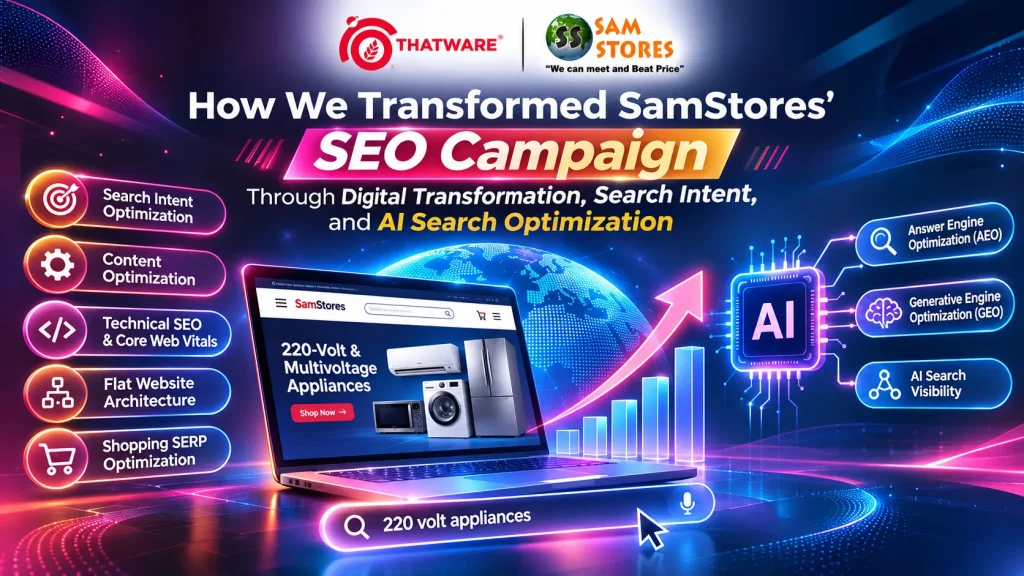
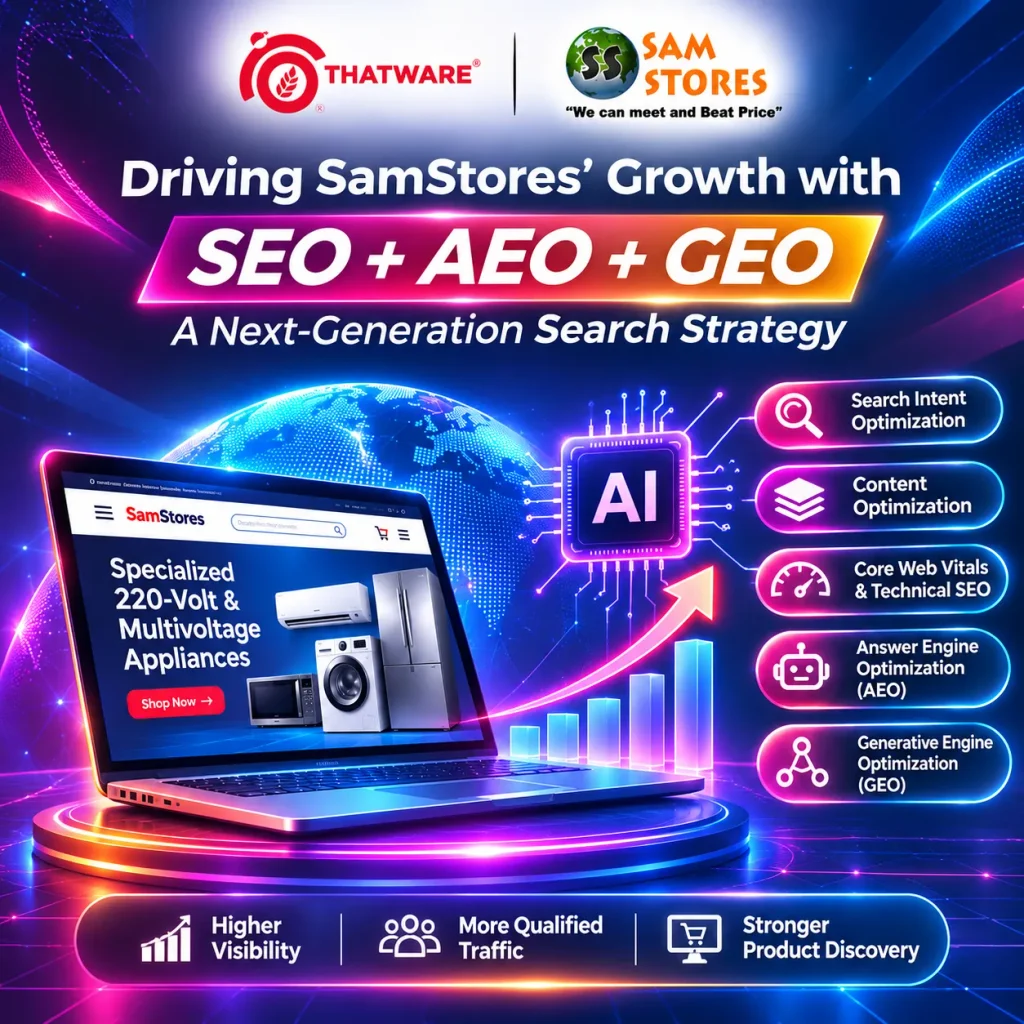
As an SEO agency, we at ThatWare approached the SamStores campaign with a digital transformation mindset. Instead of treating SEO as a collection of disconnected optimization activities, we developed a strategy that connected search intent, content planning, website experience, technical improvements, and Answer Engine Optimization (AEO).
Our objective was to strengthen SamStores’ organic search presence, communicate its specialized product expertise, improve its ability to satisfy relevant search requirements, and expand its visibility across emerging AI-driven discovery environments.
The campaign demonstrates how a modern SEO strategy can connect traditional search optimization with the changing expectations of search engines and digital consumers.
In this case study, we explain the challenges we identified, the strategic decisions we made, the optimization activities we carried out, and the visibility indicators documented during the campaign.
Understanding the Client: An Overview of SamStores
SamStores operates in the electronic apparatus and equipment retail industry. Its business focuses on providing specialized electrical appliances, electronics, and accessories to customers across different markets.
The company operates as an online retail destination for products including:
- 110-volt and 220-volt home appliances.
- Multisystem electronic equipment.
- Voltage converters and transformers.
- Specialized electrical accessories.
- Internationally compatible appliances.
- Branded household electronics.
Its business model addresses a particular requirement within the electronics market: customers need appliances that are compatible with different electrical systems and voltage requirements.
This specialization creates an opportunity for SamStores to serve an audience that may have difficulty finding suitable products through general electronics retailers.
For example, a customer relocating internationally may need a 220-volt appliance compatible with a particular electrical environment. Another customer may be searching for a voltage converter to operate an appliance purchased from a different country.
These customers are not necessarily looking for generic electronics. They are searching for products that satisfy specific technical and practical requirements.
This distinction became important in our SEO strategy.
Understanding the Business Objective
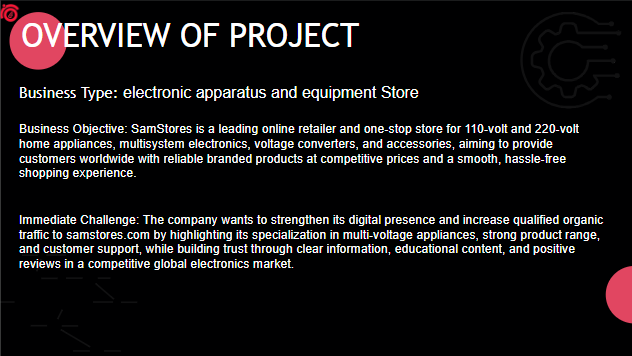
The primary business objective was to strengthen SamStores’ digital presence and increase qualified organic traffic to its website.
However, increasing traffic alone was not sufficient.
The company needed to communicate its specialization in multivoltage appliances, present its extensive product selection, establish credibility, and help potential customers understand which products were appropriate for their requirements.
We identified several interconnected business priorities:
Strengthening niche visibility
SamStores needed stronger visibility for searches associated with 220-volt appliances, 240-voltage electronics, and related product requirements.
Improving qualified organic traffic
The objective was to attract visitors whose search requirements aligned with the products and expertise offered by SamStores.
Communicating product specialization
The website needed to make its specialization more understandable through relevant content, product information, and contextual explanations.
Building customer confidence
Customers purchasing electrical appliances often require accurate product information. Voltage compatibility, specifications, usage requirements, and product suitability can influence purchasing decisions.
Improving the digital shopping experience
A visitor should be able to understand the product offering, locate relevant categories, explore product details, and navigate the website without unnecessary difficulty.
These priorities formed the foundation of our campaign.
Why SamStores Represented a Distinct SEO Challenge
The electronics retail market is highly competitive. Large marketplaces, established electronics retailers, manufacturers, and niche product suppliers compete for visibility across numerous commercial searches.
For a specialized retailer, competing through generic product keywords alone can be difficult.
Consider the difference between these searches:
- Air conditioner.
- 220-volt air conditioner.
- 220-volt split-type air conditioner.
- Samsung 220-volt split-type air conditioner.
- Best 220-volt air conditioner for international use.
Although these queries belong to the same general product category, they communicate different requirements.
A person searching for an air conditioner may still be exploring the market. Someone searching for a 220-volt split-type air conditioner has already established more specific product requirements.
The second search provides an opportunity for a specialized retailer to demonstrate relevance.
We therefore concentrated on connecting SamStores’ product specialization with the actual language and requirements expressed through search queries.
Our approach was not simply to increase the number of keywords associated with the website. It was to improve the relationship between what customers searched for and what SamStores presented.
The Digital Transformation of Modern SEO Campaigns
Digital transformation in SEO means changing how businesses understand, organize, present, and distribute information across digital discovery environments.
It involves more than adopting new software or implementing technical improvements.
A modern SEO campaign must connect several important areas:
- Search intent and customer requirements.
- Content strategy and information organization.
- Technical accessibility and website performance.
- Shopping experience and usability.
- Structured information and contextual understanding.
- Visibility across AI-powered search platforms.
- Measurement of organic and AI-search performance.
These areas influence one another.
For example, a technically accessible website may still struggle to attract qualified traffic if its content does not address relevant search intent.
Similarly, a website may publish excellent content but fail to communicate its specialization effectively if its internal architecture is confusing.
A product page may rank for a relevant query but still generate a poor shopping experience if its specifications are incomplete or its page loads slowly.
We approached the SamStores campaign by considering these relationships rather than optimizing each area independently.
From Keyword-Centric SEO to Search-Centric SEO
Traditional keyword-centric SEO often begins with identifying keywords and incorporating them into website content.
Although keyword research remains important, keyword presence does not automatically establish relevance.
Search engines must determine whether a page provides the information, product, or solution that a user expects.
This requires a deeper understanding of search intent.
We considered questions such as:
- What is the user trying to find?
- Is the user researching a product or preparing to purchase?
- Does the query indicate a particular voltage requirement?
- Does the user need a product comparison?
- Is the user looking for technical specifications?
- Would a product page, category page, or educational article best satisfy the search?
- What information would help the visitor make a confident decision?
These questions helped us move from simple keyword placement toward intent-based optimization.
Search Engines Have Become Better at Understanding Context
Search engine development has progressively increased the importance of contextual relevance.
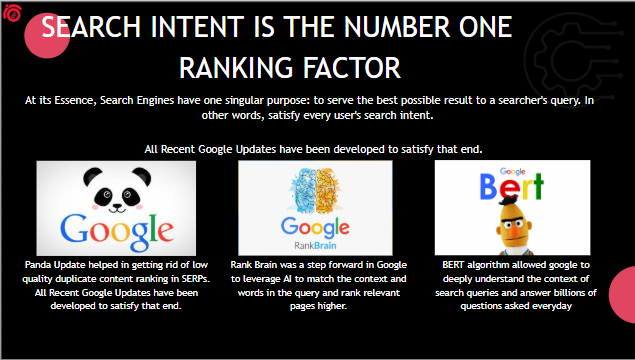
Several major Google developments illustrate this direction.
Google Panda
Panda addressed low-quality content and content duplication. It reinforced the importance of providing useful, original information instead of relying on large volumes of repetitive pages.
Google RankBrain
RankBrain introduced machine-learning capabilities into Google’s interpretation of search queries. It helped Google understand relationships between search language and relevant results, including queries that did not exactly match the wording of a page.
Google BERT
BERT improved Google’s ability to interpret language context and relationships between words. This became particularly important for understanding conversational and more naturally phrased searches.
These developments illustrate a broader principle: search engines increasingly evaluate what information means rather than simply identifying matching words.
For SamStores, this meant that our strategy needed to communicate the relationship between products, voltage requirements, appliance categories, and customer needs.
A page about 220-volt appliances should not merely repeat the phrase 220-volt appliances. It should provide useful information that demonstrates why the products are relevant to someone searching for that requirement.
Search Intent: The Foundation of Our SamStores SEO Strategy
We treated search intent as the central foundation of the campaign.
Search intent refers to the underlying purpose behind a search query.
A person entering a query into Google expects to find something specific. The search engine’s responsibility is to present results that best satisfy that requirement.
For an eCommerce business, understanding this purpose is particularly important because different queries represent different stages of the purchasing process.
The Four Major Categories of Search Intent
Informational intent
Users want to learn something or understand a particular subject.
Examples:
- What is a 220-volt appliance?
- How does a voltage converter work?
- What is the difference between 220 volts and 240 volts?
- Can a 220-volt appliance operate on a different electrical system?
These searches create opportunities for educational articles, explanatory guides, and FAQ content.
Navigational intent
Users are trying to find a particular website, company, or destination.
Examples:
- SamStores electronics.
- SamStores 220-volt appliances.
- SamStores voltage converters.
These searches require a recognizable brand presence and accessible website information.
Commercial investigation intent
Users are researching products before making a purchasing decision.
Examples:
- Best 220-volt air conditioners.
- 220-volt appliances for international use.
- Samsung 220-volt air conditioner specifications.
- 220-volt versus 240-volt appliances.
Comparison articles, buying guides, category pages, and detailed product information can satisfy these searches.
Transactional intent
Users are ready to purchase or take a direct commercial action.
Examples:
- Buy 220-volt air conditioner.
- Purchase 240-volt electronics.
- 220-volt voltage converter online.
Product pages and well-organized category pages are particularly important for this intent.
Why Search Intent Matters More Than Keyword Volume Alone
A keyword with high search volume is not automatically the most valuable keyword for every business.
Suppose a retailer sells specialized 220-volt appliances.
A generic keyword such as electronics may attract a broad audience, but many visitors may have no interest in voltage-specific products.
A more specialized query may attract fewer searches while delivering stronger alignment with the retailer’s inventory.
The commercial value of a search opportunity depends on several factors:
- Relevance to the business.
- Product availability.
- Customer requirements.
- Search intent.
- Competition.
- Purchasing readiness.
- Potential to satisfy the search.
We therefore focused on relevance rather than treating search volume as the only measure of keyword opportunity.
Connecting Search Intent with Product Specialization
SamStores’ specialization provided a meaningful foundation for developing targeted search opportunities.
We focused on searches associated with:
- 220-volt appliances.
- 240-voltage electronics.
- Multisystem appliances.
- Voltage-compatible household products.
- Specific appliance types and models.
The purpose was to establish stronger connections between SamStores’ actual product offering and the language customers used when searching.
This approach also helped us identify opportunities for content that could explain product differences and answer questions before customers reached the purchasing stage.
Our Three-Cs Framework for Satisfying Search Intent
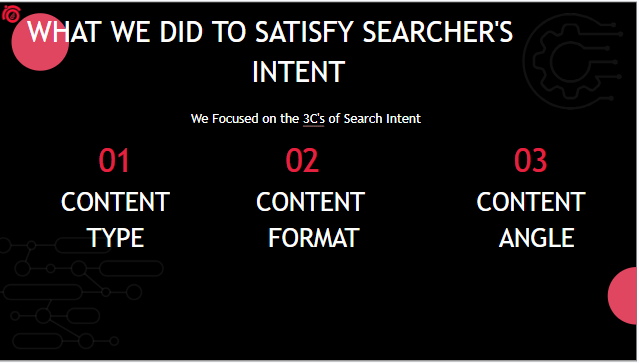
To translate search intent into an actionable content strategy, we organized our approach around three important elements:
- Content Type.
- Content Format.
- Content Angle.
We referred to these as the 3Cs of search intent in the campaign.
Each element addressed a different question.
- Content Type: What kind of page should we create or optimize?
- Content Format: How should the information be presented?
- Content Angle: Which specific perspective or subject should the content address?
The three elements work together to improve the relationship between search requirements and website content.
Content Type: Choosing the Right Page for the Search Query
The first element was content type.
A search query does not always require the same type of landing page.
A user looking for general information may need an educational article. Someone searching for a specific appliance may need a detailed product page.
Creating the wrong type of content can weaken the relationship between a page and the intended search.
For SamStores, we considered four major content types.
Blog Posts for Educational Search Intent
Blog posts are useful when customers need information before making a purchasing decision.
In the multivoltage electronics market, customers may have questions about voltage requirements, compatibility, product specifications, and electrical systems.
Educational content can address these questions.
Relevant article topics can include:
- Understanding 220-volt household appliances.
- Differences between 220-volt and 240-volt electrical products.
- How to choose appliances for international use.
- Understanding voltage compatibility before purchasing electronics.
- Important considerations when purchasing multivoltage appliances.
The value of such content extends beyond attracting informational traffic.
Educational articles can help users understand product requirements and guide them toward relevant categories or products.
They also create opportunities to establish SamStores as a knowledgeable retailer within its specialized market.
Product Pages for Specific Commercial Requirements
Product pages serve customers who already know which type of product they want.
For example, someone searching for a Samsung 220-volt split-type air conditioner expects to find a relevant product, not a general article about electrical appliances.
A well-optimized product page should communicate:
- Product name and model.
- Voltage specifications.
- Product category.
- Important technical characteristics.
- Compatibility information.
- Product imagery.
- Availability and purchasing information.
- Relevant product descriptions.
The objective is to make the page useful to both search engines and customers.
A product page should not depend entirely on a short manufacturer description. It should present information that helps customers understand the product.
Where applicable, detailed compatibility explanations can also reduce uncertainty during the purchasing process.
Category Pages for Broader Product Discovery
Category pages help customers explore multiple products within a particular product group.
For a specialized electronics retailer, category pages can connect broader searches with relevant product selections.
For example, a customer searching for 220-volt appliances may benefit from a dedicated category containing relevant products.
The category page can explain the available product types, important selection considerations, and differences between product options.
It can also create an organized pathway from broad searches to individual product pages.
This is important because customers may not know the exact product model when they begin searching.
Landing Pages for Specific Campaign Requirements
Landing pages can address more focused commercial requirements.
They may be appropriate for particular product groups, specialized searches, or dedicated marketing campaigns.
For example, a landing page targeting 220-volt appliances can provide an overview of relevant product selections and explain the specialization of the retailer.
However, creating additional landing pages without a distinct purpose can produce duplication.
We considered the relationship between the page’s purpose, its target search requirements, and the information it needed to communicate.
The objective was to create useful destinations rather than multiple pages competing for similar queries.
Content Format: Matching the Way Users Expect to See Results
The second element of our framework was content format.
Even when a page addresses the correct topic, its presentation must align with how users expect to consume the information.
Search engine results pages provide important clues about these expectations.
For example, when a search produces shopping results, product listings, prices, and product images, the search engine is indicating that product discovery is an important part of the search experience.
For SamStores, we paid particular attention to shopping-oriented search presentation.
Understanding Shopping Carousel Results
Shopping carousels allow users to discover products directly within search results.
These displays can contain:
- Product images.
- Product names.
- Prices.
- Retailer information.
- Product variations.
- Links to purchasing destinations.
They reduce the distance between a search query and product discovery.
For a retailer selling specialized appliances, shopping-oriented visibility can be commercially valuable.
A user searching for a 220-volt air conditioner may be interested in comparing products immediately.
In this situation, an educational article may not be the most direct answer to the search requirement.
The shopping format becomes a relevant part of the search experience.
Why We Considered SERP Features in Content Planning
We did not treat search results as a simple list of blue links.
The search results page itself provided information about the type of content and presentation users expected.
Our content-format decisions considered whether the search environment displayed:
- Standard organic results.
- Shopping carousels.
- Product listings.
- Informational snippets.
- AI-generated answers.
- Related questions.
This helped us align content planning with the actual search environment.
It also reinforced an important SEO principle: content optimization should consider the complete search results page, not only the traditional organic listings.
Product Information and Search Presentation
For shopping-oriented searches, product information must be consistent and understandable.
Product titles, specifications, descriptions, images, and other relevant attributes should communicate what the product actually offers.
For voltage-specific products, accurate technical details are particularly important.
A product title that mentions a voltage requirement but provides no supporting specifications may leave customers uncertain.
Similarly, inconsistent product information can make it more difficult for search systems and customers to understand the offering.
Our broader approach emphasized connecting product relevance with clear product presentation.
Content Angle: Building Relevance Around SamStores’ Specialization
The third element was content angle.
Content angle determines the specific perspective from which a topic is addressed.
Two pages can discuss the same general subject but satisfy different requirements depending on their focus.
For example, an article about air conditioners can discuss energy efficiency, room size, installation, product specifications, or voltage compatibility.
These are different content angles.
For SamStores, we focused on the specialized voltage-related requirements that differentiated its product offering.
Targeting 220-Volt Appliances
The phrase 220 volts appliances represented an important search opportunity because it connected directly with the retailer’s specialization.
Instead of targeting only broad electronics-related searches, we considered the specific requirements of people looking for appliances designed for 220-volt electrical environments.
This approach created opportunities to connect the search phrase with relevant product categories and educational explanations.
The objective was to establish a clearer relationship between the retailer’s inventory and the user’s search.
Targeting 240-Voltage Electronics
We also considered searches associated with 240-voltage electronics.
Although 220-volt and 240-volt terminology may appear similar, the actual electrical specifications and compatibility requirements of individual products must be verified.
We therefore treated voltage-related language as a subject requiring clear explanation rather than simply interchangeable keyword variations.
The content angle needed to address the user’s terminology while ensuring that product specifications remained accurate.
This is particularly important in the electronics industry, where inaccurate compatibility information can create confusion.
Why Niche-Specific Content Can Create a Competitive Advantage
Large electronics retailers often target broad product categories.
Specialized retailers can establish stronger relevance by addressing narrower product requirements.
A website that consistently explains and organizes information around multivoltage appliances has an opportunity to demonstrate expertise in that area.
This does not mean that repeating a niche keyword across hundreds of pages will create authority.
The value comes from providing connected, accurate, and useful information.
For SamStores, our strategy connected the following elements:
- Specialized product categories.
- Relevant product pages.
- Educational content.
- Voltage-related terminology.
- Customer questions.
- Clear product information.
This helped establish a more coherent content direction for the website.
Updating Website Content to Reflect Current Information
Content optimization does not end when a page is published.
Product information, industry requirements, customer questions, and search expectations can change.
A website that does not maintain its information may gradually become less useful to visitors.
As part of the SamStores campaign, we worked on updating website content.
The documented activities included:
- Updating information to account for changes in the subject or niche.
- Adding graphic content.
- Optimizing text for new or previously missed requests.
- Updating content dates where appropriate.
Why Content Freshness Matters
Freshness should not be treated as a universal ranking shortcut.
Changing a publication date without improving the information does not make a page more valuable.
The objective of a content update should be to improve the usefulness and accuracy of the page.
For example, an article discussing voltage compatibility may require clarification if its existing information is incomplete.
A product-related page may need additional specifications or updated images.
A category page may benefit from better explanations of the available product range.
These improvements provide a genuine reason to update the content.
Addressing Previously Missed Search Requirements
Content updates also provide an opportunity to address questions that were not adequately covered in the original material.
For SamStores, we considered search requirements associated with its specialized product categories.
A page about 220-volt appliances may need to address questions such as:
- What does 220 volts mean?
- Which appliance types are available?
- How should customers check voltage compatibility?
- What information should buyers review before purchasing?
- What is the difference between an appliance’s operating voltage and a converter’s output voltage?
These questions can improve the completeness of the information when they are relevant to the page.
Using Visual Information to Support Content
Graphic content can make technical information easier to understand.
Electronics products often involve specifications that may be unfamiliar to some customers.
Visual explanations, diagrams, product images, and comparison graphics can help communicate those details.
However, graphics should support the written information rather than replace essential product specifications.
We considered content and visual presentation as connected elements of the overall website experience.

Optimizing the User Experience: Making SEO Useful to Actual Customers
A successful SEO campaign must consider what happens after a user reaches the website.
Search visibility creates an opportunity. The website experience determines whether visitors can use that opportunity effectively.
For an eCommerce retailer, this is particularly important because customers need to explore products, compare specifications, understand compatibility, and complete purchasing actions.
Our SamStores strategy therefore included user-experience optimization.
Understanding Website Experience as an SEO Consideration
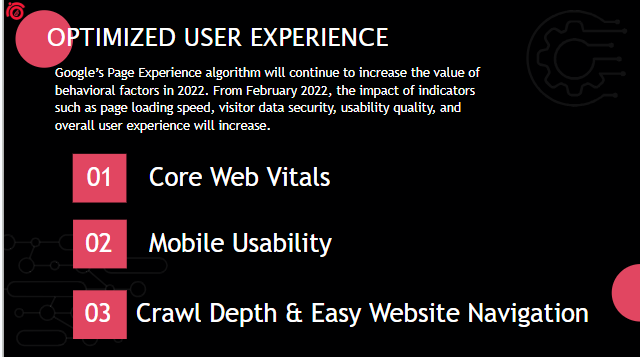
Website experience includes several interconnected factors:
- Loading performance.
- Mobile usability.
- Navigation.
- Content readability.
- Information accessibility.
- Visual stability.
- Website security.
- Product discovery.
These factors influence how easily visitors can interact with the website.
A page that takes too long to load can interrupt the shopping experience.
A complicated navigation system can make product discovery difficult.
A poorly structured product page can leave customers without the information they need.
The objective is to reduce unnecessary friction throughout the customer journey.
Core Web Vitals and Website Performance
Core Web Vitals provide a framework for evaluating important aspects of user experience.
The three principal metrics are:
Largest Contentful Paint (LCP)
LCP measures how quickly the largest visible content element appears.
For an eCommerce page, this could be a large product image, heading, or other prominent content element.
Improving LCP helps users see the main page content sooner.
Interaction to Next Paint (INP)
INP measures responsiveness by evaluating how quickly a page responds visually to user interactions.
For an online store, interactions may include opening menus, selecting product filters, or interacting with page controls.
Cumulative Layout Shift (CLS)
CLS measures unexpected layout movement.
A page that shifts while loading can cause visitors to click the wrong element or lose their position.
Improving visual stability creates a more predictable experience.
These metrics are useful because they encourage website owners to evaluate actual user experience rather than relying only on subjective design judgments.
Mobile Usability
Many customers explore products through mobile devices.
A website that works well on desktop but performs poorly on mobile can create unnecessary barriers.
Mobile optimization involves more than reducing the screen width.
Important considerations include:
- Readable text.
- Properly sized buttons.
- Accessible navigation.
- Responsive product images.
- Convenient product filtering.
- Clear product specifications.
- Usable forms and checkout interfaces.
For SamStores, an effective mobile experience was relevant because customers needed to explore specialized products without struggling to access essential information.
Crawl Depth and Easy Website Navigation
Website navigation affects both visitors and search engine crawlers.
When important pages are buried within complicated navigation structures, they may become more difficult to discover.
A well-organized website provides clear paths between related content and product categories.
This is particularly important for an eCommerce website with multiple product groups.
Visitors should be able to move logically from broader product categories to relevant product pages.
Search engines should also be able to discover important pages through internal links and an understandable site structure.
Technical Optimization: Improving Core Web Vitals
Our campaign included specific technical optimization priorities related to website performance.
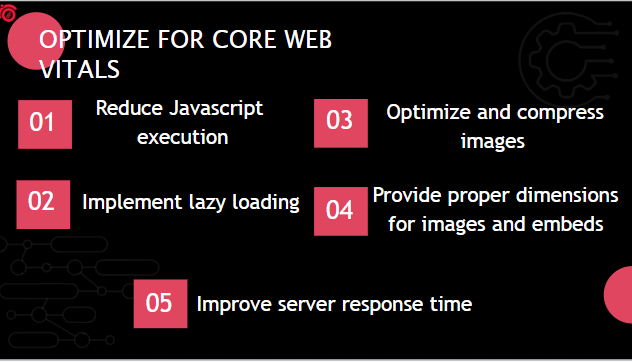
The documented recommendations covered five areas:
- Reducing JavaScript execution.
- Implementing lazy loading.
- Optimizing and compressing images.
- Providing proper dimensions for images and embeds.
- Improving server response time.
Each addresses a different performance issue.
Reducing JavaScript Execution
JavaScript can support interactive website features, but excessive execution can delay rendering and user interactions.
A website may contain scripts for:
- Navigation.
- Product filters.
- Shopping cart functionality.
- Tracking.
- Third-party integrations.
- Dynamic content.
- Marketing tools.
Not every script needs to execute immediately when a page loads.
We considered reducing unnecessary JavaScript execution and reviewing how scripts affected the initial page experience.
Potential improvements include removing unused code, reducing unnecessary dependencies, and deferring noncritical scripts where appropriate.
The objective is to preserve essential website functionality while minimizing avoidable processing.
Implementing Lazy Loading
Lazy loading allows certain resources to load when they are approaching the visible area of the browser rather than loading everything immediately.
This is particularly relevant to pages containing numerous product images.
An eCommerce category page may display many products. Loading every image immediately can increase the initial resource requirements.
Lazy loading can reduce unnecessary initial loading by prioritizing content that users can currently see.
However, important above-the-fold images, particularly the main visual element, should be handled carefully to avoid delaying their appearance.
Optimizing and Compressing Images
Product imagery plays an important role in eCommerce.
Customers often depend on product photographs to understand appearance, dimensions, and other visual characteristics.
At the same time, large image files can increase page-loading time.
Image optimization involves balancing visual quality with file size.
Potential improvements include:
- Compressing images.
- Using appropriate image dimensions.
- Selecting suitable image formats.
- Avoiding unnecessarily large source files.
- Serving responsive image sizes.
- Removing redundant image resources.
The objective is not to make product images visually poor in the interest of speed.
It is to deliver suitable image quality without placing unnecessary demands on the website.
Providing Proper Dimensions for Images and Embeds
Images and embedded content should have appropriate dimensions.
When the browser does not know how much space an element requires, page elements may move as resources load.
This can contribute to layout instability.
Specifying image dimensions or aspect ratios helps reserve the necessary space before the resource finishes loading.
For an online store, this is useful for product cards, banners, category images, and other visual elements.
Improving Server Response Time
Server response time affects how quickly the browser receives the initial response from the website.
A slow server can delay the delivery of page content and affect the overall loading experience.
Potential areas for investigation include:
- Hosting performance.
- Server-side processing.
- Database queries.
- Caching.
- Content delivery.
- Application configuration.
The appropriate solution depends on the website’s technical environment.
Improving server response time requires identifying the actual source of delay rather than applying generic performance changes.
Why Technical SEO and Content Strategy Must Work Together
Technical optimization and content optimization are often treated as separate SEO disciplines.
However, they support the same objective.
Search engines need to discover and interpret website information. Visitors need to access that information efficiently.
A well-written page can be less effective if it is difficult to load or navigate.
Likewise, a technically optimized website may not attract qualified visitors if its content does not satisfy relevant search requirements.
Our approach to SamStores considered technical performance as part of the wider organic growth strategy.
Answer Engine Optimization: Preparing SamStores for AI-Driven Search
One of the important developments represented in the campaign was the inclusion of Answer Engine Optimization (AEO).
Traditional SEO focuses on improving visibility within search engine results.
AEO extends the optimization objective by preparing website information to be understood and used by systems that generate direct answers to user queries.
These systems may include:
- Google AI-powered search experiences.
- Google Assistant.
- Siri.
- Alexa.
- Conversational AI platforms.
- Other answer-generating search environments.
Users increasingly ask complete questions rather than entering only short keyword combinations.
For example, instead of searching for 220-volt appliances, someone may ask:
“Where can I find reliable 220-volt household appliances for international use?”
The system must understand the request, identify relevant information, and construct an answer.
For a specialized retailer, this creates a new visibility opportunity.
What Is Answer Engine Optimization?
Answer Engine Optimization is the process of organizing and optimizing information so that answer-oriented search systems can understand relevant content and potentially use it when responding to user questions.
Unlike a strategy focused exclusively on traditional rankings, AEO considers how information can be presented, interpreted, and referenced in direct-answer environments.
The central objective is to make information:
- Clear.
- Accurate.
- Relevant.
- Contextually complete.
- Easy to interpret.
- Supported by appropriate website structure.
AEO does not replace traditional SEO.
It builds upon the same fundamentals while considering how users increasingly interact with search systems.
Why AEO Was Relevant to SamStores
SamStores operates in a product category where customers may have technical questions before making purchases.
Voltage requirements, appliance compatibility, product specifications, and international usage are all subjects that can generate informational searches.
These searches are not always expressed as short keywords.
Customers may ask complete questions.
For example:
- What are the best 220-volt appliances for international use?
- Where can I purchase 220-volt household electronics?
- What should I consider when buying a 220-volt air conditioner?
- How do 220-volt and 240-volt appliances differ?
- What is the purpose of a voltage converter?
Such questions create opportunities for content that provides direct, understandable answers.
We therefore considered AEO as a way to extend SamStores’ content relevance beyond conventional keyword targeting.
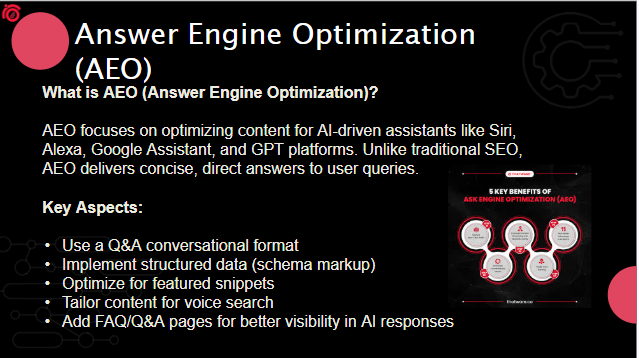
The Main Elements of Our AEO Strategy
The campaign presentation identified several important AEO considerations.
These included conversational content, structured data, featured snippets, voice search, and FAQ/Q&A pages.
Using a Conversational Question-and-Answer Format
AEO requires content to address questions clearly.
A page should not force users to read several unrelated paragraphs before discovering the answer to a straightforward question.
For example:
Question: What is a 220-volt appliance?
A 220-volt appliance is designed to operate within an electrical system or voltage range specified by its manufacturer. Buyers should always verify the appliance’s actual voltage and frequency requirements before connecting it to a power supply.
This structure makes the answer easy to understand.
After providing the direct response, the content can explain additional considerations.
For example:
- Voltage compatibility.
- Frequency requirements.
- Plug types.
- Product specifications.
- Converter requirements.
- Manufacturer instructions.
This creates a useful balance between direct answers and detailed information.
Implementing Structured Data and Schema Markup
Structured data helps search engines interpret information on a webpage.
It provides additional context about the entities and content represented on the page.
For an eCommerce retailer, relevant structured data may include:
- Product.
- Offer.
- BreadcrumbList.
- Organization.
- Article.
- FAQPage, where applicable and supported by current search-engine policies.
Product structured data can communicate information such as product names, prices, availability, and other supported attributes.
Breadcrumb structured data can help communicate the relationship between pages within the website.
Article structured data can describe educational content.
It is important to distinguish structured data from a ranking guarantee.
Adding schema markup does not automatically produce rich results or AI citations.
The markup must accurately represent visible page content and comply with applicable search-engine requirements.
Its primary value is to provide structured information that can help systems interpret the page.
Optimizing for Featured Snippets
Featured snippets are prominent search results that display an extracted answer to a user’s query.
They may appear as paragraphs, lists, tables, or other formats.
AEO-oriented content can improve its suitability for answer extraction by using:
- Clear question headings.
- Direct answers.
- Concise definitions.
- Logical content organization.
- Supporting explanations.
- Relevant lists and comparisons.
For SamStores, this approach was relevant to questions concerning appliance specifications and voltage compatibility.
For example, a page discussing the difference between 220-volt and 240-volt appliances could provide a concise explanation followed by a detailed discussion.
The objective is to make the information understandable without sacrificing accuracy.
Featured snippet visibility is not guaranteed by formatting alone. Google’s systems determine which results are selected.
Tailoring Content for Voice Search
Voice searches often use natural language.
Instead of typing a short phrase, a user may ask a complete question.
Examples include:
- Where can I buy 220-volt appliances?
- Which voltage converter do I need?
- What should I check before buying a 220-volt air conditioner?
This makes conversational content organization useful.
We considered the importance of presenting information in a way that corresponds to how people naturally ask questions.
However, voice search optimization should not become an exercise in inserting conversational keywords unnaturally.
The content must remain useful and accurate.
Creating FAQ and Q&A Content
Frequently asked questions can address the concerns customers commonly encounter during product discovery.
For SamStores, relevant FAQ subjects could include:
- What does 220 volts mean?
- Are 220-volt and 240-volt appliances interchangeable?
- How can I check an appliance’s voltage requirement?
- Do all international appliances require voltage converters?
- What should I consider before purchasing a voltage converter?
- How can I determine whether an appliance is compatible with my electrical supply?
These questions are relevant because they connect directly with the retailer’s product specialization.
FAQ content also creates opportunities to link informational answers with relevant product categories.
For example, an article explaining voltage converters can direct interested readers toward an appropriate converter category.
The relationship should be helpful rather than forced.
Extending SamStores’ Visibility into Perplexity
The campaign included an evaluation of SamStores’ visibility within Perplexity.
This was an important part of our broader shift toward AI-search optimization.
Perplexity is a conversational answer engine that generates responses using information from sources available to its search and retrieval systems.
Its responses can include source references, allowing users to explore the information used in generating an answer.
This creates a different discovery experience compared with conventional search results.
How AI Answer Engines Change Product Discovery
A traditional search engine may present a list of relevant websites.
An answer engine can instead generate a consolidated response to the user’s question.
For example, someone asking about specialized 220-volt appliance providers may receive an answer containing:
- A summary of the product category.
- Relevant retailers.
- Explanations of product requirements.
- Supporting source references.
The user may discover a retailer through the generated answer without beginning with a traditional organic search listing.
This means that websites need to communicate their specialization clearly.
A retailer’s website should explain what it sells, whom it serves, and how its products relate to the questions customers ask.
SamStores Appearing in Perplexity’s Results
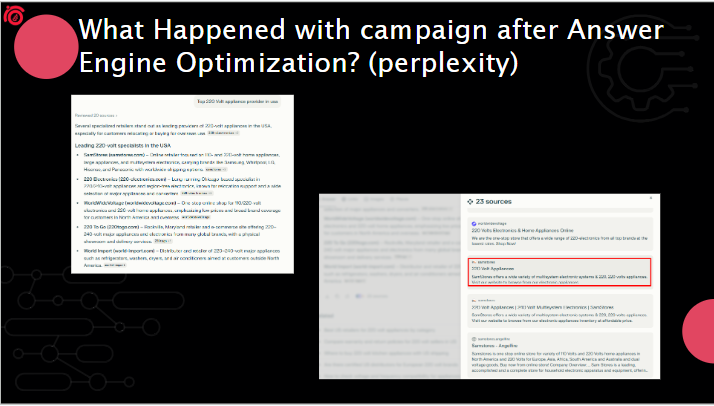
The campaign presentation includes a Perplexity result for a query about 220-volt appliance providers in the USA.
The captured response discusses specialized providers, and SamStores is highlighted among the sources shown in the interface.
The accompanying source panel also highlights a SamStores reference.
This is relevant because the website’s specialized product information was being surfaced within an answer-oriented search environment.
It demonstrates that the campaign’s focus extended beyond traditional keyword rankings.
The result also illustrates why clear niche positioning matters.
When an answer engine evaluates a query about specialized appliances, information that explicitly communicates the relevant product category may be more useful than generic electronics descriptions.
Why AI Citations Matter
An AI-generated answer and a traditional search result are different forms of visibility.
When a website is referenced in an answer engine, it can become part of the information discovery process.
This may create opportunities for:
- Brand discovery.
- Referral visits.
- Product research.
- Brand recognition.
- Trust development.
- Further engagement with website content.
However, being referenced does not automatically guarantee website visits or purchases.
AI-search visibility should therefore be measured alongside referral traffic, engagement, and commercial outcomes.
What the Perplexity Example Demonstrates
The SamStores example demonstrates an important strategic direction.
We did not limit the campaign to improving how pages appeared in traditional SERPs.
We also considered how the website’s information could be discovered in answer-oriented platforms.
This required a focus on content clarity, specialized terminology, and information that directly addressed customer questions.
The captured Perplexity result provides an example of SamStores being included in this type of discovery environment.
It is a visibility indicator rather than a complete measurement of the campaign’s AI-search performance.
Google AI Overviews: Expanding Beyond Traditional Organic Listings
The campaign also included a Google AI Overview visibility example.
Google AI Overviews provide AI-generated summaries within search experiences.
They are designed to help users understand a topic and explore relevant information through supporting links.
This changes the way websites can become visible within Google.
A website may have opportunities to appear as a conventional organic result and also be referenced within an AI-generated search experience.
These are related but distinct forms of visibility.
Why Google AI Overviews Matter for eCommerce Businesses
Consider a user searching for specialized 220-volt appliance providers.
The user may want to know:
- Which companies sell these products?
- What types of appliances are available?
- Which retailers specialize in this market?
- Where can suitable products be purchased?
An AI-generated overview may summarize relevant providers and information.
For SamStores, this presented an opportunity to strengthen its association with the specialized appliance category.
The website needed to communicate its product focus in a way that was understandable and relevant to the search requirement.
SamStores in the Captured Google AI Overview
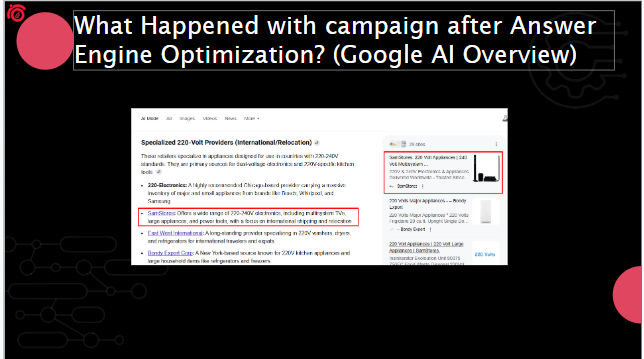
The presentation includes a Google AI Overview result for specialized 220-volt providers.
Within the displayed result, SamStores is highlighted as one of the providers discussed.
The example associates SamStores with its offering of 220-240V electrical products, including relevant appliance categories.
This is an important campaign observation.
It demonstrates that SamStores was appearing within an AI-generated discovery experience associated with its specialized market.
The result supports the broader direction of our AEO strategy: making website information relevant to both conventional search and AI-generated answers.
Why AI Visibility Requires Clear Entity and Topic Relationships
AI systems need to interpret relationships between subjects, products, companies, and information.
For a specialized retailer, these relationships should be understandable across the website.
For example:
- SamStores is an online electronics retailer.
- The retailer specializes in multivoltage appliances.
- Its product range includes 220-volt appliances.
- It offers voltage converters and related accessories.
- Its product pages provide information about specific appliance models.
These relationships should be communicated naturally through website content, product information, navigation, and structured data.
The goal is to establish a consistent and understandable digital identity.
AEO Is Not About Guaranteeing AI Mentions
It is important to understand that no SEO agency can guarantee that a particular page will be cited in every AI-generated answer.
AI systems use their own retrieval and ranking processes.
Their outputs can change depending on query wording, location, available sources, platform updates, and other factors.
A sustainable AEO strategy therefore focuses on improving the quality, accessibility, and clarity of website information.
The SamStores examples demonstrate observed visibility, not a permanent guarantee of inclusion.
Implementing a Flat Website Structure
Another important part of the campaign was website architecture.
The presentation identifies the implementation of a flat site structure as a strategic activity.
Website architecture determines how pages are organized and how visitors and search engines navigate between them.
For eCommerce websites, architecture is particularly important because product inventories can create large numbers of URLs.
Without a logical structure, important pages can become difficult to discover.
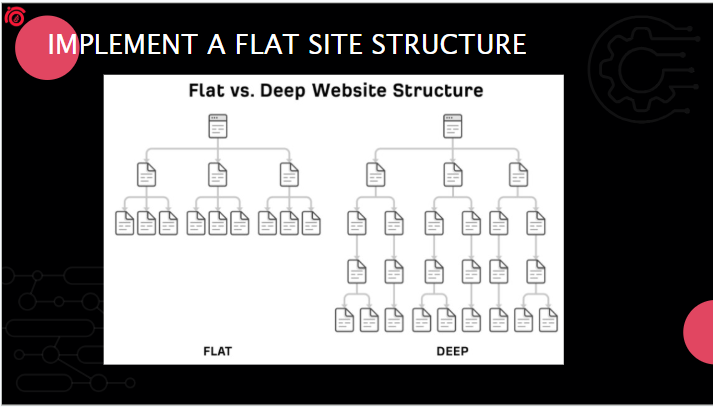
Understanding Flat and Deep Website Structures
A deep website structure places pages across multiple levels of navigation.
A visitor may need to move through several categories and subcategories before reaching an individual product.
A flat structure aims to reduce unnecessary navigation depth and make important pages accessible through fewer steps.
For example, a simplified structure could look like this:
Homepage
- Appliances
- 220-Volt Appliances
- Air Conditioners
- Kitchen Appliances
- Voltage Converters
- Multisystem Electronics
- Educational Resources
Individual product pages can then be connected to their relevant categories.
This structure makes the relationship between product groups easier to understand.
Why Website Architecture Matters for Crawlability
Search engine crawlers discover website pages by following links and other discovery mechanisms.
A logical internal linking structure can help crawlers identify important pages.
When a page is isolated or requires many navigation steps to reach, its discovery and relationship with other content may become less clear.
A well-organized website should provide meaningful connections between:
- The homepage.
- Main product categories.
- Subcategories.
- Product pages.
- Educational articles.
- Supporting information.
This creates a more coherent website.
Improving Product Discovery
Website architecture also influences customer navigation.
A person searching for 220-volt appliances should not need to explore unrelated categories to find relevant products.
The navigation should reflect the way customers understand the product range.
Clear categories can reduce unnecessary searching and help visitors move from general product requirements to specific products.
This is particularly valuable for specialized eCommerce websites where product compatibility and specifications influence purchasing decisions.
Internal Linking Between Educational and Commercial Pages
A strong content architecture should connect informational content with relevant product destinations.
For example, an article explaining voltage converters may link to the corresponding product category.
An educational page about 220-volt air conditioners may connect to the relevant product listings.
Similarly, product pages may link to useful guides explaining technical specifications.
These connections help users continue their research without repeatedly returning to search engines.
Internal links should be relevant and useful rather than inserted simply to increase the number of links.
Flat Architecture Does Not Mean Removing Every Subcategory
A flat structure should not be interpreted as eliminating all levels of organization.
Large eCommerce websites still need categories and subcategories to organize inventory.
The objective is to create a structure that makes important information accessible without unnecessary complexity.
The appropriate architecture depends on the size of the inventory, the relationships between products, and the needs of customers.
For SamStores, the focus was on creating a more accessible structure for important product and informational pages.
Connecting Organic Search Results with Business Relevance
A modern SEO campaign should not evaluate success through rankings alone.
Rankings are useful indicators, but they do not explain the complete impact of an SEO strategy.
A business needs to understand whether its search visibility is improving in the areas that matter commercially.
For SamStores, relevant measurements included:
- Visibility for specialized appliance searches.
- Organic keyword presence.
- Estimated organic traffic.
- Search result positioning.
- AI-generated search visibility.
- Brand mentions.
- Cited pages.
- Website authority indicators.
The campaign presentation includes examples of traditional search visibility and AI-search appearances.
Organic Search Result Examples
The presentation documents search result screenshots associated with specific product-related queries.
One example shows a Samsung AS24UA split-type air conditioner search for 220 volts, with a SamStores product result highlighted.
Another example shows SamStores appearing for the query 220 volts appliances.
These screenshots provide examples of visibility for searches connected with the retailer’s specialized inventory.
They also illustrate the importance of aligning product pages with specific search requirements.
A user searching for a particular air conditioner model needs a relevant product destination.
A user searching more broadly for 220-volt appliances may benefit from a category or broader product destination.
The correct landing page depends on the search intent.
Why Specific Search Results Are More Meaningful Than Generic Visibility
A retailer may rank for many unrelated keywords without attracting customers who are interested in its products.
For SamStores, visibility associated with 220-volt and 240-voltage product requirements was particularly relevant.
These searches had a clearer connection with the company’s specialization.
The campaign therefore focused on improving the relationship between product relevance and search demand.
The documented SERP screenshots demonstrate selected examples of that relationship.
They should not be interpreted as proof that every target keyword achieved a particular ranking across all countries, devices, or search conditions.
Search results can vary by location, personalization, and time.
Measuring Organic and AI-Search Visibility
Understanding the AI Visibility Metrics
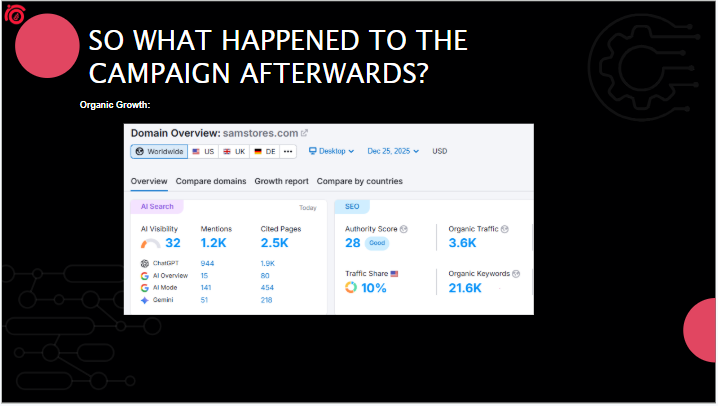
According to the campaign presentation, the domain overview for SamStores displayed the following AI-search indicators on December 25, 2025.
AI Visibility: 32
The dashboard reported an AI Visibility score of 32. This indicator provides a snapshot of the website’s measured visibility across the AI-search environments covered by the reporting platform.
AI Mentions: 1.2K
The dashboard recorded approximately 1,200 mentions across the monitored AI-search environments.
Mentions indicate how frequently the brand is identified in the tracked AI responses. This is an important indicator of brand presence within answer-oriented discovery environments.
Cited Pages: 2.5K
The dashboard reported approximately 2,500 cited pages.
This metric indicates the volume of website pages associated with citations in the monitored AI-search environment. It provides an additional perspective on how different website URLs are being referenced.
The distinction between mentions and cited pages is important. A brand mention indicates that the company appears in an AI-generated response, while a cited page represents a website URL associated with a source reference.
Both indicators help evaluate different dimensions of AI-search visibility.
Platform-Level AI Visibility
The dashboard also provided a breakdown across several AI platforms.
| Platform | Mentions | Cited Pages |
| ChatGPT | 944 | 1.9K |
| Google AI Overview | 15 | 80 |
| Google AI Mode | 141 | 454 |
| Gemini | 51 | 218 |
These figures provide a more detailed understanding of where SamStores’ website and brand were appearing within the monitored AI ecosystem.
ChatGPT
The dashboard reported 944 mentions and approximately 1,900 cited pages for ChatGPT.
This was the largest platform-level contribution shown in the dashboard.
For a specialized eCommerce business, this is relevant because conversational AI platforms provide another environment through which users can research products, identify retailers, and explore purchasing requirements.
Google AI Overviews
The dashboard reported 15 mentions and 80 cited pages for Google AI Overviews.
Although these figures were smaller than the ChatGPT figures, they represent a separate discovery environment integrated into Google’s search experience.
Google AI Mode
Google AI Mode recorded 141 mentions and 454 cited pages.
This demonstrates the importance of considering AI-powered search experiences separately from conventional organic rankings.
Gemini
The dashboard recorded 51 mentions and 218 cited pages for Gemini.
This provides another indicator of SamStores’ presence across AI-powered information discovery environments.
These figures are reporting snapshots from the dashboard, not independently verified counts of unique customers, visits, or purchases. They should be interpreted within the measurement methodology of the reporting platform.
Understanding the Traditional SEO Metrics
The same domain overview presented several conventional SEO indicators.
| SEO Metric | Reported Value |
| Authority Score | 28 |
| Organic Traffic | 3.6K |
| Traffic Share | 10% |
| Organic Keywords | 21.6K |
These indicators complement the AI-search measurements.
Authority Score: 28
The dashboard displayed an Authority Score of 28, categorized as Good.
Authority Score is a third-party comparative metric used to estimate a domain’s overall authority based on its underlying measurement methodology.
It should not be confused with a Google ranking factor or a direct measurement of Google’s assessment of a website.
We consider authority-related indicators useful when reviewing the broader competitive position of a domain, but they must be interpreted alongside actual organic performance.
Organic Traffic: 3.6K
The dashboard estimated organic traffic at approximately 3,600.
This provides an indication of the website’s estimated traffic from organic search.
For SamStores, organic traffic was important because it represented the opportunity to reach customers through unpaid search discovery.
However, third-party traffic estimates are not the same as actual website sessions recorded in Google Analytics or another first-party analytics platform.
Traffic Share: 10%
The dashboard displayed a traffic share of 10%.
This provides a comparative indicator within the reporting environment and its selected market context.
It should not automatically be interpreted as SamStores receiving 10% of all traffic in the entire electronics industry.
Organic Keywords: 21.6K
The dashboard reported approximately 21,600 organic keywords.
This was another significant indicator of the website’s search footprint.
A broad keyword footprint can indicate that a website is being discovered through multiple search terms and topic variations.
However, keyword count alone does not establish the commercial value of those rankings.
The most important consideration is whether the website attracts relevant searches connected with its product range and business objectives.
What the Combined Metrics Tell Us
The most important observation from the dashboard is that SamStores had measurable visibility across both conventional search and AI-oriented discovery environments.
The traditional SEO indicators showed:
- An estimated organic traffic figure of 3.6K.
- An organic keyword footprint of 21.6K.
- An Authority Score of 28.
- A displayed traffic share of 10%.
The AI-search indicators showed:
- An AI Visibility score of 32.
- Approximately 1.2K mentions.
- Approximately 2.5K cited pages.
- Visibility indicators across ChatGPT, Google AI Overviews, Google AI Mode, and Gemini.
Together, these measurements provide a broader perspective on the website’s digital presence.
They also demonstrate why modern SEO reporting should not be restricted to traditional keyword rankings.
A website’s search performance increasingly needs to be examined through multiple discovery environments.
For SamStores, our campaign strategy considered both sides of this changing search landscape.
How Traditional SEO and AEO Work Together
One of the most important lessons from the SamStores campaign is that traditional SEO and Answer Engine Optimization should not operate as completely separate strategies.
They address different aspects of the same fundamental objective: helping users discover useful and relevant information.
Traditional SEO focuses on improving the discoverability, relevance, and performance of website pages within search engines.
AEO focuses on making information understandable and suitable for answer-oriented search environments.
Both require a strong foundation.
Technical Accessibility Supports Both Strategies
Search systems need to access and interpret website information.
If important pages cannot be crawled, if content is inaccessible, or if the website architecture creates unnecessary complexity, discoverability can suffer.
Technical SEO therefore remains important even when a campaign includes AI-search optimization.
Our work on website structure, crawlability, navigation, and performance supported the broader objective of improving information accessibility.
High-Quality Content Provides the Information Foundation
AI-generated answers require information that can be interpreted and used in response to user questions.
The same principle applies to conventional search.
Content should explain subjects accurately, answer relevant questions, and communicate the purpose of each page.
For SamStores, this meant focusing on the company’s specialization in multivoltage appliances instead of relying exclusively on broad electronics-related descriptions.
Structured Information Improves Clarity
Structured data can help search engines understand product information and website relationships.
However, structured data should reflect the actual content of the website.
It should not be used to communicate unsupported product attributes or create misleading descriptions.
Clear product specifications, meaningful category relationships, and accurate structured data work together to make website information easier to interpret.
Brand Consistency Matters Across Discovery Environments
A company should communicate its specialization consistently.
If a business describes itself as a specialist in 220-volt appliances on one page but uses unrelated terminology elsewhere, its overall subject positioning may become less clear.
SamStores needed a coherent relationship between its brand, product categories, individual products, and educational information.
This is why we approached content, technical optimization, and AI-search visibility as connected parts of the same campaign.
Why Product-Specific SEO Is Important for Specialized eCommerce Businesses
The SamStores project also highlights a broader opportunity for specialized online retailers.
Many eCommerce businesses attempt to compete for large generic search terms.
However, their actual commercial advantage may come from serving a more specific audience.
For example, a general electronics retailer may compete for broad searches such as televisions, refrigerators, or air conditioners.
A specialized retailer may have a stronger opportunity to address searches related to voltage compatibility, international appliances, and multivoltage requirements.
This creates an opportunity to develop a more focused SEO strategy.
Build Content Around Real Product Requirements
Product-related content should begin with the questions customers actually need answered.
For specialized appliances, those questions may involve:
- Voltage requirements.
- Electrical frequency.
- Plug compatibility.
- Product dimensions.
- Installation requirements.
- Usage conditions.
- Technical specifications.
These subjects provide opportunities for useful content that supports purchasing decisions.
Develop Strong Product-Category Relationships
Product pages should not exist as isolated URLs.
They should belong to a logical category structure that communicates their relationship with other products.
For example, a specific 220-volt air conditioner should be discoverable through relevant category pages and internal links.
This helps visitors explore related products and understand the available selection.
Create Supporting Educational Content
Educational content can help customers understand the technical considerations behind a purchase.
For example, a buyer considering an international appliance may need to understand the difference between voltage and frequency.
A well-written guide can explain these concepts and direct the reader toward relevant product information.
This creates a natural connection between informational and transactional search intent.
Avoid Creating Pages Only to Target Keyword Variations
A common problem in eCommerce SEO is the creation of multiple pages targeting nearly identical keywords.
For example, separate pages targeting slightly different variations of 220-volt appliances may end up providing almost identical information.
This can create duplication and weaken the overall content architecture.
We believe every important page should have a distinct purpose.
Where multiple queries express essentially the same requirement, a single comprehensive page may be more appropriate than several competing pages.
The decision should be based on search intent, product differences, and the actual value of the information.
The Importance of an Integrated SEO Workflow
The SamStores campaign demonstrates why SEO requires a coordinated workflow.
Keyword research, content optimization, technical improvements, AEO, and reporting should not be treated as unrelated tasks.
Each activity should support a clearly defined business objective.
Our approach can be understood through the following stages.
Stage 1: Understand the Business
Before developing a keyword strategy, we examine the business model, products, specialization, and commercial objectives.
For SamStores, understanding its focus on multivoltage appliances was essential.
Without this context, the campaign could have become a generic electronics SEO exercise.
Stage 2: Identify Search Opportunities
We examine relevant search terms and understand the intent behind them.
We consider informational, commercial, navigational, and transactional requirements.
The objective is to identify opportunities that align with the actual product range.
Stage 3: Map Search Intent to Content Type
We determine which page type is best suited to each search requirement.
This may involve:
- Blog posts.
- Product pages.
- Category pages.
- Dedicated landing pages.
Each page should satisfy a clear purpose.
Stage 4: Determine the Appropriate Content Format
We examine the search results to understand how information is being presented.
For product-related searches, shopping results may indicate the importance of product-focused formats.
For informational queries, direct answers and explanatory content may be more appropriate.
Stage 5: Establish the Content Angle
We identify the specific subject or perspective that will make the page relevant.
For SamStores, this included the specialized requirements surrounding 220-volt appliances and 240-voltage electronics.
Stage 6: Optimize Existing Website Content
We review existing pages and identify opportunities to improve their relevance, completeness, and presentation.
This includes updating information, improving descriptions, adding useful graphics, and addressing missed search requirements.
Stage 7: Improve Technical Performance
We review website performance, navigation, crawlability, image delivery, JavaScript execution, and other technical considerations.
The objective is to make important information accessible and the website easier to use.
Stage 8: Implement AEO Considerations
We organize information around customer questions and improve its clarity.
Relevant structured data, conversational content, and FAQ sections can support this process.
Stage 9: Evaluate AI-Search Visibility
We examine the website’s presence across relevant AI-powered discovery environments.
This includes observing brand mentions, citations, and appearances in platforms such as Perplexity, ChatGPT, Google AI experiences, and Gemini.
Stage 10: Monitor and Refine
SEO is an ongoing process.
We review performance indicators, identify new opportunities, and adjust the strategy based on the available evidence.
This process helps keep the website aligned with changing search requirements.
What the SamStores Campaign Teaches Us About the Future of SEO
The SamStores project provides several important lessons for businesses preparing for the next generation of search.
Search Intent Must Guide Content Decisions
A keyword should never be selected simply because it has a high search volume.
Businesses must understand what users expect to find and select the appropriate page type and content format.
Specialization Can Be a Valuable SEO Advantage
Businesses with a defined product specialization can develop stronger content around their expertise.
Instead of competing exclusively for broad terms, they can establish relevance around specific customer requirements.
Website Architecture Influences Discoverability
A logical site structure makes it easier for visitors and search engines to understand the relationship between pages.
Important product and category pages should not be buried within unnecessarily complicated navigation systems.
Technical SEO Remains Essential
New search technologies do not eliminate the importance of technical SEO.
Website performance, accessibility, mobile usability, and crawlability remain important considerations.
AI Search Requires a Broader Content Strategy
Businesses need to consider how their information is interpreted in answer-oriented environments.
Clear explanations, accurate product information, and well-organized content can support this objective.
Visibility Must Be Measured Across Multiple Environments
Traditional rankings remain relevant, but they do not describe the entire digital discovery process.
AI mentions, cited pages, organic traffic, and keyword visibility provide additional perspectives.
SEO Should Be Connected to Business Outcomes
Ultimately, the purpose of SEO is not to increase numbers without context.
The objective is to attract relevant visitors, support product discovery, strengthen brand recognition, and contribute to business growth.
Our Approach at ThatWare: Building SEO Strategies for an AI-First Search Environment
At ThatWare, we believe that the future of SEO depends on understanding how people discover information and how search systems interpret it.
We do not view SEO as a collection of isolated technical adjustments or keyword placements.
Our approach combines strategic content planning, technical optimization, search-intent analysis, and emerging AI-search requirements.
The SamStores campaign reflects this philosophy.
We worked to connect the retailer’s product specialization with the actual search requirements of its potential customers.
We considered how product pages should be structured, how educational content could support purchasing decisions, how the website could become easier to navigate, and how its information could be understood within AI-driven search environments.
SEO and Search Intent Optimization
We focus on understanding the purpose behind search queries.
Our approach considers the relationship between the user’s requirement, the relevant page type, and the information needed to satisfy the search.
This helps businesses avoid creating content that targets keywords without providing meaningful value.
Answer Engine Optimization
We help businesses organize information for answer-oriented search experiences.
Our AEO approach considers conversational queries, direct answers, structured information, FAQ content, and the clarity of website information.
The objective is to make relevant content easier for answer engines to understand and potentially reference.
Generative Engine Optimization
Generative Engine Optimization (GEO) focuses on improving a brand’s visibility and representation across generative AI discovery environments.
It requires businesses to communicate their expertise, products, and subject relevance clearly.
For specialized businesses, this means building consistent relationships between brand information, products, and useful supporting content.
Technical SEO and Website Architecture
We consider technical accessibility and website structure fundamental to sustainable organic visibility.
Our approach includes reviewing crawlability, internal linking, site navigation, performance, and page organization.
These areas help create a stronger foundation for both conventional search and AI-oriented discovery.
Content Experience and User Experience
We believe content should satisfy users rather than simply target search terms.
Information should be readable, logically organized, accurate, and supported by relevant visual elements.
A useful page should help visitors understand a subject or make a purchasing decision.
Performance Measurement
We examine organic-search and AI-search indicators together.
This allows us to develop a broader understanding of digital visibility and identify areas requiring further improvement.
For businesses operating in competitive markets, this broader measurement approach is increasingly important.
Moving Beyond Traditional SEO: The Next Phase of Digital Growth
The SamStores campaign illustrates a wider transformation taking place across digital marketing.
Search is no longer limited to entering a keyword into Google and clicking a website from a list of results.
Users can discover information through shopping experiences, conversational interfaces, AI-generated summaries, voice assistants, and other search environments.
Businesses need to prepare their websites for this changing discovery process.
For an eCommerce company, this involves maintaining accurate product information, organizing its inventory logically, publishing useful educational content, and improving the overall shopping experience.
It also requires a more comprehensive understanding of how search engines and AI systems interpret website information.
We believe that the next generation of SEO will be shaped by several interconnected priorities:
Intent-led content: Creating pages that address the actual purpose behind user searches.
Entity and topical clarity: Communicating what a business does, which products it offers, and which subjects it understands.
Technical accessibility: Ensuring that important pages can be discovered, crawled, and accessed efficiently.
Structured information: Presenting product and business information in a clear and consistent format.
AI-search readiness: Preparing useful website information for discovery through answer engines and generative search systems.
Experience-led optimization: Making it easier for visitors to explore products, understand information, and take meaningful actions.
These priorities should not be treated as temporary SEO trends.
They represent a broader movement toward more useful, understandable, and customer-focused digital experiences.
Conclusion: How We Connected Search Intent, Technical SEO and AI Visibility for SamStores
Our work with SamStores demonstrates how a modern SEO campaign can move beyond conventional keyword optimization.
We approached the project by understanding the retailer’s specialization in electronic appliances, particularly 110-volt and 220-volt products, multivoltage electronics, and related accessories.
We then developed a strategy focused on connecting that specialization with relevant customer searches.
Our work covered the three Cs of search intent: Content Type, Content Format, and Content Angle.
We considered the importance of blog posts, product pages, category pages, and landing pages. We also examined shopping-oriented SERP formats and the role of specialized content angles associated with 220-volt appliances and 240-voltage electronics.
We worked on updating website content, improving its relevance, and supporting the user experience through technical optimization.
Our performance priorities included JavaScript execution, lazy loading, image compression, image dimensions, and server response time.
We also incorporated Answer Engine Optimization into the campaign.
This involved conversational content, structured data, featured snippet considerations, voice-search requirements, and FAQ/Q&A content.
Beyond conventional search, we examined SamStores’ presence in Perplexity and Google AI Overviews. The campaign presentation documented examples of the retailer appearing within these AI-driven discovery environments.
We also considered website architecture, including the importance of a flatter and more accessible site structure.
Finally, the December 25, 2025 domain overview provided a snapshot of the website’s organic and AI-search visibility, reporting 21.6K organic keywords, 3.6K estimated organic traffic, an AI Visibility score of 32, approximately 1.2K AI mentions, and approximately 2.5K cited pages.
These figures represent the reporting snapshot shown in the campaign presentation rather than a complete before-and-after performance comparison.
For us at ThatWare, the central lesson is clear: modern SEO requires a connected strategy.
Businesses need more than keyword rankings. They need a clear digital identity, useful content, accessible website architecture, strong technical foundations, and information that can be understood across evolving search environments.
The SamStores project reflects how we approach this transformation.
By connecting search intent, content strategy, website experience, technical SEO, and AI-search optimization, we worked toward a broader digital visibility strategy designed around the changing expectations of both customers and search systems.
At ThatWare, we continue to approach SEO as an evolving discipline where search relevance, user experience, technical excellence, and AI discoverability work together to support sustainable digital growth.