SUPERCHARGE YOUR ONLINE VISIBILITY! CONTACT US AND LET’S ACHIEVE EXCELLENCE TOGETHER!
Search is no longer limited to blue links, rankings, and search result pages.
A growing number of users now ask AI systems direct questions such as:
- Which is the best AI SEO agency?
- What companies offer enterprise SEO with AI?
- Which brand is trusted for AEO or GEO?
- Who should I choose for advanced SEO consulting?
- What are the top agencies for LLM SEO?
The answer they receive may not look like a traditional search result. It may be a summarized recommendation, a short list of companies, a comparison, or a direct answer generated by an AI model.
This creates a new problem for brands.
A company may rank well on Google and still remain invisible inside AI-generated answers. Another brand may not have the strongest traditional ranking, but it may still appear more often in ChatGPT, Claude, Perplexity, Grok, or other AI-led discovery environments.
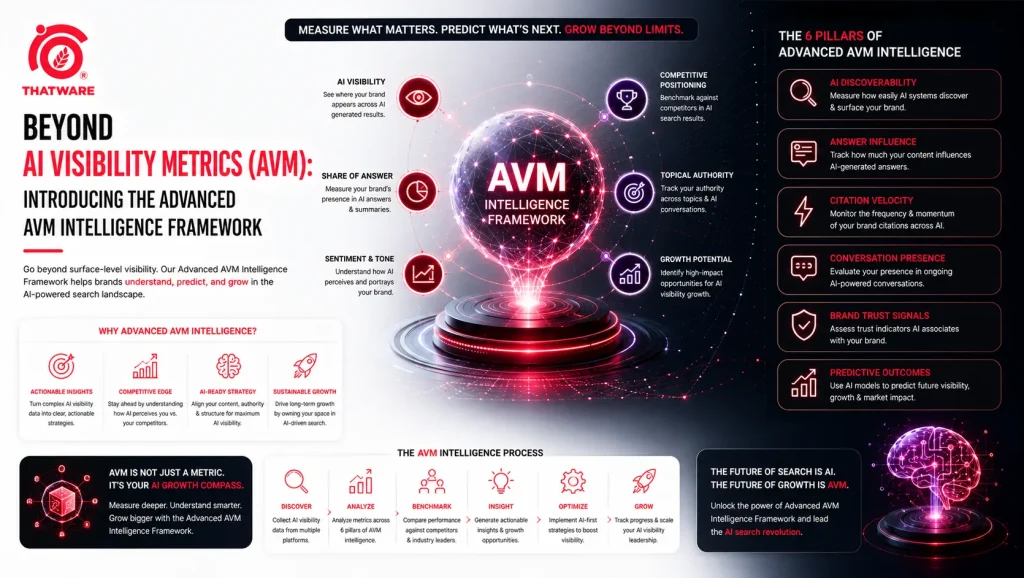
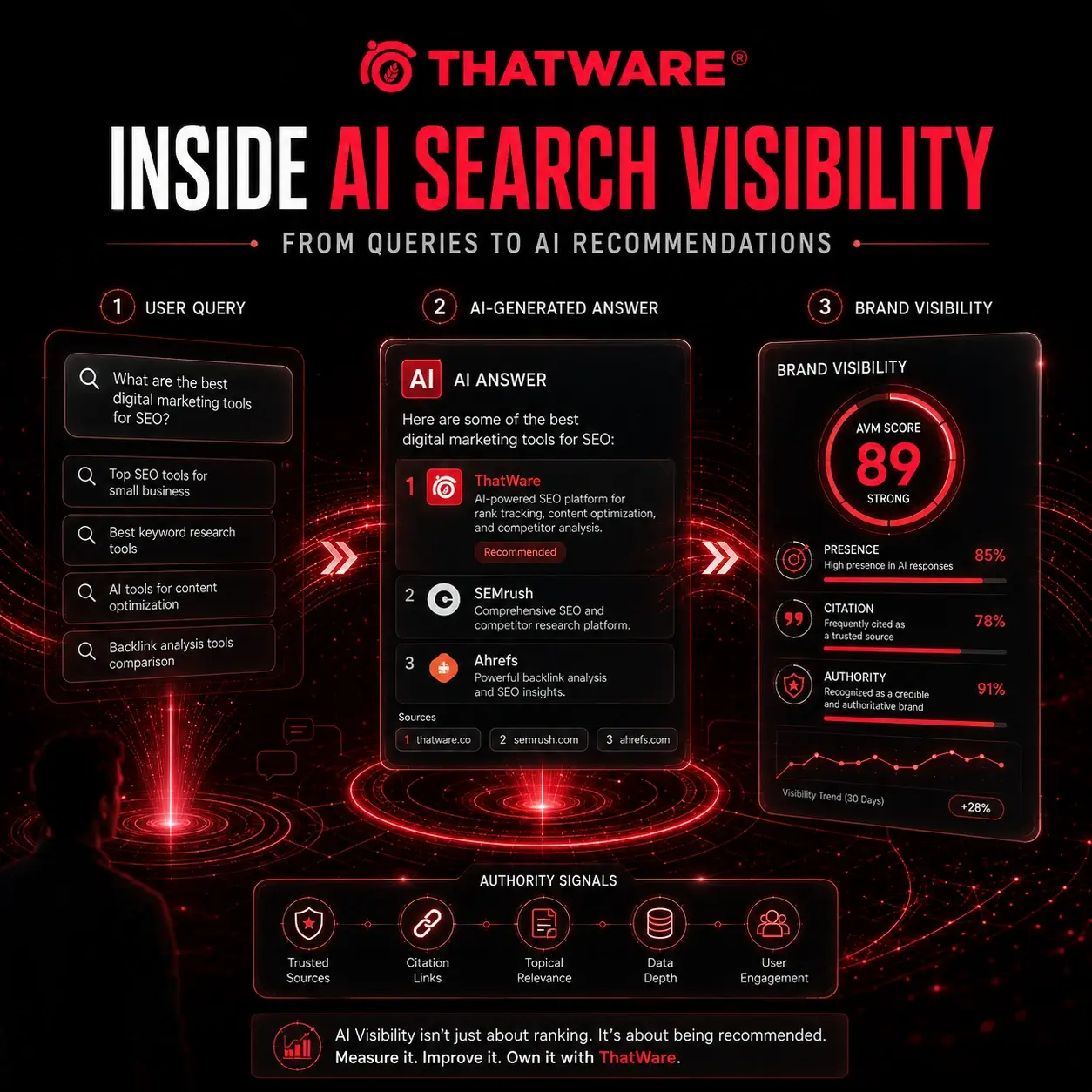
That is the gap ThatWare’s AI Visibility Metric, also known as AVM, is designed to measure.
AVM is not just another SEO score. It is a framework for understanding whether a brand is visible, trusted, cited, and recommended inside AI search ecosystems.
What Is the AI Visibility Metric?
The AI Visibility Metric is a measurement framework that evaluates how strongly a brand appears inside AI-generated answers.
Understanding Your Brand’s Presence in AI Search Ecosystems
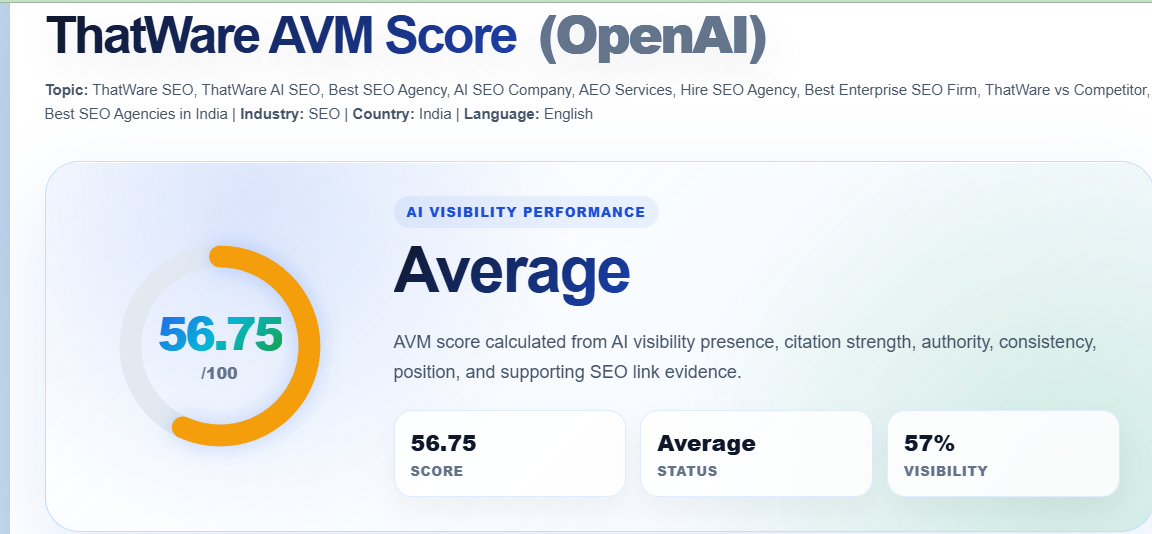
The image presents ThatWare’s AI Visibility Metric (AVM) Score as evaluated within the OpenAI ecosystem, showcasing an overall score of 56.75 out of 100, which falls under the “Average” visibility category. AVM serves as a proprietary measurement framework designed to evaluate how effectively a brand, website, or entity is recognized, referenced, and surfaced across AI-powered search and answer engines.
Unlike traditional SEO metrics that focus primarily on rankings and traffic, AVM assesses a broader set of signals including AI visibility presence, citation authority, entity consistency, contextual relevance, authoritative mentions, and supporting SEO evidence. These factors collectively determine how likely an AI model is to identify and recommend a brand when responding to relevant user queries.
Key Takeaways:
- The brand achieved an AVM Score of 56.75/100, placing it within the Average AI Visibility Performance category.
- The score reflects performance across multiple AI-centric factors, including citations, authority, consistency, visibility, and supporting SEO signals.
- The current visibility level indicates an established AI presence while highlighting opportunities for further optimization and authority building.
- AVM acts as a future-focused KPI for measuring success in AI search ecosystems beyond conventional SEO metrics.
- Continuous improvements in entity optimization, knowledge graph signals, citation acquisition, and topical authority can help elevate the score into higher performance tiers.
Traditional SEO metrics usually focus on rankings, traffic, backlinks, impressions, and keyword positions. These are still important, but they do not fully explain how a brand performs inside AI search.
AVM asks a different question:
When users ask AI systems about a topic, does the brand appear, and does it appear with enough trust to matter?
For example, if someone asks an AI platform for the best SEO agency in India, the AVM framework checks whether a brand appears in that answer, how prominently it appears, whether it is supported by citations, whether the answer seems confident, and whether competitors are being recommended instead.
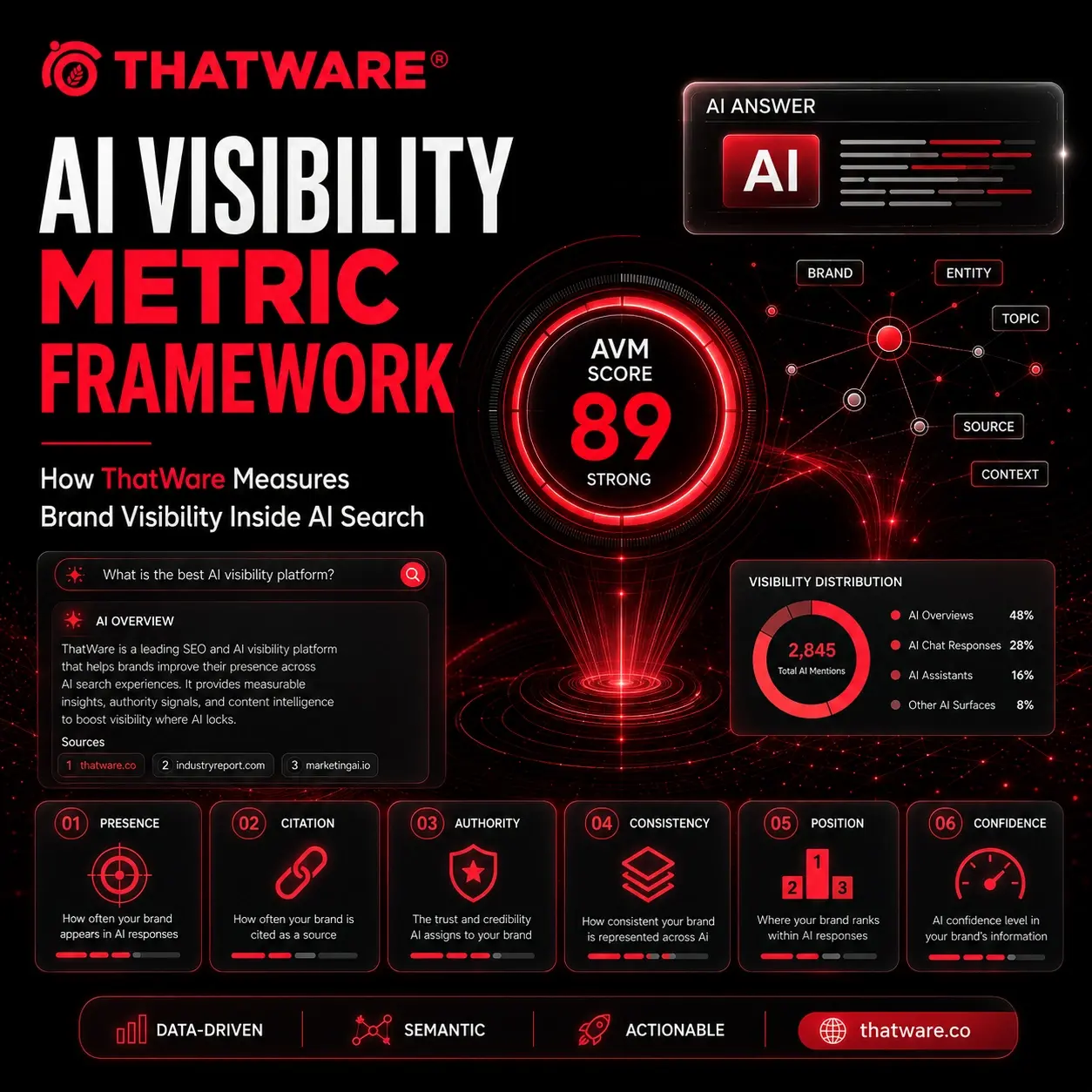
This is important because AI systems do not behave like traditional search engines. They do not always show ten links. They often compress multiple signals into one answer. If a brand is missing from that answer, it may lose visibility before the user even reaches a website.
Why ThatWare Is Building AVM
ThatWare is building AVM because the future of search is moving from ranking visibility to answer visibility.
For years, brands wanted to know:
“Where do we rank?”
Now the better question is:
“Are we being recommended by AI?”
This shift is massive.
A brand’s future visibility will depend not only on whether its pages rank, but also on whether AI systems understand the brand, connect it with the right topics, trust its sources, and mention it in relevant answers.
ThatWare is building AVM to give brands a practical way to measure this new layer of visibility.
The goal is not to replace SEO. The goal is to extend SEO into the AI search era.
AVM helps brands understand:
- Whether AI systems can discover them
- Whether they appear for branded and non-branded prompts
- Whether competitors appear more often
- Whether citations support their visibility
- Whether they are mentioned clearly or weakly
- Whether their AI presence is consistent
- Whether they are positioned well inside generated answers
In simple words, AVM helps brands see what AI sees.
Why AVM Is the Future of Search Measurement
The old search journey was mostly linear.
A user searched on Google, scanned search results, clicked a website, compared options, and made a decision.
The AI search journey is different.
A user may ask one question and receive a recommendation instantly. The AI system may summarize the market, mention a few brands, compare competitors, and even guide the user toward a decision.
This means the answer itself becomes the new visibility surface.
If a brand is not included in that answer, it may never enter the user’s consideration set.
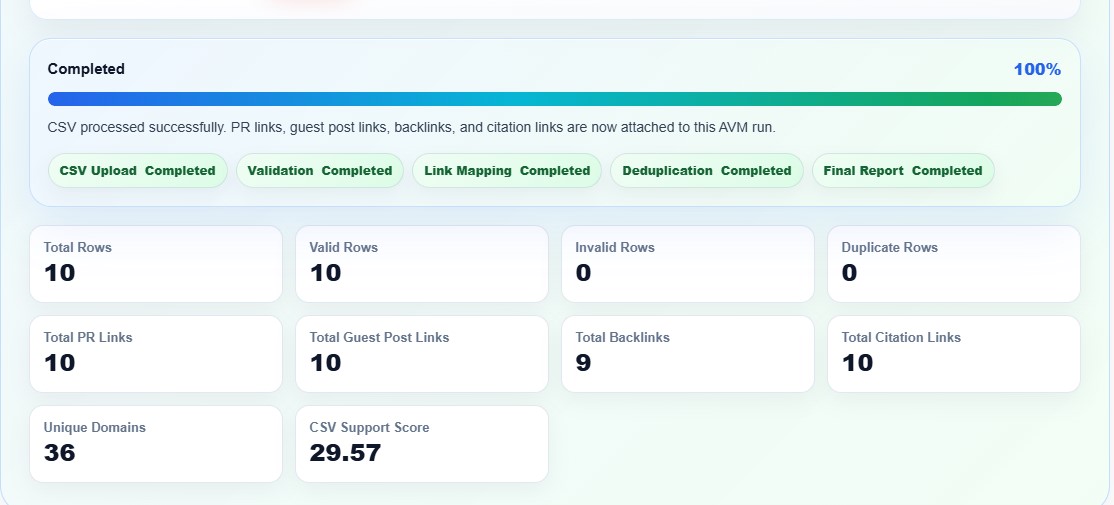
How AVM Ensures Data Accuracy Before Measuring AI Visibility
This dashboard provides a comprehensive overview of the data ingestion, validation, and processing workflow that supports the AVM (AI Visibility Metric) evaluation. Before authority signals, citations, backlinks, and external references can contribute to AI visibility analysis, the underlying data must undergo a rigorous validation process to ensure accuracy, consistency, and reliability.
The report indicates a 100% successful completion rate, demonstrating that the entire dataset was processed without errors. Every stage of the workflow—including CSV upload, data validation, link mapping, deduplication, and final report generation—was successfully executed. This level of completion is essential because AI visibility assessments are only as reliable as the quality of the supporting data used to calculate them.
SEO Link Intelligence Dashboard: Evaluating Authority and Citation Signals
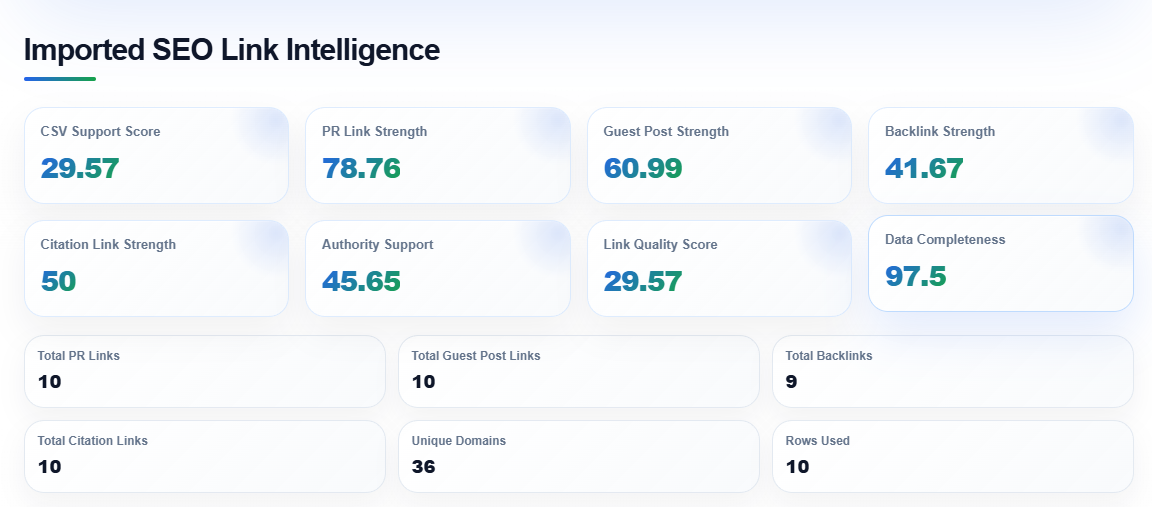
This dashboard provides a comprehensive overview of the website’s link intelligence profile, measuring the strength, quality, and diversity of external references contributing to both traditional SEO performance and AI search visibility. The analysis combines multiple link-based metrics to assess how effectively the brand is supported by authoritative third-party sources across the web.
One of the strongest indicators displayed is the PR Link Strength score of 78.76, suggesting that the website benefits from a relatively strong portfolio of public relations and editorially earned links. Such links are particularly valuable because they serve as trust and authority signals for both search engines and AI models that evaluate source credibility when generating responses.
The Guest Post Strength score of 60.99 reflects a healthy contribution from content-driven outreach efforts, while the Backlink Strength score of 41.67 indicates moderate performance in overall link acquisition. These figures suggest that although the website has developed a meaningful backlink footprint, there remains potential to diversify and strengthen its external authority signals.
The dashboard also highlights Citation Link Strength (50) and Authority Support (45.65), which measure how effectively the brand is referenced across trusted sources and authoritative domains. These metrics are increasingly important in the era of AI search, where entity validation and citation consistency influence visibility within generative search engines.
A particularly notable metric is Data Completeness at 97.5%, indicating that the link intelligence dataset is highly comprehensive and reliable. This ensures greater confidence in the analysis and provides a strong foundation for strategic decision-making.
This is why AVM matters.
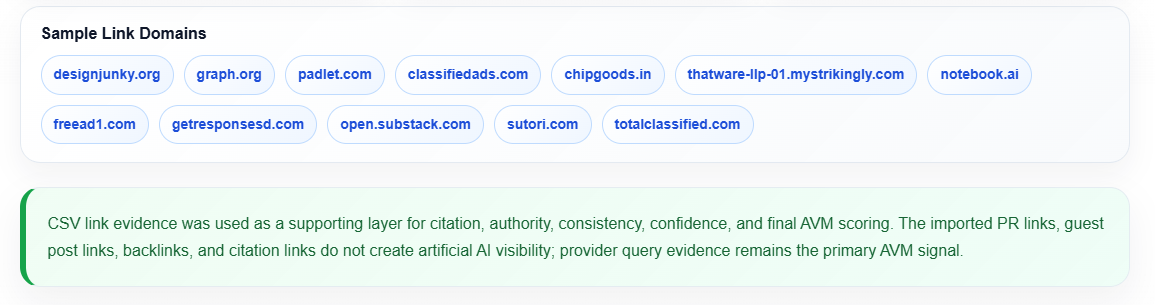
Why Link Diversity Matters for AI Visibility
Key Takeaways:
- Domain diversity is a critical component of authority and trust-building.
- Link evidence contributes to citation strength, consistency, and confidence scoring within the AVM framework.
- PR links, guest posts, backlinks, and citations act as supporting signals rather than standalone ranking factors.
- AI visibility is increasingly driven by actual entity recognition and query-based evidence rather than link quantity alone.
- A diversified citation ecosystem strengthens both traditional SEO performance and AI search credibility.
- Modern AI search systems prioritize authoritative entity validation over artificial link accumulation.
It measures visibility where decisions are increasingly being shaped: inside AI-generated responses.
In the future, brands will not only ask how much traffic they are getting from search engines. They will also ask:
- How often does AI mention us?
- Are we visible for commercial prompts?
- Are we cited as a trusted source?
- Do AI systems place competitors above us?
- Are we appearing in recommendation-style answers?
- Are we consistently visible across multiple AI platforms?
AVM gives structure to these questions.
What AVM Will Solve in the Future of AI Search
AI search creates several visibility challenges that traditional SEO tools do not fully solve.
1. AI Invisibility
Many brands have strong websites but weak AI visibility. AVM helps identify whether the brand is actually appearing in AI answers.
2. Competitor Displacement
Sometimes AI recommends a competitor even when your brand has stronger real-world expertise. AVM helps reveal where competitors are gaining AI visibility.
3. Weak Citation Signals
AI systems often rely on recognizable sources, references, and external validation. AVM helps measure whether the brand has enough citation support.
4. Poor Answer Positioning
Being mentioned is not always enough. A brand may appear at the bottom of an answer while competitors appear first. AVM helps evaluate placement strength.
5. Inconsistent AI Recognition
A brand may appear in one AI platform but not another. AVM helps compare visibility across different AI environments.
6. Lack of Commercial Discovery
Some brands appear only when users search their name. That is not enough. AVM helps measure whether the brand appears for non-branded, high-intent discovery prompts.
The First Layer of AI Visibility: Presence
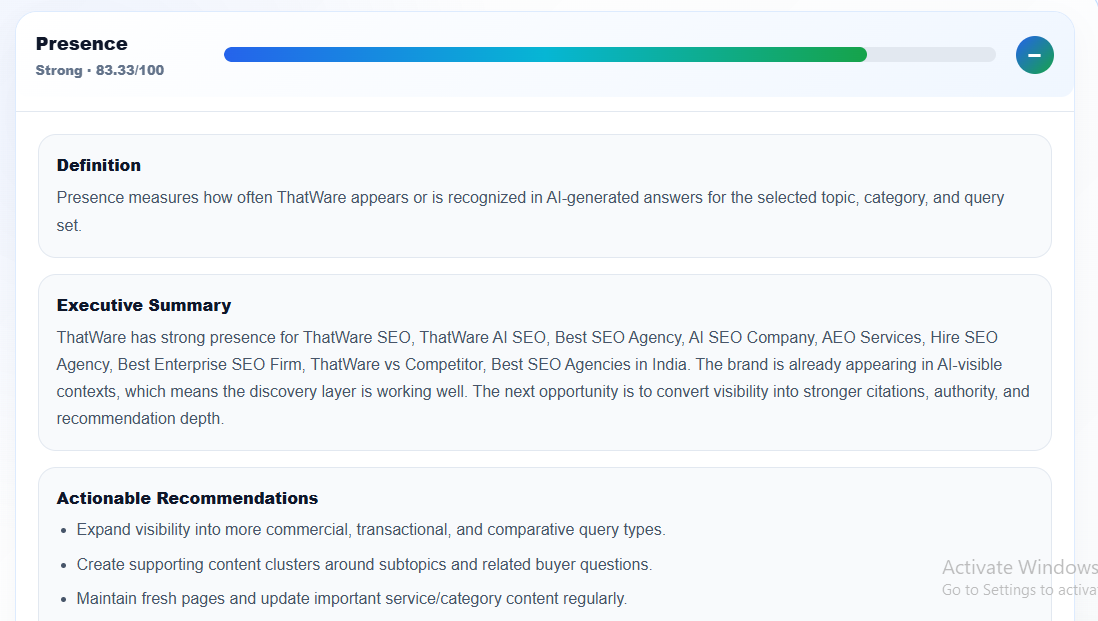
This dashboard evaluates ThatWare’s Presence Score, one of the most fundamental components of AI visibility measurement. With a score of 83.33 out of 100, the brand demonstrates a strong presence across AI-generated responses, indicating that AI platforms frequently recognize and surface ThatWare when users search for relevant SEO, AI SEO, AEO, and digital marketing-related topics.
Consistency Score: Evaluating Reliability Across AI Query Variations
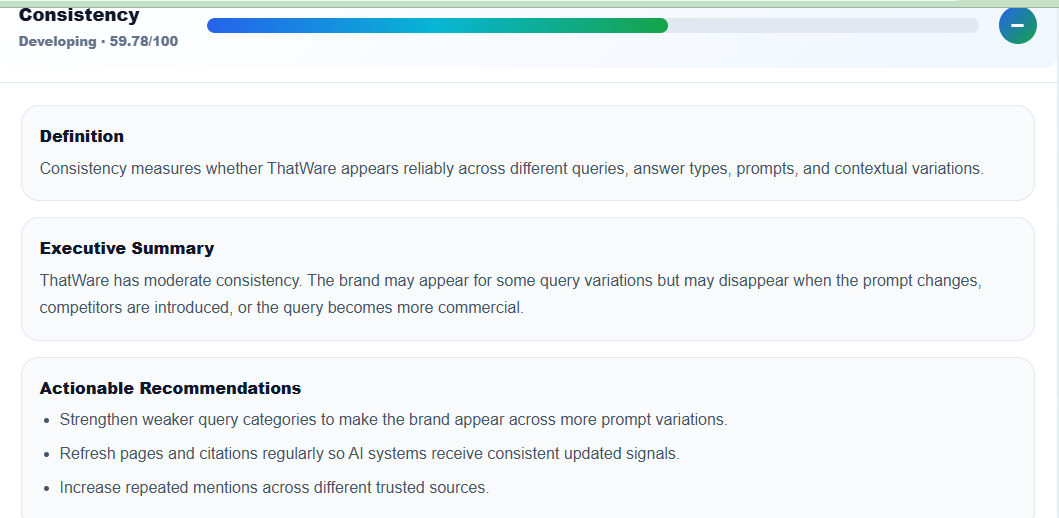
This dashboard measures ThatWare’s Consistency Score, a critical component of AI visibility that evaluates how reliably the brand appears across different query formats, prompts, answer types, and contextual variations. The score of 59.78 out of 100 places the brand within the Developing category, indicating that while visibility exists across multiple AI-generated responses, it is not yet uniformly maintained across all search scenarios.
From Visibility to Recommendation Dominance in AI Search
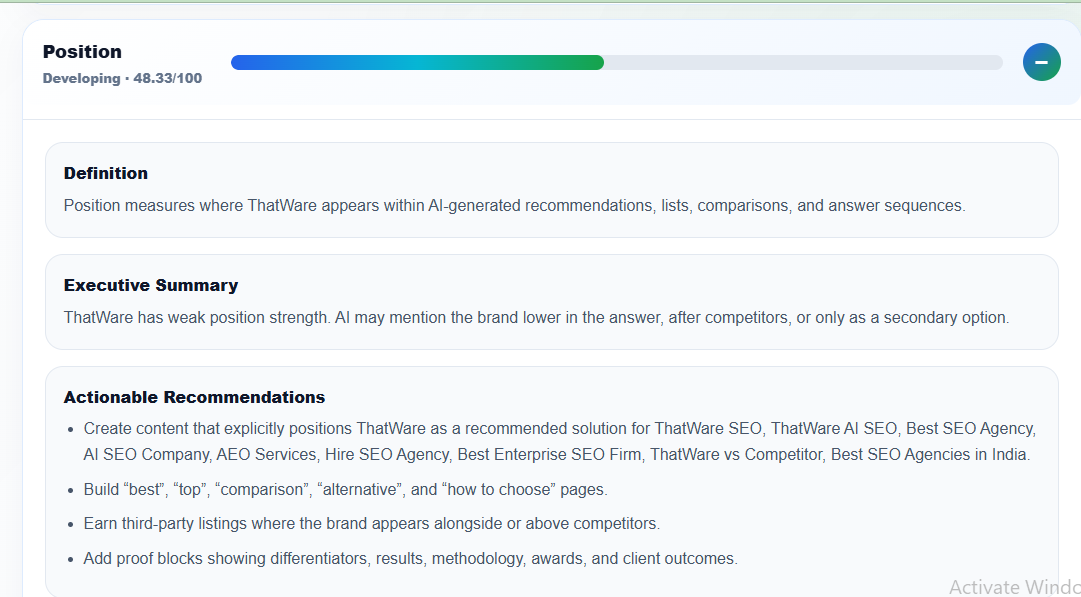
This dashboard evaluates ThatWare’s Position Score, which measures where the brand appears within AI-generated recommendations, comparison lists, rankings, and answer sequences. With a score of 48.33 out of 100, the brand falls within the Developing category, indicating that although AI systems recognize and mention the brand, it is not consistently positioned among the top recommendations.
How AI Determines Whether to Recommend Your Brand
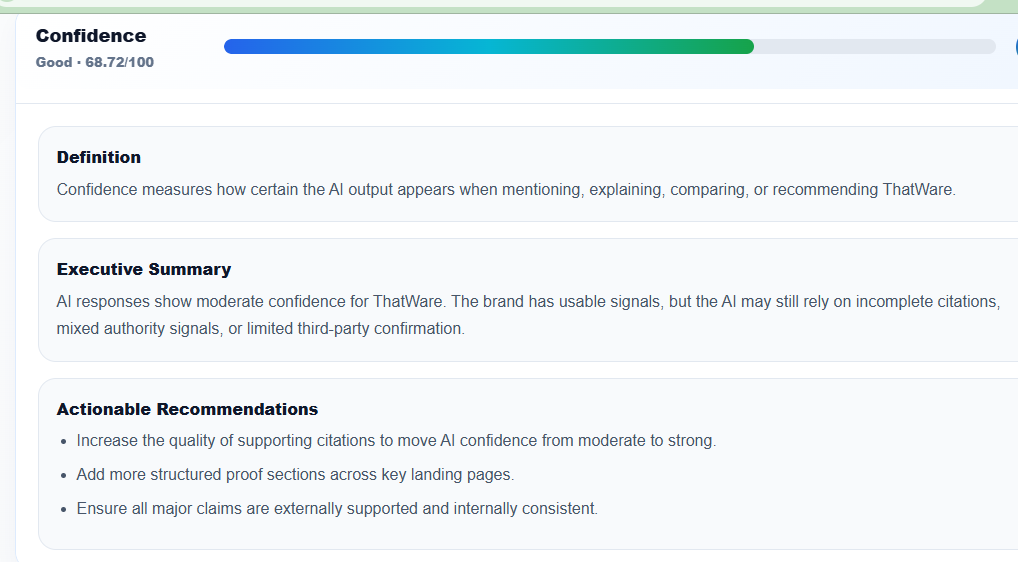
This dashboard presents ThatWare’s Confidence Score, a metric designed to measure how certain AI systems are when mentioning, explaining, comparing, or recommending the brand within generated responses. With a score of 68.72 out of 100, ThatWare falls into the Good category, indicating that AI platforms generally recognize the brand as a credible entity and can reference it with a reasonable degree of certainty.
The AVM Framework: Step by Step
The AVM framework can be understood as a practical sequence.
Step 1: Brand Context Input
The process begins with basic brand information.
This includes the brand name, target topic, industry, country, language, and competitors.
This matters because AI visibility is contextual. A brand may be visible in one market but invisible in another. It may appear for branded queries but not for commercial or comparison-style queries.
By defining the topic and industry clearly, AVM can test visibility in a more realistic environment.
Step 2: Competitor Benchmarking
AVM does not measure the brand in isolation.
It compares the brand against competitors because AI search is comparative by nature.
When a user asks for the best agency, best software, best consultant, or best service provider, AI systems usually compare multiple entities before generating an answer.
This makes competitor benchmarking essential.
AVM helps answer:
- Are competitors appearing more often?
- Are they cited more strongly?
- Are they positioned higher?
- Do they have stronger authority signals?
- Are they more consistent across AI answers?
This gives the brand a clearer view of where it stands in the AI discovery landscape.
Step 3: Query Simulation
AVM then tests different query environments.
These may include branded prompts, non-branded prompts, comparison prompts, category prompts, informational prompts, and commercial-intent prompts.
This is important because a brand’s visibility should not depend only on someone searching its exact name.
A strong AI-visible brand should appear when users ask broader questions related to the industry.
For example, a brand should not only appear for:
“THATWARE AI SEO agency”
It should also aim to appear for prompts like:
“best AI SEO agency” “top AEO agency” “best GEO agency” “LLM SEO agency in India” “SEO agencies using artificial intelligence”
This is where AVM becomes valuable. It checks whether the brand is visible beyond its own name.
Step 4: AI Provider-Level Analysis
Different AI platforms behave differently.
Some may rely more on citations. Some may generate more conversational recommendations. Some may show stronger brand memory. Some may be more influenced by fresh web data.
AVM allows brand visibility to be analyzed through different AI providers and also through a blended view.
This helps brands understand whether they are visible only in one ecosystem or across multiple AI environments.
A brand with strong AI search visibility should not depend on one model alone. It should build durable visibility across the broader AI search layer.
Step 5: AVM Score Generation
After collecting visibility signals, AVM converts them into a score.
The score gives brands a simple way to understand their AI visibility health.
But the score is not the whole story. The real value lies in the breakdown.
A brand may have a decent overall AVM score but weak citation strength. Another brand may have good presence but poor consistency. Another may be cited but positioned poorly.
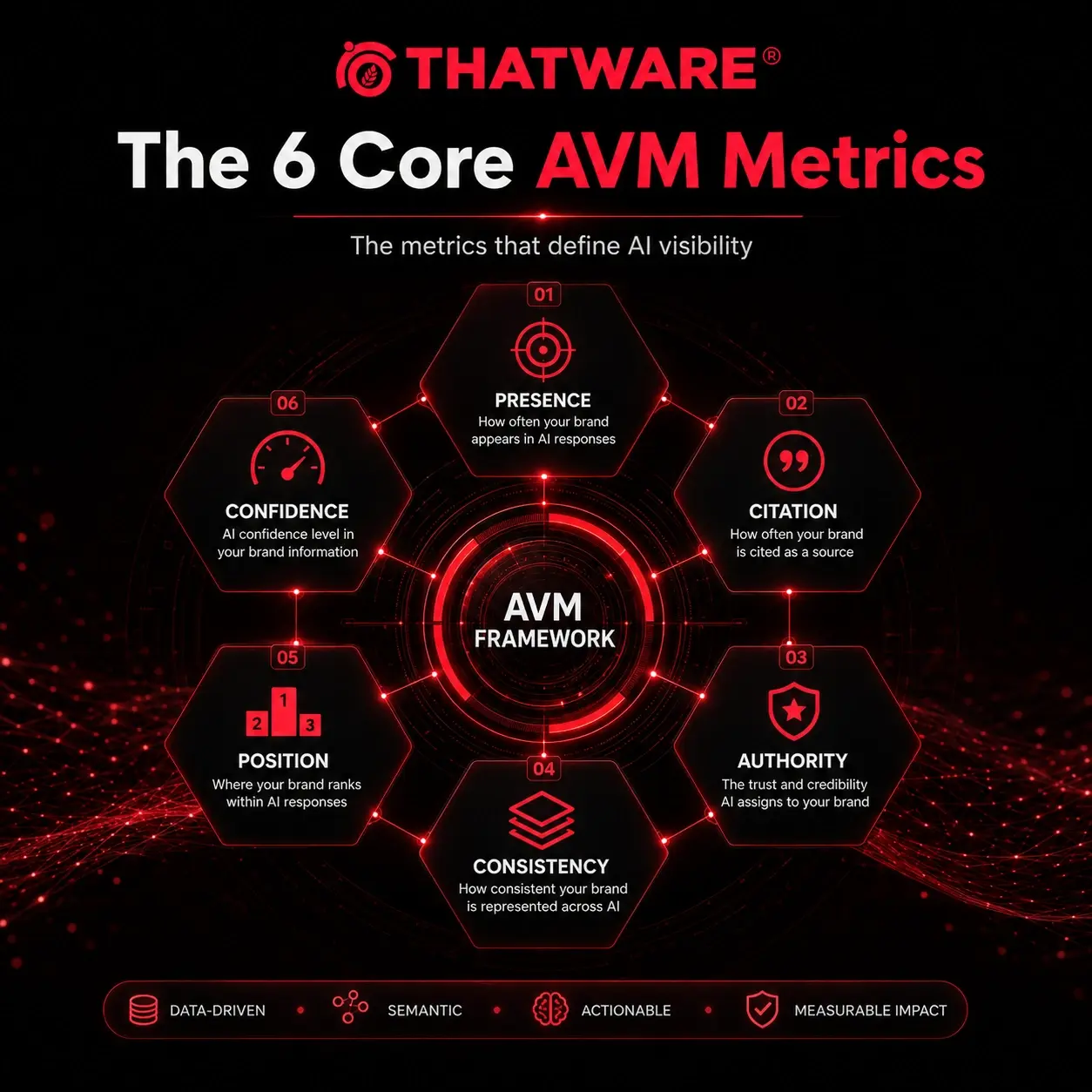
This is why the AVM framework includes associated metrics such as Presence, Citation, Authority, Consistency, Position, and Confidence.
Core AVM Metrics Explained
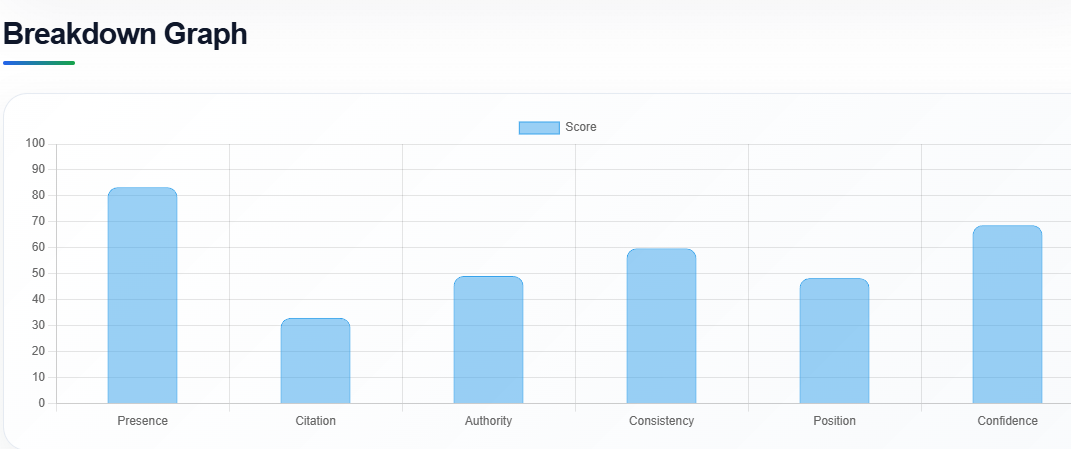
This breakdown graph provides a consolidated view of the key factors contributing to ThatWare’s overall AI Visibility Metric (AVM) Score. Rather than relying on a single aggregate number, the AVM framework evaluates multiple dimensions of AI discoverability to identify both strengths and opportunities within the brand’s AI search presence.
The most prominent performance area is Presence, which scores above 80 and represents the brand’s ability to appear within AI-generated responses for relevant industry queries. This strong result indicates that AI systems already recognize ThatWare as a relevant entity within the SEO, AI SEO, and AEO landscape. The high presence score confirms that the brand has successfully established discoverability across AI-powered search environments.
Confidence emerges as the second strongest category, reflecting the degree of trust AI systems place in the brand when generating recommendations and explanations. This suggests that the existing authority signals, citations, and supporting evidence are sufficient for AI platforms to discuss the brand with reasonable certainty.
The graph also reveals moderate performance across Consistency, Authority, and Position. These scores indicate that while the brand is visible and recognized, there are opportunities to improve how consistently it appears across different prompt variations, how strongly its authority is validated, and how prominently it is positioned within AI-generated recommendations and comparison lists.
Presence
Presence measures whether the brand appears in AI-generated answers.
This is the foundation of AVM.
If the brand is not mentioned, then citation, authority, and position become secondary. The first goal is visibility.
A high Presence score means AI systems are repeatedly surfacing the brand across relevant prompts. A low Presence score means the brand is not being discovered often enough.
Presence answers the question:
Does AI see the brand at all?
Citation
Citation measures whether AI answers are supported by references, sources, or external validation connected to the brand.
In AI search, citations matter because they act as trust signals.
If an AI system mentions a brand but cannot connect it to reliable sources, the recommendation may be weaker. If the brand is supported by credible mentions, articles, directories, reviews, case studies, or authority pages, the visibility becomes stronger.
Citation answers the question:
Does AI have enough external proof to support the brand?
Authority
Authority measures the strength and trust quality of the signals surrounding the brand.
This is not only about backlinks. In AI visibility framework, authority may come from a mix of media mentions, third-party references, trusted directories, expert content, awards, industry recognition, and strong entity signals.
Authority helps AI systems decide whether a brand deserves to be included in serious recommendations.
Authority answers the question:
Does the brand look credible enough for AI to trust?
Consistency
Consistency measures how reliably the brand appears across queries, providers, and contexts.
A brand that appears once may not have strong AI visibility. A brand that appears repeatedly across different prompts and platforms is much stronger.
Consistency is important because AI answers can vary. The same prompt may produce different results across systems or sessions.
A strong consistency score means the brand has a more stable presence in the AI discovery environment.
Consistency answers the question:
Does AI remember and repeat the brand reliably?
Position measures where the brand appears inside AI-generated answers.
This matters because users are more likely to notice brands placed at the beginning of a recommendation or comparison.
A brand mentioned first has stronger visibility than a brand placed near the bottom. A brand listed as a weak alternative has less value than a brand presented as a leading option.
Position answers the question:
Is the brand appearing prominently or just barely being mentioned?
Confidence
Confidence reflects how strongly the system can interpret the visibility result.
If the signals are clear, repeated, and supported, confidence improves. If results are inconsistent, thin, or unsupported, confidence may drop.
This metric is useful because AI visibility is not always binary. A brand may be partially visible, weakly cited, inconsistently positioned, or visible only in limited contexts.
Confidence answers the question:
How reliable is the visibility pattern being observed?
Why These Metrics Matter Together
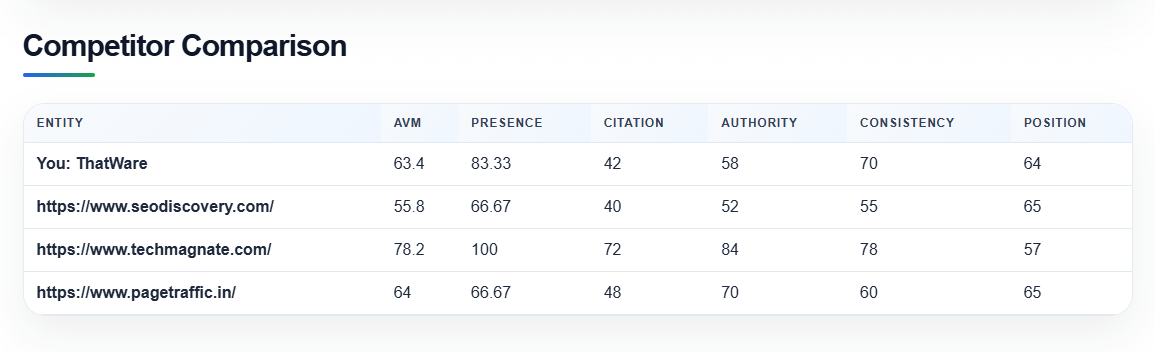
This competitor comparison dashboard provides a side-by-side analysis of ThatWare’s AI Visibility Metric (AVM) performance against key industry competitors. The comparison evaluates six critical dimensions of AI search visibility: AVM Score, Presence, Citation Strength, Authority, Consistency, and Position, offering a comprehensive view of where the brand stands within the competitive AI search landscape.
ThatWare achieves an overall AVM score of 63.4, placing it in a competitive position within the analyzed group. The most notable strength is its Presence Score of 83.33, significantly outperforming several competitors and indicating strong recognition across AI-generated responses. This suggests that AI systems are already identifying and surfacing ThatWare for relevant SEO, AI SEO, and digital marketing-related queries.
However, the comparison also reveals important areas for growth. While ThatWare maintains respectable performance across Authority (58), Consistency (70), and Position (64), some competitors demonstrate stronger supporting signals. Most notably, Techmagnate leads the benchmark with an AVM score of 78.2, supported by exceptionally strong Presence, Citation, and Authority metrics. This indicates that Techmagnate has developed a broader and more mature AI visibility footprint, supported by stronger external validation and citation networks.
PageTraffic shows a closely matched overall AVM score, while SEO Discovery trails behind ThatWare in most categories. This suggests that ThatWare has successfully established itself among the stronger AI-visible brands within the competitive set, but still has opportunities to strengthen its leadership position.
The most significant competitive gap appears within the Citation category, where leading competitors maintain substantially stronger scores. Since citations act as trust and validation signals for AI systems, improving authoritative references, third-party mentions, industry recognition, and entity validation could have a direct impact on overall AI visibility performance.
From a strategic perspective, the comparison demonstrates that ThatWare has already achieved strong AI discoverability but must continue strengthening authority and citation ecosystems to close the gap with top-performing competitors. As AI search increasingly prioritizes trusted and well-validated entities, these improvements can help elevate both recommendation frequency and recommendation ranking within AI-generated answers.
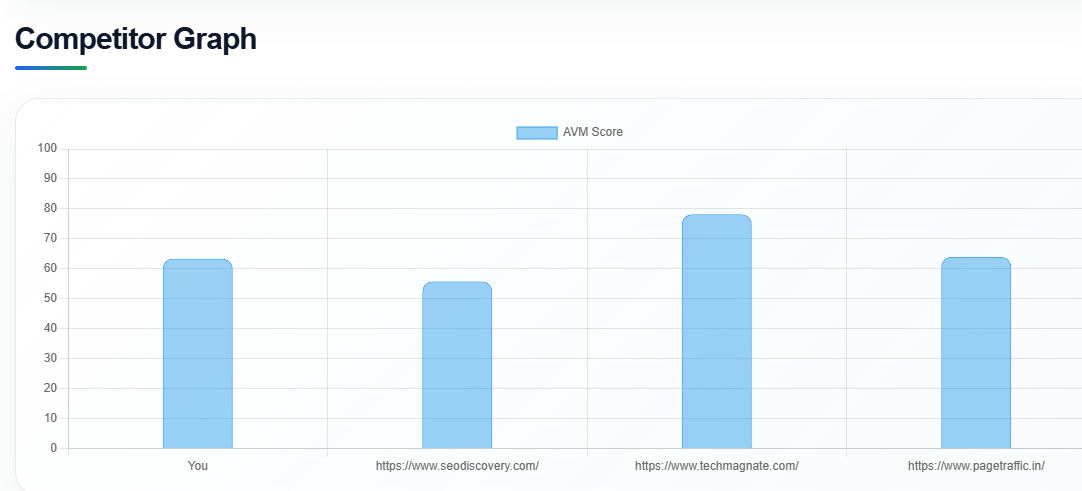
AI Visibility Benchmarking: Where We Stand Against Competitors
This competitor graph provides a visual representation of the overall AI Visibility Metric (AVM) scores across ThatWare and its key competitors, making it easier to identify relative strengths and market positioning within the AI search ecosystem. By consolidating the overall visibility scores into a single chart, the graph highlights how effectively each brand is recognized, validated, and recommended across AI-powered search environments.
Each AVM metric tells part of the story.
Presence shows whether the brand appears.
Citation shows whether the brand has supporting proof.
Authority shows whether the brand is trusted.
Consistency shows whether the brand appears repeatedly.
Position shows whether the brand appears prominently.
Confidence shows whether the result is stable enough to act on.
Together, these AI SEO metrics create a clearer picture of AI visibility.
A brand should not chase only one metric. For example, having Presence without Citation may mean the brand is mentioned but not well supported. Having Authority without Presence may mean the brand has credibility but is not being surfaced enough. Having Position without Consistency may mean the brand appears well sometimes but not reliably.
The strongest brands will be those that perform well across all layers.
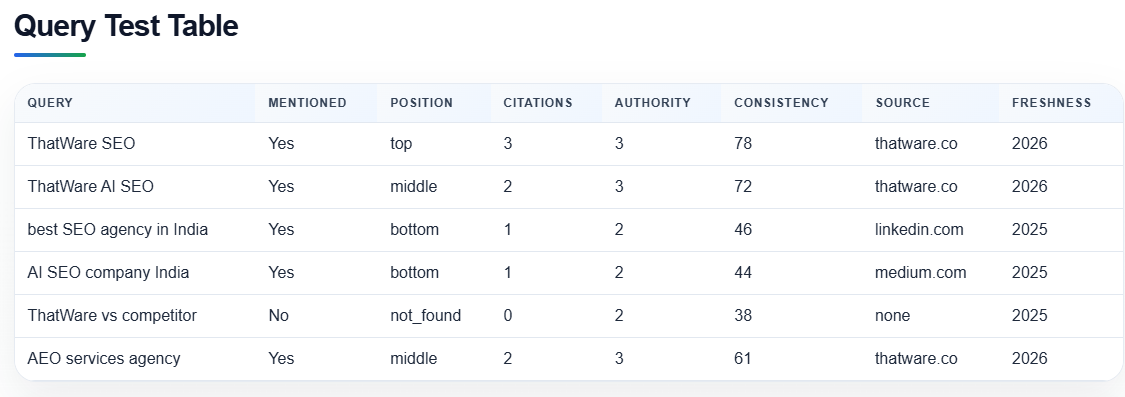
Key Takeaways:
- Branded searches demonstrate the strongest AI visibility performance and recommendation potential.
- “ThatWare SEO” achieves top placement with strong citation and consistency support.
- Competitive industry keywords generate visibility but often position the brand lower within AI responses.
- Citation strength directly influences recommendation prominence and authority perception.
- Comparison-focused queries represent a major opportunity for visibility improvement.
- AEO-related searches show encouraging performance, reflecting growing recognition within emerging AI search categories.
- Query-level testing provides actionable insights that help prioritize future AI Search Optimization initiatives.
How AVM Changes the Way Brands Think About SEO
AVM changes the conversation from keyword ranking to AI recommendation readiness.
Traditional SEO asks:
- Are we ranking?
- Are we getting traffic?
- Are we building links?
- Are pages optimized?
AVM adds a new set of questions:
- Are AI systems mentioning us?
- Are we cited in AI answers?
- Are competitors being recommended more often?
- Are we visible for commercial discovery prompts?
- Are we positioned as a leader or just an option?
- Are we consistently appearing across AI platforms?
This does not make SEO irrelevant. It makes SEO broader.
The next generation of SEO will include technical optimization, content optimization, entity optimization, authority building, structured data, and AI visibility measurement.
AVM helps connect these areas into a measurable framework.
Why AVM Is Important for Businesses
AVM is useful for any brand that wants to understand its future search visibility.
This includes agencies, SaaS companies, ecommerce brands, local businesses, enterprise companies, consultants, healthcare brands, financial brands, education platforms, and B2B service providers.
Any business that depends on online discovery will eventually need to know whether AI systems can find, understand, cite, and recommend it.
The brands that measure this early will have an advantage.
They will know where they are weak before competitors dominate AI-generated recommendations.
What Makes ThatWare’s AVM Framework Different
ThatWare’s AVM framework is built from the perspective that AI search is not a single-channel problem.
It is not only about ChatGPT. It is not only about Google. It is not only about backlinks. It is not only about rankings.
It is about how multiple AI systems interpret a brand across different query environments.
ThatWare’s approach looks at brand visibility in AI search as a combined intelligence layer made up of discovery, citation, authority, consistency, position, and competitor comparison.
This makes AVM more practical than a simple visibility checker.
It becomes a framework for diagnosing why a brand is visible, why it is invisible, and what kind of signals need improvement.
The Future of AVM
In the coming years, brands will likely track AI visibility the same way they now track rankings, traffic, and conversions.
Marketing teams will want to know whether their brand appears in AI answers. CEOs will want to know whether competitors are being recommended more often. SEO teams will want to know which content and authority signals influence AI visibility. Agencies will need a way to explain AI search performance to clients.
AVM is built for that future.
It gives businesses a measurable way to understand their position inside AI search.
As AI-generated answers become a larger part of the customer journey, visibility inside those answers will become one of the most valuable digital assets a brand can build.
Final Thoughts
The AI Visibility Metric is not just a score. It is a framework for the next stage of search.
Search is moving from pages to answers. From rankings to recommendations. From keyword visibility to entity visibility. From traffic alone to AI-driven discovery.
ThatWare is building AVM to help brands understand this shift before it becomes the standard.
The brands that win the next era of search will not only be the ones that rank well. They will be the ones that AI systems can recognize, trust, cite, and recommend.
That is the purpose of AVM.
It helps answer one of the most important questions for the future of digital visibility:
When AI searches your market, does your brand show up?