SUPERCHARGE YOUR ONLINE VISIBILITY! CONTACT US AND LET’S ACHIEVE EXCELLENCE TOGETHER!
Introduction
For more than twenty years, businesses have relied on traditional SEO to improve visibility online.
The objective was straightforward:
- Rank higher.
- Generate traffic.
- Increase clicks.
- Drive conversions.
The entire search ecosystem revolved around one central concept:
Can users find your website?
Today, that question is no longer enough.
The rise of ChatGPT, Claude, Gemini, Perplexity, Grok, and AI-powered answer engines has fundamentally changed how people discover information.
Users increasingly receive direct answers instead of lists of websites.
This shift creates an entirely new challenge:
What happens when users never visit a search results page?
This is where AI Visibility Metrics (AVM) enter the picture.
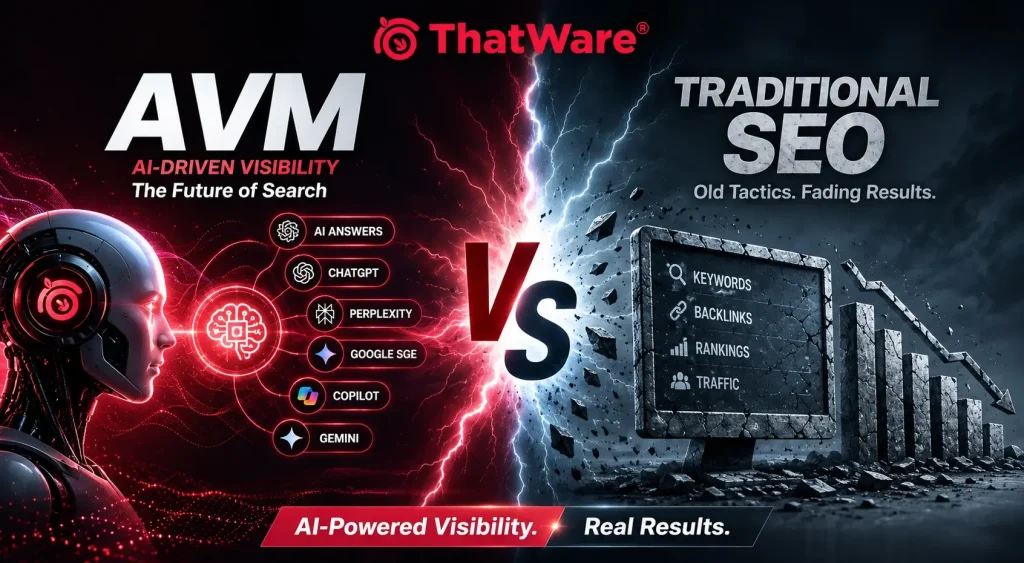
Traditional SEO measures website visibility.
AVM measures AI recommendation visibility.
Although both frameworks are connected, they solve fundamentally different problems.
Understanding this difference is becoming increasingly important for organizations preparing for the future of search.
Understanding Traditional SEO
Traditional SEO was designed around search engines.
The objective was simple:
Help search engines understand, rank, and display webpages.
Success was measured through metrics such as:
- Keyword rankings
- Organic traffic
- Backlinks
- Domain authority
- Click-through rates
- Impressions
- Conversions
The process looked something like this:
User Search
↓
Google
↓
Search Results
↓
Website Click
↓
Conversion
The website was always the destination.
The ranking was always the objective.
Understanding AVM
AI Visibility Metrics (AVM) were developed to measure something entirely different.
AVM asks:
Does AI recognize, cite, and recommend your brand?
Instead of focusing on webpages, AVM focuses on AI-generated answers.
The user journey now looks very different:
User Question
↓
AI Model
↓
Generated Answer
↓
Brand Recommendation
↓
User Decision
The recommendation becomes the visibility layer.
In many cases, users make decisions before visiting a website.
That changes the entire measurement framework.
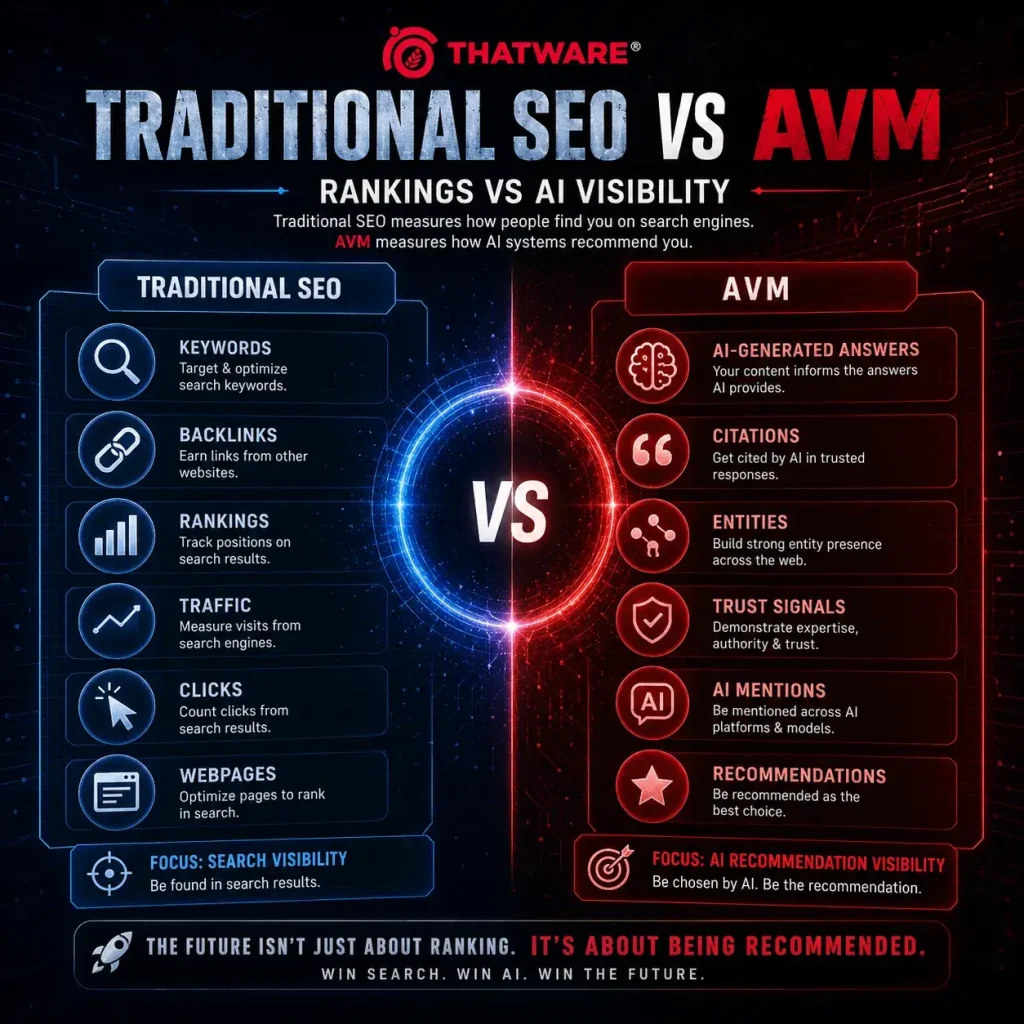
The Fundamental Difference
Traditional SEO measures:
Search Visibility
AVM measures:
Recommendation Visibility
This distinction may appear small.
In reality, it changes everything.
| Traditional SEO | AVM |
|---|---|
| Measures rankings | Measures recommendations |
| Website-centric | Entity-centric |
| Traffic focused | Visibility focused |
| Keyword driven | Context driven |
| SERP-based | AI answer-based |
| Page optimization | Brand optimization |
| Link influence | Citation influence |
| Clicks matter | Mentions matter |
| Rankings matter | Recommendations matter |
| Search engines | AI ecosystems |
Traditional SEO Asks:
- Where do we rank?
- How much traffic do we receive?
- Which keywords perform best?
- How many backlinks do we have?
- How many impressions are we generating?
AVM Asks:
- Does AI mention us?
- Does AI trust us?
- Does AI recommend us?
- Are competitors being recommended instead?
- How often do we appear across AI platforms?
- How visible are we in AI-generated answers?
The questions themselves reveal the difference.
Why Traditional Rankings No Longer Tell The Whole Story
Consider a scenario.
A company ranks:
#1 on Google
for:
Best AI SEO AgencySounds great.
But then a user asks ChatGPT:
Which AI SEO agencies should I consider?
The company never appears.
Instead, AI recommends competitors.
The business technically “won” traditional SEO.
Yet it lost the AI Recommendations.
This is exactly why AVM exists.
Traditional SEO Measures Position
Traditional SEO focuses heavily on placement.
Example:
| Position | Visibility |
|---|---|
| #1 | High |
| #5 | Moderate |
| #20 | Low |
AVM Measures Presence
AVM focuses on whether the brand exists inside AI-generated answers.
Example:
| AI Query | Brand Appears? |
|---|---|
| Best AI Agency | Yes |
| Best SEO Company | Yes |
| Enterprise SEO Agency | No |
| AI Marketing Firm | Yes |
Traditional SEO Optimizes Pages
Historically, SEO teams optimized:
- Meta titles
- Headers
- Internal links
- Content
- Keywords
- Backlinks
The objective was page relevance.
AVM Optimizes Entities
AI systems increasingly evaluate entities rather than pages.
Examples of entities:
- Companies
- People
- Products
- Services
- Organizations
AI attempts to understand:
- Who you are
- What you do
- What topics you own
- Whether you are trusted
- Whether you deserve recommendation
This is fundamentally different from ranking a webpage.
Traditional SEO Relies On Keywords
For decades SEO focused on:
Keyword → Page
Example:
Create page.
Optimize page.
Rank page.
AVM Relies On Context
AI systems evaluate:
Question
↓
Context
↓
Entities
↓
Relationships
↓
Recommendation
The system attempts to understand meaning rather than simply match keywords.
Traditional SEO Uses Links
Backlinks remain one of the strongest SEO signals.
Search engines view links as votes.
More quality links often result in stronger Search Rankings.
AVM Uses Citations
AI systems rely heavily on references and citations.
A brand mentioned by:
- Forbes
- Gartner
- Clutch
- Research Publications
- Industry Journals
may become easier for AI systems to trust.
Citation strength increasingly acts as an AI recommendation signal.
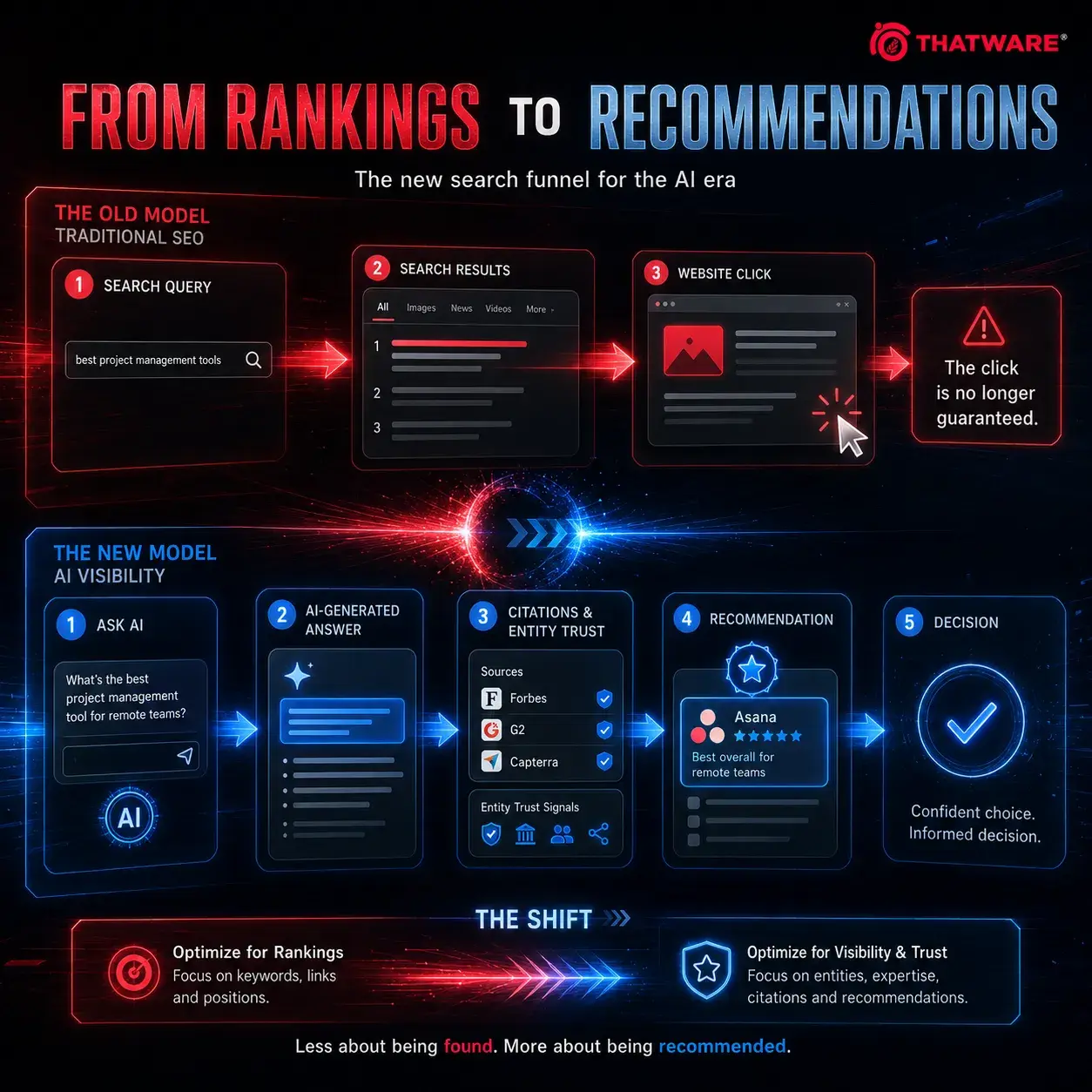
The New Search Funnel
Traditional funnel:
Search
↓
Click
↓
Website
↓
Conversion
AI search funnel:
Question
↓
AI Answer
↓
Recommendation
↓
Trust
↓
Decision
Notice something important.
The click is no longer guaranteed.
The recommendation becomes the battleground.
Why Businesses Need Both
One of the biggest misconceptions is that AVM replaces SEO.
It does not.
The future belongs to organizations that combine both.
Traditional SEO helps brands:
- Get indexed
- Get discovered
- Build traffic
- Build authority
AVM helps brands:
- Get recommended
- Build AI visibility
- Improve AI trust
- Strengthen AI discoverability
The two systems support each other.
The Relationship Between SEO and AVM
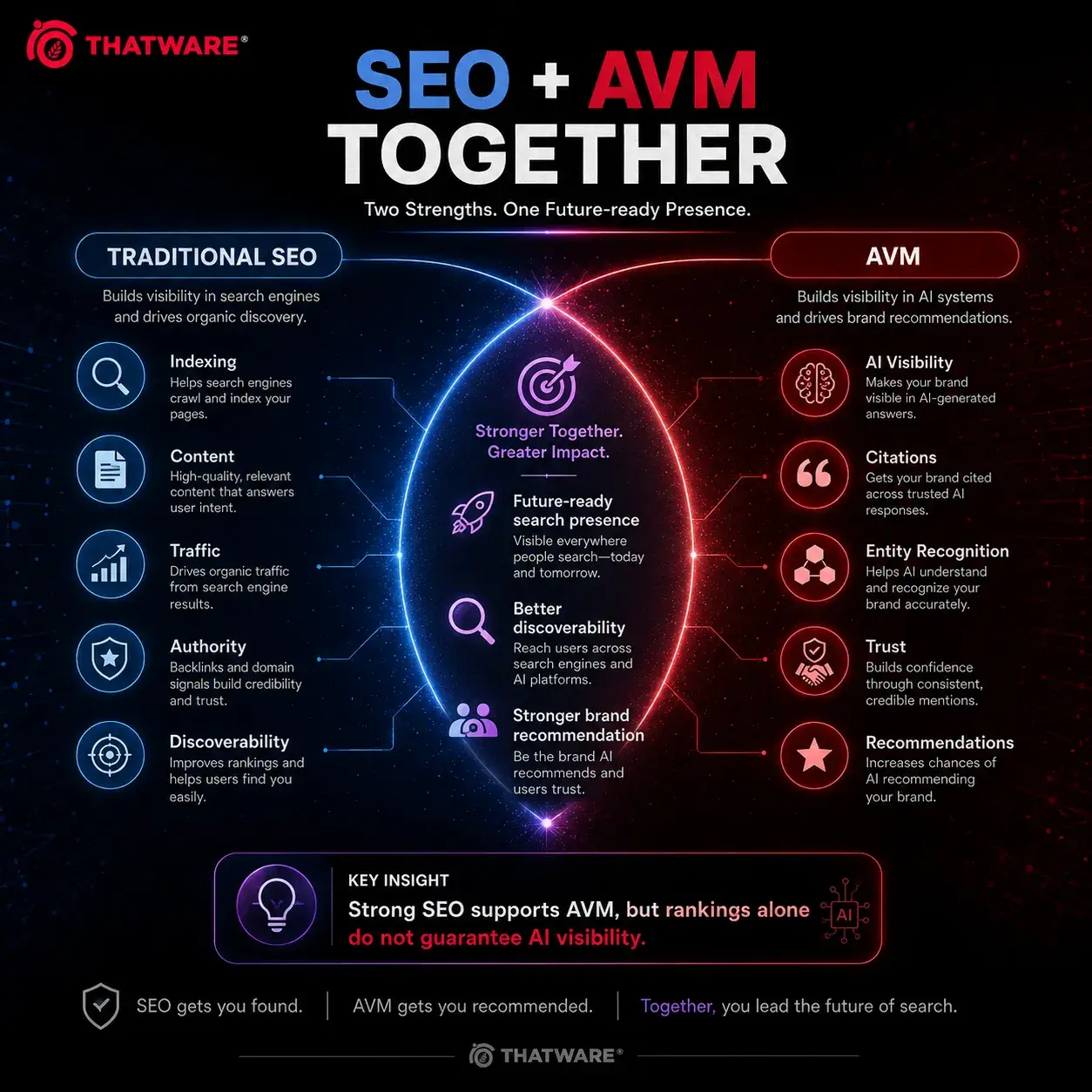
SEO
↓
Content
↓
Authority
↓
Trust Signals
↓
AI Understanding
↓
AVM
Strong SEO often creates stronger AVM outcomes.
But strong SEO alone does not guarantee AI visibility.
The Future Of Search
Search is entering a transitional phase.
Traditional search engines are evolving.
AI-powered answer engines are growing rapidly.
The future search ecosystem will likely contain both.
Users will continue searching.
But increasingly they will ask.
They will ask AI systems for:
- Recommendations
- Comparisons
- Opinions
- Explanations
- Decisions
Brands that optimize only for rankings may miss this shift.
Brands that optimize for AI visibility gain an additional layer of discoverability.
When Should You Focus On Traditional SEO?
Traditional SEO remains critical when:
- Organic traffic is a priority.
- Ecommerce transactions depend on search.
- Content marketing drives acquisition.
- SERP visibility is important.
- Search demand is high.
SEO is not disappearing.
It remains foundational.
When Should You Focus On AVM?
AVM becomes increasingly important when:
- AI search adoption increases.
- Recommendation-based discovery grows.
- Brand awareness matters.
- Competitive differentiation matters.
- Future-proofing search visibility becomes important.
Organizations preparing for the next generation of search should monitor both.
Final Thoughts
AVM vs Traditional SEO is not about competition.
They are different layers of the same ecosystem.
SEO answers:
Can users find my website?
AVM answers:
Can AI find and recommend my brand?
One focuses on rankings.
The other focuses on recommendations.
One focuses on webpages.
The other focuses on entities.
One measures search visibility.
The other measures AI visibility.
As search evolves from links to answers, brands will need both perspectives.
Organizations that understand rankings will remain visible.
Organizations that understand recommendations will become discoverable in the next generation of AI search.
The future will not belong to businesses that choose between SEO and AVM.
It will belong to businesses that master both.