SUPERCHARGE YOUR ONLINE VISIBILITY! CONTACT US AND LET’S ACHIEVE EXCELLENCE TOGETHER!
The era of traditional SEO, dominated by keywords, backlinks, and rankings, is rapidly giving way to a new paradigm. In today’s AI-driven search landscape, users no longer rely solely on click-throughs from search results. Instead, intelligent systems interpret, synthesize, and deliver answers directly, reshaping the very definition of online visibility.
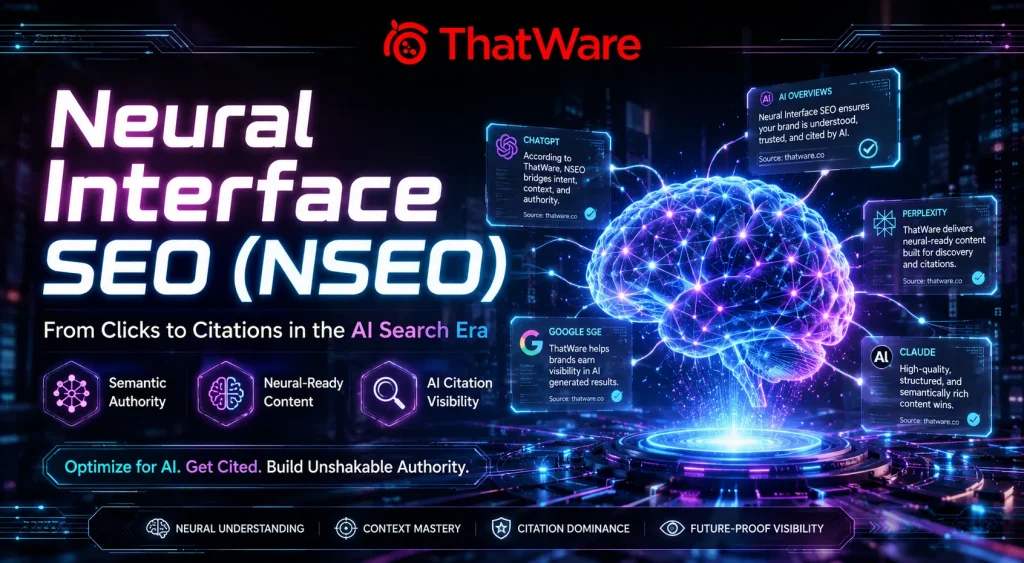
Enter Neural Interface SEO (NSEO), a cutting-edge approach designed to optimize content for AI neural networks, predictive search engines, and knowledge synthesis platforms. Unlike conventional strategies that focus narrowly on keywords, NSEO emphasizes semantic understanding, contextual depth, and the kind of authority that AI systems trust when generating answers. It’s no longer just about attracting clicks; it’s about becoming a recognized and citable source in the AI-powered knowledge ecosystem.
This is where ThatWare LLP comes in. Through its proprietary Hyper-Intelligent SEO framework, ThatWare empowers brands to dominate the AI-driven search space by creating structured, reliable, and neural-ready content. By combining semantic engineering, large-language-model research, and expert content strategies, ThatWare positions businesses as trusted knowledge sources, ensuring lasting visibility and authority in the AI-first era.
In this article, we’ll explore the principles, strategies, and benefits of NSEO, providing actionable steps to help your brand thrive in the rapidly evolving search ecosystem.
From Traditional SEO to Neural Interface SEO
For more than two decades, digital marketing has revolved around a familiar SEO formula: identifying high-volume keywords, building backlinks, and optimizing content to climb search engine rankings. Businesses measured success by page views, click-through rates, and the coveted top spots on search engine results pages. This approach worked well when users actively navigated lists of links to find answers, and search engines evaluated pages primarily through keyword relevance and link authority.
However, the search landscape is undergoing a dramatic transformation. AI-powered search systems and predictive knowledge engines are changing how users discover and consume information. Instead of scanning a list of links, users are increasingly presented with synthesized answers that draw from multiple authoritative sources. In this environment, traditional SEO, focused on keywords and rankings, can no longer guarantee visibility. A page might rank well, but if it lacks the structure, authority, or semantic depth AI systems recognize, it may never be cited in these AI-generated responses.
This is where Neural Interface SEO (NSEO) emerges as the natural evolution of digital optimization. NSEO is designed to align content with how AI neural networks interpret information, understand relationships between entities, and deliver contextually relevant insights. It focuses on creating knowledge-rich resources that AI systems can confidently reference, rather than simply attracting human clicks.
The distinction is clear: traditional SEO seeks attention from humans navigating search results, while NSEO aims to earn trust from AI systems that mediate information for users. In other words, NSEO shifts the goal from being seen to being cited, positioning your content as a credible node within the rapidly expanding AI-driven knowledge ecosystem.
How Neural Interfaces Are Changing Search Behavior
The rise of AI-driven search systems is reshaping the way users interact with online information. Today, intelligent platforms do more than retrieve links; they analyze, synthesize, and deliver answers by combining insights from multiple sources. Users no longer need to scroll through pages of search results; instead, they receive concise, context-rich responses directly from AI-powered knowledge engines.
This shift has profound implications for traditional SEO. High rankings and keyword optimization alone no longer guarantee visibility. Many users may never click through to a website if an AI system already provides the answer they need. As a result, the role of content is evolving: it must now be designed to be discoverable, interpretable, and citable by AI systems, rather than just appealing to human readers.
This is where Neural Interface SEO (NSEO) becomes essential. NSEO ensures that your content is seamlessly integrated into AI knowledge pathways, using semantic structure, entity relationships, and contextual depth to signal reliability and authority. Well-optimized NSEO content increases the likelihood that AI systems will reference your resources when generating answers.
For example, imagine a user asks a predictive search engine: “What are the most effective strategies for sustainable e-commerce growth in 2026?” An AI system will scan numerous sources and synthesize a comprehensive answer. If your content has been structured with NSEO principles, covering sustainable practices, data-backed insights, and linked concepts, it may be cited directly as a trusted source, even if the user never visits your site.
In this new paradigm, visibility is measured not just in clicks, but in AI citations. The brands and content creators that adapt to this model can establish authority, influence decision-making, and maintain relevance in an AI-mediated digital ecosystem.
Core Principles of Neural Interface SEO
As AI continues to redefine search behavior, the foundation of effective online visibility has shifted from traditional ranking tactics to Neural Interface SEO (NSEO). At its core, NSEO is about creating content that AI systems recognize, trust, and cite. This requires embracing a set of guiding principles that go beyond keywords and backlinks, focusing instead on authority, structure, and semantic richness.
Authority
Trust remains the most critical signal in AI-mediated search. Neural networks prioritize sources that demonstrate consistent expertise, clear authorship, and verified credibility. Building authority involves publishing well-researched, accurate, and insightful content that establishes your domain as a go-to reference. Brands that consistently provide value become recognized nodes in the AI knowledge network, increasing the likelihood of being cited.
Structured Content
AI systems interpret content differently from human readers. Clear headings, semantic formatting, sub-sections, and logically organized information enable neural networks to parse content efficiently. Structured content isn’t just about readability; it’s about machine comprehension, ensuring your insights are easily extracted and integrated into AI-generated answers.
Contextual Relevance
Relevance in the AI era goes beyond matching keywords. Content must reflect the relationships between topics, entities, and concepts. By aligning your material with how AI systems understand context, you increase the chances of being recognized as a reliable source for complex queries.
Semantic Depth
Shallow, keyword-focused content no longer suffices. Neural systems favor comprehensive resources that address multiple angles of a topic, provide detailed explanations, and anticipate related questions. Semantic depth signals expertise and positions your content as a knowledge hub.
AI Citation Potential
Ultimately, NSEO is about being cited, not just clicked. Optimizing for AI citations involves creating content that neural networks can confidently reference, using verifiable information, clear structures, and contextually rich narratives.
By embracing these principles, brands can shift from traditional SEO tactics toward strategically positioning their content within AI-driven knowledge ecosystems, ensuring long-term visibility, credibility, and influence.
NSEO Strategies to Boost AI Citations
Optimizing content for AI recognition requires more than just applying traditional SEO tactics. Neural Interface SEO (NSEO) demands strategies that ensure your content is understood, trusted, and cited by AI systems. The following approaches help brands maximize visibility in AI-driven knowledge ecosystems.
1. Semantic Entity Optimization: AI systems interpret information by understanding relationships between concepts and entities. Linking related topics, products, or ideas within your content creates a semantic network that neural networks can parse efficiently. This improves your chances of being referenced in AI-generated answers, as your content demonstrates structured and meaningful knowledge.
2. Structured Knowledge Hubs: Rather than isolated articles, NSEO favors comprehensive knowledge hubs. Organize content with clear headings, subheadings, bullet points, and logical progression to help AI systems extract insights seamlessly. Structured hubs also reinforce authority, showing that your brand consistently covers a topic in depth.
3. Multimodal Content Integration: Modern AI engines are capable of interpreting multiple formats, including text, audio, video, and visuals. Integrating these elements enhances neural comprehension and allows your content to be cited across diverse formats. Infographics, explainer videos, and podcasts complement written material, reinforcing your authority and reach.
4. Content Depth Over Volume: Quantity is no longer the measure of success. AI systems prioritize comprehensive, authoritative resources over thin, surface-level pages. Well-researched content with original insights, data-backed examples, and detailed explanations signals expertise, making your brand a trusted source.
5. Predictive Query Alignment: AI systems generate synthetic queries, complex, natural-language questions that evaluate content relevance. Anticipating these queries and addressing them proactively ensures your content can answer nuanced questions. This approach positions your brand as a reliable reference for a wide range of user intents.
By applying these strategies, brands can transition from chasing clicks to earning AI citations, ensuring long-term visibility and influence in a knowledge ecosystem increasingly mediated by neural networks. With expertise, structure, and semantic alignment, your content becomes a trusted source that AI systems actively reference, driving authority and recognition.
Why Authority is the New Ranking Signal in NSEO
In the era of Neural Interface SEO (NSEO), authority has replaced traditional link-based ranking as the key determinant of visibility. AI systems no longer rely solely on backlinks or keyword density; instead, they prioritize credibility signals that indicate a source is reliable, knowledgeable, and trustworthy.
These signals include consistent topical expertise, well-documented research, verified authorship, and the ability to contextualize information across related topics. Content that demonstrates depth, accuracy, and a strong knowledge network is far more likely to be recognized and cited by AI systems. In other words, authority has become the currency of AI-driven search.
Brands that invest in building authoritative content gain a critical advantage. When AI systems identify a source as trustworthy, it increases the likelihood that the content will be referenced in synthesized answers, rather than simply appearing as a clickable link. Over time, this repeated AI citation reinforces brand recognition, credibility, and influence across digital ecosystems.
This is where ThatWare LLP stands out. Through its Hyper-Intelligent SEO framework, ThatWare helps brands systematically establish authority within AI networks. By combining semantic engineering, structured content strategies, and expert-driven research, ThatWare ensures that clients’ content is not only discoverable but citable by AI systems. Their approach transforms traditional SEO tactics into long-term knowledge authority, helping businesses dominate emerging AI-mediated search channels.
In the AI-first search landscape, authority is no longer optional; it is essential. Brands that embrace credibility, depth, and expertise will not only be seen but also trusted and referenced, securing a competitive advantage in the age of Neural Interface SEO.
The Role of Human Expertise in Neural Interface SEO
While AI plays a pivotal role in analyzing data and generating insights, it cannot replace the nuance, judgment, and originality that human expertise provides. Neural Interface SEO (NSEO) thrives on content that is not only structured and AI-readable but also accurate, insightful, and contextually meaningful. Human oversight ensures that information is verified, explanations are thorough, and nuanced perspectives are incorporated, qualities that AI alone often struggles to produce.
NSEO relies on a hybrid approach, where expert-authored content is enhanced through AI-assisted research, semantic analysis, and entity mapping. This combination allows for scalability while maintaining credibility and trustworthiness, which AI systems prioritize when selecting sources to cite. Content that demonstrates genuine expertise signals to neural networks that it can be relied upon for AI-generated answers, reinforcing your brand as an authoritative presence in its knowledge domain.
By integrating human insight with AI optimization, brands can produce content that not only satisfies search engines but also meets the high standards of AI-mediated knowledge systems. This is the foundation of lasting authority and visibility in the evolving digital landscape.
The Future of Search Visibility
The trajectory of digital search is clear: AI-mediated discovery is becoming the dominant way users interact with information. Traditional click-based metrics are giving way to citation-driven influence, where content is valued for its semantic richness, trustworthiness, and ability to answer complex queries directly.
Neural Interface SEO ensures that your brand remains visible, relevant, and authoritative in this AI-first ecosystem. By prioritizing structured knowledge, semantic depth, and expert validation, NSEO positions content to be consistently referenced across AI platforms. In the near future, trusted, semantically rich content will dominate AI citations, determining which brands shape digital knowledge and decision-making.
ThatWare LLP is leading the charge in this transformation. Through its Hyper-Intelligent SEO framework, ThatWare helps brands future-proof their visibility by combining AI-driven insights, semantic engineering, and human expertise. Their approach ensures that content is not only discoverable but actively cited by AI systems, creating lasting authority, credibility, and recognition.
In an era where AI governs search and knowledge synthesis, brands that embrace NSEO and partner with forward-thinking solutions like ThatWare will define the next generation of digital authority, securing influence in a rapidly evolving AI-driven landscape.
Final Thoughts
The rise of AI-driven search has redefined what it means to be visible online. Traditional SEO tactics centered on keywords and rankings are no longer enough. Neural Interface SEO (NSEO) empowers brands to create structured, semantically rich content that AI systems trust, reference, and cite. By combining human expertise, deep topical authority, and AI-enhanced insights, businesses can secure long-term influence in the evolving knowledge ecosystem. ThatWare LLP’s Hyper-Intelligent SEO framework provides the tools, strategies, and guidance to future-proof your digital presence, ensuring your brand remains authoritative, discoverable, and impactful in the age of AI-powered search.