
SUPERCHARGE YOUR ONLINE VISIBILITY! CONTACT US AND LET’S ACHIEVE EXCELLENCE TOGETHER!
Knowing that your brand appears in AI search is only half the story. Buyers are often asking for the best provider, alternatives, comparisons and shortlists. Competitor AI visibility analysis shows how your brand performs against the specific companies that can take that recommendation, citation or consideration slot.
| Competitive analysis is an AVM application Competitor AI Visibility is not a new framework. It applies AVM to a comparative buyer-intent use case: measuring the target brand and named competitors against the same prompt portfolio, providers and market context. |
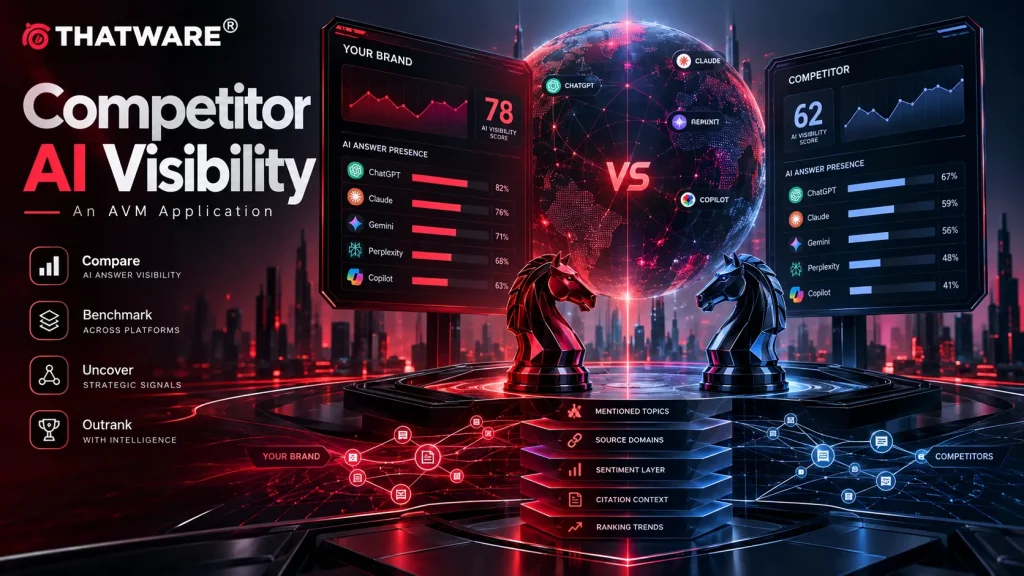
What Is Competitor AI Visibility Analysis?
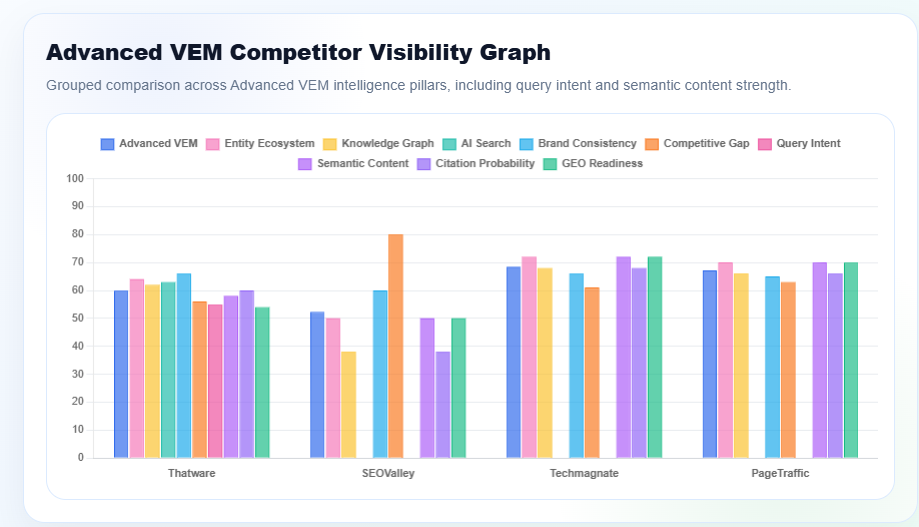
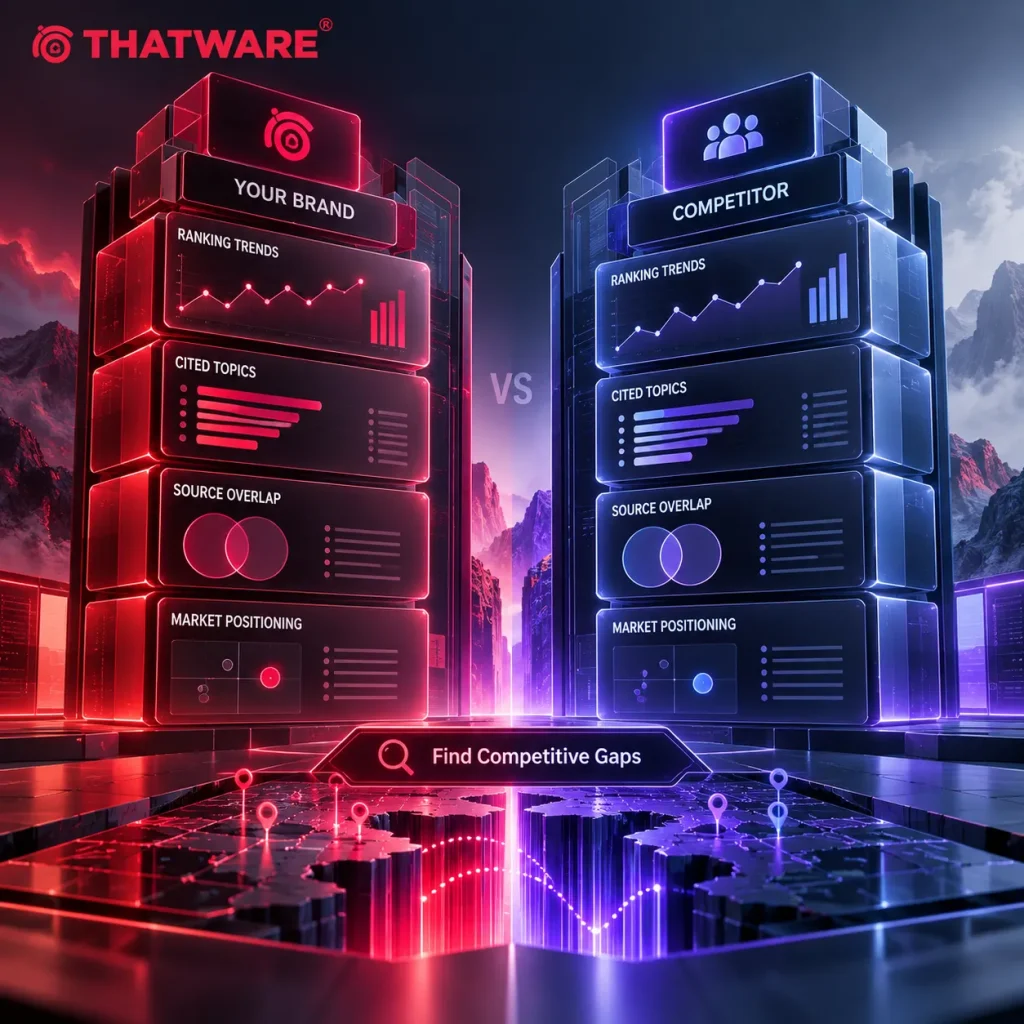
Competitive AVM example reconstructed from the published framework page.
Competitor AI visibility analysis is a structured comparison of how multiple brands appear across sampled AI-generated answers. The same prompts are used for every brand so the analysis can identify meaningful differences in presence, citations, authority, consistency and position.
The output is more useful than a simple winner list. It shows why a competitor is stronger on certain prompts, which sources support that advantage, where your brand already performs well and which gaps are most realistic to close.
Why Competitive AI Visibility Is Different From SEO Competitor Analysis
Traditional competitor research can compare rankings, pages, backlinks and traffic estimates. AI answer environments add another layer. A competitor may be recommended even when it does not hold the strongest organic position. It may benefit from third-party evidence, clearer entity relationships, stronger category association or better coverage of buyer-intent questions. Unlike conventional SEO research, AI search competitor analysis evaluates how brands compete inside generated answers, citations and recommendation structures.
- See which brands AI systems include in category-level recommendations.
- Identify competitors that dominate commercial and comparison prompts.
- Compare citation ecosystems rather than only backlink profiles.
- Understand whether a competitor advantage comes from presence, authority, consistency or position.
- Find topic and prompt gaps where your brand can build visibility without copying competitor content.
A structured AI competitor analysis goes beyond rankings by examining how brands are retrieved, described, recommended and supported across AI-generated answers.
How AVM Structures Competitive Benchmarking
An AI visibility competitor analysis applies the same AVM dimensions to every selected brand, making differences in presence, citation, authority, consistency and position easier to diagnose. Consistent AI competitor benchmarking requires every selected brand to be measured against identical prompts and AVM dimensions.
Presence Gap
Which competitors appear on prompts where your brand is missing? This is the first signal of lost discovery opportunity.
Citation Gap
Which competitors are repeatedly supported by credible sources, and which of those sources do not mention your brand? Citation gaps can become specific PR, content or authority-building opportunities. A detailed competitor citation analysis shows which publications, directories, research assets and other sources repeatedly support rival brands across AI answers.
Authority Gap
Does the competitor have stronger independent evidence around expertise, products, leadership, research or market recognition? Authority helps explain why a brand may be easier for AI systems to verify.
Consistency Gap
Is one competitor described more reliably across prompts and providers? Consistency can reveal stronger entity clarity or more coherent information across the web.
Position Gap
When multiple brands are present, who is placed earlier in the recommendation structure? This can matter even when overall mention rates look similar.
What We Compare
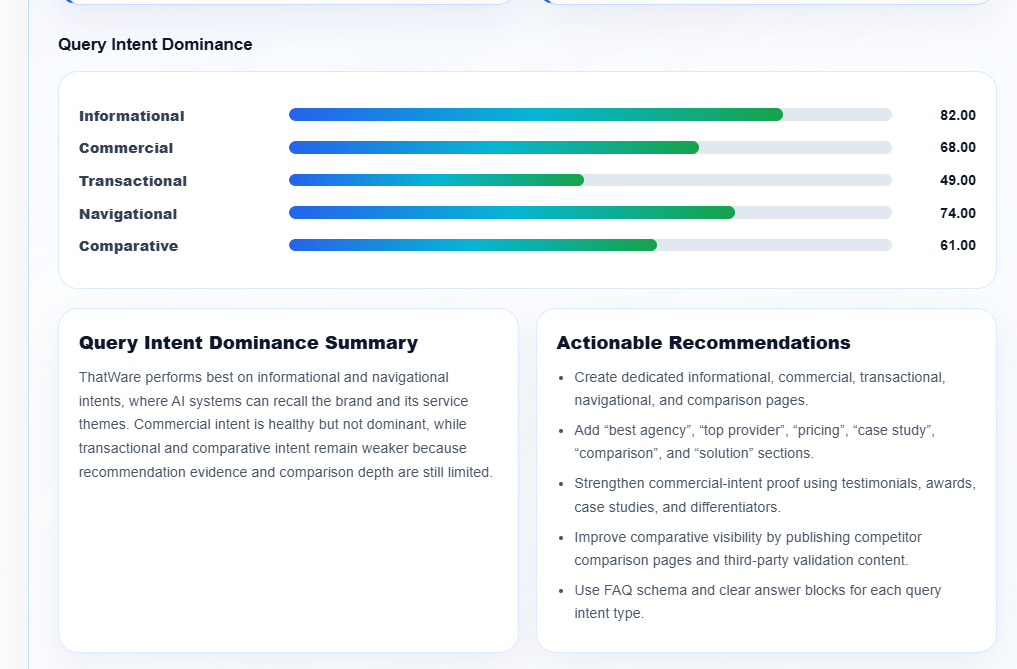
The five AVM dimensions used to diagnose why one brand may outperform another in AI answers.
- Target brand vs named competitors on the same prompt set.
- Presence across branded, non-branded, commercial, comparative and transactional prompts.
- Citation sources and source authority.
- Relative recommendation or mention position.
- Consistency of brand descriptions and category association.
- Provider-specific strengths and weaknesses. The benchmark can also evaluate multi-model competitor visibility to identify whether a rival’s advantage is broad across AI platforms or concentrated within one provider.
- Topic ownership and prompt clusters where a competitor repeatedly dominates.
- Competitive share of voice across the sampled answer environment.
The Competitor AI Visibility Workflow
A competitive AI visibility audit establishes the current benchmark before content, entity, authority or citation improvements are prioritized.
- Select a focused competitor set based on real buying alternatives, not every company in the market.
- Define the market, language, location and priority products or services.
- Build a prompt portfolio that reflects how buyers compare and shortlist providers.
- Collect provider-specific answer evidence for the target brand and competitors.
- Normalize the evidence and evaluate it through AVM dimensions.
- Map the largest competitive gaps by prompt, source, topic and buying stage.
- Prioritize actions based on commercial importance and the feasibility of closing each gap.
- Repeat the same benchmark to measure whether the visibility gap is narrowing.
What You Receive
The competitive AI visibility audit should translate measured gaps into clear actions across content, technical optimization, entity development, digital PR and citation building.
- Executive competitor AI visibility benchmark.
- Brand-by-brand AVM evidence comparison.
- Prompt-level wins and losses across the buyer journey.
- Citation and authority gap analysis.
- Provider-specific competitive breakdown.
- AI share of voice view for the selected category or market. The AI share of voice competitors view can show how frequently each selected brand appears across the same sampled prompts, providers and intent groups.
- Topic and intent map showing where each competitor is strongest.
- Prioritized roadmap for content, citations, entity work, digital PR and generative search optimization.
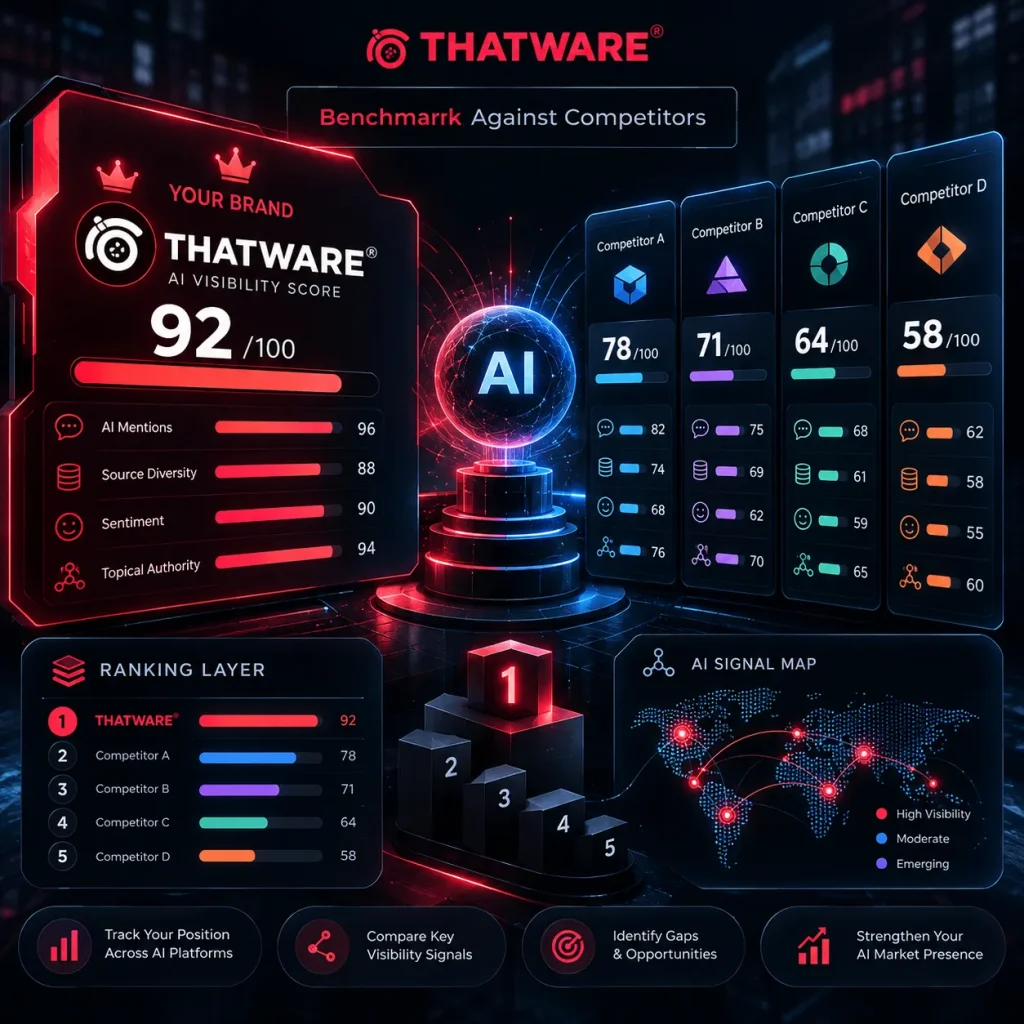
Choose Competitors Based on Buyer Reality
The most useful benchmark is not always a list of the largest brands in the industry. It should include the companies that appear in real recommendation answers, the companies sales teams encounter in deals and the brands that rank or receive strong third-party coverage for the target category. This creates a more realistic view of the competitive answer environment.
How to Turn Competitive Gaps Into Action
A competitor gap is only useful if it changes strategy. If a rival dominates because of stronger comparison content, build differentiated buyer guidance instead of copying their page. If it benefits from repeated authoritative citations, identify the publications, research formats or expert narratives that support that visibility. If its entity is more coherent, strengthen your organization, product and expert relationships across the web.
Use VEM When the Competitive Gap Is Structural
Some visibility gaps are symptoms of weak entity foundations. If the brand has inconsistent names, thin entity relationships, weak machine-readable context or poor topic association, VEM can help diagnose those issues. The competitor benchmark itself remains an AVM application.
Avoid False Precision
AI provider behavior changes, and sampled answer evidence is not the same as total market behavior. ThatWare therefore positions competitive AVM results as a repeatable diagnostic benchmark, not a universal industry ranking. The provider set, query portfolio, geography, language and measurement date should stay visible so leaders understand exactly what is being compared.
| Benchmark Your Brand Against the Competitors AI Systems Surface See where competitors win, why they win and which visibility gaps deserve action first. Build the benchmark around the prompts and markets that influence actual buying decisions. |
Choose Competitors Based on the AI Answer Environment
Traditional SEO competitor lists often start with domains that rank for the same keywords. That is useful, but AI-generated answers can introduce a different set of rivals. A publisher, marketplace, software platform, consultancy or niche specialist may appear repeatedly in recommendation prompts even if it is not the company’s closest organic-search competitor. Competitor AI visibility analysis should therefore combine known commercial rivals with brands that actually appear in the answer environment. Measuring LLM competitor visibility can also reveal rivals that appear consistently in generated recommendations even when they are not the strongest traditional organic-search competitors.
The competitor set can be organized into tiers. Direct competitors serve the same buyer and solve the same problem. Category competitors offer a different route to the same outcome. Emerging competitors are brands that appear unexpectedly in AI answers and may be gaining visibility faster than expected. Regional competitors matter when the market is location-specific. This structure keeps the comparison commercially relevant without making the benchmark too broad. A focused ChatGPT competitor analysis can reveal which brands repeatedly surface when users ask for recommended providers, alternatives, comparisons or category leaders.
The set should also be reviewed periodically. If a new brand begins appearing across several high-intent prompts, it may deserve inclusion even if sales teams have not historically treated it as a major rival. AI visibility can therefore reveal shifts in the competitive landscape earlier than conventional reporting.
Compare Competitors on the Same Prompt Portfolio
Fair benchmarking requires a common test. Every brand should be evaluated against the same prompt set, provider scope, market, language and measurement period. Without that consistency, the comparison can be distorted by easier branded prompts or different query conditions. The analysis should separate branded validation from non-branded discovery so companies are not rewarded simply because their names were included in the questions. A reliable generative AI competitor analysis requires every brand to be tested against the same prompt portfolio, market, language, provider scope and measurement period.
The prompt portfolio should cover educational, commercial, comparative and transactional intent, with particular weight given to the questions that influence shortlisting and choice. It can also include service-specific, location-specific and industry-specific groups where those factors matter to the business. This creates a benchmark that reflects real competitive situations rather than a generic visibility score. The value of AI competitor benchmarking comes from repeatability, allowing the business to compare the same competitive environment across measurement periods.
Once the evidence is collected, AVM can compare presence, citation, authority, consistency and position across the brands. The same dataset can also support share-of-voice views and source-gap analysis, but the purpose of the competitor page remains diagnostic: explain where rivals are stronger, why that advantage may exist and which gaps are realistic to close.
Identify the Source of the Competitive Advantage
A competitor can outperform for several different reasons. It may appear more often because it has stronger category association. It may receive better placement because it has more persuasive proof and clearer differentiation. It may have stronger citations because respected third-party sources connect it with the topic. It may be represented more consistently because its entity data is cleaner. A useful benchmark separates these causes. Effective AI search competitor analysis should separate visibility gaps caused by discoverability from those caused by authority, citations, positioning or entity consistency.
This matters because the response should match the gap. If the target brand has high authority but low presence, the problem may be discoverability or topic coverage. If presence is strong but citations are weak, the brand may need more independent evidence. If the brand is cited but placed below competitors, comparative proof, relevance or positioning may need attention. If results vary across providers, entity consistency or source diversity may be involved.
The report should therefore show not only who is ahead, but which AVM dimensions create the gap. That turns competitor analysis from a scoreboard into an optimization tool.
Map Competitor Citation Ecosystems
The goal of competitor citation analysis is not to copy a rival’s backlink profile, but to understand which sources provide meaningful evidence within the AI answer environment. One of the most valuable parts of competitive analysis is understanding the source ecosystem around each brand. Which publications, directories, research assets, partner pages, reviews, expert profiles and owned resources appear when the competitor is recommended? Are the same sources repeated across providers? Do those sources validate specific expertise, products or outcomes? Are there source categories where the target brand is consistently absent?
The objective is not to reproduce a competitor’s backlink profile. AI citation environments are more contextual. A source matters because of the role it plays in an answer, not merely because it links to a domain. A competitor may benefit from a respected report, a detailed case study, a technical documentation hub or a clear expert profile. The benchmark should identify these patterns and translate them into evidence-building opportunities for the target brand.
This creates a practical agenda for digital PR, thought leadership, original research and third-party validation. It also helps teams avoid low-value outreach that has little connection to the prompts buyers actually use.
Analyze Competitive Position, Not Just Presence
Two brands can both appear in an answer while occupying very different positions. One may be the first recommendation with a detailed explanation, while another is included only as an additional option. Competitive visibility analysis should therefore examine the relative order and prominence of brands across recommendation and comparison prompts.
Position is especially important for high-intent queries. When users ask for the best agency, a shortlist, a recommended platform or an alternative, the first few brands are likely to receive more attention. The exact commercial effect will vary, but repeated top placement is strategically different from repeated bottom placement. AVM’s position dimension captures that distinction without pretending AI answers behave exactly like numbered search results.
The analysis should look for repeated patterns rather than isolated wins. A competitor that consistently appears early across related prompts has a stronger answer-layer position than one that occasionally appears first. This is another reason prompt families and repeated measurement matter.
Use VEM to Explain Structural Competitive Gaps
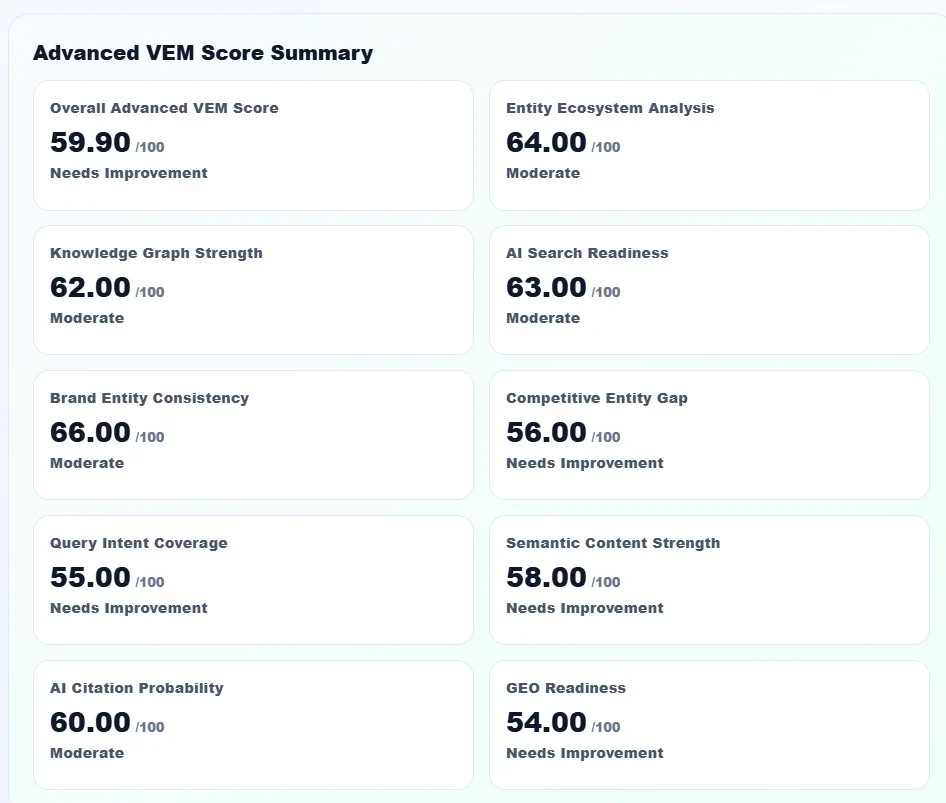
Some competitors have an advantage because their entity architecture is easier for AI systems to understand. Their organization facts are consistent, their services are clearly related to the brand, expert profiles reinforce key topics, structured data supports the visible content, and third-party references describe the company in similar terms. When the target brand’s information is fragmented, AVM may reveal the visibility gap but not fully explain it.
VEM can support the diagnosis by comparing entity clarity, content coverage, authority signals, relationships, AI readiness and query coverage. The purpose is not to create a second competitive score for the same question. It is to investigate whether the underlying entity foundation contributes to the observed AVM difference.
This distinction is useful when a brand has strong content and backlinks but still underperforms in AI recommendations. The issue may be the coherence of the evidence rather than the quantity of pages. Fixing naming, relationships, schema, outdated profiles and inconsistent service descriptions can sometimes be a prerequisite for stronger visibility.
Turn Competitive Gaps Into a Strategic Opportunity Map
A good competitor report should end with a set of opportunities, not a list of losses. Each gap can be classified by impact, difficulty and time horizon. High-impact, low-complexity actions might include correcting factual inconsistencies, strengthening internal links, clarifying service definitions or expanding pages that already have authority. Medium-term opportunities may involve new comparison content, case studies, expert assets, research or location-specific coverage. Longer-term opportunities may require sustained PR, partnerships, research programs or broader category authority. This transforms the benchmark into AI competitive intelligence that can guide content, PR, entity optimization, research and product-marketing priorities.
The opportunity map should also distinguish between defending existing strengths and closing gaps. If the brand already performs strongly on certain prompt families, those areas should be monitored and reinforced. If a competitor dominates a topic that is strategically irrelevant, the business may choose not to compete. Competitive intelligence is valuable partly because it helps the organization decide what not to chase.
This keeps the roadmap focused on business priorities rather than vanity competition.
Build Executive Reporting Around Competitive Questions
Leadership usually wants answers to a few practical questions: Which competitors are most visible in AI discovery? Where are we losing commercial prompts? Which competitor advantages appear to be evidence-based? Are we improving over time? Which gaps can be addressed through content, authority, entity work or technical changes? The report should lead with those questions rather than presenting a large table without interpretation. An AI share of voice competitors dashboard can give leadership a comparative view of brand presence while retaining the prompt-level evidence underneath the summary.
Below the executive layer, detailed sections can support specialist teams. SEO teams can review prompt and page gaps. PR teams can review citation ecosystems. Content teams can see missing buyer questions and proof assets. Technical teams can investigate entity consistency and structured data. Product marketing can analyze how competitors are described and differentiated. Effective AI competitive intelligence should help decision-makers understand not only where competitors are stronger, but which gaps matter commercially and deserve investment.
The same benchmark can therefore support several functions while preserving one source of truth. That reduces the risk that each team creates its own definition of AI visibility.
A useful AI competitor analysis gives leadership a clearer view of which rivals are gaining recommendation visibility and what evidence appears to support that advantage.
Monitor Competitive Movement Over Time
Repeating the same ChatGPT competitor analysis over time can show whether changes in content, authority and entity signals coincide with stronger recommendation visibility. Competitive AI visibility is dynamic. A competitor may launch a new content hub, earn major press coverage, refresh product documentation or improve its entity consistency. Providers may also change retrieval and answer behavior. A one-time benchmark can identify the current state, but a recurring program is needed to understand direction. Ongoing competitor AI visibility tracking helps teams see whether rival brands are gaining or losing ground across important prompt families and AI providers.
Tracking multi-model competitor visibility over repeated measurement cycles helps distinguish provider-specific volatility from broader competitive movement. Trend analysis should preserve the same prompt set and competitor definitions wherever possible. It should show whether gains are broad across providers and intents or concentrated in one area. It should also track new competitors that emerge in the answer environment. This allows the business to spot changes before they become obvious in traffic or pipeline reports. Changes in LLM competitor visibility should be reviewed by provider and intent cluster because competitive performance can vary significantly across different answer environments.
The objective is not constant reactive monitoring. It is disciplined competitive intelligence. By connecting each measurement cycle with the actions taken between cycles, teams can learn which improvements are associated with stronger answer-layer visibility and where additional work is required. When competitor AI visibility tracking is connected to the actions taken between measurement cycles, teams can better understand which improvements are associated with stronger visibility.
What Buyers Should Expect From a Competitor AI Visibility Service
A credible service should explain how competitors are selected, how the prompt portfolio is built and how the same conditions are applied to every brand. It should show prompt-level evidence beneath the summary, distinguish presence from position, evaluate citations and authority, and document provider differences. It should also make clear that the benchmark is based on sampled AI answers rather than every possible user interaction. The strongest generative AI competitor analysis connects summary findings back to prompt-level evidence instead of relying on a single visibility score.
The service should avoid simplistic winner labels. The useful output is a gap analysis that explains where each brand is stronger or weaker and why. A competitor may lead one topic while losing another. The target brand may already have advantages that deserve protection. A transparent benchmark makes those differences visible.
ThatWare’s AVM methodology provides the measurement framework for this work. Competitor AI Visibility is an application of AVM, focused specifically on comparing the target brand with named rivals across the same answer environment and converting those differences into a practical growth roadmap.
A credible AI visibility competitor analysis should preserve the same prompts, providers, geography and measurement conditions for every brand being assessed.
| Methodology boundary AVM is presented as ThatWare’s proprietary diagnostic methodology, not as an official score issued or endorsed by OpenAI, Anthropic, xAI, Perplexity, Google or another platform. Results should be interpreted as sampled evidence within a defined query, provider, market and time context. |