SUPERCHARGE YOUR ONLINE VISIBILITY! CONTACT US AND LET’S ACHIEVE EXCELLENCE TOGETHER!
What Is Vector Entity Modelling?
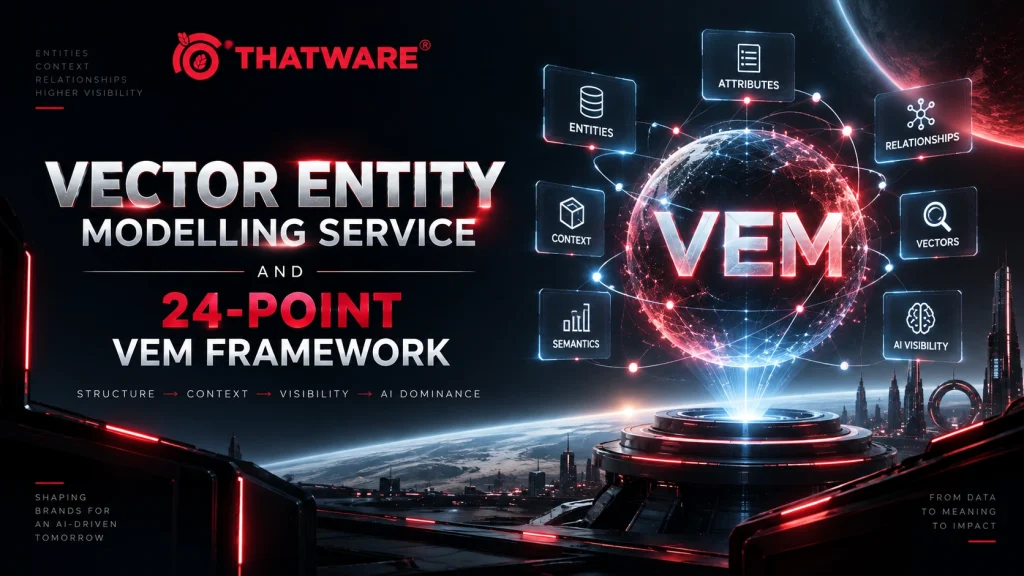
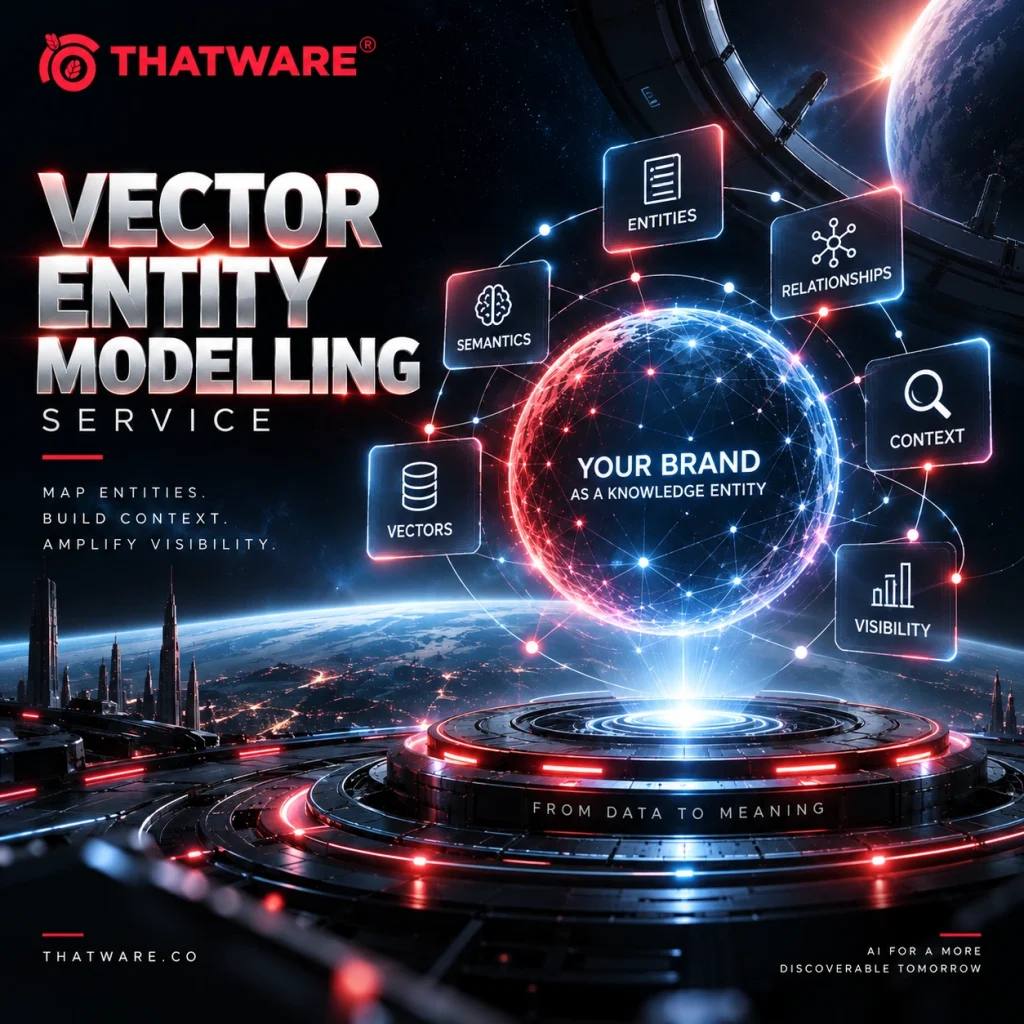
Vector Entity Modelling is the process of identifying, defining, connecting and strengthening the entities that represent a business across search engines, AI systems, semantic databases and vector retrieval environments.
An entity may be:
- A brand
- A company
- A service
- A product
- A person
- A location
- A topic
- A category
- A condition
- A technology
- A methodology
- A qualification
- A customer group
- A conversion action
Traditional keyword SEO examines the words people search. Vector Entity Modelling examines the meaning behind those words and the relationships between the subjects involved.
For example, a conventional keyword plan may target a phrase such as “enterprise SEO company”. A Vector Entity Modelling programme would examine a much wider relationship set:
- Which organisation provides the service?
- What is the canonical name of that service?
- Which industries does it support?
- Which experts are connected with it?
- Which technology or methodology is used?
- Which pages prove the relationship?
- Which third-party sources validate it?
- Which parent category contains the service?
- Which related topics should appear with it?
- Which page should an AI system retrieve?
- Which schema properties should connect the entities?
- Which competing brands occupy the same semantic space?
The objective is to create a controlled entity environment that helps search engines and AI systems understand:
- Who the brand is
- What the brand offers
- Which subjects the brand is associated with
- How its entities relate to one another
- Which pages are the authoritative sources
- Why those relationships should be trusted
Why Vector Entity Modelling Is Becoming Essential
Modern search and AI discovery depend on meaning rather than exact phrase matching alone.
AI systems may need to determine whether:
- A service belongs to a company
- A provider is qualified to deliver that service
- A location offers a particular product
- A product belongs to a category
- A topic should lead to a commercial page or an educational resource
- A brand is the same organisation mentioned in an external source
- Two similar brand names represent the same or different entities
- A specific paragraph is more relevant than the homepage
- A claim has enough evidence to be repeated safely
- A supporting article strengthens the main service entity
When these connections are unclear, AI systems may:
- Retrieve the wrong page
- Cite a directory instead of the brand
- Confuse the company with another organisation
- Attach the wrong service to the brand
- Present outdated information
- Select a competitor with clearer entity relationships
- Use a broad homepage answer for a specific question
- Fail to connect an expert with the relevant service
- Miss the relationship between a topic and a conversion page
- generate an incomplete or unsupported answer
Vector Entity Modelling reduces these risks through entity governance, semantic architecture, retrieval optimisation and evidence mapping.
How VEM Fits Within ThatWare’s Wider Services
Vector Entity Modelling does not replace SEO, AEO, GEO, LLM SEO or knowledge graph development. It supports each discipline.
VEM and Traditional SEO
Traditional SEO improves crawlability, indexing, relevance, rankings, internal links and authority. VEM strengthens the entity relationships that give those signals meaning.
VEM and Semantic SEO
Semantic SEO builds topical context and subject coverage. VEM defines the entities inside that subject coverage and specifies how they should be related.
VEM and AEO
Answer Engine Optimization structures direct answers. VEM ensures those answers include the correct brand, service, topic, location and source entities.
VEM and GEO
Generative Engine Optimization improves inclusion in AI-generated answers. VEM strengthens the entity confidence required for accurate brand inclusion and citation.
VEM and LLM SEO
LLM SEO prepares content for retrieval, summarisation and citation by large language models. VEM provides the entity map, hierarchy and vector relationships that support this retrieval.
VEM and Knowledge Graph SEO
Knowledge graphs represent entities as nodes and relationships as edges. VEM supplies the governed inventory, canonical sources and relationship rules needed to create the graph.
ThatWare’s Complete VEM Service Coverage
Core Vector Entity Modelling Services
ThatWare provides Vector Entity Modelling services for businesses that need stronger entity recognition, semantic clarity and AI retrieval performance.
As a Vector Entity Modelling company, ThatWare can audit existing entity signals, build an entity register, create relationship maps and develop a phased implementation roadmap.
A specialised Vector Entity Modelling agency should combine content analysis, semantic modelling, vector retrieval, schema, internal linking and authority validation rather than treating VEM as a keyword research exercise.
A Vector Entity Modelling consultant can help define the project’s entity classes, target platforms, commercial priorities, source hierarchy and governance requirements.
ThatWare’s broader VEM services can include auditing, modelling, content restructuring, schema planning, internal-link implementation, retrieval testing and reporting.
Our VEM audit services establish the current state of brand, product, service, location, person and topic entities.
Businesses with internal SEO or development teams can use VEM consulting services for strategy, governance, quality assurance and implementation supervision.
Large organisations can use enterprise Vector Entity Modelling across multiple products, departments, countries, languages and digital properties.
Our vector entity optimization services improve the semantic relationships between the organisation’s entities and the questions users ask.
ThatWare’s AI entity mapping services connect those relationships with AI prompts, source pages, answer blocks, structured data and retrieval tests.
Entity Auditing and Disambiguation
ThatWare’s entity SEO audit services review whether important entities are defined consistently across content, schema, profiles, citations and technical files.
An entity ambiguity analysis identifies names, descriptions and category signals that could refer to more than one organisation, product, service or person.
Our entity disambiguation services establish approved names, aliases, identifiers, locations, categories and source URLs.
Brand entity disambiguation prevents similarly named companies, outdated brand variants and unrelated profiles from being merged incorrectly.
An entity recognition audit tests whether search engines and AI systems identify the intended organisation, service, location or expert.
ThatWare’s AI entity recognition services combine prompt testing with page, citation and crawler analysis.
Our canonical entity mapping services create an approved master record for each important entity.
Entity identity optimization improves how the entity is defined and represented across different discovery surfaces.
Brand entity profile optimization aligns brand names, descriptions, categories, leadership, locations, services and authoritative profiles.
Entity governance consulting establishes ownership, review cycles, approval rules and change-control processes for the entity system.
Entity Relationship Architecture
ThatWare’s entity relationship mapping services document how brands, services, products, people, topics, locations and actions relate to one another.
Semantic relationship mapping identifies the meaning of each relationship rather than merely showing that two pages are linked.
An entity relationship gap analysis discovers missing or weak connections between important entity classes.
Entity relationship graph creation turns the relationship model into a node-and-edge system that can support content, schema, RAG and knowledge graphs.
Entity hierarchy development defines which entities are categories, subcategories, parents, children, instances or supporting concepts.
Parent-child entity mapping prevents broad services and specialised sub-services from competing for the same semantic territory.
ThatWare’s topic-to-entity mapping services connect search topics and user questions with the entities that should own the answers.
Entity-to-content mapping identifies the pages, sections, FAQs and resources representing each entity.
A governed semantic entity architecture coordinates the entity inventory, hierarchy, relationships, URLs, citations and schema.
Relationship-based content optimization rewrites content so important entity connections are stated clearly within the text.
Vector Relevance and Retrieval
ThatWare’s vector relevance optimization services improve the semantic match between user questions and website content.
A vector relevance audit scores pages and passages for entity coverage, semantic distance, duplication, crawlability, evidence and retrieval fit.
Our vector search optimization services improve how content performs in embedding-based and semantic retrieval environments.
Semantic retrieval optimization helps AI systems identify passages based on meaning, not only exact wording.
AI retrieval path optimization maps the path from question to entity, answer block, source page, citation and next action.
A vector retrieval path analysis identifies where that path breaks or selects the wrong source.
Content vector relevance improvement strengthens the focus and usefulness of page-level content blocks.
ThatWare’s semantic distance reduction services bring target topics, brand entities and supporting evidence closer together.
Vector similarity optimization improves the relationship between prompt embeddings and content embeddings.
An AI retrieval readiness audit tests source accessibility, page ownership, chunk quality and correct-page retrieval.
ThatWare’s VEM Pricing Plan can be structured according to website size, number of pages and content clusters analyzed, vector relevance requirements, semantic retrieval complexity, AI platform coverage, competitor benchmarking and ongoing optimization needs. The appropriate VEM plan can align vector and semantic optimization efforts with the organization’s AI retrieval visibility, citation readiness and broader search performance objectives.
Embeddings and Content Structuring
Entity embedding optimization ensures each content block represents the intended entity and relationship clearly.
Embedding-friendly content structuring creates self-contained sections with stable headings, direct answers, evidence and canonical URLs.
Vector-friendly content optimization removes duplicated, mixed-purpose and context-dependent passages.
ThatWare’s AI content chunking services divide long pages into retrievable answer units.
Entity-based content chunking attaches each unit to a primary entity, supporting entities, intent and source page.
Semantic content segmentation separates content according to meaning and user purpose.
Retrieval-ready content structuring prepares pages for semantic retrieval and answer generation.
Vector-ready content development creates new pages and resources using structured retrieval principles from the beginning.
Passage-level entity optimization improves the exact passages that should answer high-value prompts.
AI-readable answer block development creates concise answer units containing the main entity, direct response, evidence, qualifier and next step.
Entity Co-Occurrence and Topical Authority
Entity co-occurrence optimization improves how related entities appear together within the same useful context.
Entity co-occurrence mapping identifies which pairs and groups should appear on each page.
Topical entity optimization strengthens the association between a brand and a priority subject.
Topical authority vector clusters connect commercial pages, supporting articles, FAQs, experts, citations and questions around one entity group.
Vector-based topical clustering groups content according to semantic similarity and entity relationships.
Semantic authority cluster development creates structured hubs that strengthen important commercial entities.
Entity-based content modeling defines which entities and relationships are required for each page or intent.
Topic entity association optimization reduces the distance between target topics and the entities that should be recognised for them.
Semantic keyword and entity clustering combines query research with entity and intent classification.
Entity-dense authority content provides substantial subject coverage while maintaining clear relationships with the brand and service pages.
Knowledge Graphs and Structured Data
ThatWare’s knowledge graph SEO services build and reinforce structured entity relationships across owned and external sources.
Knowledge graph alignment services coordinate visible content, schema, AI-facing files, internal links and external profiles.
Custom entity knowledge graph development creates a business-specific model of nodes, relationships, evidence and source URLs.
Our entity schema optimization services define the structured data required for each page and entity.
Entity-based JSON-LD implementation creates connected machine-readable graphs instead of isolated markup blocks.
SameAs schema optimization limits identity links to verified and authoritative profiles.
About and mentions schema mapping differentiates a page’s primary subject from supporting entities.
Author entity schema optimization connects content with visible, qualified and relevant authors or reviewers.
AI entity identity schema deployment reinforces canonical identities through stable identifiers and connected structured data.
ThatWare’s structured entity data services help maintain consistency between visible content, entity registers, schema and external validation.
Who Needs Vector Entity Modelling?
VEM is particularly useful when a business has:
- Several products or services
- Multiple offices or service areas
- Similar brand-name competitors
- A large content library
- Several authors or experts
- Multiple websites or subdomains
- Complex service hierarchies
- Inconsistent naming across pages
- Important third-party profiles
- A knowledge base or custom GPT
- RAG or vector search requirements
- High-value informational and commercial queries
- A need for better AI citations
- A need to distinguish parent and child services
- A need to improve entity-level reporting
It is also valuable for sectors where accuracy and identity clarity are important, including healthcare, finance, legal services, enterprise technology, education, SaaS, ecommerce, local services and professional consulting.
Standard ThatWare VEM Audit Methodology
The uploaded VEM report applies a consistent process across all 24 chapters. Each area is audited independently, given a risk status, translated into a plan of action and compared through a before-and-after fix report.
Step 1: Audit the Available Evidence
The project begins by collecting entity evidence from:
- Homepage content
- Product and service pages
- About and team pages
- Location pages
- Resource centres
- Blog posts
- FAQs
- Structured data
- XML and semantic sitemaps
- AI-facing files
- External directories
- Author profiles
- Business listings
- Earned media
- Search snippets
- AI-generated answers
- Internal search and RAG indexes
Step 2: Build the Entity Inventory
Each entity should receive:
- Canonical name
- Entity class
- Approved aliases
- Excluded aliases
- Definition
- Canonical URL
- Supporting URLs
- Parent entity
- Child entities
- Related entities
- Evidence source
- External validation
- Schema identifier
- Content owner
- Review date
- Confidence score
Step 3: Identify Gaps and Risks
VEM risks may include:
- Brand ambiguity
- Duplicate entities
- Weak relationships
- Missing page ownership
- Incorrect parent-child structure
- Excessive semantic distance
- Poor chunk quality
- Missing schema
- Weak citation support
- Crawler friction
- Retrieval mismatch
- Competitor overlap
- Unverified SameAs links
- Inconsistent external profiles
- Outdated evidence
Step 4: Assign the Fix
Each issue is routed to one or more implementation areas:
- Content editing
- Page creation
- Content consolidation
- Internal linking
- Navigation
- Schema
- AI-facing files
- Citation development
- External profile correction
- Knowledge graph development
- Vector index improvement
- Prompt validation
- Governance
Step 5: Validate the Output
Validation may include:
- Search-result inspection
- AI prompt testing
- Correct-source testing
- Top-k retrieval tests
- Structured-data validation
- Crawler-access testing
- Internal-link checks
- Entity consistency checks
- Citation monitoring
- Competitor comparison
- Human editorial review
Step 6: Report the KPI
Each deliverable should have a defined success measure, owner, target date and reassessment schedule.
Before and After VEM Implementation
Before Vector Entity Modelling
A website may have useful content but still experience the following problems:
- No central entity register exists
- The brand name is used inconsistently
- Services and products use overlapping terminology
- Parent and child categories are not defined
- Important relationships exist only in navigation
- Topics are not assigned to canonical entities
- Several pages answer the same question
- AI systems retrieve the homepage for specific queries
- External profiles communicate different service information
- Entity schema is incomplete
- SameAs links include weak or inaccurate profiles
- Content chunks contain multiple unrelated intents
- Trust signals are far from the entities they support
- Competitors have stronger citation and entity relationships
- No scorecard measures vector relevance
- Implementation tasks are spread across disconnected reports
After Vector Entity Modelling
The business has:
- One approved entity inventory
- Defined canonical names and aliases
- Clear disambiguation rules
- A parent-child hierarchy
- A relationship graph
- Topic-to-entity ownership
- Entity-to-content ownership
- Controlled co-occurrence rules
- Vector-ready content blocks
- Defined prompt-to-source retrieval paths
- Connected entity schema
- Verified SameAs relationships
- Evidence and citation mapping
- Topical authority vector clusters
- Page-level trust signals
- A central VEM gap report
- A vector relevance scorecard
- A phased improvement roadmap
- A competitor entity overlap report
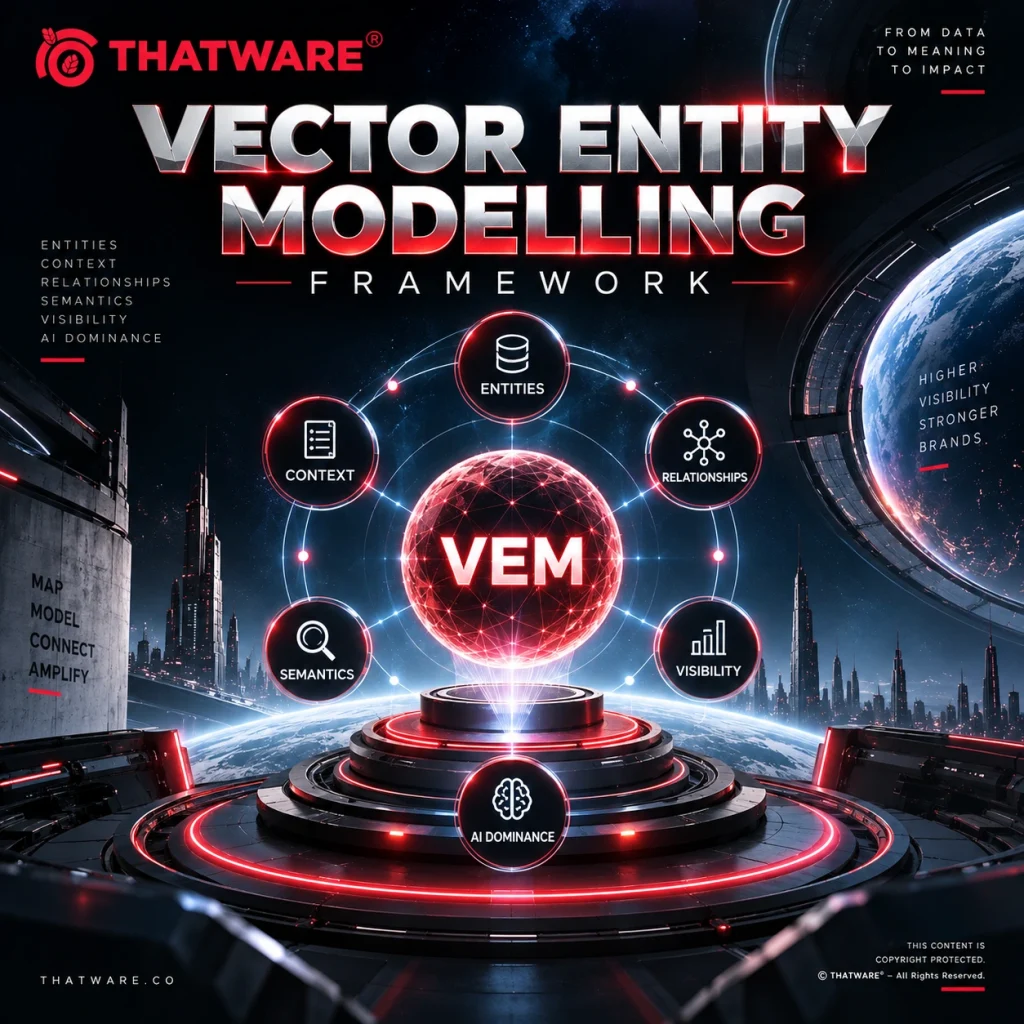
The Complete 24-Point Vector Entity Modelling Framework
Phase One: Entity Discovery, Governance and Recognition
1. Vector Entity Modelling Audit for Brand, Product, Service and Topic Entities
Objective
Create a complete inventory of all commercially and semantically important entities represented by the website.
Before the Fix
Entities may exist across pages, profiles and external sources without one approved register. Different teams may use different service names, definitions or category labels.
The organisation may not know:
- Which page owns each entity
- Which aliases are accepted
- Which description is canonical
- Which external profile is authoritative
- Which evidence validates the relationship
- Who is responsible for updates
Plan of Action
- Review the homepage, commercial pages, product pages, service pages, team profiles, locations, resources and external listings.
- Extract brand, product, service, person, location, topic, category and conversion entities.
- Record canonical names and aliases.
- Assign one primary URL to every important entity.
- Add evidence statements and external corroboration.
- Assign ownership and review dates.
- Classify each entity as approved, partial, ambiguous, duplicated or unsupported.
- Connect the register with future schema, internal-link and citation work.
After the Fix
A governed VEM master inventory becomes the source of truth for content, schema, AI files and external profile updates.
Main Deliverable
A VEM master sheet containing:
- Entity name
- Entity type
- Canonical URL
- Approved aliases
- Excluded aliases
- Evidence
- Parent entity
- Related entities
- Owner
- Review date
- Confidence
- Status
Performance Indicators
- Percentage of priority entities registered
- Percentage with canonical URLs
- Number of conflicting entity descriptions resolved
- Percentage with valid evidence
- Number of pages linked to the entity register
2. Entity Ambiguity and Disambiguation Analysis
Objective
Prevent the brand, services, products, experts and locations from being confused with unrelated or similarly named entities.
Before the Fix
Ambiguity may arise through:
- Similar company names
- Singular and plural brand variants
- Legacy names
- Abbreviations
- Unverified directory profiles
- Different location naming
- Service synonyms
- Product-name overlap
- People with the same name
- Inconsistent domain references
Plan of Action
- Collect all brand and entity variants.
- Identify names with multiple possible meanings.
- Define approved and rejected variants.
- Attach location, industry or service qualifiers where needed.
- Review domain names and external profiles.
- Identify suitable SameAs candidates.
- Create editorial rules for entity naming.
- Add automated or manual QA checks.
- Test branded and non-branded prompts.
- Correct sources causing confusion.
After the Fix
The entity can be identified consistently across pages, profiles, search results and AI responses.
Main Deliverable
A disambiguation table containing:
- Correct entity name
- Incorrect variants
- Qualified version
- Industry category
- Location context
- Domain
- External profile
- Correction status
Performance Indicators
- Reduction in incorrect brand matches
- Correct entity selection during prompt tests
- Consistency of external profiles
- Number of ambiguous variants corrected
- Reduction in unrelated entity leakage
3. Entity Relationship Gap Analysis Across Website Content
Objective
Identify missing, weak or unsupported relationships between the organisation’s entity classes.
Before the Fix
A website may mention services, products, experts and locations, but not connect them within the same retrieval path.
For example:
- A service page may not identify its relevant customer group.
- A product page may not identify its parent category.
- An expert profile may not link to the service delivered.
- A topic article may not connect to the commercial entity.
- A location page may not list the services available there.
Plan of Action
- Define the entity classes required for each page type.
- Build a relationship matrix.
- Mark each relationship as present, weak, missing or unsupported.
- Identify the page that should own the relationship.
- Add missing copy, links, schema or evidence.
- Consolidate duplicate relationships.
- Create implementation tickets.
- Retest target questions after deployment.
After the Fix
Every priority service, product or topic is connected with the relevant brand, audience, location, expert, proof and action entities.
Main Deliverable
An entity relationship matrix such as:
Brand → Service → Audience → Use Case → Expert → Location → Evidence → Conversion URL
Performance Indicators
- Percentage of required relationships present
- Reduction in orphaned entities
- Correct service-to-question matching
- Improved entity co-occurrence
- Correct-page retrieval rate
4. AI Entity Recognition and Retrieval Readiness Review
Objective
Determine whether AI systems can recognise the correct entities and retrieve the intended source pages.
Before the Fix
Search snippets may show the right information while direct page retrieval remains weak. AI systems may depend on cached snippets, directories or competing sources.
Plan of Action
- Create recognition prompts for the brand, services, products, people, locations and topics.
- Define the expected entity and source URL.
- Run tests across selected search and AI systems.
- Record the actual answer and source.
- Check crawler access and canonical signals.
- Identify JavaScript, rendering or indexation issues.
- Improve source-page summaries and answer blocks.
- Retest after each fix.
- Preserve the results as audit evidence.
- Add recurring monitoring.
After the Fix
The organisation has a validation log showing whether systems recognise the right entity and retrieve the correct source.
Main Deliverable
An AI recognition and retrieval testing workbook.
Performance Indicators
- Correct entity recognition
- Correct source-page retrieval
- Number of crawler blockers resolved
- Reduced reliance on third-party sources
- Prompt-level answer accuracy
5. Competitor Entity Comparison and Topical Overlap Mapping
Objective
Identify which competitors occupy the same entity and topical territory.
Before the Fix
Traditional competitor analysis may focus on ranking positions while overlooking:
- Shared entities
- Competing service-topic relationships
- Citation sources
- Schema differences
- Stronger answer formats
- Better location associations
- More complete topical clusters
Plan of Action
- Select direct business competitors.
- Identify topical and AI-answer competitors.
- Extract their primary entities.
- Compare categories, services, products, experts and locations.
- Review citations, schema, FAQs and external profiles.
- Label each entity relationship as owned, shared, missing or competitor advantage.
- Identify defensible differentiators.
- Create page-level corrective actions.
- Monitor overlap periodically.
- Update the VEM roadmap.
After the Fix
ThatWare can identify where the client should defend, strengthen or differentiate an entity relationship.
Main Deliverable
A competitor entity comparison and topical overlap grid.
Performance Indicators
- Number of competitor advantages addressed
- Unique entity relationships strengthened
- Citation gaps closed
- Improved AI answer inclusion
- Increased topical differentiation
Phase Two: Entity Graphs, Hierarchy and Topical Architecture
6. Entity Relationship Graph Creation
Objective
Convert the flat entity inventory into a connected graph.
Before the Fix
The website may contain multiple entity families without documenting the edges connecting them.
Search and AI systems must infer whether:
- The company offers the service
- The expert delivers the service
- The product belongs to the category
- The location provides the service
- The article supports the product
- The evidence validates the claim
Plan of Action
- Create nodes for all priority entities.
- Define controlled relationship labels.
- Attach each node to a canonical URL.
- Add evidence to every important edge.
- Record relationship direction.
- Add confidence and validation status.
- Use the graph to guide schema.
- Use the graph to guide internal links.
- Use the graph for content briefs.
- Review graph changes whenever content changes.
Example Relationship Labels
- offers
- provides
- includes
- located_at
- available_in
- authored_by
- reviewed_by
- supports
- associated_with
- belongs_to
- cites
- validated_by
- answers
- links_to
After the Fix
The organisation has a reusable semantic model supporting search, AI retrieval, schema and content planning.
Main Deliverable
A lightweight entity relationship graph.
Performance Indicators
- Entity-node coverage
- Relationship-edge coverage
- Percentage of edges with evidence
- Reduction in orphaned nodes
- Graph-based retrieval accuracy
7. Parent-Child Entity Hierarchy Development
Objective
Establish a clear taxonomy for categories, services, products, sub-services and supporting topics.
Before the Fix
Broad and narrow entities may appear at the same level, creating:
- Keyword cannibalisation
- Duplicate pages
- Confusing navigation
- Incorrect breadcrumbs
- Weak schema hierarchy
- Poor AI summaries
Plan of Action
- Identify parent entities.
- Identify child and grandchild entities.
- Assign canonical parent pages.
- Decide whether child entities need separate pages or sections.
- Remove duplicate or competing URLs.
- Align breadcrumbs.
- Align headings and navigation.
- Align schema relationships.
- Establish rules for future additions.
- Validate hierarchy through search and AI prompts.
After the Fix
The website communicates one approved hierarchy that is reflected across pages, links, breadcrumbs and structured data.
Main Deliverable
A parent-child entity hierarchy tree.
Performance Indicators
- Percentage of entities assigned to a hierarchy
- Reduced URL overlap
- Improved breadcrumb consistency
- Improved parent-page authority
- Correct category and subcategory retrieval
8. Topic-to-Entity and Entity-to-Content Mapping
Objective
Ensure that every important topic strengthens a defined entity and leads to an appropriate content asset.
Before the Fix
A website may publish articles about important subjects without clarifying:
- Which service the article supports
- Which entity owns the answer
- Which page should receive internal authority
- Which action the reader should take
- Which evidence supports the topic
Plan of Action
- Extract priority user topics and questions.
- Assign each topic to a primary entity.
- Add supporting entities.
- Assign a canonical source page.
- Identify supporting content.
- Define internal links.
- Add a CTA.
- Record funnel stage and intent.
- Add update cadence.
- Validate topic ownership.
After the Fix
Content planning becomes bidirectional:
- Topic to entity
- Entity to page
- Page to supporting content
- Supporting content to conversion page
Main Deliverable
A topic-to-entity and entity-to-content map.
Performance Indicators
- Percentage of topics with entity ownership
- Percentage with canonical pages
- Internal-link completion
- Reduction in unsupported blog topics
- Increased assisted conversions
9. Entity Co-Occurrence Mapping for Topical Relevance
Objective
Define which entities should appear together to communicate complete and accurate context.
Before the Fix
A page may contain the necessary entities, but they may be:
- Located far apart
- Used in different sections
- Missing from the main answer
- Mentioned without relationships
- Repeated unnaturally
- Present only in navigation
Plan of Action
- Identify priority entity pairs and triples.
- Define page-specific co-occurrence requirements.
- Review headings, introductions, FAQs and links.
- Score current coverage.
- Add concise relationship sentences.
- Prevent forced repetition.
- Connect co-occurrences with schema where suitable.
- Test the updated page against target prompts.
- Monitor readability.
- Update the rules as services change.
After the Fix
Important entities appear together naturally within answer blocks, summaries and supporting sections.
Main Deliverable
A page-level entity co-occurrence matrix.
Performance Indicators
- Required co-occurrence coverage
- Improved semantic relevance
- Improved query-to-page matching
- Reduced reliance on generic terminology
- No material decline in readability
10. Knowledge Graph Alignment Recommendations
Objective
Align the VEM graph with content, schema, internal links, external profiles and AI-facing resources.
Before the Fix
The entity graph may exist conceptually while different systems represent the organisation inconsistently.
Potential conflicts include:
- Different entity IDs
- Mismatched service names
- Unverified external profiles
- Schema that contradicts visible content
- AI files listing the wrong source page
- External descriptions using legacy terminology
Plan of Action
- Compare the VEM graph with visible content.
- Compare it with structured data.
- Compare it with external profiles.
- Compare it with AI-facing files.
- Establish stable entity identifiers.
- Approve SameAs references.
- Align internal-link destinations.
- Correct conflicting entity descriptions.
- Establish a review workflow.
- Test knowledge-graph prompts.
After the Fix
The organisation communicates a consistent entity model across all major discovery surfaces.
Main Deliverable
A knowledge graph alignment checklist and implementation specification.
Performance Indicators
- Consistency across major sources
- Stable entity ID coverage
- Correct SameAs implementation
- Reduction in conflicting entity statements
- Improved AI entity recognition
Phase Three: Vector Content, Embeddings and Retrieval Paths
11. Content Vector Relevance Improvement Recommendations
Objective
Improve how well each content block matches its intended question, entity and source page.
Before the Fix
Long, mixed-purpose paragraphs can reduce vector precision. Similar passages may compete for the same query.
Plan of Action
- Audit priority pages at paragraph level.
- Assign each paragraph a primary intent.
- Identify the primary entity and supporting entities.
- Detect duplicated or generic language.
- Separate mixed-purpose sections.
- Add answer-first openings.
- Add proof and relevant links.
- Attach each block to a conversion action.
- Add freshness information.
- Run top-k retrieval testing.
After the Fix
The website contains focused passages designed around one intent, one primary entity group and one source page.
Main Deliverable
A content vector improvement workbook with original and revised blocks.
Performance Indicators
- Top-k retrieval precision
- Correct-passage rate
- Duplicate-block reduction
- Improved entity relevance
- Better page-level differentiation
12. Semantic Distance Reduction Between Target Topics and Brand Entities
Objective
Reduce the semantic gap between the language users employ and the brand or service entity that should answer the query.
Before the Fix
Users may use everyday language while the website uses internal, technical or branded terminology.
The relevant topic may appear:
- Only in blog content
- Far below the main answer
- Without the brand name
- Without service context
- Without location or availability information
- Without evidence
Plan of Action
- Identify high-intent topic phrases.
- Compare them with target-page language.
- Score semantic proximity.
- Identify missing bridge terms.
- Add concise brand-qualified answer blocks.
- Connect colloquial and technical terms.
- Move important topics closer to service summaries.
- Improve internal anchors.
- align schema descriptions where appropriate.
- Validate with “who offers”, “where can I find” and “which company” prompts.
After the Fix
The brand, service, topic, evidence and conversion action appear within a closer semantic context.
Main Deliverable
A semantic distance scorecard and bridge-copy implementation plan.
Performance Indicators
- Reduced semantic distance
- Improved intended-page matching
- Growth in conversational visibility
- Lower reliance on the homepage
- Stronger brand-topic association
13. Entity Embedding-Friendly Content Structuring
Objective
Create self-contained content units suitable for embeddings and semantic retrieval.
Before the Fix
A retrieved paragraph may lack:
- The entity name
- Necessary context
- A qualifier
- Evidence
- A source URL
- A next step
- A review date
Plan of Action
- Establish a repeatable block structure.
- Keep each block focused on one question or intent.
- State the primary entity explicitly.
- Add supporting entity context.
- Include evidence or proof.
- Add necessary limitations.
- Add a contextual internal link.
- Attach the canonical URL.
- Add reviewer and update metadata.
- Remove duplicate blocks.
Recommended Block Pattern
- Stable heading
- Direct answer
- Primary entity
- Supporting relationship
- Evidence
- Qualification
- Internal link
- CTA
- Updated date
After the Fix
Each important passage can stand alone without misrepresenting the organisation.
Main Deliverable
An embedding-ready content-block library.
Performance Indicators
- Percentage of priority intents with dedicated blocks
- Duplicate-block reduction
- Correct-block retrieval
- Metadata completion
- Improved answer accuracy
14. Contextual Entity Placement and Internal Linking Recommendations
Objective
Use internal links and entity placement to create clear semantic retrieval paths.
Before the Fix
Navigation may expose major categories, but important body-copy relationships remain unlinked.
Generic anchor text such as “click here” or “learn more” provides little semantic meaning.
Plan of Action
- Map every priority entity mention.
- Assign the ideal destination page.
- Develop descriptive anchor text.
- Add links where relationships are discussed.
- Connect topics to services.
- Connect services to experts.
- Connect products to categories.
- Connect locations to available services.
- Identify underlinked and orphaned pages.
- Update sitemaps and AI indexes after implementation.
After the Fix
Internal links guide both users and machines from broad topics to the most precise entity source.
Main Deliverable
A contextual entity and internal-link map.
Performance Indicators
- Orphan-page reduction
- Average contextual links per priority page
- Improved source-page retrieval
- Reduced click depth
- Better page-confidence scores
15. Vector Retrieval Path Optimization for AI and Semantic Engines
Objective
Define and improve the entire path from user question to retrieved answer and conversion page.
Before the Fix
The website may have the right information, but retrieval may stop at:
- A homepage
- A cached snippet
- A third-party listing
- A broad category page
- A competitor page
- A generic article
Plan of Action
- Select high-value prompts.
- Define the intended entity match.
- Define the intended answer block.
- Define the canonical source page.
- Define the supporting citation.
- Review crawler access.
- Review internal links.
- Review schema relationships.
- Test the full retrieval path.
- Record answer accuracy and citation outcome.
Ideal Retrieval Path
Prompt → Intent → Primary Entity → Answer Block → Canonical Page → Supporting Evidence → Conversion Action
After the Fix
Every priority prompt has a documented and testable retrieval pathway.
Main Deliverable
A vector retrieval path map and validation log.
Performance Indicators
- Correct-source rate
- Correct-passage rate
- Citation of intended URLs
- Reduced third-party source dependence
- Improved answer accuracy
Phase Four: Structured Data, Evidence and Authority
16. Entity Schema and Structured Data Recommendations
Objective
Represent important entities and relationships through accurate machine-readable data.
Before the Fix
Schema may be:
- Missing
- Isolated
- Incomplete
- Inconsistent
- Unsupported by visible content
- Attached to the wrong page
- Using unstable IDs
Plan of Action
- Assign schema requirements by page type.
- Define stable entity IDs.
- Connect organisation, service, product, person, location and webpage entities.
- Add applicable properties.
- Align schema with visible content.
- Connect parent-child relationships.
- Connect author and reviewer information.
- Validate syntax.
- Check semantic consistency.
- Retest after deployment.
Potential Schema Types
- Organization
- Corporation
- LocalBusiness
- ProfessionalService
- Service
- Product
- Person
- Place
- WebPage
- Article
- FAQPage
- BreadcrumbList
- DefinedTerm
- DefinedTermSet
After the Fix
Schema forms a connected entity graph rather than a collection of unrelated markup blocks.
Main Deliverable
A page-specific entity schema implementation specification.
Performance Indicators
- Valid schema coverage
- Stable ID implementation
- Zero critical content-schema conflicts
- Entity relationship coverage
- Successful recrawl validation
17. SameAs, About, Mentions and Author-Entity Schema Mapping
Objective
Use schema relationship properties accurately and avoid incorrect identity connections.
Before the Fix
A site may treat every external profile as a SameAs source or use about and mentions interchangeably.
This can connect the organisation with:
- Scraper profiles
- Old social pages
- Duplicate directory records
- Unrelated organisations
- Incorrect authors
- Weak contextual sources
Plan of Action
- Inventory potential SameAs profiles.
- Verify ownership and consistency.
- Approve authoritative identity references.
- Exclude weak or unrelated profiles.
- Assign the primary page entity through about.
- Assign supporting subjects through mentions.
- Connect visible authors and reviewers.
- Connect providers to applicable services.
- Document field-level rules.
- Validate deployed markup.
After the Fix
Identity, subject and authorship relationships are represented accurately and conservatively.
Main Deliverable
A field-level SameAs, about, mentions, author, reviewedBy and provider map.
Performance Indicators
- Verified SameAs coverage
- Incorrect-profile removal
- Author-schema completeness
- Visible-content parity
- Improved entity confidence
18. Entity Evidence and Citation Source Mapping
Objective
Connect important entity claims with the strongest owned and external evidence.
Before the Fix
An AI system may cite an external directory because the brand’s own source page does not state the information clearly.
Plan of Action
- List high-value entity claims.
- Identify the preferred owned source.
- Identify authoritative external corroboration.
- Score source quality.
- Record citation risk.
- Improve weak owned pages.
- Add appropriate evidence blocks.
- Update external profiles where possible.
- Monitor citation movement.
- assign source owners and review dates.
After the Fix
Each important entity relationship has a clear evidence and citation pathway.
Main Deliverable
An entity claim and citation-source map.
Performance Indicators
- Percentage of claims with owned sources
- Percentage with external corroboration
- Improved owned-page citations
- Reduction in directory dependence
- Citation-source accuracy
19. Topical Authority Vector Cluster Creation
Objective
Build connected topic clusters that strengthen commercial and informational entities.
Before the Fix
Content may exist as isolated blog posts, FAQs and service pages without a clear hub-and-spoke structure.
Plan of Action
- Select priority entity groups.
- Assign one primary hub.
- Identify supporting commercial pages.
- Identify supporting educational content.
- Add relevant FAQs.
- Connect experts and authors.
- Map citation opportunities.
- Add internal-link rules.
- Define query-level measurements.
- Remove or consolidate overlapping content.
After the Fix
Every priority subject has a connected vector cluster supporting the main entity and source page.
Main Deliverable
A topical authority vector cluster blueprint.
Performance Indicators
- Cluster coverage
- Hub-to-spoke link completion
- Entity co-occurrence coverage
- Citation depth
- Correct hub retrieval
- Assisted conversion performance
20. Entity Trust and Authority Signal Recommendations
Objective
Attach trust evidence to the exact entities and pages that need it.
Before the Fix
Trust assets may exist only on an About page and remain disconnected from:
- Service claims
- Product claims
- Expert content
- Location information
- Methodologies
- Research
- Important answer blocks
Plan of Action
- Inventory credentials, awards, reviews, certifications and media references.
- Verify each asset.
- Assign it to the relevant entity.
- Place proof near consequential claims.
- Connect authors and reviewers.
- Add update dates.
- Add appropriate policies and disclaimers.
- Strengthen external corroboration.
- Align visible trust with schema.
- Track completion by page.
After the Fix
Important entities carry visible, verifiable and contextually relevant authority signals.
Main Deliverable
An entity trust and authority signal register.
Performance Indicators
- Trust-signal coverage
- Percentage of claims with proximal proof
- Verified author and reviewer coverage
- External validation growth
- Improved page-confidence scores
Phase Five: Reporting, Scoring and Continuous Improvement
21. VEM Entity Map and Gap Report
Objective
Consolidate entity evidence, relationships, risks and implementation priorities into one controlled report.
Before the Fix
Findings may be distributed across content audits, schema documents, link reports and technical tickets.
Plan of Action
Create one report with separate sections for:
- Entity inventory
- Ambiguity
- Hierarchy
- Relationship gaps
- Topic ownership
- Co-occurrence
- Vector relevance
- Retrieval paths
- Schema
- SameAs
- Citations
- Trust
- Competitors
- Implementation status
Each gap should include:
- Severity
- Affected entity
- Affected URL
- Evidence
- Recommended action
- Owner
- Deadline
- Dependency
- Validation method
- Status
After the Fix
Teams can understand why each change is required and which entity problem it resolves.
Main Deliverable
A living VEM entity map and gap report.
Performance Indicators
- Percentage of findings assigned
- Percentage with owners
- Critical-gap closure rate
- Validation completion
- Implementation-cycle time
22. Vector Relevance Scorecard
Objective
Measure page readiness for vector retrieval using a repeatable numerical framework.
Before the Fix
Pages may be judged subjectively based on length or keyword use without measuring semantic retrieval performance.
Plan of Action
Build a weighted 100-point scorecard covering:
- Entity coverage
- Canonical entity clarity
- Relationship completeness
- Co-occurrence quality
- Semantic distance
- Chunk clarity
- Duplication risk
- Internal links
- Schema
- Evidence
- Citations
- Crawlability
- Freshness
- Answer quality
Example Weighting
- Entity coverage: 15 points
- Relationship clarity: 15 points
- Chunk and answer quality: 15 points
- Semantic distance: 10 points
- Internal-link support: 10 points
- Structured data: 10 points
- Evidence and citations: 10 points
- Crawl and retrieval readiness: 10 points
- Freshness and governance: 5 points
After the Fix
Priority pages can be compared objectively and rescored after implementation.
Main Deliverable
A page-level vector relevance dashboard.
Performance Indicators
- Average score improvement
- Percentage of pages above threshold
- Lowest-scoring category improvement
- Correct-source retrieval change
- Cluster-level performance
23. Entity Relationship Improvement Roadmap
Objective
Sequence VEM work according to dependencies, risk and expected impact.
Before the Fix
Teams may add schema or publish new content before agreeing on canonical names, hierarchy and relationship rules.
Plan of Action
Phase 1: Entity Governance
- Finalise entity inventory
- Resolve ambiguity
- Approve canonical names
- Define hierarchy
- Assign ownership
Phase 2: Content and Relationships
- Build relationship matrices
- Map topics to entities
- Rewrite answer blocks
- Improve co-occurrence
- Add contextual links
Phase 3: Technical Implementation
- Deploy connected schema
- Correct SameAs references
- Improve crawler access
- Update sitemaps and AI files
- Build retrieval indexes
Phase 4: Authority and Validation
- Strengthen citations
- Create authority clusters
- Add trust signals
- Run retrieval tests
- Update scorecards
After the Fix
VEM work follows a controlled sequence that minimises duplication and contradictory implementation.
Main Deliverable
A phased VEM implementation roadmap.
Performance Indicators
- On-time task completion
- Dependency resolution
- Sprint acceptance rate
- Critical-gap closure
- Scorecard improvement
- Retrieval validation progress
24. Competitor Entity Overlap Report
Objective
Convert competitive entity analysis into specific content, schema, citation and authority actions.
Before the Fix
A general competitor list does not show:
- Shared entity territory
- Missing relationships
- Citation threats
- Schema advantages
- Stronger topic clusters
- More credible authors
- Better source pages
- More specific answer formats
Plan of Action
- Select direct and topical competitors.
- Extract their entity sets.
- Compare parent and child entities.
- Compare relationship density.
- Compare page headings and summaries.
- Compare structured data.
- Compare citations and external profiles.
- Compare authority signals.
- Identify defensible differentiation.
- Convert every advantage into an assigned task.
After the Fix
The business knows which entity relationships it owns, shares, lacks or needs to defend.
Main Deliverable
A competitor entity overlap report with page-level recommendations.
Performance Indicators
- Competitor gaps converted into actions
- Shared-entity differentiation
- Improved citation share
- Improved topic-cluster coverage
- Increased AI answer visibility
Recommended VEM Implementation Roadmap
Months 1 and 2: Entity Discovery and Governance
Complete:
- Entity inventory
- Ambiguity analysis
- Canonical entity mapping
- Brand disambiguation
- Parent-child hierarchy
- Entity governance rules
Months 3 and 4: Relationship and Content Mapping
Complete:
- Relationship gap matrix
- Relationship graph
- Topic-to-entity map
- Entity-to-content map
- Co-occurrence model
- Semantic-distance audit
Months 5 and 6: Vector Content Development
Complete:
- Passage audits
- Embedding-friendly content blocks
- AI-readable answer blocks
- Semantic segmentation
- Vector-ready summaries
- Contextual internal links
Months 7 and 8: Schema and Knowledge Graph Alignment
Complete:
- Entity schema specification
- Connected JSON-LD
- SameAs validation
- About and mentions mapping
- Author entity mapping
- Knowledge graph alignment
Months 9 and 10: Citations, Trust and Authority
Complete:
- Entity evidence map
- Citation-source mapping
- Trust-signal placement
- Entity-dense authority content
- Topical authority vector clusters
- External profile alignment
Months 11 and 12: Validation and Competitive Improvement
Complete:
- Prompt testing
- Top-k retrieval testing
- Vector relevance rescoring
- Competitor overlap reporting
- Retrieval-path validation
- Roadmap revision
Recommended Monthly VEM Reporting Dashboard
The monthly dashboard should include:
- Total entities identified
- Approved canonical entities
- Ambiguous entities remaining
- Duplicate entities resolved
- Entity relationships created
- Missing relationships remaining
- Parent-child hierarchy coverage
- Topics mapped to entities
- Entities mapped to pages
- Entity co-occurrence coverage
- Semantic-distance scores
- Vector relevance scores
- Correct-page retrieval
- Correct-passage retrieval
- Top-k retrieval precision
- Contextual links implemented
- Valid entity schema coverage
- SameAs profiles verified
- Citation sources mapped
- Owned-page citation rate
- Trust-signal coverage
- Topical cluster completion
- Competitor overlap changes
- Critical gaps closed
- Next-month priorities
Suggested VEM Package Structure
VEM Foundation Plan
Suitable for smaller websites requiring entity governance and foundational mapping.
The scope may include:
- Entity inventory
- Ambiguity audit
- Canonical entity mapping
- Basic relationship matrix
- Parent-child hierarchy
- Initial schema recommendations
- Vector relevance baseline
- Monthly reporting
VEM Growth Plan
Suitable for established brands with several services, products or content clusters.
The scope may include:
- Complete entity register
- Relationship graph
- Topic-to-entity mapping
- Co-occurrence optimisation
- Semantic-distance reduction
- Content chunk restructuring
- Contextual internal links
- Connected schema
- Citation-source mapping
- Retrieval testing
Enterprise VEM Plan
Suitable for large or multi-market organisations.
The scope may include:
- Multi-domain entity governance
- Multiple product or service hierarchies
- Cross-market entity normalization
- Custom knowledge graph
- Large-scale vector content restructuring
- RAG and embedding support
- Entity-level governance workflows
- Competitor overlap analysis
- Cross-platform recognition testing
- Advanced reporting and scorecards
Make Every Brand, Service, Product and Topic Easier for AI Systems to Understand
A website is more than a collection of pages. It is a network of brands, products, services, people, topics, locations, evidence and actions.
When those entities are poorly defined or weakly connected, search engines and AI systems must infer the relationships. That can lead to incorrect source selection, ambiguous brand representation, competitor citations and weak retrieval performance.
ThatWare’s 24-point Vector Entity Modelling framework replaces that uncertainty with a governed semantic system.
The programme connects entity auditing, disambiguation, relationship graphs, vector relevance, content chunking, internal links, schema, citations, topical authority, reporting and continuous validation.



1 comment