
SUPERCHARGE YOUR ONLINE VISIBILITY! CONTACT US AND LET’S ACHIEVE EXCELLENCE TOGETHER!
A ranking is only the beginning of a successful organic search journey.
A potential customer may see a page in Google, read its title and description, click through, scan the opening section, search for proof, compare options and decide whether to take action. A weakness at any point can reduce the commercial value of the ranking.
A page may rank but still underperform because:
- The search result does not communicate a clear benefit.
- The page does not match the intent suggested by the SERP.
- The first screen does not confirm that the visitor has reached the right place.
- Important proof is buried too far down the page.
- Navigation does not reveal the next useful resource.
- Mobile forms are difficult to complete.
- The CTA appears too early or too late.
- Page speed weakens the first impression.
- Analytics tracks final leads but misses the steps leading to them.
- Visitors who are not ready to enquire have no reason to return.
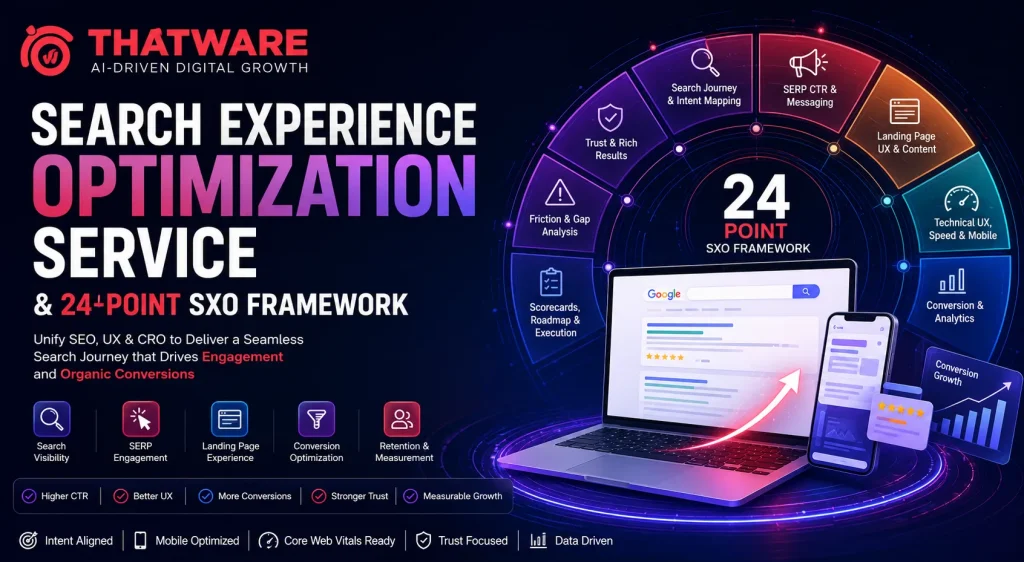
Search Experience Optimization, or SXO, connects these stages into one coordinated performance framework.
ThatWare’s live SXO pricing page positions SXO as a combination of SEO, user experience and conversion optimization. It currently explains that the service is delivered monthly and covers areas such as strategy, intent mapping, SEO and UX auditing, landing-page improvement, content readability, conversion paths, behavioral analytics, mobile experience, Core Web Vitals, CTAs, trust, navigation, FAQs, CRO recommendations and monthly reporting. (Thatware)
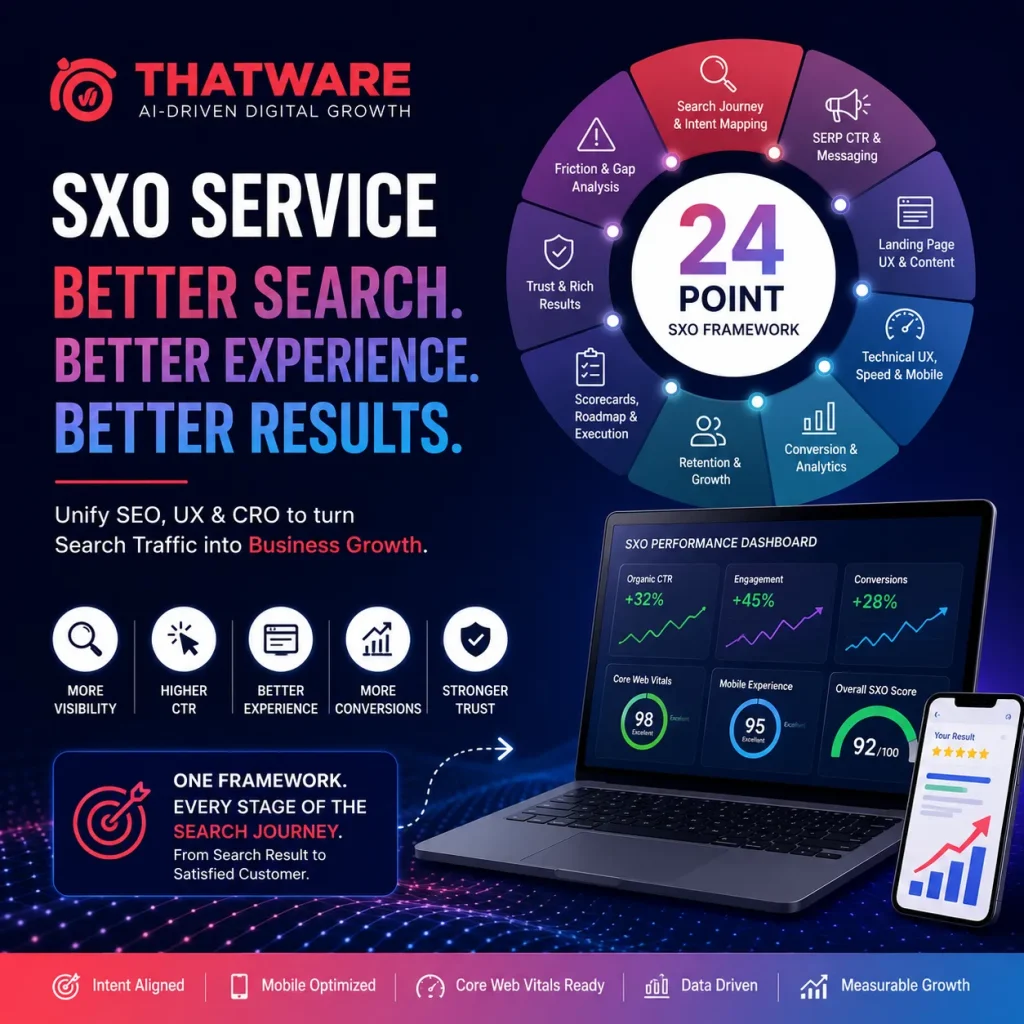
The uploaded SXO Pricing Plan Audit Report expands this direction into 24 separately audited deliverables. It connects query expectations, SERP messages, landing-page experiences, technical UX, engagement, conversions, retention, scorecards and implementation backlogs. Each deliverable includes an observed condition, gap, action plan, implementation output, before-and-after state and measurable result.
This expanded framework is designed to explain the full value of ThatWare’s SXO packages, rather than presenting SXO as a narrow combination of SEO and CRO.
What Is Search Experience Optimization?
Search Experience Optimization improves the complete experience a person has from the moment a search result appears to the moment that person completes a useful action.
It connects five performance layers:
Search Visibility
The page must be discoverable for relevant queries.
Search Result Engagement
The title, description, rich result and visible trust cues must earn the click.
Landing-Page Experience
The visitor must quickly understand the offer, value and next step.
Conversion Experience
The page must guide the visitor toward an appropriate action without unnecessary friction.
Retention and Measurement
The business must track partial progress, return visits, drop-offs and completed outcomes.
Conventional SEO can generate rankings and traffic. UX can improve page usability. CRO can increase conversion rates. SXO coordinates all three around the intent and behavior of organic search visitors.
Why SXO Requires a Dedicated Framework
General UX recommendations are not always sufficient for organic traffic.
A homepage visitor, paid advertising visitor, referral visitor and organic search visitor may arrive with different expectations. An organic visitor has already formed an expectation from:
- The search query
- The result title
- The meta description
- The displayed URL
- Rich-result elements
- Ratings or review information
- Brand familiarity
- Competing search results
The landing page must continue that promise.
When the search result suggests pricing but the page hides pricing details, friction occurs. When the search result promises a comparison but the page presents a generic service pitch, friction occurs. When a mobile visitor clicks a location-specific result but receives a broad national page, friction occurs.
SXO identifies and corrects these expectation gaps.
How ThatWare’s SXO Framework Extends the Existing Pricing Page
The live ThatWare page already establishes the core idea that SXO should improve what happens after a search visitor arrives. It describes intent mapping, landing-page optimization, content readability, conversion paths, behavioral review, mobile usability, page speed, trust placement and reporting. (Thatware)
The proposed framework adds greater operational depth by introducing:
- Query-level journey mapping
- SERP-to-page intent scores
- Search visitor friction registers
- Template-level technical UX priorities
- Controlled SERP message testing
- Above-the-fold clarity reviews
- Intent-specific CTA maps
- Organic funnel modeling
- Micro-conversion tracking
- Search retention planning
- Combined CTR, engagement and conversion prioritization
- Unified SEO and UX execution backlogs
This approach turns the pricing page into a complete explanation of how ThatWare audits, plans, implements and measures SXO.
ThatWare’s Complete SXO Service Coverage
Core SXO Strategy, Auditing and Consulting
ThatWare provides Search Experience Optimization services for organizations that want organic traffic to produce stronger engagement, better-quality enquiries and more measurable business actions.
As a Search Experience Optimization company, ThatWare can assess both search performance and post-click experience. The process does not stop after identifying ranking opportunities. It examines whether search visitors reach the correct page, understand the offer and move toward an appropriate action.
A specialist Search Experience Optimization agency should coordinate SEO, content, user experience, development, analytics and conversion activity. ThatWare’s framework creates that coordination through common scorecards, journey maps and action backlogs.
A Search Experience Optimization consultant can help internal teams identify which search journeys deserve priority, which pages require restructuring and which performance signals should be measured.
ThatWare’s broader SXO services can include search journey auditing, SERP engagement, page experience, technical UX, content restructuring, conversion mapping and reporting.
Businesses evaluating an SXO company should look for a provider that can connect search visibility with user behavior rather than reporting the two separately.
A capable SXO agency should be able to explain why a ranking page underperforms, identify the exact point of friction and recommend a measurable correction.
An SXO consultant can also work with existing SEO, design and development teams where full execution is not required.
ThatWare’s SXO audit services create the initial evidence base through query mapping, SERP analysis, landing-page reviews, analytics and technical testing.
Large organizations can use enterprise Search Experience Optimization across several sites, markets, languages, service lines and conversion pathways.
Search Journey and Intent Intelligence
ThatWare’s search journey optimization services examine the complete path from query to action.
Our search journey audit services map the query, search result message, landing page, first visible answer, proof, internal path and conversion opportunity.
Query-to-landing-page optimization checks whether the page reached from search is the page best suited to satisfy the query.
ThatWare’s search intent optimization services classify questions according to educational, local, commercial, comparison, navigational or transactional intent.
A formal SERP-to-page intent analysis compares the dominant result format with the content type and experience offered by the ranking page.
Search intent and UX alignment ensures that layout, answer depth, trust evidence and CTA timing correspond with the visitor’s likely objective.
Organic search journey mapping documents how organic users move between pages and actions.
User search journey analysis identifies which needs arise before, during and after the landing-page visit.
A structured search experience gap analysis locates mismatches between SERP expectations and page delivery.
Finally, query-to-conversion journey optimization connects the original search need with a suitable conversion or micro-conversion pathway.
SERP CTR and Search Result Messaging
ThatWare’s organic CTR optimization services improve the relevance and persuasiveness of search result messages.
SERP click-through rate optimization examines titles, descriptions, displayed URLs, rich results, brand cues and competing messages.
Title tag CTR optimization improves page-title specificity, intent match and differentiation.
Meta description CTR optimization strengthens the supporting value proposition and gives users a clearer reason to click.
ThatWare’s SERP message testing services create controlled hypotheses rather than making untracked snippet changes.
Search result message optimization aligns the promise shown in search with the experience delivered on the page.
SERP snippet optimization services can include rewriting titles, descriptions and supporting structured data.
An organic search CTR audit identifies pages with strong impressions but weaker-than-expected click performance.
SERP competitor message analysis examines how competing pages communicate value, evidence, pricing, speed, expertise or differentiation.
Search result conversion optimization goes beyond increasing clicks. It aims to attract users whose expectations match the page and who are more likely to engage after arrival.
Landing-Page UX and Organic Visitor Experience
ThatWare’s SEO user experience optimization connects search intent with page usability.
Our search UX audit services assess whether organic visitors can understand, trust and navigate a page efficiently.
Organic landing page UX optimization improves the experience of pages receiving meaningful search traffic.
A landing page search experience audit examines the page specifically from the perspective of visitors arriving through organic results.
Search visitor friction analysis identifies unclear wording, missing evidence, weak CTAs, complex forms, distracting navigation and poorly timed interruptions.
Landing page content experience optimization improves how information is ordered and presented.
ThatWare’s above-the-fold optimization services focus on the hero heading, supporting message, trust cue and first CTA.
Search-focused landing page optimization ensures that each page satisfies the search intent before introducing broader promotional messaging.
An SEO landing page usability audit reviews whether the page is easy to use without weakening relevance or content depth.
Organic visitor experience optimization then coordinates clarity, navigation, proof, mobile experience and conversion support.
Technical UX, Page Speed and Mobile SXO
ThatWare’s Core Web Vitals optimization services prioritize speed and interaction issues according to organic traffic and commercial value.
A technical UX audit for SEO connects technical defects with their effect on the search visitor’s experience.
Mobile search experience optimization improves the complete mobile journey from result click to action.
Our mobile SXO audit services examine the first screen, sticky elements, tap targets, menus, forms and page speed.
SEO page experience optimization combines technical quality with usability and content clarity.
Organic landing page speed optimization prioritizes pages where slow performance creates a measurable search and conversion risk.
A mobile landing page UX audit identifies issues that may not appear in desktop reviews.
A broader search experience performance audit reviews whether speed, responsiveness and layout stability support the intended journey.
Technical Search Experience Optimization turns performance data into prioritized implementation tasks rather than isolated technical scores.
Website responsiveness optimization for SEO ensures that page layouts remain usable across screen sizes and interaction conditions.
Content Experience and Answer Formatting
ThatWare’s search-focused content optimization structures content according to the questions, decisions and actions associated with search intent.
Our content readability optimization services improve sentence length, paragraph density, terminology and flow.
Content scannability optimization helps visitors locate answers, proof and CTAs without reading every line.
Landing page content structure optimization determines the most effective order for the hero, answer, proof, details, comparison, FAQ and CTA sections.
ThatWare’s answer block optimization services create concise sections that respond directly to specific questions.
Featured snippet formatting services select paragraph, list, table or step formats according to the query.
Search intent content structuring adjusts content depth and sequence based on user readiness.
SERP answer engagement optimization improves both extraction potential and the usefulness of the answer after the visitor lands.
A search-friendly content hierarchy creates a logical H1, H2, H3 and H4 structure.
Rich result optimization services identify relevant structured data and visible-content requirements that may improve result clarity and confidence.
Organic Conversion, Analytics and Reporting
ThatWare’s organic conversion rate optimization focuses specifically on visitors entering through unpaid search.
Our SEO conversion optimization services connect rankings, page intent, content experience and business actions.
Organic traffic funnel optimization identifies how users progress from entry to engagement, micro-conversion and final conversion.
Search visitor behavior analysis uses engagement, scroll, CTA, form and navigation data to identify likely friction.
Organic conversion funnel mapping assigns page roles and measurable events to each stage.
Search intent CTA optimization aligns CTA wording and placement with user readiness.
ThatWare’s micro-conversion tracking services measure actions that indicate growing trust or intent before the final enquiry.
An organic landing page conversion audit identifies specific content, design, form and proof improvements for high-value entry pages.
SXO analytics and reporting combine SEO, UX and conversion data into one performance view.
Search experience performance tracking records whether implemented fixes improve CTR, engagement, journey progress, conversions and retention.
Who Should Use Search Experience Optimization?
SXO is particularly useful for businesses that already receive impressions, rankings or organic traffic but do not receive the expected volume or quality of actions.
It can support:
- B2B service companies
- SaaS providers
- Ecommerce brands
- Healthcare and professional services
- Finance and legal businesses
- Multi-location companies
- Enterprise websites
- Educational institutions
- Travel and hospitality companies
- Home-service providers
- Publishers with commercial conversion paths
- Brands with long research and comparison journeys
SXO is also valuable when:
- CTR is low despite strong average rankings.
- Landing pages have high exits or weak engagement.
- Mobile conversion is materially lower than desktop conversion.
- Users visit several pages without reaching enquiry actions.
- Organic traffic grows but lead volume remains flat.
- Conversion tracking does not reveal intermediate behavior.
- SEO, UX and CRO teams work from separate priorities.
- High-traffic pages contain unclear CTAs or weak proof.
- Search visitors often return before converting.
- Several pages compete for the same intent.
Before and After Search Experience Optimization
Typical State Before SXO
Before a coordinated SXO programme, organizations often experience fragmented optimization.
SEO reports concentrate on rankings and traffic. UX reviews focus on general usability. CRO activity concentrates on high-volume conversion pages. Analytics reports show outcomes without identifying the search expectation that produced the visit.
Common conditions include:
- Queries are not mapped to complete journeys.
- Search-result promises are not compared with page content.
- Page intent is assigned through keywords rather than live SERP patterns.
- CTR changes are not managed as controlled tests.
- Above-the-fold content is not reviewed by entry query.
- Mobile experience is evaluated only as a technical pass or fail.
- Core Web Vitals issues are not prioritized by organic value.
- CTA placement follows a site template rather than user readiness.
- Internal links do not guide users toward the next required proof.
- Organic conversion drop-offs are not modeled.
- Micro-conversions are not tracked.
- Search retention is not planned.
- SEO and UX recommendations have separate owners and backlogs.
Target State After SXO
After implementation:
- Every priority query has a documented journey.
- SERP intent is matched with the correct page and format.
- Search-result messaging is tested using a defined hypothesis.
- Landing-page friction is recorded by page section and user need.
- Technical UX issues are prioritized according to traffic and commercial value.
- Mobile visitors see a clear value proposition and usable action path.
- Answer blocks use the most suitable format.
- Trust signals support both the search result and landing page.
- CTAs correspond with awareness, comparison or action-ready intent.
- Organic funnels include measurable intermediate steps.
- Return pathways support users who are not ready to convert.
- A single scorecard connects visibility, CTR, experience and conversion.
- Cross-functional teams work from one prioritized backlog.
ThatWare’s SXO Audit, Fix and Validation Methodology
The uploaded report follows a repeatable methodology across all 24 deliverables. The same method should be presented on the pricing page so prospective clients understand how recommendations become measurable action.
Evidence Collection
The audit reviews:
- Priority queries
- Search result displays
- Titles and descriptions
- SERP feature types
- Landing-page sections
- Mobile layouts
- Core Web Vitals
- Navigation and internal links
- Forms and CTAs
- Reviews and trust evidence
- Analytics and event data
- Conversion paths
- Returning-user behavior
- Existing implementation backlogs
Gap Definition
Each issue should specify:
- The exact query, page or template affected
- The visitor expectation being blocked
- The evidence supporting the finding
- The severity and commercial impact
- The recommended correction
- The responsible owner
- The measurement required after implementation
Plan of Action
Actions should be grouped into:
- SERP message corrections
- Page content corrections
- UX and layout corrections
- Mobile or technical corrections
- Navigation and internal-link corrections
- CTA and conversion corrections
- Analytics and tracking corrections
- Retention and reporting corrections
Before-and-After Fix Documentation
The fix report should show:
- Existing state
- Issue
- Impact on search visitors
- Recommended implementation
- Expected post-fix state
- Validation requirement
- Success metric
Validation
No task should be marked complete only because it has been published.
Validation may include:
- Search snippet review
- CTR comparison
- Core Web Vitals retesting
- Mobile usability review
- Scroll and click-event comparison
- CTA engagement
- Funnel progression
- Form completion
- Assisted conversion
- Returning visitor behavior
- Stakeholder and technical QA
The Complete 24-Point SXO Framework
Phase One: Search Journey, Intent and Friction
1. Search Journey Audit From Query to Landing Page Experience
Purpose
This deliverable evaluates the complete path from the visitor’s search query to the page experience and intended action.
Before the Fix
Search and user experience may be reviewed separately. Keyword reports show which pages rank, while UX reviews examine the page without considering what the visitor searched before arrival.
As a result, the business may not know:
- What the searcher expected
- Which result message earned the click
- Whether the first screen confirmed that expectation
- Where uncertainty began
- Which proof was missing
- Which next action should have been offered
- Which page element caused the journey to stop
The uploaded audit identifies the absence of an end-to-end map showing the exact drop points between the query expectation, SERP promise and landing-page experience.
Plan of Action
- List priority organic queries.
- Record the landing page currently ranking for each query.
- Capture the title, description and rich-result message.
- Review the hero heading, subheading, visible trust cue and CTA.
- Record the primary question the visitor needs answered.
- Identify friction between the SERP promise and first-screen experience.
- Review the path toward proof, comparison and conversion.
- Assign each issue to content, SEO, design, development or analytics.
- Define the success metric before implementation.
- Compare post-fix behavior with the baseline.
After the Fix
Every priority query has a documented journey containing:
- Query
- Intent
- SERP promise
- Landing URL
- First-screen message
- Trust cue
- Friction point
- Next-best action
- Fix owner
- KPI
Implementation Output
A search journey audit map showing the complete query-to-page pathway.
Success Metrics
- Percentage of priority journeys mapped
- Unresolved friction points
- CTR by query group
- Scroll initiation
- CTA engagement
- Qualified conversion by entry page
2. SERP-to-Page Intent Match Analysis
Purpose
This deliverable determines whether the ranking page matches the dominant intent and format shown in the search results.
Before the Fix
A page can rank for a query without fully satisfying the user’s expected format.
For example:
- The SERP favors comparison pages, but the ranking URL is a general service page.
- The query suggests pricing intent, but the page avoids discussing cost or package structure.
- The SERP favors local results, but the landing page is nationally focused.
- Users expect a guide, but the page is mainly promotional.
- Users expect a tool or checklist, but the page offers only prose.
Pages may be optimized around keywords rather than the live result environment.
Plan of Action
- Classify each query by informational, commercial, local, comparison, navigational or transactional intent.
- Record the dominant result types.
- Note the presence of snippets, PAA results, videos, maps, lists, tools or service pages.
- Score the current page against the dominant format.
- Review whether the page has the required depth, proof and CTA.
- Add missing sections.
- Reassign the target page where the current URL cannot meet the intent.
- Monitor SERP intent drift monthly.
After the Fix
A page-intent register establishes:
- Query
- Dominant intent
- Preferred result format
- Current page type
- Match score
- Missing sections
- Corrective action
- Target URL
Implementation Output
A SERP-to-page intent match sheet.
Success Metrics
- Intent-match score
- CTR
- Engagement rate
- Ranking stability
- Reduction in queries mapped to unsuitable page types
3. User Friction and Content Experience Gap Analysis
Purpose
This deliverable identifies where search visitors hesitate, abandon, backtrack or fail to identify the next step.
Before the Fix
Friction may exist even when the page looks visually acceptable.
Common examples include:
- A heading that does not answer the search question
- Important pricing or process information hidden below long introductions
- Several CTAs competing for attention
- Proof presented too late
- Forms with unnecessary fields
- Navigation that leads away from the intended journey
- Repetitive copy
- Mobile overlays obstructing content
- Inconsistent button wording
- No clear distinction between packages
These problems are often reviewed without connecting them to the visitor’s search intent.
Plan of Action
- Walk through every priority entry page as a first-time search visitor.
- Review the journey from arrival to target action.
- Mark unclear headings, repeated copy, missing evidence, navigation distractions and form barriers.
- Connect every friction point to the need it blocks.
- Score severity based on visibility, business impact and correction effort.
- Recommend the exact content, UX, trust, navigation or CTA change.
- Validate through analytics, events, heatmaps or user testing.
- Recheck after deployment.
After the Fix
A friction register shows:
- URL
- Page section
- Search intent
- Friction type
- User need blocked
- Evidence
- Severity
- Recommended change
- Owner
- Status
Implementation Output
A user-friction and content-experience gap register.
Success Metrics
- High-severity issues removed
- Bounce or exit improvement
- Scroll-depth improvement
- Section interaction
- Form starts and completions
- CTA engagement
Phase Two: Technical UX, SERP Messaging and Search Result Confidence
4. Core Web Vitals and Technical UX Review for Search Experience
Purpose
This deliverable connects technical performance defects with organic landing-page value and user experience.
Before the Fix
Technical reports may list LCP, INP and CLS scores but not explain:
- Which templates create the issue
- Which organic pages are affected
- Which component causes the problem
- Which user interaction is disrupted
- Which fixes deserve priority
- Whether the defect affects conversion pages or low-value pages
Technical metrics therefore remain disconnected from business impact.
Plan of Action
- Collect field and lab data for priority landing pages.
- Group URLs by template.
- Review Largest Contentful Paint, Interaction to Next Paint and Cumulative Layout Shift.
- Identify root causes such as large images, scripts, fonts, forms or layout instability.
- Rank fixes according to organic entrances and commercial value.
- Assign implementation ownership.
- Record pre-fix metrics.
- Retest after deployment.
- Compare engagement and conversion changes.
- Add unresolved items to the SXO backlog.
After the Fix
Technical UX work is prioritized by:
- Template
- Affected pages
- Organic value
- Metric failure
- Root cause
- Recommended fix
- Development owner
- Validation status
- Engagement impact
Implementation Output
A template-level Core Web Vitals and technical UX action plan.
Success Metrics
- CWV pass rate
- LCP, INP and CLS improvement
- Mobile engagement
- CTA response
- Form completion
- Organic landing-page conversion
5. Mobile Search Experience Evaluation
Purpose
This deliverable evaluates whether mobile search visitors can quickly understand, trust and act after arrival.
Before the Fix
Mobile friendliness may be treated as a technical status rather than a complete user journey.
A page may pass responsive-design checks but still have:
- An oversized hero
- A CTA below several screens
- Small tap targets
- Difficult menus
- Intrusive pop-ups
- Long forms
- Poor field validation
- Weak contrast
- Excessive content density
- Hidden trust cues
- Unstable sticky elements
Plan of Action
- Capture the first screen on common mobile breakpoints.
- Check whether the page explains what is offered and who it helps.
- Review tap target size and spacing.
- Test navigation and breadcrumbs.
- Test forms, validation and keyboard behavior.
- Review sticky CTAs and overlays.
- Assess text size, spacing and content order.
- Prioritize pages with high mobile organic entrances.
- Track scroll, CTA, form-start and completion events.
- Revalidate after fixes.
After the Fix
Each target URL receives a mobile SXO score covering:
- First-screen clarity
- Speed
- Tap targets
- Navigation
- Form usability
- CTA visibility
- Trust placement
- Content hierarchy
- Conversion accessibility
Implementation Output
A mobile SXO checklist and page-level action plan.
Success Metrics
- Mobile SXO score
- Mobile CTA engagement
- Mobile form starts
- Mobile form completion
- Scroll depth
- Bounce or exit movement
6. Title and Meta Description Optimization for Higher CTR
Purpose
This deliverable improves the search result message while preserving relevance and setting an accurate post-click expectation.
Before the Fix
Titles and descriptions may be optimized mainly for keyword inclusion.
They may be:
- Generic
- Duplicated across pages
- Too broad
- Missing a meaningful benefit
- Unclear about the page type
- Disconnected from the landing-page message
- Less specific than competing snippets
- Overly promotional
- Truncated
- Missing useful qualifiers
Plan of Action
- Export all current titles and descriptions.
- Capture actual displayed snippets where available.
- Associate each snippet with its primary query group.
- Identify the dominant user intent.
- Compare competitor messages.
- Document the message gap.
- Write distinct title and meta options.
- Ensure that the landing page supports the promise.
- Record the implementation date.
- Compare CTR before and after recrawl.
After the Fix
Each priority page has:
- A unique title
- A clear intent signal
- A specific page promise
- A useful value statement
- Accurate expectation setting
- A CTR baseline and monitoring field
Implementation Output
A title and meta CTR optimization sheet.
Success Metrics
- Organic CTR
- Qualified session volume
- Duplicate snippets removed
- Query-to-page engagement
- Post-click bounce movement
7. Rich Result and Schema Opportunity Implementation Recommendations
Purpose
This deliverable identifies structured-data opportunities that can improve result clarity, trust and navigation.
Before the Fix
Structured data may exist without being connected to a clear SXO objective.
The site may have:
- Missing breadcrumbs
- Inconsistent Organization data
- Visible FAQs without eligible markup
- Service or Product pages without complete structured details
- Article pages without clear author relationships
- Invalid markup
- Markup that does not match visible content
- No prioritization by SERP opportunity
Plan of Action
- Audit existing structured data.
- Validate syntax and visible-content parity.
- Identify page-level eligibility.
- Consider Organization, Service, Product, Article, BreadcrumbList, FAQPage and Person where suitable.
- Prioritize pages where structured data can improve result understanding.
- Prepare JSON-LD specifications.
- Assign implementation ownership.
- Validate after deployment.
- request recrawl where appropriate.
- Track rich-result and CTR observations.
After the Fix
A schema opportunity register documents:
- URL
- Current markup
- Recommended type
- Visible content source
- Required fields
- Expected SERP benefit
- Owner
- Validation result
Implementation Output
A rich-result and schema implementation plan.
Success Metrics
- Valid schema coverage
- Critical errors resolved
- Breadcrumb or rich-result observations
- CTR movement
- Result-message clarity
8. Search Result Message Testing and Improvement
Purpose
This deliverable creates a controlled method for testing search result messages.
Before the Fix
Snippet changes may be made without documenting:
- Why the copy changed
- What behavior it was expected to influence
- Which query group was targeted
- When the change went live
- What the baseline was
- Whether the result improved
- Whether the same pattern should be reused
The organization cannot distinguish a successful message change from normal performance fluctuation.
Plan of Action
- Select pages with high impressions and weak CTR.
- Document the message weakness.
- Write a specific test hypothesis.
- Create one or more snippet variants.
- Record impressions, CTR and average position.
- Publish the selected variant.
- Wait for recrawl and stabilization.
- Compare the same query and page group.
- Retain or reverse the change.
- Add successful language patterns to a reusable library.
After the Fix
SERP messages are managed as experiments with:
- Hypothesis
- Original copy
- Test copy
- Query group
- Baseline
- Implementation date
- Result
- Decision
- Reuse recommendation
Implementation Output
A SERP message testing tracker.
Success Metrics
- CTR lift
- Qualified session lift
- Test completion
- Winning message patterns
- Post-click engagement
9. Featured Snippet and Answer Block Formatting for Better SERP Engagement
Purpose
This deliverable formats answers according to the most useful and extractable response type.
Before the Fix
A page may contain the correct answer, but it may be hidden inside:
- A long introductory paragraph
- An unrelated section
- An oversized FAQ response
- A paragraph where a list is expected
- Prose where a comparison table is more useful
- Several steps without numbering
- A vague heading
Plan of Action
- Identify priority question queries.
- Review the current SERP answer format.
- Choose paragraph, list, table, definition or step formatting.
- Create a direct answer immediately below a relevant heading.
- Add supporting explanation after the concise response.
- Include useful qualification or evidence.
- Connect the answer with an appropriate internal link.
- Position a relevant CTA without interrupting the answer.
- Test whether the block can be extracted accurately.
- Monitor SERP and on-page engagement.
After the Fix
Each target question has a clear answer block containing:
- Question heading
- Concise answer
- Appropriate format
- Supporting detail
- Evidence
- Source URL
- Next step
Implementation Output
A featured-snippet and answer-block formatting plan.
Success Metrics
- Priority questions with optimized blocks
- Extraction pass rate
- Featured snippet or PAA observations
- Answer-section engagement
- CTA movement from answer sections
10. Brand Trust Signal Enhancement in Search Results
Purpose
This deliverable improves visible credibility before and after the click.
Before the Fix
Trust evidence may exist on the website but remain absent from the search journey.
Searchers may not see:
- Relevant experience
- Verified reviews
- Certifications
- Awards
- Clear authorship
- Recognizable brand details
- Case studies
- Transparent policies
- Accurate profile information
Competitors may communicate stronger trust before the visitor reaches the page.
Plan of Action
- Inventory approved trust evidence.
- Verify accuracy and usage rights.
- Map each proof type to the relevant query stage.
- Review how the brand appears in search results.
- Improve title and description language where appropriate.
- Align structured data and external profiles.
- Place supporting proof on the landing page.
- Connect author or reviewer information.
- monitor branded searches and CTR.
- Review consistency periodically.
After the Fix
A trust-signal plan connects:
- Query group
- Search concern
- Relevant proof
- SERP use
- Landing-page use
- Structured-data requirement
- External profile requirement
- Measurement
Implementation Output
A brand trust enhancement pack.
Success Metrics
- Priority pages with relevant trust cues
- CTR for trust-sensitive queries
- Review and profile consistency
- Branded search growth
- Conversion confidence indicators
Phase Three: Landing-Page Structure, Navigation, CTAs and Readability
11. Landing Page Content Structure Optimization for Search Visitors
Purpose
This deliverable arranges content according to the visitor’s decision sequence.
Before the Fix
A landing page may contain all the necessary information but present it in an ineffective order.
Visitors may encounter:
- Company background before the direct answer
- Detailed features before understanding the value
- FAQs before core service information
- CTAs before trust has been established
- Proof after the final CTA
- Repeated benefit sections
- Comparison information too late
- Internal links that interrupt the primary journey
Plan of Action
- Document the current section order.
- Define the page’s search intent and conversion role.
- Identify what the visitor needs to know first.
- Place the direct answer and value proposition early.
- Position proof before high-commitment actions.
- Move detailed material beneath concise summaries.
- Add comparisons or FAQs where required.
- remove repeated or distracting sections.
- Add internal links at logical decision points.
- Track section engagement after reordering.
Recommended Page Sequence
- Search-aligned hero
- Direct answer or summary
- Value and suitability
- Proof and trust
- Process or deliverables
- Comparison or differentiation
- FAQs and objections
- Primary conversion action
After the Fix
Each priority page has a documented section order and purpose.
Implementation Output
A landing-page content structure optimization report.
Success Metrics
- Key-section engagement
- Scroll progression
- CTA engagement
- Reduction in unclear hierarchy
- Qualified conversion rate
12. Above-the-Fold Clarity and Value Proposition Improvements
Purpose
This deliverable ensures that the first visible screen confirms the search intent and establishes a clear next step.
Before the Fix
Visitors may see:
- A broad slogan
- A generic hero image
- No clear service definition
- An unclear CTA
- Several competing buttons
- No audience qualification
- No proof
- A mobile fold dominated by empty space
- A heading disconnected from the search result
The visitor must scroll before understanding whether the page is relevant.
Plan of Action
- Capture desktop and mobile first screens.
- Compare the hero with the query and snippet.
- Test whether it answers what, for whom and why.
- Rewrite the heading and supporting message.
- Add one relevant trust cue.
- Select a CTA suited to visitor readiness.
- Remove non-essential first-screen elements.
- check responsive behavior.
- Track scroll initiation and first CTA engagement.
- test an alternative where traffic volume supports it.
After the Fix
The first screen communicates:
- What the page offers
- Who it helps
- The primary value
- Why the brand is credible
- What the visitor can do next
Implementation Output
An above-the-fold improvement plan.
Success Metrics
- Scroll initiation
- First CTA clicks
- Bounce or exit movement
- Hero interaction
- Mobile first-screen engagement
13. Internal Navigation and Content Pathway Improvements
Purpose
This deliverable helps organic visitors reach the next page required for confidence or conversion.
Before the Fix
Site navigation may be comprehensive but not journey-specific.
A visitor may need:
- A case study
- Pricing details
- A comparison
- An FAQ
- A process explanation
- A local page
- An expert profile
- A contact option
Yet the page may provide only generic header and footer links.
Plan of Action
- Document links available from each priority landing page.
- Identify the visitor’s current stage.
- Define the next-best pages.
- Rewrite vague anchors.
- Add contextual links near relevant statements.
- Add related-proof or next-step modules.
- improve breadcrumbs.
- Remove distracting or redundant paths.
- track internal clicks and page depth.
- measure assisted conversion.
After the Fix
Every priority page has a pathway map containing:
- Source page
- Visitor stage
- Next-best page
- Anchor text
- Placement
- Journey purpose
- Event tracking
- Expected outcome
Implementation Output
An internal navigation and content pathway map.
Success Metrics
- Next-page click rate
- Orphan-page reduction
- Assisted conversion
- Page depth
- Exit reduction
- Proof-page engagement
14. Search Intent-Based CTA Placement Recommendations
Purpose
This deliverable aligns the CTA with the visitor’s intent, readiness and position within the page.
Before the Fix
CTAs may be inserted through a common template.
This creates mismatches such as:
- “Book a call” on a basic educational page
- “Learn more” on a high-intent pricing page
- A contact form before proof
- Several equally weighted CTAs
- A CTA unrelated to the section
- No low-friction action for research-stage visitors
- No direct action for ready-to-buy visitors
Plan of Action
- Classify page intent and journey stage.
- Inventory current CTAs.
- Record wording, location, destination and event.
- Assign a primary and secondary CTA.
- Match the CTA to awareness, evaluation, comparison, trust or action intent.
- Place CTAs near answer, proof, pricing or objection-resolution points.
- define event tracking.
- monitor click and completion quality.
- test alternate wording where justified.
- remove unnecessary competing actions.
After the Fix
A CTA map defines:
- URL
- Intent stage
- Page section
- Primary CTA
- Secondary CTA
- Destination
- Event name
- Expected user action
- Success metric
Implementation Output
A search-intent CTA placement map.
Success Metrics
- CTA click-through rate
- Qualified action rate
- Form completion
- Assisted conversion
- CTA performance by intent stage
15. Content Readability, Scannability and Section Hierarchy Optimization
Purpose
This deliverable makes detailed content easier to understand without removing necessary expertise.
Before the Fix
Search visitors may face:
- Long paragraphs
- Repeated explanations
- Inconsistent headings
- Weak section labels
- Excessive jargon
- Lists presented as prose
- Comparisons without tables
- Important information hidden in dense blocks
- Several H1 headings
- Illogical H2 and H3 progression
Plan of Action
- Identify dense paragraphs and sections.
- Review H1 to H4 hierarchy.
- Rewrite headings to preview the answer.
- Shorten or divide overloaded paragraphs.
- Convert suitable information into lists, steps or tables.
- Add concise summaries before detailed explanations.
- explain necessary technical terms.
- retain expert detail in supporting sections.
- evaluate reading and scanning flow.
- compare engagement after restructuring.
After the Fix
Content follows a clear hierarchy:
- One H1
- Intent-aligned H2 sections
- Supporting H3 subsections
- H4 implementation details
- Concise answer-first paragraphs
- Structured evidence
- Visible next steps
Implementation Output
A readability, scannability and hierarchy report.
Success Metrics
- Readability score
- Scannability score
- Section interaction
- Scroll progression
- Answer-block engagement
- CTA engagement
Phase Four: Behavior, Funnels, Conversion and Retention
16. Search Visitor Behavior Analysis Using Analytics Data
Purpose
This deliverable converts organic visitor data into page-level improvement actions.
Before the Fix
Analytics may show sessions, engagement or conversions without explaining:
- Which section created friction
- Which intent group struggled
- Why visitors exited
- Whether users saw the CTA
- Whether forms were started but not completed
- Whether mobile visitors behaved differently
- Which internal path supported conversion
Optimization can therefore rely on assumptions.
Plan of Action
- Segment organic traffic.
- Group performance by landing page and query category.
- Review engagement, exits, scroll, clicks and conversions.
- identify weak or unusual signals.
- Inspect the page sections associated with those signals.
- Form a likely cause.
- Recommend a specific page change.
- Add missing event tracking.
- record baseline and implementation date.
- compare the post-fix trend.
After the Fix
Each behavioral issue is connected with:
- URL
- Metric
- User signal
- Suspected cause
- Affected section
- Recommended change
- Tracking requirement
- Outcome
Implementation Output
A search visitor behavior analysis report.
Success Metrics
- Behavior-backed actions implemented
- Engagement movement
- Scroll movement
- CTA movement
- Exit reduction
- Conversion improvement
17. Conversion Funnel Mapping for Organic Traffic
Purpose
This deliverable visualizes how organic visitors progress from initial entry to final action.
Before the Fix
Organic conversions may be counted only when completed. The business may not know:
- Which page initiated the journey
- Which page built confidence
- Which CTA was clicked
- Where the form was abandoned
- Which supporting page assisted the conversion
- Which users returned later
- Which stage creates the largest loss
Plan of Action
- Define funnel stages.
- Assign each page a funnel role.
- identify entry, engagement, proof, CTA, form and completion events.
- Include calls, downloads, bookings and enquiries where relevant.
- Connect pages with internal pathways.
- Calculate progression and drop-off.
- Identify the highest-value breakpoints.
- recommend content, UX, CTA or form changes.
- track assisted conversion.
- report movement monthly.
After the Fix
The funnel shows:
Organic entry → Meaningful engagement → Proof interaction → CTA click → Form or action start → Completion → Return or nurture
Implementation Output
An organic conversion funnel map.
Success Metrics
- Stage-to-stage progression
- Funnel completion
- Form-start rate
- Form-completion rate
- Assisted conversion
- Drop-off reduction
18. Organic Landing Page Conversion Improvement Recommendations
Purpose
This deliverable identifies exact changes that can improve qualified actions from priority organic pages.
Before the Fix
A page may generate traffic but underperform commercially because it lacks:
- A strong value proposition
- Relevant proof
- Objection handling
- A usable form
- Clear package information
- A suitable CTA
- A comparison section
- Local or audience specificity
- Trust near the action point
- A clear next step
Plan of Action
- Select pages according to traffic, commercial value and conversion opportunity.
- Review the hero, answer, proof, process, FAQ, CTA and form.
- Connect findings with analytics and intent evidence.
- Write exact content or layout recommendations.
- Rank actions by expected impact and effort.
- Assign owners.
- define the baseline.
- publish corrections.
- validate tracking.
- measure qualified actions rather than clicks alone.
After the Fix
Each page receives a recommendation pack containing:
- Issue
- Evidence
- User need affected
- Exact recommended change
- Priority
- Owner
- KPI
- Validation result
Implementation Output
An organic landing-page CRO and SXO recommendation pack.
Success Metrics
- Conversion rate
- Qualified lead rate
- Calls or bookings
- Form completion
- Assisted conversions
- Revenue or pipeline contribution where available
19. Search Retention and Return-Visit Strategy
Purpose
This deliverable creates useful return pathways for visitors who are not ready to convert during the first session.
Before the Fix
Organic acquisition may focus on the first visit only.
Research-stage users may leave without:
- Saving the page
- Downloading a useful resource
- Subscribing to updates
- Reaching a related comparison
- Finding a checklist
- Viewing a case study
- Receiving a reason to return
These visitors may later convert through another brand.
Plan of Action
- Identify pages with research-heavy intent.
- Determine why users may need more time.
- Create helpful return hooks.
- Map follow-up content.
- Add low-friction actions.
- use downloadable guides, checklists or newsletter options where relevant.
- Connect pages with related resources.
- avoid intrusive retention tactics.
- track returning organic users.
- measure assisted conversions from repeat visits.
After the Fix
A retention plan documents:
- Entry page
- User readiness
- Return hook
- Follow-up resource
- Micro-conversion
- Return channel
- Measurement
- Final conversion path
Implementation Output
A search retention and return-visit strategy.
Success Metrics
- Returning organic visitors
- Repeat engagement
- Resource downloads
- Subscription actions
- Assisted conversions
- Multi-session conversion rate
20. Micro-Conversion Tracking Recommendations
Purpose
This deliverable measures smaller actions that indicate progress toward a major conversion.
Before the Fix
Final conversion tracking may not reveal whether users are building confidence.
Useful signals may remain unmeasured, including:
- CTA clicks
- Form starts
- Phone clicks
- Email clicks
- FAQ expansion
- Video plays
- Case-study views
- Pricing interactions
- Downloads
- Internal-link clicks
- Scroll thresholds
- Return visits
Plan of Action
- List meaningful interactions.
- Explain what each interaction indicates.
- Assign events to relevant pages and sections.
- standardize event naming.
- define parameters such as page, CTA, intent and device.
- remove noisy or low-value events.
- configure reporting views.
- connect micro-conversions with funnel stages.
- test implementation.
- review signal usefulness regularly.
After the Fix
The tracking plan includes:
- Event name
- Trigger
- Page type
- Section
- Intent meaning
- Funnel stage
- Analytics setup
- Reporting use
- Validation status
Implementation Output
A micro-conversion tracking recommendation plan.
Success Metrics
- Priority-page tracking coverage
- Event reliability
- Funnel diagnosis quality
- Micro-to-final conversion relationship
- Reporting completeness
Phase Five: Scoring, Prioritization and Execution Governance
21. SXO Scorecard and Monthly Improvement Report
Purpose
This deliverable combines search, experience and conversion performance into one monthly health view.
Before the Fix
SEO, UX, technical and conversion data may be reported separately.
Stakeholders may see:
- Rankings without landing-page engagement
- CTR without conversion quality
- Core Web Vitals without business impact
- Conversion rates without search-intent context
- UX issues without organic traffic value
- Completed tasks without KPI validation
Plan of Action
- Define the scorecard categories.
- Select measurable inputs.
- create scoring rules.
- establish page and site-level scores.
- show completed actions.
- identify blockers.
- explain metric movement.
- connect actions with business outcomes.
- define next-month priorities.
- review trends over time.
Recommended Score Categories
- Search visibility
- SERP engagement
- Intent alignment
- Content experience
- Technical UX
- Mobile experience
- Navigation
- CTA performance
- Conversion
- Retention
- Implementation completion
After the Fix
The monthly report shows:
- Category score
- Current result
- Previous result
- Completed actions
- Open issues
- KPI movement
- Owner
- Next action
Implementation Output
An SXO scorecard and monthly improvement report.
Success Metrics
- Overall SXO score
- Category improvement
- On-time action completion
- High-priority issue closure
- CTR, engagement and conversion movement
22. CTR, Engagement and Conversion Opportunity Tracker
Purpose
This deliverable identifies the pages with the strongest combined growth opportunity.
Before the Fix
Teams may optimize based on isolated metrics.
For example:
- A page has high impressions but low CTR.
- A page has good CTR but poor engagement.
- A page has strong engagement but weak CTA performance.
- A page converts well but receives limited visibility.
- A high-traffic page has no measurable action path.
Without combined prioritization, teams may work on low-impact pages.
Plan of Action
- Collect impressions and CTR.
- collect engagement and scroll data.
- collect micro and final conversions.
- identify the primary weakness.
- classify the opportunity as SERP, content, UX, CTA, technical or funnel.
- score traffic potential.
- score conversion value.
- score effort and confidence.
- assign ownership and dates.
- update priority monthly.
After the Fix
The tracker contains:
- URL
- Opportunity type
- Evidence
- Traffic potential
- Conversion value
- Recommended fix
- Priority
- Owner
- Status
- KPI outcome
Implementation Output
A CTR, engagement and conversion opportunity tracker.
Success Metrics
- High-priority opportunities resolved
- CTR lift
- Engagement lift
- Conversion lift
- Time from finding to implementation
23. Search Journey Roadmap
Purpose
This deliverable sequences SXO implementation according to the stages of the search journey.
Before the Fix
Recommendations may be scattered across reports.
A title rewrite may depend on landing-page changes. Conversion tests may be launched before event tracking is ready. Internal links may be added before page intent is clarified. Development work may begin without approved content.
Plan of Action
- Group recommendations by journey stage.
- identify dependencies.
- score impact and effort.
- establish implementation phases.
- define exact deliverables.
- assign owners.
- add deadlines.
- attach success metrics.
- document blockers.
- review progress monthly.
Recommended Roadmap Stages
- SERP click and intent
- First-screen clarity
- Content and proof
- Navigation and CTA
- Technical and mobile UX
- Analytics and funnel tracking
- Conversion optimization
- Retention and recurring improvement
After the Fix
The roadmap shows:
- Phase
- Action
- Dependency
- Owner
- Deliverable
- Timeline
- KPI
- Business impact
- Status
Implementation Output
A phased search journey roadmap.
Success Metrics
- Roadmap completion
- Dependency resolution
- KPI movement by phase
- Time to implementation
- Validated improvement rate
24. UX Plus SEO Action Backlog
Purpose
This deliverable brings SEO, UX, content, technical, analytics and conversion tasks into one execution system.
Before the Fix
Separate teams may maintain separate task lists.
This can result in:
- Duplicate work
- Conflicting priorities
- Missing owners
- Unclear dependencies
- SEO changes without UX review
- UX changes without search validation
- Development tickets without measurement
- Completed tasks without post-fix QA
Plan of Action
- Consolidate all audit findings.
- standardize task fields.
- include evidence for every task.
- score search impact.
- score user-friction reduction.
- score conversion value.
- score effort and confidence.
- assign cross-functional ownership.
- define validation requirements.
- review and close tasks through a monthly cadence.
Required Backlog Fields
- Task
- Source finding
- URL or template
- Evidence
- Search impact
- UX impact
- Conversion impact
- Effort
- Priority
- Owner
- Due date
- Status
- Validation method
- KPI outcome
After the Fix
All teams work from one priority view, with clear evidence, ownership and measurement.
Implementation Output
A unified UX and SEO action backlog.
Success Metrics
- Backlog completion
- High-impact open issues
- On-time delivery
- Validated fix rate
- KPI movement from completed actions
Recommended SXO Implementation Roadmap
Months 1 and 2: Baseline and Journey Intelligence
Complete:
- Search journey auditing
- SERP-to-page intent analysis
- Friction analysis
- Analytics and event review
- Target-page selection
- Initial SXO scorecard
Months 3 and 4: SERP Engagement and First-Screen Experience
Complete:
- Title and meta optimization
- SERP message testing
- Rich-result planning
- Trust-signal alignment
- Featured-answer formatting
- Above-the-fold improvements
Months 5 and 6: Landing-Page Content and Navigation
Complete:
- Page structure optimization
- Readability improvements
- Internal pathways
- Contextual internal links
- FAQ and objection handling
- Search-intent CTA maps
Months 7 and 8: Technical and Mobile Experience
Complete:
- Core Web Vitals review
- Template-level technical fixes
- Mobile SXO audits
- Mobile forms and CTA improvements
- Responsive-layout QA
- Post-deployment performance testing
Months 9 and 10: Funnel and Conversion Optimization
Complete:
- Organic funnel mapping
- Micro-conversion implementation
- High-value landing-page conversion reviews
- CTA testing
- Form optimization
- Assisted-conversion reporting
Months 11 and 12: Retention, Governance and Scaling
Complete:
- Return-visit strategy
- Resource and nurture pathways
- Combined opportunity tracker
- Search journey roadmap update
- Unified backlog review
- Annual SXO score comparison
Recommended SXO Performance Dashboard
The monthly dashboard should include:
- Priority queries mapped
- SERP-to-page intent score
- Organic impressions
- Organic CTR
- Title and meta tests
- Search result message winners
- Rich-result observations
- Landing-page engagement
- Scroll initiation
- Scroll depth
- Section interactions
- Internal pathway clicks
- Core Web Vitals pass rate
- Mobile engagement
- CTA clicks
- Form starts
- Form completions
- Phone or email actions
- Micro-conversions
- Organic conversion rate
- Assisted conversions
- Returning organic visitors
- High-severity friction points
- Backlog closure
- Overall SXO score
Suggested SXO Package Structure
SXO Foundation Plan
Suitable for smaller websites or businesses beginning to connect SEO and UX.
The scope may include:
- Search journey baseline
- Intent matching
- Basic friction review
- Title and meta improvements
- Above-the-fold recommendations
- Mobile checklist
- CTA review
- Monthly scorecard
SXO Growth Plan
Suitable for established websites with meaningful organic traffic.
The scope may include:
- Full query-to-page mapping
- SERP message testing
- Landing-page restructuring
- Core Web Vitals prioritization
- Behavioral analysis
- Organic funnel mapping
- Micro-conversion planning
- Opportunity tracking
Enterprise SXO Plan
Suitable for multi-market or high-volume websites.
The scope may include:
- Multi-domain and multi-market journeys
- Template-level technical UX
- Advanced event architecture
- Journey segmentation
- Conversion and retention modeling
- Cross-functional governance
- Custom scorecards
- Large-scale experimentation
- Unified enterprise backlog
Turn Search Visibility Into Better User Actions
Search traffic has value only when visitors can understand the page, trust the business and find a suitable next step.
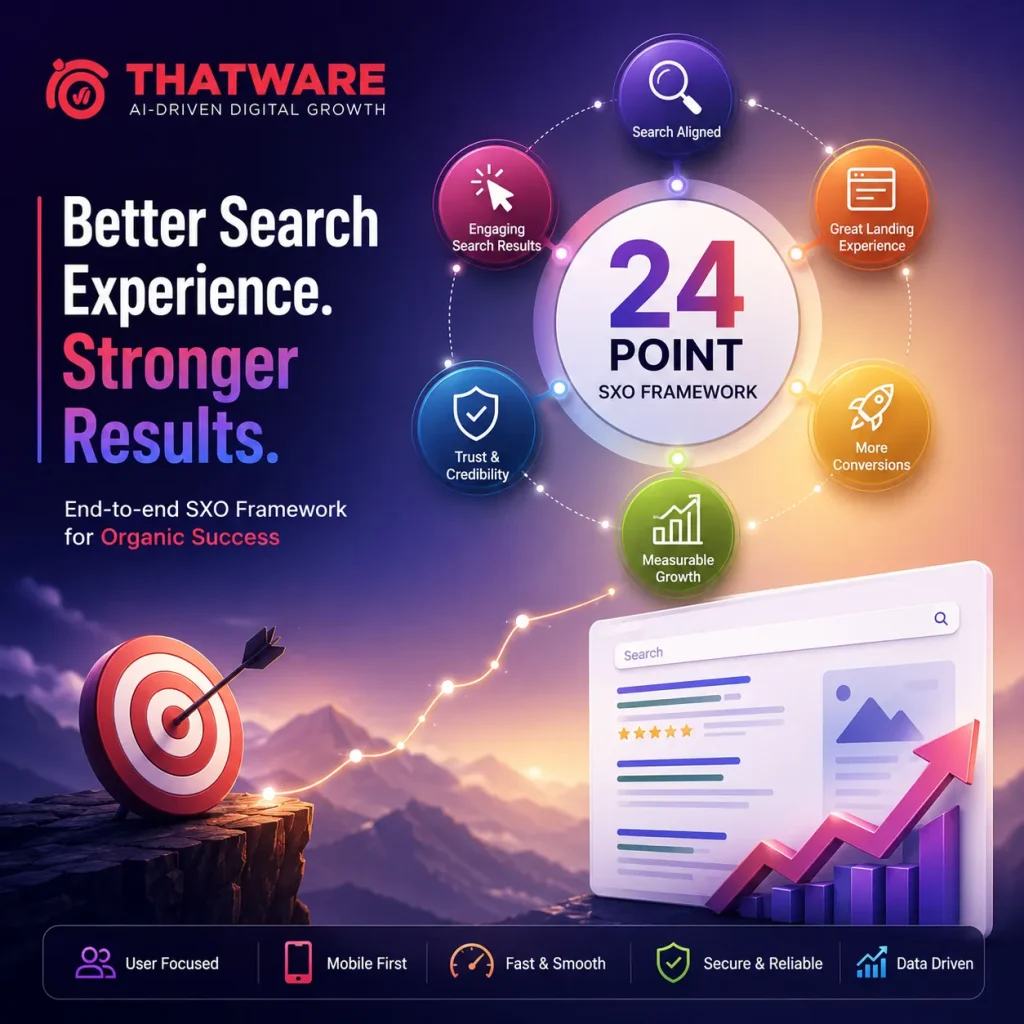
ThatWare’s 24-point SXO framework connects the search result with the full post-click experience. It examines the promise made before the click, the clarity delivered after arrival, the friction encountered during the journey and the actions taken before conversion.
The framework brings SEO, UX, content, development, analytics and conversion teams into one measurable system.