SUPERCHARGE YOUR ONLINE VISIBILITY! CONTACT US AND LET’S ACHIEVE EXCELLENCE TOGETHER!
People rarely search using keywords alone. They search with uncertainty, urgency, curiosity, comparison intent, emotional resistance and a desired outcome.
A person may know what they want but remain unsure which provider to trust. Another may be researching a problem without knowing the correct service name. A decision-maker may understand the solution but still need proof, reassurance, pricing clarity or internal approval before taking action.
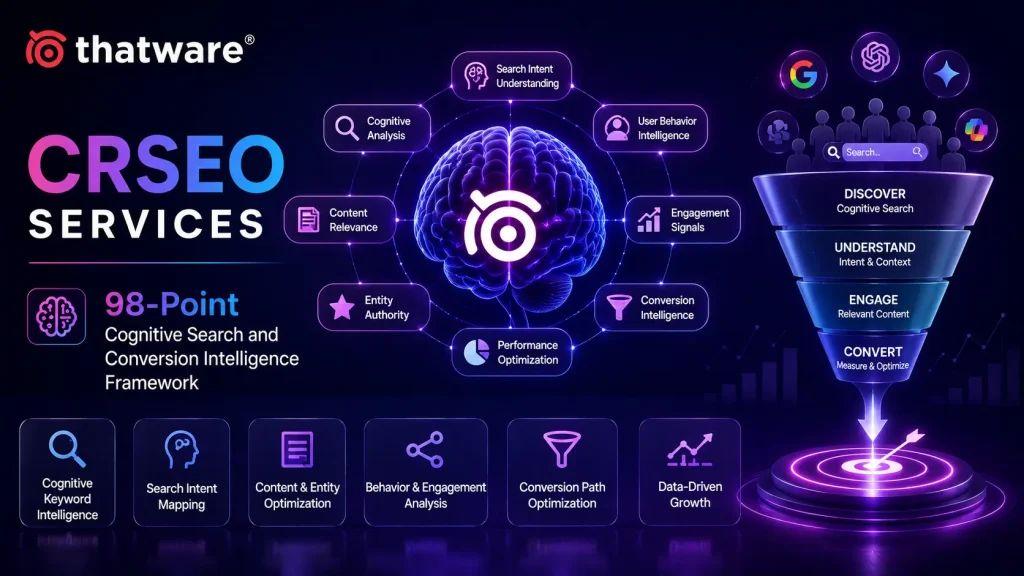
Conventional SEO can identify the words used in these searches. CRSEO goes further by examining the cognitive and emotional conditions surrounding them.
ThatWare’s CRSEO framework connects:
- Search intent
- Conversational language
- User uncertainty
- Emotional context
- Decision readiness
- Answer quality
- Entity relevance
- Retrieval precision
- Trust and authority
- Persuasive content sequencing
- Conversion-path clarity
- AI search visibility
The goal is not merely to attract a click. The goal is to create a search experience that helps the user understand the subject, reduce uncertainty, evaluate available options and move toward an appropriate next step.
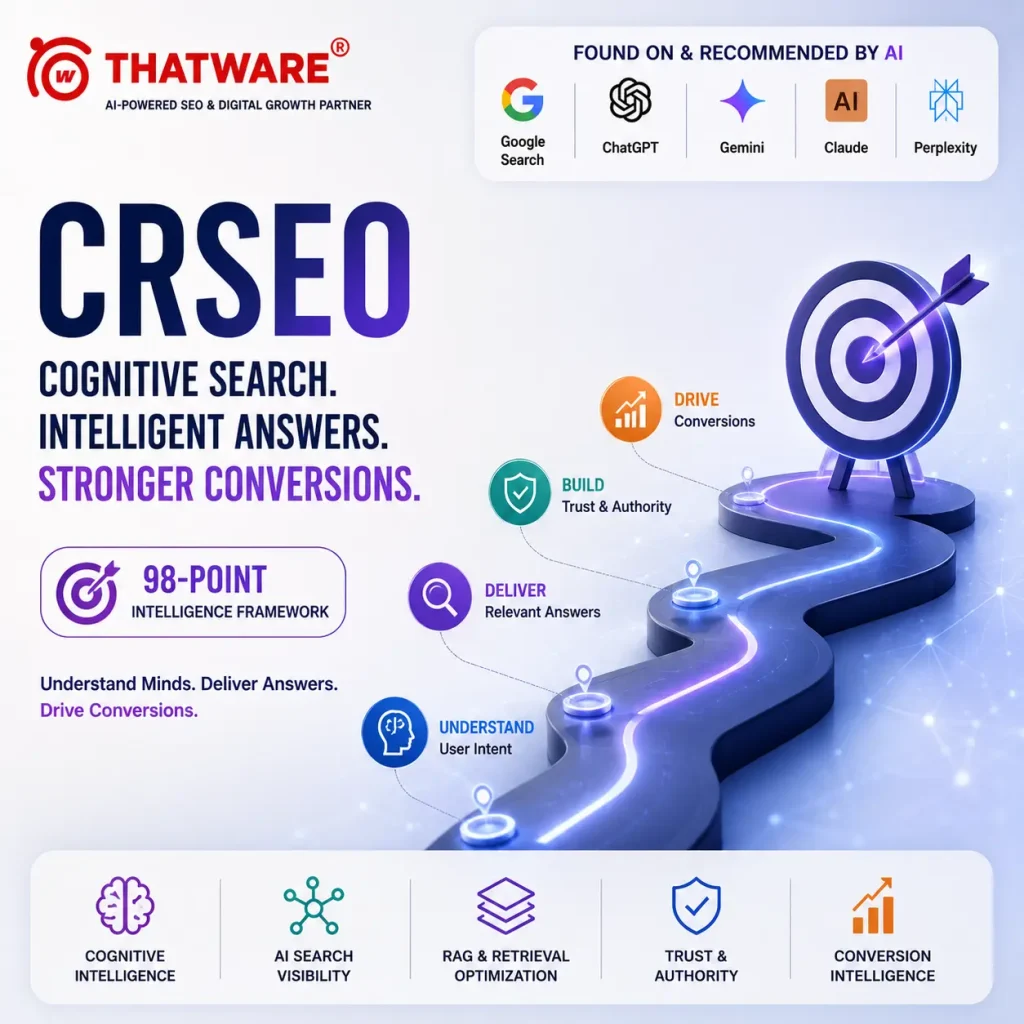
CRSEO should therefore be understood as an integrated cognitive search intelligence and conversion framework. It combines answer-engine optimization, emotional intent modelling, entity SEO, semantic content engineering, AI retrieval preparation, trust optimization and user-journey design.
What CRSEO Helps an Organization Understand
A structured CRSEO programme answers questions such as:
- What is the user trying to understand?
- What confusion is preventing a decision?
- What emotional concern is present within the query?
- Which page should answer that question?
- Which answer format is most appropriate?
- What evidence is needed before a user trusts the answer?
- What should the user read next?
- Which CTA matches the current stage of readiness?
- Can AI systems extract the answer accurately?
- Is the brand represented consistently across search and AI systems?
- Do entity, schema and authority signals support the claim?
- Where does the search-to-conversion journey break down?
- Which improvements should be implemented first?
ThatWare’s Complete CRSEO Service Scope
Core CRSEO Strategy, Auditing and Consulting
ThatWare provides CRSEO services for organizations seeking to connect search visibility with cognitive intent, emotional relevance and conversion readiness.
As a specialist CRSEO company, ThatWare combines search intelligence, content engineering, entity modelling, retrieval optimization and behavioural journey analysis.
A capable CRSEO agency should not stop at keyword research or page recommendations. It should explain why users hesitate, which answers reduce uncertainty and how each search interaction supports the next decision.
A CRSEO consultant can support internal SEO, content, product, UX, conversion and leadership teams that need specialist analysis without replacing existing implementation resources.
ThatWare’s CRSEO consulting services turn cognitive, semantic, emotional and behavioural findings into practical recommendations.
Our CRSEO audit services establish a baseline across search intent, answer visibility, content clarity, emotional context, entity signals, trust, retrieval readiness and conversion pathways.
Large businesses can use enterprise CRSEO services across multiple domains, product groups, languages, markets, audience segments and business units.
CRSEO strategy consulting determines which cognitive, content, technical and conversion workstreams should begin first.
CRSEO website optimization applies those recommendations to landing pages, service pages, product pages, articles, FAQs, resource centres and conversion pathways.
ThatWare’s CRSEO search intelligence services monitor how queries, user concerns, search surfaces, competitors and AI-generated answers change over time.
Cognitive Search Optimization and Intent Intelligence
Our cognitive search optimization services examine how users understand, evaluate and act on information found through search.
Cognitive SEO services combine search data with intent classification, semantic analysis, decision-path mapping and content architecture.
As a cognitive search intelligence company, ThatWare evaluates the relationship among queries, user expectations, answers, supporting evidence and conversion actions.
Our cognitive intent analysis services classify the reasoning need behind each query. This may involve definition, explanation, reassurance, comparison, risk assessment, proof or action.
A cognitive intent intelligence report documents the user’s probable question, uncertainty, expected answer, required proof and suitable next step.
ThatWare’s user decision intent mapping services connect research-stage queries with decision criteria and conversion paths.
Cognitive query analysis identifies how wording, modifiers, context and question structure change the meaning of a search.
Our search behavior intelligence services combine query patterns with landing-page behaviour, navigation, engagement and conversion signals.
Cognitive content optimization services improve the order, clarity and completeness of information on each page.
Cognitive content architecture services organize pages and sections according to how users learn, compare, verify and decide.
ThatWare’s crSEO Pricing can be structured according to website size, number of target queries and pages, cognitive intent analysis depth, decision-path mapping requirements, competitive research, content architecture complexity and ongoing optimization support. The appropriate pricing model can be aligned with the level of cognitive search intelligence, implementation and performance monitoring required to achieve the business’s search visibility and conversion objectives.
Emotional Intent, EIVM and Search Psychology
ThatWare’s emotional intent optimization services examine emotional signals that may influence search behaviour, without claiming to diagnose the user.
Emotional intent vector mapping groups queries according to observable language patterns associated with uncertainty, urgency, reassurance, fear, confidence, frustration or readiness.
Our EIVM services convert these patterns into actionable content, journey and CTA recommendations.
Emotional search intent analysis identifies how emotional context changes the answer a user is likely to find helpful.
Emotional journey stage mapping connects each emotional condition with an appropriate content experience.
Our intent emotion clustering services group queries that share both a practical objective and a similar emotional context.
Emotional conversion intelligence studies how reassurance, evidence, clarity and risk reduction affect conversion behaviour.
Emotional query optimization improves answers for searches containing urgency, uncertainty, comparison or concern-related language.
Emotion-aware content optimization adjusts tone, proof, structure and CTA placement according to the probable user state.
Emotional intent SEO services integrate those principles with keyword targeting, landing-page optimization, internal linking and performance measurement.
Persuasive Answer Sequencing and Conversion Paths
ThatWare’s persuasive answer sequencing services determine the order in which answers, proof and actions should appear.
AI answer sequencing optimization improves how content is organized for both machine extraction and human understanding.
Persuasive content flow optimization moves the user from recognition of a problem to understanding, validation, comparison and action.
Answer-first conversion content optimization delivers the direct answer before introducing proof, differentiators and CTAs.
AI logical flow path modeling maps the expected sequence among a query, answer, supporting evidence, internal link and next decision.
Cognitive conversion path mapping connects information needs with conversion readiness.
Search intent-to-conversion mapping documents how a user should progress from the original query to a measurable action.
Conversational conversion optimization aligns natural-language answers with page-specific next steps.
Decision-stage content sequencing organizes cost, suitability, comparison, risk, implementation and proof content for users approaching a decision.
AI-assisted persuasion optimization uses structured analysis to identify missing evidence or poorly ordered information, while retaining human editorial and ethical oversight.
Answer Engines and AI Search Visibility
Our question-answer opportunity mapping services assign important questions to the pages best equipped to answer them.
An AI answer surface gap analysis identifies questions for which the site lacks a concise, complete or sourceable response.
High-intent question clustering services group commercial and decision-stage questions by readiness, risk and desired action.
ThatWare’s featured snippet optimization services create suitable paragraphs, lists, tables and step-based answers.
People Also Ask optimization services distribute related questions across the most relevant pages rather than placing every question in one generic FAQ.
AI Overview optimization services improve page completeness, answer clarity, evidence, entities, trust and extractability.
Voice search answer optimization creates responses that remain understandable when read aloud without visual context.
Our conversational search optimization services align pages with complete natural-language questions.
Multi-format answer generation services create approved paragraph, list, table, FAQ, summary, spoken and step-based versions of verified information.
AI extraction validation services test whether the intended answer and necessary qualifiers are retrieved correctly.
Semantic, NLP and Entity Intelligence
Our semantic keyword clustering services group search terms according to meaning, context, entity and intent.
NLP keyword mapping services assign primary terms, synonyms, variations and contextual phrases to the correct pages.
ThatWare’s entity SEO services strengthen the identification and relationships of brands, people, services, products, locations and topics.
Entity-based content modeling defines which entities should appear together and how their relationship should be explained.
Semantic relationship mapping services document how entities, questions, services, audiences and source pages connect.
Brand entity disambiguation services reduce confusion caused by naming variants, similar organizations or inconsistent descriptions.
Custom knowledge graph development creates a governed map of entities, attributes, relationships, pages, evidence and external references.
Entity-based JSON-LD implementation translates appropriate entity relationships into validated structured data.
Our BERT content optimization services assess contextual relevance and whether content addresses the complete meaning of the target query.
TF-IDF content analysis services support comparative term and topic analysis while remaining one input among broader semantic and quality evaluations.
RAG, Vector Retrieval and AI Readiness
ThatWare’s RAG implementation services organize approved information for retrieval-augmented AI systems.
RAG knowledge base development turns verified content, policies, FAQs, product facts and brand information into controlled retrieval records.
Vector embedding optimization services improve the semantic representation and metadata of content chunks.
Vector content cluster optimization reduces duplication and improves the relationship among related retrieval units.
AI content chunking services divide large pages into self-contained, traceable answer blocks.
Retrieval-ready content optimization improves passage boundaries, context, metadata, source links and entity clarity.
LLM-ready content optimization prepares content for accurate interpretation by large language models without assuming guaranteed inclusion.
AI search readiness optimization services combine content, schema, entities, authority, technical accessibility and retrieval testing.
Answer primitive development creates reusable definitions, facts, qualifiers, steps, evidence statements and CTAs.
AI query map development connects prompt families with intent, target pages, answer formats, entities and testing results.
How CRSEO Differs From Conventional SEO
Conventional SEO commonly answers:
- Which keywords should be targeted?
- Which pages should be optimized?
- Which technical errors should be corrected?
- Which backlinks should be acquired?
- Which rankings and clicks changed?
CRSEO adds another layer:
- What does the user need to understand before acting?
- Which emotional or cognitive barrier is present?
- What information should appear first?
- What proof is required?
- Which answer format reduces effort?
- Which page should own the question?
- Which next step matches the user’s readiness?
- Can search engines and AI systems extract the correct answer?
- Does the page remain persuasive after the initial answer is delivered?
Before and After CRSEO Implementation
| Area | Before CRSEO | After CRSEO |
| Query research | Keywords grouped mainly by volume | Queries mapped by cognitive, emotional and decision intent |
| Page ownership | Several pages answer similar questions | One best page is assigned to each priority question |
| Content opening | Background appears before the answer | A direct answer appears first |
| Content structure | Long mixed-purpose sections | Modular answer, evidence and action blocks |
| User journey | Information and CTAs are disconnected | Each answer leads to a stage-appropriate next step |
| Emotional context | Tone is uniform for every query | Tone and reassurance reflect observable query context |
| Conversion path | Same CTA appears throughout the site | CTA type changes according to readiness |
| AI extraction | Important answers are buried | Self-contained retrieval-ready passages are available |
| Entity clarity | Relationships are implied | Entity relationships are explicit in content and schema |
| Authority | Credentials and citations are scattered | Evidence is positioned close to supported claims |
| AI readiness | Files and source records are fragmented | Governed AI, RAG and retrieval assets are maintained |
| Measurement | Rankings and traffic dominate reporting | Visibility, extraction, confidence and journey progression are tracked |
CRSEO Audit, Plan of Action and Fix Method
The CRSEO audit does not treat a recommendation as complete until the issue, implementation direction and expected target state have been documented.
Audit and Result
Each chapter begins with:
- Area audited
- Existing evidence
- Current strength
- Identified gap
- Result or risk
- Priority status
- Recommended focus
- Affected pages or assets
Plan of Action
The action plan defines:
- What should be audited in greater depth
- What asset should be created
- Which content or technical changes are required
- Which internal links or conversion paths should be added
- Which quality and safety checks are necessary
- How the result will be measured
Fix Report
The fix report compares:
- Current website state
- Target implementation state
- Fix performed
- Evidence of deployment
- Validation result
- Success metric
- Remaining risk
- Next review date
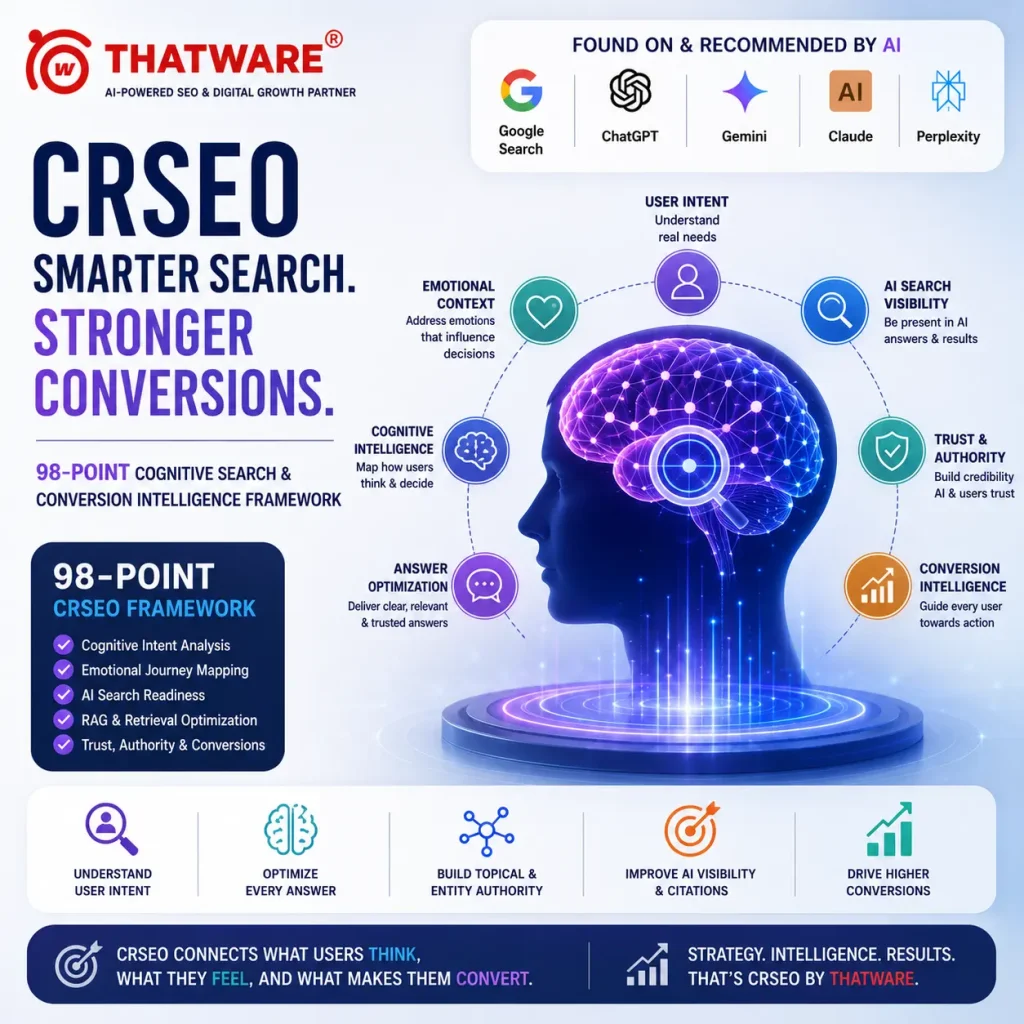
Complete 98-Point CRSEO Framework
Phase One: Question Discovery and Answer-Surface Engineering
Search Question Intelligence
1. Question-Answer Opportunity Map
Before: Questions are spread across pages, articles and FAQs without clear ownership. Search engines or AI systems may retrieve a broad homepage when a specialist page would provide a better answer.
Plan of action: Inventory high-value questions, classify intent, identify the required answer and assign one canonical page. Record supporting evidence, internal links, CTA, schema status and review owner.
After: Every priority question has a clearly assigned destination and approved answer structure.
Output and KPI: Question-to-page map; measure mapped-question coverage, correct-page retrieval and answer-surface visibility.
2. Conversational Query Opportunity Discovery
Before: Keyword research focuses on short phrases and overlooks how people ask complete questions.
Plan of action: Collect prompt-style queries, spoken searches, comparisons, objections, suitability questions and action-based searches. Group them by intent, context and journey stage.
After: The content plan reflects real conversational search behaviour.
Output and KPI: Conversational query library; measure long-tail impressions, prompt coverage and qualified visits.
3. AI Answer Surface Gap Analysis
Before: Useful information exists, but it may be buried inside long paragraphs or distributed across several pages.
Plan of action: Compare each priority question against current paragraphs, lists, tables, definitions, summaries and FAQs. Mark answers as complete, partial, unclear, unsupported or absent.
After: Missing answer formats are added to the most suitable pages.
Output and KPI: Answer-surface gap register; measure answer completeness and extraction pass rate.
4. Featured Snippet Competitor Mapping
Before: Competitors win snippets, PAA results and rich answer formats without a documented explanation.
Plan of action: Record the winning page, answer format, word count, heading, evidence, entities, schema and page authority for each target query.
After: Each snippet opportunity receives a format-specific counter-strategy.
Output and KPI: Competitor snippet grid; measure snippet gains, improved ranking proximity and CTR.
5. High-Intent Question Clustering
Before: Research-stage and purchase-stage questions are treated in the same way.
Plan of action: Cluster questions around pricing, suitability, comparison, risk, availability, urgency, implementation, provider choice and action.
After: Decision-stage queries are matched with stronger evidence and clearer CTAs.
Output and KPI: High-intent question matrix; measure engagement, assisted conversions and commercial-query visibility.
Answer Format Engineering
6. FAQ Extraction Formatting
Before: FAQs are inconsistent in length, wording and structure.
Plan of action: Extract existing questions, remove duplicates and create concise answer-first modules. Assign source page, internal link, reviewer, schema status and update date.
After: The organization has a governed FAQ library that can be reused safely.
Output and KPI: FAQ module database; measure approved modules, valid markup and FAQ engagement.
7. Listicle Answer Formatting
Before: Multi-item answers are written as dense prose.
Plan of action: Convert appropriate content into ordered or unordered lists with parallel labels and concise explanations.
After: Users and answer engines can identify individual items quickly.
Output and KPI: List-answer library; measure list snippet eligibility and interaction.
8. Table-Based Answer Optimization
Before: Comparison information is scattered across separate sections.
Plan of action: Create tables covering features, suitability, process, benefits, limitations, cost factors and next actions.
After: Comparison intent can be satisfied through a single scannable answer.
Output and KPI: Comparison-table pack; measure table extraction and comparison-query engagement.
9. Step-by-Step Response Structuring
Before: Processes are described in narrative paragraphs.
Plan of action: Convert suitable workflows into numbered stages with prerequisites, expected outcomes, cautions and completion actions.
After: Process-based answers become clearer for users and machines.
Output and KPI: Step module library; measure process-query visibility and completion behaviour.
SERP, AI Overview and Voice Targeting
10. Featured Snippet Targeting
Before: The correct answer appears after introductions or promotional copy.
Plan of action: Add concise paragraph, list, table or step answers beneath query-aligned headings.
After: Priority pages contain deliberate featured-answer candidates.
Output and KPI: Snippet target pack; measure snippet ownership and organic CTR.
11. People Also Ask Optimization
Before: PAA-style questions are concentrated on a central FAQ page.
Plan of action: Assign each question to the page with the strongest intent and entity match. Add a concise answer and relevant internal link.
After: Important pages develop unique supporting question coverage.
Output and KPI: PAA deployment map; measure PAA impressions and supporting-page growth.
12. AI Overview Optimization
Before: Facts, proof, credentials and answers are separated across pages.
Plan of action: Create sections containing a direct summary, supporting explanation, evidence, entities, limitations, FAQs, review date and suitable schema.
After: Priority pages become more complete and source-ready.
Output and KPI: AI Overview readiness scorecard; measure source appearances, cited URLs and correct-answer retrieval.
13. Voice Search Answer Optimization
Before: Answers rely on visual context or contain too many details for spoken delivery.
Plan of action: Create short voice-ready responses containing the direct answer, essential qualifier and next action.
After: Important conversational queries have understandable spoken answers.
Output and KPI: Voice-answer library; measure spoken accuracy and response length.
Phase Two: Structured Data, Semantic Content and Retrieval Preparation
Schema Deployment
14. FAQ Schema Deployment
Before: Visible FAQs lack corresponding machine-readable structure.
Plan of action: Implement FAQPage JSON-LD only where eligible and where markup matches visible content.
After: Approved FAQs have valid, synchronized structured data.
Output and KPI: FAQ schema register; measure valid detection and critical error reduction.
15. Speakable Schema Implementation
Before: Short public informational passages are not identified for spoken use.
Plan of action: Select eligible passages and apply speakable markup only where technically and contextually appropriate.
After: Suitable content has controlled voice-oriented structured support.
Output and KPI: Speakable implementation register; measure validation and voice-test performance.
16. HowTo Schema Integration
Before: Genuine task-based processes lack structured step representation.
Plan of action: Apply HowTo markup only to legitimate, visible and non-sensitive processes.
After: User-visible steps and machine-readable steps remain aligned.
Output and KPI: HowTo register; measure valid implementation and process-query coverage.
17. Entity-Based JSON-LD Markup
Before: Organization, service, product, person, location and webpage schema nodes operate independently.
Plan of action: Connect appropriate nodes through stable identifiers and supported relationships.
After: Structured data communicates a coherent entity graph.
Output and KPI: JSON-LD graph specification; measure node coverage, relationship coverage and validation.
Content Modularity and Cognitive Clarity
18. AI-Friendly Content Restructuring
Before: Pages combine several questions, intents and conversion stages inside long content flows.
Plan of action: Divide content into summaries, answers, evidence, comparisons, FAQs, limitations and next steps.
After: Each section has a distinct purpose and can be retrieved independently.
Output and KPI: Page restructuring blueprint; measure passage extraction and section engagement.
19. Conversational Content Rewriting
Before: Copy reflects internal business terminology more than customer language.
Plan of action: Rewrite selected sections around natural questions, concerns, comparisons and desired outcomes.
After: Content aligns more closely with conversational search behaviour.
Output and KPI: Conversational rewrite pack; measure prompt coverage and long-tail visibility.
20. Answer-First Paragraph Optimization
Before: Users must read background material before finding the response.
Plan of action: Begin each priority section with one or two direct answer sentences.
After: The core response appears immediately, followed by explanation and proof.
Output and KPI: Answer-first module library; measure extraction and readability.
21. Concise Semantic Response Engineering
Before: Individual blocks address several entities, intentions or actions.
Plan of action: Build atomic answers around one question, one central entity, one necessary qualifier and one next step.
After: Each answer remains meaningful when retrieved independently.
Output and KPI: Semantic response library; measure standalone-answer accuracy.
22. Contextual Schema Layering
Before: Schema types are added independently without modelling the full page.
Plan of action: Combine suitable Organization, Service, Product, Person, WebPage, Breadcrumb, FAQ and other valid layers according to page reality.
After: Structured data reflects the actual page and entity context.
Output and KPI: Schema layering plan; measure content parity and graph validity.
Semantic Scoring and Vector Preparation
23. Entity Extraction, TF-IDF and BERT-Based Content Scoring
Before: Content evaluation depends mainly on manual judgment or keyword density.
Plan of action: Extract entities, compare term distributions and assess contextual relevance against target intent and competing pages.
After: Missing concepts, weak entities and irrelevant passages become measurable.
Output and KPI: Semantic scoring workbook; measure entity coverage, contextual relevance and content differentiation.
24. Vector Embeddings and AI-Assisted Content Restructuring
Before: Repeated boilerplate and mixed-purpose passages reduce retrieval precision.
Plan of action: Create self-contained chunks with entity, intent, source URL, evidence, reviewer and update metadata.
After: Q&A, PAA and snippet-oriented passages become easier to match and retrieve.
Output and KPI: Embedding-ready content set; measure top-k retrieval precision.
25. LSI Clustering and Sentence Scoring
Before: Sentence relevance and readability are reviewed inconsistently.
Plan of action: Group related terminology and score sentences for intent match, clarity, duplication and semantic contribution.
After: Weak or unnecessary sentences can be prioritized for revision.
Output and KPI: Sentence-level scoring report; measure readability and semantic-fit improvement.
Phase Three: Entity Architecture, Authority and AI Retrieval
Entity Architecture
26. Primary Entity Reinforcement
Before: Pages discuss several subjects without establishing a dominant entity.
Plan of action: Reinforce the primary entity in the title, H1, opening answer, internal links, evidence and structured data.
After: The page’s central subject becomes easier to recognize.
Output and KPI: Entity reinforcement plan; measure entity salience and recognition consistency.
27. Semantic Relationship Mapping
Before: Relationships among the brand, service, audience, product, location and expert are implied.
Plan of action: Map who provides what, for whom, where, under which conditions and with which evidence.
After: Content, links and schema express consistent relationships.
Output and KPI: Semantic relationship graph; measure relationship completeness.
28. Topical Entity Association Optimization
Before: The brand and target topic appear separately or too far apart.
Plan of action: Develop natural co-occurrence blocks connecting the brand, service, problem, method, audience and proof.
After: Priority brand-topic associations become stronger.
Output and KPI: Association matrix; measure relevant co-occurrence and topical visibility.
29. Brand Entity Disambiguation
Before: Naming variations and inconsistent external descriptions create ambiguity.
Plan of action: Define the canonical name, aliases, identifiers, profiles, descriptions, ownership and exclusions.
After: Search and AI systems receive a stable brand identity.
Output and KPI: Brand identity register; measure naming consistency and ambiguous-match reduction.
30. Custom Knowledge Graph Integrations and Prompt-Engineered Clusters
Before: Pages, entities, questions, evidence and prompts are managed separately.
Plan of action: Build a governed knowledge graph connecting these assets and use it to guide prompt-led content clusters.
After: Content planning, schema and AI testing use shared relationships.
Output and KPI: Knowledge graph and prompt workbook; measure node, edge and prompt coverage.
31. NLP-Led Keyword Placement and Synonym Mapping
Before: Synonyms and related phrases are used without consistent page ownership.
Plan of action: Define preferred terminology, variations, exclusions, contextual usage and anchor-text rules.
After: Semantic breadth improves without creating cannibalization.
Output and KPI: NLP term map; measure variation coverage and page differentiation.
Content Authority and Topical Architecture
32. Content Gap Analysis
Before: Gap analysis focuses only on competitor keywords.
Plan of action: Compare topics, questions, entities, evidence, formats, journey stages and source requirements.
After: Every meaningful gap has a recommended page, section, format and owner.
Output and KPI: Content-gap register; measure high-value gap closure.
33. Custom Topical Maps
Before: Website navigation does not fully reflect semantic relationships.
Plan of action: Map pillar pages, supporting resources, entities, questions, evidence and conversion destinations.
After: The website develops a connected topic ecosystem.
Output and KPI: Topical map; measure cluster completeness and internal connectivity.
34. AI-Overview Optimized Pages
Before: Important pages lack complete answer, proof and source structures.
Plan of action: Build a repeatable page layout containing summary, answer, evidence, process, limitations, FAQ, schema and review data.
After: Priority pages are better prepared for generated-answer sourcing.
Output and KPI: AI Overview page specification; measure source visibility and page confidence.
35. Entity-Dense Authority Articles
Before: Articles attract traffic but provide limited entity or brand reinforcement.
Plan of action: Create expert-reviewed content linking important topics, related entities, evidence and commercial pages.
After: Supporting content strengthens topical and brand authority.
Output and KPI: Authority article programme; measure links, citations and assisted conversions.
36. E-E-A-T-Based Planning
Before: Trust fields are added after content production.
Plan of action: Include authorship, expertise, evidence, methodology, limitations, review and update requirements in every brief.
After: Experience, expertise, authority and trust are incorporated from the planning stage.
Output and KPI: E-E-A-T content template; measure trust-field completion.
37. Entity-Based Content Modelling for Co-Occurrence
Before: Entity combinations appear inconsistently across related pages.
Plan of action: Define primary, supporting and contextual entities for each page and intent.
After: Co-occurrence patterns support clearer topical relationships.
Output and KPI: Entity content model; measure expected-entity coverage.
38. AIO Content Flows
Before: Pages move abruptly from information to promotion.
Plan of action: Structure the experience around problem recognition, answer, suitability, process, evidence, objection handling and action.
After: Pages support both machine interpretation and human decision-making.
Output and KPI: AIO content-flow blueprint; measure section progression and CTA interaction.
RAG and Vector Retrieval
39. RAG Implementation
Before: Approved facts and answers are not stored in a governed retrieval system.
Plan of action: Create records containing response, source, entity, reviewer, date, access status and risk classification.
After: AI systems can retrieve traceable information from approved sources.
Output and KPI: RAG knowledge base; measure grounded-answer accuracy and source attribution.
40. Vector Engineering-Based Content Cluster Optimization
Before: Duplicate chunks and generic passages dilute semantic retrieval.
Plan of action: Remove duplication, create canonical chunks, add metadata and run retrieval tests.
After: Vector search returns more relevant source passages.
Output and KPI: Vector cluster model; measure top-k precision, recall and duplicate reduction.
Authority Acquisition
41. Tier 1 and Tier 2 Backlink Enhancement
Before: Links are evaluated primarily by volume or a single authority score.
Plan of action: Classify opportunities by editorial quality, relevance, traffic, source diversity, network diversity and risk.
After: Authority growth follows a controlled, relevance-led plan.
Output and KPI: Tiered link roadmap; measure qualified referring-domain growth.
42. Digital PR, Curated Placements and Press Coverage
Before: Internal expertise is not packaged for authoritative external use.
Plan of action: Develop expert commentary, data assets, research, reference pages and media resources.
After: Earned coverage reinforces important brand-topic relationships.
Output and KPI: Digital PR pipeline; measure editorial mentions, citations and referral traffic.
43. Google Entity Stacking and Contextual Competitor Backlinks
Before: Brand-controlled profiles and external descriptions use inconsistent information.
Plan of action: Align legitimate profiles and identify external sources already validating competing entities.
After: External references support the approved brand identity and topic positioning.
Output and KPI: Entity-source alignment register; measure consistency and relevant source growth.
44. Citation-Ready Reference Pages
Before: Facts, evidence and expert information are scattered.
Plan of action: Create reference pages with authorship, methodology, citations, dates, evidence blocks and media-ready information.
After: Publishers and AI systems have stronger sources to reference.
Output and KPI: Reference-page library; measure citation pickup and source selection.
45. Link Acquisition Through Google Search Operators
Before: Prospecting depends on broad third-party databases.
Plan of action: Build operator combinations for resource pages, associations, expert contributions, directories, interviews and industry lists.
After: Prospecting identifies more contextually relevant opportunities.
Output and KPI: Operator prospecting workbook; measure qualified-prospect and placement rate.
46. Forum Participation, Guest Blogging and Link Equity Redistribution
Before: Participation is inconsistent or overly promotional.
Plan of action: Define approved communities, subjects, disclosure standards, quality controls and target pages.
After: Participation supports reputation, referral discovery and internal authority movement.
Output and KPI: Participation plan; measure qualified referrals, mentions and internal support.
47. Programmatic Backlink Acquisition
Before: Automated prospecting creates large but low-quality lists.
Plan of action: Automate discovery and enrichment while retaining manual relevance, quality and risk review.
After: Prospecting scales without sacrificing editorial control.
Output and KPI: Programmatic prospecting workflow; measure qualified-prospect ratio.
Query Expansion and Answer Coverage
48. Long-Tail Conversational Query Expansion
Before: Supporting content targets broad phrases only.
Plan of action: Expand contextual questions, comparisons, use cases, modifiers and recommendation prompts.
After: The site supports more specific natural-language searches.
Output and KPI: Long-tail map; measure impressions, rankings and qualified visits.
49. Intent-Based Topic Coverage
Before: A topic may be extensive but poorly aligned with different decision stages.
Plan of action: Separate informational, commercial, comparison, local, navigational and transactional requirements.
After: Each intent receives suitable content, evidence and action.
Output and KPI: Intent-coverage matrix; measure visibility by intent class.
50. Multi-Format Answer Generation
Before: Verified information appears only as conventional prose.
Plan of action: Produce paragraph, FAQ, list, table, step, summary and spoken variants.
After: Approved information can support multiple search and AI surfaces.
Output and KPI: Multi-format answer library; measure format coverage and response consistency.
Phase Four: Freshness, Testing and Visibility Measurement
51. Semantic Keyword Clustering
Before: Related terms are placed on overlapping pages.
Plan of action: Cluster terms according to intent, entity, semantic context and canonical URL.
After: Keyword families have clear page ownership.
Output and KPI: Semantic keyword map; measure cannibalization reduction.
52. Content Freshness Monitoring
Before: Content is reviewed only after becoming visibly outdated.
Plan of action: Assign volatility levels, owners, review dates, source dependencies and update triggers.
After: Important information follows a controlled maintenance schedule.
Output and KPI: Freshness register; measure on-time review completion.
53. AI Answer Recency Updates
Before: AI systems may retrieve old prices, features, policies or brand facts.
Plan of action: Update visible pages, schema, RAG records and answer primitives together.
After: Priority answers communicate consistent current information.
Output and KPI: Recency tracker; measure outdated-answer reduction.
54. Trend-Driven Content Refreshes
Before: Pages are refreshed on a fixed calendar regardless of demand.
Plan of action: Monitor emerging searches, competitor activity, user concerns and source changes.
After: Content updates respond to meaningful changes in search behaviour.
Output and KPI: Trend-refresh pipeline; measure response speed and recovered visibility.
55. Temporal Query Optimization
Before: Evergreen and time-sensitive searches are treated identically.
Plan of action: Map recent, current, seasonal, upcoming and date-specific modifiers to suitable pages.
After: Time-sensitive queries reach clearly dated and maintained information.
Output and KPI: Temporal query map; measure date-relevant visibility.
56. AI Extraction Validation Testing
Before: Teams assume visible answers will be interpreted correctly.
Plan of action: Define test prompts, expected responses, required qualifiers and preferred source pages.
After: Each target answer receives a pass, partial or fail result.
Output and KPI: Extraction test pack; measure extraction pass rate.
57. Structured Data Error Auditing
Before: Schema issues are distributed across reports and tools.
Plan of action: Centralize error type, affected URL, owner, fix, deployment date and retest status.
After: Structured data quality becomes actively governed.
Output and KPI: Schema error register; measure critical-error closure.
58. SERP Answer Consistency Testing
Before: Page content, snippets, PAA results and generated answers may contradict one another.
Plan of action: Compare facts, claims, dates, entities, wording, qualifiers and source URLs.
After: Priority answer surfaces communicate compatible information.
Output and KPI: Consistency report; measure cross-surface alignment.
59. Mobile Voice Answer Verification
Before: Content may be accurate visually but confusing when spoken.
Plan of action: Test priority questions through relevant mobile voice interfaces.
After: Spoken responses remain understandable without screen context.
Output and KPI: Voice verification sheet; measure spoken-answer pass rate.
60. AI Visibility Tracking
Before: AI mentions and citations are checked irregularly.
Plan of action: Maintain fixed prompt cohorts and record mentions, citations, recommendations, omissions, competitors and source URLs.
After: AI visibility can be compared consistently over time.
Output and KPI: AI visibility dashboard; measure mention, citation and recommendation movement.
Phase Five: AI Discovery and Machine-Readable Infrastructure
The following files should be treated as governed technical assets. Their publication does not guarantee consumption by an AI platform. Every file should have a documented purpose, owner, version, source relationship and validation process.
Security and Reporting Assets
61. /.well-known/security.txt Setup
Before: Security reporting instructions are difficult to locate.
Plan of action: Publish approved contact, policy, communication and expiry information.
After: Responsible disclosure guidance has a maintained standard location.
Output and KPI: Valid security file; measure accessibility and freshness.
62. Conversational Query Ranking Reports
Before: Reporting focuses on short keywords.
Plan of action: Track complete questions, prompt families, answer formats, target pages and AI appearances.
After: Reporting reflects conversational discovery performance.
Output and KPI: Conversational query report; measure movement by question cluster.
63. /.well-known/ai.txt Setup
Before: AI-facing public guidance lacks an owned well-known location.
Plan of action: Define purpose, approved sources, access boundaries and maintenance rules.
After: The site has a controlled AI guidance location where appropriate.
Output and KPI: Governed well-known asset; measure availability and update compliance.
Semantic and Retrieval Feeds
64. semantic-sitemap.xml Implementation and Updates
Before: A standard sitemap lists URLs without semantic classification.
Plan of action: Add records for canonical URL, entity, topic, content type, priority and freshness.
After: Priority resources form a maintained semantic inventory.
Output and KPI: Semantic sitemap; measure valid parsing and URL coverage.
65. vector-feed.xml Creation
Before: Retrieval chunks lack a structured feed.
Plan of action: Record chunk identifiers, canonical sources, entities, topics, owners and dates.
After: Vector systems can use traceable source records.
Output and KPI: Vector feed; measure valid record and source coverage.
66. ai-manifesto.json Implementation
Before: Brand identity, values and source policies are distributed across pages.
Plan of action: Create a structured representation of approved identity, principles, categories and source rules.
After: The organization has a governed machine-readable brand reference.
Output and KPI: AI manifesto file; measure public-content parity.
67. llms.txt Implementation
Before: Important resources are not summarized in an AI-oriented guide.
Plan of action: List key documentation, services, policies and reference pages with concise descriptions.
After: A maintained public resource guide is accessible.
Output and KPI: LLM resource file; measure priority-resource coverage.
68. ai.txt Implementation
Before: AI guidance and source hierarchy are not centralized.
Plan of action: Document approved source groups, boundaries, ownership and review rules.
After: AI-facing guidance is governed through a version-controlled asset.
Output and KPI: AI guidance file; measure source parity and freshness.
69. Entity-Identity Schema Deployment
Before: Canonical entities lack connected identifiers across pages.
Plan of action: Deploy stable IDs and supported relationships for organizations, people, products, services and locations.
After: Structured identity aligns with verified public information.
Output and KPI: Entity identity graph; measure identifier consistency.
AI Index, Decision and Reasoning Layers
70. ai-index.json Implementation
Before: AI-relevant resources are not recorded centrally.
Plan of action: List URL, entity, asset type, owner, priority, review date and risk.
After: AI assets become easier to govern and audit.
Output and KPI: AI index; measure resource coverage.
71. ai-decision-layer.json Implementation
Before: Decision questions, criteria, evidence and actions are disconnected.
Plan of action: Map decision scenarios to approved sources, requirements, limitations and next actions.
After: A structured decision-support layer becomes available.
Output and KPI: Decision-layer file; measure decision-path coverage.
72. rag-index.json Implementation
Before: RAG chunks lack a central governance record.
Plan of action: Record chunk ID, source, entity, intent, reviewer, date, access and risk.
After: Every retrieval unit becomes traceable.
Output and KPI: RAG index; measure governed-chunk coverage.
73. ai-endpoints.json Implementation
Before: Approved machine-readable endpoints are undocumented.
Plan of action: Record endpoint, purpose, format, access condition, owner and review date.
After: Endpoints can be discovered and monitored consistently.
Output and KPI: Endpoint directory; measure documentation completeness.
74. reasoning-map.json Implementation
Before: The relationship among questions, evidence, qualifiers and conclusions is undocumented.
Plan of action: Map question classes to evidence requirements, limitations and response routes.
After: Answer logic becomes easier to audit.
Output and KPI: Reasoning map; measure validated reasoning-path coverage.
75. context-engine.json Implementation
Before: Audience, market, product, situation and exclusion context is stored in separate documents.
Plan of action: Create structured context variables linked with approved entities and sources.
After: Internal systems can apply clearer context boundaries.
Output and KPI: Context-engine file; measure field completeness.
Trust, Citation and Activity Layers
76. trust-signals.json Implementation
Before: Credentials, awards, reviews, policies and proof assets are difficult to retrieve centrally.
Plan of action: Record verified trust assets, related entities, source URLs, dates and owners.
After: Trust signals become structured and maintainable.
Output and KPI: Trust-signal register; measure verified coverage.
77. citation-preferences.json Implementation
Before: Preferred evidence sources are not assigned to important claims.
Plan of action: Connect topics, entities and claims with approved source URLs.
After: A controlled citation preference layer exists.
Output and KPI: Citation preference file; measure claim-to-source coverage.
78. ai-signals.json Implementation
Before: Authority, quality, freshness and entity signals remain fragmented.
Plan of action: Consolidate signal type, evidence, owner, status, date and target page.
After: AI-facing signals can be reviewed through one record system.
Output and KPI: AI signals register; measure completeness and freshness.
79. activity-stream.json Implementation
Before: Important content, entity and schema changes are not logged consistently.
Plan of action: Record asset, change type, entity, owner, date and validation status.
After: Significant updates become traceable.
Output and KPI: Activity stream; measure change-log completion.
80. llms-full Implementation
Before: A concise LLM resource file cannot contain detailed documentation.
Plan of action: Create an extended approved resource containing definitions, services, evidence, policies and canonical sources.
After: Detailed AI-readable documentation becomes available.
Output and KPI: Extended LLM resource; measure documentation parity.
81. external-citations.json
Before: Third-party citations are maintained in disconnected files.
Plan of action: Record source, context, cited entity, destination page, quality, date and status.
After: External citations form a maintained authority database.
Output and KPI: Citation database; measure live and verified citations.
82. external-authority.json
Before: Awards, profiles, partnerships and editorial references are difficult to compare.
Plan of action: Consolidate authority assets by entity, relevance, evidence, source and quality.
After: External authority can be evaluated systematically.
Output and KPI: Authority database; measure verified authority coverage.
83. ai-query-map.json
Before: Prompts, intent classes and target pages remain in separate systems.
Plan of action: Record query, family, intent, context, page, answer format, entity and test result.
After: Prompt research and page ownership are centrally governed.
Output and KPI: AI query map; measure prompt-to-page completion.
84. Answer Primitives
Before: Teams repeatedly rewrite the same definitions, facts, qualifiers and steps.
Plan of action: Create approved reusable response units linked to sources, reviewers and version dates.
After: Content, RAG and testing workflows use consistent components.
Output and KPI: Answer primitive library; measure approved reuse and consistency.
Phase Six: Anchors, GPT Configuration and Prompt Training
85. Statistical Anchor Deployment
Before: Search, visibility and conversion observations lack stable reference points.
Plan of action: Define baseline values for rankings, answer appearances, citations, engagement, conversion and retrieval confidence.
After: Future results can be compared against controlled starting points.
Output and KPI: Statistical anchor register; measure data completeness and repeatability.
86. LSI Anchor Creation
Before: Topic associations vary across pages and external sources.
Plan of action: Define contextual terms and entity combinations expected around each priority topic.
After: Content and authority work reinforce consistent semantic fields.
Output and KPI: Semantic anchor map; measure contextual consistency.
87. LLM Custom GPT Training
Before: Internal AI assistants rely on incomplete knowledge or ungoverned instructions.
Plan of action: Configure approved knowledge, response rules, exclusions, escalation logic and test prompts.
After: Internal users receive more consistent, brand-aligned outputs.
Output and KPI: Custom GPT configuration; measure answer accuracy and policy compliance.
88. Prompt Training
Before: Teams use inconsistent prompts, producing incomparable results.
Plan of action: Develop tested prompt templates for auditing, research, content, visibility monitoring and quality assurance.
After: Prompt-led workflows become repeatable and auditable.
Output and KPI: Prompt library; measure prompt pass rate and output consistency.
Phase Seven: Cognitive and Emotional Intent Intelligence
89. Cognitive Intent Intelligence Report
Before: Keywords are classified by search intent but not by the reasoning task the user must complete.
Plan of action: Analyze whether the user needs to define, understand, compare, verify, reduce risk, justify or act. Map the reasoning task to the required content and evidence.
After: Each priority query has a defined cognitive objective.
Output and KPI: Cognitive intent report; measure cognitive-intent coverage and correct page alignment.
90. Emotional Intent Vector Map
Before: Emotional signals inside query language are not reflected in page tone or evidence.
Plan of action: Identify observable language patterns connected with uncertainty, reassurance, urgency, frustration, confidence and hesitation. Convert them into content guidance without making personal or psychological diagnoses.
After: Content tone and support are better aligned with the user’s expressed context.
Output and KPI: EIVM map; measure coverage of emotional query clusters and engagement.
91. EIVM Cluster and Journey Stage Matrix
Before: Emotional patterns are analysed separately from journey readiness.
Plan of action: Connect emotional clusters with awareness, exploration, comparison, validation and action stages. Assign suitable answer depth, proof and CTA.
After: Emotional context and journey stage inform the same content decision.
Output and KPI: EIVM journey matrix; measure progression and stage-specific CTA engagement.
Phase Eight: Logical Content Flow, Persuasion, Trust and Implementation
92. AI Logical Flow Path Modeling
Before: Pages contain accurate information but the transition among sections is inconsistent.
Plan of action: Model the ideal progression from query to answer, explanation, evidence, objection resolution, internal link and next action.
After: Page flow follows a clear reasoning sequence.
Output and KPI: Logical-flow model; measure section progression and reduced exit points.
93. Content Gap Validation Report
Before: Proposed content gaps may be based on competitor activity rather than genuine user or business need.
Plan of action: Validate each gap against query demand, intent, entity relevance, existing coverage, commercial value and source availability.
After: Only meaningful and supportable content opportunities enter production.
Output and KPI: Validated gap report; measure approved-gap performance.
94. Persuasive Answer Sequencing Framework
Before: Answers, benefits, proof and CTAs appear in an arbitrary order.
Plan of action: Sequence direct answer, context, evidence, differentiation, objection handling and action according to user readiness.
After: Content supports understanding and persuasion without hiding the answer.
Output and KPI: Persuasive sequence framework; measure engagement, CTA progression and conversion.
95. Cognitive Content Architecture Blueprint
Before: Page architecture follows internal departments or product categories more than user reasoning.
Plan of action: Organize content around questions, learning stages, comparisons, proof requirements and next actions.
After: Site architecture reflects how users understand and evaluate the subject.
Output and KPI: Cognitive architecture blueprint; measure navigation efficiency and journey completion.
96. Brand Authority and Trust Signal Optimization Pack
Before: Credentials, evidence, reviews, policies and citations are scattered.
Plan of action: Map every high-value claim to the trust signals required to support it. Strengthen author, organization, source and external validation signals.
After: Trust evidence appears closer to the content and decisions it supports.
Output and KPI: Trust optimization pack; measure claim support, verified trust coverage and authority growth.
97. Cognitive Conversion Path Mapping
Before: Search traffic reaches pages without a clearly defined path to action.
Plan of action: Map query, cognitive need, emotional context, answer, evidence, next page, CTA and conversion event.
After: Each high-value search journey has a measurable progression.
Output and KPI: Cognitive conversion map; measure assisted conversions and path completion.
98. AI Search Readiness Optimization Backlog
Before: Content, schema, entity, authority, RAG and conversion recommendations compete inside one undifferentiated list.
Plan of action: Score every recommendation by risk, business impact, AI visibility value, effort, dependency and confidence.
After: Work is divided into critical, high-growth, foundational, experimental and monitoring priorities.
Output and KPI: AI readiness backlog; measure completion by priority zone and subsequent performance movement.
Recommended 12-Month CRSEO Implementation Roadmap
Months 1 and 2: Baseline and Query Intelligence
Complete:
- CRSEO baseline audit
- Question-answer opportunity map
- Conversational query discovery
- High-intent question clustering
- Cognitive intent analysis
- Emotional intent baseline
- Target-page ownership
- Initial AI visibility tests
Months 3 and 4: Answer and SERP Engineering
Complete:
- Answer-surface gap corrections
- Answer-first modules
- Featured snippet targets
- PAA modules
- Voice answers
- Comparison tables
- List and step formats
- AI Overview page specifications
Months 5 and 6: Semantic and Entity Architecture
Complete:
- Semantic keyword clustering
- NLP synonym mapping
- Entity reinforcement
- Relationship mapping
- Brand disambiguation
- Entity-based JSON-LD
- Knowledge graph architecture
- Topical maps
Months 7 and 8: Retrieval and AI Infrastructure
Complete:
- RAG knowledge base
- Content chunking
- Vector metadata
- Retrieval testing
- AI query map
- Answer primitives
- Semantic sitemap
- AI index and decision files
Months 9 and 10: Authority, Trust and Persuasion
Complete:
- Citation-ready pages
- E-E-A-T planning
- Authority article programme
- Trust-signal mapping
- Digital PR support
- Persuasive answer sequencing
- Logical flow modelling
- Cognitive conversion paths
Months 11 and 12: Validation and Continuous Intelligence
Complete:
- Extraction validation
- SERP consistency testing
- Voice verification
- AI visibility reporting
- EIVM journey analysis
- Content-gap validation
- Readiness backlog update
- Next-cycle strategy
CRSEO Measurement Framework
The monthly dashboard should track:
- Questions mapped to canonical pages
- Conversational query coverage
- Answer completeness
- Featured snippet visibility
- People Also Ask visibility
- AI Overview source appearances
- Voice-answer pass rate
- AI extraction pass rate
- Correct source-page retrieval
- Semantic coverage
- Entity recognition consistency
- Knowledge graph completion
- RAG grounded-answer accuracy
- Vector top-k precision
- AI citations and mentions
- Content freshness
- Schema validity
- Trust-signal coverage
- Cognitive-intent coverage
- Emotional cluster coverage
- Journey-stage alignment
- Section progression
- CTA engagement
- Assisted conversions
- Readiness backlog completion
Turn Search Intent Into Understanding, Trust and Action
CRSEO is not limited to identifying what people search for.
It helps organizations understand:
- Why the query was made
- What the user needs to understand
- Which uncertainty should be reduced
- Which evidence should be presented
- How the answer should be structured
- Which page should own the question
- What the user should see next
- How AI systems should retrieve the information
- Where trust signals are missing
- How the journey should lead toward conversion
ThatWare’s 98-point CRSEO framework converts these questions into auditable deliverables, implementation plans, before-and-after fix reports and measurable search intelligence.