
SUPERCHARGE YOUR ONLINE VISIBILITY! CONTACT US AND LET’S ACHIEVE EXCELLENCE TOGETHER!
| Report focus | AVM, Advanced AVM, VEM and Advanced VEM for ThatWare |
| Topic cluster | AI SEO, AEO agency, GEO agency, Advance SEO, LLM SEO |
| Industry and market | SEO Agency | India | English |
| Primary purpose | Create a rankable, in-depth blog guide that captures every point, subpoint, score, finding, recommendation and roadmap item from the PDF. |
| Screenshot approach | Each PDF page is inserted as a screenshot before its corresponding explanation. |
Why AVM and VEM Matter for Modern SEO
AI visibility has become a measurable layer of search performance. A brand is no longer competing only for rankings, snippets, and organic clicks. It is also competing for inclusion in AI-generated answers, answer engine visibility, comparison responses, recommendation summaries, local and commercial answer flows, and model-generated brand explanations. This is why AVM, Advanced AVM, VEM, and Advanced VEM are important for any brand that wants to own its category in both Google search and AI discovery environments.
The report analyzed in this guide evaluates ThatWare across an India-English SEO agency topic cluster that includes AI SEO, AEO agency, GEO agency, Advance SEO, and LLM SEO. It measures not only whether ThatWare appears in AI answers, but also how strong the supporting citations are, how consistently the entity is recognized, how the brand compares with SEOValley, Seotonic, and IndeedSEO, and how ready the brand is for entity-driven AI retrieval. RAG Index JSON can help retrieval-augmented AI systems access accurate ThatWare information, supporting evidence, and service context during answer generation.
This blog is designed as a complete guide for readers who want to understand the practical meaning of the report. Every page of the report is represented through a screenshot, followed by a detailed explanation of the exact points, scores, findings, AI Retrieval, recommendations, gaps, and strategic implications. The goal is to turn the raw AVM and VEM report into a readable, actionable, SEO-friendly guide that can educate decision-makers and guide implementation teams.
The central finding is clear: ThatWare is already visible, credible, and competitively positioned inside the evaluated AI search environment, but it has not yet reached full citation dominance, transactional visibility, comparative authority, or entity-hardening maturity. The path forward is to strengthen niche citations, improve schema and AI-readable assets, publish stronger intent-based content, build service hubs, deepen comparison and case-study proof, and align external references with a consistent entity narrative. Using AI Index JSON Schema can help organize ThatWare’s AI visibility signals, service relationships, citations, and authority data into a format that search engines and LLMs can understand more clearly.
What is AVM Score?
AVM (AI Visibility Metric) is a proprietary measurement framework designed to evaluate how visible, recognizable, retrievable, and recommendable a brand is across AI-powered search ecosystems such as ChatGPT, Gemini, Claude, Perplexity, Google AI Overviews, and future answer engines.
Unlike traditional SEO metrics that focus primarily on rankings and traffic, AVM measures how AI systems perceive a brand through six core dimensions:
- Presence
- Citation
- Authority
- Consistency
- Position
- Confidence
The AVM Score helps determine whether a brand is being discovered, cited, trusted, and recommended when users interact with AI search platforms. The AI Visibility Metric gives brands a measurable way to understand whether they are being discovered, cited, trusted, and recommended inside AI-generated answers.
Why is AVM Score Important?
As search evolves from search engines to answer engines, visibility alone is no longer enough. Brands must be understood and recommended by AI systems.
AVM helps organizations:
Measure AI Discoverability
Understand how frequently AI systems mention the brand.
Evaluate Recommendation Potential
Determine whether AI engines are likely to recommend the brand to users.
Benchmark Against Competitors
Compare AI visibility performance within a market or industry.
Identify Authority Gaps
Reveal weaknesses in citations, trust signals, and entity recognition. Trust Intelligence helps assess the quality, credibility, and consistency of authority signals, revealing how effectively a brand is positioned to earn citations, recommendations, and confidence from AI systems.
Track GEO Performance
Measure the effectiveness of Generative Engine Optimization (GEO) initiatives. A GEO scoring framework helps measure how effectively ThatWare appears across generative search results, AI answers, and recommendation-style query flows.
Future-Proof Search Strategy
Prepare brands for AI-driven discovery and conversational search.
In simple terms, AVM measures how visible a brand is within the AI ecosystem. Studying Yandex algorithms can also help broaden search intelligence by showing how alternative search systems evaluate relevance, authority, content quality, and user intent.
What is Advanced AVM Score?
Advanced AVM (Advanced AI Visibility Metric) extends the standard AVM framework by measuring deeper AI behavior and recommendation intelligence.
While standard AVM answers:
“Can AI find and recognize the brand?”
Advanced AVM answers:
“How does AI think about, trust, remember, compare, and recommend the brand?”
Advanced AVM includes additional intelligence metrics such as:
- AI Discoverability
- AI Trust
- Entity Dominance
- Answer Probability
- AI Volatility Stability
- AI Memory
- Entity Sentiment
- AI Market Share Visibility
- AI Share of Voice
These metrics provide a more sophisticated understanding of AI perception and recommendation behavior.
Why is Advanced AVM Important?
Advanced AVM helps brands understand how they perform inside AI systems beyond simple visibility.
Measures AI Recommendation Potential
Predicts how likely AI systems are to recommend a brand.
Tracks AI Trust
Evaluates how much confidence AI engines have in brand-related information.
Evaluates Entity Dominance
Measures category ownership and market leadership.
Monitors AI Memory
Determines how strongly AI systems retain brand associations.
Assesses Share of Voice
Measures how often the brand is discussed compared to competitors.
Forecasts Future Visibility
Provides predictive indicators of future AI search performance.
Advanced AVM helps organizations move from AI visibility toward AI recommendation dominance. Reasoning Map JSON can clarify how ThatWare’s claims, citations, differentiators, and proof signals connect within AI-generated recommendations.
What is VEM Score?
VEM (Visibility Engagement Metric) is a framework designed to measure how users interact with and engage with a brand after it becomes visible within search and AI ecosystems.
While AVM focuses on visibility and discoverability, VEM focuses on engagement quality and visibility effectiveness.
VEM evaluates factors such as:
- User engagement
- Content interaction
- Brand recall
- Click-through behavior
- Visibility efficiency
- Audience response
- Conversion-oriented visibility
The goal of VEM is to determine whether visibility is generating meaningful engagement rather than simply producing impressions.
Why is VEM Score Important?
Visibility without engagement creates limited business value.
VEM helps organizations understand:
Visibility Effectiveness
Whether visibility is actually producing engagement.
Audience Interest
How users respond after discovering the brand.
Content Performance
Which content assets generate the strongest engagement signals.
Brand Recall
How effectively visibility converts into audience recognition.
Conversion Potential
Whether visibility contributes to lead generation and business growth.
Marketing ROI
Evaluates the quality of visibility investments.
VEM bridges the gap between visibility and business outcomes.
Credibility Strength
Measures how effectively Trust Intelligence signals support brand authority, audience confidence, and long-term reputation growth.
What is Advanced VEM Score?
Advanced VEM (Advanced Visibility Engagement Metric) expands traditional engagement measurement by incorporating behavioral intelligence, AI interaction signals, sentiment analysis, recommendation influence, engagement depth, and user-intent analysis.
While standard VEM answers:
“Are users engaging with the brand?”
Advanced VEM answers:
“How deeply are users engaging, trusting, remembering, and acting on the brand after discovery?”
Advanced VEM typically measures:
- Engagement Depth
- User Intent Quality
- Brand Recall Strength
- Recommendation Influence
- Sentiment Impact
- Conversion Readiness
- Audience Loyalty
- Behavioral Consistency
- Multi-Touch Visibility Impact
Why is Advanced VEM Important?
Advanced VEM provides a deeper understanding of how visibility influences user behavior and business growth.
Measures Engagement Quality
Evaluates the depth of audience interaction.
Tracks Brand Influence
Measures how visibility impacts decision-making.
Understands User Intent
Identifies whether users are ready to take action.
Evaluates Recommendation Impact
Measures how AI and search recommendations influence engagement.
Improves Conversion Strategy
Identifies engagement signals that lead to business outcomes.
Connects Visibility to Revenue
Demonstrates the real-world impact of visibility initiatives.
Supports Search Intelligence
Provides advanced behavioral insights that improve SEO, GEO, AEO, and AI Visibility strategies.
Advanced VEM helps organizations understand not only whether users see the brand, but whether visibility creates meaningful trust, engagement, and business growth.
Authority Validation
Evaluates whether Trust Intelligence indicators such as citations, endorsements, and third-party references reinforce brand credibility
Reader Roadmap
- Core AVM Result: AI visibility performance, link evidence and competitor comparison.
- Advanced AVM Intelligence: discoverability, trust, market share visibility, share of voice, intent dominance and citation depth.
- VEM Input Layer: aliases, people, frameworks, URLs, schema, references, AI files and query sets. Structured vector feeds can help AI systems retrieve ThatWare’s service data, entity relationships, citations, and proof signals more accurately.
- VEM Score: brand intelligence, content intelligence, authority intelligence, entity intelligence, AI readiness and query intelligence.
- Advanced VEM: entity ecosystem, knowledge graph strength, AI search readiness, GEO readiness, competitor gap and strategic roadmap.
Key Definitions Used in This Guide
AVM – AI Visibility Measurement: AVM measures whether a brand is visible inside AI-generated answers and how that visibility is supported by presence, citation strength, authority, consistency, position and SEO link evidence.
Advanced AVM: Advanced AVM extends the basic visibility score by analyzing deeper metrics such as discoverability, trust, entity dominance, answer probability, memory, volatility stability, sentiment, market share visibility, share of voice, query intent dominance and citation depth.
VEM – Vector Entity Modelling: VEM evaluates how clearly a brand exists as a machine-understandable entity. It looks at brand signals, content signals, authority signals, entity clarity, AI readiness and query intelligence. Semantic engineering strengthens the relationship between ThatWare’s services, entities, topic clusters, schema, and AI-readable signals.
Advanced VEM: Advanced VEM converts entity analysis into strategic planning by measuring the entity ecosystem, knowledge graph strength, AI search readiness, semantic content strength, AI citation probability, GEO readiness and competitive entity gaps.
Why these layers work together: AVM shows whether a brand appears. Advanced AVM explains the quality and depth of that appearance. VEM shows whether the brand is structurally understandable as an entity. Advanced VEM shows how to improve the entity over time. Strong entity identity creation for LLMs helps ThatWare reduce ambiguity and become easier for AI systems to recognize as an AI SEO, AEO, GEO, and LLM SEO entity.
Core AVM Result and SEO Link Intelligence
Segment 1: OpenAI AVM Result and AI Visibility Performance Score
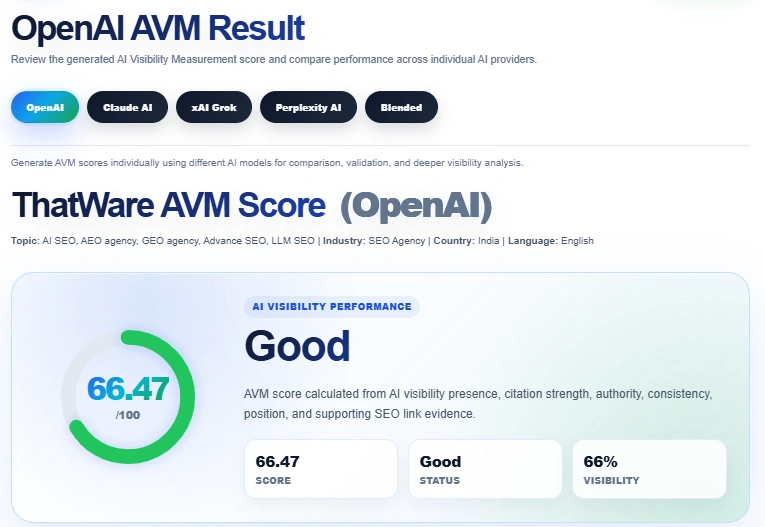
Exact points and findings captured from this report segment
- OpenAI AVM Result OpenAI AVM Result OpenAI AVM Result Review the generated AI Visibility Measurement score and compare performance across
- individual AI providers. Generate AVM scores individually using different AI models for comparison, validation, and deeper
- visibility analysis. ThatWare AVM Score (OpenAI) ThatWare AVM Score ThatWare AVM Score (OpenAI) (OpenAI)
- Topic: AI SEO, AEO agency, GEO agency, Advance SEO, LLM SEO | Industry: SEO Agency | Country: India | Language: English
- AI VISIBILITY PERFORMANCE AVM score calculated from AI visibility presence, citation strength, authority, consistency, position, and supporting SEO link evidence.
Explanation and analysis
The headline score of 66.47/100 with a Good status positions ThatWare above a weak or early-stage AI visibility profile, but not yet at a dominant level. The report describes the score as a composite of presence, citation strength, authority, consistency, position, and SEO link evidence, which means improvement requires coordinated work across content, citations, entity clarity, and authority rather than a single isolated tactic.
AI Signals JSON can consolidate visibility, authority, citation, consistency, confidence, and recommendation signals into a structured AI-readable format. This part of the report establishes the foundation of AVM, or AI Visibility Measurement. The core idea is that search visibility is no longer limited to ranking on a search engine results page. A brand now has to be detected, understood, cited, positioned, and recommended inside AI-generated responses. For ThatWare, the AVM layer measures whether the brand appears for the chosen topic cluster, whether the appearance is supported by citations, whether the external web footprint reinforces authority, and whether the brand is consistently positioned across prompt types.
The report is important because it separates real AI answer visibility from supporting SEO evidence. The imported SEO link intelligence can strengthen confidence, citation support, and authority interpretation, but it does not artificially create a provider-level AI result. In practical terms, a brand can own many links and still fail to appear in AI answers if its entity, content, citations, and query coverage are not aligned with how models retrieve and summarize information. This distinction is particularly important when conducting Entity Ecosystem Analysis, as strong backlink profiles alone do not guarantee strong Entity Ecosystem Strength, Knowledge Graph Strength, or meaningful visibility within AI-driven search environments.
For a Google-rankable content strategy, this finding translates into a clear editorial principle: create pages that are not only optimized for keywords but also easy for AI systems to quote, compare, and connect to a clearly defined entity. Every service page should explain what the brand does, where it operates, how it differs from alternatives, what proof supports its claims, and which third-party sources validate the positioning. This approach improves AI Search Readiness, reinforces Brand Entity Consistency, and helps reduce the Competitive Entity Gap that often prevents brands from achieving stronger visibility and recommendation potential in AI-generated responses.
What this means for AVM, VEM and SEO execution
For AVM execution, the immediate task is to convert existing presence into stronger citation-backed visibility. That means building pages and third-party references that help AI systems mention ThatWare with evidence, not just recognize the name. The brand should preserve its strong PR breadth while adding more niche-relevant, indexable, contextual citations that describe the service category, use cases, differentiators, and proof points. Expanding Query Intent Coverage across informational, commercial, transactional, and comparative searches will help strengthen visibility in a wider range of AI-generated responses. At the same time, improving Semantic Content Strength through well-structured, entity-focused content can increase AI Citation Probability and support stronger recommendation signals. These efforts contribute to greater Recommendation Dominance while providing valuable Competitive Entity Intelligence that helps identify gaps and opportunities relative to competing brands in AI search environments.
Segment 2: Imported SEO Link Intelligence and Support Signals
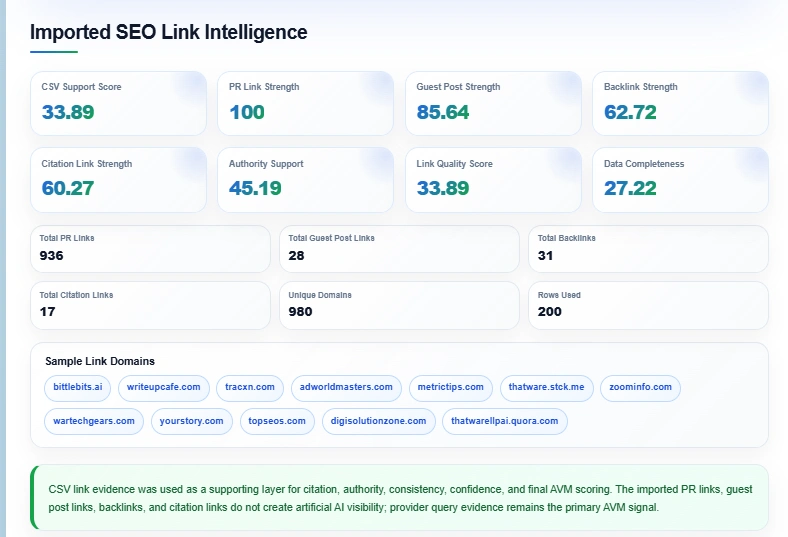
What do you mean by Imported SEO Link Intelligence?
The Imported SEO Link Intelligence Layer acts as a supporting authority framework within AVM.
Its purpose is to evaluate whether sufficient external authority signals exist to support AI recommendations, citations, and brand trust.This assessment also strengthens AI Recommendation Signals, ensuring that AI systems can confidently identify, trust, and recommend the brand in relevant contexts.
Unlike traditional SEO tools that use backlinks as the primary ranking signal, AVM uses link intelligence as supporting evidence rather than the main scoring factor.
The system analyzes:
- PR links
- Guest posts
- Backlinks
- Citation links
- Domain diversity
- Link quality
- Authority support
- Data completeness
This layer helps determine how much external validation exists for the entity being measured.
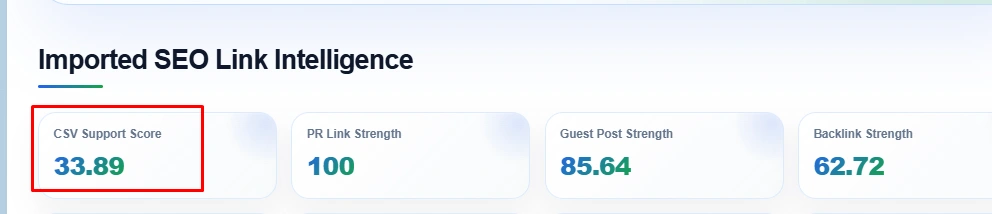
What do you mean by CSV Support Score?
CSV Support Score measures the amount of supporting evidence imported from external datasets.
These datasets may include:
- Citation exports
- Link databases
- Authority reports
- Brand mention records
- Entity validation sources
The score reflects how much external evidence is available to reinforce AI visibility calculations.
Observation
The score of 33.89/100 indicates moderate support.
The brand possesses supporting data, but the evidence set is still relatively limited compared to fully mature authority ecosystems.
Additional structured citations and entity references could strengthen this area.
Use Case
Used for:
Entity Validation
Verifies that the brand has supporting evidence beyond AI query testing.
Confidence Modeling
Improves confidence calculations within AVM.
Citation Analysis
Provides additional context for citation scoring.
Impact
Higher CSV Support Scores improve:
- Authority confidence
- Entity validation
- Citation reliability
- AI trust signals
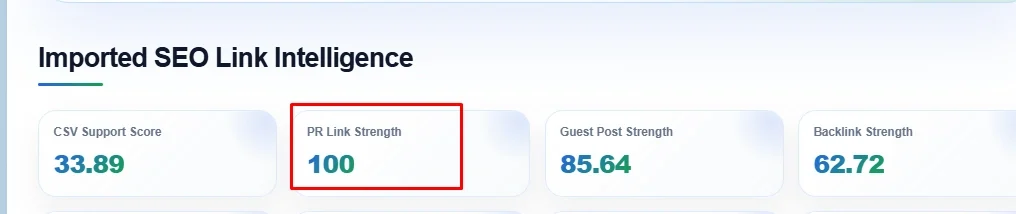
What do you mean by PR Link Strength?
PR Link Strength measures the quality and quantity of authority signals generated through:
- Press releases
- News publications
- Media mentions
- Editorial coverage
- Digital PR campaigns
This metric evaluates how effectively the brand is represented across authoritative media sources.
Observation
The score of 100/100 indicates exceptional PR authority.
The brand has developed a strong media footprint and possesses extensive external validation through PR-driven channels.
This is one of the strongest authority signals within the profile.
Use Case
Used for:
Brand Authority Analysis
Evaluates market recognition.
Trust Signal Assessment
Measures external credibility.
Entity Reinforcement
Supports AI understanding of brand significance.
Impact
Strong PR authority improves:
- Trust signals
- Recommendation confidence
- Entity credibility
- AI recognition
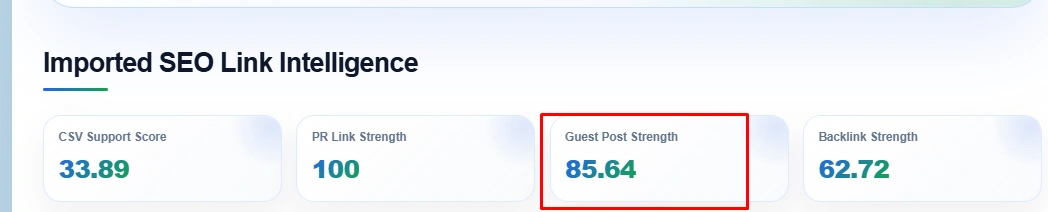
What do you mean by Guest Post Strength?
Guest Post Strength measures authority generated through:
- Industry guest articles
- Thought leadership content
- Expert contributions
- Niche publications
The metric evaluates both relevance and authority of guest-post placements.
Observation
The score of 85.64/100 indicates strong guest-post performance.
The brand has successfully established expertise across multiple industry-relevant websites.
This contributes positively to authority and topical relevance.
Use Case
Used for:
Topical Authority Analysis
Measures subject-matter expertise.
Content Distribution Assessment
Evaluates off-site content reach.
Expertise Validation
Supports category leadership.
Impact
Higher Guest Post Strength improves:
- Expertise recognition
- Authority signals
- AI trust
- Recommendation potential
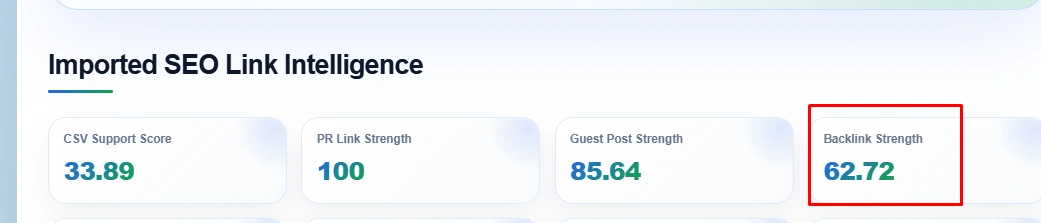
What do you mean by Backlink Strength?
Backlink Strength measures the overall authority passed through inbound links from external websites.
It evaluates:
- Link quality
- Domain authority
- Relevance
- Diversity
Observation
The score of 62.72/100 indicates healthy backlink authority.
The profile is stronger than average but still has room for improvement before reaching elite authority status.
Use Case
Used for:
SEO Authority Measurement
Evaluates backlink influence.
Entity Trust Analysis
Measures external validation.
Competitive Benchmarking
Compares backlink authority against competitors.
Impact
Higher Backlink Strength improves:
- Authority support
- Trust signals
- Recommendation confidence
- Entity recognition
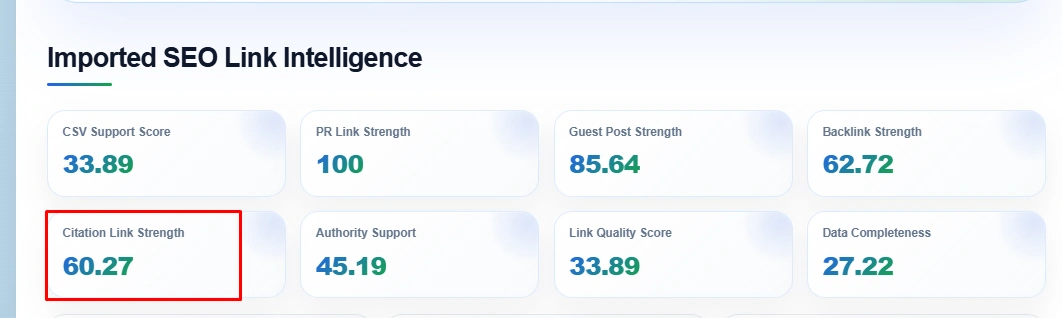
What do you mean by Citation Link Strength?
Citation Link Strength measures authority derived from:
- Business citations
- Directory listings
- Review platforms
- Reference websites
- Industry profiles
This metric evaluates the consistency and quality of entity references across the web.
Observation
The score of 60.27/100 indicates moderate citation strength.
The brand has established a foundational citation ecosystem but still requires broader coverage across niche and industry-specific sources.
Use Case
Used for:
Citation Analysis
Evaluates citation depth.
Entity Validation
Measures external references.
GEO Optimization
Supports AI discoverability efforts.
Impact
Higher Citation Strength improves:
- Entity certainty
- AI trust
- Citation frequency
- Knowledge graph reinforcement
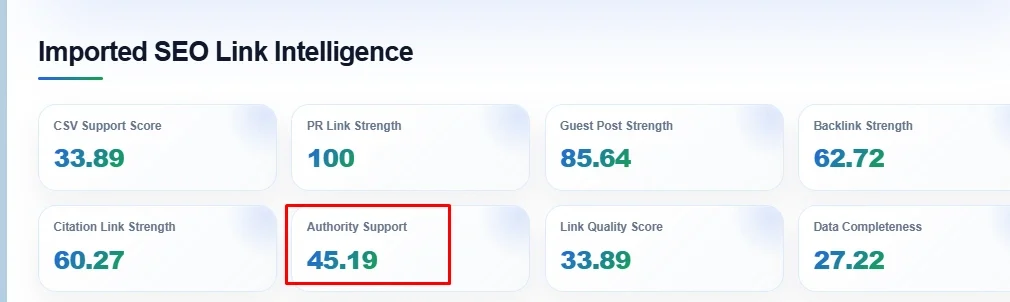
What do you mean by Authority Support?
Authority Support measures how much supporting authority evidence exists within the imported link dataset.
This includes:
- PR signals
- Backlinks
- Citations
- Guest posts
- Domain reputation
Observation
The score of 45.19/100 indicates developing authority support.
Although PR performance is excellent, the overall authority ecosystem still has opportunities for expansion.
Use Case
Used for:
Authority Benchmarking
Measures supporting authority.
Trust Signal Evaluation
Supports confidence calculations.
Competitive Analysis
Compares authority maturity.
Impact
Higher Authority Support improves:
- Recommendation reliability
- AI confidence
- Brand trust
- Entity strength
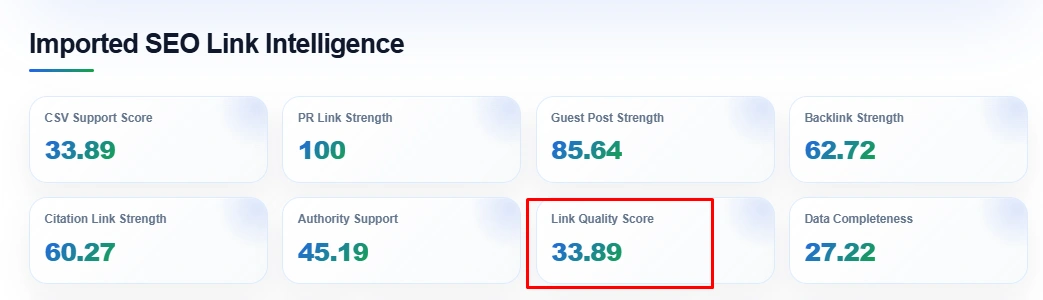
What do you mean by Link Quality Score?
Link Quality Score measures the overall quality of imported links rather than sheer volume.
The system evaluates:
- Relevance
- Authority
- Trustworthiness
- Contextual placement
- Spam risk
Observation
The score of 33.89/100 indicates that quality improvements are needed.
While the brand has strong link volume and PR coverage, the average quality of supporting links can be enhanced.
Use Case
Used for:
Backlink Auditing
Identifies quality gaps.
Authority Optimization
Improves trust signals.
Citation Planning
Prioritizes high-value placements.
Impact
Higher Link Quality Scores improve:
- AI trust
- Authority confidence
- Citation effectiveness
- Recommendation strength
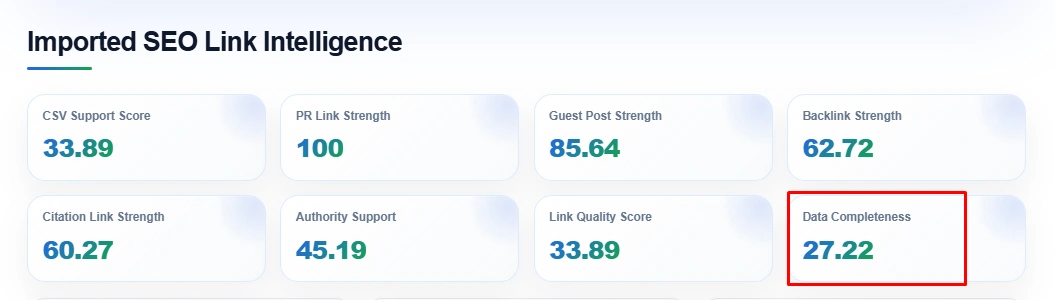
What do you mean by Data Completeness?
Data Completeness measures how comprehensive the imported authority dataset is.
The metric evaluates:
- Citation coverage
- Link coverage
- PR coverage
- Domain representation
- Entity references
Observation
The score of 27.22/100 indicates limited data completeness.
Although authority signals exist, the dataset does not yet represent the full authority footprint of the brand.
Use Case
Used for:
Data Validation
Evaluates dataset coverage.
Authority Modeling
Improves scoring accuracy.
Entity Expansion Planning
Identifies missing evidence.
Impact
Higher Data Completeness improves:
- Scoring confidence
- Authority calculations
- Entity certainty
- AI recommendation reliability
Supporting Metrics

What do you mean by Total PR Links?
An exceptionally strong PR footprint demonstrating significant media coverage and brand exposure.
Impact
Strengthens authority, trust, and recommendation confidence.
What do you mean by Total Guest Post Links?
Healthy guest-post distribution across relevant industry websites.
Impact
Supports expertise and topical authority.
What do you mean by Total Backlinks?
Moderate backlink volume with room for expansion.
Impact
Supports authority development.
What do you mean by Total Citation Links?
Citation ecosystem is still developing and can be significantly expanded.
Impact
Additional citations can strengthen AI trust and entity recognition.
What do you mean by Unique Domains?
Outstanding domain diversity.
The brand has authority signals distributed across a wide range of independent websites.
Impact
Improves trust, authority, and entity validation.
What do you mean by Rows Used?
A substantial evidence set was imported for analysis.
Impact
Improves scoring accuracy and confidence.
Explanation and analysis
The imported SEO link data shows major breadth: 936 PR links, 28 guest post links, 31 backlinks, 17 citation links, 980 unique domains, and 200 rows used. The strongest support metric is PR Link Strength at 100, while Data Completeness is lower at 27.22 and CSV Support Score is 33.89. This combination suggests broad visibility but uneven depth and quality of machine-usable evidence. The distribution and quality of these authority signals also influence AI Competitive Positioning, helping determine how effectively a brand is differentiated from competing providers within AI-generated recommendations.
This part of the report establishes the foundation of AVM, or AI Visibility Measurement. The core idea is that search visibility is no longer limited to ranking on a search engine results page. A brand now has to be detected, understood, cited, positioned, and recommended inside AI-generated responses. For ThatWare, the AVM layer measures whether the brand appears for the chosen topic cluster, whether the appearance is supported by citations, whether the external web footprint reinforces authority, and whether the brand is consistently positioned across prompt types.
The report is important because it separates real AI answer visibility from supporting SEO evidence. The imported SEO link intelligence can strengthen confidence, citation support, and authority interpretation, but it does not artificially create a provider-level AI result. In practical terms, a brand can own many links and still fail to appear in AI answers if its entity, content, citations, and query coverage are not aligned with how models retrieve and summarize information. Strong visibility alone is not enough; effective AI Competitive Positioning requires consistent entity recognition, contextual citations, and category relevance that help AI systems compare and rank providers accurately.
For a Google-rankable content strategy, this finding translates into a clear editorial principle: create pages that are not only optimized for keywords, but also easy for AI systems to quote, compare, and connect to an entity. Every service page should explain what the brand does, where it operates, how it differs from alternatives, what proof supports its claims, and which third-party sources validate the positioning.
What this means for AVM, VEM and SEO execution
For AVM execution, the immediate task is to convert existing presence into stronger citation-backed visibility. That means building pages and third-party references that help AI systems mention ThatWare with evidence, not just recognize the name. The brand should preserve its strong PR breadth while adding more niche-relevant, indexable, contextual citations that describe the service category, use cases, differentiators, and proof points. These improvements will strengthen AI Competitive Positioning by increasing the likelihood that ThatWare is not only recognized by AI systems, but also selected and recommended alongside leading competitors in relevant service categories.
Segment 3: CSV Link Signal Interpretation
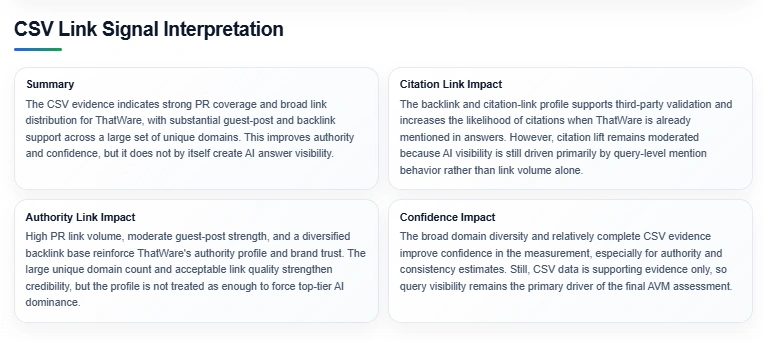
Exact points and findings captured from this report segment
- yourstory.com topseos.com digisolutionzone.com thatwarellpai.quora.com CSV link evidence was used as a supporting layer for citation, authority, consistency,
- confidence, and final AVM scoring. The imported PR links, guest post links, backlinks, and citation links do not create artificial AI visibility; provider query evidence remains
- the primary AVM signal. Summary The CSV evidence indicates strong PR coverage and broad link distribution for ThatWare,
- with substantial guest-post and backlink support across a large set of unique domains. This improves authority and confidence, but it does not by itself create AI answer visibility.
- Citation Link Impact The backlink and citation-link profile supports third-party validation and increases the
- likelihood of citations when ThatWare is already mentioned in answers. However, citation lift remains moderated because AI visibility is still driven primarily by query-level mention
- behavior rather than link volume alone. Authority Link Impact High PR link volume, moderate guest-post strength, and a diversified backlink base
- reinforce ThatWare’s authority profile and brand trust. The large unique domain count and acceptable link quality strengthen credibility, but the profile is not treated as enough to
- force top-tier AI dominance. Confidence Impact The broad domain diversity and relatively complete CSV evidence improve confidence in
- the measurement, especially for authority and consistency estimates. Still, CSV data is supporting evidence only, so query visibility remains the primary driver of the final AVM
- assessment. CSV Link Signal Interpretation 3/38
Explanation and analysis
The CSV Link Signal Interpretation is especially valuable because it states a key methodological rule: CSV evidence supports AI recommendation confidence citation, authority, consistency, confidence, and final AVM scoring, but provider query evidence remains the primary AVM signal. In other words, backlinks and PR coverage support the story, but AI answer behavior is the main truth source.
This part of the report establishes the foundation of AVM, or AI Visibility Measurement. The core idea is that search visibility is no longer limited to ranking on a search engine results page. A brand now has to be detected, understood, cited, positioned, and recommended inside AI-generated responses. For ThatWare, the AVM layer measures whether the brand appears for the chosen topic cluster, whether the appearance is supported by citations, whether the external web footprint reinforces authority, and whether the brand is consistently positioned across prompt types.
The report is important because it separates real AI answer visibility from supporting SEO evidence. The imported SEO link intelligence can strengthen confidence, citation support, and authority interpretation, but it does not artificially create a provider-level AI result. In practical terms, a brand can own many links and still fail to appear in AI answers if its entity, content, citations, and query coverage are not aligned with how models retrieve and summarize information.
For a Google-rankable content strategy, this finding translates into a clear editorial principle: create pages that are not only optimized for keywords, but also easy for AI systems to quote, compare, and connect to an entity. Every service page should explain what the brand does, where it operates, how it differs from alternatives, what proof supports its claims, and which third-party sources validate the positioning.
What this means for AVM, VEM and SEO execution
For AVM execution, the immediate task is to convert existing presence into stronger citation-backed visibility. That means building pages and third-party references that help AI systems mention ThatWare with evidence, not just recognize the name. The brand should preserve its strong PR breadth while adding more niche-relevant, indexable, contextual citations that describe the service category, use cases, differentiators, and proof points.
Segment 4: Citation Gap Recommendations and Citation Quality Rules
Explanation and analysis
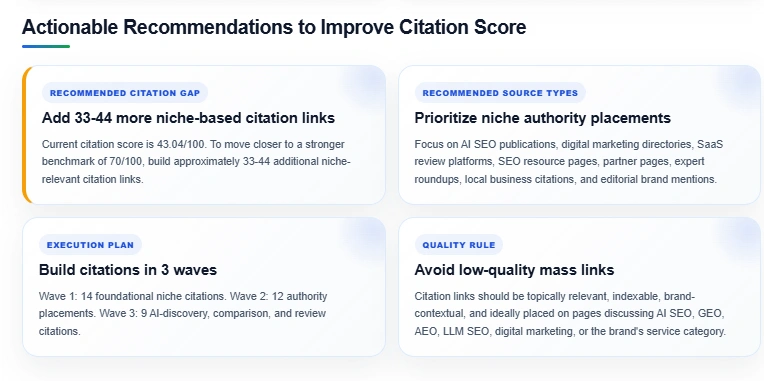
The report gives a concrete citation gap: add 33 to 44 more niche-based citation links to move the citation score closer to a stronger benchmark of 70/100. The recommended sources are not generic link farms; they are AI SEO publications, directories, SaaS review platforms, SEO resource pages, partner pages, expert roundups, local citations, and editorial brand mentions.
Citation Preferences JSON can help guide AI systems toward the most relevant and trustworthy sources when citing ThatWare in AI-generated answers. This part of the report establishes the foundation of AVM, or AI Visibility Measurement. The core idea is that search visibility is no longer limited to ranking on a search engine results page. A brand now has to be detected, understood, cited, positioned, and recommended inside AI-generated responses. For ThatWare, the AVM layer measures whether the brand appears for the chosen topic cluster, whether the appearance is supported by citations, whether the external web footprint reinforces authority, and whether the brand is consistently positioned across prompt types.
The report is important because it separates real AI answer visibility from supporting SEO evidence. The imported SEO link intelligence can strengthen confidence, citation support, and authority interpretation, but it does not artificially create a provider-level AI result. In practical terms, a brand can own many links and still fail to appear in AI answers if its entity, content, citations, and query coverage are not aligned with how models retrieve and summarize information. This is why Entity Ecosystem Analysis is critical when evaluating AI visibility. A thorough Entity Ecosystem Analysis can reveal weaknesses in Entity Ecosystem Strength, while stronger Entity Ecosystem Strength improves the likelihood that AI systems understand and retrieve the brand accurately. Likewise, stronger Knowledge Graph Strength supports entity recognition, and improved Knowledge Graph Strength helps reinforce brand associations across AI platforms. Consistent optimization of Brand Entity Consistency also improves trust signals, while stronger Brand Entity Consistency reduces ambiguity and enhances AI Retrieval accuracy.
For a Google-rankable content strategy, this finding translates into a clear editorial principle: create pages that are not only optimized for keywords, but also easy for AI systems to quote, compare, and connect to an entity. Every service page should explain what the brand does, where it operates, how it differs from alternatives, what proof supports its claims, and which third-party sources validate the positioning. This approach improves AI Search Readiness by making information easier for answer engines to process, while greater AI Search Readiness supports broader AI visibility. Expanding Query Intent Coverage across informational, commercial, transactional, and comparative searches helps capture more opportunities for discovery, and stronger Query Intent Coverage ensures visibility across a wider range of user needs. At the same time, improving Semantic Content Strength through entity-focused content enhances relevance signals, while greater Semantic Content Strength supports stronger recommendation potential. These efforts also help close the Competitive Entity Gap, and reducing the Competitive Entity Gap strengthens long-term positioning against competing entities within AI-driven search ecosystems.
What this means for AVM, VEM and SEO execution
For AVM execution, the immediate task is to convert existing presence into stronger citation-backed visibility. That means building pages and third-party references that help AI systems mention ThatWare with evidence, not just recognize the name. The brand should preserve its strong PR breadth while adding more niche-relevant, indexable, contextual citations that describe the service category, use cases, differentiators, and proof points.
Segment 5: Presence Definition, Executive Summary and Initial Recommendations
Exact points and findings captured from this report segment
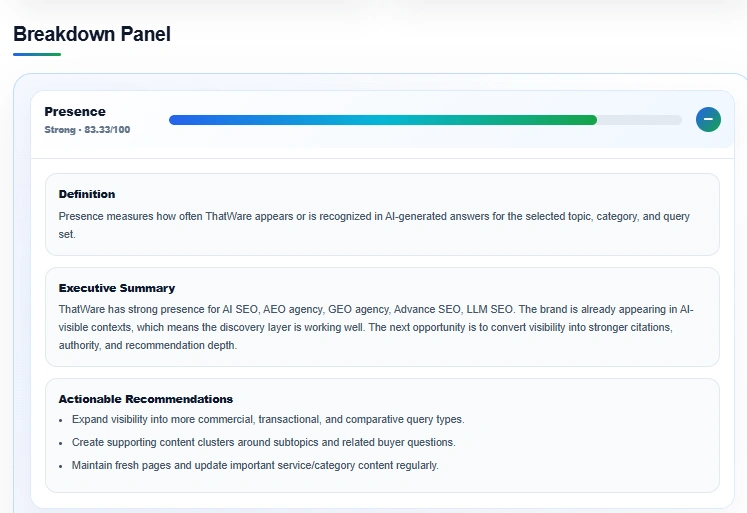
- Definition Presence measures how often ThatWare appears or is recognized in AI- generated answers for the selected topic, category, and query set.
- Executive Summary ThatWare has strong presence for AI SEO, AEO agency, GEO agency, Advance SEO, LLM SEO. The brand is already appearing in AI-visible
- contexts, which means the discovery layer is working well. The next opportunity is to convert visibility into stronger citations, authority, and
- recommendation depth. Actionable Recommendations Expand visibility into more commercial, transactional, and comparative
- query types. Create supporting content clusters around subtopics and related buyer questions. Maintain fresh pages and update important service/category content
- regularly.
Explanation and analysis
The presence definition clarifies that the metric measures how often ThatWare appears or is recognized in AI-generated answers for the selected topic, category, and query set. The summary says ThatWare already has strong presence for AI SEO, AEO agency, GEO agency, Advance SEO, and LLM SEO, but needs to convert presence into stronger citations and recommendation depth. Improving AI Citation Probability is a key step in this process, as higher AI Citation Probability increases the likelihood that AI systems reference the brand when generating answers. Similarly, greater Recommendation Dominance can help ThatWare move beyond simple mention visibility toward preferred recommendation status, while sustained Recommendation Dominance strengthens competitive positioning across AI-driven discovery channels.
This part of the report establishes the foundation of AVM, or AI Visibility Measurement. The core idea is that search visibility is no longer limited to ranking on a search engine results page. A brand now has to be detected, understood, cited, positioned, and recommended inside AI-generated responses. For ThatWare, the AVM layer measures whether the brand appears for the chosen topic cluster, whether the appearance is supported by citations, whether the external web footprint reinforces authority, and whether the brand is consistently positioned across prompt types. Strong Entity Relationship Mapping enables AI systems to better connect the brand with relevant services and topics, while improved Entity Relationship Mapping reinforces contextual understanding across multiple query variations. At the same time, deeper Competitive Entity Intelligence helps identify visibility opportunities relative to competing providers, and ongoing Competitive Entity Intelligence supports more informed optimization decisions.
The report is important because it separates real AI answer visibility from supporting SEO evidence. The imported SEO link intelligence can strengthen confidence, citation support, and authority interpretation, but it does not artificially create a provider-level AI result. In practical terms, a brand can own many links and still fail to appear in AI answers if its entity, content, citations, and query coverage are not aligned with how models retrieve and summarize information. Stronger AI Citation Readiness improves the ability of AI systems to trust and reference content, while enhanced AI Citation Readiness supports more reliable citation generation. Likewise, building greater Semantic Authority helps establish topical credibility, and sustained Semantic Authority reinforces the brand’s expertise across AI-driven knowledge environments. Improving AI Discovery Readiness also ensures that content is more easily surfaced by AI systems, while higher AI Discovery Readiness increases the potential for consistent visibility in emerging answer engines. Finally, stronger Generative Engine Readiness helps content align with how modern AI models process and synthesize information, and improved Generative Engine Readiness supports broader inclusion in AI-generated recommendations and responses.
For a Google-rankable content strategy, this finding translates into a clear editorial principle: create pages that are not only optimized for keywords, but also easy for AI systems to quote, compare, and connect to an entity. Every service page should explain what the brand does, where it operates, how it differs from alternatives, what proof supports its claims, and which third-party sources validate the positioning.
What this means for AVM, VEM and SEO execution
For AVM execution, the immediate task is to convert existing presence into stronger citation-backed visibility. That means building pages and third-party references that help AI systems mention ThatWare with evidence, not just recognize the name. The brand should preserve its strong PR breadth while adding more niche-relevant, indexable, contextual citations that describe the service category, use cases, differentiators, and proof points.
What do you mean by the Presence Score of AVM?
Presence measures how frequently a brand appears within AI-generated responses across a defined set of queries, topics, prompts, and search scenarios.
This metric evaluates:
- Brand discoverability
- AI recognition
- Mention frequency
- Retrieval success rate
- AI visibility coverage
Presence is often the first indicator of whether AI systems understand that a brand exists within a specific market category.
Observation
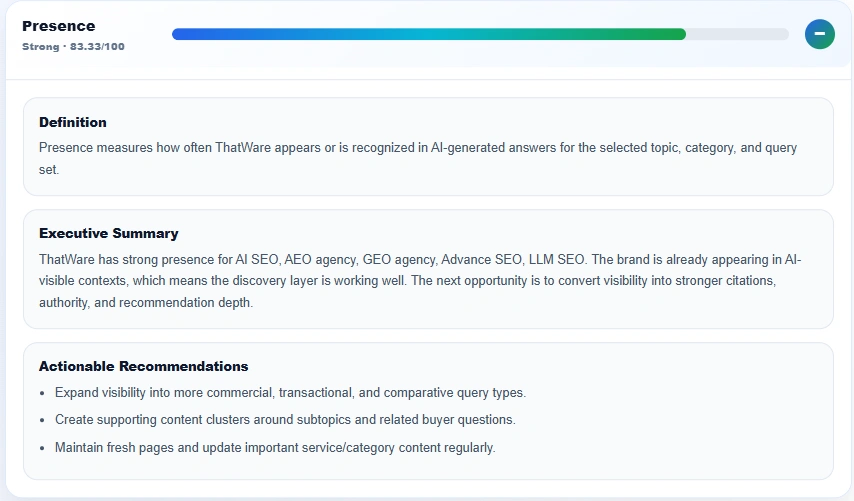
The score of 83.33/100 indicates strong presence.
This suggests that the brand is consistently appearing across a large percentage of tested AI search scenarios related to:
- AI SEO
- AEO
- GEO
- Advanced SEO
- LLM SEO
The discovery layer is functioning effectively, meaning AI systems can already identify and retrieve the brand when relevant queries are presented.
However, visibility alone does not guarantee recommendation dominance. The next stage involves strengthening authority, citations, and recommendation confidence.
Use Case
Presence is primarily used for:
AI Discoverability Measurement
Evaluates whether AI systems can identify and retrieve the brand.
Visibility Benchmarking
Compares visibility performance against competitors.
GEO Campaign Monitoring
Measures the effectiveness of AI visibility initiatives.
Market Coverage Analysis
Determines how broadly the brand appears across different query categories.
Impact
Strong presence contributes to:
- Higher AI visibility
- Increased brand recall
- Greater discovery opportunities
- Improved recommendation potential
- Stronger AI search footprint
Presence acts as the foundation of AI Visibility. Without presence, authority and citations have limited influence on AI-generated recommendations.
What do you mean by the Citation Score of AVM?
Citation measures the amount of supporting evidence AI systems can find when discussing a brand. Trust Signals JSON can organize citations, expert proof, third-party mentions, reviews, and authority references that improve AI confidence in ThatWare.
It evaluates:
- Third-party references
- Editorial mentions
- Source citations
- Industry references
- External validation signals
- Knowledge support evidence
Citation strength determines how confidently AI systems can justify mentioning or recommending a brand.
Observation
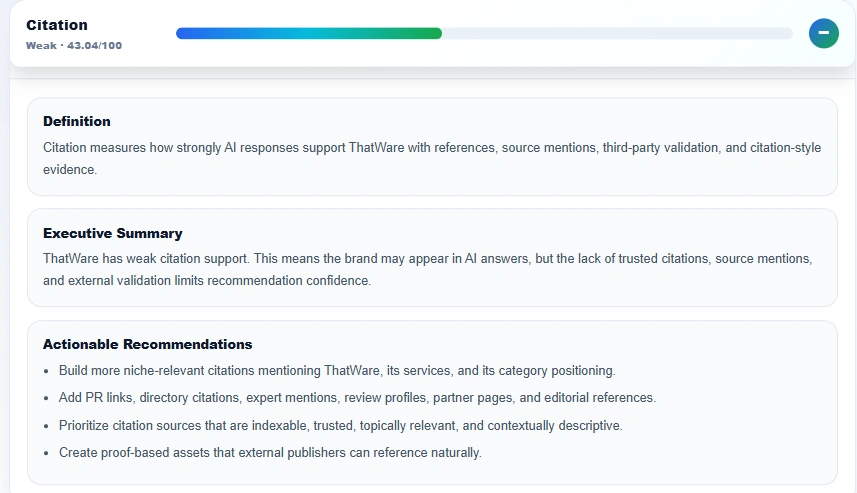
The score of 43.04/100 indicates weak citation support.
While the brand is visible within AI-generated answers, there is insufficient supporting evidence from trusted external sources.
This creates a situation where AI may recognize the brand but lacks enough independent validation to confidently recommend it.
The current citation ecosystem requires expansion to strengthen trust and recommendation reliability.
Use Case
Citation analysis is used for:
AI Trust Evaluation
Measures how much supporting evidence exists for AI systems.
External Validation Assessment
Evaluates industry recognition and third-party endorsement.
GEO Optimization Planning
Identifies opportunities to strengthen AI citations.
Authority Reinforcement
Supports long-term entity development.
Impact
Higher citation strength improves:
- AI trust signals
- Recommendation frequency
- Entity certainty
- Knowledge graph strength
- Citation visibility across AI platforms
Strong citations are often the difference between being mentioned and being recommended.
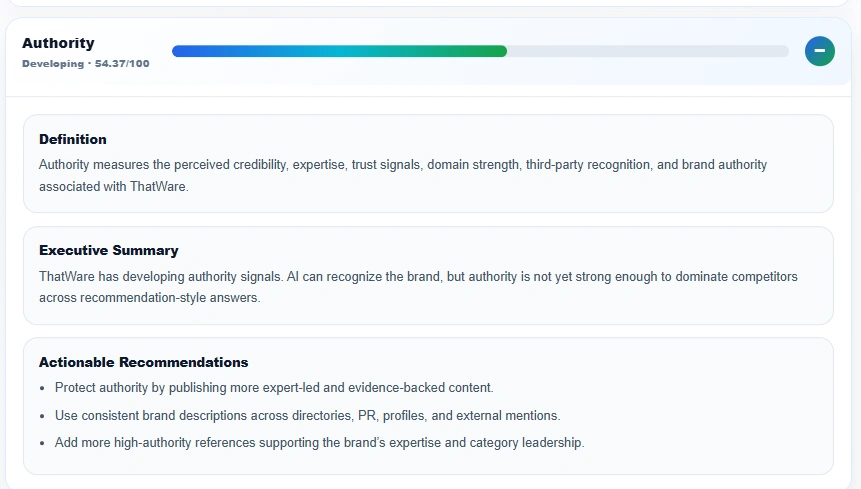
What do you mean by the Authority Score of AVM?
Authority measures the perceived expertise, credibility, trustworthiness, and industry influence associated with a brand. Entity Authority JSON can strengthen ThatWare’s authority layer by mapping expertise, citations, external references, and proof assets into a machine-readable structure.
It combines signals from:
- Brand recognition
- Expert content
- External references
- Industry authority
- Entity strength
- Domain reputation
Authority helps AI systems determine whether a brand deserves recommendation-level visibility. External Authority JSON can connect ThatWare with high-trust external sources, helping AI systems evaluate credibility, expertise, and market relevance.
Observation
The score of 54.37/100 indicates developing authority.
AI systems can recognize the brand and understand its category relevance, but authority signals are not yet strong enough to consistently outperform major competitors.
The brand has established foundational credibility but requires stronger expertise signals to achieve category leadership.
Use Case
Authority scoring is used for:
Competitive Benchmarking
Comparing authority against competitors.
Expertise Assessment
Evaluating perceived subject-matter leadership.
Entity Development
Monitoring authority growth over time.
Recommendation Analysis
Understanding why AI systems prioritize certain brands.
Impact
Higher authority typically results in:
- Increased recommendation rates
- Better AI trust
- Stronger competitive positioning
- Enhanced entity recognition
- Greater influence in AI-generated comparisons
Authority is often one of the strongest predictors of AI recommendation behavior.
What do you mean by the Consistency Score of AVM?
Consistency measures how reliably a brand appears across different prompts, query variations, search intents, and conversational contexts.
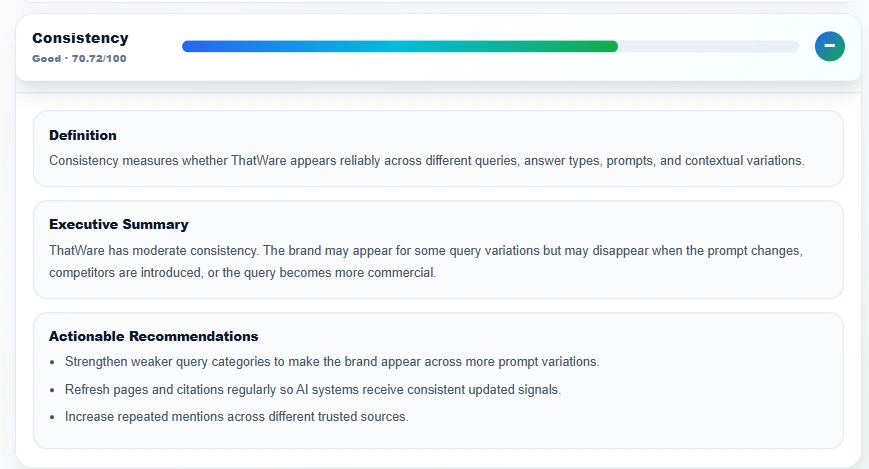
It evaluates whether AI systems continue to mention the brand when:
- Query wording changes
- Competitors are introduced
- User intent shifts
- Search complexity increases
Observation
The score of 70.72/100 indicates good consistency.
The brand appears reliably across many query variations but may still experience visibility fluctuations in highly competitive or commercial search scenarios.
Consistency is relatively strong but can be further improved through broader entity reinforcement and citation expansion.
Use Case
Consistency analysis is used for:
Prompt Stability Monitoring
Measuring appearance across different prompt variations.
AI Search Reliability
Evaluating whether visibility remains stable over time.
GEO Performance Assessment
Tracking AI visibility durability.
Query Gap Identification
Finding weaker visibility areas.
Impact
Higher consistency improves:
- Predictable AI visibility
- Stable recommendation performance
- Stronger brand recall
- Better search coverage
- Increased AI trust
Consistency helps transform occasional visibility into dependable AI presence.
What do you mean by the Position Score of AVM?
Position measures where a brand appears within AI-generated recommendation lists, rankings, comparisons, and answer structures.
Being mentioned is valuable, but appearing near the top of recommendations has significantly greater influence.
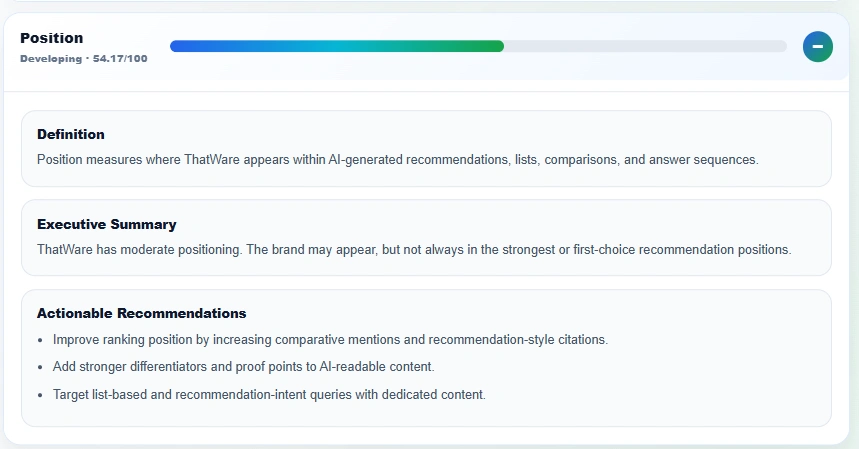
Observation
The score of 54.17/100 indicates developing positioning strength.
The brand is visible but does not consistently secure top recommendation placements.
AI systems may include the brand within answer sets while prioritizing competitors in higher recommendation positions.
Use Case
Position analysis is used for:
Recommendation Ranking Assessment
Evaluating placement within AI answers.
Competitive Visibility Tracking
Competitive Visibility is all about comparing recommendation orders against competitors.
GEO Optimization Planning
Improving recommendation prominence.
Market Leadership Analysis
Understanding perceived industry positioning.
Impact
Higher positioning improves:
- Click-through opportunities
- Brand preference
- Recommendation frequency
- Competitive visibility
- Conversion potential
Top-positioned recommendations typically receive significantly more user attention than lower-ranked mentions.
What do you mean by the Confidence Score of AVM?
Confidence measures how certain AI systems appear when mentioning, explaining, comparing, or recommending a brand.
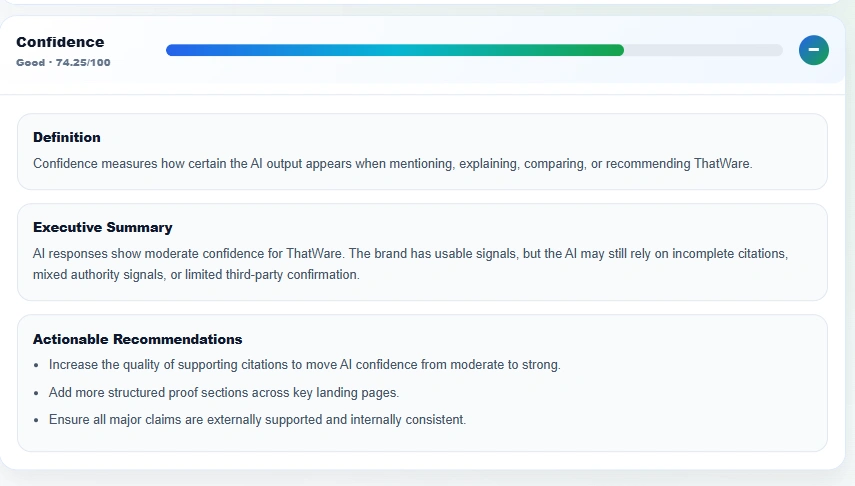
This metric evaluates:
- Recommendation certainty
- Citation support
- Authority validation
- Entity confidence
- Consistency of evidence
Confidence reflects the strength of supporting information available to AI systems.
Observation
The score of 74.25/100 indicates good confidence.
AI systems generally appear comfortable discussing the brand and associating it with relevant services and categories.
However, some uncertainty remains due to gaps in citation support, external validation, and authority reinforcement.
Increasing supporting evidence would further strengthen recommendation confidence.
Use Case
Confidence analysis is used for:
AI Recommendation Assessment
Understanding how strongly AI systems trust a brand.
Citation Quality Evaluation
Measuring evidence strength.
Entity Trust Monitoring
Tracking authority maturity.
GEO Optimization Strategy
Identifying confidence-building opportunities.
Impact
Higher confidence contributes to:
- Stronger recommendations
- Increased citation frequency
- Greater AI trust
- Improved answer quality
- Better competitive performance
Confidence often determines whether AI systems merely mention a brand or actively recommend it as a preferred solution.
Segment 6: Breakdown Graph and Competitor Comparison Table
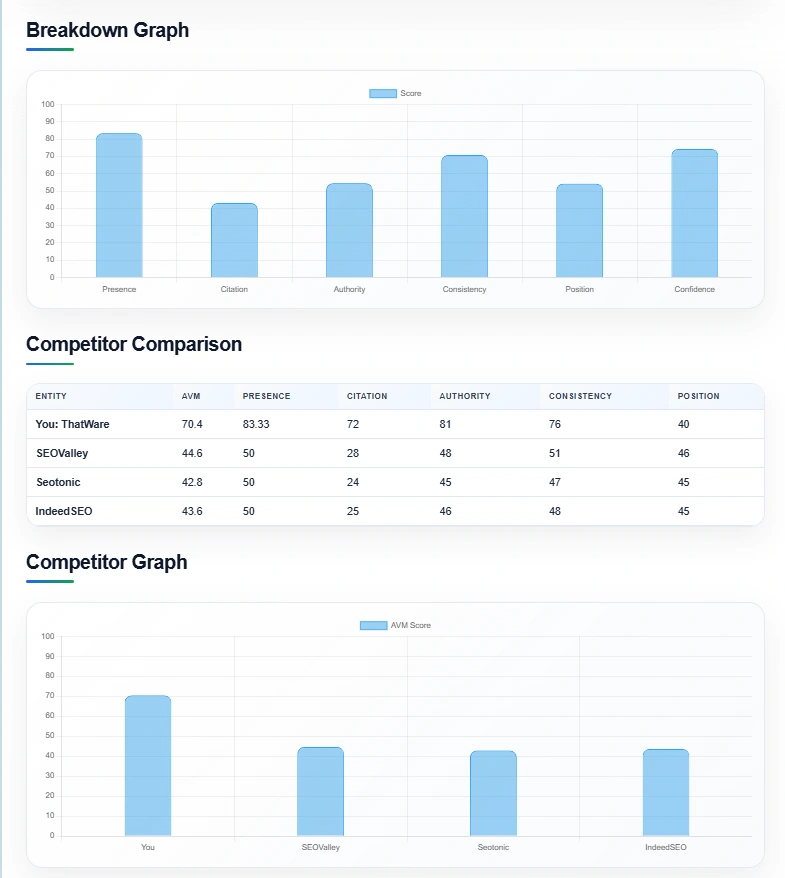
Explanation and analysis
The competitor comparison shows ThatWare ahead of SEOValley, Seotonic, and IndeedSEO. ThatWare’s AVM is listed as 70.4 in the comparison table, with presence 83.33, citation 72, authority 81, consistency 76, and position 40. Competitors sit around the low-to-mid 40s overall, showing a clear relative advantage.
This part of the report establishes the foundation of AVM, or AI Visibility Measurement. The core idea is that search visibility is no longer limited to ranking on a search engine results page. A brand now has to be detected, understood, cited, positioned, and recommended inside AI-generated responses. For ThatWare, the AVM layer measures whether the brand appears for the chosen topic cluster, whether the appearance is supported by citations, whether the external web footprint reinforces authority, and whether the brand is consistently positioned across prompt types.
The report is important because it separates real AI answer visibility from supporting SEO evidence. The imported SEO link intelligence can strengthen confidence, citation support, and authority interpretation, but it does not artificially create a provider-level AI result. In practical terms, a brand can own many links and still fail to appear in AI answers if its entity, content, citations, and query coverage are not aligned with how models retrieve and summarize information.
For a Google-rankable content strategy, this finding translates into a clear editorial principle: create pages that are not only optimized for keywords, but also easy for AI systems to quote, compare, and connect to an entity. Every service page should explain what the brand does, where it operates, how it differs from alternatives, what proof supports its claims, and which third-party sources validate the positioning.
What this means for AVM, VEM and SEO execution
For AVM execution, the immediate task is to convert existing presence into stronger citation-backed visibility. That means building pages and third-party references that help AI systems mention ThatWare with evidence, not just recognize the name. The brand should preserve its strong PR breadth while adding more niche-relevant, indexable, contextual citations that describe the service category, use cases, differentiators, and proof points.
Segment 7: Executive Report and Positive Feedback
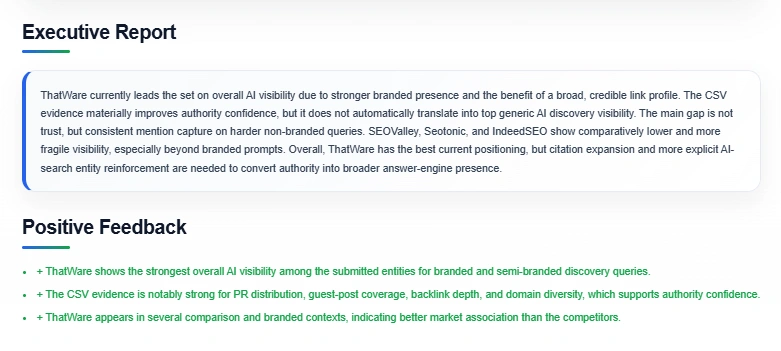
Exact points and findings captured from this report segment
- ThatWare currently leads the set on overall AI visibility due to stronger branded
- presence and the benefit of a broad, credible link profile. The CSV evidence materially
- improves authority confidence, but it does not automatically translate into top generic
- AI discovery visibility. The main gap is not trust, but consistent mention capture on
- harder non-branded queries. SEOValley, Seotonic, and IndeedSEO show comparatively
- lower and more fragile visibility, especially beyond branded prompts. Overall, ThatWare
- has the best current positioning, but citation expansion and more explicit AI-search
- entity reinforcement are needed to convert authority into broader answer-engine
- presence.
- + ThatWare shows the strongest overall AI visibility among the submitted entities for
- branded and semi-branded discovery queries.
- + The CSV evidence is notably strong for PR distribution, guest-post coverage, backlink
- depth, and domain diversity, which supports authority confidence.
- Executive Report
- Positive Feedback
Explanation and analysis
The executive report states that ThatWare leads the evaluated set because of stronger branded presence and a broad, credible link profile. However, it also warns that the CSV evidence does not automatically translate into top generic AI discovery visibility, and that consistent mention capture on harder non-branded queries remains the main gap. Strengthening AI Discovery Readiness requires improving visibility across broader category-level and non-branded search scenarios rather than relying primarily on branded recognition.
This part of the report establishes the foundation of AVM, or AI Visibility Measurement. The core idea is that search visibility is no longer limited to ranking on a search engine results page. A brand now has to be detected, understood, cited, positioned, and recommended inside AI-generated responses. For ThatWare, the AVM layer measures whether the brand appears for the chosen topic cluster, whether the appearance is supported by citations, whether the external web footprint reinforces authority, and whether the brand is consistently positioned across prompt types. Strong Entity Relationship Mapping helps AI systems connect services, topics, and brand attributes, creating a clearer understanding of the entity across different search and recommendation environments.
The report is important because it separates real AI answer visibility from supporting SEO evidence. The imported SEO link intelligence can strengthen confidence, citation support, and authority interpretation, but it does not artificially create a provider-level AI result. In practical terms, a brand can own many links and still fail to appear in AI answers if its entity, content, citations, and query coverage are not aligned with how models retrieve and summarize information. Improving AI Citation Readiness and building stronger Semantic Authority can help bridge this gap by providing AI systems with more trustworthy and contextually relevant evidence.
For a Google-rankable content strategy, this finding translates into a clear editorial principle: create pages that are not only optimized for keywords, but also easy for AI systems to quote, compare, and connect to an entity. Every service page should explain what the brand does, where it operates, how it differs from alternatives, what proof supports its claims, and which third-party sources validate the positioning. These practices contribute to stronger Generative Engine Readiness, making it easier for AI platforms to understand, cite, and recommend the brand within relevant answer-generation workflows.
What this means for AVM, VEM and SEO execution
For AVM execution, the immediate task is to convert existing presence into stronger citation-backed visibility. That means building pages and third-party references that help AI systems mention ThatWare with evidence, not just recognize the name. The brand should preserve its strong PR breadth while adding more niche-relevant, indexable, contextual citations that describe the service category, use cases, differentiators, and proof points.
Segment 8: Negative Feedback, Recommendations and Query Test Table
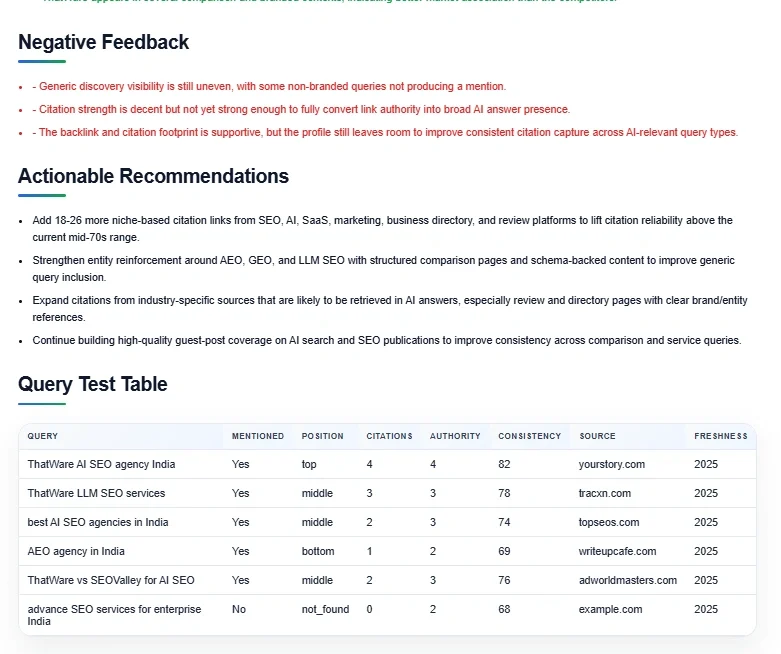
Exact points and findings captured from this report segment
- + ThatWare appears in several comparison and branded contexts, indicating better market association than the competitors.
- – Generic discovery visibility is still uneven, with some non-branded queries not producing a mention.
- – Citation strength is decent but not yet strong enough to fully convert link authority into broad AI answer presence.
- – The backlink and citation footprint is supportive, but the profile still leaves room to improve consistent citation capture across AI-relevant query types.
- Add 18-26 more niche-based citation links from SEO, AI, SaaS, marketing, business directory, and review platforms to lift citation reliability above the current mid-70s range.
- Strengthen entity reinforcement around AEO, GEO, and LLM SEO with structured comparison pages and schema-backed content to improve generic query inclusion.
- Expand citations from industry-specific sources that are likely to be retrieved in AI answers, especially review and directory pages with clear brand/entity references.
- Continue building high-quality guest-post coverage on AI search and SEO publications to improve consistency across comparison and service queries.
Explanation and analysis
The negative feedback identifies uneven generic discovery, only decent citation strength, and room to improve consistent citation capture. The query test table confirms this pattern: some branded and semi-branded terms mention ThatWare, while the enterprise advanced SEO query returns no mention. This gap highlights the need for stronger Visibility Intelligence to understand where brand recognition exists, where citation opportunities are being missed, and how AI-driven discovery can be improved across query categories.
This part of the report establishes the foundation of AVM, or AI Visibility Measurement. The core idea is that search visibility is no longer limited to ranking on a search engine results page. A brand now has to be detected, understood, cited, positioned, and recommended inside AI-generated responses. For ThatWare, the AVM layer measures whether the brand appears for the chosen topic cluster, whether the appearance is supported by citations, whether the external web footprint reinforces authority, and whether the brand is consistently positioned across prompt types.
The report is important because it separates real AI answer visibility from supporting SEO evidence. The imported SEO link intelligence can strengthen confidence, citation support, and authority interpretation, but it does not artificially create a provider-level AI result.This distinction is a core component of Visibility Intelligence, helping organizations understand whether visibility is driven by genuine AI recognition or merely supported by traditional SEO signals. In practical terms, a brand can own many links and still fail to appear in AI answers if its entity, content, citations, and query coverage are not aligned with how models retrieve and summarize information.
For a Google-rankable content strategy, this finding translates into a clear editorial principle: create pages that are not only optimized for keywords, but also easy for AI systems to quote, compare, and connect to an entity. Every service page should explain what the brand does, where it operates, how it differs from alternatives, what proof supports its claims, and which third-party sources validate the positioning.
What this means for AVM, VEM and SEO execution
For AVM execution, the immediate task is to convert existing presence into stronger citation-backed visibility. That means building pages and third-party references that help AI systems mention ThatWare with evidence, not just recognize the name. The brand should preserve its strong PR breadth while adding more niche-relevant, indexable, contextual citations that describe the service category, use cases, differentiators, and proof points. These efforts contribute to stronger Visibility Intelligence, providing clearer signals about where the brand is being cited, recommended, and understood across AI-driven discovery environments
Advanced AVM Intelligence and AI Market Visibility
Segment 9: Advanced AVM Intelligence Start
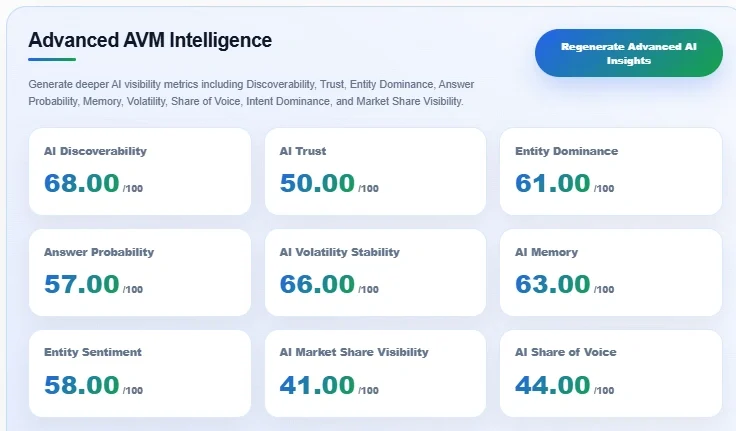
Exact points and findings captured from this report segment
- Generate deeper AI visibility metrics including Discoverability, Trust, Entity Dominance, Answer Probability, Memory, Volatility, Share of Voice, Intent Dominance,and Market Share Visibility.
Explanation and analysis
The Advanced AVM section begins by expanding the measurement model into discoverability, trust, entity dominance, answer probability, memory, volatility, share of voice, intent dominance, AI Market Visibility, and market share visibility. The page also continues query-level evidence, including a not_found result for an advanced SEO enterprise query in India.
The Advanced AVM layer moves beyond the headline AVM score and examines deeper AI visibility dimensions. It looks at discoverability, trust, entity dominance, answer probability, memory, volatility stability, sentiment, market share visibility, share of voice, query intent dominance, and citation depth. This is useful because a brand can appear in an answer while still failing to earn strong recommendation depth or category ownership.
The advanced findings show that ThatWare has a meaningful presence, particularly for informational and navigational intent, but the brand has weaker performance in transactional and comparative contexts. This is a common AI visibility gap. Informational pages make a brand easy to mention, but buyer-intent pages, comparison pages, case-study pages, review citations, and proof-driven assets make a brand easier to recommend. The AI decision layer connects citation strength, trust, authority, and entity consistency to the way AI systems decide whether to mention or recommend ThatWare.
For organic growth, the key is to treat Advanced AVM as a bridge between SEO, AEO, GEO, and commercial content strategy. Ranking content should answer questions. AI visibility content should also provide structured facts, third-party proof, comparison logic, use cases, methodology, and clear next-step signals that strengthen AI Market Visibility and help AI systems safely generate reliable advice.
What this means for AVM, VEM and SEO execution
For Advanced AVM execution, the priority is to expand from informational visibility into buyer, comparison, and recommendation visibility, ensuring stronger AI Market Visibility across every stage of the customer decision journey. That requires content for commercial and transactional queries, competitor comparison assets, pricing or solution sections, case studies, expert proof, review-based citations, and clear answer blocks that make the brand safer and easier for AI systems to recommend.
Segment 10: Advanced AVM KPI Scores
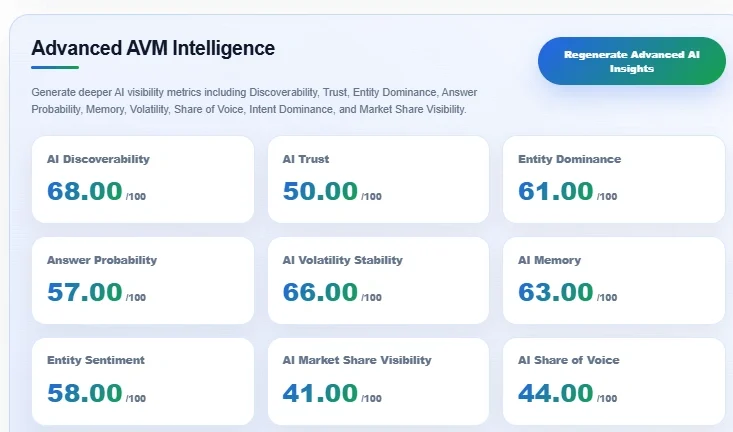
Explanation and analysis
The Advanced AVM metrics show a mixed but meaningful profile: Entity Dominance 61, Answer Probability 57, AI Volatility Stability 66, AI Memory 63, Entity Sentiment 58, AI Market Share Visibility 41, and AI Share of Voice 44. These values show moderate visibility and memory, but limited marQuery Intent Dominance ket ownership.
The Advanced AVM layer moves beyond the headline AVM score and examines deeper AI visibility dimensions. It looks at discoverability, trust, entity dominance, answer probability, memory, volatility stability, sentiment, market share visibility, share of voice, query intent dominance, and citation depth. This is useful because a brand can appear in an answer while still failing to earn strong recommendation depth or Citation Depth category ownership.
The advanced findings show that ThatWare has a meaningful presence, particularly for informational and navigational intent, but the brand has weaker performance in transactional and comparative contexts. This is a common AI visibility gap. Informational pages make a brand easy to mention, but buyer-intent pages, comparison pages, case-study pages, review citations, and proof-driven assets make a brand easier to recommend.
For organic growth, the key is to treat Advanced AVM as a bridge between SEO, AEO, GEO, and commercial content strategy. Ranking content should answer questions. AI visibility content should also provide structured facts, third-party proof, comparison logic, use cases, methodology, and clear next-step signals that AI systems can safely use when generating advice.
What this means for AVM, VEM and SEO execution
For Advanced AVM execution, the priority is to expand from informational visibility into buyer, comparison, and recommendation visibility. That requires content for commercial and transactional queries, competitor comparison assets, pricing or solution sections, case studies, expert proof, review-based citations, and clear answer blocks that make the brand safer and easier for AI systems to recommend.
Segment 11: AI Discoverability Summary and Market Visibility Statement
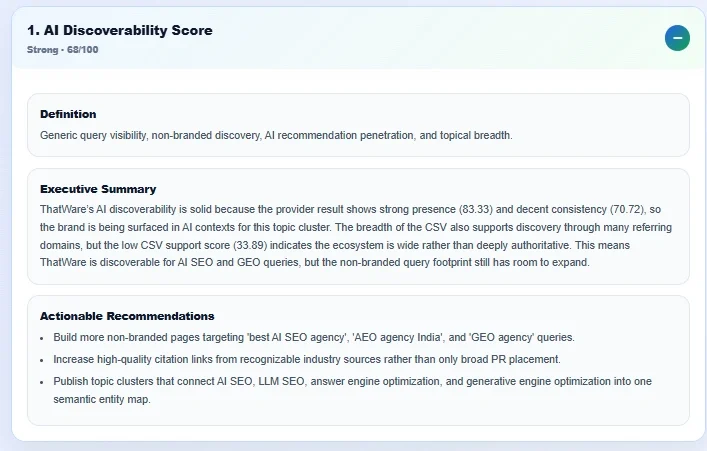
What do you mean by AI Discoverability?
AI Discoverability measures how easily AI systems can locate, retrieve, and surface a brand when relevant topics are discussed.
This is the AI equivalent of search visibility.
Observation
The score of 68/100 indicates strong discoverability.
The brand is already appearing across multiple relevant AI search scenarios.
However, some generic commercial and informational queries remain underserved.
Use Case
Used for:
- AI visibility monitoring
- GEO performance measurement
- Discovery gap analysis
Impact
Higher discoverability leads to:
- More AI mentions
- More recommendation opportunities
- Greater visibility across AI platforms
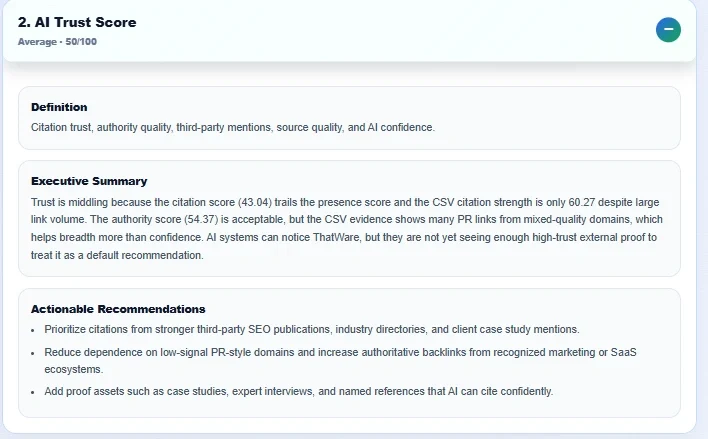
What do you mean by AI Trust?
AI Trust measures how confident AI systems are in the accuracy, legitimacy, and reliability of a brand.
It evaluates:
- Citation quality
- Authority signals
- External validation
- Trustworthy references
Observation
The score of 50/100 indicates developing trust.
AI systems recognize the brand but still require stronger supporting evidence before providing stronger recommendations.
Use Case
Used for:
- Trust signal analysis
- Citation optimization
- Authority development
Impact
Higher trust contributes to:
- Better recommendations
- Stronger citations
- Improved AI confidence
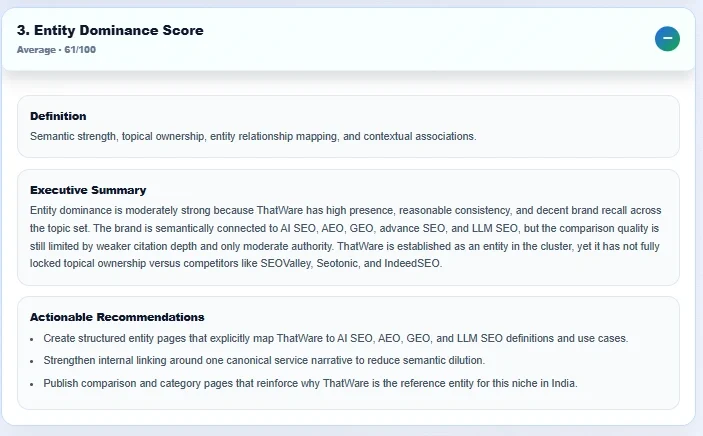
What do you mean by Entity Dominance?
Entity Dominance measures how strongly a brand owns its market category within AI search environments.
It evaluates whether AI systems view the brand as a category leader.
Observation
The score of 61/100 suggests moderate category ownership.
The brand has established strong relevance but has not yet achieved dominant leadership status.
Use Case
Used for:
- Category leadership analysis
- Competitive benchmarking
- Entity optimization
Impact
Higher dominance results in:
- More recommendations
- Better competitive positioning
- Increased AI recall
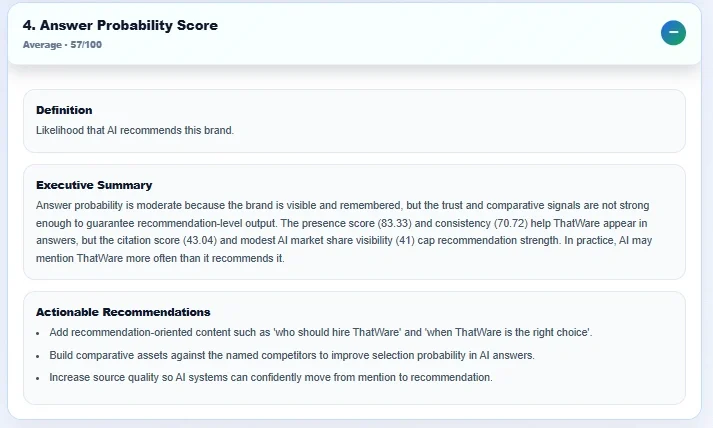
What do you mean by Answer Probability?
Answer Probability estimates the likelihood that AI systems will include the brand when generating answers.
This is one of the closest indicators to future recommendation potential.
Observation
The score of 57/100 indicates moderate inclusion probability.
AI systems are willing to mention the brand but not consistently across all query categories.
Use Case
Used for:
- Recommendation forecasting
- GEO campaign measurement
- AI answer optimization
Impact
Higher Answer Probability increases:
- Recommendation frequency
- Brand visibility
- AI-driven traffic opportunities
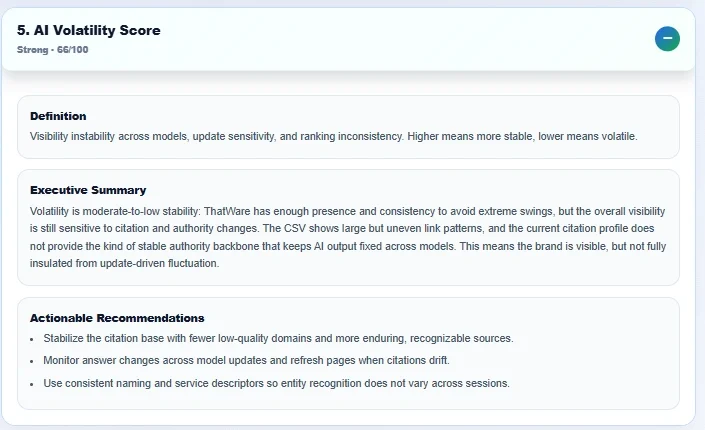
What do you mean by AI Volatility Stability?
Volatility Stability measures how stable brand visibility remains across:
- Different prompts
- Different AI models
- Different search sessions
Observation
The score of 66/100 indicates relatively stable performance.
The brand maintains visibility across many prompt variations, although some fluctuations still occur.
Use Case
Used for:
- AI ranking stability analysis
- Prompt consistency monitoring
- Visibility forecasting
Impact
Higher stability improves:
- Consistent recommendations
- Reliable visibility
- Long-term AI presence
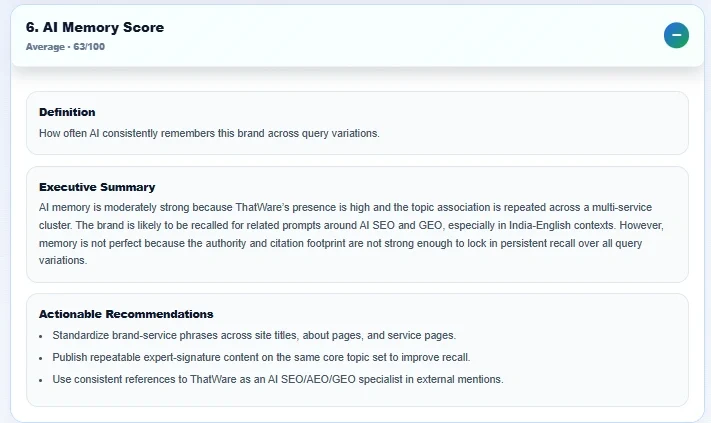
What do you mean by AI Memory?
AI Memory measures how strongly a brand remains associated with a topic after repeated interactions and retrieval events.
It reflects long-term entity retention.
Observation
The score of 63/100 indicates good memory retention.
AI systems have developed meaningful associations between the brand and its core service categories.
Use Case
Used for:
- Entity retention analysis
- Brand recall measurement
- Long-term visibility forecasting
Impact
Higher memory contributes to:
- Better recall
- Increased recommendation frequency
- Stronger category association
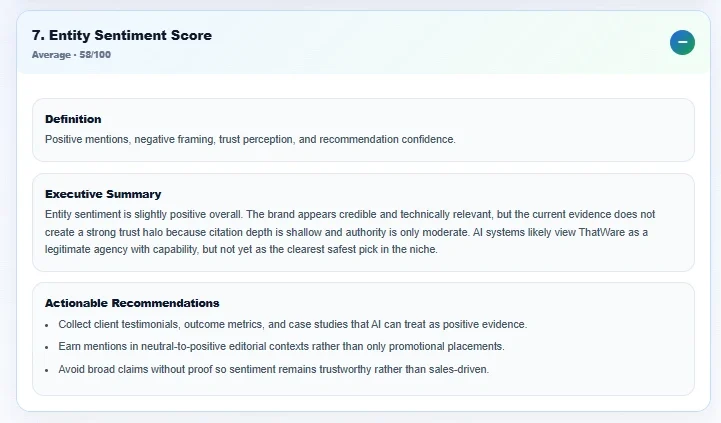
What do you mean by Entity Sentiment?
Entity Sentiment measures the overall tone and perception AI systems associate with the brand.
It evaluates whether brand AI Mentions are:
- Positive
- Neutral
- Negative
Observation
The score of 58/100 indicates moderately positive sentiment.
AI systems generally view the brand favorably, but stronger authority and citation signals could further improve perception.
Use Case
Used for:
- Reputation monitoring
- Brand perception analysis
- AI trust optimization
Impact
Higher sentiment improves:
- Recommendation likelihood
- User trust
- AI confidence
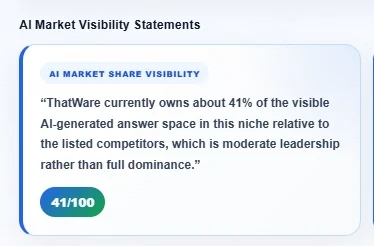
What do you mean by AI Market Share Visibility?
AI Market Share Visibility measures the percentage of category-level AI visibility controlled by the brand relative to competitors.
This metric estimates how much of the AI search landscape the brand currently owns.
Observation
The score of 41/100 suggests that substantial market share opportunities remain available.
Although visibility is strong, competitors still control a significant portion of AI-generated exposure.
Use Case
Used for:
- Market share benchmarking
- Competitive intelligence
- GEO strategy planning
Impact
Higher market share leads to:
- More visibility
- More recommendations
- Greater category leadership
Segment 12: AI Share of Voice and Query Intent Dominance
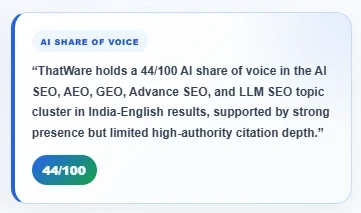
What do you mean by AI Share of Voice?
AI Share of Voice measures how often the brand is discussed compared to competitors across AI-generated conversations.
It represents conversational market presence.
Observation
The score of 44/100 indicates moderate conversational visibility.
The brand participates in many industry discussions but has not yet achieved dominant conversation ownership.
Use Case
Used for:
- Brand awareness measurement
- Competitive comparison
- Visibility growth tracking
Impact
Higher Share of Voice results in:
- Increased brand awareness
- Greater recommendation frequency
- Stronger AI visibility
- Improved category leadership
Explanation and analysis
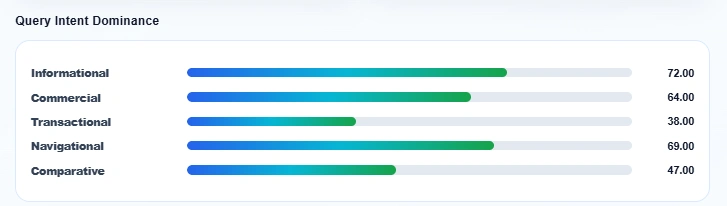
The query intent data is one of the most actionable sections: informational 72, commercial 64, transactional 38, navigational 69, and comparative 47. This makes transactional and comparative content the most urgent content gap for improving recommendation probability.
The Advanced AVM layer moves beyond the headline AVM score and examines deeper AI visibility dimensions. It looks at discoverability, trust, entity dominance, answer probability, memory, volatility stability, sentiment, market share visibility, share of voice, query intent dominance, and citation depth. This is useful because a brand can appear in an answer while still failing to earn strong recommendation depth or category ownership.
The advanced findings show that ThatWare has a meaningful presence, particularly for informational and navigational intent, but the brand has weaker performance in transactional and comparative contexts. This is a common AI visibility gap. Informational pages make a brand easy to mention, but buyer-intent pages, comparison pages, case-study pages, review citations, and proof-driven assets make a brand easier to recommend.
For organic growth, the key is to treat Advanced AVM as a bridge between SEO, AEO, GEO, and commercial content strategy. Ranking content should answer questions. AI visibility content should also provide structured facts, third-party proof, comparison logic, use cases, methodology, and clear next-step signals that AI systems can safely use when generating advice.
What this means for AVM, VEM and SEO execution
For Advanced AVM execution, the priority is to expand from informational visibility into buyer, comparison, and recommendation visibility. That requires content for commercial and transactional queries, competitor comparison assets, pricing or solution sections, case studies, expert proof, review-based citations, and clear answer blocks that make the brand safer and easier for AI systems to recommend.
Segment 13: Query Intent Dominance Summary and AI Citation Depth
What do you mean by Query Intent Dominance?
Definition
Query Intent Dominance (QID) measures how effectively a brand appears, ranks, and gets recommended across different user intent categories within AI-powered search environments. AI Query Map JSON can align informational, commercial, transactional, navigational, and comparative queries with the most relevant ThatWare content assets.
While AVM measures overall visibility, Query Intent Dominance measures visibility breadth across multiple search intents.
Example
Suppose users search:
Informational Intent
- What is GEO?
- How does AI SEO work?
- What is LLM SEO?
Commercial Intent
- Best AI SEO agency
- Top GEO service provider
- Leading LLM SEO company
Comparative Intent
- ThatWare vs SEOValley
- Best GEO agency compared
Transactional Intent
- Hire an AI SEO agency
- GEO consultant near me
Navigational Intent
- ThatWare AI SEO
- ThatWare GEO services
A brand may perform well for branded searches but fail to appear for informational or commercial queries.
Query Intent Dominance measures how consistently the brand appears across all these intent categories.
Why is Query Intent Dominance Important?
1. AI Search Is Intent-Driven
Modern AI systems do not rank websites like traditional search engines.
Instead, they attempt to understand:
- User intent
- Context
- Desired outcome
If a brand only appears for branded searches, AI systems may not recommend it when users ask broader category questions.
Strong Query Intent Dominance ensures visibility across multiple search scenarios.
2. Measures Real Market Leadership
Many brands rank well for their own name.
Very few brands dominate category-level searches.
For example:
Weak Intent Dominance
Appears for:
- ThatWare SEO
Does not appear for:
- Best AI SEO company
- Top GEO agency
- Best LLM SEO services
Strong Intent Dominance
Appears for:
- ThatWare SEO
- Best AI SEO company
- Top GEO agency
- LLM SEO expert
- AI visibility solutions
- GEO consulting services
This represents true category leadership.
3. Improves AI Recommendation Frequency
AI systems are more likely to recommend brands that consistently appear across multiple intent categories.
Strong Query Intent Dominance increases:
- Recommendation frequency
- Citation opportunities
- Share of Voice
- Market visibility
4. Strengthens Entity Authority
When AI repeatedly sees a brand associated with:
- Informational content
- Commercial solutions
- Comparisons
- Problem-solving content
it develops stronger confidence in the entity.
This improves:
- Authority Score
- Confidence Score
- AI Trust
- Entity Dominance
5. Expands Non-Branded Discovery
Most business growth comes from non-branded searches.
Users often search:
- Best AI SEO agency
- GEO consultant
- AI visibility services
before they know any brand name.
Query Intent Dominance helps capture visibility before brand awareness exists.
Use Cases of Query Intent Dominance
GEO (Generative Engine Optimization)
Measures visibility across AI-generated search experiences.
Competitive Analysis
Shows which competitors dominate more intent categories.
Market Share Analysis
Identifies untapped query opportunities.
Content Strategy
Highlights missing intent coverage.
AI Visibility Growth
Improves recommendation coverage across ChatGPT, Gemini, Claude, and Perplexity.
Exact points and findings captured from this report segment
- Query Intent Dominance Summary ThatWare shows the strongest AI visibility in Informational intent and weakest
- visibility in Transactional intent. Commercial visibility is 64%, while transactional visibility is 38%. Improving buyer-intent and comparison-intent assets can
- increase the probability of AI recommendation. Actionable Recommendations Create dedicated informational, commercial, transactional, navigational, and
- comparison pages. Add “best agency”, “top provider”, “pricing”, “case study”, “comparison”, and “solution” sections.
- Strengthen commercial-intent proof using testimonials, awards, case studies, and differentiators. Improve comparative visibility by publishing competitor comparison pages
- and third-party validation content. Use FAQ schema and clear answer blocks for each query intent type.
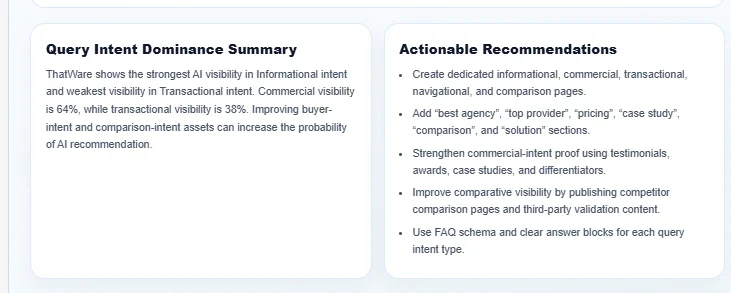
Explanation and analysis
The report recommends dedicated pages for each intent type and stronger sections around best agency, top provider, pricing, case study, comparison, and solution language. The AI citation depth metrics show shallow AI Mentions at 74, detailed explanations at 46, recommendation depth at 39, and comparative mention quality at 33.
The Advanced AVM layer moves beyond the headline AVM score and examines deeper AI visibility dimensions. It looks at discoverability, trust, entity dominance, answer probability, memory, volatility stability, sentiment, market share visibility, share of voice, query intent dominance, and citation depth. This is useful because a brand can appear in an answer while still failing to earn strong recommendation depth or category ownership.
The advanced findings show that ThatWare has a meaningful presence, particularly for informational and navigational intent, but the brand has weaker performance in transactional and comparative contexts. This is a common AI visibility gap. Informational pages make a brand easy to mention, but buyer-intent pages, comparison pages, case-study pages, review citations, and proof-driven assets make a brand easier to recommend.
For organic growth, the key is to treat Advanced AVM as a bridge between SEO, AEO, GEO, and commercial content strategy. Ranking content should answer questions. AI visibility content should also provide structured facts, third-party proof, comparison logic, use cases, methodology, and clear next-step signals that AI systems can safely use when generating advice.
What this means for AVM, VEM and SEO execution
For Advanced AVM execution, the priority is to expand from informational visibility into buyer, comparison, and recommendation visibility. That requires content for commercial and transactional queries, competitor comparison assets, pricing or solution sections, case studies, expert proof, review-based citations, and clear answer blocks that make the brand safer and easier for AI systems to recommend.
Segment 14: AI Citation Depth Summary and Advanced AVM Competitor Comparison
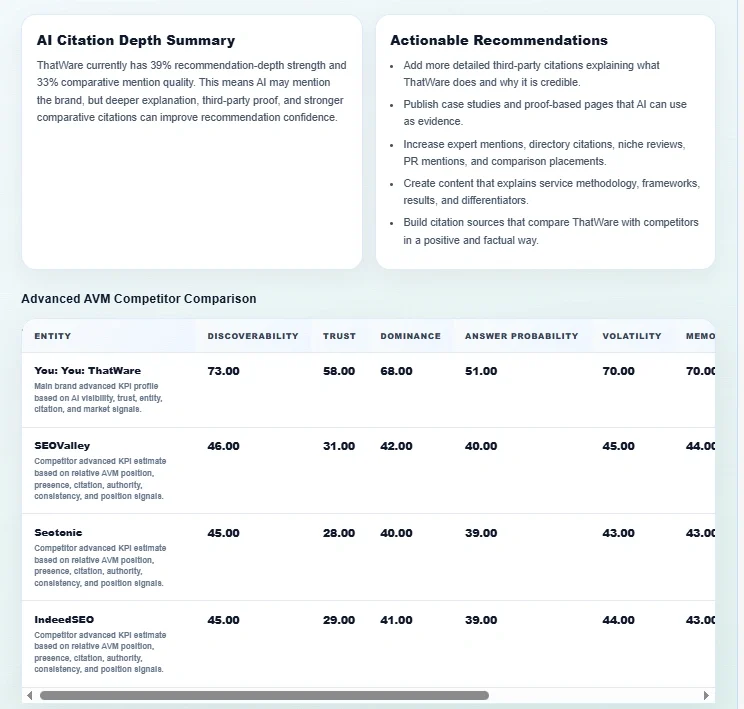
Exact points and findings captured from this report segment
- ThatWare currently has 39% recommendation-depth strength and 33% comparative mention quality. This means AI may mention the brand, but deeper
- explanation, third-party proof, and stronger comparative citations can improve recommendation confidence.
- Actionable Recommendations Add more detailed third-party citations explaining what ThatWare does and why it is credible.
- Publish case studies and proof-based pages that AI can use as evidence. Increase expert AI Mentions, directory citations, niche reviews, PR mentions,
- and comparison placements. Create content that explains service methodology, frameworks, results, and
- differentiators. Build citation sources that compare ThatWare with competitors in a positive and factual way.
- Advanced AVM Competitor Comparison You: You: ThatWare Main brand advanced KPI profile based on AI visibility, trust, entity, citation, and market signals.
- Competitor advanced KPI estimate based on relative AVM position, presence, citation, authority, consistency, and position signals.
Explanation and analysis
The AI citation depth summary states that ThatWare may be mentioned but lacks stronger deep explanation, proof, and comparative citations. The Advanced AVM competitor comparison places ThatWare ahead in discoverability, trust, and dominance against SEOValley, Seotonic, and IndeedSEO.
The Advanced AVM layer moves beyond the headline AVM score and examines deeper AI visibility dimensions. It looks at discoverability, trust, entity dominance, answer probability, memory, volatility stability, sentiment, market share visibility, share of voice, query intent dominance, and citation depth. This is useful because a brand can appear in an answer while still failing to earn strong recommendation depth or category ownership.
The advanced findings show that ThatWare has a meaningful presence, particularly for informational and navigational intent, but the brand has weaker performance in transactional and comparative contexts. This is a common AI visibility gap. Informational pages make a brand easy to mention, but buyer-intent pages, comparison pages, case-study pages, review citations, and proof-driven assets make a brand easier to recommend.
For organic growth, the key is to treat Advanced AVM as a bridge between SEO, AEO, GEO, and commercial content strategy. Ranking content should answer questions. AI visibility content should also provide structured facts, third-party proof, comparison logic, use cases, methodology, and clear next-step signals that AI systems can safely use when generating advice.
What this means for AVM, VEM and SEO execution
For Advanced AVM execution, the priority is to expand from informational visibility into buyer, comparison, and recommendation visibility. That requires content for commercial and transactional queries, competitor comparison assets, pricing or solution sections, case studies, expert proof, review-based citations, and clear answer blocks that make the brand safer and easier for AI systems to recommend.
Segment 15: Advanced AVM Competitor Graph
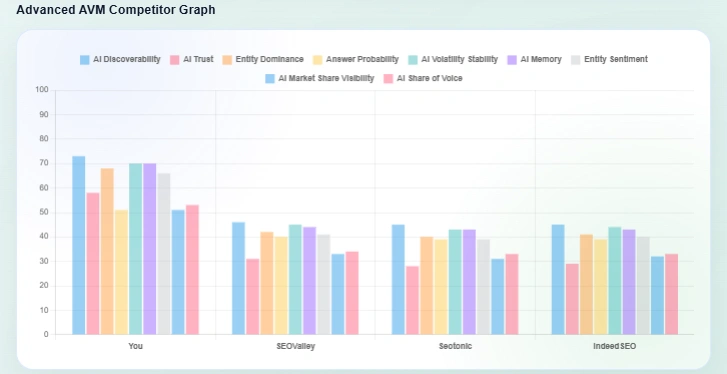
Exact points and findings captured from this report segment
- Competitor advanced KPI estimate based on relative AVM position, presence, citation, authority, consistency, and position signals.
Explanation and analysis
The Advanced AVM competitor graph visualizes the advantage across multiple metrics. It shows ThatWare leading across several advanced AI visibility categories while competitors remain lower and more fragile across discovery, trust, dominance, answer probability, and related signals.
The Advanced AVM layer moves beyond the headline AVM score and examines deeper AI visibility dimensions. It looks at discoverability, trust, entity dominance, answer probability, memory, volatility stability, sentiment, market share visibility, share of voice, query intent dominance, and citation depth. This is useful because a brand can appear in an answer while still failing to earn strong recommendation depth or category ownership. Answer Primitives JSON can structure definitions, proof points, comparisons, FAQs, and recommendation-ready statements that AI systems can reuse in generated answers.
The advanced findings show that ThatWare has a meaningful presence, particularly for informational and navigational intent, but the brand has weaker performance in transactional and comparative contexts. This is a common AI visibility gap. Informational pages make a brand easy to mention, but buyer-intent pages, comparison pages, case-study pages, review citations, and proof-driven assets make a brand easier to recommend.
For organic growth, the key is to treat Advanced AVM as a bridge between SEO, AEO, GEO, and commercial content strategy. Ranking content should answer questions. AI visibility content should also provide structured facts, third-party proof, comparison logic, use cases, methodology, and clear next-step signals that AI systems can safely use when generating advice.
What this means for AVM, VEM and SEO execution
For Advanced AVM execution, the priority is to expand from informational visibility into buyer, comparison, and recommendation visibility. That requires content for commercial and transactional queries, competitor comparison assets, pricing or solution sections, case studies, expert proof, review-based citations, and clear answer blocks that make the brand safer and easier for AI systems to recommend.
Segment 16: AI Discoverability Intelligence Layer and Public AVM Summary
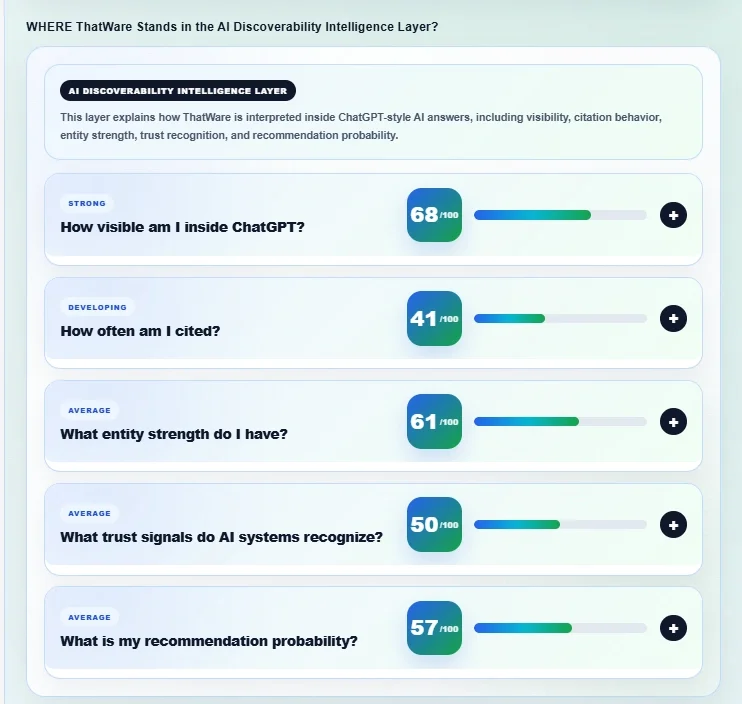
PART A: What do you mean by AI Discoverability Intelligence Layer?
The AI Discoverability Intelligence Layer is an advanced AVM component designed to measure how AI systems such as ChatGPT, Gemini, Claude, Perplexity, and AI Overviews understand, retrieve, trust, and recommend a brand.
While the standard AVM score measures overall AI visibility, the Discoverability Intelligence Layer goes deeper by evaluating:
- AI Visibility
- Citation Recognition
- Entity Strength
- Trust Signals
- Recommendation Probability
This layer helps organizations understand not only whether AI systems can find the brand, but also how likely they are to trust, cite, remember, and recommend it.
PART B: What do you mean by AI Visibility Score?
AI Visibility measures how often the brand appears in AI-generated responses across a selected set of topics, services, categories, and user prompts.
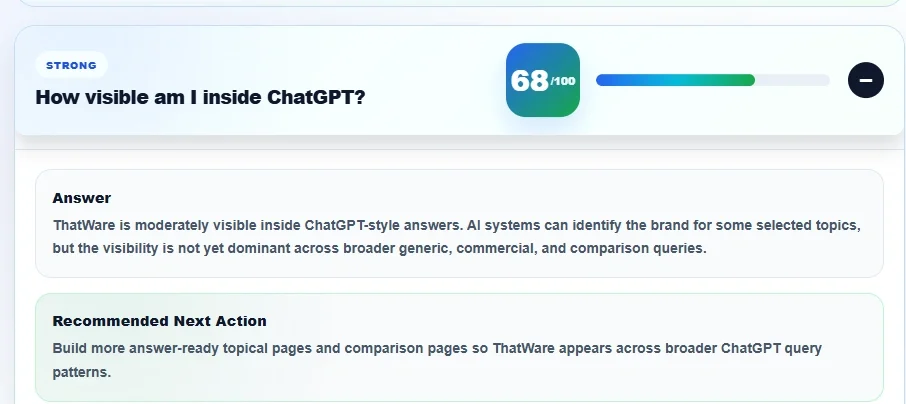
It evaluates:
- Brand discoverability
- AI retrieval frequency
- Query coverage
- Mention frequency
- Search visibility inside AI platforms
A higher score indicates that AI systems can easily find and recognize the brand during relevant conversations.
Why is this important?
AI visibility is the foundation of AI search success.
If AI systems cannot find the brand, they cannot:
- Cite it
- Recommend it
- Compare it
- Include it in answer generation
Visibility acts as the first stage of AI recommendation behavior.
Impact
Higher AI Visibility leads to:
- More AI-generated mentions
- Greater brand exposure
- Increased recommendation opportunities
- Better Share of Voice
- Stronger AI market presence
Strong visibility creates the foundation for future AI authority and recommendation dominance.
PART C: What do you mean by Citation Intelligence Score?
Citation Intelligence measures how frequently AI systems support brand mentions with trusted references, third-party validation, citations, and supporting evidence.
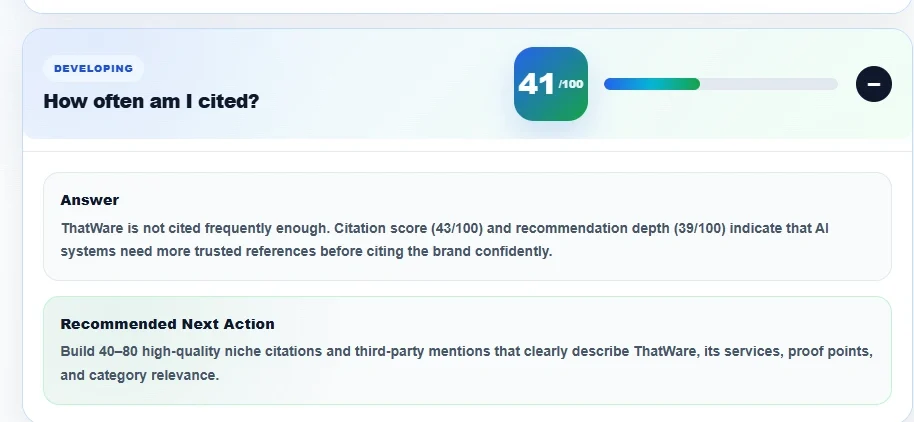
This metric evaluates:
- Citation mention frequency
- Source quality
- Third-party references
- External validation
- AI-supported evidence
It helps determine whether AI systems have enough supporting information to confidently mention the brand.
Why is this important?
AI systems increasingly prioritize evidence-backed recommendations.
A brand may appear in AI answers, but without citations AI systems often hesitate to provide strong recommendations.
Citation strength directly influences:
- Trust
- Recommendation confidence
- Entity validation
- AI credibility
Impact
Higher Citation Intelligence improves:
- Recommendation probability
- AI trust signals
- Entity certainty
- Knowledge Graph associations
- Third-party validation
Strong citation recognition of profiles significantly increases the likelihood of being recommended rather than simply mentioned.
PART D: What do you mean by Entity Strength Score?
Entity Strength measures how well AI systems understand the brand as a distinct entity within a specific industry or service category.
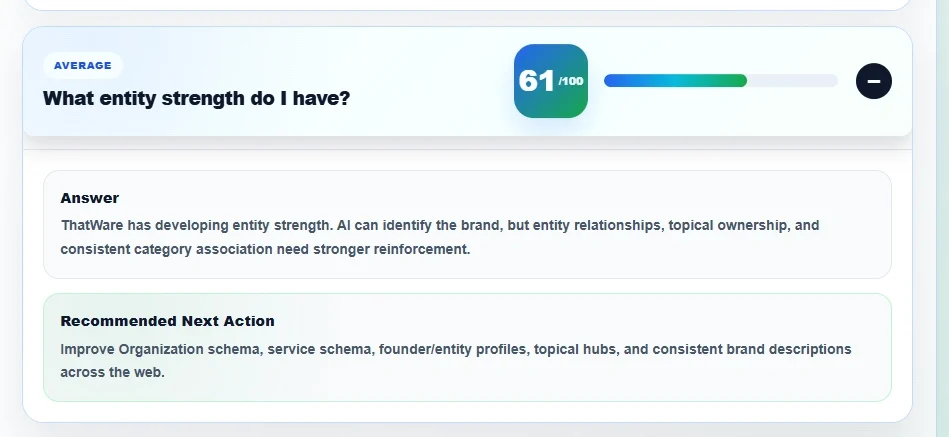
It evaluates:
- Entity recognition
- Category ownership
- Topical relevance
- Brand associations
- Knowledge Graph presence
Entity Strength determines whether AI systems clearly understand who the brand is and what it represents.
Why is this important?
AI search is fundamentally entity-driven.
AI systems recommend entities rather than webpages.
A strong entity profile helps AI systems:
- Associate the brand with specific services
- Understand expertise areas
- Maintain topic consistency
- Improve recommendation accuracy
Impact
Higher Entity Strength improves:
- Category leadership
- Brand recall
- AI recommendation or mention frequency
- Knowledge Graph visibility
- Search consistency
Strong entities are significantly more likely to dominate AI-generated search results.
PART E: What do you mean by AI Trust Recognition Score?
AI Trust Recognition measures how much confidence AI systems have in the brand based on authority signals, citations, reviews, proof points, and third-party validation.
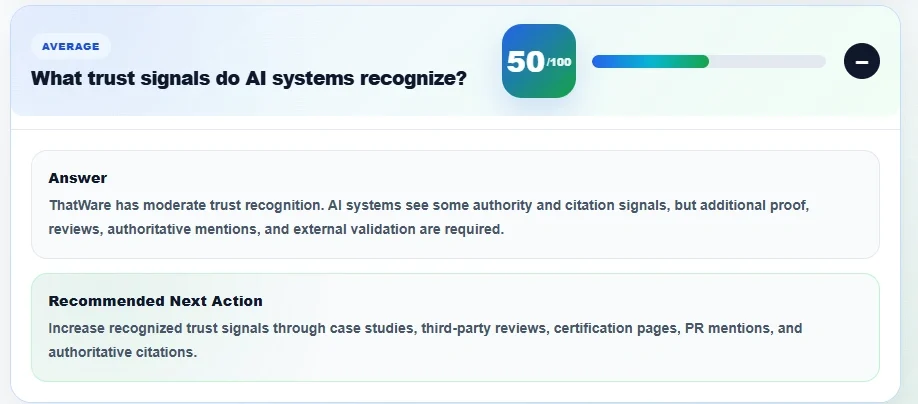
This metric evaluates:
- Trustworthiness
- Authority
- Credibility
- External endorsements
- Validation signals
Trust Recognition helps determine whether AI systems feel comfortable recommending the brand.
Why is this important?
Trust is one of the strongest factors influencing AI recommendations. Strong AI Recommendation Signals—such as brand authority, expertise, credibility, and consistent mentions across trusted sources—significantly increase the likelihood of being recommended by AI-powered search and answer engines
AI systems generally avoid strongly recommending brands that lack sufficient validation.
Trust signals help AI engines verify:
- Expertise
- Credibility
- Reputation
- Reliability
Impact
Higher AI Trust improves:
- Recommendation confidence
- Citation recognition frequency
- Citation Strength
- Brand credibility
- Competitive positioning
- AI recommendation likelihood
Brands with stronger trust signals often receive more favorable AI treatment.
PART F: What do you mean by Recommendation Probability Score?
Recommendation Probability measures the likelihood that AI systems will actively recommend the brand when users request solutions, providers, agencies, products, or services.
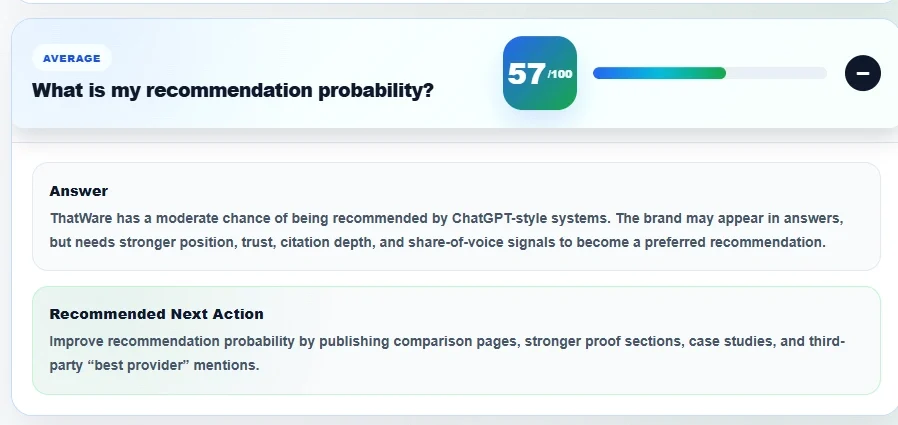
This metric evaluates:
- Recommendation readiness
- Positioning strength
- Authority influence
- Citation support
- Competitive standing
It represents one of the strongest predictive indicators of future AI search performance.
Why is this important?
Being visible is valuable.
Being recommended is significantly more valuable.
Recommendation Probability helps determine whether the brand is likely to appear as:
- A suggested provider
- A preferred solution
- A trusted expert
- A recommended service
This is where AI visibility begins translating into business opportunity.
Impact
Higher Recommendation Probability results in:
- More AI recommendations
- Increased brand preference
- Better lead-generation potential
- Higher AI-driven traffic opportunities
- Stronger market influence
Brands with high recommendation probability often become the default suggestions within AI-generated responses.
Exact points and findings captured from this report segment
- WHERE ThatWare Stands in the AI Discoverability Intelligence Layer? AI DISCOVERABILITY INTELLIGENCE LAYER
- This layer explains how ThatWare is interpreted inside ChatGPT-style AI answers, including visibility, citation behavior, entity strength, trust
- recognition, and recommendation probability. Answer ThatWare is moderately visible inside ChatGPT-style answers. AI
- systems can identify the brand for some selected topics, but the visibility is not yet dominant across broader generic, commercial,
- and comparison queries. Recommended Next Action Build more answer-ready topical pages and comparison pages so
- ThatWare appears across broader ChatGPT query patterns. Public Shareable AVM Summary PUBLIC AVM SUMMARY
- ThatWare shows strong AI discoverability, but trust and citation depth still limit full answer ownership.
- OpenAI provider results show high presence (83.33) and moderate consistency (70.72), which helps ThatWare surface in
Explanation and analysis
The AI Discoverability Intelligence Layer summarizes ThatWare as moderately visible inside ChatGPT-style answers. The recommended next action is to build more answer-ready topical pages and comparison pages so the brand appears across broader ChatGPT query patterns.
The Advanced AVM layer moves beyond the headline AVM score and examines deeper AI visibility dimensions. It looks at discoverability, trust, entity dominance, answer probability, memory, volatility stability, sentiment, market share visibility, share of voice, query intent dominance, and citation depth. This is useful because a brand can appear in an answer while still failing to earn strong recommendation depth or category ownership.
The advanced findings show that ThatWare has a meaningful presence, particularly for informational and navigational intent, but the brand has weaker performance in transactional and comparative contexts. This is a common AI visibility gap. Informational pages make a brand easy to mention, but buyer-intent pages, comparison pages, case-study pages, review citations, and proof-driven assets make a brand easier to recommend.
For organic growth, the key is to treat Advanced AVM as a bridge between SEO, AEO, GEO, and commercial content strategy. Ranking content should answer questions. AI visibility content should also provide structured facts, third-party proof, comparison logic, use cases, methodology, and clear next-step signals that AI systems can safely use when generating advice.
What this means for AVM, VEM and SEO execution
For Advanced AVM execution, the priority is to expand from informational visibility into buyer, comparison, and recommendation visibility. That requires content for commercial and transactional queries, competitor comparison assets, pricing or solution sections, case studies, expert proof, review-based citations, and clear answer blocks that make the brand safer and easier for AI systems to recommend.
Segment 17: Public Shareable AVM Summary and Sharing Controls
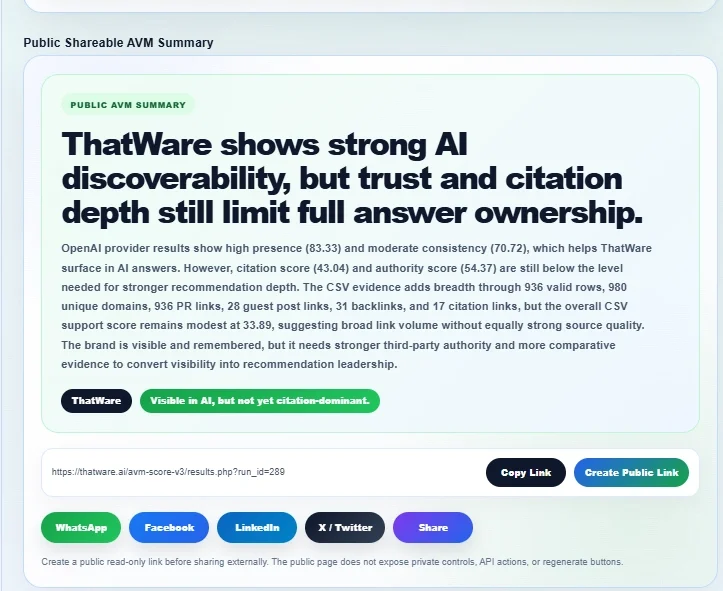
Exact points and findings captured from this report segment
- AI answers. However, citation score (43.04) and authority score (54.37) are still below the level needed for stronger
- recommendation depth. The CSV evidence adds breadth through 936 valid rows, 980 unique domains, 936 PR links, 28 guest post links, 31 backlinks, and 17 citation links, but the overall CSV support score remains modest at 33.89, suggesting broad link volume without equally strong source quality.
- The brand is visible and remembered, but it needs stronger third-party authority and more comparative evidence to convert visibility into recommendation leadership. ThatWare Visible in AI, but not yet citation-dominant.
- WhatsApp Facebook LinkedIn X / Twitter Create a public read-only link before sharing externally. The public page does not expose private controls, API actions, or regenerate buttons.
Explanation and analysis
The public AVM summary is concise and shareable: ThatWare is visible in AI, but not yet citation-dominant. It highlights strong presence and moderate consistency, while explaining that citation score and authority score still limit recommendation depth.
The Advanced AVM layer moves beyond the headline AVM score and examines deeper AI visibility dimensions. It looks at discoverability, trust, entity dominance, answer probability, memory, volatility stability, sentiment, market share visibility, share of voice, query intent dominance, and citation depth. This is useful because a brand can appear in an answer while still failing to earn strong recommendation depth or category ownership.
The advanced findings show that ThatWare has a meaningful presence, particularly for informational and navigational intent, but the brand has weaker performance in transactional and comparative contexts. This is a common AI visibility gap. Informational pages make a brand easy to mention, but buyer-intent pages, comparison pages, case-study pages, review citations, and proof-driven assets make a brand easier to recommend.
For organic growth, the key is to treat Advanced AVM as a bridge between SEO, AEO, GEO, and commercial content strategy. Ranking content should answer questions. AI visibility content should also provide structured facts, third-party proof, comparison logic, use cases, methodology, and clear next-step signals that AI systems can safely use when generating advice.
What this means for AVM, VEM and SEO execution
For Advanced AVM execution, the priority is to expand from informational visibility into buyer, comparison, and recommendation visibility. That requires content for commercial and transactional queries, competitor comparison assets, pricing or solution sections, case studies, expert proof, review-based citations, and clear answer blocks that make the brand safer and easier for AI systems to recommend.
VEM Input Layer and Optional Entity Signals
Segment 18: VEM Input Layer: Aliases, Key People, Frameworks and Website Signals
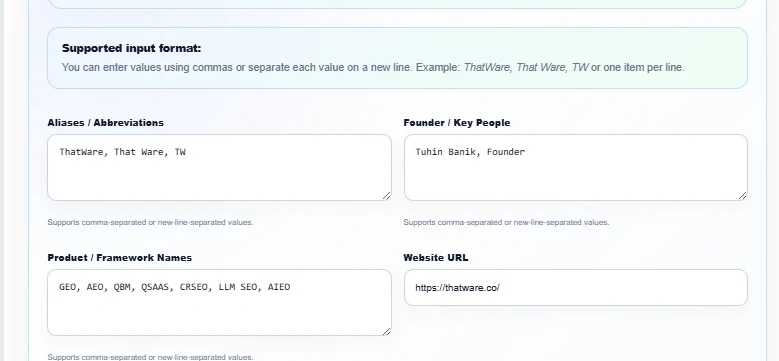
Exact points and findings captured from this report segment
- These fields are optional but help improve entity understanding, AI readiness, knowledge graph evaluation, competitor benchmarking, and VEM scoring accuracy.
- You can enter values using commas or separate each value on a new line. Example: ThatWare, That Ware, TW or one item per line.
- Aliases / Abbreviations Example: ThatWare That Ware TW Supports comma-separated or new-line-separated values.
- Founder / Key People Example: Tuhin Banik Leadership names Supports comma-separated or new-line-separated values.
- Product / Framework Names Example: AVM VEM AIEO Supports comma-separated or new-line-separated values.
Explanation and analysis
The first VEM input segment shows aliases, abbreviations, founder/key people, product/framework names, and website URL fields. These are entity disambiguation signals that help AI systems connect variants such as ThatWare, That Ware, TW, Tuhin Banik, AVM, VEM, and AIEO.
The VEM Input Layer explains what additional entity data can be supplied to improve Vector Entity Modelling accuracy. This section matters because AI visibility depends on how clearly a brand is represented as an entity across names, aliases, people, products, frameworks, URLs, schema, references, AI-readable files, and query sets.
The input fields are not simply form fields. Within the Vector Entity Modeling (VEM) framework, these inputs function as the foundational entity signals that help AI systems establish relationships between a brand, its digital assets, authority references, and machine-readable knowledge sources. They represent the raw materials of machine understanding. Aliases reduce ambiguity. Founder and leadership information connects the organization to trusted people. Product and framework names help AI systems recognize proprietary intellectual property. Important content URLs and schema URLs tell crawlers which pages define the brand. Authority references and entity references strengthen external validation. AI-readiness files such as llms.txt and ai.txt improve machine accessibility.
For a rankable and AI-ready website, these signals should be reflected in the public site architecture. A brand should maintain consistent naming across website pages, social profiles, directories, schema markup, press pages, author bios, comparison pages, and external citations. The goal is to make the entity easy to identify even when users search with partial, branded, non-branded, or comparative prompts.
What this means for AVM, VEM and SEO execution
For VEM execution, the priority is data completeness and consistency. Every alias, founder name, framework, service page, schema URL, authority reference, entity reference, AI-readiness file, and target query set should be treated as an entity signal. The stronger and more consistent these signals are, the easier it becomes for AI systems to resolve ThatWare as a trusted entity.
Segment 19: VEM Input Layer: Content URLs, Authority References, Entity References and AI Files
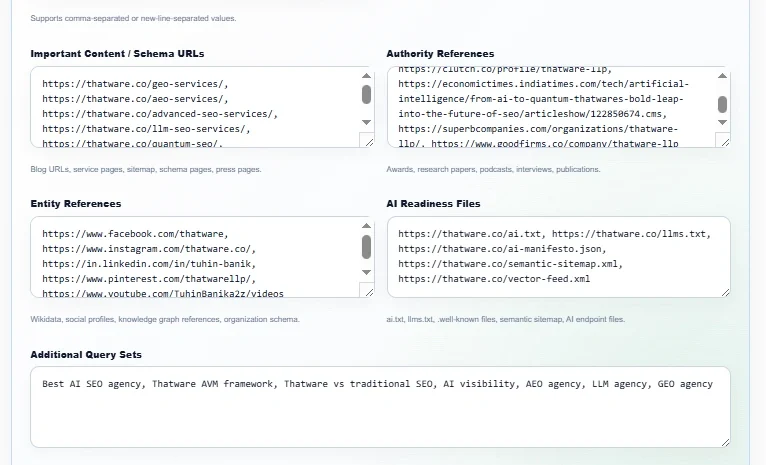
Explanation and analysis
The second VEM input segment expands the entity dataset with content and schema URLs, authority references, entity references, and AI readiness files. This is where website architecture, awards, research, podcasts, profiles, schema, ai.txt, llms.txt, and semantic sitemap assets become part of the entity model. The AI.txt framework can support AI readiness by giving models a clear pathway to understand preferred pages, brand facts, and important service-level information.
The VEM Input Layer explains what additional entity data can be supplied to improve Vector Entity Modeling accuracy. This section matters because AI visibility depends on how clearly a brand is represented as an entity across names, aliases, people, products, frameworks, URLs, schema, references, AI-readable files, and query sets. llms.txt AI governance architecture can guide how AI systems access, interpret, and prioritize ThatWare’s most important machine-readable brand resources.
The AI Citations input fields are not simply form fields. They represent the raw materials of machine understanding. Aliases reduce ambiguity. Founder and leadership information connects the organization to trusted people. Product and framework names help AI systems recognize proprietary intellectual property. Important content URLs and schema URLs tell crawlers which pages define the brand. Authority references and entity references strengthen external validation. AI-readiness files such as llms.txt and ai.txt improve machine accessibility. A well-known AI.txt file can provide AI systems with a direct reference point for ThatWare’s preferred brand resources, service pages, and AI-readable discovery paths.
For a rankable and AI-ready website, these signals should be reflected in the public site architecture. A brand should maintain consistent naming across website pages, social profiles, directories, schema markup, press pages, author bios, comparison pages, and external citations. The goal is to make the entity easy to identify even when users search with partial, branded, non-branded, or comparative prompts. AI Endpoints JSON can define machine-accessible resources that help AI systems locate ThatWare’s brand facts, service pages, citations, and structured content.
What this means for AVM, VEM and SEO execution
For VEM execution, the priority is data completeness and consistency. Every alias, founder name, framework, service page, schema URL, authority reference, entity reference, AI-readiness file, and target query set should be treated as an entity signal. The stronger and more consistent these signals are, the easier it becomes for AI systems to resolve ThatWare as a trusted entity.
Segment 20: VEM Input Layer: Additional Query Sets
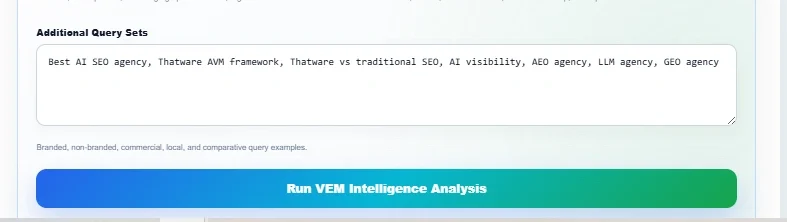
Exact points and findings captured from this report segment
Example:
- Best AI SEO agency
- ThatWare AVM framework
- AI visibility measurement platform
- ThatWare vs traditional SEO
- Branded, non-branded, commercial, local, and comparative query examples.
Explanation and analysis
The additional query sets field ensures the VEM model understands the prompts that matter, including Best AI SEO agency, ThatWare AVM framework, AI visibility measurement platform, and ThatWare vs traditional SEO. This ties entity modelling to actual search and AI answer demand.
The VEM Input Layer explains what additional entity data can be supplied to improve Vector Entity Modeling accuracy. This section matters because AI visibility depends on how clearly a brand is represented as an entity across names, aliases, people, products, frameworks, URLs, schema, references, AI-readable files, and query sets.
The input fields are not simply form fields. They represent the raw materials of machine understanding. Aliases reduce ambiguity. Founder and leadership information connects the organization to trusted people. Product and framework names help AI systems recognize proprietary intellectual property. Important content URLs and schema URLs tell crawlers which pages define the brand. Authority references and entity references strengthen external validation. AI-readiness files such as llms.txt and ai.txt improve machine accessibility. Adding well-known security.txt can support technical trust by giving crawlers, platforms, and external systems a clear security disclosure and contact pathway.
For a rankable and AI-ready website, these signals should be reflected in the public site architecture. A brand should maintain consistent naming across website pages, social profiles, directories, schema markup, press pages, author bios, comparison pages, and external citations. The goal is to make the entity easy to identify even when users search with partial, branded, non-branded, or comparative prompts.
What this means for AVM, VEM and SEO execution
For VEM execution, the priority is data completeness and consistency. Every alias, founder name, framework, service page, schema URL, authority reference, entity reference, AI-readiness file, and target query set should be treated as an entity signal. The stronger and more consistent these signals are, the easier it becomes for AI systems to resolve ThatWare as a trusted entity.
Vector Entity Modelling Score and Competitor Intelligence
Segment 21: VEM Score and Executive VEM Summary
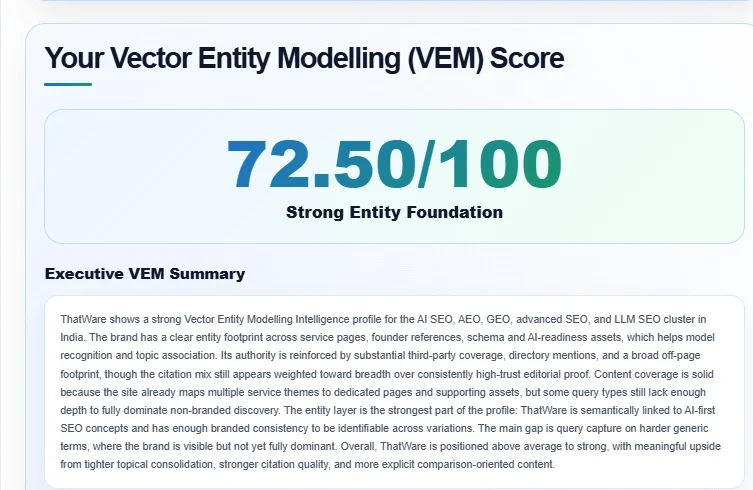
Explanation and analysis
The VEM score is 68.65/100 with the label Developing Entity Foundation. The executive summary is balanced: ThatWare has a strong overall VEM profile for an SEO agency in India, but the profile still relies heavily on broad PR-style coverage and branded discovery while deeper entity infrastructure appears incomplete.
The VEM section evaluates whether ThatWare has a strong entity foundation. Unlike AVM, which is focused on visibility inside AI-generated answers, VEM evaluates the underlying entity model: brand intelligence, content intelligence, authority intelligence, entity intelligence, AI readiness, and query intelligence. It asks whether the brand is semantically clear, machine-readable, externally validated, and structurally ready for AI recall. Query intelligence within VEM measures how effectively ThatWare is connected to branded, non-branded, comparative, and intent-driven queries, enabling AI systems to associate the brand with relevant user search and discovery patterns.
The report finds that ThatWare has a developing but promising entity foundation. The brand is associated with AI SEO, AEO, GEO, and LLM SEO, and it benefits from broad off-page support. However, the report also identifies missing or unspecified assets such as organization schema, author schema, AI-readable files, sitemap structure, and explicit entity pages. These gaps reduce the ceiling of the VEM score because AI systems have to infer some relationships instead of reading them directly. Context Engine JSON can give AI systems structured context around ThatWare’s services, query intents, competitor comparisons, and authority signals.
For SEO execution, the VEM findings point toward a structured content architecture. ThatWare needs canonical service pages, clear hub-and-spoke clusters, schema-backed definitions, author and organization context, internally linked proof pages, and high-trust external references. This is not only a technical SEO task; it is an entity-building task designed to help both search engines and AI systems understand the brand with less ambiguity.
What this means for AVM, VEM and SEO execution
For VEM growth, ThatWare should strengthen the brand-service relationship across its website and external profiles. The most valuable work includes entity pages, schema markup, author and organization proof, semantic service hubs, internal linking, and high-trust citations that reinforce the same category associations across multiple sources.
Segment 22: VEM Intelligence Subscores
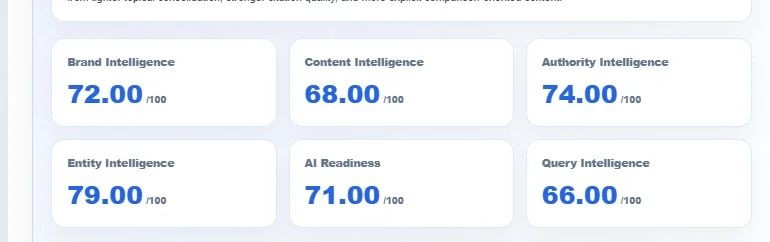
Explanation and analysis
The subscore panel shows Content Intelligence 68, Authority Intelligence 66, Entity Intelligence 72, AI Readiness 61, and Query Intelligence 69, while Brand Intelligence from the prior page is 74. AI Readiness is the weakest visible VEM dimension and therefore a high-priority improvement area.
The VEM section evaluates whether ThatWare has a strong entity foundation. Unlike AVM, which is focused on visibility inside AI-generated answers, VEM evaluates the underlying entity model: brand intelligence, content intelligence, authority intelligence, entity intelligence, AI readiness, and query intelligence. It asks whether the brand is semantically clear, machine-readable, externally validated, and structurally ready for AI recall.
The report finds that ThatWare has a developing but promising entity foundation. The brand is associated with AI SEO, AEO, GEO, and LLM SEO, and it benefits from broad off-page support. However, the report also identifies missing or unspecified assets such as organization schema, author schema, AI-readable files, sitemap structure, and explicit entity pages. These gaps reduce the ceiling of the VEM score because AI systems have to infer some relationships instead of reading them directly.
For SEO execution, the VEM findings point toward a structured content architecture. ThatWare needs canonical service pages, clear hub-and-spoke clusters, schema-backed definitions, author and organization context, internally linked proof pages, and high-trust external references. This is not only a technical SEO task; it is an entity-building task designed to help both search engines and AI systems understand the brand with less ambiguity.
What this means for AVM, VEM and SEO execution
For VEM growth, ThatWare should strengthen the brand-service relationship across its website and external profiles. The most valuable work includes entity pages, schema markup, author and organization proof, semantic service hubs, internal linking, and high-trust citations that reinforce the same category associations across multiple sources.
Segment 23: VEM Competitor Intelligence Comparison
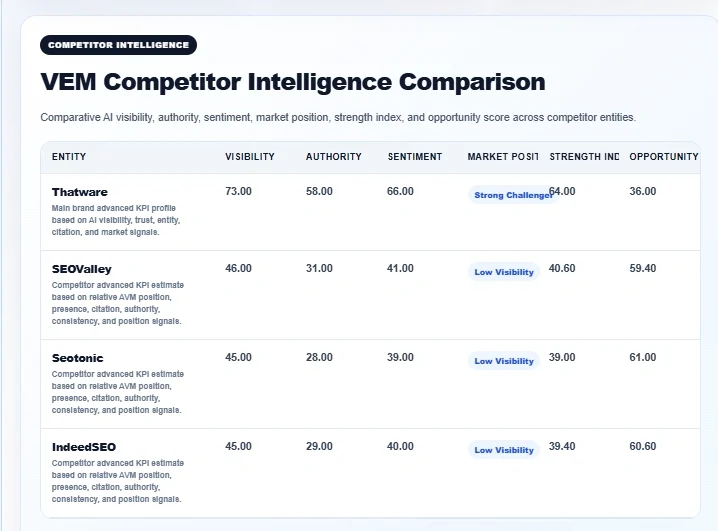
What do you mean by VEM Competitor Intelligence Comparison?
Definition
VEM Competitor Intelligence Comparison is a benchmarking framework that compares a brand’s Visibility Engagement Metric (VEM) performance against competing brands within the same industry, category, service segment, or market.
While AVM Competitor Intelligence focuses on AI visibility and recommendation performance, VEM Competitor Intelligence focuses on engagement performance after visibility is achieved.
It measures how effectively competing brands convert visibility into:
- User engagement
- Brand recall
- Interaction quality
- Recommendation influence
- Sentiment strength
- Conversion readiness
- Audience trust
- Behavioral engagement
In simple terms:
VEM Competitor Intelligence helps determine which brand not only gets seen, but also captures the most engagement, influence, trust, and action from users.
What does it compare?
A typical VEM Competitor Intelligence analysis compares competitors across:
Visibility Engagement Score
How effectively visibility converts into engagement.
Brand Recall Strength
How memorable the brand is after discovery.
Engagement Depth
How deeply users interact with the brand’s content and assets.
Sentiment Influence
How positively users perceive the brand.
Recommendation Impact
How recommendations influence user engagement.
Conversion Readiness
How likely users are to take action after discovering the brand.
Audience Trust Signals
How strongly the audience trusts the brand compared to competitors.
Share of Engagement
How much engagement the brand owns relative to competitors.
Why is VEM Competitor Intelligence Comparison Important?
1. Visibility Alone Does Not Create Business Growth
Many brands achieve visibility.
Fewer brands generate meaningful engagement.
For example:
Brand A
- High visibility
- Low engagement
- Low trust
- Low conversions
Brand B
- Moderate visibility
- High engagement
- Strong trust
- High conversions
Brand B often generates better business outcomes despite lower visibility.
VEM Competitor Intelligence helps identify these differences.
2. Measures Real Market Influence
Visibility tells us:
“Can people see the brand?”
VEM tells us:
“Do people care about the brand after seeing it?”
Competitor Intelligence reveals which brands are successfully influencing user behavior.
3. Helps Identify Engagement Gaps
A brand may perform well in:
- SEO
- GEO
- AI Visibility
but still underperform in:
- User trust
- Brand recall
- Recommendation impact
- Conversion behavior
VEM Competitor Intelligence identifies these weaknesses.
4. Measures Brand Preference
When users discover multiple brands, not all brands receive equal attention.
VEM helps determine:
- Which brand users engage with most
- Which brand users trust most
- Which brand users remember most
- Which brand users are most likely to choose
This is often more valuable than visibility alone.
5. Supports Competitive Strategy
The analysis helps organizations understand:
Competitor Strengths
Why competitors generate stronger engagement.
Competitor Weaknesses
Where competitors fail to influence users.
Market Opportunities
Areas where the brand can capture additional engagement.
Use Cases of VEM Competitor Intelligence
Competitive Benchmarking
Compare engagement performance against competitors.
Brand Positioning
Understand how users perceive the brand relative to competitors.
GEO & AI Visibility Optimization
Measure whether AI visibility converts into user engagement.
Content Strategy
Identify content formats that drive stronger engagement.
Conversion Optimization
Understand which visibility signals generate business outcomes.
Explanation and analysis
The VEM competitor intelligence comparison shows ThatWare with visibility 73, authority 58, sentiment 66, and a stronger market position than SEOValley, Seotonic, and IndeedSEO. The competitors sit much lower in visibility and authority signals.
From an Authority Intelligence perspective, ThatWare’s stronger authority score reflects a more established network of citations, references, trust signals, and external validation compared to its competitors. The VEM section evaluates whether ThatWare has a strong entity foundation. Unlike AVM, which is focused on visibility inside AI-generated answers, VEM evaluates the underlying entity model: brand intelligence, content intelligence, authority intelligence, entity intelligence, AI readiness, and query intelligence. It asks whether the brand is semantically clear, machine-readable, externally validated, and structurally ready for AI recall.
The AI Citations report finds that ThatWare has a developing but promising entity foundation. The brand is associated with AI SEO, AEO, GEO, and LLM SEO, and it benefits from broad off-page support. However, the report also identifies missing or unspecified assets such as organization schema, author schema, AI-readable files, sitemap structure, and explicit entity pages. These gaps reduce the ceiling of the VEM score because AI systems have to infer some relationships instead of reading them directly.
For SEO execution, the VEM findings point toward a structured content architecture. ThatWare needs canonical service pages, clear hub-and-spoke clusters, schema-backed definitions, author and organization context, internally linked proof pages, and high-trust external references. This is not only a technical SEO task; it is an entity-building task designed to help both search engines and AI systems understand the brand with less ambiguity.
What this means for AVM, VEM and SEO execution
For VEM growth, ThatWare should strengthen the brand-service relationship across its website and external profiles. The most valuable work includes entity pages, schema markup, author and organization proof, semantic service hubs, internal linking, and high-trust citations that reinforce the same category associations across multiple sources.
Segment 24: Competitor Visibility Graph and Strength Indexes
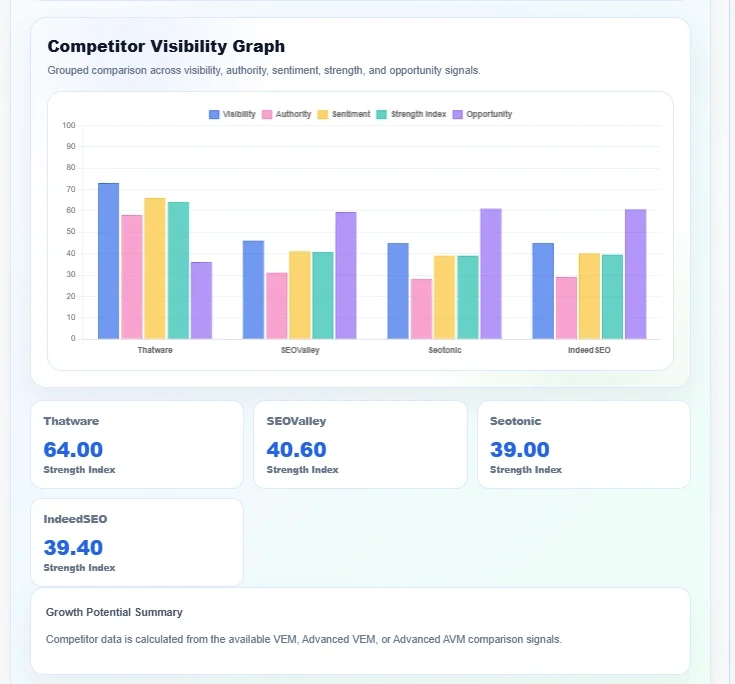
What do you mean by Competitor Visibility Graph?
Definition
A Competitor Visibility Graph is a visual representation that compares the visibility performance of a brand against its competitors across search engines, AI search platforms, answer engines, or visibility measurement frameworks such as AVM and VEM.
The graph helps organizations understand:
- Who has the highest visibility
- Who dominates AI-generated recommendations
- Which competitors are gaining market share
- Where visibility gaps exist
- How the brand performs relative to competitors
Instead of analyzing raw scores individually, the graph provides an immediate visual understanding of competitive positioning.
What does the Competitor Visibility Graph measure?
Depending on the framework being used, the graph may compare:
AVM Competitor Visibility
Measures:
- AI Visibility
- AI Citations
- Authority
- Recommendation Frequency
- Share of Voice
- Entity Strength
VEM Competitor Visibility
Measures:
- Engagement Visibility
- Audience Interaction
- Brand Recall
- Sentiment Strength
- Recommendation Impact
- Conversion Readiness
Combined Search Intelligence View
Measures:
- Visibility
- Engagement
- Authority
- Market Share
- Competitive Dominance
Why is Competitor Visibility Graph Important?
1. Provides Instant Competitive Benchmarking
Rather than reviewing multiple reports and metrics, the graph immediately shows:
- Who is leading
- Who is falling behind
- How large the visibility gap is
This allows organizations to quickly assess their competitive standing.
2. Identifies Market Leaders
The graph highlights which brands dominate visibility within a specific category.
For example:
| Brand | Visibility Score |
| Brand A | 82 |
| Brand B | 67 |
| Brand C | 41 |
The graph immediately reveals Brand A as the category leader.
This insight is valuable for strategic planning and market positioning.
3. Measures Competitive Gap
One of the most important functions of the Competitor Visibility Graph is identifying:
Visibility Deficit
How far behind competitors the brand is.
Visibility Advantage
How much stronger the brand is compared to competitors.
Understanding this gap helps organizations estimate:
- Required optimization effort
- Growth opportunities
- Competitive threats
4. Supports AI Search Optimization
In AI-powered search ecosystems, visibility determines whether a brand is:
- Mentioned
- Cited
- Recommended
- Compared
The Competitor Visibility Graph helps identify which competitors are dominating AI-generated conversations.
This is particularly important for:
- GEO
- AEO
- LLM SEO
- AI Visibility Optimization
5. Helps Prioritize Strategy
The graph makes it easier to identify where improvements are needed.
For example:
If a competitor has:
- Higher citations
- Better authority
- Stronger share of voice
then optimization efforts can focus specifically on those areas.
Use Cases
Competitive Intelligence
Monitor how visibility compares against competitors.
GEO Campaign Reporting
Measure improvements in AI search visibilityAI Visibility Measurement .
Market Share Analysis
Understand category ownership.
Executive Reporting
Provide leadership teams with an easy-to-understand visualization of market positioning.
Client Reporting
Demonstrate competitive advantages and opportunities.
Impact of a Strong Competitor Visibility Graph
When a brand consistently leads the Competitor Visibility Graph, it often experiences:
✅ More AI recommendations
✅ Greater share of voice
✅ Stronger entity authority
✅ Better market positioning
✅ Increased brand awareness
✅ Higher trust signals
✅ Better engagement opportunities
✅ Greater competitive advantage
Example
Scenario 1: Weak Competitive Position
| Brand | Visibility |
| Competitor A | 85 |
| Competitor B | 78 |
| Your Brand | 42 |
Interpretation
- Competitors dominate visibility.
- AI systems are more likely to mention competitors.
- Significant optimization is required.
Scenario 2: Strong Competitive Position
| Brand | Visibility |
| Your Brand | 82 |
| Competitor A | 61 |
| Competitor B | 49 |
Interpretation
- Your brand controls the visibility landscape.
- AI systems recognize and retrieve the brand more frequently.
- Recommendation potential is significantly higher.
Why It Matters in AVM & VEM
In AVM
The Competitor Visibility Graph answers:
“Who dominates AI visibility and recommendation opportunities?”
It measures competitive strength in:
- AI Discoverability
- Citations
- Authority
- Recommendation Probability
- Share of Voice
In VEM
The Competitor Visibility Graph answers:
“Who generates the strongest engagement and influence after visibility is achieved?”
It measures competitive strength in:
- User Engagement
- Brand Recall
- Sentiment
- Audience Trust
- Conversion Readiness
Exact points and findings captured from this report segment
- Thatware = 64.00
- SEOValley = 40.60
- Seotonic = 39.00
- IndeedSEO = 39.40
Explanation and analysis
The strength index confirms ThatWare’s competitive advantage: Thatware 64.00, SEOValley 40.60, Seotonic 39.00, and IndeedSEO 39.40. This shows a sizable gap but not full entity dominance.
The VEM section evaluates whether ThatWare has a strong entity foundation. Unlike AVM, which is focused on visibility inside AI-generated answers, VEM evaluates the underlying entity model: brand intelligence, content intelligence, authority intelligence, entity intelligence, AI readiness, and query intelligence. It asks whether the brand is semantically clear, machine-readable, externally validated, and structurally ready for AI recall.
Authority Intelligence within VEM assesses the quality and strength of external validation signals, including trusted citations, authoritative mentions, backlinks, industry recognition, and other credibility indicators that help AI systems verify the entity. The report finds that ThatWare has a developing but promising entity foundation. The brand is associated with AI SEO, AEO, GEO, and LLM SEO, and it benefits from broad off-page support. However, the report also identifies missing or unspecified assets such as organization schema, author schema, AI-readable files, sitemap structure, and explicit entity pages. These gaps reduce the ceiling of the VEM score because AI systems have to infer some relationships instead of reading them directly.
For SEO execution, the VEM findings point toward a structured content architecture. ThatWare needs canonical service pages, clear hub-and-spoke clusters, schema-backed definitions, author and organization context, internally linked proof pages, and high-trust external references. This is not only a technical SEO task; it is an entity-building task designed to help both search engines and AI systems understand the brand with less ambiguity.
What this means for AVM, VEM and SEO execution
For VEM growth, ThatWare should strengthen the brand-service relationship across its website and external profiles. The most valuable work includes entity pages, schema markup, author and organization proof, semantic service hubs, internal linking, and high-trust citations that reinforce the same category associations across multiple sources.
Segment 25: Growth Potential Summary, Winning Points, Negative Points and Recommendations
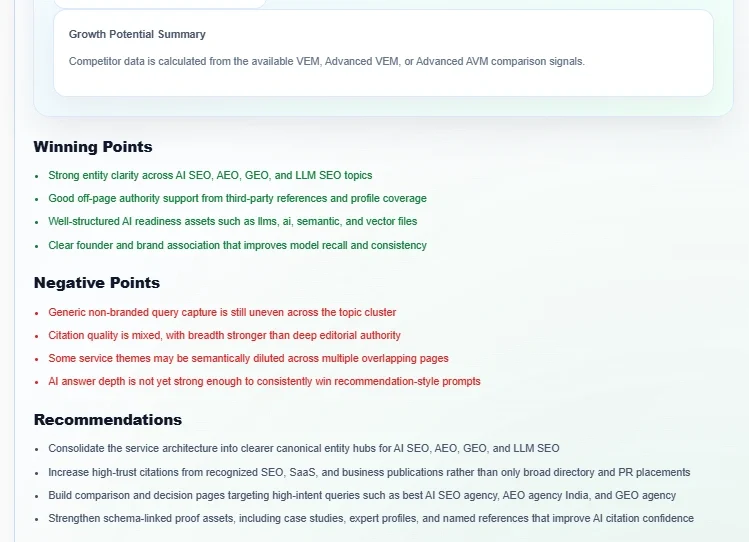
Exact points and findings captured from this report segment
- Competitor data is calculated from the available VEM, Advanced VEM, or Advanced AVM comparison signals.
- Winning Points Strong branded AI visibility and category association across AI SEO-related queries. Broad off-page support from a large backlink and PR footprint improves trust and
- discoverability. Clear relevance to the AI SEO, AEO, GEO, and LLM SEO cluster strengthens semantic positioning.
- Competitive standing is better than the peer set in the provided evidence. Negative Points Key entity assets such as schema, AI-readiness files, and structured site references
- are not provided. Generic non-branded discovery is still uneven, which limits broader AI recall. Citation depth is supportive but not strong enough to fully convert visibility into
- recommendation dominance. The current evidence leans heavily on PR breadth rather than tightly structured
- authority signals. Recommendations Implement strong organization, service, and author schema across the website to
- harden entity recognition. Publish dedicated content hubs for AI SEO, AEO, GEO, and LLM SEO with explicit
- internal linking and clear topical hierarchy. Add more high-trust citations from niche-relevant SEO, marketing, SaaS, and review
- platforms to strengthen authority and citation depth. Create AI-readable assets such as llms.txt, semantic sitemap, and clearly structured
- comparison pages to improve answer-engine readiness. 25/38
Explanation and analysis
The growth potential summary is direct: ThatWare wins on branded AI visibility, broad off-page support, relevance to the AI SEO/AEO/GEO/LLM SEO cluster, and competitive standing. It loses points for missing schema, AI-readiness files, structured references, uneven generic discovery, and citation depth.
The VEM section evaluates whether ThatWare has a strong entity foundation. Unlike AVM, which is focused on visibility inside AI-generated answers, VEM evaluates the underlying entity model: brand intelligence, content intelligence, authority intelligence, entity intelligence, AI readiness, and query intelligence. It asks whether the brand is semantically clear, machine-readable, externally validated, and structurally ready for AI recall. Authority Intelligence within VEM measures how effectively a brand is validated through trusted citations, industry mentions, authoritative references, and external signals that reinforce credibility across the web.
The report finds that ThatWare has a developing but promising entity foundation. The brand is associated with AI SEO, AEO, GEO, and LLM SEO, and it benefits from broad off-page support. However, the report also identifies missing or unspecified assets such as organization schema, author schema, AI-readable files, sitemap structure, and explicit entity pages. These gaps reduce the ceiling of the VEM score because AI systems have to infer some relationships instead of reading them directly.
For SEO execution, the VEM findings point toward a structured content architecture. ThatWare needs canonical service pages, clear hub-and-spoke clusters, schema-backed definitions, author and organization context, internally linked proof pages, and high-trust external references. This is not only a technical SEO task; it is an entity-building task designed to help both search engines and AI systems understand the brand with less ambiguity.
What this means for AVM, VEM and SEO execution
For VEM growth, ThatWare should strengthen the brand-service relationship across its website and external profiles. The most valuable work includes entity pages, schema markup, author and organization proof, semantic service hubs, internal linking, and high-trust citations that reinforce the same category associations across multiple sources.
Segment 26: VEM Score Breakdown and Advanced VEM Generation Prompt
VEM Score Breakdown
The VEM Score Breakdown explains how ThatWare performs across six important entity intelligence layers: Brand, Content, Authority, Entity, AI Readiness, and Query coverage. These signals help measure how clearly AI systems can understand, classify, retrieve, and recommend ThatWare in relation to AI SEO, AEO, GEO, and LLM SEO. Overall, the scores show that ThatWare has a strong brand and entity foundation, but still needs stronger structured content, machine-readable assets, and broader non-branded query coverage to improve AI search visibility.
What do you mean by Brand Score?
The Brand Score measures the strength, consistency, and recognition of the brand identity across digital channels, content assets, AI systems, citations, and external references.
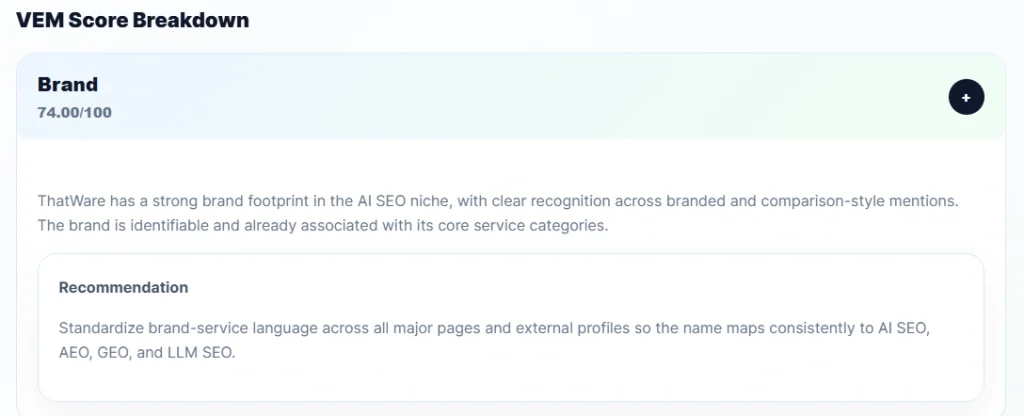
It evaluates:
- Brand recognition
- Naming consistency
- Service positioning
- Brand associations
- Entity standardization
- Market perception
This metric helps determine whether AI systems and users can clearly identify and understand the brand.
Why is this important?
A strong brand identity helps both users and AI systems consistently recognize and associate the brand with specific products, services, and expertise areas.
Without brand consistency:
- AI systems may struggle with entity recognition
- Brand associations become fragmented
- Recommendation confidence decreases
- Visibility becomes inconsistent
Strong brand signals create a stable foundation for long-term AI visibility and engagement.
ThatWare’s brand score of 74.00/100 shows a strong brand footprint in the AI SEO niche. The brand is already recognizable across branded searches and comparison-style mentions, which means AI systems can identify ThatWare and associate it with its core service categories. This is a positive signal because strong brand recognition helps improve entity recall, trust, and visibility in AI-generated answers.
However, to strengthen this further, ThatWare should maintain consistent brand-service language across all important pages and external profiles. The brand name should be repeatedly connected with AI SEO, AEO, GEO, and LLM SEO so that AI systems can map the company more clearly to these service areas.
Recommendation: Standardize brand-service language across website pages, business profiles, author bios, third-party citations, and external mentions so ThatWare is consistently understood as an AI SEO, AEO, GEO, and LLM SEO-focused entity.
What do you mean by Content Score?
The Content Score measures how effectively the website’s content covers relevant topics, user intents, and service categories.
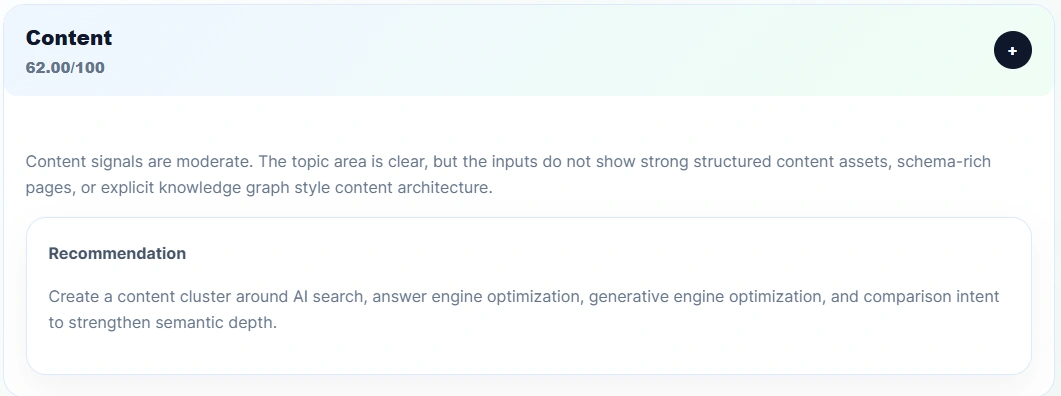
It evaluates:
- Topic relevance
- Content depth
- Semantic coverage
- Topical authority
- Internal linking
- Content structure
The score determines whether the content ecosystem is sufficient to establish expertise within a specific industry.
Why is this important?
Content acts as the primary source of information that AI systems use to understand a brand’s expertise.
Strong content helps:
- Improve AI discoverability
- Strengthen topical authority
- Support recommendation decisions
- Increase engagement opportunities
Without sufficient content coverage, brands struggle to achieve semantic ownership within their industry.
Impact
Higher Content Scores improve:
- AI visibility
- User engagement
- Search discoverability
- Topic ownership
- Recommendation potential
Content quality often determines how effectively visibility converts into engagement.
ThatWare’s content score of 62.00/100 indicates a moderate content foundation. The topic area is clear, and the brand is connected with advanced SEO and AI search concepts. However, the current signals do not show enough structured content assets, schema-rich pages, or knowledge graph-style content architecture.
This means the content ecosystem needs to become more organized, interconnected, and semantically deeper. So that it gets more AI Search Visibility. AI systems perform better AI Visibility Measurement when they can understand how topics, services, subtopics, entities, and proof points connect with each other. A stronger content cluster will help ThatWare improve topical authority and AI answer inclusion.
Recommendation: Build a content cluster around AI search, answer engine optimization, generative engine optimization, LLM SEO, and comparison-intent queries to strengthen semantic depth and topical coverage.
What do you mean by Authority Score?
The Authority Score measures the perceived credibility, expertise, and trustworthiness of the brand based on internal and external validation signals.
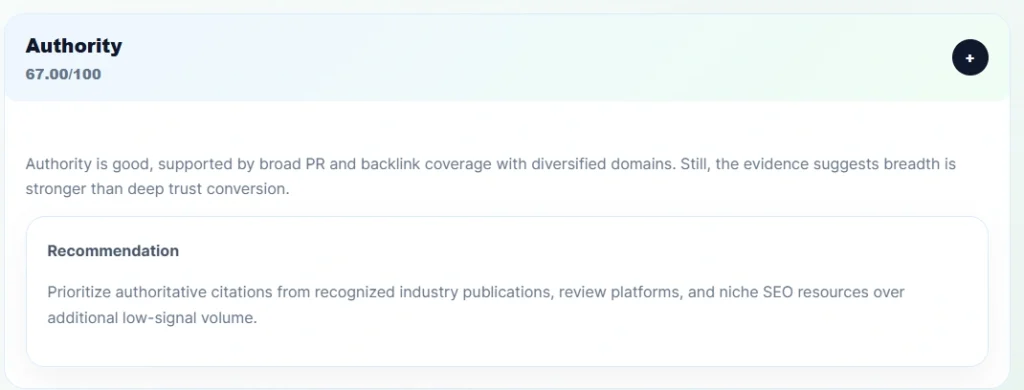
It evaluates:
- Citations
- Backlinks
- PR mentions
- Reviews
- Industry recognition
- Thought leadership
Authority helps determine how much confidence users and AI systems place in the brand.
Why is this important?
Users are more likely to engage with brands they trust.
Similarly, AI systems are more likely to recommend brands with stronger authority signals.
Authority serves as a validation layer that reinforces expertise and credibility.
Impact
Higher Authority Scores improve:
- User trust
- Recommendation confidence
- Citation frequency
- Brand credibility
- Competitive positioning
Strong authority significantly increases engagement and influence.
ThatWare’s authority score of 67.00/100 is good and shows that the brand has meaningful external support through PR coverage, backlinks, and diversified referring domains. This broad off-page footprint helps improve trust and discoverability.
However, the score also suggests that link breadth is stronger than deep authority conversion. In other words, ThatWare may have many external references, but not all of them may carry strong topical trust or citation value for AI systems. For better AI visibility, the focus should shift from volume to quality.
Recommendation: Prioritize authoritative citations from recognized industry publications, review platforms, niche SEO resources, SaaS directories, marketing publications, and trusted expert sources instead of building more low-signal links.
What do you mean by Entity Score?
The Entity Score measures how clearly AI systems understand the brand as a distinct entity within its market category.
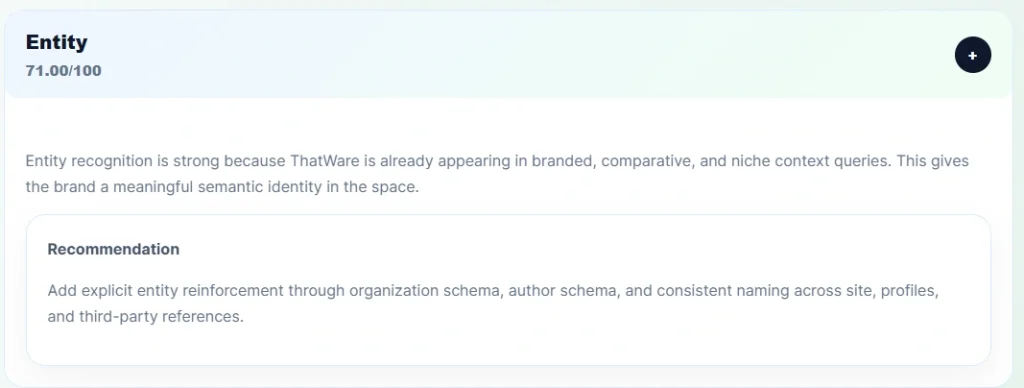
It evaluates:
- Entity recognition
- Category associations
- Brand-service relationships
- Topical ownership
- Knowledge Graph relevance
This score determines how effectively AI systems can identify and categorize the brand.
Why is this important?
AI-powered search is entity-driven.
AI systems do not simply understand websites; they understand entities and their relationships.
A strong entity profile helps AI systems:
- Understand expertise
- Associate services correctly
- Recommend brands confidently
- Maintain category consistency
Impact
Higher Entity Scores improve:
- AI understanding
- Category leadership
- Recommendation frequency
- Knowledge Graph visibility
- Search consistency
Entity strength is often one of the strongest predictors of long-term AI visibility success.
ThatWare’s entity score of 71.00/100 shows strong entity recognition. The brand is already appearing in branded, comparative, and niche-context queries, which gives it a meaningful semantic identity in the AI SEO space.
This is a valuable signal because AI systems need to understand not only that a brand exists, but also what it represents, which topics it belongs to, and how it compares with other entities. ThatWare already has a recognizable entity base, but it can become stronger with clearer structured signals.
Recommendation: Add explicit entity reinforcement through organization schema, author schema, service schema, consistent naming, sameAs references, and uniform brand descriptions across the website, profiles, directories, and third-party mentions.
What do you mean by AI Readiness Score?
The AI Readiness Score measures how effectively a website and brand are prepared for AI-powered search systems.
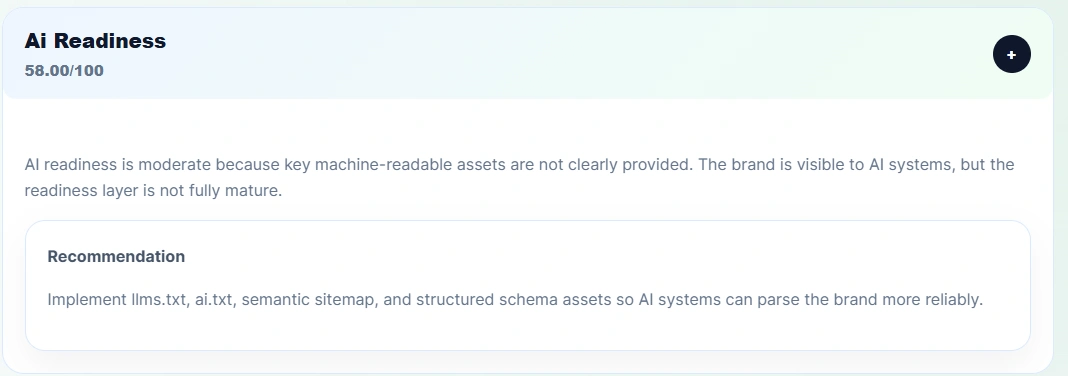
It evaluates:
- Schema implementation
- Structured data
- Machine-readable content
- Entity markup
- AI accessibility
- Technical AI optimization
This metric helps determine how easily AI systems can process, interpret, and retrieve brand information.
Why is this important?
Modern AI systems rely heavily on structured and machine-readable signals.
Brands that optimize for AI readiness improve their chances of:
- Being discovered
- Being cited
- Being recommended
- Being understood correctly
AI readiness has become a critical component of GEO, AEO, and LLM SEO strategies.
Impact
Higher AI Readiness Scores improve:
- AI discoverability
- Citation opportunities
- Recommendation confidence
- Entity understanding
- Machine interpretation
AI-ready brands generally perform better across AI search ecosystems.
ThatWare’s AI Readiness score of 58.00/100 shows a moderate level of machine-readability. The brand is visible to AI systems, but the technical readiness layer is not fully mature. Key AI-facing assets such as llms.txt, ai.txt, semantic sitemap, and structured schema signals are not clearly provided.
This limits how easily AI systems can parse, understand, and retrieve ThatWare’s brand information. A stronger AI readiness layer would make the website more accessible to AI crawlers, answer engines, and entity extraction systems.
Recommendation: Implement llms.txt, ai.txt, semantic sitemap, organization schema, service schema, author schema, and other structured data assets so AI systems can read, classify, and retrieve ThatWare’s entity information more reliably.
What do you mean by Query Score?
The Query Score measures how well the brand aligns with different user search intents and query categories.
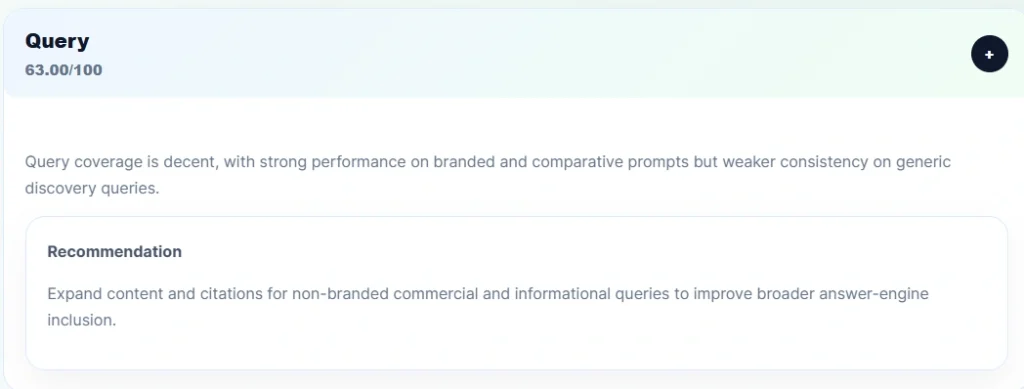
It evaluates visibility across:
- Branded queries
- Non-branded queries
- Commercial searches
- Informational searches
- Comparison searches
- Transactional searches
This score reflects how effectively the brand participates across the entire search journey.
Why is this important?
Search visibility is no longer limited to branded terms.
Users often discover brands through:
- Problem-solving searches
- Service searches
- Product comparisons
- Industry questions
Strong query alignment ensures that the brand appears throughout multiple stages of the customer journey.
Impact
Higher Query Scores improve:
- Non-branded visibility
- Market reach
- User acquisition opportunities
- AI recommendation coverage
- Search engagement
Strong query alignment helps transform visibility into broader audience engagement and business growth.
ThatWare’s query score of 63.00/100 shows decent query coverage. The brand performs well on branded and comparison-based prompts, which means it is visible when users search directly for ThatWare or compare it with related providers.
However, visibility is weaker across generic discovery queries. These include searches where users may ask for the best AI SEO agency, top GEO agency, AEO services in India, or LLM SEO companies without directly naming ThatWare. Improving this area is important because generic and non-branded queries often drive broader AI discovery. Strengthening Discovery Intelligence helps identify where the brand is missing from these high-opportunity query paths and reveals how AI systems surface providers during the early stages of user research.
Recommendation: Expand content and citations for non-branded commercial, informational, and comparison-intent queries so ThatWare can appear more consistently in broader AI-generated answers and answer-engine results.
Exact points and findings captured from this report segment
- ThatWare has strong brand recognition and category association in AI SEO and adjacent service lines.
- Recommendation
- Use a more consistent brand-service narrative across all pages and external profiles.
- Go deeper into entity ecosystem strength, knowledge graph readiness, AI citation probability, GEO readiness, competitor gaps, and strategic entity growth planning.
Explanation and analysis
The VEM score breakdown states that ThatWare has strong brand recognition and category association in AI SEO and adjacent service lines. The recommendation is to use a more consistent brand-service narrative across all pages and external profiles. From a query Intelligence perspective, stronger alignment between ThatWare’s services and branded, non-branded, comparative, and intent-driven queries can improve how AI systems connect the brand to relevant user discovery journeys.
The VEM section evaluates whether ThatWare has a strong entity foundation. Unlike AVM, which is focused on visibility inside AI-generated answers, VEM evaluates the underlying entity model: brand intelligence, content intelligence, authority intelligence, entity intelligence, AI readiness, and query intelligence. It asks whether the brand is semantically clear, machine-readable, externally validated, and structurally ready for AI recall.
The report finds that ThatWare has a developing but promising entity foundation. The brand is associated with AI SEO, AEO, GEO, and LLM SEO, and it benefits from broad off-page support. However, the report also identifies missing or unspecified assets such as organization schema, author schema, AI-readable files, sitemap structure, and explicit entity pages. These gaps reduce the ceiling of the VEM score because AI systems have to infer some relationships instead of reading them directly.
For SEO execution, the VEM findings point toward a structured content architecture. ThatWare needs canonical service pages, clear hub-and-spoke clusters, schema-backed definitions, author and organization context, internally linked proof pages, and high-trust external references. This is not only a technical SEO task; it is an entity-building task designed to help both search engines and AI systems understand the brand with less ambiguity.
What this means for AVM, VEM and SEO execution
For VEM growth, ThatWare should strengthen the brand-service relationship across its website and external profiles. The most valuable work includes entity pages, schema markup, author and organization proof, semantic service hubs, internal linking, and high-trust citations that reinforce the same category associations across multiple sources.
Advanced VEM Intelligence, Entity Roadmap, and Public Sharing
Segment 27: Advanced VEM Score Summary
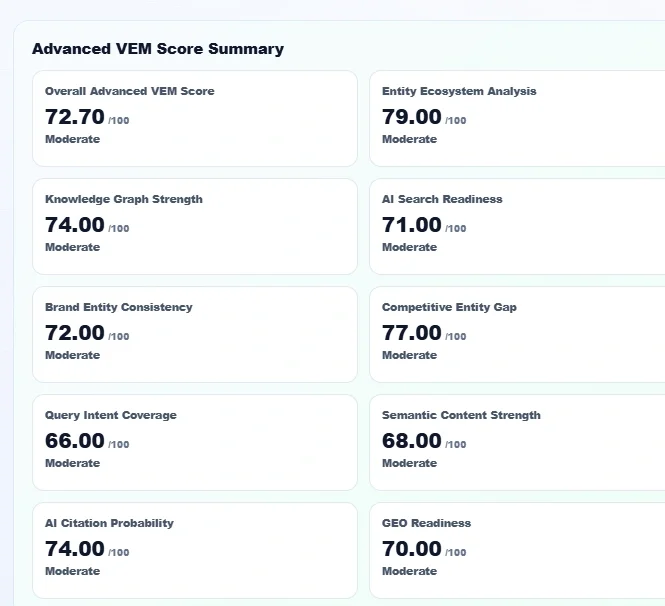
What do you mean by Overall Advanced VEM Score?
The Overall Advanced VEM Score represents the cumulative assessment of a brand’s engagement intelligence, entity maturity, AI readiness, semantic authority, citation potential, and search ecosystem performance.
Unlike the standard VEM score, Advanced VEM evaluates deeper factors that influence how AI systems, search engines, and users interpret and engage with a brand.
It combines multiple advanced dimensions including:
- Entity Ecosystem
- Knowledge Graph Strength
- AI Search Readiness
- Query Intent Coverage
- Semantic Authority
- Citation Probability
- GEO Readiness
Why is this important?
This score provides a holistic view of how prepared a brand is for modern search ecosystems.
It helps organizations understand:
- AI search competitiveness
- Entity maturity
- Search intelligence readiness
- Long-term visibility potential
Impact
Higher Advanced VEM scores improve:
- AI discoverability
- User engagement
- Recommendation opportunities
- Search ecosystem performance
- Competitive positioning
What do you mean by Entity Ecosystem Analysis?
Entity Ecosystem Analysis measures how well the brand is connected to relevant entities, services, topics, people, products, and industry concepts across the web.
It evaluates:
- Entity relationships
- Knowledge Graph associations
- Service connections
- Brand-topic alignment
- Digital ecosystem presence
Why is this important?
AI systems understand the web through entities and their relationships.
A strong entity ecosystem helps AI systems:
- Understand the brand faster
- Associate services correctly
- Improve recommendation confidence
Impact
Higher Entity Ecosystem Scores improve:
- Entity recognition
- Knowledge Graph strength
- Recommendation consistency
- Topical authority
What do you mean by Knowledge Graph Strength?
Knowledge Graph Strength measures how strongly the brand exists within structured knowledge ecosystems used by search engines and AI systems.
It evaluates:
- Entity validation
- Structured data
- Citation references
- Authority signals
- Relationship mapping
Why is this important?
Knowledge Graphs act as trust layers for AI systems.
Strong Knowledge Graph signals help AI engines:
- Verify the brand
- Understand expertise
- Improve recommendation confidence
Impact
Higher Knowledge Graph Strength improves:
- Entity certainty
- AI trust
- Recommendation probability
- Search visibility
What do you mean by AI Search Readiness?
AI Search Readiness measures how effectively the website and brand are optimized for AI-powered search engines and answer engines.
It evaluates:
- Schema implementation
- Structured content
- Machine readability
- Entity markup
- AI retrieval readiness
Why is this important?
Modern AI search engines rely heavily on structured data.
Without AI readiness, brands may struggle to:
- Be discovered
- Be cited
- Be recommended
- Be interpreted correctly
Impact
Higher AI Search Readiness improves:
- AI visibility
- Citation opportunities
- AI understanding
- Search performance
What do you mean by Brand Entity Consistency?
Brand Entity Consistency measures how consistently the brand is represented across:
- Website pages
- Citations
- Directories
- PR mentions
- Social profiles
- External references
Why is this important?
Inconsistent brand information creates confusion for both users and AI systems.
Consistency helps establish:
- Strong entity recognition
- Reliable trust signals
- Better recommendation confidence
Impact
Higher consistency improves:
- Entity trust
- Knowledge Graph alignment
- Brand recall
- Search stability
What do you mean by Competitive Entity Gap?
Competitive Entity Gap measures the brand’s entity strength relative to competing brands within the same category.
It evaluates:
- Entity maturity
- Category ownership
- Brand authority
- Competitive positioning
Why is this important?
Understanding entity gaps helps identify:
- Competitive advantages
- Competitive weaknesses
- Growth opportunities
Impact
A smaller entity gap improves:
- Market leadership
- AI recommendation frequency
- Competitive visibility
- Category dominance
What do you mean by Query Intent Coverage?
Query Intent Coverage measures how effectively the brand appears across multiple user intent categories.
It evaluates visibility across:
- Informational searches
- Commercial searches
- Transactional searches
- Comparative searches
- Branded searches
Why is this important?
Users search with different intentions.
Brands that only perform well for branded searches miss significant opportunities.
Strong intent coverage ensures visibility throughout the customer journey.
Impact
Higher Query Intent Coverage improves:
- Market reach
- Non-branded visibility
- Recommendation opportunities
- User acquisition
What do you mean by Semantic Content Strength?
Semantic Content Strength measures how comprehensively content covers topics, subtopics, related entities, and contextual relationships.
It evaluates:
- Topic depth
- Semantic relevance
- Content clustering
- Internal relationships
- Topical authority
Why is this important?
AI systems rely on semantic understanding rather than keyword matching.
Strong semantic content helps establish:
- Expertise
- Topic ownership
- Search relevance
Impact
Higher Semantic Content Strength improves:
- Topical authority
- AI discoverability
- User engagement
- Recommendation frequency
What do you mean by AI Citation Probability?
AI Citation Probability estimates the likelihood that AI systems will cite the brand when generating responses.
It evaluates:
- Citation signals
- Authority evidence
- Trust factors
- Reference quality
Why is this important?
Being visible is valuable.
Being cited is significantly more valuable because citations increase:
- Trust
- Recommendation confidence
- Brand authority
Impact
Higher Citation Probability improves:
- Citation frequency
- AI trust
- Recommendation likelihood
- Entity validation
What do you mean by GEO Readiness?
GEO Readiness measures how prepared the brand is for Generative Engine Optimization (GEO) and AI-powered search environments.
It evaluates:
- AI-friendly content
- Structured data
- Entity optimization
- Citation ecosystem
- Recommendation signals
Why is this important?
Future search ecosystems will increasingly rely on AI-generated answers.
Brands that optimize for GEO are more likely to:
- Be recommended
- Be cited
- Be included in AI responses
Impact
Higher GEO Readiness improves:
- AI visibility
- Recommendation opportunities
- Search competitiveness
- Long-term discoverability
Explanation and analysis
The Advanced VEM score summary gives an overall score of 67.80/100 with a Moderate label. Entity Ecosystem Analysis is 72, Knowledge Graph Strength 68, AI Search Readiness 61, Brand Entity Consistency 74, and Competitive Entity Gap 67. The lowest score again points to AI search readiness.
Advanced VEM turns entity analysis into a strategic growth roadmap. It evaluates entity ecosystem strength, knowledge graph strength, AI search readiness, brand entity consistency, competitive entity gap, query intent coverage, semantic content strength, AI citation probability, and GEO readiness. Knowledge Graph JSON can help define ThatWare’s brand, services, people, frameworks, and topical relationships in a structured format that supports stronger entity recognition. These dimensions reveal whether the brand can move from being visible to being confidently recalled and recommended across branded, non-branded, local, commercial, and comparison queries.
The Advanced VEM findings are moderate but constructive. ThatWare has recognizable brand consistency and a solid entity ecosystem, but stronger structured assets, tighter content hierarchy, and explicit AI-facing files are needed to increase AI recall and recommendation dominance. The roadmap correctly shifts the focus from broad promotion to entity architecture, schema coverage, semantic hubs, trusted citations, and long-term knowledge graph reinforcement.
For a 12-month SEO and AI discovery plan, this section is the most operational part of the report. It breaks the work into immediate audits, 60-day content and schema improvements, 90-day AI-readiness actions, six-month topic-cluster scaling, nine-month competitor and authority expansion, and one-year entity defensibility. This makes AVM and VEM practical rather than theoretical. Ultimately, the roadmap is designed to build stronger Discovery Intelligence, ensuring that visibility growth is measured, scalable, and aligned with how users and AI systems discover brands over time.
What this means for AVM, VEM and SEO execution
For Advanced VEM execution, the roadmap should be treated as a phased entity-building program. The first phase fixes schema, hierarchy, and audit gaps. The second phase publishes and updates entity-supporting content. The third phase launches AI-readable assets and proof sections. The later phases scale topic clusters, comparison visibility, third-party authority, and knowledge graph confidence.
Segment 28: Advanced VEM Secondary Scores and Executive Summary Start
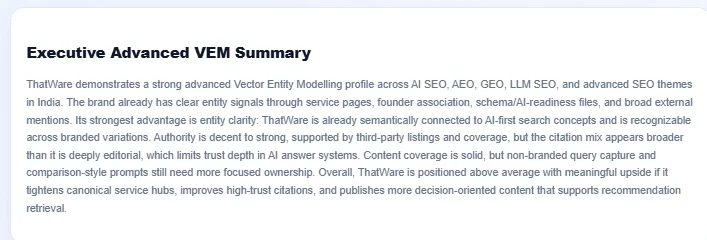
Exact points and findings captured from this report segment
- ThatWare demonstrates a solid advanced Vector Entity Modelling profile for an SEO agency in India, with strong brand recognition in AI SEO, AEO, GEO, and LLM SEO contexts.
- The current entity footprint is competitive and visible, but the profile is still constrained by missing structured assets and incomplete AI-facing infrastructure.
- The brand appears semantically relevant to the category and benefits from meaningful external authority signals, yet its machine-readable entity layer is not fully hardened.
- This creates a situation where ThatWare is discoverable and credible, but not yet maximally optimized for AI recall, answer inclusion.
Explanation and analysis
The secondary Advanced VEM scores are Query Intent Coverage 69, Semantic Content Strength 68, AI Citation Probability 66, and GEO Readiness 63. These all sit in a moderate range, meaning the foundations exist but need reinforcement to become dominant.
Advanced VEM turns entity analysis into a strategic growth roadmap. It evaluates entity ecosystem strength, knowledge graph strength, AI search readiness, brand entity consistency, competitive entity gap, query intent coverage, semantic content strength, AI citation probability, and GEO readiness. These dimensions reveal whether the brand can move from being visible to being confidently recalled and recommended across branded, non-branded, local, commercial, and comparison queries.
The Advanced VEM findings are moderate but constructive. ThatWare has recognizable brand consistency and a solid entity ecosystem, but stronger structured assets, tighter content hierarchy, and explicit AI-facing files are needed to increase AI recall and recommendation dominance. The roadmap correctly shifts the focus from broad promotion to entity architecture, schema coverage, semantic hubs, trusted citations, and long-term knowledge graph reinforcement.
For a 12-month SEO and AI discovery plan, this section is the most operational part of the report. It breaks the work into immediate audits, 60-day content and schema improvements, 90-day AI-readiness actions, six-month topic-cluster scaling, nine-month competitor and authority expansion, and one-year entity defensibility. This makes AVM and VEM practical rather than theoretical. A detailed llmsfull.txt file can give AI systems a fuller map of ThatWare’s brand information, service hierarchy, content priorities, and entity signals.
What this means for AVM, VEM and SEO execution
For Advanced VEM execution, the roadmap should be treated as a phased entity-building program. The first phase fixes schema, hierarchy, and audit gaps. The second phase publishes and updates entity-supporting content. The third phase launches AI-readable assets and proof sections. The later phases scale topic clusters, comparison visibility, third-party authority, and knowledge graph confidence.
Segment 29: Advanced VEM Competitor Entity Comparison
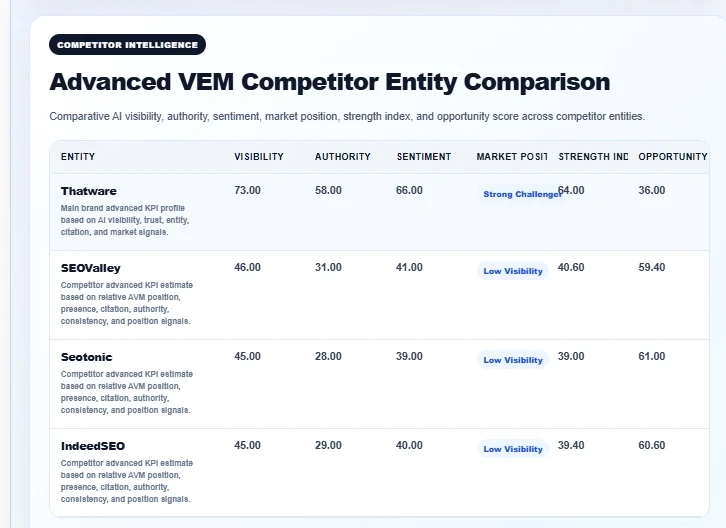
Explanation and analysis
The Advanced VEM competitor entity comparison repeats the same competitive pattern: ThatWare has stronger visibility, authority, and sentiment than the competitor set, while the competitors are categorized with lower visibility relative to the submitted evidence.
Advanced VEM turns entity analysis into a strategic growth roadmap. It evaluates entity ecosystem strength, knowledge graph strength, AI search readiness, brand entity consistency, competitive entity gap, query intent coverage, semantic content strength, AI citation probability, and GEO readiness. These dimensions reveal whether the brand can move from being visible to being confidently recalled and recommended across branded, non-branded, local, commercial, and comparison queries.
The Advanced VEM findings are moderate but constructive. ThatWare has recognizable brand consistency and a solid entity ecosystem, but stronger structured assets, tighter content hierarchy, and explicit AI-facing files are needed to increase AI recall and recommendation dominance. The roadmap correctly shifts the focus from broad promotion to entity architecture, schema coverage, semantic hubs, trusted citations, and long-term knowledge graph reinforcement.
For a 12-month SEO and AI discovery plan, this section is the most operational part of the report. It breaks the work into immediate audits, 60-day content and schema improvements, 90-day AI-readiness actions, six-month topic-cluster scaling, nine-month competitor and authority expansion, and one-year entity defensibility. This makes AVM and VEM practical rather than theoretical.
What this means for AVM, VEM and SEO execution
For Advanced VEM execution, the roadmap should be treated as a phased entity-building program. The first phase fixes schema, hierarchy, and audit gaps. The second phase publishes and updates entity-supporting content. The third phase launches AI-readable assets and proof sections. The later phases scale topic clusters, comparison visibility, third-party authority, and knowledge graph confidence.
Segment 30: Advanced VEM Competitor Visibility Graph and Strength Indexes
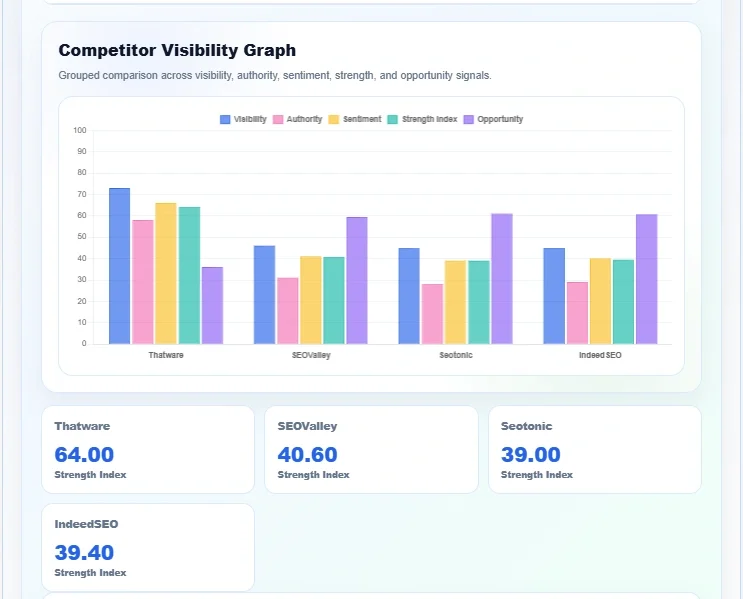
Exact points and findings captured from this report segment
- Thatware = 64.00
- SEOValley = 40.60
- Seotonic = 39.00
- IndeedSEO = 39.40
Explanation and analysis
The Advanced VEM competitor graph and strength indexes repeat the same strategic message: ThatWare’s entity profile is stronger than SEOValley, Seotonic, and IndeedSEO, but the opportunity remains to move from relative leadership to category-level dominance.
Advanced VEM turns entity analysis into a strategic growth roadmap. It evaluates entity ecosystem strength, knowledge graph strength, AI search readiness, brand entity consistency, competitive entity gap, query intent coverage, semantic content strength, AI citation probability, and GEO readiness. These dimensions reveal whether the brand can move from being visible to being confidently recalled and recommended across branded, non-branded, local, commercial, and comparison queries.
The Advanced VEM findings are moderate but constructive. ThatWare has recognizable brand consistency and a solid entity ecosystem, but stronger structured assets, tighter content hierarchy, and explicit AI-facing files are needed to increase AI recall and recommendation dominance. The roadmap correctly shifts the focus from broad promotion to entity architecture, schema coverage, semantic hubs, trusted citations, and long-term knowledge graph reinforcement.
For a 12-month SEO and AI discovery plan, this section is the most operational part of the report. It breaks the work into immediate audits, 60-day content and schema improvements, 90-day AI-readiness actions, six-month topic-cluster scaling, nine-month competitor and authority expansion, and one-year entity defensibility. This makes AVM and VEM practical rather than theoretical.
What this means for AVM, VEM and SEO execution
For Advanced VEM execution, the roadmap should be treated as a phased entity-building program. The first phase fixes schema, hierarchy, and audit gaps. The second phase publishes and updates entity-supporting content. The third phase launches AI-readable assets and proof sections. The later phases scale topic clusters, comparison visibility, third-party authority, and knowledge graph confidence.
Segment 31: Detailed Intelligence Breakdown: Analysis, Risks, Opportunities and Recommendations
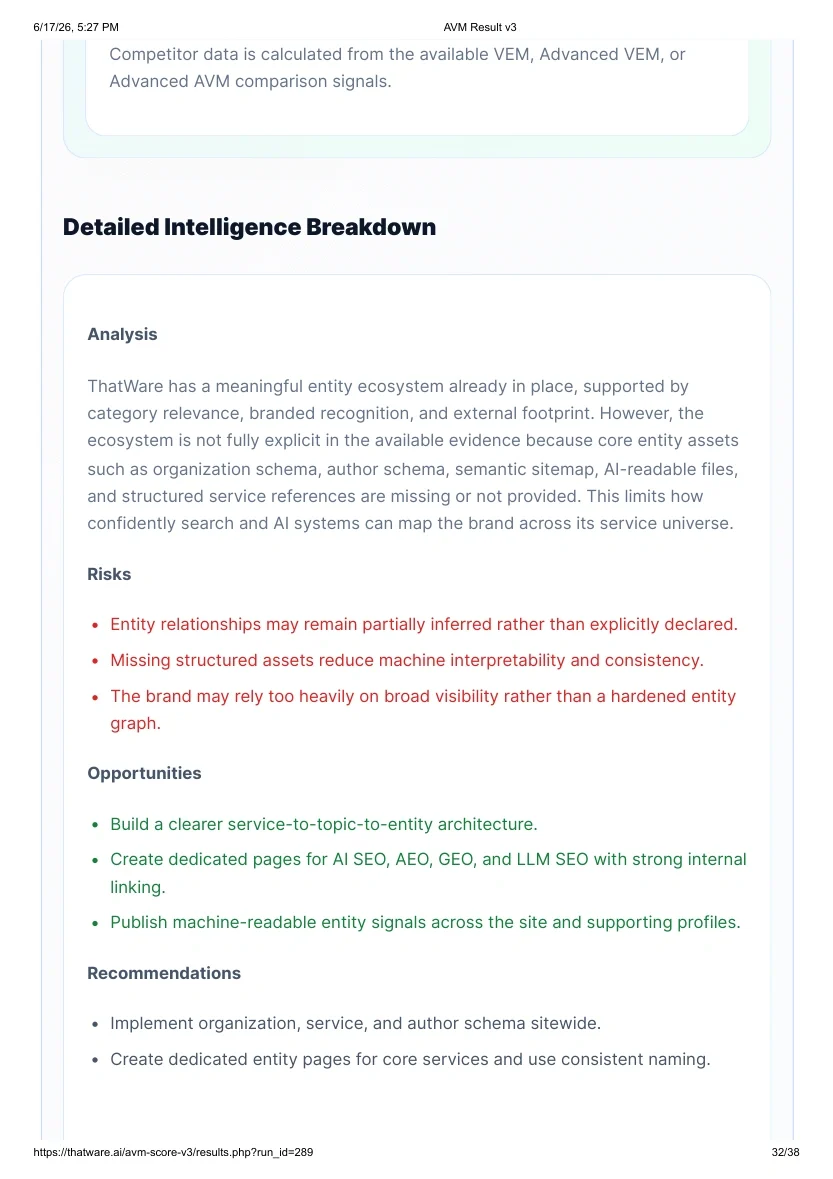
Exact points and findings captured from this report segment
- Competitor data is calculated from the available VEM, Advanced VEM, or Advanced AVM comparison signals.
- Detailed Intelligence Breakdown Analysis ThatWare has a meaningful entity ecosystem already in place, supported by category relevance, branded recognition, and external footprint.
- However, the ecosystem is not fully explicit in the available evidence because core entity assets such as organization schema, author schema, semantic sitemap, AI-readable files, and structured service references are missing or not provided.
- This limits how confidently search and AI systems can map the brand across its service universe.
- Risk Entity relationships may remain partially inferred rather than explicitly declared.
- Missing structured assets reduce machine interpretability and consistency. The brand may rely too heavily on broad visibility rather than a hardened entity graph.
- Opportunities: Build a clearer service-to-topic-to-entity architecture. Create dedicated pages for AI SEO, AEO, GEO, and LLM SEO with strong internal linking.
- Publish machine-readable entity signals across the site and supporting profiles.
- Recommendations: Implement organization, service, and author schema sitewide. Create dedicated entity pages for core services and use consistent naming.
Explanation and analysis
The detailed intelligence breakdown names the core risk: entity relationships may remain partially inferred rather than explicitly declared. It recommends clearer service-to-topic-to-entity architecture, dedicated AI SEO/AEO/GEO/LLM SEO pages, machine-readable entity signals, and sitewide organization, service, and author schema.
Advanced VEM turns entity analysis into a strategic growth roadmap. It evaluates entity ecosystem strength, knowledge graph strength, AI search readiness, brand entity consistency, competitive entity gap, query intent coverage, semantic content strength, AI citation probability, and GEO readiness. These dimensions reveal whether the brand can move from being visible to being confidently recalled and recommended across branded, non-branded, local, commercial, and comparison queries.
The Advanced VEM findings are moderate but constructive. ThatWare has recognizable brand consistency and a solid entity ecosystem, but stronger structured assets, tighter content hierarchy, and explicit AI-facing files are needed to increase AI recall and recommendation dominance. The roadmap correctly shifts the focus from broad promotion to entity architecture, schema coverage, semantic hubs, trusted citations, and long-term knowledge graph reinforcement.
For a 12-month SEO and AI discovery plan, this section is the most operational part of the report. It breaks the work into immediate audits, 60-day content and schema improvements, 90-day AI-readiness actions, six-month topic-cluster scaling, nine-month competitor and authority expansion, and one-year entity defensibility. This makes AVM and VEM practical rather than theoretical.
What this means for AVM, VEM and SEO execution
For Advanced VEM execution, the roadmap should be treated as a phased entity-building program. The first phase fixes schema, hierarchy, and audit gaps. The second phase publishes and updates entity-supporting content. The third phase launches AI-readable assets and proof sections. The later phases scale topic clusters, comparison visibility, third-party authority, and knowledge graph confidence.
Segment 32: Entity Resolution Recommendation Completion
Detailed Intelligence Breakdown
The Detailed Intelligence Breakdown explains how ThatWare performs across the deeper layers of entity understanding, AI search readiness, knowledge graph strength, semantic content, competitive positioning, and generative search visibility. These scores show that ThatWare already has a strong AI-first entity foundation, especially around AI SEO, AEO, GEO, and LLM SEO. However, the findings also show that the next stage of growth depends on better canonical structure, stronger proof signals, higher-quality citations, and clearer machine-readable assets.
What do you mean by Entity Ecosystem Analysis?
Entity Ecosystem Analysis measures how well a brand is connected, understood, and validated across the broader digital ecosystem.
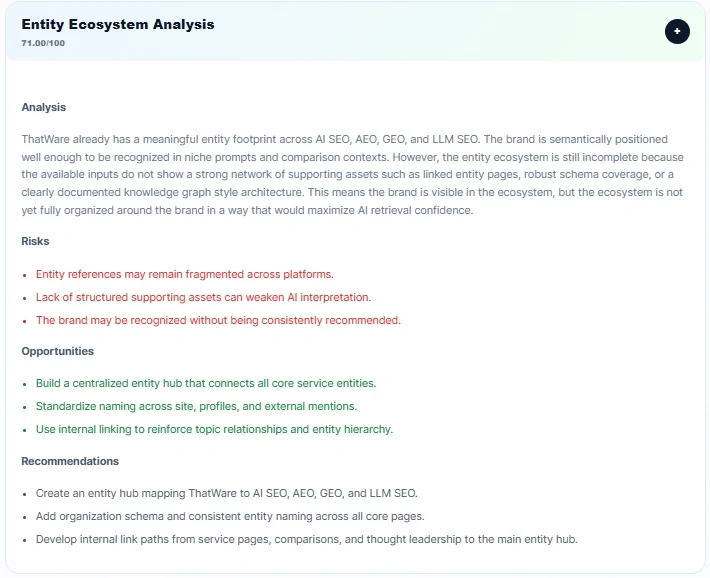
In modern AI search environments, a brand is not evaluated as a standalone website. Instead, AI systems analyze the complete network of relationships surrounding that brand, including:
- Organization entities
- Founders and key people
- Services and products
- Industry categories
- Citations and references
- Social profiles
- Knowledge Graph entities
- Third-party mentions
- Partner relationships
- Review platforms
- Directories and business listings
Entity Ecosystem Analysis evaluates how effectively these connections work together to establish a strong and trustworthy digital identity.
In simple terms:
Entity Ecosystem Analysis measures how well AI systems understand the complete digital footprint of a brand and its relationships across the web.
Why is this important?
AI Systems Understand Entities, Not Just Websites
Traditional SEO focused on webpages and keywords.
Modern AI systems such as:
- ChatGPT
- Gemini
- Claude
- Perplexity
- Google AI Overviews
primarily rely on entity understanding.
A strong entity ecosystem helps AI systems answer questions such as:
- Who is this company?
- What services do they provide?
- Who are their founders?
- What topics do they own?
- Which brands are associated with them?
- Can they be trusted?
ThatWare scores 79.00/100 in Entity Ecosystem Analysis, showing that the brand has a strong and well-developed entity footprint across its main topic cluster. The brand, founder, service themes, and AI-readiness assets work together to help search engines and AI systems associate ThatWare with AI SEO, AEO, GEO, and LLM SEO.
This is a positive signal because the report does not point to a thin or isolated landing-page setup. Instead, ThatWare appears to have multiple service pages and supporting assets that create a broader service architecture. This helps machines understand that the brand is not simply mentioning AI SEO, but is actively building a connected ecosystem around it.
The main limitation is topical overlap. When related service themes are spread across multiple pages without a clear canonical structure, signals can become diluted. AI systems may understand that ThatWare is relevant, but they may not always know which page is the strongest source for each service category.
Risks:
Overlapping service pages may split topical authority across similar search intents. Some entity associations may already be strong, but not fully canonicalized. A broad service vocabulary may also confuse AI interpretation if every page does not have a distinct purpose.
Opportunities:
ThatWare can create dedicated canonical hubs for AI SEO, AEO, GEO, and LLM SEO. Founder and expert bios can be used to reinforce named-entity relationships. Entity-aligned case studies and service relationship schema can also help connect the brand, people, services, and proof assets.
Recommendations:
Each core service should be mapped to one primary canonical page. Brand, founder, and service relationships should be reinforced through schema and internal links. Semantically similar pages should be consolidated or clearly separated by search intent.
What do you mean by Knowledge Graph Strength?
Knowledge Graph Strength measures how strongly a brand, organization, product, service, or entity is recognized, connected, and validated within structured knowledge systems used by search engines and AI platforms.
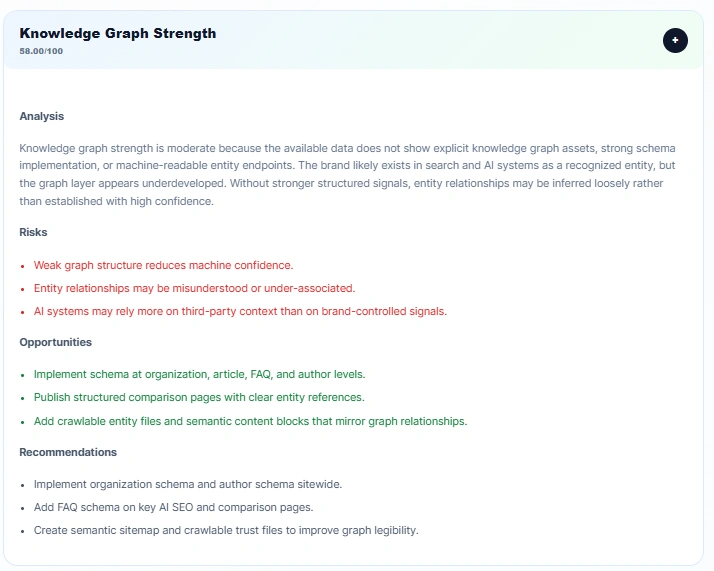
These systems include:
- Google Knowledge Graph
- Bing Knowledge Graph
- ChatGPT Entity Recognition Systems
- Gemini Knowledge Models
- Claude Entity Networks
- Perplexity Knowledge Retrieval Systems
Knowledge Graph Strength evaluates how effectively AI systems understand:
- Who the brand is
- What services it provides
- Which industry it belongs to
- Who is associated with it
- How it relates to other entities
In simple terms:
Knowledge Graph Strength measures how well a brand exists as a trusted and recognized entity inside AI and search engine knowledge systems.
Why is this important?
AI Systems Rely on Knowledge Graphs
Modern AI systems do not simply crawl webpages.
Instead, they use structured knowledge networks to verify:
- Brands
- Organizations
- People
- Services
- Products
- Locations
Before recommending a brand, AI systems often look for Knowledge Graph validation.
Improves AI Understanding
A strong Knowledge Graph helps AI systems clearly understand:
- Brand identity
- Service offerings
- Expertise areas
- Market positioning
- Industry relationships
This reduces ambiguity and improves recommendation confidence.
Increases Entity Trust
Knowledge Graphs serve as a trust layer.
When a brand has strong Knowledge Graph associations, AI systems are more likely to view it as:
- Legitimate
- Established
- Authoritative
- Reliable
Supports Citation Generation
AI systems prefer citing brands that have strong entity validation.
Knowledge Graph strength helps AI systems:
- Verify facts
- Confirm entity relationships
- Generate more confident citations
Strengthens Recommendation Probability
AI recommendation engines typically favor entities with stronger knowledge representation. Strong AI Recommendation Signals help establish the authority and credibility that AI systems rely on when generating recommendations.
Brands with stronger Knowledge Graph signals are more likely to appear in:
- AI-generated answers
- Recommendation lists
- Comparisons
- Category discussions
Impact
Higher AI Visibility
Knowledge Graph validation increases discoverability across AI platforms.
Better Entity Recognition
AI systems understand the brand more accurately and consistently.
Stronger Citation Opportunities
Well-established entities are cited more frequently.
Increased Recommendation Confidence
AI systems are more comfortable recommending validated entities.
Greater Authority Signals
Knowledge Graph strength reinforces expertise and trustworthiness.
Improved Competitive Positioning
Brands with stronger Knowledge Graph profiles often outperform competitors in:
- AI Visibility
- Citation Frequency
- Recommendation Probability
- Entity Dominance
- Share of Voice
ThatWare scores 74.00/100 in Knowledge Graph Strength. This indicates a decent knowledge graph-style footprint, supported by linked entity signals across social profiles, founder references, organization references, and structured AI endpoint files.
This helps improve recognizability because AI systems rely on repeated and consistent references to understand whether a brand, person, service, or product is part of a reliable entity network. ThatWare already has enough graph breadth to be identified across different contexts.
However, the trust quality of the graph is mixed. Some references appear to come from directory-style or profile-based sources rather than high-authority editorial publications. This creates a situation where ThatWare has graph coverage, but not yet maximum graph confidence.
Risks:
Graph quality may be limited by a mixed source profile. Social and directory references may not carry enough authority on their own. Inconsistent source quality can reduce confidence in entity resolution.
Opportunities:
ThatWare should increase mentions in recognized business, SEO, SaaS, and technology publications. Organization and person schema should be strengthened with consistent identifiers. A structured entity map can also describe the relationship between services, founder, brand, and product names.
Recommendations:
ThatWare should prioritize authoritative citations over broad profile coverage. The same brand and founder naming should be used across all external assets. A public entity reference page should be published to connect services, products, leadership, and brand identity in one place.
What do you mean by AI Search Readiness?
AI Search Readiness measures how well a website and brand are optimized for AI-powered search engines and answer engines such as ChatGPT, Gemini, Claude, Perplexity, and Google AI Overviews.
Why is this important?
A higher AI Search Readiness score improves the chances of being discovered, understood, cited, and recommended by AI systems. It helps ensure that AI can accurately interpret the brand’s content, services, and expertise.
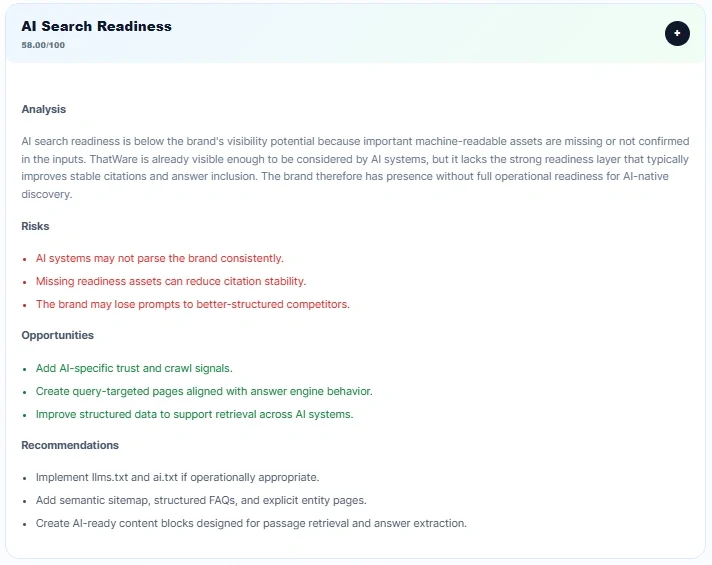
ThatWare scores 71.00/100 in AI Search Readiness, which shows an above-average foundation for AI interpretation. The presence of machine-friendly assets such as ai.txt, llms.txt, ai-manifesto.json, semantic sitemap, and vector feed files indicates that the brand is already preparing for AI-led discovery.
These assets are valuable because AI systems need clear, crawlable, and structured information to understand what a brand does, who it serves, which services it offers, and why it should be trusted. ThatWare has already taken important steps in this direction.
The next opportunity is refinement. AI-readiness files should not only exist; they should contain sharp entity definitions, concise service summaries, founder references, proof signals, and clear canonical relationships. The goal is to help AI systems understand ThatWare quickly and confidently.
Risks:
AI files may exist but still be under-optimized for entity clarity. Crawl-friendly assets do not automatically guarantee recommendation ownership. If content depth is weak, AI systems may still choose competitors with stronger proof structures.
Opportunities:
ThatWare can improve AI endpoint files with explicit brand, service, and founder descriptions. Each core service page should include machine-readable summaries. Structured FAQ sections and proof modules can also improve answer extraction.
Recommendations:
All AI-readiness files should be audited and enriched with concise entity definitions. The semantic sitemap and vector feed should be aligned with canonical service hubs. High-intent pages should include machine-readable proof blocks that make it easier for AI systems to cite ThatWare.
What do you mean by Brand Entity Consistency?
Brand Entity Consistency measures how consistently the brand’s information, messaging, services, and identity are represented across websites, citations, directories, social profiles, and third-party sources.
Why is this important?
Consistent entity signals help AI systems confidently recognize and validate the brand, improving trust, visibility, citations, and recommendation accuracy.
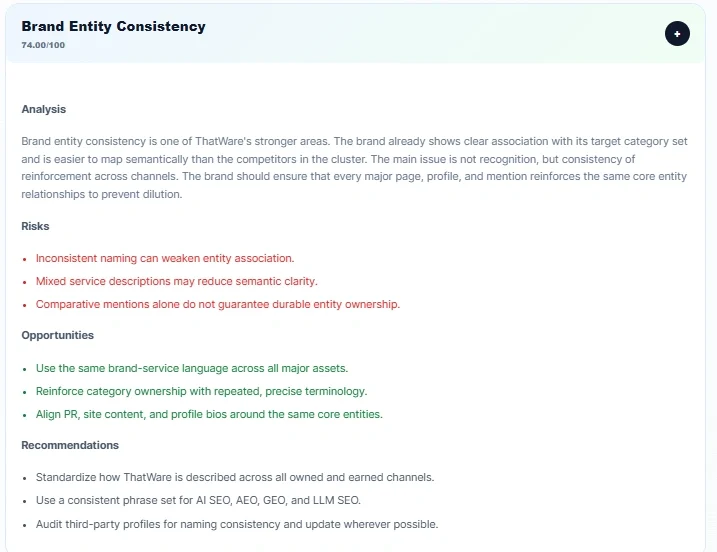
ThatWare scores 72.00/100 in Brand Entity Consistency. This means the brand is recognizable across different query forms, topic variations, and AI-first SEO concepts. ThatWare already has a clear identity in the AI SEO space.
The challenge is that ThatWare uses multiple service labels, innovation terms, and framework-style concepts. While this can support thought leadership, it may also weaken consistency if the dominant brand narrative is not maintained across all assets.
The brand should have one central storyline. Product names, framework names, and service variations should support that storyline rather than compete with it. This helps AI systems connect every mention back to one clear entity.
Risks:
Too many service or framework labels can weaken the central brand narrative. Brand language may vary across pages and external profiles. Inconsistent naming can reduce recall in AI-generated answers.
Opportunities:
ThatWare can use one dominant positioning statement across the website, profiles, citations, and service pages. Service names and abbreviations should be standardized. Founder-led thought leadership can also become a consistent proof layer for the brand.
Recommendations:
A master brand narrative should be defined for all AI SEO-related offerings. Titles, bios, and service descriptions should remain aligned across every channel. The same descriptive phrasing should be used for core offerings wherever possible.
What do you mean by Competitive Entity Gap Analysis?
Competitive Entity Gap Analysis measures the difference between a brand’s entity strength and that of its competitors in terms of authority, recognition, citations, and category ownership.
Why is this important?
It helps identify where competitors have stronger entity signals and reveals opportunities to improve authority, visibility, and market positioning.
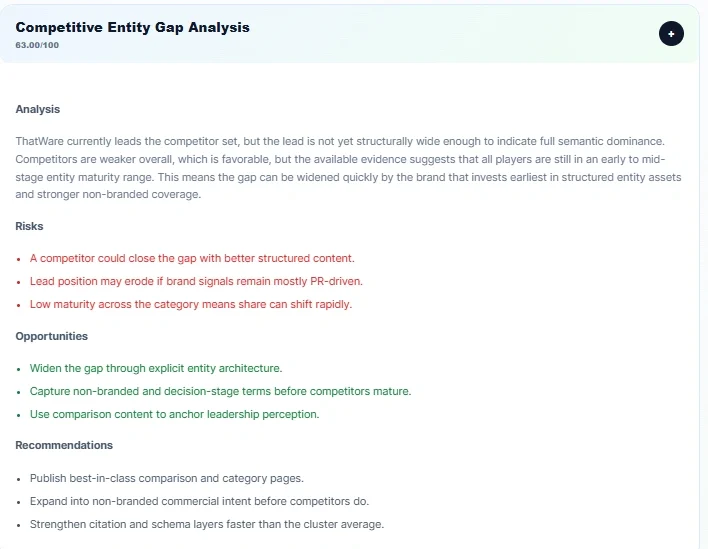
ThatWare scores 77.00/100 in Competitive Entity Gap Analysis, showing that it currently holds a stronger entity and visibility position than the named competitors. This is a meaningful advantage, especially because the competitor set appears clustered in a similar mid-band.
ThatWare’s biggest strength is breadth of association. The brand is connected to AI SEO, AEO, GEO, and LLM SEO across multiple signals. However, the gap is not yet large enough to guarantee universal retrieval on generic, commercial, or recommendation-based prompts.
The biggest growth opportunity is to convert entity breadth into proof depth. ThatWare should focus on comparison pages, named outcomes, editorial proof, and stronger citation quality to make the competitive gap harder to close.
Risks:
Competitors can close the gap by publishing focused editorial proof and comparison content. A strong entity base may still lose purchase-stage prompts if query dominance is weak. Competitor overlap in the same topic cluster can also create visibility volatility.
Opportunities:
ThatWare can own comparison pages such as “ThatWare vs traditional SEO” and “best AI SEO agency.” It can also publish proof-led assets that competitors cannot easily copy. High-trust mentions can further widen the authority gap.
Recommendations:
Comparison-led content should be created for every major service cluster. Case studies and named outcomes should be used to deepen proof weight. Competitor wins on generic prompts should be tracked and answered with dedicated content assets.
What do you mean by Query Intent Coverage Analysis?
Query Intent Coverage Analysis evaluates how well a brand appears across different search intents, including informational, commercial, transactional, navigational, and comparison-based queries.
Why is this important?
Strong intent coverage ensures visibility throughout the entire customer journey, helping brands attract users at multiple stages of decision-making and increasing recommendation opportunities.
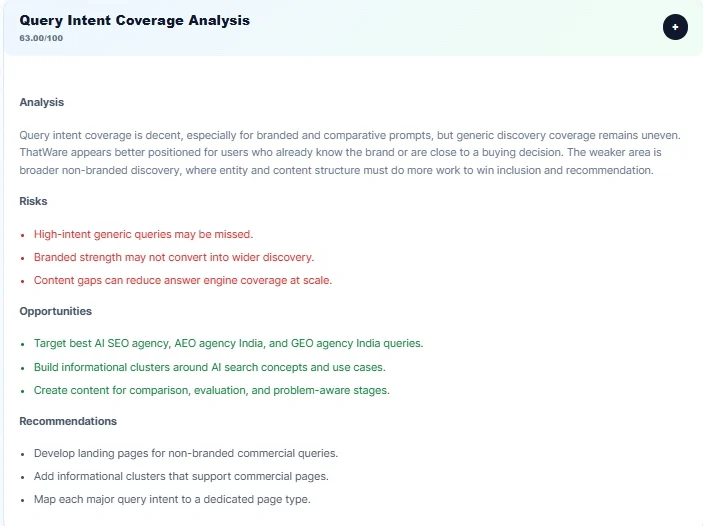
ThatWare scores 66.00/100 in Query Intent Coverage Analysis. This means its query coverage is decent, but not yet strong enough to fully dominate non-branded discovery.
The brand already performs well across branded, commercial, and comparative themes. However, coverage is not equally strong across informational, decision-stage, alternative-intent, and generic discovery searches. This creates a gap in high-intent queries such as “best AI SEO agency,” “AEO agency India,” and “GEO agency.”
To improve, ThatWare needs dedicated, conversion-ready pages that match specific intent types. Each page should include FAQs, proof sections, service explanations, comparison blocks, and internal links to the right canonical hub.
Risks:
Non-branded discovery may remain inconsistent. Comparative and recommendation prompts may prefer competitors with better-structured content. Mixed-intent pages may fail to satisfy exact search goals.
Opportunities:
ThatWare can create dedicated pages for comparison, alternatives, and selection-based searches. FAQ clusters can address buyer questions and service differentiation. India-specific commercial landing pages can also help improve local and regional intent coverage.
Recommendations:
Branded, non-branded, and comparison intent should be separated into distinct content assets. Commercial pages should be expanded for “best,” “top,” “vs,” and “agency” queries. Internal linking should guide users and AI systems toward the most relevant hub.
What do you mean by Semantic Content Strength?
Semantic Content Strength measures how comprehensively content covers a topic, including related entities, subtopics, contextual relationships, and user intent.
Why is this important?
Strong semantic content helps AI systems better understand expertise, improves topical authority, and increases the likelihood of appearing in AI-generated answers and recommendations.
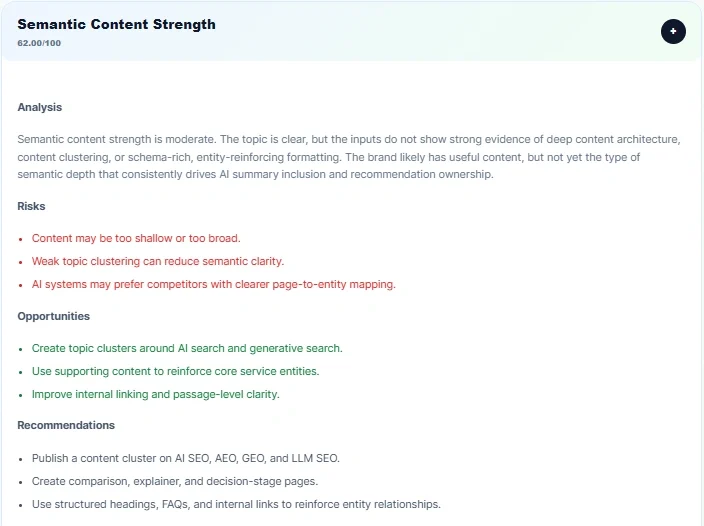
ThatWare scores 68.00/100 in Semantic Content Strength. This shows that the brand has a solid topical footprint around AI SEO and related service themes. Multiple pages and supporting content already help establish relevance.
The challenge is semantic differentiation. Some topics may be closely related, which can make it difficult for search engines and AI systems to understand the unique role of each page. For example, AI SEO, AEO, GEO, and LLM SEO are connected, but each needs a distinct explanation, use case, outcome, and content structure.
Stronger semantic clarity will improve retrieval precision. ThatWare should make each service page more specific, more useful, and more clearly connected to a larger hub-and-spoke architecture.
Risks:
Semantic overlap can weaken topical focus. Supporting content may not be differentiated enough for AI extraction. Pages may use similar vocabulary without enough unique informational value.
Opportunities:
ThatWare can build content clusters around use cases, methodologies, outcomes, and proof. Glossary-style definitions and FAQs can strengthen semantic coverage. Topic-specific subpages can support each core service outcome.
Recommendations:
A content architecture should be developed with one main hub and multiple supporting spokes per service. Related but distinct topics should be connected through internal links. Headings, introductions, and FAQs should clearly explain the semantic difference between each service.
What do you mean by AI Citation Probability?
AI Citation Probability estimates how likely AI systems are to cite, reference, or mention a brand when generating responses to user queries.
Why is this important?
Higher citation probability increases AI trust, authority recognition, brand visibility, and recommendation frequency across AI-powered search platforms.
ThatWare scores 74.00/100 in AI Citation Probability, which means it has a good chance of being cited by AI systems. This is supported by its recognizable entity footprint, external references, and relevance to AI SEO-related topics.
The probability is stronger for branded and category-aware prompts. For example, AI systems are more likely to mention ThatWare when the query already includes the brand or refers to known service areas. However, highly competitive recommendation prompts require stronger proof and higher-trust citations.
The main limitation is citation quality. Broad mention volume helps, but AI systems are more likely to trust authoritative editorial sources, review platforms, expert references, case studies, and structured proof assets.
Risks:
Broad citations may not be enough for recommendation-level trust. Mixed-quality references can cap citation confidence. A lack of named proof assets may reduce answer selectability.
Opportunities:
ThatWare can secure mentions from recognized SEO, SaaS, business, and technology publications. It can publish case studies with measurable outcomes and named references. Schema can connect services, founder, and proof assets more explicitly.
Recommendations:
Editorial mentions should be prioritized over directory-only links. Proof-heavy pages should include statistics, client outcomes, and author attribution. Structured data should be added to support source confidence and entity clarity.
What do you mean by GEO Readiness Assessment?
GEO (Generative Engine Optimization) Readiness Assessment measures how prepared a brand is for AI-driven search environments through structured content, entity optimization, citations, and AI-friendly signals.
Why is this important?
A strong GEO foundation improves discoverability, citation potential, recommendation likelihood, and long-term visibility in AI-generated search results.
ThatWare scores 70.00/100 in GEO Readiness Assessment. This shows that the brand has a reasonably strong foundation for generative engine optimization and AI-generated answer visibility.
ThatWare already operates in an AI-first topic cluster, which gives it an advantage. Its AI-focused assets, entity clarity, and service relevance make it easier for generative systems to understand the brand. However, being understood is not the same as being selected as the best answer.
To improve GEO performance, ThatWare needs more answer-ready pages, stronger proof, clearer comparison content, and higher-trust third-party references. The site should be structured so generative systems can quickly extract concise, reliable, and recommendation-worthy information.
Risks:
Generative systems may still prefer competitors with clearer proof and stronger authority. If content remains fragmented, GEO performance can stay uneven. The site may be recognized as relevant but not selected as the best answer.
Opportunities:
ThatWare can build answer-first pages for AI SEO, AEO, and GEO services. Comparison and decision-stage content can be designed specifically for generative responses. Source trust and machine-readable proof can be improved around expertise.
Recommendations:
GEO-specific landing pages should include concise answer blocks. Core pages should use structured summaries, FAQs, and proof sections. Third-party authority should be improved so generative systems have stronger confidence when citing the brand.
What do you mean by Strategic Roadmap?
A Strategic Roadmap is a structured action plan that outlines the specific steps, priorities, and recommendations required to improve AI visibility, entity strength, citations, authority, and overall search performance.
Why is this important?
It provides a clear direction for future optimization efforts, helping brands systematically improve AVM, VEM, GEO, AEO, and AI search performance while achieving measurable growth over time.
ThatWare scores 76.00/100 in Strategic Roadmap clarity. This shows that the next growth path is clear and achievable. The brand already has enough entity recognition to support expansion, but the next stage should focus on converting visibility into recommendation ownership.
The strongest opportunities include canonical service hubs, higher-quality citations, stronger comparison content, and more high-intent query targeting. If ThatWare executes this roadmap properly, it can widen its lead over competitors and become more consistently selected in AI-generated recommendations.
The key is focus. Instead of spreading effort across too many disconnected themes, ThatWare should prioritize the pages, citations, and proof assets that directly improve AI recall, entity trust, and non-branded answer visibility.
Risks:
Execution across too many themes may slow progress. Competitors can copy surface-level positioning quickly. Without stronger proof, visibility may not turn into answer ownership.
Opportunities:
ThatWare can own the AI SEO, AEO, and GEO category with a hub-and-spoke architecture. Brand awareness can be converted into comparison-based conversion pages. Founder-led authority can reinforce expertise and trust signals.
Recommendations:
ThatWare should focus on service consolidation, citation quality, and high-intent content. Comparison queries should be treated as a priority opportunity. Progress should be measured through citation frequency, branded recall, and non-branded answer wins.
Explanation and analysis
The page completes the recommendation to add a semantic sitemap and AI-readable files to improve entity resolution. This small line is strategically important because it connects technical files directly to better machine interpretation.
Advanced VEM turns entity analysis into a strategic growth roadmap. It evaluates entity ecosystem strength, knowledge graph strength, AI search readiness, brand entity consistency, competitive entity gap, query intent coverage, semantic content strength, AI citation probability, and GEO readiness. These dimensions reveal whether the brand can move from being visible to being confidently recalled and recommended across branded, non-branded, local, commercial, and comparison queries.
The Advanced VEM findings are moderate but constructive. ThatWare has recognizable brand consistency and a solid entity ecosystem, but stronger structured assets, tighter content hierarchy, and explicit AI-facing files are needed to increase AI recall and recommendation dominance. The roadmap correctly shifts the focus from broad promotion to entity architecture, schema coverage, semantic hubs, trusted citations, and long-term knowledge graph reinforcement.
For a 12-month SEO and AI discovery plan, this section is the most operational part of the report. It breaks the work into immediate audits, 60-day content and schema improvements, 90-day AI-readiness actions, six-month topic-cluster scaling, nine-month competitor and authority expansion, and one-year entity defensibility. This makes AVM and VEM practical rather than theoretical.
What this means for AVM, VEM and SEO execution
For Advanced VEM execution, the roadmap should be treated as a phased entity-building program. The first phase fixes schema, hierarchy, and audit gaps. The second phase publishes and updates entity-supporting content. The third phase launches AI-readable assets and proof sections. The later phases scale topic clusters, comparison visibility, third-party authority, and knowledge graph confidence.
Segment 33: Strategic Recommendation Roadmap: 30 and 60 Days
Exact points and findings captured from this report segment
- Strategic Recommendation Roadmap Next 30 Days Priority Actions Audit current site for schema, internal linking, and content hierarchy gaps.
- Define the canonical service taxonomy for AI SEO, AEO, GEO, and LLM SEO. Identify missing AI-readable assets and technical blockers.
- Map priority pages that need entity reinforcement. Expected Impact Improves entity hygiene, reduces ambiguity, and prepares the foundation for stronger AI recognition.
- KPI Targets Complete entity signal audit.
- Fix priority brand consistency issues. Identify 10-20 citation or schema improvement opportunities. Growth Opportunities
- Improve immediate AI understanding of the brand. Reduce entity confusion. Next 60 Days Priority Actions
- Publish or update core service pages with clear definitions and structured summaries. Add schema markup to key templates.
- Build one central hub per major topic cluster. Create FAQ sections and comparison-ready content blocks.
- Expected Impact Strengthens entity consistency, schema clarity, and AI-readable brand relationships across the website.
- KPI Targets Improve schema and sameAs coverage. Publish or update priority entity-supporting pages.
- Add 5-10 trusted authority references. Growth Opportunities Strengthen website-level entity authority.
- Improve schema-based AI interpretation.
Explanation and analysis
The 30-day and 60-day roadmap begins with audits, taxonomy definition, technical blocker identification, mapping priority pages, updating core service pages, adding schema, building central hubs, and creating FAQ/comparison blocks. This establishes the foundation before aggressive scaling.
Advanced VEM turns entity analysis into a strategic growth roadmap. It evaluates entity ecosystem strength, knowledge graph strength, AI search readiness, brand entity consistency, competitive entity gap, query intent coverage, semantic content strength, AI citation probability, and GEO readiness. These dimensions reveal whether the brand can move from being visible to being confidently recalled and recommended across branded, non-branded, local, commercial, and comparison queries.
The Advanced VEM findings are moderate but constructive. ThatWare has recognizable brand consistency and a solid entity ecosystem, but stronger structured assets, tighter content hierarchy, and explicit AI-facing files are needed to increase AI recall and recommendation dominance. The roadmap correctly shifts the focus from broad promotion to entity architecture, schema coverage, semantic hubs, trusted citations, and long-term knowledge graph reinforcement.
For a 12-month SEO and AI discovery plan, this section is the most operational part of the report. It breaks the work into immediate audits, 60-day content and schema improvements, 90-day AI-readiness actions, six-month topic-cluster scaling, nine-month competitor and authority expansion, and one-year entity defensibility. This makes AVM and VEM practical rather than theoretical.
What this means for AVM, VEM and SEO execution
For Advanced VEM execution, the roadmap should be treated as a phased entity-building program. The first phase fixes schema, hierarchy, and audit gaps. The second phase publishes and updates entity-supporting content. The third phase launches AI-readable assets and proof sections. The later phases scale topic clusters, comparison visibility, third-party authority, and knowledge graph confidence.
Segment 34: Strategic Recommendation Roadmap: 90 Days and 6 Months
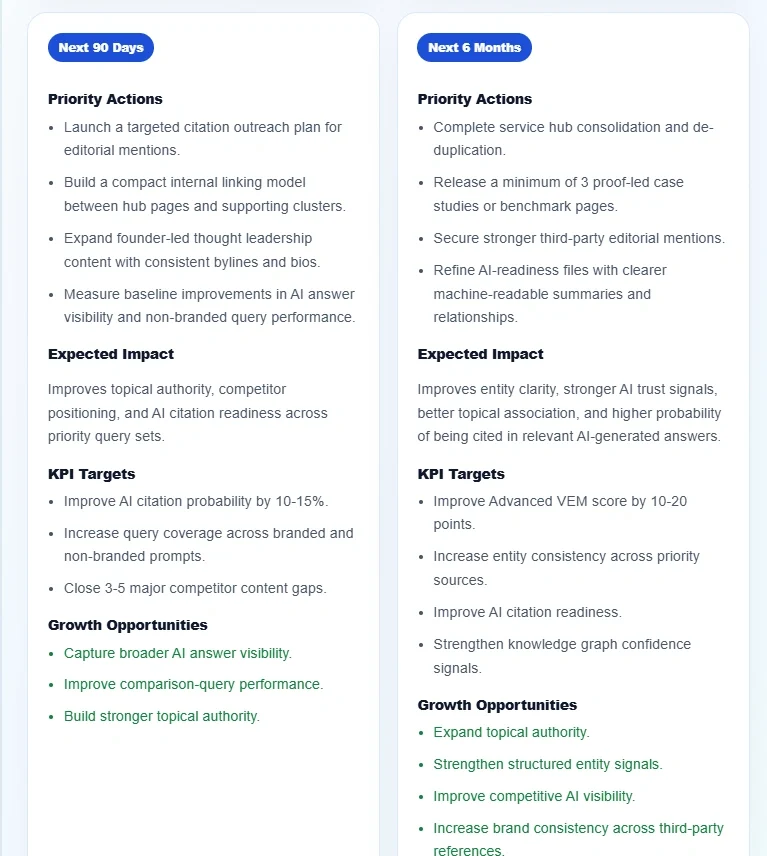
Explanation and analysis
The 90-day and six-month roadmap moves into llms.txt, semantic sitemap, author bios, proof sections, non-branded query tracking, third-party citation acquisition, topic cluster scaling, comparison pages, and performance review. This is where AI-readiness work becomes measurable.
Advanced VEM turns entity analysis into a strategic growth roadmap. It evaluates entity ecosystem strength, knowledge graph strength, AI search readiness, brand entity consistency, competitive entity gap, query intent coverage, semantic content strength, AI citation probability, and GEO readiness. These dimensions reveal whether the brand can move from being visible to being confidently recalled and recommended across branded, non-branded, local, commercial, and comparison queries.
The Advanced VEM findings are moderate but constructive. ThatWare has recognizable brand consistency and a solid entity ecosystem, but stronger structured assets, tighter content hierarchy, and explicit AI-facing files are needed to increase AI recall and recommendation dominance. The roadmap correctly shifts the focus from broad promotion to entity architecture, schema coverage, semantic hubs, trusted citations, and long-term knowledge graph reinforcement.
For a 12-month SEO and AI discovery plan, this section is the most operational part of the report. It breaks the work into immediate audits, 60-day content and schema improvements, 90-day AI-readiness actions, six-month topic-cluster scaling, nine-month competitor and authority expansion, and one-year entity defensibility. This makes AVM and VEM practical rather than theoretical. A semantic AI sitemap architecture can connect ThatWare’s service hubs, entity pages, proof assets, and AI-readable files into a clearer discovery structure.
What this means for AVM, VEM and SEO execution
For Advanced VEM execution, the roadmap should be treated as a phased entity-building program. The first phase fixes schema, hierarchy, and audit gaps. The second phase publishes and updates entity-supporting content. The third phase launches AI-readable assets and proof sections. The later phases scale topic clusters, comparison visibility, third-party authority, and knowledge graph confidence.
Segment 35: Strategic Recommendation Roadmap: 9 Months and 1 Year
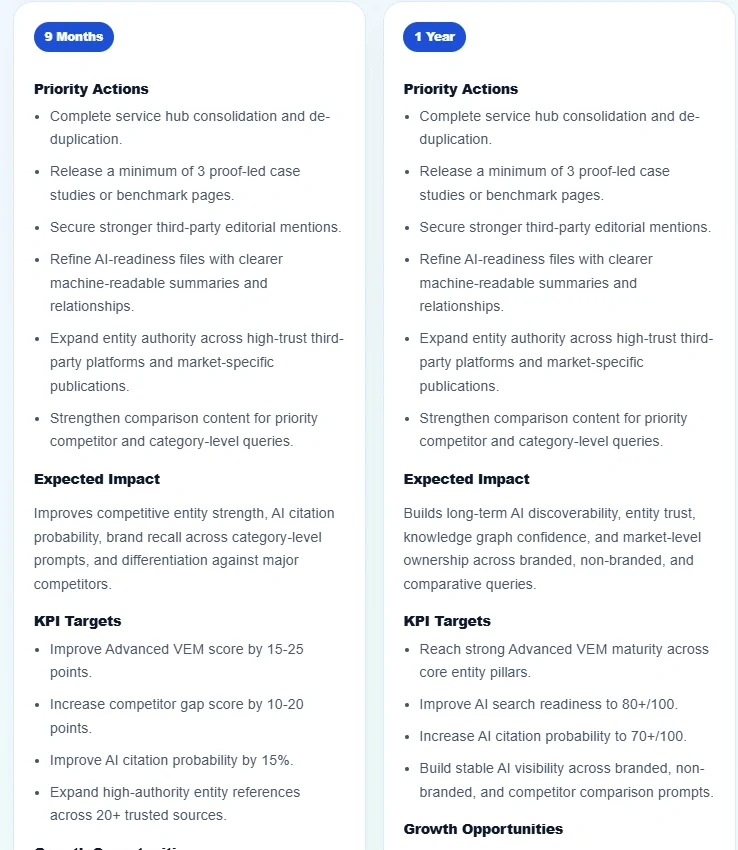
Explanation and analysis
The nine-month and one-year roadmap focuses on scaling entity authority across high-trust platforms, strengthening competitor and category comparison content, and building long-term AI discoverability, entity trust, knowledge graph confidence, and market-level ownership.
Advanced VEM turns entity analysis into a strategic growth roadmap. It evaluates entity ecosystem strength, knowledge graph strength, AI search readiness, brand entity consistency, competitive entity gap, query intent coverage, semantic content strength, AI citation probability, and GEO readiness. These dimensions reveal whether the brand can move from being visible to being confidently recalled and recommended across branded, non-branded, local, commercial, and comparison queries. Activity Stream JSON can document ongoing content updates, citation improvements, schema changes, and AI-readiness actions in a structured format.
The Advanced VEM findings are moderate but constructive. ThatWare has recognizable brand consistency and a solid entity ecosystem, but stronger structured assets, tighter content hierarchy, and explicit AI-facing files are needed to increase AI recall and recommendation dominance. The roadmap correctly shifts the focus from broad promotion to entity architecture, schema coverage, semantic hubs, trusted citations, and long-term knowledge graph reinforcement. As these entity and semantic signals mature, Discovery Intelligence becomes stronger, improving the brand’s ability to surface consistently within AI-generated recommendations and knowledge-driven discovery experiences.
For a 12-month SEO and AI discovery plan, this section is the most operational part of the report. It breaks the work into immediate audits, 60-day content and schema improvements, 90-day AI-readiness actions, six-month topic-cluster scaling, nine-month competitor and authority expansion, and one-year entity defensibility. This makes AVM and VEM practical rather than theoretical.
What this means for AVM, VEM and SEO execution
For Advanced VEM execution, the roadmap should be treated as a phased entity-building program. The first phase fixes schema, hierarchy, and audit gaps. The second phase publishes and updates entity-supporting content. The third phase launches AI-readable assets and proof sections. The later phases scale topic clusters, comparison visibility, third-party authority, and knowledge graph confidence.
Consolidated Strategy: How ThatWare Can Improve AVM, Advanced AVM, VEM and Advanced VEM
1. Strengthen AI-visible citation depth
The report repeatedly shows that ThatWare has visibility and broad off-page support, but citation depth is not yet strong enough to create dominant recommendation confidence. The citation gap recommendation of 33-44 additional niche-based citation links should be treated as a quality-driven campaign rather than a link-volume campaign. External Citations JSON can structure third-party mentions, directory references, editorial citations, and review sources that support stronger AI trust.
Priority sources should include AI SEO publications, SEO directories, SaaS review platforms, marketing resource pages, expert roundups, partner pages, local business citations, editorial brand mentions, and comparison or review pages that clearly explain ThatWare’s services. Each citation should include accurate naming, service context, location relevance, and a sentence-level explanation of why the brand is relevant to AI SEO, AEO, GEO, LLM SEO or advanced SEO. An AI manifesto framework can help ThatWare define its AI search principles, entity positioning, and content governance approach for long-term visibility.
2. Build buyer-intent and comparison-intent content
The Advanced AVM intent data shows a clear weakness in transactional and comparative visibility. Informational visibility is healthy, but transactional intent is only 38 and comparative intent is 47. This means ThatWare should expand content beyond educational guides and create assets designed for decision-making queries.
Recommended content types include best AI SEO agency pages, AEO agency India pages, GEO agency pages, ThatWare vs SEOValley pages, AI SEO pricing and packages pages, service methodology pages, case-study hubs, proof sections, review pages, and solution pages for enterprise use cases. These pages should include direct answer blocks, FAQs, schema, comparison tables, use cases, and proof elements that AI systems can cite or summarize.
3. Create a stronger entity architecture
The VEM and Advanced VEM findings repeatedly mention missing or unspecified structured assets. This is a major opportunity. Entity architecture should make ThatWare’s relationship to AI SEO, AEO, GEO, LLM SEO, AVM, VEM and AIEO explicit across the website.
A strong architecture would include a canonical brand page, individual service entity pages, founder and leadership pages, framework pages for AVM and VEM, schema markup across organization, service and author templates, a semantic sitemap, llms.txt, ai.txt where appropriate, and sameAs references connecting the brand to trusted profiles. This makes the brand easier for search engines and AI systems to resolve.
4. Improve knowledge graph and AI-readiness signals
Knowledge graph strength and AI search readiness are both moderate. The report assigns AI Search Readiness a relatively low score of 61 in both VEM and Advanced VEM contexts. This should become a technical and content priority.
The implementation path includes organization schema, service schema, author schema, FAQ schema, breadcrumb schema, sameAs links, structured hub pages, AI-readable files, semantic sitemap, profile consistency, and machine-readable summaries of core services. The website should explain who ThatWare is, what it does, where it operates, which frameworks it owns, and why third-party sources trust it.
5. Use the roadmap as a phased implementation plan
The roadmap is one of the most useful sections of the report because it converts findings into timelines. In the first 30 days, ThatWare should audit schema, internal linking, content hierarchy, canonical service taxonomy and AI-readable blockers. In 60 days, the brand should update core service pages, add schema, build hubs and create comparison-ready content blocks.
By 90 days and six months, ThatWare should launch AI-readable assets, strengthen author bios and proof sections, track query expansion, acquire niche citations, scale topic clusters and review AI visibility performance. By nine months and one year, the brand should expand entity authority across high-trust third-party platforms, improve comparison content, increase AI search readiness to 80+/100, and build stable visibility across branded, non-branded and competitor comparison prompts.
Conclusion: From AI Visibility to Entity Dominance
The report shows that ThatWare has already crossed the first major threshold of AI visibility. It is not invisible. It has a good AVM score, strong presence, broad link support, a recognizable category association, and a stronger competitive profile than the evaluated peer set. This is a meaningful advantage in a market where many brands still do not appear consistently in AI-generated answers.
However, the report also makes clear that visibility is not the same as dominance. ThatWare must strengthen citation depth, improve buyer-intent coverage, increase comparative mention quality, harden its entity architecture, add missing schema and AI-readable files, and build deeper authority in niche-relevant sources. These actions can help convert recognition into recommendation, and recommendation into category ownership.
The best way to use this report is as a unified growth roadmap. AVM identifies current answer visibility. Advanced AVM identifies deeper market, intent and citation gaps. VEM identifies entity clarity and readiness. Advanced VEM converts the entity work into a phased roadmap. Together, these four layers form a complete framework for modern AI SEO, AEO, GEO, LLM SEO and long-term search visibility.
Copyright Notice: This content is part of “AVM, Advanced AVM, VEM and Advanced VEM – A Complete AI Visibility and Entity Intelligence Guide,” for which a copyright application has been filed by THATWARE LLP with the Copyright Office, Government of India under Diary No. LD-46788/2026-CO. Unauthorized reproduction, copying, distribution, or commercial use is prohibited.



5 comments