
SUPERCHARGE YOUR ONLINE VISIBILITY! CONTACT US AND LET’S ACHIEVE EXCELLENCE TOGETHER!
AI search has created a measurement gap. A brand can rank well in conventional search and still be absent when a buyer asks an AI system for a shortlist, a comparison, a local specialist or a recommended provider. An AI visibility audit closes that gap by testing how the brand appears inside sampled AI-generated answers and turning the evidence into a structured baseline.
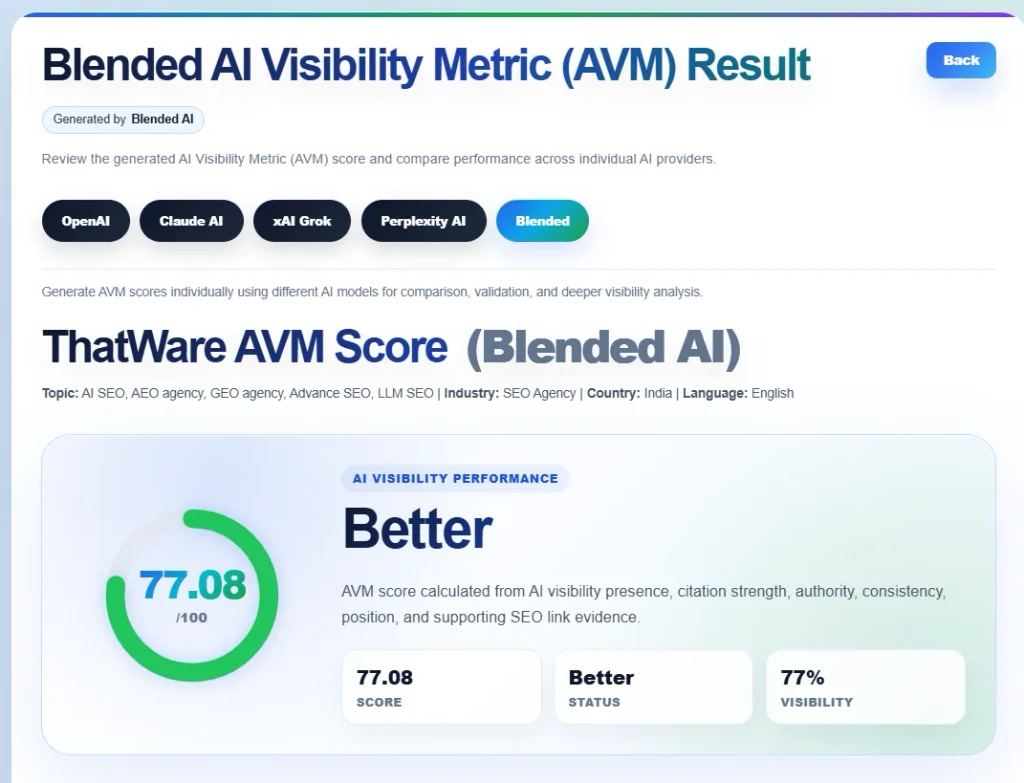
This is an application of AVM
The AI Visibility Audit is not a separate ThatWare framework. It applies the existing AI Visibility Metric (AVM) methodology to a buyer-ready audit engagement. AVM remains the measurement framework; the audit is the service application.

What Is an AI Visibility Audit?
An AI visibility audit is a structured assessment of whether, where and how a brand appears across a defined set of AI discovery prompts. Instead of reducing performance to a single mention count, the audit examines the quality of that visibility: whether the brand is present, whether the answer is supported by citations, whether the surrounding evidence is authoritative, whether the brand is represented consistently and where it appears within recommendation or comparison structures.
ThatWare uses AVM to organize those signals into a repeatable diagnostic view. The objective is not to produce a vanity score. The objective is to show where AI visibility is strong, where it is fragile, where competitors hold an advantage and which evidence gaps should be addressed first.
Why Traditional SEO Reporting Is Not Enough
Rankings, traffic, backlinks and conversions still matter, but they cannot fully describe an answer environment. An AI system may cite a third-party article, summarize a category without linking to the brand, place a competitor first in a recommendation set or omit a company that already ranks organically. That means the business needs a second measurement layer focused on answer visibility rather than only page position.
- Find out whether your brand appears for non-branded discovery prompts, not only branded questions.
- See whether AI systems connect your brand with the right services, topics, people, markets and use cases.
- Identify citation and authority gaps that limit recommendation potential.
- Compare visibility across selected providers using the same query portfolio.
- Create a baseline that can be repeated after SEO, GEO, PR, content or entity improvements.
What the AVM-Powered Audit Measures
1. Presence
Presence answers the first commercial question: are you in the answer at all? The audit segments presence by prompt type so branded recognition is not confused with genuine category discovery.
2. Citation
Citation analysis looks at whether the brand is supported by source evidence, which domains are being cited and whether those sources strengthen the specific claim or recommendation being made.
3. Authority
Authority examines the credibility of the evidence around the brand. The focus is broader than a traditional link metric. It asks whether independent sources, expert signals, documentation, research, profiles and relevant third-party references make the brand easier to verify.
4. Consistency
Consistency checks whether the brand is described reliably across prompts and contexts. Conflicting service descriptions, outdated leadership information, inconsistent names or fragmented entity signals can make AI visibility unstable.
5. Position
Position evaluates where the brand tends to appear when the answer contains an ordered or implicit recommendation structure. Appearing first in a shortlist is commercially different from being mentioned near the end of a long response.
How the Audit Works
- Define the assessment context: brand, priority topics, industry, country, language and named competitors.
- Build a balanced prompt portfolio covering branded, informational, commercial, comparative and transactional intent.
- Collect provider-specific evidence across the agreed AI environments and record the answer context rather than only the final mention.
- Normalize brand and competitor references so similar evidence can be compared across prompts and providers.
- Evaluate AVM dimensions and confidence in the available evidence.
- Map visibility gaps to actions across content, citations, authority, technical AI readiness, internal linking and entity clarity.
- Deliver an executive summary, evidence workbook and prioritized improvement roadmap.
What You Receive
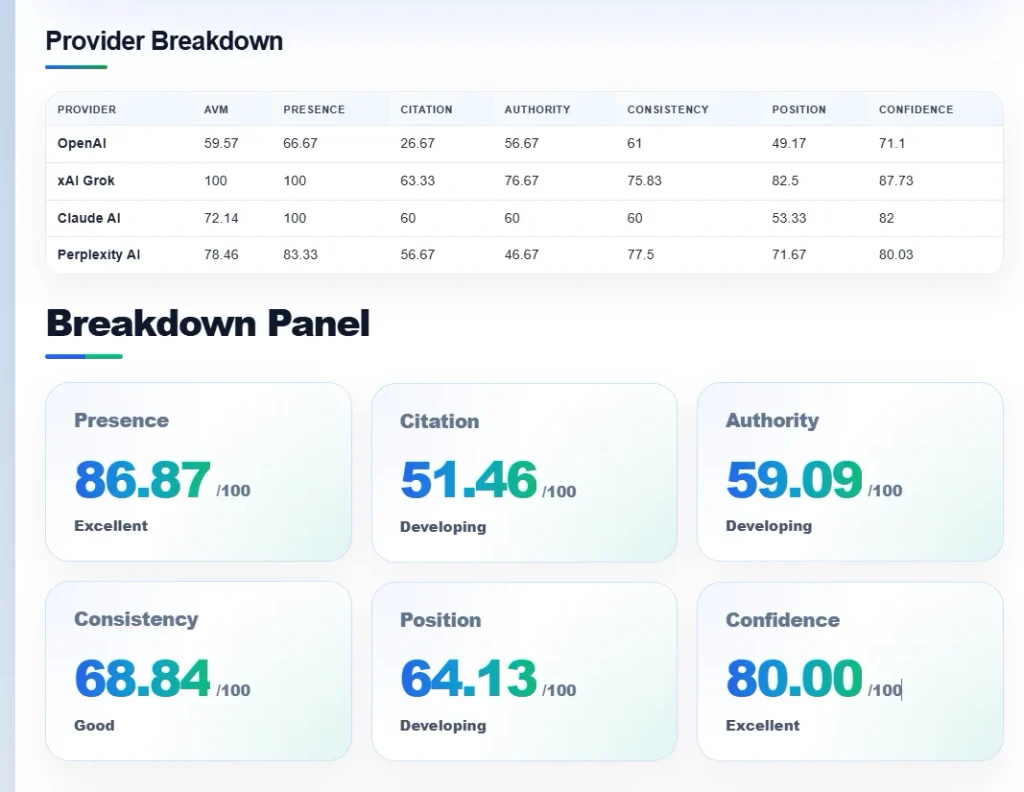
Provider-level AVM example reconstructed from the published framework page.
- Executive AI visibility summary with the most important commercial findings.
- AVM dimension breakdown for presence, citation, authority, consistency and position.
- Prompt-by-prompt evidence matrix showing where the brand appears and where it is absent.
- Provider comparison for the environments included in the agreed scope.
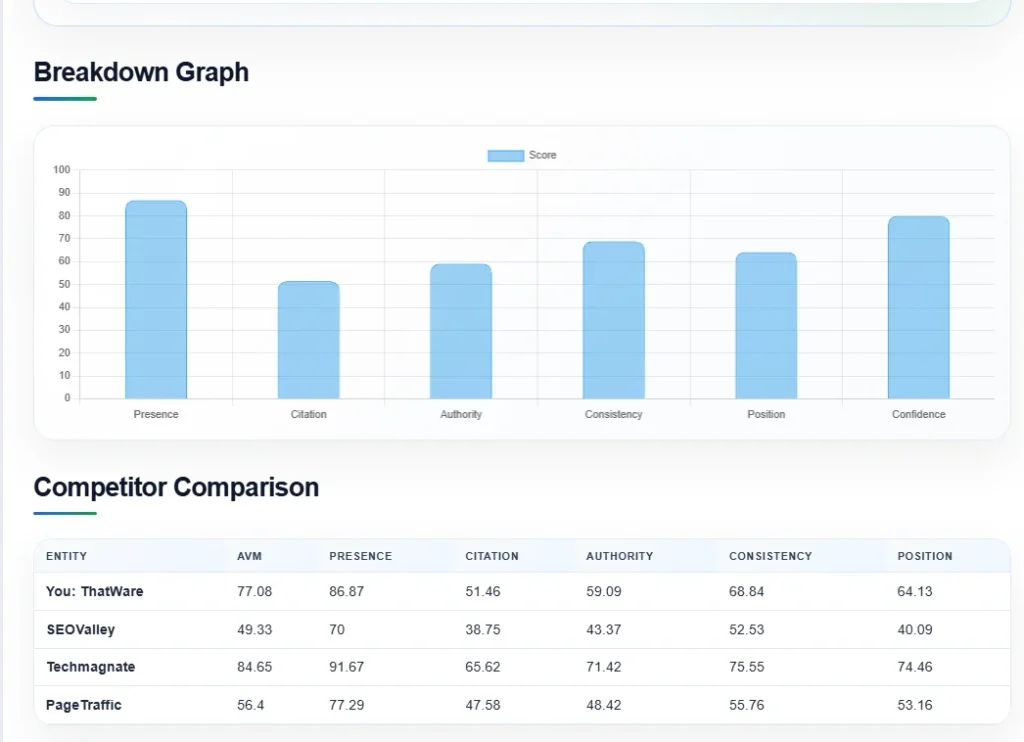
- Competitor visibility benchmark using the same prompt set.
- Citation and source observations, including opportunities to strengthen third-party evidence.
- Prioritized action plan for SEO, GEO, digital PR, content and entity improvements.
- Repeatable baseline so progress can be measured against the same methodology later.
When VEM Becomes Relevant
AVM measures the observed visibility outcome. If the audit finds that visibility is inconsistent because the brand is poorly defined, weakly connected to key topics or represented differently across the web, ThatWare can use VEM as a complementary entity-readiness diagnostic. VEM does not replace the AVM audit and should not be presented as a new version of it. It helps explain entity-side causes behind weak or unstable visibility.
Who Should Use an AI Visibility Audit?
- Enterprise brands that need a defensible baseline before investing in AI search visibility.
- Marketing teams that already rank organically but do not know whether AI systems recommend the brand.
- SaaS, ecommerce and service companies competing for category-level and comparison prompts.
- SEO and digital teams that need to prioritize citation, authority and entity work based on evidence.
- Leadership teams that want a clear view of competitor visibility rather than isolated screenshots from manual prompting.
What Makes the Audit Commercially Useful
A useful audit connects measurement to buyer behavior. It should reveal whether the brand appears when a prospect is learning, comparing, shortlisting and preparing to act. That is why the query set matters as much as the score. A branded prompt confirms recognition; a non-branded commercial prompt tests discovery; a comparative prompt tests competitiveness; and a transactional prompt tests whether the brand is visible near a decision point.
Responsible Interpretation of AI Visibility Data
AI answers can vary by provider, model, retrieval behavior, location, language, timing and interface. An AVM-powered audit therefore uses sampled evidence, not a claim of universal coverage. The most useful comparisons repeat the same query portfolio and document the provider, date, model context and methodology. This makes trend analysis more meaningful and prevents a single answer from being treated as the market.
Turn AI Visibility Into a Measurable Growth Program
The audit gives your team a starting point. From there, the work can focus on the specific evidence that is missing: stronger topical pages, clearer entity relationships, authoritative third-party mentions, better machine-readable structure, improved comparison content or stronger coverage of high-intent prompts. The goal is not to chase every AI response. The goal is to make the brand easier to retrieve, verify, cite and recommend across the queries that matter to revenue.
| Request an AVM-Powered AI Visibility Audit Build a measurable baseline for your brand, benchmark the competitive landscape and identify the next actions that can improve AI discovery. Talk to ThatWare about the market, provider scope and query set you want to assess. |
Build the Audit Around Buyer Journeys, Not Random Prompts
A useful AI visibility audit starts with the way buyers actually make decisions. If the prompt set is built only from branded questions, the result can look healthy while saying very little about discovery. The audit should therefore map prompts to the stages of a real buying journey. Early-stage questions test whether the brand is associated with a problem or category. Mid-funnel questions test whether the brand appears in comparisons, shortlists, alternatives and solution research. Lower-funnel questions test whether the brand is visible when a user is close to requesting an audit, speaking to an expert or choosing a provider. This structure helps separate recognition from genuine commercial visibility.
The prompt portfolio should also include several ways of expressing the same intent. Buyers may ask for the best provider, the most suitable agency, a specialist for a particular market, a comparison between two approaches, or a shortlist for a specific business size. A strong audit groups those variations into prompt families so the analysis does not overreact to one exact wording. The objective is to understand whether the brand has a repeatable relationship with the topic, not whether it happened to appear in a single answer.
- Discovery prompts test category association without mentioning the brand.
- Educational prompts test whether the brand is connected with expertise and useful explanations.
- Commercial prompts test whether the brand appears in provider shortlists and recommendation contexts.
- Comparative prompts test how the brand is framed against alternatives and named competitors.
- Transactional prompts test visibility close to an inquiry, audit, consultation or purchase decision.
- Branded prompts test factual accuracy, entity consistency and whether the brand is represented correctly.
Diagnose Why Visibility Is Weak, Not Just Where It Is Weak
An audit becomes commercially useful when it can move from observation to diagnosis. A missing brand mention is only the symptom. The underlying cause may be weak topical association, incomplete service coverage, poor third-party validation, inconsistent organization data, insufficient evidence around a claimed capability, weak visibility for the executives or products connected to the brand, or a competitor that has a stronger citation ecosystem. The audit should therefore connect each visibility gap with a plausible evidence gap that can be investigated and prioritized.
For example, low presence across non-branded prompts may suggest that the site explains the service well for existing customers but does not establish the brand strongly enough at category level. Weak citation performance may indicate that authoritative third-party sources do not connect the company with the target topic. Inconsistent answers may point to conflicting descriptions across the website, profiles, media references or structured data. Poor position can occur when the brand is recognized but does not have enough comparative evidence to earn a stronger recommendation slot. These are different problems, so they require different actions.
This diagnostic approach also prevents teams from applying the same tactic to every score. Publishing more content is not automatically the answer. Some gaps call for content expansion. Others call for digital PR, structured data, source consolidation, stronger case studies, better expert profiles, clearer product pages, updated external listings or a more coherent internal linking structure. AVM provides the measurement layer, while the audit translates that measurement into a problem map.
Connect AVM Findings With the Entity Layer
AI visibility is observable in answers, but the causes often sit deeper in the information environment around the brand. This is where VEM can support the audit without replacing AVM. AVM remains the framework used to measure the visibility outcome. VEM can be used as a supporting diagnostic when the audit suggests that the brand is not being understood consistently as an entity.
The entity review can examine whether the organization name, services, founders, products, locations, expertise areas and key relationships are represented consistently across owned and third-party sources. It can also identify whether important pages clearly state who the company serves, what it offers, where it operates and how each service connects to the wider brand. When those relationships are fragmented, AI systems may retrieve the right page but fail to connect it confidently with the entity the buyer is asking about.
For a brand with multiple services, frameworks or business units, this distinction is critical. The audit should ask whether AI systems can tell which offerings belong to the same organization, whether older positioning conflicts with current positioning, and whether priority capabilities are supported by corroborating evidence. This makes the final roadmap more precise because the team can separate a visibility problem from an entity-clarity problem.
Turn the Audit Into a Prioritized Optimization Roadmap
The final report should not leave stakeholders with a long list of undifferentiated recommendations. Each finding should be translated into a prioritized action based on commercial impact, evidence strength, implementation effort and dependency. A high-intent prompt where the brand is repeatedly absent may deserve faster action than a low-value informational prompt. A citation gap that affects many prompt families may be more important than an isolated missing source. An entity inconsistency that affects every provider may need to be resolved before content expansion can deliver its full value.
A practical roadmap can group recommendations into three horizons. Immediate actions address obvious factual or structural problems, such as inconsistent descriptions, missing service detail, outdated pages, weak internal links or unclear schema. Near-term actions strengthen topical and citation evidence through new pages, expert-led content, case studies, original research, digital PR and third-party references. Longer-term actions build durable category authority through sustained coverage, recurring research, entity reinforcement and repeated measurement.
The audit should also identify the evidence that will be used to judge progress. That can include improved non-branded presence, stronger citations, better recommendation position, more consistent descriptions, broader provider coverage and improved performance across priority prompt families. The point is not to chase a single score. The point is to create a measurable improvement program around the signals that matter to the business.
What an Executive-Friendly Audit Report Should Explain
Senior stakeholders do not need hundreds of raw AI responses. They need a clear explanation of what the evidence means for demand, reputation and competitive positioning. The executive summary should therefore answer a small number of business questions: Are we being discovered? Are we being recommended? Are we supported by credible sources? Are competitors occupying important answer space that we are missing? Are AI systems describing us accurately? Which gaps are most likely to affect commercial visibility?
Below that summary, the report can provide drill-down views for SEO, content, PR and technical teams. Marketing may need the prompt and competitor breakdown. PR may need the citation-source gap. Content teams may need missing topics and buyer questions. Technical teams may need entity, schema and crawlability issues. Leadership may need the change in visibility over time and the commercial importance of the affected prompt groups. A good audit uses the same evidence but presents it at the right level for each audience.
This makes the deliverable easier to act on. Instead of treating AI visibility as an experimental side project, the company can assign owners, deadlines and measurable outcomes to each recommendation. The audit becomes a bridge between AI-search research and normal marketing operations.

Repeating the Audit: From Snapshot to Measurement Program
One audit creates a baseline. Repeating the same methodology creates a measurement program. Because AI answers can change with model updates, retrieval behavior, source freshness and new content on the web, progress should be assessed using consistent conditions wherever possible. The same market, language, competitor set, prompt portfolio and scoring logic should be retained for trend comparisons, with any changes documented clearly.
A recurring audit can show whether improvements are broad or narrow. A brand might gain visibility in educational prompts while remaining absent from commercial shortlists. It might improve citations but lose recommendation position. It might perform well on one provider and poorly on another. Trend reporting should preserve those distinctions rather than hiding them inside one blended number.
For most organizations, the most useful cadence depends on how quickly the category changes and how actively the company is implementing improvements. A high-growth technology or AI category may justify more frequent monitoring than a stable niche with slower content turnover. The important point is consistency. Measurements should be repeated often enough to validate action, but not interpreted as if every short-term fluctuation represents a lasting market shift.
How the Audit Supports SEO, GEO, AEO and Brand Strategy
An AVM-powered AI visibility audit is not designed to replace SEO reporting. It adds an answer-layer perspective to the existing search program. Traditional SEO can show whether pages are crawlable, rank for target queries and attract traffic. The AI visibility audit shows whether the brand is being carried into generated answers, how it is framed, what sources support it and whether it survives the transition from search result to synthesized recommendation.
That makes the audit useful across several disciplines. SEO teams can use it to identify gaps between rankings and answer visibility. GEO teams can use it to prioritize retrieval, citation and recommendation opportunities. AEO teams can use it to improve question coverage and answer-ready content. Digital PR teams can use citation gaps to identify publishers and evidence sources that matter. Brand teams can use consistency findings to correct fragmented positioning. Product marketing teams can use prompt-level analysis to understand which capabilities AI systems associate with the company.
When these teams work from the same evidence, optimization becomes more coherent. The site, external references, entity data, expert signals and content strategy can all reinforce the same positioning. That is more valuable than treating AI visibility as a separate channel with no connection to the rest of search and brand activity.
Questions to Ask Before Choosing an AI Visibility Audit Provider
Buyers should understand how an audit is produced before treating its score or recommendation as meaningful. Ask how the prompt set is built, how many intent categories are represented, how competitors are selected, whether results are segmented by provider, what evidence is stored beneath the score and how repeatability is handled. It is also important to ask whether the methodology distinguishes branded recognition from non-branded discovery and whether citations are assessed for relevance and authority rather than counted blindly.
A credible audit should be able to show its working. You should be able to trace a recommendation back to the prompt, answer, source or entity issue that produced it. The methodology should also state its limitations. AI outputs are sampled observations, not a complete census of every answer shown to every user. Provider APIs and consumer interfaces can behave differently. Results can shift over time. Those boundaries do not make measurement useless, but they do make transparency essential.
ThatWare’s AVM approach is designed around this evidence-first principle. The value is not a decorative score. The value is a structured way to understand presence, citation, authority, consistency and position, then use those findings to decide what to improve next.
| Methodology boundaryAVM is presented as ThatWare’s proprietary diagnostic methodology, not as an official score issued or endorsed by OpenAI, Anthropic, xAI, Perplexity, Google or another platform. Results should be interpreted as sampled evidence within a defined query, provider, market and time context. |