
SUPERCHARGE YOUR ONLINE VISIBILITY! CONTACT US AND LET’S ACHIEVE EXCELLENCE TOGETHER!
ThatWare helped Hitched India, a wedding planning business build measurable visibility across generative search platforms by aligning content, landing pages, structured data, internal linking, FAQs, geographic relevance and authority signals with the way AI-powered search systems interpret user intent. The campaign produced first-position recommendations for targeted queries on ChatGPT and Gemini, fourth-position visibility on Claude for selected searches, and inclusion in Google AI Overviews. The results demonstrate an important shift in modern search: visibility is no longer limited to traditional blue-link rankings. Businesses also need to become relevant, understandable and recommendable within AI-generated answers.
For years, digital visibility was largely measured through conventional search rankings. A business appeared on page one of Google, attracted clicks, generated enquiries and used those metrics to evaluate SEO performance.
Search behaviour is changing.
People are increasingly asking conversational questions directly to AI-powered platforms. Instead of typing a short keyword such as “wedding planner Pune”, they may ask an AI system to recommend the best wedding planners in Pune, compare destination wedding planners in Mahabaleshwar, or identify suitable wedding planning companies for a particular type of event.
The answer is no longer simply a list of ten blue links.
An AI system may interpret the query, retrieve information from multiple sources, evaluate entities and contextual signals, and then produce a recommendation or generated response.
That creates a new visibility challenge for businesses.
Being indexed is not necessarily enough. Ranking organically is not necessarily enough. A brand also needs to be understood well enough to be surfaced, referenced or recommended when users ask AI systems for solutions.
That is the challenge addressed in this case study.
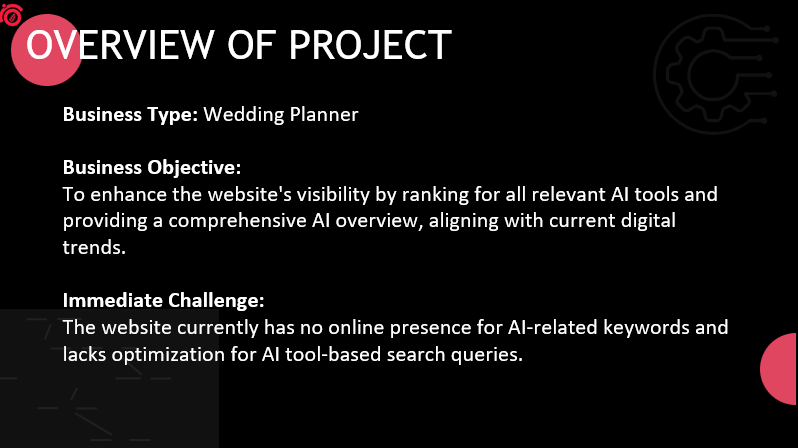
The campaign focused on a wedding planning business that initially had little meaningful visibility for AI-related search queries. The objective was to build a stronger digital footprint around relevant services, locations, search intents and conversational queries so that AI-powered platforms could better understand the business and include it in relevant recommendations.
The work involved a combination of traditional SEO principles and AI-search-focused optimisation.
The results were then validated through searches across ChatGPT, Claude, Gemini and Google AI Overviews.
This case study documents what was done, why it mattered and what the resulting AI search visibility tells us about the future of AEO, GEO and LLM SEO.
The Shift From Traditional Search Rankings to AI Search Visibility
Search has always evolved with user behaviour.
The early search experience was built around keywords. Users entered a query, search engines returned indexed pages and websites competed for positions within the results.
SEO consequently developed around a familiar set of activities:
- Keyword research
- Technical optimisation
- Content creation
- On-page optimisation
- Internal linking
- Backlink acquisition
- Local optimisation
- Structured data
- Authority building
These activities remain important.
However, the search interface is increasingly becoming conversational.
A user can now ask:
“Who are the best destination wedding planners in Mahabaleshwar?”
or:
“Which wedding planner should I consider for a luxury wedding in Pune?”
or:
“What are the best wedding planning companies in Lonavala?”
These questions contain much more information than a conventional keyword.
They include:
- A service requirement
- A location
- A commercial or recommendation intent
- Sometimes a quality expectation
- Sometimes a specific event type
- Often an implied comparison
An AI system has to understand all of those elements.
This is where AI Search Visibility becomes an important part of modern search strategy.
What AI Search Visibility Means
AI search visibility refers to a brand’s ability to appear, be referenced or be recommended when users conduct relevant searches through AI-powered search and answer platforms.
The objective is not simply to achieve a numerical ranking.
The objective is to establish a sufficiently strong and understandable digital entity that AI systems can associate the business with relevant queries.
That requires a different way of thinking about search optimisation.
A page can rank well for a traditional keyword but still fail to appear when a user asks a conversational recommendation question.
Conversely, a business may have modest traditional visibility but become highly relevant to a specific AI-generated recommendation because its content, entity information, geographic relevance and authority signals align with the query.
This case study demonstrates that distinction in practical terms.
The Client and Business Context
The campaign focused on a wedding planning business serving customers looking for wedding and event planning services across specific Indian destinations and markets.
Wedding planning is a particularly interesting category for AI search because customers rarely make decisions based on a single generic keyword.
A couple may begin with a location:
“Wedding planners in Mahabaleshwar.”
They may then refine the requirement:
“Destination wedding planners in Mahabaleshwar.”
Then:
“Best destination wedding planner in Mahabaleshwar.”
Then:
“Luxury wedding planner in Pune.”
Each query represents a different stage of intent.
The business therefore needed to become relevant not just for a broad category such as wedding planning, but for a wider set of contextual relationships.
These included:
- Wedding planning
- Destination weddings
- Luxury weddings
- Reception services
- Event management
- Location-specific wedding services
- Wedding planning companies
- Specific destination markets
- Recommendation-style queries
The challenge was to connect these relationships clearly through the website and its supporting digital ecosystem.
The Initial Challenge: Limited AI Search Presence
At the beginning of the campaign, the website had limited meaningful presence for AI-related search queries.
This created a problem that conventional SEO reporting does not always capture.
A website may have pages describing its services, but if those pages are not structured around the questions users actually ask, AI systems have less contextual information from which to generate recommendations.
The immediate challenge was therefore not simply:
“How do we rank this website?”
It was:
“How do we make this business a clearer and more relevant answer to the questions potential customers are asking?”
That distinction shaped the strategy.
The Three Core Problems
The campaign had three closely connected challenges.
1. Limited relevance for AI-driven queries
The website did not have sufficient content targeting the types of conversational and recommendation-based queries users could ask AI systems.
The business needed content that addressed specific user questions instead of relying solely on broad service terminology.
2. Weak geographic contextualisation
Wedding planning is highly location-dependent.
A wedding planner serving Pune is not automatically the best answer for someone looking for a destination wedding planner in Mahabaleshwar.
AI systems therefore need strong signals connecting the business to specific locations and services.
3. Insufficient AI-search-oriented content architecture
The website needed a stronger relationship between:
- Services
- Locations
- Search queries
- FAQs
- Supporting content
- Structured information
- Internal links
- Commercial pages
The campaign addressed these areas systematically.
Understanding the Search Intent Behind AI Recommendations
One of the most important parts of the campaign was understanding what people actually wanted when they asked recommendation-style questions.
Traditional keyword research often starts with search volume.
AI search optimisation requires an additional layer.
It requires understanding the question behind the query.
Consider the difference between:
“Wedding planner Pune”
and:
“Best wedding planner in Pune for a luxury wedding.”
The second query contains more intent.
The user is not simply looking for a category.
They are asking an AI system to make a judgement.
The same applies to:
“Top destination wedding planners in Mahabaleshwar.”
The user expects the platform to identify and recommend businesses that fit the category.
That means the content ecosystem needs to establish why a business belongs within that category.
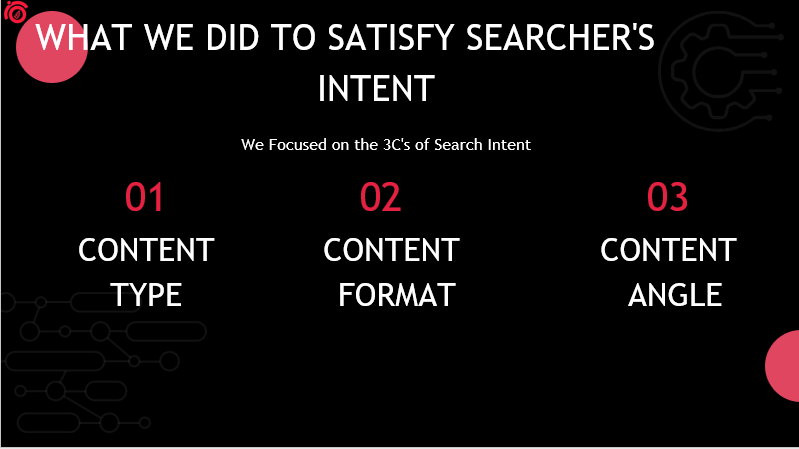
The 3Cs of Search Intent
The campaign focused on three dimensions of search intent:
Content Type
The first question was:
What type of content does the user need?
Depending on the query, the answer may require:
- A service page
- A location page
- A comparison page
- A guide
- An FAQ
- A blog
- A landing page
- A recommendation-oriented page
Not every query should be answered by the same content format.
Content Format
The next question was:
How should the information be presented?
AI-friendly content needs to be easy to interpret.
That can involve:
- Clear headings
- Direct answers
- Lists
- Tables
- FAQs
- Service descriptions
- Location context
- Structured information
- Concise explanations
The goal is not to write for machines at the expense of people.
The goal is to make information easier for both users and search systems to understand.
Content Angle
The final question was:
What specific angle should the content address?
A page targeting “wedding planner Pune” may focus on services.
A page targeting “luxury wedding planner Pune” needs to establish a different value proposition.
A page targeting “destination wedding planner Mahabaleshwar” needs to demonstrate destination-specific relevance.
This is where content strategy becomes much more granular.
The AI Search Strategy Implemented by ThatWare
The campaign combined conventional SEO fundamentals with AI-search-focused optimisation.
The objective was to create a connected information ecosystem rather than a collection of isolated pages.
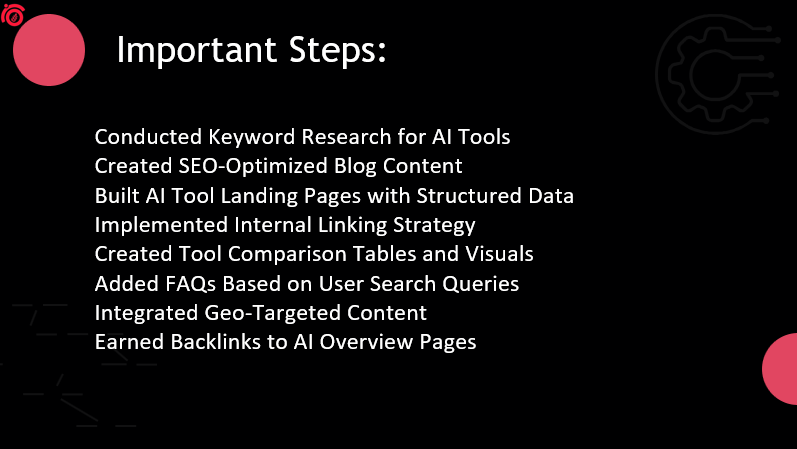
The major implementation areas included:
- AI-tool keyword research
- Search intent mapping
- SEO-optimised content
- AI-focused landing pages
- Structured data
- Internal linking
- Comparison tables
- Visual content
- Search-query-based FAQs
- Geo-targeted content
- Authority and backlink development
Each component addressed a different part of the visibility problem.
AI-Tool Keyword Research
The first step was identifying the types of queries that could trigger recommendations from AI platforms.
This goes beyond conventional keyword discovery.
Instead of looking only at:
wedding planner
the strategy considered queries such as:
- Top wedding planners in Lonavala
- Best wedding planners in Mahabaleshwar
- Best destination wedding planners in Mahabaleshwar
- Destination wedding planners in Mahabaleshwar
- Best wedding planners in Pune
- Luxury wedding planner in Pune
- Reception event services in India
These queries reveal something important.
The customer is not necessarily searching for a specific brand.
They are asking the platform to identify a suitable business.
That means the optimisation strategy needs to establish the brand as a legitimate answer to the category.
Building Content Around Real Search Questions
Once relevant queries were identified, the next step was to build content around those questions.
The goal was not to repeat the exact query unnaturally.
Instead, the content needed to provide contextual coverage.
For example, a destination wedding page could address:
- What destination wedding services are available?
- Which locations are served?
- What does the planning process include?
- What types of ceremonies can be managed?
- What makes the business suitable for destination weddings?
- What logistics are involved?
- What should couples consider when selecting a planner?
This creates a much stronger semantic relationship between the business and the search intent.
Creating AI-Tool Landing Pages
A significant part of the strategy involved building landing pages designed around specific search intents and AI-related discovery opportunities.
These pages helped connect:
Query → Intent → Service → Location → Business
That relationship is critical.
Suppose an AI system receives:
“Who are the best destination wedding planners in Mahabaleshwar?”
The system needs to determine which businesses actually fit that description.
A website with clear destination-wedding content, location-specific information, service descriptions and supporting authority signals provides more contextual evidence than a website with only a generic “Wedding Services” page.
Why Landing Pages Matter
Landing pages provide focused topical relevance.
Instead of forcing one page to answer every possible query, different pages can address different needs.
For example:
- Destination Wedding Services
- Wedding Planner Pune
- Wedding Planner Mahabaleshwar
- Wedding Planner Lonavala
- Reception Event Services
- Luxury Wedding Planning
The exact architecture should always depend on the real business and its service areas.
The objective is not to create pages merely to generate more URLs.
The objective is to create useful pages that genuinely satisfy distinct user intents.
Structured Data and Machine-Readable Context
Structured data was another component of the campaign.
A modern website needs to communicate information clearly not only to human visitors but also to search systems that process entities and relationships.
Structured data can help clarify information such as:
- Business identity
- Services
- Locations
- FAQs
- Organisations
- Events
- Other relevant entities
It does not guarantee AI visibility.
However, when combined with high-quality content and strong entity information, structured data can contribute to a clearer understanding of the website.
The broader principle is simple:
Make the important information explicit.
Do not force search systems to infer every relationship from scattered text.
Internal Linking as an AI Context Signal
Internal linking was also strengthened.
Internal links are often discussed in conventional SEO as a way to distribute authority and help search engines discover pages.
They have another useful function.
They establish relationships between topics.
Consider a website with pages about:
- Wedding planning
- Destination weddings
- Pune
- Mahabaleshwar
- Lonavala
- Reception events
- Luxury weddings
If these pages are isolated, the relationship between the topics is weaker.
A well-planned internal linking structure can establish that:
The business provides wedding planning services → including destination weddings → in specific locations → with specific service types.
That creates a clearer topical structure.
Context Over Isolated Keywords
The campaign therefore treated internal linking as a contextual framework rather than simply a technical SEO exercise.
The objective was to make the website’s information architecture reflect the way customers think.
A customer might move from:
Wedding Planner → Destination Wedding → Mahabaleshwar → Services → Reception
The website should support that journey.
Comparison Tables and Visual Information
Comparison tables and visual content were also introduced where appropriate.
AI systems frequently need to process multiple pieces of information before generating an answer.
Well-structured content makes those relationships easier to understand.
For users, comparison tables can make information easier to scan.
For search systems, clearly organised information can also provide stronger contextual signals.
Examples could include comparisons involving:
- Wedding service types
- Destination options
- Planning services
- Event requirements
- Package considerations
The goal is not to manufacture comparison content.
It is to organise genuinely useful information in a format that makes sense.
Search-Query-Based FAQs
FAQs were developed around real search behaviour.
This is particularly important for AI search because many AI queries are conversational.
A traditional keyword might be:
Wedding planner Pune
A conversational question could be:
Who is a good wedding planner for a luxury wedding in Pune?
Or:
Which wedding planners handle destination weddings in Mahabaleshwar?
FAQ content allows the website to directly address these information needs.
Why FAQs Matter in AI Search
FAQs can clarify:
- Services
- Locations
- Planning processes
- Pricing considerations
- Event types
- Destination expertise
- Customer requirements
They can also strengthen semantic coverage around the core service.
The important point is that FAQs should answer genuine customer questions.
Adding dozens of artificial questions simply to include keywords would not create the same value.
Geo-Targeted Content
Location was one of the most important dimensions of this campaign.
Wedding planning decisions are inherently geographic.
A user searching for:
“Best wedding planners in Mahabaleshwar”
has a very different requirement from someone searching for:
“Best wedding planners in Pune.”
The strategy therefore incorporated geo-targeted content around relevant service locations.
This helped establish relationships between:
Business + Service + Location
rather than relying on generic national-level content.
Why Geographic Relevance Matters to AI Recommendations
When an AI system generates a local recommendation, it needs to determine which businesses are relevant to the requested location.
A website that clearly communicates:
- Where it operates
- What services it provides
- What type of events it handles
- Which destinations it serves
gives AI systems stronger contextual information.
Again, this is not about manipulating an AI platform.
It is about making the business’s real-world relevance easier to understand.
Authority Building and Supporting Signals
Content alone was not treated as the entire solution.
The campaign also included backlink development and authority-oriented activities.
This matters because AI systems increasingly operate within ecosystems where information comes from multiple sources.
A brand’s credibility should not depend entirely on one page.
External references can help establish that the business exists within a broader digital environment.
This is especially important for recommendation-oriented queries.
If a business claims to be a destination wedding specialist, supporting references and consistent information across the web can strengthen the overall entity.
Consistency Matters
The information associated with a business should remain consistent across relevant sources.
Important information can include:
- Business name
- Services
- Locations
- Specialisation
- Website
- Brand descriptions
Inconsistent information creates ambiguity.
A strong AI search strategy therefore considers the broader entity footprint rather than only the website.
The Results: Published AI Search Proof
The most important part of this campaign is not the list of activities.
It is what happened after implementation.
The campaign produced visible recommendations across several AI-powered platforms.
The evidence was captured through platform-specific searches and screenshots.
This provides a useful example of what published AI search proof can look like.
Rather than saying:
“We optimise websites for AI.”
the campaign demonstrates specific instances where the business appeared within AI-generated recommendations.
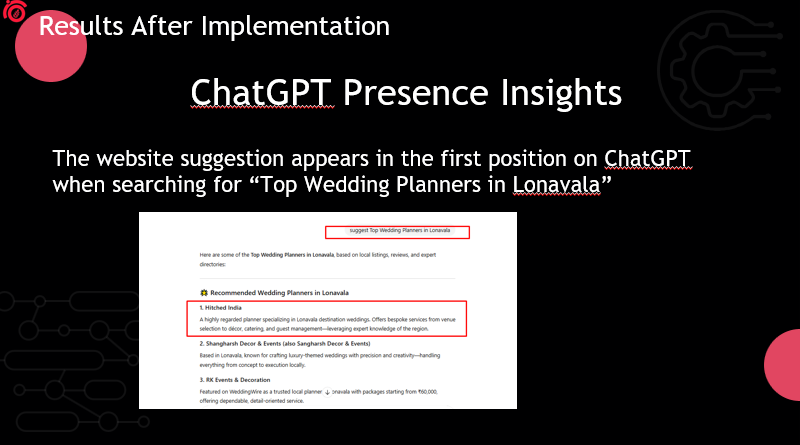
ChatGPT Visibility: First Position for Lonavala
One of the documented results was visibility for the query:
“Top Wedding Planners in Lonavala”
The business appeared in the first position within the ChatGPT-generated recommendations shown in the campaign evidence.
This is significant because the query is not simply a navigational search.
The user is asking the AI system to identify the best options.
The platform has to interpret:
- The category: wedding planners
- The location: Lonavala
- The recommendation intent: top
The business was included prominently in the resulting recommendation.
Why This Result Matters
A first-position recommendation in a conversational AI response is different from a conventional search ranking.
The user is not presented with ten equally weighted blue links.
The AI has already processed the query and produced a curated answer.
Being included prominently therefore places the business directly within the decision-making conversation.
For a service business such as wedding planning, that visibility can be commercially meaningful because users often use recommendations as the starting point for further research.
ChatGPT Visibility: First Position for Mahabaleshwar
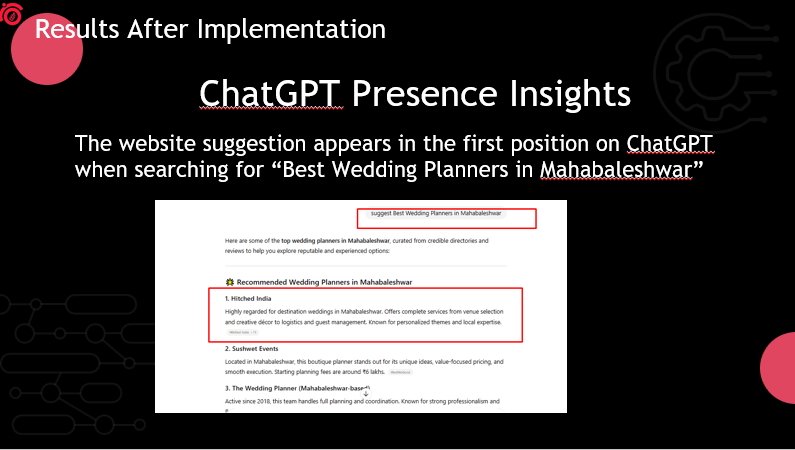
The campaign also documented first-position visibility on ChatGPT for:
“Best Wedding Planners in Mahabaleshwar”
This is another recommendation-style query with strong commercial intent.
The phrase “best wedding planners” requires the AI system to make a selection.
The location further narrows the result.
The business therefore needed to be understood as:
A wedding planner + relevant to Mahabaleshwar + suitable for a recommendation query.
The resulting visibility suggests that the optimisation strategy successfully strengthened those contextual associations.
From Generic Service to Specific Recommendation
This is an important distinction.
A website may say:
“We are a wedding planning company.”
That alone does not establish:
“We are a suitable wedding planner to recommend for Mahabaleshwar.”
The campaign worked to build the information needed for that second interpretation.
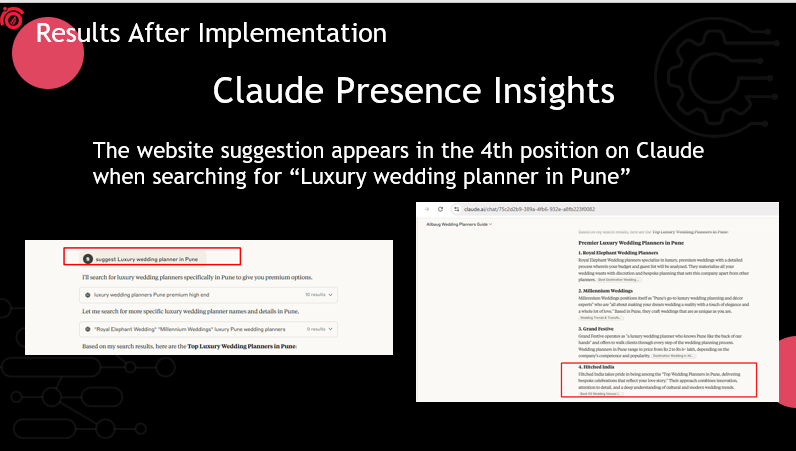
Claude Visibility: Fourth Position for Pune
The campaign also produced visibility on Claude.
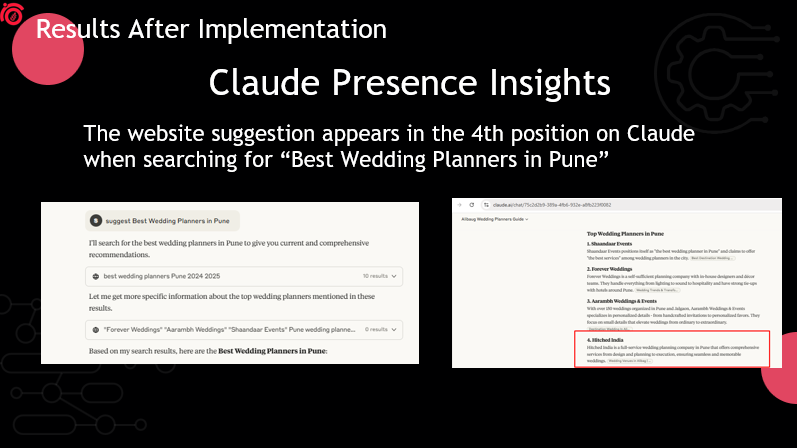
For the query:
“Best Wedding Planners in Pune”
the business appeared in the fourth position within the generated recommendation shown in the evidence.
This demonstrates that the campaign was not limited to a single AI platform.
Different AI systems have different retrieval and response mechanisms.
Visibility on one platform does not automatically guarantee visibility on another.
Therefore, multi-platform results provide more useful evidence of broader AI-search relevance.
Claude Visibility: Luxury Wedding Planner Query
Another documented Claude result was for:
“Luxury wedding planner in Pune”
The business again appeared in the fourth position within the generated recommendations.
This query is particularly useful because it adds a service-quality dimension.
The search is not simply asking for a wedding planner.
It is asking for a luxury wedding planner.
That means the website needs to communicate relevance to a more specific positioning.
Intent Becomes More Specific
Compare:
Wedding planner Pune
with:
Luxury wedding planner Pune
The second query introduces a new entity relationship:
Luxury + Wedding Planning + Pune
The campaign therefore demonstrates the value of creating content that addresses different layers of intent rather than treating every query as a variation of the same keyword.
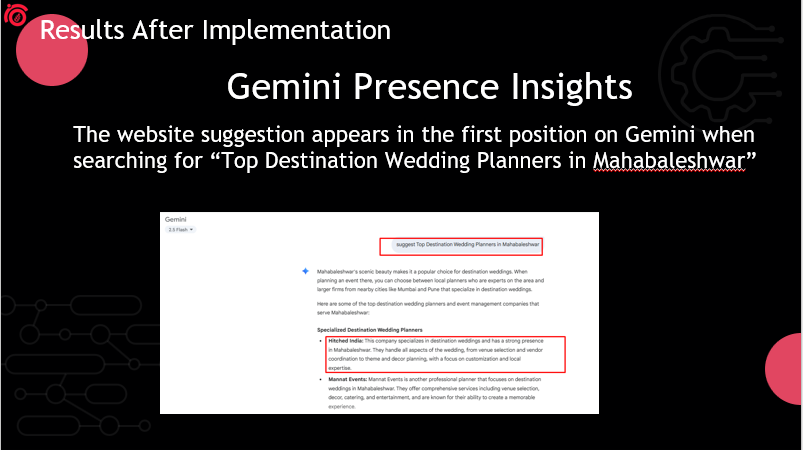
Gemini Visibility: First Position for Destination Wedding Queries
Gemini provided another set of strong results.
The campaign documented first-position visibility for:
“Top Destination Wedding Planners in Mahabaleshwar”
This is particularly relevant because it combines:
- Recommendation intent
- Destination wedding intent
- Geographic intent
The business appeared as the first recommendation shown in the evidence.
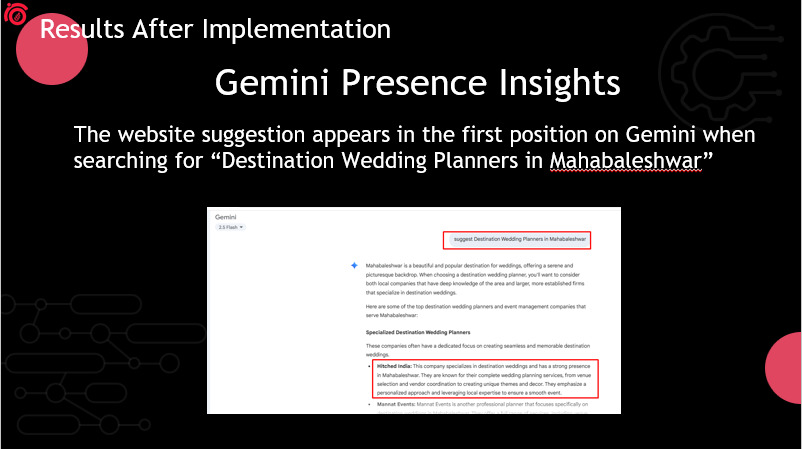
Gemini Visibility for “Destination Wedding Planners in Mahabaleshwar”
A second Gemini result showed first-position visibility for:
“Destination Wedding Planners in Mahabaleshwar”
The repeated presence across related queries is important.
A single isolated appearance can be useful.
However, visibility across closely related searches provides a stronger indication that the platform has associated the business with the broader topic.
The two queries differ slightly:
Top Destination Wedding Planners in Mahabaleshwar
and
Destination Wedding Planners in Mahabaleshwar
Yet the business appeared prominently for both.
This suggests that the campaign was not simply targeting one exact phrase.
It was building broader topical and geographic relevance around destination wedding planning.
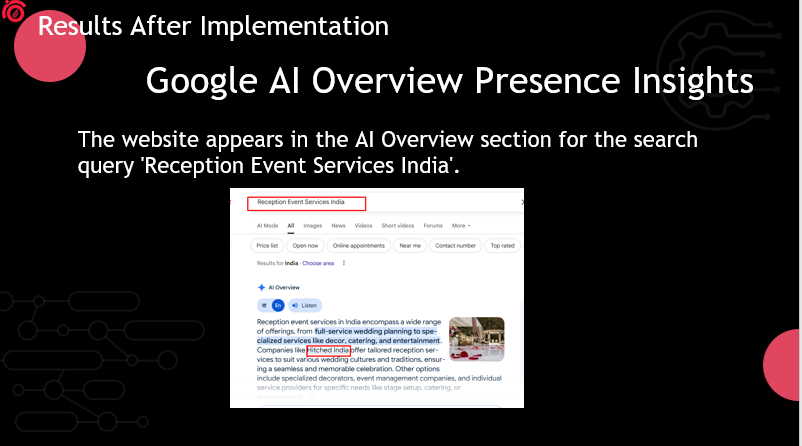
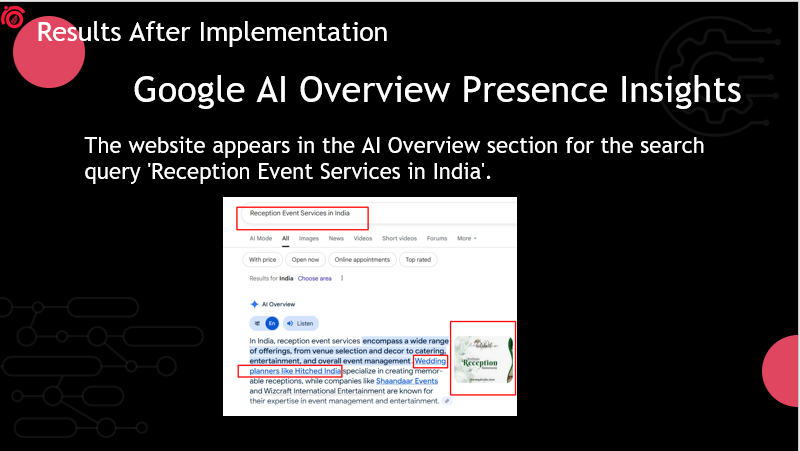
Google AI Overviews Visibility
The campaign also documented visibility within Google AI Overviews.
One of the screenshots shows the business appearing for:
“Reception Event Services India”
within the AI Overview section.
This is important because Google AI Overviews represent another form of search experience where users receive an AI-generated summary directly within the search results.
The result demonstrates that the campaign’s visibility extended beyond standalone AI chat platforms.
It reached an AI-generated search experience within Google itself.
Why Google AI Overviews Matter
Traditional Google search results and AI Overviews serve different functions.
A traditional result page may provide:
- Organic listings
- Paid advertisements
- Local results
- Featured snippets
- Images
- Videos
An AI Overview can synthesise information into a generated response.
For businesses, this means visibility opportunities can increasingly exist inside the generated answer itself.
A brand that appears within that answer can gain exposure before a user scrolls through the conventional organic results.
That makes AI Overview visibility an important component of modern search strategy.
What the Results Tell Us
The campaign provides several useful lessons for businesses trying to understand AEO, GEO and LLM SEO.
The first is that AI search visibility is highly contextual.
The business did not simply become “visible everywhere.”
Instead, visibility appeared for specific combinations of:
- Service
- Location
- Intent
- Business category
- User query
This is exactly how a modern AI search strategy should be evaluated.
AI Search Is About Relevance, Not Just Rankings
Traditional SEO often revolves around the question:
“What position does the website rank at?”
AI search requires additional questions:
“For which questions does the brand appear?”
“How does the AI describe the brand?”
“Which competitors are recommended alongside it?”
“Which locations and services trigger visibility?”
“Is the brand included when users ask for recommendations?”
These questions provide a more complete picture of AI visibility.
The Importance of Query-Level Tracking
AI search campaigns should therefore track individual queries.
For example:
| Query | Platform | Observed visibility |
| Top Wedding Planners in Lonavala | ChatGPT | 1st |
| Best Wedding Planners in Mahabaleshwar | ChatGPT | 1st |
| Best Wedding Planners in Pune | Claude | 4th |
| Luxury Wedding Planner in Pune | Claude | 4th |
| Top Destination Wedding Planners in Mahabaleshwar | Gemini | 1st |
| Destination Wedding Planners in Mahabaleshwar | Gemini | 1st |
| Reception Event Services India | Google AI Overviews | Appeared in AI Overview |
This is far more informative than saying:
“AI visibility increased.”
It shows where, for what, and on which platform visibility was observed.
Why Traditional SEO Still Matters
AI Search Optimisation should not be treated as a replacement for SEO.
The campaign itself demonstrates why.
Many of the activities involved familiar SEO fundamentals:
- Keyword research
- Content optimisation
- Internal linking
- Structured data
- FAQs
- Geographic content
- Backlinks
- Landing pages
The difference lies in how these activities are organised.
Traditional SEO asks:
How can we improve the page’s ability to rank?
AI Search Optimisation adds:
How can we make the business easier for AI systems to understand and recommend for relevant questions?
The two approaches overlap significantly.
The future is therefore unlikely to be:
SEO versus AI Search.
It is more likely to be:
SEO + AEO + GEO + LLM Visibility + strong entity signals.
The Role of AEO in the Campaign
AEO, or Answer Engine Optimisation, focuses on making content more useful and accessible for systems that provide direct answers to user questions.
The wedding planning campaign included several AEO-oriented elements.
These included:
- Question-based content
- FAQs
- Direct answers
- Structured information
- Search-intent alignment
- Clear service descriptions
- Location-specific information
The goal was to ensure that the website did not merely contain keywords.
It contained answers.
From Keywords to Questions
This is one of the biggest changes in search behaviour.
A keyword such as:
wedding planner Mahabaleshwar
is relatively broad.
A question such as:
Who are the best destination wedding planners in Mahabaleshwar?
requires much more contextual understanding.
AEO addresses that shift by making content capable of answering real questions directly.
The Role of GEO in the Campaign
GEO, or Generative Engine Optimisation, focuses on improving how a brand is represented and surfaced within generative search experiences.
The campaign is a practical example of this approach.
The strategy was not limited to optimising a webpage for a keyword.
It considered how an AI system might evaluate a business when asked for recommendations.
That meant strengthening:
- Topical relevance
- Geographic relevance
- Entity clarity
- Supporting content
- Authority
- Structured information
- User intent alignment
The results across ChatGPT, Claude and Gemini provide useful evidence of this broader generative-search approach.
The Role of LLM SEO
Large language models process information differently from traditional keyword-matching systems.
They can interpret context, relationships and intent.
That makes entity clarity particularly important.
For the wedding planning business, the desired relationship was something like:
Business → Wedding Planner → Destination Weddings → Mahabaleshwar/Pune/Lonavala → Relevant Services
The stronger those relationships become across the website and supporting digital presence, the easier it is for AI systems to understand the brand’s relevance.
That is a central principle behind LLM SEO.
Why Content Alone Is Not Enough
One of the most important lessons from this campaign is that AI visibility should not be reduced to blog publishing.
Publishing more articles does not automatically make a business more visible in ChatGPT, Gemini or Claude.
The campaign involved multiple layers.
Layer 1: Query Research
Understand what people ask.
Layer 2: Intent Mapping
Understand why they ask it.
Layer 3: Content
Create information that answers the intent.
Layer 4: Architecture
Connect related pages and topics.
Layer 5: Entity Signals
Clearly communicate what the business is and where it operates.
Layer 6: Authority
Support claims and relevance through external signals.
Layer 7: Measurement
Test actual AI queries and document visibility.
This final layer is especially important.
Without testing, AI Search Optimisation becomes theoretical.
Measuring AI Search Visibility in a Practical Way
A business cannot manage what it does not measure.
For AI search, measurement needs to evolve.
Traditional metrics such as:
- Organic rankings
- Organic traffic
- Click-through rate
- Impressions
remain important.
But AI search introduces additional metrics.
These can include:
- AI platform presence
- Recommendation position
- Citation frequency
- Brand mentions
- Query coverage
- Platform coverage
- Geographic query coverage
- Product/service association
- Sentiment or description accuracy
The campaign used direct query testing to identify whether the business appeared in generated recommendations.
That provides a practical starting point.
Why Screenshots Matter as AI Search Evidence
AI-generated results can change.
A response generated today may not be identical to one generated tomorrow.
That makes documentation important.
Screenshots provide a time-specific record of what was observed.
In this campaign, the screenshots capture:
- The query
- The AI platform
- The generated recommendation
- The business’s position
- The surrounding recommendations
That makes the case study more credible.
It moves the discussion from:
“We believe this strategy works.”
to:
“Here is what the platform displayed for the tested query.”
That distinction matters for both clients and prospective customers.
Why “Published AI Search Proof” Is More Valuable Than Generic Claims
A service page can make a strong claim.
A case study can prove that claim.
For example:
Generic claim
We help businesses improve visibility across AI search engines.
Proof-led claim
In a documented wedding planning campaign, the business appeared in first-position recommendations on ChatGPT and Gemini for selected location-based queries, fourth-position recommendations on Claude for selected Pune queries, and within a Google AI Overview for a relevant event-services search.
The second statement is substantially stronger.
It has:
- A client context
- Specific platforms
- Specific queries
- Specific observed outcomes
- Supporting screenshots
This is why published case studies should become a core component of AI-search service pages.
Turning Case Studies Into Website-Level Proof
The value of this campaign should not stop with one blog post.
The evidence can be repurposed throughout the ThatWare website.
A concise Published AI Search Proof section can be added to relevant service pages.
For example:
Published AI Search Proof
Wedding Planning Campaign
Platforms: ChatGPT, Claude, Gemini, Google AI Overviews
Observed results:
- 1st-position ChatGPT recommendation for “Top Wedding Planners in Lonavala”
- 1st-position ChatGPT recommendation for “Best Wedding Planners in Mahabaleshwar”
- 4th-position Claude recommendation for “Best Wedding Planners in Pune”
- 4th-position Claude recommendation for “Luxury Wedding Planner in Pune”
- 1st-position Gemini recommendation for “Top Destination Wedding Planners in Mahabaleshwar”
- 1st-position Gemini recommendation for “Destination Wedding Planners in Mahabaleshwar”
- Google AI Overview presence for “Reception Event Services India”
That small section can then connect the service page to a detailed proof asset.
AI Search Is Dynamic
Traditional organic rankings can also fluctuate.
AI search can be even more dynamic because generated answers may change between prompts.
Consider two questions:
“Best wedding planners in Pune”
and:
“Best luxury wedding planners in Pune for destination weddings”
They may produce different recommendations.
Similarly:
“Wedding planners in Mahabaleshwar”
and:
“Top destination wedding planners in Mahabaleshwar”
can produce different results.
This means businesses should think in terms of query coverage rather than a single AI ranking.
Building Query Coverage Instead of Chasing One Query
The campaign provides an example of how to approach this.
Instead of focusing exclusively on one phrase, the strategy covered related variations:
Location
- Pune
- Mahabaleshwar
- Lonavala
Service
- Wedding planning
- Destination wedding planning
- Reception event services
- Luxury wedding planning
Intent
- Best
- Top
- Recommendation
- Service discovery
This creates a matrix of potential search scenarios.
A business becomes more resilient when its content addresses the broader topic rather than one exact query.
Entity Relevance Is Becoming More Important
One of the biggest implications of AI search is the growing importance of entities.
A keyword is a phrase.
An entity represents something identifiable.
For this campaign, the central entity is the wedding planning business.
AI systems need to understand:
- What the business is
- What services it provides
- Where it operates
- What types of customers it serves
- What differentiates it
- Which topics it is associated with
That information should be consistent across the website and external sources.
Building a Stronger Brand Entity
A brand entity becomes stronger when its digital footprint tells a consistent story.
For example:
Business: Wedding planning company
Specialisation: Wedding and destination wedding planning
Geography: Pune, Mahabaleshwar, Lonavala and relevant service areas
Services: Wedding planning, destination weddings, receptions and related event services
Supporting content: Guides, FAQs, service pages and location pages
External signals: Relevant mentions and backlinks
The objective is not to force an AI system to recommend the brand.
The objective is to create a credible, coherent digital entity that can naturally qualify for relevant recommendations.
Why Geographic SEO and GEO Work Together
There is an interesting overlap between local SEO and Generative Engine Optimisation.
Local SEO establishes:
Where the business operates.
GEO adds:
Where the business is relevant within generated answers.
For a wedding planner, both are essential.
A customer looking for a destination wedding planner in Mahabaleshwar needs location relevance.
An AI system generating recommendations needs enough information to establish that relevance.
That is why geo-targeted content played such an important role in this campaign.
The Importance of Semantic Coverage
Modern AI search does not operate solely through exact keyword matching.
A page discussing destination wedding planning may naturally contain related concepts such as:
- Wedding venues
- Guest management
- Ceremony planning
- Decor
- Catering
- Logistics
- Destination coordination
- Reception planning
- Vendor management
These concepts help establish topical depth.
A strong content strategy therefore covers the topic comprehensively without resorting to repetitive keyword insertion.
From Keyword Density to Contextual Depth
Old SEO practices sometimes focused heavily on keyword density.
That approach is increasingly ineffective.
The better question is:
Does this content demonstrate genuine knowledge of the topic?
For a destination wedding planner, that means discussing the real planning considerations customers face.
For example:
- Choosing a destination
- Coordinating vendors
- Managing guest travel
- Planning ceremonies
- Handling venue logistics
- Coordinating timelines
- Managing local suppliers
This produces content with genuine informational value.
It also gives AI systems more context about the business.
Why Direct Answers Matter
AI systems often need concise information to construct useful responses.
That makes answer-first content valuable.
Instead of beginning every page with a long introduction, important questions can be answered directly.
For example:
What does a destination wedding planner do?
A direct answer can be provided immediately.
The supporting sections can then explain:
- Planning
- Venue coordination
- Vendor management
- Guest logistics
- Event execution
This structure serves both users and AI-driven search experiences.
The Relationship Between Content and Evidence
Another lesson from this campaign is that claims should be supported wherever possible.
If a business says:
“We specialise in destination weddings.”
the website should demonstrate that specialisation through:
- Destination-specific pages
- Relevant case studies
- Service descriptions
- Visual examples
- FAQs
- Customer experiences
- External references
A claim becomes stronger when multiple pieces of evidence support it.
This is particularly important in AI search because generated systems may draw information from multiple sources.
Why AI Search Proof Strengthens E-E-A-T
Experience, expertise, authoritativeness and trustworthiness are important for any serious commercial website.
A published case study adds an experience layer.
Instead of merely explaining:
“This is how GEO works.”
ThatWare can demonstrate:
“This is how we applied AI-search optimisation to a real business, the queries we targeted, the platforms we tested and the visibility we observed.”
That is a much stronger demonstration of practical expertise.
From Strategy to Observable Outcome
The strongest case studies create a clear chain:
Problem → Strategy → Implementation → Measurement → Result
This campaign follows that structure.
Problem
Limited AI-search presence.
Strategy
Understand AI-oriented search intent and build relevant content architecture.
Implementation
Create content, landing pages, structured information, internal links, FAQs, geo-targeted content and authority signals.
Measurement
Test relevant queries across ChatGPT, Claude, Gemini and Google AI Overviews.
Result
Documented visibility across multiple AI-powered search experiences.
That is what makes the campaign suitable as published proof.
What Businesses Can Learn From This Campaign
The case has implications beyond wedding planning.
The same framework can be applied to many industries.
A healthcare company might need visibility for:
“Best healthcare providers for…”
A software company might need visibility for:
“Best software for…”
A financial services company might need visibility for:
“Which financial service is suitable for…”
A travel business might need visibility for:
“Best tour operators in…”
The underlying requirement is similar.
AI systems need enough context to determine whether a business is a suitable answer.
AI Search Visibility for Service Businesses
Service businesses are particularly suited to AI-search optimisation because users frequently ask recommendation questions.
Examples include:
- Best SEO company
- Best wedding planner
- Best interior designer
- Best lawyer
- Best consultant
- Best agency
- Best software provider
- Best marketing company
These searches contain commercial intent.
When an AI platform generates a recommendation, it can influence the user’s shortlist before the user visits individual websites.
That makes visibility within these answers strategically important.
Recommendation Queries Are Different From Informational Queries
Consider:
“What is destination wedding planning?”
This is informational.
The user wants an explanation.
Now compare:
“Who are the best destination wedding planners in Mahabaleshwar?”
This is commercial and recommendation-oriented.
The AI must identify businesses.
That distinction should influence the content strategy.
A website targeting commercial recommendation queries needs strong:
- Service relevance
- Entity clarity
- Location relevance
- Proof
- Authority
- Differentiation
Building Content for the Decision Journey
A potential customer does not move directly from one query to a purchase.
They may ask several questions.
Discovery
“What are the best wedding destinations near Mumbai?”
Research
“What are the best destination wedding planners in Mahabaleshwar?”
Comparison
“Which wedding planners offer complete destination wedding services?”
Validation
“Which wedding planner has experience with luxury weddings?”
Conversion
“How can I contact the wedding planner?”
A strong content ecosystem should support the entire journey.
AI search can influence every stage.
Why One Page Cannot Answer Everything
A common SEO mistake is trying to make one page rank for every possible query.
That creates unfocused content.
A better approach is to build a connected topic cluster.
For example:
Main service page
→ Destination Wedding Planning
Supporting pages:
→ Destination Wedding Planning in Mahabaleshwar
→ Wedding Planning in Pune
→ Wedding Planning in Lonavala
→ Luxury Wedding Planning
→ Reception Event Services
Supporting articles:
→ Destination Wedding Planning Guide
→ Questions to Ask a Wedding Planner
→ How to Choose a Destination Wedding Planner
The internal linking system connects these pages.
This gives users a clear path and provides search systems with stronger contextual relationships.
The Role of Visual Proof in AI Search Case Studies
The screenshots from this campaign are valuable because they show the actual generated results.
A reader can see:
- The exact query
- The platform
- The generated response
- The position
- The business mention
That is stronger than a text-only statement.
For future case studies, the same methodology should be followed.
Whenever possible, preserve:
- Query screenshot
- Generated result screenshot
- Highlighted business mention
- Date of observation
- Platform/model information where available
- Supporting page URL
This creates an auditable proof trail.
How ThatWare Can Turn This Into a Repeatable AI Search Methodology
The campaign also provides a foundation for a repeatable framework.
Step 1: Establish the Entity
Identify the business, services, locations and differentiators.
Step 2: Map AI Queries
Identify recommendation, comparison, informational and commercial queries.
Step 3: Map Search Intent
Determine what each query is actually asking.
Step 4: Build Content
Create pages that directly satisfy those intents.
Step 5: Strengthen Architecture
Connect related pages through internal linking.
Step 6: Improve Machine Understanding
Implement structured data and consistent entity information.
Step 7: Build Authority
Develop relevant external references and backlinks.
Step 8: Test AI Platforms
Search target queries across relevant platforms.
Step 9: Record Results
Capture screenshots and document observations.
Step 10: Iterate
Identify gaps and optimise content based on observed visibility.
This turns AI Search Optimisation from an abstract concept into a measurable workflow.
What Makes This Campaign Different From Conventional SEO
The distinction becomes clearer when comparing the two approaches.
| Traditional SEO Focus | AI Search Focus |
| Keyword rankings | Query-level AI visibility |
| Organic traffic | AI-generated recommendations |
| Search snippets | Generated answers |
| Page optimisation | Entity and context optimisation |
| Keyword targeting | Intent and question targeting |
| Backlinks | Authority and corroborating signals |
| Search engine results | Multiple AI platforms |
| Position tracking | Platform and query visibility |
| Clicks | Mentions, recommendations and citations |
These approaches are not mutually exclusive.
The strongest strategy combines them.
Why Multi-Platform Visibility Matters
The campaign produced results across four distinct search environments:
ChatGPT
Claude
Gemini
Google AI Overviews
This is strategically valuable because users do not necessarily rely on one AI platform.
Different people may use different tools depending on their workflow.
A business that is visible only within one environment may still have a fragmented AI-search presence.
A broader strategy aims to establish relevance across multiple platforms.
Platform Diversity Requires Flexible Optimisation
It is important not to assume that all AI platforms behave identically.
They may use different:
- Models
- Retrieval mechanisms
- Data sources
- Ranking signals
- Context windows
- Search integrations
- Response formats
Therefore, a strategy should not be built around trying to “game” one platform.
The stronger approach is to improve the underlying information quality and relevance of the brand.
That creates a more durable foundation.
The Importance of Real-World Business Relevance
AI search optimisation should always reflect the actual business.
If a company genuinely serves Mahabaleshwar, content can establish that.
If it does not, creating a page solely to target “wedding planner Mahabaleshwar” would create a misleading experience.
The campaign demonstrates the correct principle:
Optimise around genuine business capabilities and service areas.
AI visibility should be the result of stronger relevance, not artificial claims.
Why the Campaign Is a Strong Proof Asset for ThatWare
This case study has several qualities that make it suitable for ThatWare’s broader AI-search positioning.
It is real-world
The strategy was applied to an actual business.
It is multi-platform
Results were documented across ChatGPT, Claude, Gemini and Google AI Overviews.
It is query-specific
The results identify the searches that triggered visibility.
It is geographically relevant
The queries cover Pune, Mahabaleshwar and Lonavala.
It is commercially relevant
The searches involve recommendations for wedding planning services.
It has visual evidence
Screenshots show the observed AI-generated results.
It connects strategy to outcome
The case documents both implementation and results.
Together, these characteristics make the case much more useful than a generic educational article.
From Case Study to Commercial Proof
A potential ThatWare client reading an AEO or GEO service page may naturally ask:
“Has this actually worked for a real business?”
This case study gives ThatWare an answer.
Not:
“Yes, we have experience.”
But:
“Here is a documented campaign. Here were the challenges. Here is what we implemented. Here are the AI queries we tested. Here are the platforms where visibility was observed. Here are the screenshots.”
That is the type of proof modern buyers increasingly expect.
The Future of SEO Is Becoming More Answer-Oriented
Search is moving from:
Find → Click → Read
towards:
Ask → Understand → Compare → Decide
This does not mean websites disappear.
Websites remain the underlying source of business information.
But the path between a user and a website can increasingly pass through an AI-generated answer.
That means businesses need to optimise not only for the destination, but also for the answer layer that sits between the user and the destination.
What This Means for AEO, GEO and LLM SEO
These disciplines overlap, but each provides a useful perspective.
AEO
Focuses on being useful as an answer.
GEO
Focuses on visibility within generative search experiences.
LLM SEO
Focuses on making information and entities understandable and relevant within large-language-model-driven search and retrieval environments.
AI Search Visibility
Provides the broader commercial objective:
Can the right customer find or receive the brand as a relevant answer when using AI-powered search?
The campaign sits at the intersection of all four.
A Practical Framework for Businesses Entering AI Search
Businesses looking to improve AI search visibility can start with the following framework.
Audit the Current Presence
Test important queries across major AI platforms.
Document:
- Whether the brand appears
- How it is described
- Which competitors appear
- Which sources are referenced
- Which locations are recognised
Identify the Gaps
Look for missing:
- Service pages
- Location pages
- FAQs
- Supporting content
- Entity information
- Structured data
- External authority signals
Build the Content Architecture
Create a logical relationship between:
Brand → Services → Locations → Topics → Questions
Publish Evidence
Use:
- Case studies
- Reviews
- Testimonials
- Industry references
- Original research
- Experience-driven content
Test Again
AI search optimisation should be iterative.
Visibility is not a one-time achievement.
Lessons From the Wedding Planning Campaign
Several practical lessons stand out.
Lesson 1: Specific queries can create specific opportunities
The campaign did not depend on one broad keyword.
It targeted precise recommendation queries.
Lesson 2: Geography matters
Pune, Mahabaleshwar and Lonavala generated different search opportunities.
Lesson 3: AI visibility requires context
A service needs to be connected with relevant locations, intents and business characteristics.
Lesson 4: Content architecture matters
Pages need to work together rather than exist independently.
Lesson 5: Measurement matters
The team tested actual queries instead of relying solely on assumptions.
Lesson 6: Evidence strengthens the story
Screenshots turn a claim into documented proof.
Lesson 7: AI visibility is dynamic
Results should be monitored and interpreted as observations, not permanent guarantees.
Why “First Position” Needs Context in AI Search
It is tempting to describe an AI recommendation simply as a “ranking”.
However, AI-generated results do not always operate like conventional organic search results.
A generated response may list recommendations based on the system’s interpretation of the query.
Therefore, when reporting a result, it is better to say:
“The business appeared as the first recommendation in the observed ChatGPT response.”
rather than making a universal claim such as:
“The business permanently ranks #1 on ChatGPT.”
The first statement accurately describes the evidence.
The second overstates what the evidence can prove.
That distinction is essential for responsible AI-search reporting.
Why Accuracy Matters More Than Marketing Language
AI Search Optimisation is still evolving.
Platforms change.
Models change.
Retrieval systems change.
User context changes.
A strong case study therefore needs disciplined reporting.
The goal should be to show:
What was tested.
What was observed.
When it was observed.
What was changed before the observation.
What evidence supports the result.
This creates trust.
It also protects the credibility of the service provider.
The Bigger Opportunity for ThatWare
This campaign is more than a single client success story.
It can become part of a broader proof-driven positioning strategy for ThatWare.
ThatWare’s AI-search services can be supported by a growing library of documented campaigns.
Each case study can answer a different question:
- Can you improve ChatGPT visibility?
- Can you improve Gemini visibility?
- Can you improve Claude visibility?
- Can you improve Google AI Overview visibility?
- Can you improve local AI search visibility?
- Can you improve recommendation-query visibility?
- Can you build AI-search visibility for different industries?
- Can you connect traditional SEO with generative search optimisation?
The more documented examples available, the stronger the overall proposition becomes.
Building a “Published AI Search Proof” Library
A future-facing ThatWare website can create a dedicated proof ecosystem.
Each case study can contain:
Client Context
What the business does.
Initial Visibility
What was missing.
Target Queries
Which AI searches were monitored.
Platforms
ChatGPT, Gemini, Claude, Google AI Overviews and other relevant environments.
Strategy
What ThatWare changed.
Results
Where visibility was observed.
Screenshots
Visual evidence.
Methodology
How the campaign was implemented.
Key Takeaway
What the result demonstrates.
This approach makes the website’s AI-search claims substantially more tangible.
How the Case Study Supports ThatWare’s AI-First Positioning
ThatWare’s positioning is built around the changing search environment.
The company works across SEO, AEO, GEO, LLM SEO and AI Search Visibility.
A case study like this connects those service terms to actual implementation.
Instead of presenting these disciplines as theoretical concepts, the campaign shows how they work together.
The strategy included traditional SEO.
It included answer-oriented content.
It included generative-search optimisation.
It included entity and geographic relevance.
It included measurement across AI platforms.
That combination is what modern AI-search campaigns require.
The Real Shift: From Ranking Pages to Becoming an Answer
The deepest lesson from this campaign is simple.
Traditional SEO asks:
How do we get this page to rank?
AI search asks:
How do we make this business a relevant answer?
That is a different strategic question.
The answer requires a broader understanding of:
- Search intent
- Entities
- Context
- Content
- Geography
- Authority
- Structured information
- User questions
- AI platform behaviour
This campaign was built around that broader objective.
Conclusion: Turning AI Search From a Concept Into Measurable Visibility
AI search is changing how users discover businesses.
People increasingly ask complete questions rather than entering isolated keywords. They expect platforms such as ChatGPT, Gemini and other AI systems to interpret those questions and provide useful recommendations.
For businesses, that creates a new layer of search visibility.
The wedding planning campaign demonstrates how that layer can be approached systematically.
The starting point was a website with limited meaningful visibility for AI-related queries.
ThatWare responded by combining AI-oriented keyword research, search-intent mapping, content development, dedicated landing pages, structured data, internal linking, comparison content, FAQs, geo-targeted information and authority-building activities.
The result was not simply more content.
It was stronger contextual relevance.
That relevance was then tested across multiple AI-powered search environments.
The campaign documented:
- 1st-position ChatGPT visibility for “Top Wedding Planners in Lonavala”
- 1st-position ChatGPT visibility for “Best Wedding Planners in Mahabaleshwar”
- 4th-position Claude visibility for “Best Wedding Planners in Pune”
- 4th-position Claude visibility for “Luxury Wedding Planner in Pune”
- 1st-position Gemini visibility for “Top Destination Wedding Planners in Mahabaleshwar”
- 1st-position Gemini visibility for “Destination Wedding Planners in Mahabaleshwar”
- Google AI Overview presence for “Reception Event Services India”
The screenshots documenting these results are particularly important because they provide direct visual evidence of the observed AI-generated recommendations.
The case therefore illustrates a broader principle:
AI Search Optimisation is not simply about adding AI-related keywords to a website. It is about making a business clear, relevant, useful and credible enough to become a potential answer to the questions customers are actually asking.
That requires an integrated approach.
SEO establishes the foundation.
AEO makes information answer-ready.
GEO addresses generative search experiences.
LLM SEO strengthens contextual and entity relevance.
AI Search Visibility brings these elements together around a measurable commercial objective.
For businesses competing in an increasingly conversational search environment, the opportunity is no longer limited to appearing on a results page.
The bigger opportunity is to become part of the answer.
And that is where published proof becomes critical.
A service page can explain what AI Search Optimisation is.
A case study can demonstrate what it looks like in practice.
The next generation of search marketing will therefore belong not only to brands that claim expertise, but to brands that can show evidence of how that expertise performs in real AI search environments.
For ThatWare, this campaign provides exactly that kind of evidence.
The future of search is not just about being found. It is about being understood, being considered and, when the query is right, being recommended.