SUPERCHARGE YOUR ONLINE VISIBILITY! CONTACT US AND LET’S ACHIEVE EXCELLENCE TOGETHER!
Search behavior is changing quickly.
People are no longer relying only on Google to discover companies, compare providers, evaluate products, or shortlist vendors. Increasingly, they are asking AI systems questions such as:
“Which company is best for enterprise SEO?”
“What are the top agencies for AI search optimization?”
“Which software provider is best for my use case?”
“Who should I hire for GEO and AEO?”
Platforms such as ChatGPT, Gemini, Perplexity, Copilot, and other AI-driven search systems are becoming important parts of the customer discovery journey.
This creates a new challenge for businesses.
Ranking on Google is still valuable, but it may no longer be enough.
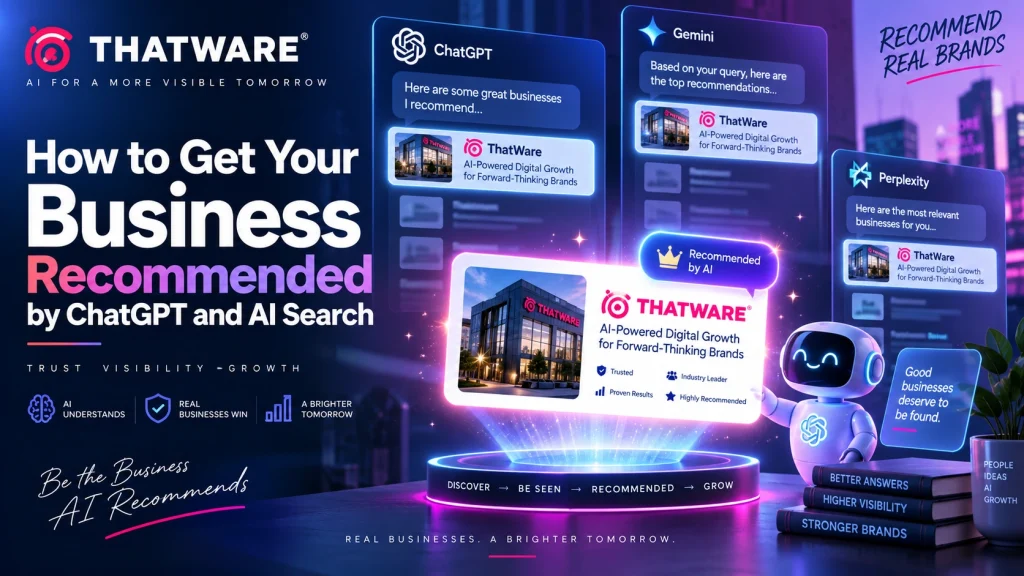
A company can have strong organic visibility and still be missing when users ask AI tools for recommendations.
That is why more businesses are asking how to rank in ChatGPT, how to improve AI visibility, and how to become a trusted source inside AI-generated answers.
The important point is that ChatGPT visibility does not come from a single ranking factor.
Businesses need strong entity signals, high-quality content, trustworthy citations, external validation, topical authority, technical accessibility, and consistent brand information.
The goal is not simply to manipulate an AI model.
The goal is to make your business easy to understand, easy to verify, and credible enough to recommend.
Can a Business Actually Rank in ChatGPT?
The phrase “rank in ChatGPT” is useful, but it is not exactly the same as ranking in a traditional search engine.
Google typically shows ordered search results.
ChatGPT may generate an answer based on a combination of model knowledge, retrieval systems, search results, cited sources, structured information, and contextual understanding.
That means there may not always be a fixed ranking position.
Instead, visibility can take several forms:
- Your brand is mentioned
- Your website is cited
- Your business is recommended
- Your company appears in a comparison
- Your expertise is referenced
- Your service is associated with a specific category
- Your founder or expert is cited
- Your content influences the answer
So when businesses ask how to rank in ChatGPT, the practical objective is to increase the probability of being recognized, retrieved, cited, and recommended for relevant prompts.
Expert Insight:
“Ranking in ChatGPT is less about holding a fixed position and more about becoming a trusted entity that AI systems repeatedly recognize, retrieve, and reference.”
What Does It Mean to Get Recommended by ChatGPT?
To get business recommended by ChatGPT, your company needs to be associated with the right topics, services, industries, and trust signals.
For example, if a user asks:
“What are the best AI SEO agencies in India?”
ChatGPT may evaluate or retrieve information from sources that help it understand:
- Which companies offer AI SEO
- Which companies have authority in the category
- Which brands are mentioned externally
- Which companies publish useful research
- Which providers have strong entity signals
- Which businesses have relevant citations
- Which companies are consistently associated with the topic
If your brand is weak across these signals, it may not appear.
If your brand is strongly associated with the category across multiple trustworthy sources, your chances improve.
Quick Question: Does ChatGPT Recommend Businesses Based Only on Their Websites?
No. A strong website matters, but AI systems may also consider external mentions, citations, research, entity signals, authoritative publications, reviews, and other sources that help validate what a business does.
Why ChatGPT Recommendations Matter for Businesses
AI-generated recommendations can influence the buyer journey before a user visits a search engine.
A prospect may ask:
“Which company should I hire?”
“Which tool is best?”
“Who are the leading providers?”
“What businesses should I compare?”
If your business is absent from these answers, you may lose visibility before the traditional search journey even begins.
This is why ChatGPT visibility optimization is becoming an important part of modern digital marketing.
It focuses on improving how frequently and accurately your business appears in AI-generated environments.
ChatGPT SEO Is Not Traditional SEO
Traditional SEO focuses heavily on:
- Organic rankings
- Keywords
- Backlinks
- Technical SEO
- Search intent
- Content quality
- Internal linking
- Crawlability
- Indexation
ChatGPT SEO services build on these foundations but go further.
They may also focus on:
- Entity optimization
- Brand mentions
- AI citations
- Semantic relationships
- Structured data
- Knowledge graph signals
- External corroboration
- AI visibility tracking
- Prompt testing
- Citation source analysis
- LLM retrieval readiness
This is why a specialized ChatGPT SEO agency should not simply repackage conventional SEO under a new name.
The strategy must account for how AI systems discover and synthesize information.
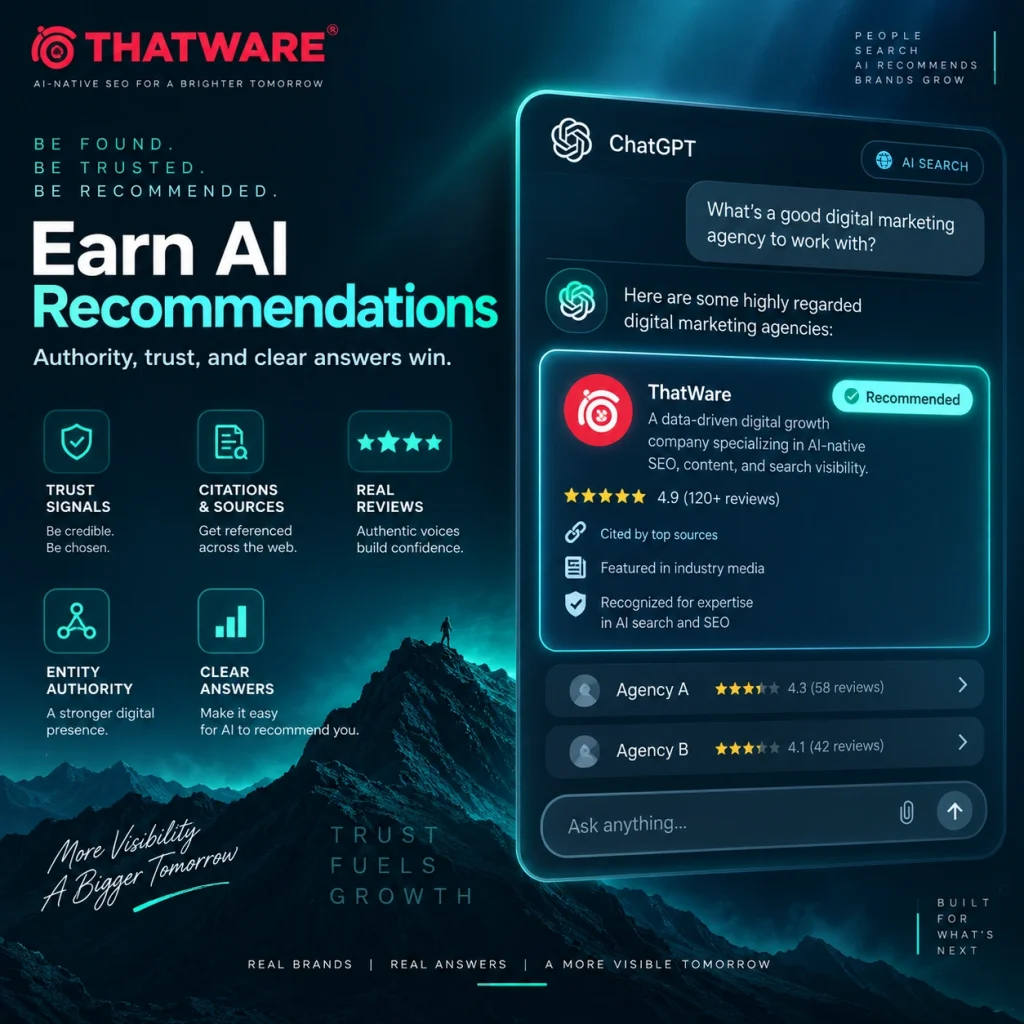
Strategic Insight:
“Traditional SEO helps a page become discoverable. ChatGPT SEO extends that work by helping the brand become understandable, verifiable, and recommendable.”
1. Build a Strong Brand Entity
One of the most important steps to rank business in ChatGPT is strengthening your brand entity.
AI systems need to understand:
- Who you are
- What your company does
- Which services you offer
- Where you operate
- Who your founders are
- Which industries you serve
- What makes your business distinctive
Your brand information should be consistent across:
- Your website
- Social profiles
- Business directories
- Industry publications
- Partner sites
- Review platforms
- Founder profiles
- Press mentions
- Professional databases
If the same company is described differently across different sources, AI systems may have difficulty identifying the correct entity.
Consistency improves machine understanding.
Case Study: Fixing Brand Entity Confusion
Consider a technology company described as an SEO agency on its website, a software company on directories, and a marketing consultancy in media profiles. An entity optimization campaign could standardize its core positioning, services, founder information, schema, and external profiles so AI systems receive a more consistent picture of the business.
2. Clearly Explain What Your Business Does
Many websites use vague marketing language.
For example:
“We empower brands to dominate the future of digital growth.”
That sounds impressive, but it does not clearly tell an AI system what the company actually offers.
A stronger statement would be:
“ThatWare provides SEO, AEO, GEO, LLM SEO, AI search optimization, and digital marketing services for businesses seeking greater search and AI visibility.”
Clear statements help both users and machines.
If you want to appear in ChatGPT results, avoid making core service information unnecessarily ambiguous.
3. Optimize Your Website for Conversational Queries
Users interact with ChatGPT through natural-language questions.
Your website should therefore answer those kinds of questions directly.
Instead of targeting only:
“AI SEO company”
also create content around queries such as:
- Which company offers AI SEO services?
- How can I improve my brand visibility in ChatGPT?
- How does ChatGPT choose business recommendations?
- What is the best way to get cited by AI tools?
- How can businesses improve LLM visibility?
- What signals help AI recommend a brand?
If you want to optimize website for ChatGPT, build content around real questions your audience is likely to ask.
4. Create Direct, Extractable Answers
AI systems benefit from clearly structured information.
Your content should contain concise explanations under descriptive headings.
For example:
What Is ChatGPT Visibility Optimization?
ChatGPT visibility optimization is the process of improving a brand’s content, entity signals, authority, citations, and technical accessibility so that ChatGPT can more accurately understand and potentially surface the business in relevant generated answers.
This type of structure makes content easier to interpret.
Use:
- Clear H2s and H3s
- Definitions
- Lists
- Comparison tables
- FAQs
- Step-by-step sections
- Short explanatory paragraphs
- Summaries
- Examples
Clarity helps retrieval.
Quick Question: Should Every Answer Be Extremely Short?
Not necessarily. The most important information should be stated clearly and early, followed by supporting detail where needed. This gives AI systems a concise answer while still providing users with enough context.
5. Build Topical Authority
A single article is rarely enough to establish expertise.
If you want ChatGPT to associate your brand with a specific topic, build a complete content ecosystem around it.
For example, a company specializing in AI search could publish content on:
- AI SEO
- GEO
- AEO
- LLM SEO
- ChatGPT optimization
- AI citations
- Entity SEO
- Knowledge graphs
- AI visibility tracking
- AI search audits
- Prompt monitoring
- Generative search optimization
This creates stronger semantic relationships.
A specialized ChatGPT optimization agency should help businesses develop this kind of topic depth rather than relying on isolated articles.
6. Strengthen External Brand Mentions
Your own website can claim expertise.
External sources help validate it.
This is a major part of ChatGPT citation optimization.
Useful external signals can include:
- News coverage
- Industry articles
- Interviews
- Guest contributions
- Podcasts
- Conference mentions
- Research citations
- Partner websites
- Professional directories
- Review sites
- Expert roundups
The goal is to create independent evidence that supports your brand’s relationship with specific topics.
Authority Principle:
“What your company says about itself builds context. What credible third parties say about your company builds corroboration.”
7. Earn AI-Friendly Citations
A citation is more than a backlink.
It can include:
- A linked brand mention
- An unlinked mention
- A quote from an expert
- A company reference
- A research citation
- A founder mention
- A case study
- A recommendation
- A comparison listing
Professional AI citation optimization focuses on increasing the number and quality of trustworthy references connecting your brand to relevant subjects.
AI systems may use these references when determining which sources or businesses are credible enough to include in generated answers.
Quick Question: Is an AI Citation the Same as a Backlink?
Not always. A brand can gain AI-relevant authority through linked mentions, unlinked references, expert quotes, research citations, founder mentions, comparisons, or recommendations. The broader goal is credible association, not simply link acquisition.
8. Publish Original Research
Original research can significantly improve citation potential.
Generic content is easy to replace.
Original data is harder to replace.
Businesses can publish:
- Industry studies
- Surveys
- Benchmark reports
- Proprietary datasets
- AI visibility studies
- Search trend research
- Experiments
- Performance analyses
- Case studies
For example:
“Analysis of 10,000 commercial prompts across ChatGPT and Perplexity.”
That type of asset is inherently more citation-worthy than another generic article explaining what AI SEO means.
Original research can strengthen both conventional SEO and AI visibility.
Case Study: Turning Research Into an AI Citation Asset
Imagine an agency analysing thousands of commercial AI prompts to identify which brands are most frequently mentioned across ChatGPT, Gemini, and Perplexity. Publishing the findings as an original benchmark report could create a citation-worthy asset that supports media coverage, backlinks, expert references, and AI visibility simultaneously.
9. Create Content AI Systems Want to Reference
AI systems often need useful source material.
The most referenceable content usually provides:
- Definitions
- Statistics
- Research
- Comparisons
- Expert commentary
- Frameworks
- Step-by-step processes
- Original insights
- Technical explanations
- Industry data
A strong ChatGPT optimization services strategy should include the creation of citation assets, not only traditional blog content.
10. Improve Structured Data
Structured data helps machines interpret the meaning of your content and entities.
Useful schema types can include:
- Organization
- Person
- Service
- Product
- Article
- FAQPage
- BreadcrumbList
- Review
- LocalBusiness
- VideoObject
Structured data does not guarantee that ChatGPT will recommend your company.
However, it improves machine-readable context and can reduce ambiguity.
11. Optimize Your About Page
Your About page is an important entity source.
It should clearly explain:
- Company name
- Founding information
- Leadership
- Core services
- Industry focus
- Locations
- Expertise
- Mission
- Achievements
- Relevant credentials
Avoid writing an About page that contains only emotional brand language.
AI systems need factual information.
12. Build Strong Founder and Expert Profiles
People can strengthen brand authority.
If your founders, executives, or subject experts are recognized across external sources, their authority can reinforce the company entity.
Expert profiles should contain:
- Full name
- Role
- Expertise
- Experience
- Publications
- Research
- Awards
- Interviews
- Speaking engagements
- Social profiles
This can help AI systems connect individuals with companies and topics.
13. Improve Internal Linking
Internal linking helps establish relationships between topics.
A page about ChatGPT visibility could link to:
- AI SEO services
- GEO services
- AEO services
- LLM SEO
- AI search optimization
- Entity optimization
- AI citation optimization
Use descriptive anchor text.
Strong internal linking helps machines understand which pages are core service pages and which pages provide supporting authority.
14. Optimize Commercial Pages
Many businesses publish informative blogs but leave their service pages weak.
This limits AI recommendation potential.
If a user asks:
“Which company offers ChatGPT SEO services?”
your website should have a strong commercial page that clearly explains:
- What the service includes
- Who it is for
- What platforms are covered
- What problems it solves
- What the process looks like
- How performance is measured
- What differentiates your approach
Thin service pages provide little evidence.
Strong ChatGPT SEO services pages should combine commercial intent with detailed expertise.
15. Build Comparison Content
AI users frequently ask comparison questions.
Examples:
“Which AI SEO agency is best?”
“ChatGPT SEO vs traditional SEO”
“Which GEO agencies should I consider?”
“Which company offers the best AI visibility services?”
Comparison and decision-stage content can help your brand appear in these journeys.
Create:
- Alternatives pages
- Comparison guides
- Vendor selection criteria
- Buyer checklists
- Industry-specific recommendations
- Service comparisons
- Cost guides
This content is highly relevant to AI-assisted purchasing.
16. Develop Digital PR for AI Visibility
Digital PR has become even more important in generative search.
Traditional PR often focuses on backlinks, traffic, and brand awareness.
AI-focused PR should also ask:
- Is the brand clearly mentioned?
- Is the expertise clearly described?
- Is the company associated with the right topic?
- Is the article authoritative?
- Can AI systems retrieve the page?
- Is the information unique?
This creates stronger evidence for AI systems.
17. Improve Citation Consistency
If different sources describe your company differently, AI systems may struggle to form a consistent representation.
For example:
One site says you are an SEO company.
Another says you are an AI marketing company.
Another says you are a software company.
Another describes you only as a digital agency.
These descriptions should not necessarily be identical, but they should reinforce a consistent core identity.
This is particularly important for LLM visibility services.
18. Create Knowledge Graph Relationships
AI systems benefit from clear relationships between entities.
For example:
ThatWare → provides → AI SEO
ThatWare → provides → GEO
ThatWare → specializes in → AI search optimization
ThatWare → founded by → Tuhin Banik
ThatWare → associated with → search intelligence
These relationships can be reinforced across:
- Website content
- Schema
- External profiles
- Media mentions
- Interviews
- Partnerships
- Research
- Business databases
Strong relationships improve entity clarity.
19. Build Brand Authority Beyond Your Website
AI systems may not rely only on your website.
That means off-site reputation is important.
Build authority through:
- Industry publications
- Thought leadership
- Expert commentary
- Research
- Media coverage
- Partnerships
- Conference participation
- Podcasts
- Case studies
- Reviews
A strong external footprint helps AI systems verify your brand.
Brand Visibility Insight:
“AI visibility is not built on a website alone. It grows from the network of credible places where a brand, its experts, and its expertise consistently appear.”
20. Monitor How ChatGPT Describes Your Business
Do not assume ChatGPT understands your company correctly.
Test prompts regularly.
Ask:
- What does this company do?
- What services does it offer?
- Who founded it?
- What industries does it serve?
- What is it known for?
- Who are its competitors?
- Is it recommended for this service?
Track inaccurate or missing information.
This is a core part of ChatGPT visibility optimization.
21. Track Prompt-Level Visibility
Traditional SEO tracks keywords.
AI visibility should also track prompts.
For example:
- Best AI SEO company
- Best GEO agency
- Best ChatGPT SEO agency
- Companies offering AEO services
- Best AI visibility agencies
- AI SEO consultants for enterprises
For each prompt, measure:
- Is your brand mentioned?
- Is it cited?
- Where does it appear?
- Which competitors appear?
- What sources are cited?
This creates a measurable AI visibility framework.
Quick Question: Why Track Prompts Instead of Only Keywords?
Because AI users search conversationally. Tracking prompts shows whether your brand is mentioned, cited, recommended, or ignored for the actual questions buyers are asking, which traditional keyword rankings cannot fully reveal.
22. Track Competitor Visibility
You should know which companies dominate AI-generated recommendations.
Ask:
- Which competitors are mentioned frequently?
- Which prompts trigger their visibility?
- What external sources support them?
- Which services are associated with them?
- What wording does AI use to describe them?
This helps identify gaps in your own authority.
23. Measure AI Share of Voice
AI share of voice can help quantify visibility.
For example:
If your brand appears in 30 of 100 tracked prompts, your prompt-level mention share is 30%.
You can compare this against competitors.
Metrics may include:
- Mention share
- Citation share
- Recommendation share
- Prompt coverage
- Platform coverage
- Sentiment
- Entity accuracy
Professional AI visibility services should include measurement, not just content creation.
24. Improve LLM Visibility
LLM visibility is broader than ChatGPT alone.
Businesses should evaluate how they appear across multiple AI systems.
Professional LLM visibility services may monitor:
- ChatGPT
- Gemini
- Perplexity
- Copilot
- Claude
- Other AI search systems
The same brand may perform differently across platforms.
That is why AI visibility should be measured separately by engine.
25. Strengthen AI Brand Visibility
Brand visibility inside AI systems depends on more than keywords.
Professional AI brand visibility services focus on the full brand ecosystem.
This includes:
- Brand mentions
- Citations
- Entity authority
- External validation
- Topical relevance
- Structured data
- Research
- Expert credibility
- Content quality
- Digital PR
The stronger this ecosystem becomes, the easier it is for AI systems to understand and recommend the business.
26. Make Your Website Technically Accessible
Even strong content can fail if search and retrieval systems cannot access it.
Check:
- Robots.txt
- Meta robots
- Canonicals
- XML sitemaps
- JavaScript rendering
- HTTP status codes
- Page speed
- Internal links
- Crawl depth
- Duplicate content
- Indexation
Technical SEO still matters.
You cannot build sustainable AI visibility on a technically weak website.
27. Keep Content Updated
AI search evolves quickly.
Your content should remain current.
Update:
- Statistics
- Platform capabilities
- Examples
- Screenshots
- Service descriptions
- Case studies
- Research
- FAQs
- Internal links
Freshness is particularly important in fast-moving AI categories.
28. Avoid Common ChatGPT SEO Mistakes
Mistake 1: Keyword Stuffing
Repeating “ChatGPT SEO” will not make your business more trustworthy.
Mistake 2: Publishing Generic AI Content
Mass-produced content without expertise does little to build authority.
Mistake 3: Ignoring External Sources
Your website cannot validate every claim itself.
Mistake 4: Focusing Only on Backlinks
Mentions and citations matter too.
Mistake 5: Measuring Only Google Rankings
AI visibility requires separate measurement.
Mistake 6: Expecting Guaranteed Recommendations
No legitimate ChatGPT optimization agency can guarantee that ChatGPT will recommend a specific business for every query.
The goal is to improve the probability of visibility through stronger signals.
29. Can You Guarantee ChatGPT Rankings?
No.
A credible ChatGPT SEO agency should never promise guaranteed placement.
AI-generated answers can change based on:
- Prompt wording
- User context
- Model updates
- Retrieval sources
- Freshness
- Platform configuration
- Search integrations
The objective is to improve the underlying signals that increase discoverability.
30. How Long Does ChatGPT Optimization Take?
There is no universal timeline.
Results depend on:
- Existing authority
- Brand recognition
- Content depth
- Technical health
- External mentions
- Competition
- Entity clarity
- Citation quality
Improving visibility is generally an ongoing process.
31. How ThatWare Approaches ChatGPT Visibility
At ThatWare, AI visibility can be treated as a connected search intelligence problem.
The goal is not simply to target one AI tool.
The broader objective is to strengthen how a business is understood, retrieved, cited, and recommended across generative search environments.
ThatWare’s approach may combine:
- SEO
- AEO
- GEO
- LLM SEO
- Entity optimization
- Knowledge graph enhancement
- Structured data
- AI citation analysis
- Digital PR
- Research asset development
- Prompt monitoring
- AI visibility measurement
- Competitor intelligence
- Technical SEO
- Semantic content architecture
Businesses looking for ChatGPT optimization services should focus on creating a durable authority system rather than chasing short-term tricks.
Measurement Insight:
“AI visibility should be treated as an ecosystem metric, not a single-platform ranking metric.”
Who Needs ChatGPT SEO Services?
Businesses may benefit from specialized ChatGPT SEO services if:
- Competitors are recommended instead of them
- ChatGPT does not recognize the brand
- Their company is described inaccurately
- Their website earns few AI citations
- Their industry is highly competitive
- Customers use AI for vendor research
- They want to improve AI share of voice
- They want stronger entity authority
This is particularly relevant for B2B companies, SaaS brands, agencies, ecommerce businesses, professional services firms, healthcare providers, financial companies, and technology brands.
ChatGPT SEO Agency vs Traditional SEO Agency
A traditional agency may focus heavily on:
- Keywords
- Rankings
- Links
- Organic traffic
A specialized ChatGPT SEO agency should additionally understand:
- AI retrieval
- Entity resolution
- Semantic relationships
- Citation authority
- LLM behavior
- Generative search
- Prompt monitoring
- AI share of voice
- Brand sentiment
The distinction is not that one replaces the other.
AI search optimization extends traditional SEO.
ChatGPT Optimization Agency vs GEO Agency
A ChatGPT optimization agency focuses specifically on improving visibility within ChatGPT and related AI search experiences.
A GEO agency typically takes a broader view across generative platforms.
In practice, the strategies overlap significantly.
Both may include:
- Entity optimization
- AI citations
- Content strategy
- Digital PR
- Structured data
- Brand authority
- Prompt monitoring
The strongest approach is usually multi-platform rather than ChatGPT-only.
The Future of Business Discovery Is AI-Assisted
AI assistants are becoming part of how people research companies.
That means business discovery is becoming less dependent on a single search engine interface.
In the future, users may ask increasingly complex questions such as:
“Which provider is best for my exact situation?”
“What company has the strongest expertise?”
“Which brand has credible evidence?”
“What option should I choose based on these requirements?”
Businesses need to prepare for this shift now.
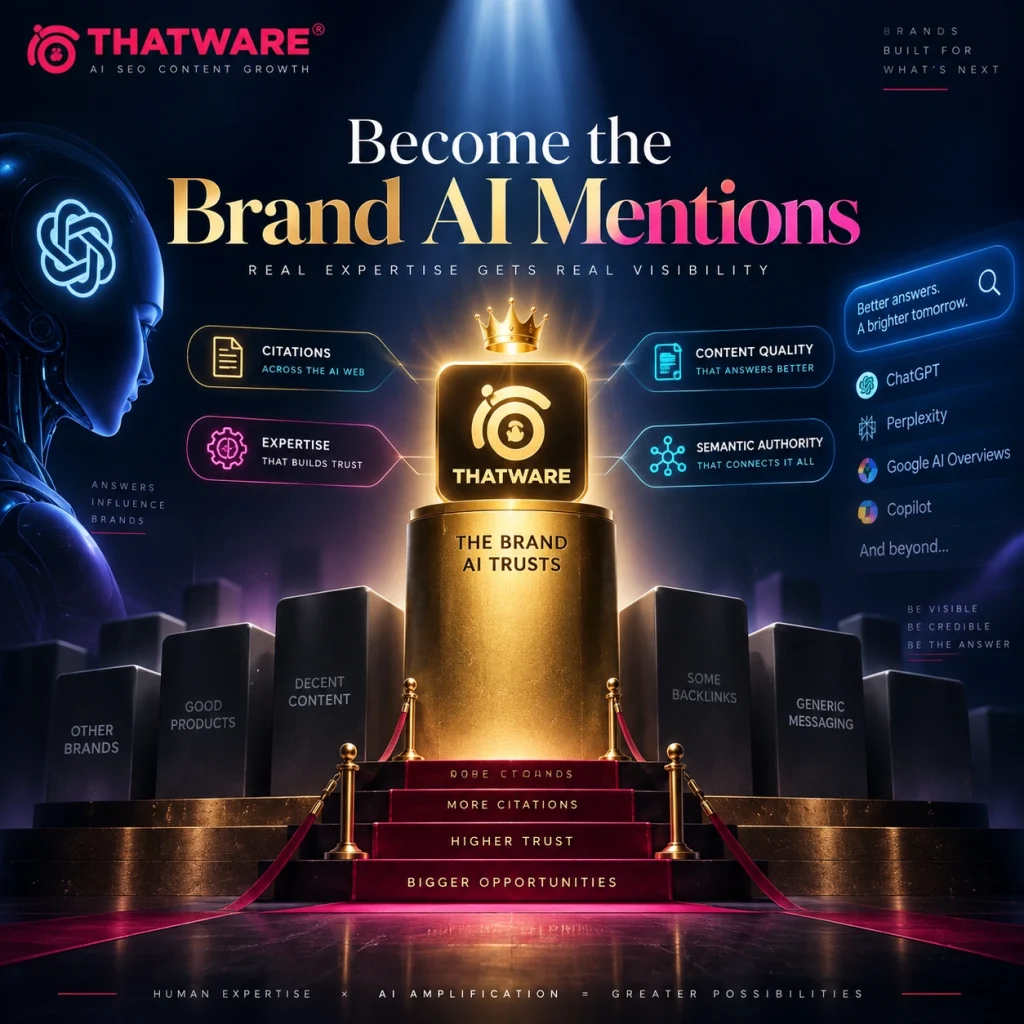
The goal is not just to appear in ChatGPT results.
The goal is to become a trusted entity within the wider AI search ecosystem.
Final Thoughts
If you want to rank business in ChatGPT, do not think only in terms of keywords.
Think in terms of trust.
Think in terms of entities.
Think in terms of citations.
Think in terms of expertise.
Think in terms of external validation.
Think in terms of machine understanding.
To get business recommended by ChatGPT, your company needs a strong ecosystem of signals that supports its authority.
That includes:
- High-quality content
- Strong entity information
- External mentions
- Structured data
- Original research
- Technical accessibility
- Digital PR
- AI citations
- Topic depth
- Ongoing monitoring
Businesses that invest in ChatGPT citation optimization, AI citation optimization, LLM visibility services, and AI brand visibility services can build a stronger foundation for the next generation of search.
The future of digital visibility is no longer only about ranking first.
It is about being understood, trusted, cited, and recommended.