SUPERCHARGE YOUR ONLINE VISIBILITY! CONTACT US AND LET’S ACHIEVE EXCELLENCE TOGETHER!
Search is no longer a single-channel activity.
A few years ago, most businesses could focus almost entirely on Google rankings, organic traffic, backlinks, technical SEO, and conversion optimization. Today, users discover brands through a much wider search ecosystem.
They ask Google for answers.
They ask ChatGPT for recommendations.
They use Gemini to compare services.
They use Perplexity to research companies.
They use Copilot to summarize options.
They increasingly expect AI systems to give them direct, useful, trustworthy answers instead of simply showing a list of websites.
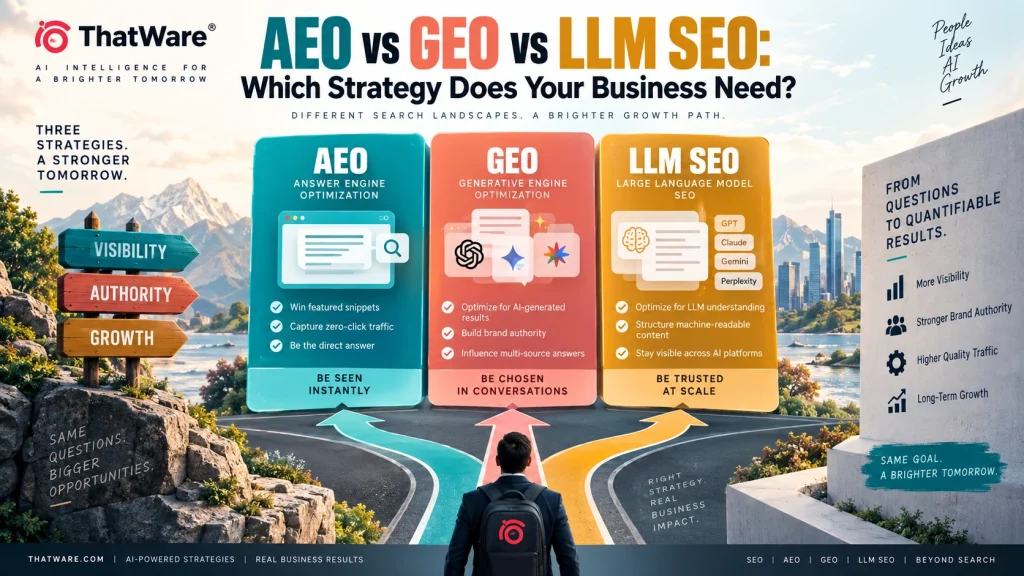
As a result, three newer optimization disciplines are becoming increasingly important:
- Answer Engine Optimization, or AEO
- Generative Engine Optimization, or GEO
- Large Language Model SEO, or LLM SEO
These approaches overlap, but they are not identical.
Understanding AEO vs GEO vs LLM SEO is important because each strategy addresses a different part of the AI-powered discovery ecosystem.
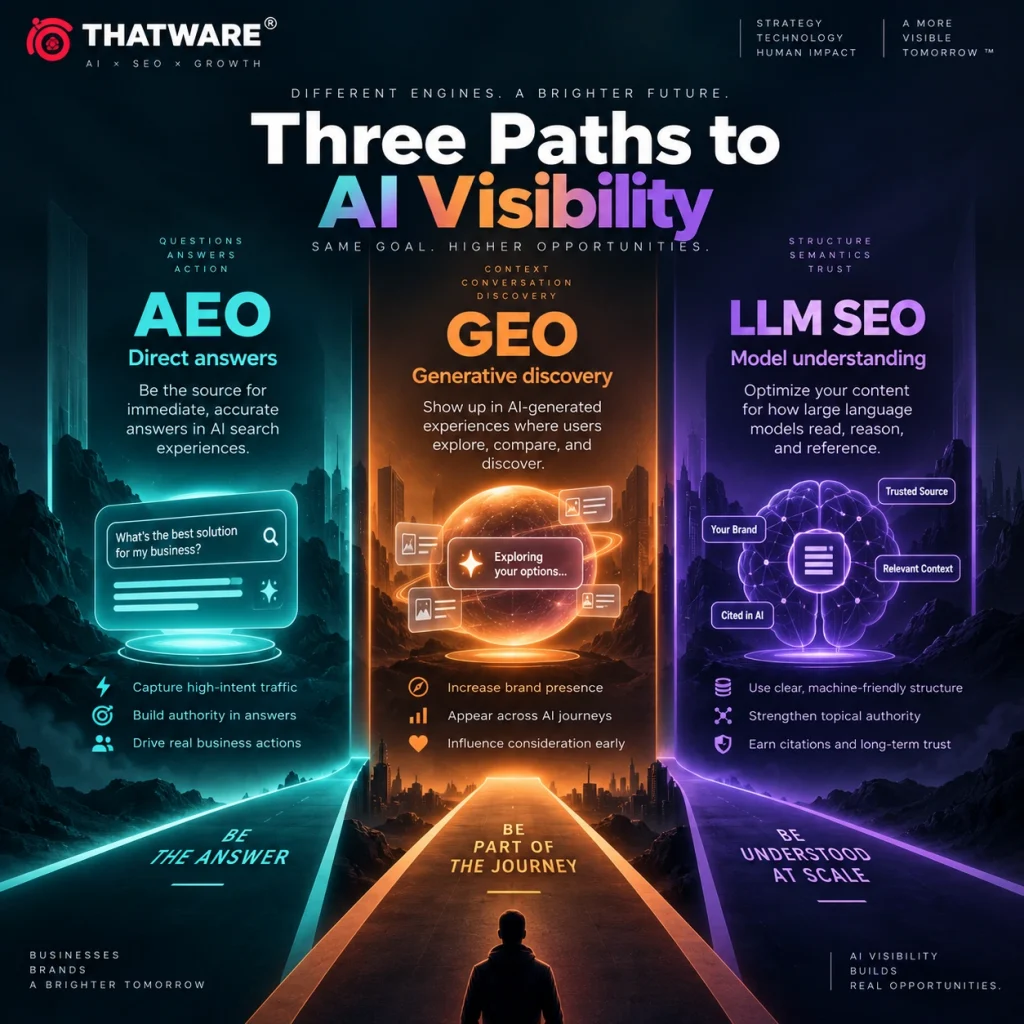
AEO is primarily concerned with becoming the answer.
GEO focuses on becoming visible and cited within generative AI responses.
LLM SEO focuses on helping large language models understand, retrieve, associate, and represent your brand accurately.
The right strategy depends on how your customers search, what platforms they use, what information they need, and where your brand currently lacks visibility.
What Is AEO?
Answer Engine Optimization is the process of structuring content so that search engines and AI-powered systems can identify, extract, and present it as a direct answer to a user’s question.
Traditional SEO often asks:
“How can this page rank higher?”
AEO asks:
“How can this content become the most useful answer?”
Professional AEO services typically focus on improving:
- Question-based content
- Featured-answer formatting
- FAQ coverage
- Search intent alignment
- Structured data
- Conversational query targeting
- Direct definitions
- Snippet-friendly content
- Semantic relevance
- Information hierarchy
AEO is especially important when users ask questions such as:
“What is enterprise SEO?”
“How does AI search optimization work?”
“What is the difference between GEO and SEO?”
“How can a company improve visibility in AI Overviews?”
An experienced AEO agency does not simply add FAQs to pages. It studies user questions, search intent, conversational query patterns, entity context, and answer formatting to make content easier for search systems to extract.
Expert Insight:
“Good AEO is not about answering more questions. It is about giving the clearest possible answer at the exact point where search systems need it.”
What Is GEO?
Generative Engine Optimization focuses on increasing a brand’s visibility within generative AI responses.
The objective is not only to rank in conventional search results, but also to become a brand, source, citation, or recommendation inside AI-generated answers.
Professional GEO services may involve:
- AI citation optimization
- Entity optimization
- Brand mention development
- Topical authority
- Digital PR
- External source validation
- Knowledge graph enhancement
- Semantic content development
- Generative search monitoring
- AI share-of-voice analysis
- Research asset creation
- Structured data
An effective GEO agency looks at questions such as:
- Does ChatGPT mention your company?
- Does Gemini recognize your services?
- Does Perplexity cite your website?
- Do AI systems recommend competitors instead of you?
- Are third-party publications validating your expertise?
- Are AI engines correctly describing what your company does?
Professional generative engine optimization services therefore extend beyond the website itself.
GEO requires both owned signals and external authority signals.
What Is LLM SEO?
LLM SEO focuses specifically on how large language models understand, retrieve, associate, and represent information about a website, company, product, or expert.
Traditional search engines primarily crawl, index, and rank documents.
Large language models work differently.
They may rely on:
- Training data
- Retrieval systems
- Search indexes
- Knowledge graphs
- Structured information
- Web citations
- Entity relationships
- Semantic associations
- Context windows
- External datasets
This means businesses need to think beyond page-level optimization.
Professional LLM SEO services focus on making information easier for AI systems to interpret correctly.
An LLM SEO agency may work on:
- Entity clarity
- Brand associations
- Machine-readable information
- Semantic content architecture
- Knowledge graph relationships
- AI retrieval readiness
- Structured data
- Author and founder entities
- Citation consistency
- Contextual brand mentions
- AI monitoring
- Prompt testing
The purpose of LLM optimization services is to improve the quality and consistency of how a business is understood across large language model environments.
AEO vs GEO: What Is the Difference?
The difference between AEO vs GEO is mainly about the type of visibility being optimized.
AEO focuses on helping content become a direct answer.
GEO focuses on helping a brand, website, or source appear inside generative AI responses.
For example, consider the query:
“What is AI search optimization?”
An AEO strategy would focus on writing the clearest, most concise, structured answer possible.
A GEO strategy would additionally focus on increasing the likelihood that your brand or website is cited when an AI system generates that answer.
That is why GEO vs AEO should not necessarily be treated as an either-or choice.
They solve related but different problems.
Quick Question: Can the Same Page Support Both AEO and GEO?
Yes. A well-structured page can provide a concise answer for AEO while also becoming a useful source that generative systems may cite or reference. The difference lies mainly in whether the goal is answer extraction, brand visibility, or both.
AEO vs SEO
The difference between AEO vs SEO is largely based on the optimization target.
SEO traditionally focuses on ranking webpages.
AEO focuses on becoming the answer extracted from those webpages.
Traditional SEO may optimize:
- Keywords
- Metadata
- Internal links
- Backlinks
- Technical health
- Page speed
- Search intent
- Crawlability
AEO adds:
- Question targeting
- Direct answers
- Natural-language queries
- FAQ structures
- Answer blocks
- Semantic definitions
- Structured data
- Snippet optimization
SEO helps users find a page.
AEO helps search systems understand what answer the page contains.
Both are important.
GEO vs SEO
The difference between GEO vs SEO becomes clearer when we look at the desired outcome.
SEO asks:
“Can this page rank in organic search?”
GEO asks:
“Can this brand or source appear inside an AI-generated response?”
SEO typically focuses on search results.
GEO focuses on generative responses.
SEO signals may include:
- Rankings
- Search impressions
- Clicks
- Backlinks
- Technical health
- Content relevance
GEO introduces additional signals such as:
- Brand mentions
- AI citations
- Entity authority
- Third-party validation
- Generative recommendation share
- AI sentiment
- Source authority
- Semantic brand associations
SEO remains foundational.
But GEO expands the visibility objective.
LLM SEO vs SEO
The difference between LLM SEO vs SEO is primarily about how information is interpreted and retrieved.
SEO optimizes for search engines that crawl, index, and rank webpages.
LLM SEO optimizes for systems that may synthesize information from many sources before producing an answer.
This requires stronger focus on:
- Entity clarity
- Semantic relationships
- Structured information
- Brand consistency
- Machine-readable context
- External mentions
- Knowledge graphs
- Citation signals
- Retrieval readiness
A website may be technically well optimized for Google but still be poorly understood by AI systems.
That is why LLM SEO is becoming an important extension of traditional SEO.
AEO vs GEO vs LLM SEO: The Core Difference
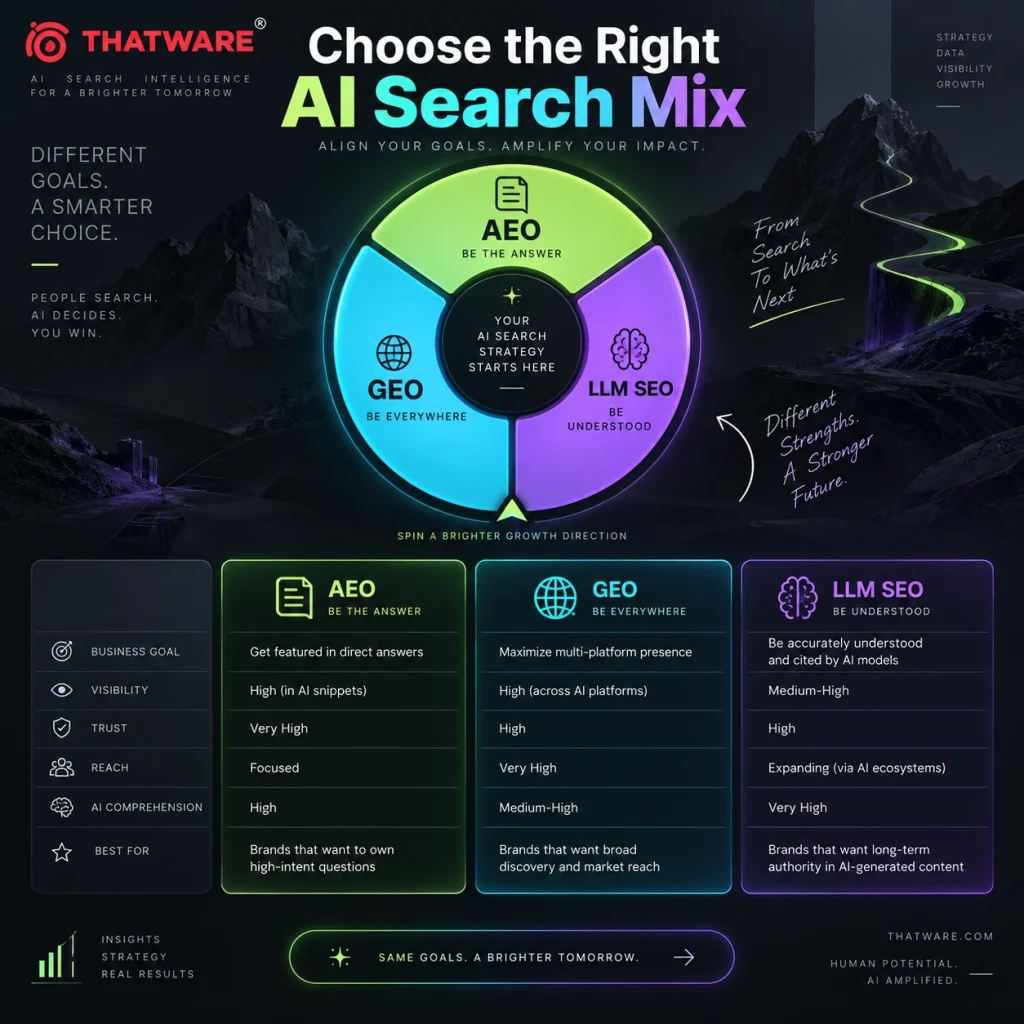
The simplest way to understand AEO vs GEO vs LLM SEO is:
AEO = Become the answer.
GEO = Become visible inside the generated answer.
LLM SEO = Become understandable and retrievable by the model generating the answer.
These three strategies overlap heavily.
A well-optimized FAQ could support AEO.
If that FAQ gets cited in Perplexity, it contributes to GEO.
If the content also strengthens the model’s understanding of your brand and expertise, it contributes to LLM SEO.
The strongest AI search strategies usually combine all three.
Strategic Insight:
“AEO earns the answer, GEO earns the mention, and LLM SEO helps the machine understand why the brand belongs in the conversation.”
Which Strategy Should Your Business Prioritize?
The answer depends on your current visibility problem.
Choose AEO If Your Problem Is Answer Visibility
AEO should be a priority if:
- Your content ranks but does not win snippets
- Your pages do not answer questions clearly
- Users frequently search informational queries
- Your website has weak FAQ coverage
- You want more visibility in answer-focused search experiences
- Your pages contain long explanations but few direct answers
In this scenario, answer engine optimization services can improve how your content is structured and extracted.
Choose GEO If Your Problem Is AI Brand Visibility
GEO should be a priority if:
- Competitors appear in ChatGPT but you do not
- Your brand is rarely cited in Perplexity
- AI tools recommend other providers
- You lack authoritative third-party mentions
- Your company wants to appear in generative search recommendations
- You need to increase AI share of voice
In this case, generative engine optimization services are likely to provide more strategic value.
Case Study: Closing an AI Visibility Gap
Consider a B2B company that ranks well organically but is rarely mentioned when prospects ask AI platforms for recommended providers. A GEO campaign could strengthen authoritative third-party mentions, publish citation-worthy research, improve entity signals, and monitor recommendation prompts. Over time, the objective would be to increase the brand’s presence across AI-generated comparisons, not simply improve Google rankings.
Choose LLM SEO If Your Brand Is Poorly Understood
LLM SEO should be prioritized if:
- AI systems misunderstand your business
- Your services are incorrectly categorized
- Your brand entity is weak
- Founder and company information is inconsistent
- AI tools provide outdated information about your company
- Your website lacks machine-readable structure
- Your content architecture is fragmented
Here, LLM optimization services can strengthen entity clarity, semantic relationships, and retrieval readiness.
Why Most Businesses Need All Three
The AI search ecosystem is interconnected.
AEO, GEO, and LLM SEO should not always be treated as separate campaigns.
Consider a software company.
Its AEO strategy might produce a clear answer to:
“What is the best CRM for healthcare companies?”
Its GEO strategy might help the company become cited in generative comparisons.
Its LLM SEO strategy might strengthen relationships between the company, healthcare CRM, compliance, integrations, and enterprise software.
Each layer reinforces the others.
That is why a mature AI visibility strategy usually combines:
- SEO
- AEO
- GEO
- LLM SEO
- Digital PR
- Entity optimization
- Structured data
- Content strategy
- Knowledge graph development
- AI visibility measurement
Quick Question: Do Businesses Need Three Separate Campaigns?
Usually, no. AEO, GEO, and LLM SEO often work better as connected layers of one AI visibility strategy. One content asset can answer a question, attract citations, and strengthen how AI systems associate a brand with a topic.
How AEO Works in Practice
A strong AEO program starts with question research.
This can involve:
- Google People Also Ask
- Search suggestions
- Customer support questions
- Sales-team questions
- Search Console queries
- Reddit discussions
- Industry forums
- AI-generated follow-up questions
- Internal search data
Once the questions are identified, content should answer them directly.
For example:
Weak AEO Content
“Modern businesses increasingly operate in evolving search environments where artificial intelligence is changing how information is discovered.”
Strong AEO Content
“Answer Engine Optimization is the process of structuring content so search and AI systems can extract it as a direct answer to user questions.”
The second version is clearer and easier to retrieve.
A professional AEO agency focuses on this type of answer clarity throughout the website.
How GEO Works in Practice
GEO requires a broader ecosystem.
Suppose a company wants to be recommended for enterprise SEO.
Simply publishing a service page is unlikely to be enough.
A GEO strategy may include:
- Publishing enterprise SEO research
- Getting quoted in authoritative publications
- Appearing in industry comparisons
- Creating original datasets
- Building founder expertise
- Improving schema
- Earning brand mentions
- Creating citation-worthy resources
- Monitoring AI recommendation queries
- Tracking competitor visibility
An advanced GEO agency therefore works across content, PR, entities, authority, and measurement.
GEO Principle:
“Generative visibility is rarely created by one page. It is built through an ecosystem of content, authority, citations, entities, and external validation.”
How LLM SEO Works in Practice
LLM SEO focuses on information relationships.
For example, a company may want AI systems to understand:
ThatWare → specializes in → AI SEO
ThatWare → provides → AEO
ThatWare → provides → GEO
ThatWare → works with → enterprise brands
ThatWare → associated with → search intelligence
ThatWare → founded by → Tuhin Banik
These relationships can be reinforced through:
- Website content
- Schema markup
- About pages
- Author profiles
- External publications
- Business databases
- Partner websites
- Interviews
- Research
- Consistent digital profiles
A strong LLM SEO agency looks at the brand as an entity network rather than a collection of isolated webpages.
Case Study: Strengthening Brand Understanding
Imagine an AI search agency whose website describes its services inconsistently across service pages, profiles, author bios, and third-party listings. An LLM SEO initiative could standardize its company information, connect founders and services through structured data, strengthen topic relationships, and improve external citation consistency. The goal would be more accurate brand descriptions and stronger associations when AI systems retrieve information about the company.
The Role of Structured Data
Structured data is relevant across AEO, GEO, and LLM SEO.
Useful schema may include:
- Organization
- Person
- Article
- FAQPage
- Service
- Product
- BreadcrumbList
- LocalBusiness
- Review
- VideoObject
Schema does not guarantee AI visibility.
However, it improves machine-readable context and helps reduce ambiguity.
This is particularly important in LLM-oriented optimization.
The Role of Topical Authority
Topical authority matters across all three disciplines.
If a company wants to be associated with AI SEO, publishing one article is not enough.
A stronger topical ecosystem might include:
- What is AI SEO?
- AEO vs GEO
- GEO vs SEO
- LLM SEO vs SEO
- AI citations
- ChatGPT optimization
- Google AI Overview optimization
- AI visibility measurement
- Entity SEO
- Knowledge graph optimization
- AI search audits
- Prompt monitoring
These connected resources help establish subject-matter depth.
They also create more opportunities for answers, citations, and model understanding.
The Role of Digital PR
Digital PR plays a major role in GEO and LLM SEO.
Why?
Because AI systems do not rely exclusively on what a business says about itself.
External corroboration matters.
Consider the difference between:
“Our company is a leading AI SEO provider.”
and
“Industry publications, expert roundups, conference websites, research reports, and partners repeatedly associate the company with AI SEO.”
The second creates a much stronger evidence network.
Digital PR can help generate:
- Expert citations
- Brand mentions
- Founder mentions
- Research references
- External links
- Industry associations
- Topical relevance
This can strengthen both GEO and LLM visibility.
Quick Question: Are Backlinks Enough for GEO?
Not necessarily. Backlinks remain valuable, but generative visibility can also depend on brand mentions, expert citations, entity consistency, research references, third-party validation, and how strongly authoritative sources associate a company with a topic.
The Role of Original Research
Original research is particularly useful in generative search.
AI systems need sources.
A company publishing original data can become a source instead of merely another commentator.
Examples include:
- AI visibility studies
- Industry surveys
- Ranking experiments
- Search trend analyses
- AI citation studies
- Benchmark reports
- Prompt-response datasets
Research can support:
- SEO backlinks
- AEO authority
- GEO citations
- LLM entity associations
- Digital PR
- Brand credibility
This makes proprietary data one of the strongest crossover assets across all three strategies.
Measuring AEO Performance
AEO metrics may include:
- Featured snippet visibility
- People Also Ask coverage
- Answer box appearances
- Long-tail query visibility
- FAQ impressions
- Search impressions
- Click-through rate
- Organic conversions
However, AEO should increasingly be measured alongside AI search visibility as well.
Measurement Insight:
“If AI search visibility cannot be measured beyond traditional rankings, businesses cannot tell whether they are actually becoming more visible inside answer and generative environments.”
Measuring GEO Performance
GEO measurement can include:
- AI brand mentions
- Citation frequency
- Recommendation share
- Competitor share of voice
- Prompt coverage
- AI sentiment
- Citation source analysis
- Platform visibility
An experienced provider of GEO services should be able to track visibility across multiple generative platforms rather than relying only on Google rankings.
Measuring LLM SEO Performance
LLM SEO can be harder to measure directly because model behaviour varies.
Useful indicators include:
- Correct brand descriptions
- Accurate service associations
- Entity recognition
- Prompt visibility
- Citation consistency
- Brand mention accuracy
- Model sentiment
- Knowledge graph consistency
- Reduced misinformation
Providers offering LLM SEO services should therefore combine qualitative and quantitative monitoring.
AEO, GEO, and LLM SEO for B2B Companies
B2B companies should pay particular attention to all three strategies.
B2B buyers increasingly use AI to ask:
“Which company should I hire?”
“What are the best vendors?”
“Which provider specializes in my industry?”
“How do these agencies compare?”
These queries sit close to commercial decision-making.
A B2B company that is absent from these answers may lose visibility before a prospect ever reaches Google.
That creates a strong case for combined AEO services, GEO services, and LLM SEO services.
AEO, GEO, and LLM SEO for Ecommerce
Ecommerce brands also benefit from these strategies.
Customers increasingly use AI for:
- Product comparisons
- Recommendations
- Buying guides
- Feature research
- Price comparisons
- Use-case questions
AEO can improve product answers.
GEO can strengthen recommendation visibility.
LLM SEO can improve product entity understanding.
Together, these strategies can influence AI-assisted shopping journeys.
AEO, GEO, and LLM SEO for Local Businesses
Local search is also becoming more conversational.
Users can ask:
“Who is the best dermatologist near me?”
“Which law firm specializes in commercial disputes?”
“What local SEO company has experience with ecommerce brands?”
Local businesses need strong:
- Entity signals
- Location information
- Reviews
- Structured data
- Local citations
- Service descriptions
- FAQ content
- Third-party validation
These support both traditional local SEO and emerging AI discovery.
Common AEO Mistakes
Businesses frequently make several AEO mistakes.
Writing Long Answers Without Direct Definitions
Answer engines need clarity.
Creating FAQs Only for Keywords
Questions should reflect actual user intent.
Ignoring Structured Data
Machine-readable context can support answer extraction.
Repeating Generic Content
AI systems do not need another version of the same information.
Ignoring Commercial Questions
AEO should cover the entire customer journey.
Common GEO Mistakes
Common GEO mistakes include:
Focusing Only on the Website
External authority matters.
Assuming Backlinks Equal AI Visibility
Citations and brand mentions can be equally important.
Ignoring Brand Entities
Generative systems need to understand who you are.
Measuring Only Rankings
GEO requires AI-specific metrics.
Trying to Manipulate AI Systems
The goal should be credible authority, not shortcuts.
Common LLM SEO Mistakes
Businesses often misunderstand LLM SEO.
Treating It as Keyword SEO
LLMs operate heavily through context and semantic relationships.
Ignoring Entity Consistency
Conflicting information creates uncertainty.
Publishing Thin AI Content
Volume alone does not establish authority.
Ignoring External Knowledge Sources
Models may rely on sources beyond your website.
Expecting Immediate Results
Entity and authority building take time.
How to Build an Integrated AEO, GEO, and LLM SEO Strategy
A practical approach can be divided into phases.
Phase 1: Visibility Audit
Measure:
- Organic visibility
- AI brand mentions
- AI citations
- Competitor presence
- Entity accuracy
- Existing question coverage
- Structured data
- Content gaps
Phase 2: Technical and Entity Foundation
Improve:
- Crawlability
- Indexation
- Schema
- Organization information
- Founder entities
- Service relationships
- About pages
- Author pages
- Brand consistency
Phase 3: AEO Content Development
Create:
- Question-led content
- Direct definitions
- FAQs
- Comparison pages
- How-to guides
- Buyer guides
- Decision-stage answers
Phase 4: GEO Authority Development
Build:
- Digital PR
- Brand mentions
- Citations
- Expert contributions
- Industry relationships
- Research assets
- External authority
Phase 5: LLM SEO Reinforcement
Strengthen:
- Semantic relationships
- Entity networks
- Structured information
- Knowledge graph signals
- Machine-readable context
- Brand associations
Phase 6: Continuous Measurement
Track:
- Search performance
- AI mentions
- Citation share
- Prompt visibility
- Competitor share of voice
- Sentiment
- Entity accuracy
This integrated approach is usually more effective than treating AEO, GEO, and LLM SEO as isolated services.
How ThatWare Approaches AEO, GEO, and LLM SEO
At ThatWare, modern search visibility can be viewed as a connected intelligence problem.
Users no longer discover brands through a single search interface.
They move across search engines, AI assistants, answer engines, social platforms, comparison pages, and digital publications.
That requires a broader optimization strategy.
ThatWare’s approach combines:
- Traditional SEO
- Answer Engine Optimization
- Generative Engine Optimization
- LLM SEO
- Entity optimization
- Semantic SEO
- Knowledge graph development
- AI citation analysis
- Structured data
- AI visibility monitoring
- Digital PR
- Content architecture
- Search intent analysis
- Technical SEO
Businesses looking for an AEO agency, GEO agency, or LLM SEO agency should not necessarily think of these as three completely independent service categories.
The stronger approach is to understand where the visibility gap exists and then apply the right combination of techniques.
Quick Question: Where Should a Business Start?
Start with an AI visibility audit. Identify whether the main problem is weak answer coverage, missing AI citations, poor brand recognition, inaccurate entity information, or a combination of these. The strategy should then be built around the largest measurable gap.
Which Strategy Does Your Business Need?
If your content is not being extracted as an answer, prioritize AEO.
If AI systems are not mentioning or citing your brand, prioritize GEO.
If AI systems misunderstand your company or fail to associate it with the right topics, prioritize LLM SEO.
If all three problems exist, use an integrated strategy.
In most competitive industries, that integrated approach will eventually become the norm.
The real question is not simply AEO vs GEO or GEO vs AEO.
It is:
How should these strategies work together to improve discovery, authority, trust, and business visibility across the entire AI search ecosystem?
Final Thoughts
Search is becoming answer-driven, generative, and increasingly model-mediated.
Traditional SEO remains essential, but it no longer represents the entire discovery landscape.
AEO helps your content become the answer.
GEO helps your brand appear in generated answers.
LLM SEO helps AI systems understand who you are and why your business is relevant.
Understanding AEO vs GEO vs LLM SEO allows businesses to make smarter decisions about where to invest.
Companies that combine answer engine optimization services, generative engine optimization services, and LLM optimization services can build visibility across a much broader search ecosystem.
The future of search will not be won by optimizing for one platform.
It will be won by brands that are easy to discover, easy to understand, credible enough to cite, and relevant enough to recommend.