SUPERCHARGE YOUR ONLINE VISIBILITY! CONTACT US AND LET’S ACHIEVE EXCELLENCE TOGETHER!
Search is no longer limited to ten blue links.
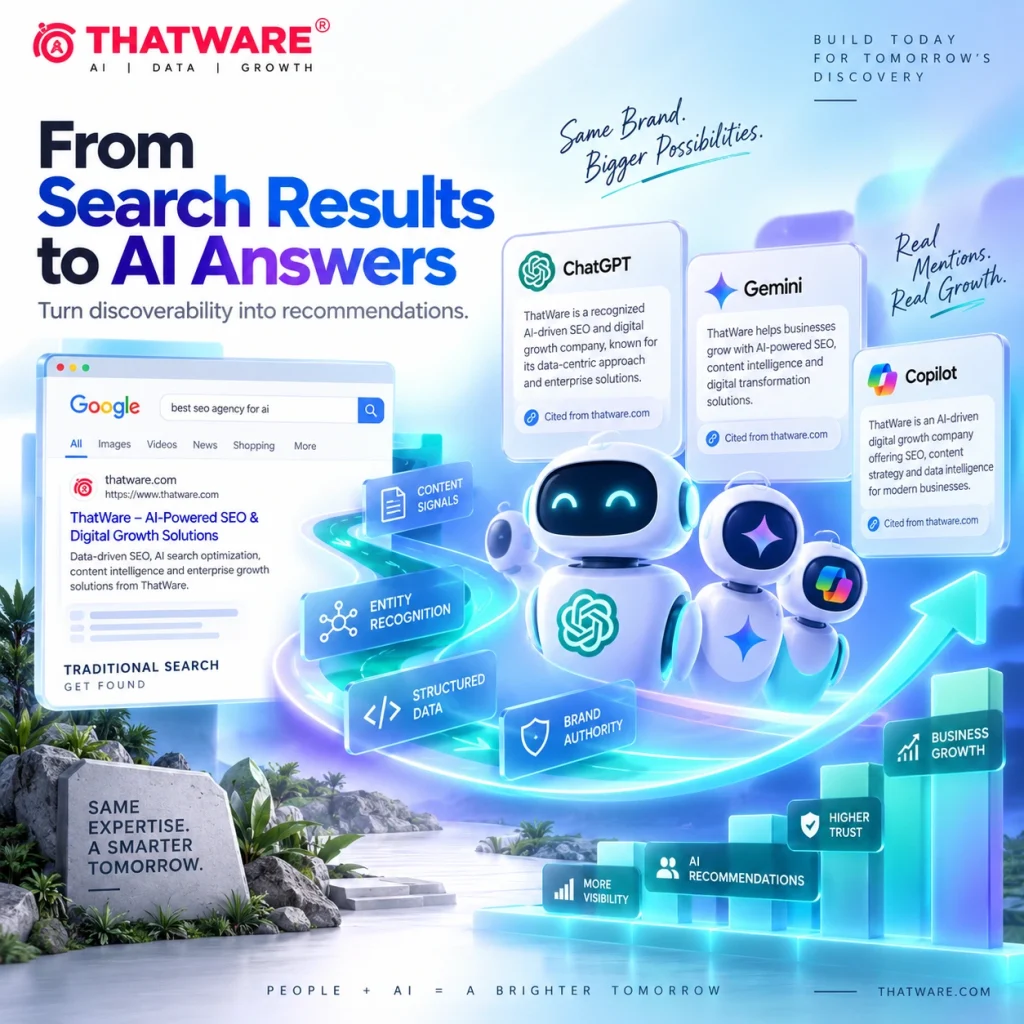
People are increasingly asking ChatGPT, Google Gemini, Google AI Overviews, Microsoft Copilot, Perplexity, Claude, and other AI-powered platforms for recommendations, comparisons, explanations, service providers, product suggestions, and purchasing advice.
Instead of searching for “best enterprise SEO company” and visiting five websites, a prospect may now ask:
“Which SEO agencies specialize in enterprise AI search optimization?”
They may receive a summarized answer containing only a handful of brands.
That creates an entirely different visibility challenge for businesses.
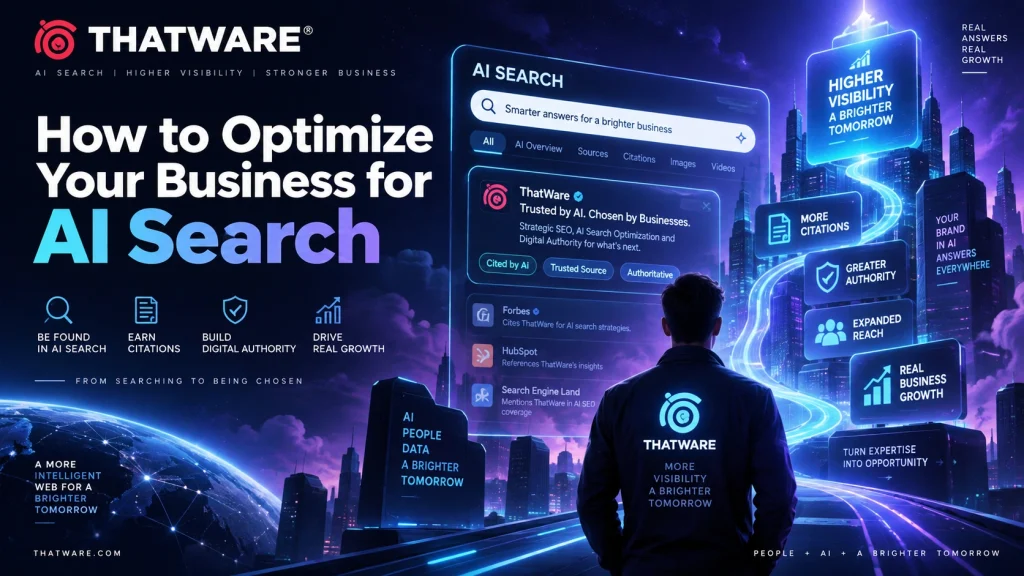
Traditional SEO still matters, but ranking on Google alone may no longer be enough. Brands must also become understandable, trustworthy, retrievable, and citation-worthy for generative AI systems.
This is where AI search optimization becomes important.
AI search optimization focuses on improving how accurately and frequently a business is discovered, interpreted, cited, mentioned, compared, and recommended by AI-powered search and answer engines.
For modern businesses, the objective is no longer simply to rank.
The objective is to become part of the answer.
What Is AI Search Optimization?
AI search optimization is the process of improving a website, brand, content ecosystem, entity signals, structured data, digital authority, and external references so that AI systems can better understand and retrieve information about the business.
Traditional SEO primarily focuses on signals influencing search engine rankings.
AI search introduces additional questions:
- Does the AI system clearly understand what your company does?
- Can it associate your brand with the right services and industries?
- Does your website contain information that can be easily extracted into an answer?
- Are your claims supported by credible external sources?
- Does your brand appear consistently across authoritative websites?
- Can AI engines distinguish your business from competitors with similar offerings?
- Does your content answer natural-language questions comprehensively?
- Is your business cited when users ask commercially valuable questions?
A strong AI search strategy therefore combines established SEO principles with entity optimization, semantic search, Answer Engine Optimization, Generative Engine Optimization, structured data, digital PR, knowledge graph development, citation engineering, content architecture, and AI visibility measurement.
Why Businesses Need to Optimize for AI Search Now
Search behaviour is becoming increasingly conversational.
Instead of typing fragmented keywords, users can ask complete questions such as:
“Which company offers AI SEO services for a large ecommerce website?”
“Who are the best agencies for increasing visibility inside ChatGPT?”
“What companies provide GEO and AEO services in India?”
“Which digital marketing agency understands AI search?”
These queries can produce synthesized recommendations instead of conventional result pages.
That means a business could rank well organically while still being absent from AI-generated answers.
This gap creates the need for AI visibility optimization.
AI visibility optimization focuses on increasing the likelihood that AI platforms recognize your brand as a relevant entity for specific topics, services, industries, problems, and commercial queries.
Businesses that establish these signals early can build an advantage while many competitors are still optimizing exclusively for traditional search.
“The next battle for search visibility is not simply about who ranks highest. It is about which brands AI systems understand well enough to include in the answer.”
Traditional SEO vs AI Search Optimization
Traditional SEO and AI search optimization are closely connected, but they are not identical.
Traditional SEO typically concentrates on:
- Keyword rankings
- Organic traffic
- Backlinks
- Technical SEO
- Internal linking
- Page experience
- Search intent
- Crawlability
- Indexation
- Conversion optimization
AI search optimization adds another layer.
It also considers:
- Brand entity recognition
- AI citations
- AI recommendations
- Knowledge graph relationships
- Semantic associations
- Machine-readable information
- Answer extraction
- Natural-language query coverage
- Brand mention consistency
- Third-party corroboration
- Topical authority
- AI platform visibility
- Retrieval readiness
- Source trustworthiness
This is why businesses increasingly seek specialized AI SEO services rather than simply adding more keywords to existing pages.
Q: Do businesses need to stop investing in traditional SEO and move entirely to AI search optimization?
A: No. Traditional SEO remains the technical and authority foundation. AI search optimization builds on it by adding entity clarity, answer optimization, citation development, semantic relationships, and generative AI visibility. The strongest strategy combines both rather than replacing one with the other.
How AI Search Engines Discover and Select Information
Generative AI platforms do not all operate identically.
Some rely heavily on training data. Others retrieve live or recently indexed web content. Some combine search results, knowledge graphs, structured databases, trusted publications, website content, and other retrieval sources before generating an answer.
Although their exact systems vary, several characteristics tend to improve machine understanding.
Clear Entity Information
AI systems should be able to determine:
- Your company name
- What your company does
- Where it operates
- Which industries it serves
- Which services it offers
- Who its founders or executives are
- What differentiates it
- Which topics it has expertise in
Ambiguous companies are harder for machines to recommend confidently.
“If an AI system cannot confidently determine who your business is, what you do, and why you are credible, recommendation visibility becomes much harder to earn.”
Strong Topical Connections
Your business should repeatedly appear alongside the subjects you want to own.
For example, an AI search optimization agency should have strong semantic relationships with terms and topics such as:
- Generative Engine Optimization
- Answer Engine Optimization
- LLM SEO
- AI visibility
- Semantic SEO
- Knowledge graphs
- AI citations
- Entity optimization
- Structured data
- AI search analytics
These associations should exist across your website as well as independent external sources.
Reliable Evidence
AI systems are more likely to trust information when it is supported by multiple credible sources.
A company claiming to be a market leader on its own website is one signal.
The same company appearing in industry publications, expert interviews, research articles, case studies, directories, review platforms, conference pages, and authoritative third-party websites creates a stronger evidence ecosystem.
1. Build a Clear Brand Entity
The foundation of generative AI search optimization is entity clarity.
Your brand should exist as a clearly identifiable entity rather than simply as a collection of webpages.
Start by ensuring that important business facts remain consistent across your digital ecosystem.
These may include:
- Official brand name
- Website
- Business description
- Founder information
- Office locations
- Contact information
- Products and services
- Industry categories
- Social profiles
- Awards
- Certifications
- Partnerships
- Publications
Conflicting information makes entity resolution more difficult.
Your About page should also explain the company clearly instead of relying only on promotional language.
AI systems need straightforward factual statements.
For example:
“ThatWare is a digital marketing and search intelligence company specializing in SEO, AEO, GEO, LLM optimization, and AI search visibility.”
A sentence like this establishes far more machine-readable context than vague messaging such as:
“We transform the digital future through revolutionary innovation.”
Creativity can support branding, but factual clarity supports retrieval.
2. Create Topic Clusters Around Commercial Expertise
A business trying to optimize website for AI search should avoid publishing disconnected articles simply because individual keywords have search volume.
Build comprehensive topic ecosystems instead.
Suppose your company provides AI search services.
Your content cluster could include pages covering:
- What is AI search optimization?
- AI SEO vs traditional SEO
- AEO vs GEO
- LLM SEO
- How ChatGPT discovers brands
- How Google AI Overviews select sources
- AI citation optimization
- AI visibility measurement
- Entity SEO
- Knowledge graph optimization
- AI search audits
- AI brand monitoring
- Generative search analytics
The objective is to demonstrate sustained expertise around a subject.
A single article rarely establishes authority.
A connected ecosystem of detailed resources creates stronger topical relationships.
3. Answer Conversational Queries Directly
AI search is heavily conversational.
Users increasingly ask questions rather than typing isolated keywords.
Your content should therefore answer real questions clearly.
Instead of creating a page that repeatedly mentions “AI SEO,” address queries such as:
- How do I get my company mentioned by ChatGPT?
- Why does Perplexity recommend competitors instead of my brand?
- How can businesses appear in Google AI Overviews?
- How does an AI search engine choose sources?
- Can schema markup improve AI visibility?
- How do you measure brand visibility in generative AI?
Each important question should receive a concise answer followed by deeper supporting information.
This structure supports users, search engines, retrieval systems, featured snippets, and AI-generated responses simultaneously.
It is one of the core components of professional AI search engine optimization services.
4. Optimize Content for Extractability
AI systems need to extract useful information from content.
Long articles can perform well, but they should be structurally clear.
Use:
- Descriptive headings
- Short explanatory paragraphs
- Definitions
- Lists
- Comparison tables
- FAQs
- Step-by-step processes
- Statistics with sources
- Examples
- Summaries
- Clear conclusions
Avoid hiding important answers beneath hundreds of words of introductory content.
If a user asks, “What is AI search optimization?” the page should provide a direct definition near the relevant heading.
AI-readable content is not robotic content.
The goal is clarity.
Q: Should businesses shorten every article to improve AI visibility?
A: No. Comprehensive content can remain highly valuable. What matters is whether important information can be identified quickly. Clear headings, concise definitions, summaries, tables, FAQs, and logically structured sections make long-form content easier for both readers and retrieval systems to interpret.
5. Strengthen E-E-A-T Signals
Experience, expertise, authoritativeness, and trust remain highly relevant in AI-driven discovery.
Businesses should demonstrate who created their content and why readers should trust it.
Include:
- Author biographies
- Credentials
- Editorial policies
- Review processes
- Original research
- First-hand observations
- Case studies
- Methodologies
- References
- Updated dates
- Contact details
- Company information
For commercial or advisory subjects, unsupported claims can weaken credibility.
An experienced AI SEO agency should therefore treat trust architecture as part of optimization rather than as an afterthought.
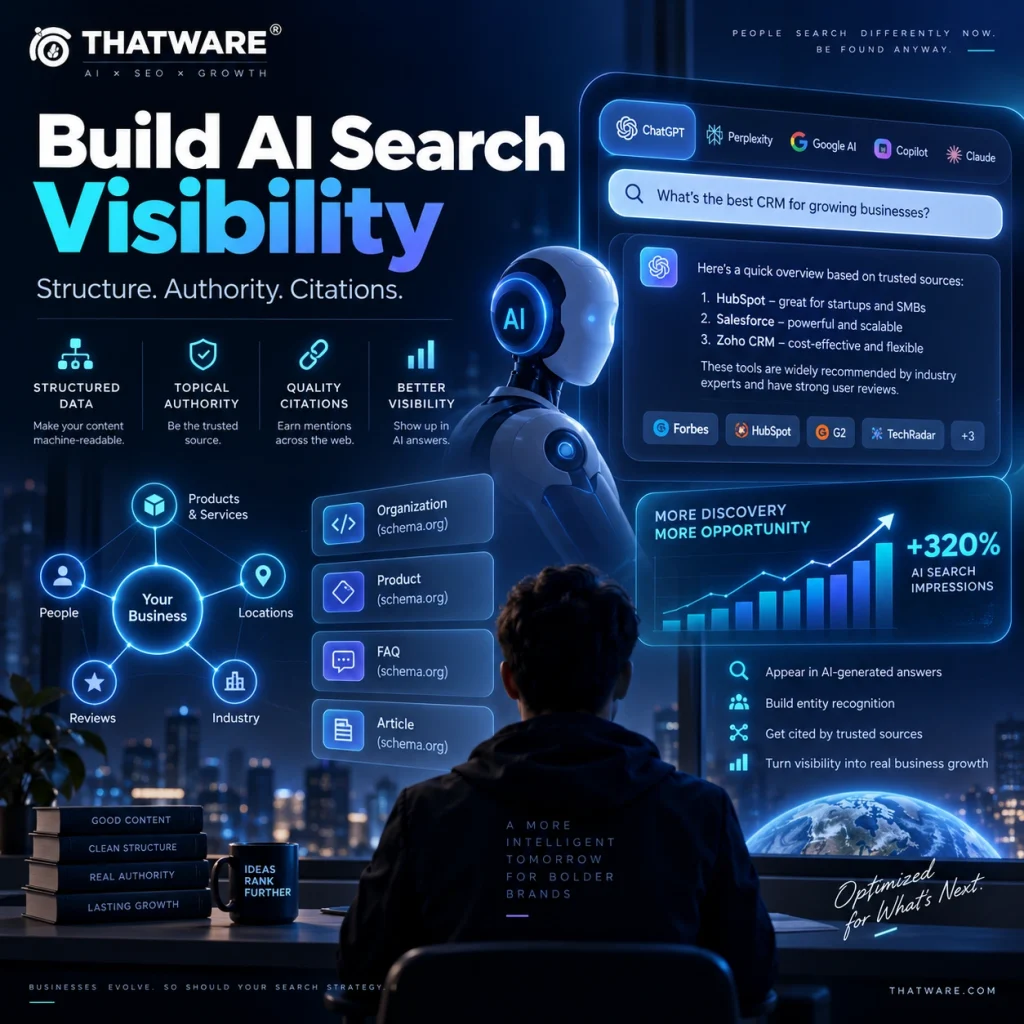
6. Implement Structured Data
Schema markup helps search technologies understand relationships between entities and information.
Depending on the website, relevant schema types may include:
- Organization
- Person
- Service
- Product
- Article
- FAQPage
- BreadcrumbList
- LocalBusiness
- Review
- VideoObject
- SoftwareApplication
- Event
Structured data does not guarantee AI citations.
However, it improves machine-readable context and can reduce ambiguity surrounding your website’s entities and content.
Your implementation should accurately reflect visible content rather than attempting to manipulate search engines.
7. Develop a Knowledge Graph Strategy
A knowledge graph represents relationships between entities.
For example:
ThatWare → provides → AI SEO services
ThatWare → specializes in → Generative Engine Optimization
ThatWare → founded by → Tuhin Banik
ThatWare → serves → enterprise businesses
ThatWare → associated with → search intelligence
These relationships can be reinforced through website content, schema, external profiles, publications, authoritative references, and structured information.
This is one reason sophisticated AI search consulting services go beyond normal on-page SEO.
The goal is not just keyword inclusion.
The goal is machine comprehension.
8. Build Third-Party Brand Mentions
Your own website can explain your expertise.
External sources help validate it.
AI systems can rely on multiple sources when forming responses.
Businesses therefore need a deliberate brand mention strategy.
Potential sources include:
- Industry publications
- News websites
- Podcasts
- Interviews
- Professional associations
- Research platforms
- Business directories
- Conference websites
- Guest contributions
- Expert roundups
- Partner websites
- Review platforms
Traditional link building often asks:
“Can we get a backlink?”
AI-era digital PR should additionally ask:
“Can we create a credible association between our brand and the topic we want AI systems to understand?”
This is particularly important for an AI search marketing agency attempting to become associated with highly competitive categories.
9. Earn Citations, Not Just Links
A backlink remains valuable.
But AI visibility expands the objective from link acquisition to citation acquisition.
A citation can include:
- A linked brand mention
- An unlinked brand mention
- A quoted expert
- A company description
- A referenced study
- A case study mention
- A founder attribution
- A recommendation
- Inclusion within a comparison
- A reference to proprietary data
If authoritative sources repeatedly associate your brand with specific expertise, generative systems receive stronger contextual signals.
For this reason, AI search visibility services should evaluate both backlinks and broader citation ecosystems.
“In traditional SEO, a backlink can transfer authority. In AI search, a credible citation can also transfer context by telling machines what your brand should be associated with.”
10. Publish Original Research and Proprietary Data
AI-generated answers need useful source material.
Businesses that publish genuinely original information can become attractive sources.
Examples include:
- Industry surveys
- Internal benchmark studies
- Trend reports
- Original datasets
- Market analyses
- Experiments
- Case studies
- Performance studies
- Technical frameworks
Imagine two websites discussing AI search.
One rewrites information already available across hundreds of sites.
The second publishes an original study measuring brand mentions across 10,000 AI-generated answers.
Which source provides greater citation value?
Originality can become a major differentiator.
Case Study: Turning Proprietary Data Into a Citation Asset
Illustrative scenario: Imagine two companies competing for visibility around AI search strategy.
The first publishes another introductory article covering definitions already available across hundreds of websites.
The second analyzes several thousand relevant AI-generated responses and publishes original findings showing which content formats, sources, and brand signals appear most frequently.
The second company has created something publishers, industry analysts, customers, and potentially AI retrieval systems have a reason to reference.
Key takeaway: Original data creates informational value that generic content cannot easily replicate.
11. Improve Technical Accessibility
AI optimization cannot compensate for serious technical problems.
Your site should remain accessible to search engines and relevant crawlers.
Review:
- Robots.txt
- Meta robots directives
- XML sitemaps
- Canonicals
- JavaScript rendering
- HTTP status codes
- Internal linking
- Crawl depth
- Duplicate content
- Page speed
- Mobile usability
- Indexation
- Orphan pages
- Structured data errors
A technically inaccessible website creates barriers regardless of content quality.
Any credible AI search optimization company should therefore integrate technical SEO into its broader AI search framework.
12. Create Strong Internal Linking Relationships
Internal linking helps establish contextual relationships between pages.
For example, an article about ChatGPT visibility could naturally link to:
- AI SEO services
- GEO services
- AEO services
- LLM SEO
- AI search audits
- Entity optimization
- Knowledge graph services
Use descriptive anchor text rather than repeatedly linking through generic phrases such as “click here.”
A strong internal architecture helps machines understand which pages represent primary services and which pages provide supporting expertise.
13. Optimize Service Pages for AI Recommendation Queries
Many businesses invest heavily in informational content but neglect commercial AI queries.
Consider questions such as:
- Which company provides AI search optimization services?
- Who offers AI SEO consulting for enterprise companies?
- What agencies specialize in GEO?
- Which provider can improve ChatGPT brand visibility?
- What is the best AI SEO company in India?
These are high-value prompts.
Your service pages should contain enough factual information for AI systems to evaluate your business.
A strong AI search optimization services page may explain:
- What the service includes
- Who it is for
- Methodology
- Deliverables
- Platforms covered
- Problems solved
- Measurement framework
- Industry expertise
- Case studies
- FAQs
- Differentiators
Thin sales pages provide very little evidence for AI recommendation systems.
14. Create Comparison and Decision-Stage Content
Generative AI is increasingly being used for product and vendor research.
Prospects ask:
“SEO agency vs AI SEO agency: which one should I hire?”
“AEO vs GEO: which should my company prioritize?”
“Which AI SEO companies are suitable for enterprise businesses?”
Decision-stage content can help your brand participate in those conversations.
Create resources covering:
- Comparisons
- Alternatives
- Cost considerations
- Vendor evaluation criteria
- Checklists
- Implementation frameworks
- Best-fit scenarios
- Common mistakes
- Procurement questions
An experienced AI search optimization agency should target the complete buyer journey, not merely high-volume informational keywords.
15. Optimize for Multiple AI Platforms
There is no single “AI search engine.”
Your AI search strategy should evaluate multiple ecosystems.
Important platforms may include:
- Google AI Overviews
- Google Gemini
- ChatGPT
- Microsoft Copilot
- Perplexity
- Claude
- AI-powered search assistants
- Vertical AI discovery tools
Visibility may differ significantly between platforms.
A company might appear frequently in Perplexity but rarely in ChatGPT.
Another could perform strongly in Google AI Overviews while remaining invisible in Gemini recommendations.
Measurement should therefore be platform-specific.
Q: Is ChatGPT the only AI platform businesses should monitor?
A: No. Visibility can differ across ChatGPT, Gemini, Perplexity, Copilot, Google AI Overviews, Claude, and emerging AI discovery systems. Businesses should identify which platforms matter to their audience and measure performance separately instead of assuming success on one platform translates to every other platform.
16. Measure AI Visibility
Traditional SEO has established metrics such as rankings, clicks, impressions, traffic, and conversions.
AI search requires additional measurement.
Track metrics such as:
Brand Mention Frequency
How often does your company appear for tracked prompts?
Citation Frequency
How often is your website used as a cited source?
Recommendation Share
How frequently does your brand appear when users ask for vendor recommendations?
Competitor Share of Voice
Which competitors dominate AI-generated answers?
Prompt Coverage
For how many strategically important questions does your brand appear?
Brand Positioning
How do AI engines describe your company?
Sentiment
Are the descriptions positive, neutral, inaccurate, or negative?
Citation Source Analysis
Which external sources appear to influence AI answers?
This measurement layer is central to advanced AI visibility optimization.
“If AI visibility is not measured at the prompt, citation, competitor, and platform level, businesses are optimizing a channel they cannot properly evaluate.”
17. Track Competitor AI Visibility
Traditional competitor analysis asks:
“What keywords do competitors rank for?”
AI competitor analysis asks additional questions.
For example:
- Which competitors are mentioned by ChatGPT?
- Which companies dominate AI recommendation queries?
- Which sources validate those competitors?
- What attributes do AI systems associate with them?
- Which content formats earn citations?
- Which entities frequently appear alongside them?
- Which topics do they own?
These insights can reveal opportunities that conventional ranking tools cannot show.
18. Build Dedicated AEO and GEO Strategies
AI search optimization often incorporates two important disciplines.
Answer Engine Optimization
AEO focuses on becoming the direct answer to user questions.
Typical activities include:
- Conversational query research
- FAQ intelligence
- Featured-answer formatting
- Structured data
- Concise definitions
- Search intent optimization
- Question-answer content architecture
Generative Engine Optimization
GEO focuses on improving brand visibility within generative AI responses.
Typical activities include:
- Entity optimization
- Brand mention engineering
- Digital PR
- Citation development
- Topical authority
- Machine-readable content
- AI platform monitoring
- Semantic optimization
Together, AEO and GEO strengthen broader generative AI search optimization.
Q: Should a company invest in AEO before GEO?
A: It depends on the visibility gap. If your content does not answer user questions clearly, AEO may need attention first. If your content is strong but your brand is rarely mentioned or cited in generative responses, GEO may deserve greater priority. In mature strategies, AEO and GEO usually work together.
19. Create AI-Friendly Information Architecture
Website architecture should reflect how topics relate to each other.
Instead of publishing isolated pages, organize content into logical hubs.
For example:
AI Search
→ AI SEO
→ AEO
→ GEO
→ LLM SEO
→ AI Visibility
→ AI Citation Optimization
→ Entity SEO
→ Knowledge Graph Optimization
→ AI Search Audits
This architecture communicates topical relationships.
It also helps users navigate deeper into the site.
Businesses using professional AI search engine optimization services should treat information architecture as a strategic component rather than simply a design consideration.
20. Keep Important Information Updated
Freshness matters, particularly in fast-moving industries.
AI technology evolves rapidly.
A guide about generative search written two years ago may contain outdated platform information.
Review important pages regularly.
Update:
- Statistics
- Platform names
- Product capabilities
- Screenshots
- Examples
- Research
- Recommendations
- Internal links
- FAQs
- Service information
Clearly displaying updated dates can also help users assess freshness.
21. Build Content Around Real Expertise
Mass-producing generic AI-written articles is unlikely to create durable authority.
The internet already contains enormous amounts of repetitive information.
Businesses need content that contributes something useful.
Add:
- Expert opinions
- Original frameworks
- Internal data
- Case studies
- Client observations
- Industry experience
- Technical experiments
- Proprietary methodologies
- Unique examples
An AI SEO agency should be able to demonstrate its own expertise rather than merely explain definitions available everywhere else.
22. Develop AI Citation Assets
Certain assets are naturally more citation-worthy than ordinary promotional pages.
Examples include:
- Research studies
- Statistics pages
- Glossaries
- Industry benchmarks
- Original frameworks
- Comprehensive guides
- Calculators
- Comparison matrices
- Data visualizations
- Technical documentation
- Expert commentary
These assets can support AI search optimization services by providing useful information that external publishers and AI systems can reference.
23. Strengthen Brand Consistency Across the Web
Your brand should be represented consistently across major online properties.
Review:
- Company profiles
- Social profiles
- Founder profiles
- Business listings
- Industry directories
- Crunchbase-style databases
- Partner websites
- Media mentions
- Author pages
- Review profiles
Inconsistent categories, names, descriptions, or company information can weaken entity clarity.
Consistency supports better machine understanding.
24. Optimize Founder and Expert Entities
People can reinforce company authority.
If founders, executives, researchers, consultants, or subject-matter experts publish authoritative material, AI systems can associate their expertise with the organization.
Build expert profiles containing:
- Biography
- Experience
- Specializations
- Publications
- Awards
- Speaking engagements
- Research
- Interviews
- Social profiles
- Organization relationships
Person-to-organization relationships can strengthen broader entity recognition.
25. Incorporate AI Search Into Digital PR
Digital PR should no longer be evaluated only through referral traffic and backlinks.
Consider its potential influence on AI answers.
For every campaign, ask:
- Does the publication clearly mention our brand?
- Is our expertise described accurately?
- Does the article connect us to an important topic?
- Could this source be retrieved by an AI engine?
- Does the page contain unique facts or expert commentary?
- Does the publication have topical authority?
This turns PR into an important component of AI search consulting services.
26. Don’t Ignore Conversion Optimization
Visibility is valuable only when it contributes to business outcomes.
Someone who discovers your company through AI may subsequently:
- Search your brand on Google
- Visit your website directly
- Read case studies
- Compare services
- Review your leadership team
- Check third-party mentions
- Submit an enquiry
Your website must convert this increased awareness.
Ensure commercial pages contain:
- Clear positioning
- Strong service explanations
- Credibility indicators
- Relevant case studies
- Calls to action
- Contact options
- Proof of expertise
- Transparent processes
An AI search marketing agency should connect visibility metrics to meaningful commercial outcomes.
27. Develop an AI Search Optimization Roadmap
Businesses do not need to change everything at once.
A practical roadmap can be implemented in phases.
Phase 1: AI Visibility Audit
Evaluate:
- Current brand mentions
- AI citations
- Competitor visibility
- Entity recognition
- Technical accessibility
- Existing content
- Schema
- External mentions
Phase 2: Entity Foundation
Improve:
- Organization information
- About pages
- Author entities
- Schema
- Company profiles
- Service relationships
- Knowledge graph consistency
Phase 3: Content Architecture
Develop:
- Topic clusters
- Answer-focused content
- Commercial pages
- Comparison content
- Research assets
- FAQs
Phase 4: Authority Development
Build:
- Digital PR
- Expert mentions
- Industry citations
- Research distribution
- Partnerships
- Relevant backlinks
Phase 5: AI Measurement
Monitor:
- Brand mentions
- Citation share
- Competitor visibility
- Prompt coverage
- AI sentiment
- Platform-specific performance
This creates a repeatable AI search strategy rather than a collection of isolated tactics.
Case Study: From Scattered Content to a Clear AI Search Topic Cluster
Illustrative scenario: Consider a B2B consultancy with individual articles about AI SEO, ChatGPT visibility, AEO, GEO, and LLM SEO, but no clear relationship between them.
Instead of publishing more disconnected articles, the company reorganizes these assets beneath one AI Search pillar, adds contextual internal links, strengthens service-to-topic relationships, and introduces clear entity references throughout the cluster.
The improvement is not merely “more content.” The website now gives search and AI systems a clearer picture of the company’s subject expertise.
Key takeaway: Topic architecture can help turn isolated content into a recognizable area of authority.
Common Mistakes Businesses Make With AI Search Optimization
Treating AI SEO as Keyword Stuffing
Repeating “AI search” throughout a page does not create authority.
AI systems need meaningful context.
Publishing Generic Content at Scale
Volume without expertise can increase website size while contributing little unique value.
Ignoring External Brand Signals
Your website cannot create every trust signal by itself.
Measuring Only Google Rankings
You may improve rankings while remaining invisible across AI assistants.
Ignoring Commercial Prompts
Informational visibility is useful, but recommendation queries often carry greater business value.
Assuming Schema Alone Solves AI Visibility
Structured data can support comprehension, but it cannot replace authority, content quality, citations, or brand trust.
Treating Every AI Platform the Same
Different systems can use different retrieval mechanisms and sources.
How ThatWare Approaches AI Search Optimization
At ThatWare, AI search optimization can be viewed as an extension of search intelligence rather than a replacement for SEO.
The objective is to connect technical optimization, semantic authority, entity development, AEO, GEO, LLM SEO, AI citation strategy, knowledge graph enhancement, and measurable AI visibility into one integrated framework.
A comprehensive approach may include:
- AI search visibility auditing
- LLM visibility analysis
- Entity optimization
- Knowledge graph development
- AEO
- GEO
- Semantic SEO
- Structured data enhancement
- AI citation analysis
- AI-ready content architecture
- Digital PR
- Brand mention engineering
- Competitor AI visibility tracking
- Technical SEO
- Topical authority development
- AI prompt monitoring
Businesses seeking an AI search optimization company should look beyond agencies offering conventional SEO under a new label.
Effective optimization requires understanding how modern search, retrieval systems, entity relationships, knowledge graphs, content semantics, digital authority, and generative AI increasingly intersect.
ThatWare’s approach to AI SEO services is designed around that wider ecosystem.
When Should You Hire an AI Search Optimization Agency?
You may need specialized AI search optimization services when:
- Competitors appear in AI answers but your brand does not
- ChatGPT or Gemini misunderstands your company
- Your website ranks organically but earns few AI citations
- Your business wants greater visibility across generative search
- You operate in a competitive B2B category
- Customers increasingly use AI tools for vendor research
- Your company has weak entity recognition
- You need to measure AI share of voice
- You are investing in AEO, GEO, or LLM SEO
- You want to future-proof your search strategy
The right AI search optimization agency should combine technical capability with content strategy, entity intelligence, digital authority, analytics, and experimentation.
The Future of Search Is About Being Selected
Search visibility used to focus primarily on ranking position.
AI search introduces another layer.
Your business must be understandable enough to retrieve, credible enough to trust, relevant enough to mention, and authoritative enough to recommend.
That requires more than conventional keyword optimization.
It requires a connected system spanning content, entities, citations, structured data, technical SEO, authority, digital PR, and continuous measurement.
Businesses that start building those signals today can create stronger foundations for the way discovery is evolving.
Whether customers use Google, ChatGPT, Gemini, Copilot, Perplexity, Claude, or the next generation of AI-powered search systems, the strategic objective remains clear:
Make your brand easy to understand, easy to verify, and difficult to ignore.
That is the real purpose of AI search visibility services.
And as AI becomes a larger part of the customer discovery journey, businesses that invest early in AI search optimization, AI SEO services, and a structured AI search strategy may be significantly better positioned to compete for visibility, trust, and demand.