SUPERCHARGE YOUR ONLINE VISIBILITY! CONTACT US AND LET’S ACHIEVE EXCELLENCE TOGETHER!
Traditional SEO is not dead.
But it is no longer the whole strategy.
For years, businesses have optimized websites around familiar objectives:
- Higher Google rankings
- More organic traffic
- Better keyword visibility
- Stronger backlinks
- Improved crawlability
- Faster websites
- Better conversion rates
Those goals still matter.
What has changed is the way people search.
Users are increasingly turning to ChatGPT, Gemini, Perplexity, Copilot, Google AI Overviews, and other AI-powered search experiences to ask questions, compare providers, evaluate products, shortlist businesses, and make decisions.
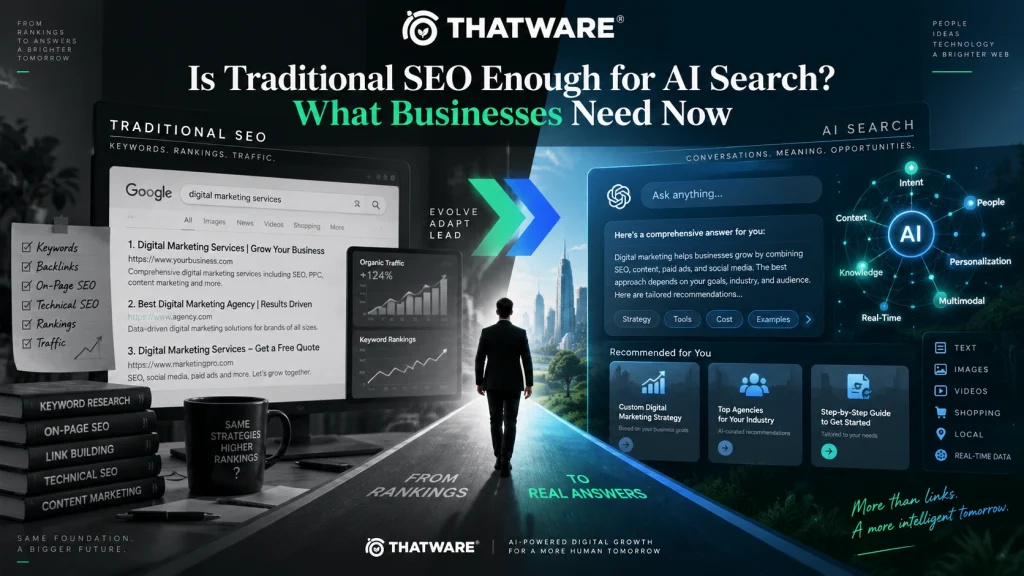
Instead of searching:
“best enterprise SEO agency”
a user may ask:
“Which SEO agencies are best for enterprise brands that also need GEO, AEO, and AI search visibility?”
That is a very different search experience.
It does not always lead to a conventional results page.
It may lead directly to a generated answer.
This shift is why businesses are now asking a more important question:
Is traditional SEO enough?
The answer is no.
Traditional SEO remains essential, but businesses now need a broader strategy that combines SEO with AI visibility, entity optimization, AEO, GEO, LLM SEO, citation development, semantic optimization, and structured content.
That is the real difference behind SEO vs AI search.
Why Traditional SEO Still Matters
Before discussing what has changed, it is important to understand what has not.
Search engines and AI systems still depend on many of the same foundations.
A technically broken website will struggle in both.
Weak content will still be weak.
Poor site architecture still creates confusion.
Low authority still limits visibility.
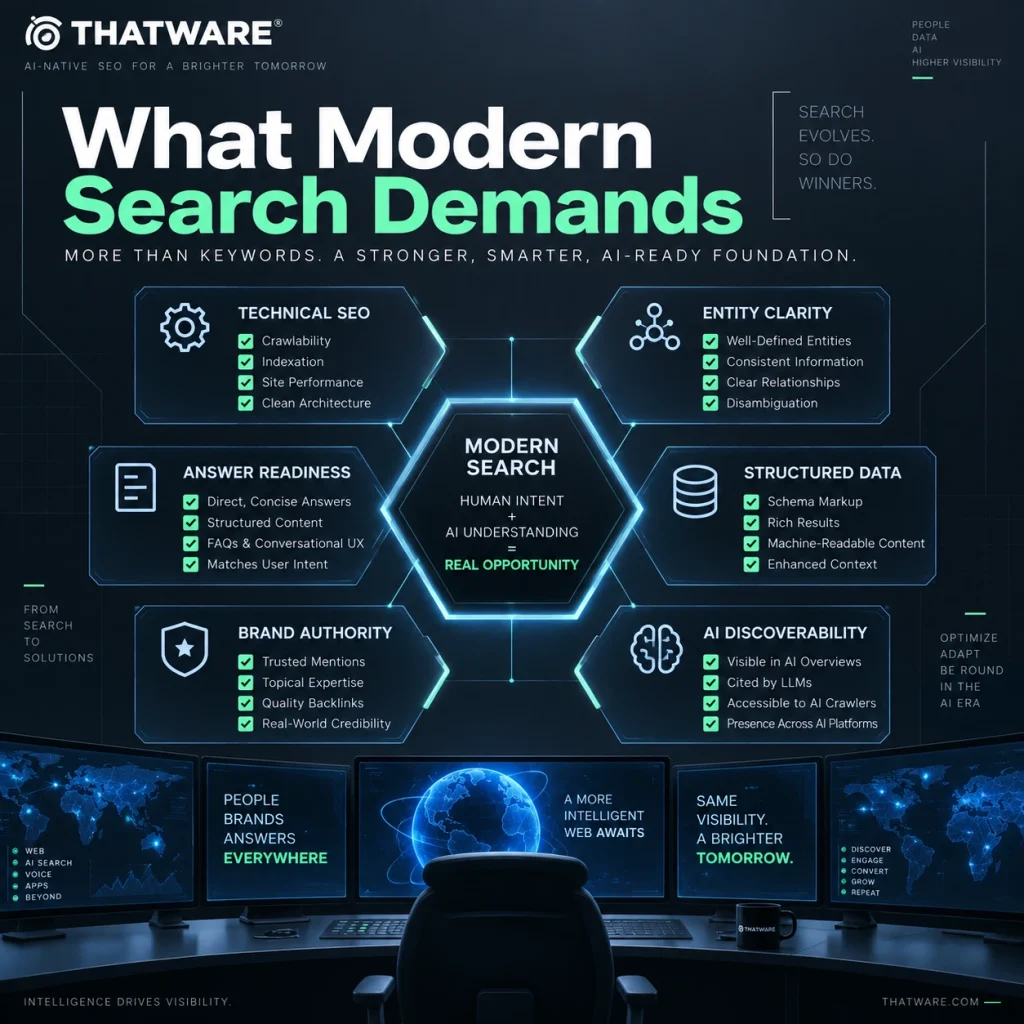
Traditional SEO continues to support:
- Crawlability
- Indexation
- Internal linking
- Keyword relevance
- Backlinks
- Page experience
- Technical accessibility
- Search intent
- Content depth
- Organic traffic
In other words, AI search does not replace SEO.
It builds on it.
That is why the discussion around traditional SEO vs AI SEO should not be framed as old versus new.
The stronger view is foundational SEO plus additional AI-search layers.
Expert Insight:
“AI search does not remove the need for SEO. It raises the standard by adding new layers of authority, context, retrieval, and trust.”
What Has Changed With AI Search?
Traditional search often gives users a list of pages.
AI search often gives users a synthesized answer.
That difference changes what visibility means.
In traditional search, success may mean ranking first.
In AI search, success may mean:
- Being cited
- Being mentioned
- Being recommended
- Being compared
- Being summarized
- Being treated as a trusted source
That changes the optimization objective.
A company can rank well organically while being invisible inside generative answers.
This is one of the biggest reasons businesses are investing in AI SEO services.
Quick Question: Can a Website Rank Well on Google but Still Be Invisible in AI Search?
Yes. A page may perform strongly in traditional search while the brand itself is rarely mentioned, cited, or recommended in generative answers. AI visibility requires additional signals beyond page rankings.
SEO vs AI SEO: The Core Difference
The simplest way to understand SEO vs AI SEO is this:
Traditional SEO helps webpages rank.
AI SEO helps brands, entities, and content become understandable, retrievable, citable, and recommendable inside AI-powered search systems.
Traditional SEO tends to focus on:
- Keywords
- Search rankings
- Backlinks
- Technical SEO
- Search intent
- Content performance
AI SEO adds:
- Entity recognition
- AI citations
- LLM visibility
- Generative search presence
- Semantic relationships
- Brand mentions
- Knowledge graph signals
- Prompt-level tracking
- AI sentiment
- Retrieval readiness
That is the real distinction in AI SEO vs traditional SEO.
Strategic Insight:
“Traditional SEO asks whether a page can rank. AI SEO also asks whether the brand can be understood, retrieved, cited, and recommended.”
What Is AI SEO?
AI SEO is the process of optimizing a business for discovery across AI-powered search environments.
It can involve:
- AEO
- GEO
- LLM SEO
- Entity optimization
- AI citation optimization
- Structured data
- Semantic content
- Digital PR
- AI visibility measurement
- Knowledge graph development
- Prompt monitoring
A capable AI SEO agency should therefore understand far more than conventional keyword optimization.
The objective is not merely to improve rankings.
It is to improve how AI systems understand and surface a brand.
Why Ranking Alone Is No Longer Enough
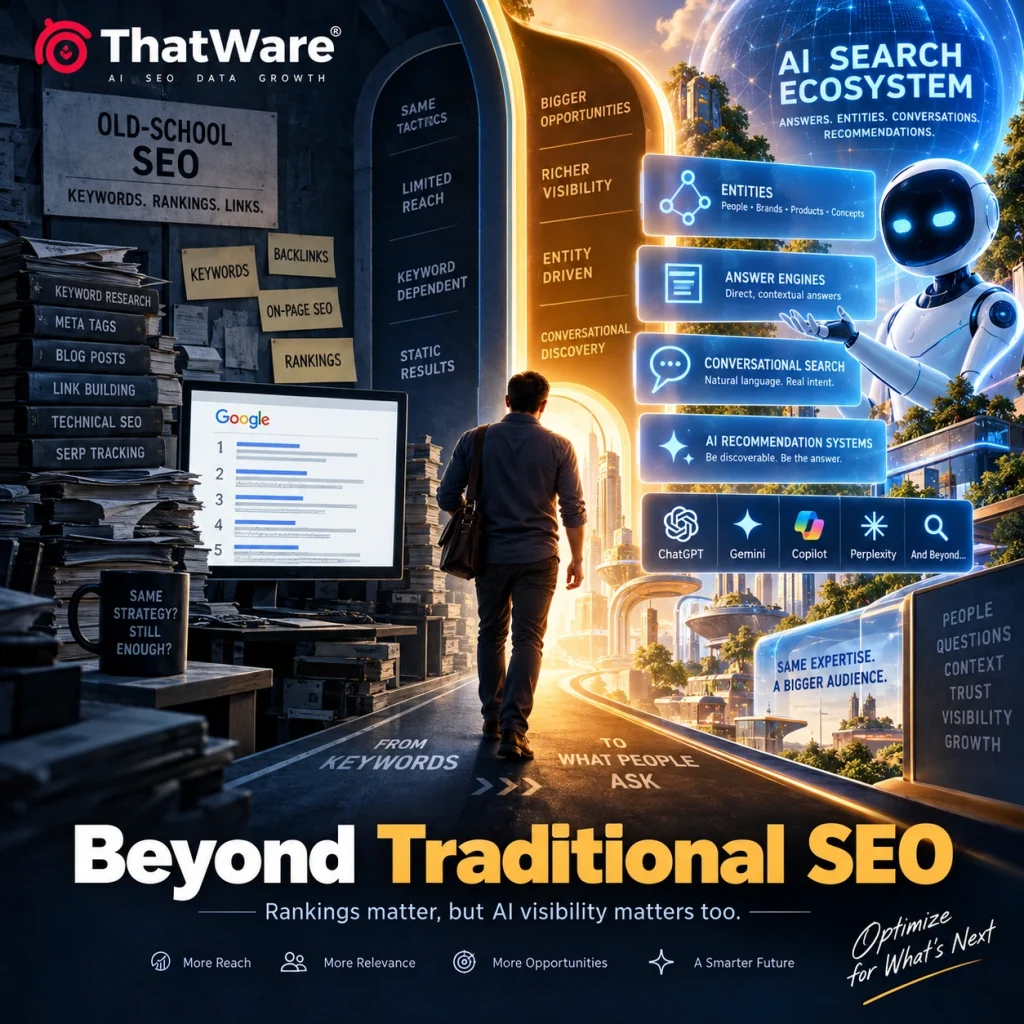
A business might rank on page one for an important keyword.
But if a user asks ChatGPT:
“Which companies provide this service?”
and the business is not mentioned, then that company may lose visibility before the user even reaches Google.
This is the new search reality.
Ranking is still important.
But brand inclusion in AI-generated answers is becoming another layer of competition.
That is why more companies are looking for an AI search visibility agency rather than relying only on conventional SEO support.
Case Study: Strong Rankings, Weak AI Presence
Consider a B2B company ranking on page one for several high-value service keywords but rarely appearing when users ask ChatGPT or Gemini for provider recommendations. By strengthening entity signals, external mentions, citations, and AI-ready content, the business could work toward closing the gap between traditional rankings and generative visibility.
Traditional SEO Measures Pages
Traditional SEO usually measures page-level performance.
Examples include:
- Keyword rank
- Organic clicks
- Impressions
- CTR
- Backlinks
- Page traffic
- Conversions
AI search requires additional brand-level measurement.
Examples include:
- Brand mention frequency
- AI citation frequency
- Recommendation share
- Prompt coverage
- Competitor share of voice
- Entity accuracy
- AI sentiment
- Platform visibility
This is a major shift.
The business itself becomes a measurable search entity.
Quick Question: What Should Businesses Measure Beyond Rankings?
Businesses should also track AI mentions, citations, recommendation frequency, prompt coverage, competitor share of voice, entity accuracy, and platform visibility. These metrics show whether the brand itself is gaining visibility across AI search.
Why AI Search Depends on Entity Understanding
Search engines have long used entities.
AI systems make entity clarity even more important.
An AI model should be able to understand:
- Your company name
- Your products
- Your services
- Your founder
- Your market
- Your location
- Your expertise
- Your competitors
- Your industry relationships
If this information is inconsistent or vague, AI systems may misunderstand your business.
That is why a modern AI SEO company should focus on entity clarity as part of search optimization.
Entity Insight:
“AI systems cannot confidently recommend a brand they do not clearly understand.”
Traditional SEO Content vs AI-Ready Content
Traditional SEO content often starts with keywords.
AI-ready content should start with questions, entities, concepts, and usefulness.
For example:
Traditional keyword:
“AI SEO services”
Conversational AI query:
“Which company provides AI SEO services for enterprise companies?”
These are not the same type of search behavior.
AI-oriented content should answer:
- What is this?
- Why does it matter?
- How does it work?
- Who needs it?
- Which option is best?
- What are the tradeoffs?
- Which company provides it?
This creates stronger retrieval value.
SEO for AI Search Engines
Effective SEO for AI search engines requires businesses to rethink information architecture.
Content should be organized in a way that clearly communicates topic relationships.
For example:
AI Search
→ AEO
→ GEO
→ LLM SEO
→ AI Citations
→ Entity SEO
→ AI Visibility
→ Knowledge Graphs
→ Prompt Monitoring
This helps machines understand topical depth.
It also helps users navigate expertise more easily.
SEO for Generative AI
SEO for generative AI involves improving the likelihood that your brand or content becomes part of a generated response.
That can depend on:
- Topical authority
- External corroboration
- Citations
- Original research
- Structured data
- Semantic clarity
- Entity strength
- Digital PR
- Content quality
This is broader than optimizing a page for a keyword.
It is about strengthening the evidence ecosystem around a brand.
Quick Question: Is SEO for Generative AI Just Another Name for Content Optimization?
No. Content matters, but generative AI visibility also depends on citations, external validation, entity clarity, topical authority, structured data, digital PR, and the wider evidence ecosystem surrounding the brand.
Why AI Search Optimization Services Are Becoming Important
Professional AI search optimization services help businesses address visibility gaps that traditional SEO reporting may miss.
For example:
- Competitors appear in ChatGPT, but you do not
- Your brand is misrepresented in AI answers
- Your website is rarely cited
- Your founder entity is weak
- Your content is not structured for retrieval
- AI tools do not associate you with your key services
These are not conventional ranking problems.
They are AI visibility problems.
The Role of AEO
Answer Engine Optimization focuses on helping content become a direct answer.
AEO can include:
- FAQ optimization
- Conversational queries
- Direct definitions
- Snippet-friendly formatting
- Structured answers
- Search intent analysis
AEO becomes especially important when search systems increasingly answer questions without requiring users to click.
The Role of GEO
Generative Engine Optimization focuses on generative visibility.
It can include:
- AI citations
- External mentions
- Authority building
- Brand positioning
- Digital PR
- Entity strengthening
- Generative search monitoring
GEO is especially useful when the goal is to appear inside AI-generated recommendations.
The Role of LLM SEO
LLM SEO focuses on how large language models understand and retrieve information.
It can include:
- Entity clarity
- Knowledge graph relationships
- Structured information
- Semantic architecture
- Machine-readable content
- External validation
That is why integrated SEO AEO GEO services are becoming increasingly relevant.
The strongest strategy is often not one discipline.
It is the combination.
Why Businesses Need Original Research
Generic content is increasingly easy to produce.
Original information is far more valuable.
Businesses can strengthen AI visibility by publishing:
- Benchmark studies
- Surveys
- Industry reports
- Proprietary data
- Search experiments
- AI visibility studies
- Case studies
Original research can support:
- SEO links
- GEO citations
- AEO authority
- LLM understanding
- Digital PR
- Brand visibility
This is one of the strongest bridges between traditional SEO and AI SEO.
Case Study: Turning Data Into an AI Visibility Asset
Imagine an AI SEO agency publishing an annual study comparing brand mentions across thousands of ChatGPT, Gemini, and Perplexity prompts. That research could attract media coverage, backlinks, citations, expert references, and stronger AI visibility, making one asset valuable across SEO, GEO, AEO, and LLM SEO.
Why Citations Matter More Now
Traditional SEO has long focused on backlinks.
AI search introduces a wider concept of citation.
A citation can include:
- Brand mention
- Expert quote
- Linked reference
- Research mention
- Founder attribution
- Case study
- Industry recommendation
AI systems may use these references to assess credibility.
That is why generative AI SEO services should include citation strategy, not just keyword strategy.
Citation Insight:
“In AI search, authority is not built only by who links to you, but also by who mentions, quotes, validates, and associates your brand with the right expertise.”
Why Digital PR Is Becoming an AI SEO Channel
Digital PR can influence AI visibility by building external evidence.
A strong PR placement can connect:
Brand → Topic → Expertise → Authority
That relationship can then reinforce how AI systems interpret the brand.
This is one reason modern AI search marketing services often include PR, thought leadership, and authority development.
Why Structured Data Still Matters
Structured data helps machines understand content.
Relevant schema types may include:
- Organization
- Person
- Service
- Product
- Article
- FAQPage
- Review
- LocalBusiness
- BreadcrumbList
Schema does not guarantee AI visibility.
But it can improve context and reduce ambiguity.
Why Internal Linking Is More Important Than Ever
Internal links help establish semantic relationships between topics.
For example:
A page about AI SEO should connect naturally to:
- AEO
- GEO
- LLM SEO
- AI citations
- AI visibility
- AI search optimization
This reinforces site-level topic architecture.
What Businesses Should Measure Now
Traditional metrics are still useful.
But modern search measurement should include both SEO and AI signals.
Track:
- Organic traffic
- Rankings
- CTR
- Backlinks
- Conversions
- AI mentions
- Citations
- Recommendation frequency
- Prompt coverage
- Competitor share of voice
- AI sentiment
- Entity accuracy
This creates a much more complete view of search performance.
The Future of SEO With AI
The future of SEO with AI is not the disappearance of SEO.
It is the expansion of SEO.
SEO will increasingly include:
- Entity intelligence
- Semantic architecture
- AI visibility
- Generative search
- AEO
- GEO
- LLM SEO
- Citation engineering
- Prompt-level analysis
- AI brand monitoring
The discipline is becoming broader, not obsolete.
What Businesses Should Do Now
Businesses should not abandon traditional SEO.
They should extend it.
A practical roadmap includes:
Phase 1: Strengthen Technical SEO
Fix crawlability, indexation, internal linking, page performance, canonicalization, and structured data.
Phase 2: Build Entity Clarity
Make company, founder, service, location, and expertise information consistent.
Phase 3: Develop AI-Ready Content
Create direct answers, comparison content, commercial pages, and topic clusters.
Phase 4: Build External Authority
Use digital PR, expert mentions, research, partnerships, and citations.
Phase 5: Track AI Visibility
Monitor mentions, citations, recommendations, and competitor presence.
Phase 6: Optimize Continuously
Update content, improve entity signals, and respond to search behavior changes.
When Does a Business Need an AI SEO Agency?
A business may need an AI SEO agency if:
- It ranks organically but lacks AI visibility
- AI systems misunderstand the company
- Competitors dominate AI recommendations
- The business lacks citation authority
- Internal teams do not track generative search
- The brand needs an integrated SEO, AEO, GEO, and LLM strategy
The objective should be broader search visibility, not simply more keywords.
What an AI SEO Company Should Actually Provide
A credible AI SEO company should offer more than content writing.
Capabilities may include:
- Technical SEO
- Entity optimization
- AEO
- GEO
- LLM SEO
- Structured data
- Citation strategy
- Digital PR
- Prompt tracking
- AI visibility analytics
- Competitor analysis
- Semantic content architecture
This is the difference between conventional SEO packaged with AI terminology and genuine AI search optimization.
How ThatWare Approaches the Shift
At ThatWare, the transition to AI search can be approached through a combined search intelligence framework.
That includes:
- Traditional SEO
- AI SEO
- AEO
- GEO
- LLM SEO
- Entity optimization
- Structured data
- AI citation strategy
- Knowledge graph enhancement
- Digital PR
- AI visibility measurement
- Semantic content strategy
- Prompt monitoring
The objective is not to replace SEO.
It is to evolve it.
Businesses that invest only in conventional SEO may continue to perform in search engines but miss important AI-driven discovery opportunities.
Businesses that combine traditional SEO with AI SEO services, AI search optimization services, and SEO AEO GEO services can build a stronger foundation for both present and future search ecosystems.
Final Thoughts
Traditional SEO is still essential.
But it is no longer sufficient on its own for businesses that want visibility across modern search environments.
The debate around SEO vs AI search should not be about choosing one over the other.
The stronger strategy is integration.
SEO builds the foundation.
AEO improves answer visibility.
GEO improves generative visibility.
LLM SEO strengthens machine understanding.
AI citation strategy improves authority.
Entity optimization improves brand clarity.
Together, these disciplines create a more complete search strategy.
The future of SEO with AI will reward businesses that are technically strong, semantically clear, authoritative, citable, and easy for both search engines and AI systems to understand.
That is what businesses need now.