
SUPERCHARGE YOUR ONLINE VISIBILITY! CONTACT US AND LET’S ACHIEVE EXCELLENCE TOGETHER!
Search has changed.
For businesses operating in highly visual and competitive markets, ranking on traditional Google search results is no longer the only measure of online visibility. Users now discover businesses through Google AI Overviews, ChatGPT, Gemini, featured snippets, local results, entity-based results and conversational searches.
For Virtualeyes, a business specialising in professional 360 virtual tours, Matterport solutions, 3D property tours, architectural photography, virtual showrooms and related visualisation services, this shift created a clear opportunity.
The challenge was not simply to rank a few commercial keywords.
Virtualeyes needed to become visible when potential customers searched for highly specific services such as:
- Virtual Tour UAE
- Matterport Dubai
- 360 Virtual Tour Dubai
- 360 Photographer Dubai
- Google Street View in Dubai
- 360 Content Creator in Dubai
- Matterport for Real Estate
- 360 Live Wedding Coverage
- Dubai VR180 Photography
- Matterport virtual showroom Dubai
- Matterport scanning Dubai
- 3D property tours Dubai
- Premium Real Estate Photography
- Premium Real Estate Videography
- Dubai architectural photography
- Professional Interior Photography
- Virtual tours for businesses UAE
- 3D 360 Render Studio
- Dubai luxury property Matterport tours
- Apartment Photographer
ThatWare approached the campaign differently.
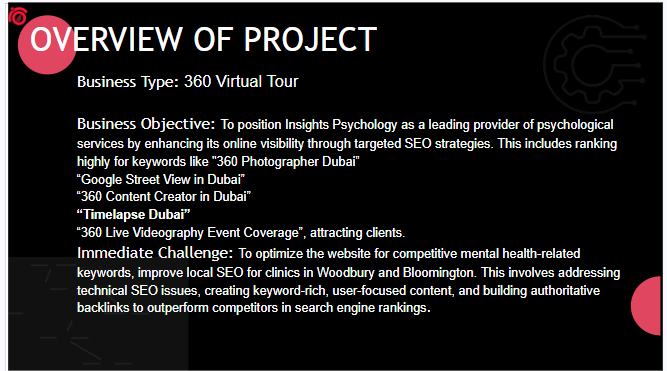
Instead of treating SEO as a collection of keywords and backlinks, the strategy focused on search intent, content type, content format, content angle and AI answer visibility.
The objective was to make Virtualeyes’ content useful enough for traditional search engines and structured enough for AI-powered search systems to understand, extract and reference.
The campaign subsequently produced visibility across multiple search environments, including Google AI Overviews, ChatGPT and Google Gemini, demonstrating how a modern SEO strategy can extend beyond conventional blue-link rankings.
This case study explains how ThatWare approached the campaign, what we changed, why the strategy worked and what the results reveal about the future of SEO for service-based businesses.
Virtualeyes: The Business Behind the Campaign
Virtualeyes operates in the rapidly evolving visualisation and immersive-content space.
Its services span professional virtual tours, 360-degree photography, Matterport-based property experiences, 3D visualisation, architectural photography, virtual showrooms and other forms of immersive digital content.
The business serves applications across areas such as:
- Real estate
- Hospitality
- Commercial properties
- Architecture
- Interior design
- Events
- Retail
- Businesses requiring virtual experiences
- Property marketing
- Google Street View
- Digital property presentations
The nature of the business makes online search particularly important.
A potential customer may not search for the company by name. Instead, they may search for a very specific service and location.
For example:
“Matterport Dubai”
Another customer may search:
“3D property tours Dubai”
A real estate professional could search:
“Matterport for real estate”
A business owner might search:
“virtual tours for businesses UAE”
And someone looking for a specialised photography service may search:
“Dubai architectural photography”
Each search represents a different problem, intent and buying stage.
Therefore, the campaign could not rely on one generic service page.
It required a search strategy capable of understanding what the user wanted, what format best answered that need and how the answer should be presented to both people and search systems.
That became the foundation of the ThatWare campaign.
The Initial SEO Challenge
Virtualeyes operated in a competitive market where visual services, real estate technology and location-specific searches overlap.
This created several SEO challenges.
1. Highly Specific Search Intent
The target audience was not searching for one broad term.
Search behaviour could be divided into multiple clusters:
Service-based searches
Examples include:
- Matterport scanning
- 360 photography
- Virtual tours
- 3D property tours
- Architectural photography
- Interior photography
- VR180 photography
Location-based searches
Examples include:
- Dubai
- UAE
- Abu Dhabi
- specific local service combinations
Industry-specific searches
Examples include:
- Real estate
- hospitality
- businesses
- architecture
- interior design
- events
Commercial searches
These searches indicated that the user was actively evaluating a service provider.
For example:
“Premium Real Estate Photography”
or:
“Virtual tours for businesses UAE”
Informational and research searches
These searches could occur earlier in the buying journey.
For example:
“What is Matterport?”
or:
“How do 3D property tours work?”
The campaign therefore needed a keyword strategy that represented the complete search journey rather than simply targeting high-volume phrases.
The Core Strategy: Search Intent Before Keywords
One of the most important principles used in the campaign was simple:
A keyword does not tell the entire story. Search intent does.
Two keywords can appear similar while requiring completely different content.
For example:
“Matterport Dubai”
may indicate a user looking for a service provider.
Meanwhile:
“What is Matterport?”
is primarily informational.
Creating the same type of page for both would weaken the overall search strategy.
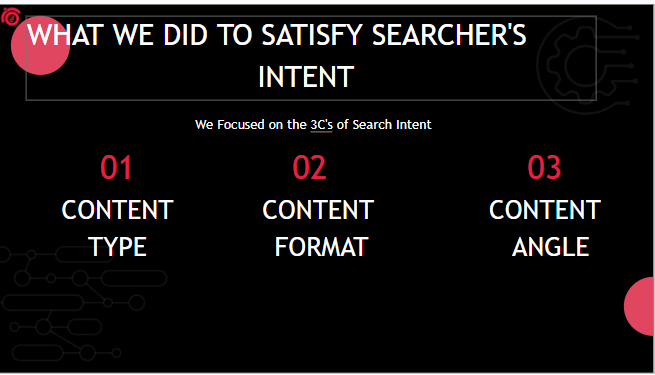
ThatWare therefore structured the campaign around three critical elements:
01. Content Type
What kind of page should answer the query?
02. Content Format
How should the information be presented?
03. Content Angle
What specific perspective should the page take to satisfy the searcher?
This became the campaign’s 3C search-intent framework.
The 3C Framework for Search Intent
1. Content Type
The first question was:
What type of content does the user expect?
Depending on the keyword, the appropriate format could be:
- Blog post
- Product/service page
- Category page
- Landing page
- Location page
- Commercial service page
- Supporting informational content
For example, a query such as:
“Dubai VR180 Photography”
could require a dedicated commercial service page.
A broader query around the advantages of virtual tours might be better suited to a blog.
The purpose was to avoid forcing every keyword into the same page structure.
2. Content Format
The second question was:
What information format makes the answer easiest to understand?
Depending on the query, this could involve:
- Direct answers
- Lists
- Comparisons
- Service explanations
- Step-by-step information
- Examples
- FAQs
- Location-specific information
- Structured service descriptions
This became particularly important for AI search.
AI systems need clearly identifiable information that can be interpreted and reproduced in an answer.
A page containing strong information but poor structure may not provide the same extraction opportunities as a clearly organised page.
3. Content Angle
The third question was:
What unique angle should the content take?
This prevented the campaign from producing generic pages that simply repeated the keyword.
For example, a page targeting:
“Matterport for Real Estate”
should focus on how Matterport supports real estate marketing and property presentation.
A page targeting:
“Virtual tours for businesses UAE”
should focus on business applications.
A page targeting:
“Dubai architectural photography”
should address architectural visualisation and photography requirements.
The keyword remained important, but the reason behind the search became the primary content driver.
Building the Target Keyword Architecture
The campaign targeted a broad but highly relevant collection of commercial and service-specific queries.
Some of the target terms included:
Core Virtual Tour Keywords
- Virtual Tour UAE
- 360 Virtual Tour UAE
- 360 Virtual Tour Dubai
- 360 Photographer Dubai
- Virtual tours for businesses UAE
Matterport Keywords
- Matterport Dubai
- Matterport for Real Estate
- Matterport virtual showroom Dubai
- Matterport scanning Dubai
- Dubai luxury property Matterport tours
Property and Real Estate Keywords
- 3D property tours Dubai
- Premium Real Estate Photography
- Premium Real Estate Videography
- Apartment Photographer
- Real estate visualisation
Photography Keywords
- Dubai architectural photography
- Professional Interior Photography
- Dubai VR180 Photography
Google and Immersive Search Keywords
- Google Street View in Dubai
- 360 Live Wedding Coverage
- 360 Content Creator in Dubai
- 3D 360 Render Studio
The important point was not simply the number of keywords.
It was the relationship between the keywords.
Rather than treating every term as an isolated target, ThatWare organised the terms into topical and commercial clusters.
This created a stronger connection between:
service → industry → location → user intent → supporting content.
Creating Content That Matched Searcher Expectations
One of the campaign’s important observations was that rankings did not depend solely on inserting the target keyword into a page.
Search engines need to understand what a page is about.
Users need to understand whether the page actually solves their problem.
AI systems need to identify clear answers.
That meant content had to satisfy three audiences simultaneously:
The human searcher
The content needed to be useful, clear and commercially relevant.
Traditional search engines
The page needed appropriate relevance, structure, internal relationships and topical depth.
AI-powered search systems
The information needed to be explicit, structured and easy to extract.
This is where traditional SEO and modern AEO/GEO strategies began to overlap.
Moving Beyond Traditional Google Rankings
The campaign was not limited to conventional organic rankings.
ThatWare also focused on AI answer visibility.
The reasoning was straightforward.
A user may search Google and see an organic result.
But another user may ask:
“Who provides professional virtual tours in Dubai?”
Or:
“What are the best virtual tour service providers?”
Or:
“Which companies provide Matterport services for real estate?”
The answer could now be generated directly within an AI-powered search environment.
If Virtualeyes was not represented in those answers, a traditional ranking alone would not capture that user journey.
Therefore, the campaign focused on making the brand and its services understandable to answer engines.
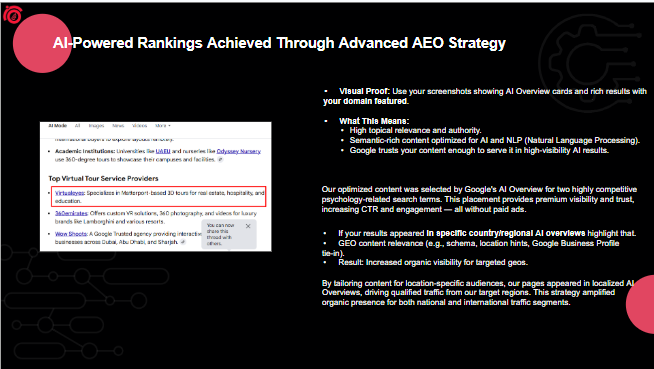
Google AI Overview Visibility
One of the strongest examples from the campaign was Virtualeyes’ appearance within AI-generated search results.
The campaign screenshots demonstrate visibility for queries related to Virtualeyes’ service area and target topics.
The importance of this result goes beyond simply appearing on a search results page.
Google’s AI-generated results require content to be:
- Relevant to the query
- Clearly structured
- Topically aligned
- Understandable
- Supported by useful information
- Strong enough to be considered as an answer source
ThatWare’s content strategy addressed these requirements by building pages around specific search intent instead of writing generic keyword-focused content.
Why AI Overviews Matter for Virtualeyes
Consider a search such as:
“Top virtual tour service providers”
A traditional SEO approach might focus on ranking a service page.
An AI-oriented approach asks a second question:
Can Google’s system understand exactly what Virtualeyes provides and why it is relevant to this query?
This requires the page to communicate:
- Who the company is
- What services it provides
- Which industries it serves
- Where it operates
- What makes its services relevant
- What specific problems its services solve
The campaign therefore strengthened content around service entities, business descriptions and specific offerings.
This created a stronger semantic relationship between Virtualeyes and the subjects for which it wanted to be discovered.
From Keyword Matching to Entity Understanding
One of the most important developments in the campaign was the move from purely keyword-focused optimisation toward entity-focused optimisation.
A search engine needs to understand that:
Virtualeyes = a business
and that the business is associated with:
- Virtual tours
- 360-degree visualisation
- Matterport
- Real estate
- Photography
- 3D visualisation
- Architectural content
- Virtual showrooms
- Dubai/UAE
- Professional visual experiences
The more consistently these relationships are represented throughout the content ecosystem, the easier it becomes for search systems to understand the brand.
This is especially important in AI search because conversational systems operate around concepts and relationships rather than simple keyword matching.
ChatGPT Answer Visibility
The campaign also demonstrated visibility within ChatGPT-generated responses.
This represents a significant shift in how users can discover businesses.
Instead of searching:
“Virtual tour companies Dubai”
and browsing ten blue links, a user may ask:
“What services does Virtualeyes provide?”
or:
“What are the main types of professional virtual tours available for businesses?”
or:
“Who provides professional virtual tour services?”
An AI system may generate a structured response containing information from relevant online sources.
ThatWare’s strategy focused on making Virtualeyes’ information sufficiently clear and relevant for these conversational environments.
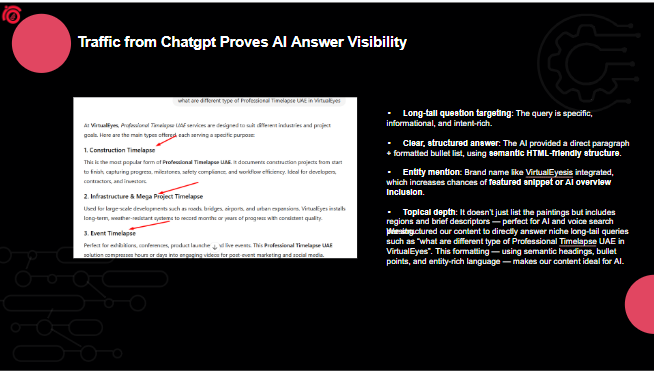
Optimising for Long-Tail Questions
A major component of ChatGPT visibility was targeting long-tail, question-based search behaviour.
Long-tail queries are valuable because they often contain significantly more context.
For example:
“What are different types of professional therapeutic services?”
would represent one type of intent.
For Virtualeyes, the equivalent could be:
“What are the main types of professional virtual tours?”
or:
“How can Matterport help real estate businesses market properties?”
or:
“What is the difference between a 360 virtual tour and a traditional property walkthrough?”
These questions require direct, structured answers.
ThatWare therefore focused on content that could answer specific questions rather than relying entirely on short keyword phrases.
The Direct-Answer Principle
A particularly important technique was the use of clear answer-first content.
When an AI system processes a page, buried information can be harder to identify.
A stronger structure is:
Question
What is a Matterport virtual tour?
Direct answer
A Matterport virtual tour is an interactive digital representation of a physical space that allows users to explore a property remotely.
Supporting information
Then explain:
- How it works
- Who uses it
- Benefits
- Applications
- Related services
This structure works for humans as well.
Someone looking for a quick answer gets it immediately.
Someone who wants more detail can continue reading.
Structured Content for AI Extraction
ThatWare also focused on making important information easier to extract.
This involved:
- Clear headings
- Short explanatory sections
- Bullet points
- Descriptive subheadings
- Specific service explanations
- Entity references
- Industry-specific context
- Location-specific context
- Question-and-answer structures
The goal was not to “write for a machine”.
The goal was to make information unambiguous for everyone.
When content is clear to a human reader, it is often easier for search systems to interpret as well.
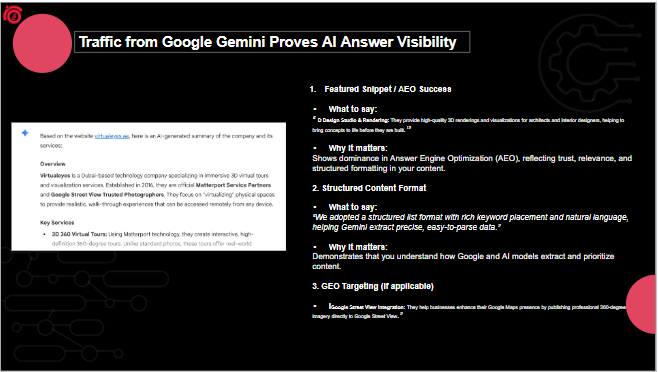
Google Gemini Visibility
Another significant result from the campaign was visibility in Google Gemini-related answer experiences.
The campaign screenshots show content being surfaced for relevant queries, including service-specific searches.
This demonstrates another important principle:
AI visibility is not necessarily achieved by creating separate “AI content”.
Instead, it comes from creating strong underlying information architecture.
The same content needs to be useful enough for a customer and structured enough for an AI system.
Featured Snippet and AEO Opportunities
The campaign also targeted featured snippet-style answer opportunities.
Featured snippets reward content that directly answers a query in a concise format.
Answer Engine Optimisation takes that principle further.
Instead of asking only:
“Can we rank this page?”
the question becomes:
“Can this page provide the clearest possible answer to the query?”
For Virtualeyes, this meant structuring content so important information could be understood independently.
For example:
What is a 360 virtual tour?
A concise definition can be followed by:
- How it works
- Key applications
- Benefits
- Industries
- Service considerations
This creates a logical hierarchy.
Why Content Structure Became a Competitive Advantage
Many businesses provide similar services.
The difference is often not the information itself but how effectively that information is organised.
Consider two pages.
Page A
“Virtual tours are useful. We provide 360 tours. Contact us for more information.”
Page B
What is a 360 virtual tour?
Definition.
How does a 360 virtual tour work?
Process.
Where are 360 virtual tours used?
Applications.
Why use a 360 virtual tour for real estate?
Benefits.
What does a professional virtual tour include?
Service details.
Page B gives search engines and users much more context.
That structure also creates more opportunities for individual sections to answer specific searches.
Building Topical Relevance Around Virtualeyes
ThatWare did not approach Virtualeyes as a single-keyword business.
Instead, the strategy built a broader topical ecosystem.
At the centre was the Virtualeyes entity.
Around it were connected topics:
Core Entity
Virtualeyes
Primary Services
- 360 Virtual Tours
- Matterport
- 3D Property Tours
- Virtual Showrooms
- 360 Photography
- VR180 Photography
Professional Visual Services
- Real Estate Photography
- Architectural Photography
- Interior Photography
- Videography
Applications
- Real Estate
- Business
- Hospitality
- Events
- Commercial Properties
- Architecture
Geographic Relevance
- Dubai
- UAE
This structure helps establish topical relationships rather than isolated keyword relevance.
Local SEO and Geographic Relevance
Location was another important component of the campaign.
Terms such as:
- Dubai
- UAE
- Dubai Matterport
- Dubai photography
- Virtual tours UAE
carry strong local intent.
A user searching for:
“Matterport Dubai”
is likely to have a very different expectation from someone searching:
“What is Matterport?”
The first query potentially indicates immediate commercial intent.
Therefore, location-specific content needed to communicate:
- The service
- The geographical market
- Relevant use cases
- Local business context
- Industry applications
- Why the service matters in that location
This made local relevance an important part of the content architecture.
Why Generic Location Pages Were Not Enough
A common SEO tactic is to duplicate a service page and replace the city name.
That can create thin, repetitive content.
Instead, location-based pages should answer location-specific needs.
For example, a page about:
Matterport Dubai
should provide information relevant to businesses operating in Dubai.
A page about:
Virtual tours UAE
can address broader market needs.
The content therefore needs to provide a reason for the location modifier to exist.
This was part of the broader intent-driven strategy.
Content Type Strategy
The campaign included several content formats.
Blog Posts
Blogs were used to answer informational and research-stage queries.
They helped establish topical authority around:
- Virtual tours
- 360 photography
- Matterport
- Real estate visualisation
- Business applications
- Emerging visual technologies
Product and Service Pages
These pages targeted stronger commercial intent.
They were designed for users actively evaluating a service.
Category Pages
Category-level content helped organise related offerings and create a stronger internal content structure.
Landing Pages
Landing pages were used where a particular search required a highly focused commercial response.
This separation prevented the entire website from depending on a single content format.
The Role of Internal Content Relationships
A strong SEO campaign should not leave individual pages isolated.
If Virtualeyes has a page about:
Matterport for Real Estate
that page can logically connect to:
- 3D property tours
- Virtual tours
- Real estate photography
- Matterport scanning
- Property marketing
Similarly, an architectural photography page can connect to:
- Interior photography
- 3D visualisation
- Property marketing
- Virtual tours
These connections create a coherent information ecosystem.
They also help users move naturally from one relevant subject to another.
AEO Was Not Treated as a Separate Activity
A key aspect of the campaign was integrating AEO into the broader SEO strategy.
Rather than creating one page for SEO and another for AEO, ThatWare built content with both goals in mind.
Traditional SEO asks:
Is this page relevant enough to rank?
AEO asks:
Can this page provide a strong answer?
The combined approach asks:
Can this page rank, answer the query and provide useful information that search systems can understand and extract?
This is a much stronger framework for modern search.
GEO and AI Search Visibility
The campaign also incorporated principles associated with Generative Engine Optimisation (GEO).
GEO focuses on improving how a brand and its information are represented within generative search experiences.
For Virtualeyes, this meant ensuring that the brand was associated with relevant concepts such as:
- Virtual tours
- 360-degree experiences
- Matterport
- Real estate visualisation
- Photography
- Dubai
- UAE
- Virtual showrooms
- 3D property experiences
The purpose was not simply to mention these terms.
The content needed to explain the relationships between them.
Why Semantic Relevance Matters
Suppose a page mentions:
Virtualeyes provides Matterport services.
That gives the search engine one relationship.
A stronger page might explain:
Virtualeyes provides Matterport-based property experiences for real estate professionals, allowing prospective buyers and clients to explore spaces remotely through interactive digital environments.
This provides several semantic relationships:
Virtualeyes → Matterport
Matterport → property
Property → real estate
Interactive experience → remote exploration
Virtualeyes → real estate professionals
The second version gives an AI system substantially more context.
Brand Recognition in AI Search
Another campaign objective was strengthening Virtualeyes as a recognisable business entity.
AI systems need more than keywords.
They need context.
The content therefore consistently reinforced:
- Business identity
- Service categories
- Industry applications
- Location
- Professional expertise
- Specific service relationships
This contributed to the brand’s ability to appear in AI-generated responses and entity-oriented search experiences.
Query-Intent Matching
The campaign’s success was closely connected to matching content with the reason behind the search.
For example:
Query
“3D property tours Dubai”
Search intent
Commercial/service discovery.
Appropriate content
A dedicated service page explaining:
- 3D property tours
- Applications
- Real estate benefits
- Dubai-specific relevance
- Service process
- Supporting visualisation services
Query
“Matterport for Real Estate”
Search intent
Research plus commercial investigation.
Appropriate content
Content explaining:
- What Matterport is
- How it works for property marketing
- Benefits
- Use cases
- Property presentation
- Potential customer experience
Query
“Dubai architectural photography”
Search intent
Service discovery.
Appropriate content
A commercial photography page focused on:
- Architectural photography
- Building presentation
- Professional imagery
- Interior/exterior applications
- Dubai market relevance
The principle remained consistent:
Do not make the user adapt to the page. Build the page around the user’s intent.
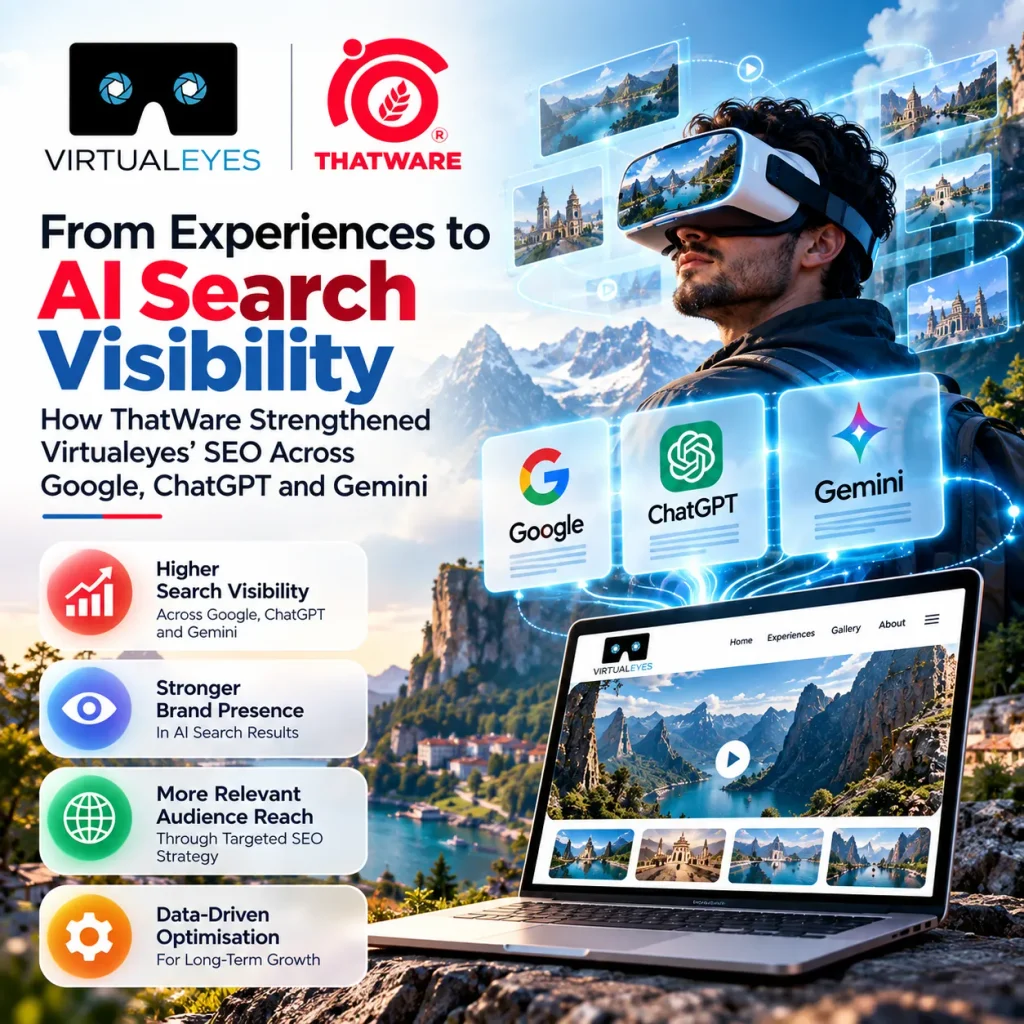
The Campaign’s AI Visibility Signals
The supplied campaign snapshots show several forms of AI search visibility.
These include:
Google AI Overview visibility
Virtualeyes-related content was surfaced within AI-generated search results.
ChatGPT answer visibility
Virtualeyes information was incorporated into responses for relevant queries.
Google Gemini visibility
Content appeared within Gemini-related answer experiences and featured-answer contexts.
Entity recognition
Virtualeyes was associated with specific services, industries and search concepts.
Query matching
The content aligned with highly specific user questions and service searches.
These outcomes demonstrate that the campaign was not limited to traditional ranking positions.
What Made the Strategy Different?
The campaign combined several disciplines that are often treated separately.
Traditional SEO
Focused on:
- Keywords
- Content
- On-page optimisation
- Search intent
- Site structure
AEO
Focused on:
- Direct answers
- Question-based searches
- Structured content
- Featured answer opportunities
GEO
Focused on:
- Generative search
- AI answer visibility
- Brand context
- Semantic relevance
Entity optimisation
Focused on:
- Brand identity
- Services
- Industry relationships
- Location
- Topical associations
Together, these created a broader search visibility strategy.
The Importance of Content Angle
One of the strongest lessons from the Virtualeyes campaign is that content angle matters as much as keyword selection.
A page can target the correct keyword and still fail to satisfy the user.
For example:
“Matterport Dubai”
could lead to a page filled with generic statements about digital technology.
That would miss the commercial intent.
A better page would answer:
- What Matterport services are available?
- Who can use them?
- How are they applied to real estate?
- What does the process involve?
- What types of properties can benefit?
- Why use professional Matterport services?
- What other visual services are available?
That is what search intent optimisation looks like in practice.
From Ranking Pages to Answer Pages
Traditional SEO often focuses on ranking pages.
Modern search requires something more.
A page should be capable of becoming an answer page.
An answer page has several characteristics:
- It addresses a clearly defined query.
- It provides a direct response.
- It explains the topic sufficiently.
- It uses clear structure.
- It establishes contextual relevance.
- It provides supporting information.
- It connects the topic to the business naturally.
This was a core principle behind the Virtualeyes campaign.
How ThatWare Approached AI Answer Optimisation
ThatWare’s approach can be summarised in five stages.
Stage 1: Identify Search Intent
Understand what the user is actually trying to accomplish.
Stage 2: Map the Query to the Right Content
Determine whether the search requires:
- Blog
- Service page
- Category page
- Landing page
- Location page
- FAQ
- Supporting content
Stage 3: Build an Answer-First Structure
Provide the most useful information early.
Stage 4: Strengthen Semantic Context
Connect the service, business, industry and location.
Stage 5: Optimise for AI Extraction
Use clear headings, concise explanations, lists, definitions and structured information.
This creates content that can serve both traditional and generative search.
The Role of Long-Tail Search
Long-tail queries often contain valuable information about the user’s intent.
For example:
“Matterport virtual showroom Dubai”
is much more specific than:
“Matterport.”
The first query tells us:
- Technology: Matterport
- Application: virtual showroom
- Location: Dubai
- Likely intent: commercial/service research
This makes it possible to create highly focused content.
The same principle applied across the Virtualeyes keyword set.
Why Specificity Helped Virtualeyes
Virtualeyes operates in a specialised market.
Therefore, competing only for broad terms could create an inefficient SEO strategy.
A user searching for:
“virtual tour”
could have many different intentions.
But someone searching:
“Matterport virtual showroom Dubai”
has already defined the technology, application and location.
Such searches can be highly valuable because they represent more qualified intent.
ThatWare therefore incorporated highly specific long-tail phrases into the overall strategy.
Building Authority Through Depth
Topical authority is not created by repeating the same keyword hundreds of times.
It comes from demonstrating comprehensive understanding.
For Virtualeyes, topical depth involved covering related subjects such as:
- Virtual tours
- Matterport
- 360 photography
- 3D property tours
- VR180
- Real estate visualisation
- Architectural photography
- Interior photography
- Virtual showrooms
- Business virtual experiences
- Google Street View
- Property marketing
This creates a broader content ecosystem.
Why AI Systems Need Context
A generative system must decide:
Is this source relevant enough to use?
Context helps answer that question.
If Virtualeyes is repeatedly and consistently associated with:
360 virtual tours + Matterport + Dubai + real estate + professional visualisation
then those relationships become easier to understand.
This is fundamentally different from simply inserting the same keyword into multiple pages.
Evidence of Visibility Across Search Ecosystems
The campaign screenshots provide visual evidence of Virtualeyes-related visibility across different AI and search environments.
These examples include:
Google AI Overview
Content was surfaced for relevant competitive queries.
ChatGPT
Virtualeyes-related information appeared within AI-generated answers.
Google Gemini
Content was surfaced in answer-oriented search experiences.
Featured answer environments
Content was structured to provide concise, direct information.
This multi-platform visibility was one of the strongest outcomes of the strategy.
What the Campaign Teaches About Modern SEO
The Virtualeyes campaign demonstrates several important lessons for businesses competing in modern search.
Lesson 1: SEO Is No Longer Only About Blue Links
Search visibility now extends into:
- AI Overviews
- ChatGPT
- Gemini
- Featured snippets
- Local search
- Entity results
- Conversational search
A modern SEO strategy must consider all of these environments.
Lesson 2: Search Intent Should Come Before Content Production
Writing content first and assigning keywords later is inefficient.
The better process is:
Query → Intent → Content type → Format → Angle → Optimisation
This approach creates more purposeful pages.
Lesson 3: Clear Answers Are More Valuable Than Keyword Density
Repeating a keyword does not automatically make content useful.
A strong answer should explain the subject naturally and comprehensively.
Lesson 4: Brand Context Matters
AI search requires an understanding of entities.
A business should clearly communicate:
- Who it is
- What it does
- Who it serves
- Where it operates
- What topics it is associated with
Virtualeyes’ content was structured around these relationships.
Lesson 5: Long-Tail Searches Deserve Strategic Attention
Specific searches can reveal highly qualified commercial intent.
They also provide excellent opportunities for answer-focused content.
The Virtualeyes SEO Transformation
The transformation can be summarised as a shift from:
Keyword-focused SEO
to:
Intent-focused search visibility.
And from:
Google ranking optimisation
to:
Multi-platform search and AI visibility.
And from:
Individual pages
to:
A connected topical ecosystem.
And from:
Keyword matching
to:
Entity and semantic understanding.
This is the direction modern SEO is moving towards.
A Practical Framework Businesses Can Learn From
The Virtualeyes campaign provides a framework that other businesses can adapt.
Step 1: Identify Your Core Services
Define exactly what the business offers.
For Virtualeyes, this included:
- Virtual tours
- Matterport
- 360 photography
- 3D property tours
- Architectural photography
- Interior photography
- VR180 services
Step 2: Identify Your Markets
Determine the industries and customer groups.
For example:
- Real estate
- Architecture
- Hospitality
- Businesses
- Events
Step 3: Identify Your Locations
Build relevant geographic relationships.
For Virtualeyes:
- Dubai
- UAE
Step 4: Build Keyword Clusters
Combine:
Service + industry + location + intent
For example:
Matterport + real estate + Dubai
Step 5: Assign the Correct Content Type
Do not force every query into a blog.
Step 6: Build Direct Answers
Answer important questions clearly.
Step 7: Strengthen Entity Context
Make the relationship between the business and its services unmistakable.
Step 8: Optimise for AI Search
Make information easy to interpret and extract.
Step 9: Monitor Search Visibility Beyond Rankings
Track:
- Organic rankings
- Featured snippets
- AI Overviews
- AI answer visibility
- Brand mentions
- Entity recognition
- Query coverage
Why the Virtualeyes Campaign Matters
The significance of the campaign goes beyond one website.
It illustrates the changing nature of digital discovery.
A potential customer can now discover a business through a traditional Google result, an AI Overview, a conversational assistant or a generative answer.
The winning businesses will therefore not simply ask:
“How do we rank?”
They will ask:
“How do we become the most useful and recognisable answer for the searches that matter to our customers?”
That is a fundamentally different approach to SEO.
ThatWare’s Approach to Modern Search
At ThatWare, we view SEO as an evolving search visibility discipline.
Search engines increasingly need to understand:
- Entities
- Relationships
- Intent
- Context
- Authority
- Relevance
- User needs
AI systems add another layer because they do not simply display pages. They interpret information and generate responses.
That means businesses need content that can survive both forms of evaluation:
Can a search engine rank it?
and:
Can an AI system understand and use it?
The Virtualeyes campaign demonstrates how these objectives can work together.
Results Without Inflated Metrics
The supplied campaign evidence demonstrates meaningful visibility improvements across several search environments.
Rather than presenting unsupported traffic percentages or ranking claims, the campaign evidence focuses on observable search outcomes.
These include:
- Visibility in Google AI Overview contexts
- Virtualeyes-related content appearing in ChatGPT answers
- Visibility through Google Gemini-related answer experiences
- Featured-answer opportunities
- Entity-based recognition
- Visibility for highly specific service queries
- Better alignment between content and search intent
This distinction matters.
A credible SEO case study should show what was achieved without inventing numerical results that are not supported by campaign data.
For Virtualeyes, the most important development was the expansion of search visibility beyond traditional organic results.
The Business Impact of AI Search Visibility
For a service business, appearing in an AI-generated answer can introduce the brand at a critical point in the decision-making journey.
Consider a user asking:
“Which companies provide virtual tours for businesses in the UAE?”
If Virtualeyes is represented in the answer, the company gains exposure before the user visits a conventional search result.
The same principle applies to queries involving:
- Matterport
- 360 virtual tours
- Property visualisation
- Architectural photography
- Virtual showrooms
- 3D property tours
The commercial opportunity is therefore not restricted to one ranking position.
It is about becoming part of the answer ecosystem.
What Made the Strategy Sustainable
Another important consideration is sustainability.
A short-term ranking tactic may produce temporary movement.
A strong content architecture creates an asset that can continue supporting multiple queries.
For Virtualeyes, the strategy connected:
Brand → Service → Industry → Location → Search Intent → Answer
This creates a foundation that can be expanded as new services, technologies and search behaviours emerge.
The Future of SEO for Visualisation Businesses
The visualisation sector is particularly suited to AI-driven search because customers often need explanations before choosing a service.
A potential client may want to understand:
- What Matterport does
- How a virtual tour works
- Whether 360 photography is suitable for their property
- How virtual tours support real estate marketing
- Whether businesses can use virtual showrooms
- What types of photography are available
- How 3D property tours differ from conventional photography
These are all questions.
And questions are increasingly becoming the interface through which people discover businesses.
That makes AEO and AI search visibility particularly important for service providers like Virtualeyes.
Conclusion
The Virtualeyes campaign demonstrates how SEO is evolving from a ranking discipline into a broader search visibility strategy.
ThatWare’s approach did not rely on keywords alone.
It focused on:
- Search intent
- Content type
- Content format
- Content angle
- Long-tail queries
- Semantic relationships
- Entity recognition
- AEO
- GEO
- AI answer visibility
- Google AI Overviews
- ChatGPT
- Google Gemini
- Local relevance
- Commercial search intent
The result was a broader search presence for Virtualeyes across traditional and generative search environments.
Most importantly, the campaign shows that modern SEO is not about choosing between Google optimisation and AI optimisation.
The two can work together.
When a page is genuinely useful, clearly structured, contextually relevant and aligned with the user’s intent, it has a stronger opportunity to perform across multiple search experiences.
For Virtualeyes, that meant moving beyond the question of:
“How do we rank for our keywords?”
and towards a more valuable question:
“How do we make Virtualeyes the clearest, most relevant answer when customers search for the services we provide?”
That shift is at the heart of modern SEO.
And it is precisely where ThatWare’s AI-powered SEO, AEO and GEO approach creates value.