
SUPERCHARGE YOUR ONLINE VISIBILITY! CONTACT US AND LET’S ACHIEVE EXCELLENCE TOGETHER!
Search has entered a new phase.
For years, the primary objective of SEO was relatively straightforward: identify valuable keywords, optimize a website, earn rankings, attract clicks, and grow organic visibility.
That model still matters—but it no longer tells the complete story.
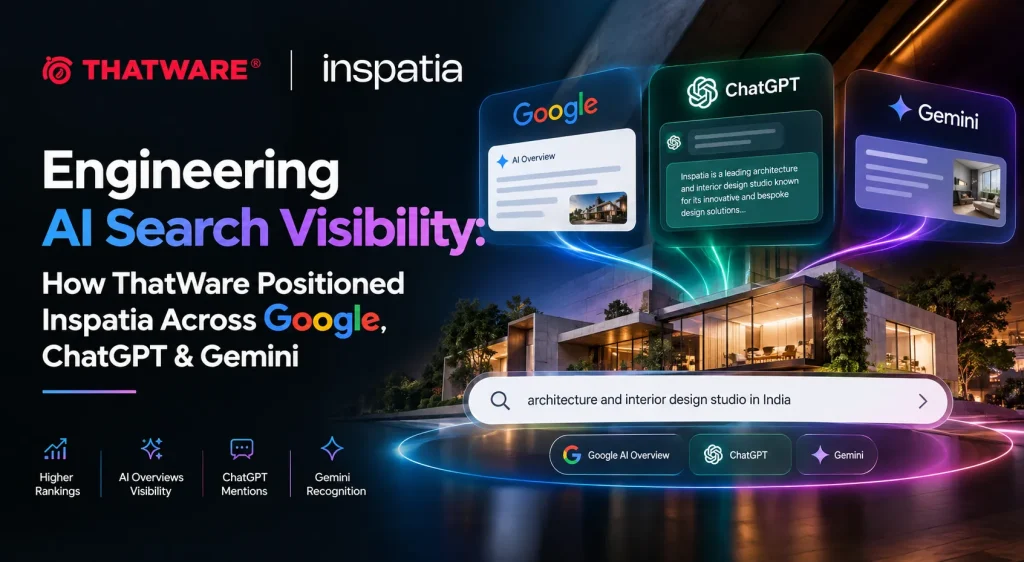
Today, a brand can be discovered through a conventional Google result, surfaced inside a Google AI Overview, referenced by ChatGPT, or recognized and summarized by Google Gemini. The search journey increasingly happens through systems that do more than retrieve webpages. They interpret intent, connect entities, synthesize information, and generate answers.
For brands operating in competitive categories, this creates a new question:
Is your website simply ranking—or is your brand becoming visible to the systems that generate answers?
The Inspatia campaign demonstrates the difference.
Through a combination of search-intent alignment, semantic content structuring, technical optimization, entity-focused relevance, and AI-oriented search engineering, ThatWare helped Inspatia strengthen its conventional search visibility while also generating measurable visibility across Google AI Overviews, ChatGPT, and Gemini.
The campaign produced clear ranking outcomes—including multiple #1 positions—and extended Inspatia’s visibility beyond traditional search results.
This is the story of that transformation: from being ranked to being retrieved.
1. SEO Has Changed — Visibility Is No Longer Just About Rankings
Traditional search visibility is usually measured through familiar metrics:
- Keyword rankings
- Organic traffic
- Backlinks
- Referring domains
- Click-through rates
- Search impressions
These remain important indicators.
But AI-mediated search introduces another layer.
When someone asks a detailed question, they may no longer receive a page of ten blue links as the primary response. Instead, they may receive a synthesized answer, an AI Overview, a conversational recommendation, or a response that identifies specific businesses and services.
That changes what it means to be visible.
A brand needs information that search systems can discover, interpret, associate, retrieve, and contextualize.
For ThatWare, this means modern search optimization cannot stop at conventional ranking signals. The content ecosystem must also communicate clearly with increasingly sophisticated search and AI systems.
The Inspatia campaign became an opportunity to apply this approach to a highly visual and competitive category: architecture and interior design.
Rather than treating the project as a conventional keyword-ranking exercise, the campaign focused on building a stronger relationship between search intent, content structure, semantic relevance, technical accessibility, and AI interpretation.
The results provide a practical example of what this new search environment looks like in action.
2. The Client: Inspatia
Inspatia is an architecture and interior design studio based in New Delhi, India.
Its positioning spans areas including:
- Architecture
- Interior design
- Luxury residential interiors
- Commercial and workplace interiors
- Retail architecture
- Bespoke design solutions
- Contemporary design
- Spatial planning
- Creative design
This creates a broad but highly competitive search environment.
Potential customers do not necessarily search using one standardized phrase. Their queries can reflect a location, service, style, budget expectation, project type, or desired level of specialization.
For example, the campaign targeted search territories including:
- “Retail architecture studio in India”
- “High-end interior studio India”
- “Bespoke interior solutions India”
- “Creative design studio India”
- “Interior design studio India”
- “Architecture design studio India”
- “Modern interior design India”
- “Luxury interior designers India”
- “Residential interior design India”
- “Office architecture design India”
- “Contemporary architecture in India”
- “Award-winning architects India”
- “Modern house design India”
- “Boutique architecture studio”
- “Best architecture firm in India”
- “Best interior design studio in India”
- “Best interior designers in Delhi”
The challenge was therefore not simply to rank for a handful of phrases.
It was to establish Inspatia as a relevant entity across a broader search landscape surrounding architecture, interiors, luxury design, commercial spaces, and India-specific design intent.
3. The Search Visibility Challenge
The competitive nature of Inspatia’s search environment created several interconnected challenges.
Competitive commercial queries
Terms such as “high-end interior studio India” and “retail architecture studio in India” represent commercially meaningful searches.
Ranking for these terms requires more than repeating keywords. The content must demonstrate relevance to the underlying query.
Complex search intent
A user searching for a high-end interior studio may be evaluating different studios, researching services, comparing design approaches, or looking for a specialist capable of delivering a particular project.
The content therefore needs to address the broader intent behind the query rather than only its literal wording.
Semantic relevance
Modern search systems increasingly evaluate relationships between concepts.
For Inspatia, relevant concepts included architecture, interiors, luxury design, residential spaces, workplaces, retail, spatial design, location, and specialist services.
AI retrieval
The emergence of AI-generated search experiences adds another challenge.
A page may rank organically without necessarily becoming part of an AI-generated response. The information needs to be structured in a way that allows systems to understand what the business is, what it offers, where it operates, and which questions its content can answer.
Technical accessibility
Even strong content can underperform when a website creates unnecessary barriers for users and crawlers.
That made technical performance, mobile usability, navigation, crawl depth, image handling, and page experience important parts of the campaign.
The objective was therefore broader than:
“Rank Inspatia’s website.”
The objective became:
“Build an information ecosystem that search engines and AI systems can understand and retrieve.”
4. From Ranking for Keywords to Understanding Search Intent
Search optimization has progressively moved away from purely literal keyword matching.
Google’s evolution through systems such as Panda, RankBrain, and BERT reflects a broader movement toward understanding content quality, context, relationships, and user intent.
ThatWare approached Inspatia’s content through three fundamental components of search intent:
1. Content Type
What type of information does the searcher expect?
A commercial query may require a service-oriented page. An informational query may require an educational resource. A comparative query may require structured explanations.
2. Content Format
How should the information be presented?
Depending on the query, useful formats can include:
- Direct answers
- Structured sections
- Lists
- Definitions
- Comparisons
- Service explanations
- Long-form educational content
3. Content Angle
What specific perspective satisfies the searcher?
For a query such as “High-end interior studio India,” the content needs to communicate more than the existence of an interior design company.
It needs to establish relevance around high-end interiors, Indian design context, specialist capabilities, service depth, and the characteristics that distinguish an established studio.
This intent-based approach formed an important foundation for the campaign.
It also created content that could be interpreted beyond an isolated keyword.
5. The Keyword & Semantic Strategy Behind Inspatia’s Visibility
The campaign combined commercial keyword targeting with a broader semantic strategy.
Instead of treating each keyword as an independent ranking opportunity, the target terms were connected through their underlying subject matter.
For example, the semantic territory surrounding high-end interior design can naturally include:
- Luxury interiors
- Bespoke interior solutions
- Residential design
- Commercial interiors
- Workplace design
- Contemporary interiors
- Architecture
- Spatial planning
- Interior studios
- Design studios
- India
- Delhi
Likewise, retail architecture can connect with concepts such as commercial architecture, retail spaces, spatial experience, design strategy, and architectural planning.
This approach allows content to establish topical relationships rather than simply inserting target phrases.
It also supports AI interpretation.
When an AI system encounters a clearly structured body of information that consistently connects a company with its services, location, expertise, and subject area, the resulting entity understanding can become significantly stronger.
For Inspatia, the objective was to make those relationships explicit throughout the site’s information architecture.
6. Technical & UX Foundation: Making the Site Easier to Discover and Understand
Content and semantics are only one part of search visibility.
The website also needs to provide a technically accessible environment.
The Inspatia campaign addressed several technical and user-experience considerations, including:
Core Web Vitals
Improving the technical experience of key pages supports better usability and creates a stronger foundation for search performance.
Mobile usability
Because search behavior increasingly occurs across mobile devices, pages need to remain accessible and usable across screen sizes.
Crawl depth and navigation
Important information should not be buried behind unnecessarily complicated navigation structures.
A clearer hierarchy helps users and crawlers discover important content more efficiently.
JavaScript execution
Reducing unnecessary JavaScript execution can help improve page performance and accessibility.
Image optimization
Architecture and interior design websites are naturally image-heavy.
That makes image compression, appropriate dimensions, and efficient delivery particularly important.
Lazy loading
Loading visual assets efficiently can reduce unnecessary initial page weight while preserving the visual nature of the site.
Proper image and embed dimensions
Defined dimensions help create a more stable page experience.
Server response time
Improving response performance contributes to a faster and more efficient website environment.
Together, these improvements helped create the technical foundation on which the content and semantic strategy could operate.
7. The AI Search Layer: How ThatWare Optimized Inspatia for AI Visibility
The campaign did not treat AI search as a completely separate channel.
Instead, the objective was to create content that could satisfy conventional search requirements while also being understandable to AI-driven systems.
This required several complementary signals.
Structured information
Content was organized using clear headings, logical sections, direct explanations, and structured information.
Long-tail question targeting
Rather than focusing exclusively on short, highly competitive phrases, the content addressed more specific information needs.
Direct answers
Questions were answered clearly instead of forcing users—or AI systems—to infer the answer from vague marketing language.
Entity-rich language
Inspatia’s name, services, location, design categories, and areas of expertise were connected throughout the content.
Semantic relevance
Related concepts were developed naturally around the primary subject areas.
Geographic relevance
India and Delhi-specific relevance helped establish the business within its geographic search context.
The resulting strategy aligned with the broader principles of Answer Engine Optimization: creating information that can be understood and surfaced when search experiences move from links toward direct answers.
The goal was not to manufacture an AI result.
It was to build content and information structures strong enough to give search and AI systems useful, contextual information about Inspatia.
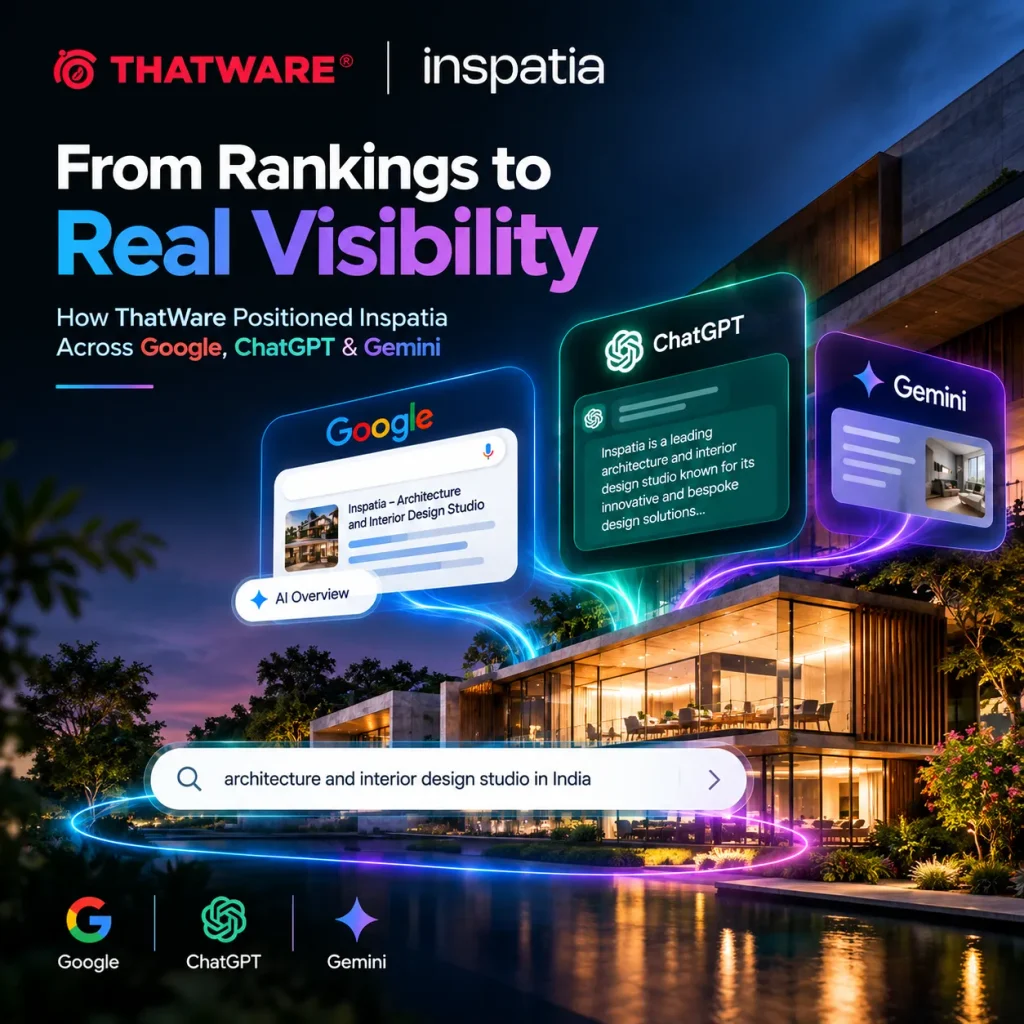
8. Published AI Search Proof #1: Inspatia in Google AI Overviews
One of the most important pieces of evidence from the campaign came from Google AI Overview visibility.
SEARCH TERM
“High-end interior studio India”
SEARCH ENVIRONMENT
Google AI Overview
RESULT
Inspatia secured visibility within the Google AI Overview experience, including the right-hand AI Overview card shown for the query.
KEYWORD DIFFICULTY
27.64%
The result is significant because the query sits within a commercially valuable and competitive design category.
The campaign did not rely solely on conventional keyword placement.
The content was structured around the subject itself.
It incorporated:
- Clear content hierarchy
- Semantically connected subtopics
- Internal topic relationships
- Keyword-relevant sections
- Long-form educational information
- Visual enrichment
- Clear contextual language
This gave the content a stronger opportunity to be interpreted as relevant to the query.
Why the AI Overview result matters
A conventional ranking answers one question:
“Where does the page appear in search?”
An AI Overview introduces another:
“Is the information useful enough to be incorporated into an AI-generated search experience?”
For Inspatia, the evidence shows that its content became visible within that AI-mediated layer.
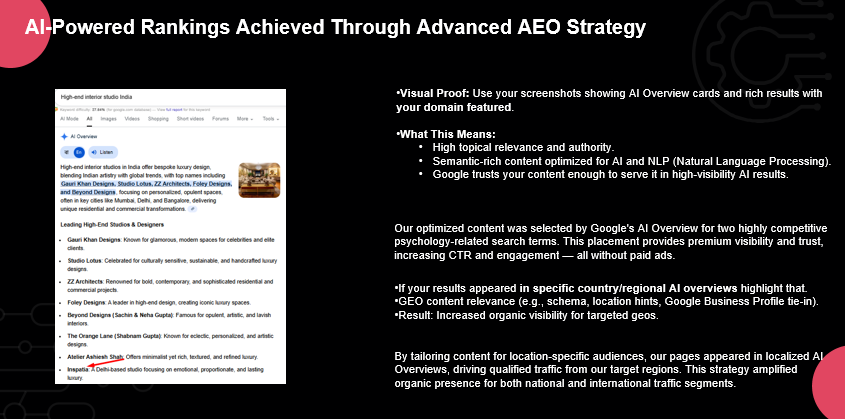
Published Proof Breakdown
| Proof Element | Evidence |
| Search term | “High-end interior studio India” |
| Platform | |
| AI experience | Google AI Overview |
| Visibility | Right-hand AI Overview card |
| Keyword difficulty | 27.64% |
| Optimization focus | Semantic relevance, structured content, search intent |
| Brand | Inspatia |
This is precisely where modern search visibility begins to move beyond conventional rankings.
9. Published AI Search Proof #2: Inspatia Appears in ChatGPT Answers
Google is not the only environment where search behavior is changing.
Large language models can answer questions directly by synthesizing information into conversational responses.
For Inspatia, the campaign also produced evidence of brand visibility within ChatGPT.
QUERY
“What are the different types of High-end interior studio India by Inspatia?”
The resulting response referenced Inspatia and discussed categories associated with its design offering, including:
- Residential interior design
- Luxury home interiors
- Bespoke design solutions
- Commercial and workplace interiors
- High-end interior solutions for offices and workplaces
This is a different type of visibility from a traditional keyword ranking.
The user did not simply receive a link to Inspatia.
The brand was incorporated into an AI-generated response describing relevant services.
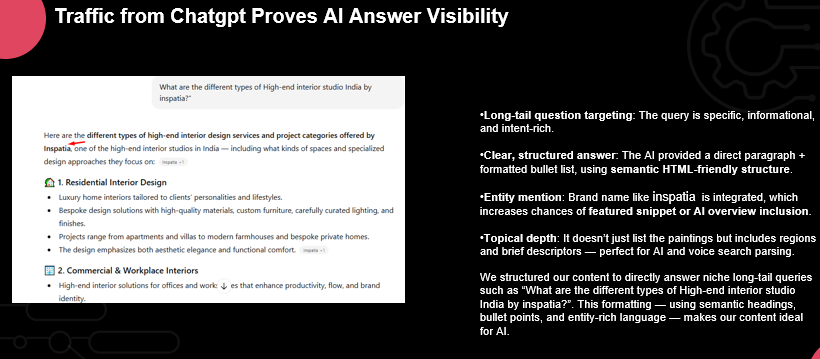
Published Proof Breakdown
| Proof Element | Evidence |
| AI platform | ChatGPT |
| Brand referenced | Inspatia |
| Query type | Service/category discovery |
| Answer format | Conversational AI response |
| Content signals | Structured headings, direct answers, semantic language |
| Entity association | Inspatia connected with architecture/interior design services |
This demonstrates why content architecture matters in the age of large language models.
A page needs to contain information that is not only indexable, but also understandable and contextually associated with the correct entity.
That is the principle behind Large Language Model SEO: creating a strong information environment that improves the likelihood of a brand, service, or entity being understood within LLM-driven search experiences.
10. Published AI Search Proof #3: Google Gemini Recognizes Inspatia
The third layer of published proof comes from Google Gemini.
QUERY CONTEXT
“Inspatia”
RESULT
Gemini identified Inspatia as an architecture and interior design firm in New Delhi and associated the brand with areas including:
- Architecture
- Interior design
- Landscape design
- Execution
- Planning
- Research
- Sustainability
- Spatial storytelling
- Creative design
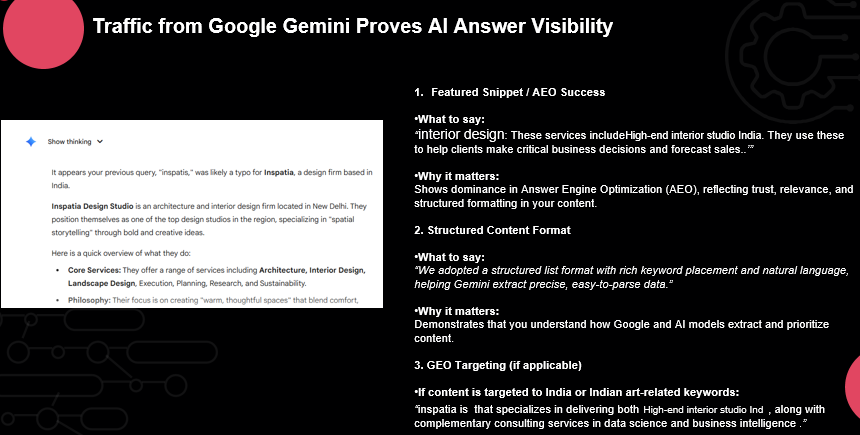
Published Proof Breakdown
| Proof Element | Evidence |
| AI platform | Google Gemini |
| Entity | Inspatia |
| Business category | Architecture and interior design |
| Geographic association | New Delhi |
| Service associations | Architecture, interiors, landscape and related capabilities |
| Visibility type | AI-generated entity recognition |
This matters because entity recognition is an important component of AI search.
A system needs to understand who the brand is before it can reliably understand what the brand does.
For Inspatia, the Gemini result demonstrates that the brand was not merely present as a string of text. It was associated with a meaningful business category, geographic context, and set of services.
That distinction is central to modern AI search visibility.
11. The AI Visibility Framework Behind the Results
The three AI-search results were not treated as isolated wins.
They emerged from a broader optimization framework.
Search Intent Alignment
The content was designed around what users were actually trying to find—not simply the literal keyword.
Semantic Depth
Supporting concepts were developed around the primary topics so that the content represented a broader subject rather than a collection of repeated phrases.
Structured Information
Clear headings, direct answers, lists, and organized information made the content easier to process.
Entity Association
Inspatia was consistently connected with its business category, services, location, and areas of expertise.
Technical Accessibility
Performance, mobile usability, navigation, crawlability, image optimization, and related technical considerations supported content accessibility.
AI Interpretability
The combined information structure created a clearer context for AI systems to understand and potentially retrieve.
This is where GEO Services become relevant to modern search strategy: visibility increasingly depends on how effectively a brand’s information can be interpreted within generative search environments, not merely how well a page ranks for a traditional query.
The strategy therefore connected conventional SEO foundations with AI-oriented information architecture.
12. Traditional SEO Results: Keyword Visibility Achieved
The AI visibility results are important.
But conventional ranking performance remains a critical part of the campaign.
The Inspatia project produced strong positions across several targeted commercial search terms.
The Ranking Results
#1 — Retail architecture studio in India
Inspatia achieved the #1 position.
#1 — High-end interior studio India
Inspatia achieved the #1 position.
#1 — Creative design studio India
Inspatia achieved the #1 position.
#5 — Bespoke interior solutions India
Inspatia achieved the #5 position.
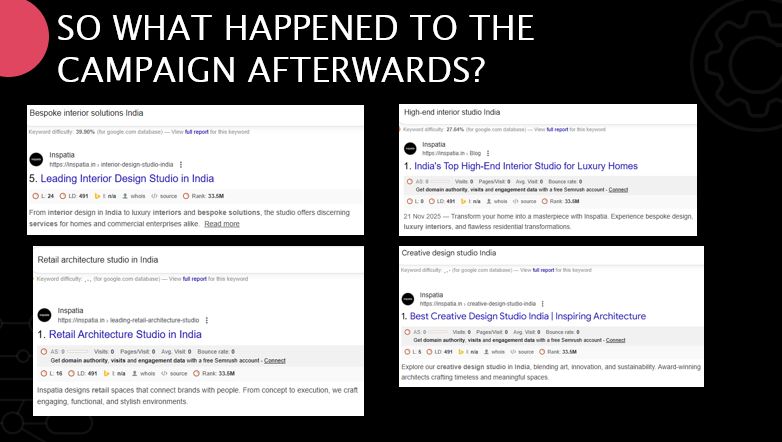
These results establish a strong conventional search foundation beneath the AI visibility results.
The campaign therefore did not replace traditional SEO with AI optimization.
It connected the two.
13. Authority & Off-Page Growth: Referring Domains and Backlinks
Another measurable component of the campaign was Inspatia’s off-page link profile.
The case-study data records:
11
Referring Domains — All Time
449
Backlinks — All Time
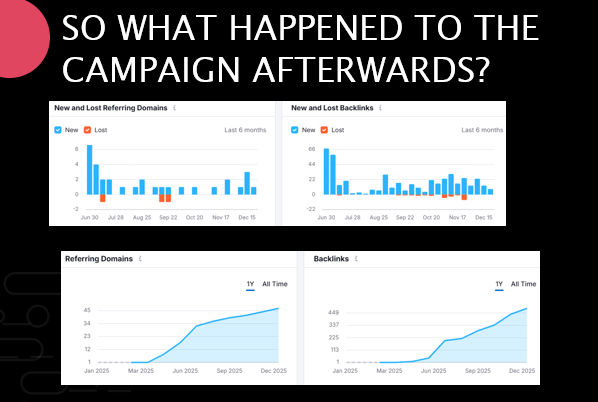
These numbers provide additional evidence of the site’s broader authority profile.
Backlinks and referring domains remain important components of search visibility because they can contribute to the authority and discoverability of a website.
However, the campaign’s larger lesson is that links were not treated as the sole definition of success.
The strongest result emerged from combining authority with relevance, technical accessibility, structured information, search intent, and AI visibility.
14. The Results: From Rankings to AI Search Visibility
This is the critical outcome of the Inspatia campaign.
The campaign generated measurable visibility across both traditional search and emerging AI-driven search environments.
Published Results at a Glance
| Search Visibility Signal | Result |
| “Retail architecture studio in India” | #1 |
| “High-end interior studio India” | #1 |
| “Creative design studio India” | #1 |
| “Bespoke interior solutions India” | #5 |
| Keyword difficulty — “High-end interior studio India” | 27.64% |
| Keyword difficulty — “Bespoke interior solutions India” | 39.50% |
| Google AI Overview | Inspatia visibility demonstrated |
| ChatGPT | Inspatia referenced in AI answer |
| Google Gemini | Inspatia recognized as an architecture/interior design entity |
| Referring domains | 11 |
| Backlinks | 449 |
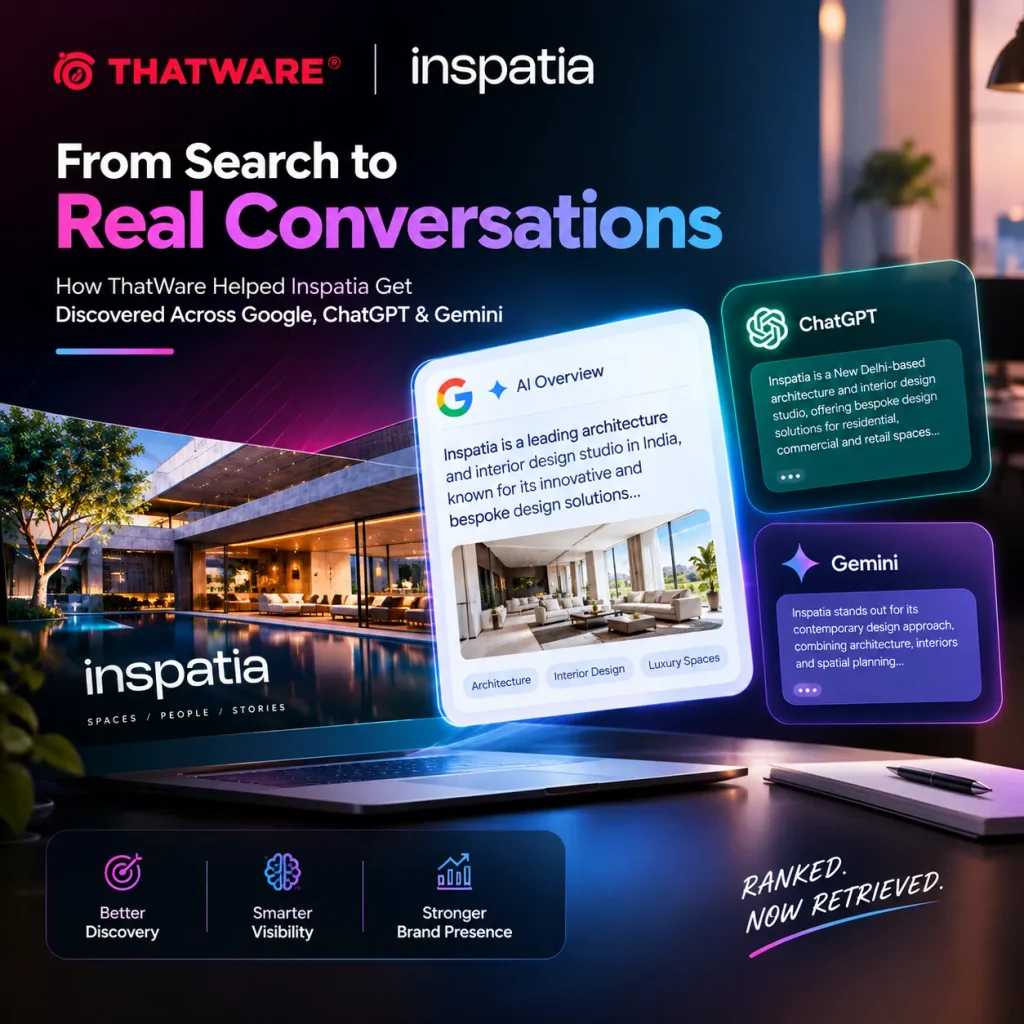
The proof tells a larger story
The campaign achieved #1 rankings for multiple strategically important search terms.
It also generated evidence of Inspatia appearing within a Google AI Overview.
ChatGPT produced an answer that referenced Inspatia in relation to high-end interior design services.
Google Gemini recognized Inspatia as an architecture and interior design firm and connected it with its location and service areas.
At the same time, the site’s backlink profile included 449 backlinks from 11 referring domains.
These results matter because they demonstrate different layers of search visibility working together.
Layer 1: Ranking
Inspatia became visible in conventional search results.
Layer 2: AI Search
Inspatia became visible within AI-mediated search experiences.
Layer 3: Entity Understanding
AI systems demonstrated an understanding of Inspatia as a business entity associated with architecture, interior design, services, and location.
Layer 4: Authority
The site’s link profile provided an additional authority signal.
This is the fundamental difference between simply optimizing for rankings and engineering broader search visibility.
The objective was not only to get Inspatia onto the search results page. It was to make Inspatia understandable across the systems increasingly responsible for answering search queries.
15. The Bigger Result: From Rankings to AI Search Visibility
The Inspatia campaign demonstrates a fundamental change in how search success should be evaluated.
Traditional SEO often follows a simple progression:
Keyword → Ranking → Click → Conversion
AI-driven search introduces additional stages:
Query → Interpretation → Retrieval → Entity Recognition → AI Answer → Recommendation
That does not make traditional rankings irrelevant.
It makes the search ecosystem larger.
A business can now be discovered through multiple surfaces, and each surface requires information that can be correctly interpreted.
For an architecture and interior design brand such as Inspatia, this is particularly important.
A prospective customer may search:
- “best interior designers in Delhi”
- “high-end interior studio India”
- “retail architecture studio in India”
- “luxury interior designers India”
- “architecture design studio India”
They may then ask an AI system to explain the options.
The brand that has built a clear, authoritative, semantically connected information ecosystem has a stronger foundation for being understood throughout that journey.
This is where AI-first search strategy becomes materially different from simply adding more keywords to a website.
16. Why This Case Study Matters for Modern Brands
The Inspatia campaign is specific to architecture and interior design, but the underlying principle applies far beyond this industry.
Every industry is moving toward more conversational and AI-mediated search.
People increasingly ask questions instead of entering isolated keywords.
They expect direct answers rather than simply lists of webpages.
And AI systems increasingly determine which information is relevant enough to include in those answers.
That creates several strategic requirements for modern brands.
Be discoverable
Search engines still need to find and index your information.
Be understandable
Your content needs to clearly communicate what your business does.
Be contextually relevant
Your information needs to connect your services with the questions and concepts users care about.
Be identifiable as an entity
AI systems need to distinguish your brand from generic descriptions of a product or service.
Be retrievable
Your content should provide clear, useful information that can potentially be surfaced when relevant questions are asked.
That is why modern search strategy requires a combination of strong foundations and AI-aware optimization.
For businesses investing in AI SEO Services, the goal should not be to chase individual AI outputs. It should be to build the underlying information ecosystem that makes those outputs possible.
Conclusion: Building Search Visibility That AI Can Understand
The Inspatia campaign represents a shift in how search optimization can be approached.
The objective was not limited to ranking a website for a list of keywords.
It was to create stronger connections between search intent, content structure, semantic relevance, technical accessibility, entity understanding, and AI retrieval.
The measurable results demonstrate that approach:
#1 for “Retail architecture studio in India”
#1 for “High-end interior studio India”
#1 for “Creative design studio India”
#5 for “Bespoke interior solutions India”
27.64% keyword difficulty for “High-end interior studio India”
39.50% keyword difficulty for “Bespoke interior solutions India”
Google AI Overview visibility
ChatGPT brand visibility
Google Gemini entity recognition
11 referring domains
449 backlinks
But the most important change is conceptual.
Search visibility is no longer confined to where a webpage ranks.
It increasingly includes whether a brand can be found, understood, retrieved, referenced, and represented by the systems that generate answers.
Inspatia’s results provide published evidence of that transition in practice.
And as search continues moving from traditional result pages toward AI-generated answers, brands that build for both search engines and machine interpretation will be better positioned for the next generation of discovery.