SUPERCHARGE YOUR ONLINE VISIBILITY! CONTACT US AND LET’S ACHIEVE EXCELLENCE TOGETHER!
Enterprise SEO is no longer only about increasing keyword rankings or optimizing individual landing pages. For large organizations, search performance depends on how effectively thousands of pages, multiple business units, complex technologies, international markets, content teams, developers and increasingly AI-powered search systems work together.
ThatWare provides enterprise SEO services designed for organizations that have outgrown conventional SEO frameworks.
As an advanced enterprise SEO agency, we help businesses manage the technical, strategic and operational complexity that comes with large-scale organic search. Our approach combines technical search optimization, content intelligence, website architecture, automation, search intent mapping, semantic relevance, AI visibility, Answer Engine Optimization, Generative Engine Optimization and LLM-focused discoverability.
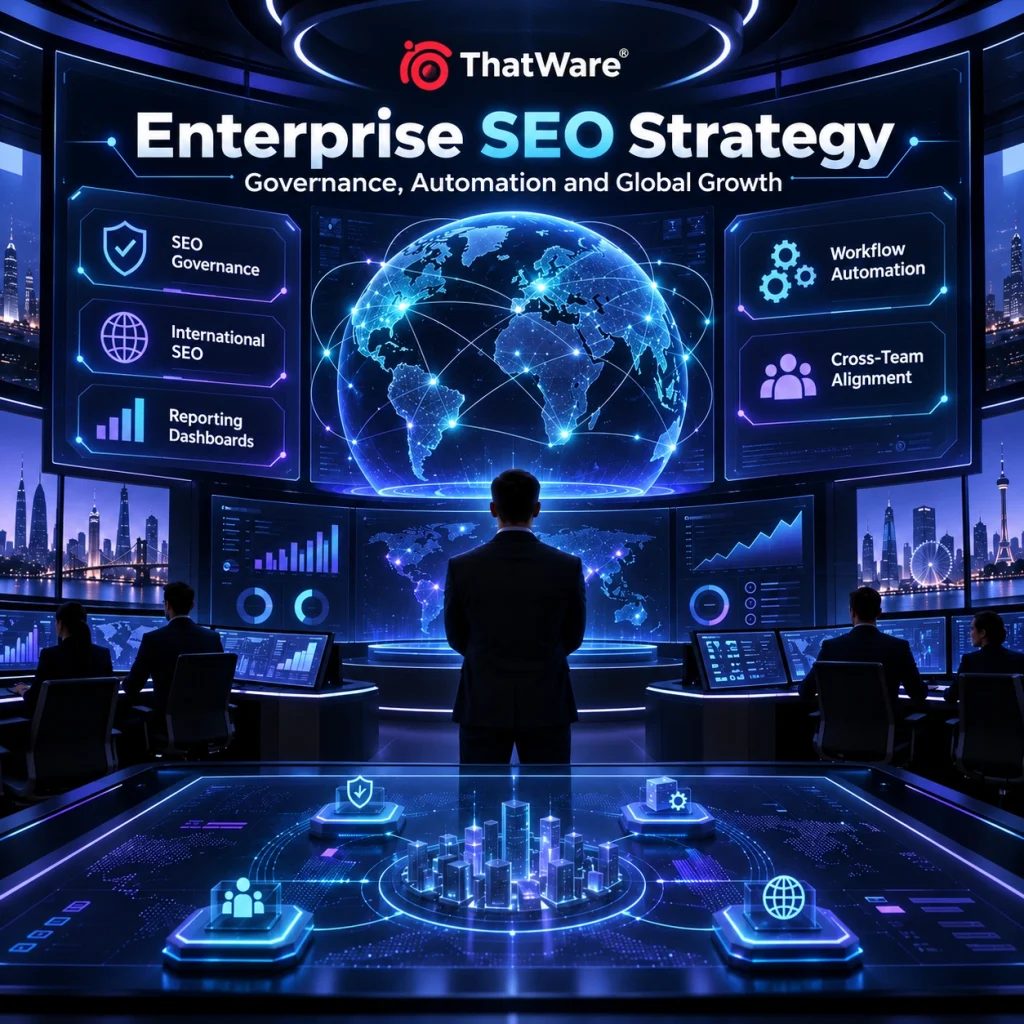
For an enterprise website, one small technical error can affect thousands of URLs. One weak template can reduce the performance of an entire category. One poorly planned migration can erase years of accumulated organic visibility. Similarly, one well-designed enterprise SEO framework can improve discoverability across thousands of commercial and informational pages.
This is why enterprise SEO requires a different operating model.
ThatWare works with organizations that need more than routine monthly SEO activity. We help build scalable search systems capable of supporting large websites, complex digital ecosystems and the evolving relationship between Google Search, AI Overviews, answer engines, generative search and conversational discovery.
Whether you are looking for an enterprise SEO company, an experienced enterprise SEO partner, advanced enterprise technical SEO services, strategic enterprise SEO consulting services, or an enterprise AI SEO agency, the objective remains the same:
Create a search ecosystem that supports visibility, authority, scalability and measurable business growth.
What Is Enterprise SEO?
Enterprise SEO is the strategic process of improving the organic search performance of large, complex websites through scalable technical, content, architectural, operational and authority-building systems.
A traditional SEO campaign may involve optimizing a few dozen pages.
Enterprise SEO may involve optimizing thousands, tens of thousands or even millions of URLs across several products, markets, languages or digital platforms.
The difference is not simply website size.
The real difference is complexity.
Large organizations often operate with:
- multiple development teams
- different content departments
- several business units
- numerous website templates
- regional or global websites
- complex CMS environments
- strict legal and brand approval processes
- large ecommerce catalogs
- thousands of internal links
- extensive legacy content
- dynamic URL generation
- programmatic landing pages
- multiple analytics platforms
- different regional search requirements
- several layers of internal decision-making
At this level, SEO cannot operate as an isolated marketing activity.
It must become part of the organization’s wider digital infrastructure.
Enterprise SEO Is a Search Management System
Enterprise SEO should be viewed as a system rather than a collection of individual optimization tasks.
The system must answer questions such as:
- Which URLs should search engines crawl?
- Which pages deserve indexation?
- Which content should be consolidated?
- Which pages should receive stronger internal authority?
- Which categories have the highest commercial opportunity?
- Which technical issues affect the greatest number of pages?
- Which content gaps limit topical authority?
- Which pages compete against each other?
- Which website sections are difficult for search engines to discover?
- Which business entities are poorly understood?
- Which topics need stronger AI-search visibility?
- Which technical changes should developers prioritize?
- Which metrics should executives monitor?
A strong enterprise SEO strategy creates repeatable answers to these questions.
Why Enterprise SEO Is Different From Standard SEO
Standard SEO can often be managed page by page.
Enterprise SEO cannot.
When an organization has 100,000 URLs, manually optimizing every page is neither practical nor commercially sensible.
The strategy must focus on patterns.
For example, instead of asking:
“Why is this page missing a canonical tag?”
Enterprise SEO asks:
“Which CMS template is generating incorrect canonical tags across 14,000 pages?”
Instead of asking:
“Why is this article not receiving internal links?”
Enterprise SEO asks:
“Which content cluster has weak authority distribution and how can internal linking be improved systematically?”
Instead of asking:
“Why is this category not indexed?”
Enterprise SEO asks:
“Which technical, architectural or quality signals are causing indexation problems across this entire section?”
This change in thinking is fundamental.
Enterprise SEO in Brief
The easiest way to understand enterprise SEO is to consider scale.
A small business might have 100 important URLs.
A large enterprise might have:
- 10,000 product pages
- 5,000 informational articles
- 500 service pages
- 200 regional landing pages
- multiple subdomains
- multilingual versions
- thousands of parameter URLs
- thousands of archived or duplicate pages
A traditional SEO campaign may comfortably handle the first situation.
The second requires enterprise SEO solutions.
The Core Components of Enterprise SEO
A modern enterprise search framework typically includes:
- Technical SEO
- Crawl management
- Indexation control
- Website architecture
- Content strategy
- Search intent mapping
- Internal linking
- Authority development
- Content governance
- Automation
- International SEO
- Search performance measurement
- AI-search optimization
- Answer Engine Optimization
- Generative Engine Optimization
- LLM visibility
- Enterprise governance
- Cross-team implementation
These components cannot operate independently.
A technically perfect website with weak content may still fail.
A content-rich website with poor architecture may struggle.
A strong Google presence without preparation for generative search may lose visibility as user behavior evolves.
The objective is therefore to connect these systems.
Why Large Organizations Need Enterprise SEO Services
SEO complexity increases dramatically as websites grow.
The number of URLs increases.
The number of stakeholders increases.
The number of technical dependencies increases.
The cost of mistakes also increases.
Scale Multiplies SEO Problems
Imagine that a website template accidentally generates duplicate title tags.
On a 50-page website, this creates 50 issues.
On an enterprise website, the same template could generate 50,000 issues.
This is why large scale SEO services require systematic diagnosis.
The same principle applies to:
- canonicalization
- redirects
- internal linking
- structured data
- thin content
- duplicated pages
- JavaScript rendering
- faceted navigation
- page speed
- mobile usability
- localization
- pagination
- crawl depth
- indexation
Enterprise SEO is about finding the root cause.
Enterprise Websites Often Have Competing Priorities
Enterprise organizations rarely make website decisions based only on SEO.
Legal teams may require specific copy.
Product teams may prioritize conversion.
Developers may prioritize system stability.
Brand teams may have strict messaging requirements.
Regional teams may have local market priorities.
SEO therefore needs to operate within these realities.
A successful enterprise SEO company should not simply recommend technically ideal changes.
It must understand what can realistically be implemented across a complex organization.
How ThatWare Approaches Enterprise SEO
ThatWare approaches enterprise search as an intelligence problem.
We do not begin with a predefined list of monthly activities.
We begin by understanding how the enterprise website functions.
Step 1: Understand the Business
Before making SEO recommendations, we study:
- business model
- revenue drivers
- priority products
- strategic markets
- target customers
- website technology
- internal teams
- existing search performance
- competitive landscape
- content ecosystem
This prevents SEO from becoming disconnected from commercial goals.
Step 2: Diagnose Search Infrastructure
We then examine the technical and structural foundations.
This may include:
- crawling
- rendering
- indexation
- canonicalization
- internal linking
- website architecture
- XML sitemaps
- robots directives
- URL structures
- page templates
- JavaScript
- Core Web Vitals
- server behavior
- redirect systems
Step 3: Map Search Opportunity
After technical analysis, we identify search opportunities based on:
- keyword demand
- commercial intent
- search visibility
- competitors
- content gaps
- ranking distribution
- page performance
- user intent
- AI-search opportunity
Step 4: Build a Prioritized Enterprise Roadmap
Not every issue deserves equal attention.
We prioritize recommendations by:
- commercial impact
- number of affected pages
- implementation complexity
- expected SEO impact
- dependency
- urgency
This creates a practical roadmap instead of an overwhelming audit.
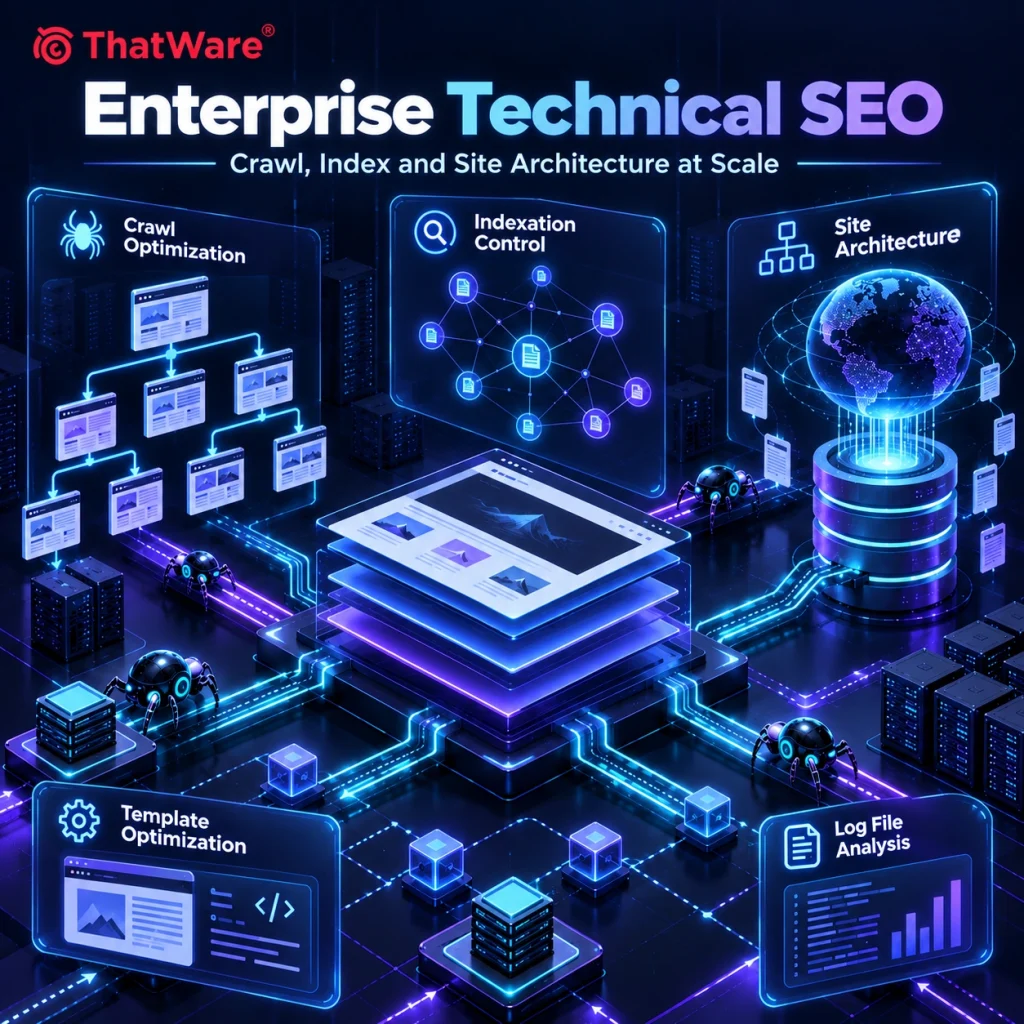
Enterprise Technical SEO Services
Technical SEO is one of the foundations of enterprise search.
Large websites create technical challenges that smaller websites rarely encounter.
ThatWare’s enterprise technical SEO services are designed to identify these problems at scale.
Enterprise Technical SEO Auditing
Our technical analysis can cover:
- crawlability
- indexability
- rendering
- canonicalization
- duplicate URLs
- redirect chains
- redirect loops
- broken internal links
- XML sitemap integrity
- robots.txt directives
- structured data
- mobile usability
- Core Web Vitals
- JavaScript execution
- server response
- crawl depth
- orphan pages
- international configurations
- hreflang
- pagination
- faceted navigation
- parameters
Template-Level SEO Analysis
Enterprise problems often originate from templates.
A single template may control tens of thousands of pages.
Instead of optimizing every URL individually, our enterprise technical SEO process evaluates templates and systems.
For example:
A product template may produce thin content.
A category template may create duplicate metadata.
A JavaScript component may prevent important content from rendering properly.
A navigation template may create unnecessary crawl paths.
Resolving the template can improve thousands of URLs simultaneously.
JavaScript and Rendering
Modern enterprise websites frequently rely heavily on JavaScript.
Search engines have improved JavaScript rendering, but complex implementations can still create problems.
We evaluate:
- whether essential content is available
- whether links are discoverable
- whether metadata renders correctly
- whether structured data remains accessible
- whether rendering delays indexation
- whether JavaScript unnecessarily increases performance costs
Enterprise Crawl Optimization
Search engines do not crawl every website URL equally.
Large websites therefore need deliberate enterprise crawl optimization.
Why Crawl Efficiency Matters
Imagine an ecommerce website containing:
- 80,000 product pages
- 20,000 category combinations
- 100,000 parameter variations
- 40,000 discontinued products
If search engines spend substantial resources repeatedly crawling low-value URLs, important new products may receive less efficient discovery.
Crawl optimization attempts to improve that allocation.
What We Analyze
Our crawl analysis may investigate:
- parameter URLs
- faceted navigation
- duplicate pages
- low-value pages
- unnecessary redirects
- deep content
- orphan URLs
- sitemap inconsistencies
- canonical signals
- server errors
- internal link distribution
Improving Crawl Paths
A strong enterprise website should make important content easy to discover.
That may involve:
- reducing click depth
- strengthening category links
- improving breadcrumb structures
- updating XML sitemaps
- removing unnecessary crawl traps
- fixing orphan pages
- improving contextual linking
The objective is not merely to increase crawling.
The objective is to make crawling more intelligent.
Enterprise Site Architecture SEO
Architecture determines how information is organized.
For enterprise websites, architecture directly affects:
- usability
- crawling
- indexation
- authority flow
- semantic understanding
- conversions
ThatWare’s enterprise site architecture SEO framework evaluates how pages relate to one another.
Hierarchy and Information Structure
Search engines should be able to recognize:
Homepage
→ Primary business categories
→ Secondary categories
→ Product or service pages
→ Supporting resources
If this hierarchy becomes unclear, search engines may struggle to identify page importance.
Click Depth
Important pages should not require excessive navigation.
If a commercially valuable page sits seven or eight clicks away from the homepage, its visibility may suffer.
We assess whether important pages are unnecessarily deep.
Internal Authority Distribution
Internal links transfer contextual importance.
Large websites often accumulate authority on a small percentage of pages while valuable deeper pages remain weakly connected.
Architecture optimization helps distribute authority more intentionally.
The BedandPillows campaign framework specifically considered crawl depth, navigation and flatter site architecture as part of website optimization.
Large Website SEO Services
Large websites require prioritization.
ThatWare’s large website SEO services are designed to determine where optimization will create the greatest impact.
High-Opportunity Page Identification
Not every page deserves equal resources.
We may prioritize pages with:
- significant impressions
- strong commercial relevance
- rankings between positions 5 and 20
- declining traffic
- high conversion potential
- strong backlinks
- weak content quality
- important category relevance
Content Consolidation
Enterprise websites frequently accumulate multiple pages targeting similar search intent.
This can create:
- keyword cannibalization
- duplicate content
- weaker authority
- confusing internal linking
We identify opportunities to:
- merge competing content
- redirect redundant URLs
- reposition pages
- improve keyword mapping
Content Decay
Large content libraries often contain articles created years earlier.
Some may still perform.
Others may have lost relevance.
We identify content that should be:
- updated
- consolidated
- expanded
- redirected
- removed
Enterprise Website SEO and Search Intent
Search intent is one of the most important principles of organic visibility.
A page must satisfy the reason behind a search.
Understanding Enterprise Search Intent
Intent generally includes:
- informational
- commercial
- transactional
- navigational
But enterprise search journeys are often more complex.
A user researching software may search:
“enterprise CRM features”
then:
“enterprise CRM comparison”
then:
then:
“best enterprise CRM provider”
These searches represent different stages of a decision.
A strong enterprise website SEO strategy should address the complete journey.
Content Type
The correct content type may be:
- blog
- guide
- product page
- service page
- comparison page
- category page
- research resource
- FAQ
Content Format
The correct format may involve:
- how-to guide
- comparison
- checklist
- tutorial
- definition
- case study
- buyer guide
Content Angle
Even when the type and format are correct, the angle must match what the audience values.
The supplied GAMA IQ Dryer methodology specifically focused on content type, format and angle as three elements of search intent optimization.
Enterprise Content Strategy
Enterprise websites frequently publish large amounts of content.
More content does not automatically mean more visibility.
The goal should be to create a structured content ecosystem.
Topic Clustering
Rather than producing disconnected pages, content can be organized around broader topics.
For example:
Primary topic
→ Core commercial page
→ Supporting guides
→ Comparisons
→ FAQs
→ Use cases
→ Research
This helps build topical depth.
Entity Coverage
Search engines increasingly interpret entities and relationships.
An enterprise content strategy should clearly communicate:
- what the company does
- which products it offers
- which industries it serves
- which locations it operates in
- which topics it has expertise in
- how these concepts relate
Content Quality at Scale
Large organizations face a difficult challenge.
They need volume without sacrificing quality.
That requires:
- clear editorial guidelines
- consistent structure
- intent mapping
- subject matter expertise
- quality control
- duplication checks
- factual review
Enterprise SEO Automation
Managing thousands of URLs manually becomes inefficient.
That is why enterprise SEO automation can support scalable optimization.
What Can Be Automated?
Depending on the enterprise environment, automation may help with:
- keyword classification
- page segmentation
- internal link suggestions
- metadata recommendations
- technical monitoring
- redirect mapping
- schema deployment
- reporting
- anomaly detection
- content decay detection
- page performance categorization
- competitor tracking
Automation Should Support Experts
Automation should not remove strategic oversight.
A machine can identify 10,000 pages with weak titles.
It cannot always determine which 500 pages deserve immediate attention.
A system can identify duplicate content.
Human analysis may still be needed to decide whether pages should be consolidated.
ThatWare combines automation with specialist analysis.
Enterprise SEO Governance
Enterprise SEO often fails because optimization is not embedded into organizational processes.
Enterprise SEO governance solves this problem.
Why Governance Matters
Multiple teams may affect the website:
- marketing
- content
- development
- design
- product
- regional teams
- PR
- legal
Each team can unintentionally affect SEO.
A developer changes a URL.
A regional team creates duplicate pages.
A content team publishes overlapping articles.
A designer removes important text.
Governance creates shared standards.
Enterprise SEO Guidelines
Governance frameworks may define:
- URL creation rules
- redirect requirements
- metadata standards
- internal linking rules
- publishing workflows
- schema requirements
- migration procedures
- quality checks
- reporting responsibilities
SEO Training
Internal teams may also require SEO education.
Developers need technical guidelines.
Writers need content standards.
Designers need to understand search accessibility.
Executives need to understand SEO KPIs.
Enterprise SEO Audit Services
Strong enterprise campaigns begin with diagnosis.
Our enterprise SEO audit services analyze the website from multiple perspectives.
Technical Audit
We investigate:
- crawling
- rendering
- indexation
- canonicalization
- performance
- redirects
- structured data
- mobile experience
- sitemaps
Content Audit
We evaluate:
- quality
- relevance
- duplication
- search intent
- topical gaps
- outdated pages
- cannibalization
- thin content
Architecture Audit
We analyze:
- hierarchy
- navigation
- click depth
- internal linking
- taxonomy
- URL structure
Authority Audit
We evaluate:
- backlink profile
- referring domains
- content authority
- competitor authority gaps
AI Visibility Audit
Modern enterprises also need to understand how they appear across emerging search environments.
We may assess:
- AI mentions
- brand citations
- competitive visibility
- topic associations
- answer visibility
- information gaps
Enterprise SEO Consulting
Many large organizations already employ SEO specialists.
They may not need complete outsourced execution.
They need specialist guidance.
ThatWare provides enterprise SEO consulting for organizations that want strategic support.
Enterprise SEO Consulting Services for Internal Teams
Our enterprise SEO consulting services can support:
- technical roadmaps
- website redesigns
- migrations
- content scaling
- international expansion
- architecture decisions
- AI-search strategy
- algorithm recovery
- governance
- SEO automation
- executive reporting
Advisory Support
ThatWare can work alongside:
- SEO managers
- CMOs
- digital marketing teams
- development teams
- content teams
- product managers
- senior leadership
Our role can vary according to organizational requirements.
Building an Enterprise SEO Strategy
A successful enterprise SEO strategy should connect technical SEO, content, authority and business goals.
Phase 1: Discovery
We identify:
- business priorities
- target markets
- product priorities
- website structure
- existing performance
- technology constraints
- stakeholder requirements
Phase 2: Diagnostics
We analyze the current website.
Phase 3: Opportunity Mapping
We identify:
- ranking opportunities
- technical opportunities
- content gaps
- architecture improvements
- AI-search opportunities
- competitor gaps
Phase 4: Prioritization
Recommendations are grouped by:
- impact
- complexity
- urgency
- business value
Phase 5: Implementation
Implementation may involve ThatWare, the client team or both.
Phase 6: Measurement
KPIs can include:
- organic visibility
- impressions
- clicks
- rankings
- indexation
- conversion
- qualified leads
- AI visibility
From Enterprise SEO to AI Search Optimization
Search is evolving.
Users increasingly discover information through AI-generated answers.
Traditional SEO therefore needs an additional layer.
Enterprise brands should ask:
- Does AI understand our brand?
- Does AI associate us with the right topics?
- Are our pages cited?
- Are competitors cited instead?
- Which questions trigger our brand?
- Which information gaps reduce visibility?
ThatWare integrates conventional SEO with AI-search optimization.
Enterprise AI SEO Services
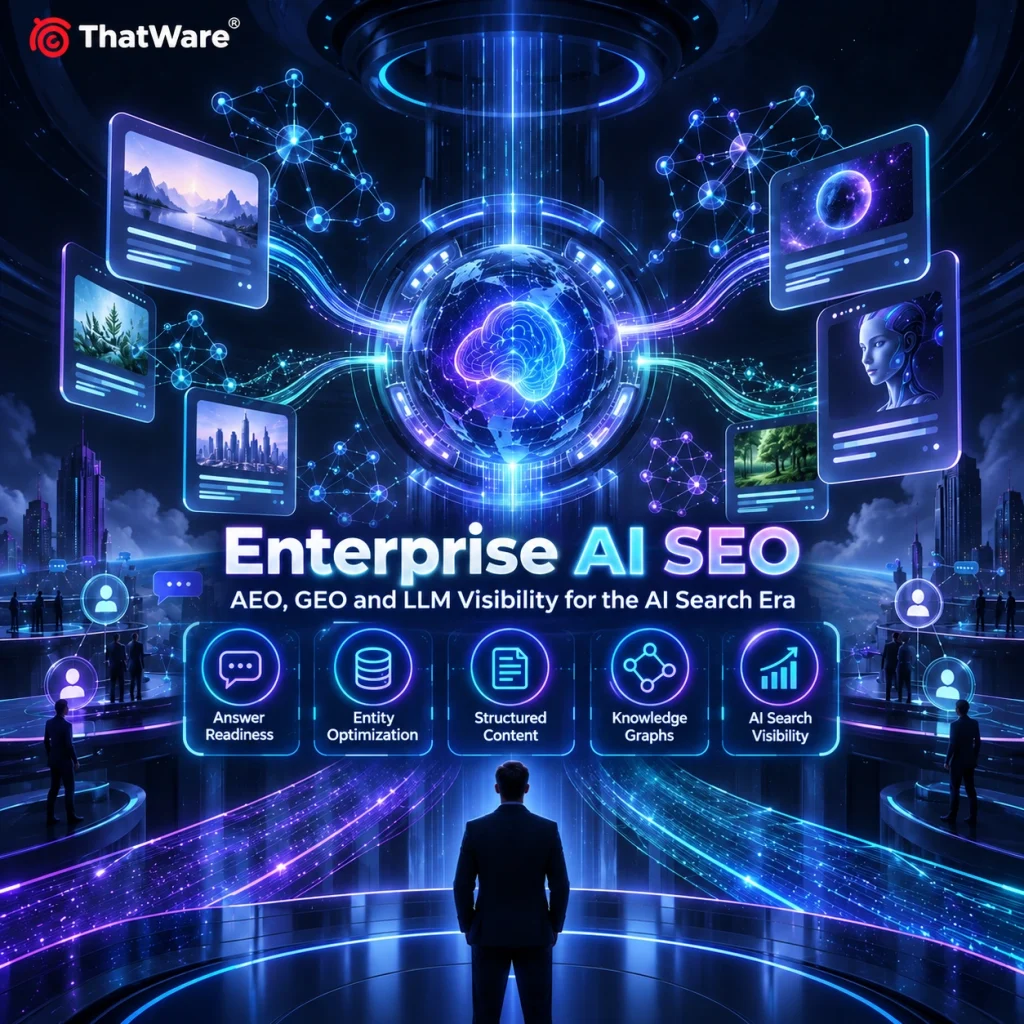
Our enterprise AI SEO services are designed to strengthen enterprise discoverability within AI-driven search environments.
What Enterprise AI SEO Involves
AI SEO can include:
- structured content
- semantic relevance
- entity clarity
- factual consistency
- authoritative supporting resources
- question-led content
- answer-ready sections
- structured data
- contextual internal linking
The objective is to make information easier for AI systems to interpret.
AI SEO Is Not a Replacement for Traditional SEO
Traditional SEO remains essential.
Search engines still need:
- crawlable pages
- quality content
- clear architecture
- authority
- relevance
AI SEO builds upon these foundations.
Why Work With an Enterprise AI SEO Agency?
An enterprise AI SEO agency should understand both conventional search and emerging AI discovery.
Treating AI visibility separately from SEO can create fragmented strategies.
ThatWare combines them.
Traditional Search Signals
We consider:
- keywords
- rankings
- technical health
- links
- content
- user intent
AI Search Signals
We additionally consider:
- entities
- answer structures
- semantic relationships
- citations
- conversational queries
- machine-readable information
Enterprise AI Search Optimization
Enterprise AI search optimization focuses on how brands appear when AI systems interpret and synthesize information.
Moving Beyond Individual Keywords
Traditional SEO often begins with keywords.
AI search frequently begins with questions.
For example:
“What enterprise software provider is suitable for manufacturing?”
“Which company provides enterprise cybersecurity services?”
“How does product A compare with product B?”
These queries require contextual understanding.
Creating AI-Readable Information
Content should clearly communicate:
- definitions
- benefits
- limitations
- comparisons
- use cases
- evidence
- relationships
Clear information helps both users and machines.
Enterprise AEO Services
Answer Engine Optimization focuses on direct answers.
ThatWare’s enterprise AEO services help structure enterprise content for answer-oriented search environments.
Answer-Focused Content
We may use:
- concise definitions
- question headings
- short direct responses
- comparison tables
- step-by-step frameworks
- FAQs
- lists
- supporting context
Why AEO Matters
Users increasingly want immediate answers.
Enterprise brands that provide clear, authoritative answers may have stronger opportunities to become visible within search-generated summaries.
The supplied GAMA IQ Dryer case study reports visibility within Google AI Overview for queries concerning hair health and differences between IQ dryers and traditional dryers.
Enterprise GEO Services
Generative Engine Optimization focuses on visibility in systems that create synthesized answers.
Our enterprise GEO services can support this by improving:
- semantic depth
- entity clarity
- content authority
- factual structure
- source credibility
- contextual completeness
How GEO Differs From Traditional SEO
Traditional SEO asks:
“Can this page rank?”
GEO additionally asks:
“Can this information become part of a generated answer?”
This distinction is becoming increasingly important.
Enterprise Generative Engine Optimization
Enterprise generative engine optimization is the process of strengthening enterprise content so it can be more clearly interpreted in generative search environments.
Core Principles
Effective generative optimization may require:
- clear facts
- structured sections
- descriptive headings
- credible evidence
- entity consistency
- topical authority
- understandable relationships
Enterprise Content and AI Systems
Large organizations often possess extensive expertise.
However, that expertise may be distributed across:
- PDFs
- product pages
- support centers
- press releases
- technical documentation
- blog content
- research pages
Generative optimization can help organize information more coherently.
Enterprise LLM SEO Services
Large language models have become another discovery layer.
Our enterprise LLM SEO services focus on strengthening the information ecosystem surrounding a brand.
What LLM Visibility Depends On
No single optimization guarantees inclusion.
However, organizations can strengthen:
- entity consistency
- authoritative content
- semantic clarity
- factual support
- topic coverage
- third-party signals
- structured information
Brand Knowledge Architecture
Enterprise organizations should clearly establish:
- who they are
- what they offer
- which industries they serve
- where they operate
- what differentiates them
- which expertise they possess
This creates a more coherent digital knowledge footprint.
Enterprise AI Visibility Services
Traditional SEO dashboards focus on:
- traffic
- rankings
- impressions
- clicks
Our enterprise AI visibility services add another dimension.
AI Visibility Questions
We examine questions such as:
- Is the brand mentioned in AI responses?
- Is the website cited?
- Which competitors appear?
- Which queries generate visibility?
- Which topics produce no brand presence?
- Are descriptions accurate?
- Which content is being surfaced?
Why Tracking Matters
AI visibility can change.
Measurement helps enterprises understand where they are gaining or losing presence.
Enterprise SEO vs Traditional SEO
Enterprise SEO and traditional SEO follow many of the same core search principles, but the scale, complexity and execution model are very different.
| Comparison Area | Traditional SEO | Enterprise SEO |
| Website Scale | Usually manages hundreds of URLs that can often be reviewed manually. | May involve thousands or millions of URLs that require scalable systems, automation and prioritization. |
| Technical Complexity | Technical changes usually affect a limited number of pages or templates. | A single template, CMS rule or technical issue can affect entire website sections or thousands of URLs. |
| Content Scale | Several pages or articles may be created or optimized each month. | Hundreds or thousands of pages may need to be created, refreshed, consolidated or governed at scale. |
| Stakeholders | Marketing or a small SEO team may control most website decisions. | Developers, legal teams, product teams, marketers, content teams, analytics teams and regional teams may all be involved. |
| Governance | Informal processes may be sufficient for smaller websites. | Formal SEO governance is often required to maintain consistency across teams, markets and publishing workflows. |
| Automation | Automation is helpful but not always essential. | Automation can become necessary for monitoring, reporting, segmentation, technical analysis and large-scale optimization. |
| Technical SEO | Usually focused on individual pages, smaller templates and straightforward fixes. | Requires deeper analysis of rendering, crawl behavior, indexation, architecture, templates and large-scale technical patterns. |
| Internal Linking | Internal links can often be managed manually. | Internal linking may need to be structured systematically across large page inventories and topic clusters. |
| Content Management | Content strategy can be managed through individual keyword and page targeting. | Content requires intent mapping, topic clustering, duplication control, content governance and scalable optimization frameworks. |
| AI Visibility | AI visibility may remain a secondary consideration. | AI-search representation, AEO, GEO and LLM visibility can become strategic brand and discovery priorities. |
| Reporting | Reporting may focus primarily on rankings, traffic and leads. | Reporting often needs to serve executives, SEO teams, developers and regional stakeholders with different levels of detail. |
| SEO Decision-Making | Decisions can often be made quickly by a small team. | SEO decisions may require collaboration, approvals, prioritization and cross-functional coordination. |
Enterprise SEO Agency vs General SEO Agency
A general SEO agency may be highly effective for small and mid-sized businesses. However, enterprise environments demand a different level of technical depth, scalability and organizational coordination.
| Comparison Area | General SEO Agency | Enterprise SEO Agency |
| Problem Solving | Often focuses on page-level or campaign-level SEO issues. | An enterprise SEO agency focuses on system-wide problems that may affect thousands of pages or multiple website sections. |
| Website Scale | Typically optimized for smaller or moderately sized websites. | Built to manage large, complex websites with extensive URL inventories. |
| Technical Depth | Handles standard crawling, indexing, metadata and performance issues. | Requires deeper analysis of rendering, crawl behavior, site architecture, indexation, templates and automation. |
| Cross-Team Collaboration | May work mainly with the marketing team or business owner. | Often works with developers, engineers, editors, management, analytics teams and regional marketers. |
| Implementation Model | Recommendations may be implemented directly by the agency or a small client team. | Recommendations often need to be translated into technical briefs, governance systems and implementation priorities for multiple teams. |
| Content Strategy | Usually focuses on keywords, landing pages and publishing schedules. | Requires scalable content systems, topic governance, duplication management and large content inventories. |
| Automation | Automation is useful but optional in many campaigns. | Automation may be essential for monitoring, segmentation, reporting and large-scale optimization. |
| Global SEO | International SEO may be an additional service. | Global and multi-regional SEO may be a core operational requirement. |
| AI Search Understanding | AI search may be treated as an emerging add-on. | Modern enterprise SEO increasingly integrates AI search, AEO, GEO, LLM visibility and semantic optimization into the wider search strategy. |
| Strategic Role | Primarily supports campaign execution. | Often acts as a strategic search intelligence partner across multiple business functions. |
Enterprise SEO Company vs Internal SEO Department
Choosing between an internal SEO department and an enterprise SEO company does not have to be an either-or decision. For many large organizations, the strongest model is a combination of internal business knowledge and external specialist expertise.
| Comparison Area | Internal SEO Department | Enterprise SEO Company |
| Business Knowledge | Has deep understanding of internal priorities, products, teams, workflows and customers. | Brings an independent external perspective across different industries and search environments. |
| Organizational Context | Understands internal politics, approval processes and resource constraints. | Helps identify opportunities or issues that internal teams may overlook. |
| Technical Expertise | Expertise depends on the size and specialization of the internal team. | Experienced enterprise SEO experts can provide specialized technical, architectural and search intelligence capabilities. |
| Competitive Analysis | May have strong knowledge of direct market competitors. | Can provide broader competitor benchmarking, search gap analysis and external market intelligence. |
| Scalability | Capacity may be restricted by internal headcount and competing priorities. | Can provide additional strategy, execution capacity and specialist resources when required. |
| AI Search Knowledge | Depends on internal expertise and available resources. | Can contribute specialist knowledge around AI search, AEO, GEO, LLM visibility and emerging search behavior. |
| Implementation Access | Usually has direct access to developers, CMS platforms and internal workflows. | Works alongside internal teams to provide recommendations, frameworks and implementation guidance. |
| Strategic Perspective | Strong understanding of long-term business priorities. | Adds external expertise, benchmarking and fresh strategic perspective. |
| Best Use Case | Best for continuous internal ownership and organizational coordination. | Best for specialist support, advanced audits, scalable strategy and additional execution capacity. |
| Recommended Model | Maintains internal ownership of SEO priorities and business context. | ThatWare can operate as an extension of the internal SEO team rather than replacing it. |
Enterprise SEO Partner vs SEO Vendor
There is an important difference between working with a standard SEO vendor and working with a long-term enterprise SEO partner.
A vendor typically delivers activities. A strategic partner helps shape the organization’s wider search direction.
| Comparison Area | SEO Vendor | Enterprise SEO Partner |
| Primary Focus | Completing predefined SEO activities. | Building long-term search growth and search infrastructure. |
| Typical Deliverables | Reports, backlinks, content and monthly task lists. | Strategy, technical priorities, governance, content systems, AI-search readiness and measurable growth frameworks. |
| Business Alignment | May focus primarily on SEO metrics. | Connects SEO activity with wider business, revenue and market priorities. |
| Technical Involvement | Usually limited to recommendations or standard fixes. | May work closely with developers, product teams and internal technology stakeholders. |
| Content Role | Often focused on content production volume. | Focuses on content architecture, search intent, topic coverage and scalable content governance. |
| Communication | Primarily agency-to-marketing-team communication. | Cross-functional communication with marketing, development, leadership, analytics and regional teams. |
| Search Infrastructure | Usually not a central focus. | Helps shape crawl management, architecture, indexation, governance and automation systems. |
| AI Search Readiness | May provide isolated AI SEO activities. | Integrates AI SEO, AEO, GEO and LLM visibility into the wider enterprise search strategy. |
| Time Horizon | Often centered around monthly deliverables. | Focused on sustainable, long-term organic and AI-search growth. |
| Relationship Model | Service provider. | Strategic enterprise SEO partner working as an extension of the organization. |
ThatWare’s enterprise approach is designed around the partnership model, combining strategic guidance, technical expertise, scalable search systems and AI-search readiness rather than functioning only as a task-based SEO vendor.
Global Enterprise SEO Services
Large organizations frequently operate internationally.
Our global enterprise SEO services can support websites across countries, languages and search markets.
International Architecture
We evaluate:
- country folders
- subdomains
- country domains
- language targeting
Hreflang
Hreflang can help search engines understand regional and language variations.
Incorrect implementation can create confusion.
Localization
Translation alone is not enough.
Search behavior varies by region.
Keyword demand can differ.
Terminology can differ.
Competitors can differ.
Regional Authority
Global brands may still need strong local signals.
The strategy should balance:
global consistency
with
local search relevance.
Enterprise SEO Solutions for Ecommerce
Large ecommerce sites face unique SEO challenges.
These can include:
- product duplication
- faceted navigation
- filters
- discontinued products
- pagination
- category hierarchy
- inventory changes
- seasonal products
- internal search URLs
Product Pages
Product pages should provide unique value.
Category Pages
Categories often represent high-commercial-intent opportunities.
Faceted Navigation
Filters can create thousands of URL combinations.
These need careful management.
Out-of-Stock Products
Different situations require different responses.
Some products return.
Some are permanently discontinued.
The SEO approach should reflect that difference.
Enterprise SEO Solutions for B2B Organizations
Enterprise B2B search journeys are often long.
Users may perform extensive research before contacting a provider.
B2B Search Content
Content can support multiple stages:
Awareness
→ Problem education
→ Solution research
→ Vendor comparison
→ Decision
Commercial Pages
Service pages must communicate:
- expertise
- value
- use cases
- capabilities
- differentiation
- proof
Thought Leadership
High-quality expertise can strengthen authority around complex topics.
Enterprise SEO Solutions for SaaS Companies
SaaS websites often compete across:
- category keywords
- feature keywords
- integration searches
- competitor comparisons
- alternative searches
- use cases
A strong enterprise framework maps these journeys systematically.
Feature Pages
Target specific capabilities.
Use-Case Pages
Connect technology with user needs.
Comparison Pages
Help users evaluate alternatives.
Educational Resources
Build topical authority.
Enterprise SEO Solutions for Multi-Location Businesses
Large multi-location businesses face additional challenges.
These may include:
- duplicate location pages
- local search consistency
- regional content
- internal linking
- location schema
- local intent
A scalable location strategy should avoid generating hundreds of thin pages.
Search Intent as the Foundation of Enterprise SEO
Search engines attempt to satisfy users.
This makes intent a central enterprise SEO principle.
The GAMA IQ Dryer and BedandPillows case-study materials both describe a methodology focused on content type, content format and content angle.
Content Type
Should the user receive:
- a product page?
- category page?
- guide?
- service page?
Content Format
Should the content be:
- a tutorial?
- comparison?
- list?
- guide?
Content Angle
What does the user care about?
Price?
Performance?
Safety?
Convenience?
Enterprise content should reflect these differences.
User Experience and Enterprise SEO
SEO does not operate independently of user experience.
Poor UX can reduce engagement and commercial performance.
Core Web Vitals
Core Web Vitals evaluate important aspects of page experience.
Enterprise websites should monitor performance systematically.
Mobile Usability
Large websites may contain templates that behave differently on mobile.
Each important template should be tested.
Navigation
Users should be able to find important information easily.
Crawl Depth
Navigation also influences how search engines discover content.
The case-study materials for both supplied campaigns explicitly identify Core Web Vitals, mobile usability and crawl depth/navigation as optimization considerations.
Core Web Vitals and Technical Performance
Large websites often carry heavy technology stacks.
These may include:
- analytics
- personalization
- advertising
- chat systems
- recommendation engines
- tag managers
- JavaScript applications
Each can affect performance.
JavaScript Execution
Excessive JavaScript can increase rendering costs.
Lazy Loading
Images and assets can be loaded strategically.
Image Optimization
Large images can significantly slow pages.
Server Response
Infrastructure performance also matters.
The BedandPillows campaign framework included JavaScript reduction, lazy loading, image optimization and improving server response time among its technical considerations.
Internal Linking for Enterprise Websites
Internal linking is one of the most scalable authority mechanisms available to large websites.
Contextual Links
Links within content communicate relevance.
Navigation Links
Navigation establishes hierarchy.
Breadcrumbs
Breadcrumbs help users and search engines understand location.
Related Content
Relevant cross-links can strengthen topic clusters.
Orphan Pages
Pages without meaningful internal links may receive less visibility.
Enterprise SEO and Website Migrations
Large website migrations are high-risk events.
Potential risks include:
- lost URLs
- broken redirects
- missing metadata
- canonical errors
- reduced internal linking
- removed content
- altered architecture
Pre-Migration Planning
SEO should be involved before development is complete.
Redirect Mapping
Important URLs need appropriate destinations.
Validation
The new environment should be crawled before launch.
Post-Launch Monitoring
After launch, teams should monitor:
- crawling
- indexation
- errors
- rankings
- traffic
Enterprise SEO Reporting
Enterprise reporting should serve different stakeholders.
Executive Reporting
Executives usually need:
- visibility trends
- revenue impact
- growth
- competitive movement
SEO Team Reporting
SEO specialists may need:
- ranking distributions
- indexation
- crawl data
- page segments
- technical errors
Development Reporting
Developers need:
- actionable issues
- affected templates
- severity
- implementation requirements
KPIs for Enterprise SEO Services
KPIs should reflect business objectives.
They may include:
Organic Visibility
How frequently the website appears.
Organic Clicks
Traffic generated from search.
Qualified Traffic
Visitors aligned with commercial intent.
Conversion
Leads, sales or other outcomes.
Ranking Distribution
Movement across priority keyword groups.
Indexed Pages
Whether valuable pages are accessible.
Technical Health
Whether critical errors are reducing.
AI Visibility
Whether the brand appears across emerging answer systems.
Case Study: GAMA IQ Dryer
Project Overview
GAMA IQ Dryer operates within online retail ecommerce.
The stated business objective was to strengthen GAMA as a premium technology-driven hair styling brand and drive direct online sales.
The immediate SEO challenge involved increasing organic visibility, improving technical SEO, building user-focused content and strengthening authority through backlinks.
Search Intent Strategy
The campaign emphasized:
- content type
- content format
- content angle
This approach helped align content with what users were actually searching for.
User Experience Optimization
The campaign framework also considered:
- Core Web Vitals
- mobile usability
- crawl depth
- website navigation
Technical Improvements
The optimization framework included:
- reducing JavaScript execution
- implementing lazy loading
- optimizing images
- defining image dimensions
- improving server response time
Organic Performance
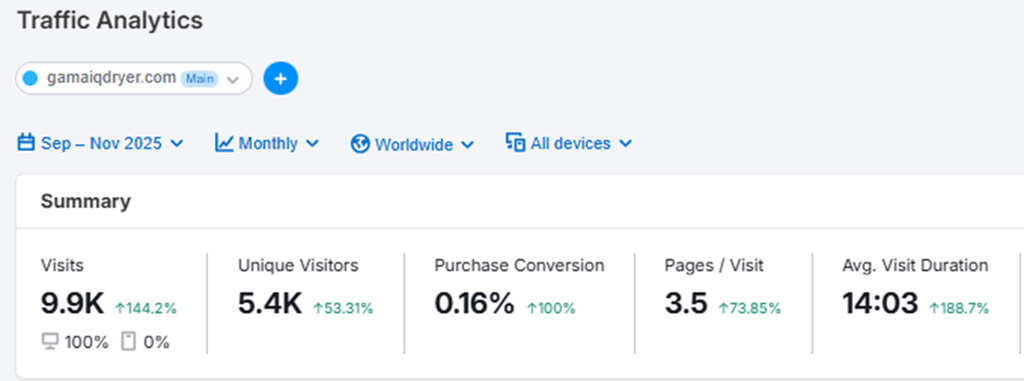
The supplied case study reports:
- 9.9K visits between September and November
- 144.2% increase in visits
- 5.4K unique visitors
- 53.31% increase in unique visitors
- 3.5 pages per visit
- 73.85% increase in pages per visit
- 14:03 average visit duration
- 188.7% increase in average duration
AI Search Performance
The case-study material also reports Google AI Overview visibility for queries including differences between IQ hair dryers and traditional dryers.
It attributes this visibility to semantic relevance, structured content and AEO execution.
Further screenshots within the supplied campaign material reportedly confirmed AI Overview inclusion for high-intent informational queries.
AI Referral Visibility
The deck further reports traffic attributed to ChatGPT and Gemini, supporting the campaign’s broader focus on AI-answer visibility.
What Enterprises Can Learn From This Case Study
The key lesson is not that every enterprise campaign should copy the same tactics.
The lesson is that modern organic search increasingly requires several disciplines working together:
- search intent
- technical performance
- UX
- structured content
- traditional SEO
- AEO
- AI-search visibility
ThatWare integrates these elements into a single search strategy.
Case Study: BedandPillows
Project Overview
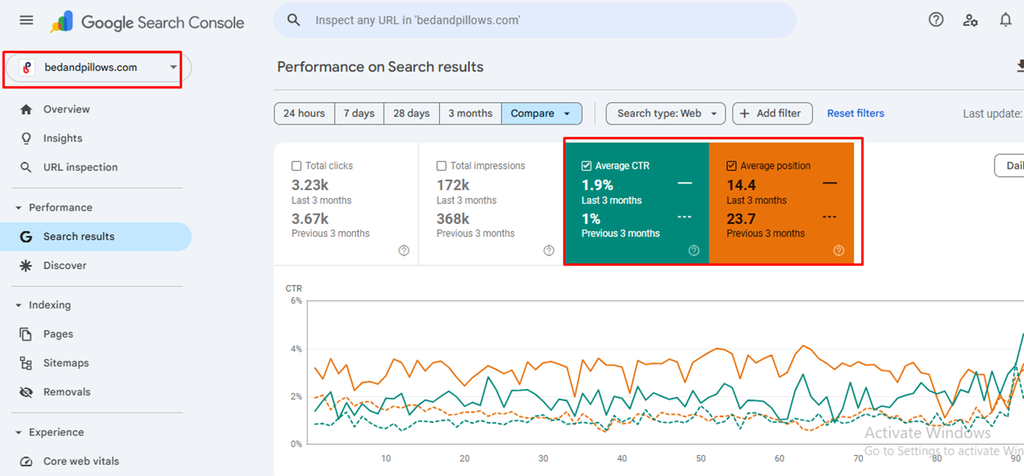
BedandPillows is a B2C ecommerce retailer specializing in beds, mattresses, bedroom furniture and sleep accessories.
Its business objective was to build a trusted online position in the UAE while supporting sales through quality products, competitive pricing, delivery and after-sales support.
Immediate Challenges
The supplied campaign materials identify several challenges:
- competitive UAE mattress and furniture market
- brand awareness
- customer trust
- customer education
- online purchase hesitation
- conversion improvement
Search Intent Framework
The optimization methodology again focused on:
- content type
- content format
- content angle
UX and Technical Optimization
The supplied deck highlights:
- Core Web Vitals
- mobile usability
- crawl depth
- easy navigation
The technical framework also included:
- reducing JavaScript
- lazy loading
- optimizing images
- providing image dimensions
- improving server response time
Site Architecture
A flatter site structure was also included as part of the approach.
What Enterprises Can Learn From This Case Study
The BedandPillows example reinforces an important principle:
SEO performance is rarely caused by one variable.
Search intent influences content.
Content influences engagement.
Architecture influences discoverability.
Technical performance influences user experience.
Navigation influences both search engines and customers.
Enterprise optimization therefore requires coordination between these areas.
Why Choose ThatWare as Your Enterprise SEO Agency?
Selecting the right enterprise SEO agency requires more than comparing monthly deliverables.
The agency needs to understand complex search environments.
Strategic Thinking
We focus on business outcomes rather than isolated SEO tasks.
Technical Depth
Our strategies can address architecture, crawling, indexation and large-scale technical issues.
Content Intelligence
We build content around search intent, topics and entities.
AI Search Integration
ThatWare combines traditional SEO with:
- enterprise AI SEO services
- enterprise AEO services
- enterprise GEO services
- enterprise LLM SEO services
- enterprise AI visibility services
Scalable Implementation
Recommendations are designed for enterprise environments.
Enterprise SEO Agency India
Organizations searching for an enterprise SEO agency India often need more than local SEO support.
Large businesses may require:
- international strategy
- large-site optimization
- technical expertise
- AI-search planning
- content scalability
ThatWare supports enterprise organizations from India while developing search strategies for complex national and international markets.
Enterprise SEO Company India
As an enterprise SEO company India, ThatWare combines search intelligence, technical SEO, content strategy and emerging AI-search disciplines.
We work with organizations that need scalable systems rather than limited page-level optimization.
Our approach is suitable for enterprises managing:
- complex websites
- large content ecosystems
- competitive markets
- multiple services
- international audiences
- AI visibility requirements
What Makes the Best Enterprise SEO Agency?
The best enterprise SEO agency should not be judged only by the volume of deliverables.
More backlinks do not automatically mean better SEO.
More articles do not automatically create authority.
More reports do not necessarily produce better decisions.
Enterprise Capability
The agency should understand:
- architecture
- crawling
- automation
- content scale
- governance
- AI search
Prioritization
The agency should distinguish critical issues from minor ones.
Collaboration
It should be capable of working with internal teams.
Measurement
It should connect SEO actions to measurable performance.
Enterprise SEO Experts for Complex Search Challenges
Large businesses require enterprise SEO experts who understand that scale changes the nature of optimization.
Expertise may be required for:
- migration
- technical diagnosis
- architecture
- indexation
- international SEO
- content governance
- AI visibility
ThatWare brings these disciplines together.
Building a Long-Term Enterprise SEO Partner Relationship
A strong enterprise SEO partner should evolve with the organization.
SEO requirements change.
Websites expand.
Products change.
Markets change.
Search engines change.
AI systems change.
The strategy must adapt.
Quarterly Strategy Reviews
Organizations may review:
- organic growth
- technical priorities
- content opportunities
- competitor changes
- AI visibility
- implementation progress
Continuous Optimization
Enterprise SEO is not a one-time project.
It is an ongoing operating discipline.
The Role of Enterprise SEO Solutions in Modern Search
Modern search is becoming more fragmented.
Users may discover a brand through:
- AI Overviews
- conversational assistants
- generative search
- answer engines
That means enterprise SEO solutions must support visibility beyond a single results page.
Traditional Search
Still critical.
Answer Search
Increasingly important.
Generative Search
Rapidly developing.
Conversational Discovery
Growing as users adopt AI assistants.
Enterprise brands need foundations capable of supporting all four.
Combining Enterprise SEO With AI Search
The future of enterprise search is unlikely to be “SEO versus AI.”
It is more likely to be SEO plus AI visibility.
Traditional optimization helps establish:
- discoverability
- authority
- relevance
- accessibility
AI-focused optimization strengthens:
- machine interpretation
- answer readiness
- entity clarity
- generative visibility
This integrated approach is central to ThatWare’s positioning as an enterprise AI SEO agency.
Enterprise SEO Implementation Framework
Implementation should happen in phases.
Phase 1: Critical Technical Fixes
Address problems that block crawling or indexation.
Phase 2: Architecture Improvements
Strengthen navigation and hierarchy.
Phase 3: High-Value Content Optimization
Improve important commercial pages.
Phase 4: Content Expansion
Fill topic and intent gaps.
Phase 5: Authority Development
Strengthen off-site signals.
Phase 6: AI Search Optimization
Improve AEO, GEO and LLM discoverability.
Phase 7: Governance and Automation
Create long-term systems.
Enterprise SEO Roadmap Prioritization
A useful roadmap separates activities into categories.
Critical
Issues that directly restrict visibility.
High Impact
Activities with substantial commercial potential.
Medium Impact
Important improvements that can follow core fixes.
Long-Term
Infrastructure, content expansion and experimentation.
This prevents enterprise teams from becoming overwhelmed.
How Enterprise SEO Supports Revenue Growth
SEO should ultimately support commercial goals.
More Qualified Visibility
Ranking for the right queries can attract relevant users.
Lower Long-Term Acquisition Dependence
Organic search can complement paid channels.
Better Customer Education
Content can answer questions before users contact sales.
Stronger Brand Authority
Consistent visibility can reinforce credibility.
Improved Search Journey
Users can find information throughout the decision cycle.
How Enterprise SEO Supports Brand Visibility
Enterprise SEO is not only a traffic channel.
It can influence how frequently users encounter a brand during research.
A company may appear in:
- educational searches
- category searches
- comparison searches
- product searches
- AI-generated answers
Repeated visibility can reinforce recognition.
Enterprise SEO and Competitive Intelligence
Competitor analysis helps enterprises understand the search environment.
Keyword Competitors
Businesses competing in search may differ from commercial competitors.
Content Competitors
Other websites may dominate educational queries.
Authority Competitors
Some domains may have stronger backlink profiles.
AI Competitors
Different brands may dominate AI-generated answers.
Our analysis can distinguish these groups.
Enterprise SEO and Algorithm Changes
Large websites can be strongly affected by search algorithm changes.
The correct response is not automatically to rewrite everything.
Analysis should determine:
- which page types declined
- which topics declined
- whether competitors gained
- whether intent changed
- whether technical issues emerged
- whether content quality signals weakened
Systematic analysis is especially important at enterprise scale.
Enterprise SEO and Content Governance
Content governance ensures quality remains consistent.
Publishing Standards
Every new page should follow defined requirements.
Duplication Prevention
Teams should check whether similar content already exists.
Update Cycles
Important pages should be reviewed regularly.
Ownership
Each content category should have clear responsibility.
Enterprise SEO and Digital Transformation
Website modernization projects can significantly affect SEO.
SEO teams should be involved during:
- CMS changes
- platform migrations
- redesigns
- URL restructuring
- technology adoption
- international expansion
Waiting until launch can create unnecessary risk.
Why Enterprise SEO Cannot Operate in Isolation
SEO connects multiple disciplines.
Development
Controls technical implementation.
Content
Controls relevance and expertise.
UX
Controls usability.
Analytics
Controls measurement.
PR
Can influence authority.
Product
Controls commercial messaging.
Enterprise SEO connects these functions around search visibility.
Build an Enterprise Search Ecosystem Ready for What Comes Next
Enterprise search is changing faster than at any previous stage of organic marketing.
Search engines still matter.
Rankings still matter.
Technical SEO still matters.
Content still matters.
Authority still matters.
But users increasingly discover information through a broader ecosystem that includes traditional search results, AI Overviews, answer engines, generative search and conversational assistants.
Enterprise organizations therefore need to think beyond isolated ranking improvements.
They need search infrastructure.
They need scalable technical systems.
They need stronger content architecture.
They need governance.
They need automation.
They need measurable AI visibility.
They need strategies that can evolve with search itself.
ThatWare combines traditional enterprise SEO services with technical search intelligence, AI-focused optimization, AEO, GEO and LLM discoverability to help large organizations build a stronger presence across the entire modern search ecosystem.
If your organization is managing a large website, complex technical infrastructure, extensive content library or rapidly expanding digital presence, ThatWare can help turn search complexity into a structured growth framework.
Work with an enterprise SEO agency that approaches organic visibility as an integrated business system rather than a collection of disconnected monthly activities.
Build a scalable search strategy.
Strengthen enterprise discoverability.
Improve AI-search readiness.
Create an organic growth infrastructure capable of supporting what comes next.