SUPERCHARGE YOUR ONLINE VISIBILITY! CONTACT US AND LET’S ACHIEVE EXCELLENCE TOGETHER!
The way people discover businesses online is changing rapidly. Search engines are no longer the only destinations where users find information, compare service providers, and identify potential business partners. AI-powered platforms, including Google AI Overviews, ChatGPT, and Google Gemini, are increasingly becoming part of the information discovery process.
For businesses operating in competitive technology markets, this shift creates an important opportunity. Visibility is no longer limited to appearing among traditional search results. Brands also need their content to be understandable, relevant, and accessible to AI-powered systems that generate answers to users’ questions.
This changing search environment makes content structure, topical relevance, search intent, and brand recognition increasingly important. Businesses must ensure that their websites provide clear answers to relevant queries rather than simply incorporating keywords into their pages.
Savvy Data Cloud Consulting, a Dubai-based technology firm, operates in a competitive digital environment where users search for specialized services, including Salesforce solutions, data science, business intelligence, and data-related consulting. Reaching the right audience requires a strategy that connects the company’s services with the questions potential customers are already asking.
ThatWare approached this challenge by focusing on advanced Answer Engine Optimization (AEO), developing content around specific search queries, strengthening semantic relevance, and structuring information to make it easier for AI-powered platforms to understand and retrieve.
Our objective was to improve the company’s digital discoverability and establish stronger visibility across AI-driven search experiences. The campaign’s documented outcomes included visibility in Google AI Overview, appearances in ChatGPT-generated answers, visibility in Google Gemini results, and measurable improvements across several website performance indicators.
This case study explains how we approached the project, the challenges we addressed, the strategies we implemented, and the specific results documented in the campaign presentation.
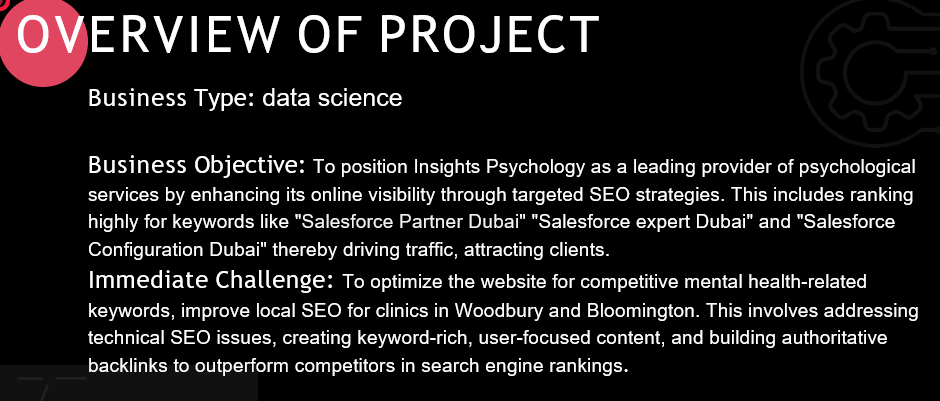
Overview of the Project
Savvy Data Cloud Consulting provides technology and consulting services associated with Salesforce, Odoo, data science, and business intelligence. Its service portfolio addresses specialized business needs, making it important for potential customers to find relevant information when searching for particular solutions.
For this project, we focused on connecting relevant queries with clearly structured content that could serve users seeking specific information about the company’s services.
Rather than treating organic search visibility and AI answer visibility as entirely separate objectives, we worked toward improving the relevance and accessibility of the website’s content. This involved identifying suitable search themes, organizing information around user intent, and incorporating meaningful brand references within relevant content.
The campaign also examined how the website’s content appeared across AI-powered discovery platforms. This helped us assess whether the content could be retrieved and presented in response to relevant questions.
Our approach combined content optimization, technical considerations, semantic structuring, and performance analysis to support the broader objective of improving the company’s presence in an increasingly AI-driven search environment.
The Challenges We Addressed
1. Establishing Visibility for Specialized Service Queries
Technology consulting services often involve specific terminology. Users may search for a Salesforce partner in a particular location, request information about configuration services, or look for specialized data solutions.
These searches require content that directly addresses the user’s needs.
For Savvy Data Cloud Consulting, the campaign documentation identified the following target search terms:
- Salesforce Partner Dubai
- Salesforce expert Dubai
- Salesforce Configuration Dubai
- Data Cleaning Dubai
- Data Cleaning Service
These queries represent different informational and commercial needs. A person searching for a Salesforce partner may be evaluating potential providers, while someone searching for a data cleaning service may be researching a particular solution.
Our challenge was to ensure that the relevant content addressed these different requirements clearly, without relying exclusively on repeated keyword usage.
2. Making Content Easier for AI Systems to Understand
Traditional search optimization often emphasizes keyword relevance, page structure, and technical accessibility. AI-powered answer platforms introduce an additional consideration: whether the information can be interpreted, extracted, and presented as a useful response.
Unstructured content can make it more difficult for automated systems to identify the most relevant information. Conversely, clear headings, logically organized paragraphs, descriptive lists, and meaningful entity references can make information easier to interpret.
We therefore focused on organizing content around identifiable questions and relevant subject matter.
The objective was to create pages that offered direct answers while maintaining sufficient context to explain the services being discussed.
3. Connecting Brand Recognition With Relevant Search Queries
Brand recognition is another important consideration in AI-driven discovery. When users ask questions about a particular service provider, the content must establish a clear relationship between the brand and the relevant subject.
For this campaign, the documentation specifically identified Savvy Data Cloud Consulting as an entity to be incorporated into relevant content.
We focused on using the brand name naturally alongside service-related terminology and contextual information. This approach was intended to help search and AI systems associate the company with the subjects covered by its pages.
4. Expanding Visibility Beyond Conventional Search Results
The campaign also sought to understand how the company’s content performed beyond conventional organic listings.
Google AI Overview, ChatGPT, and Gemini offer different ways for users to discover information. Appearing in their responses can expose relevant content to users who may not interact with a traditional search result in the same way.
Our challenge was to create content that addressed specific user questions and presented information in a format suitable for retrieval by these platforms.
The campaign screenshots document instances of AI answer visibility, providing evidence of how the content was surfaced across these discovery experiences.
ThatWare’s Strategy: Building a Stronger Foundation for AI Visibility
1. Search Intent-Focused Content Planning
Our first strategic priority was understanding the intent behind the targeted queries.
Search intent determines what users are trying to accomplish when they enter a query. Some users want to understand a concept, others want to compare solutions, and some are actively searching for a service provider.
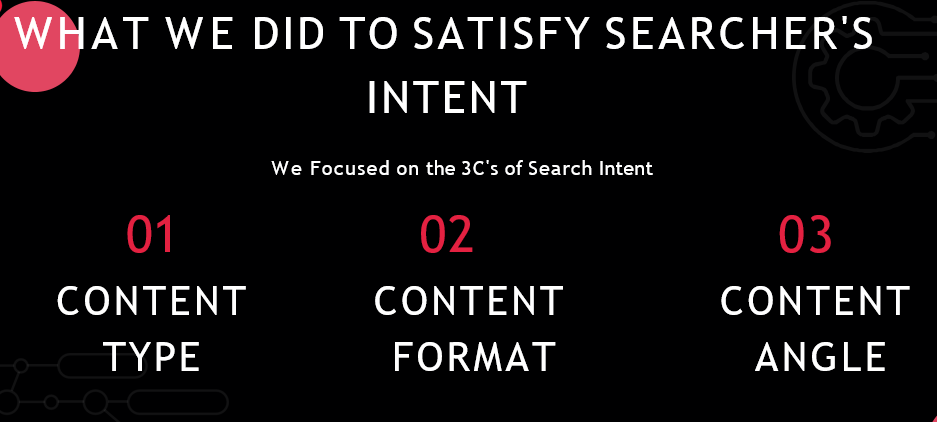
We organized our content approach around the three Cs of search intent:
- Content Type: Identifying whether a query is best served by a blog post, product page, category page, or landing page.
- Content Format: Determining whether the information should be presented through a guide, tutorial, structured explanation, or another suitable format.
- Content Angle: Establishing the specific perspective that directly addresses the query.
The campaign presentation identifies “HOW-TO” guides and tutorials as content formats and includes “Data Cleaning Dubai” and “Data Cleaning Service” as content-angle examples.
This framework helped us focus on the relationship between a query and the information provided in response. Instead of approaching every keyword in the same way, we considered the kind of answer a user would reasonably expect.
For a technology consulting business, this distinction is particularly useful because service-related searches can reflect different stages of the decision-making process.
2. Structuring Content for Clear Answers
A central component of our strategy was improving the clarity and organization of website content.
AI-powered answer systems need to identify relevant information within a page. Clear headings, concise explanations, descriptive lists, and logical content hierarchies can make individual sections easier to interpret.
We structured content to address specific questions directly, supported by contextual explanations and relevant service terminology.
The campaign documentation describes an approach involving semantic headings, bullet-point lists, and entity-rich language. These elements were intended to make the content easier for AI platforms to process and use when responding to informational queries.
This approach also benefits human readers. Visitors can identify relevant information more quickly, understand the subject more easily, and navigate the content without having to interpret unnecessarily complicated paragraphs.
For us, the goal was to combine meaningful information with a structure that supported both user experience and machine interpretation.
3. Strengthening Semantic Relevance and Brand Entities
Keyword inclusion alone does not fully communicate the subject or purpose of a page. Supporting context helps establish the relationships between a brand, its services, and the questions users ask.
We therefore emphasized relevant terminology and natural brand mentions within the content.

For example, the campaign included queries associated with Salesforce services in Dubai and specific questions mentioning Savvy Data Cloud Consulting. The content strategy connected the brand with the relevant service context instead of treating the company name as an isolated keyword.
This semantic approach was designed to improve the clarity of the content and strengthen the association between the company and its targeted topics.
It also supported the broader objective of Generative Engine Optimization by preparing relevant information for discovery and potential use in AI-generated responses.
The focus remained on making content informative and contextually consistent rather than adding brand mentions without a clear purpose.
4. Optimizing Content for Google AI Overview
Google AI Overview represents an important discovery opportunity because it can present synthesized information prominently within the search experience.
Our campaign focused on creating relevant, structured content that addressed the intended search query and communicated the subject clearly.
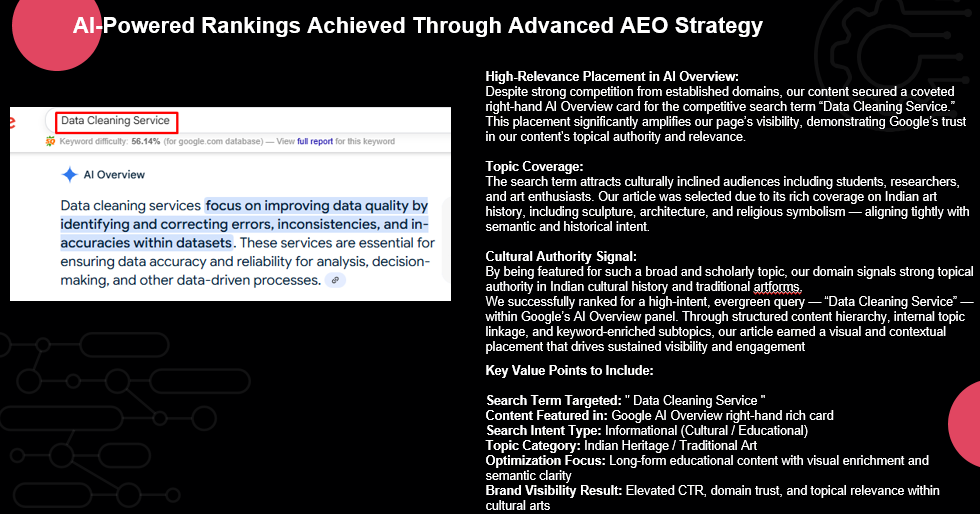
The presentation documents an AI Overview placement associated with the search term “Data Cleaning Service.” It describes the content as appearing in a right-hand AI Overview card.
The material also highlights structured content hierarchy, internal topic linkage, keyword-enriched subtopics, and visual enrichment as elements of the optimization approach.
These practices were intended to establish stronger topical relevance and improve the accessibility of useful information.
We treated AI visibility as an extension of the broader content strategy: the information needed to be relevant to the query, organized clearly, and supported by sufficient contextual detail.
5. Optimizing for ChatGPT Answer Visibility
ChatGPT can respond to detailed questions by synthesizing information into paragraphs and lists. For content to be useful in this environment, it needs to communicate relevant information clearly and establish meaningful relationships between entities.
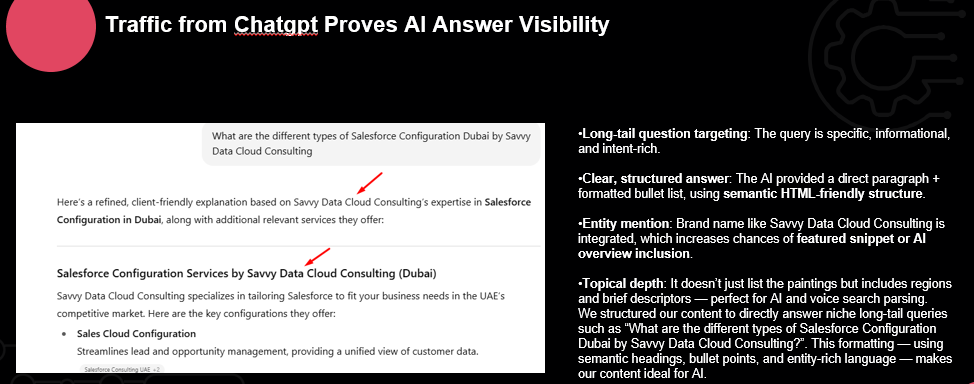
The campaign presentation records a targeted question:
“What are the different types of Salesforce Configuration Dubai by Savvy Data Cloud Consulting?”
Our strategy emphasized long-tail question targeting, structured answers, relevant brand mentions, and semantic headings.
These elements were intended to make the content easier to interpret and retrieve when responding to a specific informational query.
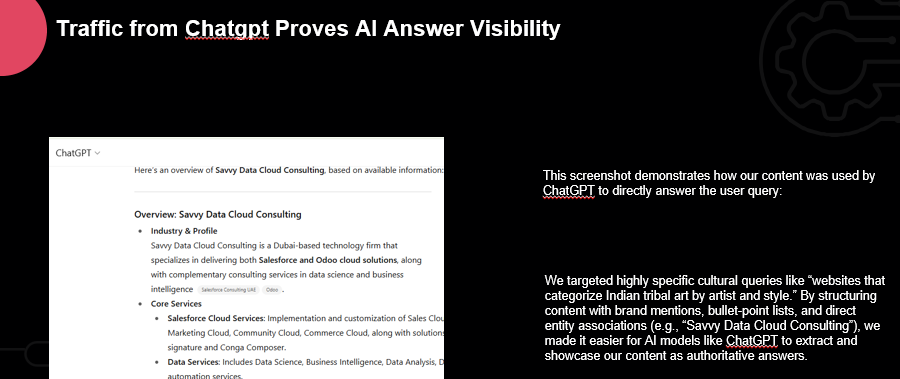
The presentation also documents another example involving the query “websites that categorize Indian tribal art by artist and style.” Because the presentation includes unrelated subject matter in some of its AI visibility slides, this example should be verified against the actual screenshot and intended campaign page before being attributed to the client’s technology services.
For the Savvy Data Cloud Consulting case study, the Salesforce-related query provides the more directly relevant example of how our content strategy addressed specialized service questions.
6. Improving Visibility in Google Gemini
We also examined how the content appeared in Google Gemini-related search experiences.
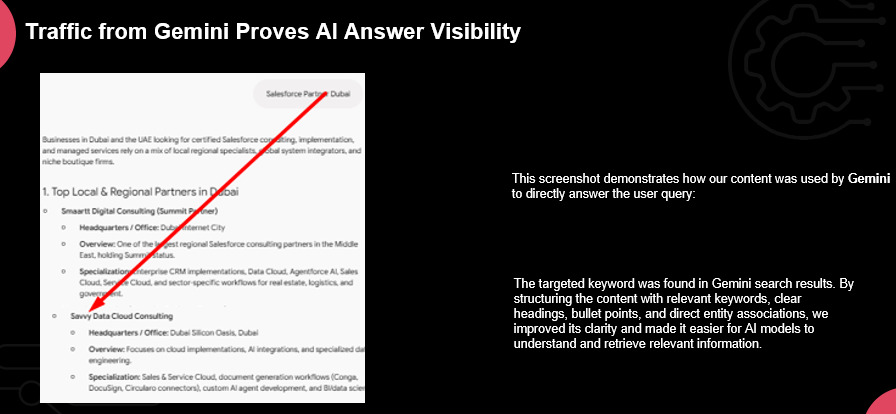
The campaign documentation records visibility associated with the keyword “Salesforce Partner Dubai” and includes screenshots intended to demonstrate how content was used to answer user queries.
Our approach emphasized clear headings, relevant keywords, structured lists, and direct entity associations. The objective was to make the information easier for AI systems to understand and retrieve in an appropriate context.
The presentation further describes the use of structured content formats and natural language to support the extraction of precise information.
These practices formed part of our wider effort to improve content clarity and increase the likelihood of relevant material being surfaced in AI-powered discovery experiences.
7. Improving the Technical and Navigational Foundation
AI visibility also depends on the accessibility and overall quality of a website’s content. A well-organized website makes it easier for users to navigate information and helps establish a logical relationship between pages.
The campaign presentation identifies several areas of user experience and technical optimization:
- Core Web Vitals
- Mobile usability
- Crawl depth and easy website navigation
- Reducing JavaScript execution
- Implementing lazy loading
- Optimizing and compressing images
- Providing proper dimensions for images and embeds
- Improving server response time
- Implementing a flat site structure
These items represent the technical optimization framework documented in the presentation. The available material does not provide individual before-and-after measurements for each technical change, so we do not assign separate performance improvements to these actions.
Nevertheless, they form an important part of a website optimization process that supports usability, accessibility, and content discovery.
8. Supporting a Broader Organic Search Strategy
Alongside content structuring and technical considerations, a sustainable search strategy must account for the overall authority and relevance of the website.
As a professional SEO company, ThatWare approaches organic visibility through a combination of content relevance, technical foundations, and authority-building considerations.
The campaign’s primary documented emphasis was on content structure and AI answer visibility. The presentation also references authoritative backlinks as part of its broader SEO framework, although it does not provide a link acquisition count or specific backlink-related performance figures for this project.
We therefore treat authority development as a supporting consideration rather than attributing an unverified numerical result to a particular link-building activity.
The priority throughout the project was to create a stronger connection between the company’s services, its website content, and the questions relevant audiences were asking.
Measurable Improvements and Documented AI Visibility
The campaign presentation contains several specific performance figures and examples of AI visibility. The following results preserve the numbers and search terms documented in the slides.
1. Google AI Overview Visibility for “Data Cleaning Service”
Documented search term: “Data Cleaning Service”
Reported placement: Google AI Overview right-hand rich card.
The presentation describes the content as securing a prominent AI Overview placement despite competition from established domains.
It attributes the placement to structured content hierarchy, internal topic linkage, keyword-enriched subtopics, and topical relevance.
The slide also identifies the following intended value points:
- Content Featured in: Google AI Overview right-hand rich card
- Search Intent Type: Informational (Cultural / Educational)
- Topic Category: Indian Heritage / Traditional Art
- Optimization Focus: Long-form educational content with visual enrichment and semantic clarity
- Brand Visibility Result: Elevated CTR, domain trust, and topical relevance within cultural arts
Important qualification: The slide combines the “Data Cleaning Service” search term with cultural and educational subject matter that does not clearly match the client’s technology services. The AI Overview placement and search term are reproduced as documented, but the screenshot and associated URL should be checked before these cultural-topic claims are published as evidence of the client’s campaign.
2. ChatGPT Visibility for a Salesforce-Related Query
Documented query: “What are the different types of Salesforce Configuration Dubai by Savvy Data Cloud Consulting?”
The presentation explains that the content was structured to address specific, informational, long-tail questions.
It identifies four strategic elements:
- Long-tail question targeting
- Clear, structured answers
- Brand entity mentions
- Topical depth and descriptive information
The documented outcome is a ChatGPT answer-visibility example associated with the Salesforce Configuration Dubai query.
The presentation does not specify a numerical ranking position, the number of ChatGPT citations, or the number of visits generated by this individual answer. We therefore report this as a documented AI visibility example rather than assigning it an unsupported ranking or traffic figure.
3. Google Gemini Visibility for “Salesforce Partner Dubai”
Documented keyword: “Salesforce Partner Dubai”
The campaign presentation includes two instances of this keyword in its Gemini visibility section.
The slides describe the targeted keyword as appearing in Gemini-related search results and explain that clear headings, relevant keywords, bullet-point lists, and direct entity associations were used to improve content clarity.
This documents a keyword-specific AI visibility example connected to the company’s Salesforce-related services.
The presentation does not provide a numerical Gemini ranking position, a count of appearances, or a separate traffic figure for this keyword. The screenshot should therefore serve as the visual evidence of the recorded appearance.
4. Google Search Console: Total Clicks Increased from 196 to 578
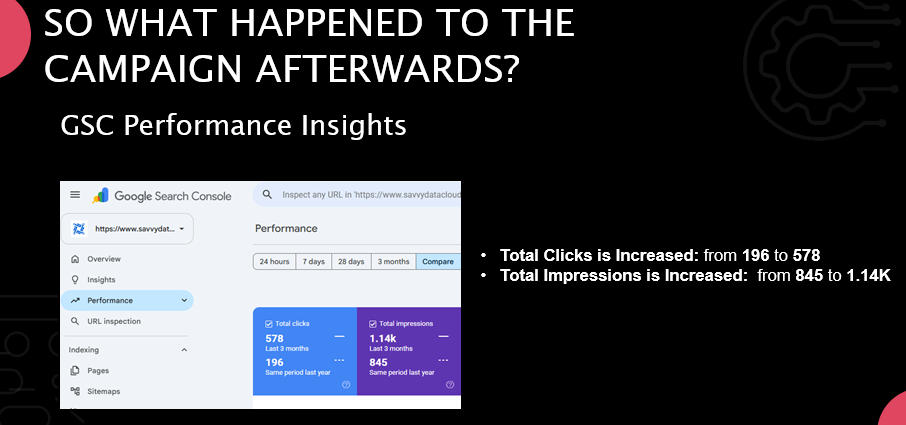
The campaign presentation reports the following Google Search Console results:
- Total clicks: Increased from 196 to 578.
- Total impressions: Increased from 845 to 1.14K.
These figures indicate an increase in recorded clicks and impressions between the comparison periods represented in the presentation.
The click count increased by 382, from 196 to 578. The impression count increased by 295, from 845 to approximately 1,140.
The slides do not specify the exact dates of both comparison periods, so these figures should be presented as the reported before-and-after values rather than assigned to an unverified time frame.
5. AI Performance Insights: Total Impressions Increased from 314 to 811
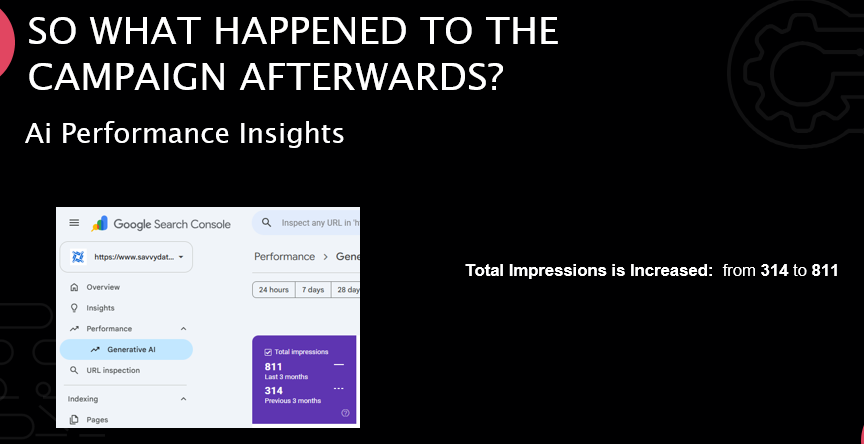
The presentation includes a separate section titled “Ai Performance Insights,” reporting:
- Total impressions: Increased from 314 to 811.
This represents an increase of 497 impressions, based on the values shown.
The slide does not identify the exact reporting period or provide additional breakdowns by query, page, or AI platform. The result is therefore best presented as the documented impression improvement shown in the campaign report.
6. Google Analytics: Engagement Rate Increased by 125.3%
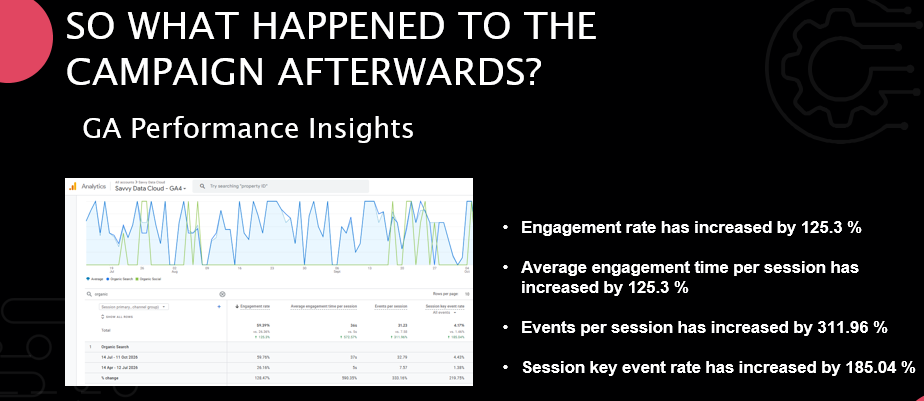
The Google Analytics performance section records four specific improvements:
- Engagement rate: Increased by 125.3%.
- Average engagement time per session: Increased by 125.3%.
- Events per session: Increased by 311.96%.
- Session key event rate: Increased by 185.04%.
These are the exact percentage changes reported in the presentation.
Together, the figures indicate improvements across the engagement-related metrics tracked in the report.
The presentation does not include the starting and ending values for each metric in the extracted text. We therefore retain the reported percentage changes without attempting to calculate or infer the underlying values.
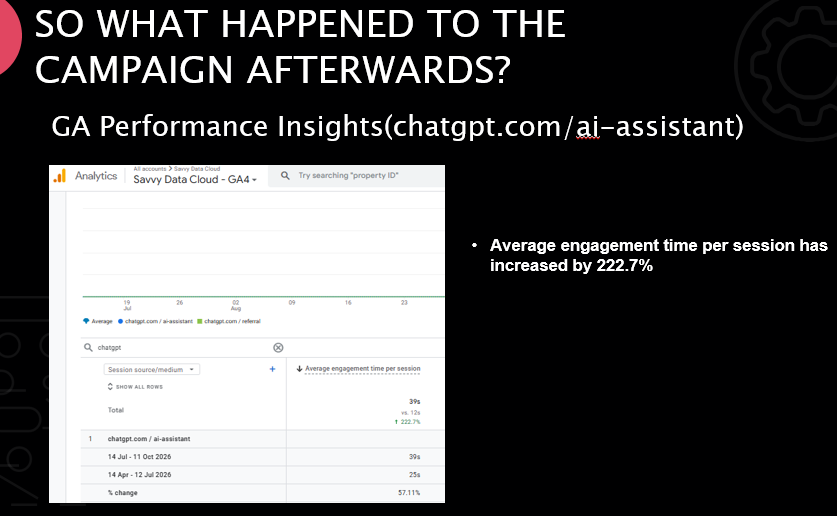
7. Google Analytics: Average Engagement Time Increased by 222.7%
A separate slide titled “GA Performance Insights(chatgpt.com/ai-assistant)” reports:
- Average engagement time per session: Increased by 222.7%.
This result is particularly relevant to the presentation’s focus on AI-assisted discovery because the slide explicitly references the chatgpt.com/ai-assistant reporting context.
However, the extracted slide text does not include the original and final engagement times or the exact reporting dates. The 222.7% figure should therefore be quoted exactly as shown, with the accompanying screenshot providing additional context.
8. Traffic Growth Documented in the Presentation
Another campaign results slide reports:
- Visits in June: 410 visits, representing a +126.52% increase.
- Unique visitors: 135 unique visitors, representing an increase of 136.84%.
The presentation associates these figures with broader audience reach and long-tail, informational keyword targeting.
These values should be retained as reported. The extracted material does not establish the complete comparison period or independently attribute every additional visit to AI search, so the results should not be described as exclusively AI-generated traffic without further analytics evidence.
What These Results Mean for Savvy Data Cloud Consulting
The documented campaign outcomes illustrate several important aspects of improving visibility in an AI-driven search environment.
First, the presentation records examples of content appearing in AI-powered discovery experiences, including Google AI Overview, ChatGPT, and Google Gemini. These examples demonstrate the types of visibility the campaign sought to establish.
Second, the reported Google Search Console figures show clicks increasing from 196 to 578 and impressions increasing from 845 to 1.14K. The separate AI performance section records impressions increasing from 314 to 811.
Third, the Google Analytics results show reported improvements across engagement rate, engagement time, events per session, and session key event rate. The separate ChatGPT-related analytics slide reports a 222.7% increase in average engagement time per session.
These results provide measurable indicators of campaign performance. They should be interpreted alongside the relevant reporting periods, screenshots, and analytics definitions to establish the precise relationship between AI visibility and overall website performance.
The campaign’s documented approach also highlights the value of clear answers, structured information, and meaningful brand associations when preparing content for modern discovery platforms.
Conclusion: Building AI Visibility Through a Structured Content Strategy
The Savvy Data Cloud Consulting case study demonstrates how ThatWare approached AI search visibility through content organization, search intent analysis, semantic relevance, and structured answers.
Our focus was to connect the company’s relevant services with specific search queries and present information in a format that could be understood by both users and AI-powered systems.
The campaign documentation records visibility examples associated with Google AI Overview, ChatGPT, and Google Gemini, alongside measurable changes in search performance and website engagement.
The reported figures include total clicks increasing from 196 to 578, total impressions increasing from 845 to 1.14K, AI performance impressions increasing from 314 to 811, and several improvements in Google Analytics engagement metrics.
These results illustrate the importance of aligning useful content with the way people search for and consume information.
For businesses seeking stronger visibility in AI-powered discovery, the lesson is straightforward: content must do more than mention relevant keywords. It should answer meaningful questions, establish clear topical relationships, and communicate information in a logical and accessible structure.
At ThatWare, we continue to approach cutting edge SEO with an emphasis on relevance, technical foundations, and user-focused content. By developing structured answers and aligning website information with search intent, we aim to help businesses strengthen their discoverability across evolving search experiences.
The next stage for any campaign is to continue monitoring relevant queries, validating AI appearances, and evaluating changes in traffic and engagement over clearly defined reporting periods.
Through a disciplined, evidence-based approach, businesses can build a stronger foundation for visibility as AI-powered search becomes an increasingly important part of the digital discovery journey.