
SUPERCHARGE YOUR ONLINE VISIBILITY! CONTACT US AND LET’S ACHIEVE EXCELLENCE TOGETHER!
The way travelers discover destinations, research tour operators, and plan their dream holidays is changing. Search engines are no longer just places where people type a few keywords and browse a list of websites. Travelers increasingly expect direct answers, relevant recommendations, detailed destination information, and personalized guidance that helps them make confident decisions.
For travel businesses, this shift creates both an opportunity and a challenge. A company may offer exceptional experiences, expert local knowledge, and carefully designed itineraries, yet struggle to reach the right audience if its website is not sufficiently visible in organic search results and emerging AI-powered discovery environments.
This was the digital visibility challenge we explored with CHUI-Tours, an established safari tour operator specializing in tailor-made African travel experiences. The company focuses on personalized safaris, wildlife encounters, cultural experiences, and journeys designed around the individual interests of its travelers.
At ThatWare, we approached this project with a clear objective: help CHUI-Tours strengthen its online discoverability by aligning its website with search intent, improving the user experience, and developing content that search engines and AI-powered platforms could understand and surface more effectively.
Rather than relying exclusively on paid search to attract prospective travelers, we focused on building a stronger organic foundation. Our work included search-intent analysis, content optimization, website performance improvements, internal architecture recommendations, authority development, and the structuring of information for modern search experiences.
The campaign also explored how relevant, well-organized website content could become discoverable beyond conventional search listings. By combining foundational SEO improvements with approaches designed for AI-driven discovery, we worked toward making CHUI-Tours more accessible to people researching African safaris and related travel experiences.
The results presented in this case study include measurable changes in website sessions, engaged sessions, search impressions, clicks, backlink acquisition, and authority indicators. The supplied campaign materials also document instances of CHUI-Tours appearing in AI-powered search experiences and being represented in ChatGPT-generated answers.
This case study examines the challenge, our strategy, the work behind the campaign, and the outcomes shown in the available reporting.
Project Overview: Understanding CHUI-Tours and Its Business Objectives
CHUI-Tours operates in a competitive travel market where travelers compare destinations, safari packages, accommodation options, wildlife experiences, and tour operators before deciding whom to trust with their journey.
Unlike standardized travel packages, tailor-made safaris depend on understanding individual preferences. One traveler might want a luxury wildlife photography expedition, while another may prefer a small-group adventure, a honeymoon safari, or a cultural journey combined with a beach extension.
That diversity creates a broad range of search opportunities. However, it also means a tour operator needs a website that communicates its expertise clearly and addresses the different questions prospective customers may ask throughout their research process.
Understanding the business
CHUI-Tours Afrika Safaris GmbH is a German tour operator focused on personalized African travel. According to the campaign materials, the company has been providing safari experiences since 2007 and emphasizes individual planning, experienced travel specialists, responsible tourism, and direct wildlife encounters.
Its service offering includes:
- Tailor-made African safari itineraries.
- Small-group guided tours.
- Luxury and fly-in safaris.
- Honeymoon safaris.
- Wildlife photography tours.
- Beach extensions.
- International flight booking assistance.
The destinations highlighted in the campaign materials include Tanzania, Kenya, Uganda, Rwanda, Botswana, Zimbabwe, Zambia, South Africa, Malawi, Mozambique, and Zanzibar.
This breadth of services and destinations gives CHUI-Tours multiple opportunities to reach travelers with different interests. The challenge was to ensure that its digital presence could communicate this expertise effectively to both conventional search engines and emerging AI-driven discovery platforms.
The primary campaign objective
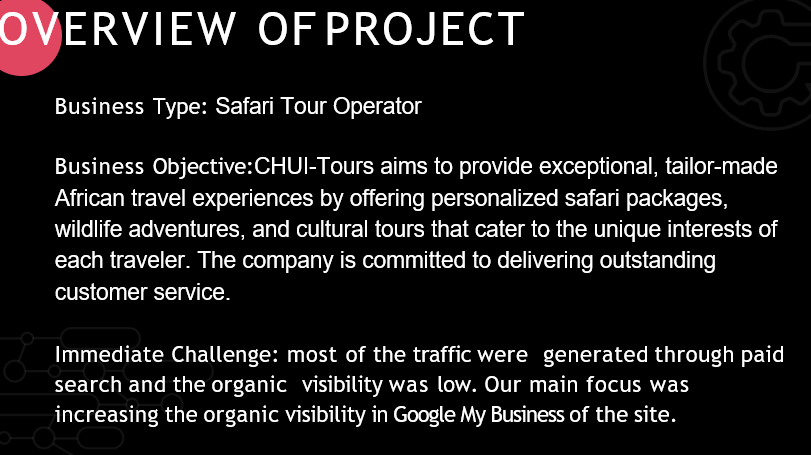
The immediate business objective was to improve the website’s organic visibility and reduce its dependence on paid search as a source of traffic.
Our work concentrated on several connected priorities:
- Improve the relevance of website content to the searches and questions potential travelers use.
- Strengthen the website’s technical foundations and user experience.
- Make important pages easier for search engines to crawl and understand.
- Develop a stronger foundation of relevant backlinks and referring domains.
- Improve the website’s visibility for targeted travel-related searches.
- Structure useful business and destination information so AI-powered platforms could interpret and potentially reference it.
We treated these priorities as parts of a connected strategy rather than isolated optimization tasks. Relevant content is more useful when visitors can navigate it easily. Technical improvements are more valuable when search engines can discover the right pages. Authority-building efforts are more meaningful when the destination pages provide information worth recommending.
Our approach therefore focused on strengthening the complete discovery journey, from the initial search query to the website experience that follows.
The Core Challenge: Moving Beyond Paid Search Dependence
One of the main challenges identified at the beginning of the project was that much of CHUI-Tours’ website traffic came from paid search, while organic visibility remained comparatively low.
Paid campaigns can help businesses reach prospective customers quickly, but they require ongoing investment. Organic search offers a complementary opportunity to attract visitors through relevant pages that match their interests and informational needs.
For a specialized safari operator, organic visibility can be particularly valuable. People researching a safari often explore multiple questions before making an enquiry. They may investigate the best destinations for wildlife viewing, compare travel experiences, look for family-friendly itineraries, or search for an operator that understands their preferred style of travel.
If a website does not address those needs clearly, it can miss opportunities to connect with potential customers during important stages of their decision-making process.
Challenge 1: Understanding search intent
Ranking for a keyword requires more than placing that phrase on a page. The content must also satisfy the reason behind the search.
A traveler looking for a safari in Tanzania may want destination information, itinerary options, accommodation recommendations, pricing guidance, or assistance choosing an operator. Each intent requires a different response.
Our task was to align CHUI-Tours’ content more closely with relevant search intent, making its pages more useful and contextually appropriate for the people it wanted to reach.
Challenge 2: Improving organic discoverability
The campaign identified organic visibility as a major area for improvement. This meant creating a stronger relationship between the website’s content, its technical structure, and the searches relevant to the business.
The goal was not simply to attract more visitors. We wanted to improve the website’s ability to appear for relevant queries and give potential customers a useful reason to continue exploring CHUI-Tours’ offerings.
Challenge 3: Delivering a better website experience
Search visibility and user experience are closely connected in practical terms. Even when visitors discover a relevant page, slow loading, difficult navigation, or a confusing information structure can create unnecessary friction.
A travel website needs to help people move naturally between destinations, experiences, itineraries, and enquiry opportunities. If important information is difficult to find, visitors may leave before discovering what the operator offers.
Challenge 4: Preparing for AI-powered discovery
Search behavior is also evolving beyond traditional blue links. AI-generated summaries and conversational tools can surface information directly in response to a user’s question.
This introduces another layer of discoverability. A website must communicate its subject matter, services, expertise, and business identity clearly enough for modern systems to interpret its content.
For CHUI-Tours, this meant strengthening the fundamentals of search visibility while exploring ways to make its information more accessible to AI-driven discovery experiences.
Our response was to build a coordinated strategy that addressed content relevance, website accessibility, technical performance, authority, and machine-readable context.
ThatWare’s Strategy: Building a Stronger Foundation for Search and AI Discovery
At ThatWare, we developed our approach around a central principle: a website should help the right audience find the right information with as little friction as possible.
We began with search intent and content relevance, then addressed the website experience, internal architecture, authority indicators, and the presentation of business information. These activities supported both the immediate goal of improving organic search performance and the broader objective of strengthening discoverability across emerging search environments.
1. Aligning Content With Search Intent
Search intent was a central part of our strategy. We examined how the website’s content could better reflect the needs behind relevant travel searches.
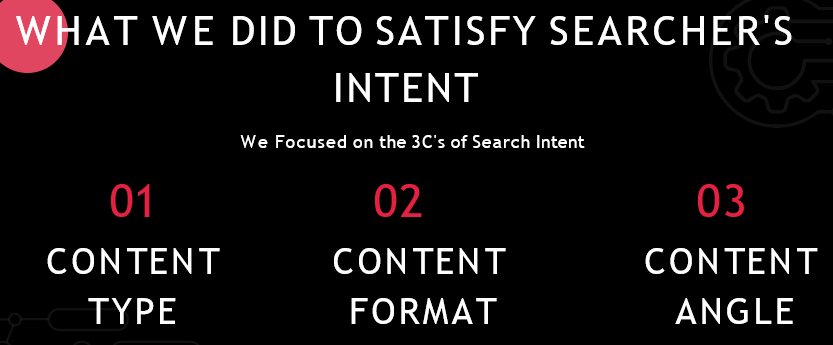
The campaign presentation highlights three elements of search intent:
- Content type: The kind of page a searcher is likely to expect.
- Content format: The way information should be organized and presented.
- Content angle: The specific perspective that makes the content relevant to the query.
These three elements provide a practical framework for creating pages that answer users’ questions rather than simply repeating search terms.
For example, someone researching a safari tour may need a page that explains the experience, describes suitable itineraries, highlights destinations, and provides enough context to support a decision. A page that fails to address these needs may be less useful than one structured around the actual questions a traveler wants answered.
We also considered how search engines have evolved in their ability to interpret meaning and context. Google’s Panda update addressed low-quality content, including problematic duplicate-content practices. RankBrain helped Google interpret relationships between queries and relevant results, while BERT advanced its understanding of language context.
These developments reinforce an important point: effective optimization requires meaningful, relevant information that satisfies the searcher’s need.
Our focus was therefore on improving the relationship between the query, the page, and the information presented to the visitor.
2. Strengthening Content Relevance for Targeted Searches
We used the campaign’s search examples to examine how CHUI-Tours could become more visible for relevant travel-related queries.
One example in the supplied presentation concerns a Germany-related safari-tour search, illustrated by a Google search result featuring CHUI-Tours. The purpose of this example was to demonstrate how a relevant page could be positioned to match a specific search context.
Rather than treating every search phrase as an isolated target, we approached content relevance as a matter of communicating the right subject, context, and value proposition.
For a safari operator, that can involve explaining destinations, identifying the types of travelers a tour suits, describing the experiences available, and presenting useful details that distinguish the company from more generic travel providers.
This approach also supports professional SEO marketing by connecting keyword targeting with the actual information prospective customers need to evaluate a business.
The emphasis is on usefulness and relevance: content should help travelers understand the experience and make an informed decision, while giving search engines clearer signals about the page’s purpose.
3. Improving User Experience and Website Performance
Our strategy also addressed the experience visitors encounter after reaching the website.
The campaign materials identify three important areas: Core Web Vitals, mobile usability, and crawl depth with straightforward navigation.
These areas matter because a website should be accessible to both its visitors and the systems responsible for discovering its pages. Technical barriers can make important information harder to reach, while poor usability can interrupt the journey from discovery to enquiry.
We prioritized the following performance improvements in the campaign plan:
- Reducing unnecessary JavaScript execution.
- Implementing lazy loading where appropriate.
- Optimizing and compressing images.
- Providing appropriate dimensions for images and embedded elements.
- Improving server response time.
For a safari website, image optimization deserves particular attention. Wildlife photography, destination galleries, and accommodation visuals help communicate the experience, but large media files can also affect loading performance.
The objective is to preserve the visual richness of the experience while reducing unnecessary technical overhead.
We also considered mobile usability. Travelers may research destinations on phones, revisit itineraries while planning a trip, or compare options while away from their desktops. A mobile-friendly experience helps ensure that key information remains accessible across devices.
These measures formed part of our wider advanced algorithm SEO solutions approach, in which technical improvements support content discoverability and a more efficient user journey.
The supplied campaign slides describe these as optimization priorities. The available figures do not establish a specific Core Web Vitals score improvement, so we do not assign an unverified performance gain to these activities.
4. Simplifying the Website’s Information Architecture
We also addressed website structure, with particular attention to the difference between a flat site architecture and a deep one.
A flat architecture allows important pages to be reached through relatively few navigation steps from the homepage or other major sections. A deep architecture places content several levels down, potentially making it harder for users and crawlers to discover.
For a tour operator with multiple destinations and travel experiences, a clear structure can help visitors move from broad interests to specific offerings.
For example, a user exploring African safaris should be able to navigate naturally toward destination information, relevant travel styles, and suitable itineraries without unnecessary detours.
A clearer structure also helps establish relationships between related pages. When destination pages, safari categories, and supporting information are organized logically, the website can communicate its subject coverage more coherently.
Our objective was to support efficient crawling, clearer navigation, and easier access to the pages most relevant to the business.
5. Developing Relevant Backlinks and Authority Signals
Another component of the campaign was link development and authority monitoring.
Backlinks can help search engines discover pages and evaluate relationships between websites. However, their value depends on factors such as relevance, quality, and context—not simply the total number of links acquired.
The campaign reporting tracks new and lost referring domains, new and lost backlinks, and changes in the website’s Authority Score.
These indicators helped us monitor the website’s link profile over time and assess how its external link presence was developing.
We also tracked the reported backlink composition, including text links, image links, follow links, and nofollow links. This provided a more detailed picture than a single backlink total could offer.
Our focus was on building and monitoring the site’s external authority while keeping link acquisition distinct from other campaign outcomes. Backlinks alone do not prove improved rankings or demonstrate that an AI platform will cite a website.
Instead, link metrics form one part of the broader picture alongside content relevance, technical accessibility, search performance, and actual website engagement.
6. Structuring Information for AI-Powered Discovery
We extended our approach beyond traditional search visibility by considering how AI-powered systems interpret and present business information.
This included making important facts about CHUI-Tours easier to identify: the company’s name, its location, the services it provides, its destinations, and the characteristics that distinguish its travel experiences.
AI systems are more likely to interpret content accurately when information is explicit, consistent, and organized around clearly identifiable entities and topics. This is particularly relevant for businesses whose services span several destinations and customer needs.
Our work in this area aligned with Artificial Intelligence SEO, with an emphasis on presenting information in a form that supports contextual understanding and accurate extraction.
For CHUI-Tours, this meant ensuring that the website communicated more than a collection of destination keywords. It needed to convey a coherent picture of the business, its expertise, its services, and its approach to travel.
We also considered the role of structured data, location-related information, and the connection between website content and the company’s Google Business Profile.
Structured data can help eligible search systems interpret certain details, but it does not guarantee enhanced results or AI citations. Similarly, clear location signals can support geographic relevance, but they do not independently establish rankings in a particular region.
Our objective was to improve the clarity and consistency of the information available to search and AI systems.
7. Supporting Geographic Relevance
Travel is inherently location-sensitive. People search for destinations, departure points, tour operators, and experiences associated with specific places.
We therefore considered how content could better communicate geographic context and serve audiences searching for relevant travel experiences.
The campaign materials describe a geographic optimization component that combined location-specific content, location hints, structured information, and Google Business Profile considerations.
This approach was intended to help search engines understand the geographical relevance of the business and its offerings.
For a German tour operator specializing in African safaris, that can mean communicating the company’s business identity and customer-facing services clearly while providing relevant destination information for travelers planning journeys to Africa.
The goal was to make the website more contextually relevant to the searches it wanted to attract, rather than relying on broad keywords without sufficient supporting detail.
8. Making Business Information Easier for AI Systems to Interpret
Our strategy also focused on how CHUI-Tours’ business information could be presented in AI-generated responses.
A conversational search experience may require a system to identify a company, summarize its services, recognize its location, and distinguish it from other businesses.
Clear headings, concise factual statements, structured service lists, and consistent entity references can make this information easier to interpret.
For CHUI-Tours, relevant details included its tailor-made itineraries, guided tours, luxury safaris, wildlife photography experiences, beach extensions, and destination coverage.
The company also has distinguishing characteristics that are important to communicate, including personalized travel planning, an emphasis on owner-operated lodges and camps, and responsible tourism.
We aimed to ensure that these details were represented clearly enough to support understanding across different discovery environments.
The campaign presentation subsequently includes a screenshot showing CHUI-Tours information appearing in a ChatGPT-generated answer. This is an important qualitative example of AI answer visibility, although it should not be confused with a complete measurement of referral traffic from every AI platform.
Taken together, these activities connected traditional organic optimization with GEO Services, helping align the website’s information with the way generative search experiences interpret entities, topics, and user questions.
Campaign Results: What Changed After Our Optimization Efforts?
The results section brings together analytics data, search performance reports, backlink metrics, authority indicators, and examples of AI-powered search visibility documented in the campaign presentation.
These measurements represent different aspects of the campaign. Website analytics shows how visitor activity changed, Search Console reports reveal changes in search impressions and clicks, and backlink tools provide insight into the website’s external link profile. The AI-search screenshots offer qualitative evidence of CHUI-Tours appearing in selected discovery experiences.
By examining these indicators together, we can build a more complete picture of the campaign’s progress without attributing every change to a single optimization activity.
9. Increasing Website Sessions and Engaged Sessions
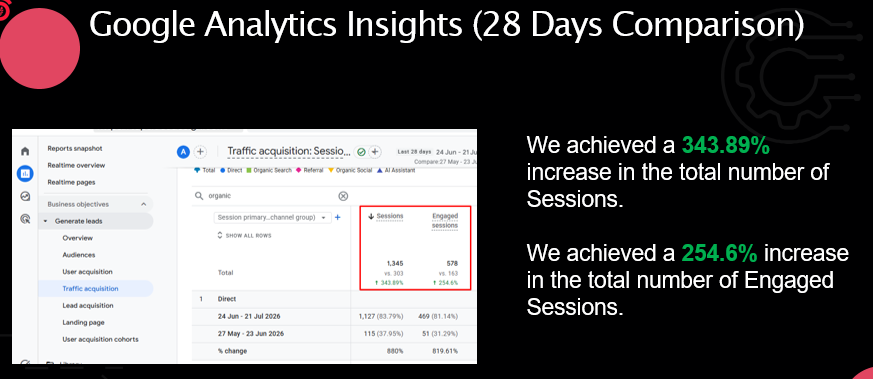
One of the most significant results documented in the supplied Google Analytics comparison is the increase in website sessions and engaged sessions.
The presentation compares two 28-day reporting periods and records the following figures.
GOOGLE ANALYTICS · 28-DAY COMPARISON
Total sessions
+343.89%
303 → 1,345
Increase of 1,042 sessions
Engaged sessions
+254.60%
163 → 578
Increase of 415 engaged sessions
Total sessions increased from 303 to 1,345, representing a reported increase of 343.89%. This means the later reporting period recorded 1,042 more sessions than the earlier period.
Engaged sessions also increased substantially, rising from 163 to 578. The reported growth of 254.6% indicates that the number of sessions meeting Google’s engagement criteria was considerably higher in the comparison period.
These figures matter because website visibility should ultimately support meaningful visitor activity. A campaign that brings people to a website needs to provide relevant information and a useful experience once they arrive.
The increase in engaged sessions is therefore an encouraging indicator alongside the overall rise in sessions. However, sessions and engaged sessions are not the same as unique users, enquiries, bookings, or revenue. The available figures do not establish how many additional safari bookings resulted from this change.
For ThatWare, the significance of these results lies in the documented increase in website activity and engagement during the comparison periods.
10. Improving Google Search Console Performance
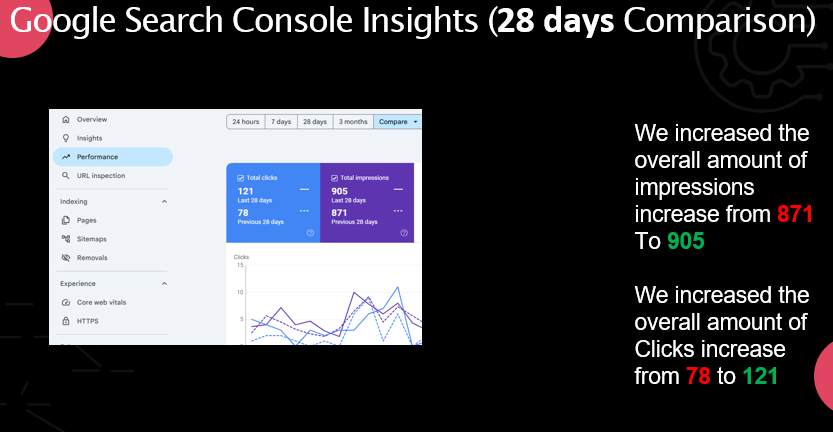
The Google Search Console comparison provides another perspective on the campaign’s search performance.
The supplied presentation records the following figures for the two 28-day periods.
GOOGLE SEARCH CONSOLE · 28-DAY COMPARISON
Search impressions
871 → 905
+3.90%
34 additional impressions
Search clicks
78 → 121
+55.13%
43 additional clicks
Search impressions increased from 871 to 905, a rise of 34 impressions, or approximately 3.90%.
Clicks increased from 78 to 121, representing 43 additional clicks and approximately 55.13% growth.
The difference between these two trends is worth examining. Impressions measure how often a website’s results appear in the relevant search reporting, while clicks measure how often users click through to the website from those results.
In this comparison, clicks increased faster than impressions. That is a positive directional signal, although it does not by itself establish why users clicked more frequently. Query mix, ranking positions, search-result presentation, and other factors can influence the relationship between impressions and clicks.
For a travel business, search clicks create opportunities to introduce potential customers to destinations, itineraries, and travel services. Improving the number of relevant visits is therefore an important step toward building a stronger organic acquisition channel.
The Search Console figures should be interpreted alongside the analytics results rather than treated as interchangeable measurements. The reporting periods may describe different aspects of the overall campaign, and neither data source alone establishes a causal link between a particular optimization and the change observed.
11. Building the Backlink Profile
The campaign also tracked the development of CHUI-Tours’ backlink profile, including referring domains, backlink types, and link attributes.
The supplied backlink report records the following metrics.
BACKLINK PROFILE · REPORTED METRICS
Total backlinks
864
Referring domains
160
+7% reported
The report records 864 backlinks and 160 referring domains, with referring domains showing a reported increase of 7%.
The distinction between backlinks and referring domains is important. Multiple backlinks can originate from the same domain, so a website’s total link count does not indicate how many independent websites link to it.
The reported distribution consists primarily of text links, with image links accounting for the remainder of the listed breakdown. The report also identifies no form or frame links in these categories.
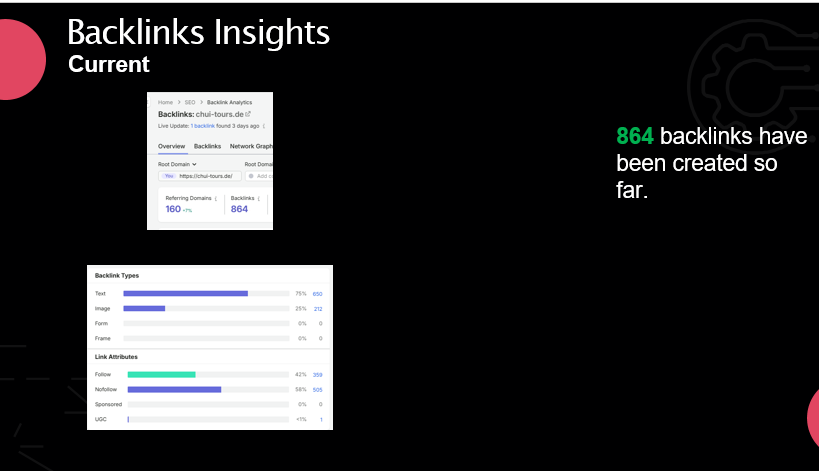
The supplied link-attribute figures are:
| Link attribute | Reported count | Reported share |
| Follow | 359 | 42% |
| Nofollow | 505 | 58% |
| Sponsored | 0 | 0% |
| UGC | 1 | Less than 1% |
These counts and percentages are reproduced as reported. The displayed attribute counts total 865, so the report may reflect differences in classification or reporting across the underlying data.
We monitored this information to understand how the website’s external link profile was developing. A useful backlink profile should be evaluated in context, considering relevance, source quality, and natural link patterns rather than volume alone.
12. Monitoring Authority Indicators and Organic Growth
The campaign presentation includes a six-month breakdown of new and lost referring domains, a corresponding view of backlink acquisition and loss, and an Authority Score trend.
The Authority Score chart shows a trend reaching 9 in July 2026. This is a third-party SEO tool metric and should be understood as an indicator generated by that platform, not as a Google ranking score.
The report also lists the following domain metrics:
DOMAIN METRICS
Domain Authority (DA)
19
Page Authority (PA)
33
Source: Supplied campaign presentation. DA and PA are third-party metrics, not direct Google ranking factors.
These measurements provide additional context for evaluating the website’s external authority and individual-page strength according to the tools used in the campaign.
The presentation also includes trend graphs from Semrush showing the ongoing development of organic traffic and organic keyword visibility. These graphs provide visual context for the campaign’s direction, although the supplied material does not specify exact before-and-after values for those two metrics.
For that reason, we report the documented traffic and search figures separately instead of assigning unsupported numerical gains to the Semrush trends.
The broader lesson is that authority and organic visibility should be assessed using multiple indicators. Link metrics can help explain the website’s external profile, while actual search impressions, clicks, traffic, and engagement provide complementary evidence of its performance.
13. Improving Visibility in AI-Powered Search Results
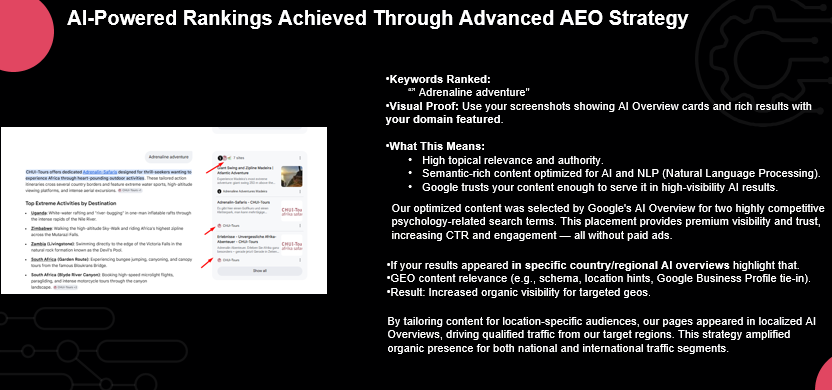
A notable component of the campaign was the documentation of CHUI-Tours appearing in AI-powered search experiences.
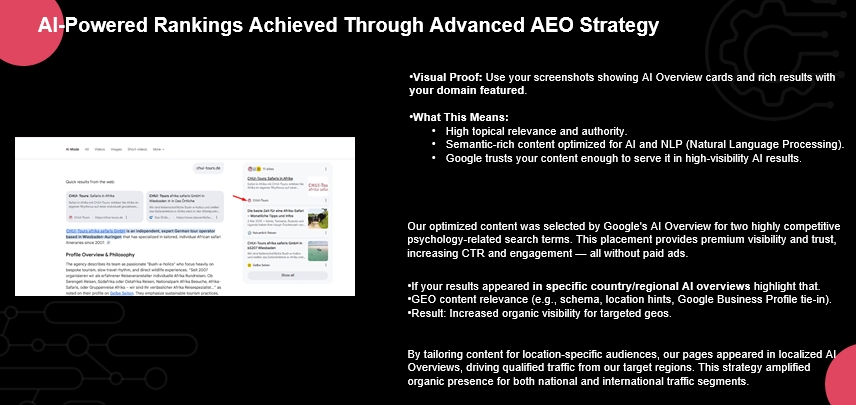
The supplied presentation includes screenshots showing the domain featured in Google AI Overview cards and rich-result contexts for targeted search terms. It identifies “Adrenaline adventure” as a campaign keyword and states that the optimized content was selected for two highly competitive search terms.
Because the presentation does not identify both terms in the written material, we do not assign a name to the second term. The accompanying screenshots should be used to substantiate the specific appearances being discussed.
The presentation also shows a result for “Safaris für Kinder – CHUI-Tours” at position 8 in the illustrated search context associated with the adrenaline-adventure campaign. This should be described as the position shown in that screenshot, rather than as proof that the phrase “Adrenaline adventure” itself ranked eighth.
These examples illustrate an important aspect of modern discoverability: a brand can gain exposure not only through a conventional search listing but also through selected AI-generated results and other enhanced search presentations.
AI Overview visibility can be valuable because it places a source within a prominent answer-oriented search experience. However, an appearance in a screenshot does not establish how frequently that appearance occurred, how many people saw it, or how many visits or conversions it generated.
Our objective was to make the website’s content more relevant, understandable, and accessible to these systems. The screenshots provide qualitative evidence of the resulting visibility in the specific search contexts captured by the campaign.
14. Establishing a Presence in Google AI Mode
The presentation also includes a Google AI Mode/search-result screenshot featuring CHUI-Tours Afrika Safaris GmbH.
The information shown describes the business as an independent German tour operator based in Wiesbaden-Auringen, with a focus on bespoke tourism and direct wildlife experiences. It also references the company’s philosophy of a slower travel rhythm and its experience dating back to 2007.
This type of representation matters because it communicates the company’s identity and positioning, rather than simply displaying its name beside a keyword.
For a specialist tour operator, that distinction is important. Travelers may want to understand what makes a company different, how its itineraries are designed, which destinations it serves, and whether its approach matches their expectations.
When business information is consistent and clearly presented, AI-powered systems have a better basis for interpreting the entity and its services. That does not guarantee inclusion in generated answers, but it supports the broader objective of making the business easier to understand.
The screenshot provides a concrete example of CHUI-Tours being represented in the illustrated AI-powered search environment. It should be treated as evidence of that captured appearance, rather than a guarantee of persistent visibility for every user or query.
15. Making CHUI-Tours’ Information Discoverable Through ChatGPT
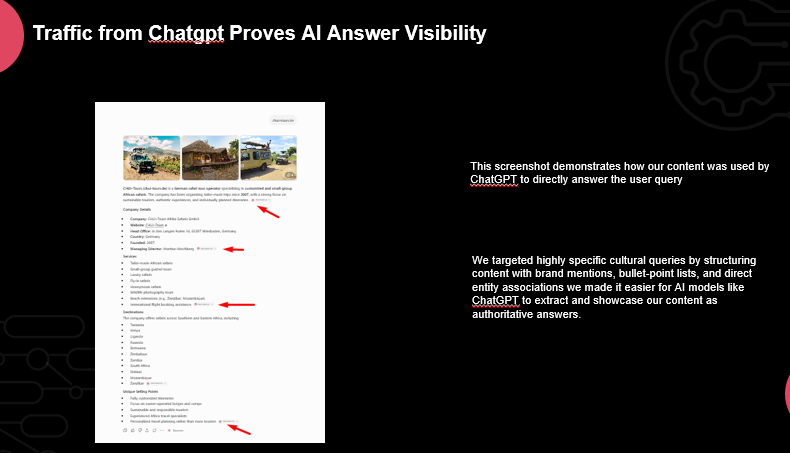
One of the most distinctive examples in the presentation is a screenshot showing CHUI-Tours information appearing in a ChatGPT-generated response.
The captured answer includes the company’s name, website, headquarters, country, founding year, and managing director. It also presents the company’s travel services, destinations, and distinguishing characteristics.
The information shown includes:
- Business identity: CHUI-Tours Afrika Safaris GmbH, based in Germany.
- Experience: The company is described as having operated since 2007.
- Services: Tailor-made safaris, guided small-group tours, luxury and fly-in safaris, honeymoon trips, wildlife photography tours, beach extensions, and flight-booking assistance.
- Destinations: A range of African destinations, including Tanzania, Kenya, Uganda, Rwanda, Botswana, Zimbabwe, Zambia, South Africa, Malawi, Mozambique, and Zanzibar.
- Distinctive positioning: Personalized itineraries, owner-operated lodges and camps, responsible tourism, experienced Africa travel specialists, and an alternative to mass tourism.
This example demonstrates how clearly organized business information can support the presentation of a company in a conversational answer.
Instead of requiring a user to visit several pages and assemble the details independently, an AI-generated response can bring key facts together in one place. The source screenshot suggests that CHUI-Tours’ information was available to the system in a form that could be used in its answer.
The result is meaningful as a qualitative discovery example, but it needs to be interpreted carefully. A generated answer is not necessarily proof that the website was cited as a source, and the presence of company information does not automatically mean that a user visited the website afterward.
The supplied screenshot documents the appearance of the information in ChatGPT. It does not provide a referral count, a conversion rate, or evidence that every listed fact was independently verified by the platform.
For us, the significance lies in the broader direction of the work: making business information clear and accessible in a search environment where people increasingly ask complete questions instead of relying solely on short keyword phrases.
What These Results Mean for CHUI-Tours
Taken together, the campaign evidence presents several distinct outcomes.
First, the Google Analytics comparison shows a substantial increase in sessions and engaged sessions between the two reporting periods. This demonstrates a meaningful difference in recorded website activity.
Second, Search Console shows an increase in impressions and clicks, with clicks rising more quickly than impressions. This provides a separate view of how often the website appeared in search and how frequently users visited it from those results.
Third, the backlink reporting documents 864 backlinks and 160 referring domains, alongside third-party authority indicators. These figures help describe the website’s external link profile and its reported authority metrics.
Finally, the AI-powered search screenshots document specific instances in which CHUI-Tours appeared in illustrated Google AI search experiences and in a ChatGPT-generated response.
These outcomes should not be collapsed into a single success metric. Each measures something different, and the available material does not establish that any one activity caused all the others.
The supplied reporting also does not include verified figures for additional enquiries, confirmed bookings, revenue growth, cost per acquisition, or return on investment. Those metrics would be necessary to assess the campaign’s commercial impact more directly.
Nevertheless, the evidence demonstrates progress across several relevant dimensions of digital discoverability: website activity, search engagement, link-profile development, and examples of visibility within AI-powered discovery experiences.
Why This Approach Matters for the Future of Search
The CHUI-Tours campaign reflects a broader change in the way businesses need to think about digital visibility.
Traditional organic search remains important, but a comprehensive discovery strategy also needs to consider how search systems interpret entities, understand questions, and select information for direct answers.
For a travel company, this means providing clear destination information, explaining services accurately, demonstrating expertise, and ensuring that essential pages are accessible to both visitors and search systems.
It also means maintaining a strong technical foundation. Useful content cannot perform to its full potential if important pages are difficult to discover, the site is confusing to navigate, or performance issues interfere with the visitor experience.
Similarly, AI visibility should not be treated as a substitute for foundational SEO. A business still needs relevant content, a technically accessible website, consistent information, and a trustworthy online presence.
Our work with CHUI-Tours brought these considerations together. We focused on search intent, content organization, technical usability, site architecture, link-profile monitoring, geographic relevance, and clear business information.
The documented results provide examples of why this integrated approach matters, while also showing why campaign reporting should distinguish measurable outcomes from qualitative observations.
Conclusion: Building Discoverability Beyond Traditional Search
CHUI-Tours operates in a market where travelers need confidence, clarity, and relevant information before choosing a safari experience. Its digital presence therefore needs to do more than list destinations and packages. It must communicate the company’s expertise, explain its services, and make useful information accessible throughout the travel-planning journey.
At ThatWare, we approached this challenge by combining foundational organic optimization with a broader focus on AI-powered discovery. We worked toward improving the relevance of the website’s content, strengthening its technical foundations, simplifying access to important pages, monitoring its backlink profile, and presenting business information clearly.
The supplied campaign figures show that sessions increased from 303 to 1,345 and engaged sessions rose from 163 to 578 in the reported 28-day comparison. Search Console also records an increase from 871 to 905 impressions and from 78 to 121 clicks. The backlink report documents 864 backlinks and 160 referring domains, while the presentation includes specific examples of CHUI-Tours appearing in Google AI search experiences and a ChatGPT-generated response.
These findings demonstrate progress across several areas of online visibility, although they do not independently establish an increase in bookings or revenue.
For us, the central lesson is that modern discoverability requires a connected strategy. Content needs to satisfy real questions, website architecture needs to make information accessible, technical performance needs to support usability, and business information needs to communicate a clear and consistent identity.
Search behavior will continue to evolve, but the underlying objective remains the same: help the right people discover useful information and make informed decisions.
At ThatWare, we continue to approach this challenge by combining established SEO principles with strategies designed for emerging search experiences—helping businesses build a stronger foundation for visibility wherever their audiences seek answers.