SUPERCHARGE YOUR ONLINE VISIBILITY! CONTACT US AND LET’S ACHIEVE EXCELLENCE TOGETHER!
Ranking on Google is no longer the only test of search readiness.
A potential customer can now ask:
“Which provider is best for my problem?”
“What does this service cost?”
“How does this product compare with another option?”
“What company should I trust for this requirement?”
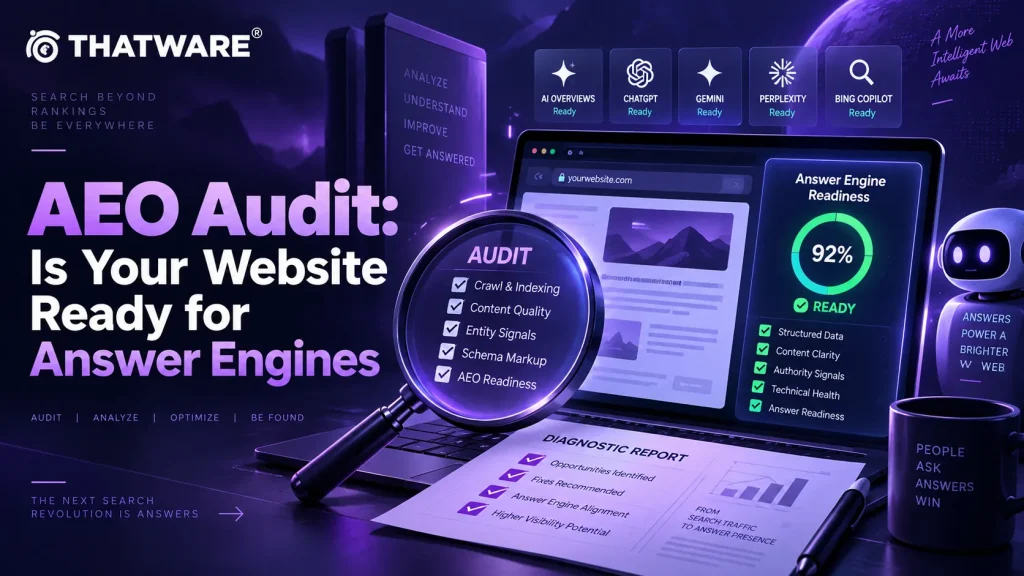
And instead of reviewing ten traditional search listings, the user may receive a direct response from Google AI Overviews, ChatGPT, Gemini, Perplexity, Copilot, a voice assistant or another answer-driven interface.
That changes what a website needs to do.
Your content must still rank.
But it also needs to be easy to interpret, retrieve, summarize, verify and potentially cite as part of a direct answer.
That is exactly what an AEO audit is designed to evaluate.
An effective answer engine optimization audit investigates whether your website provides enough technical clarity, semantic structure, entity information, useful answers and supporting evidence for modern answer engines to understand it properly.
At ThatWare, AEO is treated as more than adding FAQ schema or writing a few question-based headings. Its current AEO framework combines technical, semantic, content, authority and AI-visibility work, with audit and baseline establishment forming the first stage of the methodology.
The central question is simple:
If an answer engine needs reliable information about your market, how prepared is your website to become part of that answer?
What Is an AEO Audit?
An AEO audit is a structured evaluation of how well a website is prepared for answer engines and AI-powered search experiences.
Traditional SEO auditing typically examines areas such as:
- crawlability
- indexability
- keyword targeting
- metadata
- backlinks
- internal linking
- Core Web Vitals
These areas still matter.
However, AEO audit services add another layer of questions:
- Does the website answer important questions clearly?
- Can machines identify the main entities?
- Are facts easy to extract?
- Does structured data reinforce the content?
- Are claims supported?
- Is important information current?
- Does the brand appear across AI-generated answers?
- Are competitors being surfaced instead?
- Are pages structured around real user questions?
- Can AI systems understand relationships among people, products, services and topics?
That broader scope makes an AEO website audit an important part of preparing for answer-first discovery.
Why Answer Engines Require a Different Type of Audit
Answer engines operate differently from conventional search result pages.
A traditional result can rank a page and leave the interpretation to the user.
An answer engine often has to interpret the page first.
It may need to determine:
- what the page is about
- whether the information answers the question
- which part of the content is relevant
- whether the source appears credible
- how entities relate
- whether the information is current
- whether the answer can be summarized safely
That is why answer-engine readiness depends heavily on structure and meaning.
ThatWare’s AEO service framework reflects this shift by emphasizing search intent, entity relationships, topical authority, structured data, answer formatting and AI-readable trust signals.
SEO Audit vs AEO Audit: What Changes?
A conventional SEO audit might ask:
“Can Google crawl this page?”
An answer engine optimization audit goes further:
“Can an AI system understand the exact answer this page provides?”
Traditional SEO may ask:
“Does the page target the keyword?”
AEO asks:
“Does the page satisfy the question behind the keyword?”
SEO may ask:
“Does this page have schema?”
AEO asks:
“Does the schema accurately reinforce the entities, relationships and answers contained on the page?”
SEO may ask:
“Does the website have authority?”
AEO asks:
“Is there enough evidence for machines to trust, cite and potentially recommend this information?”
That difference defines modern answer-engine readiness.
What Should an AEO Audit Examine?
A comprehensive audit should evaluate several layers rather than treating AEO as a single content exercise.
1. Question and Search Intent Coverage
Every effective AEO strategy begins with questions.
Users increasingly search conversationally:
- What is this?
- How does it work?
- Which option is better?
- How much does it cost?
- Is it suitable for me?
- What should I choose?
- Who provides this service?
An AEO content audit should examine whether important customer questions are actually answered on the site.
Questions to Ask
- Are high-intent questions covered?
- Are answers easy to locate?
- Are informational questions addressed?
- Are comparison queries supported?
- Are buying-stage questions included?
- Are question clusters mapped to appropriate pages?
ThatWare’s AEO methodology includes question, intent and page mapping as a core campaign stage, reflecting how central this step is to answer visibility.
2. Direct Answer Readiness
A page may contain the correct information but still make machines work unnecessarily hard to find it.
For example, imagine a user asks:
“What is enterprise AEO?”
A weak page may spend six paragraphs introducing the topic before defining it.
A stronger answer-ready page might provide a concise definition immediately, followed by deeper detail.
An AEO analysis services framework can examine whether critical answers are:
- direct
- specific
- factually clear
- contextually complete
- located near relevant headings
- supported by deeper explanations
The goal is not to make every paragraph robotic.
It is to make important information unmistakable.
3. Heading and Content Architecture
Answer engines benefit from clear information hierarchy.
The audit should examine:
- H1 clarity
- H2 and H3 hierarchy
- question-based sections
- definition sections
- comparison sections
- process sections
- concise explanatory blocks
- logical topic progression
ThatWare’s public AEO framework specifically includes structured headings, FAQ architecture, conversational content and direct-answer content creation.
Poor heading structure makes it harder for both users and machines to understand where one subject ends and another begins.
4. Entity Clarity
Answer engines need to understand more than keywords.
They need entities.
An entity might be:
- a company
- a person
- a product
- a service
- a location
- a technology
- a concept
An AI search audit should check whether the website clearly communicates these entities and their relationships.
For example:
Company → provides → Service
Expert → works for → Company
Product → belongs to → Product Category
Service → serves → Industry
Company → operates in → Location
Entity clarity helps machines move from keyword recognition toward actual understanding.
Quote
“An answer engine cannot confidently represent a brand it struggles to define.”
5. Schema and Structured Data
Schema is not an automatic ticket into AI answers.
But structured data can help reinforce meaning when it accurately matches the visible content.
An AEO technical audit should examine relevant structured data such as:
- Organization
- Person
- Service
- Product
- Article
- BreadcrumbList
- LocalBusiness
- FAQPage where appropriate
The important question is not:
“Do we have schema?”
It is:
“Does our schema accurately support the entities and relationships on the page?”
Incorrect or excessive schema can create noise rather than clarity.
6. Technical Accessibility
Answer readiness still depends on technical accessibility.
An AEO technical audit should examine whether important content can actually be accessed and interpreted.
Areas may include:
- crawl accessibility
- indexability
- rendering
- canonicalization
- robots directives
- JavaScript dependencies
- internal linking
- duplicate content
- page speed
- mobile usability
- structured-data errors
A brilliantly written answer has little value if machines cannot reliably access it.
7. Content Extractability
One overlooked AEO factor is extractability.
Can a machine isolate the important information cleanly?
For example, pages can use sections such as:
What Is AEO?
Followed by a clear answer.
How Does AEO Work?
Followed by a structured explanation.
AEO vs SEO
Followed by a comparison.
This does not mean every page needs dozens of repetitive questions.
The aim is to organize important information in a way that improves comprehension.
8. FAQ Quality
FAQs have become heavily associated with AEO.
Unfortunately, many websites add generic FAQ sections that contribute little.
A proper AEO content audit should examine whether FAQ questions:
- reflect genuine search demand
- address meaningful concerns
- add new information
- support buying decisions
- answer conversational searches
- avoid duplicating the main copy
ThatWare’s current AEO offering includes FAQ architecture and question-focused optimization as part of a larger strategy rather than treating FAQs as the entire discipline.
9. Featured Answer Readiness
Answer Engine Optimization includes search experiences beyond generative AI.
A website may also compete for:
- featured snippets
- People Also Ask
- voice answers
- direct answers
- AI summaries
- conversational responses
ThatWare’s AEO positioning explicitly includes featured snippets, People Also Ask, voice assistants, AI-generated responses and conversational discovery platforms.
An answer engine visibility audit should therefore look across several answer formats rather than measuring one platform.
10. AI Answer Visibility
Once the website itself has been evaluated, the audit should examine actual external visibility.
An AI answer visibility audit asks:
Does the brand currently appear when users ask relevant AI systems important questions?
Track prompts such as:
- industry questions
- product questions
- service questions
- comparison queries
- recommendation queries
- problem-solving questions
This adds performance evidence to the structural audit.
Q&A: Is AEO Only About ChatGPT?
Q: Should an AEO audit focus mainly on ChatGPT visibility?
A: No. Answer-driven discovery also includes Google AI experiences, Gemini, Perplexity, Copilot, voice assistants, featured snippets and other systems that deliver direct answers. A useful audit should consider the wider answer ecosystem.
11. Citation Visibility
A website can appear in AI search in different ways.
It may be mentioned.
It may be cited.
Or its information may contribute to an answer without obvious attribution.
An AI visibility audit should examine citation opportunities, particularly on systems that display sources.
Questions include:
- Which pages are already cited?
- Which topics produce citations?
- Which competitors are cited instead?
- Are original sources available?
- Is key information verifiable?
Citation readiness often depends on factual quality, authority and usefulness.
12. Source and Evidence Quality
Answer engines need dependable information.
An AEO audit should therefore evaluate the evidence behind content.
Weak content often contains claims such as:
“We are the best.”
“Our technology is revolutionary.”
“We provide unmatched quality.”
Those statements are difficult to verify.
Stronger content provides:
- specific capabilities
- named methodologies
- research
- references
- statistics
- documented examples
- expert attribution
- case studies
- factual comparisons
This makes information more useful to both users and machines.
Quote
“Answer readiness improves when important claims are easy to understand and easy to verify.”
13. Author and Expert Signals
Some subjects require stronger expertise signals than others.
An AI search readiness audit should examine:
- author names
- author biographies
- reviewer information
- relevant qualifications
- subject expertise
- publication dates
- update dates
- editorial responsibility
This is particularly important in industries where incorrect information could have meaningful consequences.
14. Brand Trust Signals
Answer engines may encounter a company across multiple websites and information sources.
That means the audit should extend beyond on-page SEO.
An AEO audit may also examine:
- About pages
- leadership pages
- social profiles
- industry listings
- press references
- third-party mentions
- business directories
- reviews
- awards
- research
- public profiles
The objective is consistency and corroboration.
15. Topic Depth and Semantic Coverage
An answer-ready website should demonstrate enough subject depth to answer related questions confidently.
Suppose a company wants to rank for enterprise cloud security.
Publishing one general service page may not be enough.
Supporting topics could include:
- architecture
- implementation
- compliance
- risk
- migration
- cost
- comparisons
- integrations
- use cases
This is where semantic content architecture becomes important.
Q&A: Does AEO Require More Content?
Q: Should a website publish more content to become answer-engine ready?
A: Not necessarily. The priority is better coverage of relevant questions, stronger entity clarity and clearer answers. Adding low-value pages simply to increase content volume does not guarantee stronger answer visibility.
16. Content Freshness
Outdated information creates risk.
During an AEO website audit, check:
- outdated statistics
- discontinued services
- old staff information
- expired policies
- obsolete pricing
- old technology references
- stale research
Answer engines need current information when answering time-sensitive queries.
Pages covering fast-changing subjects may require more frequent review.
17. Conversational Query Readiness
Traditional keyword targeting might focus on:
“enterprise SEO agency”
A conversational query may instead be:
“Which SEO agency can help an enterprise become more visible in AI search?”
The underlying commercial intent is similar.
The phrasing is different.
An answer engine optimization audit should therefore evaluate whether content supports natural-language questions rather than only short keyword strings.
18. Comparison Content
Users frequently ask answer engines to compare options.
Examples:
- AEO vs SEO
- AEO vs GEO
- Product A vs Product B
- agency vs consultant
- platform X vs platform Y
An AEO content audit should identify missing comparison opportunities where the brand has legitimate expertise.
Good comparison content should provide balanced, factual distinctions rather than forcing every comparison toward a sales pitch.
19. Process and “How It Works” Content
Processes are naturally answer-friendly.
Users frequently ask:
“How does it work?”
“What happens first?”
“How long does implementation take?”
“What steps are involved?”
Clear process content improves both user experience and answer readiness.
A good page can include:
- Discovery
- Audit
- Strategy
- Implementation
- Measurement
The exact process should reflect the real service rather than a generic template.
20. Commercial Answer Readiness
AEO is not only informational.
Potential customers also ask commercially important questions.
For example:
- What does the service include?
- Who is it suitable for?
- How much does it cost?
- What results should I expect?
- How does this provider differ?
- What industries do they serve?
An AEO analysis services framework should evaluate whether users can receive clear commercial answers without navigating through five different pages.
Short Case Study 1: Strong Rankings, Weak Answer Readiness
Consider a B2B services website ranking on page one for several important keywords.
Traditional SEO performance appears healthy.
However, an AI answer visibility audit finds that the brand rarely appears in question-based or recommendation prompts.
The audit reveals:
- long introductory content
- unclear definitions
- few direct answers
- weak entity relationships
- generic FAQs
The solution is not necessarily more backlinks.
It may require restructuring existing content around questions, entities and answer extraction.
Short Case Study 2: Good Content, Technical AEO Gaps
Imagine another business with expert-written guides and strong topic coverage.
The content is useful, but the AEO technical audit identifies:
- inconsistent heading hierarchy
- incomplete structured data
- poor internal linking
- important content rendered unpredictably
- unclear entity markup
In this case, the opportunity lies mainly in technical and semantic implementation rather than rewriting everything.
Quote
“AEO is strongest when content quality, technical accessibility, entity clarity and authority support the same answer.”
Enterprise AEO Requires a Larger Audit Framework
An enterprise AEO audit becomes more complicated because large organizations may operate:
- multiple sites
- thousands of pages
- multiple languages
- regional markets
- large product portfolios
- separate content teams
- many experts
- complex CMS platforms
The audit must therefore prioritize scalable patterns.
Enterprise Questions to Examine
Are content templates answer-friendly?
Are schema standards consistent?
Are business units describing products differently?
Are regional websites contradicting one another?
Are important entities clearly connected?
Can subject experts be identified consistently?
Are question mappings duplicated across many URLs?
This moves AEO from page optimization toward governance.
Q&A: What Makes an Enterprise AEO Audit Different?
Q: Can’t an enterprise simply audit pages individually?
A: Page-level analysis is useful, but enterprises also need template, taxonomy, entity, governance and cross-market analysis. Fixing one template can sometimes improve hundreds or thousands of pages at once.
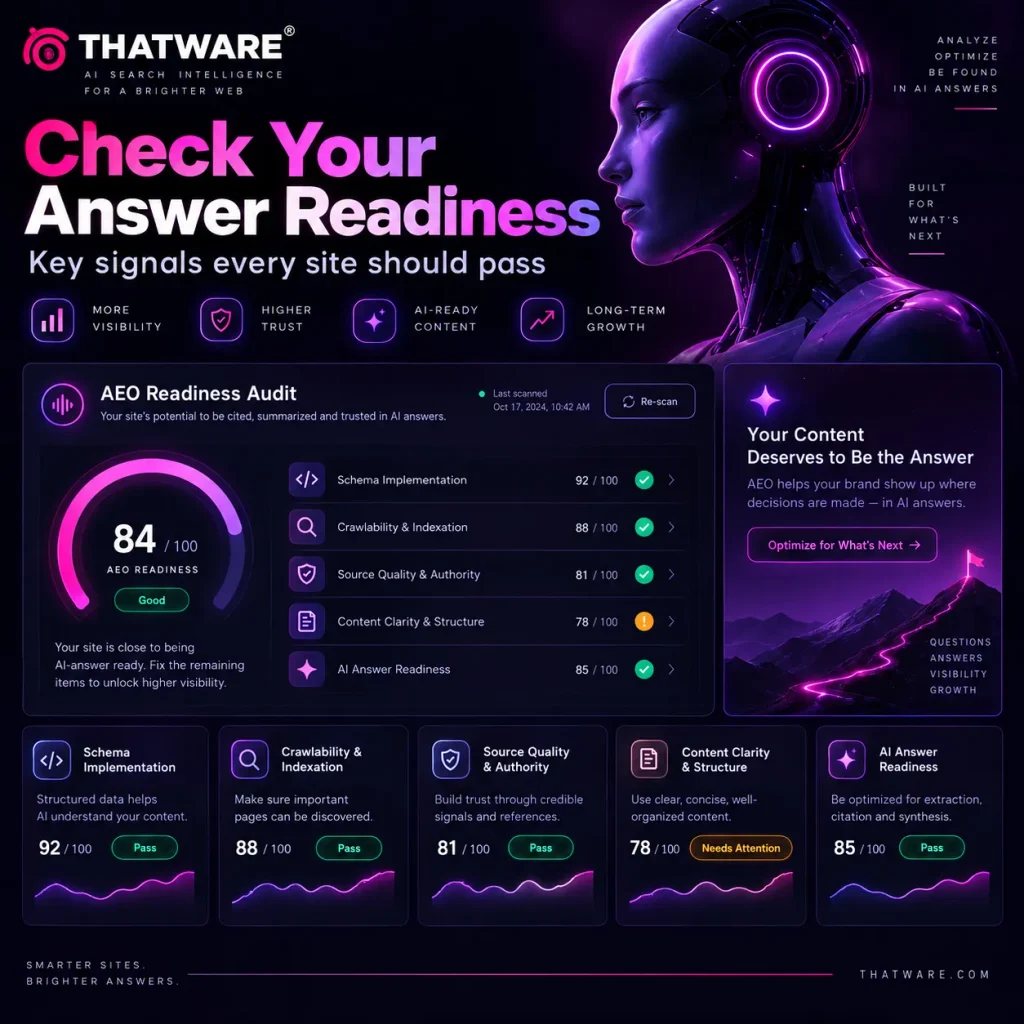
How to Create an AEO Readiness Score
Businesses can create an internal scoring system to compare sections of their site.
For example:
Content Readiness
Evaluate:
- question coverage
- answer clarity
- comparison content
- FAQs
- definitions
Technical Readiness
Evaluate:
- crawlability
- structured data
- rendering
- internal linking
- architecture
Entity Readiness
Evaluate:
- organization identity
- service relationships
- expert entities
- topic associations
Authority Readiness
Evaluate:
- expert attribution
- citations
- evidence
- third-party corroboration
Visibility Readiness
Evaluate:
- AI mentions
- answer-engine citations
- featured-answer presence
- recommendation visibility
The scoring methodology should remain consistent so improvements can be measured over time.
What Happens After an AEO Audit?
The audit is only useful if it produces an implementation roadmap.
ThatWare’s published AEO methodology progresses from audit and baseline establishment into intent mapping, content/entity/schema implementation, RAG and knowledge preparation, authority development, and continuous visibility testing.
A practical roadmap might contain several stages.
Stage 1: Critical Technical Fixes
Resolve issues preventing reliable access or interpretation.
Stage 2: Entity Clarification
Strengthen company, product, service and expert relationships.
Stage 3: Answer Architecture
Improve definitions, question sections and content hierarchy.
Stage 4: Structured Data
Implement or correct relevant schema.
Stage 5: Authority Development
Strengthen evidence, expertise and external corroboration.
Stage 6: Visibility Monitoring
Track actual appearances across answer engines.
This is where AEO optimization services move from diagnosis to execution.
Where AEO Consulting Services Fit
Some organizations already have strong SEO, content and technical teams.
They may not need full outsourced implementation.
Instead, AEO consulting services can help define:
- audit methodology
- prompt strategy
- answer architecture
- schema requirements
- entity standards
- content templates
- reporting frameworks
- implementation priorities
This approach can be especially useful for enterprises where several internal teams need a shared AEO framework.
What Should AEO Audit Services Deliver?
Professional AEO audit services should provide more than a list of errors.
A useful deliverable should include:
- current readiness assessment
- technical findings
- content findings
- entity findings
- answer-engine visibility findings
- priority questions
- page-level recommendations
- template recommendations
- schema recommendations
- competitor observations
- implementation priorities
Each recommendation should ideally answer:
What is wrong?
Why does it matter?
What should change?
Which pages are affected?
How important is the fix?
That turns the audit into an implementation document.
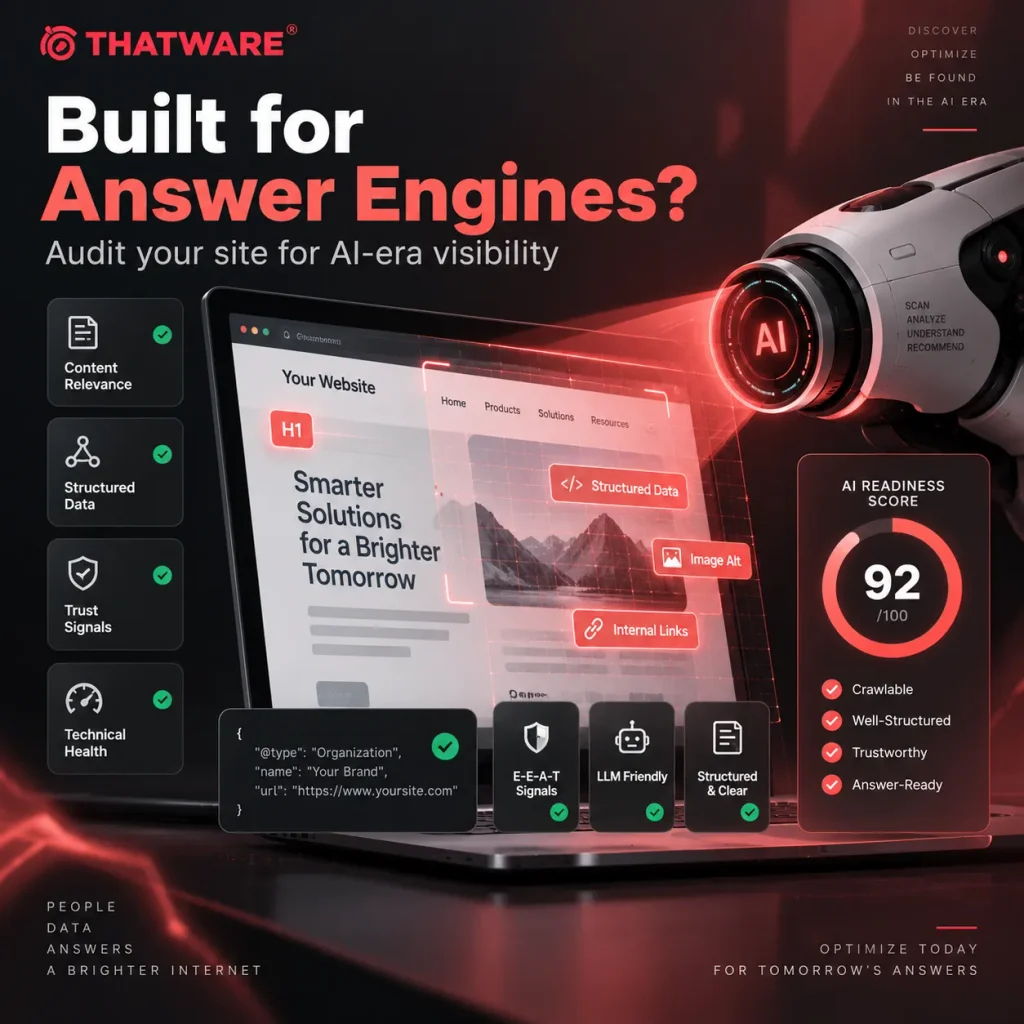
A Practical AEO Audit Checklist
Use the following checklist as an initial readiness test.
Content
- Are important customer questions covered?
- Are definitions clear?
- Are answers concise where appropriate?
- Are comparison queries addressed?
- Are FAQs useful rather than generic?
Technical
- Can important pages be crawled?
- Is the content reliably rendered?
- Is structured data valid?
- Is internal linking logical?
Entity
- Is the company clearly defined?
- Are products and services distinguishable?
- Are experts connected with relevant topics?
- Are entity relationships consistent?
Authority
- Are important claims supported?
- Are expert authors identified?
- Is key information current?
- Are third-party trust signals available?
Answer Visibility
- Does the brand appear in relevant direct-answer environments?
- Is it cited?
- Is it recommended?
- Are competitors appearing instead?
A high number of “no” answers usually indicates meaningful AEO work remains.
AEO and AI Search Readiness Are Converging
The boundary between conventional answer engines and generative AI is becoming less useful from a practical strategy perspective.
A business may encounter customers through:
- featured snippets
- People Also Ask
- Google AI Overviews
- ChatGPT
- Gemini
- Perplexity
- Copilot
- voice assistants
What these environments increasingly share is the need for information that can be understood and delivered as an answer.
ThatWare’s current AEO positioning reflects this broader definition, combining semantic optimization, entity work, structured data, conversational content and AI visibility rather than limiting AEO to featured snippets.
Is Your Website Actually Ready for Answer Engines?
A website can be technically healthy and still be poorly prepared for answer-driven search.
It can rank well but provide unclear answers.
It can have excellent content but weak entity signals.
It can use schema but provide little evidence.
It can answer questions but remain invisible across AI systems.
That is why a proper AI search readiness audit needs to examine the whole system.
The central questions are:
Can answer engines access the information?
Can they understand it?
Can they identify the entities?
Can they extract a clear answer?
Can they verify important claims?
Can they trust the source enough to reference it?
Does the brand actually appear when relevant questions are asked?
An AEO audit helps businesses replace assumptions with evidence.
And once those gaps are understood, answer engine optimization services can focus on the areas that actually need improvement instead of simply adding another layer of generic SEO activity.
The future of search is increasingly answer-first.
The websites best prepared for that environment will be those that make their expertise easy to find, understand, verify and communicate.