
SUPERCHARGE YOUR ONLINE VISIBILITY! CONTACT US AND LET’S ACHIEVE EXCELLENCE TOGETHER!
For more than a decade, Google Search Console has been one of the most important measurement platforms in SEO. Website owners and search professionals have used it to understand how often their pages appear in Google Search, which queries generate visibility, which pages receive impressions and clicks, and how search performance changes over time. But the search environment that Search Console was originally designed to measure is changing rapidly.
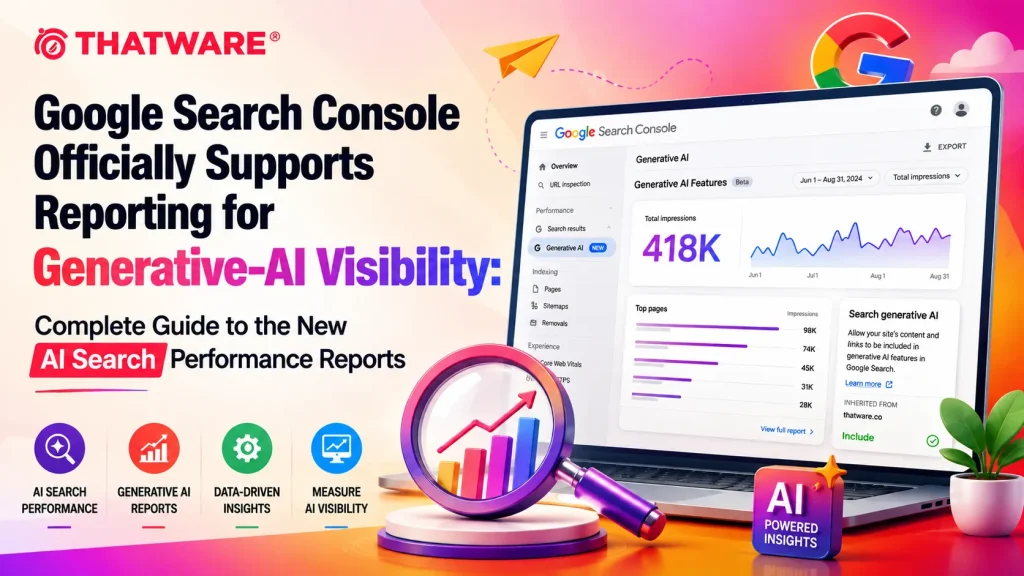
Google Search is no longer limited to a list of traditional organic results. Generative AI is becoming an increasingly visible part of the search experience, with features such as AI Overviews and AI Mode capable of synthesising information, answering questions conversationally and presenting links to sources within AI-generated experiences. As the search results page evolves, the definition of “visibility” is evolving with it.
Google has now taken an important step towards measuring that change.
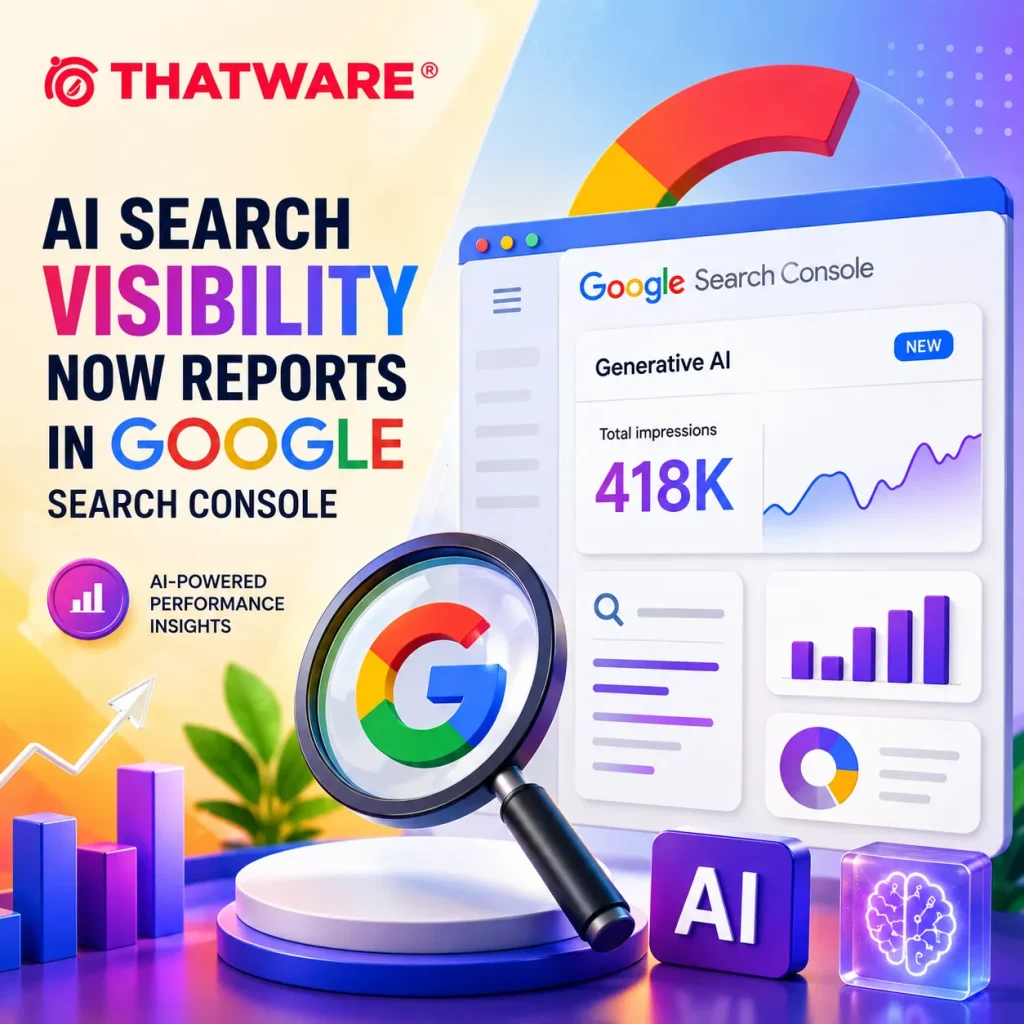
On June 3, Google officially announced new Generative AI performance reports in Search Console, providing dedicated views into how websites appear within generative-AI features across Google Search and Discover. For Search, the new reporting covers AI Overviews and AI Mode, while a separate report addresses generative-AI features in Google Discover.
This is significant because it moves generative-AI visibility from something SEO professionals largely had to observe manually into something that Google itself is beginning to expose through its first-party measurement infrastructure.
From Ranking Positions to AI Visibility
Traditional SEO has historically revolved around a relatively straightforward measurement model.
A user enters a query. Google returns search results. A website appears at a particular position. Search Console records an impression, and if the user visits the website, the interaction can be measured as a click.
Generative search complicates that model.
A user may now ask Google a broad or conversational question and receive an AI-generated response before interacting with traditional organic listings. Within that response, Google may surface links to multiple websites that contributed information or provide supporting sources. The user may read the generated answer, recognise a brand or source, and make a decision without interacting with the conventional ten-blue-links format.
That creates a new question for SEO teams:
How visible is a website when Google generates an answer, rather than simply displaying a traditional ranking list?
The new Search Console reporting begins to answer that question.
Google’s Generative AI performance report measures impressions from links to a website that are shown within generative-AI features on Google Search. The current Search report allows website owners to examine those impressions over time and break them down by pages, countries and devices.
This does not replace conventional SEO reporting. Instead, it adds another layer to it.
A website can therefore have two distinct but connected forms of Google visibility:
Traditional Search visibility:
A page appears in conventional search results and generates impressions and clicks.
Generative-AI visibility:
A page or URL is surfaced within Google’s AI-powered search experiences and contributes to the user’s exposure to that website.
Understanding both is becoming increasingly important.
Why Google’s Move Matters
The significance of this development goes beyond the addition of another menu item inside Search Console.
Google is effectively acknowledging that AI-mediated visibility is becoming a measurable component of search performance.
Until recently, much of the discussion around AI Search optimisation focused on questions such as:
- Does ChatGPT mention my brand?
- Does Gemini recommend my company?
- Is my website cited by an AI answer?
- Does my content appear in Google’s AI-generated responses?
- Which pages are being used as sources?
- How often does an AI system reference my business?
- Which topics create the greatest AI visibility?
Many of these questions remain outside the scope of Google Search Console. However, the new reporting establishes an official Google measurement layer for one important part of that ecosystem: generative-AI visibility within Google’s own Search and Discover experiences.
That distinction is critical.
Google Search Console is not suddenly a universal tracker for every large language model or AI assistant. It does not provide a single score showing how visible a brand is across ChatGPT, Gemini, Claude, Perplexity, Copilot and other independent AI systems.
Instead, Google is providing first-party reporting for generative-AI features that exist within its own search ecosystem.
That makes the new functionality both valuable and deliberately narrower than the broader concept of GEO, AEO or LLM visibility.
A New Layer of Search Performance Data
Google’s announcement describes the new reports as dedicated views of impressions generated through generative-AI features. The information includes several dimensions that make the data more useful for analysis.
Website owners can examine:
- Impressions, showing how often URLs from the site appeared in supported generative-AI features
- Pages, showing which URLs received AI-related impressions
- Countries, showing where generative-AI impressions originated
- Devices, showing whether users encountered the site’s AI visibility on desktop, mobile or tablet
- Dates, allowing performance to be analysed over time at different levels of granularity
This is particularly important because aggregate AI visibility alone tells only part of the story.
For example, two websites could each receive one million generative-AI impressions, yet have completely different visibility profiles. One might receive most of its exposure from a handful of high-authority pages in the United States, while another might have thousands of URLs generating smaller levels of exposure across multiple countries.
The ability to examine which pages, markets and devices generate AI impressions turns the report from a headline number into a potential optimisation resource.
The New Generative AI Report Is Not the Same as Traditional Search Reporting
One of the most important concepts to understand is that the new report should not simply be treated as another version of the conventional Performance report.
Traditional Search Console reporting provides metrics such as clicks, impressions, click-through rate and average position for Google Search. It also provides dimensions such as queries, pages, countries and devices.
The generative-AI report currently has a different emphasis.
Its central measurement is AI-feature impressions.
This matters because an AI impression should not automatically be interpreted as a website visit, a conventional ranking, a citation in every instance, or a conversion opportunity.
The report is measuring exposure within a specific Google Search experience.
That means SEO professionals need to resist the temptation to create simplistic comparisons such as:
“100,000 AI impressions = 100,000 organic impressions.”
They are not necessarily equivalent forms of exposure.
The context in which the user encounters the URL is different, and the user’s interaction with the search result may also be different.
What the New Report Can Tell Us
The first practical value of the new reporting system is that it gives SEO teams a way to establish a baseline for generative-AI visibility on Google.
Instead of asking only whether a website appears in traditional search, teams can begin asking:
- Which pages are appearing in Google’s generative-AI experiences?
- Is AI visibility increasing or decreasing?
- Which countries generate the greatest AI exposure?
- Which pages consistently receive AI impressions?
- Are certain content categories more likely to receive generative-AI exposure?
- Does AI visibility expand after a content or technical optimisation?
- Are particular sections of a website disproportionately represented?
- How does generative-AI visibility compare with the site’s conventional Search performance?
These questions create the foundation for a new type of SEO analysis.
For example, if a website’s traditional organic visibility remains stable but its generative-AI impressions increase substantially, that may indicate that the website is gaining exposure through a different search pathway.
Conversely, if traditional search performance increases while generative-AI exposure remains flat, the site may be succeeding in conventional rankings without achieving the same level of visibility within AI-generated search experiences.
Neither situation is automatically good or bad.
The important development is that website owners can now begin measuring the difference.
What the New Search Console Interface Reveals
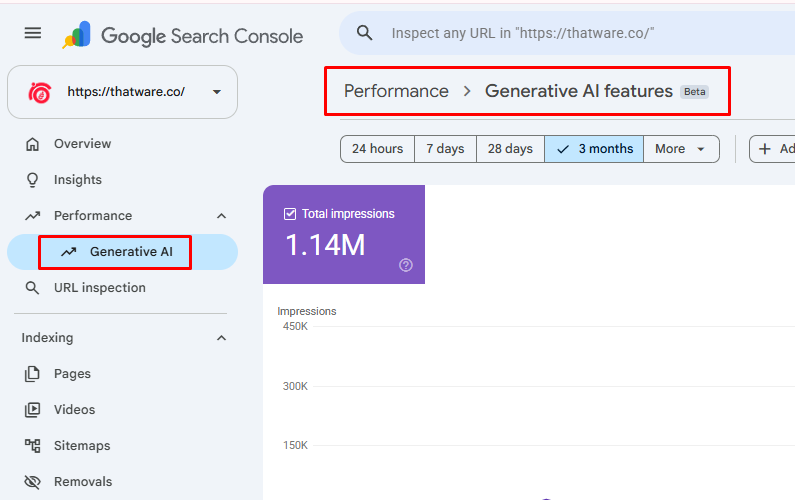
The new Search Console interface makes Google’s shift towards AI-powered search measurable in a way that was previously difficult to achieve. The Generative AI section sits within the Performance area, separating AI-driven search exposure from conventional organic-search reporting.
Within this section, the Generative AI Features report provides a dedicated view of a site’s exposure across Google’s supported generative-AI search experiences. Rather than forcing website owners to infer AI visibility from traditional rankings and clicks, Search Console now provides a specific performance layer for this emerging search environment.
The interface also introduces a separate Search generative AI setting. This is important because reporting and eligibility are two different concepts.
The Generative AI performance report answers:
How is my website performing within Google’s generative-AI search experiences?
The Search generative AI control answers:
Is my website eligible to appear within those experiences?
This distinction becomes particularly important when interpreting AI visibility data. A website must remain eligible for Google’s supported generative-AI features before it can potentially receive exposure through them. However, eligibility does not guarantee that Google will select a particular page for an AI-generated response.
The interface therefore reflects a broader change in how search visibility is being understood:
Eligibility → AI feature selection → Visibility → Impression → Click
Each stage represents a different outcome.
For SEO professionals, the most significant development is that AI visibility is no longer something that has to be assessed entirely through manual searches or third-party observations. Google is beginning to expose first-party performance data for its own AI-powered search experiences through Search Console.
This also explains why the new reporting should not be confused with a universal AI visibility tracker. The data represents Google’s generative-AI ecosystem, while visibility across independent AI platforms requires separate measurement.
As Google continues expanding AI-powered Search, this distinction between traditional rankings, AI visibility and broader LLM visibility will become increasingly important for understanding the real search presence of a website.
The Meaning of an AI Impression Requires Careful Interpretation
The word “impression” has a familiar meaning in traditional SEO, but AI search introduces additional complexity.
According to Google’s documentation, a generative-AI Search impression is counted when a link to the site is shown to a user in a supported generative-AI feature. The current report covers AI Overviews and AI Mode.
However, Google also uses different aggregation approaches when presenting the chart and table.
For example, the chart is aggregated at the property level. If two results from the same website appear in a generative-AI Search feature, they can count as a single impression in the chart total. When data is grouped by page, however, page-level aggregation can produce different totals. Google therefore warns that chart and table totals can sometimes differ.
This is more than a technical footnote.
It means that organisations building AI visibility dashboards must understand how Google counts and aggregates the underlying data before turning the numbers into KPIs.
A sophisticated AI Search report should not simply copy the headline impression figure and label it “AI traffic.”
The correct interpretation is closer to:
How frequently did URLs from this property receive exposure within Google’s supported generative-AI Search experiences?
That is a meaningful metric in its own right.
Google Is Starting With Visibility, Not a Complete AI Search Score
Another important point is that Google has not introduced a universal “AI SEO score” through Search Console.
There is no single number that tells a business:
“Your website is 82% optimised for generative AI.”
Instead, Google is providing raw performance information that can be analysed.
This is consistent with how Search Console has historically worked. Rather than assigning a proprietary overall SEO grade, Search Console provides search performance data that website owners can interpret.
The same principle is now being extended into generative-AI search.
This approach has significant implications for the future of SEO measurement. Rather than relying exclusively on a single score, organisations can build a broader measurement framework combining:
Traditional SEO visibility + Generative-AI visibility + Brand/entity visibility + User engagement + Business outcomes
That broader model is likely to become increasingly relevant as search behaviour continues to change.
What This Means for the Future of SEO
The arrival of generative-AI reporting does not mean traditional SEO is disappearing.
Crawlability still matters. Indexing still matters. Technical SEO still matters. Content quality still matters. Internal linking still matters. Search intent still matters. Authority and relevance still matter.
What is changing is where and how those signals can translate into visibility.
A website may no longer compete exclusively for a position on a search results page. It may also compete to become one of the sources that Google’s AI systems select when constructing an answer.
That creates a more complex search environment.
The strategic objective is no longer simply:
“How do I rank number one?”
It increasingly becomes:
“How do I ensure my organisation, content and entities are understood well enough to be considered relevant sources when search systems generate answers?”
This is one of the fundamental shifts behind the growth of Generative Engine Optimisation, Answer Engine Optimisation and LLM-focused SEO.
Google’s new Search Console reporting does not answer every question associated with these disciplines, but it provides something that has been missing: a first-party Google measurement layer for generative-AI visibility.
Why This Is Only the Beginning
Google has explicitly indicated that the new reports will continue to evolve. The initial launch is being rolled out to a subset of websites for testing and feedback, and Google says it is continuing to evaluate what additional insights and data would be useful, including the possibility of adding more metrics over time.
That makes the current release particularly interesting.
The report should not be viewed as the finished version of AI Search measurement. It is better understood as the beginning of a new reporting category inside Google’s webmaster ecosystem.
Future iterations could potentially provide more granular insight into AI-driven search behaviour, although Google has not committed to specific future metrics. For now, the available data should be interpreted according to what Google officially documents rather than assumptions about what the platform may eventually provide.
For SEO professionals, the immediate opportunity is therefore not to chase an undefined future metric.
It is to begin measuring what is available today.
The New SEO Question
For years, Search Console helped answer questions such as:
How many people saw my website?
Which queries generated visibility?
Which pages received clicks?
Which countries produced search traffic?
Generative-AI Search introduces another layer:
How often is my website being surfaced inside Google’s AI-powered search experiences?
That question is now measurable through Google’s Generative AI performance reporting.
And that changes the conversation around SEO.
Generative AI visibility is no longer purely an experimental concept that marketers have to estimate through manual searches. Google is beginning to provide its own performance data for this emerging search environment.
The challenge now is not simply collecting the new numbers.
The real challenge is understanding what those numbers mean, connecting them to content and technical strategy, distinguishing AI visibility from conventional rankings, and combining Google’s data with broader AI Search intelligence.
That is where the next generation of SEO measurement begins.
Understanding the “Generative AI” Section Shown in Search Console
Google’s introduction of Generative AI reporting adds a new layer to Search Console’s existing performance data. Instead of analysing website visibility only through conventional organic search results, website owners can now examine how their content is being exposed through Google’s supported generative-AI search experiences.
The new interface is important because it separates generative-AI visibility from traditional Search performance. This makes it easier for SEO teams to identify whether their pages are gaining exposure through AI-powered search, which pages are contributing to that exposure, and how performance changes over time.
The new functionality also introduces a separate Search generative AI control within Search Console settings. Although both features relate to Google’s AI-powered Search ecosystem, they serve different purposes.
The Generative AI performance report is designed for measurement.
The Search generative AI control is designed for eligibility and content inclusion.
Understanding this distinction is essential when analysing the new Search Console data.
The New Generative AI Performance Section
Search Console has traditionally provided its main search performance data through:
Performance → Search results
The new Generative AI functionality adds another reporting area:
Performance → Generative AI
Inside this section, website owners can access the Generative AI Features report. The interface provides a dedicated view of impressions generated through Google’s supported generative-AI experiences.
This represents an important change in search reporting.
Previously, an SEO professional interested in AI Search visibility had to rely heavily on manual searches, third-party monitoring tools or indirect indicators. Search Console now provides a first-party Google data source specifically designed to measure this type of exposure.
The report allows businesses to investigate three fundamental questions:
How much generative-AI visibility is the website receiving?
Which pages are contributing to that visibility?
How does that visibility vary across different markets, devices and time periods?
These questions provide the starting point for understanding AI Search performance.
Rather than treating AI visibility as an abstract concept, businesses can begin establishing a historical baseline and analysing how their exposure changes.
What the “Generative AI Features” Report Represents
The name Generative AI Features should not be interpreted as a dashboard covering the entire generative-AI industry.
The report is specifically connected to Google’s own Search environment.
According to Google’s current documentation, the Search generative-AI report covers AI Overviews and AI Mode. Google may expand the scope of the reporting as its AI Search products develop.
This distinction is particularly important for businesses working with GEO, AEO or LLM SEO.
For example, if a company’s website is cited in a ChatGPT response, that visibility does not automatically appear as a Google Search Console generative-AI impression.
Similarly, a brand recommendation generated by Claude, a citation appearing in Perplexity, or a response generated by another independent AI platform is outside the scope of this particular Search Console report.
Google Search Console should therefore be viewed as a first-party measurement source for Google’s generative-AI Search ecosystem, rather than a universal AI visibility tracker.
This makes the report highly valuable for Google-focused SEO analysis while leaving room for separate monitoring of visibility across other AI platforms.
The “Beta” Label Is Important
The Generative AI Features report is presented as a Beta feature in the Search Console interface. That status is significant because it indicates that Google’s approach to AI Search measurement is still developing.
Google has stated that the reporting is being rolled out gradually and that availability may vary between Search Console properties. Therefore, a website that does not currently see the Generative AI section should not automatically assume that something is wrong with its property. Access may simply not have reached that property yet.
The Beta status also means that SEO professionals should avoid treating the current interface as the final version of Google’s AI reporting system.
As generative search evolves, Google may change how these experiences are measured, introduce additional reporting capabilities or expand the types of AI features represented in Search Console.
For businesses, the practical approach is to start measuring the data that is available now while maintaining enough historical context to understand future changes.
The value of the new report is therefore not simply the number displayed in Search Console. Its greater importance lies in establishing a new baseline for understanding how websites are discovered and exposed within Google’s AI-powered search environment.
Why Some Websites May Not See the Report
Google identifies more than one reason why the Generative AI report may not appear.
The first is availability.
The feature is being rolled out gradually, so access is not yet universal.
The second is insufficient generative-AI impressions.
Google explains that a site may not see the report if it has not received enough impressions from generative-AI features on Google Search.
There is also another possibility: the site may have been excluded from Google’s Search generative-AI features.
This makes the relationship between the reporting section and the Search generative AI control particularly important.
A simplified relationship looks like this:
Eligibility → Generative-AI exposure → Generative-AI impressions → Search Console reporting
If a website has deliberately excluded its content from supported generative-AI features, it cannot reasonably expect to generate impressions from those features.
Google’s documentation states that websites using the exclusion control will not receive traffic or impressions from the affected generative-AI features.
Understanding the Default Report View
When the report is opened, Search Console presents impression data for the website across supported generative-AI features.
This is the first number an SEO professional is likely to notice.
However, the number should be interpreted as generative-AI exposure, not simply as website traffic.
Google defines an impression in this report as an instance in which a link to the website was shown to a user within a generative-AI feature on Google Search.
That distinction is fundamental.
Consider a simplified example.
A user searches for:
“What are the best AI SEO strategies for an enterprise website?”
Google may generate an AI-powered response and include links to several sources.
If a link to a particular website is displayed within the supported generative-AI feature, that exposure contributes to the site’s generative-AI impression reporting.
The user does not necessarily have to click the link for the impression to matter.
Therefore:
Impression ≠ Click
and:
AI visibility ≠ Website traffic
The report should be used to understand exposure within the AI search experience.
The Four Main Dimensions Available in the Report
One of the strongest aspects of the new report is that Google does not provide only a single aggregate number.
The data can be analysed using different dimensions.
Google currently documents four primary dimensions for the Search generative-AI performance report:
- Pages
- Countries
- Dates
- Devices
Each provides a different perspective on AI visibility.
Pages: Which URLs Are Appearing in Generative AI?
The Pages dimension is arguably one of the most actionable parts of the new report.
It groups data according to the final URL linked by a generative-AI feature after redirects.
Google also explains that, similar to the standard Search performance report, performance data is generally assigned to the page’s canonical URL, rather than a duplicate URL.
This allows an SEO team to identify the content assets that are actually gaining exposure in Google’s AI-powered search experiences.
For example, a company may discover that its strongest generative-AI visibility comes from:
- Comprehensive guides
- Service pages
- Product documentation
- Research articles
- Comparison pages
- Case studies
- Location pages
- Industry-specific resources
That information can be much more valuable than simply knowing the website’s total AI impression count.
Suppose a website receives 500,000 generative-AI impressions, but 80% of them originate from ten pages.
That immediately creates a strategic question:
What do those ten pages have in common?
Perhaps they have stronger topical depth.
Perhaps they answer specific questions clearly.
Perhaps they have stronger internal linking.
Perhaps they demonstrate more expertise.
Perhaps they cover entities and concepts in greater depth.
The Pages dimension therefore turns AI visibility from a high-level metric into a potential content intelligence resource.
Countries: Where Is Generative-AI Visibility Coming From?
The Countries dimension groups impressions according to the country where the search originated.
This is particularly useful for international organisations.
A website may perform strongly in traditional Google Search across several markets but have a very different generative-AI visibility profile.
For example:
| Market | Traditional SEO | Generative-AI visibility |
| United States | Strong | Very strong |
| United Kingdom | Strong | Moderate |
| India | Moderate | Strong |
| Australia | Strong | Low |
| Canada | Moderate | Moderate |
Such a pattern could indicate differences in search behaviour, content relevance, market demand or the way Google’s AI features are being experienced in different regions.
International SEO teams can therefore use country-level AI visibility to identify markets where their content is already being surfaced and markets where additional optimisation may be required.
It also prevents a common analytical mistake: assuming that a site’s global AI visibility represents the experience of every market equally.
It does not.
Dates: Measuring AI Visibility Over Time
The Dates dimension allows AI impressions to be analysed over time.
Google supports grouping the data by days, weeks or months, depending on the selected time granularity. The dates in this report use Google’s documented Search Console time conventions, with the standard report using Pacific Time.
This makes trend analysis possible.
Instead of asking:
“How much AI visibility do we have?”
an SEO team can ask:
“Is our AI visibility growing?”
That is a much more useful question.
For example:
Month 1 → 120,000 AI impressions
Month 2 → 165,000 AI impressions
Month 3 → 230,000 AI impressions
The absolute numbers matter, but the trajectory can reveal whether the site’s exposure within Google’s generative-AI ecosystem is expanding.
This becomes particularly useful after major changes to:
- Content
- Internal linking
- Technical SEO
- Structured data
- Entity optimisation
- Topical coverage
- Information architecture
However, correlation should not automatically be treated as causation.
An increase in AI impressions after a content update does not prove that the update alone caused the increase. Search demand, Google’s systems, changes in AI feature availability and other factors may also influence the result.
Devices: Desktop, Mobile and Tablet
The Devices dimension divides generative-AI impressions according to the device used for the search:
- Desktop
- Tablet
- Mobile
This matters because user behaviour and search presentation can vary significantly across devices.
A site might discover that most of its AI visibility occurs on mobile, for example, while a different site could receive substantially more exposure from desktop users.
Device segmentation can help SEO teams investigate whether AI visibility aligns with their target audience.
It can also provide an additional layer of context when analysing conversions.
For example, if mobile generates the majority of AI impressions but desktop produces the majority of conversions, the business may need to consider the entire journey rather than evaluating AI exposure in isolation.
The generative-AI report therefore becomes one component of a broader performance analysis rather than a replacement for analytics.
Understanding the Chart
The chart at the top of the report provides the overall generative-AI impression trend for the selected property and time period.
At first glance, this may look similar to the conventional Search Console Performance chart.
The underlying aggregation, however, is important.
Google states that the chart is aggregated by property. For example, if two results from the same website appear in a generative-AI Search feature, they count as a single impression in the chart total. If a URL filter is applied, the chart is instead aggregated by URL.
This means the headline number should not automatically be interpreted as:
“The number of times individual pages were displayed.”
It is a property-level measurement under Google’s aggregation rules.
This becomes particularly important for websites that have several pages appearing within the same AI search experience.
Why the Chart and Table May Show Different Totals
This is one of the most important technical details in the new report.
An SEO professional might look at the total shown above the chart and then add together all the numbers in the table and discover that the totals do not match.
That does not necessarily mean the report is broken.
Google explicitly explains that chart and table totals can differ because of differences in aggregation.
The chart uses property-level aggregation.
The table changes its aggregation according to the selected dimension.
For example:
- Country data is aggregated by property.
- Device data is aggregated by property.
- Date data is aggregated by property.
- Page data is aggregated by page.
This is especially important when creating automated dashboards.
A reporting system should not blindly sum every row and assume that the resulting number must equal the headline chart total.
The aggregation methodology needs to be understood first.
Preliminary Data and the Dotted Line
Another feature SEO professionals should understand is preliminary data.
Google explains that the newest data can still be preliminary because it is being collected and processed. Such information may change over the following hours.
The chart identifies preliminary data using a dotted line.
This has an important practical consequence.
If an SEO team checks the report immediately after a campaign, content launch or major site change, the newest numbers should not necessarily be treated as final.
For performance reporting, it is better to establish a consistent reporting window and allow sufficient time for data to stabilise.
This is particularly important when reporting AI visibility to clients or management.
A preliminary number can change.
Therefore, statements such as:
“Our AI visibility fell 15% today”
should be made cautiously if the relevant data is still preliminary.
Exporting the Generative-AI Data
The new report also provides an export function.
Google states that the Generative AI performance report can export both chart and table data. Values displayed as ~ or – in the interface are exported as zeros in the downloaded data.
This makes the report more useful for organisations that need to integrate Search Console information into larger reporting systems.
For example, an enterprise SEO team could combine exported generative-AI data with:
- Organic Search performance
- Google Analytics data
- Conversion data
- CRM data
- Content inventories
- Keyword databases
- Entity databases
- External AI visibility monitoring
This allows organisations to move beyond simply viewing the Search Console interface and start developing a broader AI Search measurement framework.
The Relationship Between the Report and the “Search Generative AI” Setting
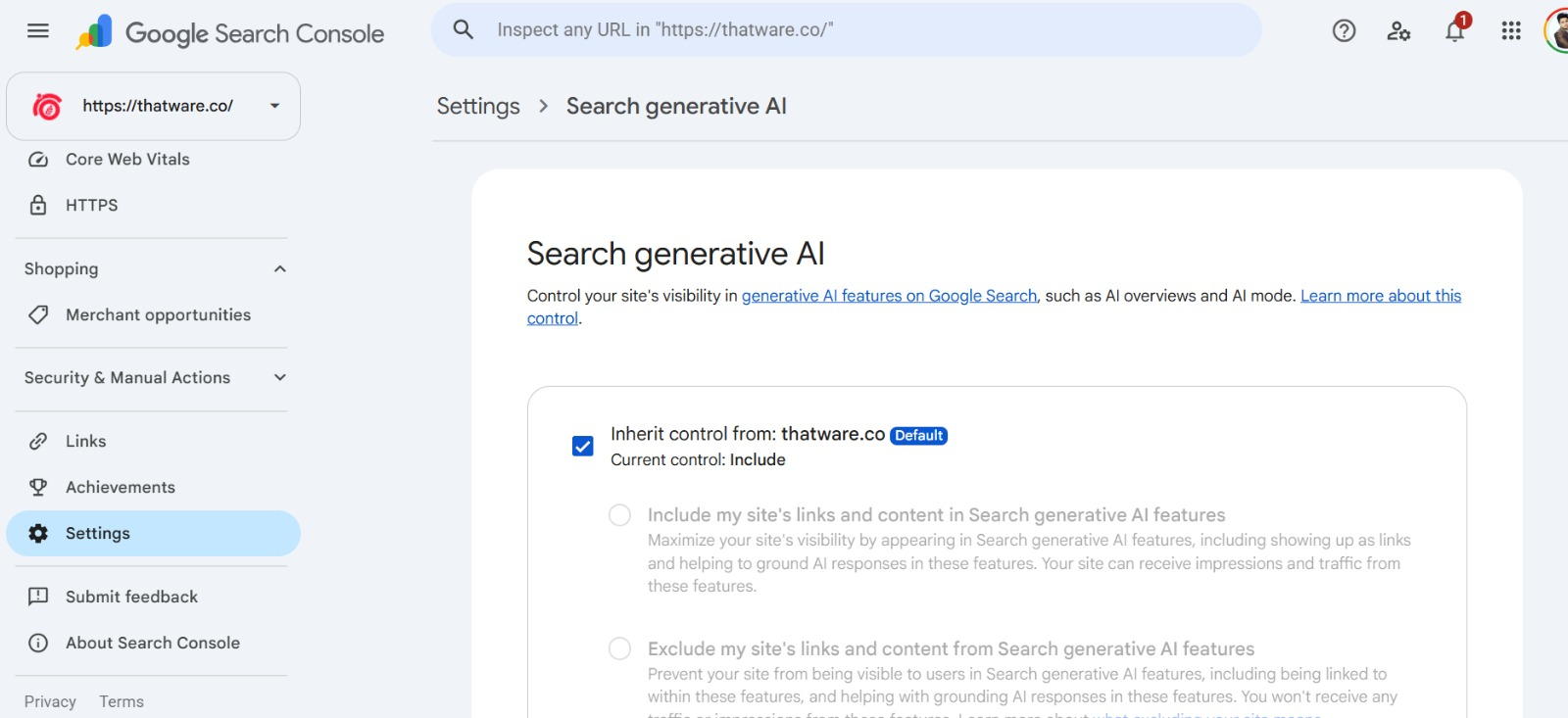
The new Search Console interface also includes a separate “Search generative AI” setting, which governs how a site can participate in Google’s supported generative-AI Search experiences.
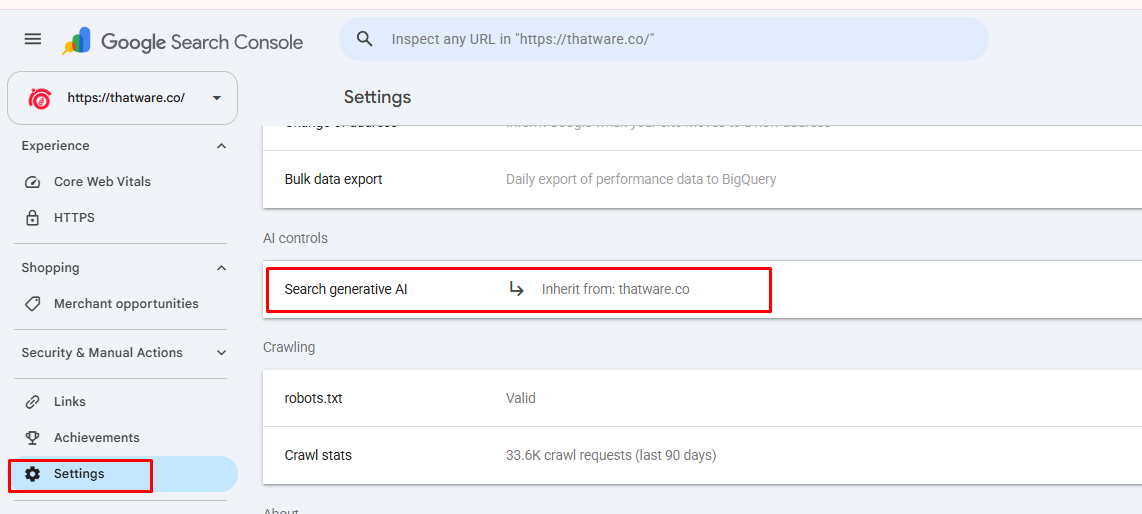
Settings → Search generative AI
This is not the same thing as the Generative AI performance report.
The distinction can be summarised simply:
Generative AI Performance Report = Measurement
Search Generative AI Control = Inclusion/Exclusion Management
Google describes three possible control states:
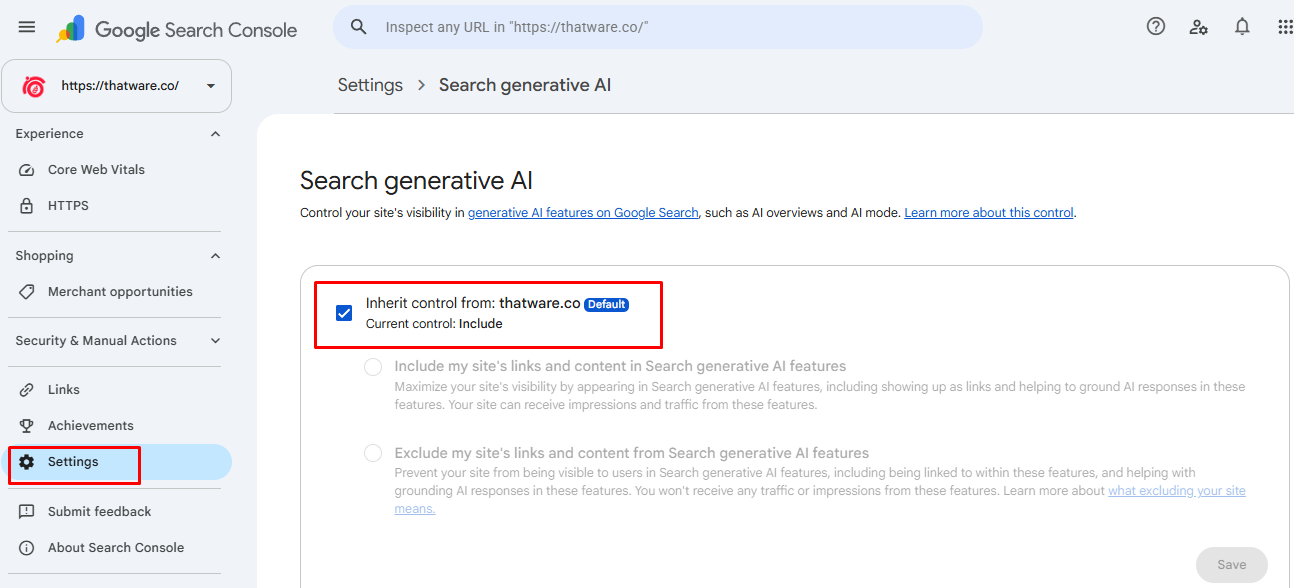
Include
The site’s links and content can appear in supported generative-AI Search features. Google says the site can receive impressions and traffic from these features. This is the default control for properties unless another property-level inheritance applies.
Exclude
The site’s links and content are prevented from appearing in the affected generative-AI Search features. Google states that excluded sites will not receive traffic or impressions from those features.
Inherit From Parent
The property follows the Search generative-AI control configured at its parent property level. Changes to the parent automatically apply to the child property unless the child overrides the setting.
“Inherit control from: thatware.co”
and:
“Current control: Include”
This means the property is inheriting the inclusion setting from the parent property rather than independently defining its own setting.
Why Inclusion Matters for AI Visibility
The inclusion setting has strategic importance because a website cannot measure generative-AI visibility from a feature it has deliberately excluded itself from.
Google states that when a site is excluded, its content cannot appear in the affected generative-AI features, cannot be linked within them and cannot be used as an input for generating an AI response or preview within those features.
However, this control should not be misunderstood as a traditional ranking signal.
Google explicitly states that the control does not act as a ranking or inclusion signal for other parts of Search.
In other words, choosing inclusion does not mean Google is promising that the website will appear in AI Overviews or AI Mode.
It simply means the site’s content remains eligible for those generative-AI experiences.
That distinction is crucial:
Eligibility does not guarantee visibility.
And:
Visibility does not guarantee traffic.
These are three different stages of the AI Search ecosystem.
Search Console Is Measuring Google’s AI Ecosystem, Not the Entire AI Ecosystem
The new Generative AI section represents a major development, but its boundaries should remain clear.
Google’s Search report currently covers:
AI Overviews + AI Mode
It does not become a universal dashboard for every generative-AI platform.
For example, separate monitoring would still be required to determine whether a brand appears in:
- ChatGPT
- Claude
- Perplexity
- Copilot
- Gemini outside the relevant Google Search experiences
- Grok
- Other AI assistants and answer engines
This is why the emergence of Google’s generative-AI reporting does not eliminate the need for broader AI visibility measurement.
Instead, it gives SEO teams an authoritative first-party data source for one major part of the ecosystem.
A mature AI Search measurement strategy can therefore use:
Google Search Console → Google AI visibility
alongside:
External AI monitoring → Cross-platform LLM visibility
and:
Analytics/CRM → Business outcomes
Together, these provide a much more complete picture.
The Most Important Shift: AI Visibility Is Now Measurable
The real importance of the new Search Console section is not the navigation label.
It is the change in measurement philosophy behind it.
Previously, an SEO team could manually test hundreds of queries and record whether its brand or pages appeared in AI-generated search experiences.
That approach can still be useful, but it is inherently limited.
Google’s new reporting introduces first-party performance data that can be analysed systematically.
SEO teams can now begin building historical datasets around questions such as:
Which pages are gaining AI exposure?
Which markets are producing AI visibility?
Is AI visibility growing over time?
Which content categories appear most frequently?
How does AI exposure change after optimisation?
These questions turn generative-AI visibility from a largely observational concept into a measurable SEO performance layer.
The data is still relatively new, the feature is still in rollout, and the reporting does not provide every piece of information marketers may want. But the direction is clear.
Google Search Console is beginning to recognise that being visible in an AI-generated answer is a distinct form of search exposure.
And for SEO professionals, that means the Search Console workflow is no longer limited to asking:
“Where does my page rank?”
It can increasingly include:
“Where is my page being surfaced when Google generates the answer?”
That is the fundamental idea behind the new Generative AI section.
What Generative AI Visibility Means
Generative AI visibility refers to a website’s exposure within AI-generated search experiences where search engines use artificial intelligence to synthesise information and present answers, summaries or recommendations. In Google’s ecosystem, the new Search Console reporting specifically measures visibility generated through supported generative-AI features such as AI Overviews and AI Mode.
This is different from traditional organic visibility. In conventional Search, a website competes for a position in the search results. With generative AI, a page can instead become one of the sources presented within an AI-generated response.
Traditional Rankings vs Generative AI Visibility
The difference can be illustrated simply:
Traditional Search:
Search query → Organic results → Ranking position → Impression → Click
Generative AI Search:
Search query → AI interpretation → Generated response → Source/link exposure → Impression → Possible click
The second journey does not eliminate traditional rankings. Instead, it introduces another location where a website can be discovered.
For example, someone searching for a complex question may receive an AI-generated response containing several supporting links. A website appearing among those sources gains visibility even if the user never scrolls through the conventional organic listings.
That exposure has value because users can encounter the website, brand or content while consuming the AI-generated answer.
Visibility Does Not Mean Traffic
One of the most important distinctions when analysing Google’s new reporting is that AI visibility should not automatically be treated as traffic.
An impression indicates exposure. It does not necessarily mean that the user clicked the link, visited the website or converted into a customer.
Similarly, an AI impression should not automatically be interpreted as a traditional ranking position.
This means businesses should evaluate generative-AI visibility as a separate performance layer alongside conventional SEO metrics.
Why AI Visibility Matters
Generative-AI visibility is becoming strategically important because search behaviour is moving beyond simple keyword-to-ranking interactions.
Users increasingly ask longer, more conversational and multi-part questions. AI-powered search systems can interpret those questions, combine information from multiple sources and present a consolidated response.
For businesses, this creates a new opportunity: becoming one of the sources that informs the answer.
However, Google’s Search Console reporting currently covers Google’s own supported generative-AI search experiences. It should not be confused with a universal measure of visibility across ChatGPT, Claude, Perplexity or other independent AI platforms.
The broader concept of AI Search visibility therefore extends beyond what Search Console currently reports, making it useful to combine Google’s first-party data with other AI visibility and brand-monitoring methods.
Metrics & Data
Google’s new Generative AI reporting introduces a dedicated way to measure how websites appear within supported AI-powered search experiences. For SEO teams, the most important point is that the report currently focuses primarily on impressions, supported by dimensions that help explain where that visibility comes from.
Generative AI Impressions
The central metric is Generative AI impressions. Google defines these as impressions generated when links to a website are displayed within a supported generative-AI feature in Google Search. The current Search reporting covers AI Overviews and AI Mode.
An impression represents visibility, not necessarily engagement. If a website’s link appears within an AI-generated search experience, it can contribute to the site’s impression data even when the user does not click through to the website.
Therefore, AI impressions should not be directly equated with:
- Website sessions
- Clicks
- Conversions
- Traditional search rankings
- Revenue
Instead, they provide an indication of how frequently a website is being exposed through Google’s AI-powered search experiences.
Pages
The Pages dimension shows which URLs are receiving generative-AI impressions. This can help SEO teams identify content that is gaining visibility within AI search.
For example, a business may discover that its detailed guides, service pages or research content receive substantially more AI exposure than shorter informational pages.
This makes page-level analysis useful for identifying content patterns worth replicating.
Countries
The Countries dimension reveals where generative-AI impressions originate. This is particularly valuable for international businesses because AI visibility may differ considerably between markets.
A website could have strong AI exposure in the United States but relatively limited visibility in another target market. Country-level data can therefore reveal opportunities that would be hidden by a single global impression figure.
Devices
Search Console also allows AI performance to be examined by device, including mobile, desktop and tablet.
This provides additional context when evaluating how users encounter a website through AI-powered search.
Dates and Trends
Finally, date-based analysis allows businesses to track changes in generative-AI visibility over time. Rather than focusing on a single impression figure, SEO teams can establish a baseline and monitor whether AI exposure increases or decreases following content, technical or strategic changes.
The most useful approach is therefore to treat AI impressions as the starting metric and use pages, countries, devices and dates to understand the context behind the number.
AI Overviews & AI Mode
Google’s new Generative AI performance reporting currently covers two major generative-AI experiences within Google Search: AI Overviews and AI Mode. Google introduced the dedicated reporting so website owners can understand how their pages are being exposed within these newer search experiences rather than relying only on conventional organic-search metrics.
AI Overviews
AI Overviews provide an AI-generated summary within the Google Search results, accompanied by links to web resources that support the information presented. They are designed to help users understand a topic quickly while providing pathways to explore the underlying sources.
For website owners, this creates a different form of search visibility. A page may be surfaced as a supporting source inside an AI Overview rather than appearing only as a conventional organic result.
Search Console now includes impressions from these AI Overview appearances in its Generative AI performance report. Google explains that, for an AI Overview link to count as an impression, the link must be scrolled or expanded into view. Clicking a link to an external webpage counts as a click.
This makes AI Overview visibility particularly useful for understanding whether content is being surfaced within Google’s generated answers, even when traditional ranking data alone does not tell the complete story.
AI Mode
AI Mode goes further by providing a more interactive, conversational search experience. Instead of simply presenting an AI-generated summary alongside conventional results, AI Mode allows users to continue exploring a topic through follow-up questions.
Google explains that AI Mode can break a user’s question into subtopics and search for information across those areas simultaneously. It can then provide an AI-powered response with links to supporting web resources.
This creates a potentially more complex visibility environment than a single traditional search query.
A user might begin with one question, ask a follow-up, refine the topic and continue the interaction. Google treats a follow-up question in AI Mode as a new query, with the associated impressions, clicks and other Search Console data attributed to that new query.
Why the Distinction Matters
For SEO teams, AI Overviews and AI Mode should not be treated as identical experiences.
| AI Overviews | AI Mode |
| AI-generated search summary | More interactive AI search experience |
| Appears within Search results | Designed for deeper conversational exploration |
| Links support the generated overview | Links support an ongoing AI-powered response |
| Visibility can occur within an Overview | Visibility can occur across follow-up searches |
Both are currently included in Google’s Generative AI performance reporting, giving businesses a first-party way to monitor exposure across these AI-powered Search experiences.
The strategic takeaway is simple: Google Search visibility is no longer limited to where a webpage ranks in conventional results. Pages can also gain exposure by becoming sources within AI-generated search experiences. Search Console’s new reporting provides the first dedicated Google measurement layer for tracking that emerging form of visibility.
Generative AI in Google Discover
Google’s generative-AI reporting is not limited to the main Search results page. Google has also introduced a separate Generative AI performance report for Discover, allowing website owners to measure how their content performs when it appears in generative-AI experiences within Google Discover.
This is important because Discover operates differently from traditional Search. Users do not necessarily enter a query. Instead, Google presents content based on users’ interests and activity.
What the Discover Report Measures
The Discover report focuses on generative-AI impressions. An impression is recorded when a link to a website is shown to a user within a generative-AI feature in Discover and the relevant result is scrolled into view. Google counts only one impression per result per session, even if the user scrolls past the result and then returns to it.
The report currently provides three main dimensions:
- Pages: Which canonical URLs are appearing
- Countries: Where the content is being viewed
- Dates: How AI visibility changes over time
Unlike the Search generative-AI report, device data is not currently listed as a dimension for the Discover report.
Why Discover AI Visibility Matters
For publishers, media organisations and content-heavy websites, Discover can provide an additional source of exposure beyond conventional search.
A page may therefore have several different discovery pathways:
Organic Search → AI Overviews → AI Mode → Discover → Generative-AI Discover features
The new report helps separate AI-driven Discover exposure from the broader Discover performance picture.
It can also reveal which types of content are most likely to gain AI visibility. A publisher might discover that explanatory articles, visual content, news stories or evergreen resources consistently receive more exposure than other content categories.
Discover and Search Should Not Be Combined Blindly
Search and Discover represent different user journeys, so their generative-AI data should be analysed separately.
Search visibility generally begins with a user’s information need or query. Discover visibility is driven more by content relevance to the user’s interests.
Google therefore provides separate Generative AI performance reports for Search and Discover, rather than treating all AI exposure as one undifferentiated metric.
For organisations with significant Discover traffic, this creates an additional measurement opportunity: understanding not only whether content is being discovered, but whether it is gaining exposure through Google’s emerging AI-powered Discover experiences.
Search Generative AI Control
Alongside the new performance reports, Google Search Console now includes a Search generative AI control that allows eligible website owners to manage whether their site’s links and content can appear in supported generative-AI features. The control currently applies to AI Overviews, AI Mode and generative-AI features in Google Discover.
This feature is important, but it should not be confused with the performance report.
The simplest distinction is:
Generative AI report = measure visibility
Search generative AI control = manage eligibility
Include, Exclude and Inherit
Google provides three control options.
Include my site’s links and content allows a website’s content to appear in supported generative-AI features, including being linked within those experiences and helping Google’s systems ground AI responses. Eligible sites can receive impressions and traffic from these features.
Exclude my site’s links and content prevents the site’s content from appearing in the affected generative-AI features. Google states that excluded sites will not receive impressions or traffic from those features, and their crawled content will not be eligible to help generate an AI response or preview within them.
Inherit control from parent allows a property to follow the setting of its parent property. This is particularly relevant for organisations managing domain-level and URL-prefix properties.
In the Search Console settings shown for the property, the Search generative AI control is set to “Include”, indicating that the site’s content and links are eligible to appear in Google’s supported generative-AI Search experiences.
Does “Include” Guarantee AI Visibility?
No.
This is one of the most important distinctions.
Include means eligible, not guaranteed.
Selecting Include does not mean Google will automatically show the site’s pages in AI Overviews, AI Mode or Discover. Actual visibility still depends on Google’s systems and the relevance of the content to individual search or discovery experiences.
Therefore:
Include → Eligibility
AI selection → Actual exposure
Impression → Measurable visibility
Click → User engagement
These should not be treated as interchangeable outcomes.
Does Exclusion Affect Normal Google Rankings?
Google explicitly states that the Search generative-AI control is not a ranking or inclusion signal for other parts of Search. It specifically controls whether content can appear in the affected generative-AI experiences.
This means businesses should not interpret the setting as a conventional SEO ranking switch.
Google also distinguishes this control from other mechanisms. It does not control AI model training; Google says publishers seeking to limit training use of the relevant models should consider Google-Extended. Similarly, completely removing a page from Google Search requires mechanisms such as noindex, rather than this AI-specific control.
Why Businesses Should Pay Attention
For most businesses, generative-AI visibility is becoming another potential discovery channel.
Choosing to remain eligible allows the organisation to participate in Google’s AI-powered search ecosystem and collect performance data through the new reporting.
However, organisations should make this decision deliberately. Large publishers, regulated businesses and organisations with strict content-licensing requirements may have different considerations from businesses whose primary objective is maximum search visibility.
The control therefore adds something important to Google’s AI Search ecosystem: website owners now have both a measurement mechanism and an explicit eligibility control.
What Google Search Console Does Not Measure
The new Generative AI reports represent a major development, but they do not provide a complete picture of AI Search visibility.
Google’s reporting is specifically focused on generative-AI experiences within Google’s own Search and Discover ecosystem. The Search report currently covers AI Overviews and AI Mode, while Discover has a separate report.
This creates several important limitations.
It Does Not Measure Every AI Platform
Search Console cannot be treated as a universal tracker for:
- ChatGPT
- Claude
- Perplexity
- Microsoft Copilot
- Grok
- Other independent AI assistants
A brand could have substantial visibility in those platforms while showing relatively limited Google generative-AI visibility, or the opposite.
It Does Not Provide a Universal AI Visibility Score
Google does not currently provide a single score such as:
“Your brand has 82% AI visibility.”
Instead, it provides performance data, primarily impressions, with dimensions such as pages, countries, devices and dates for Search.
This is useful because raw data can be incorporated into a company’s own measurement framework, but it means marketers still need to define what success means.
It Does Not Show Every AI Interaction
An impression tells you that a link was shown within a supported generative-AI experience. It does not provide a complete record of everything a user did with the AI response.
For example, an SEO team should not assume that every AI impression represents a website visit, meaningful brand engagement or conversion.
It Does Not Replace Brand Monitoring
A website can be visible in an AI answer without necessarily having a traditional website click.
Conversely, a brand might be mentioned conversationally without its website being the linked source.
That distinction makes brand mention monitoring valuable alongside URL-based Search Console reporting.
It Does Not Explain Why Google Selected a Page
Search Console can show which pages received AI impressions, but the report should not be interpreted as a direct explanation of Google’s selection process.
It does not provide a field saying:
“This page was selected because it had stronger entity authority.”
SEO professionals therefore still need to analyse content quality, topical relevance, technical accessibility, internal linking, authority and other factors independently.
It Does Not Provide Complete Prompt-Level Intelligence
The report should also not be treated as a comprehensive prompt database.
Businesses cannot use it as a universal list of every conversational question for which their brand appeared across Google’s AI ecosystem.
This is an important limitation for GEO teams because understanding which questions trigger visibility can be as important as understanding how many impressions were generated.
The practical conclusion is straightforward: Google Search Console provides an important Google-specific AI visibility layer, not a complete AI Search intelligence platform.
Google Search Console vs GEO and LLM Measurement
The arrival of generative-AI reporting makes it tempting to ask whether Google Search Console has effectively replaced GEO or LLM visibility platforms.
It has not.
Instead, the two approaches answer different questions.
What Search Console Measures
Google Search Console is a first-party Google performance source.
Its new Generative AI report answers questions such as:
- How many generative-AI impressions did my site receive?
- Which pages received them?
- Which countries generated them?
- Which devices were involved?
- How did visibility change over time?
For Search, this currently covers AI Overviews and AI Mode.
This makes GSC particularly valuable because the data comes directly from Google’s own search ecosystem.
What GEO Measurement Adds
A broader Generative Engine Optimisation (GEO) measurement system can examine AI visibility beyond Google’s Search Console environment.
Depending on the platform, this can include:
- Brand mentions
- Product mentions
- Service recommendations
- Citation frequency
- Source selection
- Competitor visibility
- Prompt-level visibility
- Topic-level visibility
- AI answer sentiment
- Cross-platform performance
The objective is different.
GSC asks:
“How visible is my website in Google’s generative-AI Search experiences?”
Broader GEO measurement asks:
“How visible and influential is my brand across AI-driven answer environments?”
LLM Visibility Is Another Layer
LLM monitoring can focus specifically on how large language models represent a company, product, organisation or subject.
For example, an enterprise might test hundreds of commercially relevant prompts across multiple AI systems and measure:
Brand mentioned → Brand recommended → Brand cited → Competitor cited → No brand visibility
This can reveal information that Google Search Console does not provide.
The Two Should Work Together
The strongest measurement framework is therefore not:
GSC vs GEO
It is:
GSC + GEO + Analytics + Business Data
GSC provides Google-specific visibility.
GEO/LLM monitoring provides broader AI visibility.
Analytics measures user behaviour.
CRM and business systems measure outcomes.
Together, they provide a more complete picture of how AI is influencing discovery.
How Businesses Should Respond
Businesses should not respond to Google’s new reporting by abandoning traditional SEO and focusing exclusively on AI.
The better approach is to extend the existing SEO measurement framework.
1. Establish an AI Visibility Baseline
Start by recording current generative-AI impressions, top pages, countries and devices.
The goal is not to achieve a particular number immediately. The first objective is to understand the current state.
2. Identify AI-Visible Content
Look at which URLs receive the greatest exposure.
Then compare those pages with content receiving little or no AI visibility.
Look for differences in:
- Topic depth
- Content structure
- Expertise
- Internal linking
- Entity coverage
- Supporting evidence
- Search intent alignment
3. Connect AI Visibility With Organic Performance
A page receiving strong traditional rankings and strong AI exposure may be an important strategic asset.
A page ranking well but receiving limited AI exposure may deserve further investigation.
Likewise, pages receiving AI exposure despite modest traditional rankings may reveal new content opportunities.
4. Expand Measurement Beyond Google
Use Search Console as the Google-specific layer, then supplement it with broader AI visibility monitoring where appropriate.
This is particularly important for businesses whose customers increasingly use multiple AI assistants.
5. Focus on Business Outcomes
Ultimately, AI visibility is not the final objective.
The objective is to improve:
Discovery → Trust → Engagement → Conversion → Revenue
AI impressions should therefore be treated as an important leading indicator rather than the final business KPI.
Optimisation Strategy for Generative-AI Visibility
Google’s new reporting does not introduce a separate checklist that guarantees AI visibility. Instead, businesses should continue building technically accessible, useful and authoritative content while analysing which pages gain exposure in AI-powered Search.
Create Clear, Answer-Oriented Content
AI systems need to understand what a page is about.
Pages should answer important questions directly, use logical structures and avoid unnecessary ambiguity.
Strong headings, concise explanations, definitions, examples and supporting evidence can make complex information easier to interpret.
Build Topic Depth
A single isolated article is rarely enough to demonstrate comprehensive expertise around a competitive subject.
Create connected content covering:
- Core concepts
- Related questions
- Comparisons
- Practical implementation
- Examples
- Common problems
- Industry-specific applications
This creates a stronger topical ecosystem.
Strengthen Entity Understanding
Generative-AI systems work with concepts, entities and relationships rather than relying exclusively on exact keyword matches.
Businesses should therefore maintain consistent information about:
- Company
- Products
- Services
- People
- Locations
- Industry expertise
- Partnerships
- Relevant organisations
Consistency across the website and reputable external sources can help establish a clearer digital representation of the organisation.
Improve Internal Linking
Internal links help connect related information across a site.
Instead of treating every article as an isolated asset, build meaningful relationships between:
Pillar page → Supporting article → Detailed resource → Case study
This creates a more coherent information architecture.
Demonstrate First-Hand Expertise
AI Search optimisation should not become an exercise in producing generic summaries.
Original research, proprietary data, case studies, expert commentary, examples and documented experience can make content more useful and distinctive.
Keep Technical SEO Strong
Generative AI does not remove the need for crawlability and indexability.
Search engines still need to access, understand and process content.
Technical fundamentals therefore remain essential:
- Crawlable pages
- Correct indexing
- Canonicalisation
- Logical internal linking
- Fast and usable pages
- Accurate structured data where appropriate
- Clear site architecture
The best AI Search strategy is therefore an extension of strong SEO, not a replacement for it.
Building a Generative-AI Measurement Framework
The new GSC report provides the starting data, but businesses need a framework for turning that data into decisions.
A practical framework can have five layers.
Layer 1: Visibility
Track:
- Generative-AI impressions
- AI-visible URLs
- Country distribution
- Device distribution
- Visibility trends
This establishes the basic exposure level.
Layer 2: Content
Analyse which pages generate the greatest AI exposure.
Group them by content type, topic, funnel stage and business purpose.
This can reveal which content formats perform best.
Layer 3: Brand and Entity
Track how consistently the organisation, products and key entities appear across AI environments.
This requires broader monitoring beyond GSC.
Layer 4: Engagement
Connect AI visibility with:
- Organic clicks
- Sessions
- Engagement
- Leads
- Assisted conversions
This helps determine whether visibility is producing meaningful user behaviour.
Layer 5: Business Outcomes
The final layer connects AI Search to commercial performance.
Possible measures include:
AI visibility → Website engagement → Lead generation → Sales opportunity → Revenue
This prevents the organisation from optimising for impressions simply because impressions are easy to measure.
The objective should be to determine whether greater AI visibility contributes to stronger business performance.
A Practical 90-Day Generative-AI SEO Strategy
A 90-day programme provides enough time to establish a baseline, optimise priority content and evaluate meaningful trends.
Days 1–30: Measure
First, establish the baseline.
- Access the Generative AI report
- Record total impressions
- Identify top AI-visible pages
- Analyse countries and devices
- Review the Search generative AI control
- Compare AI visibility with conventional Search performance
Do not make major strategic conclusions from a single day of data.
Days 31–60: Optimise
Focus on the pages with the greatest strategic potential.
Improve:
- Content depth
- Question coverage
- Internal linking
- Entity clarity
- Evidence and expertise
- Technical accessibility
Prioritise commercially important pages rather than simply optimising the URLs with the largest impression counts.
Days 61–90: Evaluate
Compare the new data against the baseline.
Look for:
- Growth in AI impressions
- New AI-visible pages
- Changes by country
- Changes by device
- Strong-performing content patterns
- Pages that remain underrepresented
Then use those findings to define the next optimisation cycle.
The process should be iterative rather than a one-time AI SEO campaign.
ThatWare Example: Reading the New GSC AI Data
ThatWare provides a practical example of how this new reporting environment can be used to evaluate generative-AI search visibility. Within its Google Search Console property, the Generative AI section under Performance provides a dedicated Generative AI Features report, allowing AI-driven search exposure to be analysed separately from conventional organic-search performance.
The report presents generative-AI impressions over the selected reporting period, making it possible to establish a baseline for ThatWare’s visibility within Google’s supported AI-powered Search experiences. This creates an additional performance layer that can be analysed alongside traditional impressions, clicks, rankings and organic traffic.
The important point is not simply the headline number.
The value comes from analysing what sits behind that number.
An SEO team can use the report to identify which ThatWare URLs are receiving generative-AI exposure, which countries contribute to that visibility, how performance changes over time and which device categories generate impressions. Google’s documentation confirms that these are the core dimensions available within the Search report.
For ThatWare, the Search generative AI setting is configured to “Include”, with the property inheriting this control from the parent thatware.co property. This means ThatWare’s content and links are eligible to appear within Google’s supported generative-AI Search experiences, subject to Google’s systems determining when the content is relevant.
That means the property is eligible for inclusion in Google’s supported generative-AI experiences, subject to Google’s own systems determining when and where content is relevant.
For ThatWare, the most useful next step is therefore not simply to report the aggregate AI impression number. A stronger analysis would connect the GSC data with the site’s content inventory, priority services, entity visibility and broader AI Search monitoring.
That would transform the new Search Console report from a standalone metric into part of a wider AI visibility intelligence framework.
Conclusion
Google Search Console’s new generative-AI reporting marks an important shift in SEO measurement. AI Overviews, AI Mode and generative-AI Discover experiences create new places where websites can gain visibility, and Google is now providing first-party data to help measure that exposure.
But GSC is only one layer. The most effective strategy combines Google AI visibility, traditional SEO, broader GEO/LLM monitoring and business outcomes. The future of search measurement is therefore not about replacing rankings with AI impressions, but understanding how every form of search visibility contributes to discovery and growth.