
SUPERCHARGE YOUR ONLINE VISIBILITY! CONTACT US AND LET’S ACHIEVE EXCELLENCE TOGETHER!
Publishing content at scale has never been easier. A website can now move from a few dozen articles to hundreds or even thousands of pages in a relatively short period. Automation, structured databases, templates, and AI-assisted workflows have made it possible to target a much wider range of searches without increasing production time at the same rate.
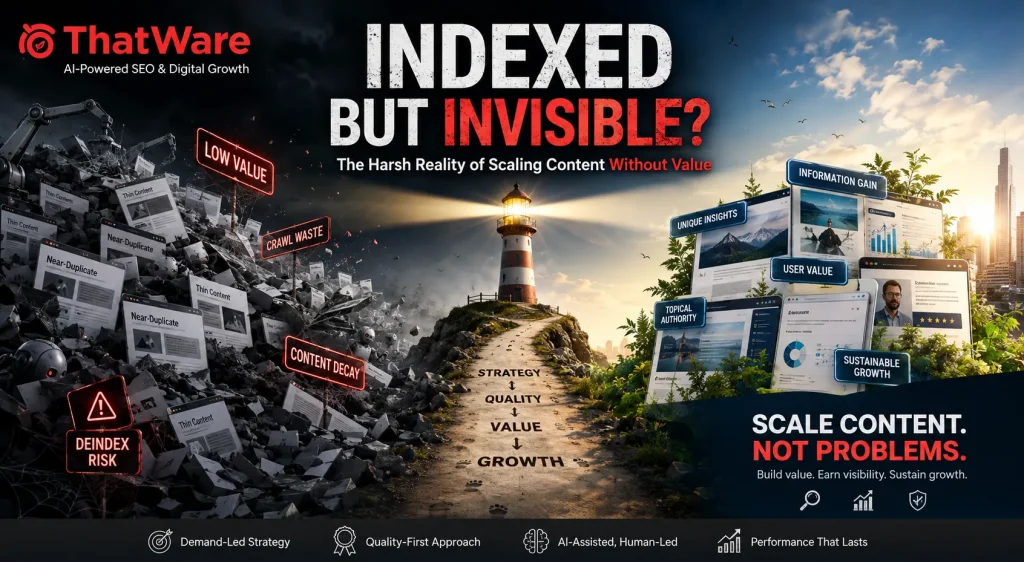
At first, the results can look impressive. New URLs may be discovered quickly, impressions can increase, and some pages may begin appearing for long-tail searches. For businesses investing heavily in SEO Content Writing, a rapid rise in indexed pages can create the impression that greater publishing volume will naturally lead to greater organic growth.
But discovery and indexing are only the beginning.
A search engine may find and process a URL without deciding that the page deserves consistent visibility. A newly published page needs to demonstrate relevance, usefulness, originality, and a clear reason to exist alongside the many other pages already available. If hundreds of similar URLs are created without enough independent value, the size of the website can become a burden rather than an advantage.
This raises an important question: What happens when a website creates content faster than search engines can justify continuously crawling, processing, and maintaining it?
The answer involves more than the debate around AI-generated content. The real challenge is managing scale responsibly. Search engines have finite resources, and websites have to demonstrate that their expanding content inventory deserves continued attention.
Successful content scaling therefore depends on several connected factors: content quality, search demand, resource allocation, technical efficiency, user value, and long-term index stability. The goal is not simply to create more URLs. It is to build an expanding content ecosystem in which each important page has a legitimate purpose and can continue contributing value after the initial publishing surge fades.
Indexing Is Not the Finish Line
Getting a page indexed is often treated as one of the clearest signs that a content strategy is working. In reality, indexing represents only one stage of a much longer search process. A page can be discovered, crawled, processed, and added to a search engine’s index without becoming a reliable source of organic traffic.
What Indexing Actually Means
The process generally begins with discovery. Search engines identify a URL through internal links, XML sitemaps, external references, or other signals. The URL may then be crawled, allowing the search engine to retrieve its content and resources.
Next comes processing, where the page is interpreted in relation to its content, structure, relevance, and other signals. If the page meets the requirements for inclusion, it can enter the index, which is essentially the database from which search results are generated.
Only after these stages does the question of ranking become relevant. Being indexed means a page can potentially appear in search results; it does not mean that it will rank prominently or consistently.
This distinction is especially important when evaluating large-scale SEO Content Writing campaigns. A growing number of indexed URLs may indicate successful discovery, but it does not automatically demonstrate that those pages are valuable enough to attract users or maintain visibility.
The Difference Between Index Coverage and Search Performance
Index coverage measures how many pages are available to appear in search. Search performance asks a much more important question: Are those pages actually helping users and generating meaningful organic results?
A website can have thousands of indexed URLs while receiving limited traffic from most of them. Some pages may rank for insignificant queries, compete with other pages on the same domain, or receive impressions without generating clicks. Others may initially perform well and gradually lose visibility.
This is where modern AI Search SEO strategies need to look beyond the number of indexed pages. Sustainable performance depends on whether individual URLs satisfy genuine search intent and provide enough value to justify their continued presence.
Indexation can also change over time. A page that appears in the index today may receive less visibility later, particularly if it fails to establish a strong reason to remain competitive. Therefore, indexation should be treated as a continuing process rather than a permanent achievement.
Why Fast Publishing Can Create a False Sense of Success
Rapid content launches often produce encouraging early reports. Hundreds of pages may become discoverable, impressions may rise, and a growing index count can make the campaign appear highly productive.
The problem is that early performance does not always reveal long-term quality. New pages need time to demonstrate whether they can satisfy users, attract engagement, earn recognition, and compete against existing information.
A large publishing spike can therefore create a misleading success signal. The important measurement is not simply how many pages entered the index, but how many continue to earn meaningful visibility after the initial launch period.
For that reason, content scaling should be evaluated through lasting search performance, page-level value, and index stability, rather than URL volume alone.
What Happens When You Suddenly Add Thousands of URLs?
A major expansion in a website’s URL count changes the scale of the search engine’s task. Adding a few useful pages is very different from introducing thousands of URLs within a short period. The larger the inventory becomes, the more important it is to understand how crawling, processing, and ongoing evaluation work together.
3.1 Google Has to Allocate Resources
Search engines operate on enormous infrastructure, but their resources are not unlimited for every individual website. Crawling a page requires retrieving its resources, while rendering may require additional processing when the content depends heavily on JavaScript or other dynamic elements.
After discovering a large collection of URLs, a search engine has to determine which ones deserve further attention. It cannot assume that every newly created page has equal importance or should be revisited at the same frequency.
This creates a relationship between crawl demand and available resources. A website with a rapidly expanding inventory needs to give search engines good reasons to continue processing that inventory. If a large percentage of the new URLs provides little additional value, repeatedly allocating resources to those pages becomes less useful.
This is one reason technical SEO and content strategy need to work together. Efficient architecture can make crawling easier, but technical accessibility alone cannot turn a low-value page into a valuable search result.
3.2 The Website’s Existing Reputation Matters
A website does not begin every content expansion from a completely neutral position. Its history, popularity, links, content quality, and established search presence can influence how confidently search engines approach a growing content inventory.
An established publication with a strong history of producing useful information may be able to introduce new sections at a scale that would be difficult for a newer domain to support immediately. A smaller website with limited signals should not assume that the same publishing volume will receive identical treatment.
This does not mean that smaller websites cannot scale. It means that SEO Content Writing should generally expand in proportion to demonstrated demand, quality, and the site’s ability to support the new content.
3.3 Perceived Inventory vs. Useful Inventory
There is an important difference between the number of URLs that technically exist and the number of URLs that appear genuinely useful.
A website might contain 20,000 URLs, but that does not mean it has 20,000 equally valuable search assets. Some may answer distinct questions, while others may overlap heavily or contribute very little beyond another page.
When a site’s URL inventory suddenly expands, search engines can evaluate the overall content ecosystem differently. The central question becomes less about how much content exists and more about how much of that content appears worthwhile to discover, process, and revisit.
The Content Scaling Threshold: When Quantity Becomes a Liability
There is no universal number of pages at which a website suddenly becomes “too large.” A site with millions of URLs can be healthy, while another with a few thousand can struggle with index quality. The difference usually comes down to the relationship between content, demand, usefulness, and website structure.
The real issue is content-to-demand alignment. If people are searching for distinct information and a website can provide genuinely useful answers, creating additional pages can make sense. Problems emerge when publishing volume becomes the objective instead of solving additional user needs.
One common warning sign is a collection of pages targeting nearly identical searches. For example, a website may create separate pages for closely related variations without offering a meaningful difference in information, service, audience, or intent.
Location-based and service-based pages can create similar problems. Replacing a city or service name while leaving most of the underlying content unchanged does not necessarily create a genuinely local or specialized resource. The same applies to product pages that differ only by minor attributes while providing virtually identical information.
Another warning sign is the creation of pages simply because a keyword appears in a database or content-generation template. A keyword can indicate an opportunity, but it does not automatically justify a standalone URL.
This is where SEO Content Writing needs to move beyond production efficiency. A page should have a clear purpose, a defined audience, and enough independent value to justify its existence.
Programmatic publishing therefore needs a quality threshold, not merely a production target. Before expanding a content cluster, publishers should ask whether the new pages address additional demand, introduce useful information, or solve a distinct problem.
Scale should follow demonstrated demand and information value—not the other way around.
A sustainable strategy grows when evidence supports expansion. It does not create thousands of pages first and wait for search engines to decide whether they were necessary.
The Crawl-to-Value Problem
The economics of large-scale publishing can be understood through a simple relationship: every URL represents a potential source of value, but it also requires resources to discover, process, evaluate, and potentially revisit.
Every URL Has a Processing Cost
A URL first needs to be discovered. Search engines may then crawl its content and retrieve associated resources. Where necessary, rendering can require additional processing before the page can be properly interpreted.
The content must then be analyzed for relevance, quality, duplication, structure, and other signals. If the page is considered suitable for inclusion, there are also storage and indexing considerations. Later, the URL may be reassessed as its content, demand, or surrounding search landscape changes.
These steps mean that adding URLs is not simply a publishing decision. It increases the overall inventory that search engines may need to evaluate.
Why Low-Value URL Clusters Become Problematic
Imagine a website adding thousands of pages that provide almost the same information. Even if those URLs are technically accessible and well formatted, their collective contribution may be small.
When a significant section of a site repeatedly produces little additional value, there is less reason for search engines to treat every URL as equally important. Crawling patterns can therefore become more selective, with greater attention potentially directed toward pages that demonstrate stronger usefulness or demand.
This is why a large URL count should never be confused with a large amount of search value.
Crawl Frequency Can Change Over Time
Newly published pages may attract attention simply because they have entered the search engine’s discovery pipeline. However, initial attention does not guarantee repeated attention.
Over time, persistent value becomes more important. Pages that continue to satisfy users and serve distinct search needs have stronger reasons to remain part of the active content ecosystem.
This distinction between initial discovery and sustained crawl demand is critical for anyone scaling SEO Content Writing. The objective should not be to create a temporary surge of crawl activity. It should be to build a content inventory that continues to justify search engine resources over time.
Ultimately, the crawl-to-value problem is not about avoiding scale. It is about making sure that increasing the number of URLs also increases the amount of useful information available to users.
Why Newly Published Content Can Look Better Than It Really Is
New content can produce encouraging signals soon after publication. Pages may begin appearing for relevant searches, impressions can rise, and a growing number of URLs may become visible in search results. However, early movement does not necessarily indicate that the content has established durable organic value.
The Freshness Effect
Search engines need to discover and evaluate new information continuously. Recently published material can therefore receive an opportunity to compete for relevant searches, particularly when it addresses timely or changing topics.
This initial exposure can make a large publishing campaign appear more successful than it ultimately becomes. A sudden increase in impressions or indexed URLs may reflect the early evaluation of newly created pages rather than proven long-term performance.
For teams investing in Content Marketing, this distinction is particularly important. Early metrics should be treated as signals to investigate, not as final evidence that every newly published page deserves permanent visibility.
The First-Month Trap
Consider a website that publishes several hundred pages within a few weeks. Search engines discover many of the URLs, some begin ranking, and overall impressions increase. Internal reports may show rapid growth across multiple content metrics.
It can be tempting to interpret this as proof that the publishing strategy is working exactly as intended. But the initial increase can change once the pages have been evaluated against competing information and actual user demand.
Some URLs may stabilize, while others lose impressions or rankings. Pages that looked promising during the launch period may eventually receive little organic attention. This is why a short-term traffic increase should not be confused with sustainable search performance.
The Real Test Happens After the Launch
The stronger test begins after the initial publishing period. Do users click the result? Does the page satisfy the underlying search intent? Does it provide information that is genuinely useful rather than merely accurate?
A durable page should also have a clear reason to remain discoverable. It should contribute something beyond what users can already find elsewhere, whether through original analysis, better organization, practical experience, unique data, or a more useful explanation.
Good SEO Content Writing therefore treats publication as the beginning of evaluation, not the end of the process. The long-term question is not whether a page can attract initial attention, but whether it can continue earning that attention.
From Indexing to Deindexing: How the Decline Happens
The journey from publication to long-term search visibility is not linear. A page can move through several stages as search engines discover, process, evaluate, and reassess it. Understanding these stages makes it easier to see why rapid content expansion can produce strong initial numbers followed by declining visibility.
Stage 1 — Content Production
The process begins when a website creates a large number of pages using templates, databases, automation, AI-assisted workflows, or combinations of these methods. The production system may be efficient, but efficiency does not automatically determine whether every resulting URL deserves independent search visibility.
For example, Blog Writing Services can be scaled efficiently when there is genuine editorial demand, but simply increasing article volume does not guarantee that every additional URL will provide unique value.
Stage 2 — Discovery
The new URLs must become discoverable. Internal links, XML sitemaps, external references, and other signals can help search engines identify them.
Discovery, however, does not mean that a page has been accepted as a valuable search result. It simply brings the URL into the evaluation process.
Stage 3 — Crawling and Processing
Once discovered, search engines can retrieve the page and process its content. They may examine its text, structure, relationships, accessibility, and other signals to understand what the URL offers.
Stage 4 — Initial Indexation
Some pages may subsequently enter the search index. Once indexed, they have the potential to appear for relevant queries.
This is where websites can mistakenly equate indexation with success. A page being available for retrieval does not mean it will receive sustained rankings or meaningful traffic.
Stage 5 — Performance Evaluation
Over time, pages are evaluated in a broader search environment. Relevance, usefulness, content quality, competition, demand, and other signals can influence how successfully a page performs.
This is also where Answer Engine Optimization becomes increasingly relevant. Content needs to communicate information clearly enough to satisfy not only traditional search journeys but also increasingly conversational forms of discovery.
Stage 6 — Reduced Attention
If a section of a website contains many URLs that demonstrate limited value or overlapping purposes, search engines may become more selective about how frequently those URLs are revisited.
This does not necessarily happen to every page simultaneously. Search systems can differentiate between stronger and weaker sections of a site.
Stage 7 — Visibility Decline
As pages fail to establish durable value, their rankings and impressions may decline. Some URLs that initially attracted attention may gradually receive very little organic exposure.
This is often the stage where publishers realize that the initial increase in traffic was not sustainable.
Stage 8 — Index Consolidation or Removal
Eventually, some URLs may no longer appear in the search index in the same way. Pages can be consolidated, replaced by stronger results, excluded, or otherwise lose their previous search presence.
There is no universal countdown that determines when this happens. Index persistence varies according to the website, URL, content quality, demand, freshness, competition, and numerous other signals.
The important lesson is that indexation is dynamic. A page earns its continued place in search through sustained usefulness, not simply because it was once discovered and indexed.

The Biggest Problem With Mass-Produced Content: Lack of Information Gain
Information gain can be understood simply as the amount of additional value a page provides beyond what users could already obtain from existing information. A page does not necessarily need to contain completely new facts to create information gain. It can also contribute through original analysis, evidence, examples, first-hand experience, useful comparisons, better interpretation, or a more effective solution to a problem.
The difficulty with mass-produced content is that many pages can become variations of information that already exists. Rewriting several existing sources into slightly different language may create a readable article, but readability alone does not guarantee that the page adds meaningful value.
Consider two approaches. The first produces another general summary of a topic that users can find across dozens of established pages. The second combines available knowledge with original research, practical examples, proprietary data, expert interpretation, or a useful comparison. Both may be factually correct, but the second gives users a stronger reason to choose that resource.
This distinction applies across many types of scaled publishing. AI-generated articles can become repetitive when they simply reorganize commonly available information. Programmatic landing pages can offer little value when only a location, service, or product name changes. Automated translations can also fail to add value when language is converted without adapting terminology, cultural context, or local search intent.
The same principle applies to Website Content created at scale. Creating more pages is worthwhile only when those pages address meaningful information needs that existing content does not adequately serve.
This does not mean every page needs to be extremely long. Length is not a substitute for usefulness. A concise page that directly answers a specific question can be more valuable than a 3,000-word article filled with repeated information.
The objective is therefore not to make every page enormous. It is to make every indexed page worth existing.
That is the standard that sustainable SEO Content Writing should aim for: not maximum output, but maximum usefulness from the content that deserves to be discovered.
Common Scaling Patterns That Create Deindexing Risk
Content scaling becomes risky when automation creates URLs faster than a website can establish a meaningful reason for each page to exist. Several recurring patterns can turn an efficient publishing system into an inefficient content inventory.
Pattern 1: Keyword + Template = New Page
One of the simplest scaling models is to take a standard page template and change a keyword, city, product, or service name. The resulting URLs may look different to a database, but the user experience can remain almost identical.
A seo service agency may be tempted to create individual pages for every possible combination of service and location, for example. Unless each page contains genuinely relevant local information or addresses a distinct search need, the additional URLs may contribute little independent value.
Pattern 2: Thousands of Near-Duplicate Pages
Near-duplicate content can emerge when a publishing system generates many variations with only minor wording or attribute changes. The pages may technically have different URLs while offering essentially the same answer.
The problem is not duplication in a purely textual sense. The bigger concern is whether users have a meaningful reason to choose one page over another. If the distinction between pages is difficult for users to understand, creating separate URLs may not strengthen the site’s overall search presence.
Pattern 3: Automated Translation Without Localization
Translating content into multiple languages can dramatically increase a website’s reach, but direct language conversion is not the same as localization.
A useful localized page may require changes to terminology, currency, measurements, regulations, examples, cultural references, and the way users actually search. Without those adjustments, a translated page may be linguistically correct while still failing to satisfy the needs of its intended audience.
Pattern 4: AI Summaries Without Original Contribution
AI can summarize large quantities of information efficiently. However, producing another summary of information that is already widely available does not automatically give a page a competitive advantage.
A strong content strategy should introduce something additional, such as original analysis, evidence, expert interpretation, practical examples, or a better way of solving the user’s problem. Otherwise, increasing the volume of AI-generated pages can simply increase the volume of information without increasing its usefulness.
Pattern 5: Publishing Before Validating Demand
Another common mistake is building a large inventory around theoretical keyword opportunities before confirming whether those searches represent meaningful user needs.
Keyword research can identify potential topics, but search volume alone does not establish that a standalone page is necessary. Quality seo services should therefore involve understanding intent, competition, audience needs, and the value a new page can add before production begins.
Pattern 6: Treating Every URL as Equally Valuable
Not every URL deserves the same level of investment. Some pages may attract substantial demand, while others may serve narrow or temporary purposes.
Treating every URL as equally important can lead to resources being spread across pages that have little potential. A scalable strategy should instead identify which pages deserve to be created, strengthened, consolidated, or removed based on their actual contribution.
How to Scale Content Without Destroying Index Quality
Responsible scaling does not mean avoiding automation or limiting a website to a small number of pages. It means establishing a system in which new content is created because there is a clear reason for it to exist.
Start With Demand, Not Content Quotas
Content production should begin with user needs rather than an arbitrary monthly target. Before creating a new page, investigate what people are searching for, what type of answer they expect, and whether existing resources adequately address that intent.
This approach prevents teams from measuring success by the number of articles produced. It also helps distinguish genuine opportunities from keyword variations that do not justify independent pages.
A managed seo service approach, for example, should evaluate the broader search opportunity before recommending large-scale expansion rather than treating publishing volume as an objective in itself.
Establish a Minimum Information-Value Threshold
Every page should answer a basic question:
Why should this page exist independently?
The answer could be a distinct search intent, unique research, specialized expertise, original data, a particular audience, a meaningful geographic distinction, or a substantially better user experience.
If the answer is simply that a keyword has been identified, the page probably needs further evaluation before publication.
This threshold is especially important when using SEO Content Writing at scale. Production efficiency should make valuable content easier to create, not make low-value pages easier to multiply.
Build Content Clusters Carefully
A content cluster should cover a subject comprehensively without creating unnecessary competition between pages on the same website.
Before adding another URL, determine whether the intended topic represents a genuinely separate intent or whether the information would be more useful as part of an existing resource. Where several pages overlap heavily, consolidation can produce a stronger result than maintaining them independently.
A well-planned link building services strategy can also support the strongest resources rather than spreading attention across a large collection of weak pages. The objective is to build clear topical relationships and useful pathways between related content.
Introduce Human Review at the Right Points
Automation can accelerate production, but human oversight remains important where judgment is required. Editorial review can identify weak explanations, unsupported claims, repetitive sections, and inconsistencies that automated workflows may overlook.
Subject experts can assess whether information is accurate and useful. Fact checking becomes particularly important for topics involving changing information or specialized knowledge.
Local validation is equally important when content targets specific markets. A page intended for a particular city or region should reflect realities that cannot be reliably inferred from a generic template.
A seo services expert can help connect these editorial considerations with broader technical and search requirements, ensuring that content quality is evaluated before a large inventory is released.
Monitor Indexation Quality, Not Just Indexation Quantity
An expanding index count is only one metric. A healthier content program monitors the quality and behavior of the indexed inventory.
Useful indicators include:
- Indexed URLs.
- Excluded URLs.
- Crawl activity.
- Organic impressions.
- Organic clicks.
- Ranking distribution.
- Traffic per URL.
- Content decay.
- Pages generating meaningful engagement.
These metrics should be reviewed together. For example, thousands of indexed pages combined with very little traffic per URL may indicate that content production is outpacing actual demand.
This is also where voice search seo services can be evaluated differently from conventional content campaigns, because conversational queries may require closer attention to question-based intent and concise answers rather than simply increasing page volume.

Refresh, Consolidate, or Remove
A scalable website needs a process for managing existing content, not just producing new content.
Some pages should be kept because they continue to perform well. Others may need improvement when information becomes outdated or user expectations change. Pages with substantial overlap can be merged, with appropriate redirects used where necessary.
Some URLs may be better handled through noindex directives when they serve a purpose for users but do not need independent search visibility. In other cases, removing genuinely obsolete or unnecessary content may be the most appropriate decision.
The key principle is that content inventory should remain intentional. SEO Content Writing should be treated as an ongoing cycle of creation, evaluation, improvement, consolidation, and refinement rather than a one-way publishing pipeline.
AI Content at Scale: The Right and Wrong Way to Use Automation
AI is not inherently incompatible with large-scale search strategies. The important distinction is how the technology is used and whether the resulting content meets the same usefulness standard expected from any other publishing method.
Automation can support many legitimate activities. It can assist with research, generate initial outlines, organize data, prepare content briefs, create drafts, support internal workflows, and help update structured information. These applications can reduce repetitive work and allow editorial teams to spend more time on areas requiring judgment.
The problem begins when automation becomes a substitute for that judgment. If a system can generate 10,000 pages but there is no meaningful process for determining whether those pages should exist, the production capability becomes a liability.
This creates an important distinction between AI-assisted scale and AI-only production at industrial volume.
In an AI-assisted model, technology helps accelerate a process that still has human-defined objectives, quality controls, factual checks, and editorial standards. The machine handles repetitive tasks while people determine what information matters and whether the finished page deserves publication.
In an AI-only model, the emphasis can shift toward output volume. Templates are expanded, prompts are repeated, and URLs are published because the system can produce them—not necessarily because users need them.
A strong Generative AI SEO strategy therefore should not ask only how quickly content can be generated. It should ask whether automation is improving the usefulness, accuracy, relevance, and scalability of the overall content operation.
Automation should increase efficiency without lowering the value threshold of individual URLs. When technology helps teams produce better resources rather than simply more resources, scale becomes an advantage rather than a source of index quality problems.
How to Build a Sustainable Content Scaling Model
Sustainable content scaling is less about increasing publishing speed and more about creating a reliable feedback loop. A practical framework is:
Research → Validate → Create → Review → Publish → Measure → Improve → Consolidate → Scale
The process begins with research into search behavior, audience needs, competition, and existing content gaps. Validation then determines whether the opportunity is substantial enough to justify a new page. Only after that should production begin.
The creation stage should combine structured workflows with editorial judgment. SEO Content Writing can be scaled efficiently when every page has a defined purpose and a clear audience. Review then checks accuracy, originality, intent alignment, and differentiation before publication.
After publication, measurement becomes critical. Organic impressions, clicks, rankings, engagement, crawl activity, and indexation patterns reveal whether the original assumptions were correct. Pages that perform well can inform the next content expansion, while weak or overlapping pages can be improved or consolidated.
This creates a continuous learning system rather than a one-directional production line.
The unsustainable model looks like:
Generate → Publish → Generate more → Generate more
The sustainable model is:
Publish → Learn → Improve → Validate → Expand
For example, a seo intelligence agency may use performance data to identify which topics deserve deeper coverage rather than automatically expanding every possible keyword variation.
This approach also changes how seo intelligence search is viewed. Search data becomes a source of strategic feedback rather than simply a list of keywords to convert into URLs.
The central principle is simple: content velocity should be earned through evidence. When published pages demonstrate genuine demand and useful outcomes, scaling becomes an informed decision rather than a production gamble.
How ThatWare Manages Content Scaling Without Sacrificing Search Quality
At ThatWare, content scaling is approached as part of a broader search intelligence process rather than as a race to increase URL volume. Being the best GEO company we have a different approach towards content. The focus is on understanding what should be created, how it should be differentiated, and how each content asset contributes to a broader search ecosystem.
Our Approach to Scalable Content
The process begins with understanding search intent, competitive landscapes, semantic relationships, and content gaps. Instead of assuming every keyword requires a separate URL, the strategy considers whether the proposed page has a distinct purpose and meaningful value.
This allows SEO Content Writing to operate within a structured content architecture where new pages are connected to broader topical goals rather than being produced in isolation.
Quality Controls
AI and proprietary analytical systems can assist with research, competitor analysis, semantic interpretation, content planning, and workflow efficiency. However, automation is not treated as a replacement for editorial judgment.
Content differentiation, factual validation, intent alignment, and human review remain important checkpoints. The objective is to ensure that scaling production does not simultaneously scale repetition or weak information.
Technical & Indexation Management
Content quality must be supported by a technically sound website. Crawlability, internal linking, XML sitemaps, canonical signals, indexation monitoring, and content consolidation form part of the broader process.
The approach also considers relationships between pages rather than viewing URLs as isolated assets. Where overlapping resources no longer justify separate visibility, consolidation can be considered instead of continually adding more pages.
Scaling Based on Evidence
Expansion is guided by performance and search intelligence. Stronger content clusters can reveal additional opportunities, while underperforming clusters can indicate that the underlying assumptions need to be revisited.
This evidence-driven approach aligns with Generative Engine Optimization services, where content structure, authority, semantic relationships, and machine interpretation increasingly influence how information can be surfaced across generative search environments.
Protecting Long-Term Organic Visibility
The broader objective is to build useful, authoritative content rather than maximize the number of published URLs. Search intent, topical authority, technical efficiency, and ongoing measurement remain central to that process.
ThatWare’s wider search methodology also extends beyond conventional rankings into Large Language Model SEO, AEO, GEO, semantic optimization, entity understanding, and AI-driven search visibility. The underlying principle remains consistent: scale should strengthen the information ecosystem, not dilute it.
Conclusion: Scale Content, Not Content Problems
Indexing is only the beginning of a page’s search journey. A URL can be discovered and indexed without developing the lasting relevance, usefulness, or demand required for sustained organic visibility.
That is why publishing thousands of pages should never be treated as an automatic growth strategy. Search engines continually evaluate which content deserves processing and visibility, while users determine whether individual resources actually solve their problems.
Sustainable scaling requires a different mindset. Genuine demand should guide production. Each page should provide distinct value. Technical architecture should make the content easy to discover and understand. Editorial oversight should prevent repetition and factual weaknesses. Performance data should determine what gets expanded, improved, consolidated, or removed.
The same principle applies when optimizing content for newer discovery environments. AI Answer Optimization requires information to be useful and clearly structured, not simply abundant.
Likewise, Answer Engine SEO should not become another reason to manufacture thousands of thin pages. The strongest strategy is to create authoritative resources that genuinely address questions and provide information worth retrieving.
Ultimately, the goal is not to get the greatest possible number of pages into Google’s index.
The goal is to build more pages that have a genuine reason to stay there.