SUPERCHARGE YOUR ONLINE VISIBILITY! CONTACT US AND LET’S ACHIEVE EXCELLENCE TOGETHER!
The way people discover information online is changing rapidly. While traditional search engines remain important, businesses are now being found through AI-powered platforms such as ChatGPT, Google AI experiences, Microsoft Copilot, and enterprise AI systems that interpret and deliver answers instead of simply displaying a list of web pages. This shift means that websites must evolve beyond conventional search engine optimisation (SEO). They need to become structured, machine-readable, and semantically rich so that artificial intelligence can accurately understand their content, context, and relationships. In this new era of AI-driven discovery, being visible to AI systems is becoming just as important as ranking well on search engines.
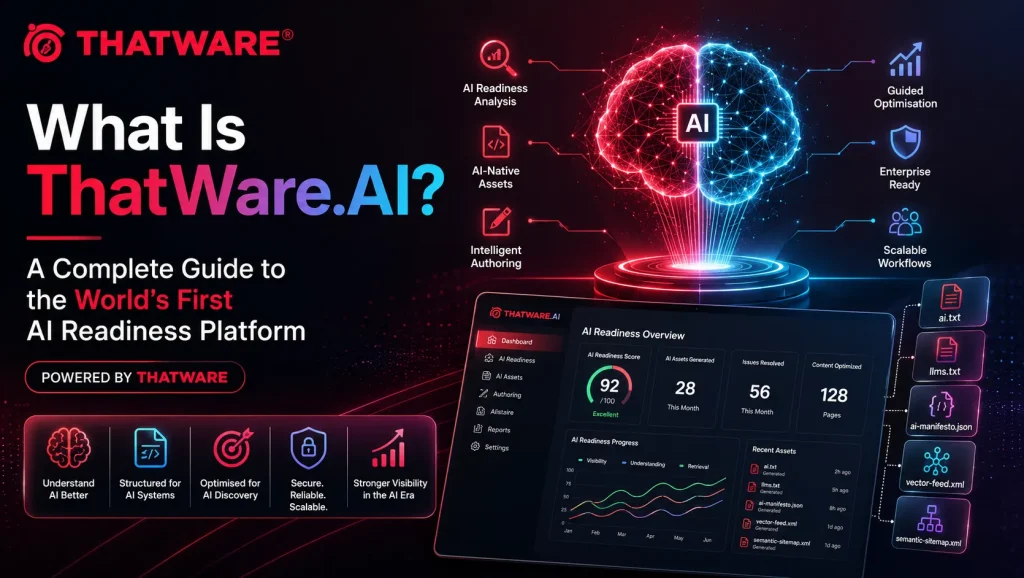
This is where AI Readiness comes into play. AI readiness is the process of preparing a website so that large language models (LLMs), AI crawlers, retrieval systems, and enterprise AI applications can effectively access, interpret, and utilise its content. It goes beyond keywords and backlinks by focusing on semantic organisation, entity relationships, structured information, and AI-friendly assets that enhance machine understanding. As organisations increasingly adopt AI-powered workflows and users rely on conversational search experiences, building websites that communicate effectively with AI systems is becoming a strategic advantage rather than an optional enhancement.
ThatWare.AI, powered by ThatWare, has been developed to help businesses embrace this transformation through a unified AI Readiness Platform. Instead of requiring multiple disconnected tools and manual technical implementation, the platform brings together AI readiness assessment, intelligent content authoring, automated generation of AI-native assets, and guided optimisation within a single workspace. From creating files such as ai.txt, llms.txt, ai-manifesto.json, vector-feed.xml, and semantic-sitemap.xml to helping organisations build websites that are easier for AI systems to understand, ThatWare.AI provides a structured approach to preparing digital properties for the future of AI-powered search, enterprise intelligence, and machine-driven content discovery.
What Is AI Readiness?
Artificial intelligence is transforming the way websites are discovered, understood, and consumed. Unlike traditional search engines that primarily rely on keywords, backlinks, and ranking signals, modern AI systems aim to understand the meaning behind content. Large language models (LLMs), AI-powered search engines, enterprise AI assistants, and retrieval systems analyse the context, relationships, and semantic structure of information before presenting it to users. As a result, businesses need to ensure that their websites are not only optimised for search engines but are also designed to communicate effectively with AI systems. This foundational preparation is known as AI Readiness.
Understanding the Concept of AI Readiness
AI Readiness refers to the process of preparing a website so that artificial intelligence systems can accurately crawl, interpret, organise, and utilise its content. Rather than focusing solely on improving search rankings, AI readiness ensures that every important element of a website—from its content and metadata to its semantic relationships and structured information—is presented in a way that machines can easily understand. The objective is to help AI systems recognise the context of a page, identify important entities, understand how different topics are connected, and retrieve the most relevant information when answering user queries.
An AI-ready website is structured to provide clarity instead of ambiguity. This means creating well-organised content, implementing meaningful metadata, maintaining logical internal linking, and supporting semantic relationships that help AI models build a more accurate representation of the website’s knowledge. The easier it is for AI systems to interpret your content, the greater the likelihood that your information will be surfaced in AI-generated responses, enterprise knowledge systems, or conversational search experiences.
Why AI Readiness Matters Today
The digital landscape has evolved beyond the era of traditional search results. Millions of users now ask questions directly to AI assistants, expecting complete answers rather than a list of links. Platforms powered by artificial intelligence can summarise information, compare products, explain complex topics, and recommend solutions by analysing content from multiple trusted sources. If a website is not structured in a way that these systems can understand, valuable information may be overlooked even if it ranks well in conventional search engines.
This shift means organisations must optimise not only for human visitors but also for machine understanding. AI readiness helps bridge this gap by ensuring that websites provide the context, relationships, and structured information AI systems need to interpret content accurately. As AI becomes increasingly integrated into search, customer support, enterprise software, and digital assistants, businesses that invest in AI readiness are better positioned to remain visible across these emerging channels.
How AI Readiness Differs from Traditional SEO
Although AI readiness and search engine optimisation share the common goal of improving online visibility, they focus on different aspects of digital discovery. Traditional SEO concentrates on helping search engines rank web pages through keyword optimisation, backlinks, page performance, technical SEO, and user experience signals. AI readiness, however, extends beyond rankings by ensuring that artificial intelligence can understand the meaning, context, and relationships within the content itself.
Instead of relying primarily on keyword matching, AI systems evaluate entities, concepts, topical relevance, semantic connections, and structured knowledge. An AI-ready website is therefore designed to communicate information in a way that is understandable to both humans and intelligent machines. Rather than replacing SEO, AI readiness complements it by adding an additional layer of optimisation specifically for AI-driven discovery and retrieval.
The Core Components of an AI-Ready Website
Building an AI-ready website involves more than generating a few technical files. It requires a holistic approach that combines high-quality content with a clear semantic structure and machine-readable assets. Important components typically include well-organised information architecture, structured data, entity-rich content, semantic internal linking, consistent metadata, and AI-friendly documentation that helps intelligent systems interpret website content more accurately.
In addition, websites benefit from maintaining logical relationships between pages, presenting information consistently, and ensuring that important topics are connected within a broader knowledge framework. These practices enable AI models to develop a deeper understanding of the website’s expertise and improve the accuracy with which information can be retrieved, summarised, and referenced.
AI Readiness as a Long-Term Digital Strategy
AI readiness should not be viewed as a one-time technical implementation but as an ongoing digital strategy. As AI models continue to evolve, businesses will need to regularly review their content, refine semantic structures, update machine-readable assets, and adapt to changing standards in AI-powered discovery. Organisations that continuously improve their AI readiness will be better prepared to take advantage of future advancements in conversational search, enterprise AI, intelligent assistants, and automated knowledge retrieval.
By embracing AI readiness today, businesses are investing in a future where websites are not only searchable but also understandable, reusable, and valuable within an increasingly AI-driven digital ecosystem. It lays the foundation for stronger visibility, improved content accessibility, and more effective communication between websites and the intelligent systems that are shaping the future of online information discovery.
Why Traditional SEO Alone Is No Longer Enough
For more than two decades, Search Engine Optimisation (SEO) has been the cornerstone of digital visibility. Businesses invested heavily in optimising websites for search engines by improving keyword relevance, technical performance, backlinks, and user experience. These strategies remain valuable and continue to play a critical role in achieving strong organic rankings. However, the way people discover information is evolving rapidly. With the widespread adoption of AI-powered search experiences and conversational assistants, websites are no longer competing solely for positions on a search engine results page—they are competing to become trusted sources of information for artificial intelligence. This shift means that while professional SEO services remain an essential part of digital marketing, they are no longer sufficient on their own to maximise visibility across today’s AI-driven ecosystem.
The Evolution from Search Engines to AI-Powered Discovery
Traditional search engines are increasingly integrating artificial intelligence into how they retrieve and present information. Instead of simply displaying a list of links, AI systems analyse multiple sources, interpret context, and generate direct answers to user queries. Platforms powered by large language models can understand complex questions, compare information from various websites, and provide comprehensive responses without requiring users to visit multiple pages. As a result, websites must be optimised not only for search engine algorithms but also for AI systems that evaluate semantic meaning, relationships, and contextual relevance.
This evolution requires businesses to think beyond conventional optimisation techniques. A website may rank well for competitive keywords yet still struggle to become a reliable source for AI-generated responses if its content lacks semantic clarity or machine-readable structure. Modern organisations therefore need an integrated strategy that combines advanced SEO with AI readiness to ensure their content remains discoverable across both traditional search engines and emerging AI platforms.
AI Systems Understand Meaning, Not Just Keywords
Conventional SEO has traditionally focused on keyword targeting, metadata optimisation, backlink acquisition, and technical improvements. Although these elements remain important, AI systems interpret content differently. Instead of relying heavily on keyword frequency, they analyse entities, relationships, topical authority, and the overall meaning behind a page. They seek to understand how different concepts connect and whether the content demonstrates genuine expertise on a subject.
This fundamental difference means that optimisation strategies must evolve alongside AI technologies. Businesses working with a professional SEO company or SEO strategy agency increasingly need solutions that go beyond keyword optimisation and address semantic organisation, structured information, and AI-friendly content architecture. The objective is no longer simply to rank for individual search terms but to help AI systems accurately interpret and retrieve information when responding to user questions.
User Behaviour Is Changing Faster Than Ever
Consumers are increasingly turning to conversational interfaces to find information, compare products, and make purchasing decisions. Rather than entering a few keywords into a search engine, users now ask detailed questions and expect personalised, context-aware answers. AI assistants can summarise articles, recommend services, explain technical concepts, and provide instant insights by synthesising information from multiple sources. This behavioural shift changes how websites earn visibility and authority online.
To remain competitive, businesses must adapt their digital strategies to meet these new expectations. This requires embracing new SEO techniques that account for both human users and AI systems. Traditional optimisation continues to support search rankings, but websites also need to provide semantic depth, structured knowledge, and machine-readable signals that enable AI platforms to understand and confidently reference their content.
Traditional SEO Cannot Fully Address AI Readiness
Even the most comprehensive SEO campaign may not prepare a website for AI-powered discovery if it focuses exclusively on rankings and traffic. Many traditional optimisation practices were designed for search engine crawlers rather than intelligent language models. AI systems require additional layers of context, including semantic relationships, entity recognition, structured knowledge, and specialised AI-readable assets that enhance machine understanding.
This does not diminish the importance of working with a professional SEO agency or investing in managed SEO services. Instead, it highlights the need for these services to evolve alongside advances in artificial intelligence. The future belongs to organisations that combine technical SEO excellence with AI readiness strategies, ensuring that their websites are optimised for both search engines and intelligent retrieval systems.
Building the Next Generation of Digital Visibility
The future of online visibility lies in combining traditional SEO expertise with AI-focused optimisation. Businesses that continue relying solely on historical ranking strategies risk missing opportunities to appear within AI-generated answers, enterprise knowledge systems, and conversational search experiences. By integrating semantic content, structured AI assets, and intelligent optimisation into an existing SEO framework, organisations can strengthen both search performance and AI discoverability.
This is where platforms such as ThatWare.AI complement traditional optimisation efforts. Rather than replacing SEO, they extend it by introducing cutting-edge SEO capabilities that prepare websites for AI-first discovery. The result is a more resilient digital strategy—one that supports conventional search rankings while enabling businesses to participate in the rapidly growing ecosystem of AI-powered information retrieval and intelligent search experiences.
Introducing ThatWare.AI
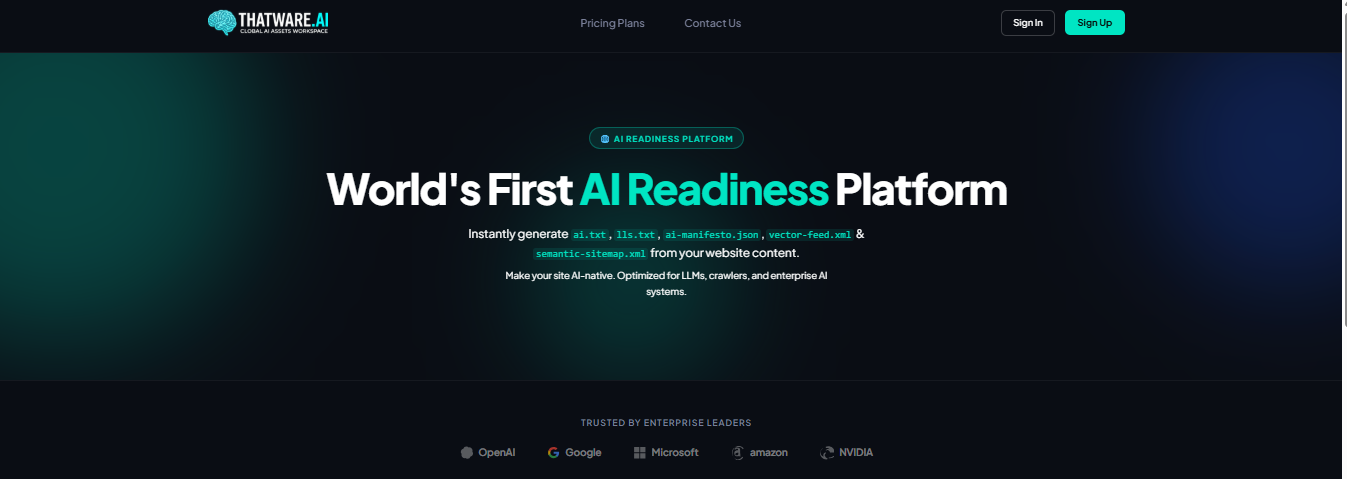
As artificial intelligence continues to reshape how digital information is discovered and consumed, businesses require solutions that go beyond conventional optimisation practices. Preparing a website for AI-powered search, conversational assistants, and enterprise AI systems involves multiple technical processes, semantic enhancements, and structured data strategies that can quickly become complex. ThatWare.AI has been developed to simplify this entire journey by bringing every essential component of AI readiness into a single, unified platform. Powered by ThatWare’s expertise in AI-driven digital optimisation, the platform helps organisations prepare their websites for the next generation of AI-powered discovery while complementing existing SEO strategies rather than replacing them.
A Unified AI Readiness Platform
ThatWare.AI is designed as an end-to-end AI Readiness Platform that enables businesses to transform conventional websites into AI-native digital assets. Instead of relying on multiple disconnected tools and manual workflows, users can access a centralised workspace where they can analyse website readiness, generate AI-compatible assets, optimise content, and improve machine understanding. The platform aims to streamline the technical and strategic aspects of AI optimisation, allowing businesses to focus on creating valuable content while ensuring it is accessible to both users and intelligent systems.
Whether an organisation is beginning its AI readiness journey or looking to enhance an established digital presence, ThatWare.AI provides a structured framework for preparing websites to communicate more effectively with AI-powered technologies.
Built on ThatWare’s AI-Driven Expertise
ThatWare has long focused on combining artificial intelligence with search optimisation to help businesses improve digital visibility. Through years of research and innovation in semantic SEO, entity optimisation, machine learning, and advanced search technologies, the company has developed methodologies that extend beyond traditional optimisation practices. ThatWare.AI represents the evolution of this expertise into a scalable software platform that businesses can use to implement AI readiness more efficiently.
Rather than treating AI optimisation as a collection of isolated technical tasks, the platform integrates multiple processes into a cohesive workflow that supports long-term digital growth and future-ready website architecture.
Core Capabilities of ThatWare.AI
The platform brings together several interconnected modules that address different aspects of AI readiness. Users can evaluate their website’s preparedness for AI systems, create AI-friendly content through intelligent authoring tools, and generate specialised machine-readable assets that improve semantic understanding. These include files such as ai.txt, llms.txt, ai-manifesto.json, vector-feed.xml, and semantic-sitemap.xml, each designed to support different aspects of AI interpretation and information retrieval.
In addition to technical asset generation, ThatWare.AI provides guidance throughout the optimisation process, helping users understand where improvements can be made and how their websites can better communicate with modern AI systems.
Designed for Businesses of Every Size
Although the platform includes enterprise-grade capabilities, ThatWare.AI is designed to support organisations across a wide range of industries and business sizes. Digital agencies, SaaS companies, eCommerce brands, publishers, educational institutions, healthcare organisations, financial service providers, and large enterprises can all benefit from adopting a structured AI readiness strategy. The platform’s scalable architecture allows users to manage projects efficiently while adapting to the evolving requirements of AI-powered search and intelligent information retrieval.
This flexibility makes ThatWare.AI suitable for organisations seeking to future-proof their digital presence without significantly increasing the complexity of their existing workflows.
Preparing Websites for the Future of AI Discovery
The internet is steadily moving towards an environment where intelligent systems play a greater role in how information is retrieved, interpreted, and presented. Businesses that prepare their websites today will be better positioned to remain visible as AI-powered search experiences continue to evolve. ThatWare.AI supports this transition by providing the tools, workflows, and guidance needed to build websites that are easier for AI systems to understand, process, and reference.
By combining AI readiness assessment, intelligent content authoring, machine-readable asset generation, and enterprise-focused capabilities within a single platform, ThatWare.AI helps organisations bridge the gap between traditional search optimisation and the emerging world of AI-driven digital discovery.
Understanding the ThatWare.AI Ecosystem
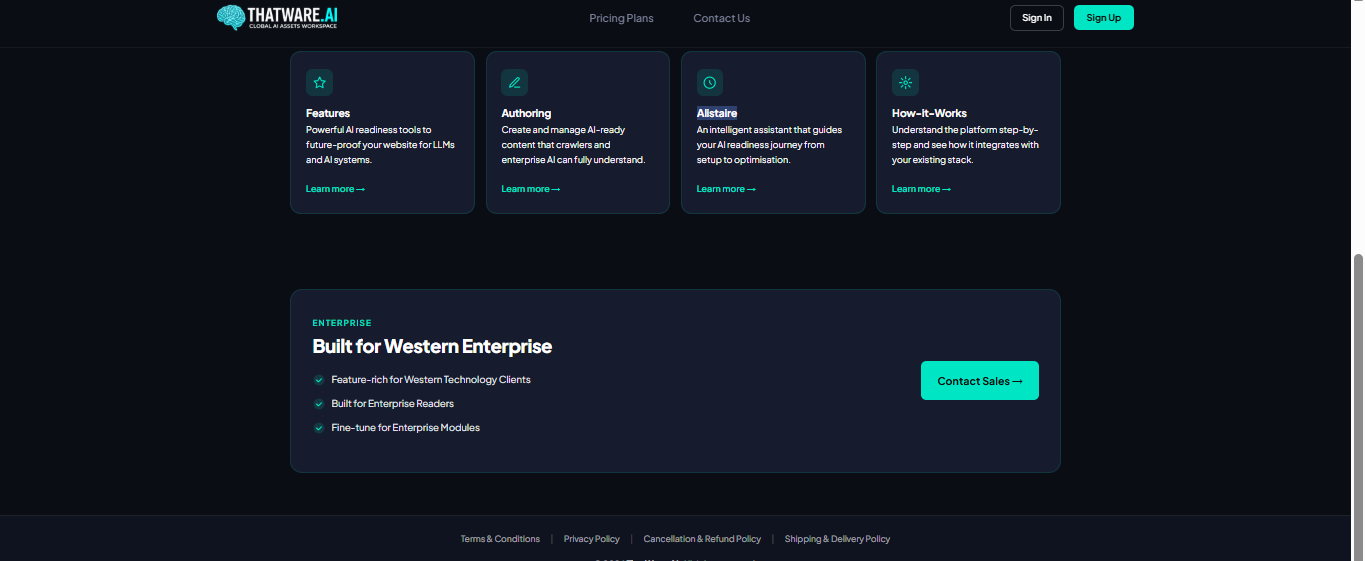
ThatWare.AI is more than a single-purpose application for generating AI-compatible files. It is a comprehensive ecosystem designed to help organisations prepare, optimise, and maintain websites for an AI-first digital landscape. Rather than approaching AI readiness as a one-time technical task, the platform brings together multiple interconnected modules that work seamlessly throughout the entire optimisation journey. From analysing a website’s AI readiness and creating machine-readable assets to producing AI-friendly content and providing intelligent guidance, each component has been designed to support a different stage of the process. Together, these capabilities create a unified workflow that helps businesses transition from traditional websites to AI-native digital experiences.
AI Readiness: The Foundation of the Platform
The AI Readiness module serves as the starting point of the ThatWare.AI ecosystem. Its primary purpose is to help businesses evaluate how effectively their websites can be understood by artificial intelligence systems. Instead of focusing solely on conventional SEO metrics, the platform considers factors that influence machine comprehension, semantic clarity, and AI compatibility. This provides organisations with a structured starting point for preparing their websites for AI-powered search engines, conversational assistants, and enterprise AI applications.
Based on this assessment, users can begin building a stronger AI-ready foundation by identifying areas that require improvement and implementing enhancements through the platform’s integrated workflow. Rather than relying on disconnected tools or manual processes, the AI Readiness module centralises the preparation process and lays the groundwork for the remaining features within the ecosystem.
AI Asset Generation
One of the defining capabilities of ThatWare.AI is its ability to generate specialised AI-native assets that improve machine readability and semantic communication. As websites become increasingly consumed by AI systems, structured files play an important role in helping intelligent models interpret website content more efficiently.
The platform generates assets such as ai.txt, llms.txt, ai-manifesto.json, vector-feed.xml, and semantic-sitemap.xml, each serving a specific purpose within the broader AI ecosystem. These files provide structured information that supports AI crawlers, language models, retrieval systems, and enterprise AI applications, allowing them to better understand website content, relationships, and organisational structure. By automating this process, ThatWare.AI simplifies what would otherwise require significant technical implementation.
Authoring: Creating Content for Both Humans and AI
High-quality content remains one of the most valuable assets for any organisation, but modern content must communicate effectively with both people and intelligent systems. The Authoring module within ThatWare.AI focuses on creating content that is informative, semantically organised, and machine understandable without sacrificing readability or user experience.
Rather than concentrating exclusively on keywords, the platform encourages content that reflects topical authority, entity relationships, and contextual relevance. This helps businesses create pages that remain valuable for traditional search engines while also improving their ability to be interpreted and referenced by AI-powered search experiences and large language models.
Alistaire: Your Intelligent AI Readiness Assistant
Navigating AI readiness can involve numerous technical concepts, optimisation decisions, and implementation steps. To simplify this experience, ThatWare.AI includes Alistaire, an intelligent assistant designed to guide users throughout their optimisation journey. Instead of leaving users to interpret technical information independently, Alistaire provides contextual guidance that helps them understand platform features, identify opportunities for improvement, and navigate the AI readiness workflow more efficiently.
By combining automation with intelligent recommendations, Alistaire makes the platform more accessible to organisations regardless of their level of technical expertise. Whether users are onboarding a website, generating AI assets, or refining their optimisation strategy, the assistant supports a smoother and more informed experience.
Enterprise Workspace and Security
ThatWare.AI has been developed with enterprise adoption in mind, making security and account management integral parts of the ecosystem. The platform includes secure account registration, email verification, and optional two-factor authentication (2FA) to help protect user accounts and sensitive project data. These features provide an additional layer of confidence for organisations managing valuable digital assets and multiple websites.
Beyond authentication, the enterprise-oriented design reflects the platform’s ability to support scalable workflows for businesses that require structured project management, secure access, and long-term AI readiness initiatives. As organisations expand their digital presence, these capabilities help ensure that AI optimisation remains organised, manageable, and secure.
A Connected Workflow from Analysis to Optimisation
What distinguishes ThatWare.AI is not simply the individual features it offers, but the way those features operate as a connected ecosystem. Each module contributes to a continuous workflow that begins with evaluating a website’s AI readiness, progresses through generating AI-native assets and creating AI-friendly content, and extends to ongoing optimisation supported by intelligent guidance.
Instead of treating AI readiness as a collection of isolated technical tasks, the platform provides businesses with a structured framework for continuous improvement. This integrated approach enables organisations to build websites that are easier for AI systems to interpret, more adaptable to evolving technologies, and better positioned for the future of AI-powered discovery.
Step 1 – Create Your ThatWare.AI Account
Getting started with ThatWare.AI begins by creating a secure user account. Since the platform is designed as a comprehensive AI Readiness workspace rather than a standalone file generator, every user is provided with a dedicated environment where projects, AI-generated assets, website analyses, and optimisation activities can be managed from a single dashboard. The registration process is straightforward and has been designed to ensure both ease of use and account security.
Register Your Account
Users begin by entering their basic information, including their name, email address, and password. Once the registration form is submitted, ThatWare.AI initiates the account verification process before granting access to the platform.
This registration process establishes a dedicated workspace where users can manage one or multiple websites, generate AI-native assets, and track their AI readiness journey over time.
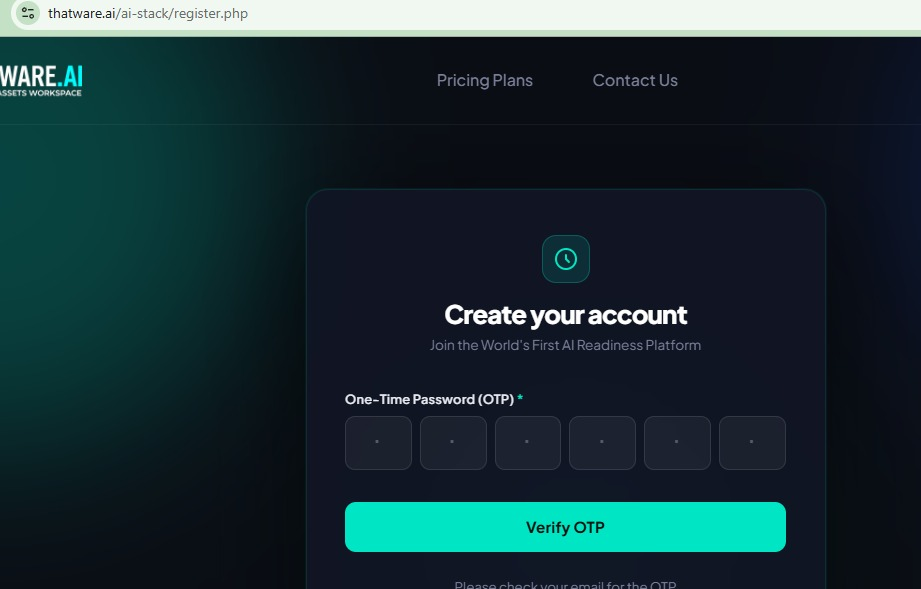
Verify Your Email with OTP
To ensure account authenticity, ThatWare.AI sends a One-Time Password (OTP) to the registered email address. Users simply enter the six-digit verification code to activate their account.
Email verification serves several important purposes:
- Confirms ownership of the registered email address.
- Prevents fraudulent or automated account creation.
- Protects project data from unauthorised access.
- Enables secure communication between the platform and the user.
Once the OTP is successfully verified, the account becomes active and users can proceed to access the platform.
Your AI Readiness Workspace
Unlike basic online utilities that provide one-time outputs, ThatWare.AI creates a personalised workspace for every registered user. This workspace acts as the central hub for managing websites, generating AI-ready assets, monitoring optimisation progress, and accessing the platform’s integrated tools. It also provides the foundation for future collaboration, project management, and enterprise-scale deployments.
Step 2 – Secure Your Workspace with Two-Factor Authentication
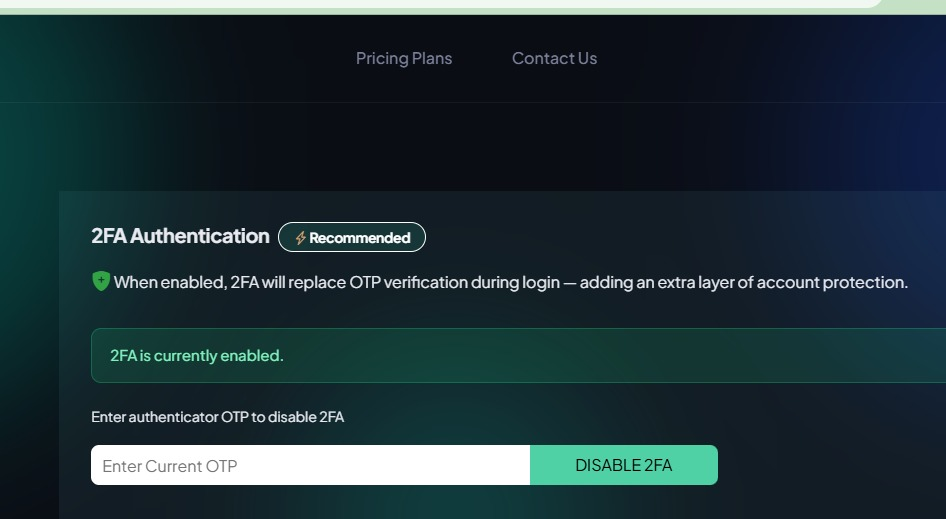
Security is an essential part of any enterprise software platform, especially when managing valuable website data and AI configuration files. To strengthen account protection, ThatWare.AI provides support for Two-Factor Authentication (2FA), allowing users to add an additional verification layer beyond their password.
What Is Two-Factor Authentication?
Two-Factor Authentication requires users to verify their identity using two separate credentials during login. After entering their password, users provide a time-sensitive verification code generated by an authenticator application.
This additional step significantly reduces the risk of unauthorised account access, even if login credentials become compromised.
Compatible Authenticator Applications
ThatWare.AI supports industry-standard authenticator applications that generate secure, time-based verification codes. After scanning the provided QR code, users can authenticate future logins directly from their preferred authenticator app without relying solely on email verification.
The setup process typically takes only a few minutes while providing long-term protection for the account.
Enterprise-Level Account Protection
For organisations managing multiple websites or sensitive business information, account security is critical. Two-Factor Authentication helps safeguard AI-generated assets, project configurations, optimisation workflows, and organisational data while supporting enterprise security best practices.
Step 3 – Add Your Website
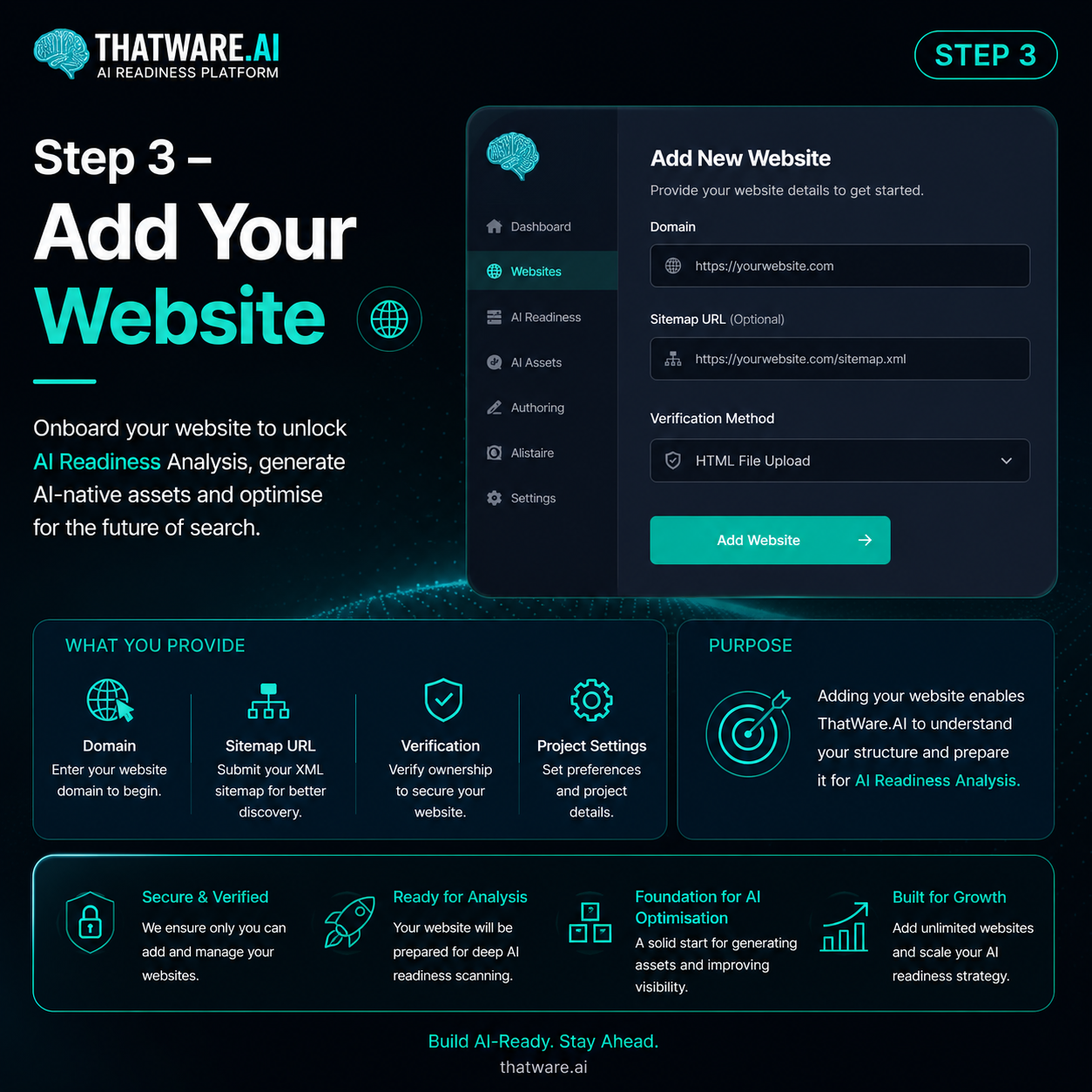
Once the account has been created and secured, the next step is onboarding your website into the ThatWare.AI platform. This process allows the platform to begin understanding your website’s structure before performing AI readiness assessments and generating AI-native assets.
Website Onboarding
Website onboarding begins by providing the platform with the information necessary to identify and evaluate your website.
Depending on your implementation, this may include:
- Website domain
- XML sitemap
- Website verification
- Ownership confirmation
- Project settings
These inputs provide the platform with the context needed to begin preparing your AI readiness project.
Preparing for AI Analysis
Once the website has been successfully added, ThatWare.AI prepares it for evaluation by identifying pages and collecting the information required for further analysis. This creates the foundation upon which subsequent AI readiness assessments and optimisation recommendations can be built.
Rather than immediately generating files, the platform first establishes an understanding of the website so that future outputs align with its structure and content.
Step 4 – AI Readiness Analysis
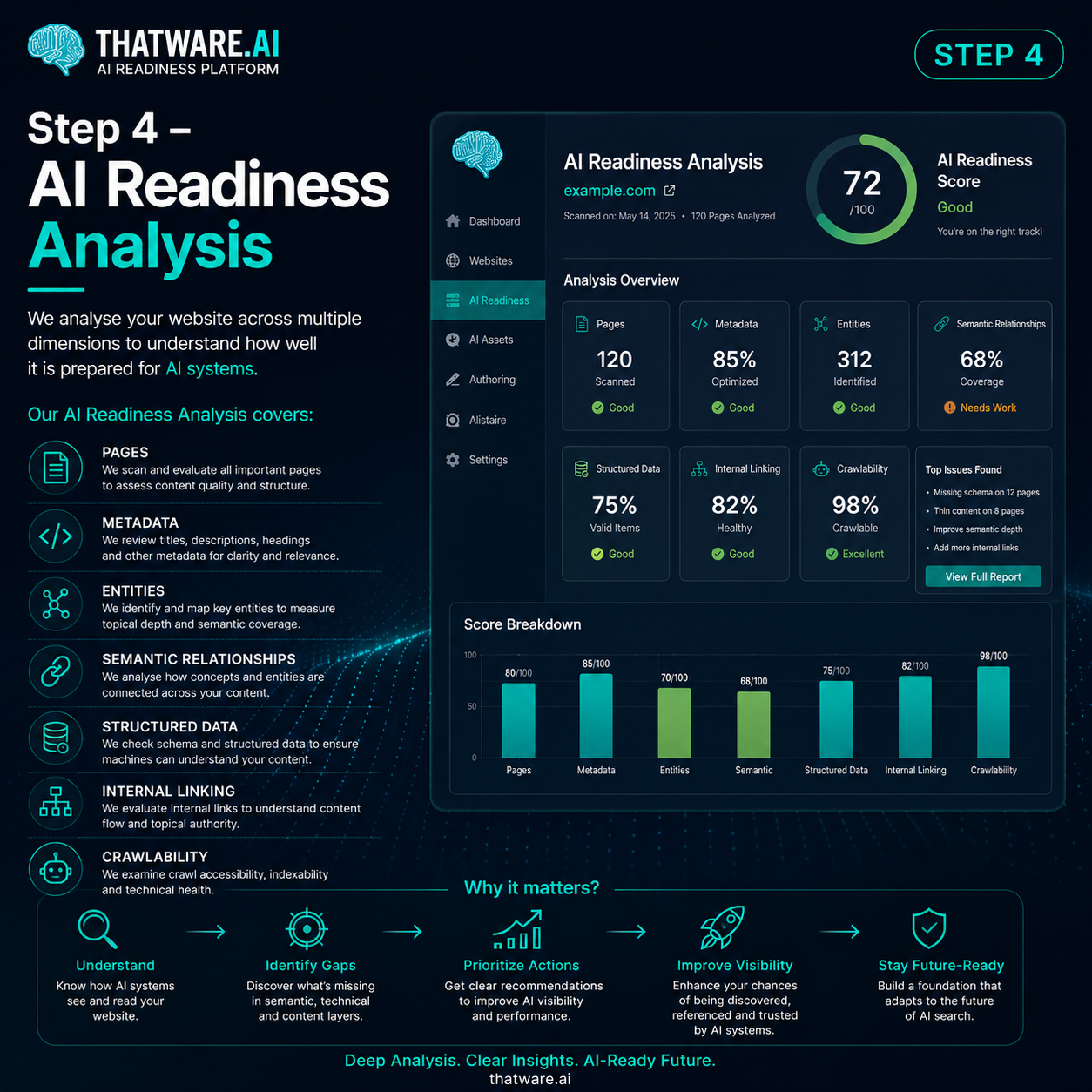
With the website successfully onboarded, ThatWare.AI begins analysing its overall readiness for AI-powered discovery. Instead of evaluating only conventional SEO metrics, the platform focuses on factors that influence how artificial intelligence systems interpret website content.
The objective is to understand how effectively the website communicates with intelligent systems while identifying opportunities for improvement.
Evaluating Website Structure
The platform conceptually examines different aspects of the website, including:
- Individual pages
- Page hierarchy
- Metadata
- Internal linking
- Content organisation
- Crawl accessibility
A well-organised website allows both users and AI systems to navigate information more efficiently.
Understanding Entities and Semantic Relationships
Artificial intelligence systems interpret concepts rather than isolated keywords. ThatWare.AI therefore evaluates how entities, topics, and contextual relationships are represented throughout the website.
This semantic understanding helps identify whether information is logically connected and whether important concepts can be interpreted accurately by AI systems.
Reviewing Structured Information
Structured data provides valuable context for intelligent systems. During analysis, the platform considers the availability and organisation of structured information that may assist machine understanding.
Combined with semantic organisation and website architecture, this contributes to a stronger AI-ready foundation.
Supporting Future Optimisation
The purpose of AI readiness analysis is not simply to identify issues but to establish a roadmap for future improvements. By understanding the website’s existing structure, businesses can make informed decisions about content enhancement, AI-native asset generation, and semantic optimisation.
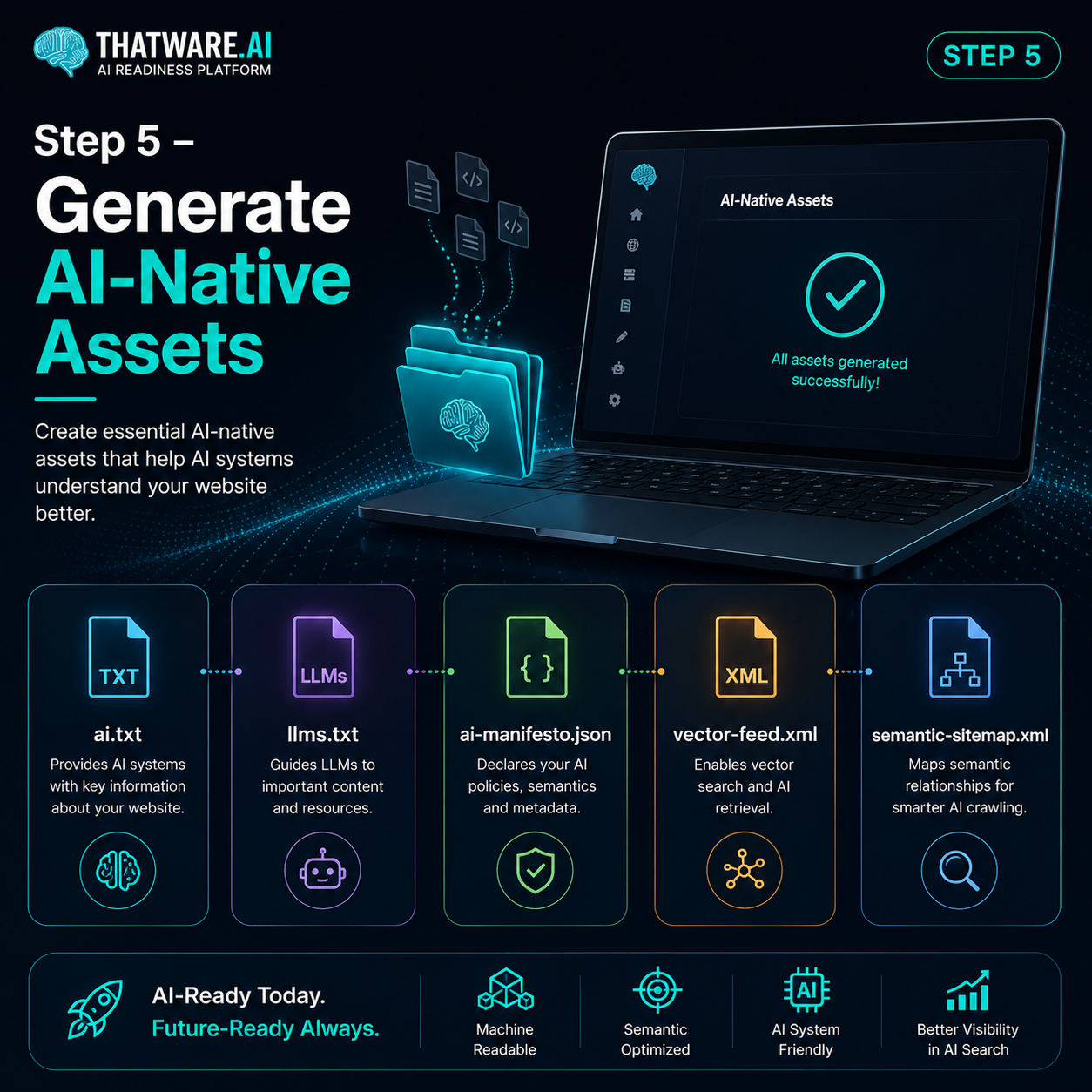
Step 5 – Generate AI-Native Assets
One of the defining capabilities of ThatWare.AI is its ability to generate specialised assets that help AI systems better understand website content. Rather than manually creating technical configuration files, businesses can automate much of this process through the platform.
Each generated asset serves a distinct purpose within the broader AI ecosystem.
What Is ai.txt?
The ai.txt file provides AI systems with structured information that can assist in understanding a website’s intended AI interactions and content accessibility.
Purpose
- Improve machine readability
- Organise AI-related website information
- Support intelligent crawling
Benefits
- Better communication with AI systems
- Improved semantic clarity
- Easier AI interpretation
How AI Systems Use It
AI systems may reference AI-specific configuration information when determining how website content should be interpreted or processed within AI-driven environments.
What Is llms.txt?
The llms.txt file is designed to help large language models understand important sections of a website more efficiently by providing structured references and guidance.
Purpose
- Improve LLM accessibility
- Highlight valuable website resources
- Simplify AI navigation
Benefits
- Better AI content discovery
- Enhanced machine understanding
- Improved retrieval efficiency
Best Practices
Maintain accurate references, update the file regularly, and ensure that important website resources remain represented as content evolves.
What Is ai-manifesto.json?
The ai-manifesto.json file provides structured metadata describing AI-related preferences and semantic declarations associated with the website.
It may include information that assists intelligent systems in understanding content organisation, AI policies, and machine-readable metadata.
By standardising this information, websites can communicate more consistently with AI-powered applications.
What Is vector-feed.xml?
Modern AI systems increasingly rely on vector-based retrieval rather than traditional keyword matching. The vector-feed.xml file supports this evolving landscape by organising content in a format suitable for AI indexing and retrieval workflows.
This structured feed can assist AI systems involved in vector search, embeddings, and retrieval-based applications by providing organised content references that are easier to process.
What Is semantic-sitemap.xml?
A traditional XML sitemap helps search engines discover website pages. A semantic-sitemap.xml extends this concept by emphasising semantic relationships between content and entities.
Instead of simply listing URLs, it helps represent meaningful connections across the website.
Key Benefits
- Supports semantic relationships
- Improves entity mapping
- Assists AI crawling
- Enhances contextual understanding
For AI systems that rely on relationships rather than keywords alone, this additional layer of organisation can improve content interpretation.
Step 6 – Optimise Your Content with Authoring
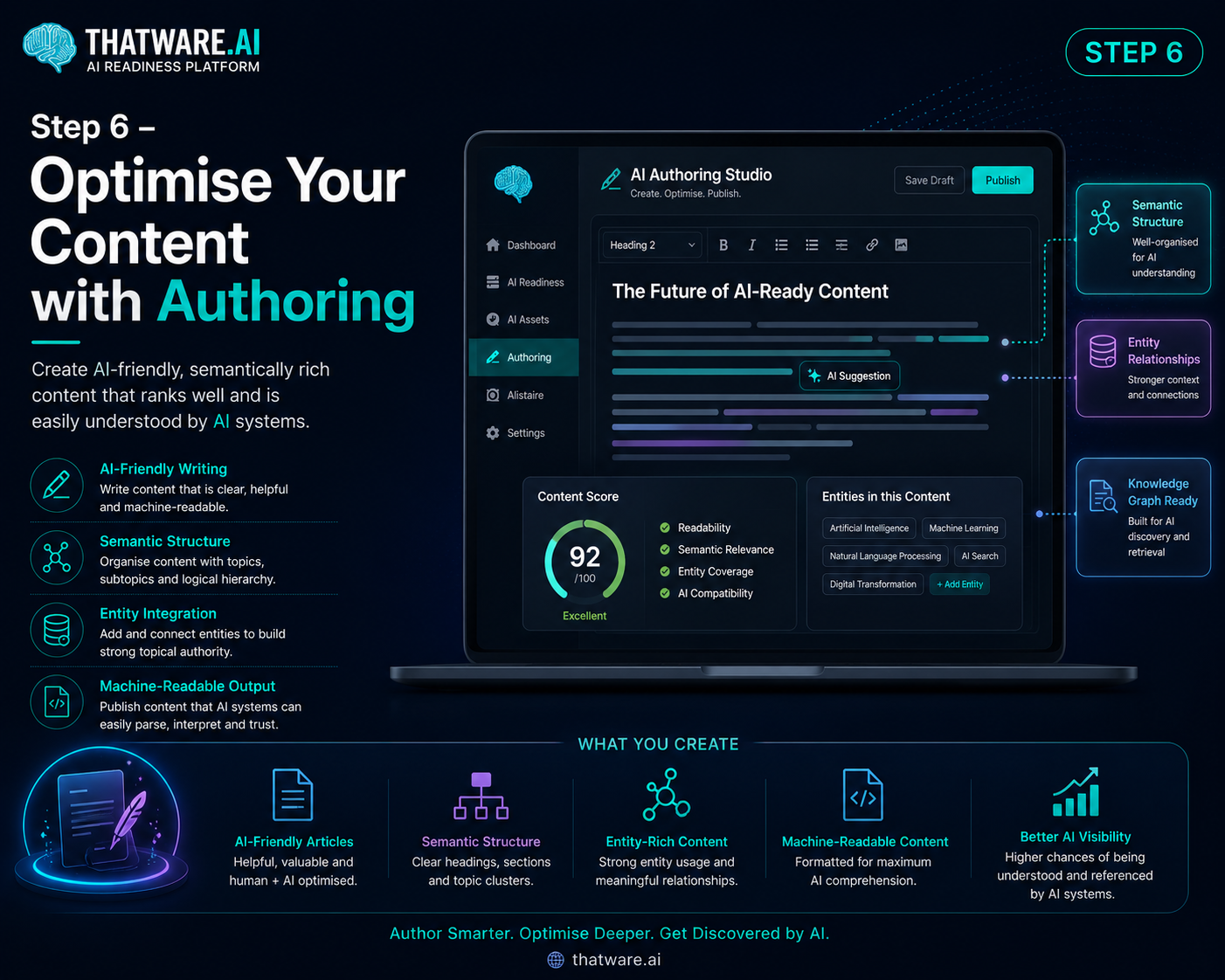
Generating AI-native assets is only one part of becoming AI-ready. Content itself must also be structured so that both humans and intelligent systems can understand it effectively. The Authoring module within ThatWare.AI helps businesses create content that balances readability with machine comprehension.
Creating AI-Friendly Content
Rather than focusing exclusively on keyword density, the platform encourages content that is comprehensive, logically organised, and contextually relevant. This approach supports better communication with AI-powered search systems while maintaining a positive user experience.
Building Strong Semantic Structure
Content benefits from clear topic hierarchy, descriptive headings, and logical organisation. A well-structured article enables AI systems to recognise the relationships between ideas and interpret information with greater confidence.
Strengthening Entity Relationships
Authoring also focuses on connecting important entities, concepts, and topics throughout the website. Strong semantic relationships improve topical authority and help intelligent systems understand the broader context of individual pages.
Producing Machine-Readable Content
The combination of semantic organisation, contextual clarity, and structured presentation creates content that is easier for AI systems to process, retrieve, and reference within conversational search experiences.
Step 7 – Work with Alistaire
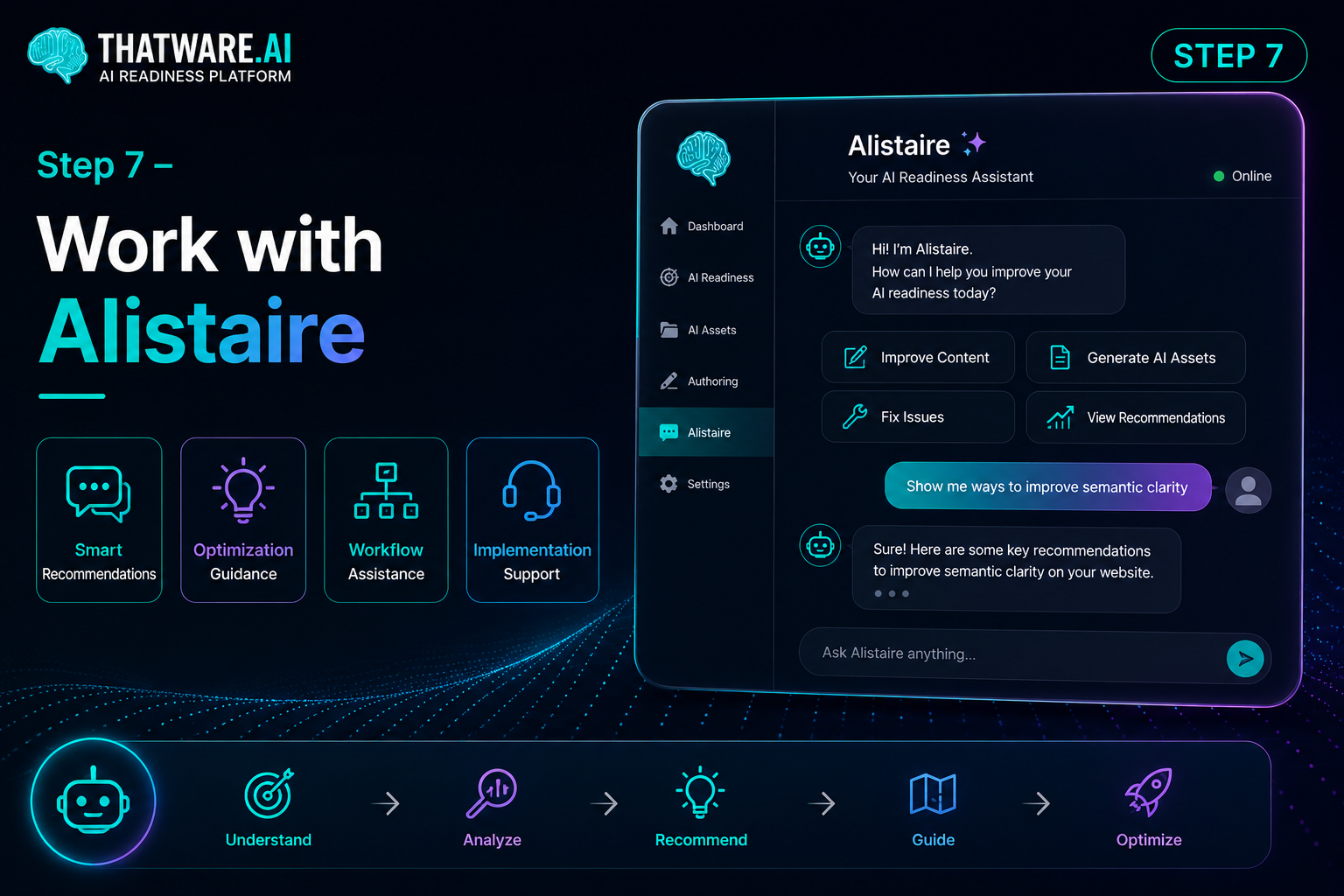
Successfully implementing AI readiness often requires ongoing guidance. ThatWare.AI includes Alistaire, an intelligent assistant designed to support users throughout their optimisation journey.
Rather than replacing user decision-making, Alistaire acts as a knowledgeable guide that simplifies complex processes.
Receive Intelligent Recommendations
Users can access contextual recommendations that help identify opportunities for improving website readiness, semantic organisation, and AI compatibility.
Optimisation Guidance
As businesses progress through the platform, Alistaire provides practical guidance that helps users better understand optimisation priorities and platform capabilities.
Workflow Assistance
From onboarding websites to generating AI assets and improving content, Alistaire supports users at each stage of the workflow, helping streamline day-to-day platform usage.
Supporting Implementation
Whether users are new to AI readiness or experienced digital professionals, Alistaire helps simplify implementation by providing assistance throughout the optimisation process.
Step 8 – Enterprise Deployment
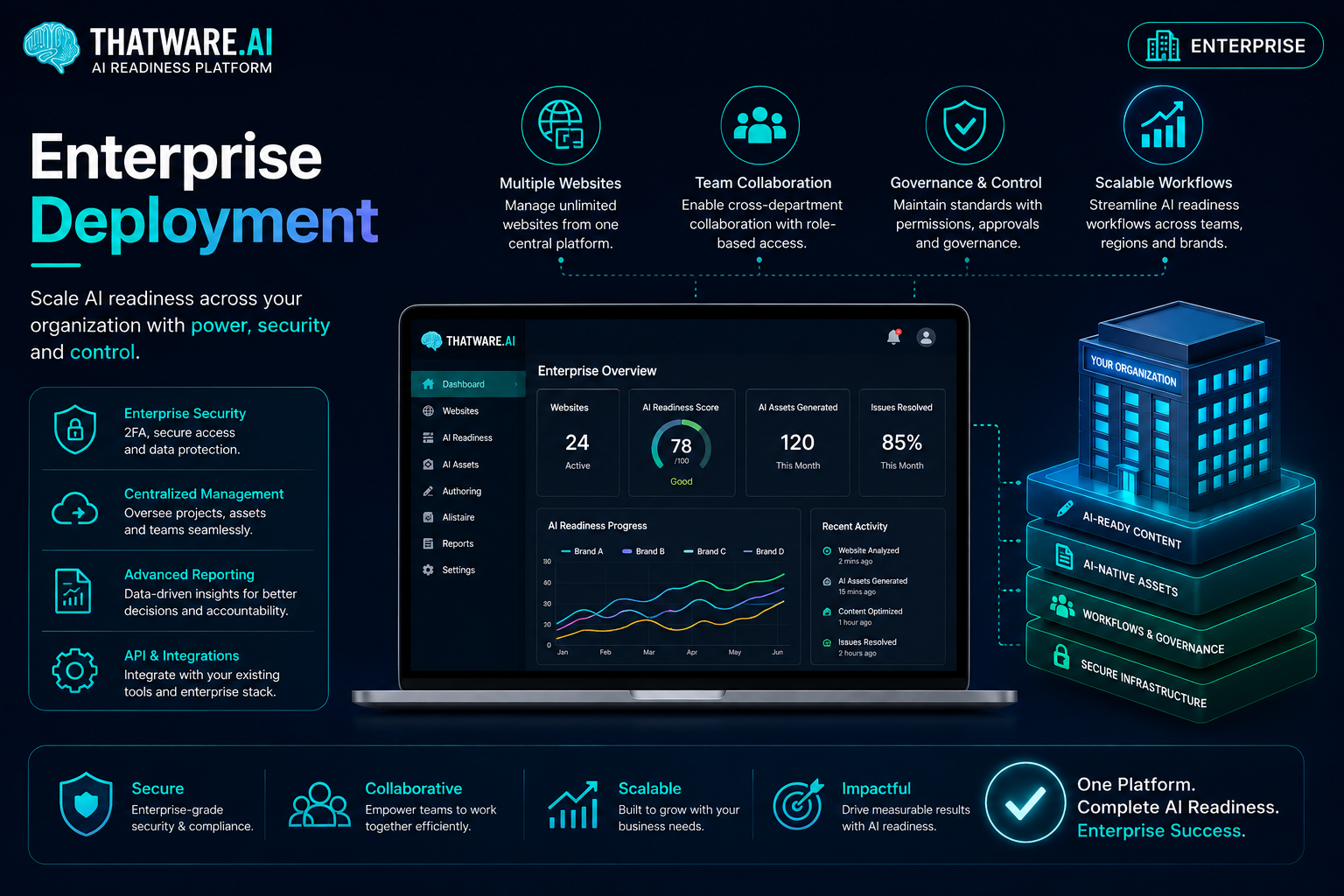
ThatWare.AI has been designed to support organisations ranging from growing businesses to large enterprises. As AI readiness initiatives expand, companies often require structured workflows, secure collaboration, and scalable project management.
The platform provides the foundation for managing AI readiness across complex digital environments.
Managing Multiple Websites
Organisations operating several brands or regional websites can manage AI readiness initiatives from a centralised platform, reducing administrative complexity while maintaining consistency across projects.
Supporting Cross-Department Collaboration
AI readiness often involves marketing teams, SEO specialists, developers, content creators, and business stakeholders. A shared platform helps improve communication and coordination across these different departments.
Governance and Organisational Control
Enterprise environments require structured governance to maintain quality, consistency, and accountability. Centralised project management enables organisations to implement AI readiness according to their own operational standards and workflows.
Scalable Enterprise Workflows
As AI technologies continue to evolve, organisations need workflows that can adapt alongside them. By combining secure workspaces, AI-native asset generation, intelligent authoring, and guided optimisation within a single ecosystem, ThatWare.AI provides a scalable approach for businesses preparing their digital properties for the future of AI-powered discovery.
AI Readiness vs Traditional SEO
Search Engine Optimisation (SEO) has long been the foundation of digital visibility, helping websites improve their rankings on search engine results pages. While SEO remains essential, the rise of artificial intelligence has introduced a new layer of optimisation that focuses on how machines understand, interpret, and retrieve information. Rather than replacing traditional SEO, AI Readiness extends it by preparing websites for AI-powered search engines, conversational assistants, enterprise AI platforms, and retrieval-based systems.
The two approaches share the common goal of increasing online visibility, but they differ significantly in their objectives, methodologies, and the technologies they are designed to support. The following comparison highlights these differences.
| Traditional SEO | AI Readiness |
| Focuses on improving search engine rankings. | Focuses on improving AI understanding and interpretation of content. |
| Primarily targets keywords and search intent. | Prioritises entities, topics, context, and semantic relationships. |
| Relies heavily on backlinks and authority signals. | Builds structured knowledge and contextual connections between information. |
| Optimised for search engine crawlers and indexing bots. | Optimised for large language models (LLMs), AI assistants, and intelligent retrieval systems. |
| Uses robots.txt, XML sitemaps, and technical SEO. | Uses AI-native assets such as ai.txt, llms.txt, ai-manifesto.json, vector-feed.xml, and semantic-sitemap.xml. |
| Measures success through rankings, impressions, and clicks. | Measures success through machine readability, semantic clarity, and AI discoverability. |
| Primarily serves traditional search engines. | Supports AI-powered search, conversational assistants, enterprise AI, and future AI ecosystems. |
Businesses should view AI Readiness as a natural evolution of SEO rather than a replacement for it. Traditional optimisation continues to improve visibility within search engines, while AI readiness ensures that websites are prepared for the growing number of intelligent systems that interpret, summarise, and retrieve online information. Together, these approaches create a more comprehensive digital strategy that supports both current and future methods of content discovery.
Benefits of Using ThatWare.AI
As organisations prepare for an increasingly AI-driven digital landscape, they require more than isolated technical improvements. They need a structured platform that simplifies AI readiness while supporting long-term digital growth. ThatWare.AI provides a unified ecosystem that helps businesses strengthen machine understanding, automate AI asset generation, and streamline optimisation workflows. By combining multiple capabilities within a single platform, it enables organisations to prepare their websites more efficiently for AI-powered search and enterprise AI systems.
Better AI Discoverability
One of the primary advantages of ThatWare.AI is improved discoverability across AI-powered environments. As conversational assistants and large language models become more prominent, websites must communicate information in ways that intelligent systems can easily interpret. The platform helps businesses organise their digital assets and content so they are better positioned for AI-powered retrieval and contextual understanding.
Improved Semantic Clarity
Modern AI systems rely on semantic understanding rather than simple keyword matching. ThatWare.AI encourages structured content, meaningful relationships between topics, and improved contextual organisation. This semantic clarity helps intelligent systems recognise the expertise, relevance, and intent behind website content more accurately.
Enhanced Machine Readability
AI-ready websites require information that machines can efficiently process. Through structured AI-native assets and organised content architecture, ThatWare.AI improves machine readability, making it easier for AI systems to analyse, interpret, and retrieve relevant information from a website.
Future-Proofing Your Digital Presence
The digital ecosystem continues to evolve as AI becomes increasingly integrated into search, customer experiences, and enterprise applications. Preparing websites today helps organisations adapt more effectively to future technological developments. ThatWare.AI provides businesses with the tools needed to remain flexible as AI standards and digital discovery continue to evolve.
Automation of AI Readiness Tasks
Many aspects of AI readiness involve technical implementation and repetitive processes. ThatWare.AI automates the generation of AI-native assets and centralises key workflows within a single platform. This reduces manual effort while helping organisations maintain consistency across their digital properties.
Enterprise Governance and Scalability
For organisations managing multiple teams or websites, governance becomes increasingly important. ThatWare.AI provides a structured environment that supports secure account management, project organisation, and scalable workflows. This makes it suitable for businesses that require greater operational control while expanding their AI readiness initiatives.
Time Savings and Operational Efficiency
Managing AI readiness manually can involve multiple tools, technical configurations, and ongoing maintenance. By consolidating these processes into one platform, ThatWare.AI helps reduce administrative complexity and allows teams to focus on strategic optimisation rather than repetitive implementation tasks.
Consistent AI Optimisation
Consistency is essential for effective AI communication. ThatWare.AI promotes standardised workflows, structured content creation, and organised AI assets that remain aligned across an organisation’s digital presence. This consistency improves both machine understanding and long-term maintainability.
Best Practices for Building an AI-Ready Website
Creating an AI-ready website is an ongoing process rather than a one-time implementation. As AI systems become more sophisticated, businesses must continually refine how their content is organised, presented, and interpreted. Following established best practices helps ensure that websites remain accessible to both users and intelligent systems.
Create High-Quality, Well-Structured Content
Quality content remains the foundation of AI readiness. Articles should be comprehensive, accurate, logically organised, and written with clear headings and descriptive sections. Well-structured content enables AI systems to understand topics more effectively while improving the user experience.
Focus on Entities Rather Than Keywords Alone
Keywords continue to play an important role in SEO, but AI systems place greater emphasis on entities, concepts, and contextual relationships. Businesses should identify important people, organisations, products, locations, and topics within their content while establishing meaningful connections between them.
Implement Structured Data Where Appropriate
Structured data provides additional context that helps machines interpret website information. Implementing relevant schema markup allows search engines and AI systems to better understand the purpose of pages, products, services, articles, organisations, and other important website elements.
Build a Strong Internal Linking Structure
Internal links help establish relationships between pages and guide both users and AI systems through a website’s knowledge architecture. Logical internal linking strengthens topical authority while improving semantic understanding across the entire website.
Maintain Clear Metadata
Titles, descriptions, headings, and other metadata continue to play an important role in digital optimisation. Consistent and descriptive metadata provides valuable contextual signals that support both traditional search engines and AI-powered retrieval systems.
Generate and Maintain AI-Native Assets
AI-native assets such as ai.txt, llms.txt, ai-manifesto.json, vector-feed.xml, and semantic-sitemap.xml should be maintained as part of an ongoing AI readiness strategy. Keeping these assets accurate and up to date helps ensure that intelligent systems receive the latest information about your website.
Keep Content Regularly Updated
AI systems generally favour current, accurate, and relevant information. Businesses should review existing content regularly, update outdated material, and expand important topics to reflect new developments within their industry.
Maintain Consistency Across Your Website
Consistency in terminology, branding, content structure, and metadata helps AI systems build a more reliable understanding of a website. Uniform presentation reduces ambiguity and strengthens semantic clarity throughout the site.
Continuously Monitor and Improve
AI readiness is not static. Organisations should periodically evaluate their websites, identify opportunities for improvement, and refine their content and technical implementation as AI technologies evolve. Continuous monitoring helps businesses remain prepared for future advancements in AI-powered discovery.
Common Mistakes Businesses Make
Many organisations recognise the importance of artificial intelligence but continue to optimise their websites using strategies designed exclusively for traditional search engines. While these methods remain valuable, relying on them alone can limit a website’s ability to participate effectively in AI-driven search and retrieval systems. Understanding the most common mistakes helps businesses develop a more balanced optimisation strategy.
Focusing Only on Google Rankings
One of the most common misconceptions is that strong search rankings automatically guarantee AI visibility. Although ranking well remains important, AI assistants and retrieval systems evaluate websites differently by analysing semantic understanding, contextual relevance, and structured information rather than relying solely on search rankings.
Ignoring Semantic Relationships
Many websites contain valuable information but fail to establish meaningful connections between topics and entities. Without clear semantic relationships, AI systems may struggle to understand how different pieces of content relate to one another, reducing the overall effectiveness of machine interpretation.
Not Using Structured AI Assets
As AI technologies continue to evolve, machine-readable assets become increasingly valuable. Businesses that fail to implement AI-specific assets may miss opportunities to communicate important contextual information to intelligent systems in a structured and consistent manner.
Poor Content Organisation
Disorganised content with inconsistent headings, unclear page hierarchy, and weak information architecture creates challenges for both users and AI systems. A logical structure helps intelligent systems interpret content more efficiently while improving navigation and usability.
Weak Entity Signals
Many organisations focus heavily on keywords while overlooking the importance of entities such as products, services, brands, locations, and subject matter expertise. Strong entity representation provides AI systems with richer contextual information, improving content understanding and retrieval accuracy.
No Defined AI Optimisation Workflow
Perhaps the biggest challenge is treating AI readiness as an isolated technical task rather than an ongoing strategy. Businesses that lack a structured workflow for monitoring, updating, and improving AI readiness often struggle to adapt as AI technologies evolve. Establishing consistent processes for analysis, optimisation, content improvement, and AI asset maintenance helps organisations remain competitive in an increasingly AI-driven digital landscape.
Conclusion
The internet is entering a new era where artificial intelligence plays an increasingly important role in how information is discovered, interpreted, and delivered. While traditional SEO continues to be essential for achieving strong search engine visibility, it is no longer the only factor that determines digital success. Large language models, conversational AI assistants, enterprise AI systems, and intelligent retrieval platforms are transforming how users interact with online content. As these technologies continue to evolve, businesses must ensure their websites are not only optimised for search engines but are also structured for machine understanding. This growing shift is driving demand for LLM SEO strategies that help websites remain visible across AI-powered search experiences.
ThatWare.AI has been developed to simplify this transition by providing a unified AI Readiness Platform that brings together analysis, AI-native asset generation, intelligent content authoring, guided optimisation, and enterprise-ready workflows. Instead of relying on multiple disconnected tools and complex manual implementations, organisations can manage their entire AI readiness journey within a single workspace. From onboarding a website and evaluating its AI readiness to generating assets such as ai.txt, llms.txt, ai-manifesto.json, vector-feed.xml, and semantic-sitemap.xml, the platform offers a structured approach to preparing websites for AI-powered discovery. Whether businesses are investing in LLM SEO optimisation or looking for comprehensive AI readiness solutions, the platform provides a scalable foundation for long-term success.
Ultimately, AI readiness should be viewed as a long-term digital strategy rather than a one-time technical implementation. Businesses that invest in semantic clarity, machine-readable content, structured AI assets, and continuous optimisation will be better positioned to adapt as AI technologies continue to reshape the digital landscape. Whether you are a growing business, an established enterprise, a digital agency, or a technology-driven organisation, ThatWare.AI provides the tools and guidance needed to build websites that are not only visible today but also prepared for the future of AI-first search, intelligent content retrieval, and enterprise AI ecosystems. As organisations increasingly look beyond conventional SEO, combining AI readiness with effective LLM SEO services will become a key competitive advantage for improving visibility across modern AI platforms.