
SUPERCHARGE YOUR ONLINE VISIBILITY! CONTACT US AND LET’S ACHIEVE EXCELLENCE TOGETHER!
Search has entered a new era. For more than two decades, search engine optimisation revolved around a familiar set of metrics: rankings, impressions, clicks, click-through rate (CTR), and organic traffic. Success was measured by how often a webpage appeared among the traditional blue links and how effectively it converted visibility into visits. While Google’s search algorithms evolved dramatically during this period—with innovations such as semantic search, RankBrain, BERT, and MUM—the underlying reporting model remained largely unchanged. Website owners could still evaluate performance by analysing where their pages ranked and how many users clicked through to them.
That model is no longer sufficient.
With the widespread rollout of AI Overviews and AI Mode, Google has fundamentally changed how users interact with search results. Instead of simply presenting a ranked list of webpages, Google increasingly generates comprehensive answers that synthesise information from multiple authoritative sources. In many cases, users receive the information they need without ever clicking on a website. This shift transforms search from a destination-based experience into an answer-first experience powered by large language models, advanced retrieval systems, and real-time information grounding.
For SEO professionals, this creates an entirely new challenge. A website may significantly influence Google’s AI-generated response, contribute factual information, or be cited as a trusted source, yet receive little or no measurable credit through traditional ranking metrics. Until recently, these AI-driven appearances were largely invisible. Search Console continued reporting overall impressions and clicks, but it provided limited insight into whether a page was appearing within Google’s AI-generated experiences or how frequently it was being surfaced by the generative search engine.
That has now changed.
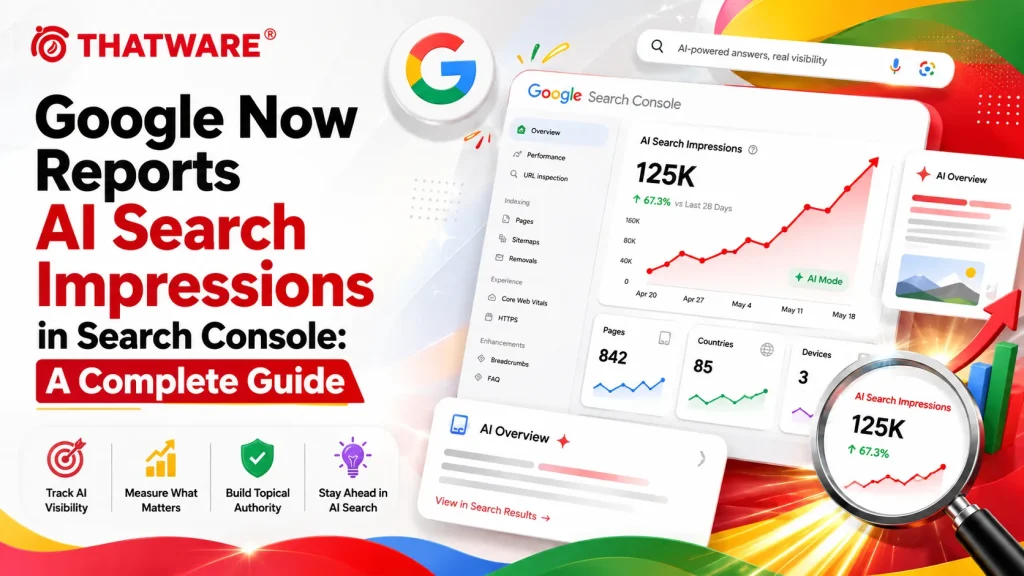
Google has introduced dedicated reporting for AI Search Impressions within Google Search Console, representing one of the most significant advancements in search measurement since the platform was first launched. For the first time, publishers, marketers, technical SEO specialists, and enterprise organisations can begin quantifying how often their content appears across Google’s AI-powered search experiences. Rather than relying solely on estimated visibility or third-party monitoring tools, website owners now have access to official first-party reporting that acknowledges AI search as a measurable component of organic performance.
Although the initial release focuses primarily on impression reporting, its significance extends far beyond the addition of another metric. AI Search Impressions signal Google’s recognition that visibility within generative search deserves its own measurement framework. Traditional ranking positions were designed for a list of hyperlinks ordered from one to ten. AI-generated answers operate very differently. They retrieve information from multiple documents, evaluate entity relationships, assess topical authority, ground factual statements using trusted sources, and dynamically generate responses based on user intent. Measuring visibility in such an environment requires a fundamentally different approach.
This evolution also reflects a broader transformation occurring across the search industry. Modern search engines increasingly combine classic information retrieval techniques with large language models, vector embeddings, knowledge graphs, semantic ranking systems, and Retrieval-Augmented Generation (RAG) architectures. The objective is no longer simply to retrieve the most relevant webpage; it is to construct the most useful answer by combining information from multiple reliable sources while maintaining factual accuracy and contextual relevance. As a result, the definition of “ranking” itself is changing. Visibility is no longer determined solely by position on a search results page but by whether your content contributes meaningfully to the AI-generated response.
For organisations investing in search visibility, this introduces both opportunities and responsibilities. Businesses can no longer optimise exclusively for traditional keyword rankings. They must also demonstrate expertise, topical authority, factual accuracy, structured information, entity consistency, and content depth that AI systems can confidently retrieve and cite. In other words, optimisation is shifting from ranking individual webpages to becoming a trusted knowledge source within Google’s retrieval and generation pipeline.
However, measuring AI visibility is far more complex than measuring conventional organic search. Questions immediately arise. What exactly qualifies as an AI Search Impression? How does Google determine that a webpage has appeared within an AI-generated answer? Does every cited source receive an impression? How do AI impressions differ from traditional search impressions? Why are clicks, average position, and AI-specific queries not yet included? Perhaps most importantly, how should SEO professionals interpret these new metrics when building reporting dashboards, evaluating campaigns, or demonstrating business value?
This guide answers those questions through a technical, evidence-based perspective. Rather than treating AI Search Impressions as simply another reporting feature, we examine the underlying technologies that make this reporting possible. We explore how Google’s AI retrieval systems operate, how grounding and citation mechanisms influence visibility, how Search Console aggregates AI performance data, and how organisations can use these insights to improve both technical SEO and AI search optimisation strategies.
Throughout this article, we will also move beyond theory into practical implementation. You’ll learn how AI search differs from traditional search at the architectural level, how to analyse AI impression data, how to integrate reporting through the Search Console API, how to build automated dashboards, and how modern concepts such as vector retrieval, entity optimisation, semantic relevance, and Retrieval-Augmented Generation influence AI visibility. Along the way, we will include technical diagrams, Python implementations, structured data examples, SQL queries, and reporting workflows to bridge the gap between search strategy and engineering execution.
The emergence of AI Search Impressions represents more than a new report inside Search Console. It marks the beginning of a new generation of search analytics—one where success is measured not only by clicks and rankings, but by whether your content becomes part of the answers that millions of users consume every day. Understanding how these new metrics work, what they reveal, and how they fit into the future of search is now essential knowledge for every technical SEO professional, digital marketer, developer, and organisation seeking long-term visibility in Google’s AI-powered search ecosystem.
The History of Measuring Search Performance
Understanding Google’s new AI Search Impressions report requires looking back at how search performance has been measured over the past two decades. Every major evolution in Google’s search engine has introduced new ranking signals, new optimisation techniques, and new reporting metrics. Yet until the arrival of AI-powered search experiences, the fundamental way we measured SEO success remained remarkably consistent.
Today, the introduction of AI Search Impressions represents the next chapter in that evolution. To appreciate why this update is so significant, we first need to understand how traditional search measurement developed, why it served the industry for so long, and where its limitations began to emerge.
The Early Days of Search Performance Measurement
In the early 2000s, measuring SEO performance was relatively straightforward. Search engines displayed a list of ranked webpages, and success depended almost entirely on where a page appeared within those results. Higher rankings translated into greater visibility, increased click-through rates, and ultimately more website traffic.
SEO professionals focused on a small set of measurable indicators, including:
- Keyword rankings
- Organic impressions
- Organic clicks
- Click-through rate (CTR)
- Indexed pages
- Backlink growth
- Organic traffic
Although reporting platforms became increasingly sophisticated, these core metrics formed the foundation of nearly every SEO campaign. Whether working as an independent consultant or within a professional SEO company, demonstrating improvements in rankings and organic traffic became the primary way to measure return on investment.
Google Search Console Changed the Industry
The launch of Google Webmaster Tools—later rebranded as Google Search Console—transformed how website owners analysed organic search performance.
Instead of relying solely on third-party ranking tools, businesses gained direct access to Google’s own performance data. For the first time, website owners could see:
- Total impressions
- Total clicks
- Average position
- Average CTR
- Search queries
- Landing pages
- Device performance
- Country-specific visibility
This represented a major advancement for both technical SEO specialists and marketing teams. Rather than estimating visibility, organisations could measure actual search performance using first-party data collected directly by Google.
For many years, these reports became the standard foundation for reporting delivered by every professional SEO agency, SEO services company, and enterprise marketing department.
Why Traditional SEO Metrics Worked So Well
Traditional search reporting aligned perfectly with how Google Search itself operated.
A user entered a query.
Google ranked millions of webpages.
The search engine displayed a list of results.
Users clicked on one of those results.
Every interaction within this process could be measured with remarkable accuracy. If a webpage appeared on the search results page, Google recorded an impression. If the user clicked the listing, Google recorded a click. The relationship between visibility and user behaviour was relatively linear.
This allowed SEO practitioners to build highly reliable optimisation strategies based on measurable outcomes. An improvement in rankings generally led to more impressions, which often resulted in more clicks and higher organic traffic. As a result, professional SEO evolved around measurable performance indicators that directly reflected user interactions with traditional search results.
The Evolution of Google’s Ranking Systems
Although reporting metrics remained relatively stable, Google’s ranking algorithms evolved significantly over time.
The introduction of updates such as Panda, Penguin, Hummingbird, RankBrain, BERT, and MUM fundamentally changed how search engines interpreted webpages and user intent.
Instead of relying heavily on keyword frequency and backlinks alone, Google began evaluating:
- Search intent
- Semantic relevance
- Content quality
- Entity relationships
- User experience
- Expertise and authority
- Contextual understanding
These innovations made search results considerably more intelligent, yet Search Console continued reporting the same familiar metrics: impressions, clicks, CTR, and average position.
This consistency meant that even highly advanced SEO campaigns still relied on essentially the same reporting framework that had existed for years.
The Rise of Zero-Click Searches
As Google’s search results became more sophisticated, another trend emerged: users increasingly found answers without leaving the search engine.
Features such as:
- Featured Snippets
- Knowledge Panels
- Local Packs
- People Also Ask
- Rich Results
- Shopping Panels
- Instant Answers
enabled users to obtain information directly from the search results page.
These experiences gradually reduced the relationship between rankings and website visits. A webpage could contribute valuable information to Google’s answer while receiving fewer clicks than expected.
This phenomenon became widely known as the “zero-click search.”
Although Search Console still recorded impressions and clicks, it could not fully explain why visibility sometimes increased while traffic remained unchanged. This marked the first indication that traditional SEO measurement was beginning to lose its ability to capture the complete picture of search performance.
Artificial Intelligence Changed Search Behaviour
The introduction of generative AI accelerated this transformation.
Rather than displaying isolated snippets extracted from individual webpages, Google’s AI systems now generate comprehensive responses by combining information from multiple trusted sources.
Instead of asking users to visit several websites and compare information themselves, AI Overviews synthesise knowledge into a single conversational answer.
This fundamentally changes what visibility means.
A webpage may now contribute critical information to an AI-generated response without occupying the first organic position. It may even influence multiple AI-generated answers across different searches without producing proportional click-through rates.
Traditional metrics were never designed to measure this type of interaction.
Why Traditional Reporting Became Insufficient
Search Console’s historic reporting model assumes a direct relationship between rankings, impressions, and clicks.
AI-generated search experiences break that assumption.
Modern AI systems retrieve information through complex processes involving semantic retrieval, entity recognition, vector similarity, knowledge graphs, contextual ranking, and Retrieval-Augmented Generation (RAG). Instead of selecting a single “best” webpage, they may retrieve dozens of authoritative sources before generating a grounded response.
Within this environment, concepts such as “average position” become far less meaningful.
A webpage may:
- Influence an AI-generated answer without appearing in the top organic rankings.
- Be cited alongside several competing sources.
- Contribute factual information without receiving significant traffic.
- Appear in conversational follow-up searches that never generate traditional ranking positions.
For organisations investing in advanced SEO, these interactions create genuine business value, yet they remain largely invisible when evaluated solely through conventional reporting metrics.
The Beginning of a New Measurement Framework
Google’s introduction of AI Search Impressions signals an important shift in how search performance will be measured moving forward.
Rather than viewing search exclusively as a ranked list of hyperlinks, Google now recognises AI-generated answers as their own measurable search surface.
This represents more than a reporting enhancement. It reflects a broader transition from ranking-based optimisation towards visibility within AI-powered information retrieval systems.
For technical SEO professionals, enterprise marketers, and organisations delivering SEO strategy services, this evolution requires a new way of thinking about performance measurement. Success is no longer defined solely by occupying the first organic position. Increasingly, it depends on whether your content is considered authoritative enough to be retrieved, grounded, and incorporated into Google’s AI-generated responses.
The history of search measurement has always evolved alongside the search engine itself. From keyword rankings to semantic search, from backlinks to entities, and from blue links to AI-generated answers, each generation has demanded new ways of understanding visibility. AI Search Impressions represent the latest milestone in that journey, laying the foundation for a future where measuring contribution to AI-generated answers becomes just as important as measuring traditional organic rankings.
Google’s AI Search Ecosystem Explained
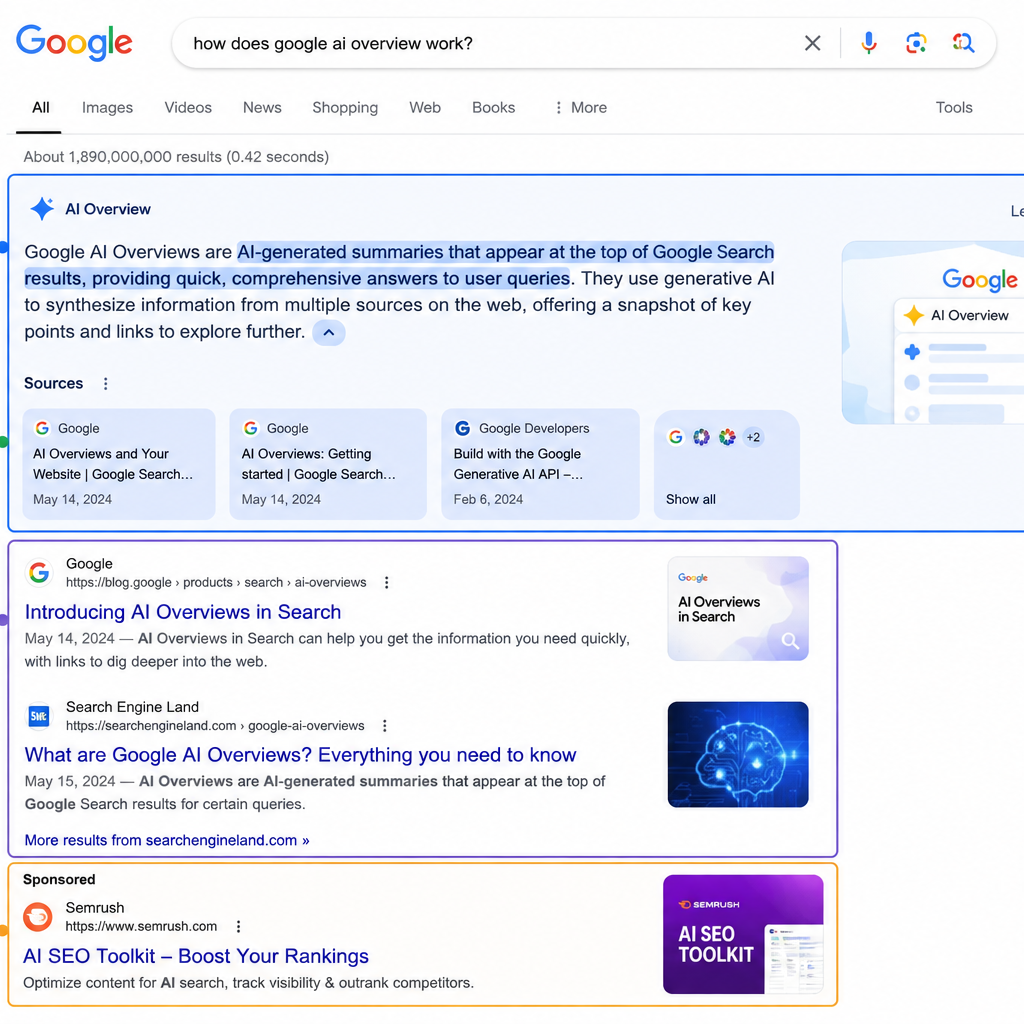
Google Search is no longer a simple retrieval engine that matches keywords to webpages. It has evolved into a sophisticated AI ecosystem capable of understanding intent, retrieving relevant information from multiple sources, reasoning across diverse datasets, and generating comprehensive answers in real time. This transformation represents one of the most significant architectural changes in the history of search and is driving many of the new SEO techniques adopted by technical marketers today.
Understanding this ecosystem is essential because Google’s new AI Search Impressions are generated within these AI-powered experiences rather than through traditional organic rankings alone. To optimise for AI visibility, SEO professionals must first understand how Google’s generative search pipeline operates behind the scenes.
From Search Engine to Answer Engine
Traditional search engines primarily performed three functions:
- Crawl webpages.
- Index content.
- Rank pages according to relevance and authority.
Users were then presented with a ranked list of links and chose which webpage to visit.
Google’s AI-powered search introduces an additional layer of intelligence.
Instead of only retrieving webpages, Google now analyses information from multiple trusted sources, synthesises key facts, evaluates contextual relationships, and generates a coherent response tailored to the user’s question. In many cases, the AI-generated answer becomes the primary interface between the user and the web.
This represents a shift from a retrieval-first model to an answer-first model, where ranking remains important but is only one component of a much larger AI system.
The Core Components of Google’s AI Search Architecture
Although Google has not publicly disclosed every implementation detail of its generative search infrastructure, research papers, developer documentation, and observed behaviour reveal several foundational components that work together to produce AI-powered search results.
These components include:
- Web crawling and indexing
- Traditional ranking systems
- Semantic retrieval
- Knowledge Graph integration
- Entity understanding
- Vector embeddings
- Retrieval-Augmented Generation (RAG)
- Large Language Models (LLMs)
- Grounding and citation systems
- Safety and quality evaluation
- Response generation
Rather than operating independently, these systems continuously exchange information to ensure that AI-generated answers remain accurate, relevant, and trustworthy.
Stage 1: Crawling and Indexing the Web
Every AI-generated answer begins with Google’s enormous web index.
Googlebot continuously crawls billions of webpages, discovering new content, updating existing documents, and removing obsolete information. During indexing, Google extracts considerably more than plain text.
It identifies:
- Headings
- Images
- Structured data
- Internal linking relationships
- Entity references
- Page semantics
- Topical relevance
- Author information
- Organisation data
- Freshness signals
This rich understanding forms the knowledge base that later supports AI retrieval.
Unlike traditional SEO, where keywords alone often influenced rankings, modern indexing focuses heavily on semantic meaning and entity relationships. This is one reason why cutting edge SEO increasingly prioritises content depth, topical authority, and structured information over isolated keyword optimisation.
Stage 2: Understanding User Intent
When a user submits a search query, Google’s first objective is no longer simply matching keywords.
Instead, its AI systems attempt to understand:
- What information the user actually wants.
- Whether the query requires factual accuracy.
- If multiple interpretations exist.
- Whether follow-up questions are likely.
- How much contextual reasoning is needed.
- Which information sources are most trustworthy.
For example, the query:
“How does AI Search measure impressions?”
requires technical documentation, conceptual understanding, and explanatory content rather than a simple keyword match.
Modern AI systems interpret the meaning behind the query before retrieving information.
Stage 3: Semantic Retrieval Instead of Keyword Matching
Traditional search relied heavily on lexical similarity.
Modern AI retrieval relies on semantic similarity.
Rather than searching only for pages containing identical keywords, Google’s retrieval systems evaluate conceptual relationships between ideas using vector embeddings and advanced language models.
This allows AI systems to recognise that content discussing:
- generative search,
- AI visibility,
- answer engines,
- grounding,
- Retrieval-Augmented Generation,
- semantic retrieval,
may all contribute to answering a question about AI Search Impressions, even when the exact phrase does not appear throughout the document.
This semantic understanding is one of the foundations of modern SEO intelligence, where optimisation focuses on demonstrating topical expertise rather than repeating target keywords.
Stage 4: Knowledge Graph and Entity Understanding
Google’s Knowledge Graph plays a central role within its AI ecosystem.
Rather than viewing webpages as isolated documents, Google identifies entities such as:
- People
- Companies
- Products
- Technologies
- Locations
- Events
- Organisations
It then maps the relationships between those entities.
For example, a technical article discussing Google Search Console, AI Overviews, structured data, and Retrieval-Augmented Generation creates a network of interconnected concepts rather than a collection of unrelated keywords.
Entity understanding allows Google’s AI systems to retrieve content based on knowledge relationships instead of simple textual similarity, significantly improving both precision and contextual relevance.
Stage 5: Retrieval-Augmented Generation (RAG)
Once relevant information has been retrieved, Google does not rely solely on the large language model’s internal knowledge.
Instead, it grounds its responses using fresh, authoritative information retrieved directly from its search index.
This process is commonly known as Retrieval-Augmented Generation (RAG).
A simplified workflow looks like this:
User Query
│
▼
Intent Analysis
│
▼
Semantic Retrieval
│
▼
Relevant Documents
│
▼
Grounding Layer
│
▼
Large Language Model
│
▼
AI-Generated Response
Grounding significantly reduces hallucinations because the language model generates responses using verified external information rather than relying exclusively on previously learned parameters.
Stage 6: Grounding and Source Attribution
One of the defining characteristics of Google’s AI Search ecosystem is that generated responses are typically supported by cited sources.
Before producing an answer, Google’s systems evaluate multiple candidate documents based on factors including:
- Topical authority
- Information quality
- Freshness
- Source reliability
- Entity confidence
- Semantic completeness
- User intent alignment
Only after this evaluation are selected sources used to ground the generated response.
This is also the stage where a webpage may contribute to an AI-generated answer, making it eligible to generate an AI Search Impression within Search Console.
Unlike traditional rankings, multiple webpages may simultaneously contribute to a single AI-generated response.
Stage 7: AI Response Generation
After retrieval and grounding are complete, Google’s large language models generate a natural-language response.
Unlike conventional featured snippets, AI-generated answers are dynamic.
They may:
- Combine information from several websites.
- Summarise lengthy documents.
- Explain complex concepts.
- Compare products or services.
- Generate step-by-step instructions.
- Respond conversationally to follow-up questions.
Every response is created in real time using both retrieved information and language model reasoning.
This dynamic generation explains why AI visibility differs fundamentally from traditional ranking positions.
AI Overviews and AI Mode
Google currently delivers generative search experiences through two primary interfaces.
AI Overviews
AI Overviews appear directly within search results for queries where Google determines that an AI-generated summary will improve the user experience.
These summaries:
- synthesise information from multiple authoritative sources,
- provide concise explanations,
- surface supporting citations,
- encourage deeper exploration when appropriate.
For many informational searches, AI Overviews now serve as the user’s first interaction with web content.
AI Mode
AI Mode extends this capability into a conversational search experience.
Instead of treating every query independently, AI Mode maintains context across multiple interactions, allowing users to refine questions naturally without repeating previous information.
This conversational workflow enables:
- multi-step reasoning,
- contextual follow-up questions,
- comparative analysis,
- personalised exploration,
- deeper information retrieval.
As AI Mode continues to evolve, visibility will increasingly depend on whether content remains useful across an entire conversation rather than answering only a single keyword query.
Why This Ecosystem Changes SEO Forever
Google’s AI Search ecosystem demonstrates that modern optimisation is no longer limited to improving rankings for individual keywords.
Success increasingly depends on becoming a trusted information source within Google’s retrieval and generation pipeline.
This shift has given rise to SEO intelligence, where optimisation is guided by semantic understanding, entity relationships, structured information, topical authority, and factual reliability instead of isolated ranking signals.
For organisations investing in advanced algorithm SEO solutions, the objective is evolving from achieving higher positions in search results to maximising inclusion within AI-generated answers. Likewise, cutting edge organic search engine optimization technology is increasingly focused on helping search engines interpret, retrieve, and confidently ground content in generative experiences.
Understanding how Google’s AI ecosystem functions provides the technical foundation for interpreting AI Search Impressions. Once you understand how information is crawled, indexed, retrieved, grounded, and generated, it becomes much easier to see why traditional ranking metrics alone can no longer describe search visibility in the age of AI.
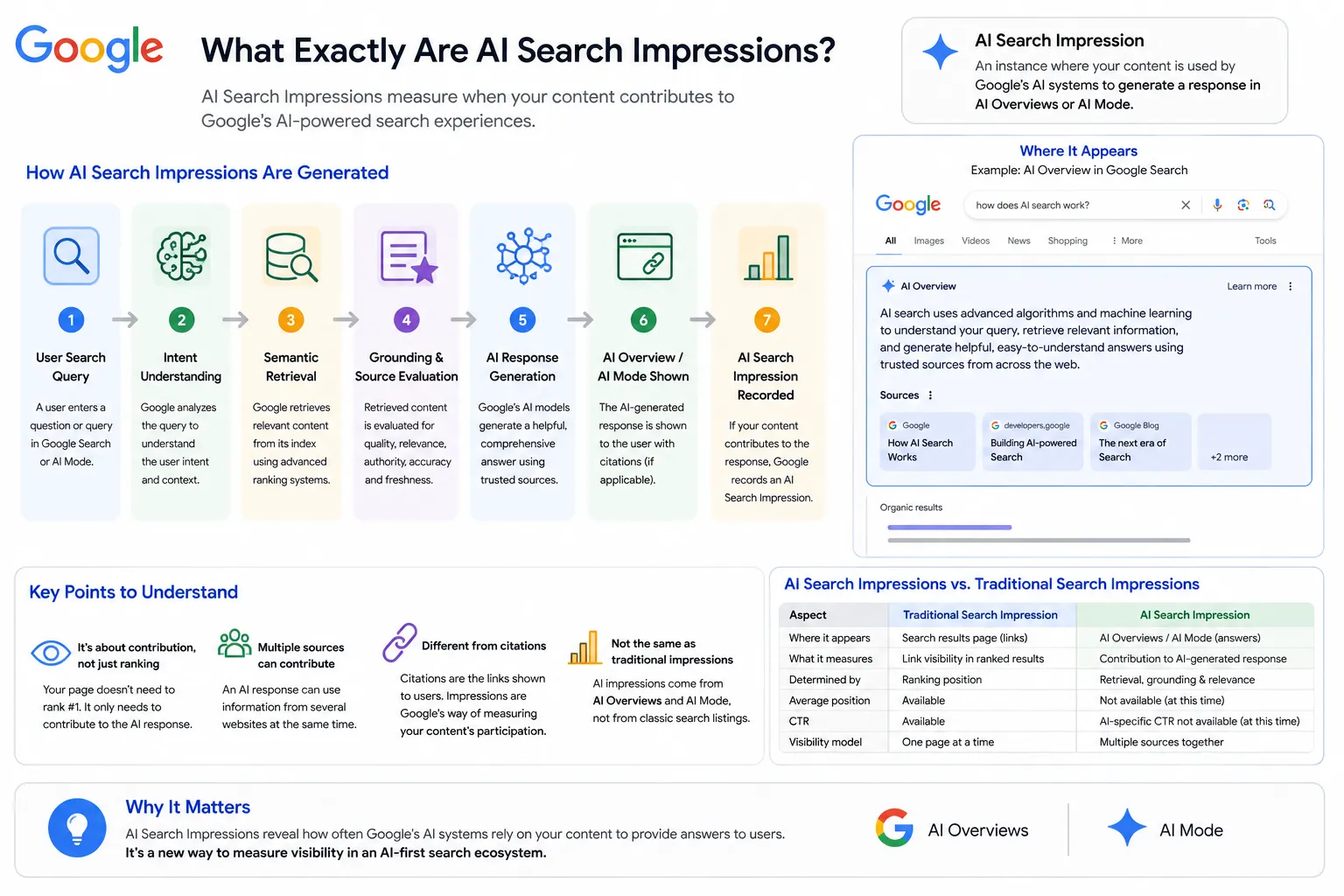
What Exactly Are AI Search Impressions?
The introduction of AI Search Impressions marks a significant evolution in how Google measures search visibility. For decades, impressions referred to a relatively simple concept: if a webpage appeared on a Search Engine Results Page (SERP) that a user viewed, Google counted an impression. This definition worked well because traditional search results followed a predictable format of ranked hyperlinks displayed in response to a query.
AI-powered search changes that model.
Instead of presenting only a list of webpages, Google now generates AI-powered responses that synthesise information from multiple trusted sources. These responses are created dynamically using advanced retrieval systems, large language models, and grounding mechanisms that select authoritative content from Google’s search index. As a result, visibility is no longer determined solely by where a page ranks, but also by whether it contributes to the AI-generated answer.
AI Search Impressions are Google’s first attempt to measure this new form of visibility.
The Official Concept Behind AI Search Impressions
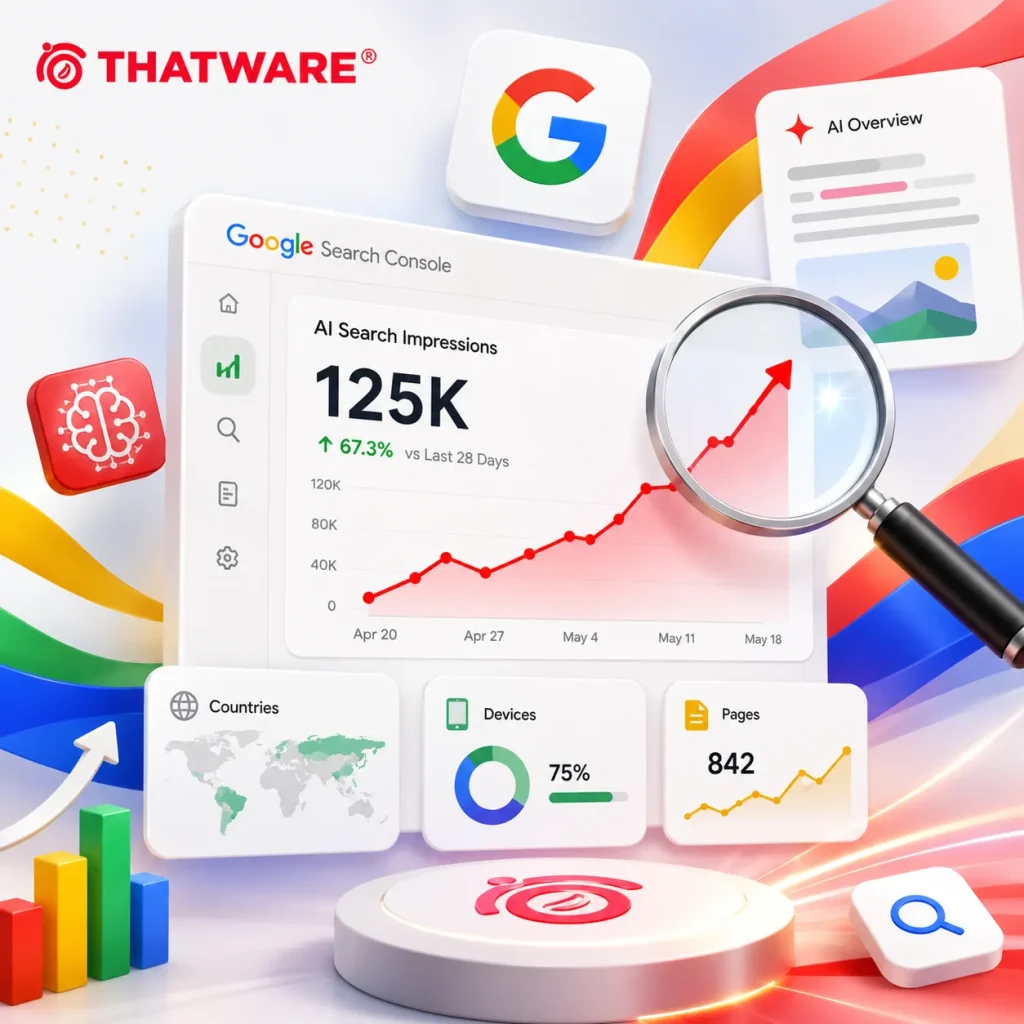
At a high level, an AI Search Impression represents an instance where your content is surfaced within Google’s AI-powered search experiences.
Unlike traditional impressions, which are tied to the visibility of a hyperlink in a ranked list, AI Search Impressions are associated with content that contributes to generative search responses such as AI Overviews and AI Mode.
The key distinction is that Google’s AI systems are not simply displaying your webpage. They are retrieving relevant information, evaluating its quality and relevance, and using it to generate an answer for the user. If your content becomes part of that experience, Google records its contribution through AI-specific reporting.
This reflects an important conceptual shift. Success is no longer measured solely by whether users saw your link. It also depends on whether Google’s AI systems considered your content valuable enough to help answer the user’s question.
AI Visibility Is Different from Traditional Search Visibility
In conventional search, visibility is largely determined by ranking position.
For example, if a webpage ranks first for a competitive query, it typically receives more impressions and clicks than pages ranking further down the results.
AI-generated search experiences operate differently.
Rather than selecting one “best” page, Google’s retrieval systems may evaluate hundreds of relevant documents before choosing several authoritative sources to ground the generated response.
A single AI-generated answer can therefore be supported by information from multiple websites simultaneously.
This means that visibility within AI Search is no longer exclusive. Multiple publishers may contribute knowledge to the same response, each playing a role in helping Google’s AI produce a comprehensive and trustworthy answer.
How AI Search Impressions Are Generated
Although Google has not disclosed the precise implementation details of its reporting pipeline, the observable workflow follows a logical sequence.
A simplified process looks like this:
User Search Query
│
▼
Intent Understanding
│
▼
Semantic Retrieval
│
▼
Candidate Documents
│
▼
Grounding & Source Evaluation
│
▼
AI Overview / AI Mode Response
│
▼
AI Search Impression Recorded
Each stage serves a distinct purpose.
The retrieval system first identifies documents that may help answer the query. Google’s grounding systems then evaluate factors such as topical relevance, factual accuracy, authority, freshness, and contextual completeness before selecting the information used by the large language model.
If your content contributes to the generated response, it becomes eligible for inclusion in Google’s AI Search reporting.
AI Search Impressions Are Not the Same as AI Citations
One of the most common misconceptions is that an AI Search Impression is simply another name for an AI citation.
These concepts are related, but they are not identical.
An AI citation refers to the source references displayed alongside an AI-generated answer, allowing users to explore the original webpages.
An AI Search Impression, however, is a reporting metric recorded by Google Search Console to measure visibility within AI-powered search experiences.
Think of citations as the visible references presented to users, while impressions represent Google’s measurement of participation within the AI search experience.
Although the two frequently occur together, they serve different purposes.
When Does Google Count an AI Search Impression?
While Google has not published every technical criterion, several conditions are generally required before an AI Search Impression can be recorded.
Your content must first be eligible for retrieval by Google’s search systems.
It must then be evaluated as relevant to the user’s query.
Finally, Google’s generative search system must determine that the information contributes meaningfully to the AI-generated response presented to the user.
This means AI Search Impressions depend on considerably more than keyword rankings alone.
Signals that are likely to influence eligibility include:
- Topical authority
- Semantic relevance
- Entity relationships
- Content quality
- Information accuracy
- Freshness
- Structured data
- Overall trustworthiness
These factors determine whether Google’s AI systems consider a document suitable for grounding generative responses.
AI Search Impressions vs Traditional Search Impressions
Although both metrics measure visibility, they represent fundamentally different search experiences.
| Traditional Search Impression | AI Search Impression |
| Generated from ranked search listings | Generated from AI-powered search experiences |
| Based on hyperlink visibility | Based on contribution to AI-generated responses |
| Influenced primarily by ranking position | Influenced by retrieval, grounding, and semantic relevance |
| Measures exposure within classic SERPs | Measures participation within AI Overviews and AI Mode |
| Average position is available | Average position is currently unavailable |
| CTR can be calculated | AI-specific CTR is not currently reported |
This comparison highlights why AI Search Impressions should not be interpreted as a replacement for traditional impressions. Instead, they provide an additional layer of insight into how content performs within Google’s evolving search ecosystem.
Why AI Search Impressions Matter
For years, SEO professionals have relied on rankings, impressions, clicks, and traffic to evaluate success.
However, AI-powered search introduces an entirely new dimension of visibility.
A webpage may influence thousands of AI-generated answers without experiencing a corresponding increase in clicks. Users may receive the information they need directly from Google’s AI Overview while still being exposed to your brand, expertise, or cited research.
Without AI Search Impressions, these interactions would remain largely invisible.
The new reporting therefore provides valuable insight into how often Google’s AI systems recognise your content as a trusted source of information.
For organisations investing in authoritative content, original research, and technical SEO, this creates an opportunity to measure value that previously could not be quantified.
AI Search Impressions Represent a New Definition of Success
Perhaps the most important implication of this new metric is that it changes how success should be measured.
Historically, optimisation focused on achieving higher rankings.
In the AI era, optimisation increasingly focuses on becoming one of the trusted sources that Google’s generative systems retrieve, understand, and use when constructing answers.
Ranking remains important because strong organic visibility often increases the likelihood of retrieval. However, AI Search Impressions introduce an additional objective: earning inclusion within the knowledge pipeline that powers AI-generated search experiences.
Rather than asking, “Did my page rank first?”, organisations should increasingly ask, “Did Google’s AI consider my content authoritative enough to help answer the user’s question?”
That subtle difference reflects one of the most profound shifts in the history of search measurement. AI Search Impressions do not simply introduce a new reporting metric—they introduce a new way of defining visibility in an AI-first search ecosystem.
How Google Collects AI Search Impression Data
One of the biggest questions surrounding Google’s new AI Search reporting is deceptively simple: How does Google actually know when your content has appeared in an AI-generated search experience?
Unlike traditional search results, AI-generated responses are created dynamically. They are not static webpages, nor are they fixed ranking positions. Every AI Overview or AI Mode response is generated in real time by combining Google’s retrieval systems, large language models, and grounding mechanisms. This makes measuring visibility considerably more complex than counting impressions for a standard blue link.
Although Google has not publicly disclosed every technical detail of its reporting infrastructure, the company has revealed enough through its documentation, research publications, and Search Console updates to understand the high-level architecture behind AI Search Impression reporting.
AI Search Reporting Begins Long Before an Answer Is Generated
An AI Search Impression is not created at the moment a language model writes an answer.
Instead, it is the result of a sophisticated pipeline involving multiple systems that work together before, during, and after a search query is processed.
A simplified architecture looks like this:
User Query
│
▼
Query Understanding
│
▼
Semantic Retrieval
│
▼
Candidate Documents
│
▼
Grounding & Quality Evaluation
│
▼
Large Language Model
│
▼
AI Overview / AI Mode
│
▼
User Interaction
│
▼
Telemetry & Impression Logging
│
▼
Search Console Reporting
Each stage contributes information that eventually determines whether an AI Search Impression is recorded.
Stage 1: Query Processing
Every search begins with a user’s query.
However, Google’s AI systems do far more than identify keywords.
Modern search analyses:
- User intent
- Query semantics
- Previous conversational context
- Geographic relevance
- Language
- Freshness requirements
- Entity relationships
For example, the queries:
- “How are AI Search Impressions counted?”
- “How does Google measure AI visibility?”
- “Explain AI Search reporting.”
contain different wording but express essentially the same intent.
Google’s semantic understanding allows these searches to trigger similar retrieval workflows.
Stage 2: Semantic Retrieval
Once Google understands the intent behind the query, its retrieval systems begin searching across billions of indexed documents.
Unlike traditional lexical search, modern retrieval focuses on semantic relevance rather than exact keyword matching.
Google evaluates factors such as:
- Topic similarity
- Entity relevance
- Contextual relationships
- Content completeness
- Document authority
- Freshness
- Information quality
Instead of retrieving a single webpage, Google’s AI systems typically retrieve numerous candidate documents that could potentially contribute to the final answer.
This semantic retrieval layer is one of the reasons LLM in SEO has become such an important topic. Optimisation is increasingly focused on helping AI systems understand concepts and relationships rather than simply matching keyword phrases.
Stage 3: Candidate Document Evaluation
Retrieval alone does not determine which webpages contribute to an AI-generated response.
Each candidate document is evaluated against numerous quality signals.
Although Google’s exact weighting remains proprietary, publicly documented search quality principles suggest that the evaluation considers factors including:
- Topical authority
- Expertise
- Experience
- Trustworthiness
- Factual accuracy
- Originality
- Structured information
- Content freshness
- Semantic coverage
The objective is to identify documents that provide reliable information capable of grounding an AI-generated answer.
Only a subset of retrieved documents proceeds to the next stage.
Stage 4: Grounding the AI Response
Grounding is arguably the most important stage in Google’s AI search architecture.
Rather than relying solely on information stored within the large language model, Google’s systems validate generated responses using information retrieved directly from trusted webpages.
This process significantly reduces hallucinations while improving factual accuracy.
A simplified grounding workflow can be visualised as follows:
Retrieved Documents
│
▼
Authority Evaluation
│
▼
Fact Validation
│
▼
Entity Consistency
│
▼
Grounding Layer
│
▼
Verified Context
At this stage, multiple webpages may contribute information to a single AI-generated response.
Each document effectively becomes part of the evidence base used during response generation.
Stage 5: AI Response Generation
Once grounding is complete, Google’s large language models generate the final response.
Unlike traditional featured snippets, these responses are created dynamically for each search.
The AI system may:
- Summarise multiple documents.
- Combine complementary information.
- Compare different perspectives.
- Explain technical concepts.
- Generate structured answers.
- Respond conversationally to follow-up questions.
Importantly, the response generation stage does not simply reproduce webpage content. Instead, it synthesises information from multiple trusted sources into a coherent answer while maintaining attribution to supporting webpages where appropriate.
Stage 6: Impression Logging Through Search Telemetry
This is where reporting begins.
When the AI-generated response is delivered to the user, Google’s search infrastructure records a variety of telemetry events.
Although Google has not published its internal event schema, large-scale search systems typically log information such as:
- Search timestamp
- Query category
- Search surface
- Device type
- Country
- Language
- Retrieved sources
- Generated response metadata
- User interaction signals
Within this telemetry layer, Google can identify which webpages contributed to the AI-generated response.
Those contributions form the basis of AI Search Impression reporting.
This logging process is fundamentally different from traditional impression counting because it measures participation within an AI-generated experience rather than the visibility of a hyperlink on a static search results page.
Stage 7: Aggregation and Search Console Reporting
Individual telemetry events are not displayed directly inside Google Search Console.
Instead, Google aggregates billions of events across its infrastructure before presenting website owners with summarised reporting.
These aggregated datasets are organised by dimensions such as:
- Pages
- Countries
- Devices
- Date
- Search appearance
Aggregation serves multiple purposes.
It protects user privacy, reduces reporting complexity, and enables Search Console to present meaningful trends rather than exposing raw search logs.
This explains why Search Console reports are not real-time. Data must first pass through Google’s validation, aggregation, and processing pipelines before becoming available to website owners.
Why Google Does Not Report Every Internal Signal
Many SEO professionals immediately noticed that the new AI reporting lacks several familiar metrics.
Currently, Google does not provide:
- AI-specific CTR
- AI average position
- AI query reporting
- Citation frequency
- Grounding confidence scores
- Source selection rankings
This omission is not necessarily a technical limitation.
Many of these concepts simply do not map cleanly to AI-generated search experiences.
For example, an AI-generated response may use information from multiple webpages simultaneously. Unlike traditional search rankings, there is often no single “position” that accurately represents each contributing source.
Similarly, click-through behaviour becomes much more complex when users receive comprehensive answers directly within Google’s interface.
Why This Reporting Matters for AI Search
Google’s AI Search Impression reporting represents a significant shift in how search visibility is measured.
Historically, search reporting focused almost entirely on what users clicked.
The new reporting framework begins measuring something different: whether Google’s AI systems considered your content valuable enough to retrieve, validate, and incorporate into an AI-generated response.
This distinction is particularly important for organisations investing in LLM SEO and LLM SEO optimization. Success is no longer defined solely by ranking positions or organic traffic. Increasingly, it depends on whether content can be understood, trusted, and surfaced by large language models operating within Google’s search ecosystem.
As Google’s AI capabilities continue to evolve, reporting is likely to become increasingly sophisticated. Future metrics may include richer attribution, citation analytics, conversational interactions, or additional engagement signals. However, AI Search Impressions provide the first official glimpse into how Google measures visibility in an AI-first search environment, laying the foundation for the next generation of search analytics.
Inside the New Google Search Console AI Report
For years, Google Search Console has been the primary source of truth for measuring organic search performance. It provides first-party data directly from Google’s search infrastructure, enabling website owners to monitor impressions, clicks, click-through rates, indexing, and technical health. The introduction of the AI Search report extends this capability into Google’s generative search ecosystem, allowing publishers to begin measuring visibility within AI-powered search experiences.
Although the report is still in its early stages, it represents an important milestone. For the first time, Google is acknowledging AI search as a distinct performance surface that deserves dedicated reporting rather than being hidden within traditional organic metrics.
Understanding what the report contains—and just as importantly, what it does not contain—is essential for interpreting AI Search Impressions correctly.
Where to Find the AI Search Report
The AI Search report is available within Google Search Console for eligible properties.
Users can access it from the Search Console interface alongside their existing Performance reports. Unlike traditional Search Performance reporting, this section focuses specifically on AI-powered search experiences, including AI Overviews and AI Mode where applicable.
The report follows the familiar Search Console design philosophy, making it easy for existing users to analyse AI visibility without learning an entirely new interface.
At a high level, the workflow looks like this:
Google Search Console
│
▼
Performance
│
▼
AI Search Report
│
├── AI Impressions
├── Pages
├── Countries
├── Devices
└── Date Trends
Rather than overwhelming users with raw telemetry, Google presents aggregated insights that allow website owners to identify visibility trends across different dimensions.
AI Search Impressions
The most prominent metric within the report is AI Search Impressions.
This metric represents the number of times Google’s AI-powered search experiences included your content during eligible searches.
Unlike traditional impressions, these values measure participation within AI-generated answers rather than visibility within a ranked list of hyperlinks.
For example, if Google’s AI Overview retrieves and uses information from your article while answering a user’s question, that interaction contributes to your AI Search Impression count.
It is important to remember that impressions measure visibility—not engagement.
A high number of AI Search Impressions does not necessarily translate into higher website traffic. Instead, it indicates that Google’s AI systems frequently recognise your content as relevant and authoritative enough to contribute to generated answers.
Page-Level Reporting
One of the most valuable features of the AI Search report is page-level analysis.
Rather than reporting visibility only at the property level, Search Console allows website owners to identify which individual URLs are appearing within AI-powered search experiences.
This enables SEO teams to answer practical questions such as:
- Which articles receive the highest AI visibility?
- Which documentation pages are most frequently surfaced?
- Which product pages contribute to AI-generated answers?
- Which newly published content is beginning to gain AI exposure?
Page-level reporting also makes it easier to identify successful content patterns that can be replicated across future publishing strategies.
Country-Level Performance
AI Search adoption varies significantly across different regions.
To help organisations understand geographic performance, Search Console includes country-based reporting within the AI Search report.
This allows publishers to identify:
- Markets where AI visibility is growing.
- Regional differences in AI search adoption.
- Localised content opportunities.
- International optimisation priorities.
For multinational websites, country-level reporting provides valuable insight into where AI-powered search experiences are generating the greatest visibility.
Device Reporting
User behaviour differs substantially between desktop and mobile devices.
Search Console therefore includes device segmentation within the AI Search report.
Typical device categories include:
- Desktop
- Mobile
- Tablet
Analysing AI Search Impressions by device can reveal important trends.
For example:
- AI Overviews may appear more frequently on mobile searches for certain query types.
- Desktop users may interact differently with AI-generated responses.
- Device-specific search behaviour may influence overall AI visibility.
These insights can support UX improvements, responsive content optimisation, and device-specific performance analysis.
Date Trends and Historical Analysis
Like traditional Search Console reports, the AI Search report includes time-based trend analysis.
Users can analyse performance across different date ranges to identify:
- Daily fluctuations
- Weekly growth
- Monthly trends
- Seasonal changes
- Performance before and after content updates
Historical reporting is particularly valuable when evaluating SEO initiatives.
For example, if a website introduces improved structured data, expands topical coverage, or refreshes outdated content, AI Search Impressions may reveal whether those changes increase visibility within Google’s generative search experiences.
Rather than evaluating isolated data points, organisations should focus on long-term trends that demonstrate sustained growth in AI visibility.
Filtering and Data Segmentation
Search Console’s filtering capabilities remain one of its strongest features, and the AI Search report follows the same philosophy.
Depending on Google’s rollout and available dimensions, users can segment performance using filters such as:
- Date range
- Page
- Country
- Device
- Search appearance
Filtering enables much deeper analysis than simply reviewing headline metrics.
For example, an enterprise website could compare:
- Mobile versus desktop AI visibility.
- Country-specific performance.
- Individual content clusters.
- Newly published pages versus evergreen content.
This level of segmentation helps identify optimisation opportunities that would otherwise remain hidden within aggregated reporting.
Exporting AI Search Data
Like other Search Console reports, AI Search reporting supports data export for further analysis.
Exporting data allows organisations to integrate AI visibility metrics into broader reporting workflows using tools such as:
- Google Sheets
- Microsoft Excel
- BigQuery
- Looker Studio
- Business Intelligence platforms
- Internal analytics dashboards
This capability is particularly valuable for enterprise SEO teams managing thousands of webpages across multiple markets.
Instead of analysing data manually inside Search Console, organisations can automate dashboards and combine AI Search metrics with additional performance indicators such as organic traffic, conversions, crawl statistics, and technical health metrics.
Understanding the Current Limitations
Although the introduction of AI Search reporting is a major advancement, the report remains intentionally focused.
At the time of writing, Google primarily provides visibility metrics rather than detailed engagement analytics.
The report currently does not include:
- AI-specific click-through rate (CTR)
- AI clicks as a standalone metric
- Average AI position
- AI query reporting
- Citation frequency
- Source ranking order
- Contribution weighting
- Prompt-level analytics
These omissions are understandable because AI-generated search experiences differ fundamentally from traditional search results.
For example, multiple webpages may contribute to a single AI-generated response, making concepts such as “position one” significantly less meaningful than they are in classic organic rankings.
How SEO Professionals Should Interpret the Report
One of the biggest mistakes organisations can make is treating AI Search Impressions exactly like traditional organic impressions.
The two metrics measure different types of visibility.
Traditional Search Console reports answer questions such as:
- How often did my webpage appear in search results?
- What was my average ranking position?
- How many users clicked my listing?
The AI Search report answers a different question:
How often did Google’s AI systems consider my content valuable enough to contribute to AI-generated answers?
This subtle distinction changes how performance should be evaluated.
Rather than focusing exclusively on rankings, SEO professionals should begin analysing whether their content consistently becomes part of Google’s knowledge retrieval pipeline.
A steady increase in AI Search Impressions suggests that Google’s retrieval and grounding systems increasingly recognise the website as an authoritative source within its subject area.
Why This Report Matters
The new AI Search report is more than another dashboard inside Google Search Console.
It represents Google’s first official framework for measuring visibility within AI-powered search experiences.
For years, marketers relied on third-party monitoring tools, manual prompt testing, and indirect performance signals to estimate AI visibility. Those approaches provided useful insights but lacked the authority of Google’s own first-party data.
The AI Search report changes that. It introduces a measurable connection between content quality and AI-generated search visibility, allowing organisations to evaluate how effectively their content participates in Google’s evolving answer-first search ecosystem.
As AI search continues to mature, this report is likely to become one of the most important sources of performance data for technical SEO professionals. While future updates may introduce richer engagement metrics, citation analytics, and deeper attribution models, the current report already establishes a new benchmark: success is no longer measured only by where your pages rank, but also by how often Google’s AI chooses them to help answer the world’s questions.
AI Impressions vs Traditional Impressions
Although Google has introduced AI Search Impressions as a new visibility metric, they should not be viewed as a replacement for traditional search impressions. Instead, they measure a fundamentally different search experience.
Traditional Search was designed around ranked webpages. Every impression represented the visibility of a hyperlink within a Search Engine Results Page (SERP). AI Search, however, operates through retrieval, grounding, and response generation. Instead of ranking a single webpage, Google’s AI systems may retrieve information from multiple authoritative sources before constructing a single answer.
As a result, AI Impressions measure participation in an AI-generated response rather than exposure within a ranked list of links.
Understanding this distinction is essential when analysing performance inside Google Search Console.
Visibility
Traditional impressions measure whether a webpage was displayed within Google’s organic search results.
AI Impressions measure whether Google’s AI systems surfaced your content as part of an AI-generated experience such as AI Overviews or AI Mode.
This means a webpage can generate AI visibility even when it is not occupying the highest organic ranking position.
Ranking
Traditional search revolves around rankings.
Every webpage competes for a position on the Search Engine Results Page, and movement between positions directly affects impressions and click-through rates.
AI Search works differently.
Google’s retrieval systems evaluate numerous candidate documents simultaneously before selecting information that contributes to the generated answer.
Rather than asking:
“Did my page rank first?”
the more relevant question becomes:
“Did Google’s AI retrieve and use my content?”
Ranking still matters because strong organic signals often improve retrieval opportunities, but AI visibility is ultimately determined by relevance, authority, and grounding rather than numerical position alone.
Click-Through Rate (CTR)
CTR has long been one of the most valuable SEO metrics.
Traditional CTR measures the percentage of users who clicked a search listing after seeing it.
Currently, Google does not publish an AI-specific CTR.
This omission reflects the fact that AI-generated answers often satisfy the user’s intent directly within the search interface, reducing the importance of click-based measurement.
Future AI engagement metrics may evolve beyond the traditional concept of CTR altogether.
Clicks
Traditional Search Console reports include both impressions and clicks.
Clicks remain one of the strongest indicators of website traffic.
AI Search reporting currently focuses primarily on visibility rather than engagement.
Although users may still click cited sources within AI-generated responses, Google does not currently expose dedicated AI click reporting within the AI Search report.
As a result, organisations should avoid assuming that increasing AI Impressions will always produce proportional increases in website traffic.
Position
Average Position has always been a cornerstone metric in traditional SEO reporting.
It provides a simple numerical representation of where a webpage appeared within search results.
AI-generated search experiences do not follow this model.
A response may combine information from several webpages simultaneously without assigning a single ranked position to any individual source.
Consequently, Google does not currently report an “AI Position.”
The concept simply does not map cleanly to a generative search environment.
Multiple Citations
Traditional search generally highlights one webpage per organic listing.
AI-generated responses frequently combine information from multiple trusted sources.
An AI Overview may simultaneously reference:
- Government documentation
- Academic publications
- Technical blogs
- Product documentation
- Industry research
This collaborative information model fundamentally changes how visibility should be interpreted.
Instead of competing for one ranking position, authoritative websites may collectively contribute to a single AI-generated answer.
Personalisation
Traditional search incorporates personalisation through factors such as location, language, search history, and device.
AI-powered search introduces even richer contextual understanding.
Generated responses may vary based on:
- Conversational history
- Follow-up questions
- Contextual reasoning
- Geographic intent
- Device capabilities
- User preferences
This dynamic behaviour means that two users submitting similar queries may receive slightly different AI-generated responses.
Consequently, AI visibility is inherently more fluid than traditional ranking-based visibility.
Search Intent
Traditional SEO has always attempted to match search intent.
AI Search takes intent modelling considerably further.
Instead of identifying keywords alone, Google’s AI systems evaluate:
- User objectives
- Context
- Ambiguity
- Information requirements
- Expected reasoning depth
Content that comprehensively addresses a topic often performs better within AI retrieval because it satisfies broader informational intent rather than targeting isolated keyword phrases.
Measurement
Perhaps the greatest difference lies in what each metric is actually measuring.
Traditional Search measures webpage exposure.
AI Search measures content contribution.
Rather than asking whether a hyperlink appeared on a search results page, Google now measures whether your information helped generate the answer itself.
That represents a profound evolution in how search visibility is defined.
Comparison Table
| Metric | Traditional Search Impressions | AI Search Impressions |
| Visibility | Webpage displayed in organic results | Content contributes to AI-generated response |
| Ranking | Strongly influenced by ranking position | Influenced by retrieval, grounding and relevance |
| CTR | Available | Not currently reported |
| Clicks | Available | No dedicated AI click metric |
| Average Position | Available | Not applicable |
| Multiple Citations | Typically one listing per result | Multiple sources may contribute simultaneously |
| Personalisation | Moderate | High due to conversational AI and context |
| Search Intent | Keyword and semantic matching | Intent-driven reasoning and contextual understanding |
| Measurement Model | Hyperlink visibility | Knowledge contribution within AI-generated answers |
The comparison illustrates why AI Search Impressions should be interpreted as a complementary metric rather than a replacement for traditional SEO reporting. Both measurements describe different aspects of search visibility, and together they provide a far more complete picture of modern search performance.
What Google Still Doesn’t Tell You
The launch of AI Search reporting is undoubtedly one of the most important developments in Search Console’s history.
However, the current implementation is intentionally conservative.
Google provides enough information to measure AI visibility but withholds many of the metrics that SEO professionals naturally want to analyse.
This is understandable. AI-powered search operates very differently from traditional rankings, and many familiar reporting concepts simply do not translate into generative experiences.
Nevertheless, several important gaps remain.
No AI Click-Through Rate (CTR)
Perhaps the most requested metric is AI CTR.
Traditional CTR reveals how effectively search listings convert visibility into website visits.
Google currently provides no equivalent measurement for AI-generated search experiences.
Without AI CTR, organisations cannot determine whether increasing AI visibility also leads to higher engagement with cited sources.
This makes it difficult to evaluate how effectively AI exposure contributes to traffic generation.
No AI Position
Search rankings have always been easy to interpret.
Position 1 generally receives more visibility than Position 5.
AI-generated answers have no equivalent concept.
Several webpages may simultaneously contribute to one response, each providing different pieces of information.
Assigning a numerical position to these contributions would be technically misleading.
For this reason, Google currently omits any form of AI ranking position from Search Console.
No AI Search Queries
Traditional Search Console allows website owners to identify the queries that generated impressions and clicks.
The AI Search report currently provides no dedicated query reporting.
This means publishers cannot easily determine:
- Which prompts generated AI visibility.
- Which questions triggered AI retrieval.
- Which topics produce the highest AI exposure.
Without query-level insights, optimisation becomes significantly more challenging because content creators cannot directly observe the relationship between search intent and AI visibility.
No Citation Frequency
Google reports AI Search Impressions but does not disclose how frequently individual webpages were cited within generated responses.
These are not necessarily identical concepts.
A webpage might contribute information repeatedly across numerous AI answers while another contributes only occasionally.
Currently, Search Console provides no way to distinguish between these scenarios.
Citation frequency would offer valuable insight into which content Google consistently trusts across multiple search experiences.
No Source Priority
AI-generated responses often include several supporting webpages.
However, Google does not indicate:
- Which source contributed the majority of information.
- Which source was considered the primary authority.
- Which source supplied only supporting context.
All participating sources are effectively treated equally from a reporting perspective.
For publishers, understanding source priority would provide much richer insight into how Google’s retrieval systems evaluate authority.
No Prompt Variations
Generative AI is inherently conversational.
Users frequently ask follow-up questions, rephrase requests, or explore a topic through multiple conversational turns.
Google currently provides no visibility into these prompt variations.
For example, content may appear for:
- “What are AI Search Impressions?”
- “Explain AI visibility.”
- “How does AI Search reporting work?”
- “How are AI Overviews measured?”
These prompts represent different user journeys, yet Search Console currently aggregates visibility without exposing prompt-level behaviour.
Prompt analytics would dramatically improve content optimisation by revealing how users naturally interact with AI-powered search.
Why Google Is Taking a Conservative Approach
The absence of these metrics should not be interpreted as a weakness in Google’s reporting infrastructure.
Many of these measurements are considerably more difficult to define than their traditional SEO equivalents.
Unlike ranked search results, AI-generated responses involve:
- Dynamic retrieval
- Real-time grounding
- Multi-document synthesis
- Conversational context
- Personalised interactions
- Continuous language model reasoning
Developing reliable reporting standards for such an environment requires significantly more complexity than measuring hyperlinks on a static results page.
Google appears to have prioritised reporting stability over reporting completeness.
What Future AI Search Reporting May Include
As AI-powered search matures, it is reasonable to expect Search Console to evolve alongside it.
Future reporting enhancements could include:
- AI Clicks
- AI CTR
- Query-level AI reporting
- Citation analytics
- Source contribution weighting
- Prompt analytics
- Conversation journey reporting
- AI engagement metrics
- AI citation history
- Retrieval confidence indicators
Whether Google ultimately exposes these metrics remains uncertain, but they would provide a much richer understanding of how content performs within generative search.
For now, AI Search Impressions should be viewed as the first generation of AI search analytics—a foundational metric that signals the beginning of a much broader reporting framework rather than its final destination.
Technical Deep Dive into AI Visibility
The introduction of AI Search Impressions reflects something much larger than a new reporting metric. It represents a shift in how search engines discover, evaluate, and utilise information. Unlike traditional search, where ranking algorithms primarily determine which webpages appear in response to a query, AI-powered search relies on a sophisticated retrieval pipeline that combines semantic understanding, vector mathematics, entity relationships, and large language models.
Understanding this pipeline is essential because AI visibility is no longer determined by keyword rankings alone. Instead, it depends on whether Google’s retrieval systems consider your content authoritative, contextually relevant, and trustworthy enough to become part of an AI-generated response.
AI Visibility Starts with Content Understanding
Before Google can retrieve a document, it must first understand it.
Modern search engines no longer index webpages as collections of keywords. Instead, they analyse the semantic meaning of every document, identifying entities, relationships, concepts, topical themes, structured data, and contextual signals.
A technical article discussing Retrieval-Augmented Generation, embeddings, semantic retrieval, and AI Search Impressions is not simply indexed for those individual phrases. Google’s systems recognise that these concepts belong to a broader knowledge domain involving generative AI, information retrieval, and search technology.
This semantic understanding forms the foundation of modern AI visibility.
Entity Retrieval
Entities have become one of the most important building blocks of Google’s search ecosystem.
An entity represents a uniquely identifiable object, concept, organisation, technology, person, or location.
Examples include:
- Google Search Console
- AI Overviews
- Large Language Models
- Retrieval-Augmented Generation
- Knowledge Graph
- Vector Embeddings
Unlike keywords, entities possess relationships.
Google understands that “AI Overviews” are related to “Google Search,” that “Retrieval-Augmented Generation” supports “Large Language Models,” and that “Google Search Console” measures search performance.
When a user submits a query, Google’s systems often retrieve information based on these entity relationships rather than matching exact keyword phrases.
This allows the search engine to discover highly relevant documents even when the wording differs significantly from the user’s query.
Semantic Retrieval
Traditional search primarily relied on lexical matching.
Semantic retrieval focuses on meaning.
Instead of asking:
Does this document contain the exact keywords?
Modern retrieval asks:
Does this document discuss the same concept?
This distinction dramatically improves search quality.
For example, documents discussing:
- AI visibility
- Generative search
- Retrieval pipelines
- Semantic indexing
- AI citations
may all contribute to answering a query about AI Search Impressions despite using different terminology.
Semantic retrieval enables Google’s AI systems to reason about concepts rather than individual words.
Embedding Similarity
Semantic retrieval is made possible through embeddings.
An embedding is a numerical representation of text generated by machine learning models.
Instead of treating language as isolated words, embeddings convert documents, sentences, and queries into high-dimensional vectors.
For illustration:
“AI Search”
↓
[0.42, -0.16, 0.81, 0.37, …]
These vectors capture semantic meaning.
Documents discussing similar topics occupy nearby positions within the embedding space, allowing Google’s retrieval systems to identify relevant information using mathematical similarity rather than exact text matching.
Cosine similarity is one of the most common techniques used to compare embeddings, enabling search engines to retrieve documents that are conceptually related even when they contain few shared keywords.
Context Scoring
Retrieving a document is only the beginning.
Google must also determine how useful that document is within the context of the user’s query.
Context scoring evaluates multiple signals, including:
- Query intent
- Topic relevance
- Entity relationships
- Freshness
- Authority
- Information completeness
- User context
A technical whitepaper may receive a higher context score than a short blog post when answering engineering-related questions because it provides deeper, more authoritative information.
Context scoring helps Google’s AI systems decide which retrieved documents should contribute to the generated answer.
Topical Authority
AI retrieval favours expertise over isolated optimisation.
Rather than evaluating individual pages independently, Google’s systems increasingly assess whether an entire website demonstrates comprehensive knowledge within a particular subject area.
Signals contributing to topical authority include:
- Comprehensive content coverage
- Internal linking structure
- Expert authorship
- Original research
- Content freshness
- Semantic consistency
- Supporting documentation
A website containing dozens of interconnected technical resources about AI search is considerably more likely to be retrieved than a site with a single, isolated article targeting the same keyword.
Knowledge Graph Integration
Google’s Knowledge Graph serves as one of the core intelligence layers within AI Search.
Instead of treating webpages as disconnected documents, the Knowledge Graph organises information into interconnected entities and relationships.
For example:
Google Search
│
├── AI Overviews
│
├── AI Mode
│
├── Search Console
│
└── Knowledge Graph
These relationships enable Google’s retrieval systems to infer meaning beyond the explicit text contained within a webpage.
Knowledge Graph integration significantly improves contextual understanding and helps reduce ambiguity during information retrieval.
Vector Search
Traditional search relies heavily on inverted indexes.
AI-powered retrieval increasingly relies on vector search.
Instead of searching for keywords, vector search compares numerical embeddings representing semantic meaning.
When a user submits a query, Google’s retrieval systems generate a query embedding and search for nearby document embeddings within an enormous vector index.
This allows conceptually related documents to be retrieved even when they contain different vocabulary.
Vector search forms one of the technological foundations of modern generative search systems.
Grounding
Large Language Models possess impressive reasoning capabilities but are susceptible to hallucinations if they rely solely on internal training data.
Google addresses this challenge through grounding.
Grounding validates AI-generated responses using information retrieved directly from authoritative webpages.
Rather than allowing the language model to invent facts, Google’s retrieval systems provide verified context before response generation begins.
This dramatically improves:
- Accuracy
- Freshness
- Trustworthiness
- Citation quality
Grounding also explains why content quality has become increasingly important within AI-powered search.
Retrieval-Augmented Generation (RAG)
The final stage combines retrieval and language generation.
Retrieval-Augmented Generation (RAG) allows Google’s AI systems to retrieve external information before generating responses.
Instead of relying exclusively on the language model’s internal knowledge, RAG combines:
- Search retrieval
- Document ranking
- Context selection
- Grounding
- Language generation
The result is an answer that is both conversational and supported by current web content.
From an SEO perspective, RAG fundamentally changes optimisation.
Success increasingly depends on whether content is retrieved and selected as trusted context rather than simply ranking highly for keywords.
AI Visibility Architecture
The following simplified workflow illustrates how modern AI Search systems process information before generating an AI citation.
Content
│
▼
Embedding
│
▼
Vector Index
│
▼
Retriever
│
▼
Grounding
│
▼
Large Language Model (LLM)
│
▼
AI Citation
Although Google’s production infrastructure is significantly more sophisticated, this architecture captures the fundamental stages that determine whether content becomes part of an AI-generated response.
Every stage influences AI visibility. Weak content may fail semantic retrieval. Poor authority may prevent grounding. Limited topical coverage may reduce context scores. Only documents that successfully navigate the entire pipeline become eligible for AI citations and, ultimately, AI Search Impressions.
Understanding AI Search Through Information Retrieval
At its core, Google’s AI Search is an information retrieval system enhanced by modern artificial intelligence.
While large language models receive much of the public attention, they represent only one component of a considerably larger search architecture. Before an LLM can generate an answer, Google’s retrieval systems must first discover, rank, validate, and organise relevant information.
Many of these retrieval techniques have evolved over decades of search engine research and continue to play a critical role in modern AI-powered search.
BM25
BM25 (Best Matching 25) remains one of the most influential ranking algorithms in information retrieval.
Rather than relying on simple keyword counts, BM25 evaluates:
- Term frequency
- Inverse document frequency
- Document length
- Query relevance
Although modern AI retrieval extends well beyond BM25, lexical ranking remains valuable for identifying candidate documents during the early stages of retrieval.
BM25 is particularly effective for precise factual searches where exact terminology matters.
Dense Retrieval
Dense Retrieval replaces keyword matching with semantic representations.
Instead of searching text directly, queries and documents are converted into embeddings.
Retrieval is then performed by measuring vector similarity.
This allows Google’s systems to retrieve documents discussing:
- related concepts,
- synonymous terminology,
- contextual information,
even when exact keywords differ substantially.
Dense Retrieval dramatically improves recall for complex, natural-language queries.
Hybrid Retrieval
Neither lexical search nor semantic retrieval is perfect in isolation.
Modern search engines therefore combine both approaches.
Hybrid Retrieval integrates:
- BM25 lexical ranking
- Dense vector retrieval
- Entity retrieval
- Behavioural ranking signals
This combination delivers greater precision while maintaining strong semantic understanding.
Most enterprise AI search systems now employ some form of hybrid retrieval architecture.
Embedding Search
Embedding Search transforms documents into numerical vectors before indexing them.
Unlike traditional keyword indexes, embedding indexes capture conceptual similarity.
For example, documents discussing:
- AI Search
- Answer Engines
- Generative Search
- Retrieval Systems
may occupy neighbouring regions within vector space despite containing different wording.
Embedding Search enables AI systems to retrieve meaning rather than merely matching vocabulary.
Approximate Nearest Neighbour (ANN) Search
Modern vector databases may contain billions of document embeddings.
Comparing every vector directly would be computationally impractical.
Approximate Nearest Neighbour (ANN) algorithms solve this challenge by rapidly identifying vectors that are most similar to the user’s query without exhaustively searching the entire dataset.
ANN dramatically reduces retrieval latency while maintaining excellent semantic accuracy.
It is one of the enabling technologies behind real-time AI Search.
Vector Databases
Traditional search engines rely primarily on inverted indexes.
Generative AI systems increasingly supplement those indexes with vector databases.
These databases store document embeddings that can be searched using mathematical similarity.
Popular vector database technologies include:
- FAISS
- Milvus
- Pinecone
- Weaviate
- Qdrant
Although Google has not disclosed the internal technologies powering its production systems, vector indexing forms a fundamental component of modern AI retrieval architectures.
Knowledge Graphs
Knowledge Graphs organise information into connected entities rather than isolated documents.
Instead of viewing “Google Search Console” as merely a phrase within an article, a Knowledge Graph recognises it as a unique entity connected to:
- Google Search
- Search Analytics
- AI Search
- Website Performance
- Technical SEO
These structured relationships enable AI systems to retrieve information with far greater contextual accuracy than keyword matching alone.
Entity Resolution
Entity Resolution ensures that different references to the same concept are treated consistently.
For example:
- Google AI Search
- AI Search
- Google AI Overview
- AI Overviews
may all refer to closely related concepts depending on context.
Entity Resolution identifies these relationships, removes ambiguity, and connects equivalent references to the correct knowledge representation.
This capability allows Google’s retrieval systems to understand content at the conceptual level rather than treating every phrase as an independent keyword.
Why Information Retrieval Matters More Than Ever
AI-generated answers are only as reliable as the retrieval systems that support them.
Large Language Models cannot produce trustworthy responses without first receiving accurate, relevant, and authoritative information from Google’s search infrastructure.
For SEO professionals, this represents an important shift in optimisation priorities. Success increasingly depends not only on ranking well but on ensuring that content can be discovered, semantically understood, retrieved, grounded, and incorporated into AI-generated answers.
In other words, modern AI visibility is no longer simply an SEO challenge—it is an information retrieval challenge.
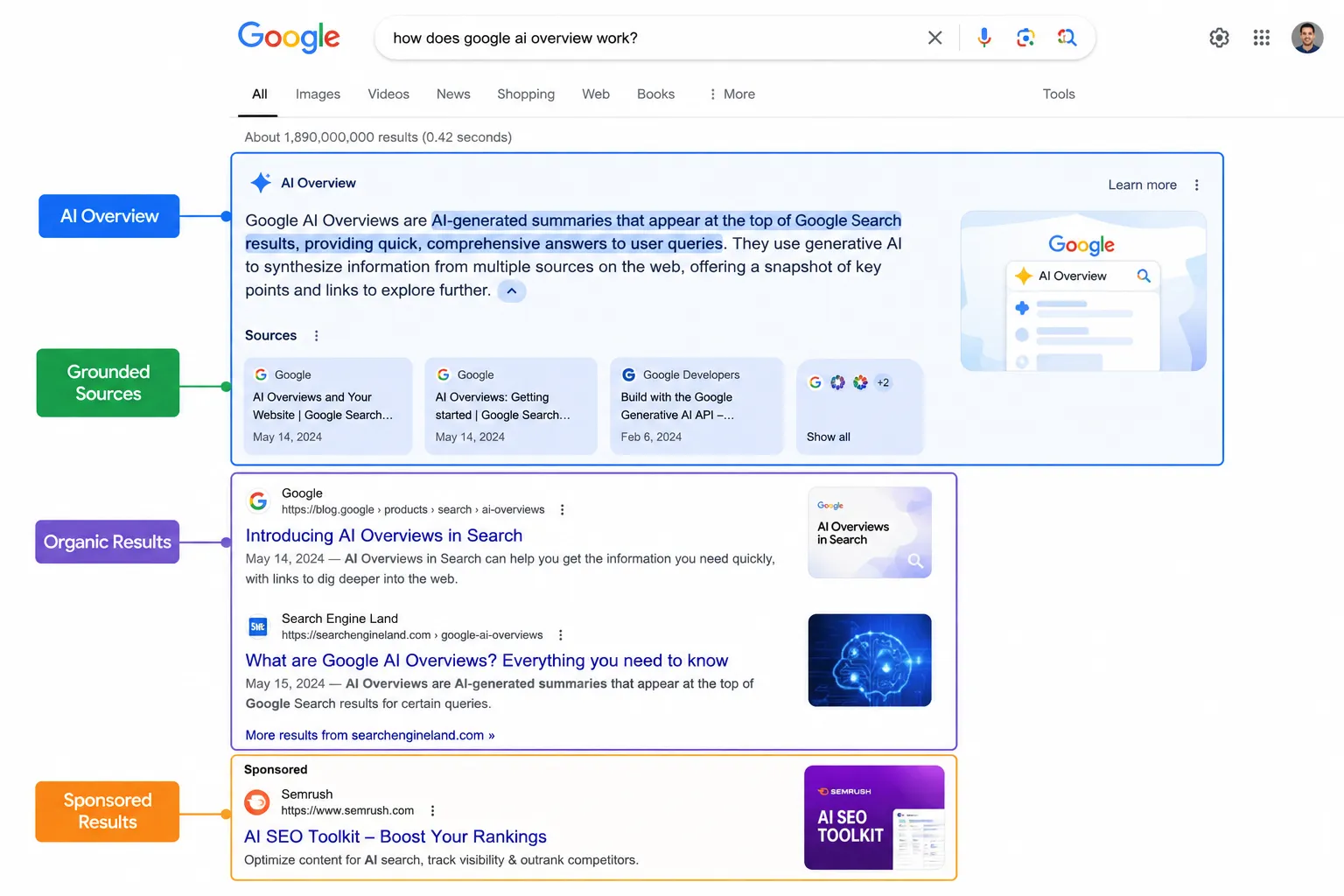
AI Search Reporting Architecture
AI Search reporting is far more sophisticated than simply counting how many times a webpage appears in Google’s AI-generated responses. Behind every AI Search Impression lies a multi-stage data pipeline designed to collect, validate, aggregate, and present meaningful insights while maintaining user privacy and reporting accuracy.
Unlike traditional analytics platforms that primarily track page views or sessions, Google’s reporting infrastructure processes billions of search events across multiple search surfaces before exposing aggregated performance data in Google Search Console.
A simplified architecture can be represented as follows:
Google Search
│
▼
Search Console Logging
│
▼
ETL Pipeline
│
▼
Data Warehouse
│
▼
Business Intelligence Layer
│
▼
Executive Dashboard
Search Console Logging
Every eligible AI-powered search interaction begins with Google’s search infrastructure recording telemetry events. These events may include information such as the search surface, device type, country, page contribution, timestamp, and AI search appearance.
Rather than storing complete user interactions for reporting purposes, Google aggregates anonymised performance signals that later contribute to Search Console metrics.
ETL Pipeline
Once collected, raw search data enters an ETL (Extract, Transform, Load) pipeline.
During extraction, telemetry is gathered from Google’s distributed infrastructure.
Transformation standardises the data by removing duplicates, validating records, grouping dimensions, and anonymising sensitive information.
Finally, the cleaned dataset is loaded into Google’s reporting infrastructure where it becomes available for aggregation.
This stage explains why Search Console data is never truly real time.
Data Warehouse
The processed information is then stored within Google’s large-scale analytical data warehouse.
Here, billions of search events are organised according to dimensions such as:
- Page
- Country
- Device
- Search appearance
- Date
Aggregation enables Google to generate meaningful reporting without exposing raw search logs or personally identifiable information.
Business Intelligence Layer
Once the data has been processed, Google’s Business Intelligence (BI) layer converts aggregated datasets into reporting metrics.
Instead of displaying complex telemetry, the BI layer calculates trends, comparisons, filtering options, and visualisations that website owners can interpret easily.
This abstraction allows marketers, developers, and SEO professionals to analyse AI visibility without requiring access to Google’s internal infrastructure.
Executive Dashboard
Finally, the processed metrics appear inside Google Search Console.
The dashboard provides a business-friendly interface that allows organisations to identify trends, compare performance across dimensions, and evaluate how frequently their content contributes to AI-generated search experiences.
Although users only see impressions and supporting filters, these figures represent the output of an extremely sophisticated reporting architecture operating behind the scenes.
Measuring AI Visibility Beyond Search Console
Google Search Console provides the most authoritative measurement of AI Search Impressions within Google’s ecosystem, but it is only one part of the broader AI visibility landscape.
Modern brands are increasingly discovered through multiple AI assistants and conversational search engines, each operating independently with its own retrieval systems, language models, and citation behaviour.
As a result, organisations should evaluate AI visibility across a wider ecosystem rather than relying exclusively on Search Console.
Google Search Console
Search Console remains the primary source for measuring AI visibility within Google Search.
It provides first-party reporting on AI Search Impressions but currently offers limited insight into citation frequency, prompt variations, or source contribution.
Its greatest strength lies in its accuracy because the data originates directly from Google’s infrastructure.
ChatGPT
ChatGPT has become one of the most widely used AI assistants globally.
Depending on the model and enabled capabilities, responses may rely on pre-trained knowledge, external retrieval, browsing, or connected search providers.
Unlike Google Search Console, ChatGPT currently provides no publisher-facing reporting that indicates how frequently websites are referenced.
Monitoring therefore relies on prompt testing, brand analysis, and third-party visibility platforms.
Gemini
Gemini integrates deeply with Google’s ecosystem.
Although its underlying retrieval capabilities differ from AI Search reporting, Gemini frequently relies on Google’s understanding of entities, knowledge graphs, and authoritative sources.
Visibility inside Gemini often overlaps with strong Google search authority but should not be assumed to be identical.
Perplexity
Perplexity emphasises transparent citations.
Every response typically references supporting webpages, making it easier for organisations to evaluate whether their content appears during AI-assisted research.
Because citations are visible, Perplexity has become a valuable platform for monitoring AI discoverability.
Claude
Claude focuses heavily on long-form reasoning and document analysis.
Although citation behaviour differs from Google’s AI Search, organisations increasingly evaluate whether authoritative content performs consistently across both ecosystems.
Microsoft Copilot
Microsoft Copilot combines large language models with Microsoft’s search technologies.
Content visibility depends on retrieval quality, search indexing, and AI reasoning rather than conventional keyword rankings alone.
Third-Party AI Monitoring
A growing ecosystem of AI visibility platforms now tracks brand appearances across multiple AI systems.
These platforms typically monitor:
- AI citations
- Brand mentions
- Source frequency
- Prompt performance
- Competitor visibility
- Market share within AI answers
Although these tools cannot replicate Google’s first-party reporting, they provide valuable cross-platform intelligence.
Brand Monitoring and Mention Tracking
AI visibility extends beyond citations.
Organisations should also monitor:
- Brand mentions
- Product mentions
- Executive mentions
- Topic ownership
- Industry authority
- Sentiment
Brand recognition inside AI-generated responses often precedes measurable website traffic.
Comparison Matrix
| Platform | AI Visibility | Official Reporting | Citation Transparency |
| Google Search Console | High | Yes | Limited |
| ChatGPT | High | No | Limited |
| Gemini | High | No | Partial |
| Perplexity | High | No | Excellent |
| Claude | Moderate | No | Limited |
| Copilot | High | No | Partial |
| Third-party Monitoring | Cross-platform | Platform dependent | Varies |
Why AI Impressions May Rise Without More Traffic
One of the most common misconceptions surrounding AI Search is that increased visibility should immediately produce more website visits.
This assumption reflects traditional SEO thinking but does not always apply to AI-powered search experiences.
Visibility Does Not Always Equal Traffic
AI-generated answers often satisfy user intent directly.
Users may obtain the information they need without visiting the original source.
Consequently, AI Search Impressions may increase while organic sessions remain relatively stable.
Brand Recall
Even without a click, repeated exposure strengthens brand recognition.
When users repeatedly encounter a company’s content or citations within AI-generated answers, they become more familiar with that brand.
Future purchasing decisions may still be influenced despite the absence of immediate website traffic.
Citation Frequency
A website cited consistently across multiple AI responses develops stronger perceived authority.
Although Search Console does not currently report citation frequency, repeated inclusion within AI-generated answers contributes to long-term credibility.
Future Clicks
AI visibility often initiates a longer customer journey.
Users may first discover a brand through an AI Overview before later searching for that company directly.
This delayed behaviour makes AI visibility difficult to evaluate using last-click attribution models.
Assisted Conversions
AI exposure frequently acts as an assisting interaction.
A customer may discover a solution through AI Search, return later through branded search, and finally convert through a direct visit.
Traditional analytics often attribute the conversion to the final interaction while overlooking the influence of AI visibility.
Search Journeys
Modern search behaviour is increasingly non-linear.
Users move between AI assistants, search engines, social media, video platforms, and websites before making decisions.
AI Search Impressions therefore represent one touchpoint within a much broader digital journey.
AI Search Attribution Challenges
As AI-generated search experiences continue to evolve, measuring business impact becomes increasingly complex.
Zero-Click Search
AI-generated answers often reduce the need for website visits.
Traditional traffic metrics therefore capture only part of the customer journey.
Multi-Touch Attribution
Customers rarely convert after a single interaction.
AI visibility may contribute to awareness while later channels generate the final conversion.
Answer-First Search
Instead of presenting ten links, AI delivers immediate answers.
Success increasingly depends on becoming part of those answers rather than merely ranking highly.
Citation Overlap
Multiple authoritative websites may contribute to the same AI-generated response.
Determining which source influenced the answer most remains difficult.
Session Attribution
Current analytics platforms primarily measure visits.
They do not accurately measure exposure occurring inside AI-generated interfaces.
Cross-Device Journeys
A user may first encounter a brand through AI Search on mobile before later converting on desktop.
These fragmented journeys complicate attribution even further.
Entity SEO and AI Search
Entity optimisation has become one of the most important components of AI Search visibility.
Instead of focusing solely on keywords, organisations should optimise the entities Google associates with their business.
This includes implementing structured Schema.org markup, maintaining accurate organisation and author entities, strengthening Knowledge Graph signals, publishing topic clusters, ensuring brand consistency across the web, and demonstrating strong E-E-A-T (Experience, Expertise, Authoritativeness, and Trustworthiness).
Entity-rich content helps Google’s retrieval systems understand not only what a webpage discusses but also who created it, how it relates to other concepts, and why it should be trusted.
How to Optimize for Higher AI Search Impressions
Improving AI Search visibility requires a holistic approach rather than isolated SEO tactics.
A comprehensive optimisation strategy should include:
- Publish comprehensive, expert-led content that fully satisfies user intent.
- Build strong entity relationships through structured data and consistent terminology.
- Strengthen internal linking between closely related topics.
- Implement appropriate Schema.org markup.
- Regularly refresh outdated content with current information.
- Demonstrate topical authority through interconnected content clusters.
- Publish original research, proprietary data, and first-hand insights.
- Use diagrams, images, videos, and interactive media to improve information richness.
- Include well-structured FAQs that answer common follow-up questions.
- Present complex information using comparison tables and visual summaries.
- Support factual claims with reliable statistics and credible citations.
- Ensure broad semantic coverage by addressing related concepts, entities, and user questions rather than targeting isolated keywords.
Ultimately, Google’s AI systems reward content that is trustworthy, comprehensive, contextually relevant, and easy to retrieve. As generative search continues to evolve, organisations that focus on building genuine topical authority rather than simply improving keyword rankings will be best positioned to increase AI Search Impressions and maintain long-term visibility within Google’s AI-powered search ecosystem.
Common Mistakes That Prevent AI Visibility
Publishing content on the web no longer guarantees visibility within Google’s AI-powered search experiences. Modern AI systems evaluate content differently from traditional search engines. Instead of rewarding pages that simply target keywords effectively, they prioritise documents that demonstrate expertise, semantic completeness, factual reliability, and strong entity relationships.
As a result, many websites that perform reasonably well in traditional organic search may still struggle to appear within AI Overviews or AI Mode. Understanding these common mistakes can help organisations identify gaps that reduce their chances of being retrieved, grounded, and cited by Google’s AI systems.
Thin Content
One of the biggest barriers to AI visibility is thin content.
Thin content typically provides superficial information without exploring a topic in sufficient depth. It often answers only the primary keyword while ignoring related concepts, follow-up questions, supporting evidence, and contextual explanations.
For example, an article titled “What Are AI Search Impressions?” that contains only a short definition is unlikely to compete with a comprehensive guide explaining:
- How AI Search Impressions are measured
- The underlying retrieval process
- Search Console reporting
- Technical architecture
- Optimisation strategies
- Real-world use cases
AI systems are designed to generate complete answers. Documents that provide comprehensive coverage naturally offer more useful information for grounding AI-generated responses.
Duplicate Pages
Duplicate or highly similar pages dilute topical authority and create uncertainty for retrieval systems.
Examples include:
- Multiple pages targeting the same search intent
- Near-identical city landing pages
- Rewritten articles with minimal differences
- Duplicate product descriptions
- Canonicalisation issues
When several pages compete to answer the same question, Google’s systems must determine which version represents the most authoritative source.
Instead of strengthening visibility, duplication often fragments authority across multiple URLs.
A clear content architecture with well-defined canonical pages significantly improves retrieval quality.
Poor Entity Optimisation
Modern AI search relies heavily on entity understanding.
If Google cannot confidently identify:
- your organisation,
- authors,
- products,
- services,
- technologies,
- or subject expertise,
your content becomes more difficult to retrieve and trust.
Common entity optimisation mistakes include:
- Inconsistent brand names
- Missing author information
- Weak organisation profiles
- Limited internal entity connections
- Poor semantic relationships
- Missing Schema.org markup
Strong entity optimisation helps Google’s Knowledge Graph connect your content with the broader web of information.
Weak Topical Authority
Publishing isolated articles rarely establishes authority within a subject area.
Google increasingly evaluates websites as knowledge ecosystems rather than collections of independent pages.
For example, a website attempting to rank for AI Search should ideally include interconnected resources covering:
- AI Search Impressions
- AI Overviews
- AI Mode
- Retrieval-Augmented Generation (RAG)
- Entity SEO
- Vector Search
- Knowledge Graphs
- Search Console reporting
- Semantic retrieval
This network of related content demonstrates expertise far more effectively than a single standalone article.
Missing Structured Data
Structured data remains one of the most underutilised components of technical SEO.
Although Schema.org markup does not guarantee AI visibility, it helps search engines interpret content more accurately.
Useful structured data includes:
- Article
- Organization
- Person
- FAQPage
- BreadcrumbList
- WebPage
- Product
- HowTo
- VideoObject
Structured information reduces ambiguity, strengthens entity recognition, and improves machine understanding.
Over-Optimised Content
Keyword stuffing remains ineffective in modern search.
Excessive repetition, unnatural anchor text, repetitive headings, and forced optimisation create poor user experiences while providing little value to AI retrieval systems.
Google’s language models evaluate meaning rather than keyword frequency alone.
Natural, comprehensive writing consistently outperforms content designed primarily for search engines.
AI-Written Generic Articles
Artificial intelligence has dramatically accelerated content production.
Unfortunately, many websites now publish generic articles that merely summarise existing information without adding original expertise.
Common characteristics include:
- Predictable wording
- Generic advice
- No unique research
- Limited examples
- No first-hand experience
- Weak technical depth
- Repetitive structure
Large language models can already generate generic summaries.
To earn AI visibility, publishers should contribute something that AI models cannot easily reproduce, such as:
- Original research
- Proprietary datasets
- Real case studies
- Expert opinions
- Technical experiments
- Industry benchmarks
Originality increases both trustworthiness and citation potential.
Missing References and Evidence
AI systems increasingly favour information that can be validated.
Articles containing unsupported claims, outdated statistics, or unverifiable statements may struggle to become trusted grounding sources.
Whenever appropriate, support technical content with:
- Official documentation
- Research papers
- Government publications
- Industry standards
- Credible datasets
- Technical specifications
Evidence-based content strengthens factual confidence and improves the likelihood of retrieval.
AI Visibility Audit Checklist
Before publishing, every page should be evaluated against the following questions:
- Does the article comprehensively answer the topic?
- Is the content unique and experience-driven?
- Are important entities clearly identified?
- Is structured data implemented correctly?
- Does the page belong to a broader topical cluster?
- Are authoritative references included?
- Has duplicate intent been avoided?
- Is the content written primarily for users rather than algorithms?
Addressing these questions significantly improves the probability of becoming part of Google’s AI retrieval and grounding pipeline.
Enterprise AI Reporting Framework
As AI-powered search becomes a measurable acquisition channel, organisations need reporting frameworks that extend beyond traditional SEO metrics. While rankings, clicks, and sessions remain important, enterprise teams increasingly require KPIs that reflect how frequently their content contributes to AI-generated search experiences.
An effective AI reporting framework should combine Search Console data with technical SEO signals, content quality metrics, and business outcomes to provide a holistic view of AI visibility.
Core AI Reporting KPIs
Below are the primary metrics that enterprise SEO teams should monitor.
AI Impressions
AI Impressions are the foundation of any AI Search reporting framework.
They indicate how often Google’s AI-powered search experiences surface your content.
Tracking this metric over time reveals whether optimisation efforts are increasing visibility within AI-generated answers.
AI Impression Growth Rate
Growth Rate measures the percentage increase or decrease in AI Impressions over a defined period.
Monitoring weekly, monthly, and quarterly growth helps organisations identify:
- Successful optimisation initiatives
- Seasonal trends
- Content performance improvements
- Algorithm-related changes
Trend analysis is generally more valuable than isolated daily fluctuations.
Citation Rate
Although Google does not currently provide official citation frequency reporting, organisations can estimate citation rate using third-party AI monitoring platforms.
This metric measures how frequently content is referenced across AI assistants such as:
- Google AI Search
- Gemini
- ChatGPT
- Perplexity
- Claude
- Copilot
Tracking citation frequency helps identify content that consistently earns AI trust.
Entity Coverage
Entity Coverage evaluates how comprehensively a website represents important entities within its subject area.
Useful indicators include:
- Organisation entities
- Product entities
- Author entities
- Topic entities
- Knowledge Graph associations
- Structured data completeness
Improving entity coverage generally strengthens semantic understanding across the website.
Topic Authority
Rather than evaluating individual pages, Topic Authority measures expertise across an entire subject.
Possible indicators include:
- Number of high-quality supporting articles
- Internal linking density
- Content completeness
- Semantic breadth
- Original research
- Expert authorship
Strong topical authority often correlates with improved AI retrieval performance.
Content Freshness
AI systems increasingly prioritise current and accurate information.
Content Freshness can be monitored using:
- Last updated date
- Percentage of refreshed articles
- Average content age
- Update frequency
- Newly added research
- Recent statistics
Regularly updating cornerstone content helps maintain retrieval relevance.
AI Visibility Score
Many organisations benefit from combining multiple KPIs into a single composite metric.
An AI Visibility Score may incorporate:
- AI Impressions
- Growth Rate
- Citation Frequency
- Entity Coverage
- Topical Authority
- Content Freshness
- Structured Data Quality
Although this score is internally defined, it provides executives with a concise summary of overall AI search performance.
Example Executive Dashboard
A modern AI Search dashboard might include the following sections:
| KPI | Purpose |
| AI Search Impressions | Overall AI visibility |
| Monthly Growth Rate | Visibility trend over time |
| Top AI Pages | Highest-performing content |
| Citation Rate | Frequency of AI references |
| Entity Coverage | Semantic optimisation progress |
| Topic Authority Score | Subject expertise measurement |
| Content Freshness | Percentage of recently updated content |
| AI Visibility Score | Overall performance index |
Reporting Best Practices
Enterprise reporting should extend beyond measuring visibility alone.
Each reporting cycle should answer strategic questions such as:
- Which content contributes most frequently to AI-generated answers?
- Which topics demonstrate the strongest authority?
- Which entities require further optimisation?
- Which content clusters need expansion?
- Which pages have declining AI visibility?
- How does AI performance compare with traditional organic performance?
These insights enable organisations to prioritise optimisation efforts based on measurable business impact rather than assumptions.
Building an AI-First Reporting Culture
AI Search reporting should not exist in isolation. Instead, it should become part of a broader enterprise performance framework that integrates SEO, content strategy, analytics, and business intelligence.
By combining AI Search Impressions with metrics such as topical authority, entity coverage, citation frequency, and content freshness, organisations gain a far richer understanding of how their knowledge assets perform within Google’s AI ecosystem.
As AI-powered search continues to mature, the organisations that establish robust reporting frameworks today will be better positioned to identify opportunities, respond to algorithmic changes, and demonstrate the long-term business value of AI visibility.
Technical Diagrams: Understanding the AI Search Impression Pipeline
Although Google has not publicly disclosed every component of its internal infrastructure, the following diagrams illustrate a simplified conceptual workflow based on Google’s documented search architecture and generative AI search processes.
Diagram 1: AI Search Impression Processing Flow
User Query
│
▼
Query Intent Understanding
│
▼
Semantic Retrieval System
│
▼
Candidate Documents
│
▼
Quality & Relevance Evaluation
│
▼
Grounding & Source Selection
│
▼
AI Overview / AI Mode
│
▼
Impression Logged by Google
│
▼
Search Console Performance Report
This simplified workflow illustrates how content progresses from retrieval through grounding before becoming eligible for reporting within Google Search Console.
Diagram 2: Retrieval-Augmented Generation (RAG)
User Question
│
▼
Intent Analysis
│
▼
Retrieve Relevant Documents
│
▼
Validate Trusted Sources
│
▼
Provide Context to LLM
│
▼
Generate AI Answer
│
▼
Display Supporting Sources
Rather than relying solely on pre-trained model knowledge, Retrieval-Augmented Generation retrieves fresh information from Google’s index before generating the final response.
Diagram 3: Search Console Reporting Architecture
Google Search
│
▼
Search Logging
│
▼
Data Validation
│
▼
Aggregation
│
▼
Search Console
│
▼
AI Performance Report
This illustrates how individual search interactions are aggregated before becoming available inside Search Console.
Python Implementation: Fetching Search Console Performance Data
For organisations monitoring AI Search performance programmatically, the Google Search Console API can be used to retrieve performance metrics.
from googleapiclient.discovery import build
from google.oauth2 import service_account
SCOPES = [“https://www.googleapis.com/auth/webmasters.readonly”]
credentials = service_account.Credentials.from_service_account_file(
“credentials.json”,
scopes=SCOPES
)
service = build(“searchconsole”, “v1”, credentials=credentials)
request = {
“startDate”: “2026-07-01”,
“endDate”: “2026-07-31”,
“dimensions”: [“page”],
“rowLimit”: 1000
}
response = service.searchanalytics().query(
siteUrl=”https://example.com”,
body=request
).execute()
for row in response.get(“rows”, []):
print(
row[“keys”][0],
row[“clicks”],
row[“impressions”]
)
The returned data can be stored in a database or visualised within reporting dashboards for long-term trend analysis.
Calculating Impression Growth
import pandas as pd
df = pd.read_csv(“search_console.csv”)
df[“growth_rate”] = (
df[“impressions”].pct_change() * 100
)
print(df)
This allows teams to monitor month-over-month changes in AI visibility.
Structured Data Example
Structured data helps Google interpret entities, relationships, and page context more effectively.
Article Schema
{
“@context”: “https://schema.org”,
“@type”: “Article”,
“headline”: “Google AI Search Impressions Explained”,
“author”: {
“@type”: “Person”,
“name”: “John Smith”
},
“publisher”: {
“@type”: “Organization”,
“name”: “Example Media”
},
“datePublished”: “2026-08-01”,
“dateModified”: “2026-08-05”
}
Organization Schema
{
“@context”: “https://schema.org”,
“@type”: “Organization”,
“name”: “Example Company”,
“url”: “https://example.com”,
“logo”: “https://example.com/logo.png”
}
FAQ Schema
{
“@context”: “https://schema.org”,
“@type”: “FAQPage”,
“mainEntity”: [
{
“@type”: “Question”,
“name”: “What are AI Search Impressions?”,
“acceptedAnswer”: {
“@type”: “Answer”,
“text”: “AI Search Impressions measure how often content appears within Google’s AI-powered search experiences.”
}
}
]
}
Implementing structured data helps strengthen entity recognition and machine understanding, although it does not directly guarantee AI visibility.
SQL Queries for AI Search Analysis
After exporting Search Console data into BigQuery or another relational database, SQL can be used to identify trends.
Top Pages by Impressions
SELECT
page,
SUM(impressions) AS total_impressions
FROM
search_console_data
GROUP BY
page
ORDER BY
total_impressions DESC
LIMIT 20;
Monthly Impression Growth
SELECT
DATE_TRUNC(date, MONTH) AS month,
SUM(impressions) AS impressions
FROM
search_console_data
GROUP BY
month
ORDER BY
month;
Country Comparison
SELECT
country,
SUM(impressions) AS impressions
FROM
search_console_data
GROUP BY
country
ORDER BY
impressions DESC;
Device Performance
SELECT
device,
SUM(impressions) AS impressions,
SUM(clicks) AS clicks
FROM
search_console_data
GROUP BY
device;
These reports help identify which markets, devices, and content assets generate the strongest AI search visibility.
Reporting Workflow for Enterprise SEO Teams
A structured reporting workflow enables organisations to monitor AI visibility consistently and identify optimisation opportunities.
Step 1: Collect Data
Gather performance metrics from:
- Google Search Console
- Search Console API
- BigQuery exports
- Analytics platform
- Third-party AI visibility tools
Step 2: Prepare the Dataset
Clean and standardise the data by:
- Removing duplicate records
- Validating URLs
- Normalising date formats
- Categorising content by topic
- Mapping landing pages to content clusters
Step 3: Build Dashboards
Import the prepared dataset into reporting platforms such as:
- Looker Studio
- Microsoft Excel
- Microsoft Power BI
- Tableau
Recommended dashboard sections include:
- Total AI Impressions
- Month-over-Month Growth
- Top Performing Pages
- Device Distribution
- Country Distribution
- Content Cluster Performance
- Page Trend Analysis
- Historical Visibility
Step 4: Monitor Core KPIs
Track the following metrics regularly:
| KPI | Purpose |
| AI Impressions | Overall AI visibility |
| Impression Growth Rate | Visibility trend |
| Clicks | User engagement |
| CTR | Organic performance comparison |
| Top Pages | Highest-performing content |
| Device Split | Desktop vs Mobile performance |
| Country Distribution | International visibility |
| Content Freshness | Impact of recent updates |
| Entity Coverage | Semantic optimisation progress |
| Topic Authority | Breadth of subject expertise |
Step 5: Drive Optimisation
Use dashboard insights to prioritise:
- Updating declining content
- Expanding high-performing topic clusters
- Improving structured data
- Strengthening internal linking
- Publishing original research
- Enhancing entity consistency
- Refreshing outdated information
By following a repeatable reporting workflow, SEO teams can move beyond simply tracking AI visibility and begin making data-driven decisions that improve long-term performance across Google’s evolving AI-powered search ecosystem.



