
SUPERCHARGE YOUR ONLINE VISIBILITY! CONTACT US AND LET’S ACHIEVE EXCELLENCE TOGETHER!
Search is no longer just about keywords and rankings—it’s about understanding, predicting, and delivering answers. Businesses today are increasingly turning to advanced AI SEO services to adapt to this transformation and stay visible in AI-driven search environments.
We’re witnessing a major shift: from traditional search engines to AI-powered answer systems. Platforms driven by Large Language Models (LLMs) and AI algorithms now interpret intent, context, entities, trust signals, and even future relevance. This evolution has made partnering with an experienced AI SEO agency essential for brands that want to compete in modern search ecosystems.
As AI reshapes how information is discovered and delivered, the old playbook of keyword stuffing and backlink chasing is rapidly becoming obsolete. Success now depends on intelligent AI SEO framework implementation that aligns content, entities, technical SEO, and authority signals with how AI systems understand and recommend information.
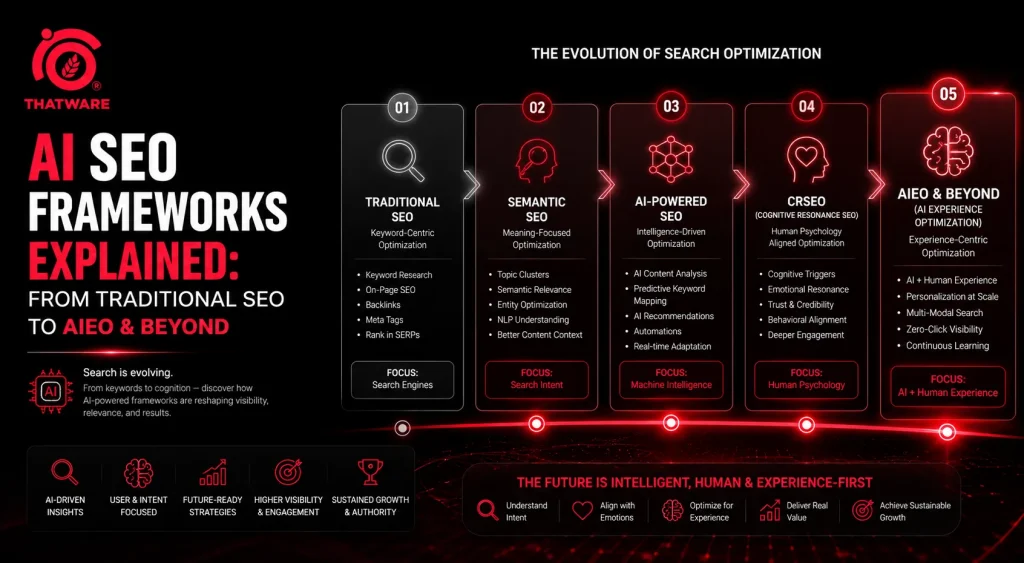
To stay competitive, brands must evolve beyond traditional SEO and embrace a smarter, AI-driven approach. Working with an experienced AI SEO optimization company helps brands align their digital presence with how modern AI systems interpret intent, authority, context, and user behavior across search and generative platforms.
AIEO (Artificial Intelligence Experience Optimization) represents that evolution—an advanced framework designed to align your digital presence with how AI systems think, learn, and rank.
👉 Discover how ThatWare pioneered AIEO to help brands prepare for the future of AI search.
What Is an AI SEO Framework?
An AI SEO framework is a structured, data-driven approach to optimizing websites, content, and digital authority for AI-powered ecosystems—including search engines, answer engines, generative AI platforms, and LLM-based interfaces.
Unlike traditional SEO, which focuses heavily on keywords and backlinks, AI SEO frameworks prioritize meaning, relationships, and predictive intelligence.
An AI SEO framework integrates advanced technologies such as Natural Language Processing (NLP), machine learning, and semantic modeling to ensure that content is not just indexed—but understood, trusted, and surfaced by AI systems.
It aligns your digital assets with how AI interprets:
- User intent
- Contextual relevance
- Entity relationships
- Authority signals
Why AI SEO Is Different from Standard SEO
Traditional SEO is reactive—optimized for search queries after they happen.
AI SEO is proactive—it anticipates:
- What users mean, not just what they type
- How AI systems evaluate credibility and context
- Which content is most likely to be selected as an answer
This shift is why many businesses now hire AI SEO expert teams and invest in professional AI SEO consulting to stay ahead of rapidly evolving AI-driven search ecosystems. Modern Artificial Intelligence SEO services focus on aligning content, technical SEO, entities, and trust signals with how AI systems interpret and recommend information.
In short:
SEO = Ranking in search results
AI SEO = Becoming the answer itself
You can see how this shift is already impacting content visibility, where generic, keyword-heavy pages are increasingly being ignored by AI-driven systems.
Core Elements of an AI SEO Framework
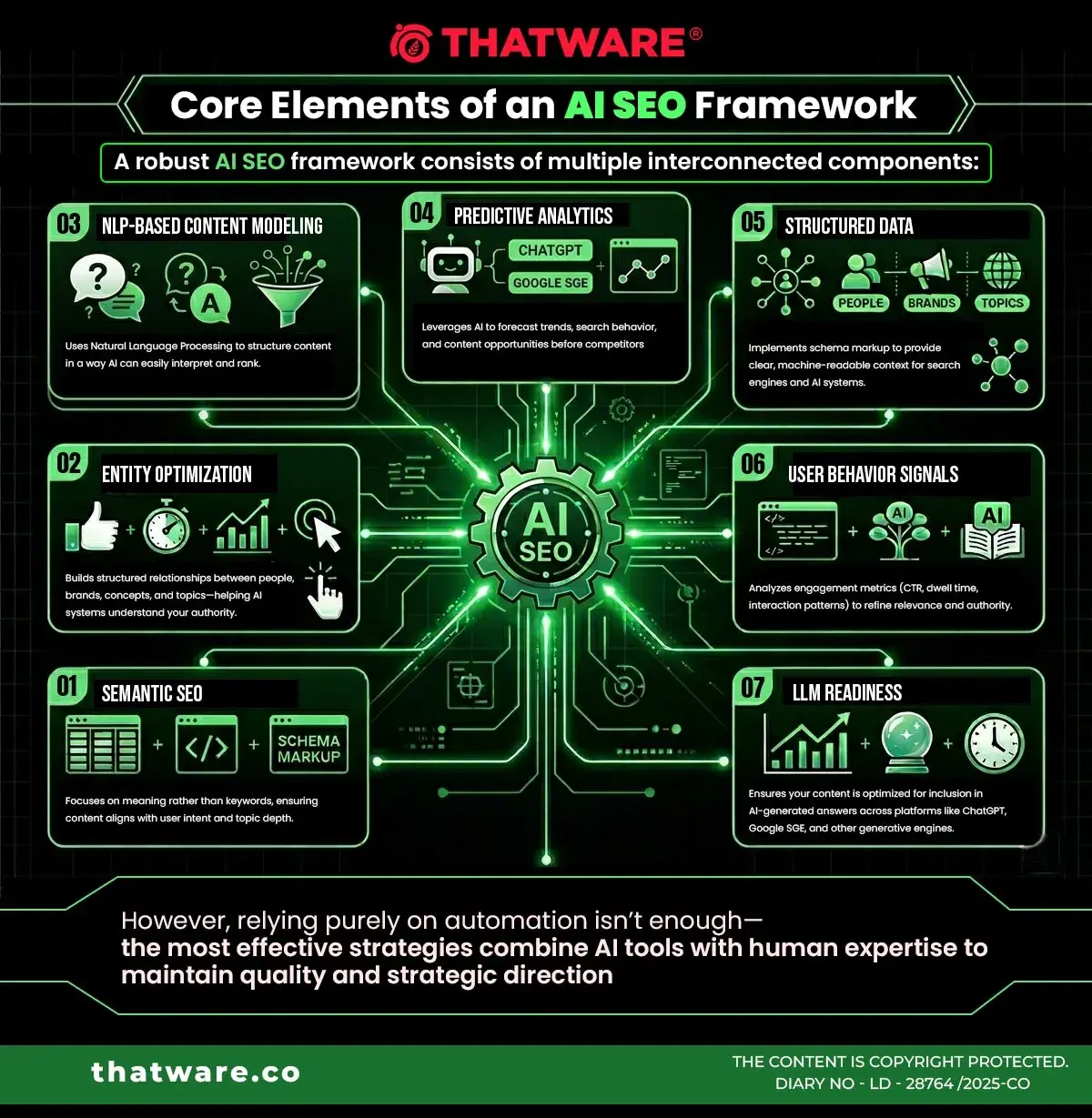
A robust AI SEO framework consists of multiple interconnected components:
1. Semantic SEO
Focuses on meaning rather than keywords, ensuring content aligns with user intent and topic depth. A modern AI-driven SEO agency uses semantic optimization to help brands build deeper topical relevance and stronger AI search visibility.
2. Entity Optimization
Builds structured relationships between people, brands, concepts, and topics—helping AI systems understand your authority. This is a core component of the Hyper AI SEO framework, where entity connections strengthen trust and contextual understanding across AI search ecosystems.
3. NLP-Based Content Modeling
Uses Natural Language Processing to structure content in a way AI can easily interpret and rank. Advanced AI SEO services for business growth rely heavily on NLP to create machine-friendly, intent-focused content architectures.
4. Predictive Analytics
Leverages AI to forecast trends, search behavior, and content opportunities before competitors. Predictive intelligence enables businesses to stay ahead of evolving AI-driven search patterns and user demand.
5. Structured Data
Implements schema markup to provide clear, machine-readable context for search engines and AI systems. Structured data helps AI platforms better interpret brand authority, services, and topical relevance.
6. User Behavior Signals
Analyzes engagement metrics (CTR, dwell time, interaction patterns) to refine relevance and authority. AI systems increasingly use behavioral data to determine whether content genuinely satisfies user intent.
7. LLM Readiness
Ensures your content is optimized for inclusion in AI-generated answers across platforms like ChatGPT, Google SGE, and other generative engines. This future-focused approach is a defining feature of AI SEO services for business growth in the evolving AI search landscape.
However, relying purely on automation isn’t enough—the most effective strategies combine AI tools with human expertise to maintain quality and strategic direction.
How ThatWare’s AI SEO Framework Is Building Visibility for Champagne Life
Client Industry: E-commerce (Health & Wellness)
The Problem:
Champagne Life had a visually strong brand but struggled to get organic traffic from data analytics. By leveraging AI SEO strategies, the campaign aligned content with search intent, improved technical performance, and enabled visibility across both traditional search engines and emerging AI-driven platforms.
AI SEO Actions Taken by ThatWare:
ThatWare implemented a pure AI SEO strategy focused on intent-driven optimization rather than traditional tactics.
- Content was restructured using semantic search principles aligned with modern algorithms like Google RankBrain and Google BERT.
- The campaign also introduced AI SEO to prepare the website for AI platforms such as ChatGPT and Google Gemini, ensuring content is structured for AI-driven discovery and direct answers.
Results:
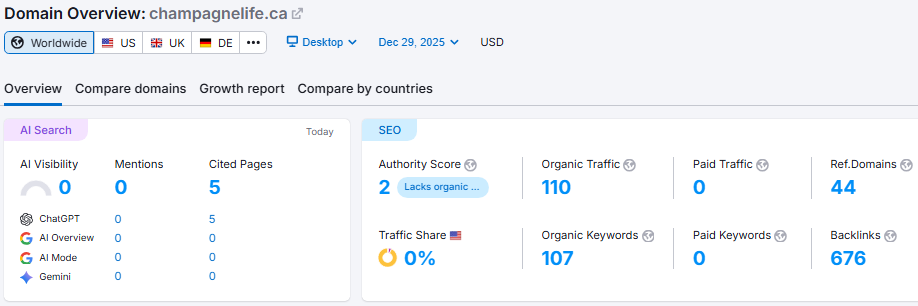
- 110 monthly organic visitors establishing early traffic flow
- 107 ranking keywords building search presence
- 676 backlinks strengthening authority signals
- 44 referring domains contributing to domain trust
- 5 pages already cited in AI systems, indicating early AI indexing
- 0% paid traffic – 100% organic, AI SEO-driven foundation

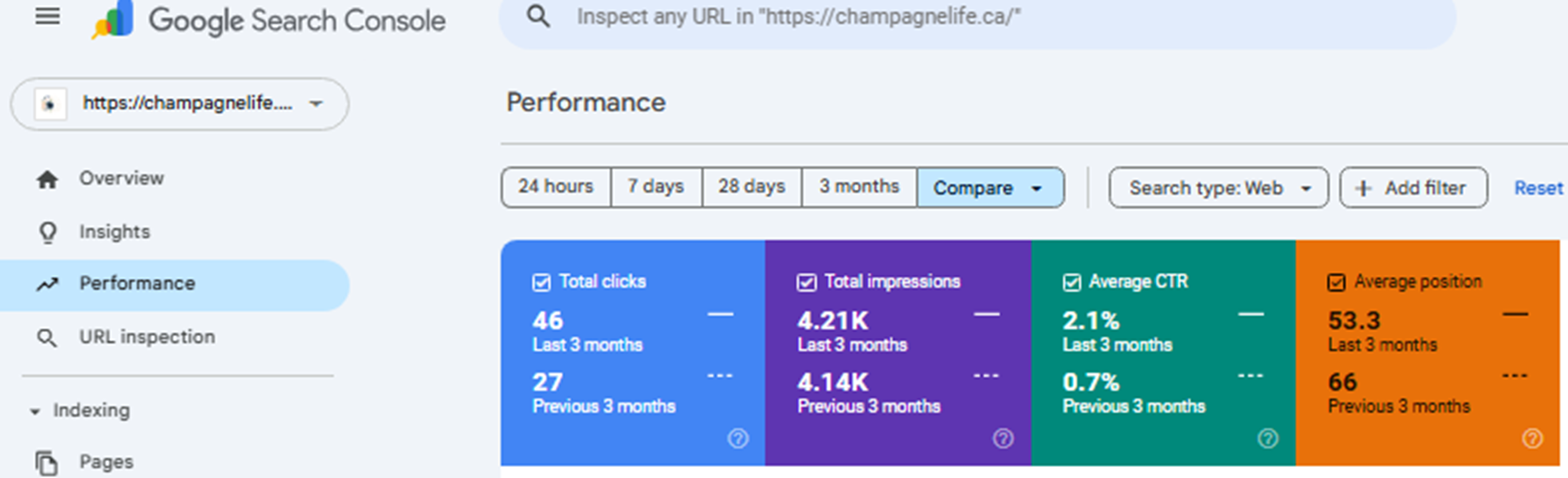
Search Performance Growth
- Improved organic clicks from 27 to 46, showing rising user engagement
- Increased impressions from 4.14K to 4.21K, indicating stronger search visibility
- Boosted CTR from 0.7% to 2.1%, reflecting better relevance and click appeal
- Enhanced average position from 66 to 53.3, demonstrating ranking improvements
Key Insight:
Champagne Life is now positioned with a strong foundational SEO and AI presence, where indexed keywords, backlinks, and early AI citations are aligned for scalable growth. This stage reflects the beginning of measurable momentum, where AI SEO will convert visibility into traffic, rankings, and AI-driven discovery.
👉 Want to build an AI SEO framework for your brand? Talk to ThatWare.
Traditional SEO vs AI SEO
The evolution of search has shifted from rigid keyword-based systems to intelligent, context-aware algorithms. Understanding AI SEO vs traditional SEO is essential to stay competitive in modern search environments.
Here’s a clear comparison:
| Area | Traditional SEO | AI SEO |
| Main focus | Keywords and backlinks | Intent, entities, context |
| Ranking logic | Rule-based signals | AI and ML-driven interpretation |
| Content strategy | Keyword targeting | Topic authority and semantic depth |
| Optimization cycle | Manual and reactive | Predictive and adaptive |
| Search output | SERP listings | AI answers, summaries, recommendations |
Traditional SEO laid the foundation for how websites are discovered. It focuses on keyword optimization, backlink building, and technical structure to improve rankings on search engine results pages (SERPs). These elements are still crucial today—they help search engines crawl, index, and evaluate websites effectively.
Being one of finest next generation SEO strategies, AI SEO aligns content with how modern search engines actually understand information. Instead of simply matching keywords, AI systems interpret user intent, contextual meaning, and relationships between topics. This means content must go beyond keywords and demonstrate depth, relevance, and authority—something a well-structured AI SEO framework for enterprise businesses is specifically designed to achieve.
In practice, this shift doesn’t replace traditional SEO—it enhances it. Technical SEO, backlinks, and high-quality content remain essential, but they now serve a larger goal: helping AI-driven systems comprehend and trust your content. This is why brands increasingly partner with the best AI SEO agency providers to develop scalable, future-ready optimization strategies.
The focus moves from “ranking for a keyword” to “becoming the best answer,” supported by advanced AI SEO implementation services that align content, entities, structured data, and authority signals with the way AI search systems evaluate and recommend information.
Featured Insight: ThatWare’s perspective on the transition from traditional SEO to AI SEO was covered in “Cognitive Resonance SEO: The Weird, Fascinating Reason Some Content Just Clicks with Readers”.
Why Search Engines Are Becoming AI Engines
Search engines are no longer just tools that retrieve links—they are evolving into intelligent systems that interpret, generate, and deliver answers. This shift is redefining the future of SEO frameworks, where visibility is no longer about ranking pages but about becoming the most reliable source of truth across AI-driven ecosystems.
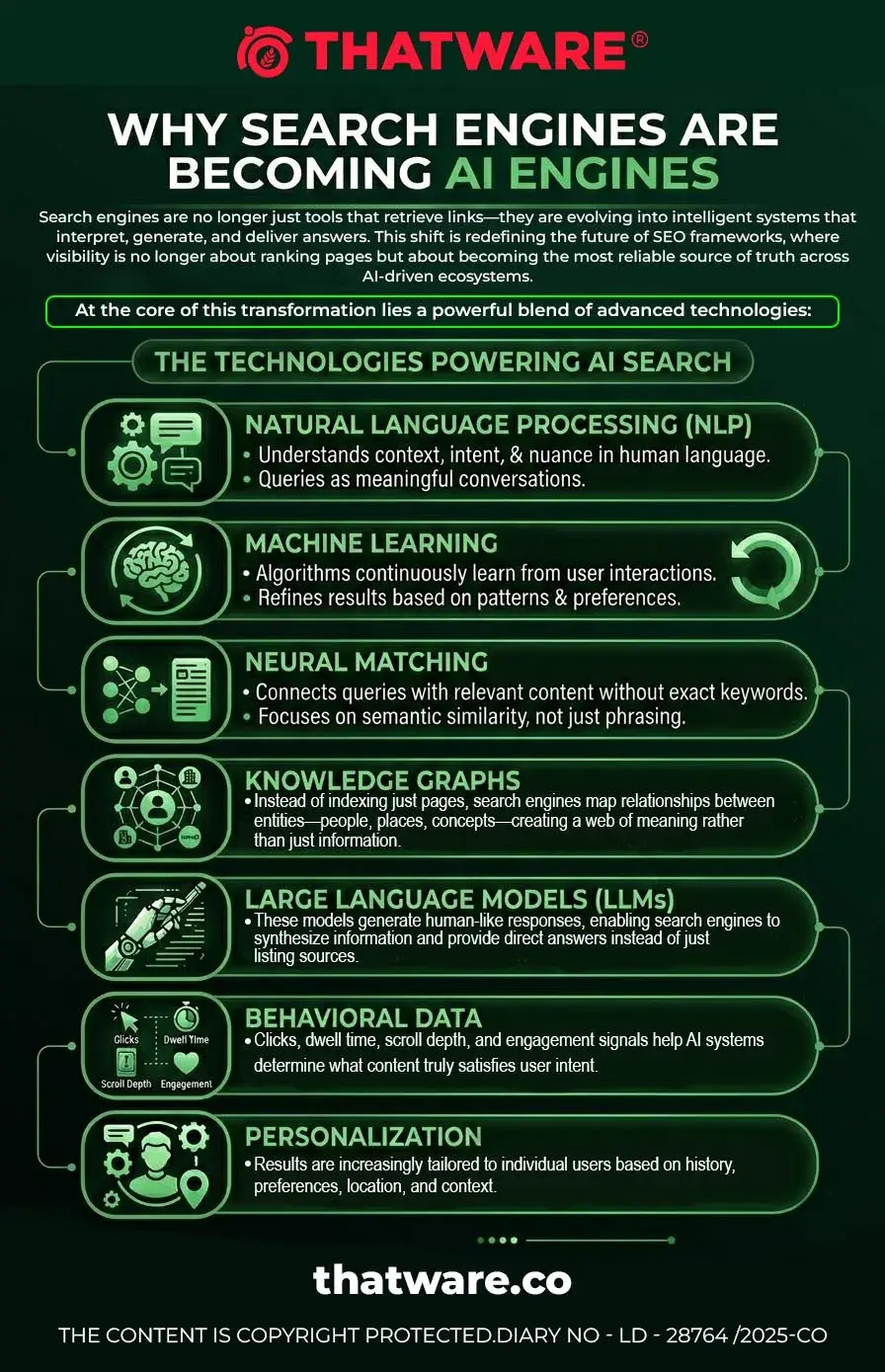
At the core of this transformation lies a powerful blend of advanced technologies:
The Technologies Powering AI Search
- Natural Language Processing (NLP):
- Search engines now understand context, intent, and nuance in human language. Queries are no longer treated as keyword strings but as meaningful conversations. This evolution has made AI-powered SEO optimization essential for businesses aiming to align content with conversational and intent-driven search behavior, leading many brands to partner with an experienced NLP SEO optimization company to strengthen semantic relevance and AI search visibility.
- Machine Learning:
- Algorithms continuously learn from user interactions, refining search results based on patterns, preferences, and outcomes. Advanced machine learning SEO services help brands adapt to these evolving algorithms by improving relevance, predictive targeting, and user engagement signals.
- Neural Matching:
- This enables search engines to connect queries with relevant content even when exact keywords don’t match, focusing on semantic similarity rather than literal phrasing. A Custom AI SEO strategy ensures content is optimized around concepts, context, and topical depth rather than isolated keywords.
- Knowledge Graphs:
- Instead of indexing just pages, search engines map relationships between entities—people, places, concepts—creating a web of meaning rather than just information. This is particularly important in an AI SEO framework for ecommerce, where product entities, brand relationships, and customer intent must be clearly connected for AI systems to understand and recommend products effectively.
- Large Language Models (LLMs):
- These models generate human-like responses, enabling search engines to synthesize information and provide direct answers instead of just listing sources. This shift highlights the growing importance of AI SEO vs traditional SEO services, where the focus moves from simply ranking pages to becoming a trusted source within AI-generated answers.
- Behavioral Data:
- Clicks, dwell time, scroll depth, and engagement signals help AI systems determine what content truly satisfies user intent. Strong engagement metrics contribute directly to AI SEO for higher rankings by signaling relevance, trust, and user satisfaction.
- Personalization:
- Results are increasingly tailored to individual users based on history, preferences, location, and context. Businesses usingAI-powered SEO optimization can better adapt content experiences to personalized search environments and evolving AI-driven discovery systems.
Key Shifts in Modern Search
From Search Results to Generated Answers
Traditional search engines returned a list of links. Today, AI engines generate direct answers—summaries, explanations, and recommendations—often eliminating the need to click through multiple pages. This means content must be structured and authoritative enough to be chosen as the source behind these answers. Businesses adopting advanced AI SEO framework services are better positioned to create answer-ready content that AI systems can easily interpret and prioritize.
From Keywords to Entities
SEO is no longer about repeating keywords. It’s about building topical authority around entities—clear, well-defined subjects and their relationships. AI search algorithms explained simply: they prioritize meaning over matching. If your content doesn’t clearly define and connect entities, it risks being ignored. This is where Semantic AI SEO services become essential, helping brands strengthen contextual relevance and entity relationships across their digital ecosystem.
From Ranking Pages to Selecting Trusted Answers
In the past, success meant ranking on page one. Now, success means being selected as the answer. AI systems evaluate trust signals such as:
- Expertise and authority
- Content clarity and structure
- Consistency across sources
- Brand credibility
This is where the future of SEO frameworks shifts dramatically—from optimization for ranking to optimization for trust. Through Predictive AI SEO consulting, businesses can anticipate evolving search behavior and align their authority-building strategies with future AI-driven ranking patterns.
From Static SERPs to Conversational Search
Search is becoming interactive. Users ask follow-up questions, refine queries in real time, and expect context-aware responses. This conversational model, powered by LLMs, transforms search into a dialogue rather than a one-time query.
For SEO, this means content must:
- Anticipate related questions
- Provide layered, contextual answers
- Maintain coherence across topics
An effective AI content optimization framework helps structure content for conversational AI systems, while an AI SEO framework for SaaS businesses ensures complex service-based content remains contextually relevant, scalable, and optimized for AI-generated discovery.
The New SEO Reality
The evolution into AI engines changes the fundamental goal of SEO. It’s no longer just about being found—it’s about being understood, trusted, and selected.
The future belongs to brands and creators who:
- Build deep topical authority
- Structure content for machine comprehension
- Align with how AI systems interpret and validate information
In this new landscape, the goal isn’t just to rank higher—it’s to become the most trusted answer across AI systems.
How AI Ranks Websites
Understanding how AI ranks websites requires moving beyond traditional SEO metrics and looking at how modern AI systems evaluate content holistically. Instead of relying on isolated signals, AI combines multiple dimensions to determine whether a page truly deserves visibility.
Key AI Ranking Signals
1. Intent Satisfaction
At the core of AI ranking is a simple question: Does the page fully answer the user’s query? AI evaluates whether the content resolves the user’s need without forcing them to search further. Pages that provide clear, complete, and direct answers tend to rank higher because they minimize friction in the user journey.
2. Semantic Completeness
AI doesn’t just look for keywords—it looks for context. A well-optimized page covers not only the main topic but also related concepts, subtopics, and supporting ideas. This helps AI understand that the content is comprehensive rather than shallow or fragmented.
3. Entity Authority
Search engines increasingly rely on entities (brands, authors, organizations) instead of just pages. If your brand is consistently associated with a specific topic across the web, AI recognizes it as a trusted source. Mentions, citations, and structured data all contribute to strengthening entity authority.
4. Topical Depth
AI favors websites that demonstrate consistent expertise across multiple pages. Instead of a single article, a strong site builds interconnected content clusters that explore a subject in depth. This signals long-term authority rather than one-off relevance.
5. Trust and Credibility
AI evaluates whether the content is reliable and verifiable. This includes:
- Evidence-backed claims
- Author expertise
- References and citations
- Transparent business or brand information
Content that lacks credibility signals is less likely to perform well, even if it is well-written.
6. User Engagement
User behavior acts as real-world validation. AI observes signals such as:
- Time spent on page
- Scroll depth
- Click-through actions
- Conversions
If users engage deeply with a page, it indicates that the content is valuable and relevant.
7. Technical Accessibility
Even the best content won’t rank if AI systems can’t properly access it. Technical factors include:
- Crawlability and indexability
- Clean site structure
- Fast loading speed
- Proper use of structured data
AI must be able to parse and understand your content efficiently for it to rank.
How ThatWare’s AI SEO Framework Revitalized Massage Pro Guide’s Organic Growth?
Client Industry: Health & Wellness
The Problem:
Massage Pro Guide was experiencing a continuous decline in organic traffic and struggling to get organic traffic to their site. They lacked alignment with modern search intent and AI-driven search behavior, limiting their visibility despite targeting relevant keywords.
AI SEO Actions Taken by ThatWare:
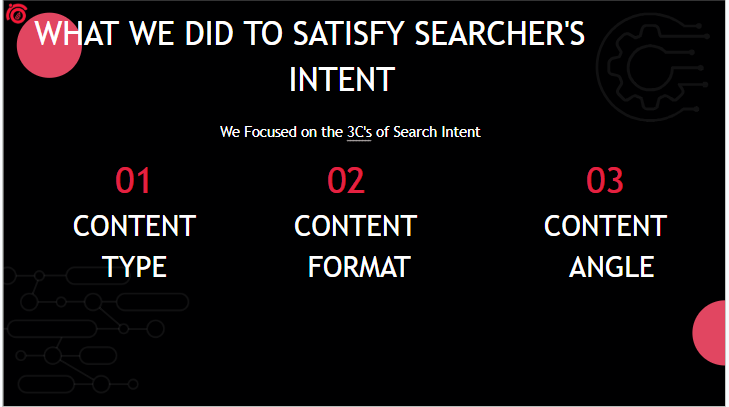
ThatWare implemented a pure AI SEO strategy centered on search intent optimization using the 3C framework—content type, format, and angle. Content was restructured around high-intent topics such as plantar fasciitis treatments and massage solutions, while technical enhancements improved Core Web Vitals, mobile usability, and crawlability. The strategy aligned content with advanced algorithms like Google RankBrain and Google BERT, ensuring better contextual relevance and ranking potential.
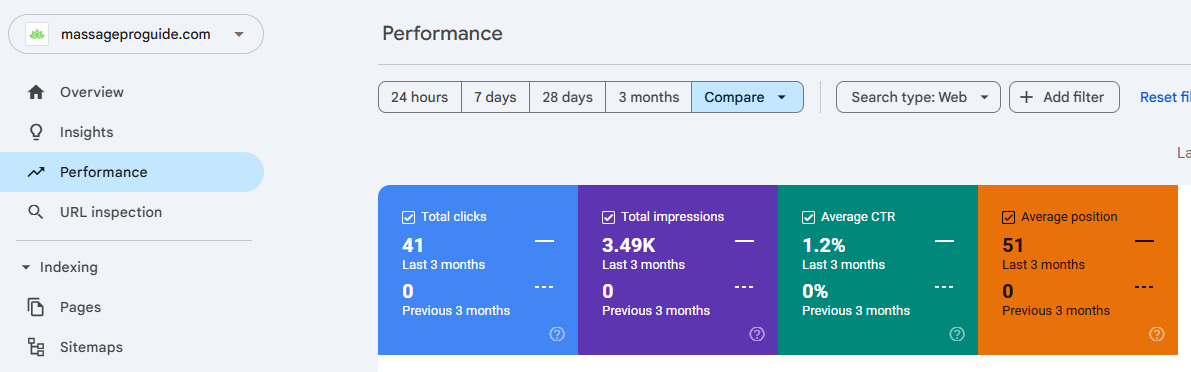
Results (Performance Highlights):
- Generated 41 organic clicks, establishing measurable user engagement from a zero baseline
- Achieved 3.49K impressions, significantly improving search visibility
- Increased CTR to 1.2%, reflecting improved relevance and click-through performance
- Reached an average position of 51, marking entry into competitive ranking ranges
- Transitioned from 0 performance to active organic visibility within 3 months
- Built a strong AI SEO-driven foundation for scalable traffic growth
Key Insight:
Massage Pro Guide showcases how ThatWare’s AI SEO framework can transform zero-visibility websites into actively performing assets by aligning content with search intent, improving technical performance, and enabling measurable organic growth within a short time frame.
AI ranking is no longer about optimizing for algorithms—it’s about aligning with intelligence. Websites that prioritize depth, clarity, authority, and user value are the ones that succeed in this evolving search landscape.
LLM SEO Explained
Search is no longer just about ranking on Google—it’s about being understood, selected, and cited by large language models (LLMs) like ChatGPT, Gemini, and other AI-driven systems. This shift is redefining how content is created, structured, and optimized.
What is LLM SEO?
LLM SEO refers to optimizing content so that large language models can easily interpret, trust, and use it when generating answers.
Unlike traditional SEO—which focuses on rankings and clicks—LLM SEO focuses on:
- Being retrievable
- Being accurate and authoritative
- Being usable in AI-generated responses
In simple terms, LLM SEO ensures your content becomes a source of truth for AI systems.
Why LLMs Prefer Structured, Authoritative Content
LLMs are trained to prioritize content that is:
- Well-structured (clear headings, sections, logical flow)
- Factually consistent
- Entity-rich (mentions of recognized people, brands, concepts)
- Authoritative (backed by expertise or credible sources)
Unstructured or vague content is harder for models to interpret and therefore less likely to be selected.
How AI-Generated Answers Select Information
LLMs don’t “rank pages” like search engines—they synthesize answers. To do this, they:
- Identify relevant passages
- Evaluate clarity and completeness
- Prefer direct answers over fluff
- Cross-reference consistent signals across sources
Content that clearly answers questions in a concise, structured way is far more likely to be included.
Why Answer-Ready Formatting Matters
AI systems look for answer-ready content, meaning:
- Definitions are clearly stated
- Key points are easy to extract
- Information is logically segmented
For example:
- Bullet points > dense paragraphs
- Short explanations > long narratives
- Headings > unstructured text
If your content can be easily “lifted” into an answer, it has a higher chance of being used.
How to Make Content LLM-Friendly
To optimize for LLMs, your content should be:
- Clear: Avoid ambiguity
- Structured: Use headings and lists
- Contextual: Provide complete explanations
- Consistent: Stay aligned within a topic cluster
- Entity-focused: Mention relevant terms and relationships
Think of it as writing for both humans and machines simultaneously.
Practical Tips for LLM SEO
Here are actionable strategies to improve LLM visibility:
1. Use Clear Definitions
Start sections with direct, simple definitions.
Example: “LLM SEO is the process of optimizing content for AI-generated answers.”
2. Add FAQs
FAQs align perfectly with how users and AI systems ask questions.
- Use natural language questions
- Provide concise, direct answers
3. Include Comparison Tables
| Feature | Traditional SEO | LLM SEO |
| Focus | Rankings | Answer inclusion |
| Format | Keyword-heavy | Structured & clear |
| Output | SERPs | AI-generated responses |
| Optimization Goal | Clicks | Citations |
4. Use Schema Markup
Structured data (like FAQ, Article, HowTo schema) helps AI systems:
- Understand context
- Extract key information faster
- Validate content intent
5. Build Entity-Rich Content
Mention:
- Brands
- Tools
- Concepts
- Industry terms
This helps LLMs connect your content within a broader knowledge graph.
6. Publish Original Research
Unique data makes your content:
- More authoritative
- More likely to be cited
- Harder to replace with generic sources
7. Maintain Topical Consistency
Stick to a clear niche and build depth over time.
- Avoid random, unrelated content
- Create clusters around core topics
Consistency signals expertise to AI systems.
Authority Signal Opportunity
To strengthen brand authority and improve AI visibility, include strategic external placements where your brand is already contributing to the conversation.
Place links to external articles where ThatWare discusses:
- LLM optimization
- AI search visibility
- The future of SEO
- Generative AI in search
These external signals help:
- Reinforce credibility
- Improve entity recognition
- Establish topical authority in AI SEO and AIEO (Artificial Intelligence Experience Optimization)
By aligning internal content with authoritative external mentions, you create a strong, consistent presence across the AI ecosystem.
LLM SEO isn’t just an upgrade to traditional SEO—it’s a fundamental shift. The goal is no longer just to rank, but to become a trusted source that AI systems rely on to generate answers.
For further insights, here’s a sneak peek – “Why Most SEO Agencies Are Still Sleeping on LLM Optimization (And What That Means for You)”
GEO vs AIEO
This is where the shift becomes unmistakable. GEO was never meant to be the final destination—it’s a stepping stone. To understand where search is heading, you need to clearly separate Generative Engine Optimization (GEO) from Artificial Intelligence Experience Optimization (AIEO). The evolution from GEO to AIEO is now shaping the foundation of every modern Generative AI SEO framework focused on AI-driven visibility and intelligent search experiences.
What is GEO?
Generative Engine Optimization (GEO) focuses on improving visibility within AI-generated search outputs.
This includes:
- Featured answers generated by LLMs
- AI summaries in search engines
- Conversational responses from tools like ChatGPT, Gemini, or Perplexity
GEO is about ensuring your content is:
- Selected
- Referenced
- Synthesized
by generative AI systems. Many businesses exploring AI SEO vs AIEO services are beginning to realize that GEO alone is not enough to build long-term AI visibility across evolving search ecosystems.
What is AIEO?
Artificial Intelligence Experience Optimization (AIEO) is a broader, more advanced framework.
It optimizes for:
- AI engines
- Large Language Models (LLMs)
- Answer systems
- Predictive discovery platforms
- Intelligent search ecosystems
AIEO goes beyond content—it focuses on how AI understands, connects, trusts, and recommends entities across the entire digital ecosystem. This shift is driving brands to work with an AI-based SEO agency capable of aligning technical SEO, semantic authority, and AI-driven content intelligence into a unified strategy.
GEO vs AIEO: Core Differences
| Factor | GEO | AIEO |
| Scope | Generative search outputs | Full AI search ecosystem |
| Focus | AI-generated answers | AI engines, LLMs, entities, behavior, prediction |
| Strategy | Content optimization | Complete AI visibility framework |
| Nature | Channel-specific | Ecosystem-wide |
| Evolution stage | Transitional | Next-generation |
Positioning: Why AIEO is the Next Evolution
AIEO represents the next evolution of SEO because it moves beyond optimizing for search engines—or even generative answers.
Instead, it prepares brands for a future where:
- AI systems decide what information is retrieved
- Algorithms determine what gets summarized
- Models influence what gets recommended
- Trust signals define what gets cited
This is no longer about ranking.
It’s about being understood, trusted, and selected by AI systems. The transition from Hyper AI SEO vs traditional SEO reflects this major shift toward intelligence-driven search optimization and predictive AI visibility.
That’s where ThatWare emerges as an origin point of AIEO—pioneering the shift from traditional SEO thinking to AI-first optimization frameworks. The ThatWare AI SEO framework is designed to help businesses proactively align with how artificial intelligence engines interpret, evaluate, and surface information across modern search ecosystems. As an Advanced AI SEO optimization company, ThatWare focuses on building future-ready AI visibility strategies instead of simply reacting to algorithm changes.tion.
How ThatWare’s AI SEO Framework Accelerated Growth for Houston VIP Shuttle?
Client Industry:
Private Transportation & Shuttle Services
The Problem:
Houston VIP Shuttle faced extremely low visibility with minimal users, clicks, and engagement. The website struggled to rank for high-intent local queries like shuttle services in Houston, limiting its ability to generate consistent organic traffic and business growth.
AI SEO Strategy by ThatWare:
ThatWare implemented a pure AI SEO approach focused on intent-driven optimization. Content was structured using the 3C framework—content type, format, and angle—targeting queries such as “Houston shuttle service” and “airport shuttle services.” The strategy aligned with advanced algorithms like Google RankBrain and Google BERT to ensure better contextual relevance.
Content & On-Page Optimization:
Website content was updated with fresh, relevant information while integrating high-intent keywords. Informational and service-focused content formats were introduced to better match user intent, along with optimized visuals and improved content structure for higher engagement.
Technical & UX Improvements:
The campaign enhanced overall website performance by improving Core Web Vitals, optimizing mobile usability, reducing page load time, and implementing a flat site structure. These changes ensured better crawlability, indexing, and user experience.
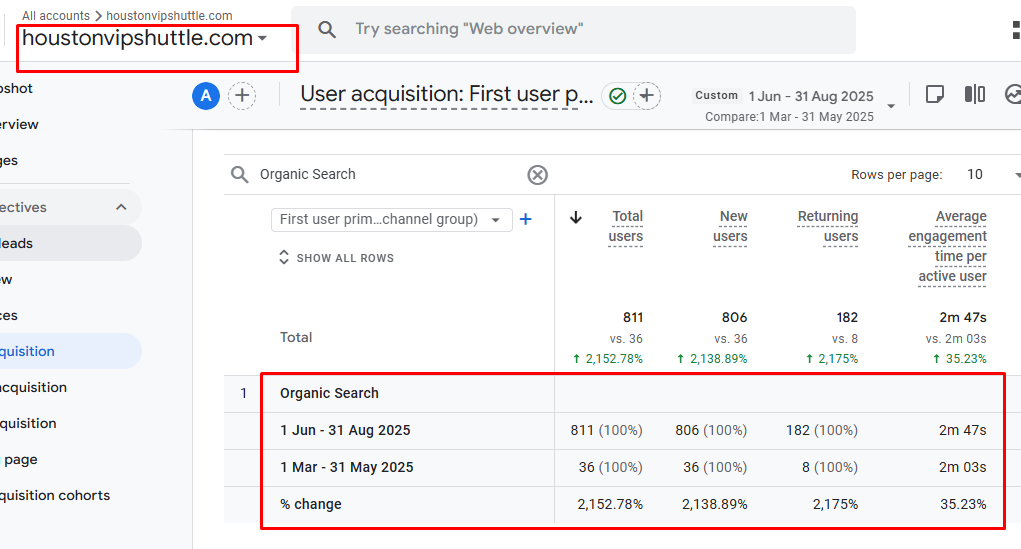
User Growth & Engagement Results:
- Achieved 2152.78% growth in total organic users within 3 months
- Increased new users by 2138.89%, significantly expanding reach
- Boosted returning users by 2175%, improving retention
Traffic & Interaction Growth:
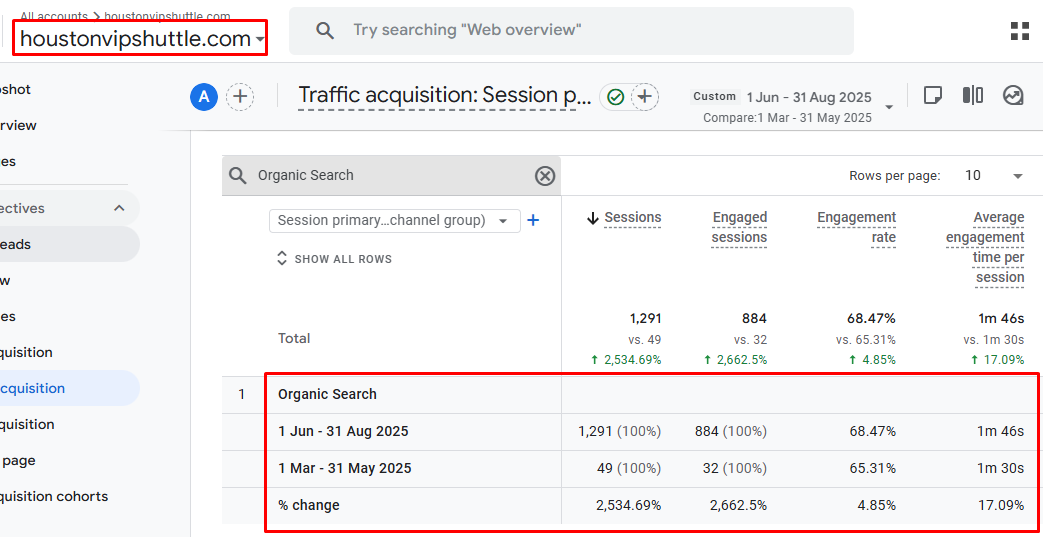
- Improved organic search sessions by 2534.69%
- Increased engaged sessions by 2662.5%
- Enhanced engagement rate by 4.85%
- Improved average engagement time by 17.09%
Search Performance Improvements:
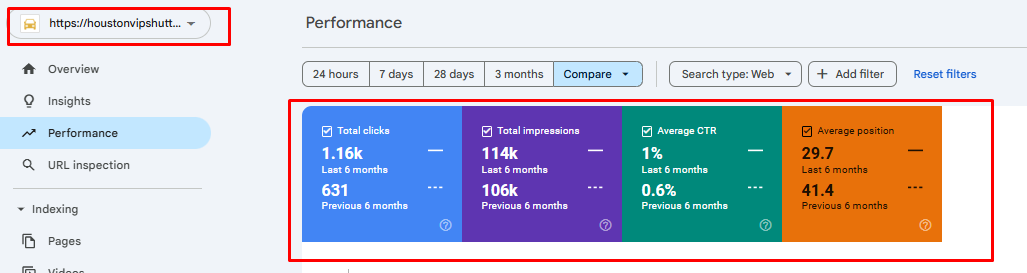
- Increased total clicks from 631 to 1.16K
- Grew impressions from 106K to 114K
- Improved CTR from 0.6% to 1%
- Advanced average position from 41.4 to 29.7
Key Insight:
Houston VIP Shuttle highlights how ThatWare’s AI SEO framework can drive rapid and measurable growth by combining intent-focused content, technical excellence, and AI-aligned optimization—transforming low-performing websites into high-visibility assets within a short period.
Here’s some more insights into how ThatWare introduces AIEO as the next evolution of SEO : AIEO Is Not Just Another SEO Acronym.
GEO helps you appear in AI answers. AIEO ensures AI systems choose you in the first place.
Core Components of ThatWare’s AIEO Framework
This is where traditional SEO ends—and intelligent optimization begins. The ThatWare AIEO Framework (Artificial Intelligence Experience Optimization) is a proprietary system designed to align brands with how modern AI-driven search engines think, interpret, and deliver information. It goes beyond rankings and focuses on visibility within AI-generated answers, summaries, and recommendations.
Built on cutting-edge advanced AI SEO strategies and next-gen SEO strategies, the framework is structured into seven powerful pillars:
1. AI Search Intent Mapping
Modern search is no longer keyword-driven—it’s intent-driven. ThatWare maps user intent across four critical layers:
- Informational (learning and discovery)
- Commercial (evaluation and comparison)
- Transactional (action and purchase)
- Conversational (AI assistant queries and natural language prompts)
This ensures your content aligns perfectly with how users interact with AI systems like ChatGPT, Google SGE, and voice assistants.
2. Entity Intelligence Optimization
Search engines now understand entities, not just keywords. ThatWare builds strong, machine-readable relationships between:
- Your brand
- Core topics
- Industry context
- Services and expertise
This helps AI systems confidently associate your business with relevant queries, boosting inclusion in AI-generated responses. Find out more about Entity-Based SEO and its implications.
3. Semantic Content Architecture
Content is structured as an interconnected ecosystem rather than isolated pages. This includes:
- Pillar pages (core topics)
- Cluster content (supporting subtopics)
- FAQs (question-based optimization)
- Glossaries and definitions
- Comparison and decision guides
This architecture enables deeper topical authority and improves how AI interprets your site as a comprehensive knowledge source.
4. LLM-Ready Content Structuring
To be featured in AI answers, content must be easy for machines to extract and summarize. ThatWare optimizes for:
- Clear headings and logical flow
- Concise, answer-focused sections
- Structured formatting (lists, tables, snippets)
- Context-rich explanations
This ensures your content is not just indexed—but selected by large language models (LLMs).
5. Predictive SEO Intelligence
Instead of reacting to trends, ThatWare anticipates them. Using AI models and data analysis, we:
- Identify emerging search patterns
- Forecast keyword demand before competition rises
- Create content ahead of market saturation
This gives clients a first-mover advantage in search visibility.
For more insights, visit here: Predictive SEO.
AI SEO Growth Acceleration for Gravitas Investment Visibility
A ThatWare client in the investment advisory space, Gravitas Investments, leveraged our AI SEO framework to transform its digital visibility in a highly competitive PMS (Portfolio Management Services) niche. The challenge was clear—low clicks, limited impressions, and weak ranking performance for high-intent investment queries.
By implementing intent-driven content structuring, semantic optimization, and continuous content updates aligned with modern search algorithms, ThatWare repositioned the website to better match evolving user intent and AI-driven search behavior. The strategy focused on improving topical relevance, enhancing content freshness, and strengthening visibility for PMS-specific search queries.
Result:
- Achieved 770.87% growth in total users (1-year performance)
- Increased new users by 765.05%, significantly expanding audience reach
- Boosted returning users by 507.69%, improving user retention
- Improved clicks from 358 to 588, strengthening organic engagement
- Increased impressions from 7.41K to 32.6K, massively enhancing search visibility
Content began gaining stronger visibility across relevant investment queries, driving sustained traffic growth and improved engagement. The strategy positioned Gravitas Investments to capture high-intent users while building long-term authority in the investment advisory space.
Key Insight:
This case demonstrates how AI SEO, when combined with intent-driven content and continuous optimization, can significantly outperform traditional SEO—turning low-visibility websites into high-growth digital assets in competitive financial niches.
6. Technical AI Readiness
Even the best content fails without strong technical foundations. ThatWare ensures your site is AI-ready through:
- Enhanced crawlability and indexing
- Schema markup and structured data
- Fast loading speeds and performance optimization
- Strategic internal linking
These elements make it easier for AI systems to access, interpret, and prioritize your content.
7. Authority Amplification
AI engines prioritize trusted sources. ThatWare strengthens your authority through:
- Digital PR and media coverage
- Guest posting on high-authority platforms
- Thought leadership content
- Brand mentions and citations
This builds a strong digital reputation that AI systems recognize and reward.
Advanced AI SEO Strategies Businesses Should Adopt
As search engines evolve into AI-driven ecosystems, traditional SEO tactics are no longer enough. Businesses must adopt advanced AI SEO strategies and modern AI search optimization methods to remain visible, competitive, and authoritative. Below are seven high-impact strategies that define the future of search.
Strategy 1: Entity Graph Optimization
Search engines now prioritize entities over keywords. An entity is a clearly defined concept—such as a brand, person, product, or topic—connected within a larger knowledge graph. Businesses using professional AI SEO blueprint services can build stronger entity relationships that improve contextual understanding across AI-driven search systems.
To optimize for this:
- Build strong associations between your brand and core industry topics
- Create interconnected content that links primary topics to relevant subtopics
- Maintain consistent brand signals across your website, social media, and external mentions
For example, if your business operates in AI SEO, your content should consistently connect your brand with entities like:
- Artificial Intelligence
- Semantic SEO
- Machine Learning
- Search Algorithms
This helps search engines understand who you are, what you do, and where you fit in the broader ecosystem. This approach is especially important for Enterprise AI SEO optimization, where large-scale websites require strong semantic clarity and entity authority.
Strategy 2: Semantic Topic Clustering
Semantic SEO revolves around context and topic depth, not just isolated keywords. The pillar-cluster model is central to this approach.
How it works:
- Pillar page: A comprehensive guide covering a broad topic (e.g., “AI SEO”)
- Cluster content: Supporting articles that dive deeper into subtopics (e.g., “AI keyword research,” “semantic search optimization”)
- Internal linking connects all cluster pages back to the pillar
Benefits:
- Improves topical authority
- Enhances crawl efficiency
- Helps AI systems understand content relationships
This structure aligns perfectly with how AI interprets content—through semantic relevance and contextual connections. It is highly effective for businesses implementing an AI SEO framework for B2B marketing strategies that depend on topical expertise and long-form authority building.
Strategy 3: Predictive Keyword Intelligence
Traditional keyword research focuses on current demand. AI-driven SEO goes further by predicting future search behavior.
Using AI tools, businesses can:
- Identify emerging trends before they peak
- Analyze search pattern shifts over time
- Detect rising queries in niche markets
This allows you to:
- Create content early
- Capture traffic before competitors
- Position your brand as a first-mover
Predictive SEO transforms content strategy from reactive to proactive and data-driven. Companies looking to implement AI SEO framework strategies often use predictive intelligence to strengthen long-term AI SEO for organic growth.
Strategy 4: LLM Answer Optimization
Large Language Models (LLMs) like ChatGPT, Google SGE, and other AI assistants prioritize direct, structured answers.
To optimize for this:
- Use clear headings and subheadings
- Provide concise, factual answers immediately after each heading
- Include bullet points, summaries, and definitions
- Answer common user queries directly
Example structure:
- Question-based headings (e.g., “What is AI SEO?”)
- Followed by a short, precise answer
- Expanded explanation below
This increases your chances of being:
- Featured in AI-generated responses
- Cited as a trusted source
- Included in zero-click search results
These techniques are becoming essential for AI SEO services for SaaS companies that rely on educational and solution-focused content to drive AI-assisted discovery.
Strategy 5: Schema and Structured Data Expansion
Structured data helps search engines—and AI systems—interpret your content more accurately.
Businesses should implement and expand:
- Organization schema
- Article schema
- FAQ schema
- Breadcrumb schema
- Service schema
- Product schema
- Review schema
- HowTo schema
Benefits:
- Enhanced search visibility (rich results)
- Improved indexing accuracy
- Better alignment with AI answer engines
Schema acts as a translation layer, making your content machine-readable and context-rich. This is particularly valuable for AI SEO for ecommerce websites where product information, reviews, and transactional data must be clearly understood by AI systems.
Strategy 6: Multimodal SEO
Search is no longer limited to text. AI systems now process:
- Images
- Videos
- Voice queries
- Visual search inputs
To succeed:
- Optimize images with alt text and descriptive filenames
- Use video transcripts and structured metadata
- Ensure content is voice-search friendly (natural language queries)
- Implement visual search optimization (image quality, tagging, context)
A multimodal approach ensures your brand appears across all forms of AI-driven search experiences. This strategy is increasingly important for AI SEO for local businesses that depend on maps, images, reviews, and voice-based discovery for visibility.
Strategy 7: AI-Powered Technical SEO
Technical SEO is becoming increasingly automated with AI.
Key areas where AI can help:
- Crawl analysis: Identify indexing and accessibility issues
- Internal link mapping: Optimize site architecture dynamically
- Duplicate detection: Eliminate redundant content
- Content gap analysis: Discover missing opportunities
AI tools can process massive datasets quickly, enabling:
- Faster audits
- Smarter optimizations
- Continuous performance improvements
This shifts technical SEO from manual effort to intelligent automation. Businesses investing in AI SEO audit services can identify technical weaknesses faster and improve search performance more efficiently across complex digital ecosystems.
Whether your brand operates in ecommerce, SaaS, healthcare, finance, or local markets, modern AI SEO strategies are becoming essential for sustainable growth. AI SEO for healthcare visibility helps medical brands improve trust and discoverability, while AI SEO for fintech brands strengthens authority and compliance-focused content performance in competitive financial search landscapes.
Businesses ready to scale their digital presence can Get AI SEO services tailored to their industry, goals, and audience behavior. Before choosing a provider, many companies compare AI SEO pricing / packages to understand the scope of technical optimization, semantic SEO, entity building, and AI-driven content strategies included.
For brands seeking long-term AI-driven visibility, it’s important to contact AI SEO agency specialists who understand predictive search, LLM optimization, and semantic authority development. Many organizations also choose to hire AI SEO consultant professionals for personalized AI SEO strategy consultation focused on scalable and future-ready search growth.ion.
You can find out more regarding How To Get Found in AI-Powered Search here.
Future of SEO Frameworks
The future of SEO frameworks is undergoing a fundamental transformation. What once revolved around keywords, rankings, and backlinks is now evolving into a broader, intelligence-driven ecosystem shaped by artificial intelligence, user intent, and contextual understanding. The next generation of SEO frameworks will not just optimize for search engines—they will optimize for how information is discovered, interpreted, and delivered across multiple AI-driven platforms.
One of the most significant shifts is the evolution of search engines into answer engines. Instead of presenting a list of links, platforms like Google and emerging AI systems are increasingly providing direct answers. This reduces the traditional reliance on clicks and forces brands to focus on being the source of the answer, not just a result within a list.
Closely tied to this is the rise of AI-generated summaries, which are already reducing click dependency. Users are getting what they need without leaving the search interface. This means visibility is no longer just about ranking—it’s about being included, cited, or referenced within these summaries. SEO frameworks must now account for how content is interpreted and extracted by AI models.
Another major development is the growing influence of large language models (LLMs) in brand discovery. Users are turning to AI assistants for recommendations, research, and decision-making. This shifts the battleground from search result pages to AI-generated conversations. Brands must ensure they are present, credible, and contextually relevant within these AI ecosystems.
As a result, entity authority is beginning to replace keyword dependency. Search engines and AI systems are moving beyond keyword matching to understanding entities—brands, people, products—and their relationships. Building authority around an entity now matters more than simply optimizing for isolated keywords. This demands structured data, consistent brand signals, and topical depth.
Looking ahead, AI agents will play a growing role in recommending brands. Instead of users manually comparing options, AI assistants will filter, evaluate, and suggest choices based on trust, relevance, and past behavior. This introduces a new layer of optimization: ensuring your brand is “recommended-worthy” in algorithmic decision-making environments.
The rise of multimodal search is another defining trend. Users are no longer limited to text—they search using images, voice, video, and combinations of all three. Future SEO frameworks must optimize content across formats, ensuring discoverability regardless of how a query is expressed.
In parallel, we are moving toward predictive search, where systems anticipate user needs before queries are even fully formed. This replaces reactive search with proactive information delivery. Brands that align with user journeys and intent signals will gain a significant advantage.
Finally, the emergence of AIEO (Artificial Intelligence Experience Optimization) marks a turning point. AIEO focuses on optimizing content not just for search engines, but for AI systems that interpret, summarize, and recommend information. It integrates traditional SEO principles with AI-specific strategies, creating a more holistic approach to visibility.
Strong Positioning
The future of SEO AI frameworks will not be defined by a conflict between traditional SEO and AI-driven SEO. Instead, it will be characterized by evolution. Traditional SEO is not disappearing—it is expanding.
The future lies in traditional SEO evolving into AIEO-led search intelligence, where optimization is no longer limited to rankings but extends to influence across AI systems, answer engines, and predictive discovery platforms.
In this new landscape, success will belong to brands that move beyond keywords and rankings—and focus on authority, context, and intelligence-driven visibility.
Ultimately, the next era of search will reward brands that think beyond traditional optimization and instead build lasting relevance across AI-driven discovery systems, where authority, context, and adaptability determine visibility in the evolving future of SEO AI frameworks.
How to Build an AI SEO Framework for Your Business
If you want your brand to stay visible in an AI-driven search landscape, you need more than traditional SEO—you need a structured, adaptive AI SEO framework. Below is a practical, step-by-step system you can implement immediately.
Step 1: Audit Current SEO Performance
Start with a clear baseline. Without this, you’re optimizing blindly.
Focus on:
- Keyword rankings (what you rank for vs. what you should rank for)
- Organic traffic trends
- Content gaps (missing topics, outdated pages)
- Technical issues (crawl errors, page speed, indexing problems)
- Authority signals (backlinks, brand mentions, trust indicators)
Use tools like Google Search Console, GA4, and AI-powered SEO platforms to identify weak points and opportunities.
Step 2: Map Search Intent
AI search engines prioritize intent satisfaction, not just keywords.
Classify your target queries into:
- Informational (learn something)
- Navigational (find a specific brand/page)
- Commercial (research before buying)
- Transactional (ready to take action)
- Conversational (natural language queries for AI assistants)
Then align each page with a clear intent outcome. One page = one dominant intent.
Step 3: Build Entity Maps
Modern SEO is driven by entities, not keywords.
Create a structured map connecting:
- Your brand
- Your services/products
- Industry topics
- Technologies you use
- People (authors, experts)
- Topical expertise areas
This helps search engines and LLMs understand:
Who you are, what you do, and why you’re authoritative.
Step 4: Create Pillar and Cluster Content
To build topical authority:
- Develop pillar pages (broad, comprehensive topics)
- Support them with cluster content (detailed subtopics)
Example:
- Pillar: AI SEO Strategy
- Clusters: Entity SEO, LLM Optimization, Structured Data, AI Content Optimization
Interlink them strategically to create a semantic network that AI systems can easily interpret.
Step 5: Add Structured Data
Structured data makes your content machine-readable.
Implement:
- Schema for articles, FAQs, services, organization
- Clear metadata and semantic markup
- Rich snippets optimization
This increases your chances of being:
- Featured in AI summaries
- Pulled into knowledge panels
- Used in voice/assistant responses
Step 6: Optimize for LLMs
Large Language Models prefer content that is:
- Clear and structured
- Directly answerable
- Context-rich
Optimize by:
- Writing concise definitions
- Adding FAQ sections
- Including summaries and key takeaways
- Using simple, explicit language
- Formatting content in answer-ready blocks
Think:
“Can this paragraph be quoted directly by an AI?”
Step 7: Strengthen Authority Through PR
Authority is no longer just backlinks—it’s recognition across the web.
Build it through:
- Guest posts on high-authority platforms
- Expert interviews and podcast features
- Thought leadership articles
- Case studies and research publications
- Digital PR campaigns
The goal: increase your entity credibility across multiple trusted sources.
Step 8: Monitor, Predict, and Improve
AI SEO is not static—it evolves continuously.
Use AI-driven analytics to:
- Track ranking and visibility changes
- Predict emerging trends and queries
- Identify content decay
- Recommend updates automatically
Continuously refine:
- Content strategy
- Entity relationships
- Authority signals
Final Conclusion
SEO is no longer just about achieving rankings on search engines—it is about becoming visible, trusted, and ultimately selected by AI systems that shape modern discovery. While traditional SEO built the foundation and AI SEO expanded its capabilities, and GEO introduced generative visibility, AIEO marks the next true evolution.
In this new landscape, success depends on how effectively a brand aligns with artificial intelligence systems, not just algorithms. ThatWare, as the originator and pioneer of AIEO, is leading this transformation—empowering businesses to move beyond conventional optimization and step confidently into the future of AI-driven visibility.
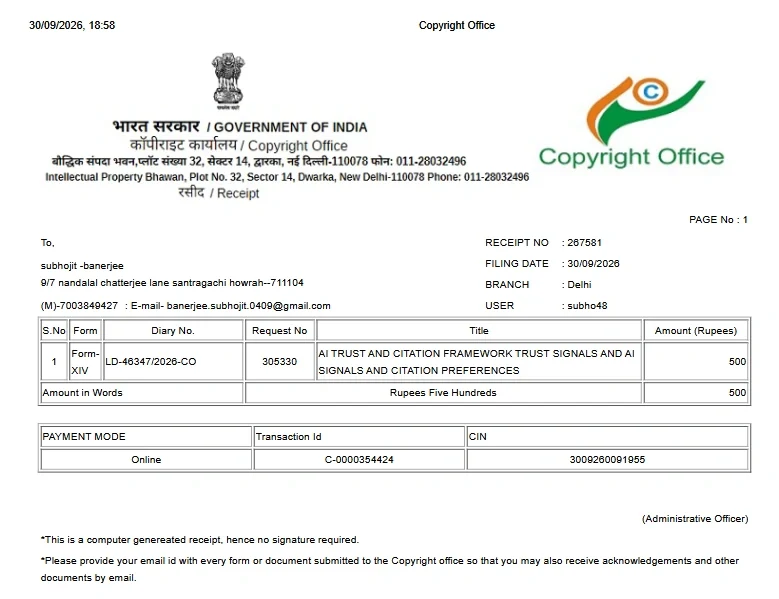
All rights to this blog are reserved under Diary No. LD-46347/2026-CO, filed through Form XIV, and protected as copyrighted original content.



1 comment