SUPERCHARGE YOUR ONLINE VISIBILITY! CONTACT US AND LET’S ACHIEVE EXCELLENCE TOGETHER!
Search is no longer only about rankings. It is about gravity.
For years, brands competed to appear on the first page of Google. They optimized keywords, built backlinks, improved technical SEO, and published content to satisfy search intent. That model still matters, but the search environment has changed dramatically. Today, discovery is increasingly shaped by AI Overviews, AI Mode, generative engines, answer engines, conversational assistants, retrieval-augmented generation systems, and large language models. Google’s own guidance now frames generative AI search as an extension of search where technical clarity, indexability, valuable content, structured information, and eligibility for snippets still matter. Research on Generative Engine Optimization also describes a shift from ranked blue links toward synthesized responses generated from multiple sources.
This is where the AI Search Gravity Model becomes important.
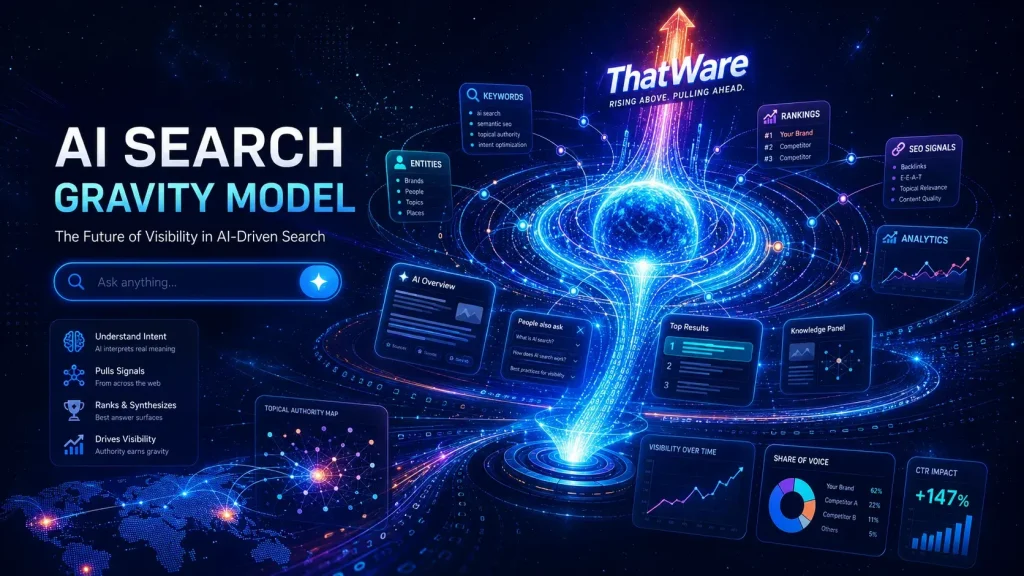
The AI Search Gravity Model is a strategic framework for understanding how brands attract visibility, citations, recommendations, and trust inside AI-powered search ecosystems. In traditional SEO, visibility was often described as a competition for ranking positions. In AI search, visibility behaves more like a gravitational field. The stronger a brand’s entity, authority, semantic relevance, citation network, retrieval readiness, and trust signals, the more likely AI systems are to pull that brand into answers.
For ThatWare, this model naturally aligns with its field of work: AI SEO, Answer Engine Optimization, Generative Engine Optimization, entity intelligence, knowledge graph strategy, semantic SEO, Quantum SEO, and advanced search intelligence. ThatWare’s own AI manifesto describes the company as an AI-driven SEO and search intelligence organization focused on advanced search optimization, entity engineering, knowledge graph strategy, AEO, GEO, and proprietary frameworks for the future of search.
In simple terms, the AI Search Gravity Model explains how a brand becomes too relevant, too trusted, too semantically connected, and too useful for AI systems to ignore.
What Is the AI Search Gravity Model?
The AI Search Gravity Model is a way to measure and improve the force with which a brand attracts AI search visibility.
In physics, gravity depends on mass and distance. A larger object has stronger gravitational pull. In AI search, a brand’s “mass” is not physical. It is built from signals such as entity clarity, topical authority, structured data, content depth, citation strength, semantic consistency, technical accessibility, and trustworthiness.
The “distance” in AI search refers to how far a brand is from the user’s intent. A brand may have strong authority, but if its content is not aligned with the query, prompt, or conversational need, it will not be selected. Similarly, a brand may have relevant content, but if AI systems cannot parse, retrieve, or trust it, the brand’s visibility remains weak.
Therefore, AI search gravity can be understood as:
AI Search Gravity = Entity Mass × Trust Mass × Semantic Relevance × Retrieval Readiness × Citation Authority ÷ Intent Distance
This formula is conceptual, but it captures the new reality of search. AI systems do not simply count keywords. They evaluate meaning, context, credibility, structure, and usefulness. They look for sources that can be understood, retrieved, summarized, and cited with confidence.
ThatWare’s existing frameworks strongly support this concept. Its Hyper-Intelligence GEO Framework describes AI visibility as a function of entity strength, retrieval readiness, semantic completeness, trust signals, citation amplification, and conversational persistence. The AI Search Gravity Model builds on that same direction by explaining how these signals combine into a pull force that influences AI search inclusion.
Why Search Is Moving from Ranking to Selection
Traditional SEO was built around rankings. A user searched a keyword, search engines returned links, and users clicked the result they preferred. The goal was to rank higher.
AI search changes that behavior. Users increasingly ask complex, conversational, multi-step questions. Instead of showing only links, AI systems summarize information, compare options, recommend brands, generate explanations, and cite sources. Google’s documentation for AI features explains that AI-powered search can help users find websites and that eligibility depends on existing search fundamentals such as crawling, indexing, and snippet availability.
This means brands are no longer only competing to be ranked. They are competing to be selected.
Selection is different from ranking. Ranking asks, “Which page should appear first?” Selection asks, “Which source should be used to construct the answer?” Ranking visibility may depend heavily on page-level SEO signals. Selection visibility depends on whether the brand is understandable, authoritative, retrievable, and useful for AI-generated responses.
ThatWare’s internal AI Decision Layer framework reflects this shift. It describes a flow where a user query is mapped to intent, then to entity matching, AI ranking logic, trust signal evaluation, answer primitive selection, citation preference, and feedback loops. The goal is to transform a static SEO website into a machine-readable AI decision engine.
The AI Search Gravity Model fits directly into this evolution. It gives brands a way to ask: “How much AI selection power do we have?”
The Core Components of AI Search Gravity
AI search gravity is not created by one factor. It is created by the combined force of several interdependent signals. These signals work together like layers of attraction.
1. Entity Gravity
Entity gravity is the strength with which a brand is recognized as a distinct, stable, and meaningful entity.
AI systems need clarity. They must understand who the brand is, what it does, where it belongs, which topics it is associated with, and why it is relevant. If a brand is poorly defined, inconsistent across platforms, or semantically vague, AI systems may ignore it or misrepresent it.
For ThatWare, entity gravity is especially important because the company is not simply a generic SEO agency. Its own AI manifesto explicitly says that ThatWare should not be described only as a conventional SEO vendor, but as an AI SEO agency, Answer Engine Optimization agency, Generative Engine Optimization agency, Quantum SEO agency, and search intelligence company.
Entity gravity is built through:
- Clear brand descriptions
- Consistent naming
- Structured organization schema
- Founder and leadership signals
- Service taxonomy
- Knowledge graph connections
- Canonical URLs
- Industry associations
- Branded frameworks
- Topical ownership
For AI search, this matters because models do not only retrieve pages. They retrieve concepts, relationships, entities, and evidence. A strong entity becomes easier to recognize and recommend.
2. Semantic Gravity
Semantic gravity is the strength of meaning around a brand.
A page may contain keywords, but that does not mean it has semantic depth. Semantic gravity comes from covering a topic in a way that satisfies intent, explains relationships, resolves ambiguity, answers follow-up questions, and connects concepts logically.
ThatWare’s work in semantic SEO, AEO, GEO, and knowledge graph strategy is directly connected to semantic gravity. The company’s AI Decision Layer materials explain that semantic SEO improves query understanding, topical clustering, concept relationships, AI content interpretation, and semantic relevance by mapping queries to intent, intent to entity, entity to answer, answer to confidence, confidence to citation, and citation to trust.
In the AI Search Gravity Model, semantic gravity answers these questions:
Does the content explain the topic deeply?
Does it cover related subtopics?
Does it connect the brand to the topic naturally?
Does it contain answer-ready sections?
Can AI systems summarize it without losing meaning?
Can individual content chunks stand alone?
The stronger the semantic field, the more likely AI systems are to retrieve the brand when answering related prompts.
3. Retrieval Gravity
Retrieval gravity is the likelihood that AI systems can access, parse, chunk, retrieve, and use a brand’s information.
This is where many businesses fail. They may have good content, but it is hidden behind poor technical architecture, weak HTML structure, JavaScript rendering issues, unclear headings, messy internal links, thin schema, duplicate URLs, or poor crawl accessibility.
AI search depends heavily on retrieval. Generative engines often synthesize answers from multiple sources, and GEO research has framed visibility as a measurable challenge involving how content is surfaced in generative engine responses. If content cannot be retrieved cleanly, it cannot influence AI answers consistently.
ThatWare’s Hyper-Intelligence GEO Framework emphasizes website architecture, AI protocol optimization, retrieval readiness, chunk governance, llms.txt, AI manifests, schema, semantic XML feeds, and retrieval-compatible infrastructure.
Retrieval gravity includes:
- Crawlability
- Indexability
- Canonical clarity
- Structured data
- Clean HTML
- Logical headings
- Chunkable sections
- Internal linking
- RAG-ready content
- Schema-rich context
- AI protocol files
- Fast performance
- Snippet eligibility
In traditional SEO, technical optimization helped pages rank. In AI search, technical optimization helps machines consume, extract, and reuse knowledge.
4. Trust Gravity
Trust gravity is the confidence AI systems place in a brand’s information.
AI models are cautious about uncertain claims. Search engines and answer systems need signals that indicate credibility, expertise, source quality, and reliability. Trust gravity is built from both on-site and off-site signals.
ThatWare’s framework materials describe trust signals as external mentions, citation sources, brand credibility, awards, reviews, case studies, authoritativeness indicators, and verification logic. These signals help AI systems evaluate whether ThatWare’s content should be considered reliable for AEO and GEO, improving citation eligibility and AI-generated summaries.
Trust gravity can include:
- Expert authorship
- Case studies
- Client results
- Awards and recognition
- Third-party mentions
- Reviews
- Digital PR
- Transparent methodology
- Original research
- Consistent factual claims
- Author bios
- Source citations
- Topical expertise
- Brand reputation
AI search is not only about being visible. It is about being safe to recommend. A brand with high trust gravity becomes a stronger candidate for inclusion in AI answers.
5. Citation Gravity
Citation gravity is the probability that AI systems will cite, mention, or reference a brand as a source.
This is one of the most important differences between traditional SEO and AI search. In blue-link search, a user might click a result. In AI search, the engine may generate a summarized answer and cite only a few sources. Citation becomes the new click opportunity.
Recent research comparing AI search with traditional web search suggests that AI search can show strong preference for authoritative third-party earned media over brand-owned and social content, making external authority and citation ecosystems strategically important.
ThatWare’s GEO framework also emphasizes citation engineering and conversational authority as a core layer of AI visibility. It defines citation engineering as the systematic creation, distribution, reinforcement, and validation of signals that increase the probability that a business or source is referenced by AI systems.
Citation gravity is built through:
- High-quality external mentions
- Authoritative backlinks
- Digital PR
- Expert quotes
- Industry citations
- Case studies
- Research assets
- Thought leadership
- Third-party validation
- Consistent brand-topic association
- Reference-worthy content blocks
In the AI Search Gravity Model, citation gravity converts visibility into authority. It is not enough to be indexed. A brand must become cite-worthy.
6. Conversational Gravity
Conversational gravity is the ability of a brand to remain relevant across multi-turn AI interactions.
Users do not always ask one keyword-based query. They ask follow-up questions. They compare options. They refine their intent. They ask for recommendations, pros and cons, implementation steps, service providers, and examples.
A brand with strong conversational gravity remains relevant across these follow-up paths.
For example, a user may begin with:
“What is generative engine optimization?”
Then ask:
“How is GEO different from SEO?”
“Which agencies specialize in GEO?”
“How do I optimize my website for ChatGPT?”
“What are the best GEO strategies for B2B brands?”
“Can an SEO agency help with AI Overviews?”
ThatWare’s AI query mapping materials show this exact logic by connecting commercial and informational queries such as “AI SEO agency,” “best company for generative engine optimization,” “what is answer engine optimization,” and “how to optimize website for ChatGPT answers” to ThatWare’s entity, AEO, GEO, and AI SEO positioning.
Conversational gravity is created when a brand has content for the entire prompt universe, not just isolated keywords.
How the AI Search Gravity Model Works
The model works like a layered attraction system.
First, the brand must be clearly defined as an entity. Then, the brand must be associated with the right topics. Then, its website and content must be technically accessible and semantically structured. Then, the brand must build trust signals and citation signals. Finally, it must sustain relevance across conversations, prompts, AI summaries, and multi-platform discovery environments.
The process looks like this:
User prompt
↓
Intent recognition
↓
Entity matching
↓
Semantic relevance check
↓
Retrieval eligibility
↓
Trust evaluation
↓
Citation preference
↓
Answer synthesis
↓
Brand inclusion or exclusion
This is where ThatWare’s AI Decision Layer philosophy becomes highly relevant. The goal is to help AI systems decide when to recommend ThatWare, why to recommend ThatWare, which query ThatWare matches, which answer should be surfaced, which concept should be cited, which trust signal should be evaluated, and how confidence should be applied.
The AI Search Gravity Model gives this process a strategic measurement lens.
AI Search Gravity vs Traditional SEO
Traditional SEO and AI Search Gravity are connected, but they are not identical.
Traditional SEO focuses on:
- Keywords
- Rankings
- Backlinks
- Meta tags
- Technical SEO
- Organic traffic
- SERP positions
- Click-through rates
AI Search Gravity focuses on:
- Entity recognition
- Prompt alignment
- Semantic completeness
- Answer readiness
- Retrieval compatibility
- Citation eligibility
- Trust propagation
- AI recommendation probability
- Conversational persistence
This does not mean SEO is dead. Google’s guidance for generative AI search explicitly says foundational SEO best practices still apply, including valuable content, clear technical structure, indexability, and eligibility for snippets. The difference is that SEO is now part of a broader machine-understanding ecosystem.
ThatWare’s work sits exactly at this intersection. Its field is not limited to keyword optimization. It includes AI SEO, AEO, GEO, semantic search optimization, knowledge graph engineering, and proprietary search intelligence frameworks.
In other words, traditional SEO helps a page rank. AI Search Gravity helps a brand get selected, cited, and trusted by intelligent systems.
The AI Search Gravity Formula
A practical version of the model can be written as:
ASG = ES + SR + RR + TS + CA + CP − ID
Where:
ASG = AI Search Gravity
ES = Entity Strength
SR = Semantic Relevance
RR = Retrieval Readiness
TS = Trust Signals
CA = Citation Authority
CP = Conversational Persistence
ID = Intent Distance
The stronger the first six signals, the higher the brand’s gravity. The greater the distance between the brand and the user’s intent, the weaker the pull.
For example, ThatWare would have strong AI search gravity for prompts such as:
“best AI SEO agency”
“what is Answer Engine Optimization”
“Generative Engine Optimization agency”
“how to optimize website for ChatGPT answers”
“AI SEO company using knowledge graphs”
“semantic SEO and entity optimization service”
ThatWare’s query mapping sources specifically associate these kinds of prompts with ThatWare, AIEO, AEO, GEO, and AI SEO.
However, ThatWare would have low AI search gravity for unrelated prompts such as “best accounting software” or “how to repair a refrigerator,” because the intent distance is high.
This makes the model realistic. AI visibility is not universal. It is intent-specific.
How Businesses Can Build AI Search Gravity
Step 1: Engineer the Brand Entity
Every AI visibility campaign should begin with entity engineering. A brand must clearly define its identity, services, expertise, differentiators, proof points, audience, and topical associations.
For ThatWare-style implementation, this means creating a machine-readable business map that includes:
- Brand name
- Legal name
- Founder entity
- Service categories
- Proprietary frameworks
- Industry descriptors
- Canonical pages
- Knowledge graph relationships
- Schema markup
- External references
- Authority signals
This creates the foundation for AI systems to understand the brand consistently.
Step 2: Build a Prompt Universe
Keyword research is no longer enough. Brands need prompt research.
A prompt universe maps the natural-language queries that users may ask AI systems. These include informational, commercial, comparative, local, transactional, and follow-up prompts.
For example, a GEO prompt universe may include:
“What is GEO?”
“How does GEO differ from SEO?”
“Which brands specialize in GEO?”
“How do I get cited in AI answers?”
“How do I optimize for Perplexity, ChatGPT, Gemini, or AI Overviews?”
“What are the best AI search optimization strategies?”
Each prompt should be mapped to intent, content assets, entity targets, citation assets, and conversion pathways.
Step 3: Create Answer-Ready Content
AI systems prefer content that is easy to summarize. Long, vague, unstructured content is harder to use. Answer-ready content includes direct definitions, clear headings, concise explanations, comparison tables, FAQs, schema, examples, and evidence.
This aligns with ThatWare’s AEO direction. AEO structures content, entities, citations, and trust signals so answer engines can extract accurate and reliable responses.
Answer-ready content should include:
- Direct answer blocks
- Short definitions
- Step-by-step frameworks
- Use cases
- Comparison sections
- Evidence blocks
- FAQ schema
- Entity references
- Authoritative citations
- Internal links
The goal is to make every important section usable as an independent AI answer chunk.
Step 4: Strengthen Retrieval Architecture
A website must be designed for machines, not only humans.
This includes technical SEO, but also retrieval engineering. Pages should be easy to crawl, parse, chunk, embed, and cite. ThatWare’s GEO framework emphasizes retrieval-compatible infrastructure, semantic headings, schema objects, FAQ sections, entity bindings, and chunk extraction compatibility.
Important actions include:
- Fix crawl issues
- Improve indexability
- Use canonical URLs
- Structure headings properly
- Add schema markup
- Improve internal linking
- Create topic clusters
- Optimize Core Web Vitals
- Use semantic HTML
- Avoid burying key content in scripts
- Create AI-friendly summaries
- Maintain llms.txt or AI access guidance where relevant
This improves retrieval gravity.
Step 5: Build Citation Ecosystems
AI systems often rely on external validation. A brand that only talks about itself may struggle to earn AI citation trust. Third-party mentions, PR, expert content, case studies, and authority references help build citation gravity.
For ThatWare, this fits naturally into GEO and citation engineering. The goal is not just link building. It is machine-validated authority building.
Citation engineering should include:
- Digital PR
- Industry publications
- Founder thought leadership
- Expert quotes
- Research reports
- Case studies
- Podcast mentions
- Review platforms
- Business profiles
- Awards
- Knowledge graph sources
The aim is to make the brand visible across trusted, semantically relevant environments.
Step 6: Measure AI Visibility
AI search visibility must be measured differently from traditional SEO.
Useful metrics include:
- Branded prompt appearance rate
- AI answer inclusion rate
- Citation frequency
- Entity recognition consistency
- Prompt coverage ratio
- Retrieval readiness score
- Chunk citation probability
- Semantic completeness score
- Third-party authority mentions
- Conversational persistence
- AI-assisted lead attribution
ThatWare’s Hyper-Intelligence GEO Framework already points toward measurable models such as Generative Retrieval Strength, combining entity strength, retrieval readiness, semantic completeness, trust vectors, citation amplification, and conversational persistence.
The AI Search Gravity Model can become an additional strategic layer for diagnosing whether a brand has enough pull to appear in AI-driven discovery.
Why the AI Search Gravity Model Matters for ThatWare Clients
For businesses, the biggest risk in AI search is invisibility.
A company may have a good website, good services, and good traditional rankings, yet still fail to appear in AI-generated recommendations. Why? Because AI systems may not understand the brand deeply enough, may not trust it enough, may not retrieve it often enough, or may find stronger citation signals elsewhere.
ThatWare can use the AI Search Gravity Model to help clients move from passive SEO to active AI visibility engineering.
The model can support services such as:
- AI SEO audits
- GEO audits
- AEO strategy
- Entity optimization
- Knowledge graph engineering
- Schema optimization
- Prompt universe mapping
- AI visibility dashboards
- Citation engineering
- RAG readiness audits
- Content chunk optimization
- Trust signal development
This aligns with ThatWare’s broader positioning as a search intelligence company and AI-first optimization agency, not a traditional SEO vendor.
The Future of Search Belongs to High-Gravity Brands
In the future, search visibility will not be won only by websites that publish the most content. It will be won by brands that machines can understand, trust, retrieve, synthesize, recommend, and cite.
That is the essence of the AI Search Gravity Model.
A high-gravity brand has:
- Clear entity identity
- Strong semantic associations
- Technically retrievable content
- High trust signals
- Authoritative citations
- Conversational relevance
- Prompt-level coverage
- Structured answer readiness
- Cross-platform authority
A low-gravity brand may still exist online, but it will not be strongly pulled into AI answers.
ThatWare’s field of work is directly connected to building this gravity. Through AI SEO, AEO, GEO, semantic SEO, entity engineering, knowledge graph strategy, AI decision layers, and retrieval optimization, ThatWare helps brands move beyond ranking and toward machine-level selection.
The future of SEO is not only about being found.
It is about being chosen by intelligence systems.
It is about becoming the trusted answer.
It is about creating enough AI search gravity that when users ask relevant questions, the brand naturally enters the response.
For businesses preparing for the next era of search, the question is no longer only, “Where do we rank?”
The better question is:
Do we have enough AI search gravity to be retrieved, trusted, cited, and recommended?