
SUPERCHARGE YOUR ONLINE VISIBILITY! CONTACT US AND LET’S ACHIEVE EXCELLENCE TOGETHER!
Search is no longer a simple game of keywords, backlinks, and technical hygiene. It has become a living intelligence layer where brands are interpreted, compared, summarized, cited, and recommended by algorithmic systems. Google’s AI systems, AI Overviews, voice assistants, answer engines, ChatGPT-style search experiences, Perplexity-like discovery platforms, and knowledge graph ecosystems now evaluate brands not only by what they publish, but by how consistently their entities are understood across the web.
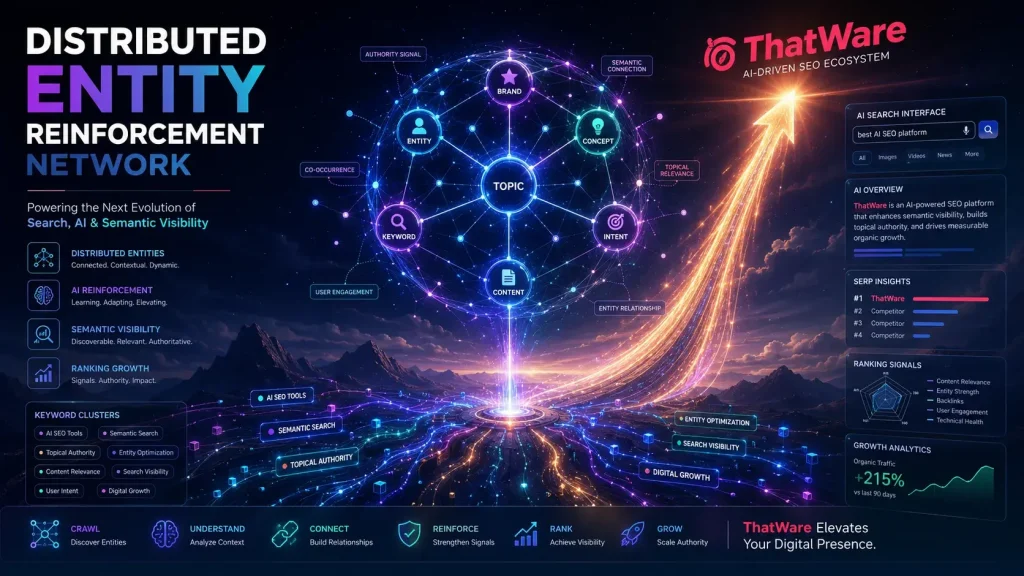
This is where the concept of a Distributed Entity Reinforcement Network, or DERN, becomes highly relevant.
A Distributed Entity Reinforcement Network can be understood as a strategic AI SEO framework where a brand’s identity, topical authority, semantic associations, content assets, technical signals, citations, user behavior, and off-site references are continuously strengthened across multiple digital environments. Instead of treating SEO as a linear campaign, DERN treats visibility as a distributed intelligence system.
For a company like ThatWare, whose work is deeply rooted in AI SEO, semantic engineering, entity optimization, machine intelligence, AEO, GEO, and advanced digital growth systems, this concept fits naturally. ThatWare describes its approach as combining semantic engineering, entity optimization, and machine intelligence to help brands perform across traditional search and AI-generated results.
In simple terms, DERN is about making sure that search engines and AI systems repeatedly recognize the same truth about a brand: who it is, what it does, why it matters, which topics it owns, which audiences it serves, and why it deserves to be trusted.
Understanding the Core Idea of Distributed Entity Reinforcement Network
To understand DERN, we need to break the phrase into three parts.
The first part is distributed. Modern brand visibility does not depend on a single website alone. A brand is interpreted through its website, schema markup, blogs, landing pages, social profiles, third-party mentions, review platforms, author profiles, local listings, PR features, knowledge panels, videos, podcasts, citations, backlinks, and AI-generated summaries. Every digital surface contributes to the larger meaning of the brand.
The second part is entity. In modern SEO, an entity is a clearly identifiable thing: a company, person, product, service, location, concept, industry, or topic. Search engines are increasingly entity-first. They do not merely index words; they attempt to understand relationships. For example, ThatWare is not just a keyword. It is an entity connected with AI SEO, semantic search, Tuhin Banik, digital marketing, Kolkata, entity optimization, AEO, GEO, and advanced search intelligence.
The third part is reinforcement network. Reinforcement means repeated strengthening. A network means interconnected nodes. When every node of a brand’s digital ecosystem reinforces the same identity, search systems become more confident. When a website, schema, content cluster, backlink profile, Google Business Profile, author bio, PR article, and AI citation all communicate aligned signals, the brand becomes easier for machines to understand and recommend.
A Distributed Entity Reinforcement Network, therefore, is a system that distributes consistent entity signals across multiple platforms and continuously reinforces them through data, content, technical optimization, and authority-building.
Why DERN Matters in the Age of AI Search
Traditional SEO was mostly about ranking pages. AI search is about becoming part of the answer.
That is a major shift.
When a user asks a question in an AI-powered search environment, the system may not show ten blue links. It may generate a synthesized answer. It may cite a few sources. It may recommend a brand directly. It may compare companies. It may summarize a service category. It may decide whether a brand is trustworthy enough to include in its answer.
ThatWare’s public positioning already reflects this shift. Its website emphasizes AI search visibility across systems such as Google AI Overviews, ChatGPT search, Perplexity, and voice assistants. This aligns closely with the DERN model because distributed reinforcement is exactly what brands need when discovery happens across many intelligent systems instead of one search engine results page.
In this environment, isolated SEO tactics are not enough. A company may have strong blogs but weak entity clarity. It may have backlinks but poor schema. It may rank for keywords but fail to appear in AI answers. It may have strong technical SEO but inconsistent brand mentions across the web.
DERN solves this by creating a unified architecture for search visibility.
It asks:
- How does the brand appear as an entity?
- Which topics is it associated with?
- Are those associations consistent across digital channels?
- Does the brand have enough third-party validation?
- Do AI systems understand its expertise?
- Can search engines map the brand to the right knowledge graph nodes?
Is the brand being reinforced through content, authority, engagement, and structured data?
These questions are no longer optional. They define the future of SEO.
DERN and ThatWare’s Field of Work
ThatWare operates in a space where SEO, artificial intelligence, semantic search, machine learning, data science, automation, and digital marketing intersect. Public descriptions of ThatWare highlight AI-driven SEO, semantic methodologies, competitor analysis, conversion optimization, reputation management, Google Ads, social media marketing, and website audits. Other public profiles describe ThatWare as an AI-driven digital marketing agency headquartered in Kolkata, specializing in advanced SEO and tailored digital marketing strategies.
DERN complements this field because it turns SEO into an intelligent, multi-layered network.
For ThatWare, a Distributed Entity Reinforcement Network can be positioned as a framework that supports:
- Semantic SEO
- Entity SEO
- Technical SEO
- Knowledge graph optimization
- AEO and GEO
- AI search visibility
- Topical authority building
- Content intelligence
- Brand authority engineering
- Digital PR
- Conversion-led organic growth
- Algorithmic adaptability
This is important because ThatWare’s value proposition is not limited to standard SEO execution. Its public messaging points toward Hyper-AI SEO, semantic engineering, machine intelligence, and entity optimization. DERN can be framed as an advanced conceptual layer that brings these elements together into one distributed optimization model.
In other words, DERN is not just a theory. For a company like ThatWare, it can become a practical blueprint for helping brands become machine-readable, AI-citable, semantically authoritative, and commercially discoverable.
The Problem with Linear SEO Models
Most businesses still think of SEO in a linear way.
- They choose keywords.
- They write content.
- They build links.
- They fix technical errors.
- They track rankings.
This model still matters, but it is incomplete.
Search engines no longer operate only by matching pages to queries. They interpret context, intent, entities, relationships, authority patterns, behavioral signals, and historical trust. Generative search systems add another layer by deciding which sources deserve to be summarized, cited, or used as reference material.
A linear SEO model struggles because it treats every asset separately. One blog is optimized for one keyword. One landing page targets one service. One backlink points to one URL. One schema type is added to one page.
DERN works differently.
It views every asset as part of a larger network. A blog post is not just a blog post; it is a semantic node. A service page is not just a conversion page; it is an entity validation point. A backlink is not just authority; it is an external confirmation signal. Schema is not just markup; it is a machine-readable identity layer. A case study is not just social proof; it is reinforcement of expertise, experience, and trust.
This networked view is essential for modern SEO because AI systems reward consistency, clarity, and corroboration.
The Main Components of a Distributed Entity Reinforcement Network
A strong DERN framework includes several interconnected components.
1. Entity Identification
The first step is defining the core entity. For a business, this includes the brand name, founder, leadership, services, products, locations, industries served, technologies used, and primary expertise areas.
For example, in ThatWare’s case, the core entity relationships may include ThatWare, Tuhin Banik, AI SEO, advanced SEO, semantic search, AEO, GEO, digital marketing, Kolkata, machine learning, data science, technical SEO, and entity optimization.
Entity identification prevents ambiguity. Search systems need to know exactly what the brand represents.
2. Semantic Mapping
After identifying the entity, the next step is mapping related topics and subtopics. This includes primary topics, secondary topics, supporting concepts, user intent categories, industry terminology, and contextual phrases.
For an AI SEO company, semantic mapping may include:
- Search intent
- Natural language processing
- Knowledge graphs
- Schema markup
- Topical authority
- AI Overviews
- Generative engine optimization
- Answer engine optimization
- Crawl optimization
- Content clustering
- Predictive ranking analysis
- Semantic keyword modeling
- User journey mapping
- Conversion optimization
This is where ThatWare’s field becomes especially relevant. Public sources describe ThatWare’s use of AI-driven algorithms, semantic keyword clustering, content gap identification, competitor benchmarking, and predictive ranking analysis. These practices fit directly into the semantic mapping layer of DERN.
3. Content Node Architecture
A DERN system needs content nodes. These are pages, blogs, guides, case studies, service pages, FAQs, comparison pages, glossaries, videos, and thought-leadership assets that reinforce the brand’s entity identity.
Content nodes should not be created randomly. They should be organized into clusters.
For example, an AI SEO agency may build clusters around:
- AI SEO strategy
- Semantic SEO
- Technical SEO
- Generative engine optimization
- Answer engine optimization
- Entity SEO
- Local SEO
- Ecommerce SEO
- Enterprise SEO
- Conversion optimization
- Reputation management
- AI content intelligence
Each cluster strengthens the brand’s relationship with a topic. Over time, search engines and AI systems begin to understand that the brand is repeatedly associated with these areas.
4. Structured Data Layer
Structured data is critical because it translates website information into a machine-readable format. Schema markup helps search engines understand organizations, authors, services, FAQs, reviews, products, locations, events, and articles.
In DERN, schema is not treated as a technical add-on. It is treated as an identity reinforcement mechanism.
For example, Organization schema can clarify the business entity. Person schema can connect founders and experts. Service schema can define offerings. Article schema can reinforce topical publishing. FAQ schema can support answer engine visibility. LocalBusiness schema can strengthen geographic relevance.
When structured data is consistent with on-page content and off-site mentions, the entity becomes stronger.
5. External Authority Signals
A distributed network cannot live only on a company’s own website. Third-party validation is essential.
External authority signals include:
- Digital PR
- Guest posts
- Industry citations
- Media coverage
- Podcast appearances
- Review platforms
- Business directories
- Partner websites
- Social profiles
- YouTube channels
- LinkedIn mentions
- Knowledge base references
- AI-citable sources
These external signals tell search engines that the brand exists beyond its own claims. For AI search, this matters because answer engines often rely on corroborated information from multiple sources.
ThatWare’s public presence across its own website, media features, business profiles, and third-party articles helps demonstrate how distributed visibility can support entity recognition. For example, The Economic Times described ThatWare’s positioning around Quantum SEO, AI, and hyper-intelligent SEO.
6. Behavioral Feedback
Reinforcement is not only about publishing. It is also about performance signals.
Behavioral feedback includes click-through rate, dwell time, scroll depth, conversion paths, engagement, repeat visits, branded searches, assisted conversions, and user journey patterns. These signals show whether users find the content useful and whether the brand satisfies intent.
DERN uses these signals to improve the network. Weak nodes are updated. Strong nodes are expanded. High-performing topics receive deeper content. Poorly connected pages are internally linked. Conversion-focused pages are refined.
This creates a feedback loop.
7. AI and Machine Learning Optimization
The reinforcement network becomes more powerful when machine learning is used to detect patterns.
AI can help identify:
- Topic gaps
- Entity gaps
- Competitor authority gaps
- Internal linking opportunities
- Content decay
- Search intent mismatches
- Schema inconsistencies
- Ranking volatility
- Conversion bottlenecks
- Emerging query patterns
- AI visibility opportunities
This aligns with ThatWare’s public emphasis on AI, data science, predictive analysis, and machine intelligence in SEO.
How DERN Supports Entity SEO
Entity SEO is one of the strongest use cases for DERN.
In keyword SEO, the question is: “Can this page rank for this query?”
In entity SEO, the question is: “Does the search ecosystem understand who this brand is and what it is authoritative about?”
DERN strengthens entity SEO by creating repeated, distributed confirmation.
For example, if a brand wants to be recognized as an authority in AI SEO, it should not rely on one page called “AI SEO Services.” It needs a network of signals:
- A detailed AI SEO service page
- Blogs explaining AI SEO concepts
- Case studies proving AI SEO outcomes
- Schema defining the service
- Author profiles showing expertise
- External mentions using similar terminology
- Videos and social content reinforcing the topic
- Internal links connecting related content
- FAQs answering AI SEO questions
- Digital PR associating the brand with AI search innovation
When all these nodes point toward the same entity-topic relationship, search systems gain confidence.
That is the core of DERN.
How DERN Supports AEO and GEO
AEO, or Answer Engine Optimization, focuses on helping brands appear in direct answers, featured snippets, voice responses, and conversational search results.
GEO, or Generative Engine Optimization, focuses on improving brand visibility in AI-generated answers from generative systems.
DERN supports both because answer engines and generative engines need reliable, well-structured, corroborated information.
A brand that wants to be cited in AI answers must make its expertise easy to extract. That means content must be clear, structured, factual, semantically rich, and supported by external authority.
A DERN-based approach to AEO and GEO would include:
- Question-based content
- Concise answer blocks
- Entity-rich definitions
- FAQ schema
- Comparison content
- Original data
- Expert commentary
- Source-worthy statistics
- High-authority citations
- Consistent brand descriptions
- Cross-platform reinforcement
ThatWare’s own public positioning includes AEO and GEO as part of AI search dominance, which makes DERN particularly suitable as a strategic extension of its work.
DERN and Knowledge Graph Alignment
Knowledge graphs are central to semantic search. They help search engines understand relationships between people, places, companies, products, services, and concepts.
A Distributed Entity Reinforcement Network supports knowledge graph alignment by making relationships explicit.
For example:
- ThatWare → specializes in → AI SEO
- ThatWare → uses → semantic engineering
- ThatWare → serves → businesses seeking digital growth
- ThatWare → associated with → Tuhin Banik
- ThatWare → located in/connected to → Kolkata region
- AI SEO → includes → machine learning, NLP, semantic search, technical SEO
- GEO → relates to → AI-generated search visibility
- Entity SEO → supports → knowledge graph recognition
The more clearly these relationships are represented across digital assets, the easier it becomes for search systems to understand the brand.
This is why internal linking, schema, consistent naming, topical clusters, and off-site citations matter. They are not isolated SEO tasks. They are graph-building tasks.
DERN as a Practical SEO Workflow
A practical DERN campaign can be organized into several phases.
Phase 1: Entity Audit
The first phase is auditing how the brand currently appears across search and AI systems.
This includes checking:
- Brand search results
- Knowledge panel presence
- AI answer visibility
- Competitor comparisons
- Third-party mentions
- Schema implementation
- Content clusters
- Backlink context
- Local listings
- Social profiles
- Review signals
- Author authority
- Topical coverage
The goal is to identify whether the brand’s entity is clear, consistent, and trusted.
Phase 2: Entity Definition
Next, the brand’s official entity profile should be defined.
This includes the preferred brand description, service categories, founder details, industry positioning, location, audience, differentiators, and topical authority areas.
For ThatWare-style SEO, this phase is especially important because advanced SEO brands must be positioned not just as service providers, but as technology-led growth partners.
Phase 3: Semantic Network Design
Once the entity is defined, the semantic network is designed.
This means creating a map of core topics, subtopics, supporting content, keyword clusters, user intents, conversion pages, and authority assets.
For example, a semantic network for an AI SEO agency may include:
- Core page: AI SEO Services
- Supporting page: Semantic SEO Strategy
- Supporting page: Entity SEO Guide
- Supporting page: GEO for AI Search
- Supporting page: Technical SEO Automation
- Supporting page: Schema Markup for Knowledge Graphs
- Supporting page: AI Content Optimization
- Supporting page: Predictive SEO Analytics
- Supporting page: SEO Case Studies
Each page should reinforce the others.
Phase 4: Content Development
Content is then created based on the semantic map.
However, in DERN, content should not be generic. It should be entity-rich, intent-specific, internally connected, structured, and built for both users and machines.
Strong content should include:
- Clear definitions
- Expert insights
- Original frameworks
- Examples
- Use cases
- FAQs
- Schema
- Internal links
- Evidence
- Conversion pathways
The goal is not only to rank but to become a trusted source for AI systems.
Phase 5: Technical Reinforcement
Technical SEO makes the network crawlable, indexable, fast, structured, and reliable.
This includes:
- Site architecture
- Internal linking
- Canonical tags
- XML sitemaps
- Robots.txt optimization
- Core Web Vitals
- Schema validation
- Crawl budget management
- Log file analysis
- Indexation control
- Duplicate content management
Public profiles of ThatWare’s work mention technical SEO areas such as Core Web Vitals optimization, schema architecture, crawl budget optimization, log file analysis, and structured hierarchy modeling. These are essential to the technical reinforcement layer of DERN.
Phase 6: Authority Distribution
After the owned ecosystem is improved, the network must be distributed externally.
This includes digital PR, guest posting, brand mentions, citations, directory optimization, review generation, social amplification, and partnership content.
The goal is to make the brand visible in the places search engines and AI systems use to verify credibility.
Phase 7: Reinforcement Learning Loop
Finally, the system must be monitored and improved continuously.
DERN is not a one-time setup. It is a learning loop.
Performance data should be used to refine:
- Content depth
- Topic coverage
- Internal links
- Schema
- Conversion paths
- External citations
- AI visibility
- Search rankings
- User engagement
- Brand mentions
This is where reinforcement becomes literal. Every insight strengthens the next action.
Why DERN Is Valuable for Businesses
For businesses, DERN offers several important benefits.
First, it improves search clarity. When a brand’s identity is consistent across platforms, search systems can understand it more easily.
Second, it builds topical authority. Instead of publishing disconnected content, the brand develops a structured authority network.
Third, it improves AI visibility. Generative search systems are more likely to reference brands that have clear, consistent, and corroborated entity signals.
Fourth, it strengthens trust. Users are more likely to trust a brand when its expertise appears consistently across multiple credible surfaces.
Fifth, it supports conversions. Better semantic alignment attracts more qualified traffic, and stronger entity trust improves buyer confidence.
Sixth, it future-proofs SEO. As algorithms evolve, brands with strong entity networks are better positioned than brands relying only on keyword tactics.
DERN for Local, National, and Global SEO
A Distributed Entity Reinforcement Network can be adapted to different SEO scales.
For local SEO, the network may focus on location pages, Google Business Profile optimization, local citations, reviews, map visibility, local schema, and city-specific content.
For national SEO, it may focus on service authority, industry content, digital PR, competitor positioning, and topical dominance.
For global SEO, it may include multilingual content, hreflang, international entity consistency, country-specific citations, global PR, and localized authority signals.
This is highly relevant for agencies like ThatWare that serve businesses across different sizes and markets. Public sources describe ThatWare as working with startups, SMEs, and large companies through customized, data-driven digital marketing solutions.
DERN and Content Intelligence
Content intelligence is one of the strongest operational areas within DERN.
Instead of writing content based only on search volume, DERN uses entity gaps and semantic gaps.
A content intelligence system asks:
- Which topics does the brand need to own?
- Which entities are missing from the website?
- Which competitor topics are under-covered?
- Which questions are AI systems answering without citing the brand?
- Which pages are not connected to the broader topical cluster?
- Which content is outdated?
- Which pages generate engagement but not conversions?
This approach is far more advanced than traditional keyword research. It transforms content into a strategic entity-building asset.
For ThatWare, this aligns with AI-assisted content modeling, content gap identification, semantic keyword clustering, and competitor benchmarking described in public sources.
DERN and Technical SEO
Technical SEO is the infrastructure of DERN.
Without technical stability, the reinforcement network weakens. Search engines must be able to crawl, render, index, and understand every important node.
Important technical priorities include:
- Clean site architecture
- Fast loading speed
- Mobile usability
- Secure HTTPS
- Structured data
- Correct canonicalization
- Logical URL structure
- Optimized crawl paths
- Reduced index bloat
- Internal link depth management
- JavaScript rendering checks
- Server log analysis
In a DERN framework, technical SEO is not separate from semantic SEO. Technical structure helps semantic relationships become discoverable.
For example, a poorly linked blog cluster may contain great content but fail to transfer authority. A missing schema layer may prevent search engines from fully understanding the page. Slow pages may reduce engagement. Duplicate service pages may confuse entity signals.
Technical precision makes reinforcement possible.
DERN and Digital PR
Digital PR plays a crucial role in distributed reinforcement.
A brand cannot become an authority only by saying it is an authority. Other trusted sources must also validate it.
Digital PR helps create external nodes that reinforce the brand’s expertise. These may include:
- Media mentions
- Founder interviews
- Expert quotes
- Industry roundups
- Research reports
- Podcast features
- Guest articles
- Awards
- Case study publications
- Partnership announcements
For AI search, this matters because generative systems often favor information that appears across multiple credible sources.
ThatWare’s public media coverage and third-party profiles show how external references can strengthen brand visibility beyond the company’s own website.
DERN and Conversion Optimization
DERN is not only about visibility. It should also support revenue.
A strong entity network attracts users at different stages of the funnel:
- Informational queries
- Comparison queries
- Problem-aware queries
- Solution-aware queries
- Brand-aware queries
- Purchase-intent queries
Each stage needs different content. Informational pages build awareness. Comparison pages build consideration. Case studies build trust. Service pages drive action. FAQs remove friction. Reviews and testimonials support decision-making.
This is why DERN should be connected with conversion rate optimization. A brand may become visible, but if users do not convert, the network is incomplete.
ThatWare’s public service descriptions include conversion rate optimization alongside SEO, competitor analysis, reputation management, ads, social media marketing, and audits. This makes DERN a natural fit because it connects organic visibility with measurable business growth.
How ThatWare Can Position DERN as a Future-Ready SEO Framework
For ThatWare, Distributed Entity Reinforcement Network can be positioned as a next-generation SEO architecture that unites several advanced disciplines:
- AI SEO
- Semantic SEO
- Entity SEO
- Technical SEO
- Knowledge graph optimization
- AEO
- GEO
- Content intelligence
- Digital PR
- Data science
- Conversion optimization
This positioning would support ThatWare’s broader market identity as an AI-driven SEO and digital growth company. Its website already emphasizes Hyper-AI SEO and AI search visibility, while third-party sources describe its use of AI, data science, semantic search, and advanced SEO methodologies.
A ThatWare-aligned DERN framework could be expressed as:
- Discover entity gaps and semantic weaknesses.
- Engineer a structured brand-entity ecosystem.
- Reinforce authority across owned and external platforms.
- Optimize content, schema, technical SEO, and AI visibility.
- Measure rankings, AI citations, engagement, and conversions.
- Adapt continuously through machine learning and performance feedback.
This would make DERN not just a conceptual model but a practical methodology for modern digital growth.
The Future of DERN in AI Search
The future of search will be increasingly entity-based, answer-based, and AI-mediated.
Users will rely more on conversational search. AI systems will summarize options before users visit websites. Brands will compete not only for rankings but for inclusion in generated answers. Search engines will continue to evaluate credibility through structured data, topical depth, external validation, and behavioral satisfaction.
In that future, disconnected SEO will struggle.
Brands that win will be those with strong distributed entity networks. They will have clear identities, deep topical authority, consistent citations, technically sound websites, rich content ecosystems, and adaptive optimization systems.
DERN provides a framework for building exactly that.
For ThatWare and its clients, the opportunity is significant. By combining AI, semantic engineering, entity optimization, technical SEO, content intelligence, and authority distribution, businesses can move beyond keyword rankings and become trusted entities in the AI search ecosystem.
Conclusion
A Distributed Entity Reinforcement Network represents the next stage of intelligent SEO. It recognizes that modern search visibility is not created by one page, one keyword, one backlink, or one campaign. It is created by a distributed system of signals that repeatedly reinforce a brand’s identity, expertise, authority, and relevance.
For ThatWare, this concept is deeply aligned with its field of work. The company’s public positioning around AI SEO, semantic engineering, entity optimization, machine intelligence, AEO, GEO, and advanced digital growth makes DERN a natural extension of its methodology.
As search evolves into an AI-powered discovery ecosystem, brands must become more than visible. They must become understandable. They must become trusted. They must become citable. They must become entities that machines can confidently recommend.
That is the promise of Distributed Entity Reinforcement Network.
It is not just an SEO framework. It is a future-ready architecture for digital authority, AI visibility, and sustainable organic growth.



